 “Not just prison rape, but specifically sending journalists to prison with the goal of them being raped so they will give up sources.” (CD) — Amid more salacious talk and other key interactions—including discussions of “golden showers”; how President Trump claimed Russian President Vladimir Putin bragged to him that Russia had the “most beautiful hookers in the world“; […]
Showing posts with label Freedom of the Press. Show all posts
Showing posts with label Freedom of the Press. Show all posts
Friday, April 20, 2018
Trump Suggested Journalists Be Sent to Jail and Raped to Make Them Squeal
“Not just prison rape, but specifically sending journalists to prison with the goal of them being raped so they will give up sources.” (CD) — Amid more salacious talk and other key interactions—including discussions of “golden showers”; how President Trump claimed Russian President Vladimir Putin bragged to him that Russia had the “most beautiful hookers in the world“; […]

Sunday, March 11, 2018
Police Warn Reporters Not to Report News Until Cops Give Them Permission—Or Face Consequences

State police are demanding that local media outlets must wait until they have received official press releases before reporting on ongoing investigations.
The post Police Warn Reporters Not to Report News Until Cops Give Them Permission—Or Face Consequences appeared first on The Free Thought Project.
Tuesday, February 13, 2018
Corrupt Gov’t Tries to Snub Out Journalist After She Exposed Shocking Number of Jail Deaths

A California journalist was dragged into court and had demands placed on her to turn over all of her confidential source work for her stories showing San Diego jails had 60 inmates die over a five-year-period.
The post Corrupt Gov’t Tries to Snub Out Journalist After She Exposed Shocking Number of Jail Deaths appeared first on The Free Thought Project.
Thursday, June 8, 2017
The Intercept Has A Source Burning Problem
(MPN) Long having built its reputation on reports derived from classified information provided to them by leakers, The Intercept now finds itself in the unpleasant position of having burned – or outed – one of its anonymous sources.
The leaker, Reality Leigh Winner, allegedly gave The Intercept classified NSA documents pertaining to an investigation of Russian military intelligence hacking within the U.S. and now faces years in prison under the Espionage Act. While outing Winner could have been the result of negligence, the FBI affidavit explaining why the bureau arrested Winner shows it went beyond mere negligence.
According to FBI documents, a reporter at the paper sent the leaked documents to a contractor working for the National Security Agency (NSA) – the very agency they had been taken from – a full week before The Intercept published the story. The alleged intention was to let the NSA itself verify the documents, an unusual move for a news outlet that was originally intended to have exclusive publication rights over the Snowden leaks that exposed NSA surveillance. Upon being contacted, the NSA asked that The Intercept redact parts of the document and The Intercept complied with some of those requests.
The FBI warrant also notes that the reporter in question – who is unnamed in the document – contacted a government contractor with whom he had a prior relationship and revealed where the documents had been postmarked from – Winner’s home of Augusta, Georgia – along with Winner’s work location. He also sent unedited images of the documents that contained security markings that allowed the document to be traced to Winner.
While the reporter’s identity remains unknown, the published report has four authors – two of whom have been known to burn sources before. Journalists Richard Esposito and Matthew Cole once found themselves involved in a case against CIA whistleblower John Kiriakou. Kiriakou specifically singled out Cole as having not only misled him, but having played a likely role in incriminating him. Kiriakou spent nearly two years in prison for exposing the CIA’s torture program.
.@theintercept should be ashamed of itself. Matthew Cole burns yet another source. It makes your entire organization untrustworthy.
— John Kiriakou (@JohnKiriakou) June 6, 2017
WikiLeaks, a publishing organization committed to transparency that maintains the confidentiality of its sources, has sharply condemned The Intercept’s role in Winner’s arrest. WikiLeaks founder Julian Assange wrote that “If the FBI affidavit is accurate, the reporter concerned must be named, shamed and fired by whomever they work for to maintain industry standards.” “Source-burning reporters are a menace,” he continued. “They chill trust in all journalists, which impedes public understanding.”
WikiLeaks is now offering a $10,000 reward for information “leading to the public exposure & termination” of the responsible reporter.
WikiLeaks issues a US$10,000 reward for information leading to the public exposure & termination of this ‘reporter’: https://t.co/W9wijCk5d3
— WikiLeaks (@wikileaks) June 6, 2017
The Intercept responded to the situation in a statement, stating:
“While the FBI’s allegations against Winner have been made public through the release of an affidavit and search warrant, which were unsealed at the government’s request, it is important to keep in mind that these documents contain unproven assertions and speculation designed to serve the government’s agenda and as such warrant skepticism. Winner faces allegations that have not been proven. The same is true of the FBI’s claims about how it came to arrest Winner.”
The paper’s most prominent journalist, Glenn Greenwald, has distanced himself from the article and claimed that he does not edit the paper – even though his bio lists him as a “founding co-editor.”
I didn’t write the article, & I don’t edit the Intercept. I don’t control other journalists. My views on it are here https://t.co/bLVvxrpc15
— Glenn Greenwald (@ggreenwald) June 6, 2017
The Intercept’s corporate dark side
This latest debacle for The Intercept may be proving the organization’s long-time critics right. The short history of the publication shows that it was hardly set up to serve the public interest. The paper was founded by Pierre Omidyar, a billionaire and major owner of both eBay and PayPal, who gave the project more than $50 million in seed money.
This alone should have been enough to complicate its mission “to hold the most powerful governmental and corporate factions accountable.”
Its first hires were Glenn Greenwald, Jeremy Scahill, and Laura Poitras – all of whom were involved in publishing the Snowden revelations, as well as other leaks. Greenwald and Poitras were the only journalists with the full Snowden cache and those secrets now belong to a single billionaire running a for-profit media company.
Omidyar’s connections to the U.S. political establishment are numerous and concerning. One of his foundation’s microcredit projects to “help” farmers in India led to an epidemic of farmer suicides that gained international headlines, as farmers became unable to pay the foundation back. His network has also funded regime change operations with USAID, most recently in Ukraine. In addition, Omidyar was well-connected to the Obama White House, which stood to lose the most from the mass publication of the Snowden cache. One of Omidyar’s main companies, PayPal, is said to be implicated in some of the NSA documents that have still been withheld.
Omidyar’s influence on The Intercept has also been established. Former Intercept writer Ken Silverstein wrote that, at the paper, “a cult of personality existed around him [Omidyar] internally that disrupted the whole organization” and that “the company’s culture centered on Omidyar.”
This background makes it less surprising that The Intercept has been caught publishing partisan stories that back U.S. establishment objectives, such as articles supporting U.S.-led regime change efforts in Syria and the very piece that outed Winner.
Outing a source only to perpetuate the “Russian hacker” narrative
The Intercept piece at the center of the controversy is particularly troubling. Titled “Top-Secret NSA Report Details Russian Hacking Effort Days Before 2016 Election,” it asserts that “Russian military intelligence executed a cyberattack on at least one U.S. voting software supplier and sent spear-phishing emails to more than 100 local election officials just days before last November’s presidential election, according to a highly classified intelligence report obtained by The Intercept.”
However, the NSA report that The Intercept published in tandem with the article provides no evidence for that claim, as it does not even mention of a cyberattack by “cyber espionage operations,” indicating that no one was attacked and only that information was collected. It also presents no proof that any accounts were compromised, nor were the U.S. elections. Even worse is that the document itself states that techniques were used by this cyber espionage actor that distinguish it from known Russian military intelligence operations, meaning the act in question may not have been carried out by Russian intelligence.
In addition, the piece quotes cyber security expert Bruce Schneier. However, Schneier is a well-known Clinton supporter and argued that Russia hacked the Democrats as far back as last July, a claim for which there is still no evidence. The Intercept piece fails to mention this aspect of Schneier’s background.
Essentially, The Intercept piece – which could lead to hard prison time for one very unfortunate whistleblower – does not accurately interpret the classified information at its core and instead seeks to propagate the “Russian hacker” narrative still being peddled by the parts of the U.S. establishment that are still bitter over Hillary Clinton’s loss. Given Omidyar’s cozy ties with the Obama White House and the left-leaning slant of The Intercept’s current editor Betsy Reed, this could be more than coincidence.
While The Intercept is now making headlines for outing a source, the bigger message is that the paper has revealed itself as being part of the system of establishment journalism it purports to stand against.
By Whitney Webb / Republished with permission / MintPress News / Report a typo
Wednesday, May 31, 2017
Snowden Smashes the Police State in Most Epic Rant Ever, ‘Terrorists Don’t Take Our Rights, Govt Does’

Whistleblower Edward Snowden does not mince words, and his ardent assessment of our perpetually-dwindling rights in the United States and around the world — offered live in a teleconference Tuesday — certainly didn’t break that mold.
“Government will not act in accordance with the public interest unless it is made to,” Snowden contended, beginning what would arguably be one of the most powerful public appearances since he blew the whistle and the U.S.’ Intelligence Community’s expansive surveillance programs in 2013.
“You may never be safe in any country — whether it’s Brussels, or Russia, or Portugal, or the United States — to speak a necessary, but inconvenient, truth,” he continued, addressing the erosion of free speech, and a lack of justice for those who exercise that right.
Terrorism won’t be combated by governments — nor by invasive surveillance. Rather, Snowden argues, such programs have proven more harmful, overall.
For instance, “the United Kingdom passed the … most extreme surveillance law in the history of the Western World last year — it’s called the Investigatory Powers Bill. It authorizes objectively obscene intrusions into the public’s ability to communicate, to interact, to relate to one another, to engage in industry, to trade — without interference — so long as they’re not doing anything wrong.
“This is justified, of course, as a means of combating terrorism.”
"Mass surveillance is effective for many things but it does not save lives" @Snowden #EstorilConferences pic.twitter.com/b9X3GOCUXL
— Estoril Conferences (@EstorilConf) May 30, 2017

Snowden stressed that nation-states invariably target the most extreme speech in platforms such as social media — posts by literal terrorists, child abuse, and other “things that are unobjectively contentious” — but the purview of governmental censorship and surveillance extends far beyond such broadly objectionable items.
However, “there is no public evidence showing that these policies are effective; that they save lives; that they make us safer.
“But there is clear evidence that they cause harm to the public. We have seen people fall on blacklists. We have seen, again and again throughout history, political parties be hamstrung, to face resistance, to be silenced by governments — because of their politics, because of their beliefs, because of their ideologies — which, over time, are always derived from what state security agencies say is a necessary effort to protect the nation.
“I’m not going to so far to say this is sort of an evil plan on behalf of the United Kingdom or any other nation, but we need to focus on one thing, the need for speech, access to free speech, free association, a free press, the ability to pick up a phone and be able to dial someone that you love without worrying about what that looks like in government database somewhere — how that will be reviewed ten years from now, when you get on a politician’s bad side.
READ MORE: Corporate Media Admits to Publishing Viral Fake News After Independent Media Busted Them
“This is the foundation of any free society.”
He added, echoing statements made in previous public appearances,
“Arguing that you don’t care about free speech, because you have nothing to hide; arguing that you don’t care about the censorship of the Internet, because you’re not a criminal … is like arguing you don’t care about freedom of speech, because you have nothing to say.”
Delving into the crucial topic of how we, as a people, can work to thwart abusive overreach by governments — including imperious censorship by a State surreptitiously working to quash dissension, Snowden asserted,
“We need the right of disagreeing. We need the right of dissent. And that means, ladies and gentlemen, we need the right to speak out — even if it’s objectionable. Even if it’s offensive. Even if it’s problematic.
“The way to defeat bad ideas, the way to discredit terrorist ideas, is not by driving them into the shadows. It’s not by censoring them from public spaces.”
Prohibiting such cadres of dangerous thought from seeing the light of day, in effect, creates an echo chamber, hidden from criticism, thus, amplifying perilous ideas — without challenge.
Such censorship and suppression isn’t necessary, Snowden continued, because “these ideas are not attractive; these ideas grow best in the dark.
“If you want to defeat terrorism, if you want to cast down radicalism, don’t hide it in the dark — drag it out into the light. And on the stage of the world, show people why it’s wrong. And why we can do better.”
READ MORE: Saudis Lead Muslim Coalition to "Fight Terror" - Pledge to Drop More Bombs to Incite More Terror
“Terrorists don’t hate us for our freedom,” the former NSA contractor asserted, “they don’t even know what our freedoms are… Terrorists are incapable of destroying our rights or diminishing our society they lack the strength — only we can do that.”
Lambasted as a traitor to the United States by some and hailed as a hero defender of human rights and constitutional protections by others, Snowden dismissed this dichotomous criticism as entirely moot, stating,
“I say, it doesn’t matter what you think of me as a person. It doesn’t matter if you think I’m the best person in the world, it doesn’t matter if you think I’m the worst person in the world — the facts are the facts, regardless. They are discoverable. And — more import than what people think about me or my reputation — is what you think about what’s going on in the world. What you’re going to do about it. Do you have the capability to influence power, to change the world in a positive direction.”
Changing the world for the better, Snowden told the predominantly German audience attending the Estoril teleconference, begins and ends with all of us — and the imperative of vigilance against encroachment by government on all our rights.
“Rights are lost by cowardly laws that are passed in moments of panic,” he said. “Rights are lost to the cringing complicity of leaders who fear the loss of their office more than the loss of our liberties.”
“It’s not enough to believe that something’s wrong,” Snowden attested. “It’s not enough to disagree with it. It’s not enough to think that things could be better.
“You have to stand for something. You have to go out there and risk something. You have to dare yourself to actually get out there and change the world — even if in a small way, even if only for one person, even if for only one instant, you lay down a brick upon which everyone else can build.”
READ MORE: BREAKING: Snowden Goes Off on Twitter, Exposes How US Govt Report "Exonerates" Him
“That, ladies and gentlemen,” Snowden concluded, “is the only way the world has ever gotten better.”
Monday, May 8, 2017
WikiLeaks Busts NPR Spreading Fake News, Destroys Them on Twitter

Wikileaks did it again — proving beyond the frailest shadow of a doubt fork-tongued mainstream presstitutes have no interest in legitimate reporting — but would rather spoon feed the American populace whatever mendacious drivel suits their corporate sponsors’ slavishly nationalist, Russophobic agenda.
Facts be damned. Oldstream media tried to hold Wikileaks accountable for yet another exploit for which it had literally no role.
Quelle surprise.
Where the civilians of this once-united nation vociferously defend their preferred mainstream outlet-du-jour for being less slanted than its political polar opposite — as in, how MSNBC could be considered the left’s answer to FOX News — one former titan of bias-free reporting just proved itself no different than a random grocery store tabloid.
Parting with an ostensively factual, if admittedly left-inclined, record of award-winning journalism, NPR — taxpayer-funded, U.S. government-approved, National Public Radio — spun the brazen anti-free press, establishment-friendly narrative into a tweet so poorly vetted, Twitter briefly raised a single collective eyebrow.
That is, before users from around the globe attacked normally mild-mannered NPR with that special scorn only Twitter can muster — because the public outlet threw journalistic integrity to the wayside — in reporting documents pertaining to now newly-elected French President Emmanuel Macron.
“Wikileaks posted 9 gigabytes of Macron’s campaign data, which is said to include both real and fake documents,” the verified NPR account flippantly tweeted with a link to its own article about the leak on Saturday afternoon.
Wikileaks posted 9 gigabytes of Macron"s campaign data, which is said to include both real and fake documents.https://t.co/ib5V8qfsKs
— NPR (@NPR) May 6, 2017
Mais bien sûr, Wikileaks had nothing whatsoever to do with the massive cache of documents being leaked online, no matter how ecstatic the apparent hack staff manning the NPR Twitter account would have been.
Just over an hour after NPR’s foray into the land of make-believe, Wikileaks excoriated the errant information, replying,
“NPR is not a credible news organization.
1) WikiLeaks did not publish #MacronLeaks
2) So far only Macron claims “fake docs”–but names none”
@NPR NPR is not a credible news organization.
1) WikiLeaks did not publish #MacronLeaks
2) So far only Macron claims "fake docs"–but names none— WikiLeaks (@wikileaks) May 6, 2017
It then took NPR nearly an hour to issue what should have been an immediate response with the lackluster,
“Thank you for clarifying. We have updated our post to correct the implication,” and, later, “Clarification: NPR cannot confirm who originally uploaded the leaked documents to the Internet.”
Worse, though the taxpayer-funded media outlet did indeed retract its statement, albeit without actually issuing an official retraction, NPR still struggled with the facts. With the top of its article now emblazoned with a bold-type notice of update, the actual correction — buried at the very end of its Macron article — somehow veered miles from the truth. Again.
It notes,
“A previous version of this post incorrectly implied that WikiLeaks was first to post the documents. NPR cannot confirm who originally uploaded the leaked documents to the Internet. WikiLeaks says that it has been working to confirm the authenticity of the documents.”
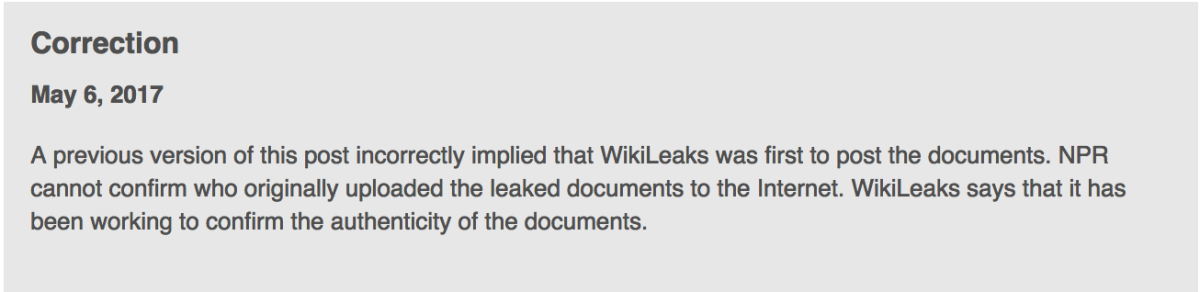
Loosely true, that lackadaisical retraction subtly intimates Wikileaks had been among the first to post the leaked cache or had been somehow otherwise responsible for damage wrought the Macron campaign. A true retraction, which NPR clearly owed Wikileaks for licentiously dragging its untarnished record through the mud, would have sounded more like,
“NPR previously stated in error Wikileaks was responsible for posting leaked documents online. We regret that mistake and apologize for any implication of complicity.”
READ MORE: Corporate Media Admits to Publishing Viral Fake News After Independent Media Busted Them
No dice. That half-hearted correction still stands today, as is.
What actually happened lacked the simplicity of a package adroitly and fastidiously wrapped — and that an anonymous 4chan user posted the voluminous leak to a popular board, sans fanfare, made the potentially earth-shaking cache a bit closer to an oddly shaped, Sunday comics-sporting holiday gift, care of that third cousin you know by name, but have never bothered meeting face to face.
NPR sought, with its underhanded but nakedly accusatory tweet, to, well, wrap up the case of an unknown leaker — perhaps hell bent on gifting far-right candidate, Marine Le Pen, the election — with a pretty bow.
But as truth is wont to be, The New Yorker divined the actual facts of the situation, and interviewed the man who, in haste, tweeted a link to the 4chan post without so much as verifying or examining the thousands of documents it contained.
Referencing Friday’s stunning sequence of events, the New Yorker reported its interview with independent journalist Jack Posobiec on Sunday, stating,
“Shortly before 3 p.m., an anonymous 4chan user posted nine gigabytes of information—purportedly hacked e-mails, photographs, and internal documents from the campaign of Emmanuel Macron. Posobiec could not know whether all the information was authentic—he didn’t even have time to glance through most of the thousands of pages—but he considered it his journalistic duty to let his followers know about the leak. ‘Massive doc dump at /pol/,’ he tweeted. He included a link to the 4chan post, along with a hashtag: #MacronLeaks.”
Within hours, Pobosiec’s tweet commanded the attention of much of France, and earned a fat banner on the wildly popular Drudge Report; though the indie journalist — ensconced in festivities at Cinco de Milo, an event held by fellow anti-globalist reporter, Milo Yiannopoulos — had been none the wiser of the attention until after midnight Friday.
Drab details of Pobosiec’s unintentional instant fame aside, the Canadian correspondent for Rebel clearly had no association with Wikileaks, much less the shadowy figure responsible for posting the leak to 4chan. Even less so, the contents of the future French president’s private emails and documents — almost instantaneously derided as at least partly fake by Macron’s campaign, mere hours before that nation’s mandatory press blackout two days prior to an election of any information with the potential to sway the vote.
So, why — amid an ongoing propaganda campaign attempting to discredit alternative and mainstream media, alike, via the label Fake News — would NPR stray so far from the path of integrity in journalism, it would need a saw-edged machete to find its way back to the light?
Worse, the putative news organization blithely refused to label its retraction deeming Wikileaks responsible as an actual retraction — opting instead to mollify its brazen error as a ‘clarification’ in a follow-up tweet, stating,
“Clarification: NPR cannot confirm who originally uploaded the leaked documents to the Internet.”
Clarification: NPR cannot confirm who originally uploaded the leaked documents to the Internet.
— NPR (@NPR) May 6, 2017
Twitter was not amused — nor had it been from the moment Wikileaks unfairly shouldered the blame — to an audience of some seven million followers of NPR.
“That was not a problem with clarity,” tweeted one disgruntled user. “That was straight up misinformation.”
@NPR @wikileaks That was not a problem with clarity. That was straight up misinformation.
— Grant (@GrantWPaul) May 7, 2017
Some softened their tone in deference to the public outlet’s previously nonpareil record, asking NPR,
“What is your basis for attribution to Wikileaks?”
@NPR What is your basis for attribution to Wikileaks?
— Ann Hunter (@AHHunter) May 6, 2017
One skeptically if rhetorically queried,
“You call yourselves journalists?”
@NPR You call yourselves journalists?
— Dasafrak (@Optimaximum) May 6, 2017
Others found it difficult to imagine NPR could stray quite so far from reality, shaming the public broadcaster, outright:
“Crickey NPR, I usually think the world of u. Do better research. #Macronleaks weren’t released by Wikileaks. This is embarassing 4 u.”
@NPR Crickey NPR, I usually think the world of u. Do better research. #Macronleaks weren"t released by Wikileaks. This is embarassing 4 u.
— Heavenly Antennas (@HeavenlyAntenna) May 6, 2017
Or,
“False. Retract and apologize to @wikileaks.”
@NPR False. Retract and apologize to @wikileaks
— Ex-Democrat (@jjmikemike) May 6, 2017
And, simply,
“You are #fakenews.”
— Junked (@junked_media) May 6, 2017
In fact, many skewered NPR for pushing the exact Fake News mainstream presstitutes of every stripe have been hollering about for months:
“#FAKENEWS NPR is CLUELESS. Wikileaks did not post the documents. Does everyone see the undeniable #Fakenews??? NPR=FakeNews.”
@NPR #FAKENEWS NPR is CLUELESS. Wikileaks did not post the documents. Does everyone see the undeniable #Fakenews??? NPR=FakeNews
— MYSTERIOUS NINJA (@MagicMetalNinja) May 6, 2017
Although a sizeable percentage of the American public has forsaken ailing mainstream media, like NPR, for alternatives in independent media, the peddling of blatantly fabricated information — whether calculated or hapless — set the stage for an all-out battle between journalism and government-approved propaganda.
That outlets like NPR, the Washington Post, and New York Times have faced intense scrutiny amid the Fake News wars for shameful attempts to manipulate public opinion in favor of the political establishment does not assuage those outlets’ foray into work ordinarily reserved for the U.S. Intelligence Community.
In fact, the nonchalance with which NPR tweeted a heinous lie evinces precisely why the public no longer puts any faith in reporting by once-illustrious outlets which now function more aptly as State mouthpieces.
Fortunately for Wikileaks and media organizations not beholden to a political or corporate agenda, that distrust has effectively rendered mainstream media moot.
This corpse of its former glory — cold, unfeeling, and lacking basic fact-checking skills — is every bit as useless at being a trusted mainstay of journalism it could once proudly claim.
Friday, April 28, 2017
US, UK Both Drop In Latest 'World Press Freedom Index' Rankings
Authored by Mike Krieger via Liberty Blitzkrieg blog,
Reporters without Borders just published its annual World Press Freedom Index rankings, and the results for both the U.S. and UK are not impressive. Both countries declined two spots from last year, with the UK at 41, and the greatest and most free nation on earth, America, down to 43.

Here’s The Guardian reporting on the UK’s decline:
Journalists in the UK are less free to hold power to account than those working in South Africa, Chile or Lithuania, according to an index of press freedom around the world.
Laws permitting generalised surveillance, as well as a proposal for a new espionage act that could criminalise journalists and whistleblowers as spies, were cited by Reporters Without Borders as it knocked the UK down two places from last year, to 40th out of 180 countries in its World Press Freedom Index.
In the past five years, the UK has slipped 12 places down the index. Rebecca Vincent, RSF’s UK bureau director, said this year’s ranking would have been worse were it not for a general decline in press freedom around the world, making journalists in Britain comparatively better off than those in countries such as Turkey and Syria.
RSF, which campaigns for free speech, warned of a general erosion of media freedom in English-speaking, democratic countries. The US, long considered a bastion of freedom of speech thanks to the first amendment of its constitution, also dropped two places, to 43rd. Canada fell four places, to 22nd, and New Zealand slipped eight places, to 13th.
Among the concerns raised by RSF was the passage of the UK’s “menacing” Investigatory Powers Act last November, which met only token resistance within parliament, despite giving UK intelligence agencies and police the most sweeping surveillance powers in the western world.
RSF said the act was a possible “death sentence” for investigative journalism in Britain, owing to its lack of protections for whistleblowers, journalists and their sources, and that it set a damaging precedent for other countries to follow.
Moving along, what about the shining city on a hill? Land of the free, home of the brave, the world’s indispensable nation!
Here’s what Reporters without Borders had to say about the U.S. as it dropped two spots to 43.
US press freedom, enshrined in the First Amendment to the 1787 constitution, has encountered several major obstacles over the past few years, most recently with the election of President Donald Trump. He has declared the press an “enemy of the American people” in a series of verbal attacks toward journalists, while attempting to block White House access to multiple media outlets in retaliation for critical reporting. Despite the bleak outlook under Trump, it bears repeating that his predecessor left behind a flimsy legacy for press freedom and access to information. Journalists continue to be arrested for covering various protests around the country, with several currently facing criminal charges. The Obama administration waged a war on whistleblowers who leaked information about its activities, leading to the prosecution of more leakers than any previous administration combined. To this day, American journalists are still not protected by a federal “shield law” guaranteeing their right to protect their sources and other confidential work-related information. And over the past few years, there has been an increase in prolonged searches of journalists and their devices at the US border, with some foreign journalists being prevented from any travel to the US after they covered sensitive topics such as Colombia’s FARC or Kurdistan.
If you think that’s bad, imagine where the U.S. will end up if the DOJ actually goes forward with charges against Julian Assange?
I discussed that troubling scenario in last week’s post, The American Empire Under Donald Trump Has Become Increasingly Desperate, Dangerous & Insecure.
Things are not headed in the right direction.
Tuesday, April 18, 2017
Leaked Docs Show Google Contractors Suppressed Alternative Media, Google Confirms

Leaked documents now reveal a plan by search engine behemoth Google to censor alternative media through the blatant suppression of search results — and, for all intents and purposes, the censoring appears part of the political establishment’s plan to quash dissent.
Documents obtained by InfoWars’ Mike Cernovich indeed show a Google contractor instructing staff to rate prominent but controversial website, InfoWars, as “low-to-medium” in reliability, with articles frequently having “been debunked.”
Although Cernovich and other InfoWars staff have indeed been known to occasionally embellish the facts, Business Insider reports,
“A Google representative appeared to confirm the validity of Cernovich’s report, linking Business Insider to his Medium post.
“A vendor hired by Google employs contractors to rate the websites that appear in its search results — the rating is used to improve search quality, helping Google’s automated search algorithm prioritize higher-rated, reliable information.
“In examining how the staffers working as website ‘raters’ should evaluate a ‘rather poor site,’ the contractor pointed to InfoWars, advising raters to consider the quality of the information and its reputation.”


While Google does employ contractors that way to improve an automated algorithm, the company noted to Business Insider it had not given instructions citing specific websites to use as examples in quality ratings; rather, it provides general guidelines for improving searches.
“In this instance, we have confirmed that a vendor we work with sent out more detailed instructions to some raters without our knowledge, which included references to specific sites,” a Google representative told Business Insider. “This is in conflict with the intent of our guidelines and the vendor has taken action to remove these references in their training module.”
InfoWars, which has been skewered for publishing articles both leaning alt-right and of the conspiracy variety, was understandably infuriated over the behind-the-scenes — if, perhaps, technically unintentional — method of censorship by suppression.
On Monday’s Alex Jones show, Cernovich enjoined followers to protest the startling censorship of InfoWars by protesting peacefully outside Google’s headquarters.
Just over one month ago, Google announced its answer to improving the quality of searches by battling faulty information and disreputable sites with a veritable army of contractors rating items to place trusted news sites at the top.
“We’re explicitly avoiding the term ‘fake news,’ because we think it is too vague,” said senior Google engineer, Paul Haahr, who works on search quality. “Demonstrably inaccurate information, however, we want to target.”
READ MORE: As US Bombs Syria, Americans Forgot Govt Used Chemical Weapons to Kill Children in Texas
However, like Facebook, or Twitter, or YouTube, what Google fails to mention about pushing ‘low quality’ sites to the bottom rung, is the punishing effect it takes on the flow of the free press — and the potential to snuff silent a growing body of independent media reporting largely unbiased, legitimate news items.
In fact, InfoWars might be the perfect example of why selective, subjective suppression allows the State and private companies to censor information painting the U.S. in an unfavorable light — or, worse, dissenting opinion, entirely.
This isn’t to say false reports, disinformation, and so-called ‘click bait’ contribute anything of value to the world of 24/7 news — indeed, Alex Jones’ InfoWars has a reputation for publishing items of highly questionable accuracy.
In one example, InfoWars responded to then-candidate Donald Trump’s call in 2015 for banning all Muslims from entering the United States, but failed miserably reporting the facts. As The Free Thought Project’s Matt Agorist reported,
“Jones’ assertion that upwards of 25% of Muslims have gone on record and said they want to ‘conduct violent attacks’ against the US and Europe is supported by zero evidence. In fact, Infowars published an article Wednesday, linking to the actual data which proves them wrong.
“In a blatant attempt to strike fear into the hearts of their xenophobic reader base, (who used to be antiwar and pro freedom of religion) Jones shills once again for Trump by pointing out that 21% of Syrians polled have favorable views ISIS. What Infowars conveniently left out, however, is the fact that the country with the highest levels of support for Isis outside Syria showed only 14 percent of people having a favorable view of the group.
“None of the data showed that any of these supposed ISIS supporters ‘want to conduct violent attacks in Europe and the United States.’ Nevertheless, Jones, Trump, and the rest of the fascist Muslim-fearing cowards have been pushing this narrative and stoking dangerous levels of hate, because they are buying into the ISIS propaganda.”
InfoWars certainly lurched hard right in time for Trump’s presidential campaign — and has published false reports like the aforementioned — but the website has not completely forsaken truth for entertainment.
After all, it was the InfoWars writer, Cernovich, whose reporting hit headlines around the world recently, Business Insider notes,
“Cernovich reported on Medium that former national-security adviser Susan Rice requested the names of Trump associates whose communications were incidentally collected, a report later verified by Bloomberg View columnist Eli Lake.”
Although propagating demonstrably false information should undoubtedly give pause about the quality of a website calling itself a reporter of real news, every news organization in existence has likely published and retracted articles later proven to be inaccurate — and those who don’t face loss in readership and revenue.
Notably, a number of weaponized fake reports most often aligning with the U.S. Government’s agendas — published by the Washington Post, New York Times, and many others — have not garnered those once-illustrious news hawks the same suppression as InfoWars and other outlets not in lock step with the mainstream narrative.
Google claims the quality search training document listing InfoWars as unreliable was a mistake — yet the ridiculously thin effort to slay dissent under the cover of combating so-called fake news has thus far focused on independent media, which, for example, might criticize the need for war.
No matter from which sources you prefer to glean the news, that preference must remain your option if there is to be any legitimate semblance of freedom in this nation — after all, it is the free press who are supposed to serve as government watchdogs to rein in any uncontrolled usurpation of power.
Tuesday, March 7, 2017
WikiLeaks: CIA Can Hack Cars to Carry Out “Undetectable Assassinations” – Just Like Michael Hastings
Award-winning journalist Michael Hastings garnered international acclaim for coverage of the Iraq War and had established a comfortable career with BuzzFeed, GQ, and Rolling Stone when his life abruptly ended in a fiery one-car crash under such suspicious circumstances, a prominent national security official claimed it was “consistent with a car cyber attack.”
“There is reason to believe that intelligence agencies for major powers,” including the United States, have developed the technology to remotely seize control of a vehicle, former U.S. National Coordinator for Security, Infrastructure Protection, and Counter-terrorism Richard A. Clarke told Huffington Post shortly after Hastings’ death in June 2013.
“What has been revealed as a result of some research at universities is that it’s relatively easy to hack your way into the control system of a car, and to do such things as cause acceleration when the driver doesn’t want acceleration, to throw on the brakes when the driver doesn’t want the brakes on, to launch an air bag,” Clarke continued.
“You can do some really highly destructive things now, through hacking a car, and it’s not that hard.”
Now — with Wikileaks’ release of the voluminous cache of Central Intelligence Agency documents known as Vault 7 — it seems Clarke has been proven correct.
“As of October 2014 the CIA was also looking at infecting the vehicle control systems used by modern cars and trucks,” Wikileaks writes. “The purpose of such control is not specified, but it would permit the CIA to engage in nearly undetectable assassinations.”
A number of inconsistencies and questions still surround the journalist’s sudden demise, despite the official ruling of accidental — but, perhaps, the CIA revelations offer the most feasible explanation.
I knew something was off in Hastings death and I was ridiculed and even mutual friends of Michaels and I turned on me and said let it go
— Joe Biggs (@Rambobiggs) March 7, 2017
People said I was crazy when my friend Michael Hastings died out of no where. His car apparently hitting a tree and throwing the engine out
— Joe Biggs (@Rambobiggs) March 7, 2017
I said I believed his car could have been hacked and Megyn Kelly called me a tin foil hit loon. Thus sending me down the rabbit hole 4 truth
— Joe Biggs (@Rambobiggs) March 7, 2017
Neighbor and eyewitness to the peculiar crash, Jordanna Thigpen, told LA Weekly Hastings had been acting erratically — convinced helicopters frequently nearby were spying on him — and told her his Mercedes had been meddled with in the days just prior to his death.
“He was scared,” Thigpen told the publication, “and he wanted to leave town.”
Friends of Hastings concurred with the assessment he’d appeared increasingly agitated and tense just before the putative accident, and worried the government had been spying on him.
In the predawn hours on June 18, 2013, Hastings’ Mercedes was captured on CCTV and witnessed by a few people flying at top speed through the Hancock Park area of Los Angeles, leaving a trail of sparks and flames before slamming directly into a palm tree and exploding into flames.
Burned beyond recognition, the medical examiner identified the 33-year-old journalist through a fingerprint match in the FBI database.
Although trace recreational substances were detected in Hastings’ system, the coroner found that could not have impaired the driver or caused the accident.

One security video purportedly showed a large flash of bright light occur prior to impact — an account backed by a witness who told San Diego News 6 an explosion came before the car hit the tree — leading some to believe the car had been purposefully blown up.
“An explosion before impact, which would slow down the vehicle, would explain the minimal damage observed on the palm tree,” Jerome Corsi wrote for WND. “Other physical evidence at the crash site also is not consistent with a high-speed, out-of-control impact.”
To understand why the CIA would have interest in the targeted assassination of a journalist, it’s necessary to understand the impact an uncensored, transparent press can have on those in power.
Hastings rose to prominence with reporting on the Iraq War for Newsweek, but it was an exposé for Rolling Stone in 2010, “The Runaway General,” on General Stanley McChrystal, commander of NATO’s International Assistance Security Force in the Afghanistan War that earned the George Polk Award — and ultimately cost the general his career.
Beyond McChrystal and the military, Hastings had grown sharply critical of the Obama administration and the Democrat Party, and developed a decided consternation for and preoccupation with the U.S. government’s surveillance of journalists.
In fact, Hastings’ last article for BuzzFeed bore the title, “Why Democrats Love To Spy On Americans.” He summarized, “Besides Senators Ron Wyden and Mark Udall, most Democrats abandoned their civil liberty positions during the age of Obama. With a new leak investigation looming, the Democrat leadership are now being forced to confront all the secrets they’ve tried to hide.”
Whether a covert government operation to seize control of Hastings’ vehicle actually took place will almost certainly never be known, but that the CIA discussed improvements to the same technology in 2014 indicates it would have been available.
Hastings tried to warn the nation about infringements against the free press by the insidious network of agencies ostensively tasked with maintaining national security — but did he pay the ultimate cost?
“So if there were a cyber attack on the car — and I’m not saying there was,” Clarke, the security official, told HuffPost, “I think whoever did it would probably get away with it.”
Tuesday, February 7, 2017
Investigative Journalist Poisoned to Death While Covering Corrupt Oil Companies
Yemen — A top Yemeni investigative journalist who died under dubious circumstances — while investigating corruption by oil companies — was poisoned, an autopsy now reveals.
Mohammed al-Absi — “whose work explored the corrupt relations between powerful militias and prominent businessmen,” reports the New Arab — was having dinner in capital city, Sana’a, with a cousin in December when both had to be rushed to the hospital — and the prominent journalist ultimately died.
Post-mortem test results reveal that Mohammed Alabsi was poisoned
His final days was investigating Houthis & Saleh oil companies pic.twitter.com/HCE457LjWt— Baraa Shiban (@BShtwtr) February 5, 2017
Al-Absi’s sudden and inexplicable death fueled suspicions among friends and family, as well as from the Yemeni journalists’ union — which called for an investigation.
Some speculated al-Absi had suffered a heart attack or other acute condition, but — delaying a proper funeral for three weeks — samples were flown to Jordan for analysis and proved this week the journalist had been poisoned.
Both the Yemeni Journalists’ Syndicate and the International Federation of Journalists — which have joined forces to demand an official probe — issued a statement of mourning shortly after al-Absi’s untimely death, with IFJ President Philippe Leruth stating,
“We are troubled by the passing of Mohamed al-Absi in such unclear circumstances and support his family and the YJS in their demands for a serious and independent investigation in the case as well as an autopsy by a doctor representing the union to clarify the cause of his death.”
OilPrice.com reports, “Al-Absi was a prominent Yemeni investigative journalist said to have been investigating oil companies owned by Houthi leadership. He had published a series of reports over the past years, focused on corruption, particularly in the energy industry and in relation to arms deals.
“Human rights activists are responsible for the claims that Al-Absi was investigating oil and gas companies allegedly operating on the black market. Activists published several documents that were in the journalist’s possession after his death.”
According to the outlet, one of the documents published post mortem concerns Houthi spokesman Mohammed Abdul Salam, who allegedly owns an oil company primarily working the black market to sell in Houthi rebel-controlled areas of Yemen, while the New Arab says another surrounds Dagsan Mohammed Dagsan, an arms dealer.
Journalists have always faced stated and unstated threats of physical harm when investigating behind-the-curtain business dealings and political corruption — and the mysterious demise of al-Absi appears to be no exception.
“In a joint statement, advocates called upon the state prosecution to start a ‘transparent investigation’ saying that al-Absi played an ‘exceptional role against corruption,’” the New Arab reports.
A separate statement from the groups investigating the death — including his family, two local nongovernmental organizations (NGOs), the YJS, and Sana’a Center for Studies — emphasized they had “not received financial support from any party or political entity” to conduct the probe.
News al-Absi had been fatally poisoned comes amid incendiary tensions of the proxy war between Iran and Saudi Arabia over Yemen — and further bellicose posturing by the United States over the supposed threat of terrorism from Tehran.
Journalists reporting from conflict zones in the Middle East have been persecuted and even killed for their efforts — besides al-Absi, American journalist Serena Shim died in Turkey in 2014, under wholly suspicious conditions while investigating connections between various politicians and the Islamic State.

Although crucial details about the poisoning of al-Absi remain unknown, the fact he was covering corruption and the dealings of oil companies certainly lends potential motivation for murder.
Wednesday, January 25, 2017
Freedom of Press? 6 Journalists Face 10 Years in Prison for Reporting on DC Unrest
Washington, D.C. — Protests and riots over the weekend in response to the inauguration of Donald Trump led to the arrest of more than 200 people — including at least six journalists — who now face the possibility of ten years in prison and fines of up to $25,000.
Random people present at 12th and L Streets were kettled by police after roving bands of rioters smashed store windows, vandalized cars, and set vehicles and trash cans alight on Friday morning.

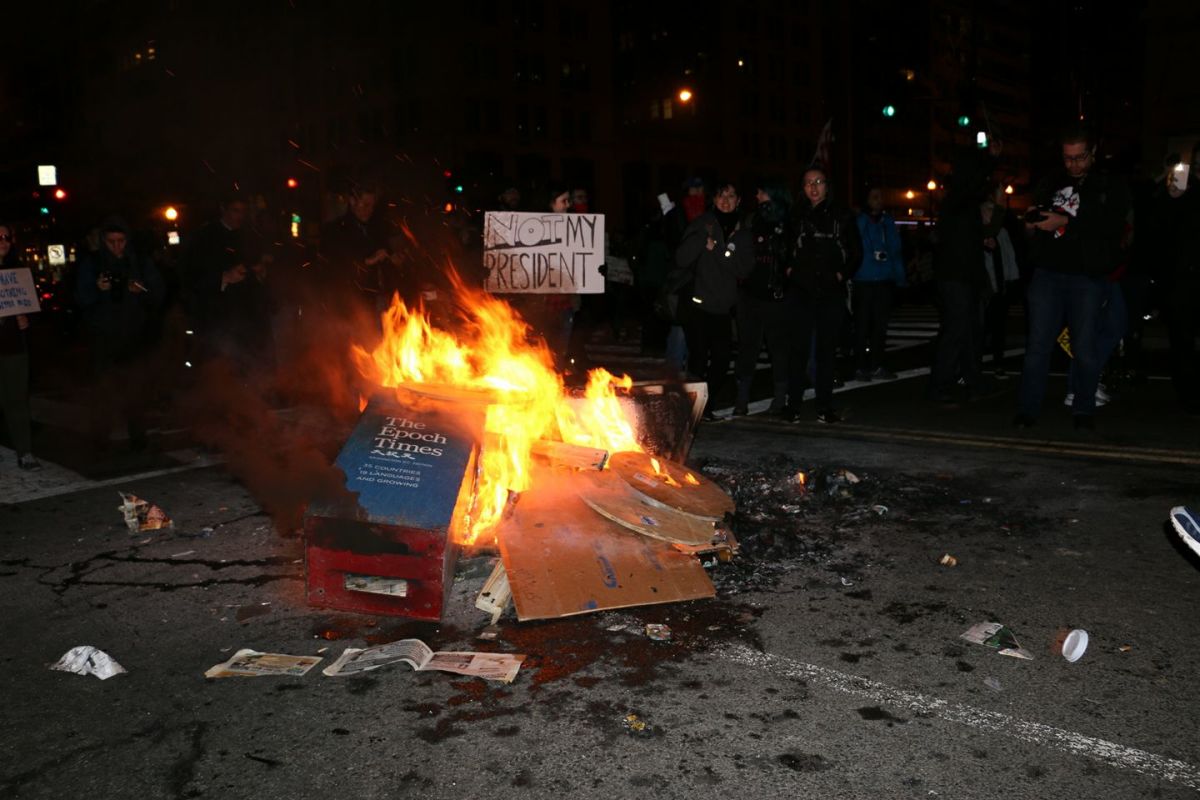
But, instead of arresting those actually responsible for the rampant destruction, police violently swarmed the trapped group — detaining legal observers and media workers along with protesters and agitators — arresting 230 and charging all who happened to be present with felony rioting.
“These charges are clearly inappropriate, and we are concerned that they could send a chilling message to journalists covering future protests,” asserted Carlos Lauría, senior Americas program coordinator for the Committee to Protect Journalists. “We call on authorities in Washington to drop these charges immediately.”
On Monday, the Guardian reported on the arrests of journalists Evan Engel of Vocativ and Alexander Rubinstein of RT America, but by Tuesday, the outlet learned four additional journalists face the same charges for reporting on the incident.
Shay Horse, an independent photojournalist and activist; Aaron Cantú, a freelance journalist whom CPJ says has written for The Baffler, Truthout, and Al-Jazeera; Matt Hopard, independent journalist and livestreamer; and Jack Keller, a producer for the web documentary series Story of America, are looking at possible lengthy stays behind bars — simply for exercising constitutionally protected rights of a free press.
They deny any wrongdoing.
Police held Keller for more than 36 hours despite telling them he’d been covering and documenting the event as media.
“The way we were treated was an absolute travesty,” he told the Guardian, adding his cellphone has not been returned.
“It is a maddening and frustrating situation,” Keller’s editor, Annabel Park, lamented. “These are people who were there observing and documenting.”
In a statement emailed to CPJ, Vocativ spokeswoman Ellen Davis said, “The arrest, detainment and rioting charge against journalist Evan Engel who was covering the protests for Vocativ are an affront to the First Amendment and journalistic freedom. Vocativ will vigorously contest this unfounded and outrageous charge.”
Davis noted police seized Engel’s phone and camera and have yet to return them, though the department refused to comment on any evidence it may or may not have regarding pending cases.
Corporate media reporters apparently, if unsurprisingly, fared far better than their independent colleagues, as U.S. News reports,
“Some journalists, including three from a local NBC station and one from U.S. News, were allowed ultimately to leave the corralled group. The NBC journalists were told their names had been provided to a lieutenant’s superior after their boss called.”
READ MORE: VIDEO: Activist Threatened with Arrest, Forced to Leave Public Space for Informing Jurors of Their Rights
According to a report by CPJ, “The criminal complaints say that the reporters are charged under section 1322(b) of the D.C. criminal code, which establishes penalties of up to 180 days in prison and a fine of up to $1000. The language in the complaint, however, references rioting that results in bodily harm or more than $5,000 in damage, which can be punished by a maximum of 10 years in jail and fines of up to $25,000. Police spokeswoman Rachel Reid told CPJ in an email she was unable to comment because a lawsuit had been filed in the case.”
Court documents cited by FOX News allegedly tallied over $100,000 in total property damage.
Charging six journalists and at least one attorney acting as a legal observer under this section of the code — as among “every person who willfully incited or urged others to engage in the riot” — is an absurd overreach not unnoticed by the legal and media communities.
“What they [the police] can’t do is round up everybody who was there and indiscriminately arrest everybody who happened to be on the block,” asserted Jeffrey Light, a District of Columbia attorney who filed a class-action lawsuit against both aforementioned police departments on behalf of Colorado legal observer and attorney, Benjamin Caraway, over the mass arrest.
Caraway — who had been wearing a green hat to clearly identify himself as a legal observer before he was arrested — is currently the only named party to the class-action suit.
Light said the arrests, themselves, weren’t the only concern about how police handled the situation — officers indiscriminately used batons, ‘sting balls,’ and pepper spray to affect the arrests and throughout the inauguration weekend protests.
D.C. and Park Police frequently sprayed crowds with OC spray — directly hitting journalists, nonviolent protesters, and bystanders, alike — and even shoved media workers to the ground, damaging expensive equipment and interfering with the right to document events as they unfolded.
As the Guardian reports, the National Lawyer’s Guild accuses D.C. metropolitan police of having “indiscriminately targeted people for arrest en masse based on location alone.”
Attorney Mark Goldstone, representing around 50 of those charged with felony rioting, told FOX News police “basically identified a location that had problems and arrested everyone in that location,” and that,
“They arrested everyone in a single location including reporters, lawyers, law students and non-riotous protesters.”
READ MORE: Judge Sics Cops on Journalist for Requesting Public Court Docs -- Has Him Arrested, Charged
In fact, journalists did show credentials to officers to explain their presence among those kettled to no avail.
“I was hit in the face with a flash grenade,” Rubinstein told RT of the January 20th incident, “it blinded me for a moment and my ears were ringing for a while…By the time I was done being treated and I could see again, we were encircled by police and I was told that everybody present would be arrested. It doesn’t matter that I’m press.”
Maggie Ellinger-Locke, of the D.C. branch of the National Lawyer’s Guild, explained in a statement the random use of tear gas, mass arrests, and other police actions over the weekend were illegal — but beyond that, have far worse repercussions:
“These illegal acts are clearly designed to chill the speech of protesters engaging in First Amendment activity.”
A police report cited by the Guardian states,
“The crowd was observed enticing a riot by organizing, promoting, encouraging and participating in acts of violence in furtherance of the riot.”
Of course, journalists and legal observers, as well as nonviolent protesters, could not possibly be considered participants or agitators destructive riots — and a crowd this disparate would never act as a single unit.

In fact, the Orwellian mass arrest sans just cause tells of a potential cooling or self-censoring effect on free and independent media — a cynic might say by design.
Keller, the documentarian charged with felony rioting and facing ten years in prison, could have been speaking for the legal observer and five other journalists when he plainly stated,
“I had absolutely nothing to do with the vandalism.”
Tuesday, January 17, 2017
BREAKING: Whistleblower Chelsea Manning to Be Freed from Prison

January 17, 2017 | admintam
President Barack Obama has commuted noted whistleblower Chelsea Manning’s prison sentence, and Manning will be released on May 17 of this year.
While Manning was reportedly on Obama’s short list for commutations, many were shocked that the president—notorious for dealing harshly with whistleblowers—followed through.
Human rights advocates, government watchdogs, and LGBTQ defenders have long been pushing Obama to commute Manning’s 35-year sentence, particularly as Manning, who is transgender and is being denied appropriate healthcare in military prison, has attempted suicide twice in the past six months.
“I’m relieved and thankful that the president is doing the right thing and commuting Chelsea Manning’s sentence,” said Chase Strangio, a staff attorney with the American Civil Liberties Union’s LGBT Project representing Manning, in a statement.
“Since she was first taken into custody, Chelsea has been subjected to long stretches of solitary confinement—including for attempting suicide—and has been denied access to medically necessary health care,” Strangio added. “This move could quite literally save Chelsea’s life, and we are all better off knowing that Chelsea Manning will walk out of prison a free woman, dedicated to making the world a better place and fighting for justice for so many.”
Progressive commentators, journalists, rights advocates, and others celebrated the news on Twitter:
Chelsea Manning is probably the most empathetic person I’ve ever met. So thrilled!! Can’t wait to see what she does. My clemency letter: pic.twitter.com/j9CQhRmxhm
— Glenn Greenwald (@ggreenwald) January 17, 2017
This article (BREAKING: Whistleblower Chelsea Manning to Be Freed from Prison) by Nadia Prupis, originally appeared on CommonDreams.org and is licensed Creative Commons 3.0. The Anti-Media radio show airs Monday through Friday @ 11pm Eastern/8pm Pacific. Help us fix our typos: edits@theantimedia.org
Subscribe to:
Posts (Atom)