Showing posts with label price. Show all posts

Monday, October 16, 2017

Fiancee Of 'Suspended' Amazon Studios Head Calls Off Wedding

Former Amazon Studios head Roy Price’s terrible, awful no-good week just got even worse...


Earlier in the week, Price was unceremoniously suspended by Amazon this past week for reportedly sexually harassing female colleagues.


Price allegedly lewdly propositioned Isa Hackett, a producer on "The Man in the High Castle," back in 2015, promising during a late-night cab ride that she’d “love his dick.” On the evening of July 10, 2015, after a long day of promoting Man in the High Castle at Comic-Con in San Diego, Hackett attended a dinner with the show"s cast and Amazon staff at the US Grant Hotel. At the dinner, Price asked Hackett to attend an Amazon staff party later that night at the former W Hotel. She ended up in a taxi with Price and Michael Paull, then another top Amazon executive and now CEO of the digital media company BAMTech.


During the ride, Price repeatedly propositioned her, Hackett said. Though she immediately reported the incident to Amazon, little was done until this week when Price, the executive in charge of Amazon studios, was suspended “indefinitely”.


Hackett is the daughter of the late Philip K. Dick, who wrote the acclaimed novel on which “The Man in the High Castle” is based.


Amazon said in a statement this past week,


“Roy Price is on leave of absence effective immediately. We are reviewing our options for the projects we have with The Weinstein Company.”


And now, Price’s fiancée, writer Lila Feinberg, has called off their wedding, which was set to take place in four weeks.


A source close to the couple confirmed the news of the cancellation to Page Six:


“Lila is currently in New York and she has called off the wedding.”


Feinberg was due to wear a Marchesa dress at the nuptials that had been custom-designed by Harvey Weinstein’s wife, Georgina Chapman, who this week announced she was leaving the movie mogul after more than 30 women came forward to accuse Weinstein of harassment, groping and – in more than a handful of instances – rape.


Price was said to be close friends with Weinstein.


Feinberg was awarded Araca Group’s National Graduate Playwriting Award for her play “Vertebrae,” and is also the creator and executive producer of “12 Parties,” an original series that was acquired by The Weinstein Company.


She has also sold projects to Legendary Television and MTV.

Monday, July 31, 2017

Bitcoin, Gold and Silver Report 30 July 2017

That’s it. It’s the final straw. One of the alternative investing newsletters had a headline that screamed, “Bitcoin Is About to Soar, But You Must Act by August 1 to Get In”. It was missing only the call to action “call 1-800-BIT-COIN now! That number again is 800 B.I.T..C.O.I.N.”


Is it about to go up? Maybe. We don’t know. And everyone should by now be skeptical of all “rocket to take off on XYZ date” claims. Between them, surely these newsletters have predicted thousands of the past zero blastoffs of gold and silver since 2011.


We have discussed bitcoin in the past, to argue that it is not money (a video here, and articles here and here). Bitcoin is not money because it is not a good. It’s just a number in a database. Money is a kind of good (genus). The most marketable kind (differentia).


Money must be a good because we are physical beings in a physical world and final payment—which is not demanded all the time, or even often—must be a physical thing that you can hold and touch in your physical hands. Bitcoin is not a physical good, so it represents, not final payment, but intermediate payment. It is not final until you trade the bitcoin for a real good. In the language of economics, a real good has utility apart from one’s hope to exchange it for something else. Bitcoin has no utility apart from this hope of its value in exchange, its price.


There is not one price but always two prices: bid and offer. When one has a thing and relies on someone else to buy it (or accept it in exchange), it is the bid price which is relevant. The offer price may be close above the bid, or it may be much higher. Typically sellers are reluctant to sell below their cost, but that has nothing to do with buyers. Buyers make a bid based on how they value it (or not).


This fact right here is sufficient to debunk the labor theory of value. Suppose producing a painting takes you 50 hours of labor plus $100 in materials. That does not matter. If your name is Banksy, people might be happy to pay tens of thousands of dollars for the painting. If your name is Keith Weiner, not so much (Keith is not known for having any skill at painting, though he can take some mean photographs).


For all commodities, for all real goods, for all tangible products, there is always a bid. Even a junk car is worth something to the scrap dealer. Even sand is worth something to the landscape contractor.


If a commodity is useful for something, it will have a robust bid. The price may be low or high, but the bid will be set by those who have a productive purpose in mind. If you can buy something, add a little bit of value from labor (e.g. cleaning it up) and sell it for $1,000 then you are willing to pay up to, say, $900.


Take copper. Copper can be used for wiring and plumbing (and many other things). If you manufacture plumbing, and you know that with a dollar worth of labor you can turn copper into a pipe that sells for $3.75, what are you willing to pay for the copper? Perhaps you would go up to $2.50 (it’s now about $2.85). If the price of copper drops, this new buyer will come into the market (for now, plumbing is made of plastic).


In this light, we now get to the 64 billion dollar question. What is the bid on bitcoin? What is it useful for, and who would buy it for that purpose?


Right now, bitcoin is a lot of fun. Its price is being driven up by frenzied speculators. With each new price level, proponents become bolder and more aggressive. Bitcoin will replace the dollar, bitcoin will go up to $1,000,000, the dollar is failing, get yours before August 1, etc. Many of these arguments were popular when the price of gold was rising relentlessly up through 2011.


But what’s the ultimate bid? Where is the floor, where it cannot go below because it’s just too profitable to buy it, transform it into a higher-value good to sell at a profit? Where is the floor where individuals will buy more and more because they want bitcoin in their living room, or in the tank of the car, or in their refrigerator, or in their basement?


It doesn’t exist, does it?


This is not a prediction for tomorrow morning. Indeed timing these things is impossible. However, there will come a point when the speculators turn. Perhaps their collective thumbs will move the planchette on the price-chart Ouija board to paint an ugly chart pattern (much uglier than head-and-shoulders). Whatever its initial cause, what will happen is clear in light of the above discussion.


The price of bitcoin could drop to any level. Incidentally, bitcoin could be used in exchange as it is now, whether its price is $0.01 or $1,000,000.


People often say that bitcoin is like gold, or even say it is “digital gold”. They are just trying to cash in on gold’s good name. The problem of the bid is another key difference between bitcoin and gold. Gold is an extremely useful commodity. Bitcoin is not any kind of commodity at all. It does not have a real bid at all, only the ever-changing bid of the fickle speculator.


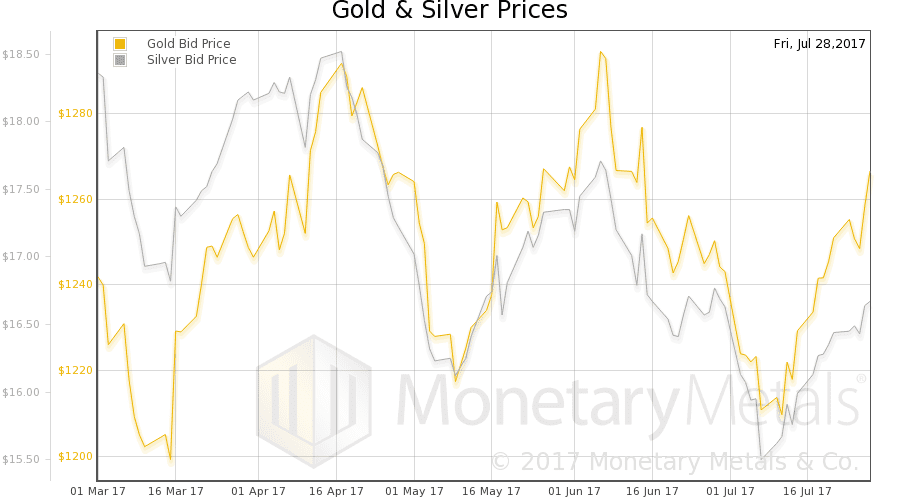
The prices of the metals rose some more this week, with gold +$13 and silver +$0.24. However, that leads to the question: is it speculators getting ahead of the fundamentals, or is it real?


Three weeks ago, with the price of gold $56 lower and the price of silver $1.15 lower than today, we asked if that was capitulation. We cited some circumstantial evidence (plus a rising scarcity of both metals as measured by the cobasis). We did not call for a moonshot, but a “normal trading bounce within the range.”


Today it is time to ask if the bounce is down, and if now is the time for a normal correction. And if it’s the same answer for both metals.


We will show graphs of the true measure of the fundamentals. But first charts of their prices and the gold-silver ratio.


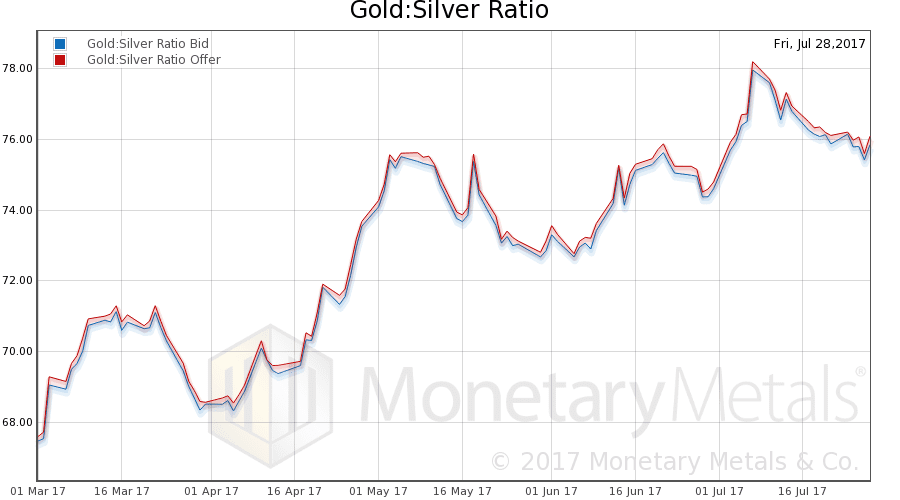
Next, this is a graph of the gold price measured in silver, otherwise known as the gold to silver ratio. The ratio moved down slightly this week. We find it interesting that the ratio did not fall farther.


In this graph, we show both bid and offer prices for the gold-silver ratio. If you were to sell gold on the bid and buy silver at the ask, that is the lower bid price. Conversely, if you sold silver on the bid and bought gold at the offer, that is the higher offer price.


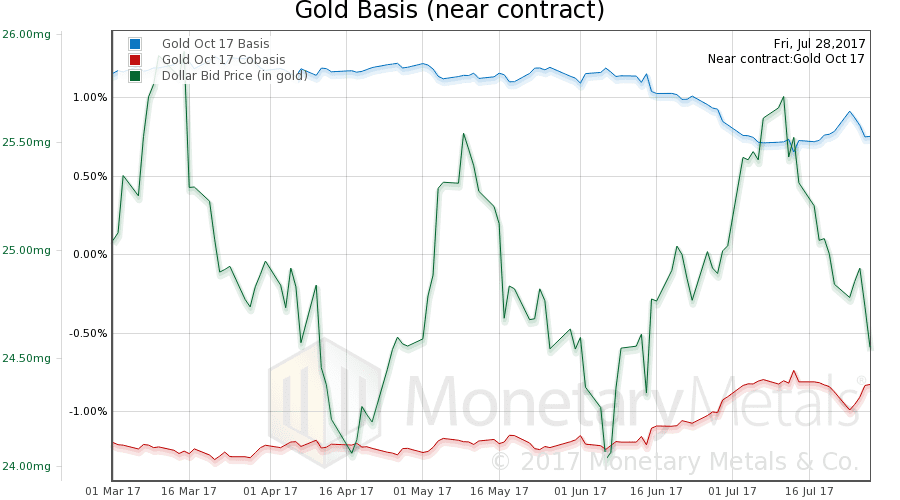
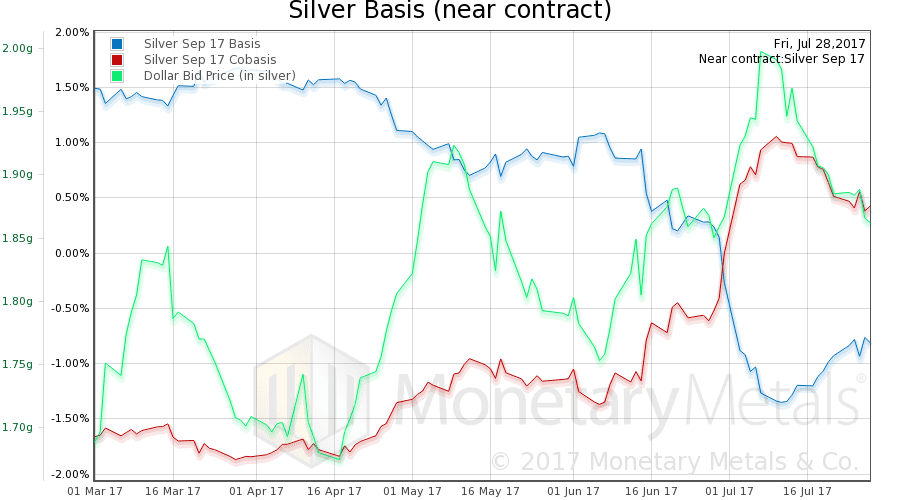
For each metal, we will look at a graph of the basis and cobasis overlaid with the price of the dollar in terms of the respective metal. It will make it easier to provide brief commentary. The dollar will be represented in green, the basis in blue and cobasis in red.


Here is the gold graph.


The dollar fell again this week (the mirror image of the rising price of gold). As the dollar fell, the cobasis increased—gold became more scarce.


Rising price + rising scarcity = rising fundamental price (fundamental price chart here).


Now let’s look at silver.


In silver, unlike in gold, as the dollar has dropped (i.e. the price of silver measured in dollars has risen), the metal has become more abundant.


Our calculated silver fundamental fell about 50 cents this week, or about 75 cents in the past few weeks. So while the price of gold may continue to rise to perhaps over $1,300 the price of silver could be a bit weaker. We calculate a fundamental gold-silver ratio of about 79 (chart here).


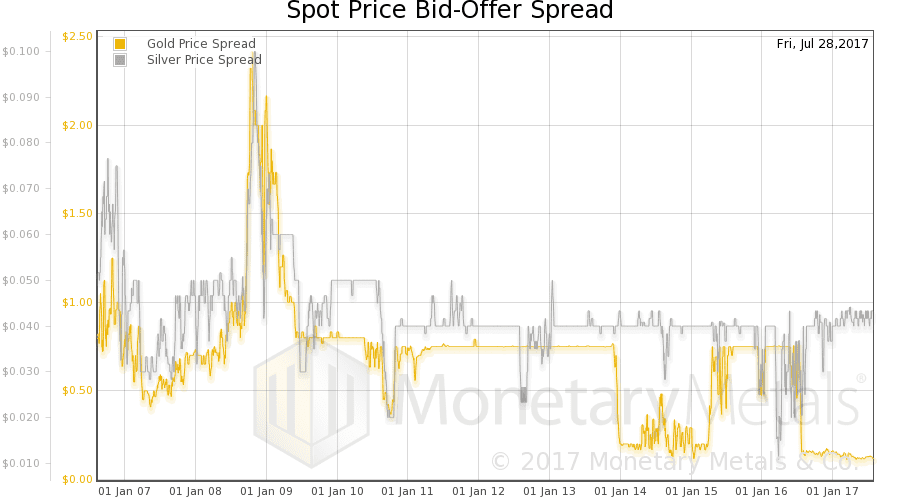
Coming back to the bid-ask spread, we thought we would publish another chart off our website. This one shows the bid-ask spread of spot gold and spot silver.


There are two salient features. First, note that the spread is really tight in both metals (though while the spread in gold dropped in mid-2016, in silver it increased). It is currently around 12 cents in gold. An ounce of gold is over $1,200 and the difference between bid and ask is $0.12 or 0.01 percent! In silver, it is around 4.2 cents, or 0.25 percent. Gold is more liquid, much more liquid.


Second, when the financial system buckled and nearly collapsed in 2008, the spreads widened to $2.40 and $0.10 in gold and silver, or 0.33 percent and 1.05% respectively. Compared to real estate in a normal market, both metals are extremely tight. Compared to illiquid assets during the peak of the crisis, it’s incredible. We recall a story of a guy who bought a famous painting by old master during the top in 2007. He paid, as we now recall, around $13 million. During the crisis, he was forced to sell it. He got $100,000. We assume the offer price on such a painting would still be $10 million or more. But $100,000 was the bid.


© 2017 Monetary Metals

Sunday, April 30, 2017

"It's Just Crazy" (Again): 2-Bedroom LA House Sells 40% Above Asking

Two days ago we looked at the latest troubling development in US home price trends: a new bubble appears to be emerging in all the "usual suspect" places. As we noted on Thursday, "home prices in markets that bubbled over back in 2006/2007, like Las Vegas and San Francisco, got cut in half in 2009 but have since doubled again of their lows.  Meanwhile, markets like Denver and Dallas that didn"t participate as much in the 2007 mania are now surging to all-time highs, with Dallas prices up 55% over the past 5 years."


The Wall Street Journal added that some of the home buying behaviors of consumers, like paying prices well above appraisal values and waiving home inspections, are starting to be eerily reminiscent of 2006:


In some markets, bidding wars are breaking out. Agents said some buyers are kicking in extra cash when properties don’t appraise for the asking price, and some are waiving their right to home inspections.


It can’t be sustained,” said David Berson, chief economist at Nationwide Insurance and a former chief economist at mortgage giant Fannie Mae, referring to the frenzied buying. “It can’t go on forever.”


Other signs of overexuberance have emerged, including surging levels of licensed Realtors all chasing a quick buck.


The number of licensed Realtors has jumped by nearly 25% since 2012, hitting a nine-year high in 2016 and sitting just 9% below the peak in 2006, according to real-estate consultant John Burns. In Denver, homes are selling briskly. The median number of days that homes spent on the market declined to eight in the first three months of the year from 61 in 2012, according to Redfin. Home prices rose 8.5% in Denver over the year ended in February, according to Case-Shiller.


Nicki Thompson, an agent in Denver, said she recently had a listing that was on the market for two weekends at $1.2 million and she received multiple all-cash offers above the listing price. 


“It’s just crazy,” she said.


And for a practical example of just how crazy it truly is, take this renovated 2-bedroom, 1,948 sq. ft house first built in 1951 in the Eagle Rock section of Los Angeles, which was listed in mid-March for $699,000, was estimated by Redfin at $780,000, and sold yesterday for $980,888 (more than $500/sq foot) and 40% above asking, just over a month after it was first listed.


Maybe it was the house"s profile "description" that unleashed the buying frenzy:


In the 1960s-80s drums played on some of the most famous pop songs known (Good Vibrations, Mrs. Robinson, A Little Less Conversation, to name a few) were built in this garage in our beloved Eagle Rock. A. F. Blaemire and his wife, Kirsten, filled this home with music and creativity for decades, and now it"s ready for its next inspired owner! With freshly refinished hardwood floors and repainted interior, 5208 Monte Bonito is a blank canvas with great potential. The rooms are bright and spacious, including a downstairs recreation room perfect for a jam room, art studio, den (or all of the above!). The two-car garage has direct access to the house and an additional storage room. The back yard has plenty of space for entertaining and gardening - there is already an avocado tree, an orange tree, and a pitaya to get you started! Views of the Eagle Rock from the master bedroom, and sunset views from the front porch make this the ideal setting to call home.


Then again, maybe not.


So what do you get for just under a million in LA these days? Not much: two bedrooms, less than two bathrooms, a 2 car garage, a decorative fireplace, a rec room, and a 7,195 sq foot lot.


Here are some photos showing what a "million dollar house" looks like in the latest US housing bubble.


Monday, February 13, 2017

Silver Futures Market Assistance, Report 12 Feb, 2017

This week, the prices of the metals moved up on Monday. Then the gold price went sideways for the rest of the week, but the silver price jumped on Friday. Is this the rocket ship to $50? Will Trump’s stimulus plan push up the price of silver? Or just push silver speculators to push up the price, at their own expense, again?


This will again be a brief Report this week, as we are busy working on something new and big. And Keith is on the road, in New York and Miami.


Below, we will show the only true picture of the gold and silver supply and demand fundamentals. But first, the price and ratio charts.


The Prices of Gold and Silver


Next, this is a graph of the gold price measured in silver, otherwise known as the gold to silver ratio. It fell this week.


The Ratio of the Gold Price to the Silver Price


For each metal, we will look at a graph of the basis and cobasis overlaid with the price of the dollar in terms of the respective metal. It will make it easier to provide brief commentary. The dollar will be represented in green, the basis in blue and cobasis in red.


Here is the gold graph.


The Gold Basis and Cobasis and the Dollar Price


Again, we see a higher price of gold (shown here in its true form, a lower price of the dollar) along with greater scarcity (i.e. cobasis, the red line).


This pattern continues. What does it mean?


First, it means the price of gold is being pushed up by buyers of physical metal. Not by buyers of futures (which would push up the basis, and reduce scarcity).


Second, if it continues too much more, it means nothing good for the banking system. There is one force that can make all the gold in the world—which mankind has been accumulating for thousands of years—disappear faster than you can say “bank bail in”. The force is fear of counterparties, fear of banks, fear of currencies, fear of central bank balance sheets… fear of government finances.


We want to emphasize that the gold basis is not signaling disaster at the moment. It is merely moving in that direction, for the first time in a long time. It has a ways to go yet.


Our calculated fundamental price is up another $40 (on top of last week’s +$40). It is now about $130 over the market price.


Now let’s look at silver.


The Silver Basis and Cobasis and the Dollar Price


Note: we switched to the May contract, as March was becoming unusable in its approach to expiry.


In silver, the story is a bit less compelling. The scarcity of the metal is holding, as the price rises. However, scarcity is not increasing.


Were we to take a guess, we would say there is some good demand for physical, and the price action had futures market assistance.


While the market price moved up 44 cents, our calculated fundamental price moved up … 46 cents.


© 2016 Monetary Metals

Sunday, December 25, 2016

The Real Cost Of Christmas Has Never Been Higher

Christmas is a time for giving.. and receiving (and piling up credit card debt). But judging by the "12 days of christmas", it has never been more expensive to satisfy your true love...


As The New York Times reports, all told, the whimsical splurge will run a little less than 1 percent more than last year, largely because of slow economic growth.  That works out to a grand total of just $34,363.49. 


h/t @Schuldensuehner


This year, there were wide fluctuations in the price of some products, based on the data that PNC gathered from retailers, hatcheries and dance companies.


A Partridge in a Pear Tree


Cost: $210


The true bargain in the gift package, the partridge price fell 20 percent, to $20, as a result of a larger supply of the game birds. Last year, the price soared because the partridge became a popular dish among foodies, but supply apparently met demand.


Adding in the pear tree, which cost $190 — the same price as last year, according to Cinnaminson Nurseries in New Jersey — the grand total for the set is $210, or 2.3 percent less than last year.


Two Turtle Doves


Cost: $375


The costs of two turtle doves, sometimes considered a symbol of true love, are adding up this year. The brace of lovebirds cost $375, or 29.3 percent more than last year, because of a shortage of birds. According to PNC, a turtle dove lays eggs, called clutches, only two or three times a year, and each clutch has only two eggs.


Three French Hens


Cost: $181.50


The brood of imported hens, sometimes called faverolles because the breed was developed in the 1860s near the French villages of Houdan and Faverolles, came in at $181.50, the same price as 2015.


Four Calling Birds


Cost: $599.96


Once called colly birds — an ancient term for blackbirds — they are ringing up at $599.96, the same as last year. Prices for these, and other birds, can swing from year to year.


Five Golden Rings


Cost: $750


Image

CreditShah Marai/Agence France-Presse — Getty Images


The price of gold rings held steady for the fourth year in a row. Even though gold commodity prices dipped earlier this year, they later evened out.


(According to some, the reference to five golden rings in the classic carol might have actually been to five ring-necked pheasants — which would be more in keeping with the lineup of birds in the song.)


Six Geese a-Laying


Cost: $360


The gaggle of geese remained at $360, holding steady from last year. Prices of the birds, sometimes associated with Christmas dinner, have varied, according to information PNC gathered from a waterfowl farm.


Seven Swans a-Swimming


Cost: $13,125


The cost for swans has historically been volatile. This year, the wedge of elegant birds had an impressive $13,125 price tag — or $1,875 each — the same as last year. But the price on their heads can be so variable that it skews the index’s outcome in some years.


Eight Maids a-Milking


Cost: $58


With no increase in the federal minimum wage — it’s been the same since 2009 — the eight maids received the same basic compensation as last year. Three decades ago, the maids earned an even more meager $26 for such toil over the holidays (not adjusting for inflation).


Nine Ladies Dancing


Cost: $7,552


As with the farm workers, the price tag for nine ladies dancing was static this year. The group (priced at a rate for professional modern or ballet dancers) was paid $7,552 this year, the same as 2015. Sorry, ballerinas — no raise in 2016.


Ten Lords a-Leaping


Cost: $5,508


Male entertainers did not fare any better than their female counterparts this year. They were consigned to performing their athletic feats for the same price, $5,508, as in 2015. But compensation for their work has increased nearly continuously since 1984, when their performance ran about $1,600.


Eleven Pipers Piping


Cost: $2,708


The cost to have 11 of these lively wind-instrument players rose for the first time since 2013. It is up 2.8 percent from their previous level of $2,635, according to a Philadelphia union for musicians. Their pay began to get a boost in the early 2000s and has risen steadily since then.


Twelve Drummers Drumming


Cost $2,934


To have the dozen drummers at your true love’s doorstep will cost some 2.8 percent more than last year. Compensation for the dozen drummers will be $2,934, their first raise in several years. No calculations were factored in to compensate the neighbors for noise complaints.


*  *  *


The entire PNC index, including a coloring book, is available here.

Monday, November 7, 2016

The Real Value of Precious Metals


Informed readers understand that the mainstream media, owned by a handful of gigantic corporations, is constantly bombarding us with propaganda, mythology, and disinformation. Some of this brainwashing is easily noted because it is very recent and/or plainly absurd. However, most of us will have absorbed large quantities of this mythology unknowingly, simply because we have been bombarded with this brainwashing (literally) every day of our lives.


One important aspect of this brainwashing is the mythology surrounding the concepts of price and value. For most people, these words are synonymous, even though they refer to two, distinct concepts. Price is the simpler of the two concepts. It merely refers to what a particular vendor or service-provider charges for their good/service.


Value is an entirely distinct concept. Value is the metric we use to compute what something is actually worth. At this point, most readers will begin to glean the difference between these two concepts. Just because a merchant charges $50 as the price for a particular good does not mean that this good has a value of $50. As consumers, we understand that it is not uncommon for merchants to over-charge for their goods, meaning that the price exceeds the value.


Conversely (although much less common) we also encounter situations where the price of a particular good is less than its actual value. Perhaps the merchant is distressed, i.e. going out of business, or is simply having a “sale” on their merchandise. In such situations where value exceeds price, we classify such transactions as “a bargain” – we obtained more purchasing power than we expected from the fiat currency in our wallets.


Now that we have clearly distinguished the concepts of price and value we can address the brainwashing. How and why have the bankers (and their media mouthpieces) managed to get most people to equate price with value, most of the time? The “how” is the easier dimension to address. In perfectly functioning free-and-open markets (something which has never existed in the real world) price does equal value.


In perfect markets, no merchant can over-charge for their products because in “perfect markets” consumers have perfect information. If one merchant charges excessively for his/her products, consumers with perfect information simply move on to a shop which prices its products fairly (i.e. price = value). Similarly, in perfect markets where merchants also have perfect information, they would never under-price their products, so once again price = value. (Note that in our “perfect markets” we assume that merchants never seek to undercut each other by discounting their goods.)


Here we see the origins of the mythology. In theory, price could/should/does equal value. The bankers and their media sycophants simply pretend that we have perfect markets – even though such markets could never exist in the real world – and thus is born the myth that price = value.


Why do the bankers consider it so important to brainwash us with this mythology? Here we have multiple motives at work. At the top of the list is market manipulation. Informed readers know that the bankers manipulate most of our markets most of the time. Indeed, the Big Banks have already been caught and/or convicted of conspiring to serially manipulate many of our most-important markets – with gold and silver markets being two of the most-obvious examples.


However, in a world where the Sheep have been brainwashed to believe that price = value, the concept of price manipulation cannot even exist. If price supposedly equals value, then no matter how high or low the price, manipulation cannot exist. Where price is assumed to equal value, any price is deemed to be a correct/legitimate price. Thus we see one, prime motive for this branch of brainwashing: to cover up the serial price/market manipulations of the One Bank.


Arguably, there is an even bigger motive for indoctrinating us with the mythology that price = value. It is found in the worthless, fiat currencies we carry in our wallets. Why is it vitally important to the One Bank that the Sheep accept the mythology that price = value with respect to our paper fiat currencies?


Very simply, if the Sheep automatically assume that price = value then those Sheep will never ponder the question “what is the actual value of this fiat currency?” The Sheep never ask this question, because they assume they already know the answer: the value of the currency is the same as its price (i.e. exchange rate). It is only in a world where the Sheep understand that price and value are separate concepts where the bankers would have to worry about those Sheep even beginning to ponder the worthlessness of these fiat currencies.


Putting this all together, we now see why price/value brainwashing has been a top priority of the One Bank, for more than a century. It is only through reinforcing this delusion that the One Bank can continue to perpetrate its serial manipulation of our markets. If we properly understood the concept of value, we would automatically see through the manipulation of most markets, because we would notice the discrepancy between price and value.


If we properly understood the concept of value, we would long ago have rejected the fraudulent fiat currencies foisted upon us by our corrupt central banks because we would immediately comprehend that these fiat currencies have no value. In a world which clearly understood the distinction between price and value, the One Bank could not continue to exist.


The constant, massive crimes it commits in manipulating our markets would become transparent. The fraud that the central banks and Big Banks perpetrate in conning us into using their worthless paper currencies would become transparent. Of all the lies which have been drilled into our minds, the mythology that price = value may be the single, most-important myth to the banking crime syndicate.


Now that we have established that there is no inherent connection between price and value, and now that we have established how/why we have been programmed with this brainwashing, we can finally address the title to this piece. What is the real value of precious metals?


It is a very simple question, yet thanks to the One Bank, it is now almost impossible to answer that question. For more than a hundred years; we have absorbed the mythology that price = value. For more than a hundred years; our markets have been constantly manipulated – perverting the relative price levels of virtually all the goods and services in our economies to historic extremes.


A century ago; answering the question “what is the value of precious metals?” would have still been an elementary proposition, because the differential between price and value had not yet been skewed to absurd extremes. For example, little more than a century ago the gold/silver price ratio was still at a rational level – approximately 20:1.


We know that number was relatively legitimate because the gold/silver price ratio is the most-established, most well-known price relationship in the history of our species: 15:1. The legitimacy of this price ratio is beyond any possible argument for two reasons. To begin with, the gold/silver price ratio (15:1) is an almost perfect match for the gold/silver supply ratio (17:1), the relative occurrence of the two elements in the Earth’s crust.


The second reason why we can be absolutely certain of the legitimacy of the historic gold/silver price ratio is that it endured for more than 4,000 years – until the One Bank began its malevolent campaign to destroy that price ratio as a first step in demonetizing silver. What is the mythology constantly fed to us by the bankers to explain/justify the ultra-fraudulent, modern gold/silver price ratio (currently around 70:1)?


Silver is no longer a monetary metal. It is now an “industrial metal.”


Pure brainwashing. In most of the world (outside the Corrupt West), silver is universally regarded as money: a store of value that most of the world’s population still uses to store (and protect) their wealth. The fact that silver also has a plethora of very important industrial applications cannot make silver less valuable. It can only make it more valuable.


The bankers’ propaganda is perverse. The fact that silver is now an “industrial metal” (while still also being money) makes silver more precious than ever, thus the historic price ratio should have shrunk to less than 15:1 rather than exploded upward to the current, ultra-fraudulent levels we have seen for an entire century.


Unfortunately, being able to price gold in relation to silver (and vice versa) helps us very little – in a world where all other prices for goods/services have also been perverted to extreme differentials versus their actual value. Given this reality, where do we even begin in attempting to determine the value of gold and silver in relation to other goods?


There is no simple way to answer this. The value of any good is supposed to be determined in accordance with its supply/demand fundamentals. However, the One Bank has severed the connection between price and fundamentals in most of our markets. In this pseudo-reality, not only does price have no connection to value, but we have been deprived of all objective reference points in determining value as a function of supply and demand.


What is the real value of precious metals? Today, this is a question which can only be answered in negative terms: the real value of gold and silver has no connection at all to the paper prices for gold and silver, and no connection at all to the paper prices for other goods.


The reaction of most readers to this elementary conclusion will be “so what?” What must be understood is that rejecting the bankers’ paper prices for all goods and all services as being fraudulent and irrelevant is an important step in changing this paradigm of fraud. It is only once we recognize that we can never estimate value of terms of the bankers’ paper prices (and the paper itself) that we reach an epiphany. We determine the real value of precious metals and the real value of all goods and services in relation to each other.


What is the real value of an ounce of gold? What is the real value of a house? What is the real value of a tennis ball? We cannot answer that question in terms of “dollars”, because our dollars have no value.


How many tennis balls can we obtain for an ounce of silver? How many ounces of gold must we spend to buy a house? Pricing hard assets in terms of other hard assets. It is only once humanity begins to ask (and answer) such questions again that we can return to a world of sanity, where price and value are at least similar, if not synonymous. It is only in such a sane world where accurate estimates of value once again become feasible.


What is the value of any good or service? We can never answer any such question as a function of dollars. We can only answer such questions as a function of real money, i.e. gold and silver.


What is the real value of precious metals today? We cannot possibly produce a rational answer to that question, in an irrational world which prices everything in terms of scraps of worthless paper. We can never estimate value as a function of something that has no value.


It is only when we completely reject the concept of “dollars” as being nothing but more banker fraud and we begin to price items of value in terms of other items of value that humanity can re-learn the concept of value – and then begin to attach rational prices to the goods and services produced by our societies.


Please email with any questions about this article or precious metals HERE