Showing posts with label Computer security. Show all posts

Monday, December 25, 2017

"My Eyes Popped Out Of My Head": Ohio Woman Receives $284 Billion Electric Bill

The ‘Nightmare Before Christmas’ has nothing on this.


Due to a processing error made by her local power company, one Ohio woman discovered earlier this month – to her abject horror – that she owed Penelec, her power provider, $284 billion, a figure that’s larger than the combined national debts of Hungary and South Africa.


According to The Eerie Times News, Mary Horomanski discovered the error while she was checking her bill online. Initially, she wondered if the hefty charge was due to her Christmas decorations.


“My eyes just about popped out of my head,” said Horomanski, 58. “We had put up Christmas lights and I wondered if we had put them up wrong."


There was, of course, one small silver lining: According to her bill, Horomanski didn’t have to pay the entire $284,460,000 sum until November 2018. Her minimum payment for December was a relatively paltry $28,156. And Penelec hadn’t turned off her electricity – yet.


Fortunately for Horomanski, the issue was quickly resolved when she texted her son, who contacted the power company and told them about the bill. They confirmed that the sum was an error, and that Horomanski owed much, much less. Her online statement was quickly fixed to the correct amount: $284.46.


A spokesman for the power company said he doesn’t know how the error occurred but that it was obviously the result of somebody accidentally moving a decimal point nine digits to the right.


“I can’t recall ever seeing a bill for billions of dollars,” Durbin said. “We appreciate the customer’s willingness to reach out to us about the mistake."


The incident, Horomanski said, prompted her to ask for a different gift from her son this year.


“I told him I want a heart monitor,” she said.


And with that, the Horomanski’s Christmas was saved.  


Sunday, December 24, 2017

Social Media Platforms Need To Be Regulated! NYU Prof Sees "Dangerous Issues For Society"

Authored by Vasant Dhar, NYU Sterm Professor, op-ed via CNBC,


Unregulated social media platforms pose significant societal risks. That"s what we found out after the 2016 election, when it became clear that social media had been used for political mass manipulation in the world"s oldest democracy.


We should not be surprised. Despite a large scale scientific study conducted by Facebook in 2012 demonstrating that users" moods could be manipulated via messages fed to them, it continued to maintain a position of "algorithmic neutrality" on content. Given what we"ve witnessed, this won"t do going forward.


The Facebook study of 2012 had sparked outrage and concern around the use of data for social experimentation without consent of human subjects. It was worrisome that data usage policies of virtually all digital platforms had become increasingly rapacious over the years, allowing them to do what they please with the data they collect assiduously. Facebook"s social experiment wouldn"t have been approved by an Institutional Review Board (IRB) for university research involving human subjects.


But the outrage has resulted in little thus far. There was no regulatory body and there still isn"t one that addresses unethical or harmful uses of platform data even though the implications are arguably as serious as those involving national security. The very real possibility that a party with meager resources can potentially influence a democratic election represents an incalculable "externality" imposed on us through a trust vulnerability in our social media ecosystem.


Because trust is so important when it comes to our money, we have historically held banks and financial firms to much higher standards of compliance and control than other businesses. Financial institutions are required to follow well-defined processes with oversight and failsafe plans aimed at minimizing risk and maximizing public trust.


The terror attacks of 2001 ushered in stringent Know Your Customer (KYC) regulations requiring such institutions know their customers in great detail. The 2008-2009 crisis resulted in further regulation aimed at mitigating economic instability and curbing the use of funds for financing terrorism and other illicit activity.


In contrast, the news industry is expected to largely regulate itself. We pride ourselves on our freedom of the press, and the freedom of expression. Indeed, one of the wonders of the Internet era is the empowerment of individuals as publishers on digital platforms.


However, unlike news organizations whose reputations ultimately depend on careful verification, we have allowed digital platforms like Facebook and Twitter to function without much regard to the risks of propaganda and bias they create. They are now promising us they will do better in the future by employing more people for fact checking. Would we have trusted the bankers with such a promise after the financial crisis and left them alone to regulate themselves?


An important lesson learned from the rise of digital platforms is that they disrupt industries by blurring the boundaries between them. Which industry does Amazon belong to? What about Google? Facebook? Apple? The answers are increasingly vague. And yet regulation continues to be siloed largely by industry, like finance, retail, and telecommunication despite their increasing irrelevance in classifying some of our largest and most powerful businesses.


KYC is critical to finance because every industry uses financial services. Since digital platforms are becoming similarly ubiquitous to virtually every industry, KYC requirements should be considered for them, similar to those for financial institutions.


Advertisements on mass media are plain for everyone to see, and political ads require disclosing who paid for them. Yet in the narrowcasting world of digital targeting it is possible for parties to target individuals with customized hate speech ads completely under the radar without the public or regulators ever noticing, or even without the platform designers being aware of their algorithms being used in ways they had never envisioned or intended!


Requiring KYC requirements on digital platforms is not new. Airbnb already does an automated KYC in real time through verification of government issued IDs. Social media platforms could be required to do something similar but with the added restriction of requiring foreign publishers to obtain legitimate U.S. issued IDs to advertise in the U.S. This would pre-empt the use of legitimate identities issued by governments who may be sponsors of illicit activity or harmful propaganda.


Secondly, we need better guidelines around the ethical use of data, especially around profiling and social manipulation. Business should follow IRB policies around the use of human subjects for social experimentation similar to university researchers, regardless of their stated data usage policies which most individuals don"t even read let alone understand.


For too long, regulators have turned a blind eye to the use of data, emboldening digital platforms to do as they please with no oversight. We need something more proactive approach, where social platforms disclose broadly their data mining goals and policies and demonstrate that they are not violating the implicit intentions of users who entrusted them with their data. These points are not intended to be critical of Facebook and Twitter, but a warning that social media platforms in general pose risks that need to be considered seriously by regulators in free societies.


There are no easy answers, but turning a blind eye to this new Internet phenomenon will continue to expose us to considerable peril in the future. The U.S. government and our regulators need to understand how digital platforms can be weaponized and misused against its citizens, and equally importantly, against democracy itself.


*  *  *


Scared yet... you should be... you"ll be begging for governemnt to regulate the freedom of speech out of social media soon enough... because it"s for your own security... or democracy itself is at stake - right? </sarc..>


Wednesday, December 13, 2017

Cyberattacks: The Biggest Threat To OPEC

Authored by Irina Slav via OilPrice.com,


Oil and cybersecurity in one sentence certainly makes for a thrilling read, and there will be an increasing amount of information on the topic as the Internet of Things expands and the global oil industry adopts automation and digital technology.


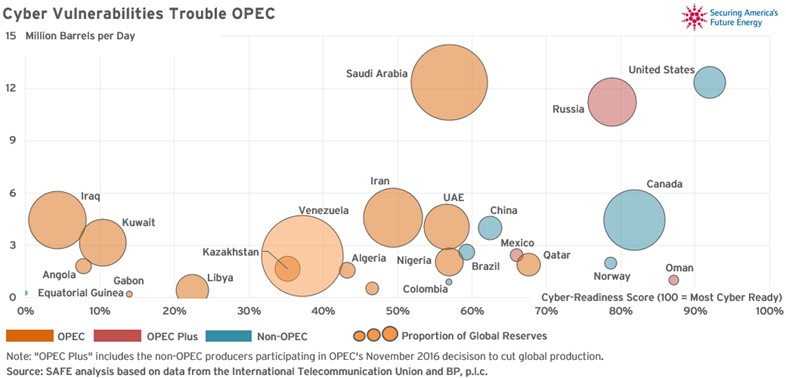
OPEC is no exception in this digitalization drive, but unlike its non-OPEC counterparts, the cartel has emerged as much more vulnerable to cybersecurity threats.


An analysis of data collected from 134 countries by the International Telecommunication Union has revealed that some of the world’s biggest oil producers, including Iraq, Saudi Arabia, Venezuela, Iran, and the UAE, are lacking in the cybersecurity department. This means that, compared to European producers and the United States, OPEC members are pretty much unprepared for a major cyberthreat.


What is the likelihood of such a threat actually materializing? Well, the general opinion in cybersecurity circles is that everything that can be hacked will be hacked at some point. Saudi Arabia’s oil and gas industry, for example, has been a favorite target for numerous attacks over the last few years, including the Shamoon virus, which in 2012 wiped clean the disks of more than 30,000 computers at Aramco, and according to reports from the cybersecurity industry, reared its ugly head again in 2016.


Overall, about half of all cyberattacks in the Middle East target the oil and gas industry, which suggests the answer to the above question is “Pretty high,” but the worse thing is that this likelihood is only going to get higher in the future. Related: Brent Spikes As This Major Pipeline Breaks Down


Middle Eastern producers are following in the footsteps of their non-OPEC counterparts in adopting digital technology and automation to improve efficiencies in the post-2014 world, where efficiency has come to the fore in oil and gas. The problem, of course, is that the more you digitalize, the more vulnerable you become to attacks through digital channels.


A recent study from Siemens and Ponemon Institute found that as digital tech adoption in the Middle East oil industry rises, so does cyber risk. What’s more, this risk is no longer limited to IT operations: the operational technology area is gaining prominence as a preferred target for cybercriminals.


The reason, according to Siemens and Ponemon Institute, is the convergence between IT and OT in the oil and gas industry. “Attackers have identified this convergence of IT and OT as a key opportunity to penetrate an organisation. As a result, an emerging trend of cyberattacks is designed to disrupt physical devices or processes used in operations. In a digital environment, industrial cyber is the new risk frontier,” says Siemens’ Vice President and Global Head of Industrial Cyber, Leo Simonovich.


The cybersecurity industry is sounding an alarm and it seems those in the Middle East that can afford it are hearing it and heeding the warning to improve their cybersecurity capabilities.


The UAE has a Dubai Cyber Security Strategy. Earlier this year, Saudi Arabia launched a National Cyber Security Center, and last month announced the set-up of a National Authority for Cyber Security, seeking to utilize international expertise and best practices to prop up government and critical infrastructure defenses. Iraq is seriously lagging behind and Iran is seen by cybersecurity insiders as more a source of cyberthreats than as a potential victim.


This sounds all well and good, but the trends in cybercrime point to a desperate need to do more. Cybercriminals do not sit on their hands while potential victims work to improve their defenses. While cybersecurity service providers continue to warn businesses and other organizations that they need to become more pro-active with regard to their cybersecurity measures, the hackers are coming up with new ways to undermine existing defenses. This is true for all industries, but it is especially true for oil and gas in the Middle East—national energy infrastructures are called critical for a reason, after all.


Wednesday, November 15, 2017

"FALLCHILL": DHS, FBI Release Details On North Korean Hacking Tools

As tensions between the U.S. and North Korea mount, the DHS and FBI have just issued a pair of technical alerts about cyber attacks which they say are sponsored by the North Korean government and that have been targeting the aerospace, telecommunications and financial industries since 2016.  According to the alert, North Korean hackers have used a type of malware referred to as “FALLCHILL” to gain entry to computer systems and compromise network systems.


Today, DHS and FBI released a pair of Joint Technical Alerts (TA17-318A and TA17-318B) that provide details on tools and infrastructure used by North Korea to target the media, aerospace, financial, and critical infrastructure sectors in the United States and globally.


The North Korean government malicious cyber activity noted in these alerts is part of a long-term campaign of cyber-enabled operations that impact the U.S. Government and its citizens. Working closely with our interagency, industry and international partners, DHS is constantly working to arm network defenders with the tools they need to identify, detect and disrupt state and non-state actors targeting the networks and systems of our country and our allies.


Per the pair of techinical alerts, the FALLCHILL malware provides hackers with wide latitude to monitor and disrupt infected networks. The malware typically gains access to systems as a file sent via other North Korean malware or when users unknowingly downloaded it by visiting sites compromised by the hackers.


FBI has high confidence that HIDDEN COBRA actors are using the IP addresses—listed in this report’s IOC files—to maintain a presence on victims’ networks and to further network exploitation. DHS and FBI are distributing these IP addresses to enable network defense and reduce exposure to any North Korean government malicious cyber activity.


This alert includes IOCs related to HIDDEN COBRA, IP addresses linked to systems infected with FALLCHILL malware, malware descriptions, and associated signatures. This alert also includes suggested response actions to the IOCs provided, recommended mitigation techniques, and information on reporting incidents. If users or administrators detect activity associated with the FALLCHILL malware, they should immediately flag it, report it to the DHS National Cybersecurity and Communications Integration Center (NCCIC) or the FBI Cyber Watch (CyWatch), and give it the highest priority for enhanced mitigation.


According to trusted third-party reporting, HIDDEN COBRA actors have likely been using FALLCHILL malware since 2016 to target the aerospace, telecommunications, and finance industries. The malware is a fully functional RAT with multiple commands that the actors can issue from a command and control (C2) server to a victim’s system via dual proxies. FALLCHILL typically infects a system as a file dropped by other HIDDEN COBRA malware or as a file downloaded unknowingly by users when visiting sites compromised by HIDDEN COBRA actors. HIDDEN COBRA actors use an external tool or dropper to install the FALLCHILL malware-as-a-service to establish persistence. Because of this, additional HIDDEN COBRA malware may be present on systems compromised with FALLCHILL.


During analysis of the infrastructure used by FALLCHILL malware, the U.S. Government identified 83 network nodes. Additionally, using publicly available registration information, the U.S. Government identified the countries in which the infected IP addresses are registered.


KJU


These latest technical alerts follow similar updates from DHS and the FBI from earlier this summer which highlighted malware they claimed North Korean hackers were utilizing to lauch DDoS attacks in the U.S.  Per The Hill:


The agencies identified IP addresses associated with a malware known as DeltaCharlie, which North Korea uses to launch distributed denial-of-service (DDoS) attacks.


The alert called for institutions to come forward with any information they might have about the nation’s cyber activity, which the U.S. government refers to as “Hidden Cobra.”


“If users or administrators detect the custom tools indicative of HIDDEN COBRA, these tools should be immediately flagged, reported to the DHS National Cybersecurity Communications and Integration Center (NCCIC) or the FBI Cyber Watch (CyWatch), and given highest priority for enhanced mitigation,” the alert reads.


The DHS and FBI also highlighted some vulnerabilities that North Korea has been known to exploit and recommended organizations upgrade to the latest versions of Adobe Flash Player, Microsoft Silverlight and Hangui Word Processor, or delete them altogether if the programs aren’t needed.


Of course, North Korea has routinely denied involvement in cyber attacks against other countries.


Monday, November 13, 2017

The Crimes Americans Worry About Most

Even though 2017 is already the worst year for mass shootings in modern U.S. history, Americans are more worried about cybercrime than violent crime.


That"s according to a new Gallup poll which found that 67 percent of U.S. adults frequently or occasionally fret about having personal, credit card or financial information stolen by hackers. 66 percent also worry about the threat presented by identity theft.


In comparison with cybercrime, Statista"s Niall McCarthy notes that anxiety about conventional crime forms is less prevalent with a large gap to the third-biggest worry - having a car stolen or broken into. That"s a frequent concern for 38 percent of people while 36 percent tend to worry about burglary when they are away from home.


Infographic: The Crimes Americans Worry About Most | Statista


You will find more statistics at Statista


More serious crimes such as muggings, murders and sexual assault are much further down the list, but why?


The reason cybercrime comes first is more than likely due to far higher levels of victimization, along with substantial coverage in the media. Gallup also found that a quarter of households have experienced hackers stealing their personal information while a mere three percent have experienced a burglary.


Saturday, October 21, 2017

Marc Faber Responds To Racism Accusations

Having been forced off the boards of Sprott, NovaGold, and Ivanhoe mines and excommunicated from mainstream business media following his comments earlier in the week, Gloom, Boom, & Doom Report writer Marc Faber responds to his racism allegations...


"I have been labeled by the mainstream media as a racist - I don"t think this corresponds at all with reality.


I wrote a report about capitalism and socialism and about private property rights, and I also wrote about the tendency nowadays to want to rewrite history.


In the US they are trying to tear down statues of people who had a different view from other people at the time... they also tried to tear down statues of Columbus..


I think that when you have civilization, when you have culture, you should remember your past.


Our past - the white man - has certainly not been glorious, it"s been very cruel with the periods of imperialism and colonialism being very cruel.


But the fact is that the white man and the Europeans brought a lot of skills and knowledge and a work ethic that built a very prosperous society... until very recently.


I think that to try to deny the fact that the western white man made America great is just not right and for that reason I was attacked very badly."


The conversation then continues to discuss cultural clashes, skin color, religion, confederate statues, African repression, capitalism, gold, bitcoin, Hillary Clinton, the swamp, President Trump, and America"s military-industrial complex running foreign policy.


We suspect Faber"s reponse will do him no favors in this age of ever-increasing virtue-signaling, but he has at least clarified his perspective.


Thursday, October 12, 2017

Equifax Web-Page Goes Offline Amid Reports Of New Breach

Equifax has taken one of its web pages offline as its security team looks into reports of another potential cyber breach, the credit reporting company, which recently disclosed a hack that compromised the sensitive information of 145.5 million people, said on Thursday.


"We are aware of the situation identified on the equifax.com website in the credit report assistance link," Equifax spokesman Wyatt Jefferies said in an email.


"Our IT and security teams are looking into this matter, and out of an abundance of caution have temporarily taken this page offline."


As CBC reports, the move came after an independent security analyst on Wednesday found part of Equifax"s website was under the control of attackers trying to trick visitors into installing fraudulent Adobe Flash updates that could infect computers with malware, the technology news website Ars Technica reported.


When I clicked it (from Gmail on Android) I was redirected to a spam page shortly after seeing the Equifax credit file form.


I thought maybe it was an anomaly because it didn"t happen again. But after reading your article about how sometimes hacks will redirect randomly I tried the link again just now and sure enough I got a spam page again (lucksupply.club saying I won an iPhone X). This is Chrome-in-a-tab from Gmail so i don"t believe there"s any extensions or other malware on my device that could have caused this redirect.


EFX share price is tumbling...


Germany Says It Found "No Evidence" Kaspersky Helped Russia Spy On US

US intelligence agencies are claiming that the Russian government leveraged the popularity of Kaspersky Labs’ cybersecurity software to create what is tantamount to a global spy network with the company’s explicit cooperation. However, Germany’s intelligence agencies say they’ve found “no evidence” to suggest these reports are true.


The Wall Street Journal, which last week reported that the US had identified at least one case of Kaspersky’s software improperly copying classified information, is back with another “exclusive” spoon fed to it by anonymous “senior US officials” alleging that Kaspersky allowed Russian government malware to piggy back on its software. The malware scanned for and copied files labeled “top secret,” not just in the US, but globally. Though WSJ neglects to list other countries that are suspected victims of Russian hacking.


Meanwhile, Germany"s BSI federal cyber agency said on Wednesday it had found no evidence to suggest that Russian hackers had used Kaspersky’s software to spy on US authorities. "There are no plans to warn against the use of Kaspersky products since the BSI has no evidence for misconduct by the company or weaknesses in its software," BSI said in an emailed response to questions about the latest media reports. "The BSI has no indications at this time that the process occurred as described in the media," according to Reuters.


Germany"s BSI, which also uses Kaspersky products for technical analyses, said it was in touch with U.S. officials and other security agencies about the issue so it could take action and issue a warning on short notice if required.


The Russian government used a popular antivirus software to secretly scan computers around the world for classified U.S. government documents and top-secret information, modifying the program to turn it into an espionage tool, according to current and former U.S. officials with knowledge of the matter.


The software, made by the Moscow-based company Kaspersky Lab, routinely scans files of computers on which it is installed looking for viruses and other malicious software. But in an adjustment to its normal operations that the officials say could only have been made with the company’s knowledge, the program searched for terms as broad as “top secret,” which may be written on classified government documents, as well as the classified code names of U.S. government programs, these people said.


After becoming suspicious that the Kaspersky software might be concealing malicious spyware, US intelligence agencies began scrutinizing the software, searching for signs that it was unknowingly copying and transmitting sensitive information.


For many months, U.S. intelligence agencies studied the software and even set up controlled experiments to see if they could trigger Kaspersky’s software into believing it had found classified materials on a computer being monitored by U.S. spies, these people said. Those experiments persuaded officials that Kaspersky was being used to detect classified information.


Later, WSJ notes that, in fact, it was Israeli intelligence that first alerted the US to Kaspersky’s skullduggery, effectively creating a separate, parallel narrative to explain how the deception was exposed.


So, which is it? Did the Israelis tell us? Or did the US discover the breach independently in 2015?


In an ironic twist, Kaspersky exposed Israel for lying about the source of its information on Iran deal talks after WSJ reported two years ago that Israel had spied on negotiations. Israel had said it received its intelligence by other means, but it had in reality infiltrated Kaspersky’s software, a fact the company publicly acknowledged in a research paper published two years ago.


In a twist, Kaspersky appears to have known, or at least suspected, that it had been hacked by Israel. In June 2015, the company published a detailed technical analysis about malicious computer code used to break into its systems, which it dubbed Duqu 2.0. Experts believe that the original Duqu malware, on which the one inside Kaspersky’s system appears to have been based, was used to spy on officials participating in international negotiations over Iran’s nuclear program, a fact that Kaspersky acknowledged in its paper.


The Journal reported in 2015 that Israel had spied on closed-door talks among the U.S. and other world powers about curtailing Iran’s nuclear ambitions. Israeli officials denied spying directly on U.S. negotiators and said they received their information through other means, including close surveillance of Iranian leaders receiving the latest U.S. and European offers.


Which begs the question: Is it possible that Israel was the source of the Kaspersky hack? The country has been exposed for spying on the US before – and not just during the Iran negotiations. And it has also been exposed for infiltrating Kaspersky’s systems.


Keep in mind, suspicions about the infiltration first emerged two years ago at a time of heightened tension between the Obama administration and Israel. In an unprecedented move, the Department of Homeland Security ordered all federal agencies using Kaspersky’s software to uninstall it, effectively ending Kaspersky’s relationship with one of its largest clients.  
 

Saturday, October 7, 2017

White House Says Trump&#039;s "Calm Before The Storm" Comment Is "Extremely Serious"

Following President Trump"s "calm before the storm" comments last night, reporters tried to ask him once again what he meant today, to which he responded "you"ll see." However, during The White House Press Briefing, Sarah Sanders replied to questions suggesting the President"s comments were "extremely serious," however without offering an explanation.


When asked if Trump was referring to military action when he said "calm before the storm." Sarah Sanders replied "We"re never going to say in advance what the president"s going to do. You"ll have to wait and see." 


Then, in a follow up question "how seriously should America"s public or America"s adversaries take these comments", the White House press secretary said "I think you can take the president protecting the American people always extremely seriously. He"s been very clear that that"s his number one priority."


Earlier in the day, Trump continued the cryptic mystery: shortly after signing a manufacturing executive order, a reporter asked what he meant when he said that a gathering of military leaders at the White House the evening before was "the calm before the storm," U.S. President Donald Trump did not elaborate, and said again, "You"ll find out."


And then he winked.


Sunday, October 1, 2017

Make BaSKeTBaLL GReaT AGaiN!

Seems like their usual M.O. of assisting communism isn"t working as well as it has in the past. Hitting them where it hurts, in their coin purse, is the only way for the average Joe to fight back. Well, besides a counter revolution, which I"m pretty sure they wouldn"t mind as long as they could jet on out of country before their neck is put into a noose.

Friday, September 29, 2017

Airports Systems Just Crashed Globally; Could The Power Grid Be Next?

Authored by Mac Slavo via SHTFplan.com,


Airport computer systems crashed around the globe yesterday. The crash caused passenger delays, angst, and fright among travelers, but a more ominous question has arisen in light of this glitch. Could the next failure be a worldwide power grid outage?


Thousands of travelers were grounded yesterday when a computer glitch took down check-in systems at more than 100 airports worldwide. The crash left passengers waiting in long lines at counters while trying to check-in for their flights. T Amadeus Alta, the company that provides the software, confirmed it is experiencing a “network issue that is causing disruption,” The Telegraph reported.


The glitch affected even massive airports,  such London’s Heathrow International Airport, Charles de Gaulle Airport in Paris, and Ronald Reagan International Airport in Washington, D.C. “Technical teams are working on the problem, services are gradually being restored,” the software company said. After a few hours, officials at Gatwick and Heathrow airports said their systems were “back up and running” after the “momentary IT glitch,” adding there may be a delay due to the outage.


A statement on the glitch read, “A small number of airlines are currently experiencing intermittent issues with their check-in systems at airports around the world — including at Heathrow.”


It continued, “Passengers will still be able to check-in for their flight, although the process may take slightly longer than usual.”


Passengers took to social media to complain about the crash.


According to Fox News, it is still unclear when all the systems will be back up and running, but it begs the question: what if a power grid failure is next?


It isn’t like it’s never happened, but it may only be a matter of time before it occurs on a massive scale.


In December of 2015, 230,000 people in Western Ukraine lost power after 30 substations were mysteriously shut off. Contrary to what most people assumed at the time, this wasn’t an innocuous power outage. The authorities would later admit that the loss of power was caused by a cyber attack, which marked the first time that malware was successfully used to attack a power grid. A similar, albeit more sophisticated cyber attack, occurred one year later just outside of Kiev. Given the current tensions between Russia and Ukraine, it’s widely believed that the Russian government was responsible for these incidents.


However, there’s more to this story than meets the eye. A computer security company has been investigating these attacks, and has discovered the malware that was used to take down the grid. They’ve found that it’s far more dangerous and easier to use than anyone realized before. –Ready Nutrition


It may not necessarily be malicious malware that takes down the grid either.  Even solar flares can cause some incredibly intense issues.


Most policy makers have not taken the threat of an earth-directed solar flare seriously, even though a senior member of the Congressional Homeland Security Committee recently warned that there is a 100% Chance of a Severe Geo-Magnetic Event Capable of Crippling Our Electric Grid.


If such an event were to happen Congressman Roscoe Bartlett, who has advised people to develop individual preparedness plans based on the threat of massive solar flares or electro-magnetic pulse detonations, says that it would take upwards of 18 months to bring the grid back online because of a decaying national infrastructure. –SHTFPlan


With the crash of the airport system affecting people worldwide, imagine how much chaos would ensue should the power grid go down over most of earth.

Wednesday, September 27, 2017

In Stunning Reversal, DHS Says Russians Were Not Behind Attempted Wisconsin Vote Hacking

Just in time for the weekend, the Associated Press reported on Friday that the Department of Homeland Security had notified 21 states earlier that day that their election systems had been targeted by malicious cyber actors. The states and DHS quickly jumped to the conclusion that Russia had ordered the cyberattacks, even though it was reported that the identity or identities of the perpetrators were inconclusive Yet, the news spread like wildfire after readers had been primed as reports of possible infiltartion of state election systems had circulated for nearly a year. Even so, for many states, the call Friday from the Department of Homeland Security was the first official confirmation that their election systems had, in fact, been targeted by hackers.


Federal officials said that in most of the 21 states, the targeting was preparatory activity such as scanning computer systems.


But in a stunning reversal - one which we doubt will put endless rumors of Russian cyberinterference to bed - the AP now reports that DHS has told Wisconsin that the Russian government was not involved in the cyber-targeting.


In an email to the state’s deputy elections administrator that was provided to reporters at the Wisconsin Elections Commission meeting on Tuesday, Homeland Security said that initial notice of Russian involvement was made in error. Also, as we noted at the time, the government did not originally assign blame to the Russians when news of the alleged "scanning" initially broke on Friday although most medias jumped at the opportunity to blame Putin.


Infuriated by the error, some state officials said that DHS should provide an expalanation for the errror, or at least issue an apology to state elections officials, who were understandbly unnerved by the news of Russian involvement.


“Based on our external analysis, the WI IP address affected belongs to the WI Department of Workforce Development, not the Elections Commission,” said the email from Juan Figueroa, with Homeland Security’s Office of Infrastructure Protection.


It wasn’t immediately known if Homeland Security made similar mistakes with any of the other 20 states. Figueroa did not immediately reply to an email seeking an explanation of how the mistake was made.


Homeland Security initially told the Elections Commission that the Russians scanned the state’s internet-connected election infrastructure, likely seeking specific vulnerabilities to access voter registration databases.


“Either they were right on Friday and this is a cover up, or they were wrong on Friday and we deserve an apology,” Mark Thomsen, the commission’s chairman, said in light of the new email.


Wisconsin’s chief elections administrator Michael Haas told AP that Homeland Security had assured the state that it had not been targeted - by Russians, or anybody else, for that matter.


“Wisconsin was not provided any information that indicated before the November election that Russian government actors were targeting election systems,” Haas said. He said one theory is that Homeland Security saw suspicious activity from IP addresses targeting state election systems in other states and assumed that was the intent in Wisconsin as well.


Others were apparently in shock: “It’s been a difficult process trying to piece all of this together,” said Wisconsin Elections Commission spokesman Reid Magney. “We’re trying to understand what happened.”


Furthermore, Wisconsin’s chief information officer, David Cagigal, told the elections commission that Wisconsin had never been told by Homeland Security, prior to the Friday notice, that Russians had targeted Wisconsin’s election system or anything else. Deputy information officer, Herb Thompson, said Homeland Security told the state in October to check on a certain IP address that the state had blocked from accessing its systems in August 2016.


“We have never seen any of those activities result in anything other than someone trying to turn the doorknob to see if a door is open,” Thompson said. “Those IP addresses we talked about, we had blocked, they were related to non-election systems.” Cagigal said, “Our systems were protected and we had no incidences.”


Still, the state"s election commission has promised to improve security before the midterms next year. Reports that Russians may have targeted, or infiltrated, state voting systems have been circulating since late last year, when the Washington Post published a story about alleged Russian infiltration in Vermont, only to retract the story shortly after. 


While we doubt that this will be the last "Russia hacked the elections" fake news, it is reassuring that all this frenzied chaos will at least bring some security to America"s voting systems. Security enhancements being considered include encrypting the entire voter registration database to protect the information and make it unusable to anyone who may be able to steal it and requiring two-factor authentication for the roughly 3,000 local and state officials who have access to the WisVote system.


Perhaps an appropriate question is why this wasn"t done before?

Tuesday, September 26, 2017

NFL Posts Job Ad For "Crisis Communications Strategist" To Advise League Executives

As the NFL"s feud with President Trump continues to dominate headlines, a feud which has effectively turned ESPN into a politically-themed talk show, the league has decided to recruit additional talent to "provide crisis communications counsel to leagues executives."  Per a job listing posted to Daybook, the NFL says they"re looking for a "Senior Communications Strategist" to be based out of New York City who can assist with "crisis communications" and "devise a strategy and long term vision to strategically position the NFL in the sports marketplace."  Here are some highlights:


Responsibilities:


The senior communications strategist will be responsible for proactively developing plans and strategies aimed at publicly positioning the NFL to key audiences through all communication channels, both traditional and emerging media. They will work closely with communications department leadership to create messaging to reflect the league"s wide variety of priorities and expedite organizational decision-making.


Additionally, the strategist will:


  •  Provide crisis communications counsel to leagues executives.

  • Devise strategy and long term vision to strategically position the NFL in the sports marketplace.

  • Provide guidance to senior leadership, including executive vice presidents and COO to achieve desired reputational results and develop metrics to measure success.


NFL


So, what kind of skills are required for such a position?  Well, you"ll need to be an "expert" in "storytelling" and you"ll need to be "comfortable working in a diverse environment"...so, no Trump-supporting racists allowed, please.


Required Education and Experience:


  •  Bachelor"s degree in related field and a minimum of 8+ years of experience in communications or journalism with expertise in storytelling, issue management and long term planning

  • Successfully demonstrated ability to lead, participate in, and support cross-departmental activities.

  • Strong written and verbal communications skills, excellent organizational skills and strong interpersonal skills.

  • Excellent working knowledge of the PR field including documented experience working in public, fast paced, high-pressure situations.

Other Key Attributes / Characteristics:


  • Strategic Leader: The successful candidate will think and act strategically as a valued member of the communications department and other NFL units.

  • Trusted Advisor: He/she will serve as a credible PR resource to clubs and league executives

  • An individual with intense and dedicated work habits. Someone who takes initiative, speaks his/her mind, and sets high standards in all he/she does.

  • An individual comfortable working in a diverse environment

  • A creative, imaginative individual who has the business acumen, curiosity and ability to define innovative strategy and deliver against it.

  • A person with the highest moral and ethical standards, who can be relied upon to always act in the best long-term interests of the League.

  • A person with the capacity to be a hands-on, sleeves-up team player.

  • Superior judgement and communication skills, as well as political sensitivity both internally and externally

  • Experience in corporate communications, sports or entertainment is preferred.


Of course, rather than prepare for a political war the NFL could also just play football...just a thought.

Massive Hack At Deloitte: Entire Internal Email System Compromised, Client Emails Exposed

Another day, another major hacking.


The Guardian reports that in the latest corporate cyber breach, one of the world’s “big four” accounting and consultancy firms, Deloitte, was been targeted by a sophisticated hack that "compromised the confidential emails and plans of some of its blue-chip clients." And just like Equifax, New York-headquartered Deloitte was similarly the victim of a cybersecurity attack that went unnoticed for months. The Guardian understands Deloitte discovered the hack in March this year, but it is believed the attackers may have had access to its systems since October or November 2016.


Responding to questions from the Guardian, Deloitte confirmed it had been the victim of a hack but insisted only a small number of its clients had been “impacted”. It would not be drawn on how many of its clients had data made potentially vulnerable by the breach. Alas, the company has yet to provide a full disclosure of just who and which clients were violated: an estimated 5 million emails were in the hacked email cloud and could have been been accessed by the hackers. Deloitte said the number of emails that were at risk was a fraction of this number but declined to elaborate.


While unlike Equifax Deloite is not a public public company and is not accountable to countless shareholders, with $37 billion in revenue last year and over 263,000 worldwide employees, Deloitte is a corporate behemoth which provides auditing, tax consultancy and - like Equifax - high-end cybersecurity advice to some of the world’s biggest banks, multinational companies, media enterprises, pharmaceutical firms and government agencies.  Here the Guardian reports that Deloitte clients "across all of these sectors had material in the company email system that was breached. The companies include household names as well as US government departments."


So far, six of Deloitte’s clients have been told their information was “impacted” by the hack. Deloitte’s internal review into the incident is ongoing.


The hacker compromised the firm’s global email server through an “administrator’s account” that, in theory, gave them privileged, unrestricted “access to all areas”.


Embarrassingly, the administrator level hack required only a single password and did not have “two-step“ verification, much like Deloitte and other companies strongly urge everyone to do.


As the Krebs on Security blog separately notes, "according to a source close to the investigation, the breach dates back to at least the fall of 2016, and involves the compromise of all administrator accounts at the company as well as Deloitte’s entire internal email system"


The source told KrebsOnSecurity they were coming forward with information about the breach because, “I think it’s unfortunate how we have handled this and swept it under the rug. It wasn’t a small amount of emails like reported. They accessed the entire email database and all admin accounts. But we never notified our advisory clients or our cyber intel clients.”


This same source said forensic investigators identified several gigabytes of data being exfiltrated to a server in the United Kingdom. The source further said the hackers had free reign in the network for “a long time” and that the company still does not know exactly how much total data was taken.


Penetrating the unknown number of emails involved breaching the Microsoft cloud used the by the company. Emails to and from Deloitte’s 244,000 staff were stored in the Azure cloud service, which was provided by Microsoft. This is Microsoft’s equivalent to Amazon Web Service and Google’s Cloud Platform.


In addition to emails, the Guardian adds the hackers had "potential access to usernames, passwords, IP addresses, architectural diagrams for businesses and health information. Some emails had attachments with sensitive security and design details."


Until today"s report, the hack had been disclosed to the public: the breach, which was US-focused, was regarded as so sensitive that only a handful of Deloitte’s most senior partners and lawyers were informed.


The team investigating the hack is understood to have been working out of the firm’s offices in Rosslyn, Virginia, where analysts have been reviewing potentially compromised documents for six months.


It has yet to establish whether a lone wolf, business rivals or state-sponsored hackers were responsible.


Translation: while Putin wasn"t accused of hacking Equifax, he may yet get the blame this time.


Making this breach even more complicated, it is still unknown what information the hackers acquired: Guardian sources said if the hackers had been unable to cover their tracks, it should be possible to see where they went and what they compromised by regenerating their queries. This kind of reverse-engineering is not foolproof, however.


“In response to a cyber incident, Deloitte implemented its comprehensive security protocol and began an intensive and thorough review including mobilising a team of cybersecurity and confidentiality experts inside and outside of Deloitte,” a spokesman said. “As part of the review, Deloitte has been in contact with the very few clients impacted and notified governmental authorities and regulators.


“The review has enabled us to understand what information was at risk and what the hacker actually did, and demonstrated that no disruption has occurred to client businesses, to Deloitte’s ability to continue to serve clients, or to consumers. We remain deeply committed to ensuring that our cybersecurity defences are best in class, to investing heavily in protecting confidential information and to continually reviewing and enhancing cybersecurity. We will continue to evaluate this matter and take additional steps as required."


“Our review enabled us to determine what the hacker did and what information was at risk as a result. That amount is a very small fraction of the amount that has been suggested.”


Deloitte declined to say which government authorities and regulators it had informed, or when, or whether it had contacted law enforcement agencies.


Of course, as noted above, the breach is a deep embarrassment for Deloitte, which offers clients advice on how to manage the risks posed by sophisticated cybersecurity attacks. If only the company had followed its own advice.  Even more awkward, in 2012 Deloitte was ranked the best cybersecurity consultant in the world and has a “CyberIntelligence Centre” to provide clients with “round-the-clock business focussed operational security." It is unclear if that unit was also hacked.


While we await an official statement from Deloitte, what comes next is lots of lawsuits and even more settlements. According to the Guardian, on 27 April Deloitte hired US law firm Hogan Lovells on “special assignment” to review what it called “a possible cybersecurity incident”. The Washington-based firm has been retained to provide “legal advice and assistance to Deloitte LLP, the Deloitte Central Entities and other Deloitte Entities” about the potential fallout from the hack.

Thursday, September 21, 2017

Ban On Kaspersky Software Exposes The Hypocrisy Of US&#039; Internet Agenda

Authored by Andrei Akulov via The Strategic Culture Foundation,


On September 18, the US Senate voted to ban the use of products from the Moscow-based cyber security firm Kaspersky Lab by the federal government, citing national security risk. The vote was included as an amendment to an annual defense policy spending bill approved by the Senate on the same day. The measure pushed forward by New Hampshire Democrat Jeanne Shaheen has strong support in the House of Representatives, which also must vote on a defense spending bill. The legislation bars the use of Kaspersky Lab software in government civilian and military agencies.


On September 13, a binding directive issued by Acting Secretary of Homeland Security Elaine Duke, ordered federal agencies to remove Kaspersky Lab products from government computers over concerns the Russia-based cybersecurity software company might be vulnerable to Russian government influence. All federal departments and agencies were given 30 days to identify any Kaspersky products in use on their networks. The departments have another 60 days to begin removal of the software. The statement says, «The department is concerned about the ties between certain Kaspersky officials and Russian intelligence and other government agencies, and requirements under Russian law that allow Russian intelligence agencies to request or compel assistance from Kaspersky and to intercept communications transiting Russian networks». The Russian law does not mention American networks, nevertheless it is used as a pretext to explain the concern.


Similar bans against US government use of Kaspersky products have been suggested before. In 2015, Bloomberg News reported that the company has «close ties to Russian spies».


According to US News, scrutiny of the company mounted in 2017, fueled by U.S. intelligence assessments and high-profile federal investigations of Russian interference in the 2016 election. This summer, the General Service Administration, which oversees purchasing by the federal government, removed Kaspersky from its list of approved vendors. In June, a proposal prohibiting the US military from using the company"s products was reportedly included in the Senate"s draft of the Department of Defense"s budget rules. US intelligence leaders said earlier this year that Kaspersky Lab was already generally not allowed on military networks.


Kaspersky Lab has been producing widely lauded anti-virus software for 20 years. Today, it boasts 400 million customers around the world. Suspected of being involved in cyber espionage, the leading antivirus programs producer concluded that it was «caught in the middle of a geopolitical fight» and is being «treated unfairly even though the company has never helped, nor will help, any government in the world with its cyberespionage or offensive cyber efforts». Eugene Kaspersky, co-founder and CEO of Kaspersky Lab, has repeatedly denounced the allegations against his company as false and lacking credible or public evidence. He accepted the invitation to testify before the US House of Representatives Committee on Science, Space, and Technology. The testimony is scheduled on Sept. 27. Too late! Even if he proves that his company is innocent, the ban will be in force. It has been introduced without giving him a chance to speak on the issue and dissipate the fears.


Kaspersky highlighted that more than 85% of its revenue comes from outside Russia. The US measure will inevitably damage the company’s image and undermine the competitive position of the Russian company internationally. Best Buy has already said it will no longer sell software made by the Russian company.


All the decisions have been taken without giving the company a chance to openly address or mitigate the concerns. There has been no thorough investigation of its activities on US soil. No credible evidence has been presented to support the accusations. It all smacks of unfair competition. The Kaspersky Lab software is quite popular in the United States, and the company’s competitors will no doubt look to capitalize on this opportunity.


The move is part of anti-Russian hysteria that hit the United States. Kaspersky Lab has come under a politically-charged attack simply because it is Russian. Can anybody imagine Russia’s authorities saying that Apple and Microsoft were working hand in glove with the CIA and, therefore, their products were considered a security threat and should be banned?


A few months ago the authorities of New Hampshire, the state Jeanne Shaheen is from, were seriously considering a ban on Russian vodka imports and sales! Meanwhile, the US energy exporters use the Countering America"s Adversaries Through Sanctions Act to vie for the European energy market.


On August 14, President Trump signed a memorandum that directs US Trade Representative Robert Lighthizer to determine whether an investigation is needed into alleged unfair Chinese trade practices. The move represents the first step in a process that could allow the president to impose tariffs on Chinese imports or other punishing trade actions. The struggle for «fair trade practices» takes place against flagrant violations of international competition rules by the United States as illustrated by the unfair treatment of Kaspersky Lab.


At the same time, the US takes no measures against Microsoft, which is abusing its dominance in the PC operating system market, creating obstacles for independent software security vendors by distributing its own Defender anti-virus software with the ubiquitous Windows operating system.


The message has been sent. Hypocrisy at the core of US internet agenda is becoming untenable. It cannot continue to advocate for an open web, while at the same time using the tactics of unfair competition. The narrative that United States is the defender of free Internet appears to be dead.

Tuesday, September 19, 2017

More Equifax Lies? Company Originally Hacked Five Months Earlier Than It Disclosed

When Equifax first disclosed the shocking news on September 7 that its servers and some 143 million private account had been hacked, leaking everything from names, to addresses, to social security numbers, it stated in its press release that it had "learned of the incident on July 29, 2017" adding that "at which point it reported the intrusion to law enforcement and contracted a cybersecurity firm to conduct a forensic review: based on the company’s investigation, the unauthorized access occurred from mid-May through July 2017."


As we commented then, it "oddly enough took shareholders and over a third of America, more than a month longer to learn that all their personal data may have been compromised."


And now, according to Bloomberg, it appears the company had lied again as it wasn"t "only one month" but nearly six that the company was aware that its systems had been violated without acting on the information::


Equifax Inc. learned about a major breach of its computer systems in March -- almost five months before the date it has publicly disclosed, according to three people familiar with the situation


While the March breach was reportedly not related to the hack that exposed the personal and financial data on 143 million U.S. consumers, "one of the people said the breaches involve the same intruders. Either way, the revelation that the 118-year-old credit-reporting agency suffered two major incidents in the span of a few months adds to a mounting crisis at the company, which is the subject of multiple investigations and announced the retirement of two of its top security executives on Friday." That one of the top security executives also happened to be a music major who desperately tried to scrub her public background has not helped the company"s case.


Some further details from Bloomberg:


Equifax hired the security firm Mandiant on both occasions and may have believed it had the initial breach under control, only to have to bring the investigators back when it detected suspicious activity again on July 29, two of the people said.


Equifax’s hiring of Mandiant the first time was unrelated to the July 29 incident, the company spokesperson said. Vitor De Souza, senior vice president for global marketing at FireEye Inc., Mandiant’s parent company, declined to comment.


As Bloomberg hedges, "there’s no evidence that the publicly disclosed chronology is inaccurate, but it leaves out a set of key events that began earlier this spring, the people familiar with the probe said."


In any even, while the company"s lawyers are surely looking for just the right explanation to justify sitting on news of cyberbreach for months before it was too late, the revelation of the March hack will complicate the company’s efforts to explain a series of unusual stock sales by Equifax executives.


If it’s shown that those executives did so with the knowledge that either or both breaches could damage the company, they could be vulnerable to charges of insider trading. 


As reported earlier, the U.S. Justice Department has opened a criminal investigation into the stock sales, according to people familiar with the probe. As a reminder, Equifax originally disclosed that it discovered the security breach on July 29, and shortly after - in early August - the three executives sold shares worth almost $1.8 million.


The company has said the managers didn’t know of the breach at the time they sold the shares, although in light of the latest news that appears rather inconceivable.


Insider trading charges aside, there is the question of all those piling lawsuits:


new questions about Equifax’s timeline are also likely to become central to the crush of lawsuits being filed against the Atlanta-based company. Investigators and consumers alike want to know how a trusted custodian of so many Americans’ private data could let hackers gain access to the most important details of financial identity, including social security and driver’s license numbers, and steal credit card numbers.


Meanwhile, far from keeping the original hack a secret, "in early March Equifax began notifying a small number of outsiders and banking customers that it had suffered a breach and was bringing in a security firm to help investigate. The company’s outside counsel, Atlanta-based law firm King & Spalding, first engaged Mandiant at about that time. While it’s not clear how long the Mandiant and Equifax security teams conducted that probe, one person said there are indications it began to wrap up in May."


The revelation of an earlier breach - and one which comes from the press instead of the company itself - will likely raise questions for the company’s executives over whether that investigation was sufficiently thorough or if it was closed too soon, and also why it wasn"t disclosed as part of the Sept. 7 press release.


For example, Equifax has said that the hackers entered the company’s computer banks the second time through a flaw in the company’s web software that was known in March but not patched until the later activity was detected in July.


For now, however, what will get the most
scrutiny in light of the new timeline is the stock sales by company insiders: on Aug. 1 and Aug. 2, regulatory
filings show that three senior Equifax executives sold shares worth
almost $1.8 million, with none of the filings listing the transactions
as being part of scheduled 10b5-1 trading plans.
Equifax’s Chief
Financial Officer John Gamble sold shares worth $946,374; Joseph
Loughran, president of U.S. information solutions, exercised options to
dispose of stock worth $584,099; and Rodolfo Ploder, president of
workforce solutions, sold $250,458 of stock.


Equifax has said the executives “had no knowledge that an intrusion had occurred at the time,” and the company spokesperson declined to make them available for comment.


Now, under the new timeline, the insider sales come several months after the March breach but before the public had any knowledge of major security issues at one of the country’s three big credit-reporting agencies. The new timeline is also likely to focus scrutiny on an earlier sale by Gamble of 14,000 shares on May 23. According to a regulatory filing, which didn’t indicate that the sale was part of a scheduled trading plan, the value of that transaction was $1.91 million, more than twice the size of his Aug. 1 disposal of 6,500 shares for $946,374.


Another question is who is behind the hack, and whether these were two separate incidents, or one organized breach:


If the two hacks are unrelated it could be that different hacking teams had different goals. One clue has emerged that suggests one goal of the attackers was to use Equifax as a way into the computers of major banks, according to a fourth person familiar with the matter.


This person said a large Canadian bank has determined that hackers claiming to sell celebrity profiles from Equifax on the dark web -- information that appears to be fraudulent, or recycled from other breaches -- did in fact steal the username and password for an application programming interface, or API, linking the bank’s back-end servers to Equifax.


According to Bloomberg, the discovery suggests that the attackers may have been trying to piggyback off of Equifax’s connections to large banks and other financial institutions as a backdoor way to hack those entities and gain access to sensitive partner systems. The company spokesperson said Equifax is “working diligently with our bank partners to assess and mitigate any impact to their operations.”


Equifax has yet to disclose that March breach to the public.

Monday, September 18, 2017

Muddy Waters&#039; Carson Block Sues Equifax For $500,000

Disgraced credit-monitoring company Equifax, which has seen its stock drop by nearly 40% since disclosing what will likely be remembered as one of the most damaging data breaches in US history, eliciting dozens of class-action lawsuits, calls for investigations by at least one state attorney general, and requests from multiple Congressional committees for more information about the exact timeline of when Equifax learned about the hack, and when it was disclosed – because somewhere between those two events, several of the company’s executives, including its CFO, cashed out of some $2 million in stock and options.


In the latest humiliating blow to a company that failed at its only job – safeguarding Americans’ sensitive personal and financial data – famed short-seller Carson Block has announced that he has decided to sue the company over its “abysmal” handling of the hack.


And here’s the kicker: He doesn’t even have an open short position against the company. In other words: There’s no profit motive here. Block – like millions of Americans - is just really, really pissed.


Here’s the Financial Times:


“Veteran short-seller Carson Block has launched a private lawsuit against Equifax, accusing the credit-reporting company of an “abysmal” handling of one of the worst cyber security incidents in history. Equifax said on September 7 that its systems were breached by criminals in a raid that went on for more than two months — an admission that has prompted a flood of regulatory inquiries, dozens of private lawsuits and a more than one-third collapse in the company’s share price. The data of up to 143m Americans was compromised, the company said, along with up to 400,000 people in the UK.


One of those was Mr Block, whose suit filed on Friday accuses Equifax of negligence in failing to safeguard and protect his personal identifying information from criminals, as well as a failure to disclose the breach in a timely fashion.”


Apparently, Block has learned that his personal information was compromised in the hack because he’s suing for personal damages. He has also accused the company of failing to disclose the breach in a timely fashion. The company’s CEO, Rick Smith, who is expected to deliver Congressional testimony early next month, has said that the company at first believed the hack was relatively minor."


According to the FT, the famed short sellers is seeking $500,000 in damages, a paltry sum considering Muddy Waters reportedly produced double-digit returns last year.


“Mr Block’s firm, Muddy Waters, has no short position that would benefit from a fall in the stock. In the suit, filed in the Northern District of California, San Francisco division, he seeks damages of at least $500,000 for the “stress, nuisance and annoyance” of dealing with issues stemming from the breach.


The suit notes that Equifax’s business revolves around being a “secure storehouse” for data and providing a clear financial profile of consumers that lenders and other businesses can rely on. According to its own description, Equifax organises, assimilates and analyses data on more than 820m consumers and more than 91m businesses worldwide.


Equifax could not be reached for comment at the time of publication.”


As the FT explains, hackers gained access to the company’s systems by exploiting a vulnerability in Apache Struts, a popular open-source framework for developing web applications in the Java programming language. On Friday, Equifax said that it had patched the hole on July 30, one day after it had detected strange activity on its servers. But cybersecurity experts note that the fix had been available since March, when the Apache Foundation put out an update which had been widely disseminated in tech circles. In short, the company’s cybersecurity experts committed an unforced error by neglecting to invest the meager resources required to patch the fix.


Amid the firestorm of controversy that has engulfed the company in the aftermath of the hacking disclosure, Equifax has actively tried to cover up the fact that Susan Mauldin, Equifax’s chief information security officer, and the person who was responsible for keeping the highly confidential and secret information of over 100 million Americans, has zero security or technology credentials…in fact, she was a music major at the University of Georgia.


Smith, Mauldin and nine other executives are named in Block’s lawsuit.  Mauldin, Equifax said, would retire immediately from the company on Friday, along with David Webb, chief information officer.


According to the suit, Equifax should’ve been more careful following two big breaches in 2016. In one of those, 430,000 names and other vital pieces of information were lost as a result of the company using “alarmingly poor” security for the generation of PINs from the last four digits of a social-security number and the four-digit year of birth.


Of course, with North Dakota Democrat Heidi Heitkamp calling for a criminal investigation into securities fraud, Block’s lawsuit for a meager half a million is probably the least of the company’s worries…
 

Saturday, September 9, 2017

Hackers Can Now Cause Blackouts On America&#039;s Electrical Grid, Report

It was inevitable that someday, hackers would have the ability to exert control over the U.S. electrical grid.  According to the computer security firm Symantec, someday is today.


Hacking attacks over the last several months that targeted U.S. energy companies have been able to gain "operational control" over systems, thus threatening blackouts across the U.S., says Symantec.


 The hacker group known as DragonFly 2.0 was able to gain control in at least 20 places, according to the firm.


Wired:


Symantec on Wednesday revealed a new campaign of attacks by a group it is calling Dragonfly 2.0, which it says targeted dozens of energy companies in the spring and summer of this year. In more than 20 cases, Symantec says the hackers successfully gained access to the target companies" networks. And at a handful of US power firms and at least one company in Turkey – none of which Symantec will name – their forensic analysis found that the hackers obtained what they call operational access: control of the interfaces power company engineers use to send actual commands to equipment like circuit breakers, giving them the ability to stop the flow of electricity into US homes and businesses.


"There"s a difference between being a step away from conducting sabotage and actually being in a position to conduct sabotage ... being able to flip the switch on power generation," says Eric Chien, a Symantec security analyst. "We"re now talking about on-the-ground technical evidence this could happen in the US, and there"s nothing left standing in the way except the motivation of some actor out in the world."


Never before have hackers been shown to have that level of control of American power company systems, Chien notes. The only comparable situations, he says, have been the repeated hacker attacks on the Ukrainian grid that twice caused power outages in the country in late 2015 and 2016, the first known hacker-induced blackouts.


Security firms like FireEye and Dragos have pinned those Ukrainian attacks on a hacker group known as Sandworm, believed to be based in Russia. But Symantec stopped short of blaming the more recent attacks on any country or even trying to explain the hackers" motives. Chien says the company has found no connections between Sandworm and the intrusions it has tracked. Nor has it directly connected the Dragonfly 2.0 campaign to the string of hacker intrusions at US power companies – including a Kansas nuclear facility – known as Palmetto Fusion, which unnamed officials revealed in July and later tied to Russia.


Chien does note, however, that the timing and public descriptions of the Palmetto Fusion hacking campaigns match up with its Dragonfly findings. "It"s highly unlikely this is just coincidental," Chien says. But he adds that while the Palmetto Fusion intrusions included a breach of a nuclear power plant, the most serious DragonFly intrusions Symantec tracked penetrated only non-nuclear energy companies, which have less strict separations of their internet-connected IT networks and operational controls.


The first question I would want answered is, if they have that sort of control, why not exercise it?  Why no blackouts or service interruptions in the U.S.?


Hacking Sony or another private business is one thing.  Fooling with our electrical infrastructure is many orders of magnitude more serious.  If a sovereign nation were behind such an event, it would be tantamount to a declaration of war.  Unless the attacking nation was supremely confident that the hack couldn"t be traced back to it, the nation would be unlikely to attempt it.


Causing a blackout in a major urban area would almost certainly result in many deaths.  We know this from previous blackouts in New York City, where the 2003 power outage is estimated to have resulted in 100 deaths.  This would be intolerable, and if the attack could be traced back to Russia or China, it would result in retaliation by the U.S.  We"re no slouches ourselves when it comes to cyber-warfare, and we could almost certainly make any country pay dearly.


But in a time of war, that kind of control over our electrical grid could wreak havoc and sow confusion and fear among the populace.  In the meantime, it would behoove the government to work with industry to harden our systems to prevent that kind of catastrophe.