Showing posts with label CBL. Show all posts

Tuesday, October 31, 2017

Dying Malls Increasingly Rely On Taxpayer Handouts For Survival

America"s dying malls have been a frequent topic of discussion of late as these relics of the 80"s have been forced to convert once valuable high-end retail square footage into grocery stores, libraries and doctor offices just to keep the lights on.  Here"s just a small sampling of the recent carnage:


But, as Bloomberg points out today, one other funding source is increasingly emerging as a key financial sponsor in the efforts of commercial REITs to re-purpose their failing assets: taxpayers.


In Brookfield, Wisconsin, for example, the city is using tax-increment financing (TIF), a common tool for municipalities to subsidize development by putting property taxes from new projects into a fund that pays for building cost, to help rebuild the Brookfield Square Mall. Meanwhile, as if that weren"t enough, the city has also agreed to pay for remediation costs related an old Sears auto repair shop and to build a new convention center and hotel where the Sears once stood.


In this depressing landscape, there is at least one player still willing to take the risk: local governments hungry for tax revenues. Developers incorporating additions such as housing and parks in their plans are turning to public partners to help rehabilitate the aging retail meccas that dot the U.S. Public subsidies have been part of retail development for decades, but with landlords pouring billions of dollars into renovation to battle a wave of store closures, public-private partnerships are more urgent, and more fraught, than ever.


At the Brookfield Square mall in Wisconsin, the landlord, CBL & Associates Properties Inc., needed a new occupant for a fading Sears. CBL had been tinkering with the mix for the past few years. Earlier, in 2008, it completed a 20,000-square-foot expansion, adding grocery stores and restaurants and renovating the interior.


In the end, it found its tenant: the city of Brookfield.


The local government plans to step in to build a conference center and hotel. By creating a hub for small and medium-size conventions on 9 of the 29 acres currently occupied by Sears, the city hopes to boost CBL’s efforts to reinvent the property, the largest taxpayer in Waukesha County. The idea is a greater focus on entertainment, recreation and business, according to Daniel Ertl, director of community development for the city of about 38,000.


“The Sears store is really a shadow of what it used to be,” Ertl said. “We encourage CBL to continue to reinvent themselves. God knows where retail is going to be in 20 years.”


Mall


As Bayer Properties CFO, Jami Wadkins, who just secured all sorts of taxpayer-funded handouts to rebuild a failed mall in Alabama, points out, public funding is becoming an "important element of the capital stack of every developer."


These expansive developments often secure additional public financing through various forms of tax arrangements and incentives, as well as infrastructure spending for things like parking garages. Such funding has become an important element of the capital stack for every developer, according to Jami Wadkins, chief financial officer of Bayer Properties, a real estate company that develops and manages retail real estate.


In Birmingham, Alabama, Bayer worked with the city government to transform the site of the Pizitz, a historic department store that closed in 1987. The Pizitz, which Bayer bought as a vacant building in 2000, was in a rundown neighborhood that lagged behind the revival occurring in other areas of downtown.


Numerous plans ended up on the scrap heap before federal and state aid was secured to build a mixed-use community, which opened in 2016. The development houses 143 residential units -- now 90 percent occupied -- a co-working space, a food hall and retailers, including Alabama’s first Warby Parker.


The project cost was $70 million, including public and private funds. Bayer was able to obtain a low-interest loan from the U.S. Department of Energy, as well as tax credits from the state. The city paid to refurbish the landscaping in the area, including the sidewalks and street lamps, according to Wadkins.


“If you can put a plan together for a city that doesn’t put the city at great risk, then they will invest with you,” Wadkins said. 


To conclude, perhaps no one summarized this lunacy better than Ronald Reagan who succinctly described the Government"s approach to economic affairs as follows:


"Government"s view of the economy could be summed up in a few short phrases: If it moves, tax it. If it keeps moving, regulate it. And if it stops moving, subsidize it."


Malls are clearly now in the "subsidize it" phase of the Government"s economic plan.


Saturday, April 22, 2017

Failing Malls Turn Empty Parking Lots Into Carnivals To Generate Cash

It should come as no surprise that America"s malls, the wonderlands of the 80s, are in big trouble.  After slowly losing market share to online competition for years, brick-and-mortar retailers have finally succumb to changing consumer habits which has resulted in a massive surge in bankruptcies and store closings.


Of course, as we"ve pointed out before, mall owners have tried just about everything to fill their empty spaces including the addition of grocery stores, doctors" offices and even high schools. 


But while most mall owners have been trying to figure out how to fill up the inside of their stores, they apparently overlooked another very "valuable" asset:  their empty parking lots.


With customer traffic sagging, U.S. retail landlords are using their sprawling concrete lots to host events such as carnivals, concerts and food-truck festivals. They’re aiming to lure visitors with experiences that can’t be replicated online -- and then get them inside the properties to spend some money.


“Events draw people to come to the shopping center,” said Keith Herkimer, whose company, KevaWorks Inc., is working with big landlords including GGP Inc. and Simon Property Group Inc. to produce outdoor events. “They generate revenue for the owner and offer a chance for cross-promotion, so they can try and drive more customers into the stores.”


The idea, obviously, is to attract customers for experiences that can"t be replicated online with a focus on everything from movies nights to carnivals.


Retail landlords have already made a push toward experience-driven offerings by adding restaurants, movie theaters and activity centers for children. Many malls are also adding rotating stores around for only a short time -- known as pop-up shops -- that are meant to attract young customers who see shopping as an event.


Now, events are reaching beyond the malls themselves. Herkimer’s task is to bring crowds to parking lots with events that generate as much as $60,000 a week for mall owners from the largest outdoor events.


The idea is gaining traction. Next month, Simon Property is having the first carnival in its Round Rock Premium Outlets parking lot, about 20 miles (32 kilometers) north of Austin, Texas. Similar events are being held for the first time at locations such as Central Mall in Port Arthur, Texas, managed by Jones Lang LaSalle Inc., and a Cheyenne, Wyoming, mall owned by CBL & Associates Properties Inc. In July, Simon Property’s Orland Square Mall, southwest of Chicago, will be holding its first parking-lot food-truck festival, with plans for live music performances, Herkimer said.


Meanwhile, REIT investors are finally starting to understand that while carnivals may help to pay the electricity bills of America"s malls they do little to help generate a return on the hundreds of millions of dollars worth of retail square footage that lies empty inside the stores.


SPG

Saturday, January 28, 2017

Retail Sector - Doomed as Doomed Can Be

From the Slope of Hope: Being an equity bear has been brutal for, oh, nearly eight years now. With the S&P up about 250% since bottoming in March 2009, equities have been, on the whole, raging higher, with some sectors in particular benefiting tremendously from the Trumpgasm. One area, though, seems to be recognizing a bitterly cold chill of reality, and that is retail.


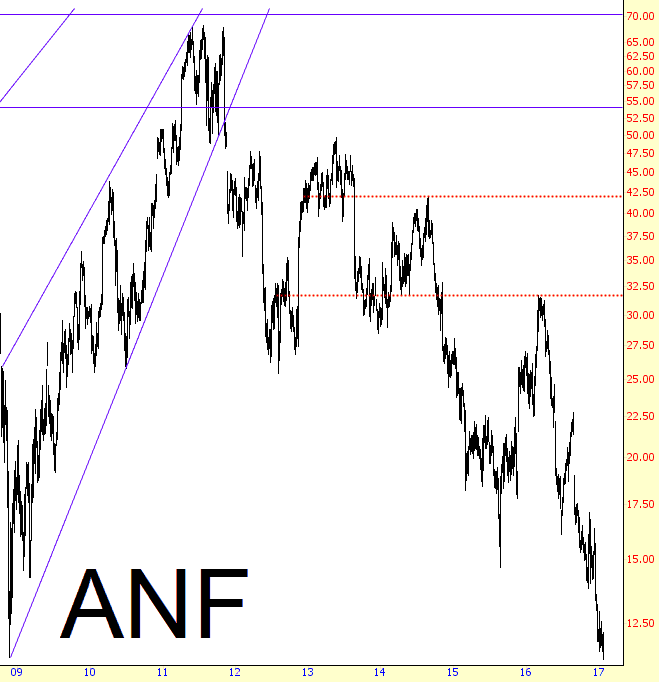
Not everything retail is weak, of course, Amazon has had an astonishing run (and we"ll see if it holds together when they report next week), and some stocks such as Autozone (AZO) and O"Reilly Auto Parts (ORLY) have cranked out multi-hundred percent gains for years now. But many retail companies, particularly those having to do with clothing, have been getting whacked. Take, for instance, Abercrombie & Fitch, which I"ve picked on endlessly: it is actually lower than it was at the greatest depths of the financial crisis. For how many stocks could you make that statement?


0128-ANF


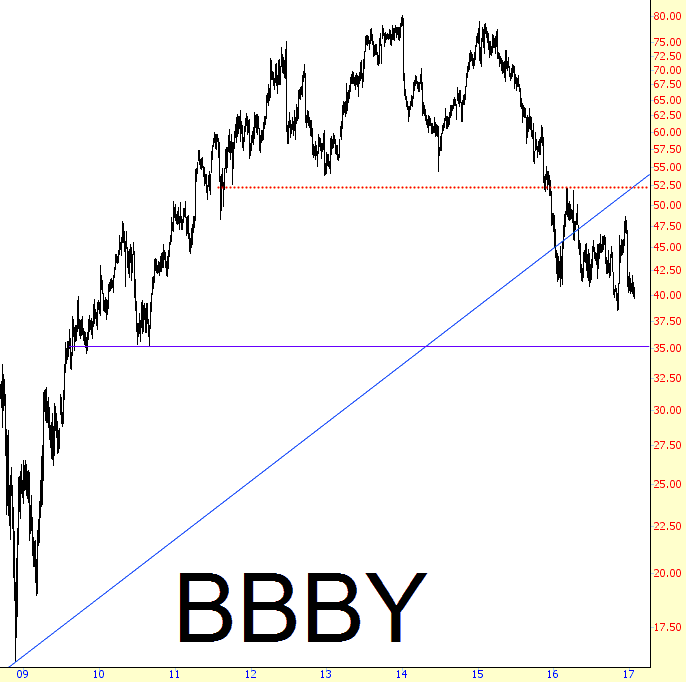
Bed Bath & Beyond has a quite well-formed head and shoulders pattern (whose neckline is shown with a red horizontal below) that suggests much lower prices to come.


0128-BBBBY


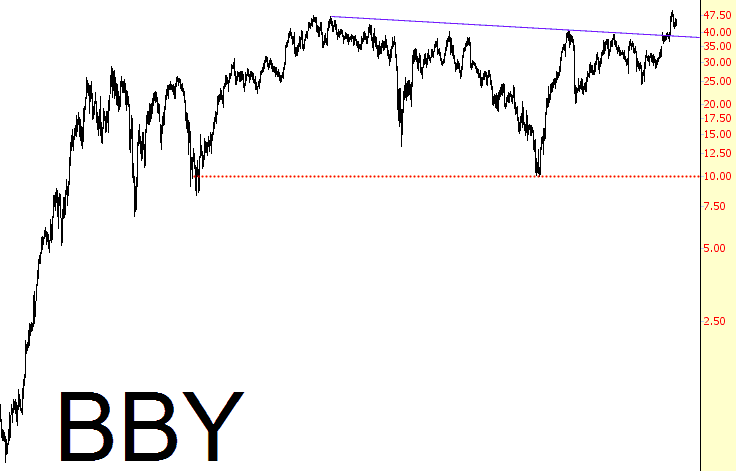
Be careful not to confuse this with a very similar symbol, however - Best Buy - which, competition from Amazon be damned, is defying gravity and broke above resistance this year.


0128-BBBY


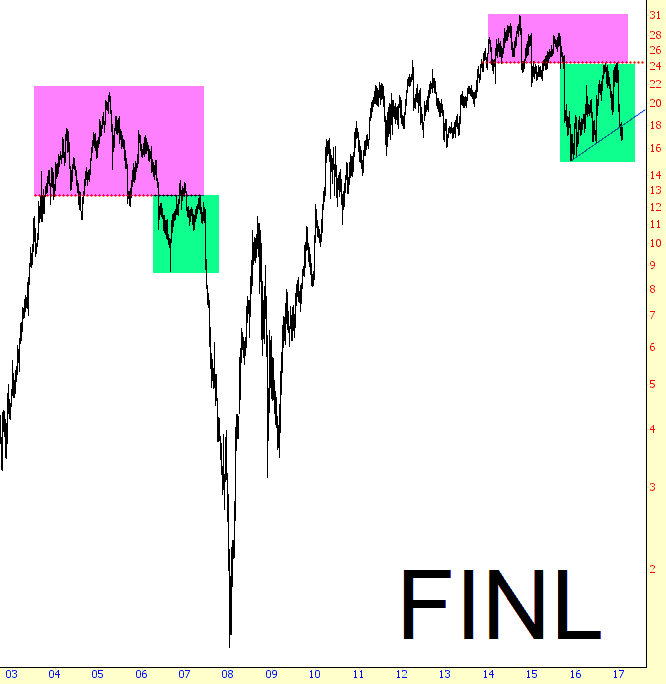
Let"s get back to the bearish charts, though: Shoe retailer Finish Line has been trending lower for months, and the analog is going beautifully:


0128-FINL


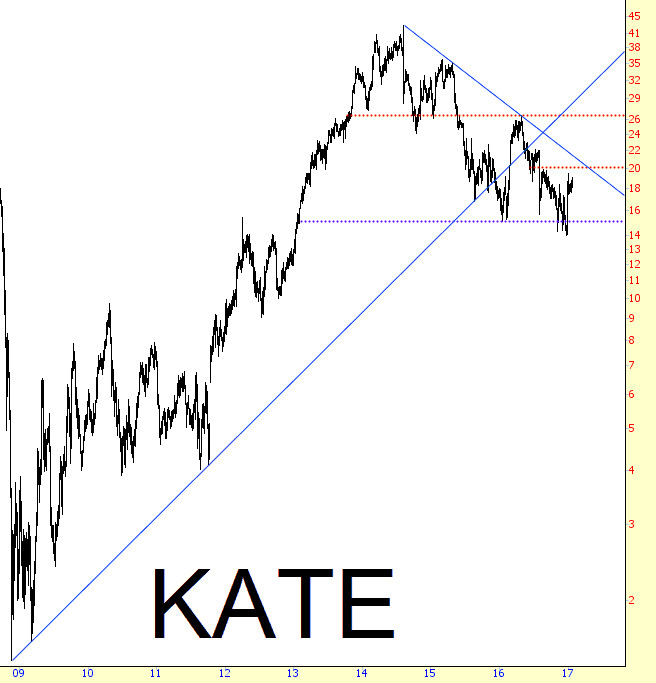
Another storefront at your local luxury mall is Kate Spade. It found strength off and on recently due to buyout chatter (they are desperately trying to sell themselves), but the pattern is bearish, and just so you are clear, just because a company is for sale doesn"t mean there will be any buyers. Just ask Twitter.


0128-KATE


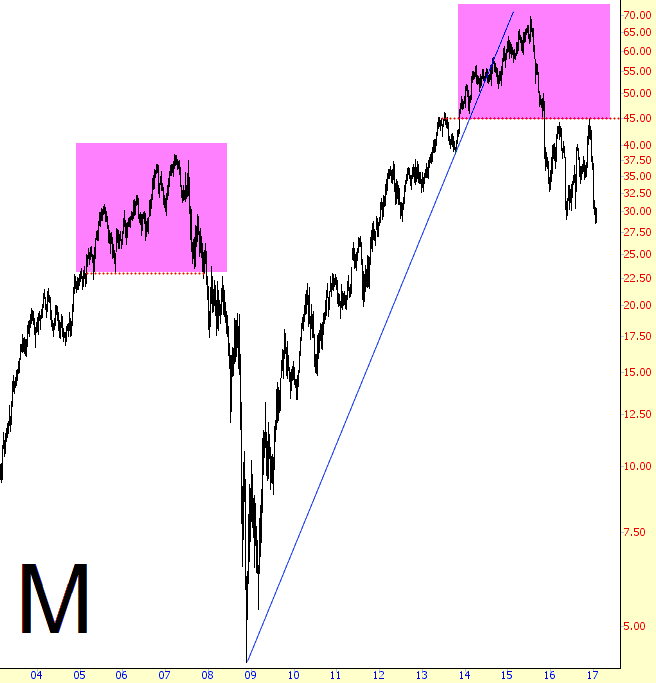
Speaking of analogs, take a look at Macy"s. Even though the stock has lost over half its value, if history is any guide, there are doomed as doomed can be (this is more impressive if you say it in an Ed Grimley voice).


0128-M


Hold on there........it"s another analog......and from another company I pick on a lot: Pier One, purveyor of scented candles, throw pillows, and monkeys carved from coconuts. This is another fine example of how just because a stock has already suffered a momentous collapse (about 65% so far) doesn"t mean it isn"t just going to keep collapsing. Firm support exists at $0.00.


0128-PIR


Overpriced seller of kitchenware, Williams Sonoma, is setting itself up for a big fall. It has found support for years in the mid 40s, but don"t count on that surviving the year intact.


0128-WSM


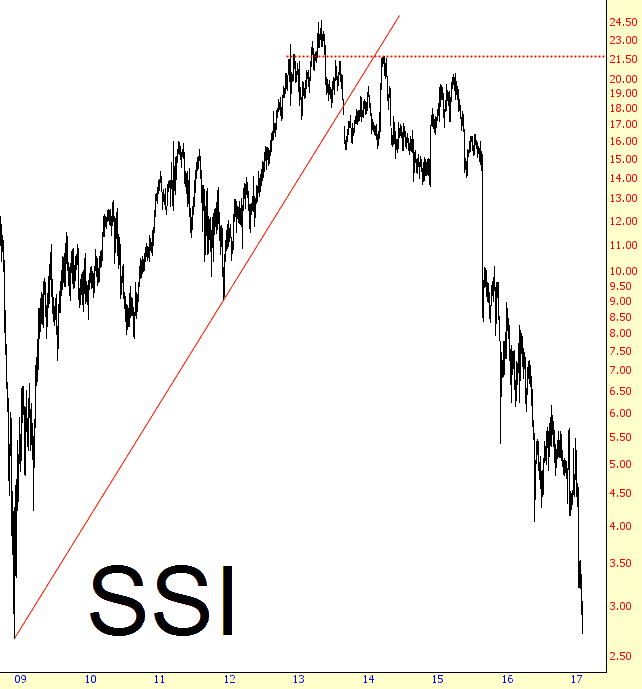
I will say, however, that some retailers are so far gone, the opportunity has already passed by. Stage Stores is a good example of a ship that"s already sailed.


0128-SSI


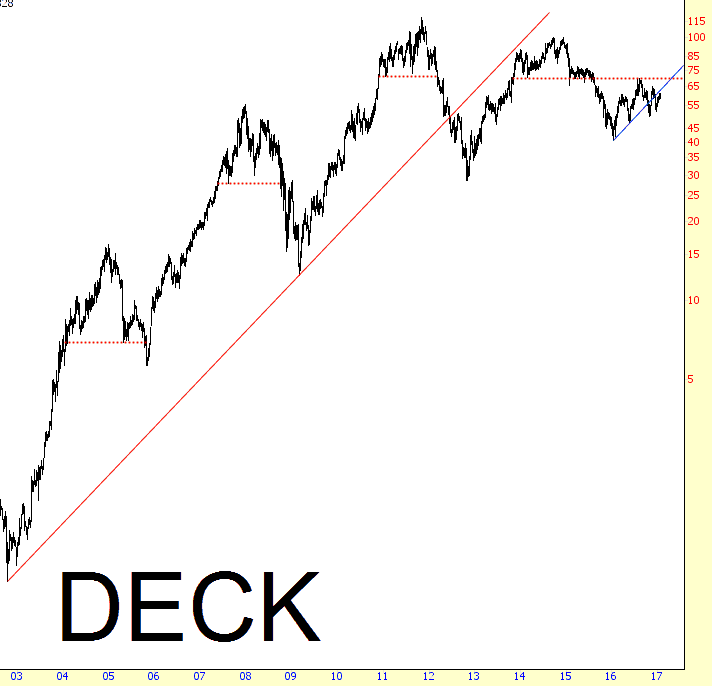
On the other hand, Deckers Outdoor (makers of the UGG shoe line, among others) has plenty of juice left to squeeze.


0128-DECK


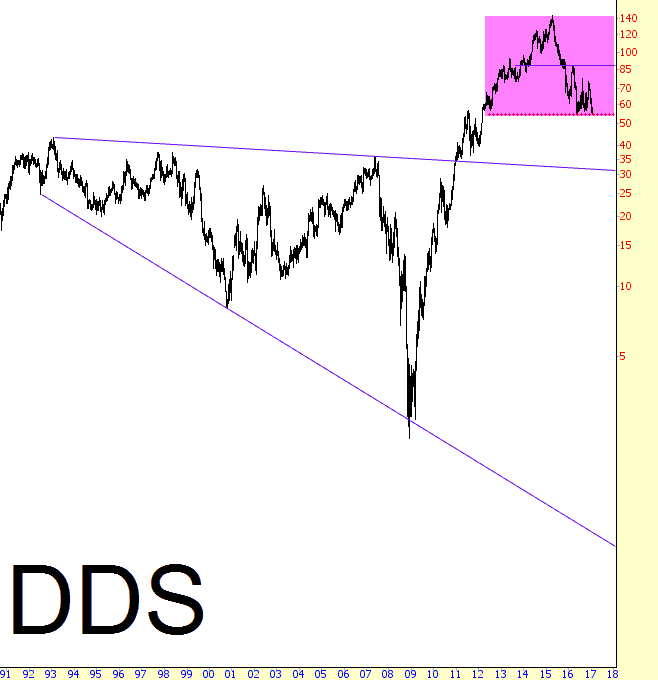
Dillard"s is another stock which has lost about 60% of its value already but doesn"t look anywhere close to being done falling.


0128-DDS


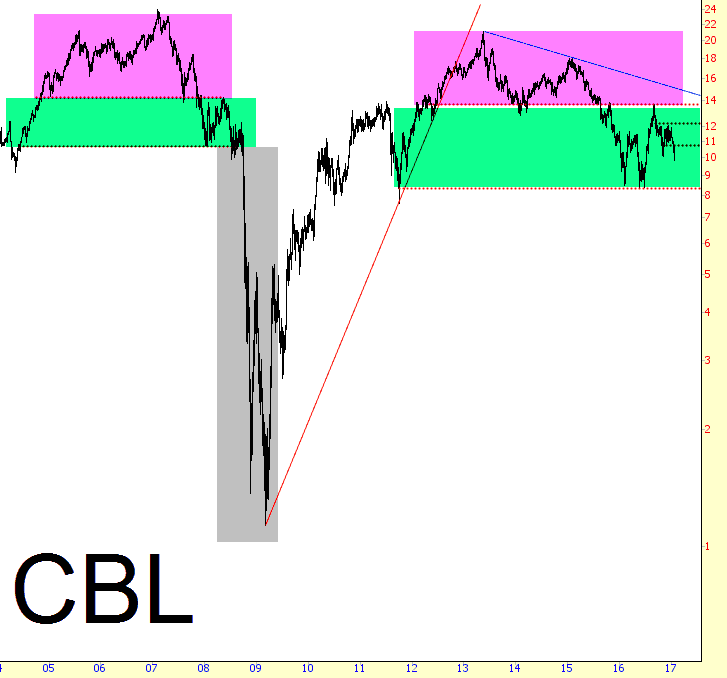
What got me thinking about all this was my best-performing short position, CBL Associates. I wasn"t sure what they did, but it turns out they are a big player in retail real estate - - hence their stock is also in a terrific analog and appears to be screwed and tattooed.


0128-CBL


If anyone is looking for rumblings to signal the kind of break in 2006/2007 that preceded the financial crisis, look no further than the charts above.