Showing posts with label market. Show all posts

Tuesday, December 26, 2017

Is Christmas Inefficient?

Authored by Jeffrey Tucker via The Mises Institute,


After hundreds of years of attacks on Christmas, economists have finally gotten into the act.


Yale University’s Joel Waldfogel, writing in the American Economic Review, condemns what he calls “The Deadweight Loss of Christmas.” Once you cut through the calculus and graphs, his conclusion is clear: though Christmas generates a $50 billion gift-giving industry, a tenth to a third of that is sheer loss. Why? Because the recipient doesn’t always get what he wants. Given the chance, the recipient would have purchased something else.


All of this follows directly from his underlying theory. In neoclassical economics, the consumer is best off when he chooses, within his means, the highest-rank good or service on his “utility” scale. If he can afford a steak, and he has to settle for a hot dog because the restaurant is out of t-bone, he experiences dead-weight loss. It’s even worse if he has to pay the price of steak and gets a wiener instead.


So it is with gifts. They generate a net loss, this theory says, unless the recipient would have otherwise purchased, with his own cash, precisely what he unwraps. Of course, this is rarely the case. To provide empirical meat to his theory, Professor Waldfogel interviewed students. The students received an average of $438 in gifts, for which these kids reported they would have paid only $313 if they had done the shopping themselves. The gap narrows when the gift is from a friend, and widens when it’s from the family.


Imagine Mr. Waldfogel attending your next Christmas gathering. Aunt Janie gives her nephews soap-on-a-rope, and they all praise her for her generosity and thoughtfulness. The economist then prods the youngsters to ‘fess up that soap-on-a-rope isn’t so great after all, and with the $9.95, they would have bought the newest Spice Girls tape. He declares the gathering a waste and encourages the party to break up in the interest of everyone’s economic welfare.


Professor Waldfogel proposes that we could eliminate these losses, which could be as high as $13 billion per year, by giving money instead of gifts, and letting the recipient spend it as he chooses. But then why not take matters one step further? What is the point of all this shuffling around of cash in the first place? According to neoclassical theory, it would be far better if everyone just clung to his own bank account and spent his own money as he saw fit. Indeed, we’d all be better off economically if Christmas were merely abolished—heck, maybe the Congress should do it—until such time as we all have perfect knowledge of each other’s preferences and are willing to act on them.


Far from being one man’s opinion, this thesis is becoming a classic “extra credit” question on microeconomics tests. Waldfogel is only distinguished for having formalized the model and tested it against his own students’ experience. The conclusion allows economists to presume they are smarter than the mass of the buying public, which persists in the irrational habit of buying things for each other instead of sending money or, even better, just spending it on themselves.


So, what’s wrong with the theory? Plenty. It equates personal utility with dollars spent, the classic conflation of value and price. In fact, a gift is a special kind of good with its own value. For example, we value the soap from the Aunt precisely because of its tie-in with familial affection. Even if the recipient would never have bought it, his personal utility is enhanced by the knowledge that his extended family is thinking about him and cares enough to give.


The source matters. If soap were given by a classmate who complains that you are odoriferously challenged, the “gift” is an insult in disguise. It has negative value. “Rich gifts wax poor when the givers prove unkind,” writes Shakespeare, who seemed to have a more complete view of economics than Professor Waldfogel. Neither is the person who receives a gift purchased under duress likely to be grateful. People on long-term welfare, for example, tend to think of taxpayers as suckers.


A comment later published in the same journal picked up on this. The authors (one from Harvard, one from the University of Miami) also did an empirical test. They used a different method (asking students about prices of specific gifts, not whole bundles), a larger sample of students (209 instead of 78), and asked more detailed questions. The results were the opposite of Waldfogel’s. The authors showed that more than half valued the gift above its retail price, suggesting that Christmas giving actually represents a gain in social welfare.


Moreover, these authors found that gifts asked for were less valued than gifts that were not. This fits with experience: we’re pleased to get what we want, but especially appreciative when we like something we had not expected. Indeed, good gift shoppers think about this ahead of time. They buy someone a tie he would never buy for himself. They buy items the receiver might be too modest or frugal to purchase himself, even if he had the resources.


Some items are just gifts and nothing more: fancy soaps, paisley boxer shorts, blankets with school logos, coffee cups printed with witty slogans, and the like. That’s why there can be such things as “gift shops” as distinguished from regular stores. Gifts have a different value because they are altogether different goods. They embody not only themselves but also their meaning. Imagine if someone came to dinner, and instead of bringing a bottle of wine, gave you $15 and told you to spend it on anything you wanted. It’s just not the same.


For his part, Waldfogel responds by accusing the authors of biasing their results. The very nature of their survey questions encouraged students to report “sentimental value” instead of pure “material value.” Going back to the drawing board, and correcting for this and other supposed errors, Waldfogel surveyed another group of students—455 this time—and still found a dead-weight loss, less than before, but a substantial one nonetheless. Christmas is inefficient: that’s his story and he’s sticking to it.


Of course there is no way to decouple one kind of value from another kind of value, since all economic value is ultimately subjective. Surveys can’t reveal what people value; only action in the marketplace does that. What’s deeply odd about this wrangling is that everyone seems to agree that only the value to the recipient should matter. That leaves out the really crucial point of gift giving: that it benefits the giver as well as the receiver.


People feel good in being generous, especially towards family and friends. Giving is an act of charity and liberality, virtues people practice because they’re good for the soul. And even if they aren’t, economists should follow the rule of “demonstrated preference”: if a person gives a gift, it is because he preferred giving the gift to keeping his own money. The action is “utility enhancing” on its own terms. Why? Because it, as opposed to something else, took place. Value is revealed in the preferences people demonstrate voluntarily. A well-chosen gift also reveals something about ourselves: we care enough to make our affections known in a personal way.


Again, the problem of the welfare state presents itself. In its form of “charity,” people do not give voluntarily. So resistant are people to dumping billions of dollars on millions of freeloaders, that the government has to threaten them with fines and jail terms (that’s what taxation is) to get them to fork over this “gift.” No one demonstrates a preference for the welfare state (voting doesn’t count since people are not using their own resources to purchase the services for which they vote). This degree of redistribution has to be imposed. Taxation, in contrast to Christmas, is a clear example of a utility-reducing activity.


But economists of the neoclassical school have rarely bothered with such distinctions. Their theories leave little room for reflection on property rights, individual choice, and the distinction between market exchange and forced redistribution. For them, a mathematically determined standard of efficiency is the only test that matters. Not even an absurd conclusion—for instance, that giving gifts is inefficient—causes them to rethink their core theory.


Economists are hardly alone in this. Skeptics and opponents of the market economy have long had a beef with the idea of giving and charity, especially as it occurs at Christmas.


Perhaps the socialists have long understood something about Christmas that others, even advocates of the market, have overlooked. In the institution of the gift, we find a strong rationale for the establishment and protection of private property and the capitalist economy. In order to give, we must first produce, acquire, own.


G.K. Chesterton, a great defender of Christmas against English Puritans who regarded it as corrupt and pagan, observed that collective ownership would mean the end of voluntary giving. Moreover, he clarified, “giving is not the same as sharing: giving is the opposite of sharing. Sharing is based on the idea that there is no property, or at least no personal property. But giving a thing to another man is as much based on personal property as keeping it to yourself.”


And contrary to the complaints of materialism at Christmas, meaningful gifts can be as elaborate as gold, frankincense, and myrrh, or as humble as two fish and five loaves.


It’s no wonder, then, that history’s dreariest socialists have denounced Christmas. The economic core of its gift giving centers on private property, while its ethical core belies the claim that private property institutionalizes greed.


“There is the greatest pleasure in doing a kindness or service to friends or guests or companions,” wrote Aristotle in The Politics, “which can only be rendered when a man has private property. These advantages are lost by excessive unification of the state…. No one, when men have all things in common, will any longer set an example of liberality or do any liberal action; for liberality consists in the use which is made of property.”


As for intellectuals—economists no less—who have failed to understand this simple truth, it’s staggering to think of the dead-weight loss their ideas have imposed on society.


Monday, November 13, 2017

Great Voids Have A Way Of Filling

Authored by Sven Henrich via NorthmanTrader.com,


I feel compelled to keep documenting reality to raise awareness of the ever larger market dangers which keep lurking underneath the current bubble. Indeed I keep seeing a great void not only in awareness but also in price discovery that have propelled markets to current levels leaving investors and participants ever more lulled into a false sense of security by the current unprecedented phase of volatility compression.


Take these comments as part of an ongoing journey outlining building risk factors. You can read about additional updates/background in the Macro Corner, Market Analysis , NT Blog and the Market Analysis sections of the site..


Briefly to get everyone on the same page:


Two way price discovery, as a normal part of market functioning, has practically seized to exist. I’ve pointed out charts of this nature before, but I’ll use the quarterly $DJIA chart as an example to illustrate the point:


Several points to make here:


The $DJIA is on its 9th quarter of consecutive price appreciation. The last red candle was before the now almost $5 trillion in combined global central bank intervention since February 2016.


The $DJIA, as the $SPX, is now on its 4th consecutive quarter of not reconnecting with its quarterly 5 EMA. Such an extended disconnect has never occurred in the 100 year market history I reviewed. And believe me, I’ve looked:


The few examples of extended quarterly 5EMA disconnects I could find were associated with coming market pain.


Aside from global central bank intervention (also see Liquidity Wave) the other key contributing factor to the no 2 way price discovery equation is the unprecedented influx of passive ETF investing and plenty of data exists to illustrate this point:


What has happened? I consider it retail capitulation. For years hedge funds have underperformed central bank liquidity infested market waters yet retail investors keep seeing markets go up with no downside ever and no apparent associated risk with rising multiple expansion.


The end result: Investors are completely impervious to the building risk factors and the actual price/valuations of asset prices they indirectly own.


If there is no risk to holding stocks then who cares if the underlying asset will ever grow in its valuation? Who cares if the business models don’t match up the PEG ratios?


Price targets have now simply been rendered an exercise in FOMO expectations. Indeed Wells Fargo rightfully calls it another QE effect:


“It’s very similar to QE.” Harvey said Wednesday on CNBC’s “Trading Nation.” “With QE, you took a certain part of the Treasury market out of circulation. Now what you’re doing is you’re taking a good part of the equity market out of circulation, and you’re upsetting the supply and demand dynamics. There are fewer natural sellers.”


Wells Fargo’s new 2017 forecast calls for the S&P 500 to reach 2,636, which reflects about a 1.9 percent gain from current levels. The firm started the year with a 2,475 year-end target, which would have come in about 4 percent short if the year was to end now.


We don’t see a lot of bad news in the short term, and so we feel it’s fairly justified,” said Harvey, who became in charge of the firm’s S&P 500 price target and earnings forecast in April. He acknowledges Wells Fargo’s initial forecast was “too conservative” and the year has been exceeding expectations.


According to Harvey, there’s still momentum in place for stocks to grind higher.


No one wants to be the first one out of the pool. No one wants to de-risk at this point in time,” Harvey added. “You have this mindset of FOMO — fear of missing out.”


There. FOMO. I can’t disagree that this price extension or even further extension could happen. As long as there is no consequence to overpaying for assets and volatility remaining compressed with all corrective activity having been removed from markets what is to stop prices from advancing ever more?


The answer: The Great Void.


Let me explain.


Firstly let me go back to a chart I showed back in March when I discussed The Finale Wave:


Back then I said the following:


“This is actually a pretty good trend line for bulls as it keeps rising of course, hence the later price were to get to there the higher markets may extend. The bad news: If this trend line has market relevance (as it appears to looking at its history), then it suggests the following:


$SPX broke this trend line in 2008/2009. And despite vast global central bank intervention as well as building a global debt load to the tune of over $152 trillion, markets remain below this long term trend line. It’s still technically broken.”


This still applies to this day and here’s an updated view of the chart with the added context of the multi decade declining trend in the 10 year yield:


Why is this important: It could be argued that low yields remain the theory of everything over the past 30 years as we’ve moved from one bubble to next with central banks reacting each time by dropping interest rates to “save markets”.


Take the $DAX chart I showed the other day:


Same concept.


What’s the net effect of one way price discovery? Massive, historically unprecedented technical extensions that scream danger, incompatible with the complacent attitude of investors.


Let me show you some charts that need to be seen to believed. Frankly if ETF investors were to see these charts they may get a better sense as to where in historical context they are deciding to invest long in these markets.


Hence my quest to raise awareness and I use linear charts in some cases to really drive the point home. Linear charts make ZERO difference in regards to moving average disconnects or fibonacci retrace levels, but they can help illustrate the vastness of the void. Indeed log charts can breed a sense of complacency as often price does not appear anywhere near as extreme.


On this latter point let me give you 2 examples of two very successful companies using log charts:


$FB:


A very steady uptrend following trend lines very diligently with tags producing either rejections or bounces. The stock has had no real correction in almost 2 years. The fib levels outline the size of the corrective opportunity were markets to get shaken out of their current lull.


$GOOGL shows a similar picture:


An ever narrowing channel showing a void of any corrective activity of size.


Now let’s get to the great awakening. I’m showing you a few examples of individual large cap stocks on yearly charts in relation to basic moving averages. Note the regular proximity to the annual 5 EMA in particular.


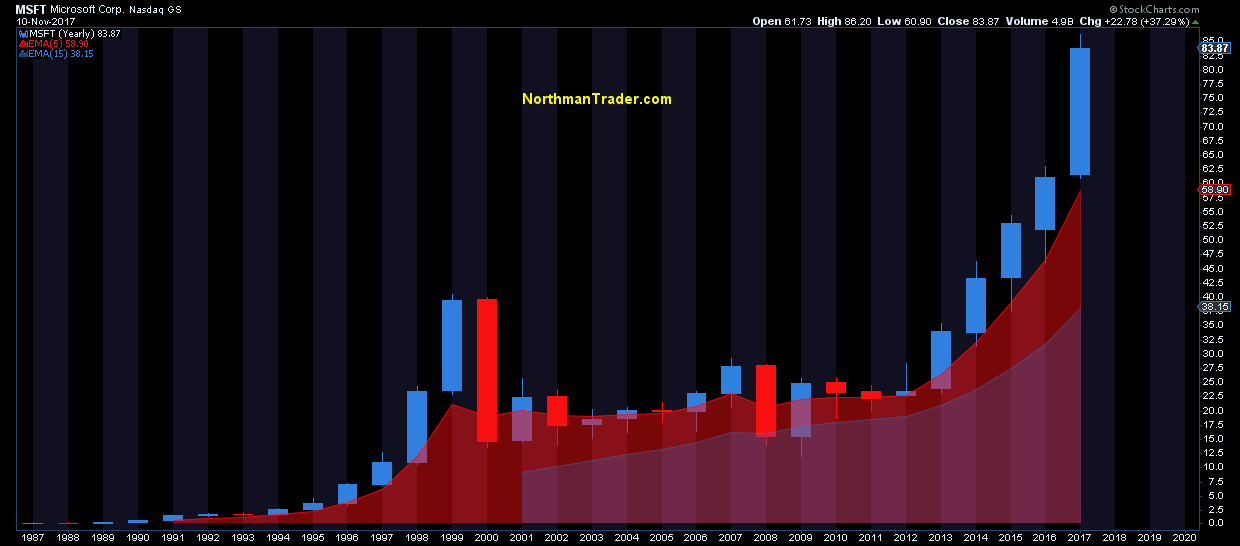
Now look at 2017. THIS is where investors are passively adding money to markets.


How do these things end? Can these things end? Look no further to $GE to give an imminent sense of risk:


Reconnects are coming. They always do and just because markets get stretched to extreme levels it does not mean reconnects are not coming.


These disconnects have been brought to you by one way price discovery. “No natural sellers” Wells Fargo calls it. That’s right. No sellers. Markets have buyers AND sellers. If there are no sellers you don’t have a market.


No sellers means no volatility. And the extremity of the volatility compression is highlighted in its inverted product the $XIV:


On the $VIX itself all regular spikes to the weekly 500MA have been eliminated 2017. For now.


History suggests that this state will not be able to sustain itself:


2017 has shown that extreme markets can become more extreme. There is nothing new about that. We’ve seen it famously in 2000.


Extreme markets do not imply future performance. But hey help inform risk/reward.


Whether we continue to extend price discovery in a one way fashion into year end I can’t say. What I can say with affirmation is that investors appear utter oblivious as to the historic and technical context in which they allocate cash to the long side.


One way price discovery, volatility compression and over 8 years of central bank intervention has paved the way to a general attitude that investors can’t lose money being long. Price will always come back. Not only in our life times, but these days every day as no downside ever last more than a few minutes. No natural sellers.


This will change.


And it’s critical for investors to keep an eye on possible signs of change, even subtle signs. I offered some not so subtle signs in Caution Slowdown. But macro signals can take a long time to play out in a market void of any apparent negative triggers.


Friday’s first $VIX close above 10 in 8 weeks may not amount to anything, but then it may also offer a subtle sign that change is perhaps closer than we think:


Yes the 200MA is now down to a pitiful 11.14, but the weekly close puts it above it. For the first time in a very long time.


Great Voids have a way of filling. Perhaps not in space, but here on earth they generally do. It’s just a matter of time. Remember: Tops are processes.


Monday, November 6, 2017

The Deflating Rally

Authored by Sven Henrich via NorthmanTrader.com,


Record prices continue to be printed on US indices as the global multiple expansion on the heels of still ongoing record central bank intervention has yet to slow down in a significant way.


All central banks were in essence dovish in recent days and weeks, whether the FOMC, the ECB, the BOE and of course the ever active BOJ as well as the SNB as it showed a new record $88B in direct holdings of US stocks.


Yet, despite the record prices on indices, the rally appears to be deflating from within.


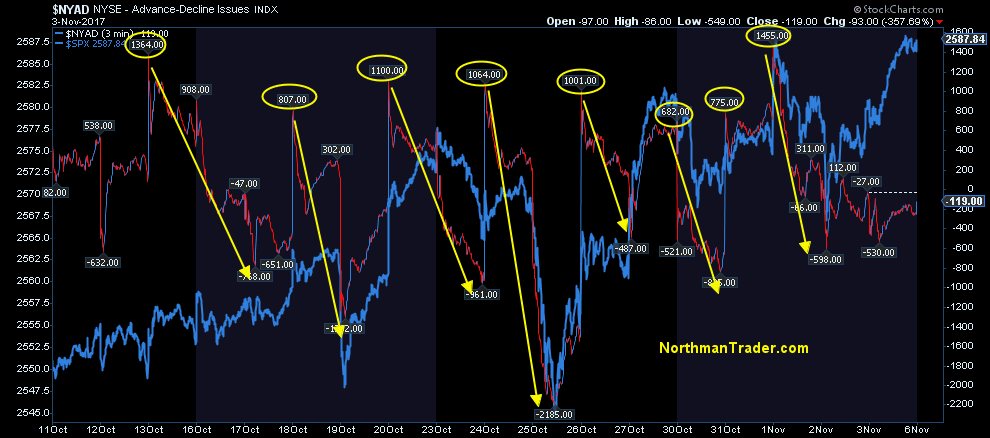
In the past several weeks I’ve pointed out a very specific pattern of positive internals on market opens and then a very distinct pattern of internals weakening throughout most days:


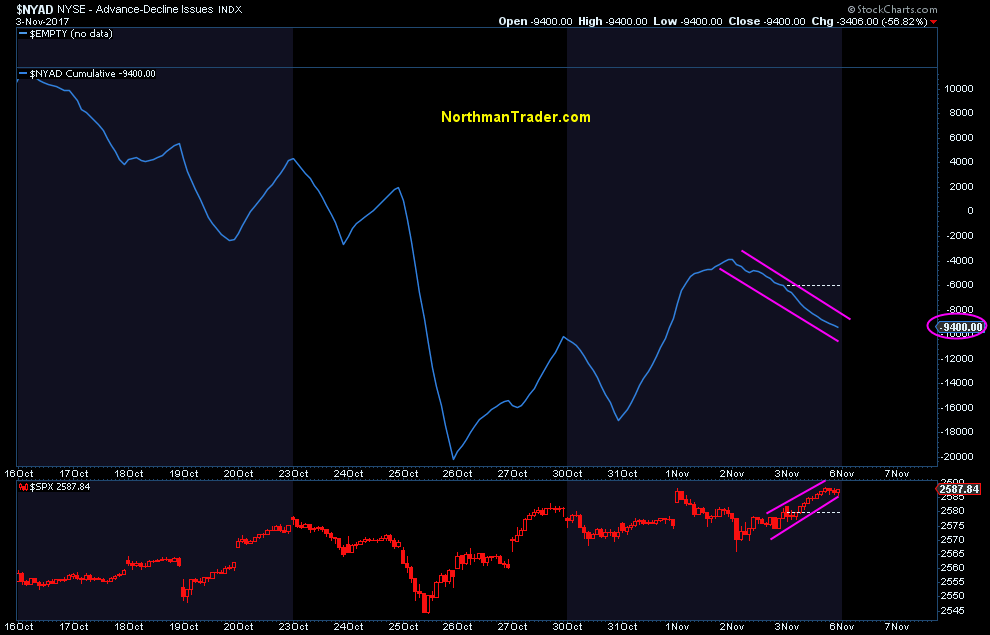
This trend has impacted the cumulative advance/decline picture and shows that recent highs have come on a negative cumulative advance/decline:


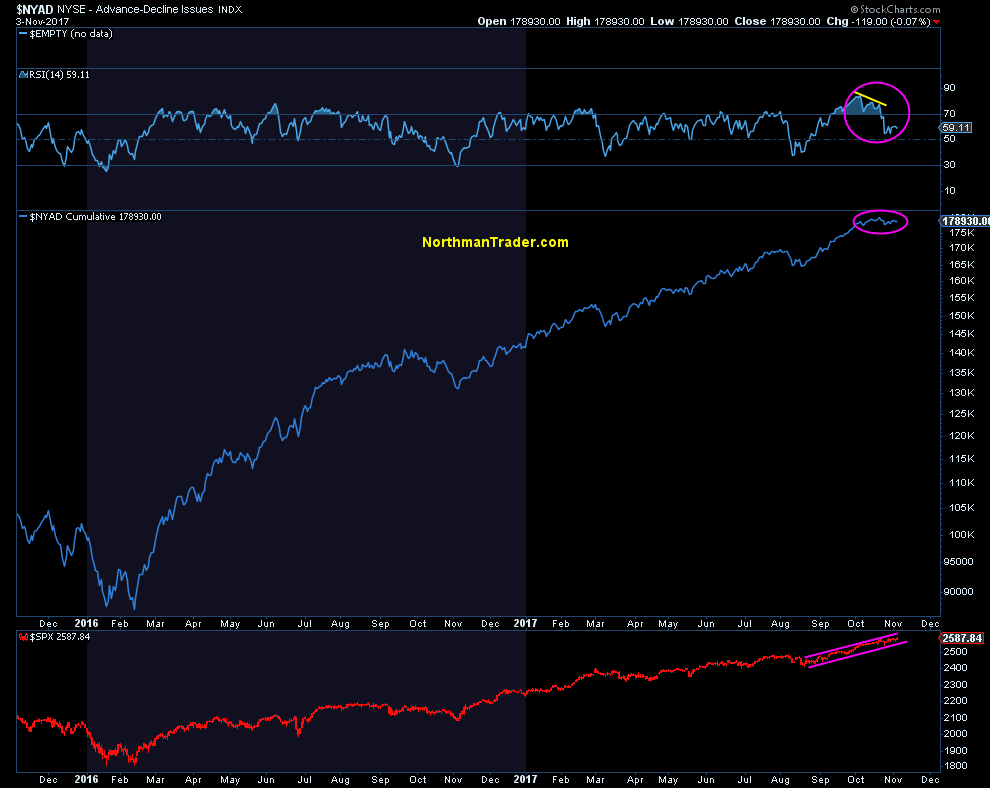
Since this rally began with massive global central bank intervention in February 2016 the cumulative advance/decline picture has often been cited as a sign of underlying core strength in markets. This picture has changed:


Recent highs came on negative divergences in relative strength despite index prices continuing to advance in a seemingly steady trend.


Yet the internal picture is practically collapsing.


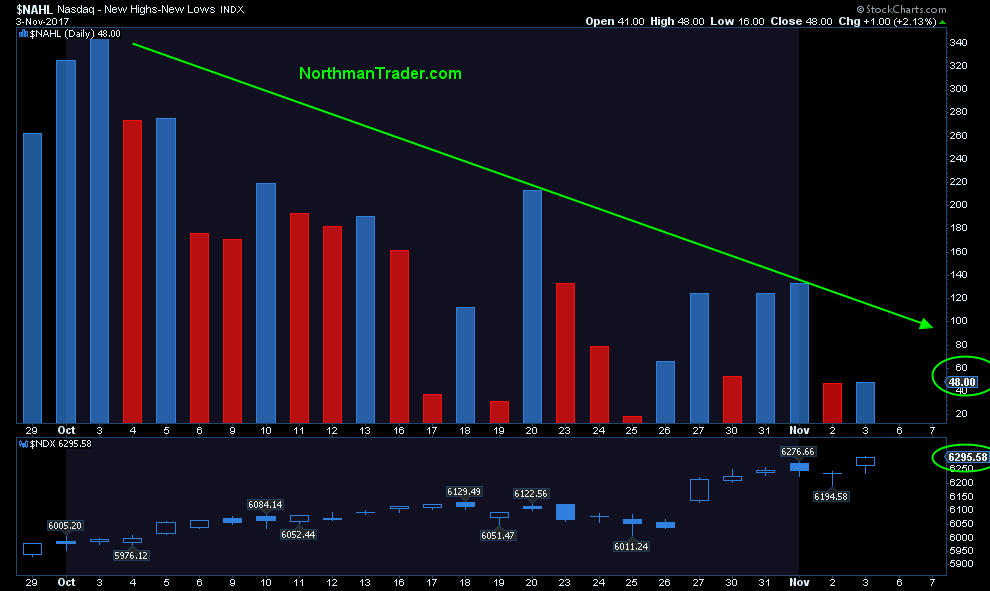
Take the recent highs in the Nasdaq.


Ever since the beginning of October all new highs in the $NDX have come on fewer new highs versus new lows. Indeed Friday’s $NDX highs came on the lowest expansion yet:


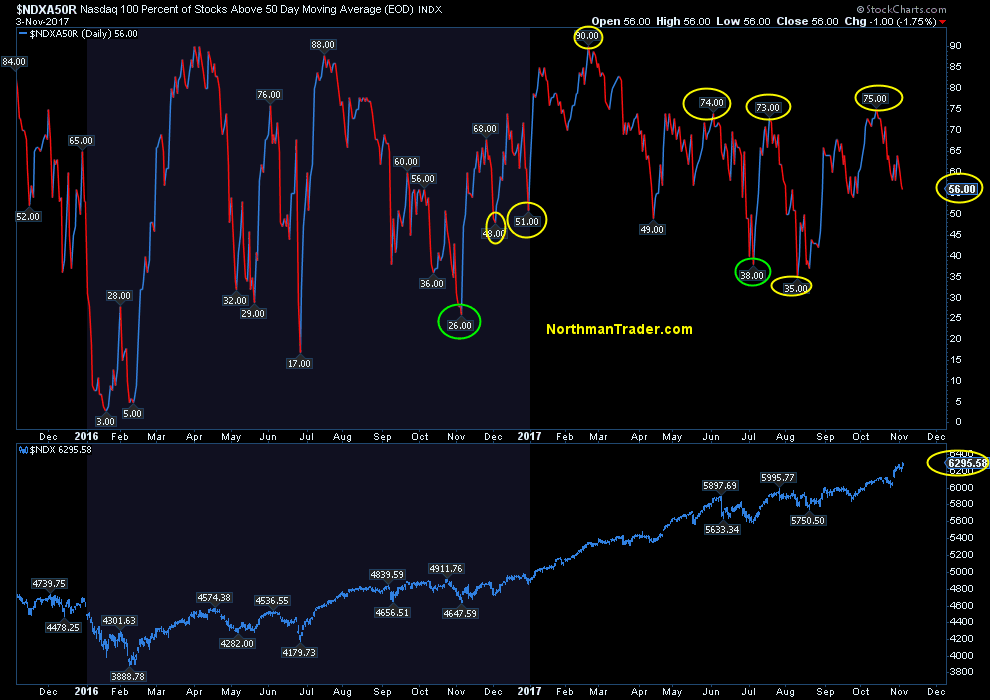
On $NDX itself we can observe a complete collapse in the amount of stocks above the 50MA as $NDX printed new highs. Only 56% of components are still above the 50MA:


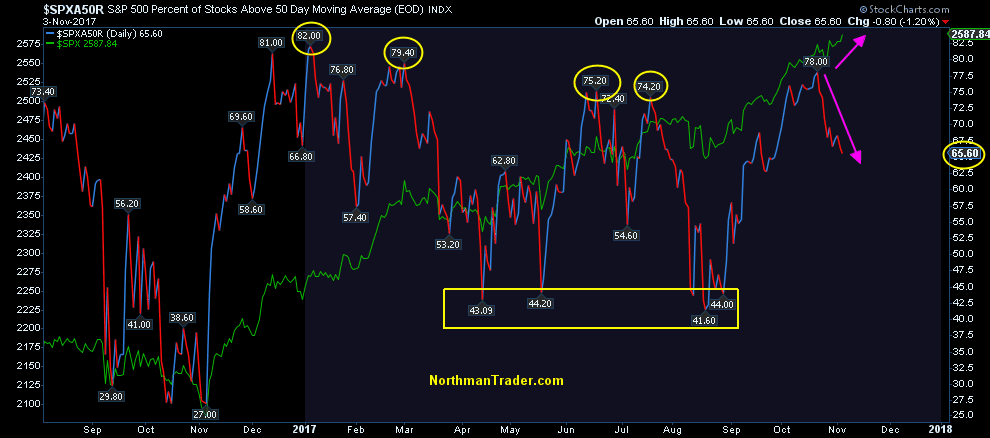
A similar picture can be observed on the $SPX:


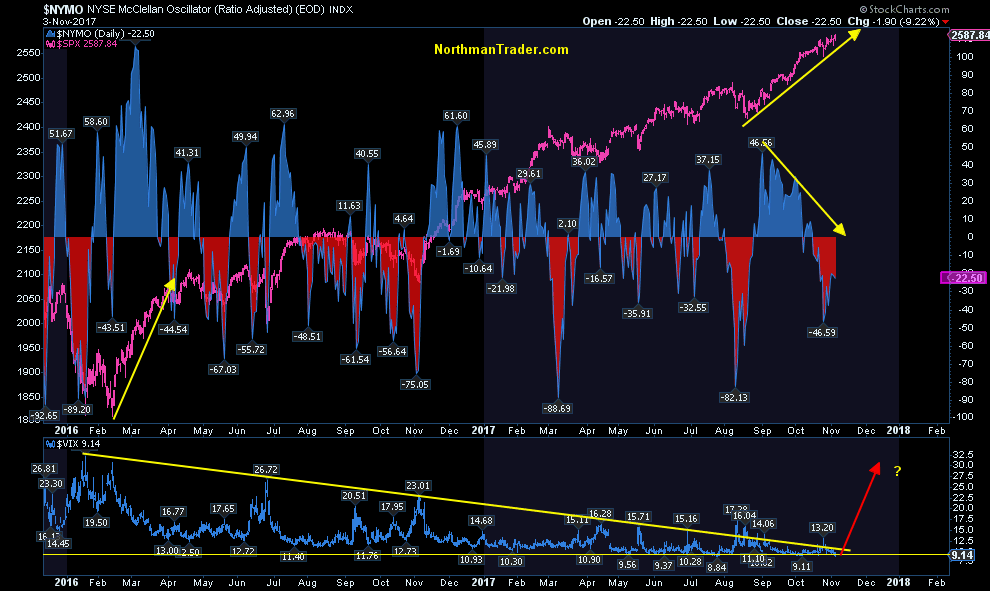
And of particular note: All recent highs have come on a negative $NYMO:


The message: Somebody is selling this market. Every day. And it’s very cleverly done as to not disturb the seeming tranquility in markets.


Note that despite all the selling volatility compression continues at a record pace as during each Friday, no matter what happens in the world, the $VIX is ensured a close below 10 by week’s end:


You’d think we’d have more volatility with such an internal breakdown in stocks. But the concentration of market cap in only a handful of stocks continues to mask the selling underneath.


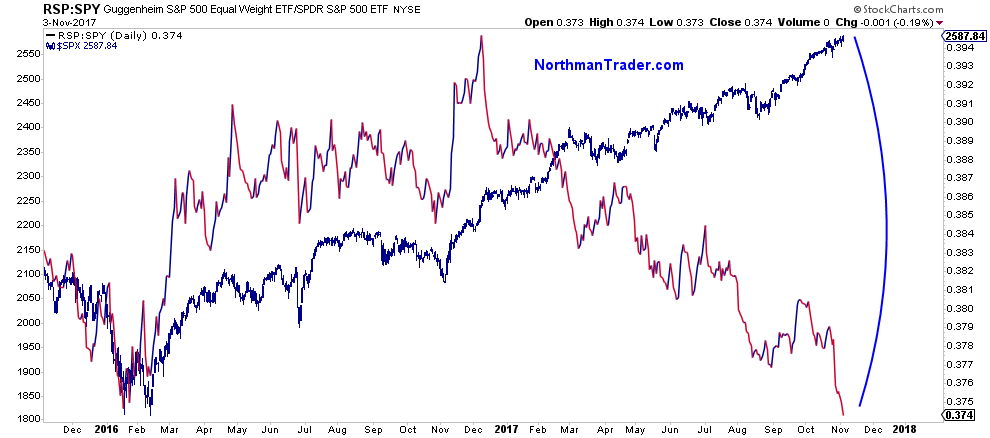
On an equal weight basis we’ve noted the divergence in markets for quite some time. This indicator has now fallen off the cliff as the correlation has completely broken down:


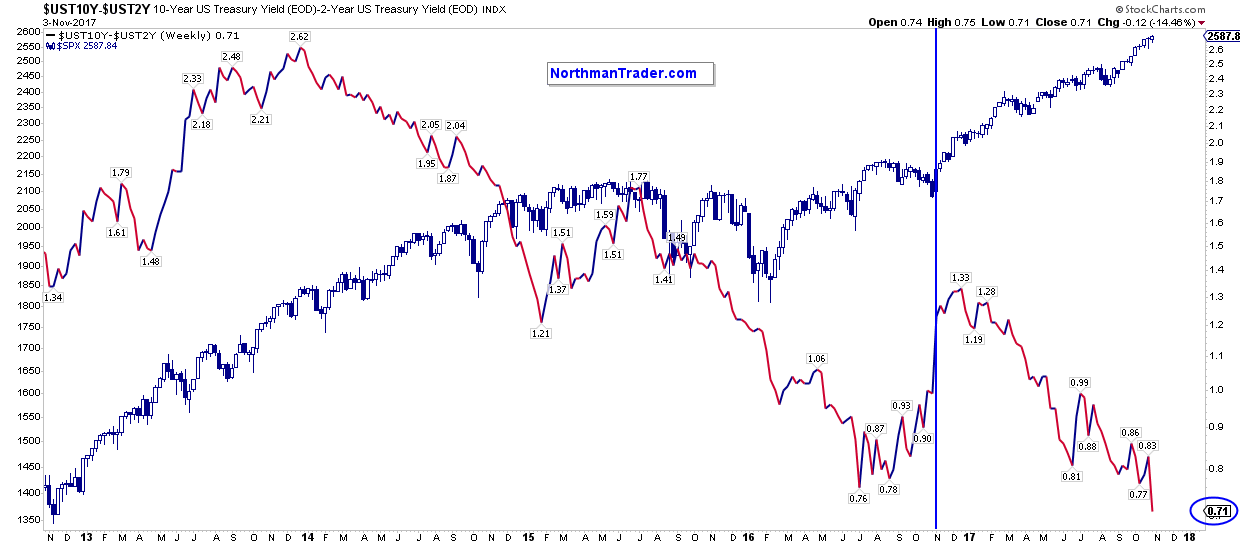
As has the yield curve which hasn’t believed in this rally in months:


2017 has seen more central bank intervention on a global basis than ever. But this party is slowly coming to an end. And while central banks will still intervene in 2018 it will be at a reduced pace. The last time we’ve seen central banks intervene at a reduced pace? 2015. And it produced sizable selling in the summer of 2015 and at the beginning of 2016 forcing record intervention since then.


All global markets have proven is that they can perform splendidly with record intervention:


2018 will then be a test case how well markets can fare with less than record intervention, a new reality. Another new reality: Soon US markets will also have their answer in regards to tax cuts. All will be priced in one way or the other.


And, from the looks of it, someone has begun selling ahead of both of these emerging realities. And once the rest of the market takes notice we suspect Friday $VIX closes below 10 may suddenly become a thing of the past.


Thursday, September 28, 2017

Kass: "Investors Seemingly Learned Nothing From History"

Authored by Doug Kass via RealInvestmentAdvice.com,


“‘A bull market is like sex. It feels best just before it ends."” – Warren Buffett


Excuse me for being redundant, but the following Jim Rogers quote that I posted yesterday underscores Mark Twain’s famous quote that “history doesn’t repeat itself, but it often rhymes”:


“When things are going right, we all need a 26-year-old. There’s nothing better than a 26-year-old in a great bull market especially in a bubble. They’re fearless. They don’t know. It will never end. They will tell you why it will never end. They know that it cannot end and will never end. So in the bull market, you’ve got to have a 26-year-old. But when they end you don’t want the 26-year-old around… they make a lot of money. They don’t know why they made money. So they don’t know why they lose money. They don’t know what happened. -Jim Rogers on Realvision


Back in 1997 I wrote this editorial in the Other Voices section of Barron’s that echoed Rogers’ recent quote.


In the difficult business of piling up a fortune everyone has an infallible strategy and a set of assumptions, technical and./or fundamental, that leads them to investment nirvana.


But it is never easy. The rules change and so do the players.


From my perch I steadily have listened to the irrational being rationalized as the bulls declare, with straight-faced confidence, that valuations in the 95% decile should be ignored because a synchronized global expansion will “earn out” from these extended metrics.


This confidence is expressed despite a plethora of possible adverse outcomes, particularly in the interconnected world in which we live.


The positive outcome of steadily expanding global growth coupled with low inflation and equally low interest rates may yet prove to become reality. Geopolitical friction may subside. Political partisanship in Washington, D.C, may succumb to cooperation, leading to the initiation of tax and regulatory reform and the repatriation of overseas corporate cash. The Orange Swan may wake up and reject the extreme influences of the Republican right. Trump may stop threatening a war with North Korea in a ping-pong of outrageous and provocative tweets. The rate of growth in real GDP may expand to 3% and we may be in another new paradigm of uninterrupted growth. S&P profits will grow at a rate of 8% annually, ad infinitum. Natural disasters will be a thing of the past and global warming concerns are nonsensical. The North Korean Rocket Man may be all hat and no cattle. The proliferation of ETFs, which in number now exceed the number of listed equity securities, and the ever-present quant strategies that are ignorant of fundamentals may not yield a “flash crash,” easily accommodating any selling waves. Every dip will continue to be bought. And interest rates and inflation may be in a permanent stage of adolescence.


But, I am blinded by a sense of history, and the belief that few of the conditions in the last paragraph are likely to be met.


In our flat, interconnected and network world, the odds favor less stability over more stability.


To this observer the markets’ dominos are exhibiting signs of falling around all over — in consumer packaged goods, in (T)FANG, in retail and elsewhere. Yet the selective memory of the talking heads in the business media emphasize the narrowing field of outperforming stocks (e.g., Nvidia Corp. (NVDA) and Deere & Co. (DE) ) that have been working, failing to see those falling dominoes around them.


Fear and Doubt Have Left Wall Street


The ever-present risk to the contrarian is that, over the short term, the past literally is repetitive and the crowd typically outsmarts the remnant. Tuesdays always follow Mondays and Wednesdays follow Tuesdays. But as we extend time cycles, history seems to move from repeating itself to rhyming with the past.


History undoubtedly teaches lessons about investment, but it does not say which lesson to apply when. “Find value, always” is as good a precept as any, but value is subjective and its definition is liable to change. In highly speculative markets, value means, to most, “it is going up.”


Stay abreast because in bull markets there is rarely a clear demarcation between progress and fantasy. I remain of the strong belief that we are in a Bull Market in Complacency that likely ends poorly and that has reduced the upside and has expanded the potential market downside.


To the bullish cabal the market “feels” great now (for, as Warren Buffett says, it is because, like sex, if feels best at or near the end), but after an eight-year bull market it may be time to consider the investment contrary. As James Surowiecki wrote in “The Wisdom of Crowds”:


“Diversity and independence are important because the best collective decisions are the product of disagreement and contest, not consensus or compromise.”


Investment returns likely have been pulled forward by central bank liquidity, low interest rates and passive investing. However, over the next five years returns may be substandard at best, but more likely, negative. At worse, we face an incipient bear market.


As expressed in yesterday’s opener, the nature of and players in the investment business have changed. This helps to explain the Teflon nature of the S&P 500 Index.


But as Grandma Koufax used to say, “my matzah brei doesn’t grow to the sky,” and every day we move closer to a Minsky Moment.


The salutary environment perceived by many today may be transitory and weak in foundation.


The potential political, geopolitical, economic and market outcomes are many, and a clear and market-friendly path is not certain.


Bottom Line


The name of the game is money. It was Lord Keynes who first saw that the handling of it is a game. Most discussions of money and investing speak only of economics and statistics, but that’s only a part of the game. The other part is people, individually and together, the emotional investor and the irrational crowd.


And it again might be the market scene that is often (as it was in 2000 and 2007) seen only in kids’ eyes or in the eyes of older investors who behave like 26-year-olds at or near the end of every significant bull market cycle:


“‘See, see,’ said the Great Winfield. ‘The flow of the seasons ! Life begins again! It’s marvelous! It’s like having a son! My boys! My kids!"” -Adam Smith, “The Money Game”


Do some reading over the weekend as it appears that the only thing many investors have learned from history is that they haven’t learned from history.

Sunday, September 17, 2017

Is the Difference Now Permanent?

From the Slope of Hope: I will start off with a chart that, in a sea of tens of thousands of charts, stood out as shocking:


0916-drawdown


What the chart represents is the percentage drop from whatever the record high was. In other words, it shows the percentage loss a person would have had if they had bought at the highest point in the history of the market.


What stunned me about the chart was how for nearly half a decade stocks have been absolutely "pinned" to the top. There was a tiny dip in late 2015, but since that time, there hasn"t been a single drop in the market of even 5%, and even those tiny 1% and 2% drops have been utterly healed.


In other words, hell on earth for an equity bear. Absolute. Living. Hell.


Of course, equity bulls are doing fine, and those who didn"t trade the market prior to 2012 must figure this is the easiest thing in the known universe. Indeed, they probably feel like geniuses. Because all you do is deposit some money, pick a few random stocks, and voila, you have more money than before.


Why should anybody even bother working, with such easy money out there?


Of course, those of us who study markets for a living know that there"s a pretty simple reason for this unidirectional "market" of ours......


0916-correla


Hell, it even applies right down to the individual stocks!


So the question I ponder with increasing frequency now - - and it"s a question whose potential answer chills me to the bone - - is this: what if it really is different this time? And, more important, what if this difference is permanent?


What if, in the relatively brief history of public equity markets, it simply took this much progress in technology, central bank knowledge, and economic scholarship to finally figure out how to completely control the market without serious price inflation?


What if, as recent history shows, equities will merely increase in price in perpetuity? They might not move that swiftly, but they will, more or less, become more valuable, with a sprinkling of tiny drops here and there to make sure people don"t go completely hog wild.


Let"s think of this from a different angle: as you probably know, the market for diamonds is tightly controlled. De Beers has mastered the art of the cartel. If diamonds were simply in a huge global open market, with price discovery fully allowed, there is no doubt prices would be far lower (albeit more volatile), because they actually are NOT that rare or precious.


As it is, though, De Beers has balanced massive marketing ("a diamond is forever"........."how can you make two months" salary last forever?") with artificially-controlled supply to yield a market with pretty much zero volatility and a steadily increasing price.


Maybe the chart above is the future of stocks. I really don"t know.


But do you notice there"s no active public market for buying and selling diamond as a commodity? And that there aren"t any technical analysts for diamond charts? Or that there"s no national network devoted to news related to diamonds? It"s because all of that stuff would be drop-dead boring, because prices are controlled, and predictable, and not worthy of examination. Someone figured out how to control the market. And thus the "market" no longer exists.


God help us all............us chartists especially...........if this is the new world order for equities.

Friday, September 8, 2017

Cubed!

By Chris at www.CapitalistExploits.at


When I set out over a year ago to just once a week highlight one element of absurdity (because it is absurdity which often leads to asymmetry and thus profits) on this ball of dirt we call home, it was inevitable that I wouldn"t have much trouble in finding things to jeer and laugh at.


With the torrent of rules and regulations, manipulations, and interventions that fill statute books each day... and with governments and central bankers doing what they do best (stupid things), it was a statistical certainty that I would reach a day when I looked around and finding far too much to show you my head would simply explode. And this week that day arrived...


And so... with an exploded head I"m useless to you.


So instead, I figured I"d go back and review all the voting on the
World Out of Whack posts I"ve done. And by George, there are a sh*tload. June of 2016 was when the fun began. I don"t know if I"ll get through them all but you never know unless you start so here"s the first three.


1. Bat isht crazy real estate


Vancouver real estate. Investors thought it was such a great idea... except you. Cos you"re smart. Well done!


Now a year on, Vancouverites would rather weld their children together with molten metal than dive in and buy.


There"s more, though. I threw some crumbs. Now, don"t say I don"t love you:


Side note: While the focus today is on overvalued RE markets, as an investor I can’t help myself from pointing out that with a P/E ratio of just 9x, Hong Kong’s equity markets are today the cheapest in the world, with the Hang Seng Index trading at the biggest discount to global shares in 15 years.


As a reference point consider that most major stock markets typically trade at a P/E of between 15-20x, so we’re looking at an equity market some 40-50% of its highs and an overvalued real estate market at the same time.


Here"s that undervalued market I was talking about:


I then mentioned those fiendish orientals... and why you should buy Bitcoin. This is a game not just for round eyes in Silicon Valley to play:


2. Next up was just after Brexit


...and we asked you:


Crikey... you lot are sharp. Certainly French elections registered as a crisis in confidence with the first time that an incumbent never even made it to the runoffs. Ha! Take that Hollande... and put it in your pipe and smoke it.


3. And then in the third issue of WOW, we covered global bond markets


We asked the question:


So that was published on 29th June.


Though gold is about where it was in June of last year, this question will only be answered in the next crisis... and I"m willing to put some shiny ones on you being right once again because I promise you this: In the next crisis, gold is likely to fair much better than trying to conjugate the modern day version of Julius Caesar"s paper.


And really... if there is one thing I"d like to get across, it is encapsulated in this wonderful chart below. Because once you realise this, you"ll begin to start thinking the right way:


Happy Wednesday!  


- Chris


"Never attribute to malice, that which can be reasonably explained by stupidity." — Spider Robinson


--------------------------------------


Liked this article? Then you"ll probably like my other missives on


this topic as well. Go here to access them (free, of course).


--------------------------------------

Sunday, August 27, 2017

Grant Williams: "History Is About To Repeat Itself Again... And It Might Get Ugly"

Real Vision"s Grant Williams believes that the 76 million retiring Baby Boomers will trigger a major pension crisis. 


“With that potentially bad situation we could face,” the seasoned asset manager and co-founder of Real Vision TV said in a recent extended Metal Masters interview (full interview below), “holding physical metal, somewhere safe, somewhere outside the banking system, is just a sensible precaution to take.”


His outlook has changed drastically since he started his first job trading Japanese markets in 1986: “What I walked into at that time was one of the greatest bull market bubbles the world had ever seen, in the Japanese equity market and real estate market.” During this heyday, precious metals weren’t on his radar at all—until a year later, when he witnessed his first stock market crash and started asking some inconvenient questions.


“I’ve always been a fan of history,” says Williams, who also writes the wildly popular macroeconomic newsletter, Things That Make You Go Hmmm… “So I read financial history and I just kept reading. And it was clear to me that at this point in time, I needed to buy some gold.”


Until then, the gold price didn’t mean much to him, except as an indicator of other things, so he considers the crashes he witnessed in his career wake-up calls and blessings in disguise.


The 1987 crash, he says, was more like “a bad day at the office; it came and went so fast… The bounce-back was quick, but it was a real shock to the system that that could happen.” When the dotcom bubble burst, he was well prepared. “I recognized the madness for what it was much sooner… and so that taught me that markets can reverse and just go down.”


He remembers reading a story about a boy from Chicago who studied in Weimar Germany, and his parents sent him tuition and rent money every month. At some point, “the Reichsmark was going through the roof—four billion to one, compared to one to one a few months earlier—and this kid, with his one hundred dollars that his parents sent him… ended up buying the entire street he lived on, all the houses, and became a landlord.”


Over the years, his study of monetary history and current economic events has convinced him that it would be prudent to hold some gold as crisis insurance. “I remember I wanted just to buy an ounce of gold… and I very consciously took cash to pay for this thing. I handed over $333 in paper, and [the dealer] gave me this coin.” The experience of holding physical gold in your hand, he says, answers a lot of questions. “People get stuck in this trap of ‘Why does it have value?’ These are the wrong questions to ask, because you’re driving yourself mad. It does. Pure and simple.”


Williams says gold is still undervalued: “At heart, I’m a value investor, and I think gold offers incredible value now.”


He says he’s followed the gold market ever since that pivotal day and recommends that everyone should have at least some allocation to precious metals: “I think if you don’t own some gold in your portfolio now, you either don’t understand history, or you don’t want to understand history.”


Much more from the author of "Things That Make You Go Hmmm" in the full video below.


Monday, August 14, 2017

Junk Bonds Wave a Red Flag at Risk

The market should bounce this morning, but after that we’re heading down.


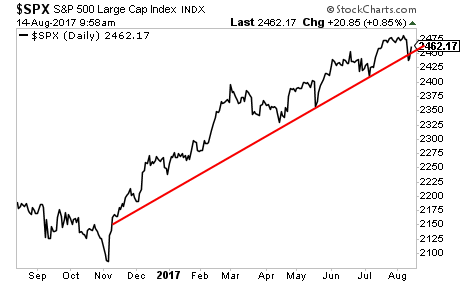
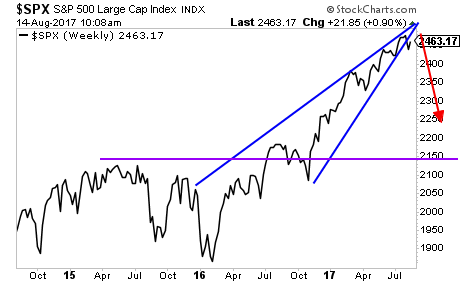
The technical damage from last week was severe with the bull market trendline that has supported stocks since early November being violated on the S&P 500.


GPC81417


Moreover, stocks finished down during August options expiration week in six of the last seven years. So there is also a negative historical pattern for this week.


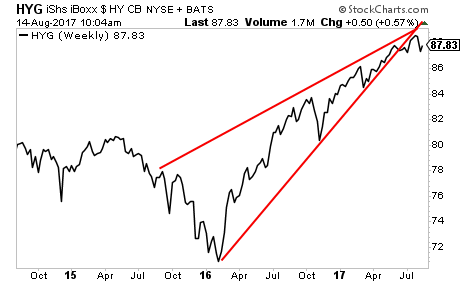
However, something much worse than all of this is brewing in the financial system. The junk bond market has broken out of a rising wedge pattern that formed since the 2016 lows.


GPC814172


This is a VERY bad sign for risk in general as junk bonds lead stocks. Indeed, based on all of the above, we"ve got the makings of a SHARP move lower for the markets this week.


GPC814173


You"ve been warned.


For more insights that can help you see serious returns from your investments, join our FREE daily e-letter, Gains Pains & Capital.


Every weekday you"ll receive our research reports before the market"s open.


In the last 6 months we"ve called the massive sell-off in the $USD, the out-performance by Emerging Markets, and more.


And best of all, it"s 100% totally FREE.


To join us, swing by: http://gainspainscapital.com/


Best Regards


Graham Summers


Chief Market Strategist


Phoenix Capital Research