Showing posts with label Share trading. Show all posts

Thursday, November 9, 2017

Stocks Sink As Tax-Cut Hopes Fade, Junk Bonds Hit 8-Month Lows

Sell the news? Stocks are slumping (following Japan"s overnight volatility) as traders await tax-cut legislation from the House Ways and Means Committee (and The Senate will also release its own version).


High-Tax companies are underperforming...


And Junk bonds just hit the lowest since March...


Whether this selling due to disappointment in what is expected to be in the bill... or an expectation that it will not pass anyway - is unclear.


Tuesday, August 29, 2017

Gold: Take Profits at $1330, Beware the London Spoof

Update 12:45pm - if we do not hold the  $1312- 1310 area in spot there is a lot of trouble ahead.


The 60 minute is looking at an inflection point in the area:


 Breaking $1312 on the 60 minute chart puts us outside the  bottom band, and would likely increase all BBand widths implying accelerated downside movement, aka a reversal. Inflection point to say the least.


 Meanwhile the daily shows the same area as an outright negation of today"s momentum higher.?The Upper BBand comes in near $1312 currently. A settlement inside that adds fuel to the 60 minute chart above


Expect more profit taking if we get below this area. Pray some buyers have not gone to the market and are waiting for this dip to buy in. If stops exist, expect Commercials to gun for them here.


Take Profits Now


posted originally on marketslant.com


Big players like Soros and Druckenmiller use liquidity events to get out of massive  positions all the time. This is another example of where these types  may sell into strength. That does not mean the market will not continue higher afterwards. it does mean profit protection is mandated when gorillas like these are entering a room. If we do not close weaker today, beware the London Open for a large profit booking as the past has shown us. Many continue to call this a spoof,  and sometimes it genuinely is. We think Friday"s Comex activity was one to shake out momo longs and help commercials cover some shorts. But it is prudent to accept that some  of those big orders seen during London hours are genuine  profit taking by players not worried about $5.00  when  they are booking $55 in 2 months


 Yesterday, via Moor Analytics we gave you the road map ahead. Admittedly we did not think  it would happen so quickly:


August 21st : We wanted a bull flag


 We  wanted a bull flag to form starting with a selloff early last week, as opposed to the one at week"s end, and said as much on Aug 21st;


Ideally, over the next 3-5 days: we wanted to see Gold fill the Comex gap underneath, and in the process shaking out some weak longs and luring some shorts to pile in. First touching the $1285 area, close with a positive settlement on a lower day. Then we could see a nice orderly rally out of a bull flag. But so far that is not the case. Instead we have more buying at the top end of a range that has earmarkings of Friday"s behavior.


Aug 28th: We got the Bull Flag


Our time frame was good. Our order of events was not. The rally / dump 2 Fridays ago did spook us, but last Friday"s sell-off and rally undid that. The Comex gap got filled underneath as we wanted, and the market closed positive on the 25th, leaving a tail of sellers trapped below.  Happy to be wrong timing wise here about the momo money bailing.  


Michael Moor"s Next Steps:


From yesterday"s post


Paraphrased with our comments in italics


  • Areas of possible exhaustion for this move up come in at 13143-237 and 13466-556 - We have moved through the first area of congestion overnight

  • Take profits in the $1330- $1332 first time up, reverse on a break above with a $1336 target - Some profits  should be taken  on speculative portfolios long from  the $1285 area or lower. We do not think  trailing stops will serve specs well here.

  •  Buy to cover shorts in the $1321 area first time down. - if you are getting short in the $1330 area with a $1332 stop, we like this advice

  • There are multiple  resistance numbers that may be broken early, only to serve as accelerators  of profit taking on a re-piercing lower - This may be a strong hands to weak hands day

For additional information contact: Moor Analytics


Our 2 Cents


Comex Futures now have a Gap between $1317.80 and $1318.90. To those who ignore gaps as Gold is a globally continuous market, we get it. But to those who trade in one time zone, they remain relevant when applied consistently. We"d be hesitant to buy that gap if tested because of our own volatility based trading style, and would rather buy it upon a break under adnarally back through $1321.


Bollinger Bands show us that if one were playing the momentum game it is prudent to remain long until a settlement occurs  within the outer band. This comes  in currently at $1321 now, and is  consistent with Moor"s levels. Any breaking of that level, especially late in the day does not give us a good risk reward in which to buy. We"d rather  short in the gap  with a stop-loss and reversal set at  $1321 for a day trade. 


Today:


  1. Take some profits near $1330-1332 if you were long from the $1285- 90 range

  2. Take more profits if the area of $1346 is reached

  3. Leave a tail in the form of long calls or a small position that wont kill  you on a $20 move lower overnight.

  4. Buy $1321 area for a bounce back to $1328- $1330. Risk a $1317 print

  5. Short here at $1325 with a buy stop on new highs with a target of $1301 ( do not take home  if  out of  the money on close)


interactive spot chart HERE


Gold is Goldilocks regardless of the next $50 move... keep the faith and let the momo guys create short term opportunities for you now.

Monday, August 21, 2017

Why Gold's Rally to $1299.70 Today May End Ugly Tomorrow

Pray for Rain?


  • Gold has profit taking above

  • There is a gap  below that "needs to be tested" for increased likelihood of a sustainable rally.

  • Short term the market is overbought, and Friday"s buyers  are  out of the money already

via Soren K Group posted originally on Marketslant.com


Ideally, over the next 3-5 days: we wanted to see Gold fill the Comex gap underneath, and in the process shaking out some weak longs and luring some shorts to pile in. First touching the $1285 area, close with a positive settlement on a lower day. Then we could see a nice  orderly rally out of a bull flag. But so far that is not the case. Instead we have more buying at the top end of a range that has earmarkings of Friday"s behavior.


The sellers right here are commercials and large funds taking profits. And the sellers" stops to buy back are much higher (if they exist at all), than the stop-losses placed underneath from this headline-chasing momentum fund buying. Can we continue  higher despite our "perfect" scenario. Sure. Guys like Ray Dalio are showing no signs of back-tracking on their "risk-off" stances. But we are not buying here. We want the hot money to short Gold, not get long. And guys like Dalio are longer term traders with deeper pockets and more apt to tell us they"ve changed their risk-off and sold their Gold after the fact.


George Gero describes Gold nicely without judgment before the open:


Today gold is steady ahead of  summit of bankers including Chair Yellen, ECB Draghi and many more all of which may keep market watchers with one eye on headlines. Keep the other eye on open interest, more new longs.. Gold over 508,734 as we mentioned Friday on cnbc, copper 329335, silver 191783,and gold options on futures 1,144,348, all these indicate asset allocations returning to metals again. Stocks iffy and more political, geo political headlines await as we look for more 1300 area to come.


Gold is higher today, and that for us is unhealthy. It is the increase in OI that worries us. It is the momentum funds looking for more $1300 and buying based on headlines of:


 $1300 GOLD YAYYYYY! BUY IT NOW  BECAUSE YOU WONT GET A CHANCE TO EVER AGAIN that scare us. Friday"s rally brought new longs. Activity and info confirmed for us asset allocators bidding, but momentum funds chasing the price.


And based on that day"s close, some of them finished out of the money. If we do not close higher today, they may bail given their gnat-like tolerance in metals. Traders with a 6 month horizon may find themselves annoyed by the funds with a 6 minute horizon right here, right now.


We fear the supernova spike/reversal right here and feel the market is much more likely to extend higher on a more sustainable basis if it consolidates a bit here and takes out some weak longs. We prefer the market establish a base here. Higher now without closing above Friday"s high means the likelihood of  a significant sell off in 3 days increases. That fear would ratchet up  MORE if we took out Friday"s  high today but closed lower than the day"s VWAP 


via Vince Lanci:


The question is, do you want a $10 rally today, or a $35 rally over the next 3 weeks?  Its a matter of perspective and time frame. But less upside volatility now means more upside later. Better someone sell it in the hole this week than momentum funds trample each other getting in today.


The caveat as Michael Moor noted to us today is "Longs should not want to trade below $1282.90 intraday."


This is consistent with our Bull flag hopes. A break below that would almost certainly negate a flag formation and thus bullish sentiment.


Gold for December delivery is trading $1297.00 as we write  this, up $5.40 on the day


SPOT GOLD 1 MINUTE CHART


?


Real time interactive charts HERE


There is a gap on Comex charts between $1286.20 and $1283.50. The smackdown was expected on first penetration of $1300. The market may linger between the gap and recent highs  for 3 to 5 days creating a bull flag base for a higher push. Our opinion is that unless Gold penetrates $1314 rallies should be sold to book profits during this time. 


Alternatively, shorting rallies this week might be a good intraday play to capture swings as the market gyrates  between the gap and new high. Separately, and not necessarily at odds with our analysis, Michael Moor would prefer the gap be tested sooner rather than later in his summary below


We can see bitcoin profits being taken while hot money is buying Gold with that same manic ajax-snorting expectation of profits. And we do not like  it. 


As long as the market is between $1284 and $1306, we see rallies as a sale, and selloffs as a buy for the next 3 days. Sell it now if  you are booking profits. Then hope it breaks $1314 and buy back in.-  Soren K.


Moor Analytics


emphasis ours- Soren K.


Analysis written by Michael Moor 


Gold (Z) 8/18/17


On a macro basis:   The maintained gap higher on 7/18 left a medium term bullish reversal intact below that warned of higher trade for days.  We have seen $67.8 of this so far from (Q) into (Z) with a roughly $7 spread differential.  The solid penetration above 12417-21 warned of solid short covering in the days/weeks ahead, with a good likelihood of a run back up toward 12980 (+).  We have seen $63.8 of this so far, taking out 12980 on 8/11.


On a shorter-term basis:   The maintained gap higher yesterday left the short term bullish reversal warned about below, which warned of decent higher trade. We have seen $11.5 of this before backing off the high.  Decent intra-day trade below 12829 will negate this definitively.  Although this has not been negated, I warned to be out of longs for the time being if we broke back below the 12978-88 and 12954-60 areas, below which I would look for decent profit taking to come in—we have seen $6.3 of this so far.  If we leave a maintained gap lower intact above on Monday, this will leave a short term bearish reversal intact that will warn of decent lower trade, likely for days.  Decent trade below 12801 (+ 1 tic (10 cents) per/hour starting at 6:00pm Sunday) will project this downward $28 minimum, $34 (+) maximum based off a ‘well formed’ formation; but if we break below here decently and back above decently, look for decent short covering to come in.—likely back toward 12980 (+).   


All inquiries for Moor Analytic"s Professional research in the Gold and Energy markets please use contact info below

Monday, August 14, 2017

Junk Bonds Wave a Red Flag at Risk

The market should bounce this morning, but after that we’re heading down.


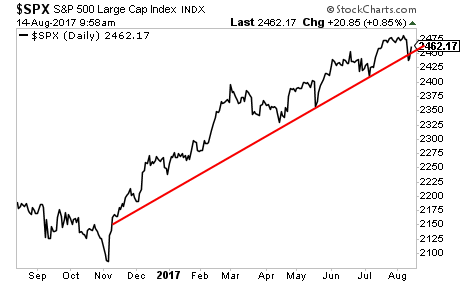
The technical damage from last week was severe with the bull market trendline that has supported stocks since early November being violated on the S&P 500.


GPC81417


Moreover, stocks finished down during August options expiration week in six of the last seven years. So there is also a negative historical pattern for this week.


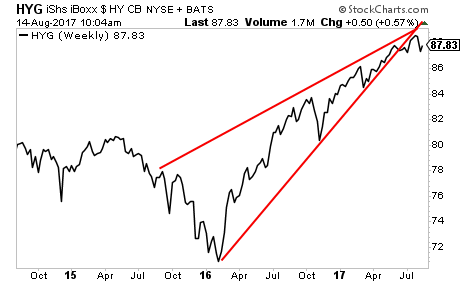
However, something much worse than all of this is brewing in the financial system. The junk bond market has broken out of a rising wedge pattern that formed since the 2016 lows.


GPC814172


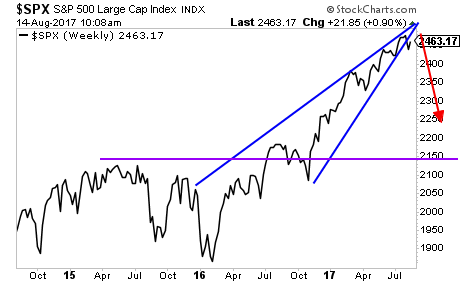
This is a VERY bad sign for risk in general as junk bonds lead stocks. Indeed, based on all of the above, we"ve got the makings of a SHARP move lower for the markets this week.


GPC814173


You"ve been warned.


For more insights that can help you see serious returns from your investments, join our FREE daily e-letter, Gains Pains & Capital.


Every weekday you"ll receive our research reports before the market"s open.


In the last 6 months we"ve called the massive sell-off in the $USD, the out-performance by Emerging Markets, and more.


And best of all, it"s 100% totally FREE.


To join us, swing by: http://gainspainscapital.com/


Best Regards


Graham Summers


Chief Market Strategist


Phoenix Capital Research

Friday, August 11, 2017

Saxo Hikes Inverse VIX ETF Margins To 40%

Last Saturday, we reported that with VIX at 9, Interactive Brokers surprised many when announced it would raise volatility margins anticipating a VIX shock. This is what the brokerage said:


VIX has established new all-time lows over the course of the past month. The price dynamics of that product are such that it can have very large relative price increases over a very short period of time base on news and other market factors. In recognition of the special risk of sudden, large increases in market volatility, that is inherent in Volatility Products such as VIX, Interactive Brokers will put into place greater margin requirements for Volatility Products after expiration processing on Saturday, 19 August.


IB was also surprisingly clear in what it anticipated


IB"s margin policy will be to consider market outcome scenarios under which VIX might rise to a price of 18 (even when it is currently priced much lower) and under which the other Volatility Products could rise to proportionately similar degrees.


As we summarized, "In other words, IB is starting to prepare for the day that the VIX doubles from current levels." Less than a week later, Interactive Brokers was proven right when VIX hit 17, nearly hitting its bogey. We also pointed out something else:


Of course, since volatility is the "fulcrum security" of today"s reflexive market nature - does a surge in the VIX send stocks lower, or does a market crash lead to a VIX surge? - the very fact that vol-linked leverage is about to be aggressively cut first by one, then by many more if not all exchanges, as we head into the critical for volatility fall period, these warnings could create a self-fulfilling prophecy whereby the margin increases are the very catalyst that leads to a surge in volatility. Whether that is what happens over the next two weeks remains to be seen.


It was "just seen", because after yesterday"s near historic spike in vol, as we expected others are starting to do precisely what Interactive Brokers did first, and on Friday morning Saxo announced it too would hike its minimum margin rate on both Korean stocks, for obvious reasons, and on Inverse VIX ETFs, sending them to 40%, in the process forcing clients to put up substantial margin or else be forced to close out of short-vol trades.


Here is Saxo:


Due to the growing tension between North Korea and the USA, we are increasing FX and CFD margin rates on Wednesday 16 August 2017, at 08:00 GMT, to reduce your risk against the potential high volatility, rapid price movements or market gaps that may occur in case of further political escalation.


And some parting "advice" from Saxo:


How does this impact your trading?


If you have open positions in any of the affected markets, please ensure that you monitor their positions carefully and maintain sufficient funds in your account to meet the increased margin requirements during this period of turmoil. We would like to recommend to keep the following in mind, especially when trading during periods of potential market volatility:


  • Consider placing relevant resting orders in advance. Market liquidity may vary substantially, and trade/quote requests may be unavailable at times as existing resting orders and new market orders are filled as priority

  • Market orders are not guaranteed to be filled at any specific price – they will be filled “at best” according to available market price when processed

  • Stop Loss orders are converted to Market orders once triggered, so are not guaranteed to be filled at your stop order level – gaps in available liquidity can result in significant slippage on Stop orders

  • Using Stop Limit type orders (rather than Stop Market) can be very beneficial as they allow the client to specify the worst acceptable immediate fill rate after triggering, and they will rest in the order book if not able to be filled immediately

  • Buying options (i.e. puts to protect long positions and calls to protect short positions) could be a hedging vehicle suitable for market uncertainty since they offer protection at the fixed Strike price, rather than Stop orders where fills on gapped prices can occur

Friday, July 28, 2017

Gold at $1268, Now What?- Analysis

IF-THEN: Short Term Action


via Moor Analytics


 About: Moor Analytics publishes 2 reports daily for Gold, Crude Oil, and Natural Gas. Each report analyzes market activity that day and in context of the bigger picture. His Energy work is especially important for spread and seasonality traders. We are subscribers, and have Michael on our speed dial for quotes and comments on big moves and points of inflection like we feel the market is entering today. Here is what he shared today with us, as we got stopped into our Gold position of long above $1259. Our comments in italics


(Excerpt)


  1. IF Gold stays above  $1261, THEN look for a run to 1270 and THEN 1283

  2. IF Gold goes back below $1261 THEN prepare for a bear leg to start as longs begin to liquidate that could drive Gold down to $1254 which is a buy level. But below $1249 is a level to get short

Note: We are taking  #2 above very seriously. Our personal approach is, as you will see below, biased longs who let profits run.


Every number is a level to decide. One could short at $1270 and reverse above it. A long could take some profits at 1270.. and so on. One must decide loss tolerances and slippage according to their own bankroll and execution style. Every number that is support, becomes resistance once pierced. Numbers in Aug futures today


SKG Position: VBS short term trade Right NOW


 Live Interactive Chart HERE


  1. Long above $1259 (filled at $1260) looking for $10.00 in 2 days = $1270 target

  2. Stop-loss at $1257 - making the risk reward 3 to 1 per our VBS system

  3. Do not take the trade home if settles Out of the money. So if settles under our buy level but not stopped out, we exit. This is a device we implemented  and improved upon specifically  to protect against thinly traded overnight spoofers who would most certainly stop us out

  4. If target reached sell half of position and trail the stop up to $1265 on the rest with the next target as $1283

N.B.- One thing that is apparent in this approach, often times the VBS will call that last frothy run higher and then the violent reversal lower. It worked very well as option longs hedging gamma. But that was because we knew if the rally continued, we"d have more futures to sell.


Using just futures, It just breaks our heart selling for a profit and having the market continue running without that gamma. So we leave a tail on in the form of a partial position.


Reversal on Stop - Out: What we should be doing per the VBS trade is selling longs at $1257 and getting short there. This is consistent with Moor"s approach... We just can"t  do it yet.. 


Bull and Bear  Macro Trends (excerpt)


via Moor Analytics


all numbers approximate - SKG


  • Ground Zero:  Bear Move from $1911 down in 2011

  • Bull Correction: the rally from $1047 to $1374 in 2015

  • Bear Correction: sell off from $1374 to $1124 in 2016

  • Bull/Bear Corrections since then  are more recent and thus shorter term.

If you have interest in learning about Moor Analytics Reports and seeing a full sample (older) report


Confessions of a Gold Bug: Right But  Poor 


We have been so right on this market and so wrong on trading it  too many times. The adage, "I"d Rather Be Rich Than Right" haunts  us constantly as macro analysts and micro risk managers.  For us, making money is easy. Keeping it is hard. Such is the nature of "parlayers",  and traders that fall in love with their trades.


But we"ve made many good calls and given very good  risk  reward scenarios based on our own momentum volatility indicators here. Our VBS system is constantly given us 3 to 1 risk rewards in may markets. But it is not by nature a directional indicator. And that makes it hard for us to reverse when we are wrong directionally. 


Biased Bulls


The issue with momentum trades like the one we have on now is, when the market penetrates below them, you must be  fearless and get short. That is not our strong suit. We get stopped out, and wait for the next buy level usually due to our macro bias. Meanwhile as we have said here many times, the market itself is biased to be short due to market structure and  manipulation. So what is wrong with us?


Here is why we are biased bulls. We have made large profits on big moves in 1994 Silver, 1997 Silver, 1999 Gold, the Silver  spread squeeze, and various Gold rallies due to events.  And we loved it. The short side manipulators were crushed, the idiotic producers who listened to the banks were crushed, and sometimes our head ot head competitors were crushed. Those were times when we saw a flicker of fear in the eyes of the powers that be. And that is the lesson.


A Hard Learned Lesson


The lesson of this must be learned and relearned every time we put a trade on. At our worst, one time after a 7 figure day in energy one of us turned to a colleague and said  "Now I"m bullet-proof".. That was a Gartman Moment.


Four weeks later every dollar made was lost, and then we went negative. And that was graduation for us.


We book profits now. But one bias lingers. The top down approach using macro analysis to create micro trades is prone to leave the "swing trades" or short trades on the table. 


Pissing Away Profits Waiting for the Buy Signal


As of right now we are trading long above $1259 based on our previous call of that level being a momentum accelerator. This does not mean it must go up. It does however  mean that it will move  quickly away form the area in short order. So we are long with a stop below $1259 


How much money have we left on the table being married to our macro opinions? How many times did we leave profits on the table only to give them back. How many times did we ignore our own analysis? Example: Be long  above $1260 is by its very implication a call to be short BELOW 1260.


This is a  lesson for everyone willing to listen. Those successes have created a bias. And that bias makes it hard for us to play short even when the numbers tell us to be. For us trading Gold flat is almost like being short.


What we are saying is, look at Moor"s Analysis. It is perfect for people with biases. IF we stay above $1260 that is good. But if we go back below THEN don"t be afraid to be short. And the lesson here  is, always have agnostic like Michael in your analysis. This type of work is the psychotherapy for our chronic Bull disease.


Originally posted on marketslant.com

Tuesday, July 4, 2017

Nasdaq Triggers Market-Wide Circuit-Breaker As AMZN "Crashes" 87% After-Hours

Nasdaq has issued a market-wide trading halt amid what appears to be a "glitch" that sent a number of the largest Nasdaq-listed stocks to crash or spike to exactly $123.47 per share.


This move crashed the value of companies including Amazon and Apple, sparked chaos in Microsoft, while sending Zynga rocketing up more than 3000%.


On the eve of the US Independence Day holiday and in after-hours trading, The FT reports that market data show that companies such as Apple, Amazon, Microsoft, eBay and Zynga were repriced at $123.47.


The Bloomberg data terminal listed either “market wide circuit breaker halt — level 2” or “volatility trading pause” on all the stocks affected.


The glitch did not affect any market trading, including after hours.


The mysterious reset to $123.47 per share meant that Amazon in theory saw its share price marked down 87.2 per cent...


while shares in Apple fell 14.3 per cent...


But Nasdaq-listed Microsoft had jumped 79.1 per cent — which would value the company at nearly $1tn...


As Bloomberg reports, the apparent swings triggered trading halts in some securities, according to automatically generated messages. The halts are a mechanism exchanges use to limit the impact of particularly volatile sessions. A system status alert on Nasdaq’s website said that systems were operating normally at 8:23 p.m. ET. After-market hours on Nasdaq typically last from 4 p.m. to 8:00 p.m.


In a statement, Nasdaq said the glitch was related to “improper use of test data” sent out to third party data providers, and said it was working to “ensure a prompt resolution of this matter”. In cases of any clearly erroneous data, trades made are cancelled.


As a reminder this is not the first time "glitches" have occurred on holidays... remember gold on Thanksgiving 2014.

Monday, June 26, 2017

Traders Scramble To "Explain" Sudden Nasdaq Swoon

After surging in early trading, the Nasdasq - together with various cryptocurrencies - suddenly slumped and dropped as much as 1% from its intraday highs two hours into trading. That"s what traders could agree with; where they clearly disagreed, was on the reason for the swoon with everything from the velocity of last week’s rally, this morning’s economic data and the Supreme Court’s decision to hear arguments on the Trump administration’s travel ban and being cited according to Bloomberg.


In other words, everyone blissfully rode the momentum on the way up, and now it"s time to come up with the most convincing story why there are more sellers than buyers.


Here is what did happen: From a high of 5,845.15 touched at 9:34 a.m. New York time, the Nasdaq 100 fell as low as 5,770.15 at 11:23 a.m., trimming its 2.1 percent rally from last week. Nvidia lost 2%, bringing its three-day drop to 5.3%, while Amazon.com, Alphabet, Facebook and Microsoft each declined more than 2 percent. The Nasdaq Biotechnology Index slipped 0.8 percent, paring last week’s 9.6 percent advance.


Here are the wildly speculative explanations:


  • Yousef Abbasi, global strategist at Jonestrading Institutional Services in New York: “Tech names have lost momentum. I doubt traders care [about the Supreme Court decision] -- algos, probably. They might have seen that headline and decided to de-risk in tech or other sectors it sees as ‘immigration ban’ impacted.”

  • Mark Kepner, managing director and equity trader at Themis Trading LLC in Chatham, New Jersey, says the Supreme Court decision is probably not related: “Utilities are really strong -- I think it’s the weaker durable goods and some of the commentary from Fed officials being not necessarily sold on another rate rise this year. It’s a lower inflation outlook, oil gave up gains too.”

  • Thomas Garcia, head of equity trading at Thornburg Investment Management Inc. in Santa Fe, New Mexico: “Tech has for sure led the way this year and I think some profits are being taken. Depends on how you crunch the numbers as to how expensive or inexpensive some of these stocks are. What do investors value? Earnings, cash flow, growth etc.”

  • Larry Weiss, head of trading for Instinet LLC in New York: “The market has shown the ability to shrug off political uncertainty, so any review of the travel ban by SCOTUS not really driving the market. Volume is light, so spreads are wide, and we would expect to bounce around in a range in the absence of market moving news.”

Source: Bloomberg

Sunday, June 11, 2017

Hedge Fund CIO: "$100BN Of Tech Stocks Got Sold And The S&P Was Unchanged. Not Sure How That Happens"

The start of another week is upon us, which means it is time for choice excerpts from the latest letter to clients by One River Asset Management CIO Eric Peters, who today writes about Brexit, the "new generals" in the market (more in a later post), rising populism in a world of tech "monopolies", modern day robber barons, and much more.


We will have more from today"s letter shortly, but for now here is Peters on a topic on everyone"s minds, volatility, and what Friday"s Nasdaq "air pocket" means:


Beep Beep


“Volatility didn’t really move,” said Roadrunner, following the Nasdaq’s Friday afternoon air-pocket decline.


There were no real flows, no one was buying options,” continued the market’s biggest volatility trader. “I’d expect this to continue for a bit at least.” These kinds of things don’t usually end in a single day.


“$100bln of tech stocks got sold and drove the Nasdaq 100 down 4% with the S&P 500 and Russell 2000 unchanged. Not sure how that happens,” said Roadrunner. “But summer is here, people leave at noon, and liquidity is thinning out.”


“The idea of a ‘new normal’ in volatility markets is utter nonsense,” continued Roadrunner. “There is never anything new when it comes to markets.”


We are just at that point in the cycle where volatility collapses - at the end, it always does. “We’re late in a bull market, and like every bull the scariest moves are to the downside.”


Nivida ($89bln mkt cap) fell 15% on Fri from intraday high-to-low, which left it +4% on the week and +46% on the year. He glanced quickly left, right, up. “And in bear markets, the most frightening moves are to the upside.”


Friday, May 26, 2017

Investing Wisdoms... Spot What's Missing

Authored by Lance Roberts via realInvestmentAdvice.com,


Over the last 30-years, I have endeavored to learn from my own mistakes and, trust me, I have paid plenty of “stupid-tax” along the way. However, it is only from making mistakes, that we learn how to become a better investor, advisor or portfolio manager.


The following is a listing of investing tips, axioms and market wisdoms from some of the great investors of our time. Importantly, as you review these wisdoms, compare how these investing legends approach investing as compared to your methodologies, those of your advisor or what you are told daily by the media.


Can you spot what’s missing?


12 Market Wisdoms From Gerald Loeb


1. The most important single factor in shaping security markets is public psychology.


2. To make money in the stock market you either have to be ahead of the crowd or very sure they are going in the same direction for some time to come.


3. Accepting losses is the most important single investment device to insure safety of capital.


4. The difference between the investor who year in and year out procures for himself a final net profit, and the one who is usually in the red, is not entirely a question of superior selection of stocks or superior timing. Rather, it is also a case of knowing how to capitalize successes and curtail failures.


5. One useful fact to remember is that the most important indications are made in the early stages of a broad market move. Nine times out of ten the leaders of an advance are the stocks that make new highs ahead of the averages.


6. There is a saying, “A picture is worth a thousand words.” One might paraphrase this by saying a profit is worth more than endless alibis or explanations. . . prices and trends are really the best and simplest “indicators” you can find.


7. Profits can be made safely only when the opportunity is available and not just because they happen to be desired or needed.


8. Willingness and ability to hold funds uninvested while awaiting real opportunities is a key to success in the battle for investment survival.-


9. In addition to many other contributing factors of inflation or deflation, a very great factor is the psychological. The fact that people think prices are going to advance or decline very much contributes to their movement, and the very momentum of the trend itself tends to perpetuate itself.


10. Most people, especially investors, try to get a certain percentage return, and actually secure a minus yield when properly calculated over the years. Speculators risk less and have a better chance of getting something, in my opinion.


11. I feel all relevant factors, important and otherwise, are registered in the market’s behavior, and, in addition, the action of the market itself can be expected under most circumstances to stimulate buying or selling in a manner consistent enough to allow reasonably accurate forecasting of news in advance of its actual occurrence.


12. You don’t need analysts in a bull market, and you don’t want them in a bear market


Jesse Livermore’s Trading Rules Written in 1940


1. Nothing new ever occurs in the business of speculating or investing in securities and commodities.


2. Money cannot consistently be made trading every day or every week during the year.


3. Don’t trust your own opinion and back your judgment until the action of the market itself confirms your opinion.


4. Markets are never wrong – opinions often are.


5. The real money made in speculating has been in commitments showing in profit right from the start.


6. As long as a stock is acting right, and the market is right, do not be in a hurry to take profits.


7. One should never permit speculative ventures to run into investments.


8. The money lost by speculation alone is small compared with the gigantic sums lost by so-called investors who have let their investments ride.


9. Never buy a stock because it has had a big decline from its previous high.


10. Never sell a stock because it seems high-priced.


11. I become a buyer as soon as a stock makes a new high on its movement after having had a normal reaction.


12. Never average losses.


13. The human side of every person is the greatest enemy of the average investor or speculator.


14. Wishful thinking must be banished.


15. Big movements take time to develop.


16. It is not good to be too curious about all the reasons behind price movements.


17. It is much easier to watch a few than many.


18. If you cannot make money out of the leading active issues, you are not going to make money out of the stock market as a whole.


19. The leaders of today may not be the leaders of two years from now.


20. Do not become completely bearish or bullish on the whole market because one stock in some particular group has plainly reversed its course from the general trend.


21. Few people ever make money on tips. Beware of inside information. If there was easy money lying around, no one would be forcing it into your pocket.


21 Rules Of Paul Tudor Jones


1. When you are trading size, you have to get out when the market lets you out, not when you want to get out.


2. Never play macho with the market and don’t over trade.


3. If I have positions going against me, I get out; if they are going for me, I keep them.


4. I will keep cutting my position size down as I have losing trades.


5. Don’t ever average losers.


6. Decrease your trading volume when you are trading poorly; increase your volume when you are trading well.


7. Never trade in situations you don’t have control.


8. If you have a losing position that is making you uncomfortable, get out. Because you can always get back in.


9. Don’t be too concerned about where you got into a position.


10. The most important rule of trading is to play great defense, not offense.


11. Don’t be a hero. Don’t have an ego.


12. I consider myself a premier market opportunist.


13. I believe the very best money is to be made at market turns.


14. Everything gets destroyed a hundred times faster than it is built up.


15. Markets move sharply when they move.


16. When I trade, I don’t just use a price stop, I also use a time stop.


17. Don’t focus on making money; focus on protecting what you have.


18. You always want to be with whatever the predominant trend is.


19. My metric for everything I look at is the 200-day moving average of closing prices.


20. At the end of the day, your job is to buy what goes up and to sell what goes down so really who gives a damn about PE’s?


21. I look for opportunities with tremendously skewed reward-risk opportunities.


 Bernard Baruch’s 10 Investing Rules


1. Don’t speculate unless you can make it a full-time job.


2. Beware of barbers, beauticians, waiters — of anyone — bringing gifts of “inside” information or “tips.”


3. Before you buy a security, find out everything you can about the company, its management, and competitors, its earnings and possibilities for growth.


4. Don’t try to buy at the bottom and sell at the top. This can’t be done — except by liars.


5. Learn how to take your losses quickly and cleanly. Don’t expect to be right all the time. If you have made a mistake, cut your losses as quickly as possible.


6. Don’t buy too many different securities. Better have only a few investments which can be watched.


7. Make a periodic reappraisal of all your investments to see whether changing developments have altered their prospects.


8. Study your tax position to know when you can sell to greatest advantage.


9. Always keep a good part of your capital in a cash reserve. Never invest all your funds.


10. Don’t try to be a jack of all investments. Stick to the field you know best.


 James P. Arthur Huprich’s Market Truisms And Axioms


1. Commandment #1: “Thou Shall Not Trade Against the Trend.”


2. Portfolios heavy with underperforming stocks rarely outperform the stock market!


3. There is nothing new on Wall Street. There can’t be because speculation is as old as the hills. Whatever happens in the stock market today has happened before and will happen again, mostly due to human nature.


4. Sell when you can, not when you have to.


5. Bulls make money, bears make money, and “pigs” get slaughtered.


6. We can’t control the stock market. The very best we can do is to try to understand what the stock market is trying to tell us.


7. Understanding mass psychology is just as important as understanding fundamentals and economics.


8. Learn to take losses quickly, don’t expect to be right all the time, and learn from your mistakes.


9. Don’t think you can consistently buy at the bottom or sell at the top. This can rarely be consistently done.


10. When trading, remain objective. Don’t have a preconceived idea or prejudice. Said another way, “the great names in Trading all have the same trait: An ability to shift on a dime when the shifting time comes.”


11. Any dead fish can go with the flow. Yet, it takes a strong fish to swim against the flow. In other words, what seems “hard” at the time is usually, over time, right.


12. Even the best looking chart can fall apart for no apparent reason. Thus, never fall in love with a position but instead remain vigilant in managing risk and expectations. Use volume as a confirming guidepost.


13. When trading, if a stock doesn’t perform as expected within a short time period, either close it out or tighten your stop-loss point.


14. As long as a stock is acting right and the market is “in-gear,” don’t be in a hurry to take a profit on the whole positions. Scale out instead.


15. Never let a profitable trade turn into a loss, and never let an initial trading position turn into a long-term one because it is at a loss.


16. Don’t buy a stock simply because it has had a big decline from its high and is now a “better value;” wait for the market to recognize “value” first.


17. Don’t average trading losses, meaning don’t put “good” money after “bad.” Adding to a losing position will lead to ruin. Ask the Nobel Laureates of Long-Term Capital Management.


18. Human emotion is a big enemy of the average investor and trader. Be patient and unemotional. There are periods where traders don’t need to trade.


19. Wishful thinking can be detrimental to your financial wealth.


20. Don’t make investment or trading decisions based on tips. Tips are something you leave for good service.


21. Where there is smoke, there is fire, or there is never just one cockroach: In other words, bad news is usually not a one-time event, more usually follows.


22. Realize that a loss in the stock market is part of the investment process. The key is not letting it turn into a big one as this could devastate a portfolio.


23. Said another way, “It’s not the ones that you sell that keep going up that matter. It’s the one that you don’t sell that keeps going down that does.”


24. Your odds of success improve when you buy stocks when the technical pattern confirms the fundamental opinion.


25. As many participants have come to realize from 1999 to 2010, during which the S&P 500 has made no upside progress, you can lose money even in the “best companies” if your timing is wrong. Yet, if the technical pattern dictates, you can make money on a short-term basis even in stocks that have a “mixed” fundamental opinion.


26. To the best of your ability, try to keep your priorities in line. Don’t let the “greed factor” that Wall Street can generate outweigh other just as important areas of your life. Balance the physical, mental, spiritual, relational, and financial needs of life.


27. Technical analysis is a windsock, not a crystal ball. It is a skill that improves with experience and study. Always be a student, there is always someone smarter than you!


James Montier’s 7 Immutable Laws Of Investing


1. Always insist on a margin of safety


2. This time is never different


3. Be patient and wait for the fat pitch


4. Be contrarian


5. Risk is the permanent loss of capital, never a number


6. Be leery of leverage


7. Never invest in something you don’t understand


But, did you spot what was missing?


Every day the media continues to push the narrative of passive investing, indexing and “buy and hold.” Yet while these methods are good for Wall Street, as it keeps your money invested at all times for a fee, it is not necessarily good for your future investment outcomes. 


You will notice that not one of the investing greats in history ever had “buy and hold” as a rule.


So, the next time that someone tells you the “only way to invest” is to buy and index and just hold on for the long-term, you just might want to ask yourself what would a “great investor” actually do. More importantly, you should ask yourself, or the person telling you, “WHY?”


The ones listed here are not alone. There numerous investors and portfolio managers that are revered for the knowledge and success. While we idolize these individuals for their respective “genius,” we can also save ourselves time and money by learning from their wisdom and their experiences. Their wisdom was NOT inherited, but was birthed out of years of mistakes, miscalculations, and trial-and-error. Most importantly, what separates these individuals from all others was their ability to learn from those mistakes, adapt, and capitalize on that knowledge in the future.


Experience is an expensive commodity to acquire, which is why it is always cheaper to learn from the mistakes of others.


Importantly, you will notice that many of the same lessons are repeated throughout. This is because there are only a few basic “truths” of investing that all of the great investors have learned over time. I hope you will find the lessons as beneficial as I have over the years and incorporate them into your own practices.

Thursday, May 25, 2017

"When It Comes To Trading, Romance Is For Losers"

Authored by Kevin Muir via The Macro Tourist blog,


A few readers have asked me to tell more stories about trading. They encouraged me to share more of my experiences throughout the years.


After giving it some thought, I decided that instead of taking the easy road and recounting a tale of when I was fortunate enough to nail some trade, I would approach from the opposite direction. In keeping with my theme that all I bring to the party is 25 years of mistakes, I have decided to recount a losing trade. And not only that, instead of just picking one losing episode, I will confess a weakness I still struggle with today.


But before I do that, I would like to talk about a book. I have always been a big Michael Lewis fan. Ever since reading Liar’s Poker as a young kid trying to make it onto a trading desk, it has held a special place in my development. Throughout the years, as Michael has published more books, I have devoured them with a ferocity reserved for just a handful of authors.


Yet when Lewis published his most recent book, The Undoing Project, I did not rush out to buy it. The story of two psychologists and their relationship throughout the years? It sounded hokey and not at all interesting. Deciding Michael had finally jumped the shark, I ignored the new release.


Lucky for me, my old man is retired and has more time on his hands. More importantly, he did not suffer the same prejudices. He bought it. After reading it, he plopped it in my hands and encouraged me to give it a whirl.


Was I ever wrong about my initial impressions. Michael Lewis’ The Undoing Project could be one of his finest books. As traders and investors, we should all be forced to read it.


The psychological concepts the two main characters discovered are essential to understanding the constant battle we are all fighting when we trade. The themes throughout the book are complex and become more nuanced, but at its heart, the book is about the understanding that human beings do not act rationally with anywhere near the frequency that most of us believe.


Specifically, humans have trouble with statistics. There are tendencies embedded within us that are difficult to overcome. In fact, the story’s two heroes developed experiments designed to exploit these biases. It was no surprise that the average person failed to overcome this human flaw. But more importantly, even professors who were trained in statistics were unable to correct for this bias.


In their breakthrough paper, the two psychologists concluded;


“People’s intuitive expectations are governed by a consistent misperception of the world.”


This observation has profound ramifications for almost all social sciences. Economists especially, base their entire framework on people behaving rationally. Yet these two psychologists had just proven that this was not always the case.


There was one part of the book that really hit home. It was when a statistics professor explained that he understood what was happening with the experiment, yet he felt the pull to go the other way. His logical brain was telling him one thing, but another part was telling him something different.


And for me, this is the perfect analogy to one of my biggest trading weaknesses.


Do you know those days when something dramatic happens in the market and stocks rocket up 1% or more at the open? Maybe it is a big employment report, or maybe some Central Bank eases.


Either way, the market opens at 9:30 and you are staring at a big gap open. Everyone is all bulled up, and excitement fills the air.


Let me assure you, I know the statistics. By far and away, on those days, the most likely outcome is for the market to chop around for the first half hour, fake a couple of sell offs, then start grinding higher. At lunch, the grind might slow down, but then at 1pm, the buying resumes. At 2:30pm there is often a decline, and it looks like it might roll over. Yet that dip is met with more buying, and the market proceeds to rip into the close, finishing at the highs of the days as the shorts cover. Although this doesn’t always happen, this is the correct bet. In fact, it’s better than the correct bet, it’s a great setup.


But I find it extremely difficult to trade this scenario. In my mind, I have glorified the handful of times (most likely one hand) that the gap open proved to be an “all baked in situation.” I distinctly remember a couple of days on the program trading desk where my floor partner and I stood in there, shorting futures to locals and ETFs to institutional clients, taking the other side of the buying panic. Before we could figure out how short we were, the buying dried up, and then next thing we knew, the market rolled over, and we were deep into sell programs, buying back our position while hammering stocks lower in the cash market with our sell baskets.


Even as I write this, there is a smile on my face. I loved being right while everyone else was wrong. It was almost romantic.


Yet I can’t tell you how much money I have wasted over the years trying to replicate these romantic dreams in my head. It is enormous, and it has cost me so much mental and actual physical capital. Springsteen wrote about the old deadbeat sitting at the bar thinking ‘bout it, and I now understand a little better what he meant.


When it comes to trading, romance is for losers.


I struggle with these different tugging forces. My logical brain knows I shouldn’t be shorting that open, but the other side desperately wants to relive those glory days.


And this is what trading is all about. We are constantly battling what we want to do, and what we should do. Even those who understand the game exceptionally well, are constantly battling their own inner demons.


Everyone’s demons take a different form, but make no mistake, we all have them.


Michael Lewis’ book told the story of the psychologists who proved they exist. We are not rational actors. Our brains are not wired to make consistent correct statistical calculations. The sooner we understand that reality, the better our trading will be.


I have by no means conquered my affliction. A little part of me worries that by writing this piece, I have almost assured the next big gap open will fail and roll over. Maybe I should just try shorting the gap higher one more time…

Monday, April 24, 2017

Chinese Stocks Are Plunging

Despite a liquidity injection and the rest of the world in "risk-on" mode over the French election results, Chinese markets are tumbling...


On Friday, we asked "Is China Trying To (Slowly) Burst Another Stock Market Bubble?" as Chinese monetray conditions were tightening dramatically...


And, as Bloomberg reports, it seems the catalyst is further crackdowns on shadow-banking.


China’s banking regulator, which said late Friday it will focus on guarding against financial risks, has ordered local units to assess cross-guaranteed loans, according to a Caixin report.


Having gone 86 trading days without a loss of more than 1% on a closing basis, the longest stretch since the market’s infancy in 1992...


It seems they might be... (or The National Team is going to have to work very hard today)...


As Shanghai Composite breaks below ist 200-day moving-average withe the biggest intraday drop since Dec 12th...


CHINEXT (China"s Nasdaq) is also getting hammered - testing its lowest levels since February 2015....


Friday, April 21, 2017

A New "Anomaly" Emerges In Chinese Markets

The Shanghai Composite Index, notorious for its wild swings over the past two years, has gone 85 trading days without a loss of more than 1% on a closing basis, the longest stretch since the market’s infancy in 1992.


The last 4 days have highlighted the unusual effect in Chinese stocks.. each time the Shanghai Composite dropped over 1% (red dotted line) it was miraculously lifted to ensure it closed with a loss less than 1%...


As Bloomberg reports, authorities favor a steady stock market because it helps companies fund investment and repay debt by issuing new shares, which could help boost economic growth, according to Yin Ming, a vice president at Baptized Capital in Shanghai.


“The national team is behind it,” Yin said. “State funds will likely continue to be a market stabilizer.”


For some investors, it’s a sign that state-directed funds are putting a floor under daily market swings - a development that presents short-term buying opportunities when the Shanghai Composite dips more than 1%  during intraday trading - but when this happens in the US its completely normal and defended as animal spirits that mean "stocks just want to go higher."

Monday, March 27, 2017

JPM: "Until Market Abandons Hope For A Tax Deal, There Will Be No Significant Weakness"

Monday"s session started off poorly, with one of the biggest pre-opening selloffs of 2017 on fears surrounding the implementation of Trump"s fiscal agenda. Since then, however, the Friday gap has been almost filled as a new batch of "buy the dippers" came out and did what they have done so well over the past 8 years.


Why the intraday bout of hope that this morning"s low is as bad as it gets?  According to the intraday market update from JPM, the answer is simple: "the market isn’t abandoning hope of action on the tax front by any means and until that happens the SPX will struggle to sustain sig. weakness." The result: as shown in the chart below, the S&P is now just barely in the red, after being over 20 points lower earlier in the session.


Below is the full intraday note from JPM"s Adam Crisafull:


Market update – it’s been a very quiet session so far. Stocks are obviously weak but flows are orderly and not particularly busy (and the major indices have bounced well off their opening lows).


Recalibrating political expectations is the main reason for the softness as investors debate the timing and scope of a tax bill, although the market isn’t abandoning hope of action on the tax front by any means and until that happens the SPX will struggle to sustain significant weakness.


It seems like many are circling ~2300 as an approximate area of support (premised on the SPX’s ability to earn ~$133-135 in ’18 w/o anything happening in Washington) and thus sentiment isn’t alarmed or panicked.


One of the biggest problems for this tape is the lack of scheduled catalysts – there isn’t anything major on the calendar over the next few days and weeks (Mar jobs Fri 4/7, CQ1 earnings season beginning Thurs 4/13, etc.). Work is underway on a tax bill but it will likely be several weeks before even rough signs of a consensus begin to emerge in the press (and in the meantime a gov’t shutdown is possible at the end of Apr). At this point the SPX is down ~2.6% from its recent high (2400) and ~1.1% from where it stood before Trump made his address to Congress on 2/28 (2363). The index is still up ~4% YTD and ~9% from where it closed on 11/8 (2139).


* * *


US sector trends – the weakest groups include banks (esp. regional banks), cap goods, autos, and steel while retail, healthcare, tech, and staples are outperforming. Within healthcare a lot of stocks levered to ACA are rallying following the demise of ACHA (HCA, UHS, CNC, etc.).


Retail is a notable bright spot as expectations for BATs fall further (BBY, SIG, DLTR, KSS, TGT, JWN, GPS, LB, etc., are all doing well). Some of the bond proxy groups bounced at the open although they have weakened from their morning highs. Most of the leading laggards within the SPX are either financial or material/industrial-related (FCX, MS, HBAN, CMA, SCHW, ZION, RF, etc.).