Showing posts with label Information Technology. Show all posts

Wednesday, December 20, 2017

US Military Rushes To Study Blockchain As "Hybrid Wars" Loom

President Trump signed into law the 2018 National Defense Authorization Act on Tuesday, a $700 billion defense policy bill that mandates for a “briefing on cyber applications of blockchain technology.” Language within the bill is part of a much wider effort to modernize the United States military, before decades of hybrid wars breakout (see: US Army Is Preparing For Decades Of Hybrid Wars.)


The blockchain study, according to the bill text (Sec.1646), will create “an assessment of efforts by foreign powers, extremist organizations, and criminal networks to utilize such technologies;…[and] an assessment of the use or planned use of such technologies by the Federal Government and critical infrastructure networks.”


Further, the study is to be delivered to Congress “not later than 180 days after the date of the enactment of this act.”Coin Desk adds while the study is set to be prepared by the Department of Defense, the final report could include input from other federal agencies and departments.


Not later than 180 days after the date of the enactment of this Act, the Secretary of Defense, in consultation with the heads of such other departments and agencies of the Federal Government as the Secretary considers appropriate, shall provide to the appropriate committees of Congress a briefing on the cyber applications of blockchain technology.


So you ask, what is blockchain? And why would the Department of Defense be interested in this technology?


Coin Desk further notes,


And though it constitutes a minor element in major funding law, the measure, proposed by Sen. Rob Portman of Ohio, could help spur investigation into possible blockchain uses within the U.S. government, some observers say.


“Blockchain was clearly one of the technological capabilities that Congress meant for agencies to look at, and what they were trying to do was create dollars with some flexibility to them so that agencies would have their own discretion on what they invest in,” Trey Hodgkins, senior vice president of public sector at the Information Technology Industry Council in Washington, D.C., told CoinDesk last month.


And lastly, a 2016 military doctrine from the United States Airforce (USAF) outlines the future importance of blockchains in cyber defense systems,


The ability of the USAF to prevail in the highly contested environment of 2040 will be dictated by its ability to defend cyber-enabled systems, and the data within them, from compromise and manipulation. Yet contemporary cyber defense is faltering, and incremental improvements seem unlikely to overcome an exponentially growing cyber threat. Thus, an entirely new model for cyber defense strategy is needed.


Blockchains are a new information technology that inverts the cyber security paradigm. First, blockchain networks are trustless; they assume compromise of the network by both insiders and outsiders. Second, blockchains are transparently secure; they do not rely on failure-prone secrets, but rather on a cryptographic data structure that makes tampering both exceptionally difficult and immediately obvious. Finally, blockchains networks are fault tolerant; they align the efforts of honest nodes to reject those that are dishonest.


As a result, blockchain networks not only reduce the probability of compromise, but also impose significantly greater costs on an adversary to achieve it. The Air Force should research and develop blockchain technology and leverage it for national defense.  


If America wants to maintain her empire, she better adopts blockchain technologies, as what it appears to be the future strategy of the Department of Defense.


Monday, December 11, 2017

The Seven Questions Goldman"s Clients Have About "Rational Exuberance"

In mid-November, just days after Barclays released its 2018 equity outlook with the title "Rational Exuberance"...


... Goldman"s David Kostin decided that imitation was the sincerest form of unveiling a non-contrarian year-end forecast, and in presenting his revised S&P price target for 2018 of 2,850 - which accounts for GOP tax reform - "borrowed" the Barclays title for his own year ahead preview...


... despite admitting that valuations have never been higher, thus suggesting that contrary to the title, the exuberance is anything but rational.


To be sure, despite their hyperbolic titles, both Barclays and Goldman simply went with the sellside flow: in fact, in addition to Barclays and Goldman, Wall Street strategists polled by Barron"s said they expect about a 7% S&P gain for 2018 same as basically every single year, according to Sentiment Trader who points out that "they"re not stupid, they go with the base rate." Indeed, there is power in numbers, because if everyone is wrong about the year ahead, it is the same as nobody being wrong, something Wall Street discovered in 2007.


And yet, with not one but two banks mangling Alan Greenspan"s infamous words to justify their late cycle bullish outlook which both admit is not deserved on a fundamental basis, Goldman"s clients remain confused, and in his Weekly Kickstart, Goldman"s chief equity strategjst David Kostin writes that he has spent the last two weeks meeting with investors to discuss his outlook for US equities in 2018, including the impact of tax reform.


"Our Nov. 21 report, entitled Rational Exuberance, describes our expectation that 14% EPS growth, driven by healthy economic growth and a 5% boost from tax reform, will lift the S&P 500 index to 2850 by year-end 2018 (+8%)."


While it will hardly come as a surprise, Kostin confirms that as we reported last week most investors remain exceptionally bullish despite the all time high in the S&P and despite record valuations, instead betting that the Fed will always step in to keep the upward mometum in risk assets; still while "most clients agree with our bullish sentiment but they questioned several of our specific views."


Below Kostin addresses seven of the most common investor questions prompted by his forecast, or specifically the things Goldman"s clients think is irrational about "rational exuberance.":


1. How can you be “rationally exuberant” about the path of US stocks in 2018 when equity valuations are so high? Although the median S&P 500 stock trades in the 99th historical valuation percentile, valuations are typically poor indicators of short-term returns. Moreover, in contrast to the “irrationally exuberant” market of the late 1990s, today’s equity valuations are justified by a macro environment of extremely low rates, modest inflation, high corporate profitability, and a stable economy. Nonetheless, earnings growth, rather than higher valuation, drives our 2018 forecast. 


2. If the out-of-consensus US Economics forecast for the Treasury yield curve is wrong and rates stay low in 2018, could equity valuations rise further? The “melt-up” scenario of a forward P/E that rises to 19x or 20x is possible, but unlikely. Our forecast for a stable 18x forward P/E multiple at year-end 2018 assumes the economic expansion continues, ROE rises, and the equity risk premium (ERP) narrows. However, in contrast with market pricing (2 hikes) and almost every client we have met (2 or 3 hikes), our economists expect the Fed will raise rates four times next year as the labor market tightens and inflation firms. A rising term premium should lift the 10-year Treasury yield to 3.0% and restrain further P/E multiple expansion.


3. Why did you downgrade the Information Technology sector when it has twice the sales growth and twice the margins of the rest of the S&P 500? The Tech sector’s low effective tax rate (19% vs. 26% for the S&P 500) means it has little to gain from tax reform. Recent performance supports our view. Regulatory risk is another reason for our downgrade. However, we recommend a Neutral weight (24%) in the sector due to strong fundamentals. Investors with sufficiently long investment horizons may find policy-driven weakness an opportunity to add to positions in the sector’s strongest secular growth constituents, which we believe remain attractive. We recommend overweight positions in Financials and Industrials. Both sectors pay above-average effective tax rates and are likely beneficiaries of tax reform. In addition, each sector has fundamental tailwinds such as deregulation and rising capex spending that should boost earnings in 2018.


4. Following value stock outperformance during recent weeks, do you still recommend growth as a style in 2018? Concentrated positioning and correlation with the Technology sector are clearly short-term headwinds to growth stocks. In fact, the  acceleration in already-strong US economic activity should have led value stocks to perform even better than they have during the past several months (Exhibit 2). However, our economists’ forecast of 2.5% US GDP growth in 2018 portrays an economic environment typically conducive to growth stock outperformance and suggests that our sector-neutral growth factor should fare well during the course of the year.


5. Is the equity market already pricing the full impact of tax reform? The prediction market shows roughly 80% odds of passage. Equity market indicators such as Altaba (AABA) and our High Tax Rate basket (GSTHHTAX) send broadly similar signals. However, lingering uncertainty regarding both the provisions that will be included in the final legislation as well as the potential impact of several proposals, such as limiting interest deductibility and the treatment of cross-border transactions, suggest more rotation at the industry and stock levels remains in store.


6. What does the Senate proposal to delay the tax rate cut until 2019 mean for S&P 500 earnings and performance? The delay in rate cut until 2019 will save roughly $140 billion in government revenue but weigh on 2018 EPS as firms face several base-broadening provisions without the offsetting benefit of the rate cut. However, we expect the net 5% boost to future earnings will be unaffected, as would our 2019 EPS estimate of $158. The likelihood that companies pull forward capex and other expenses into the higher-tax year of 2018 may even boost economic activity and provide a net 2019 earnings benefit to S&P 500 companies beyond our current f orecast. In total, particularly against a backdrop of low discount rates, we expect little impact on stock performance from a potential delay in tax cut.


7. How big a risk to EPS is the Senate’s proposal to limit interest deductibility at 30% of EBIT? The proposal would have a minor impact on S&P 500 firms but pose a greater risk to more highly-levered small-caps. Consensus 2018 estimates show 5% of S&P 500 constituents but 15% of the Russell 2000 paying interest expense above 30% of EBIT. However, the proposal suggests incremental downside risk to buybacks and credit issuance as companies adjust corporate structures in response. In addition, the pro-cyclical proposal would have a much greater potential effect on US firms in environments of higher rates or weaker earnings; the current ratio of S&P 500 interest expense to EBIT is nearly the lowest in at least 35 years.


Finally, for those who have missed the barrage of year-ahead outlooks from Goldman in the past two weeks, here is a summary of what the world"s most influential bank believes will happen in the next 12 months: "We forecast the S&P 500 index will rise by 8% to 2850 by year-end 2018. EPS will benefit from tax reform and climb by 14% to $150 while the forward P/E multiple remains stable near 18x. Growth style will prevail over value and Industrials and Financials will outperform while Consumer stocks lag. Thematically, we prefer firms that prioritize investing for growth via capex and R&D. Most clients agree with our bullish sentiment but they questioned several of our specific views. Investors have a less hawkish view than Goldman Sachs economics on the bear flattening of the yield curve and implications for equity valuation and continue to focus on the implications of tax reform."


Wednesday, November 22, 2017

These Are The Top 50 Hedge Fund Long And Short Positions

In its latest quarterly hedge fund trend monitor - a survey of 804 hedge funds with $2.1 trillion of gross equity positions ($1.4 trillion long and $704 billion short) - which analyzes hedge fund holdings as of Sept 30, Goldman makes some interesting observations about the current state of the hedge fund industry. First and foremost, it finds that the average equity long/short hedge fund has posted a 10% YTD return, which while the strongest since 2013 is once again underperforming the S&P for the 7th consecutive year.


In terms of holdings, it"s a continuation of what we discussed the last two quarters - everyone and their kitchen sink is plowing into high beta, "growty" and "momentum" tech names, and since most funds still underperform the S&P, the average net leverage is at all time high. Here"s Goldman:


Fund performance has been lifted by sector (Information Technology) and factor (growth, momentum, large-cap) exposures. Our Hedge Fund VIP list of the most popular long positions,  whose top five stocks are FB, AMZN, BABA, GOOGL, and MSFT, has outperformed the S&P 500 by 770 bp YTD (25% vs. 17%).


Also notable, while at least on paper hedge funds are expected to diversify, in reality the average HF carries 68% of its long portfolio in its top 10 positions, just below the record high reached in early 2016. Meanwhile, confirming that the market is afflicted by a creeping paralysis, portfolio position turnover fell to a new record low last quarter, at just 13% for the largest fund positions. Oh yes, and nobody is short: hedge fund short interest as a percent of S&P 500 market cap remained close to 2%, near the lowest level in five years.


Below are Goldman"s 5 key observations from this edition of the HF Trend monitor:


  1. PERFORMANCE: The average equity long/short hedge fund has returned +10% YTD on the strength of the most popular long positions, high exposure to Information Technology, and atypical factor tilts toward large-caps and away from value stocks. This ranks as the strongest return since 2013 and compares with 17% for the S&P 500, 16% for the average large-cap core mutual fund, and 2% for macro hedge funds.

  2. SECTORS: Information Technology remains the largest net sector exposure, accounting for 27% of fund portfolios. However, the 307 bp overweight tilt relative to the Russell 3000 is 100 bp smaller than at the start of 3Q. Materials represents the largest sector overweight. Financials is the largest underweight and a major source of disagreement with large-cap mutual funds, which are overweight the sector. Current overweights in Energy and Consumer Discretionary are nearly the smallest tilts in recent history, as is the underweight in Utilities.

  3. LEVERAGE: Hedge funds increased net leverage in 3Q 2017 as the most popular positions continued to outperform a rising equity market. Short interest as a percent of S&P 500 market cap remained close to 2%, near the lowest level in five years.

  4. VERY IMPORTANT POSITIONS: Our Hedge Fund VIP list (ticker: GSTHHVIP) of the most popular long positions has outperformed the S&P 500 by 770 bp YTD. The VIP list contains the 50 stocks that appear most often among the top 10 holdings of fundamentally-driven hedge fund portfolios. The basket’s absolute and risk-adjusted YTD returns rank as the strongest since 2013. The list’s top 5 stocks are FB, AMZN, BABA, GOOGL, and MSFT. The basket has outperformed the S&P 500 in 65% of quarters since 2001, generating an average quarterly excess return of 62 bp. 10 new constituents entered the basket this quarter, compared with a quarterly average of 16 stocks since 2001: EQIX, GDDY, IAC, IQV, MGM, MPC, NRG, SBAC, TTWO, and XPO.

  5. CROWDING AND TURNOVER: Hedge funds continue to demonstrate high conviction in their favorite positions. The typical hedge fund has 68% of its long equity assets in its top 10 positions, just below the record high of 69% in 1H 2016. Similarly, our crowding index increased but remains shy of its 2016 extremes. Quarterly turnover of the largest portfolio positions fell to new historical lows, at 13%, declining in all sectors but Health Care.

The biggest component of the favorable hedge fund return in Q3 was a result of the outperformance of the Goldman Hedge Fund VIP basket, also known as the "hedge fund hotel"index, a list of 50 names which are the most widely held hedge fund stocks. Good luck selling them during a firesale, as happened in early 2016 when the GSTHHVIP basket crashed, wiping out four years of gains in a few months.


With no crash yet, and despite softness during the last month, Hedge Fund VIP names outperformed the broad market YTD both in absolute and risk-adjusted terms according to Goldman.


The basket’s strong  return has more than made up for its higher volatility (8 vs. 6 for S&P 500), combining for a YTD ratio of return/volatility of 3.0, above the ratio of 2.8 for the S&P 500 and the best since 3.2 in 2013.


What is more concerning is that as discussed the past two quarters, the trend of growing hedge fund leverage (to make up for loss of alpha), continues, and according to Goldman, funds added net leverage entering 4Q. Data calculated by Goldman Sachs Prime Services on exposures in their business show that net leverage has risen in recent months and is near cycle highs.


Meanwhile, everyone has given up on shorting: in fact, short interest as a share of S&P 500 market cap sits just below 2.0%, matching January of this year as the lowest level since 2012. Relative to trading volumes, the short interest ratio (days to cover) ranks higher compared with history but still far below the cycle high in 2015.


Predictably, with market leadership increasingly more concentrated, and with fewer leaders, the density of hedge fund portfolios is near all time highs.


Hedge fund crowding in the most popular positions rose slightly in 3Q 2017 but remains below the extremes reached in 2016. The average hedge fund holds 68% of its long portfolio in its top 10 positions, just below the record “density” of 69% in 1H 2016. The increase in hedge fund portfolio density mirrors the growing share of S&P 500 market cap accounted for by the 10 largest index constituents, which has risen steadily for two years but even now sits near the average level since 1990.


As a tangent, those who were long tech, remained long tech as the average infotech portfolio turnover dropped to the lowest on record.


So putting it all together, here are the 50 positions which make up the latest GS VIP list, i.e., the 50 most popular hedge fund longs...


... and the list of 50 stocks representing the most important short positions.


Finally, here are the 20 stocks with the highest positive and negative changes in popularity.


As a reminder: traditionally, being long the most shorted hedge fund names and shorting the most favored ones has been a source of double digit alpha ever since 2011, and while this year that may have been different, for now, there is no reason to assume this normalcy will persist especially once the revulsion with tech names reappears once more.


Saturday, November 18, 2017

Silicon Valley Exec Creates New Religion Worshipping A "Godhead" Based On Artificial Intelligence

Authored by Michael Snyder via The Economic Collapse blog,


I know that the headline sounds absolutely crazy, but this is actually a true story. 


A Silicon Valley executive named Anthony Levandowski has already filed paperwork with the IRS for the nonprofit corporation that is going to run this new religion.  Officially, this new faith will be known as “Way Of The Future”, and you can visit the official website right here


Of course nutjobs are creating “new religions” all the time, but in this case Levandowski is a very highly respected tech executive, and his new religion is even getting coverage from Wired magazine


The new religion of artificial intelligence is called Way of the Future. It represents an unlikely next act for the Silicon Valley robotics wunderkind at the center of a high-stakes legal battle between Uber and Waymo, Alphabet’s autonomous-vehicle company. Papers filed with the Internal Revenue Service in May name Levandowski as the leader (or “Dean”) of the new religion, as well as CEO of the nonprofit corporation formed to run it.


So what will adherents of this new faith actually believe?


To me, it sounds like a weird mix of atheism and radical transhumanism.  The following comes from Way of the Future’s official website


We believe in science (the universe came into existence 13.7 billion years ago and if you can’t re-create/test something it doesn’t exist). There is no such thing as “supernatural” powers. Extraordinary claims require extraordinary evidence.


We believe in progress (once you have a working version of something, you can improve on it and keep making it better). Change is good, even if a bit scary sometimes. When we see something better, we just change to that. The bigger the change the bigger the justification needed.


We believe the creation of “super intelligence” is inevitable (mainly because after we re-create it, we will be able to tune it, manufacture it and scale it). We don’t think that there are ways to actually stop this from happening (nor should we want to) and that this feeling of we must stop this is rooted in 21st century anthropomorphism (similar to humans thinking the sun rotated around the earth in the “not so distant” past).


But even though Way of the Future does not embrace the “supernatural”, they do believe in a “God”.


In this new religion, the worship of a “Godhead” that will be created using artificial intelligence will be actively encouraged


The documents state that WOTF’s activities will focus on “the realization, acceptance, and worship of a Godhead based on Artificial Intelligence (AI) developed through computer hardware and software.”


That includes funding research to help create the divine AI itself.


The religion will seek to build working relationships with AI industry leaders and create a membership through community outreach, initially targeting AI professionals and “laypersons who are interested in the worship of a Godhead based on AI.”


The filings also say that the church “plans to conduct workshops and educational programs throughout the San Francisco/Bay Area beginning this year.”


So how “powerful” will this newly created “God” actually be?


Well, Levandowski says that he envisions creating an artificially intelligent being that will literally be “a billion times smarter than the smartest human”


“What is going to be created will effectively be a god,” he said. “It’s not a god in the sense that it makes lightning or causes hurricanes. But if there is something a billion times smarter than the smartest human, what else are you going to call it?”


He added, “I would love for the machine to see us as its beloved elders that it respects and takes care of. We would want this intelligence to say, ‘Humans should still have rights, even though I’m in charge.’”


But what if this “super-intelligence” gets outside of our control and turns on us?


What then?


I am not sure that Levandowski has an answer for that.


Other transhumanists also believe that artificial intelligence will grow at an exponential rate, but instead of AI ruling over us, they see a coming merger between humanity and this new super intelligence.  In fact, world famous transhumanist Ray Kurzeil believes that this will enable us to “become essentially god-like in our powers”


Kurzweil and his followers believe that a crucial turning point will be reached around the year 2030, when information technology achieves ‘genuine’ intelligence, at the same time as biotechnology enables a seamless union between us and this super-smart new technological environment.


Ultimately the human-machine mind will become free to roam a universe of its own creation, uploading itself at will on to a “suitably powerful computational substrate”. We will become essentially god-like in our powers.


And prominent transhumanist Mark Pesce takes things even further.  He in absolutely convinced that rapidly advancing technology will allow ordinary humans “to become as gods”


“Men die, planets die, even stars die. We know all this. Because we know it, we seek something more—a transcendence of transience, translation to incorruptible form.


An escape if you will, a stop to the wheel. We seek, therefore, to bless ourselves with perfect knowledge and perfect will; To become as gods, take the universe in hand, and transform it in our image—for our own delight. As it is on Earth, so it shall be in the heavens. The inevitable result of incredible improbability, the arrow of evolution is lipping us into the transhuman – an apotheosis to reason, salvation – attained by good works.”


Throughout human history, there has always been a desire to create our own gods or to become our own gods.


But no matter how hard these transhumanists try to run from death, it will eventually find them anyway, and at that point all of their questions about who God really is will be answered once and for all.


*  *  *


Michael Snyder is a Republican candidate for Congress in Idaho’s First Congressional District, and you can learn how you can get involved in the campaign on his official website. His new book entitled “Living A Life That Really Matters” is available in paperback and for the Kindle on Amazon.com.


Saturday, November 11, 2017

If The Saudi Arabia Situation Doesn"t Worry You, You"re Not Paying Attention

Authored by Chris Martenson via PeakProsperity.com,


While turbulent during the best of times, gigantic waves of change are now sweeping across the Middle East. The magnitude is such that the impact on the global price of oil, as well as world markets, is likely to be enormous.


A dramatic geo-political realignment by Saudi Arabia is in full swing this month. It’s upending many decades of established strategic relationships among the world"s superpowers and, in particular, is throwing the Middle East into turmoil.


So much is currently in flux, especially in Saudi Arabia, that nearly anything can happen next. Which is precisely why this volatile situation should command our focused attention at this time.


The main elements currently in play are these:


  • A sudden and intense purging of powerful Saudi insiders (arrests, deaths, & asset seizures)

  • Huge changes in domestic policy and strategy 

  • A shift away from the US in all respects (politically, financially and militarily)

  • Deepening ties to China

  • A surprising turn towards Russia (economically and militarily)

  • Increasing cooperation and alignment with Israel (the enemy of my enemy is my friend?)

Taken together, this is tectonic change happening at blazing speed.


That it"s receiving too little attention in the US press given the implications, is a tip off as to just how big a deal this is -- as we"re all familiar by now with how the greater the actual relevance and importance of a development, the less press coverage it receives. This is not a direct conspiracy; it"s just what happens when your press becomes an organ of the state and other powerful interests. Like a dog trained with daily rewards and punishments, after a while the press needs no further instruction on the house rules.


It does emphasize, however, that to be accurately informed about what"s going on, we have to do our own homework. Here"s a short primer to help get you started.


A Quick Primer


Unless you study it intensively, Saudi politics are difficult to follow because they are rooted in the drama of a very large and dysfunctional family battling over its immense wealth.  If you think your own family is nuts, multiply the crazy factor by 1,000, sprinkle in a willingness to kill any family members who get in your way, and you"ll have the right perspective for grasping how Saudi "politics" operate.


The House of Saud is the ruling royal family of the Kingdom of Saudi Arabia (hereafter referred to as "KSA") and consists of some 15,000 members. The majority of the power and wealth is concentrated in the hands of roughly 2,000 individuals.  4,000 male princes are in the mix, plus a larger number of involved females -- all trying to either hang on to or climb up a constantly-shifting mountain of power.


Here"s a handy chart to explain the lineage of power in KSA over the decades:


(Source)


We’ll get to the current ruler, King Salman, and his powerful son, Mohammed Bin Salman (age 32), shortly.  Before we do, though, let’s talk about the most seminal moment in recent Saudi history: the key oil-for-money-and-protection deal struck between the Nixon administration and King Faisal back in the early 1970’s.


This pivotal agreement allowed KSA to secretly recycle its surplus petrodollars back into US Treasuries while receiving US military protection in exchange.  The secret was kept for 41 years, only recently revealed in 2016 due to a Bloomberg FOIA request:


The basic framework was strikingly simple. The U.S. would buy oil from Saudi Arabia and provide the kingdom military aid and equipment. In return, the Saudis would plow billions of their petrodollar revenue back into Treasuries and finance America’s spending.


It took several discreet follow-up meetings to iron out all the details, Parsky said. But at the end of months of negotiations, there remained one small, yet crucial, catch: King Faisal bin Abdulaziz Al Saud demanded the country’s Treasury purchases stay “strictly secret,” according to a diplomatic cable obtained by Bloomberg from the National Archives database.


“Buying bonds and all that was a strategy to recycle petrodollars back into the U.S.,” said David Ottaway, a Middle East fellow at the Woodrow Wilson International Center in Washington. But politically, “it’s always been an ambiguous, constrained relationship.”


(Source)


The essence of this deal is pretty simple. KSA wanted to be able to sell its oil to its then largest buyer, the USA, while also having a safe place to park the funds, plus receive military protection to boot. But it didn’t want anybody else, especially its Arab neighbors, to know that it was partnering so intimately with the US who, in turn, would be supporting Israel.  That would have been politically incendiary in the Middle East region, coming as it did right on the heels of the Yom Kipper War (1973).


As for the US, it got the oil it wanted and – double bonus time here – got KSA to recycle the very same dollars used to buy that oil back into Treasuries and contracts for US military equipment and training.


Sweet deal.


Note that this is yet another secret world-shaping deal successfully kept out of the media for over four decades. Yes Virginia, conspiracies do happen. Secrets can be (and are routinely) kept by hundreds, even thousands, of people over long stretches of time.  


Since that key deal was struck back in the early 1970s, the KSA has remained a steadfast supporter of the US and vice versa. In return, the US has never said anything substantive about KSA’s alleged involvement in 9/11 or its grotesque human and women’s rights violations. Not a peep.  


Until recently.


Then Things Started To Break Down


In 2015, King Salman came to power. Things began to change pretty quickly, especially once he elevated his son Mohammed bin Salman (MBS) to a position of greater power. 


Among MBS"s first acts was to directly involve KSA into the Yemen civil war, with both troops on the ground and aerial bombings.  That war has killed thousands of civilians while creating a humanitarian crisis that includes the largest modern-day outbreak of cholera, which is decimating highly populated areas.  The conflct, which is considered a "proxy war" because Iran is backing the Houthi rebels while KSA is backing the Yemeni government, continues to this day.


Then in 2016, KSA threatened to dump its $750 billion in (stated) US assets in response to a bill in Congress that would have released sensitive information implicating Saudi Arabia"s involvement in 9/11.  Then-president Obama had to fly over there to smooth things out.  It seems the job he did was insufficient; because KSA-US relations unraveled at an accelerating pace afterwards.  Mission NOT accomplished, it would seem.


In 2017, KSA accused Qatar of nefarious acts and made such extraordinary demands that an outbreak of war nearly broke out over the dispute. The Qatari leadership later accused KSA of fomenting ‘regime change’, souring the situation further.  Again, Iran backed the Qatar government, which turned this conflict into another proxy battle between the two main regional Arab superpowers.


In parallel with all this, KSA was also supporting the mercenaries (aka "rebels" in western press) who were seeking to overthrow Assad in Syria -- yet another proxy war between KSA and Iran.  It"s been an open secret that, during this conflict, KSA has been providing support to some seriously bad terrorist organizations like Al-Qaeda, ISIS and other supposed enemies of the US/NATO.  (Again, the US has never said "boo" about that, proving that US rhetoric against "terrorists" is a fickle construct of political convenience, not a moral matter.)


Once Russia entered the war on the side of Syria"s legitimate government, the US and KSA (and Israel) lost their momentum. Their dreams of toppling Assad and turning Syria into another failed petro-state like they did with Iraq and Libya are not likely to pan out as hoped.


But rather than retreat to lick their wounds, KSA"s King Salman and his son are proving to be a lot nimbler than their predecessors. 


Rather than continue a losing battle in Syria, they"ve instead turned their energies and attention to dramatically reshaping KSA"s internal power structures:


Saudi Arabia’s Saturday Night Massacre


For nearly a century, Saudi Arabia has been ruled by the elders of a royal family that now finds itself effectively controlled by a 32-year-old crown prince, Mohammad bin Salman. He helms the Defense Ministry, he has extravagant plans for economic development, and last week arranged for the arrest of some of the most powerful ministers and princes in the country.


A day before the arrests were announced, Houthi tribesmen in Yemen but allied with Iran, Saudi Arabia’s regional rival, fired a ballistic missile at Riyadh.


The Saudis claim the missile came from Iran and that its firing might be considered “an act of war.”


Saudi Arabia was created between the two world wars under British guidance. In the 1920s, a tribe known as the Sauds defeated the Hashemites, effectively annexing the exterior parts of Saudi Arabia they did not yet control. The United Kingdom recognized the Sauds’ claim shortly thereafter. But since then, the Saudi tribe has been torn by ambition, resentment and intrigue. The Saudi royal family has more in common with the Corleones than with a Norman Rockwell painting.


The direct attack was undoubtedly met with threats of a coup. Whether one was actually planned didn’t matter. Mohammed Bin Salman had to assume these threats were credible since so many interests were under attack. So he struck first, arresting princes and ex-minsters who constituted the Saudi elite. It was a dangerous gamble. A powerful opposition still exists, but he had no choice but to act. He could either strike as he did last Saturday night, or allow his enemies to choose the time and place of that attack. Nothing is secure yet, but with this strike, there is a chance he might have bought time. Any Saudi who would take on princes and clerics is obviously desperate, but he may well break the hold of the financial and religious elite.


(Source)


This 32 year-old prince, Mohammed bin Salman has struck first and deep, completely upending the internal power dynamics of Saudi Arabia. 


He"s taken on the political, financial and religious elites head on. For example, pushing through the decision to allow women to drive; a provocative move designed to send a clear message to the clerics who might oppose him. That message is: "I"m not fooling around here."


This is a classic example of how one goes about purging the opposition when either taking over a government after a coup, or implementing a big new strategy at a major corporation.  You have to remove any possible opponents and then install your own loyalists. According the Rules for Rulers, you do this by diverting a portion of the flow of funds to your new backers while diminishing, imprisoning or killing all potential enemies.


So far, Mohammed bin Salman"s action plan is par for the course. No surprises.


The above article from Stratfor (well worth reading in its entirety) continues with these interesting insights:


The Iranians have been doing well since the nuclear deal was signed in 2015. They have become the dominant political force in Iraq. Their support for the Bashar Assad regime in Syria may not have been enough to save him, but Iran was on what appears to be the winning side in the Syrian civil war. Hezbollah has been hurt by its participation in the war but is reviving, carrying Iranian influence in Lebanon at a time when Lebanon is in crisis after the resignation of its prime minister last week.


The Saudis, on the other hand, aren’t doing as well. The Saudi-built anti-Houthi coalition in Yemen has failed to break the Houthi-led opposition. And Iran has openly entered into an alliance with Qatar against the wishes of the Saudis and their ally, the United Arab Emirates.


Iran seems to sense the possibility of achieving a dream: destabilizing Saudi Arabia, ending its ability to support anti-Iranian forces, and breaking the power of the Sunni Wahhabis. Iran must look at the arrests in Saudi Arabia as a very bad move. And they may be. Mohammad bin Salman has backed the fundamentalists and the financial elite against the wall.


They are desperate, and now it is their turn to roll the dice. If they fall short, it could result in a civil war in Saudi Arabia. If Iran can hit Riyadh with missiles, the crown prince’s opponents could argue that the young prince is so busy with his plans that he isn’t paying attention to the real threat. For the Iranians, the best outcome is to have no one come out on top.


This would reconfigure the geopolitics of the Middle East, and since the U.S. is deeply involved there, it has decisions to make.


So given Yemen, Syria, and its recent domestic purges, Saudi Arabia is in turmoil. It"s in a far weaker position than it was a short while ago.


This leaves the US in a far weaker regional position, too, at precisely the time when China and Russia are increasing their own presence (which we’ll get to next).


But first we have to discuss what might happen if a civil war were to engulf Saudi Arabia.  The price of oil would undoubtedly spike. In turn, that would cripple the weaker countries, companies and households around the world that simply cannot afford a higher oil price. And there"s a lot of them.


Financial markets would destabilize as long-suppressed volatility would explode higher, creating horrific losses across the board.  That very few investors are mentally or financially prepared for such carnage is a massive understatement.


So..if you were Saudi Arabia, in need of helpful allies after being bogged down in an unwinnable war in Yemen, just defeated in a proxy war in Syria, and your longtime "ally", the US, is busy pumping as much of its own oil as it can, what would you do?


Pivot To China


Given its situation, is it really any surprise that King Salman and his son have decided to pivot to China?  In need of a new partner that would align better with their current and future interests, China is the obvious first choice.


So in March 2017, only a very short while after Obama"s failed visit, a large and well-prepared KSA entourage accompanied King Salman to Beijing and inked tens of billions in new business deals:


China, Saudi Arabia eye $65 billion in deals as king visits


Mar 16, 2017


BEIJING (Reuters) - Saudi Arabia’s King Salman oversaw the signing of deals worth as much as $65 billion on the first day of a visit to Beijing on Thursday, as the world’s largest oil exporter looks to cement ties with the world’s second-largest economy.


The deals included a memorandum of understanding (MoU) between giant state oil firm Saudi Aramco and China North Industries Group Corp (Norinco), to look into building refining and chemical plants in China.


Saudi Basic Industries Corp (SABIC) and Sinopec, which already jointly run a chemical complex in Tinajin, also agreed to develop petrochemical projects in both China and Saudi Arabia.


Salman told Xi he hoped China could play an even greater role in Middle East affairs, the ministry added.


Deputy Chinese Foreign Minister Zhang Ming said the memorandums of understanding and letters of intent were potentially worth about $65 billion, involving everything from energy to space.


(Source)


This was a very big deal in terms of Middle East geopolitics.  It shook up many decades of established power, resulting in a shift away from dependence on America. 


The Saudis arrived in China with such a huge crowd in tow that a reported 150 cooks had been brought along to just to feed everyone in the Saudi visitation party.   


The resulting deals struck involved everything from energy to infrastructure to information technology to space.  And this was just on the first visit.  Quite often a brand new trade delegation event involves posturing and bluffing and feeling each other out; not deals being struck.   So it’s clear that before the visit, well before, lots and lots of deals were being negotiated and terms agreed to so that the thick MOU files were ready to sign during the actual visit.


The scope and size of these business deals are eye catching, but the real clincher is King Salman"s public statement expressing hope China will play "an even greater role in Middle East affairs."


That, right there, is the sound of the geopolitical axis-tilting. That public statement tells us everything we need to know about the sort of change the Salman dynasty intends to pursue. 


So it should have surprised no one to hear that, in August this year, another $70 billion of new deals were announced between China and KSA. The fanfare extolled that Saudi-Sino relations had entered a new era, with “the agreements covering investment, trade, energy, postal service, communications, and media.”


This is a very rapid pace for such large deals.  If KSA and China were dating, they’d be talking about moving in together already. They"re clearly at the selecting furniture and carpet samples stage.


As for the US? It seems KSA isn"t even returning its calls or texts at this point.


You Ain"t Seen Nothing Yet...


All of the above merely describes how we arrived at where things stand today.


But as mentioned, the power grab underway in KSA by Mohammed bin Salman is unfolding in real-time. Developments are happening hourly -- while writing this, the very high-profile Prince Bandar bin Sultan (recent head of Saudi Intelligence and former longtime ambassador to the US) has been arrested.


The trajectory of events is headed in a direction that may well end the arrangement that has served as the axis around which geopolitics has spun for the past 40 years. The Saudis want new partners, and are courting China hard. 


China, for reasons we discuss in Part 2 of this report, has an existential need to supplant America as Saudi Arabia"s most vital oil customer.


And both Saudi Arabia and China are inking an increasing number of strategic oil deals with Russia. Why? We get into that in Part 2, too -- but suffice it to say, in the fast-shifting world of KSA foreign policy, it"s China and Russia "in", US "out".


Maybe not all the way out, but the US clearly has lost a lot of ground with KSA over the past few years.  My analysis is that by funding an insane amount of shale oil development, at a loss, and at any cost (such as to our biggest Mideast ally) the US has time and again displayed that our ‘friendship’ does not run very deep.  In a world where loyalty counts, the US has proved a disloyal partner. Can China position itself to be perceived of as a better mate? When it comes to business, I believe the answer is ‘yes.’ 


In Part 2: The Oil Threat we couple these developments with China and Russia’s recent efforts to drop the dollar from trade, especially when purchasing oil, and clearly see the unfolding of the biggest new driver of the world’s financial, monetary and geopolitical arrangements in 50 years.


We also explain why, unless something very dramatically changes in either the supply or demand equation for oil, and soon, we can now put a timeline in place for when the great unraveling begins.  Somewhere between the second half of 2018 and the end of 2019 oil will dramatically increase in price and that will shake the foundations of the global mountain of debt and its related underfunded liabilities.  Think 9.0 on the financial Richter scale. 


Let me be blunt - you have to have your preparations done before this happens.  You really, really want to be a year early on this (at least).  When it starts happening, the breakdown will progress faster than you can react.


Click here to read Part 2 of this report (free executive summary, enrollment required for full access)


Monday, August 14, 2017

Stock Market Warning Siren Is Blaring

Authored by Wolf Richter via WolfStreet.com,


Are we blinded yet by the brilliance of corporate earnings?


“Adjusted” earnings growth is 10.2% year-over-year in the second quarter, according to FactSet, based on the 91% of the companies in the S&P 500 that have reported results. The energy sector was a key driver, with 332% “adjusted” earnings growth from the oil-bust levels of a year ago.


The sectors with double-digit earnings growth: information technology (14.7%), utilities (10.8%), and financials (10.3%). The rest were single digit. Earnings in the consumer discretionary sector declined.


Revenues grew 5.1%, also led by the energy sector. At the beginning of Q2 last year, the WTI grade of crude oil traded at $35 a barrel. In Q2 this year, WTI ranged from $42 to $53 a barrel.


So the Wall-Street hype machine is cranking at maximum RPM to propagate the great news that earnings are soaring, and that this is the reason why stocks should also be soaring, and forget everything else. The hype machine carefully avoids showing the bigger picture which is dismal for earnings and ludicrous for stock valuations.


Aggregate earnings per share (EPS) for the S&P 500 companies on a trailing 12-months basis rose for the second quarter in a row.


That’s the foundation of the Wall Street hype.


But here’s the thing with these EPS: they’re now back where they had been in… May 2014.


Yep. More than three years of earnings stagnation. No growth whatsoever, even for “adjusted” earnings. In fact, on a trailing 12-month basis, aggregate EPS of the S&P 500 companies are down about 5% from their peak in Q4 2014. And yet, over the same three-plus years of total earnings stagnation, the S&P 500 index has soared 34%.


This chart shows those “adjusted” earnings per share for the S&P 500 companies (black line) and the S&P 500 index (blue line). Chart via FactSet (click to enlarge). I marked August 2012 as the point five years ago, and May 2014:


And these are not earnings under the Generally Accepted Accounting Principles (GAAP). FactSet uses “adjusted” earnings for its analyses. These are the earnings with the bad stuff “adjusted” out of them by management to manipulate earnings into the most favorable light. Not all companies report “adjusted” earnings. Some only report GAAP earnings and live with the consequences. But others put adjusted earnings into the foreground, and that’s what Wall Street dishes up.


Since August 2012, the trailing 12-month “adjusted” earnings per share of the companies in the S&P 500 index rose just 12% in total. About the rate of inflation – nothing more. Over the same five years, the S&P 500 Index soared 72%.


And there’s another thing: these earnings per share are heavily influenced by the share count. Companies have been on a huge borrowing binge over these years, fueled by historically low interest rates, and a big part of that borrowed money wasn’t used to create new things, expand, invest, or invent, but to buy back their own shares. This type of financial engineering lowered the share count, and thus artificially increased earnings per share. Growth in EPS due to financial engineering is fake earnings growth.


This is the peculiar situation of today: On average, these companies have stagnating earnings per share propped up by “adjusting” these earnings and by financial engineering. The price-earnings multiple (P/E ratio) for stagnating companies should be low. In January 2012, the P/E ratio for the companies in the S&P 500 index was 14.9. And that was high. As of Friday, the aggregate P/E ratio is 24.3:


But look what happened. The P/E ratio peaked in March at 26.6. Since then, the S&P 500 has ticked up 3% and earnings have risen to this glorious level Wall Street has been hyping and the P/E ratio has come down a wee tiny bit…. back to where it had been in the fall of 2016.


In the five-year picture, earnings per share – however doctored they’d been – expanded just 12%. But share prices skyrocketed 73%. And thus the P/E ratio soared. These phases of “multiple expansion” are part of the stock market’s boom and bust cycle. They’re invariably followed by periods of multiple contraction.


Multiple contraction doesn’t stop at the average long-run P/E ratio but falls far below it, because that’s how the long-run average P/E ratio is formed: by periods far above the average (right now) and by periods far below the average. In the past, this type of multiple contraction from the top of the range to the lower end of the range – the process of “reversion to the mean” – offered some hair-raising rides for the stock market overall and for ludicrously overvalued stocks in particular, with many money-losing companies not making it to the next phase.


No one knows the date when this process kicks off in earnest, though everyone wants to know it so they can scurry out of the way beforehand. But when enough folks are trying to scurry out of the way, they’ll will precipitate the beginning of that process. That’s always how it happens.


The last big enthusiastic buyer, China, is leaving the party. Read…  This Hits the Wheezing Commercial Real Estate Bubble at Worst Possible Time

Monday, July 31, 2017

Wasserman Schultz IT Staffer "Frantically" Liquidating $2 Million In Real Estate Assets

As the mainstream media continues to report 24x7 on their Russian collusion narrative in a shameless attempt to take down a Republican administration without any actual evidence of wrongdoing, the Democrats find themselves embroiled in yet another actual scandal, with actual crimes, where people have actually been arrested by the FBI while actually trying to flee the country...yet shockingly, none of these actual crimes seem to be of any interest at all to traditional media outlets.


Be that as it may, the rather curious case of Imran Awan continues with the latest development coming courtesy of the Daily Caller who notes that Imran was frantically liquidating nearly $2 million in real estate holdings right up until the day has was arrested at Dulles airport.


Imran Awan, a congressional aide arrested by the FBI after wiring $300,000 to Pakistan and misrepresenting the purpose, had previously wired money to the country and was frantically liquidating multiple real estate properties on the day he was arrested, The Daily Caller News Foundation Investigative Group has learned.


Imran’s real estate properties provide a source of money that could be sent directly to Pakistan when two upcoming home sales close. Prosecutors have since filed paperwork saying they fear “the dissipation of the proceeds of the fraud and destruction of evidence in other locations.”


Imran was arrested July 24 — four months after the FBI says his wife Hina Alvi moved to Pakistan after learning the family was the subject of a criminal investigation into their work as IT administrators for House Democrats. On the day of Imran’s arrest, the couple accepted a buyer for one house owned by Hina with an asking price of $618,000 (Hawkshead Dr.) and listed another property for sale at $200,000 (Pembrook Village), real estate records show.


On June 20, a third house his wife owned was “sold” to his brother-in-law for $360,000 (Sprayer St.). In November 2016, a fourth home his wife owned was “sold” to his brother Jamal for $620,000 (Linnett Hill Dr.). In both cases, the bank financed nearly all of the purchase.


Imran


So why real estate?  As the Daily Caller notes, title companies, unlike individuals, can wire large sums of money to international bank accounts without arousing the suspicions of federal investigators.


Title companies can wire large sums abroad without attracting the suspicion Imran did at the bank, and with Hina — the nominal sole owner of each of the houses — residing in that country, it would be natural to send the proceeds to her.


In addition to the three houses sold or slated to be sold since June 20, Imran’s lawyer, Chris Gowen, told The New York Times that the $283,000 wire in January was preceded by other similar transfers to Pakistan. “Gowen said the transfer represented the latest payment by his client for a piece of property he was buying in the country,” The Times reported.


Gowen would not tell TheDCNF whether the proceeds of the $360,000 June 20 home sale were wired to Pakistan, nor where the income from the two upcoming sales would go. The office of the U.S. Attorney for the District of Columbia declined to comment on whether it would block the disbursements.


The value of the known homes that have been sold since November or are currently being sold is $1.8 million. There is also the $283,000 January wire transfer from the Congressional bank, in addition to previous wires of unknown amounts that Imran’s lawyer acknowledged.


Since Imran’s lawyer said the January wire of nearly $300,000 was the latest in a series of wires, the transfers may have been about moving money from the $4 million in House payments or other sources.


As we noted last week, Imran Awan was charged with bank fraud after being picked up by the FBI as Dulles airport while attempted to flee to Pakistan via Qatar.  That said, it is still unclear whether that charge is just a placeholder for other charges that are yet to come. 


While details are scarce, media reports have alleged that Awan and his brothers potentially ran a procurement scheme in which they bought equipment, then overcharged various House members that employed their IT firm.  Meanwhile, some congressional technology aides have alleged that the Awan’s were blackmailing representatives based on the contents of their emails and files, due to the fact that these representatives have displayed unwavering and intense loyalty towards the former aides.


As background, Imran was first employed in 2004 by former Democrat Rep. Robert Wexler (FL) as an “information technology director”, before he began working in Rep. Debbie Wasserman Schultz’s office in 2005.


The family was paid extremely well, with Imran Awan being paid nearly $2 million working as an IT support staffer for House Democrats since 2004. Abid Awan and his wife, Hina Alvi, were each paid more than $1 million working for House Democrats. In total, since 2003, the family has collected nearly $5 million.


In total, Imran"s firm was employed by 31 Democrats in Congress, some of whom held extremely sensitive positions on the House Permanent Select Committee on Intelligence and the House Committee on Foreign Affairs.


Of course, one of the most intriguing parts of the Awan narrative is precisely why former DNC Chair Debbie Wasserman-Schultz (DWS) decided to keep him on her taxpayer-funded payroll right up until his arrest and whether that decision had anything to do with the whole DNC / Hillary email scandals that erupted last summer.


A preliminary hearing for Awan is scheduled for August 21.

Wednesday, July 12, 2017

Mt. Gox Chief Denies Stealing $500 Million In Bitcoin As Trial Starts

Two-and-a-half years after the collapse of Mt. Gox ushered in a multi-year bear market in the world of digital currencies, the trial of former Gox chief executive officer Mark Karpeles began Tuesday in Tokyo.  Karpeles pleaded “not guilty” to charges of embezzlement and fraud stemming from the collapse of what was once the world’s most-active platform for buying and selling digital currencies. Some 850,000 bitcoins - then worth around half a billion U.S. dollars - were stolen in the hack, which was disclosed in February 2014, along with $28 million in cash from the exchange"s bank accounts, according to Reuters.


“The 32-year-old chief executive of defunct Mt. Gox pleaded not guilty on Tuesday to charges relating to the loss of hundreds of millions of dollars’ worth of bitcoins and cash from what was once the world"s biggest bitcoin exchange.


French national Mark Karpeles filed the plea in response to charges of embezzlement and data manipulation at the Tokyo District Court, according to a pool report for foreign journalists.”


Karpeles was indicted for transferring 341 million yen ($3 million) from a Mt. Gox account holding customer funds to an account in his name during September to December 2013. The prosecution also alleged Karpeles boosted the balance of an account in his name in Mt. Gox"s trading system.


In its opening statement to the court, Karpeles" defense team did not dispute that the transfers took place, but denied they amounted to embezzlement. Karpeles told the court he was an information technology engineer.


While the Gox bankruptcy badly damaged the public’s perception of digital currencies – particularly among risk-averse Japanese investors – it did spur Japanese lawmakers to develop a legal framework that officially recognizes digital currencies as legal, regulated assets. It also created a system for grating licenses to digital currency exchanges. Japan this year became the first country to regulate exchanges at the national level, part of a government effort to reestablish its lost influence over the crypto market.


That framework, passed into law earlier this year, officially took effect in April and presaged the entrance of Japanese banks into the digital currencies marketplace.


* * *


However, institutional investors in Japan remain wary, say those running virtual currency exchanges in Tokyo. Only 4 percent of large and mid-sized Japanese firms plan to use bitcoin in the near to medium term, showed a Reuters poll last month.


Karpeles, who disappeared from public view shortly after Gox’s collapse, was rumored to have been the target of a super subpoena, preventing him from discussing Gox or the pending case against him.
But now that the trial is underway, the public may soon receive some long-awaited answers about the hack. Namely: How did hackers infiltrate Mt. Gox? Exactly how long did Karpeles wait to disclose the theft to the public. Mt. Gox subsequently said it had found 200,000 of the missing bitcoins – where were they, who found them, and how?


And, most importantly: Were any Mt. Gox employees complicit in the theft?
 

Monday, June 19, 2017

The Fed Rate Hike and Gold, Report 18 June, 2017

The big news this week comes from the Fed, which announced two things. One, it hiked the Fed Funds rate another 25 basis points. The target is now 1.00 to 1.25%, and there will be further increases this year. Two, the Fed to reduce its balance sheet, its portfolio of bonds. It won’t do this by actually selling, but by not reinvesting some of the principle repaid as the Treasury rolls over each bond at maturity. This is like reducing the workforce by a hiring freeze and attrition, rather than by layoffs.


We are no Fed insiders, but if we were to take an educated guess, we would read the last part as a shuffle between the Fed and the banks. No one can afford rising long-term bond yields, as the banks hold plenty of them and this would be a capital loss. Also, if bond prices drop then all other asset prices would drop too. Banks would take another hit.


Right now, the banks are lending to the Fed at 1.25%. The Fed uses this cash to finance its purchase of long Treasury bonds. The 10-year bond closed on Friday at a yield of 2.16%. If the Fed can arrange for the banks to swap, basically slowly draw down their excess reserves and buy the bonds, then it would not cause the bond market to crash. At the same time, the Fed can say that it has shrunken its balance sheet. There would be no change in the bond market, but the banks can bypass the Fed, while increasing their net interest by about 0.9%.


This move would have one nonobvious side effect. The duration risk moves from the Fed to the banks. This is the risk of capital loss, if the interest rate should move upwards. At least the risk moves to the banks nominally. In practice, the Fed will have to bail out the banks should they get hit by this (or assure the banks that the Fed will do everything it can to prevent long bond yields from rising).


We present the issue in these terms, because bank solvency (and the Fed’s own solvency) is the real motivation of the Fed. Price stability—defined to make Orwell proud, as rising prices of 2% per year—is not occurring right now. That is, the Fed has failed to stimulate the price increases that it wishes.


And the Yellen Fed does wish for rising prices. In a key paper she wrote in 1990 with her husband George Ackerlof, Yellen presented her theory of inflation and the labor market. Let’s strip the academic regalia, to see it in plain terms.


  1. Disgruntled employees don’t work hard, and may even sabotage machinery.

  2. So companies must overpay to keep them from slacking.

  3. Higher pay per worker means fewer workers, because companies have a finite budget. Yellen concludes—you guessed it:

  4. Inflation provides corporations with more money to hire more people.

It’s not much as a theory of labor, but does rationalize money printing rather neatly.


The mainstream belief held by Yellen, along with her most trenchant critics, is that rising quantity of money causes rising prices. Never mind that it has failed to work out that way since the Fed turned on the printing press afterburners in 2008. It remains the prevailing belief. So it is somewhat amazing that, with consumer prices falling short of the Fed’s official policy goal of 2% per annum, the Fed is decelerating.


Maybe, Yellen feels that jawboning—saying the economy is getting stronger, etc.—will be more effective than another round of quantitative easing. Maybe. The Keynesians have a cherished belief that so called animal spirits animate markets (and Yellen is a member of the New Keynesian School).


Or, it could be that banks are getting strangled. Banks don’t care about unemployment, nor about consumer prices. They don’t even care about the dollar, being both long and short. That is, they are both borrowers and lenders. They borrow short to lend long.


While the short-term rate has been rising, the long-term rate is back to falling again (which has been the trend since 1981). The effect on banks is: margin compression. The banks are choking, for lack of net revenue oxygen. They will breathe a bit easier if they can make 2.16% rather than the 1.25% as now.


What does this have to do with inflation? Another news item this week illustrates. Amazon bought Whole Foods. Amazon has unlimited access to credit through the bond and stock markets. The lower the interest rate, the more access the big corporations have, to dirtier cheaper credit. They can’t necessarily use this credit to grow their real businesses (one cause and also effect of it being so cheap) but they can use it to make acquisitions. Acquisitions that would not be economic at higher rates.


What will Amazon do with Whole Foods? We would guess that they will pursue Jeff Bezos’ stated vision for the future: that people will always want faster delivery and lower prices. Amazon will use its superior information technology, logistics, scale—and dirt cheap credit—to drive down costs, prices, and margins at Whole Foods. And all other grocers will likely have to follow suit.


So much for higher prices. An expansion of the credit supply (the dollar is not money, which would be gold) is supposed to stoke higher prices, and here is a case where it causes lower prices.


By the way, lest anyone think that this is good because consumers get lower prices, it’s not. Sure, consumers benefit for now. But the real damage comes from the fact that the whole process is fueled by burning investor capital. That is the real nature of too-cheap credit.


And this right here is the indictment of the dollar. Not rising prices, skyrocketing prices, or hyperinflation. At least not now nor the foreseeable future. Falling interest, capital consumption, wage pressures, and unfair advantages handed to crony corporations. All managed by a Fed Chair with a frivolous theory on inflation who knows not what she does.


What does this have to do with the price of gold? Well, the price jumped up early on Wednesday as weak retail sales and inflation data numbers came out. But when Yellen spoke, the gold price fell back down, giving back the whole move and then some.


Which is all just noise. Speculators gonna speculate, but the fundamentals of gold supply and demand do not change with an inflation data report or a Fed Chair monetary policy announcement.


Over time, if people perceive gold as an inflation hedge, and continue to see a lack of inflation, maybe they won’t buy gold or even sell it. If so, they are betting on the dollar as it continues on in its ultra-low interest rate (and long-term falling) environment.


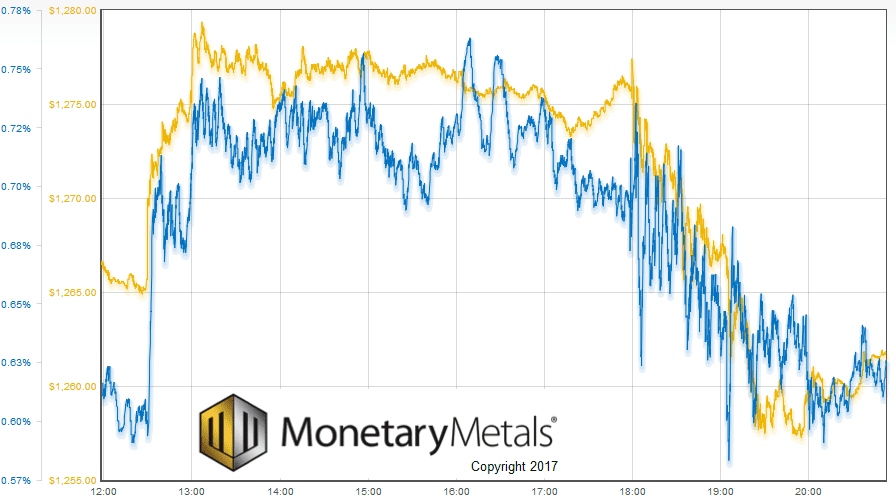
We will take a look at the Wednesday intraday gold basis overlaid with the gold price, below.


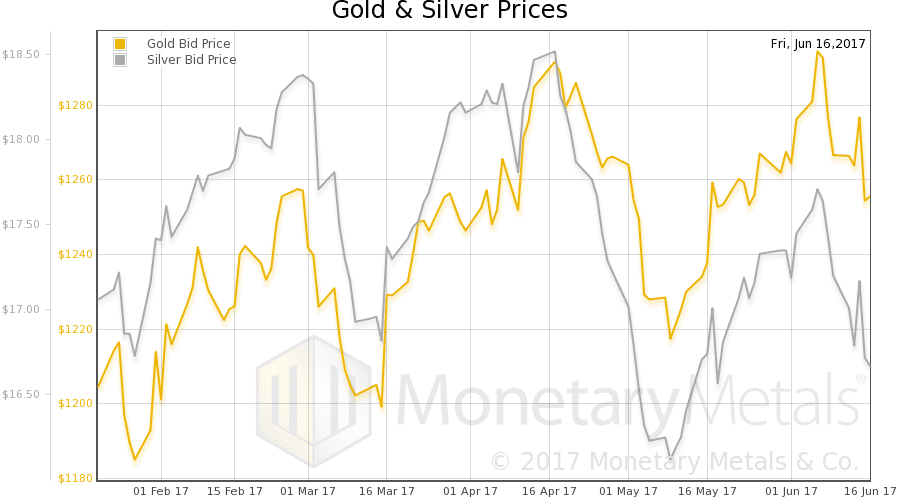
This week, the prices of the metals fell. Gold went down about $13, and silver about 50 cents. As always, we are interested in the supply and demand fundamentals. But first charts of their prices and the gold-silver ratio.


letter-june-18-prices2


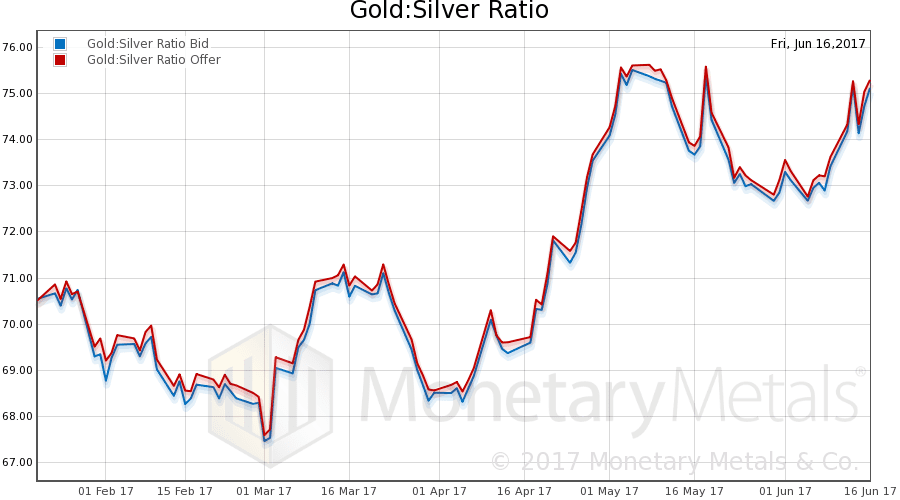
Next, this is a graph of the gold price measured in silver, otherwise known as the gold to silver ratio. It moved up a sharply.


In this graph, we show both bid and offer prices. If you were to sell gold on the bid and buy silver at the ask, that is the lower bid price. Conversely, if you sold silver on the bid and bought gold at the offer, that is the higher offer price.


letter-june-18-ratio2


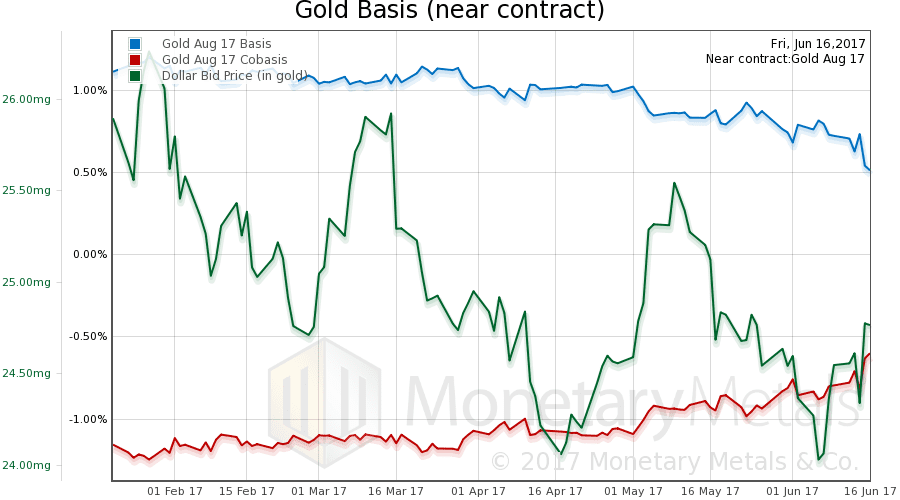
For each metal, we will look at a graph of the basis and cobasis overlaid with the price of the dollar in terms of the respective metal. It will make it easier to provide brief commentary. The dollar will be represented in green, the basis in blue and cobasis in red.


Here is the gold graph.


letter-june-18-gold2


We had a rising price of the dollar (the mirror image of the dropping price of gold). The abundance fell (the basis) and the scarcity increase (the cobasis).

Our gold fundamental price shows a decrease of about $10 to $1,334 (see chart here on our website).


Here is the intraday graph of Wednesday (all times are London) showing the gold price overlaid with the August basis.

letter-june-18-wed-intraday-gold2


The basis starts a little over 0.6% and droops along with the price from about $1,266 to $1,265. As the price shoots up $12, the basis shoots up 12bps. Later, the price begins to drop and so does the basis.


While the amount is coincidence, the relationship is not. It is causal. This is what first speculative buying, then speculative selling, looks like. All in one day.


Now let’s look at silver.


letter-june-18-silver


In silver terms, the dollar rose more (i.e. the price of silver fell more). The decrease in abundance and increase in scarcity were correspondingly greater.


Our silver fundamental price increased two cents (to $17.54). That gives us a fundamental gold-silver ratio of 76.07 (see chart on our website). Not too far from the close on Friday of 75.12 bid and 75.29 offer.


Monetary Metals will be exhibiting and FreedomFest in Las Vegas in July. If you are an investor and would like a meeting there, please click here.


© 2017 Monetary Metals

Saturday, June 10, 2017

EXPOSED: The Secret TRUTH about the FBI is not so different than their suspects

(GLOBALINTELHUB.COM) – 6/9/2017 For those who are not drooling on their lazy-boy high on Prozac and Lays (both strong brands) know that the world is not as seen on TV.  But even in TV, on shows such as “White Collar” – the strange relationship between the ‘police’ and the ‘bandits’ can be seen and understood.  The differences in many cases between a career Special Agent and cat burglar can be thin circumstantial nuances; and they often ‘flip’ sides, most notably in the case we all know about Frank Abagnale, now a successful security and fraud consultant, working with the FBI to detect serious financial fraud.  Let’s take a step back for a moment; the “FBI” hires mostly accountants, and they pursue a number of crimes but most notably financial fraud.  They serve as the police for the CFTC, the SEC, for extreme enforcement actions, as well as investigating a number of issues – from their website:


Our Priorities
Protect the United States from terrorist attack
Protect the United States against foreign intelligence operations and espionage
Protect the United States against cyber-based attacks and high-technology crimes
Combat public corruption at all levels
Protect civil rights
Combat transnational/national criminal organizations and enterprises
Combat major white-collar crime
Combat significant violent crime
Our People & Leadership
The FBI employs 35,000 people, including special agents and support professionals such as intelligence analysts, language specialists, scientists, and information technology specialists. Learn how you can join us at FBIJobs.gov. For details on our executives and organizational structure, see our Leadership & Structure webpage.


What should stick out to readers in an environment where a potentially politicized and corrupt FBI (at least, the leadership) is the “Combat public corruption at all levels” – and going back to the age old regulatory paradox, ‘who watches the watchers’ let’s take a look at the old dog who made the FBI what it is today; J. Edgar Hoover.


In case you have not, and are interested in this topic, take a weekend and read this must read book about the FBI: J. Edgar Hoover: The Man and the Secrets – why bother reading about a figure who is long gone and has no surviving heirs?  Because in order to understand where we are today, with the situation with the FBI and Trump, we need to understand where we came from.  Certainly the FBI has transformed since 1972; however the power, scope, size, methods, political leanings, and other elements of the FBI still remain as established by Hoover.


Let’s dismantle some of the false images many have about the FBI.  The FBI doesn’t ‘solve crimes’ as on popular TV shows like “CSI” – although they do have excellent forensics labs, this rarely (but sometimes) leads to a conviction.  Primarily, the FBI relies on informants, “Confidential Informants” (CIs), tips, and ‘turning’ – a technique popularized by Hoover and used to this day.  Global Intel Hub interviewed several anonymous sources to confirm this information.  Here’s how it works.  The FBI will arrest a petty low level criminal and get him to ‘turn’ on his boss; they will threaten him with life in prison, maybe poke his eyes a little or something, and get him to become a witness in court.  Also they will want a full blueprint of the organization – and in exchange they will get into the Witness Protection Program – yes this program really exists and there are literally thousands of people in this program:


As of 2013, 8,500 witnesses and 9,900 family members have been protected by the U.S. Marshals Service since 1971.


But before entering WITSEC, which is an endgame, the FBI can use informants for years.  CIs can be bank employees (i.e. Wall St.), mafia agents, corporate executives .. basically anyone.  Take a look at the case of CI gone bad:


For 30 years, DeVecchio was one of the FBI ‘s most important mob busters.


DeVecchio was Scarpa’s handler, and Scarpa was more than an ordinary stool pigeon — he had also allegedly served as muscle for the FBI when the bureau needed some extra legal assistance in making difficult cases. As a result, he was allegedly accorded special, sometimes questionable, favors, including tips on coming indictments that allowed Scarpa’s associates to skip town in advance. But, in aiding his informant to commit murder, prosecutors now allege that DeVecchio went too far in protecting his valuable mob asset. Law enforcement sources say DeVecchio may have also enriched himself in the process.


Yes, you read correctly – for 30 years, “DeVecchio” was a CI that gave the FBI information about mob activities.  A useful asset, but the underlying conclusion is simple – the FBI doesn’t ‘solve’ crimes.   With the recent testimony of James Comey, a lawyer by trade, all of this needs to be taken into consideration.  How has the FBI and its internal politics & policies affected significant events in American history; JFK, 911, the credit crisis, and others?


Another strategy which now is no secret used by Hoover, was obtaining secret information by trickery or surveillance, and then using it to blackmail the target to get them to do what they want.  Hoover supposedly kept dossiers on over 10,000 americans; however long the list is – the method was simple.  Get the dirt on the target then use it to manipulate them.  If you think this is fanciful; again – read this book  J. Edgar Hoover: The Man and the Secrets.


The point is that, there’s no way to know for sure what’s going on inside the FBI today.  The reason we need to look at Hoover’s FBI is because now that he’s long gone, and there’s even been a DiCaprio film about him, we can see a bigger picture of what was really going on in the FBI at that time.


So it should be no surprise, that an FBI director, would be meddling in domestic politics – whether it be in elections or by dealing with sitting Presidents.  Everyone was scared of Hoover, even US Presidents both before and after they were elected.  Now, clearly this was a unique individual who built the FBI in his own image during a unique period in history – there will never be another Hoover.  But all this history about the FBI should be noted, following to today’s FBI that literally is ‘creating’ terrorists right here in the USA:


WASHINGTON — The F.B.I. has significantly increased its use of stings in terrorism cases, employing agents and informants to pose as jihadists, bomb makers, gun dealers or online “friends” in hundreds of investigations into Americans suspected of supporting the Islamic State, records and interviews show.


Undercover operations, once seen as a last resort, are now used in about two of every three prosecutions involving people suspected of supporting the Islamic State, a sharp rise in the span of just two years, according to a New York Times analysis. Charges have been brought against nearly 90 Americans believed to be linked to the group.


The increase in the number of these secret operations, which put operatives in the middle of purported plots, has come with little public or congressional scrutiny, and the stings rely on F.B.I. guidelines that predate the rise of the Islamic State.


While F.B.I. officials say they are careful to avoid illegally entrapping suspects, their undercover operatives are far from bystanders. In recent investigations from Florida to California, agents have helped people suspected of being extremists acquire weapons, scope out bombing targets and find the best routes to Syria to join the Islamic State, records show.


Here’s how it works.  The FBI ‘suspects’ someone may be an extremist (they are Muslim, or at least look like).  They pose as another Muslim and start to engage in a conversation about making a ‘plot’ such as a ‘bomb’ – but at the last moment, arrest the entrapped individual.  This accomplishes a few things, one – they can make a long list of cases ‘solved’ that would have otherwise become terrorist attacks (they are working hard for their 8 Billion budget).  Two, it scares the population that the threat of terrorism is ‘real’ (when in reality, you are more likely to be struck by lightning than to be attacked by a terrorist).  This is reinforced by the media ‘terrorism terrorism terrorism’.


The paradoxical question here is – left to their own would these potential ‘terrorists’ have committed any acts of terror, or not?  Of course, foiling a crime before it happens is always ideal.  But at what point does entrapment become ‘encouragement’ – we’re not talking about drug dealing here, terrorism is a serious thing (people can be killed).


But defense lawyers, Muslim leaders and civil liberties advocates say that F.B.I. operatives coax suspects into saying and doing things that they might not otherwise do — the essence of entrapment.“They’re manufacturing terrorism cases,” said Michael German, a former undercover agent with the F.B.I. who researches national security law at New York University’s Brennan Center for Justice. In many of the recent prosecutions, he said, “these people are five steps away from being a danger to the United States.”


The American Mafia, once seen as one of the most popularized ‘threats’ has been on the wane, as most of them have moved from petty crimes to legitimate businesses (or semi-legit) .. An organization like the FBI needs terrorists and other artificial ‘threats’ to justify 35,000 + employees, just as the military and other parts of the DOD need “Russia” to act as a looming potential threat to justify trillions in military spending.  (Anyone with mild room temperature IQ knows Russia, China, Iran, North Korea all working together pose no real threat to USA militarily, economically, or culturally).


Bear this in mind next time the news media tries to distract viewers from real news – Comey is not news.  It’s irrelevant.  Trump’s reaction, irrelevant.  Remember, the entire “Russia Investigation” never existed, it was all a liberal conspiracy created or to use their term ‘fake news’ in order to destroy Trump and use it in Illuminati style ‘killing two birds with one stone’ as a prelude to war and specifically to build a pipeline through Syria as the next “Iraq” to plunder, with project Ukraine a failure the virus needs to expand into untapped resources to colonize, and Trump simply stood in the way of that policy.  The FBI being a critical component of the giant global octopus with hands everywhere, needed to jump in with their own tune to play in the melody.


For a detailed breakdown of how the global system works in reality (not ‘as seen on TV’) checkout Splitting Pennies – Understanding Forex


Order stuff online – save money, save time – enjoy your life!  @ www.pleaseorderit.com