Showing posts with label Futurology. Show all posts

Sunday, November 26, 2017

Why Superintelligent AI Could Be The Last Human Invention

Via ValueWalk.com,


When we create something more intelligent than we could ever be, what happens after that? We have to teach it.


MAX TEGMARK: Hollywood movies make people worry about the wrong things in terms of super intelligence. What we should really worry about is not malice but competence, where we have machines that are smarter than us whose goals just aren’t aligned with ours. For example, I don’t hate ants, I don’t go out of my way to stomp an ant if I see one on the sidewalk, but if I’m in charge of this hydroelectric dam construction and just as I’m going to flood this valley with water I see an ant hill there, tough luck for the ants. Their goals weren’t aligned with mine and because I’m smarter it’s going to be my goals, not the ant’s goals, that get fulfilled. We never want to put humanity in the role of those ants.


On the other hand it doesn’t have to be bad if you solve the goal alignment problem. Little babies tend to be in a household surrounded by human level intelligence as they’re smarter than the babies, namely their parents. And that works out fine because the goals of the parents are wonderfully aligned with the goals of the child’s so it’s all good. And this is one vision that a lot of AI researchers have, the friendly AI vision that we will succeed in not just making machines that are smarter than us, but also machines that then learn, adopt and retain our goals as they get ever smarter.

It might sound easy to get machines to learn, adopt and retain our goals, but these are all very tough problems. First of all, if you take a self-driving taxi and tell it in the future to take you to the airport as fast as possible and then you get there covered in vomit and chased by helicopters and you say, “No, no, no! That’s not what I wanted!” and it replies, “That is exactly what you asked for,” then you’ve appreciated how hard it is to get a machine to understand your goals, your actual goals.


A human cabdriver would have realized that you also had other goals that were unstated because she was also a human and has all this shared reference frame, but a machine doesn’t have that unless we explicitly teach it that. And then once the machine understands our goals there’s a separate problem of getting them to adopt the goals. Anyone who has had kids knows how big the difference is between making the kids understand what you want and actually adopt your goals to do what you want.


And finally, even if you can get your kids to adopt your goals that doesn’t mean they’re going to retain them for life. My kids are a lot less excited about Lego now than they were when they were little, and we don’t want machines as they get ever-smarter to gradually change their goals away from being excited about protecting us and thinking of this thing about taking care of humanity as this little childhood thing (like Legos) that they get bored with eventually.


If we can solve all three of these challenges, getting machines to understand our goals, adopt them and retain them then we can create an awesome future. Because everything I love about civilization is a product of intelligence. Then if we can use machines to amplify our intelligence then we have this potential to solve all the problems that are stumping us today and create a better future than we even dare to dream of.


If machines ever surpass us and can outsmart us at all tasks that’s going to be a really big deal because intelligence is power.


The reason that we humans have more power on this planet than tigers is not because we have larger muscles or sharper claws, it’s because we’re smarter than the tigers. And in the exact same way if machines are smarter than us it becomes perfectly plausible for them to control us and become the rulers of this planet and beyond.


When I. J. Good made this famous analysis of how you could get an intelligence explosion, or intelligence just kept creating greater and greater intelligence leaving us far behind, he also mentioned that this super intelligence would be the last invention that man need ever make. And what he meant by that, of course, was that so far the most intelligent being on this planet that’s been doing all the inventing - it’s been us.


But once we make machines that are better than us at inventing, all future technology that we ever need can be created by those machines if we can make sure that they do things for us that we want and help us create an awesome future where humanity can flourish like never before.


Saturday, November 18, 2017

Silicon Valley Exec Creates New Religion Worshipping A "Godhead" Based On Artificial Intelligence

Authored by Michael Snyder via The Economic Collapse blog,


I know that the headline sounds absolutely crazy, but this is actually a true story. 


A Silicon Valley executive named Anthony Levandowski has already filed paperwork with the IRS for the nonprofit corporation that is going to run this new religion.  Officially, this new faith will be known as “Way Of The Future”, and you can visit the official website right here. 


Of course nutjobs are creating “new religions” all the time, but in this case Levandowski is a very highly respected tech executive, and his new religion is even getting coverage from Wired magazine…


The new religion of artificial intelligence is called Way of the Future. It represents an unlikely next act for the Silicon Valley robotics wunderkind at the center of a high-stakes legal battle between Uber and Waymo, Alphabet’s autonomous-vehicle company. Papers filed with the Internal Revenue Service in May name Levandowski as the leader (or “Dean”) of the new religion, as well as CEO of the nonprofit corporation formed to run it.


So what will adherents of this new faith actually believe?


To me, it sounds like a weird mix of atheism and radical transhumanism.  The following comes from Way of the Future’s official website…


We believe in science (the universe came into existence 13.7 billion years ago and if you can’t re-create/test something it doesn’t exist). There is no such thing as “supernatural” powers. Extraordinary claims require extraordinary evidence.


We believe in progress (once you have a working version of something, you can improve on it and keep making it better). Change is good, even if a bit scary sometimes. When we see something better, we just change to that. The bigger the change the bigger the justification needed.


We believe the creation of “super intelligence” is inevitable (mainly because after we re-create it, we will be able to tune it, manufacture it and scale it). We don’t think that there are ways to actually stop this from happening (nor should we want to) and that this feeling of we must stop this is rooted in 21st century anthropomorphism (similar to humans thinking the sun rotated around the earth in the “not so distant” past).


But even though Way of the Future does not embrace the “supernatural”, they do believe in a “God”.


In this new religion, the worship of a “Godhead” that will be created using artificial intelligence will be actively encouraged…


The documents state that WOTF’s activities will focus on “the realization, acceptance, and worship of a Godhead based on Artificial Intelligence (AI) developed through computer hardware and software.”


That includes funding research to help create the divine AI itself.


The religion will seek to build working relationships with AI industry leaders and create a membership through community outreach, initially targeting AI professionals and “laypersons who are interested in the worship of a Godhead based on AI.”


The filings also say that the church “plans to conduct workshops and educational programs throughout the San Francisco/Bay Area beginning this year.”


So how “powerful” will this newly created “God” actually be?


Well, Levandowski says that he envisions creating an artificially intelligent being that will literally be “a billion times smarter than the smartest human”…


“What is going to be created will effectively be a god,” he said. “It’s not a god in the sense that it makes lightning or causes hurricanes. But if there is something a billion times smarter than the smartest human, what else are you going to call it?”


He added, “I would love for the machine to see us as its beloved elders that it respects and takes care of. We would want this intelligence to say, ‘Humans should still have rights, even though I’m in charge.’”


But what if this “super-intelligence” gets outside of our control and turns on us?


What then?


I am not sure that Levandowski has an answer for that.


Other transhumanists also believe that artificial intelligence will grow at an exponential rate, but instead of AI ruling over us, they see a coming merger between humanity and this new super intelligence.  In fact, world famous transhumanist Ray Kurzeil believes that this will enable us to “become essentially god-like in our powers”…


Kurzweil and his followers believe that a crucial turning point will be reached around the year 2030, when information technology achieves ‘genuine’ intelligence, at the same time as biotechnology enables a seamless union between us and this super-smart new technological environment.


Ultimately the human-machine mind will become free to roam a universe of its own creation, uploading itself at will on to a “suitably powerful computational substrate”. We will become essentially god-like in our powers.


And prominent transhumanist Mark Pesce takes things even further.  He in absolutely convinced that rapidly advancing technology will allow ordinary humans “to become as gods”…


“Men die, planets die, even stars die. We know all this. Because we know it, we seek something more—a transcendence of transience, translation to incorruptible form.


An escape if you will, a stop to the wheel. We seek, therefore, to bless ourselves with perfect knowledge and perfect will; To become as gods, take the universe in hand, and transform it in our image—for our own delight. As it is on Earth, so it shall be in the heavens. The inevitable result of incredible improbability, the arrow of evolution is lipping us into the transhuman – an apotheosis to reason, salvation – attained by good works.”


Throughout human history, there has always been a desire to create our own gods or to become our own gods.


But no matter how hard these transhumanists try to run from death, it will eventually find them anyway, and at that point all of their questions about who God really is will be answered once and for all.


*  *  *


Michael Snyder is a Republican candidate for Congress in Idaho’s First Congressional District, and you can learn how you can get involved in the campaign on his official website. His new book entitled “Living A Life That Really Matters” is available in paperback and for the Kindle on Amazon.com.


Saturday, November 11, 2017

When A.I. Rules...

Elon Musk unveiled his apocalytpic vision of the world a few weeks ago...


“Until people see robots going down the street killing people, they don’t know how to react because it seems so ethereal,” he said.


“AI is a rare case where I think we need to be proactive in regulation instead of reactive. Because I think by the time we are reactive in AI regulation, it’s too late.”


“Normally the way regulations are set up is a while bunch of bad things happen, there’s a public outcry, and after many years a regulatory agency is set up to regulate that industry,” he continued.


“It takes forever. That, in the past, has been bad but not something which represented a fundamental risk to the existence of civilization. AI is a fundamental risk to the existence of human civilization.”


And since then numerous futurists have prognosticated on whether is mankind"s salvation or eventual downfall. Facebook"s Mark Zuckerberg embraces it while Stephen Hawking considers this the most dangerous moment in history as AI and automation are set to decimate jobs and change the social contract.


However, as Mike Wehner via BGR.com,  writes, when AI rules, one rogue programmer could end the human race...


The idea of small groups of humans having control over some of the most powerful weapons ever to be built is scary, but it’s the reality we live in. In the not-so-distant future, that incredible power and responsibility could be handed over to AI and robotic systems, which are already in active development. In a pair of open letters to the prime ministers of bother Australia and Canada, hundreds of AI researchers and scientists are pleading for that not to happen.


The fear, they say, is that removing the human element from life and death decisions could usher in a destructive age that ultimately spells the end of mankind. The AI weapons systems are, as the researchers put it, “weapons of mass destruction” which must be banned outright before they can do any serious damage.


“Delegating life-or-death decisions to machines crosses a fundamental moral line – no matter which side builds or uses them,” the letter explains.


“Playing Russian roulette with the lives of others can never be justified merely on the basis of efficacy. This is not only a fundamental issue of human rights. The decision whether to ban or engage autonomous weapons goes to the core of our humanity.”


In a setting where computers have the ultimate say in whether or not to engage in hostile acts — even under the guise of defending their own territories or protecting the populations they are programmed to protect — conflicts could escalate much faster than humans have ever seen. Weeks, months, or even years of posturing and diplomacy could turn into mere minutes or even seconds, with missiles flying before humans can even begin to intervene. And then, of course, there’s the issue of the AI being manipulated in unforeseen ways.


“These will be weapons of mass destruction,” the scientists say.


“One programmer will be able to control a whole army. Every other weapon of mass destruction has been banned: chemical weapons, biological weapons, even nuclear weapons. We must add autonomous weapons to the list of weapons that are morally unacceptable to use.”


It’s a frightening thought, but it hasn’t stopped military contractors from exploring the possibility of AI-controlled weapons and defense systems. This could be yet another way mankind engineers its own destruction.


*  *  *


Saturday, October 14, 2017

Robocops Are Coming To London

All of Elon Musk’s worst fears are slowly becoming reality.


The Telegraph reports that robocop-type policing techniques are set to replace beat cops within a decade as the use of artificial intelligence becomes more widespread in investigating crimes.


Thames Valley Police said AI computers – which mimic humans by making decisions themselves – could be used to answer 999 calls, detect crimes and identify offenders.


But in one chilling detail that will hopefully be resolved within the next decade or so before robocops become a routine presence in London’s streets, the TVP warned of “bias” in the AI software and a concern that AI computers “might be unable to reason with a human”.


We don’t find further clues about the subject of these biases until much later in the story, when the leader of a civil liberties group – which have been predictably alarmed by plans to automate police forces – pointed to a study showing the machine’s algorithms have shown racial biases, according to the Telegraph.


Civil liberties groups were alarmed by the plans. David Green, the director of the Civitas thinktank, warned that the AI computers could unfairly target ethnic minority groups.


He said: “Robocop policing has now arrived in England. This Orwellian reliance on automated decisions has been found to undermine the most basic precepts of the justice system when it has been tried in America.


“An experiment in Fort Lauderdale, for example, found that the algorithm reflected human prejudices, including racial bias.”


However, the news comes as ministers prepare to publish the first ever review into how AI will change Britain over the coming decades. AI is already used by Scotland Yard to recognise faces at London’s Notting Hill Carnival. Durham Constabulary is also planning to use AI for deciding whether to keep suspects in custody.


In a submission to a Parliamentary inquiry into the Implications of Artificial Intelligence, Thames Valley said there are “even at the lowest level AI could perform many of the process driven tasks that take place in the police”.


AI could be used to assist “investigations by ‘joining the dots’ in police databases, the risk assessment of offenders, forensic analysis of devices, transcribing and analysis of CCTV and surveillance, security checks and the automation of many administrative tasks”, it said.


To be sure, Thames Valley police noted that even once robocops are ready for widespread use, they will still require "a high level of human oversight and clear justification".


Their report showed that “recent tests of AI in policing indicate there is a risk of bias perpetuation in AI outputs, therefore engagement with Privacy and Civil Rights groups will be necessary to persuade the public that everything possible is being done to mitigate this whilst doing our best to keep them safe.


“Of utmost importance is that any AI process that involves an ethical issue, must have a high level of human oversight and clear justification.


The automation of processes also introduces a risk of being unable to reason with a human when events occur outside expected parameters.”


Dubai earlier this year became the first major city to deploy robocops, saying that it expects them to comprise 25% of the United Arab Emirates’ police force by 2030.


Musk has repeatedly warned that humans are underestimating the dangers of AI, claiming that these technologies warrant strict government oversight so that robots don’t transform into a threat to humanity.


…just in case you forgot


Sunday, September 10, 2017

Babies On Drugs In America? 1984 Predicted It!

Authored by Chris Campbell via LFB.org,


Over a million kids in America six years old and under are on psychiatric drugs - mostly to treat anxiety.


Let that sink in.


I have to ask. Is the U.S. really becoming this out of touch? And I mean that literally.


Author Ray Williams, a contributor to Psychology Today, offered an important question back in 2010: “In our desire to have a politically correct and safe social environment, or an environment of instant communication, have we lost sight of the most important aspect of human development and culture  — physical touch?”


The science is in: After food, water and shelter, there’s little more important to kids, especially babies, than human contact. Without simple human contact, in fact, babies can die.


This is the case, actually, to varying degrees, for all mammals.


In many litters of puppies and kittens, for example, there are sometimes one or two animals that come out enfeebled — as the “runts.”


The weakness of the runts, felt by the mother during nursing, is a sign to the mother it likely won’t survive. To make sure her genes have the best chance for survival, she must use her limited resources wisely.


As a result, the mother doesn’t lick or nurture the runt. The mother still allows the runt to feed (other species don’t even go that far), but it refuses to show the runt affection.


It’s hard to understate how catastrophic this is for the runt. A certain amount of maternal licking and nuzzling is necessary. The affection, we now know, turns on the production of a certain growth hormone in the brain. Without it, food cannot be metabolized properly and healthy growth and development is impossible. If the runt continues to be ignored, even if it still gets plenty to eat, it will eventually shrivel up and die.


It’s the same for humans. Without human contact at the earliest of age, the immune system is essentially shot. The affected becomes vulnerable to all sorts of ailments and diseases.


But it’s not just babies…


Human contact, in kids and adults, has been shown to ease pain, lift depression and may even, oddly enough, increase the odds that a team will win a game.


And it’s the simplest thing. (Plus, it’s free!)


K.I.S.S.: When the Synthetic Gets in the Way


Indeed. In our headlong rush for “progress” in all forms, this is one aspect of our existence in which we need to “make great again,” rather than mindlessly perverting or opting for more synthetic versions. (Food and most medicine can also be added to this list, among other things.)


Progress, technological and otherwise, hold incredible potential to lift humanity to new heights — yet, if not done mindfully (which is the ideal role of conservatism, preserving that which is worthy of preservation), it can, without question, push us down to new lows.


The latter is precisely what both George Orwell and Aldous Huxley were warning us about.


Dystopia would come first with a smile and promises of a vast utopia. And, so enamored we would be, we wouldn’t even notice the glimmering of its fangs until, of course, it was too late.


Today, we invite Joe Jarvis of the Daily Bell to ask one unnerving question: Have we already reached dystopia?


Read on.


As Babies are Prescribed Pharmaceuticals, Have We Reached Dystopia?


By Joe Jarvis


Would you let a five-year-old smoke a joint? I certainly hope not. Yet that would probably be less harmful than loading kids up on pharmaceuticals.


Currently, over a million American children UNDER SIX YEARS OLD are taking psychiatric drugs. Babies are literally being doped up by the pharmaceutical industry. Over 274,000 babies UNDER ONE-YEAR-OLD are given drugs, mostly for anxiety.


Anxiety drugs for babies. Have they tried motherly love? Or is that just an old fashioned, outdated concept?


You know, I like to mention society’s similarity to Orwell’s 1984. And surely the growing police state, war on drugs, and endless military campaigns – where the enemy seems to change daily – are reminiscent of the fictional dictatorship of Big Brother.


But it seems the powers that be are working tirelessly to blend together the dystopia of 1984, with that of Aldous Huxley’s Brave New World.


Brave New World


In that dystopia, there is no police state or war. Society has been perfectly designed by scientists, inspired by Ford’s assembly line. Babies are grown in the lab, cloned to all look alike, depending on their class. Parents are an embarrassing relic of the past. How silly to think a child needs family when they have the state!


The lower castes are deprived of oxygen as embryos to stunt their mental development. In America, they use fluoride in the drinking water instead.


In Brave New World, children listen to 24-hour propaganda in their cribs.


Betas hear:


Alpha children wear grey. They work much harder than we do, because they’re so frightfully clever. I’m really awfully glad I’m a Beta, because I don’t work so hard. And then we are much better than the Gammas and Deltas. Gammas are stupid. They all wear green, and Delta children wear khaki. Oh no, I don’t want to play with Delta children. And Epsilons are still worse.


White pride, black pride, gay pride, national pride. Pride is not meant for accidents of birth. You should be proud of accomplishments and achievements, not genetics and geography.


Perhaps someone has been whispering in these radicalized children’s ears.


And how jealous the Department of Education must be of the incubators of Brave New World! They have to sometimes wait years to indoctrinate children. But at least the government gets to drug them up at a young age! And if the TV is left on, most of the programming is done for them.


Of course, the adults are drugged up in Brave New World as well, just like in America. If anyone feels the least bit anxious, nervous, sad–or any other troublesome emotion–they get “soma.” It’s the perfect mix of drugs with only pleasant feelings and no ill side effects.


The 1 in 6 Americans on antidepressants, antipsychotics, and anti-anxiety medication still have to put up with side effects.


The 50 million plus Americans on psychiatric medication sometimes kill themselves, or go mad and kill others. I guess the government is still working out the kinks. Or it’s just another creative blending of 1984 and Brave New World. In the former, the proles must be properly terrified.


1984


And there is one more thing I can remember from Brave New World that strikes eerily similar to modern America.


At what age does the public education system start teaching sex ed? Kindergarteners in some states receive “age appropriate” – according to the government – sexual education. Some studies suggest teen pregnancies rise in areas where sex ed is taught at younger ages.


How young is too young for a sex change? Kids can now choose between 43 genders, or make up a new one! It’s like Mr. Potato head, but with their own bodies. And they will be given corresponding drugs to enhance the “natural” changes.


In the classrooms of Brave New World:


“We had Elementary Sex for the first forty minutes,” she answered. “But now it’s switched over to Elementary Class Consciousness.”


The Director walked slowly down the long line of cots. Rosy and relaxed with sleep, eighty little boys and girls lay softly breathing…


He let out the amazing truth. For a very long period before the time of Our Ford, and even for some generations afterwards, erotic play between children had been regarded as abnormal (there was a roar of laughter); and not only abnormal, actually immoral (no!): and had therefore been rigorously suppressed.


Drugging the population, programming citizens with propaganda, sexualizing children, creating class divisions.


These dystopian novels were meant to be warnings, not instruction manuals.


Aldous Huxley explores how his fictional predictions progressed in his nonfiction work, Brave New World Revisited.

Sunday, August 13, 2017

Elon Musk Doubles Down On AI Scare: "Artificial Intelligence Vastly More Risk Than North Korea"

With the world"s attention focused on the Korean Peninsula and the growing threat of global thermonuclear war, Tesla CEO Elon Musk has bigger things to worry about. In a series of "alarming" tweets on Friday, Musk warned the world should be more worried about the dangers of artificial intelligence than North Korea.


Having unveiled his apocalytpic vision of the world a few weeks ago...


“Until people see robots going down the street killing people, they don’t know how to react because it seems so ethereal,” he said.


“AI is a rare case where I think we need to be proactive in regulation instead of reactive. Because I think by the time we are reactive in AI regulation, it’s too late.”


“Normally the way regulations are set up is a while bunch of bad things happen, there’s a public outcry, and after many years a regulatory agency is set up to regulate that industry,” he continued.


“It takes forever. That, in the past, has been bad but not something which represented a fundamental risk to the existence of civilization. AI is a fundamental risk to the existence of human civilization.”


Musk was quickly admonished by another Silicon Valley billionaire as Mark Zuckerberg suggested Musk is exaggerating, noting:


“I have pretty strong opinions on this. I am optimistic. I think you can build things and the world gets better. But with AI especially, I am really optimistic.


“And I think people who are naysayers and try to drum up these doomsday scenarios — I just, I don"t understand it. It"s really negative and in some ways I actually think it is pretty irresponsible.”


And while the feud grows...


Musk took to Twitter to turn the fearmongery amplifier to "11"...


“If you"re not concerned about AI safety, you should be. Vastly more risk than North Korea,” he tweeted.


“Nobody likes being regulated, but everything (cars, planes, food, drugs, etc.) that"s a danger to the public is regulated. AI should be too,”


His stark warning came at a time when the US and North Korea remain on heightened alert amid spiraling tensions on the Korean Peninsula. Earlier this week, both sides degenerated to open threats, demonstrating readiness to use coercive force if provoked to do so.


But Musk appeared to be more frightened by artificial intelligence, a rising phenomenon he is willing to put under control.


We look forward to Mr. Zuckerberg"s response.

Friday, August 4, 2017

Is Another Oil Head-Fake Coming?

Authored by Charles Hugh Smith via OfTwoMinds blog,


The dramatic declines in the costs of oil production will be boosting supply at the very moment that demand is falling.


Over the past decade I"ve addressed what I call Head-Fakes in the cost of oil/fossil fuel: even though we know the cost of extracting and processing oil will rise over time as the easy-to-get oil is depleted, oil occasionally plummets to such low prices that we"re fooled into thinking it will remain cheap for a long time to come.


This drop in price is a head-fake, because over time the depletion of the cheap-to-extract oil will push global prices higher.


Why does this matter? Economists have noted for decades that spikes in energy costs tend to trigger recessions for the obvious reason: the more households and businesses spend on energy, the less they have to spend on goods and services.


When the price of oil drops, people buy larger, fuel-hungry vehicles because the operating costs are reasonable at the moment of purchase. The need to conserve declines across the board, setting up a high consumption level that establishes a high cost basis when oil returns to its "natural" price levels.


Correspondent Joel M. submitted an article that explains one reason why oil may plummet in price: oil companies are dramatically dropping the costs of production in order to remain profitable as oil has fallen from $100/barrel to $50/barrel. Ironically, this drive to lower costs to make oil profitable at $50/barrel or lower is sparking a production and investment boom that promises to boost production in the near-term.


Race to Bottom on Costs May Cause Oil to Choke on Own Supplies (via Joel M.).


Wael Sawan, the head of Shell’s deep-water business, said the company had been able to reduce the cost of its wells by 50 percent over two years. The biggest reason: Shell now uses just four standard well designs worldwide, compared with dozens previously, according to Sawan.


"We are going to see more material cost saving in the next couple of years," he said in an interview.


With costs down from shale to mega-projects, companies big and small are starting to green-light more investment. Shell for example just approved the Kaikas deepwater oil field in the U.S. Gulf of Mexico, the first to get a go-head from the company in more than two years. The project will make money at less than $40 a barrel after Shell reduced its projected costs by 50 percent.


Though the global stock market is in a euphoric uptrend at the moment, many observers see the inevitability of a global recession as China dials back its astonishing credit expansion/housing bubble. Having created $30 trillion in new credit, China"s financial authorities are trying to cool down that runaway credit expansion without choking the Chinese economy. Their modest tightening in 2014 deflated their housing bubble, and the trickle-down effects soon slowed the global economy to a crawl.


As many of us have noted, no structural problems have been solved over the past eight years globally; all we"ve done is create unprecedented sums of new money in the form of credit and sovereign borrowing to keep the bubbles inflated. At some point, diminishing returns on new debt will trigger a break in the ability of households, corporations and nations to service their rising debt loads, and a retrenchment/recession of some size will occur--even if central banks flood the financial sector with liquidity and lower interest rates.


They can"t force households and corporations to borrow more, though they will try.


Any significant reduction in global demand for oil will trigger a sharp, sustained decline in the price of oil. Price for commoditized goods and services is set on the margin; a 5% decline in demand doesn"t necessarily reduce price by 5%; if the drop in demand shifts the the global supply into chronic over-supply, it may trigger a price drop of 25% or more.


The dramatic declines in the costs of oil production will be boosting supply at the very moment that demand is falling. This imbalance will crush the price of oil, perhaps as low as $25/barrel. Some analysts are predicting sub-$20 oil.


Low prices will devastate profits and oil-exporting nation"s oil revenues, and perversely remove incentives to conserve energy. These two dynamics will then set up the next oil spike, as production will decline while demand will be boosted as economies use more "cheap oil."


The global economy will quickly adjust to low oil prices, and decisions will be made to raise consumption based on those low prices.


When oil inevitably spikes higher as supply is slashed and demand increases off the recessionary trough, everyone will be "surprised" that low prices didn"t last.


That"s the oil head-fake in a nutshell.


Tuesday, July 25, 2017

Musk, Zuckerberg Trade Insults Over AI's "Existential Threat"

Elon Musk"s recent comments about AI"s "existential threat to human civilization" prompted a response from Mark Zuckerberg calling the Tesla CEO"s comments "pretty irresponsible." Well Musk has struck back this morning, slamming the Facebook chief"s understanding of AI as "limited."


As a reminder, Musk called on the government to proactively regulate artificial intelligence before things advance too far.(Musk begins talking around 42 minutes in)


“Until people see robots going down the street killing people, they don’t know how to react because it seems so ethereal,” he said.


“AI is a rare case where I think we need to be proactive in regulation instead of reactive. Because I think by the time we are reactive in AI regulation, it’s too late.”


“Normally the way regulations are set up is a while bunch of bad things happen, there’s a public outcry, and after many years a regulatory agency is set up to regulate that industry,” he continued.


“It takes forever. That, in the past, has been bad but not something which represented a fundamental risk to the existence of civilization. AI is a fundamental risk to the existence of human civilization.”


Musk has been concerned about AI for years, and he’s working on technology that would connect the human brain to the computer software meant to mimic it.


And then, as The Independent reports, during a Facebook Live over the weekend, Mr Zuckerberg picked out a question that had been submitted to him by a viewer.


“I watched a recent interview with Elon Musk and his largest fear for future was AI. What are your thoughts on AI and how it could affect the world?” it asked.


Mr Zuckerberg answered: “I have pretty strong opinions on this. I am optimistic. I think you can build things and the world gets better. But with AI especially, I am really optimistic.


“And I think people who are naysayers and try to drum up these doomsday scenarios — I just, I don"t understand it. It"s really negative and in some ways I actually think it is pretty irresponsible.”


Mr Zuckerberg dismissed those fears. He continued:


"In the next five to 10 years, AI is going to deliver so many improvements in the quality of our lives. One of the top causes of death for people is car accidents still and if you can eliminate that with AI, that is going to be just a dramatic improvement.


“Whenever I hear people saying AI is going to hurt people in the future, I think yeah, you know, technology can generally always be used for good and bad, and you need to be careful about how you build it and you need to be careful about what you build and how it is going to be used.


“But people who are arguing for slowing down the process of building AI, I just find that really questionable. I have a hard time wrapping my head around that.”


Musk decided to hit back in a comment posted to Twitter...


AI Wars - begun they have...

Friday, July 21, 2017

Visualizing The Countries Suffering Most From Low Oil Prices

As Warren Buffet says, “Only when the tide goes out do you discover who’s been swimming naked.”


And, as Visual Capitalist"s Jeff Desjardin details, in 2014, when oil prices crashed and burned, the tide was gone – and it was shown that too many countries were relying on frothy oil revenues to balance out their trade deficits.


A LINGERING CRISIS


Fast forward to today, and low oil prices are still causing big problems for many countries. The interactive visualization below from the Council of Foreign Relations shows how the world economies most reliant on oil exports have fared since the 2014 crash.


The end results are not pretty – and even in 2016, there were 18 economies that had breakeven prices (based on spending on imports) that were above the average oil price for the year:


Source: Visual Capitalist


The oil price crash made many oil-reliant economies more fragile, and this fragility can be triggered in different ways. One interesting case study is Venezuela, which is currently embroiled in an ongoing economic, currency, and humanitarian crisis.


BAD TIMING FOR MADURO


During the Hugo Chávez era, sky-high oil prices enabled fiscal and trade policies that subsidized Venezuelan life in many ways. That all changed in 2014, which was only one year after Nicolás Maduro took office.


Despite having largely the same policies as his predecessor, low oil prices have hammered the Venezuelan economy. Even with today’s prices, oil generates an estimated 95% of export revenues for the country. This has resulted in a disaster for the socialist nation, and Venezuela is now stuck with shortages in essential goods, crushing unemployment, a contracting economy, skyrocketing crime and murder rates, and even widespread malnutrition.


At the root of much of this, arguably, is an uncontrollable cycle of hyperinflation:


Source: Visual Capitalist


With an economy that is a runaway train, the government prints more and more cash to try to maintain the status quo. This almost never works, and last year it even led us to publish a chart comparing Venezuelan hyperinflation with that of Weimar Germany.


According to DolarToday.com, a website that tracks the black market rate for Venezuelan currency, it takes 8,470 bolívars to buy US$1 today. Right before the oil crash this was closer to 65 bolívars.


A LOST CAUSE


While many oil dependent nations are working to diversify or ride out low oil prices in other ways, it seems unlikely that the crisis in Venezuela will be reversed anytime soon.


Here’s the full fiscal breakeven needed by OPEC producers, including Venezuela, to help normalize things:


Friday, June 9, 2017

New US Shale Play Emerges As Rig Count Rises For 21st Week In A Row

Crude production from the Lower 48 dropped marginally last week, despite rising rig counts...


And in the last week oil rig counts rose once again (21st week in a row) up 8 to 741 - highest since April 2015 - notably given the lagged response to prices, we might expect the rig count rises to slow here.


But, while the Permian has dominated the conversation in recent months, OilPrice.com"s Irinia Slav explains the next big US shale play...


Media coverage of the U.S. shale oil and gas industry makes it sound like the Permian is the only place where things are happening. Everybody is buying acreage in the Permian, selling acreage in other shale plays, and production costs are falling the fastest in that same Permian.


True as this may be, this shale play is by no means the only one where production is growing. In fact, oil and gas output across the shale patch has been growing, as the Energy Information Administration’s latest drilling productivity report shows. And that’s not all because there is a new actor on stage: Powder River Basin in Wyoming.


Now, in its May drilling productivity report the EIA confirmed what media have been saying: the Permian is the hottest spot in the shale patch, with a 71,000-bpd increase in output in April. This hottest spot was followed by the Eagle Ford, which some see as a declining play but if we are to believe EIA data, it is far from a decline: drillers there added 36,000 bpd to total output in April.


Bakken, which the EIA last year said will become the largest source of tight oil and gas in the U.S., added 6,000 bpd to daily production, with Niobrara added 7,000 bpd. Even the Marcellus and Utica plays, which are more famous for their gas, are yielding more crude, with both adding 1,000 bpd to overall output in April.


All in all, despite much skepticism and open doubts in the actual performance of U.S. shale, the fact is that shale drillers are indeed boosting production. There is a school of thought that says the shale bubble will burst at some point, when producers stop being able to service the debts they are taking out to increase production but let’s bear in mind that they are not just investing in more production. Shale drillers are also investing in efficiency improvements that lower their production costs.


Now for the new player in the field, which is in fact not new at all. Bloomberg’s Alex Nussbaum calls Wyoming’s (and Montana’s) Powder River Basin “a home to cattle ranches and coal mines.” Yet until the 2014 price crash, the PRB was one of the shale oil basins that were growing at the fastest rate. Then prices tanked and drillers started getting out.


Now drillers are returning to the PBR. Crude oil production in the basin jumped to 1,000 bpd of oil equivalent over the last 12 months from less than 800 barrels and a major drilling expansion is on the way.


EOG, Chesapeake, and Devon Energy are planning to spend a combined US$600 million in that part of Wyoming, and pipeline operators are eager to expand in that direction. The reason: land prices are much lower than those in the Permian, for the moment. It’s all about early birds catching worms, and the earlier a bird is the better because prices in Powder River are already rising. A year ago, Nussbaum says, drilling permits went for less than US$1,000 per acre. Now, an acre costs US$17,000.


It may be that the Powder River Basin will repeat the success of the Permian, not least because its geology is similar, which of course means low production prices. Just this week, a local midstream operator, Evolution Midstream, purchased a gas gathering system from peer Lucid Energy Group, saying the asset will make the foundation for regional expansion now that interest in the Powder River Basin is growing so fast.

Sunday, May 7, 2017

Why We Should Be Concerned About Low Oil Prices

Authored by Gail Tverberg via Our Finite World blog,


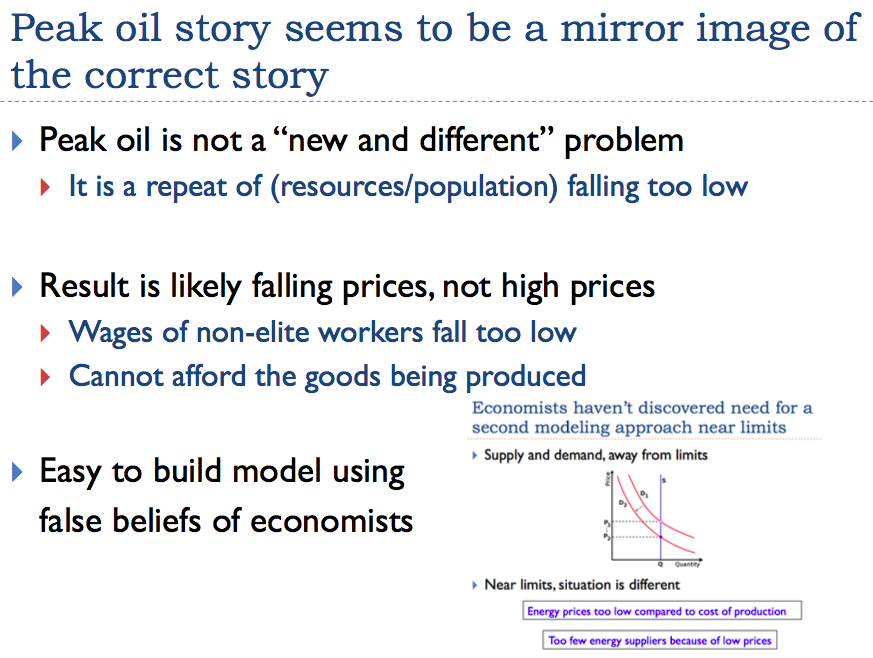
Most people assume that oil prices, and for that matter other energy prices, will rise as we reach limits. This isn’t really the way the system works; oil prices can be expected to fall too low, as we reach limits. Thus, we should not be surprised if the OPEC/Russia agreement to limit oil extraction falls apart, and oil prices fall further. This is the way the “end” is reached, not through high prices.


I recently tried to explain how the energy-economy system works, including the strange way prices fall, rather than rise, as we reach limits, at a recent workshop in Brussels called “New Narratives of Energy and Sustainability.” The talk was part of an “Inspirational Workshop Series” sponsored by the Joint Research Centre of the European Commission.


My talk was titled, “Elephants in the Room Regarding Energy and the Economy.” (PDF) In this post, I show my slides and give a bit of commentary.


The question, of course, is how this growth comes to an end.


I have been aided in my approach by the internet and by the insights of many commenters to my blog posts.


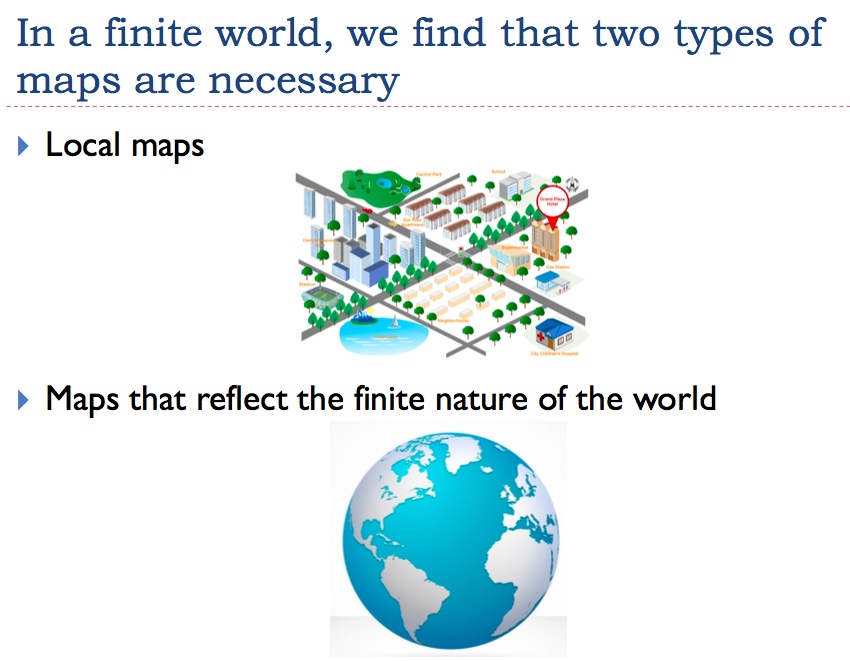
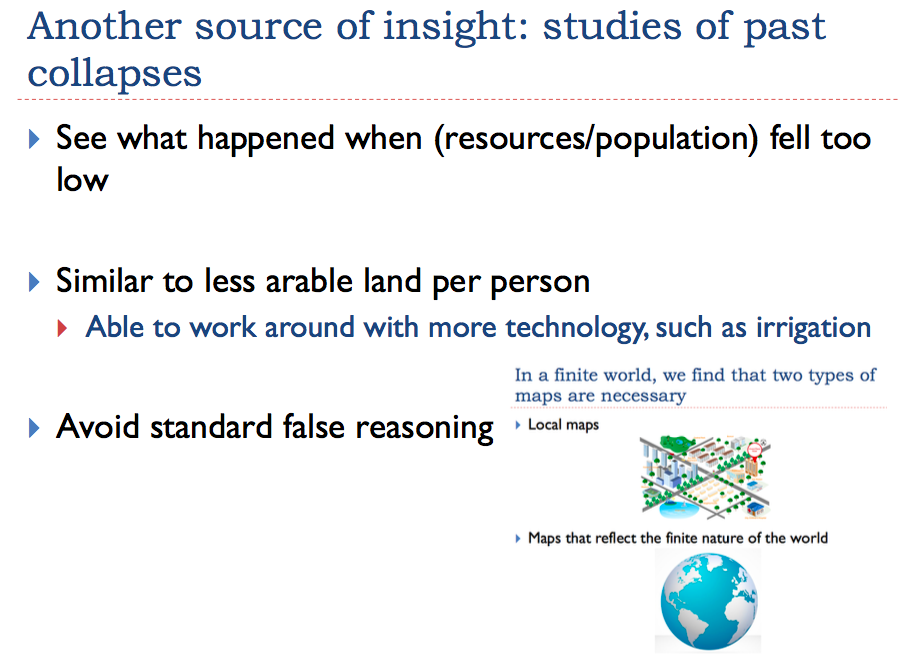
We all recognize that our way of visualizing distances must change, when we are dealing with a finite world.


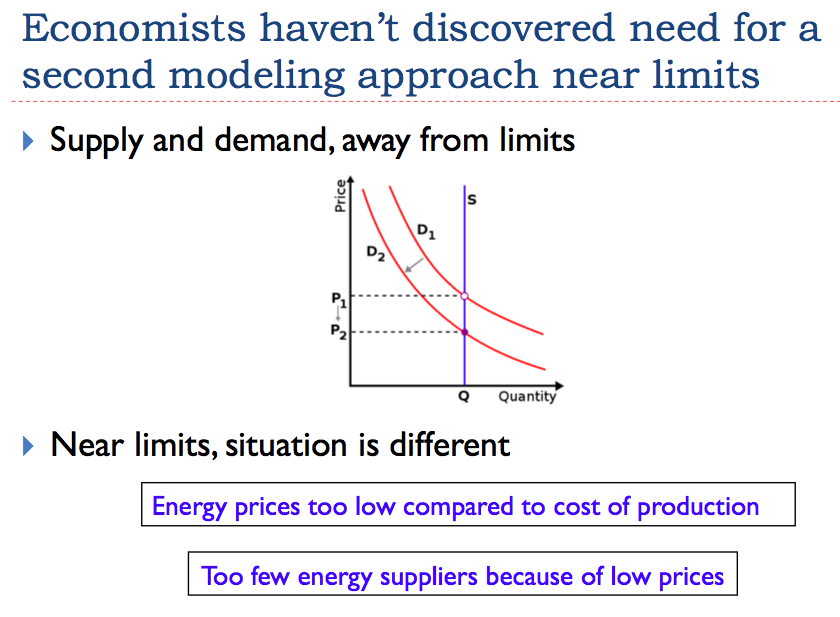
I should note that not all economists have missed the fact that the pricing situation changes, as limits are reached. Aude Illig and Ian Schindler have recently published a paper that concludes, “We find that price feedback cycles which lead to increased production during the growth phase of oil extraction go into reverse in the contraction phase of oil extraction, speeding decline.”


The comments shown in red on Slide 6 (above) reflect a variety of discussions over the last several years. Oil prices in the $50 per barrel range are way too low for producers. They may be high enough to get “oil out of the ground,” but they are not high enough to encourage necessary reinvestment, and they are not high enough to provide the tax revenue that oil exporters depend on.


Most people don’t stop to think about the symmetric nature of the problem. They also don’t realize that the adverse impacts of low oil prices don’t necessarily appear immediately. They can temporarily be hidden by more debt.


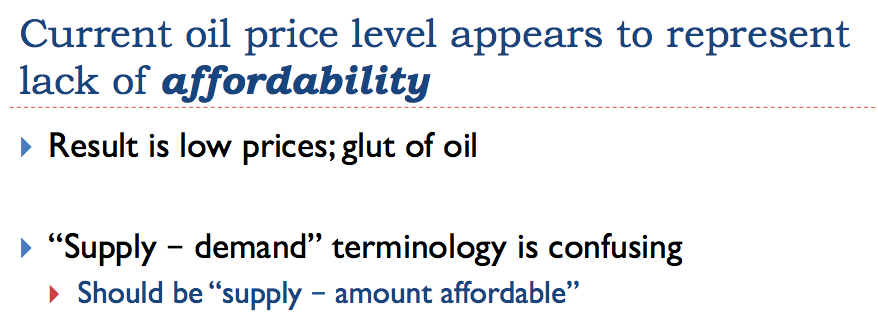
There would be no problem if wages were to rise as oil prices rise. Or if there were an easily substitutable source of cheap energy. The problem becomes an affordability problem.


The economists’ choice of the word “demand” is confusing. A person cannot simply demand to buy a car, or demand to go on a vacation trip. The person needs some way to pay for these things.


If researchers don’t examine the situation closely, they miss the nuances.


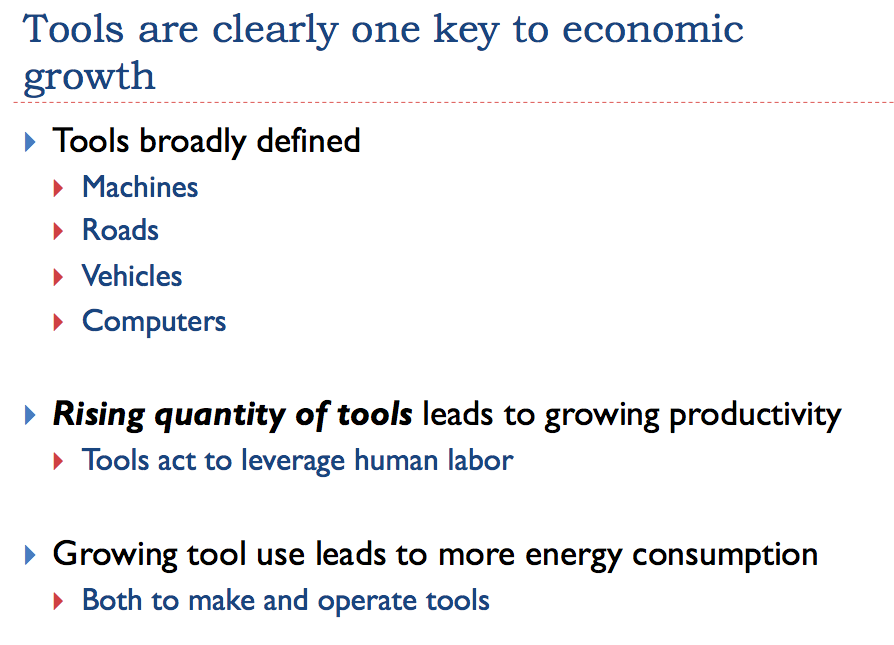
Many people think that the increasing use of tools can save us, because of the possibility of increased productivity.


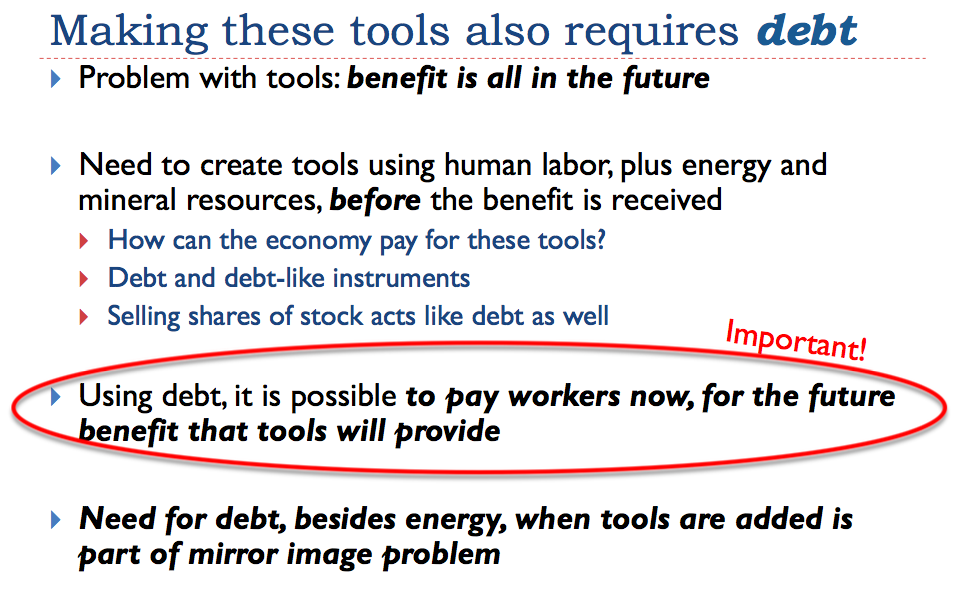
Using more tools leads to the need for an increasing amount of debt.


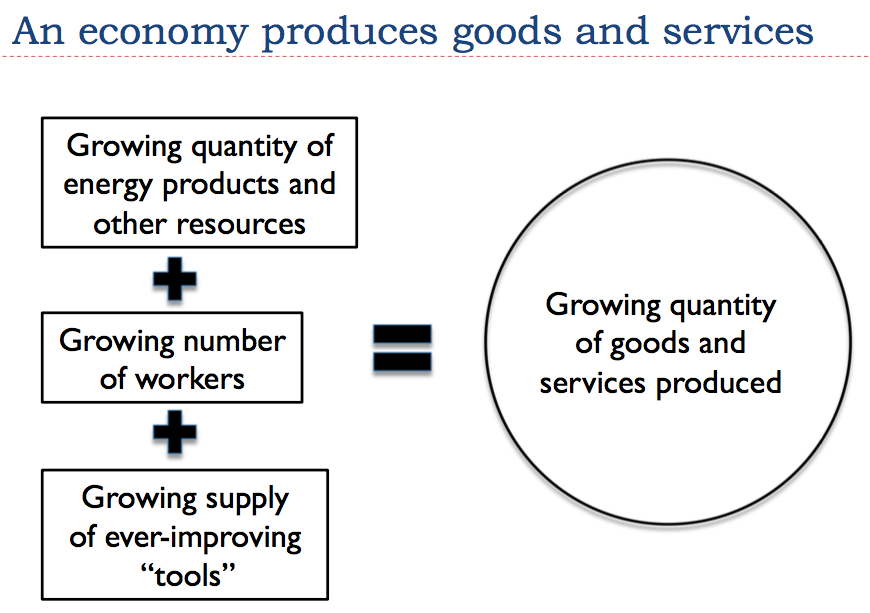
Read this chart from left to right. If we combine increasing quantities of resources, workers, and tools, the output is a growing quantity of goods and services.


Read this chart from right to left. How do we divide up the goods and services produced, among those who produced the products? If we can only use previously produced goods to pay workers and other contributors to the system, we will never have enough. But with the benefit of debt, we can promise some participants “future goods and services,” and thus have enough goods and services to pay everyone.


If we decrease the amount of debt, we have a big problem. Instead of the debt adding to the amount of goods and services produced, the shrinkage acts to decrease the amount of goods and services available for distribution as pay. This is why moving from deficit spending to a balanced budget, or a budget that reduces debt, is so painful.


When I say (resources/population), I mean resources per capita. Falling resources per capita makes it harder to earn an adequate living. Think of farmers trying to subsist on ever-smaller farms. It would become increasingly difficult for them to earn a living, unless there were to be a big improvement in technology.


Or think of a miner who is extracting ore that is gradually dropping from 5% metal, to 2% metal, to 1% metal content, and so on, because the best quality ore is extracted first. The miner needs to work an increasing number of hours to produce the ore needed for 100 kilograms of the metal. The economy is becoming in some sense “worse off,” because the worker is becoming “inefficient” through no fault of his own. The resources needed to provide benefits simply are less available, due to diminishing returns. This problem is sometimes reported as “falling productivity per worker.”


Falling productivity per worker tends to lower wages. And lower wages put downward pressure on commodity prices, because of affordability problems.


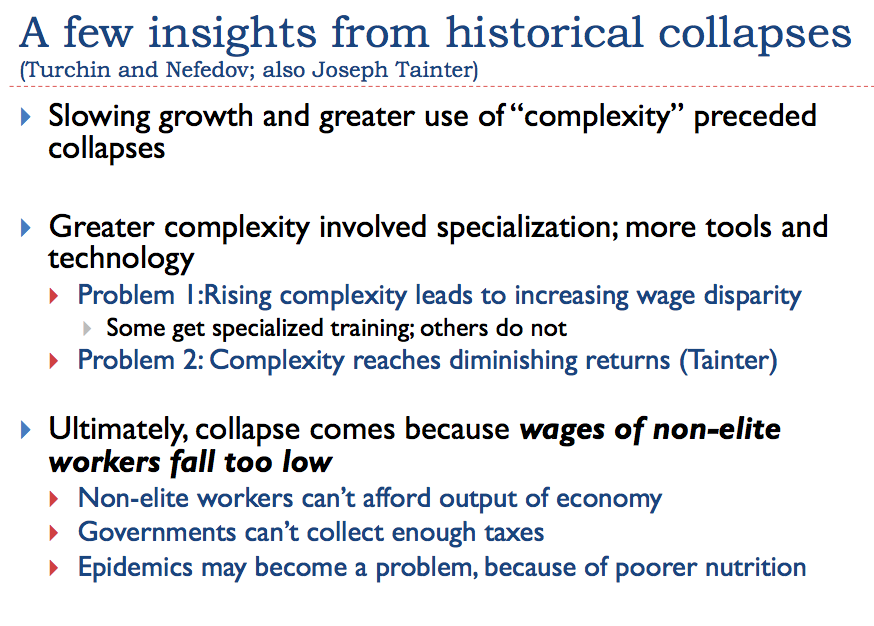
The problems that prior civilizations reached before collapse sound in many ways like the problems we are seeing today. We are seeing increased specialization, and falling relative wages of non-elite workers.


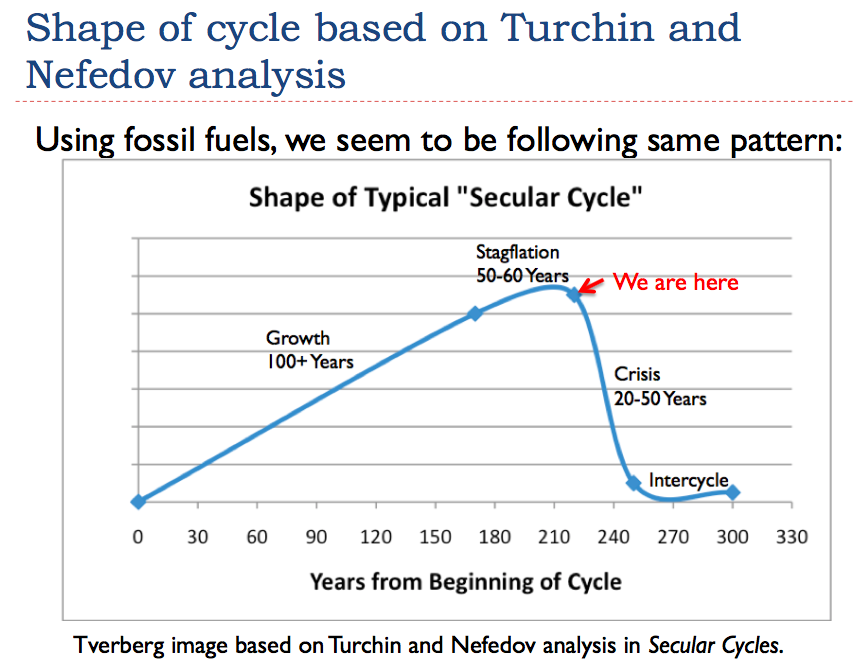
We seem to have already gone through a long period of stagflation since the 1970s. The symptoms we are seeing today look as if we are approaching a steep downslope. If we are approaching a crisis stage, it may be much shorter than the 20 to 50 years observed historically. Earlier civilizations (from which these timeframes were observed), did not have electricity or the extensive international trade system we have today.


The period since 1998 seems especially flat for wages for US wage earners, in inflation-adjusted terms. This is the period since energy prices started rising, and since globalization started playing a greater role.


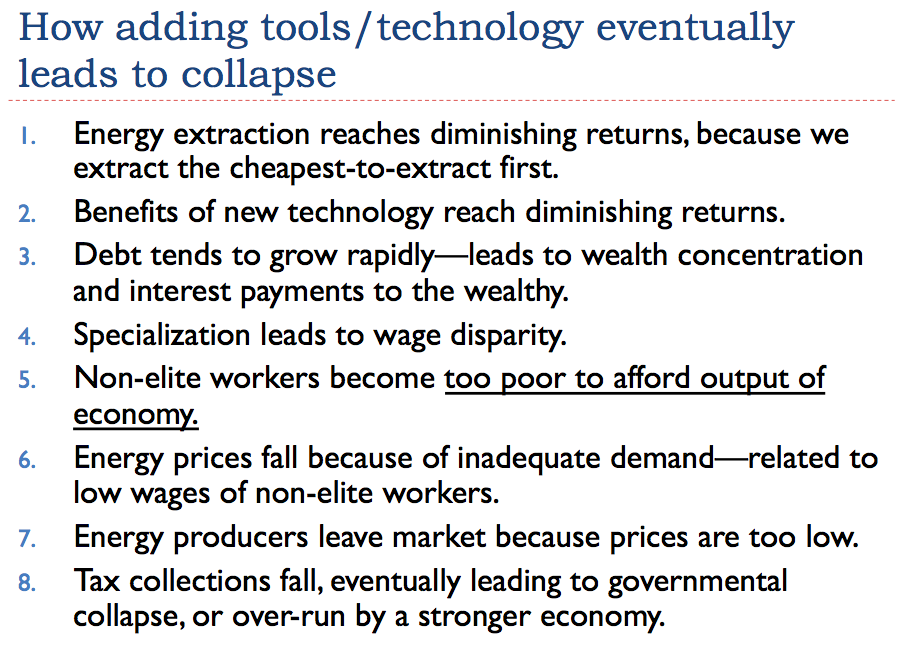
This is a list I made, showing that what looks to be beneficial–adding tools and technology–eventually leads to our downfall. The big problem that occurs is that non-elite workers become too poor to afford the output of the economy. Adding robots to replace workers looks efficient, but leaves many unemployed. Unemployment is even worse than low pay.


We can think of the economy as being a self-organized network of businesses, consumers, and governments. New products are gradually added, and ones that are no longer needed are eliminated. Government regulations change in response to changing business conditions. Debt is especially important for economic growth, because it makes goods affordable for customers, and it enables the use of “tools.” Prices are created almost magically by this networked system, through the interaction between supply and demand (reflecting affordability, among other things).


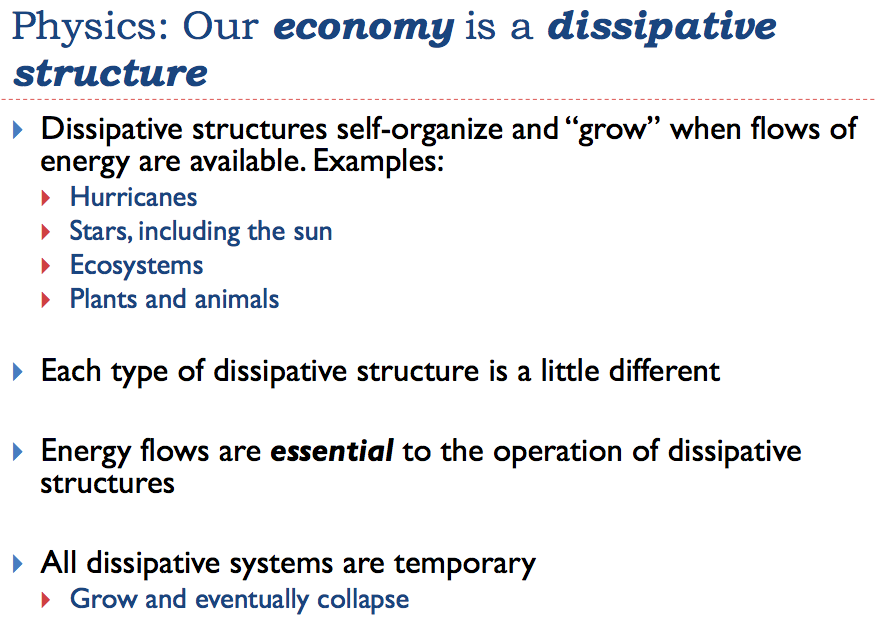
It is only in recent years that physicists have become increasingly aware of the fact that many types of structures form in the presence of flows of energy. We have known for a long time that plants and animals can grow when conditions are right. The networked economy illustrated above is one of the types of things that can grow and flourish in the presence of energy flows.


This is my view of how an economy, as a dissipative structure, works. “Tools and technology” are at the center. If a person doesn’t think too much about the issues involved, it is easy to assume that tools and technology will allow the economy to grow forever.


There is a potential for problems, both with respect to inputs and waste outputs. Early modelers missed many of these “issues.” M. King Hubbert created a model in which the quantity of energy supply and technology are the only issues of importance. He thus missed the impact of the Waste Output problems at the right. The Waste Outputs lead to falling prices as limited supply nears, and thus lead to a much steeper drop in production than Hubbert’s symmetric model would suggest.


Peak oilers recognized one important point: our use of oil products would at some point have to come to an end. But they did not understand how complex the situation is. Low prices, rather than high, would be the problem. We would see gluts rather than shortages, as we approach limits. Much of the oil that seems to be technologically extractable will really be left in the ground, because of low prices and other problems.


Here, I am getting back to the topic I was originally asked to talk about. What else, besides low energy prices and too much debt, are likely to be problems as we reach limits?


The easy way of modeling the use of wind turbines and solar turbines is to assume that the electricity produced by these devices is equivalent to electricity produced by fossil fuels, or by hydroelectric. Unfortunately, this is not the case.


Trying to integrate solar panels into an electric grid adds a whole new level of complexity to the electrical system. I have only illustrated some of the issues that arise in the slide above.

The fact that the price system doesn’t work for any fuel is a major impediment to adding more than a very small percentage of intermittent renewables to the electric grid. Intermittent renewables can only be used on the electric grid if they have a 24/7/365 backup supply that can be ramped up and down as needed. Unfortunately, the pricing system does not provide nearly high enough rates for this service. We are now seeing how this works out in practice. South Australia lost its last two coal-fired electricity power plants due to inadequate wholesale electricity prices when it added wind and solar. Now it is experiencing problems with both high electricity prices and too-frequent outages.


Another problem is that new [long distance] transmission makes buying from neighbors optimal, over at the left of Slide 28. This is a new version of the tragedy of the commons. Once long distance lines are available, and a neighbor has a fairly inexpensive supply of electricity, the temptation is to simply buy the neighbor’s electricity, rather than build local electricity generating capacity. The greater demand, without additional supply, then raises electricity prices for all, including the neighbor who originally had the less expensive electricity generation.


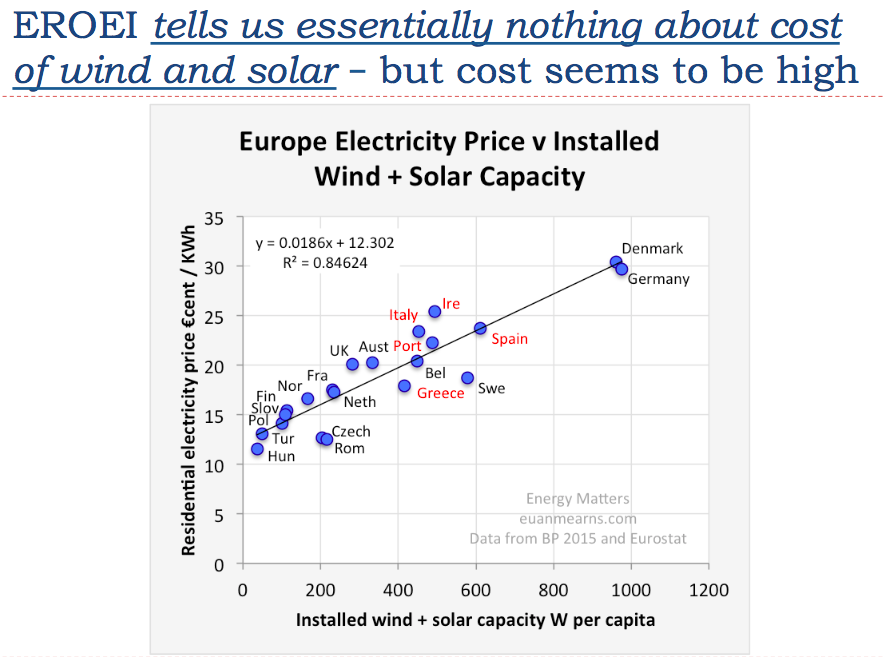
It is easy to assume that EROEI (Energy Returned on Energy Invested) or some other popular metric tells us something useful about the cost of integrating intermittent renewables into the electric grid, but this really isn’t the case.


We are now beginning to see what happens in “real life,” as intermittent renewables are added. For example, we can now see the problems South Australia is having with high electricity prices and too many outages as well as the high electricity prices in Germany and Denmark.


Wind and solar are not very helpful as stand-alone devices. Yet this is the way they are modeled. Some researchers have included installation costs, but this still misses the many problems that these devices cause for the electrical system, especially as the share of electricity production by these devices rises.


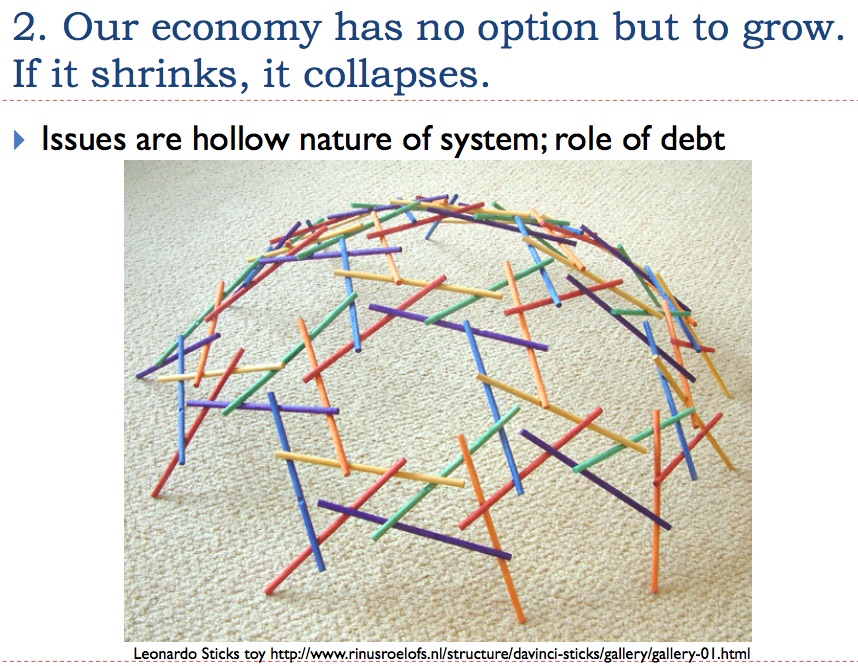
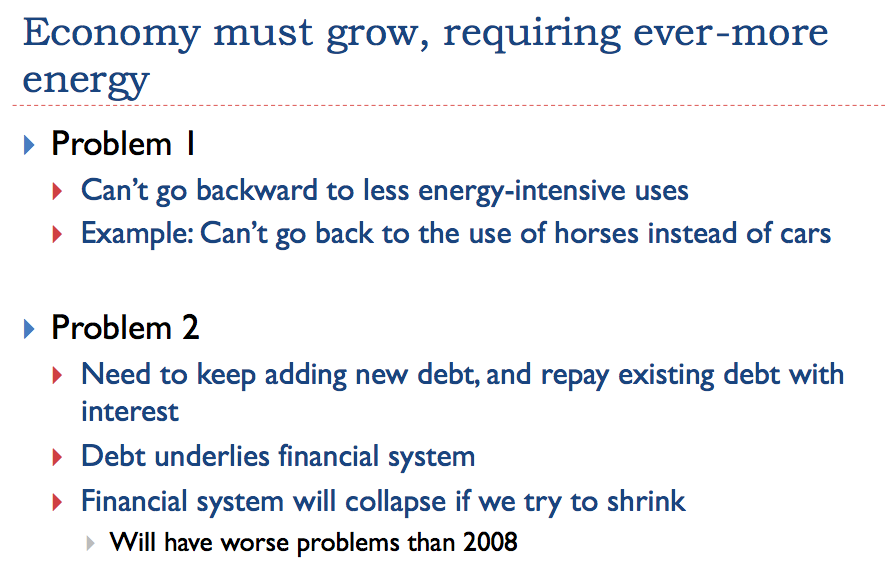
A networked system works differently than a system that is “user controlled.” It builds itself, and it can collapse, if conditions aren’t right. I have shown the economy as hollow, because there is no way of going backward.


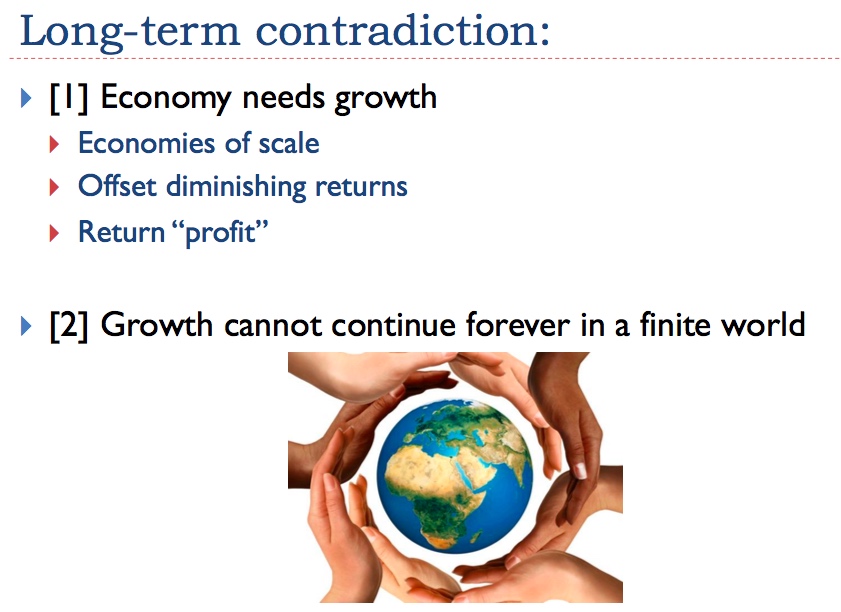
Many people miss the point that the economy must keep growing. In fact, I pointed this out in Slide 2 and gave an additional reason why it must keep growing on Slide 16. As the economy grows, we tend to need more energy. Growing efficiency can only slightly offset this. Thus, as a practical matter, energy per capita needs to stay at least level for an economy to grow.


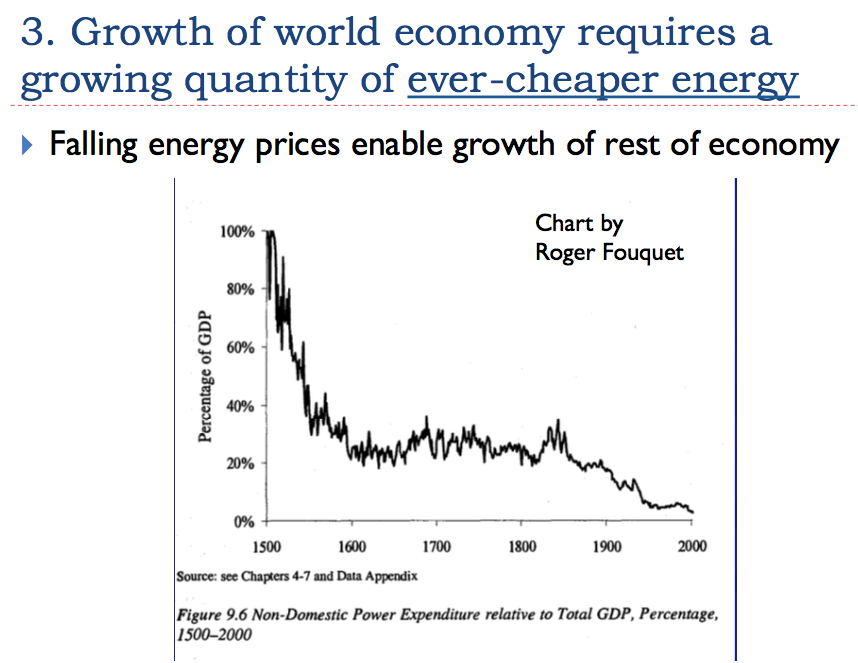
If energy prices rise, this will tend to squeeze out discretionary spending on other goods and services. If we cannot obtain energy products sufficiently cheaply, the system of economic growth will stop.


The fact that energy prices can, and do, fall below the cost of production is something that has been missed by many modelers. Prices can go down, even when the cost of production plus taxes needed by governments rises!


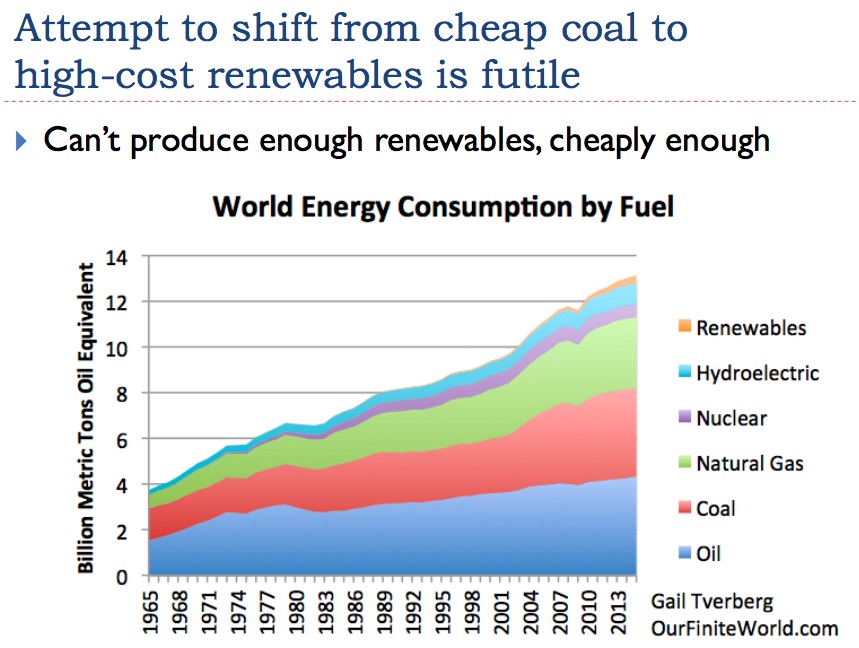
Wind and solar are part of the category at the top called “renewables.” This category also includes energy from wood and from geothermal. Many people do not realize how small this category is. Hydroelectric is also considered a renewable, but it is not growing in supply in the United States or Europe.


It takes energy to have an intergovernmental organization, such as the European Union. In fact, it takes energy to operate any kind of government. When there is not enough surplus energy to go around, citizens decide that the benefits of belonging to such organizations are less than the costs involved. That is the reason for the Brexit vote, and the reason the question is coming up elsewhere.


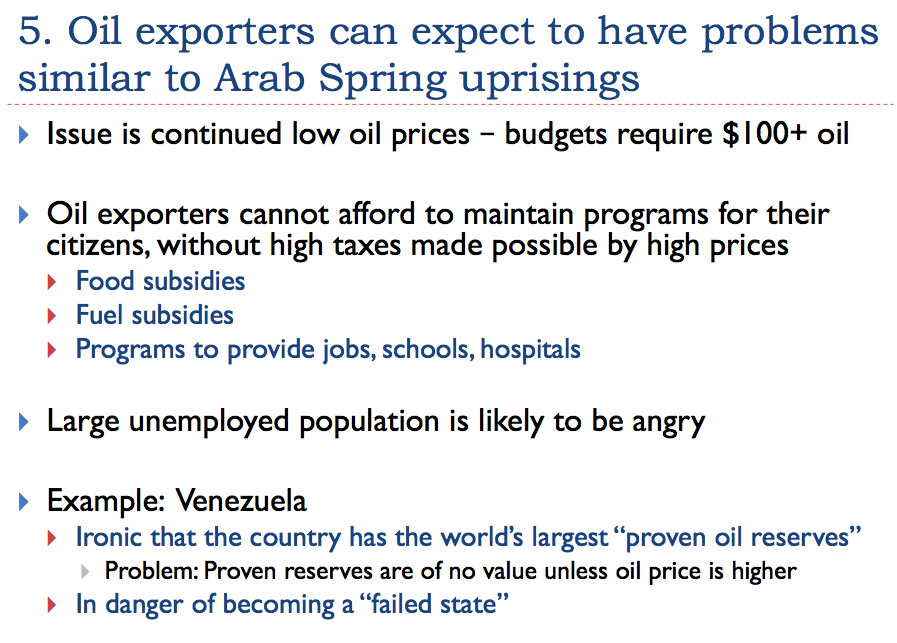
The amount of taxes oil-producing countries can collect depends on how high the price of oil is. If the price isn’t high enough, oil-exporting countries generally have to cut back their budgets. Even Saudi Arabia is having difficulty with low oil prices. It has needed to borrow in order to maintain its programs.


Oil prices have been too low for producers since at least mid-2014. It is possible to hide a problem with low prices with increasing debt for a few years, but not indefinitely. The longer the low-price scenario continues, the more likely a collapse in production is. Also, the tendency of international organizations of government to collapse (Slide 38) takes a few years to manifest itself, as does the tendency for civil unrest within oil exporters (Slide 39).


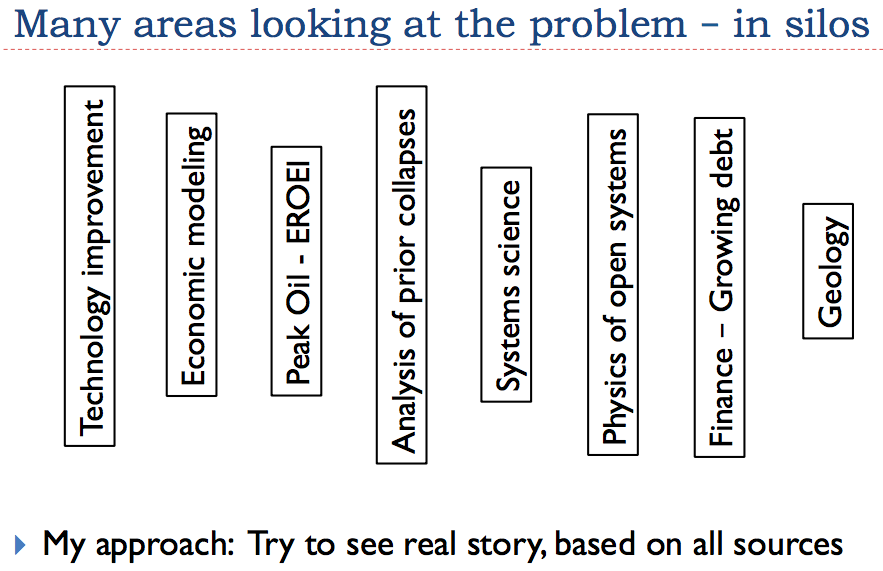
It is easy to miss the point that modeling a piece of the system doesn’t necessarily tell a person very much about the system as a whole.


Once an incorrect understanding of our energy problem becomes firmly entrenched, it becomes very difficult for leaders to understand the real problem.