Showing posts with label Jim Cramer. Show all posts

Thursday, September 28, 2017

Whitney Tilson Shuts His Hedge Fund... Again

Back in the summer of 2012, we had some fun when we reported that Whitney Tilson - the consummate, if always late immitator of other prominent investors especially Warren Buffett and Bill Ackman - following several years of abysmal returns, closed his then-hedge fund T2 (with Glenn Tongue), splitting off into his own, oddly-named venture, Kase Capital. Well, Whitney - who in recent years was better known for his bizarre family photos from Africa than managing money- has done it again and according to the WSJ, Tilson closed his hedge fund... again, "the latest high-profile investor to close shop amid an extended period of disappointing returns for the industry."


As the WSJ adds, Tilson, 50, shared his decision with clients (apparently he still had some) on Sunday. His latest hedge fund, Kase Capital, which was managing a whopping 50 million at the time of closure, and down from a peak of $180 million, lost about 8% so far this year, a more than 20% underperformance relative to the S&P YTD gain of more than 13%.


As the WSJ adds sarcastically, "while he ran a relatively small fund, Mr. Tilson was a well-known hedge-fund manager thanks to television and conference appearances, as well as books and regular writing about investing and other topics." In other words, Tilson was not so much a "hedge fund manager" as its straight-to-CNBC marketer, and the results have confirmed it.


In an amusing twist, in 2016 Tilson - a staunch never-Trumpter - inexplicably found himself the subject of scathing criticism by Elizabeth Warren, after Tilson expressed modest public support of some of President Donald Trump’s cabinet and other appointments from the banking world, "even though Mr. Tilson is a lifelong Democrat who voted for Hillary Clinton."


“The next four years are going to be a bonanza for the Whitney Tilsons of the world,” the Massachusetts Democrat said at the time. She later apologized to Mr. Tilson for her criticism.


And so Tilson joins a long procession of managers, some of whom managed actual real money, who decided that it was impossible to navigate these centrally planned markets and an exit was the noble way to go.


He is hardly the last one: in the past several months, a couple of well-known hedge funds have closed. Among them, investor Eric Mindich closed his $7 billion hedge-fund firm, Eton Park Capital Management LP, billionaire Richard Perry shuttered his hedge-fund firm and Hugh Hendry exited his flagship fund in London. “I died in active combat,” Mr. Hendry told Bloomberg at the time. “The last three months were harrowing.”


Many more closures are coming as investors redeem cash ahead of year-end at a pace not seen since the financial crisis.


As for Whitney, who somehow managed money for more than 18 years, the WSJ says that he is "expected to manage his own money." Considering Tilson was one of the founding, and most vocal members of "Patriotic Millionaires" group begging to be taxed more, we assume he does, in fact, have money to manage (we are not so sure about his clients) and this wasn"t just yet another marketing gimmick from the now former hedge fund manager.


Whitney"s full farewell letter below:


Dear friends,


I recently decided to close my funds and return capital to investors (excerpts from my letter to them are below). It was a hard decision, but the right one.


Now, I am filled with enthusiasm about what I will do with the second half of my life. What might that be? I’m not sure, but I want to share a few thoughts – and would be grateful for your feedback and ideas.


I’ve been working full time for more than 30 years, almost all of that time in an entrepreneurial capacity. While my one “regular” job early in my career was a good experience, I like being independent and plan to remain so. My goal is to find opportunities that are personally interesting, give me the chance to collaborate with great people, and are sufficiently remunerative (contrary to Elizabeth Warren’s belief, I am most definitely not a billionaire!).


I expect that most of my work will continue to be in the investment field, as I still love it and am confident that I can put my energy and 18 years of experience to good use. While I no longer intend to manage others’ money, I’m exploring a number of ideas, such as:


1) Unearthing a few great investment opportunities each year, in which I can invest personally as well as share with a few others;
2) Serving on corporate boards;
3) Doing consulting in areas in which I have expertise such as capital allocation, strategy, and activist investing; and
4) Teaching and mentoring young value investors via writings, videos and seminars.


I would welcome your advice and suggestions, so please don’t hesitate to email me at WTilson@kasecapital.com or call me at (646) 258-0687.


Sincerely yours,


Whitney


Sunday, June 18, 2017

"Major Deflationary Disruption" Looms After Amazon Purchase Of Whole Foods

Authored by Mike Shedlock via MishTalk.com,


Amazon bought Whole Foods yesterday. Widespread carnage in the grocery stock prices followed. Jim Cramer called it a major deflationary disruption saying stores cannot compete.


“If I was the Federal Reserve, I would have a meeting on this. Inflation is going to go down…. You have to rethink food … Costco knows how to compete. It will be in there tooth and nail with toilet paper and paper towels. … But Kroger, a crisis in Cincinnati, crisis.”


“Major Disruption of Society”


SupplyChain247 reports Amazon’s Move to Purchase Whole Foods Is ‘Disruption of Society’


TheStreet’s Action Alerts PLUS Portfolio Manager Jim Cramer said Amazon’s move to acquire Whole Foods is a disruption of society, “this is what I regard to be a move by Amazon to destroy the margins and own the business of food and groceries in this country,” Cramer said.


With Amazon putting down $13.7 billion to buy Whole Foods, Bezos is sending a powerful message to his retail rivals;


  • Food suppliers will now be dealing with an even larger grocery store, meaning potentially pressured profit margins for organic players such as Hain Celestial.

  • Amazon officially shows intent to enter bricks-and-mortar retail in a larger way than just bookstores. Combine that with its unmatched digital presence, Walmart, Target and others have been put on notice.

  • Grocer stores like Kroger will now be in an even bigger price war.

  • Amazon Prime integrated into Whole Foods could hurt Costco over time. Many Costco members are also Prime members.


“What Amazon did to the mall, it will now do to grocery stores,” said Cramer.


Here is a Tweet to think about:


Thursday, May 18, 2017

Chart Of The Day - It 'Is' Different This Time

I might not wear 3x shorts but I did hear that Amy Schumer"s comedy routine"s got no demand.
Should be paired with Lena Dunham
I"m sure the ratings would be something else.


Why else has Zog given us life, other than to enjoy Amy Schumer.


I"m wondering if there"re gonna be any TV viewers going forth other than for sports, old movies and great series like the Young Pope, Sherlock, Sopranos and the like.
Absolutely cannot turn on the media without the 24/7/365 rantings


Drain the Media.
Only now are we getting a real glimpse of the power and control behind the scenes.
There"re no more any independent news media organizations than there are 2 separate main political parties.


Think about that.
There"s the real terrorism.

Saturday, February 18, 2017

Why President Trump Does Not Tweet About Automation

Via 13D Research (13D.com),


"Fully automated trucks could put half of America’s truckers out of a job within a decade..."


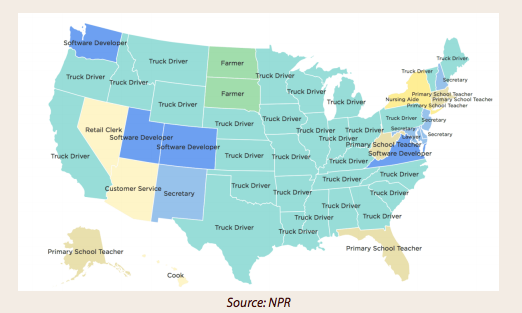
A widely circulated NPR graphic shows “truck driver” was the most common job in more than half of the U.S. states in 2014?—?in part because how the Bureau of Labor Statistics sorts common jobs, such as educators, into small groups. Indeed, truck driving is one of the last jobs standing that affords good pay (median salary for tractor-trailer drivers, $40,206) and does not require a college degree. According to the American Trucking Association, there are 3.5 million professional truck drivers in the U.S. Entire businesses (think restaurants and motels) and hundreds of small communities, supporting an additional 5.2 million people, have been built around serving truckers crisscrossing the nation. That’s 8.7 million trucking-related jobs. It also represents one of Trump’s most important voting blocs?—?working-class men.


But like many of the blue-collar jobs the President promised to save during his campaign, the future of these 3.5 million trucking jobs is less than certain. Fully automated trucks could put half of America’s truckers out of a job within a decade, The Los Angeles Times reported last year. This isn’t an imagined future. It’s already happening. Otto, an automated trucking company acquired by Uber, made a delivery of beer last year and has been approved to travel two routes in Ohio.


Last year, Noel Perry, an analyst at industry research firm FTR Transportation Intelligence, told The International Business Times: “Despite a shortage in high-quality drivers, pay hasn’t gone up in five years. Trucks are easier to drive.” So-called “soft-automation” features, like automatic braking and lane assist, mean the trucks can already be driven by less experienced operators commanding smaller salaries. Even ahead of automation, the profession is losing traction. Perry’s final remark to IBT strikes to the heart of the matter?—?“The free market produces jobs, the government doesn’t.”


Drivers reportedly account for about one third of the cost in the trucking industry. Ostensibly, there isn’t much a president?—?even one as untraditional as Trump?—?can do to stop a company from making more money. Or is there? Which begs the question: How will automation, employment, productivity and Trump co-exist?


A few days after Trump “saved” 750 jobs at Carrier, Greg Hayes, CEO of Carrier’s parent firm, United Technologies, admitted that automation would eventually win out. During a CNBC interview with Jim Cramer, Hayes revealed: “We’re going to make a $16 million investment in the factory in Indianapolis to automate to drive down costs so that we can continue to be competitive. . .But what that ultimately means is there will be fewer jobs.


Thomas H. Davenport, professor in management and information technology at Babson College, opined recently for The Harvard Business Review:


“Trump knows virtually nothing about technology?—?other than a smartphone, he doesn’t use it much. And the industries he’s worked in?—?construction, real estate, hotels, and resorts?—?are among the least sophisticated in their use of information technology. So he’s not well equipped to understand the dynamics of automation-driven job loss.


“. . .The Art of the Deal’s author clearly has a penchant for sparring with opponents in highly visible negotiations. But automation-related job loss is difficult to negotiate about. It’s the silent killer of human labor, eliminating job after job over a period of time. Jobs often disappear through attrition. There are no visible plant closings to respond to, no press releases by foreign rivals to counter. It’s a complex subject that doesn’t lend itself to TV sound bites or tweets.


To be fair, it’s not just Trump who finds this a difficult enemy to battle; other politicians don’t engage with that much either. And there are several good reasons. . . One is that automation usually comes with corporate investment rather than cutbacks. Note that United Technologies announced a $16 million investment in the Indiana Carrier plant. Who wants to criticize that?”


As we have written, Trump’s number one priority is to get re-elected. To do so, he will have to keep the 8.7 million men and women in the trucking sector employed. At the same time, he has pledged to encourage foreign investment in the U.S. and to attract U.S. companies back to American soil, all with an eye to creating more jobs for Americans. To remain competitive, these companies will have to improve productivity, and the shortest path to increased productivity, is automation. But, even with vigorous training, the vast majority of America’s working middle-class, like the 3.5 million truckers who voted largely for Trump, cannot transition easily into the types of job created by automation?—?engineering, integration, IT.


Therein lies the dilemma facing America, and much of the developed and the developing world. The economy needs more productivity growth, not less. But it also needs to create jobs. Any politician who wants to appeal to the business community will be reluctant to provoke a war against automation. But, he cannot afford to see his key voter bloc displaced.


All of which begs the question: How can Trump insulate the status quo from the disruptive forces of automation and technology? Will he tweet to the perception or the underlying reality?

Friday, February 17, 2017

BNP Risk Indicator Flashes "Love" Warning Signal For US Stocks

While the market itself has exhibited the exuberance we have all seen before (and never seem capable of learning from), BNP has quantified this love-panic relationship (and the news is not great for the bulls). When in "love" mode, the average drop in stocks has been 12% in the next six months. The biggest drivers of this "love" have been investor confidence, CoT positioning, short-interest, relative trading volumes, and sectoral outperformance with fund-flows shifting away from "love" suggesting the short-term top is in. The index itself peaked last week at the highest level of "love" in two years...


h/t @Not_Jim_Cramer


BNP explains their framework:


In our Love Panic model, we try to identify distress and euphoria in an attempt to predict forward market returns. In order to successfully predict the market we have chosen parameters with good predictive capabilities during different market cycles but also those that make qualitative sense. Investment should be dispassionate but not automatic. Some investors solve this problem by hiring a mechanic (or quant) to build a machine to invest on their behalf. This indicator is not for them. Instead, this indicator highlights when market sentiment is either overly depressed or excessively optimistic. This helps one at least adjust for ones mood. So we suggest that when the market has reached a level of distress, it’s a good time to buy. Meanwhile, when investors are euphoric,we advocate a sell. As a result we have developed a contrarian indicator model. When our signal is in panic (negative), it indicates a buy. While when the signal reads positive it’s a sell signal. In our Love Panic model, we try to identify distress and euphoria in an attempt to predict forward market returns. In order to successfully predict the market we have chosen parameters with good predictive capabilities during different market cycles but also those that make qualitative sense.


And the market has not done well once investors fall in "love"...