Showing posts with label Economy of Venezuela. Show all posts

Wednesday, September 20, 2017

Venezuela's Grim Reaper: A Weekly Report

Authored by Steve H. Hanke of the Johns Hopkins University. Follow him on Twitter @Steve_Hanke.


The Grim Reaper has taken his scythe to the Venezuelan bolivar. The death of the bolivar is depicted in the following chart. A bolivar is worthless, and with its collapse, Venezuela is witnessing the world’s worst inflation.


As the bolivar collapsed and inflation accelerated, the Banco Central de Venezuela (BCV) became an unreliable source of inflation data. Indeed, from December 2014 until January 2016, the BCV did not report inflation statistics. Then, the BCV pulled a rabbit out of its hat in January 2016 and reported a phony annual inflation rate for the third quarter of 2015. So, the last official inflation data reported by the BCV is almost two years old. To remedy this problem, the Johns Hopkins – Cato Institute Troubled Currencies Project, which I direct, began to measure Venezuela’s inflation in 2013.


The most important price in an economy is the exchange rate between the local currency and the world’s reserve currency — the U.S. dollar. As long as there is an active black market (read: free market) for currency and the black market data are available, changes in the black market exchange rate can be reliably transformed into accurate estimates of countrywide inflation rates. The economic principle of Purchasing Power Parity (PPP) allows for this transformation. 


I compute the implied annual inflation rate on a daily basis by using PPP to translate changes in the VEF/USD exchange rate into an annual inflation rate. The chart below shows the course of that annual rate, which previously peaked at 1823.03% (yr/yr) in early August 2017. At present, Venezuela’s annual inflation rate is 2432.94%, the highest in the world (see the chart below).


Wednesday, September 13, 2017

Next Up For Venezuela: PDVSA's Inevitable Default

Authored by Saxo Bank"s head of macro analysis Christopher Dembik via TradingFloor.com,


A Venezuelan default is only a matter of time.


While debt servicing has been a government priority, declining external liquidity and a deteriorating domestic situation (three-digit hyperinflation, shortages, and a political crisis between the government and the National Assembly) make it a daunting task.


By 2020, the country must repay 30% of the external debt due to expire in the next 23 years.


Venezuela can get access to liquidity via three main ways.


The first option is to borrow directly on the financial market which implies that the country must pay an increasingly prohibitive risk premium due to investors’ fear of sovereign default.


The second option, used intensively in recent years, is to borrow from allies, and especially China.


Since 2009, Venezuela has borrowed at least $60 billion from China (through the Venezuelan-China fund) in exchange for selling oil at a discounted price. Loans were used to pay foreign manufacturers and repay external debt, such as in 2015. This exchange of good practices persisted as long as oil prices were quite high and Venezuela’s political situation was fairly stable. Since 2016, China has made a strategic move to reduce exposure to Venezuela which resulted in the repatriation of Chinese oil engineers (who filled local labour shortages), the end of financial aid, and reduced oil imports. 


In this context, it is quite unlikely that Venezuela will be able to count on China for repayment of its loans, which increases the probability of sovereign default in the medium term.


The last option is through the national oil company, PDVSA (Petróleos de Venezuela SA). As the country’s main source of income and access to foreign currency, PDVSA is key for those seeking to gain a real appreciation of Venezuela’s disarray and economic future.


Over the past five years, it has accounted for virtually all of the country’s foreign exchange earnings – about 93%. The financial mechanism is quite simple: PDVSA borrows cash in the US financial market via its local subsidiary Citgo Petroleum Corporation, the sixth-largest US refinery, then the money is transferred to PDVSA and a significant part is allocated to Venezuela’s government budget.


As bonds are issued under US law, which offer a good level of protection to investors, borrowing rates are more affordable than if bonds were issued under Venezuelan law. Until very recently, this has been the least costly way for the country to borrow.


However, access to liquidity and foreign currency is being called into question by PDVSA’s increasing financial difficulties. This dates back to 2003-2004 when then-president Hugo Chavez decided to transfer the majority of PDVSA"s revenues to the government budget in order to finance the Bolivarian missions – a series of social programmes – rather than investing in capex to increase the company’s productivity.


The lack of investment did not have an immediate impact on PDVSA’s financial situation as long as oil prices were above $100/barrel. After all, it was enough to cover the cost of producing one barrel of Venezuelan oil (which are among the most expensive barrels in the world to produce at around $23.50 versus $10 in the Arabian Peninsula)... and to balance the government budget.


The fall in oil prices from mid-2014 led to a massive drop in oil production, as well as lower profit margins and tax revenues.


So far, PDVSA continues to pay its bondholders cash on the barrelhead, which explains why 80% of them buy back bonds when they expire. The company tries to maintain the illusion of a good financial situation, but this is misleading.


The company is running out of cash. It keeps repaying bondholders in order not to cut off the Venezuelan government"s financing flow but it is already unable to pay the  foreign oil field services companies on which it relies.


Since 2015, PDVSA has made extensive use of various financial instruments (credit notes and commercial papers) to settle outstanding bills with foreign companies such as General Electric in order to delay the consequences of this problem. These instruments are not very liquid and are subject to haircuts, but they have two main immediate advantages.


First, they give PDVSA additional leeway in repaying its creditors, up to six years. Furthermore, they give creditors the possibility of being reimbursed by the confiscation of PDVSA assets upon decision of the International Chamber of Commerce, an independent international organization whose secretariat is in Paris.


In the near term, PDVSA faces a challenging debt repayment schedule since it needs to repay $3.2 billion due mostly in October and November. Based on official reports, the company only has $2 billion in cash to service its debt obligations. Nevertheless, a default is unlikely this year; fighting a political crisis and defaulting at the same time would be too complicated to handle. 


Venezuela still seems willing and able to pay.


In the worst-case scenario, PDVSA might use a grace period of a few weeks, as it did last year, in order to pull coins out of the sofa to pay these bills. The company can still obtain a new loan from Russian oil company Rosneft and propose as collateral its oilfield stakes; it could get funding from Venezuela"s public banks (which has already been done recently for about $500 million); or the government can decide to use the central bank’s foreign reserves which are officially estimated at $10 billion, of which $1 billion is in cash and $9 billion in gold bars.


Nonetheless, default seems inevitable in the medium term due to the prolonged period of low oil prices and increased US sanctions. President Trump"s executive order of August 24, 2017, strengthened sanctions against PDVSA by prohibiting all transactions related to new debt with a maturity greater than 90 days and by forbidding Citgo from repatriating dividends in Venezuela.


By cutting access to an essential source of funding, the Trump administration is precipitating the default of PDVSA and, given the key economic role of the company, of Venezuela.


Any exit from the crisis will necessarily involve an increase in oil production. Since 2005, the country has been aiming to produce five million barrels per day but this target has never been reached and has been pushed back from year to year. In the first seven months of 2017, average oil production was 1.9 million barrels/day. The objective of multiplying oil production by 2.5 is achievable provided that the government lets the local private sector step in and signs agreements with foreign companies.


In this respect, it can draw inspiration from the US which has increased oil production from 4.3 million to 9.5 million barrels per day over the past five years by relying on numerous small-scale private shale oil companies. However, this also implies full respect of private property, protection of minority investors, and political stability.

Thursday, September 7, 2017

From Richer To Poorer: Venezuela's Economic Tragedy Visualized

From the 10 years of military dictatorship between 1948-1958 to the impeachment of Carlos Andrés Pérez for corruption in 1993, The Money Project"s Jeff Desjardins notes that Venezuelan politics have often been both rocky and eventful.


But despite these challenges throughout its history, no one has ever denied Venezuela’s economic potential. After the discovery of oil in the early 20th century, the nation quickly built its economy on back of black gold – and even today, Venezuela leads the world in proven oil reserves with 300 billion barrels.


Oil reserves Venezuela


Early on, Venezuela’s oil was a game-changer.


By 1950, as the rest of the world was struggling to recover from World War II, Venezuela had the fourth-richest GDP per capita on Earth. The country was 2x richer than Chile, 4x richer than Japan, and 12x richer than China!


1950 GDP per capita rates


Unfortunately for Venezuela, this wealth wouldn’t last – and an over-reliance on oil would soon decimate the economy in unexpected ways.


The Downfall of Venezuela’s Economy


From 1950 to the early 1980s, the Venezuelan economy experienced steady growth.


By 1982, Venezuela was still the richest major economy in Latin America. The country used its vast oil wealth to pay for social programs, including health care, education, transport, and food subsidies. Workers in Venezuela were among the highest paid in the region.


However, as you’ll see in the following animation, from there things went quickly downhill. In the mid-1980s, an oil glut and a free-falling oil price ended up decimating the Venezuelan economy, which was unable to diversify away from energy.


Venezuela GDP per capita


Today, Venezuela has one of the poorest major economies in Latin America – and as the current crisis rides itself out, the IMF foresees it getting far worse. By 2022, the organization predicts Venezuela’s GDP per capita (PPP) will be just $12,210, which would be a massive economic setback – the Venezuelan economy would be even poorer than it was many years before the Chávez era started.


Flying Too Close to the Sun


Although oil revenues are tempting to rely on to maintain social order, they come with a degree of unpredictability. According to OPEC, Venezuela still relies on oil for 95% of its exports, which means that any fluctuations in oil price can be the difference between immense wealth and near-poverty.


Venezuela inflation vs. oil revenues


The above graphic shows Venezuela’s oil revenues (in 2000 dollars) against the rate of inflation – and it symbolizes the story of Venezuela’s recent economic history as succinctly as possible.


After the oil glut in the 1980s, Venezuela’s oil revenues dropped significantly. It was then that Venezuela had its first bout with inflation, where rates peaked in 1989 (84.5% inflation) and later in 1996 (99.9% inflation). Without sufficient money coming in, the country had to rely on its printing presses in an attempt to maintain living standards.


In 1998, Hugo Chávez was elected with the promise that Venezuela could reduce poverty and step up living standards by leaning even more heavily on its energy wealth. The recovery of oil prices helped this come true in the 2000s, and Chávez later passed away in office in 2013.


A Temporary Fix


Nicolás Maduro, who took over after the death of his predecessor, saw oil prices crash almost immediately, and it was clear that Venezuela’s intense battle with inflation was only just beginning. The national currency, the Venezuelan bolívar, would soon be almost worthless.


Bolivar inflation against USD


The details of today’s crisis and intense hyperinflation are widely shared.


The country has massive shortages of food, electricity, and other essential goods, and violence is escalating in Caracas. More recently, the government is attempting to tighten its grip around power, and mismanagement of the economy has led to people starving on the streets. People are calling the situation a humanitarian crisis, which is extremely disheartening to see in what was once one of the richest countries on the planet.


And while the current condition of Venezuela is a tragedy in itself, the country’s inability to live up to its true economic potential is nearly just as devastating.


*  *  *


The Money Project is an ongoing collaboration between Visual Capitalist and Texas Precious Metals that seeks to use intuitive visualizations to explore the origins, nature, and use of money.

Saturday, September 2, 2017

Venezuela Headed For "Messiest Debt-Restructuring In History" Thanks To US Sanctions

After being effectively shut out from global financial markets – a situation that was made more precarious by US sanctions prohibiting purchases of Venezuelan debt (unless you’re buying them off Goldman Sachs, should the bank’s asset-management arm desire to liquidate its $3 billion “hunger bond” position) – Venezuela is drawing ever-nearer to what the Financial Times describes as potentially the “messiest debt restructuring in history.”


So far, Venezuela has managed to forestall a default by stripping assets from its state-owned oil company, Petroleos de Venezuela, commonly referred to as PVDSA, and shaking down local institutions of spare dollars – not to mention the explicit financial support of China and Russia. Recently, Rosneft, the largest Russian oil company, helped support its troubled ally, which enjoys the largest crude reserves in the world, by offering billions of dollars in advance payments for future crude supplies. Thanks to a deal brokered by deceased former President Hugo Chavez, Venezuela has for years been Rosneft’s largest foreign supplier of crude. Last year, the oil giant accepted a 49.9% stake in PVDSA’s US-based subsidiary, Citgo, as collateral for a $1.5 billion loan.


Venezuelan President Nicolas Maduro


However, thanks to the US sanctions, which prohibit purchases of newly issued debt and existing bonds that have so far not been sold outside of Caracas, the country will once again need to innovate or risk sliding into bankruptcy. Making matters all the more urgent, the country recently suffered a loss in US courts after a judge ruled that Canadian miner Crystallex can seize Venezuelan money held in a custody account at Bank of New York Mellon to cover a $1.4 billion judgment awarded by a World Bank tribunal.


Crystallex’s victory could further embolden the country’s creditors, who collectively may be owed as much as $3.7 billion.


“Venezuela has been taken to the World Bank’s ICSID tribunal 43 times. Only Argentina has been subjected to more claims. Of these 24 are still pending, including claims from Anglo American, ConocoPhillips, Air Canada and Vestey. The Eurasia Group estimates that Venezuela owes a total of $3.7bn as a result of ICSID rulings, and Crystallex’s progress is likely to embolden other creditors.”


Adding to the country’s troubles, a major US clearing house has said it will stop settling some Venezuelan bonds, and Cantor Fitzgerald has stopped trading them altogether.


After months of rhetoric, the US – which for years maintained an uneasy business relationship with Venezuela, formerly South America’s wealthiest economy – has severed the country’s last tenuous ties to the global financial system…


“The message is that the US doesn’t want its financial system enabling the Venezuelan government in any way,” says Charles Blitzer, of Blitzer Consulting, who is a former International Monetary Fund official.  


…And with the Crystallex ruling compounding the country’s troubles, its government is being set up for a “slow burn” leading ultimately to financial insolvency as creditors root out and seize whatever foreign assets they can find.


“Crystallex is the camel’s toe under the tent,” says Mark Weidemaier, a law professor at the University of North Carolina. “It will be a slow burn, but I wouldn’t be surprised to see people use the courts to ferret out where Venezuela’s assets are . . . and break down the barriers between the government, PDVSA and other entities.”


Typically, in a sovereign bankruptcy, creditors negotiate some kind of debt relief and trade their old, defaulted bonds for less valuable new ones. However, US sanctions may preclude this as an option for Venezuela, as the FT explains.


“…such a debt exchange would fall foul of the US sanctions regime, precluding any US banks from arranging one and any US bondholders from tendering their debts. In practice, it would mean indefinite financial purgatory for Venezuela until the US administration decides to lift the prohibition.


“If these sanctions stay in place, then Venezuela cannot restructure and it goes into limbo,” says Edward Al-Hussainy, a senior analyst at Columbia Threadneedle."


Since Venezuela’s economic crisis began four years ago, imports have fallen precipitously, leading to dire shortages of essentials like medicine and foodstuffs as the country"s currency depreciated to the point of worthlessness. Unless the country can find some way to circumvent the sanctions, it will be forced to decide between countenancing further import declines, or a disorderly default.


According to Torino Capital, a Latin American-focused investment bank, Venezuela could choose the latter.


“Torino Capital…argued that this might counter-intuitively make a restructuring less likely. ‘It is possible that, faced with this choice, Venezuelan authorities end up deciding that the negative effects of a disorderly default on PDVSA’s capacity to generate export revenue are worse than the contractionary effects of further import cuts,’ the bank wrote in a note to clients.”


To be sure, a default could still be years away. And investors, for one, aren’t worried. The country’s debt has been largely unperturbed by the recent developments: PDVSA bonds have largely traded sideways, despite the recent developments.


“In the near term the impact will probably be minimal. Given Venezuela’s messy finances, the country is in practice already shut out of the international bond market. And while Crystallex won a legal skirmish, it is far from winning the war. It is unclear how much money Venezuela holds at BNYM and it may still be protected by sovereign immunity. Underscoring the investor view that little has changed, Venezuela and PDVA’s bonds have largely traded sideways.”


Still, a default, whenever it arrives, could signal the last gasp of the country’s embattled government. The country"s foreign reserves have already fallen below $10 billion (though they received a boost following the Goldman deal...).


“If they default, they will be out of government within three months,” says Federico Kaune, head of emerging market debt at UBS Asset Management. “The calculation is that they’re either in government, in exile or jail.”


With the fate of the Maduro regime hanging in the balance, we imagine Washington will do everything in its power to force Venezuela into bankruptcy, allowing the US to claim victory over yet another foreign adversary.
 

Tuesday, August 29, 2017

Venezuela’s Grim Reaper – A Weekly Report

Authored by Steve H. Hanke of the Johns Hopkins University. Follow him on Twitter @Steve_Hanke.


The Grim Reaper has taken his scythe to the Venezuelan bolivar. The death of the bolivar is depicted in the following chart. A bolivar is worthless, and with its collapse, Venezuela is witnessing the world’s worst inflation. 


As the bolivar collapsed and inflation accelerated, the Banco Central de Venezuela (BCV) became an unreliable source of inflation data. Indeed, from December 2014 until January 2016, the BCV did not report inflation statistics. Then, the BCV pulled a rabbit out of its hat in January 2016 and reported a phony annual inflation rate for the third quarter of 2015. So, the last official inflation data by the BCV is almost two years old. To remedy this problem, the Johns Hopkins – Cato Institute Troubled Currencies Project, which I direct, began to measure inflation in 2013. 


The most important price in an economy is the exchange rate between the local currency and the world’s reserve currency — the U.S. dollar. As long as there is an active black market (read: free market) for currency and the black market data are available, changes in the black market exchange rate can be reliably transformed into accurate estimates of countrywide inflation rates. The economic principle of Purchasing Power Parity (PPP) allows for this transformation.


I compute the implied annual inflation rate on a daily basis by using PPP to translate changes in the VEF/USD exchange rate into an annual inflation rate. The chart below shows the course of that annual rate, which peaked at 1823% (yr/yr) in early August 2017. At present, Venezuela’s annual inflation rate is 1582%, the highest in the world (see the chart below).


Friday, August 18, 2017

A Venezuelan Tanker Is Stranded Off The Louisiana Coast

A tanker loaded with 1 million barrels of Venezuelan heavy crude has been stranded for over a month off the coast of Louisiana, not because it can"t sail but as a result of Venezuela"s imploding economy, and its inability to obtain a bank letter of credit to deliver its expensive cargo. It"s the latest sign of the financial troubles plaguing state-run oil company PDVSA in the aftermath of the latest US sanctions against the Maduro regime, and evidence that banks are slashing exposure to Venezuela across the board as the Latin American nation spirals into chaos.


As Reuters reports, following the recently imposed US sanctions, a large number of banks have closed accounts linked to officials of the OPEC member and have refused to provide correspondent bank services or trade in government bonds. The stranded tanker is one direct casualty of this escalation.


The tanker Karvounis, a Suezmax carrying Venezuelan diluted crude oil, has been anchored at South West Pass off the coast of Louisiana for about a month, according to Marinetraffic data.


For the past 30 days, PBF Energy, the intended recipient of the cargo, has been trying unsuccessfully to find a bank willing to provide a letter of credit to discharge the oil, according to two trading and shipping sources.


The tanker was loaded with oil in late June at the Caribbean island of St. Eustatius where PDVSA rents storage tanks, and has been waiting for authorization to discharge since early July, according to Reuters. It is here that the delivery process was halted as crude sellers request letters of credit from customers that guarantee payment within 30 days after a cargo is delivered.


While the documents must be issued by a bank and received before the parties agree to discharge, this time this is impossible as the correspondent bank has decided to avoid interacting with PDVSA and running afoul of the latest US sanctions. It was not immediately clear which banks have denied letters of credit and if other U.S. refiners are affected.


In an ironic coincidence, these days the state energy company of Venezuela, PDVSA, is almost as much Venezuelan as it is Russian and Chinese. Chinese and Russian entities currently take about 40% of all PDVSA"s exports as repayment for over $60 billion in loans to Venezuela and the company in the last decade, as we reported last year and as Reuters recently updated. This has left U.S. refiners among the few remaining cash buyers. Meanwhile, as a result of these ongoing historical barter deals exchanging oil for refined products and loans, PDVSA"s cash flow has collapsed even as the company"s creditors resort to increasingly more aggressive measures to collect: just this April, a Russian state company took a Venezuelan oil tanker hostage in hopes of recouping $30 million in unpaid debt.


The first indication that the financial noose is tightening on the Caracas regime came earlier this month when Credit Suisse barred operations involving certain Venezuelan bonds and is now requiring that business with President Nicolas Maduro"s government and related entities undergo a reputation risk review. In a while publicized move, this past May Goldman Sachs purchased $2.8 billion of Venezuelan debt bonds at steep discount, a move criticized by the Venezuelan opposition and other banks.


While PDVSA owns the cargo, the actual tanker was chartered by Trafigura:


Since last year, the trading firm has been marketing an increasing volume of Venezuelan oil received from companies such as Russia"s Rosneft, which lift and then resell PDVSA"s barrels to monetize credits extended to Venezuela, according to traders and PDVSA"s internal documents.


Some barrels are offered on the open market, others are supplied to typical PDVSA"s customers including U.S refiners.


Meanwhile, even before this latest sanctions-induced L/C crisis, Venezuela"s oil exports to the US were already in freefall: PDVSA and its JVs exported only 638,325bpd to the US in July, more than a fifth, or 22% less, than the same month of 2016, according to Reuters Trade Flows data.


As for the recipient, PBF received just three cargoes for a total of 1.58 million barrels last month, the lowest figure since February. Other U.S. refineries such as Phillips 66 did not receive any cargo. The US refiner and PDVSA have a long-term supply agreement for Venezuelan oil signed in 2015 when PBF bought the 189,000-bpd Chalmette refinery from PDVSA and ExxonMobil Corp.


Earlier in the month, PBF"s Chalmette refinery received half a million barrels of Venezuelan crude on the tanker Ridgebury Sally B. This second delivery got stuck on tanker Karvounis.


It is likely that soon virtually all Venezuelan cargos bound for the US will share a similar "stranded" fate as one bank after another cease providing L/C backstops to the Venezuelan company, ultimately suffocating Maduro"s regime which is in dire need of dollars to keep the army on its side and prevent a revolution. As for how high the price of oil rises as Venezuela"s oil production is slowly taken offline, it remains to be seen. Three weeks ago, Barclays calculated that a "sharper and longer disruption" to Venezuela oil production could raise oil prices by at least $5-7/barrell. Such a disruption appears to now be forming.

Thursday, August 17, 2017

"The Maduro Diet" - Venezuelans Suffer Drastic Weight Loss As Hunger Crisis Strikes

Shortages are becoming ever more severe in Venezuela. As Deutsche Welle reports, according to the World Health Organization, hospitals lack 95% of necessary medicines. Many people are undernourished and they receive no help from the government.


"An estimated 75% of Venezuelans lost at least 10 kilos last year because there is not enough food to go around... people here call it "The Maduro Diet"...


"When we say people are eating from the garbage, we are not joing, it"s our reality... people don"t have enough to eat."


Furthermore, a lack of food and basic services is also creating an education crisis with more than 1 million children no longer attending school due to a lack of food, running water and/or electricity.


About 30 percent of students who now stay home do not attend school because of water problems at home or on campus, 22 percent do not attend because of electricity blackouts and 15 percent do not attend due to school strikes, the survey found.


About 10 percent said a lack of food at home or in school was the reason for their absence. The survey said those in that category are considered among the poorest who previously never skipped school because they did not have food at home.


Of course, the failure of Venezuela"s socialist utopia likely means that civil war is all but inevitable at some point in the future absent a quick doubling of crude prices...


Friday, August 4, 2017

Venezuela Currency Disintegrates: Down 16% Today

Venezuela"s currency, the bolivar, is disintegrating at an incredible pace under the country"s political and economic crisis that has left citizens broke, desperate and in many cases, homicidal. The depreciation accelerated this week, after a disputed vote electing an all-powerful "Constituent Assembly" filled with allies of President Nicolas Maduro, which the opposition and dozens of countries have called illegitimate.


 Just two days ago, on August 2, we reported that one dollar would buy 14,100 bolivars, up from 11,280 the day before.


The next day, the bolivar slumped nearly 15 percent on the black market, to 17,000 to one US dollar. Today, it has crashed again, tumbling 16% to 20,142, and down almost 40% in just the past three days.


In the past year, the currency increasingly looks like shares of DryShips, having lost over 96% while the longer-term chart is simply breathtaking.


The decline, in France24"s words, has been "dizzying" yet completely largely ignored by the government, which continues to use an official rate fixed weekly that is currently 2,870 to the dollar, and which is completely useless. Meanwhile, ordinary Venezuelans refer only to the black market rate they have access to, which they call the "dolar negro," or "black dollar."


"Every time the black dollar goes up, you"re poorer," resignedly said Juan Zabala, an executive in a reinsurance business in Caracas. His salary is 800,000 bolivares per month. On Thursday, that was worth $47 at the parallel rate. A year ago, it was $200. The inexorable dive of the money was one of the most-discussed signs of the "uncertainty" created by the appointment of the Constituent Assembly, which starts work Friday.


As a result, those Venezuelans who are able to are hoarding dollars and other currency alternatives.


"People are protecting the little they have left," an economics expert, Asdrubal Oliveros of the Ecoanalitica firm, told AFP.


Zabala -- who is considered comparatively well-off -- and other Venezuelans struggling with their evaporating money said they now spent all they earned on food. A kilo (two pounds) of rice, for instance, cost 17,000 bolivares. The crisis biting into Venezuela since 2014 came from a slide in the global prices for oil -- exports of which account for 96 percent of its revenues.


The government has sought to monopolize dollars in the country through strict currency controls that have been in place for the past 14 years. Access to them have become restricted for the private sector, with the consequence that food, medicines and basic items -- all imported -- have become scarce.


According to the International Monetary Fund, inflation in Venezuela is expected to soar above 700 percent this year. In June, Maduro tried to clamp down on the black market trade in dollars through auctions of greenbacks at the weekly fixed rate, known as Dicom. There is also another official rate, of 10 bolivars per dollar, reserved for food and medicine imports.


"Things are going up in price faster than salaries," noted Zabala, who spends 10 percent of his income on diabetes treatment, when he can.


Meanwhile, Maduro who earlier this week was branded a "dictator" by the US State Department, has vowed that a new constitution the Constituent Assembly is tasked with writing will wean Venezuela off its oil dependency and restart industry, which is operating at only 30 percent of capacity. But Maduro, who links the "black dollar" with an "economic war" allegedly waged by the opposition in collaboration with the US, has not given details on what would be implemented. Instead, on Thursday Maduro promised that "speculators" setting their prices in line with "the terrorist criminal dollar in Miami" would go to jail.


Against that backdrop of tensions, "there is no limit on how far the black dollar can go," according to Ecoanalitica.


But a director of the firm, Henkel Garcia said he believed the current black market rate "didn"t make sense" and he noted that in the past currency declines weren"t linear.


Oliveros said increased printing of bolivares by the government was partly the reason for the black dollar"s rise. "When you inject bolivares into the market, that means that companies, individuals go looking for dollars, which are scarce," he said, estimating that the shortfall of dollars this year was some $11 billion.


And as Latin America"s socialist paradise succumbs to Venezuela, it has further headaches ahead: Venezuela has to make major debt payments, with a $3.4 billion dollar-denominated payment for state oil company PDVSA looming in October. It is increasingly unclear if the company will make the payment.

Wednesday, August 2, 2017

Venezuela Bolivar Loses A Third Of Its Value In The Past Week

With events in Venezuela now well into the endgame, following US sanctions that named "dictator" Maduro personally and a likely subsequent sanction that will cripple Venezuela"s oil industry promptly resulting in the nation"s insolvency as it loses its last remaining source of revenue, things are moving fast. So fast, in fact, that according to Reuters, Venezuela"s money supply surged 10% in just one week earlier this month, its largest single-week rise in a quarter of a century.


Meanwhile, in addition to now daily protests and strikes, Venezuela is undergoing a major economic crisis, with millions suffering food shortages, monthly wages worth only the tens of U.S. dollars, and soaring inflation - although no official data is available.  The central bank said late on Friday the total amount of local currency in circulation, or M2 as of July 21, was 27.3 trillion bolivars, up 9.66% from the previous week.


Obviously, the exponential rise in M2, the sum of cash, together with checking, savings, and other deposits, also means an exponential rise in the amount of currency circulating. As a result, Venezuela"s money supply is up 384% in the last year. In contrast, the United States" money supply is up 5.5% in the same period.


This means that Venezuelans are forced to carry huge bundles of cash to make basic purchases, if they can afford to do so given weekly price rises on many goods of course.


This means hyperinflation.


Today, the Dolar Today website reported that Venezuela"s black market exchange rate surged past 14,000 bolivars per dollar.


When President Nicolas Maduro came to power in April 2013, it was at 24 per dollar.


Putting the country"s bitter economic end in context, the bolivar has lost a third of its value in the past week.


That takes care of the economy, as for how how socialism ends in a social context, in a poll released today Gallup found the Venezuela is now the least safe country in the world.


Venezuela"s score on Gallup"s Law and Order Index -- its annual global gauge of how secure people feel -- continued to follow the country"s descent into chaos in 2016. The country"s index score of 42 out of 100 was the lowest in the world last year. This number is likely even worse now as the country"s economic and political crisis deepens, including the election on Sunday that critics, including the U.S. and a growing list of nations, are denouncing as a "sham."


Across 135 countries, Law and Order Index scores in 2016 ranged from a high of 97 in Singapore to the low of 42 in Venezuela. The index is based on people"s reported confidence in their local police, their feelings of personal safety, the incidence of theft in the past year and -- for the first time in 2016 -- the incidence of assault and mugging in the past year.


Venezuela"s scores on all of the individual questions that make up the current index were worse last year than at any point in the past decade. Just 12% of Venezuelans in 2016 said they felt safe walking alone at night where they live, and 14% expressed confidence in their police. These are not only the worst on record for Venezuela, but the worst for any country last year -- and for the past 10 years.


To put Venezuela"s 12% who feel safe walking alone at night into perspective, the next-lowest figure in 2016 was more than twice as high as Venezuela: 28% in El Salvador. Among the 12 countries in which residents are least likely to say they feel safe walking alone at night, five are in Latin America. Another six are in sub-Saharan Africa -- including two of that region"s more economically developed countries, South Africa (37%) and Botswana (38%).


At the same time, 38% of Venezuelans said they had had property or money stolen in the past year. This is up more than 10 percentage points from the previous year and a new record high for the country. Only five countries -- all in sub-Saharan Africa -- had higher percentages than Venezuela in 2016. 


Monday, July 31, 2017

WTI Jumps Above $50 On Report US Prepping Sanctions Against Venezuela Oil Industry

After both Brent and WTI rose above their respective 50DMAs on Friday, capping 2017"s best weekly rally for oil, the rising tide is accelerating as the latest CFTC COT data confirmed, when net specs boosted bullish Nymex WTI crude oil bets by 27K net-long positions to 423K, the highest in two months, as producers continued to cover short hedges, sending their net position to the most bullish since the summer of 2015.


Meanwhile, oil started the Sunday session jumping out of the gate, with WTI rising above $50 for the first time since May in early Asian trading, following the usual non-material weekend chatter and "noise" out of OPEC (which to exactly nobody"s surprise "can"t stop pumping"), however what has attracted traders" attention, is a WSJ report that following last week"s latest round of sanctions, and after today"s vote to overhaul Venezuela"s constitution further entrenching Maduro"s unpopular regime, US government officials are considering announcing sanctions against Venezuela"s oil industry as early as Monday, although as the WSJ notes, a full-blown "embargo against Venezuelan crude oil imports into the U.S. is off the table for now."


In its latest escalation, last Wednesday the U.S. government levied additional sanctions on 13 high-ranking Venezuelan officials for alleged corruption, human-rights violations and undermining democracy in the South American country. On Friday Mike Pence vowed “strong and swift economic actions” if the vote goes ahead.


While Maduro"s government has responded defiantly, "dismissing sanctions and warnings from Washington", with Maduro insisting the government would notch a triumph in Sunday’s vote, the potential collapse in oil trade between Venezuela could crippled the country even more, while sending the price of oil sharply higher.


In fact, in a note from last week posted here, Barclays Warren Russell explains just what will happen should Trump expand Venezuela"s sanctions to impact its oil sector: "a sharper and longer disruption (eg, exceeding three months) could raise oil prices at least $5-7/b and flatten the curve structure despite an assumed return of some OPEC supply, a more robust US shale response, and weaker demand. It may be just the opportunity OPEC needs to exit its current strategy. US producer hedging activity would pick up if WTI moves to $50-55, limiting price upside potential."


Furthermore, among the downstream consequences, is that refining margins should deteriorate if Venezuelan crude oil supply is curtailed. US refiners will be negatively affected by any sanctions related to trade constraints. On the other hand, China and India could benefit if Venezuelan oil is offered at a discount to comparable grades, Barclays suggests.


Finally, looking at Venezuela from a longer-term perspective, this is how Barclays estimates the local investment climate:


It is too early to assess the investment appetite in Venezuela in a post-Maduro environment. Though Venezuela’s assets are large, they are not short-cycle. Companies with deep connections to the country are likely to maintain a presence, but wait for the political landscape to stabilize before making incremental investments. Either way, it looks like Venezuela’s production trend is down over the near term.


Of course, the higher the price of oil goes, the more profitable shale will be, the more oil it will produce and so on, in the diabolic feedback loop that will assure oil does not go too far above $50 for the foreseeable future, as Goldman explained efficiently in just three bullet points last Thursday:


  • Oil prices have rebounded over the past month on large inventory draws, a declining US rig count and strong demand data, suggesting that the rebalancing is accelerating.

  • We remain, however, cautiously optimistic on prices from the current level with the recent improvements in fundamentals needing to be sustained for oil prices to rally meaningfully further.

  • In fact, too large a price recovery now would only increase the downside risks to our year-end $55/bbl WTI price forecast given the fast velocity of shale’s supply response.

At which point it"s back to square one. For now, however, the bulls get to enjoy the next few days until the momentum reverses once again.


* * *


For those who are eager for more reasons to buy oil, there are more details in the full Barclays excerpt below and posted here first last week:


Looming risk of sanctions against Venezuela


The Trump administration is considering a wide variety of sanctions against the Venezuelan regime, which could range from sanctions on several senior government officials to targeting PDVSA’s ability to transact in US dollars, according to Reuters. This would not be the first time the Trump administration has taken action against Venezuela. The US already imposed sanctions on Venezuela’s vice president (February 2017), eight members of the Supreme Court (May 2017), and other military and government officials. The most recent Supreme Court sanctions were in response to the court’s decision to disband the democratically elected congress. The administration’s recent discussion of potential new sanctions would aim to keep elections “free and fair” and prevent President Maduro from being able to establish a dictatorship, which could occur as early as July 30.


The Trump administration is likely to proceed cautiously and incrementally with any sanctions. In contrast to the energy-related sanctions imposed on Russia and Iran, the more entrenched connections between US companies and consumers and the Venezuelan oil industry lead us to believe that the US administration will take a cautious approach.


Venezuela produces around 2.2 mb/d of oil and NGLs, which represents roughly 2% of the global petroleum market. Its Orinoco heavy oil plays a critical role as a feedstock for complex refineries around the world, particularly along the US Gulf Coast. Close to half of its 1.8 mb/d of oil exports go to OECD countries, with Asia consuming most of the remainder. Venezuela is the third largest exporter of oil to the US (?750 kb/d), behind Canada (3.2 mb/d) and Saudi Arabia (1.1 mb/d).


As a guide to potential outcomes, we examine US sanctions on Iran and Russia and their impact on the oil market. We find that the sanctions on Russia have not had a noticeable effect on its production or the oil market, while sanctions against Iran lowered its production and exports and supported oil prices. For more on sanctions on Russia and Iran, see the Appendix of this report.


We see several important differences between the situation in Venezuela and those in Iran and Russia.


  1. Unlike Russia and Iran, Venezuela is at significant risk of political and economic collapse. Low oil prices have greatly reduced the government’s ability to pay its outstanding debts while funding imports of basic goods. As a result, President Maduro has taken decisions that have resulted in a deteriorating quality of life for Venezuelans in recent years. Amid the current instability, even limited sanctions are likely to have an outsized effect on the oil market.

  2. A collapse in Venezuela could turn it into a regional crisis. More than 1.5mn Venezuelans have already fled the country because of the current crisis, this number could increase exponentially, affecting neighboring countries, particularly Colombia. The international community will need to support the region in a refugee crisis. In the case of Colombia, the situation could have additional implications because there are nearly 2mn Colombian and Colombian descendants living in Venezuela. Those people would likely be the first to cross the border and the Colombian government cannot deny them their rights as Colombian citizens. This could become significant fiscal burden for the Colombian government.
    Venezuela needs to import oil and refined products to produce oil. Roughly 50% of Venezuelan production is heavy oil, which is typically blended with diluent for transportation purposes. Without access to diluent imports from the US and elsewhere, certain Orinoco projects may be at risk of being shut-in. A trade embargo, sanctions that affect PDVSA, or a sovereign default could be catalysts for heavy oil shut-ins in the Orinoco. We estimated earlier this year that a default could take around 300 kb/d of heavy oil production offline (Commodities special report: The black swans of 2017, January 2017).

  3. The current state of Venezuela’s refinery sector necessitates fuel imports, which have been met in part by imports from the US. Plagued by underinvestment, Venezuela’s refineries have been running well below nameplate capacity, with Bloomberg recently reporting that the Puerto La Cruz refinery is running at 15% utilization. Restricting fuel shipments to Venezuela would result in increased dependency on the PDVSA’s dilapidated plants and imports from other origins to prevent the country coming to a standstill.

  4. Venezuela’s oil sector is much more intricately connected to the North American energy system, due to CITGO’s presence in the US and the dependence of other US refineries on Venezuelan feedstock. This interdependency with the US and the lesser connection with other OECD countries, mean Venezuela’s position in the international energy system is quite different to that of Russia or Iran.

If the US does impose further sanctions on Venezuela, it would likely take into account these differences. The use and timing of various sanctions will likely depend on how much the conflict escalates in the coming days and whether other factors (such as the potential for default on sovereign debt payments due in October and November), might be a catalyst for political change in the near future. In our view, if the Trump administration decides to issue sanctions, it would proceed conservatively and become increasingly restrictive only if its goals are not being achieved. One of the stated goals of the Trump administration is for Venezuela to hold “free and fair elections,” according to the White House press statement on July 17, 2017. Before implementing more aggressive sanctions, the administration is likely to seek multilateral support from other nations.


The EU recently expressed a willingness to impose sanctions on Venezuela as well. We believe sanctions could turn out to be a double-edged sword. Multilateral sanctions implemented after having exhausted negotiations are most likely to be successful. Nonetheless, history shows that sanctions alone are not enough to trigger political change, eg, Cuba, North Korea, and Syria. This finally depends on the level of internal pressure, which in Venezuela seems high.


Sanctions against individuals


Additional US-imposed sanctions against government officials may be the next step. Such sanctions are likely to cause some inconvenience but probably would have only a limited impact on Venezuela’s oil industry, in our view.


Sanctions on Venezuela’s energy sector


Sanctions could take several forms, ranging from sanctions similar to those imposed on Russia to more disruptive ones that could completely halt existing operations.


  • Sanctions that prohibit or limit investment in new exploration and production activity would not likely have an immediate direct impact on Venezuelan production. Many of the companies with equity stakes in Venezuela’s new greenfield developments are headquartered in non-OECD countries. Furthermore, due to the current upstream investment environment and the increasing political risk within Venezuela, we believe upstream spending on greenfield projects is limited, with many projects shelved for future reconsideration.

  • Sanctions prohibiting businesses from operating in Venezuela would be much more disruptive to Venezuela’s current contribution to the oil market. A policy that would limit US producer and service company operations and further investment in Venezuela, would require PDVSA and other international companies to step in to maintain operations. This scenario is likely to exacerbate Venezuela’s declining production profile.

Sanctions against PDVSA


The US could take an even more drastic approach by issuing direct sanctions against PDVSA. In an extreme scenario, if the NOC is banned from banking activity in the US and from trading with US entities, the impact would likely be swift and very damaging to Venezuelan oil production. Directly targeting PDVSA will also likely lead to a sovereign debt default in 2017. This action would affect Venezuela’s petroleum imports and exports.


  • PDVSA would have to find new destinations for nearly half of its oil exports, assuming production does not collapse. Currently, Venezuela ships more than 700 kb/d of oil to the US and nearly 100 kb/d to the EU. China and India would likely be alternative destinations for some of this crude.

  • PDVSA would also need to find a new source for some of its diluent needs. Algerian and Nigerian crude and condensates were previously used for diluent purposes and could substitute for shipments of US crude and products used in the transport of heavy oil. PDVSA could ask it JV partners to import diluent, but the capacity to do this would depend on the extent of sanctions and other countries’ participation. Even if possible, this could also increase the production cost of these fields to levels that are not financially viable, which could ultimately result in shut-ins.

We believe the US would implement such measures only as a last resort. In addition, the US would likely seek multilateral support from other nations before taking this route. Such an action is likely to be severely disruptive to Venezuela as well as the oil market and its participants.


Sanctions against PDVSA would likely also mean that US producers and service companies conducting business in Venezuela would have to cease operations, which would have an outsized effect on oil production compared to the effect of the US-imposed sanctions on Russia. Compared with Russia, Venezuela is much more reliant on foreign oilfield service companies for oil extraction.


Discussions of broader sanctions likely limits Venezuela’s access to capital


Regardless of whether new sanctions are imposed, discussion of broader sanctions could limit the Venezuelan government’s ability to raise financing and to make debt payments coming due in October and November. Moreover, it could change the government’s willingness to pay. If the current government wants to remain in control and not negotiate, it may be unwilling to use the few assets left to service its debt. As mentioned above, default alone would have a significant impact on oil production and the domestic economy.


The US could sell oil from the SPR to steady the market


We believe the US would consider the sale of oil from the strategic petroleum reserve (SPR) in order to smooth any price volatility that may result from a disruption to supply from Venezuela. The previous US administration was willing to tap the SPR to steady markets after the Libyan supply disruption, and we believe the current administration would consider this option as well. The US did not sell oil from the SPR during the 2002-03 Venezuelan supply disruption and prices rose by more than 40% during that period, although other factors also contributed. We doubt a disruption will result in a 40% price increase in the event of a supply disruption, but we think prices will rise nonetheless. For this reason, we think the US government would consider using the SPR as a backstop.


At present, we believe the price response to a disruption would be more muted than previous disruptions due to the apparent increased willingness of the US to use its SPR, the fact that OPEC could raise quotas, and US producers would begin to respond to sustained higher prices.

Friday, July 21, 2017

Visualizing The Countries Suffering Most From Low Oil Prices

As Warren Buffet says, “Only when the tide goes out do you discover who’s been swimming naked.”


And, as Visual Capitalist"s Jeff Desjardin details, in 2014, when oil prices crashed and burned, the tide was gone – and it was shown that too many countries were relying on frothy oil revenues to balance out their trade deficits.


A LINGERING CRISIS


Fast forward to today, and low oil prices are still causing big problems for many countries. The interactive visualization below from the Council of Foreign Relations shows how the world economies most reliant on oil exports have fared since the 2014 crash.


The end results are not pretty – and even in 2016, there were 18 economies that had breakeven prices (based on spending on imports) that were above the average oil price for the year:


Source: Visual Capitalist


The oil price crash made many oil-reliant economies more fragile, and this fragility can be triggered in different ways. One interesting case study is Venezuela, which is currently embroiled in an ongoing economic, currency, and humanitarian crisis.


BAD TIMING FOR MADURO


During the Hugo Chávez era, sky-high oil prices enabled fiscal and trade policies that subsidized Venezuelan life in many ways. That all changed in 2014, which was only one year after Nicolás Maduro took office.


Despite having largely the same policies as his predecessor, low oil prices have hammered the Venezuelan economy. Even with today’s prices, oil generates an estimated 95% of export revenues for the country. This has resulted in a disaster for the socialist nation, and Venezuela is now stuck with shortages in essential goods, crushing unemployment, a contracting economy, skyrocketing crime and murder rates, and even widespread malnutrition.


At the root of much of this, arguably, is an uncontrollable cycle of hyperinflation:


Source: Visual Capitalist


With an economy that is a runaway train, the government prints more and more cash to try to maintain the status quo. This almost never works, and last year it even led us to publish a chart comparing Venezuelan hyperinflation with that of Weimar Germany.


According to DolarToday.com, a website that tracks the black market rate for Venezuelan currency, it takes 8,470 bolívars to buy US$1 today. Right before the oil crash this was closer to 65 bolívars.


A LOST CAUSE


While many oil dependent nations are working to diversify or ride out low oil prices in other ways, it seems unlikely that the crisis in Venezuela will be reversed anytime soon.


Here’s the full fiscal breakeven needed by OPEC producers, including Venezuela, to help normalize things:


Thursday, May 11, 2017

Venezuelan Protesters Unleash 'Poop Bombs' As Currency Collapses 99.5%

President Nicolas Maduro has overseen an unprecedented depreciation in his country’s currency since taking office, with the bolivar now down 99.5 percent to 5,100 per dollar in the black market that everyday Venezuelans use.


As Bloomberg reports, the sharp decline has wiped out savings and made buying imported goods all but impossible, helping fuel the anger directed at the government in street protests that have turned deadly in recent weeks.


While Maduro has raised the minimum wage almost 20 times during his tenure, it’s still the equivalent of just $40 a month.


So, with the Bolivar having lost 99.5% of its value in the last few years, a shortage of resources and the ferocity displayed by security forces tasked with breaking up increasingly desperate demonstrations have forced protesters to come up with creative new forms of self-defense...


As El Pais reports, the devices have been dubbed “Puputov cocktails” on social media, and they are becoming the trending weapon at anti-government protests in Venezuela. That is pronounced  “poo-poo-tov,” and as the name indicates, they are nothing more and nothing less than bombs made with feces.


Opposition supporters use a giant sling shot "Crapapult" to throw "Poopootovs", a bottle filled with feces, during a rally against President Nicolas Maduro in Caracas.


This low-tech weapon is now being used by protesters facing riot officers from the National Guard and the Bolivarian National Police on the streets of a country in the grip of social, political and economic upheaval. The next protest is scheduled for Wednesday, and posters are calling it “La Marcha de la Mierda,” literally the Shit March.


The first recorded use of excrement bombs was last weekend at a skirmish in Los Teques, the capital of Miranda state, just a few kilometers out of Caracas. According to an account that soon went viral, around a dozen National Guard officers were pelted with excrement. Before moving out again, several members of this militarized police force were allegedly so disgusted that they vomited.


Whether accurate or not, the story served to fuel interest in Puputov cocktails, with many online users exchanging “recipes” for preparing them. Although it takes little more than water, human waste and a glass container, messages containing precise, step-by-step instructions are available on WhatsApp.


"These kids live in a dictatorship, they have no other option but to protest however they see fit," said Maria Montilla, 49, behind lines of youths with masks, slingshots and makeshift wooden shields.


"There"s nothing explosive here. It"s our way of saying, "Get lost Maduro, you"re useless!"" said one young protester, who asked not to be named, between tossing bottles of feces.


As Reuters reports, the protests so far have failed to garner massive support from poorer, traditionally pro-Chavez sectors of Venezuela"s 30 million people. But a bigger cross-section of society has been apparent at recent marches, some of which drew hundreds of thousands.


Looting has been breaking out in some cities, especially at night.


Chavez"s former spy-master, Miguel Torres, has broken with Maduro"s government, despite having served as interior minister and fighting against protests in 2014. He warned on Wednesday that the violence in Venezuela may be getting out of control.


"What is happening may be the starting point for a huge armed confrontation between Venezuelans," he told Reuters. "Nobody wants that."


Sunday, May 7, 2017

Why We Should Be Concerned About Low Oil Prices

Authored by Gail Tverberg via Our Finite World blog,


Most people assume that oil prices, and for that matter other energy prices, will rise as we reach limits. This isn’t really the way the system works; oil prices can be expected to fall too low, as we reach limits. Thus, we should not be surprised if the OPEC/Russia agreement to limit oil extraction falls apart, and oil prices fall further. This is the way the “end” is reached, not through high prices.


I recently tried to explain how the energy-economy system works, including the strange way prices fall, rather than rise, as we reach limits, at a recent workshop in Brussels called “New Narratives of Energy and Sustainability.” The talk was part of an “Inspirational Workshop Series” sponsored by the Joint Research Centre of the European Commission.


My talk was titled, “Elephants in the Room Regarding Energy and the Economy.” (PDF) In this post, I show my slides and give a bit of commentary.


The question, of course, is how this growth comes to an end.


I have been aided in my approach by the internet and by the insights of many commenters to my blog posts.


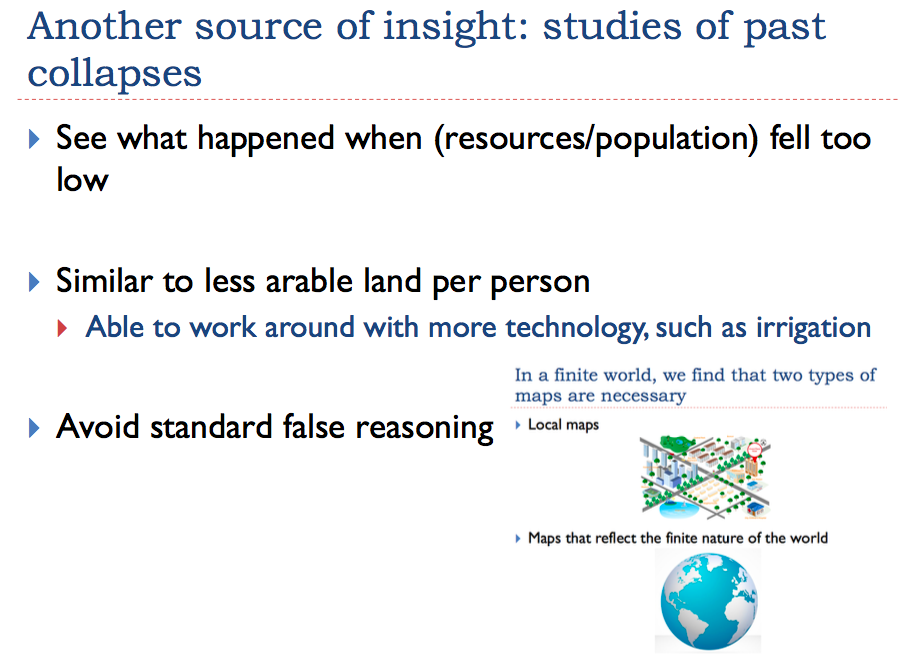
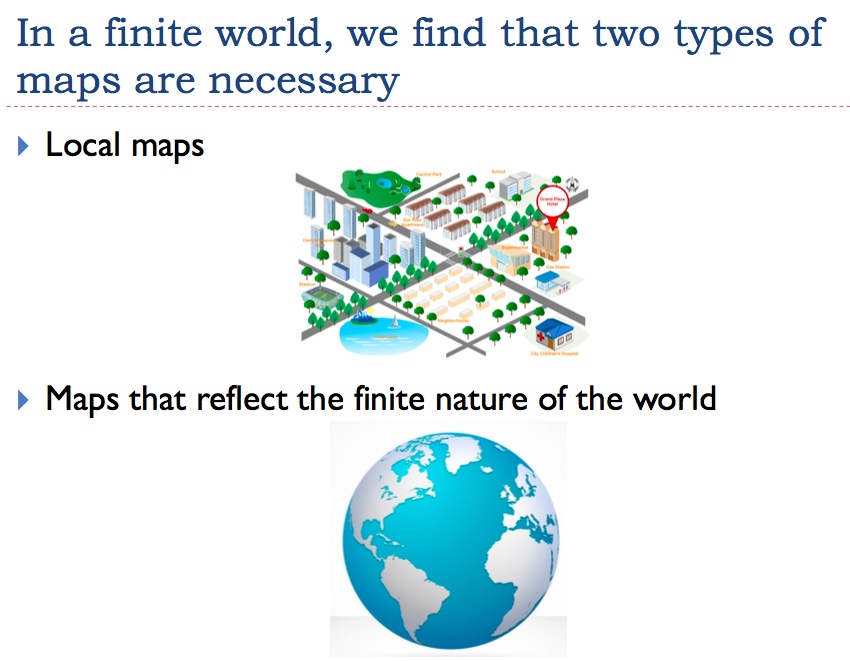
We all recognize that our way of visualizing distances must change, when we are dealing with a finite world.


I should note that not all economists have missed the fact that the pricing situation changes, as limits are reached. Aude Illig and Ian Schindler have recently published a paper that concludes, “We find that price feedback cycles which lead to increased production during the growth phase of oil extraction go into reverse in the contraction phase of oil extraction, speeding decline.”


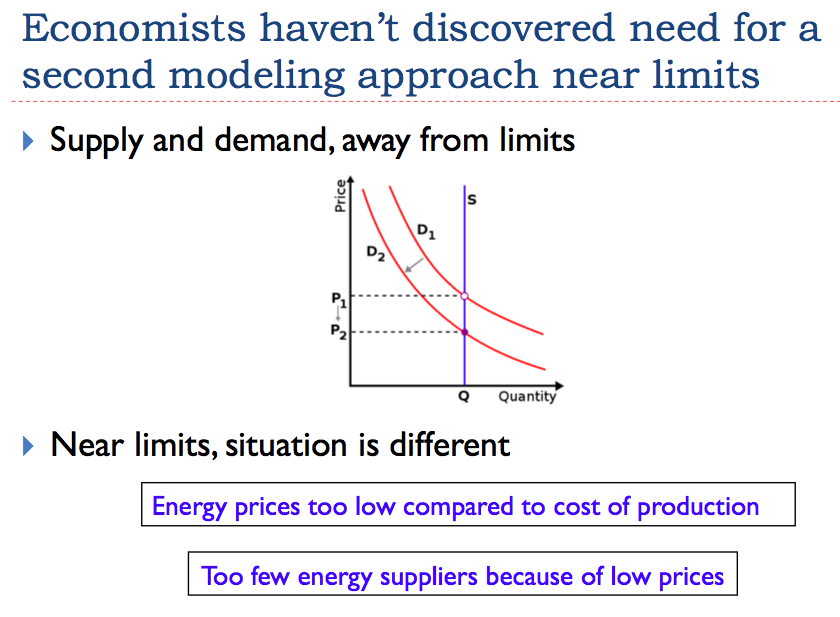
The comments shown in red on Slide 6 (above) reflect a variety of discussions over the last several years. Oil prices in the $50 per barrel range are way too low for producers. They may be high enough to get “oil out of the ground,” but they are not high enough to encourage necessary reinvestment, and they are not high enough to provide the tax revenue that oil exporters depend on.


Most people don’t stop to think about the symmetric nature of the problem. They also don’t realize that the adverse impacts of low oil prices don’t necessarily appear immediately. They can temporarily be hidden by more debt.


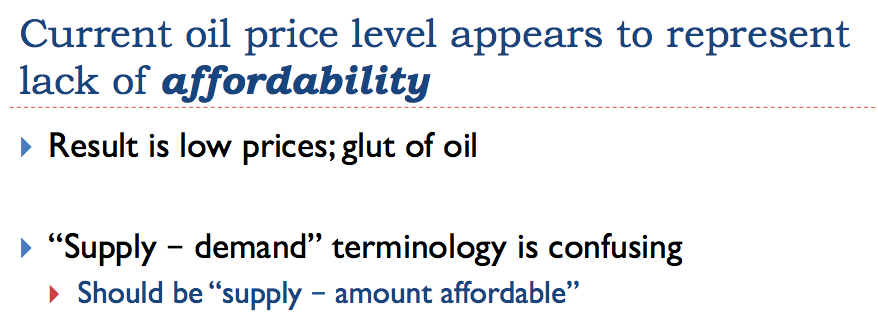
There would be no problem if wages were to rise as oil prices rise. Or if there were an easily substitutable source of cheap energy. The problem becomes an affordability problem.


The economists’ choice of the word “demand” is confusing. A person cannot simply demand to buy a car, or demand to go on a vacation trip. The person needs some way to pay for these things.


If researchers don’t examine the situation closely, they miss the nuances.


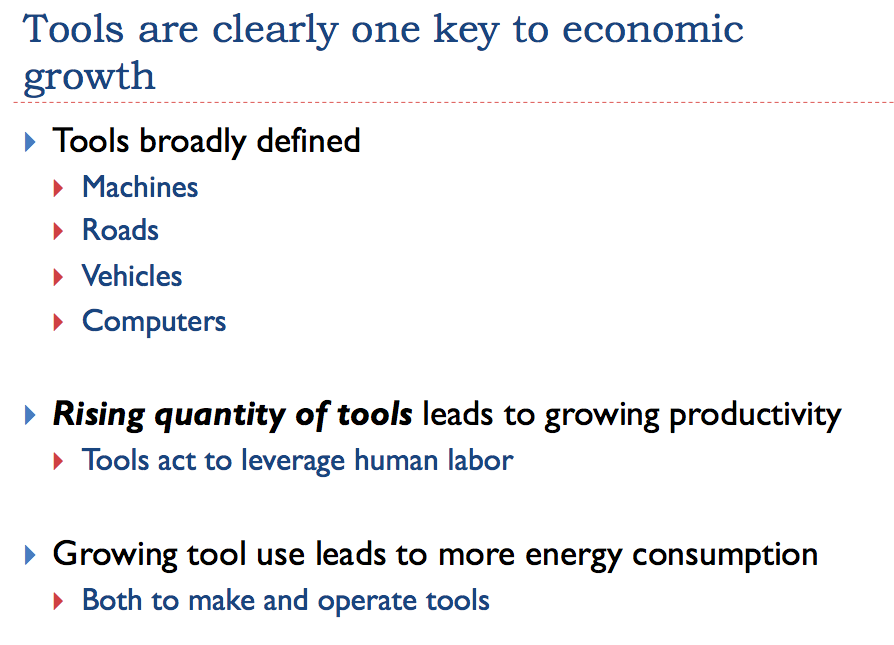
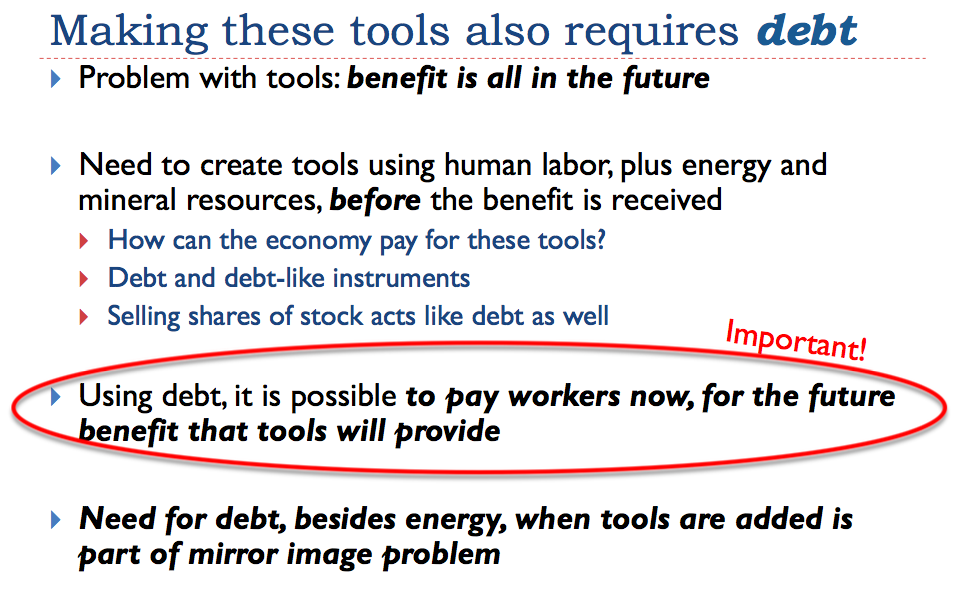
Many people think that the increasing use of tools can save us, because of the possibility of increased productivity.


Using more tools leads to the need for an increasing amount of debt.


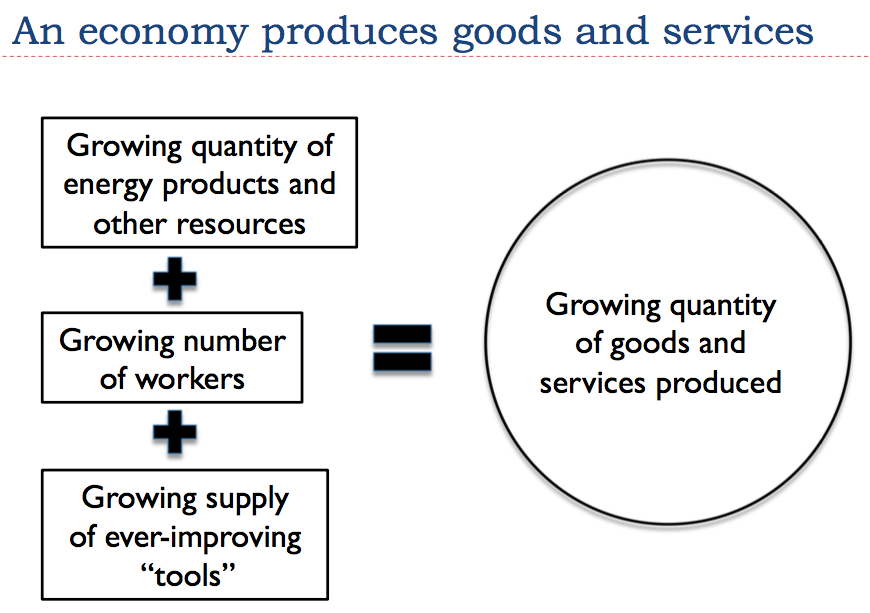
Read this chart from left to right. If we combine increasing quantities of resources, workers, and tools, the output is a growing quantity of goods and services.


Read this chart from right to left. How do we divide up the goods and services produced, among those who produced the products? If we can only use previously produced goods to pay workers and other contributors to the system, we will never have enough. But with the benefit of debt, we can promise some participants “future goods and services,” and thus have enough goods and services to pay everyone.


If we decrease the amount of debt, we have a big problem. Instead of the debt adding to the amount of goods and services produced, the shrinkage acts to decrease the amount of goods and services available for distribution as pay. This is why moving from deficit spending to a balanced budget, or a budget that reduces debt, is so painful.


When I say (resources/population), I mean resources per capita. Falling resources per capita makes it harder to earn an adequate living. Think of farmers trying to subsist on ever-smaller farms. It would become increasingly difficult for them to earn a living, unless there were to be a big improvement in technology.


Or think of a miner who is extracting ore that is gradually dropping from 5% metal, to 2% metal, to 1% metal content, and so on, because the best quality ore is extracted first. The miner needs to work an increasing number of hours to produce the ore needed for 100 kilograms of the metal. The economy is becoming in some sense “worse off,” because the worker is becoming “inefficient” through no fault of his own. The resources needed to provide benefits simply are less available, due to diminishing returns. This problem is sometimes reported as “falling productivity per worker.”


Falling productivity per worker tends to lower wages. And lower wages put downward pressure on commodity prices, because of affordability problems.


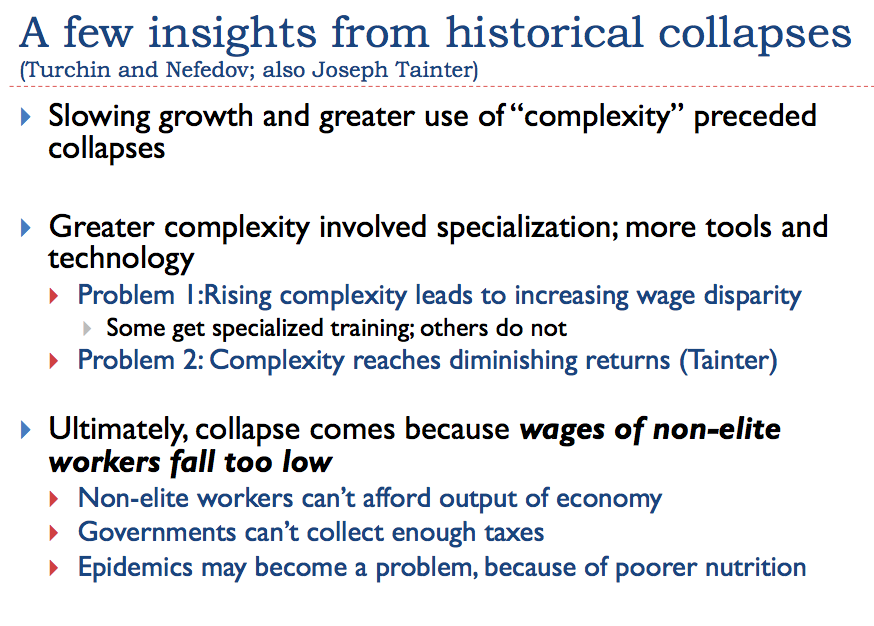
The problems that prior civilizations reached before collapse sound in many ways like the problems we are seeing today. We are seeing increased specialization, and falling relative wages of non-elite workers.


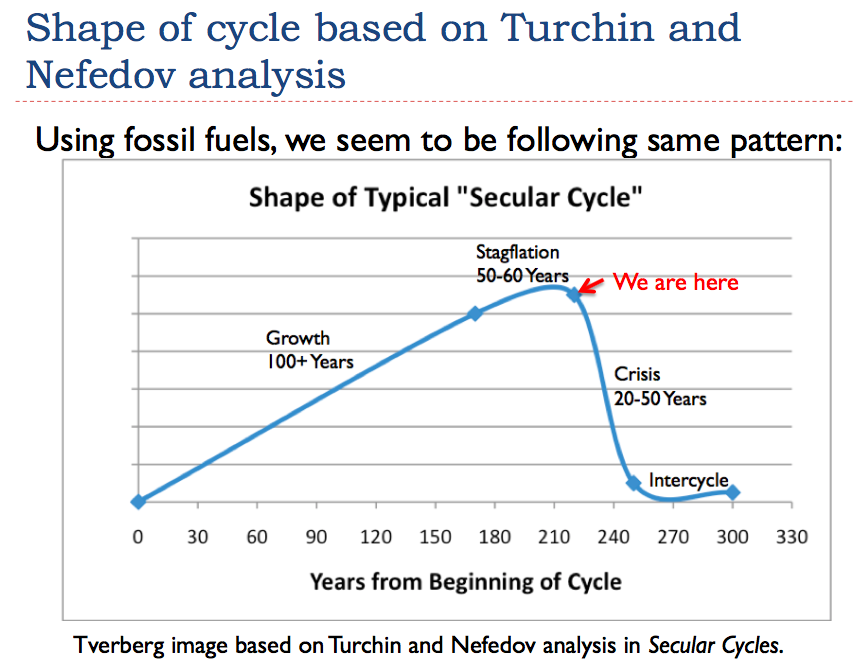
We seem to have already gone through a long period of stagflation since the 1970s. The symptoms we are seeing today look as if we are approaching a steep downslope. If we are approaching a crisis stage, it may be much shorter than the 20 to 50 years observed historically. Earlier civilizations (from which these timeframes were observed), did not have electricity or the extensive international trade system we have today.


The period since 1998 seems especially flat for wages for US wage earners, in inflation-adjusted terms. This is the period since energy prices started rising, and since globalization started playing a greater role.


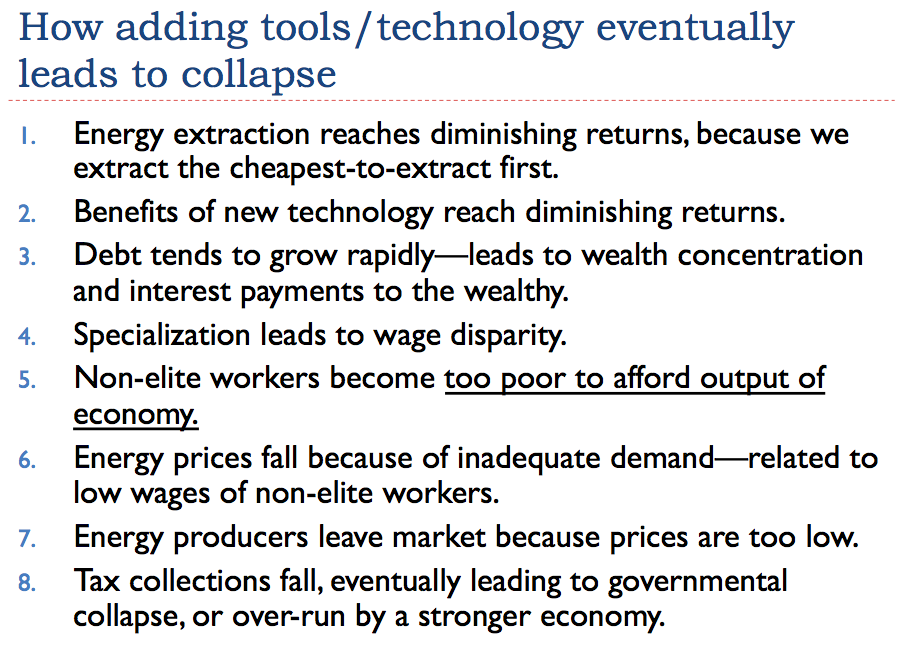
This is a list I made, showing that what looks to be beneficial–adding tools and technology–eventually leads to our downfall. The big problem that occurs is that non-elite workers become too poor to afford the output of the economy. Adding robots to replace workers looks efficient, but leaves many unemployed. Unemployment is even worse than low pay.


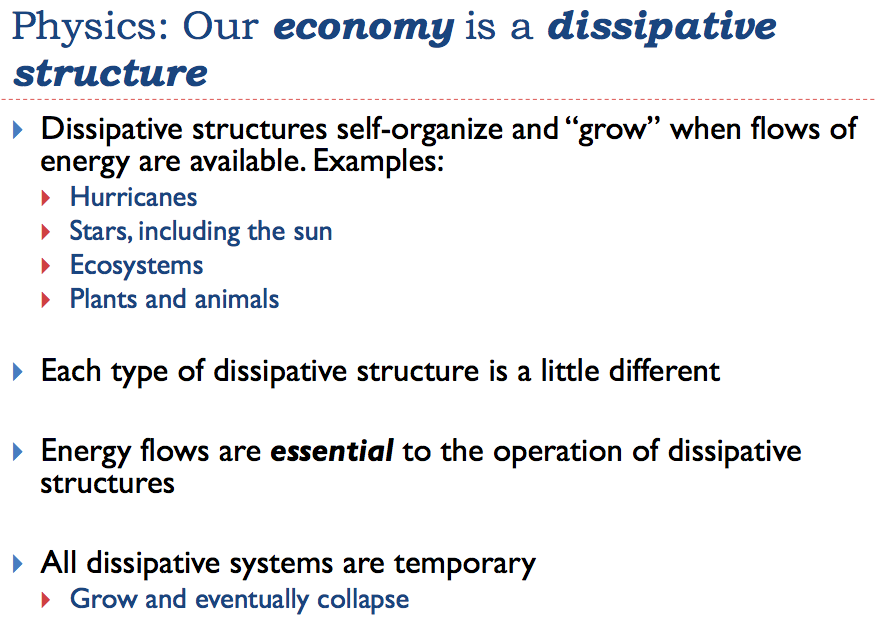
We can think of the economy as being a self-organized network of businesses, consumers, and governments. New products are gradually added, and ones that are no longer needed are eliminated. Government regulations change in response to changing business conditions. Debt is especially important for economic growth, because it makes goods affordable for customers, and it enables the use of “tools.” Prices are created almost magically by this networked system, through the interaction between supply and demand (reflecting affordability, among other things).


It is only in recent years that physicists have become increasingly aware of the fact that many types of structures form in the presence of flows of energy. We have known for a long time that plants and animals can grow when conditions are right. The networked economy illustrated above is one of the types of things that can grow and flourish in the presence of energy flows.


This is my view of how an economy, as a dissipative structure, works. “Tools and technology” are at the center. If a person doesn’t think too much about the issues involved, it is easy to assume that tools and technology will allow the economy to grow forever.


There is a potential for problems, both with respect to inputs and waste outputs. Early modelers missed many of these “issues.” M. King Hubbert created a model in which the quantity of energy supply and technology are the only issues of importance. He thus missed the impact of the Waste Output problems at the right. The Waste Outputs lead to falling prices as limited supply nears, and thus lead to a much steeper drop in production than Hubbert’s symmetric model would suggest.


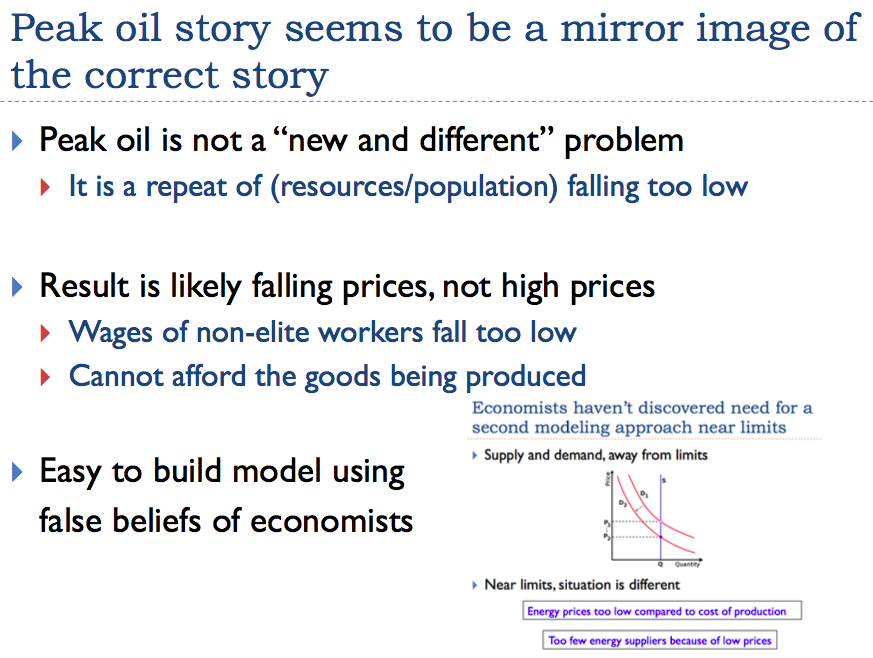
Peak oilers recognized one important point: our use of oil products would at some point have to come to an end. But they did not understand how complex the situation is. Low prices, rather than high, would be the problem. We would see gluts rather than shortages, as we approach limits. Much of the oil that seems to be technologically extractable will really be left in the ground, because of low prices and other problems.


Here, I am getting back to the topic I was originally asked to talk about. What else, besides low energy prices and too much debt, are likely to be problems as we reach limits?


The easy way of modeling the use of wind turbines and solar turbines is to assume that the electricity produced by these devices is equivalent to electricity produced by fossil fuels, or by hydroelectric. Unfortunately, this is not the case.


Trying to integrate solar panels into an electric grid adds a whole new level of complexity to the electrical system. I have only illustrated some of the issues that arise in the slide above.


The fact that the price system doesn’t work for any fuel is a major impediment to adding more than a very small percentage of intermittent renewables to the electric grid. Intermittent renewables can only be used on the electric grid if they have a 24/7/365 backup supply that can be ramped up and down as needed. Unfortunately, the pricing system does not provide nearly high enough rates for this service. We are now seeing how this works out in practice. South Australia lost its last two coal-fired electricity power plants due to inadequate wholesale electricity prices when it added wind and solar. Now it is experiencing problems with both high electricity prices and too-frequent outages.


Another problem is that new [long distance] transmission makes buying from neighbors optimal, over at the left of Slide 28. This is a new version of the tragedy of the commons. Once long distance lines are available, and a neighbor has a fairly inexpensive supply of electricity, the temptation is to simply buy the neighbor’s electricity, rather than build local electricity generating capacity. The greater demand, without additional supply, then raises electricity prices for all, including the neighbor who originally had the less expensive electricity generation.


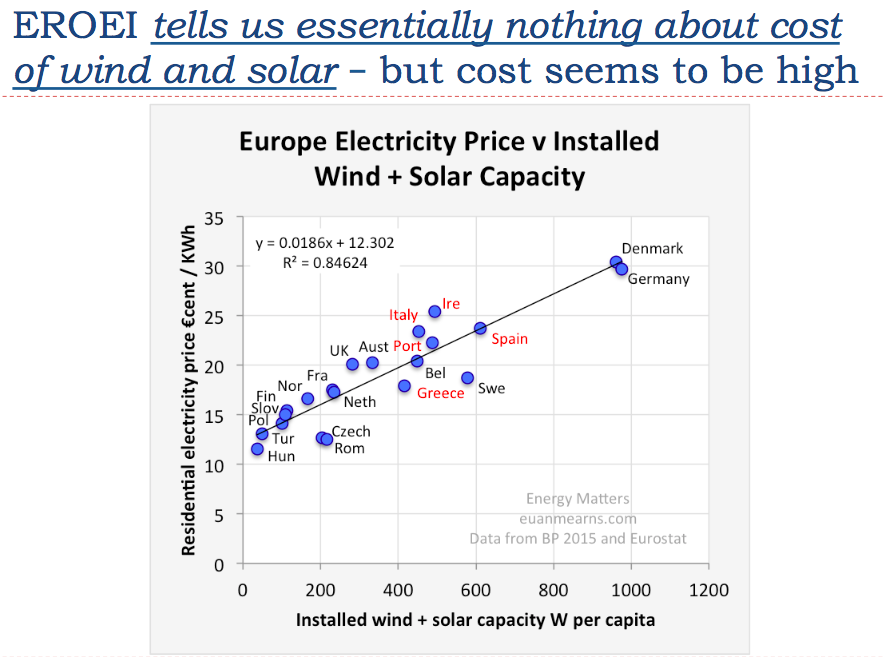
It is easy to assume that EROEI (Energy Returned on Energy Invested) or some other popular metric tells us something useful about the cost of integrating intermittent renewables into the electric grid, but this really isn’t the case.


We are now beginning to see what happens in “real life,” as intermittent renewables are added. For example, we can now see the problems South Australia is having with high electricity prices and too many outages as well as the high electricity prices in Germany and Denmark.


Wind and solar are not very helpful as stand-alone devices. Yet this is the way they are modeled. Some researchers have included installation costs, but this still misses the many problems that these devices cause for the electrical system, especially as the share of electricity production by these devices rises.


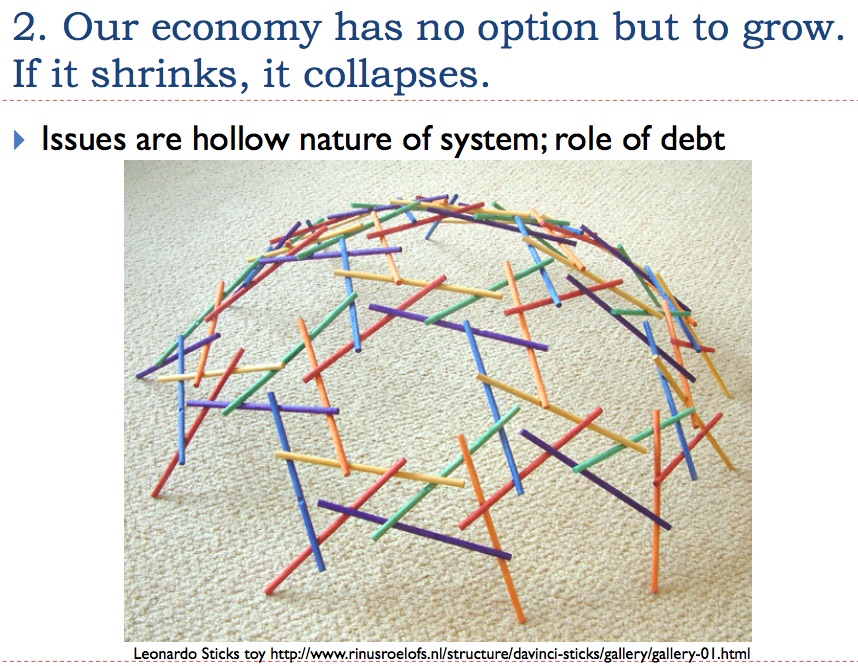
A networked system works differently than a system that is “user controlled.” It builds itself, and it can collapse, if conditions aren’t right. I have shown the economy as hollow, because there is no way of going backward.


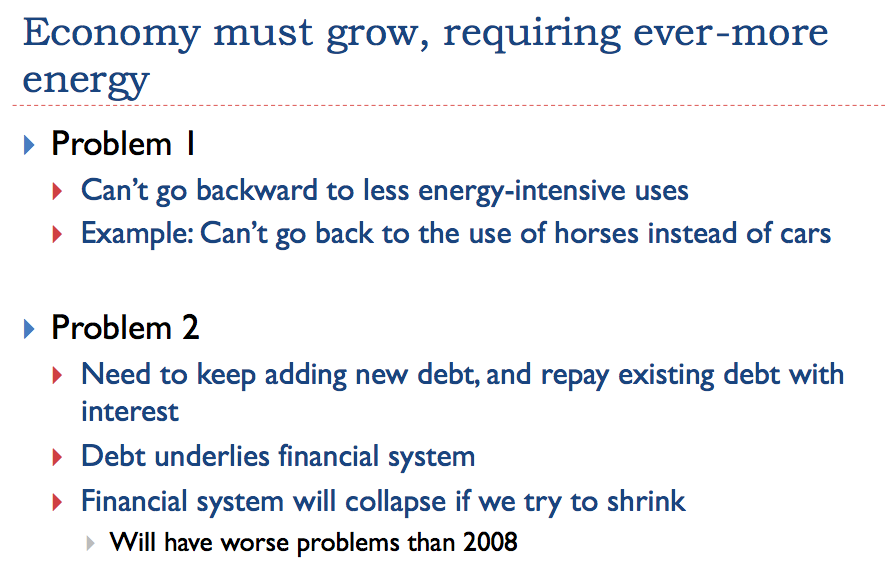
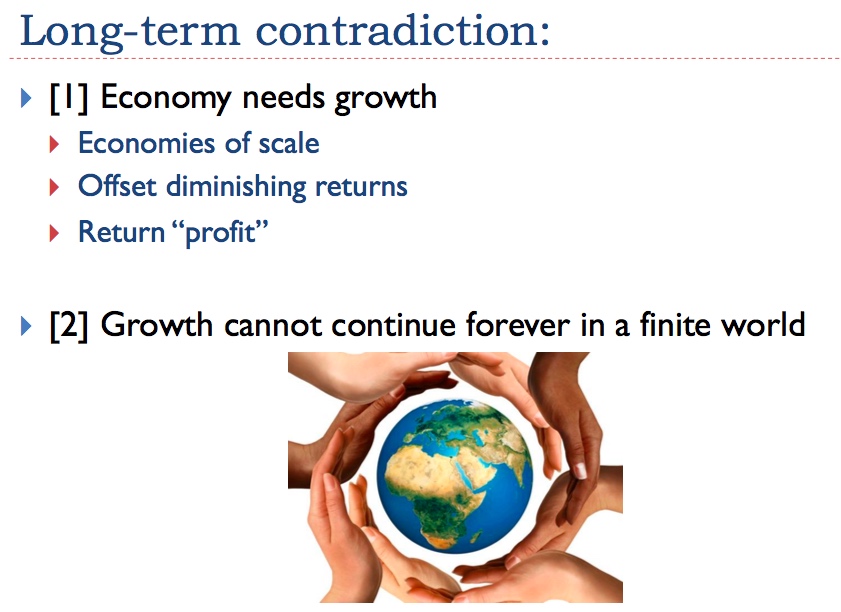
Many people miss the point that the economy must keep growing. In fact, I pointed this out in Slide 2 and gave an additional reason why it must keep growing on Slide 16. As the economy grows, we tend to need more energy. Growing efficiency can only slightly offset this. Thus, as a practical matter, energy per capita needs to stay at least level for an economy to grow.


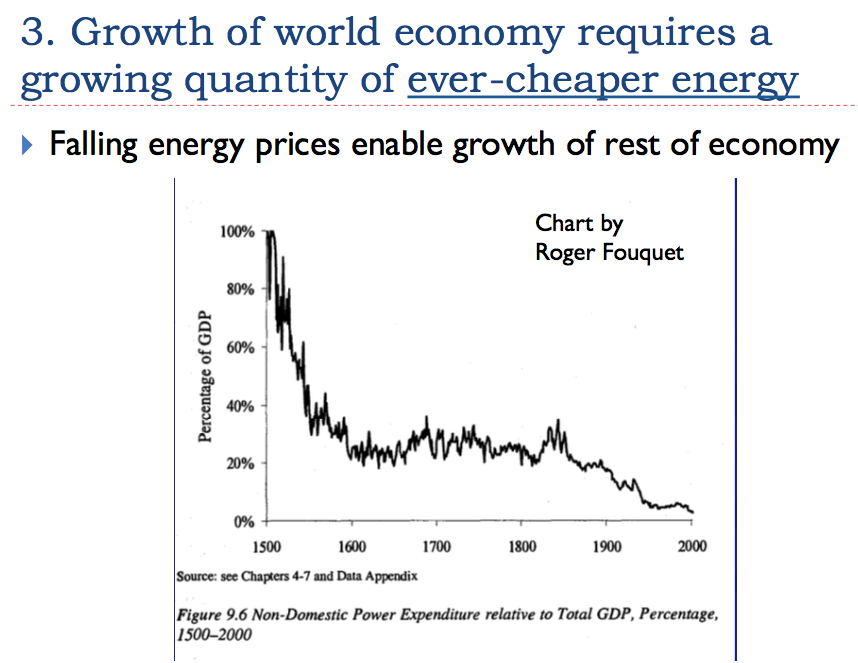
If energy prices rise, this will tend to squeeze out discretionary spending on other goods and services. If we cannot obtain energy products sufficiently cheaply, the system of economic growth will stop.


The fact that energy prices can, and do, fall below the cost of production is something that has been missed by many modelers. Prices can go down, even when the cost of production plus taxes needed by governments rises!


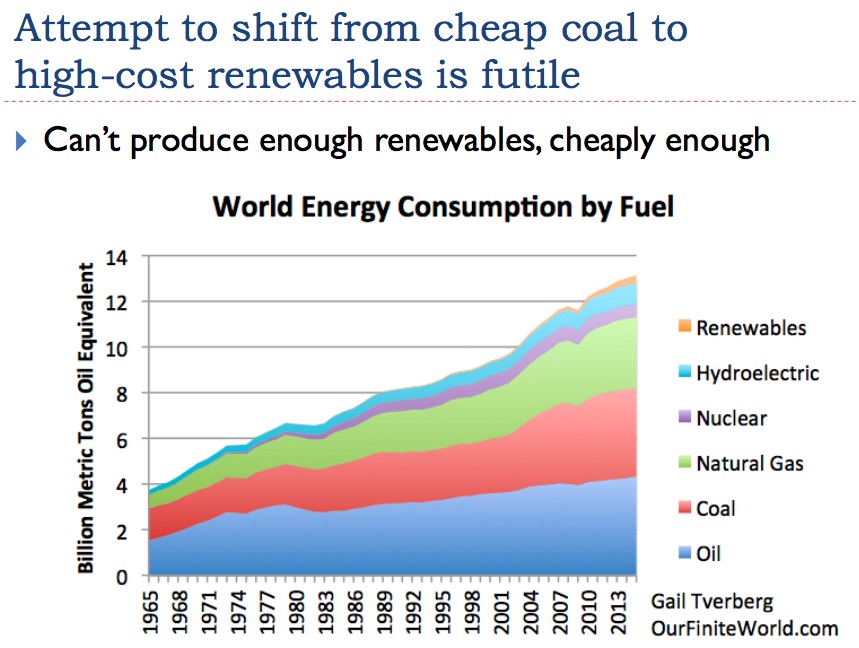
Wind and solar are part of the category at the top called “renewables.” This category also includes energy from wood and from geothermal. Many people do not realize how small this category is. Hydroelectric is also considered a renewable, but it is not growing in supply in the United States or Europe.


It takes energy to have an intergovernmental organization, such as the European Union. In fact, it takes energy to operate any kind of government. When there is not enough surplus energy to go around, citizens decide that the benefits of belonging to such organizations are less than the costs involved. That is the reason for the Brexit vote, and the reason the question is coming up elsewhere.


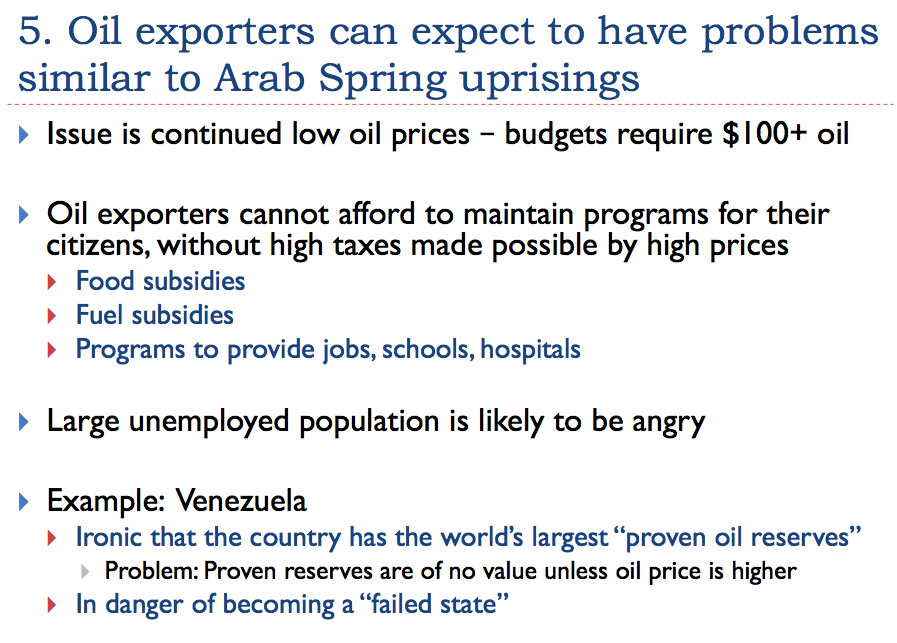
The amount of taxes oil-producing countries can collect depends on how high the price of oil is. If the price isn’t high enough, oil-exporting countries generally have to cut back their budgets. Even Saudi Arabia is having difficulty with low oil prices. It has needed to borrow in order to maintain its programs.


Oil prices have been too low for producers since at least mid-2014. It is possible to hide a problem with low prices with increasing debt for a few years, but not indefinitely. The longer the low-price scenario continues, the more likely a collapse in production is. Also, the tendency of international organizations of government to collapse (Slide 38) takes a few years to manifest itself, as does the tendency for civil unrest within oil exporters (Slide 39).


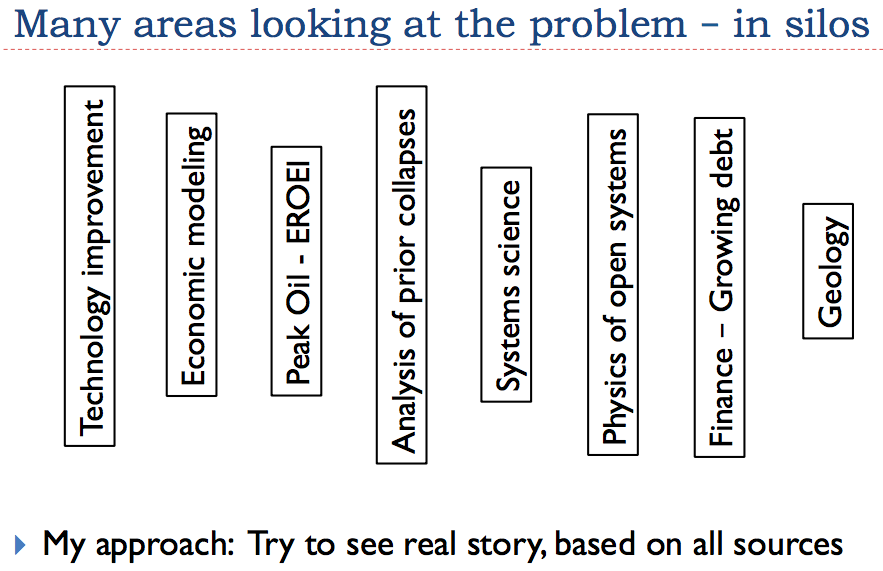
It is easy to miss the point that modeling a piece of the system doesn’t necessarily tell a person very much about the system as a whole.


Once an incorrect understanding of our energy problem becomes firmly entrenched, it becomes very difficult for leaders to understand the real problem.