Showing posts with label Natural disasters. Show all posts

Friday, April 13, 2018

Yellowstone Officials: There “Could be a Supervolcano Eruption Imminently”

This report was originally published by Tess Pennington at Ready Nutrition


Tess is the author of The Prepper’s Blueprint: A Step-By-Step Guide To Prepare For Any Disaster


Underneath the quiet nature preserve of Yellowstone lies the most powerful and largest supervolcano on the planet. The fear of it erupting in our lifetime has put many on high alert, and recently, the Steamboat Geyser of Yellowstone gave another indication that the area is under strain.


‘More than 20 police, fire, and rescue vehicles descended upon the area around Yellowstone supervolcano this week to prepare for what could be a “life or death” emergency. Earlier this week, it was reported that there were a series of eruptions at the Steamboat Geyser, the worlds tallest and active geyser and they are expecting more minor eruptions to come.


Yellowstone National Park Public Affairs confirmed that there could be a supervolcano eruption imminently – and that they were putting themselves through their paces so that they were ready for any eventuality.’


Source: Express News


Steamboat Geyser, Yellowstone


Seismologists who have monitored the area have warned for years that the area is under strain and have observed deformation in rocks occurring under Yellowstone. This deformation causes a change in pressure and magma underneath the surface.


In fact, last month, the same geyser produced similar activity giving cause for concern. Dr. Wendy Stovall, the deputy scientist in charge at the Yellowstone Volcano Observatory, a branch of the United States Geological Survey, said, “There is a lot of seismicity, or earthquake activity, and deformation around the geyser basin.” She also said, there is no cause for concern at this time. “Volcanoes all over the world have hydrothermal systems. “Because all the water goes away from the heat coming up. As long as there’s water and the geysers and hot springs and mud pots are still boiling, everything is fine.”


That said, Yellowstone National Park Public Affairs are not wasting any time and have begun preparations and training exercises. In fact, the emergency services associated with the National Park are discreetly performing training exercises to minimize local disturbances and to ensure that if the volcano erupts, they will be able to act decisively.


Morgan Warthin, a Yellowstone spokesman also discussed the challenges his team will face if there is a supervolcanic eruption at Yellowstone.


He said: “You know, the number one challenge is we are remote, so it takes a while to get to Yellowstone.”


During the simulation, family members of park employees, Xanterra employees and residents of Gardiner gave up their time to play the role of victims in the exercise.


When the test run began, responders from eight different agencies inside and outside the park dealt with the situation well.


Source: Express News


What Would Happen if the Yellowstone Supervolcano Erupted?


  • An eruption would have 2,500 times the force of Mt. Saint Helens in 1980.

  • Would be larger than any nuclear bomb ever tested.

  • The eruption would blast 240 cubic miles of rock, dust and volcanic ash into the sky. This would spread throughout the world and lower global temperatures by up to 28 degrees for years.

  • 620 cubic miles of lava would flow out of the volcano. This is equivalent to coating the entire United States in 5 inches of lava.

  • States surrounding Yellowstone would be wiped off the map (Idaho, Montana, North Dakota, South Dakota, Nebraska, Colorado, and Utah).


Moreover, the amount of ash dispersed from the eruption could be so great that it could literally crush buildings, foul water supplies, clog electronics, ground airplanes, and irritate lungs. If that wasn’t enough to be bothersome, the toxic gases and chemicals would enter our atmosphere and cause toxic rain thus killing more humans, animals, and plants.


Given these facts, it is understandable why so many are trying to prepare for this. Be it preparing for a quick getaway or sheltering in place, there is much to prepare for. Luckily, there is still time to get some reserves in order.


How Much Warning Would We Have?


An example of what an ash cloud would look like after an eruption from a supervolcano.


So, will supervolcanoes give us any type of warning before they erupt? It turns out that supervolcanoes would provide a few warning signs that would give us a fairly definite timeline before they go off, but unfortunately, it’s not a very comforting timeline. According to a recent study, you’d have about a year or less to prepare.


Right before any super eruption though, there is one final stage — the decompression stage — characterized by the release of gas bubbles at the eruption site.


So, the study researchers decided to analyze quartz crystals at the site of one of these massive eruptions that erupted in California about 760,000 years ago, creating the Long Valley Caldera. Quartz crystals cover surface rims of eruption sites, so by analyzing them, the researchers were able to determine the rim growth rates times of the volcano based on the concentration of titanium in the crystals. By measuring the size and growth rates of these rims, they were able to determine the length of time it took for an explosion to happen once the decompression phase had begun.


Their analysis showed that more than 70% of rim growth occurred in less than a year, indicating that the quartz rims grow mostly in just the days or months prior to an eruption.


At first glance, most preppers would find that kind of warning to be a relief. After all, if someone told you that say, a nuclear war was going to happen in a year or that a tsunami was going to wipe out your home in a few months, you would have plenty of time to either get ready or get out of dodge.


But with a supervolcano, you’re dealing with an epic disaster that people and governments would need more time to prepare for. That said, having these officials decide on when to sound the alarm will be the biggest struggle. “It’s going to be hard for scientists to convince themselves just because of our only partial understanding of the complexity of the processes that are taking place,” Jacob Lowenstern of the U.S. Geological Survey in Menlo Park, California, the scientist-in-charge of the Yellowstone Volcano Observatory says. Source


How To Prepare for the Long-Term


How does one prepare for a supervolcano? Survivability in this type of disaster is slim if you live in the surrounding areas. Suffice it to say, there would be mass casualties any way you look at it. This is the type of disaster that would be considered an end-of-the-world-as-we-know-it event and would change the way we live life on this planet for years to come. It is essential to understand this before you begin prepping for long-term survival.


Areas to concentrate your efforts on are preparing your vehicle for a last minute evacuation, having supplies to shelter in place for up to 6 months or more, having a way to protect yourself from breathing in toxic chemicals, having a long-term food source, and having a way to grow your own food.


Based on research on your part, find out if your location will be immediately affected. At this time, you must make a decision whether to bug in or bug out. Because you never know when the supervolcano will erupt, it would be wise to have bug out bags in multiple locations (the workplace, home, and the vehicle).


If you evacuate:


Depending on where you reside in relation to the supervolcano, millions of people may need to be evacuated, which even with a year’s heads up could turn into a massive humanitarian disaster. Similar to how officials plan localized evacuations, they will likely zone out the affected area and allow certain zones to leave one at a time. When it is your time to leave, make sure you have a clear plan on where you are headed, including where you will stay, etc. Moreover, make sure you keep your vehicle evacuation-ready. This includes ensuring the vehicle is well-maintained with a full tank of gas, has the essential bug out supplies, has essential maps and navigational items. Follow the designated evacuation route and expect heavy traffic and delays.


Before you leave, prepare your home by turning off the gas, electricity, and water. Disconnect appliances to reduce the likelihood of electrical shock when power is restored.


If you are out of immediate impact and plan to shelter in place:


To supply the home for a supervolcano disaster, you need to plan for the long-term.  That ash will clog the atmosphere enough to block out the sun, disrupting the global climate enough to cause food shortages and mass famine. Therefore, your food sources may be all that you have to get your through. If you are lucky enough to have a hydroponic growing system, make sure you have a lot of seeds to support your dietary needs.


It’s not only essential to have long-term food reserves, but also know how to pack your food properly for the long-term.


Due to the toxic rain that would cause mass extinction in the area, you want to concentrate your efforts on storing as much water as possible, as well as, food and supplies to live off of for a long-term emergency. As a starting point, fill sinks and bathtubs with water as an extra supply for washing and get a good water filter with extra filters stored for future use. This is a great week-by-week preparedness course you can use to get your supplies organized and prepped for the longevity.


You can also expect to be without power and alternative light sources will need to be prepared. To keep toxic dust from entering the home, ensure that any holes in windows are repaired and close off the fireplace and furnace dampers. In addition, consider setting adding plastic sheeting to the entrance of the home to minimize any toxic dust from entering the home.


Communication will be limited, therefore add new batteries to your radio, contact family members and let them know your plans and backup plans before the disaster. Remember that communication and emergency services may be overwhelmed or damaged during this type of emergency. Have medical supplies prepped and extra prescription medications,


Another concern you should consider is the toxic air that will be present after the eruption. Two years ago, after the volcano eruption in Indonesia, thousands complained of lung irritation shortly after the eruption. At the time, a local official urged the government to send out medical teams to areas most affected by volcanic ash, as the health awareness of local people is low and they might not consider coughing fits or flulike symptoms to be very serious. He added that ongoing exposure to the ash will destroy the lungs of people inhaling it.  Having a way to protect your airways will greatly improve your health during this disaster. If you do not have access to a gas mask, have extra respiratory masks, handkerchiefs or cloth to cover your nose and mouth.


 After the eruption:


Once the eruption has ceased, stay indoors until the ash has settled. There could be a danger of roof collapse due to excess ash. If this is the case, seek emergency shelter elsewhere. To prevent toxic dust and ash from entering the home, close and seal all windows with duct tape and keep all heating, and air conditioning units and fans turned off. As well, because volcanic ash can clog engines, avoid running your vehicle. Otherwise, you could damage moving parts and stall vehicles. During this time, you should avoid driving in heavy ash fall unless absolutely required. If you need to drive, keep the speed down to 50 km per hour or slower.


If you have proper body protection, begin clearing ash from flat or low-pitched roofs and rain gutters. Protect yourself from ash by wearing long-sleeved shirts and pants, using goggles, and a respiratory mask.


To conclude, seismologists at Yellowstone will continue to monitor the area in hopes of learning more and gaining a better picture of the supervolcano below. Until then, their preparations and training will ensure their reaction times are spot on in order to help others get to safety. All we can do at this point, is hope for the best and prepare for the worst.


(Sign up for our FREE newsletter to get the latest prepping advice, gardening secrets, homesteading tips and more delivered straight to your inbox!)


Additional Resources:


The Prepper’s Blueprint: The Step-By-Step Guide To Help You Through Any Disaster


The Prepper’s Cookbook: 300 Recipes to Turn Your Emergency Food into Nutritious, Delicious, Life-Saving Meals


Prepper’s Home Defense: Security Strategies to Protect Your Family by Any Means Necessary


The Survival Medicine Handbook: A Guide for When Help is Not on the Way


SAS Survival Handbook, Revised Edition: For Any Climate, in Any Situation


The Prepper


Tess Pennington is the author of The Prepper’s Blueprint, a comprehensive guide that uses real-life scenarios to help you prepare for any disaster. Because a crisis rarely stops with a triggering event the aftermath can spiral, having the capacity to cripple our normal ways of life. The well-rounded, multi-layered approach outlined in the Blueprint helps you make sense of a wide array of preparedness concepts through easily digestible action items and supply lists.


Tess is also the author of the highly rated Prepper’s Cookbook, which helps you to create a plan for stocking, organizing and maintaining a proper emergency food supply and includes over 300 recipes for nutritious, delicious, life-saving meals. 


Visit her web site at ReadyNutrition.com for an extensive compilation of free information on preparedness, homesteading, and healthy living.


Making a Homestead Evacuation Plan

This article was originally published by Daisy Luther at The Organic Prepper


With wildfire season approaching in California, my thoughts are with my many friends there who have small farms. Even if you don’t live in a wildfire zone, if you raise livestock, you need to have a homestead evacuation plan. Any place can have a barn fire, a chemical spill, or other environmental emergencies.


I’ve written quite a lot about evacuations since my family and I were right on the verge of it during the King Fire. Fires can approach shockingly fast, and being ready before there is ever a hint of smoke in the air is the best way to get out quickly when the time is short.


But things change dramatically when you add a farm or homestead to the mix. Suddenly, you have more living creatures in your charge than you do space in the vehicle. You absolutely must have a plan in place before a disaster occurs, because if you wait for the evacuation order, you’ve waited too long.


Create a homestead evacuation plan.


Here are some of the things that I learned about homestead evacuation. Use this to create your own plan, because disasters can strike anywhere and we all have different resources, livestock, and circumstances.


Be aware of what’s happening nearby. When I lived in California, I haunted the local boards that discussed fires and other events. I had friends who were former firefighters and subscribed to phone notifications from the local sheriff’s department. If there was a fire or mudslide nearby, I knew about it while it was still miles from me. That way, I could assess my plan and see if action needed to be taken immediately, or if I just needed to stay on top of the situation.


Figure out where you’ll take your livestock. Often, local fairgrounds will open their facilities for farmers to bring evacuated livestock. Sometimes veterinarians and kennels will also accept evacuated animals. If you are in contact with other farmers, they may be able to make room for your animals. I belonged to a local homesteading group at the time, and we all made space for animals, trailers, and RVs if we could to help our friends during fire season.


Evacuate livestock early if you can. The last fire that was nearby was called the Trailhead Fire, and it consumed 5,646 acres over the course of 20 days. Toward the end, when it drew closer to our farm, I evacuated all our chickens to a friend’s farm that was out of the danger zone. That gave me the peace of mind to know that if we had to evacuate for real, I only had to grab cats, dogs, and kid, which would have been far faster than chasing a bunch of panicked hens.


Have a way to transport your animals. You will either need a trailer, pens that can go into the back of a truck, or crates that can hold your livestock. You may need help from friends with trailers if you have a lot of animals. Have these things ready so that you aren’t trying to figure out how to move the animals when a fire is approaching.


Have a plan for last-minute homestead evacuation. This is every farmer’s nightmare because if the fire is approaching fast, you may not be able to load up all your animals in time.


  • Have trailers and trucks close to the livestock area for quick evacuation.

  • If you think you may need to evacuate, contain your livestock in the smallest area possible for ease of loading. For example, if your chickens normally free-range, keep them contained in a yard around their coop so you have a better chance of catching them. Close off the gates to the larger pastures and keep other livestock in the area closest to the trailers.

  • Practice loading up. This way, the animals get used to being loaded and are less likely to panic and fight you. Secondly, you know which animals are going to be the most uncooperative and you also have a feel for how long it takes to load them all.

  • Have blinders on hand. This may be nothing more than a piece of cloth or a fabric bag, but if your animals are panicking, it can be easier to lead them out if they can’t see the threat. Most people think only of horses needing blinders but it can be far easier to lead goats and cows this way too.

  • Give every person a job. Even younger children may be able to help round up chickens or gather feed. Be sure that everyone knows what to do beforehand so that you can all work together quickly and efficiently.

  • Remember that if there is a threat like a nearby fire, animals are much more likely to panic due to fear. This means it will probably take longer to load them up.


Know what to do if you can’t evacuate the livestock. If there is no time to load the livestock, at least turn them loose so they have a chance at escaping the flames. If your family is at risk of dying in the fire, you will have to evacuate and leave the animals behind. It’s a horrible choice but could be necessary. Remember the Napa Valley fires last summer? Some people had only moments to flee fast-moving infernos.


Have you ever been through a homestead evacuation?


Have you had the experience of evacuating a homestead? If so, please share your story and tips in the comments section below.


The Pantry Primer


Please feel free to share any information from this article in part or in full, giving credit to the author and including a link to The Organic Prepper and the following bio.


Daisy Luther is the author of The Pantry Primer: A Prepper’s Guide To Whole Food on a Half Price Budget.  Her website, The Organic Prepper, offers information on healthy prepping, including premium nutritional choices, general wellness and non-tech solutions. You can follow Daisy on Facebook and Twitter, and you can email her at daisy@theorganicprepper.ca</e


Friday, January 5, 2018

Global Disasters Wreaked Havoc In 2017 – Total Economic Losses Top $300 Billion

This report was originally published by Tyler Durden at Zero Hedge


disasters


According to a new reinsurance report issued by the Swiss Re Institute, total economic losses from natural and man-made disasters have soared 63 percent in 2017 to an estimated $306 billion, up from $188 billion in 2016.


Globally, insurers lost $136 billion from natural and man-made disasters in 2017, up from $65 billion in 2016, the third highest on record. This is “well above the previous 10-year annual average, and the third highest on sigma records,” Swiss Re said in its report. Natural disasters accounted for $131 billion of 2017’s insured losses, and man-made disasters for the remaining $5 billion. The human loss totaled around 11,000 deaths, similar to 2016.


Martin Bertogg, Head of Catastrophe Perils at Swiss Re said, “in recent years, annual insurance losses from disaster events have exceeded USD 100 billion a few times. The insurance industry has demonstrated that it can cope very well with such high losses.”


“However, significant protection gaps remain and if the industry is able to extend its reach, many more people and businesses can become better equipped to withstand the fallout from disaster events,” he added.


According to Swiss Re, “extreme weather in the US in the second half of 2017” has been the primary driver for high insured losses:


In August and September, three category 4+ hurricanes – Harvey, Irma, and Maria (HIM) – made landfall in the US. Destruction from the three hurricanes stretched from the Texas coast (Harvey) through West Florida to the Caribbean (Irma and Maria), together causing insured losses estimated to be almost USD 93 billion.


Given the vast geographic footprint of the hurricanes, which affected multiple locations in quick succession and impacted multiple lines of business, a full assessment of the insured losses is still ongoing.


The economic losses from the three events will be much higher given the significant flood damage – often uninsured – from hurricane Harvey in densely populated Houston, Texas, an extended power outage in Puerto Rico after hurricane Maria, and post-event loss amplification.


The United States was the hardest hit according to the report, which indicated hurricanes: Harvey, Irma, and Maria made 2017 the “second costliest hurricane season on sigma records after 2005.”


Wildfires and thunderstorms in the US were also mentioned in the report:


Also in the second half of 2017, hot and dry weather in California created favourable conditions for wildfires to ignite and spread to urban areas. There were three major fire events in October in Northern California: Tubbs, Atlas and Mendocino Lake. Both residential and commercial property (including vineyards) were impacted. According to preliminary estimates from Property Claims Services, the major fire events triggered combined insured property losses of USD 7.3 billion. Fires are still raging in Southern California in December, and the as-yet undetermined full-year losses from wildfires will likely be higher.


Other extreme weather in the US led to a high number of severe convective storms (thunderstorms). Five separate severe thunderstorm events from February to June caused insured losses of more than USD 1 billion each. The most intense and costly event was a four-day long storm in May with heavy damage to property inflicted by hail in Colorado and strong winds in other parts of southern and central states. The economic losses of this storm alone were USD 2.8 billion, with insured losses of USD 2.5 billion.


Elsewhere, Swiss Re discussed extreme weather events of various forms around the world:


In mid-September, two powerful earthquakes in Tehuantepec and Puebla, Mexico, led to numerous building collapses, claiming a large number of victims and resulting in insured losses of more than USD 2 billion. Earlier in the year, in late March, the category 4 tropical Cyclone Debbie hit the northeastern coast of Australia. Wind gusts of up to 263 km/h and widespread flooding in central and southeast Queensland and northeast New South Wales led to insured losses of USD 1.3 billion.


And at the end of April, Europe suffered a cold snap, followed by a summer of heat waves and record temperatures in several locations, making 2017 a year of weather extremes. Further, severe floods in South East Asia caused large devastation and, sadly, a large number or victims.


Worldwide losses (USD bln) for man-made and natural catastrophes have absolutely exploded since 1990, according to a Swiss Re.


While natural and man-made disasters wreaked havoc globally and in the United States for the 2017 time period. Will the S&P Insurers index break the neckline?


Thursday, November 30, 2017

Preppng: 5 Key Things City Dwellers Should Do To Survive An Apocalypse

apocalyptic


So far, 2017 has been full of all kinds of natural disasters.  But in the event of one of these apocalyptic events happening in your area, are you prepared? If not, have no fear; because the experts have come up with five key things a city dweller can do to survive an apocalyptic disaster.


According to one expert, a lot of the driving force behind large-scale evacuations is mass hysteria and fear. When in reality, most natural disasters don’t actually require an immediate evacuation because they can be predicted. One example of this is hurricanes, and to some extent, tornados. Weather-related events are much easier for scientists to predict in advance than geological events, like volcano eruptions and earthquakes.


But, in the case of those sudden apocalyptic events that are difficult to predict or give advanced warnings for, there are five key things experts suggest city dwellers take into account to survive impending doom. John Renne, the Director of the Center for Urban and Environmental Solutions at Florida Atlantic University, told The Week that while people don’t necessarily need to evacuate during disasters, they should be prepared for one.


The first recommendation of Renne’s will have those who created bug-out-bags a little confused.  Renne suggests that city dwellers plan to stay in their homes, actually, rather than attempt to flee. This is simply because there are not many reasons why an entire city would need to flee and for some types of disasters, such as chemical attacks, it’s safer to stay indoors rather than to leave.


However, Renne’s second recommendation is to be prepared to leave quickly.  This would be where a bug-out-bag would be useful. It’s better to have it an never need it, than to need it an not have it.  Renne suggests listening to reports on the radio or television for alerts and checking social media for evacuation plans just in case your area is affected.


The third suggestion is more common sense.  You should have the right supplies on hand.  Keep extra batteries and flashlights, as well as food and water stored so you can survive the days ahead. You should have enough water and non-perishable food for three days. Your emergency kit should also contain a solar charger for your phone, so you can stay up-to-date, and a first aid kit.  If cellular service goes down, a hand-crank generator radio would also come in handy to help you receive emergency alerts. You should also keep some cash and simply toiletries like toilet paper.


Renne’s fourth suggestion is to be aware of your surroundings.  Know how to shut off your gas, water, and electric, which could be necessary depending on the emergency. You should also plan a safe escape route in the event that you will have to leave quickly.


The fifth and final suggestion is to stay calm and remain positive.  Having a positive attitude and calm demeanor will allow you to think more clearly and better prepare yourself for the bad news. It could also prevent you from losing your cool and making a mistake that could cost you dearly.

Wednesday, November 29, 2017

New Zealand Fault Line Wakes Up: "We Need To Think Japan 2011 Ruptures"

Authored by Mac Slavo via SHTFplan.com,


A 2016 earthquake has awoken a fault line that was thought to be dormant. Now that it’s becoming active, fears have arisen that New Zealand could be destroyed by a massive 9.0 magnitude earthquake.


The devastating Kaikura earthquake in 2016 has resurrected the Hikurangi subduction zone where two tectonic plates clash and one is pushed down. Geologists are now warning that this trench could cause a massive earthquake on the ocean floor, and could trigger other 9.0 magnitude earthquakes and tsunamis that will reach the western coast of the islands in just seven minutes.


The Australian plate is heading north while the Pacific plate is heading west, and the combination of these motions means that the Pacific plate, which includes much of the South Island, is moving relative to the Australian plate at a rate of about 40millimeterss each year in a southwesterly direction.


Ursula Cochran, from the science firm GNS, told The Marlborough Express:


“We need to think Japan 2011 basically, because if our whole plate boundary ruptured it would be a magnitude-9 earthquake.”


The Great East Japan Earthquake and resulting tsunami smashed through the country’s north-eastern coast killing almost 16,000 people and destroying the lives of thousands more. It also triggered a major ongoing crisis at the Fukushima nuclear plant.


“One of the biggest hazards of that kind of earthquake is the tsunami that is triggered by a fault rupture offshore.,” Cochran added.


“We know from tsunami modeling from a hypothetical earthquake from the Hikurangi subduction zone that the travel times could be very short to the coast, so seven minutes for some of the south Wairarapa coast.”


One year after it struck, scientists are also warning that the Kaikoura quake was not the “big one” for the Hikurangi subduction zone. The quake on the Hikurangi subduction zone was devastating.


The magnitude 7.8 that destroyed houses, lifted the Kaikoura seabed by 2m, tore apart farmland, and wrecked kilometers of State Highway 1, may be minor compared to what could come, Cochran said.


“One thing about reflecting on from the Kaikoura earthquake is we don’t want people to think this is the big one.” 


An international team hopes to drill boreholes into the subduction zone and place monitoring equipment there to act as an early warning system.


Wednesday, November 15, 2017

Popocatepetl Violently Erupts, And Authorities Warn A Bigger Eruption Could Threaten More Than 20 Million People In Mexico City

This article was originally published by Michael Snyder at The Economic Collapse


mexico-city


Mt. Popocatepetl is one of the most important volcanoes on the entire planet, and yet most Americans are not familiar with it. In ancient Aztec, Popocatepetl means “smoking mountain”, but to the locals the 5,426-meter-high volcano is simply known as “Don Goyo”. A catastrophic eruption of “Don Goyo” would be a nightmare scenario for the more than 20 million people living in the Mexico City metropolitan area, and that is why authorities are watching Mt. Popocatepetl very closely at the moment. In fact, we are being warned that the eruption that just took place could be a precursor to an even larger eruption


Chilling footage showing the violent eruption emerged online amid fears there could be more.


A huge plume of smoke blasted three kilometres in to the air from the summit of Popocatepetl after a series explosions over the course of 24 hours.


Surrounding towns were blanketed with ash and debris and authorities are now warning a bigger eruption could threaten the 23.6million inhabitants in the Mexican capital, located just 35 miles (56km) away.


This latest eruption actually resulted in what is known as a “volcanotectonic earthquake”. Such quakes are caused by the movement of magma, and scientists are very concerned about what that might mean.


“Don Goyo” has been spewing ash regularly since early this month, and at this point local residents are being told to remain indoors


Locals have been warned to avoid outdoor activities and to keep doors and windows shut, and it is not yet clear when they can leave their homes.


It has been emitting ash since the beginning of the month, reports suggest, before a string of explosions.


Of course the activity at Mt. Popocatepetl has been ramping up for quite a while. Back on September 19th, a magnitude 7.1 earthquake that affected Mexico City also triggered a minor eruption of the volcano.


But minor eruptions can be handled. What we want to avoid is the kind of catastrophic eruption that has given Popocatepetl legendary status. In fact, we are told that at one time enormous mud flows from the volcano buried entire Aztec cities


Historians tell us that Popocatepetl had a dramatic impact on the ancient Aztecs. Giant mud flows produced by massive eruptions covered entire Aztec cities. In fact, some of these mud flows were so large that they buried entire pyramids in super-heated mud.


But we haven’t witnessed anything like that in any of our lifetimes, so it is hard to even imagine devastation of that magnitude.


In addition to Mexico City’s mammoth population, there are millions of others that live in the surrounding region. Overall, there are about 25 million people that live in the immediate vicinity of Popocatepetl. Thankfully, we haven’t seen a major eruption of the volcano in modern times, but at some point that will change.


Our planet is becoming increasingly unstable, and the magnitude 7.3 earthquake that just hit Iraq is yet more evidence of this fact.


A catastrophic eruption of Mt. Popocatepetl would be a disaster unlike anything North America has seen in centuries, and it would almost instantly collapse Mexico’s economy.


This isn’t getting a lot of attention from the mainstream media in the United States, but this is a major story. Great shaking is taking place all along the “Ring of Fire”, and that potentially has dramatic implications for people living all over the globe – including the west coast of the United States.


Michael Snyder is a Republican candidate for Congress in Idaho’s First Congressional District, and you can learn how you can get involved in the campaign on his official website. His new book entitled “Living A Life That Really Matters” is available in paperback and for the Kindle on Amazon.com.


GetPreparedNow-MichaelSnyderBarbaraFixMichael T. Snyder is a graduate of the University of Florida law school and he worked as an attorney in the heart of Washington D.C. for a number of years.Today, Michael is best known for his work as the publisher of The Economic Collapse Blog and The American Dream


If you want to know what is coming and what you can do to prepare, read his latest book Get Prepared Now!: Why A Great Crisis Is Coming.


Tuesday, October 17, 2017

15 Shocking Videos Expose The Reality Of Surviving The California Wildfires

Authored by Daisy Luther via The Organic Prepper blog,


The Northern California wildfires are fast-moving, unpredictable, and for some, unsurvivable.


The videos below will show you what it’s really like, trying to survive an ever-changing inferno…and why you shouldn’t wait for the official evacuation order.


A lot of folks have been critical, saying blithely, “They knew there was a fire. They should have evacuated.” It’s important to understand that it doesn’t always work like that with wildfires. Armchair quarterbacking is easy. Fleeing when the car your driving literally catches on fire and the smoke is blinding you is not.


First of all, fires move rapidly. You can be in no danger whatsoever and just see a fire on the distant horizon, and then minutes later, it’s at your back door. Secondly, they change courses. Many times, the fire gets ahold of some new fuel – like a home, tall grass, or trees, and the course veers in that direction. Finally, high winds have propelled these fires rapidly and fanned them to new heights. Every fall, California has something called the “Diablo Winds.” These are seasonal gusts that can reach as high as 80 mph and cause extremely high fire danger. When coupled with existing fires, it’s nothing less than the perfect storm.


http://www.theorganicprepper.ca/wp-content/uploads/2017/10/6364332809325... 126w, http://www.theorganicprepper.ca/wp-content/uploads/2017/10/6364332809325... 252w, http://www.theorganicprepper.ca/wp-content/uploads/2017/10/6364332809325... 55w, http://www.theorganicprepper.ca/wp-content/uploads/2017/10/6364332809325... 269w, http://www.theorganicprepper.ca/wp-content/uploads/2017/10/6364332809325... 84w, http://www.theorganicprepper.ca/wp-content/uploads/2017/10/6364332809325... 101w, http://www.theorganicprepper.ca/wp-content/uploads/2017/10/6364332809325... 265w, http://www.theorganicprepper.ca/wp-content/uploads/2017/10/6364332809325... 143w, http://www.theorganicprepper.ca/wp-content/uploads/2017/10/6364332809325... 336w" style="width: 560px; height: 667px;" />
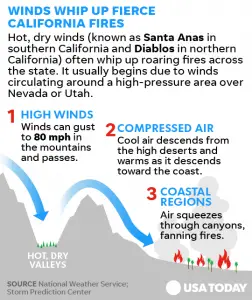
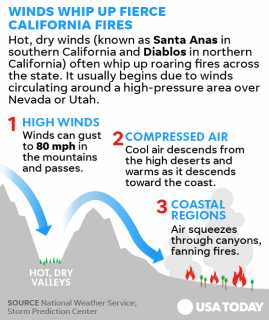
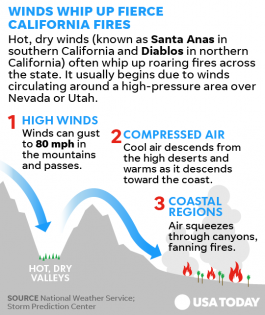

October is often the worst month of the year for wildfires in California. Not only is it the time when the Diablo winds (or Santa Ana winds in Southern California) kick up, but it’s also the driest month. California has a long dry season. It isn’t unusual to go without a single drop of rain from May through the end of October. Because of this, all the lush grass that grows during the spring rainy season is dried, crisp, and tragically perfect fuel.


In situations like this, there is often little to no warning before the fire is roaring through your property. The fire may be miles away and heading in the opposite direction one minute, then turn on a dime. Then suddenly, you find yourself directly in the path of an inferno. If you’re lucky, you escape unscathed with your life but lose all your worldly possessions. Many people have not been lucky.


15 large wildfires are blazing through Northern California’s wine country. 40 people are confirmed dead, hundreds are missing, more than a 100,000 have evacuated, and nearly 6000 homes and businesses have been completely burned to the ground. Thus far, the damage estimate is more than 3 billion dollars.


The following videos and stories show you what the Northern California wildfires are really like.


This video is shot from a fire engine from Berkeley, California on the day Santa Rosa burned. It gives you the firefighters’ firsthand view of the destruction and the speed with which it was wrought.


This video shows the utter devastation from the wildfires and includes clips of people escaping with only their lives.


These two roommates left with their dogs as the fire jumped the hill behind their home, narrowly escaping death. (Strong language)


This police officer’s body camera shows the terrifying scene when he was helping people evacuate.


This couple described their escape as being like “driving through hell.”


This video shows multiple clips of people fleeing the blaze as embers rain down and the billowing smoke gets closer. They are trappd on the freeway in slow-moving traffic.


In one tragic story, a family tried to evacuate by car. Their car caught on fire and they had to take off on foot to try and outrun the blaze. They got separated in the smoke. A 14-year-old boy burned to death and the other members of the family are burned over more than half their bodies. The mother and daughter were found by a neighbor and the father was found by paramedics. (source)


In a story with a happier ending, a farmer tried to evacuate his dogs but one refused to go. Odin, a Great Pyrenees, stayed with his herd of goats. The owners were positive they’d never see their beloved dog again, but when they returned to the farm, they discovered a slightly singed Odin with every member of his herd unharmed. This very good boy had even picked up a few baby deer. (source)


Haunting drone footage shows what Santa Rosa looks like after the fire.


While I strongly recommend evacuating in a situation like this, one man stayed behind and managed to save his home and his neighbor’s home from the wildfire.


Along the Napa/Sonoma border, these residents scrambled for safety and barely escaped with their lives. There were fires in all directions, blocking escape routes. People had to choose whether to drive through blinding smoke or flames.


This couple survived a wildfire they couldn’t escape by taking refuge in a neighbor’s swimming pool for SIX hours as the fire blazed all around them.


Another couple who tried to take refuge in a pool was not so fortunate. The woman died in her husband’s arms after 60 years of marriage.


This family’s dog ran away in a panic and they had no option but to leave. They returned home, certain their beloved pup had perished, but then they found this:


These interviews tell the stories of more narrow escapes.


This aerial footage gives you a better idea of what firefighters are dealing with during these widespread blazes.


More than eleven thousand firefighters are pushing themselves to the limits of their endurance to contain these fires, but they aren’t able to directly respond and save people. As the mayor of Calistoga said in a press conference to the few who opted to ignore evacuation orders, “You will NOT be given life safety support at this point. You are on your own.” Exhausted firefighters are grabbing moments of rest when they can.


In some areas, civilians, farmers, and construction crews have taken a stand to protect their homes from the infernos.


The story of the Capell Valley community is one that was repeated in neighborhoods and valleys across Northern California’s wine country this week, as dry conditions and high winds fueled multiple fires in Sonoma, Napa, Yuba and Mendocino counties.


It was not only firefighters who stood in the path of the blazes, but civilians too. Contractors, skilled construction workers and even former wildland firefighters came out of the woodwork to run bulldozers and drive multi-thousand gallon water tenders on twisty and damaged back roads.


They picked up what tools and equipment they could and tried to save their neighborhoods….


This wasn’t the first time Gil Pridmore had fought a fire in those hills. He spent years as the boss of a California Department of Forestry and Fire Protection bulldozer crew and fought the 1981 Atlas Peak Fire.


He used this experience to help lead a team of 30 people to cut multiple layers of firelines on the rim of the valley.


When flames would breach their lines and encroach on houses, the goal was to get the house “in the black,” or completely surrounded by burned areas so there was no fuel left to catch fire. (source)


They managed to save all but one home in the valley.


A few things to learn from the California wildfires


There are lessons to be learned from these videos (and 5 years of living in fire-prone California.) Wildfires happen in other parts of the United States as well, and it’s important to be prepared before the first spark.


You need a fire kit in your vehicle at all times. Things to include:


  • Swimming goggles: This will protect your eyes and help keep you from being blinded by smoke

  • Respirator masks: This doesn’t mean you will be able to breathe if the fire sucks all the oxygen from your environment, but it will help to filter out some of the smoke so you aren’t disabled by a coughing fit.

  • Fire extinguisher: In a worst case scenario if your vehicle catches on fire, you may be able to put it out if you attack while the blaze is small.

  • Welding gloves: Remember the guy who burned his hands opening a gate? Welding gloves will offer some protection from hot surfaces.

And here are some tips.


  • Do not wait for the official order: In some parts of Sonoma County, people are questioning why an evacuation alert never came. While officials do their best, YOU are the person who is responsible for your family’s safety. (source)

  • Have more than one escape route: In situations like this, you will often find your escape route blocked. Have more than one way out. Figure these out ahead of time and now when you are fleeing for your life and blinded by smoke.

  • Evacuate large animals ahead of time. If possible, evacuate your livestock before the emergency becomes a crisis. In a situation like this, animals can be fearful and uncooperative. Get your livestock to safety first, because if you have to rush out like many of these families did, you’ll have to leave them behind, helpless. I shared good news stories above, but a friend of mine in California went to help out with veterinary rescue. There are far more bad news stories.

  • Leash or crate pets early on: They will be affected by the same kind of panic. A normally well-behaved pet could rush off into danger, leaving you to make the choice to leave them behind or risk your family’s lives trying to save them.

  • Grab your dirty clothes hampers: If you have time to grab a few things unless you have just done laundry, grab dirty clothes hampers. They’re likely to have several days of clothing from the skin out, PJs, and socks, saving you time from searching for all those things individually.

  • Keep precious items and documents in one area: Make sure irreplaceable things are kept together. We have a decorative trunk near the door into which we can sweep precious mementos. Important documents are backed up in the Cloud, which means we don’t have to spend time packing those.

The fires are beginning to be contained, and firefighters say they are gaining an edge. Two out of three of the most destructive fires are more than 50% contained. Some people in Sonoma will be allowed to return to their homes today – or what’s left of them. Winds have lightened, but the weather will still be hot and dry until Thursday when there is a small chance of blessed rain. (source)


I wish those in the affected areas the very best.

Thursday, September 28, 2017

Puerto Rico: What It’s Really Like After the SHTF

This article was originally published by Daisy Luther at The Organic Prepper


puerto-rico


photo credit


Things are dire in Puerto Rico. We haven’t heard much directly from people there since Hurricane Maria took out power for the entire island, but what we do know is that the situation is desperate. This is a shocking, real-life glimpse into what it’s really like when the S hits the fan.


I saw a post from a friend of a friend who has family in Puerto Rico. I don’t have permission to share names, but here’s what she said:


“My family has lost everything. My uncle with stage 4 cancer is in so much pain and stuck in the hospital. However conditions in the island are far worse than we imagined and my greatest fear has been made reality. The chaos has begun. The mosquitos have multiplied like the plague. Dead livestock are all over the island including in whatever fresh water supplies they have.


My family has been robbed and have lost whatever little they had left. The gang members are robbing people at gun point and the island is in desperation. People are shooting each other at gas stations to get fuel.


They’re telling us to rescue them and get them out of the island because they are scared for their lives. We’re talking about 3.5 million people on an island, with no food, no drinking water, no electricity, homes are gone. Family if you have the means to get your people out, do it. This is just the first week. Imagine the days and weeks to come. These are bad people doing bad things to our most vulnerable.


Imagine a few weeks with no resources and the most vulnerable become desperate. What are you capable of doing if your children are sick and hungry? We have to help.”


I decided to vet what I could, and I believe this horrible story is absolutely true. I confirmed that there is very little food, no fresh water, 97% are still without power, limited cell signals have stymied communications, and hospitals are struggling to keep people alive. There is no 911. Help is not on the way. If you have no cash, you can’t buy anything. As people get more desperate, violence increases.


Never doubt that such an event could happen to any of us, no matter how carefully we prepare. Your best-laid plans could be swept away by a storm, flood, or fire. The immediate support most people have grown to expect might not be on the way.


Here’s what I learned.


Many homes were completely destroyed.


In the town of Catano, more than 60% of the residents are homeless due to the storm. At the shelter in Catano, the bathrooms flooded and sewage backed up into the building. There is food, but no water. It’s hot, dark, and the stench is overwhelming. There is more than one person at the shelter who is diabetic, and there is no ice for their insulin. (source)


Rivera Aviles, a Cataño city council member who set up the shelter with the help of her husband, found that her home was devastated, too.


She and her husband evacuated before the storm because their house — made of wood — is close to the water’s edge. After Maria passed she returned home and was shocked that “the entire roof was blown off.”


“Everything got wet — the beds, furniture, everything,” she says. The water damage has made it unlivable. (source)


The homes that are still standing were horribly damaged. “Even in homes that remain standing on the island, water damage and power outages have destroyed most belongings, medicine, and food.” (source)


An apartment building is missing a wall in San Juan, Puerto Rico, on Monday, September 25, nearly a week after Hurricane Maria devastated the US commonwealth. Power is still out in most places, and communications remain almost nonexistent on the island of 3.4 million people.


photo credit


There is hardly any potable water.


Nearly half the people in Puerto Rico are without potable drinking water. The tap water that is restored has to be boiled and filtered, and others are finding water where they can. You can expect a health crisis soon due to waterborne illnesses. When I researched my book about water preparedness, I learned that waterborne illness is one of the deadliest threats post-disaster. Although FEMA has delivered 6.5 million liters of water, on an island with 3.4 million people, it isn’t enough.


Isabel Rullán is the co-founder and managing director of a non-profit group called ConPRmetidos. She is very concerned about the water situation. She said that even if people were able to acquire water “they may not have the power or means to boil or purify it.”


She added that the problem went beyond access to drinking water — it was becoming a real public health concern.


Compounding that issue was hospitals lacking diesel and being unable to take new patients, she said.


“There’s so much contamination right now, there’s so many areas that are flooded and have oil, garbage in the water, there’s debris everywhere,” she said by phone.


“We’re going to have a lot of people that are potentially and unfortunately going to get sick and may die,” she said. (source)


According to the Department of Defense, 56% of the island has potable water, but in one town, Arecibo, the only fresh water comes from a single fire hydrant. (source)


Hospitals are struggling to keep people alive.


And speaking of hospitals, 59 of the 69 on the island were, according to the Department of Defense, “operating on unknown status.”


Only 11 of 69 hospitals on Puerto Rico have power or are running on generators, FEMA reports. That means there’s limited access to X-ray machines and other diagnostic and life-saving equipment. Few operating rooms are open, which is scary, considering an influx of patients with storm-related injuries. (source)


A hospital in San Juan reported that two people in intensive care died when the diesel fueling the generator ran out. The children’s hospital has 12 little ones who depend on ventilators to survive, and once they ran out of fuel, they have gotten by on donations. FEMA has delivered diesel fuel to 19 hospitals.


But many darkened hospitals are unable to help patients who need it most.


Without sufficient power, X-ray machines, CT scans, and machines for cardiac catheterization do not function, and generators are not powerful enough to make them work. Only one in five operating rooms is functioning. Diesel is hard to find. And with a shortage of fresh water, another concern looms: a possible public health crisis because of unsanitary conditions…


The hospitals have been crippled by floods, damage and shortages of diesel. The governor said that 20 of the island’s hospitals are in working order. The rest are not operational, and health officials are now trying to determine whether it is because they lack generators, fuel or have suffered structural damage. All five of the hospitals in Arecibo, Puerto Rico’s largest city in terms of size, not population, are closed. (source)


One emergency room director said, ““This is like in war: You work with what you have.”


And it isn’t just the hospitals that are dealing with medical crises.


“We are finding dialysis patients that haven’t been able to contact their providers, so we are having to transport them in near-death conditions,” Mayor Carmen Yulin Cruz said, recalling a group’s visit to two San Juan-area nursing homes this week. “We are finding people whose oxygen tanks are running out, because … small generators now don’t have any diesel.” (source)


Residents of Puerto Rico are also having trouble getting necessary medications.


A shortage of open pharmacies is another stressor, especially for the chronically ill and elderly residents. Most pharmacies in Puerto Rico remain closed, although they are slowly beginning to reopen. A CVS spokesman said that 21 out of 25 Puerto Rico-based CVS stores are now open, including 17 pharmacies. The first one reopened last Thursday. A Walgreens spokesman said about half of the island’s 120 stores are open and running on generators, but that hours vary. The stores are also receiving supplies of medication.


But many pharmacies in Puerto Rico are independently owned. With so many people pleading for medication, some pharmacists who know their clients are dispensing drugs without the required prescriptions or refill bottles.


Hospitals still have adequate supplies, and so do many of the open pharmacies, but there are concerns they may run out because suppliers are unable to get to them, said Dr. Victor M. Ramos Otero, the president of the College of Doctors and Surgeons of Puerto Rico.


Even when people find the drugs, they often cannot pay for them. Without electricity, A.T.M.s do not work and stores cannot accept credit cards or process insurance plans. (source)


The people who were already weakened by illness will fare the worst, shortly followed by those who become injured or ill in the aftermath.


There isn’t much food.


Much of the food on the island has spoiled or been contaminated.


In the town of Utuado, Lydia Rivera has started to ration crackers and drink rainwater to keep her two grandchildren alive. “No water, no food,” Rivera told CNN. (source)


The few markets that are open are rationing food with only 10 items per person allowed. People are standing in lines for hours to purchase their 10 items. There’s no way to keep perishables fresh. (source)

And there won’t be food produced anytime soon. 80% of the crops were completely wiped out and it will take a long time to produce more.


José A. Rivera, a farmer on the southeast coast of Puerto Rico, stood in the middle of his flattened plantain farm on Sunday and tried to tally how much Hurricane Maria had cost him.


“How do you calculate everything?” Mr. Rivera said.


For as far as he could see, every one of his 14,000 trees was down. Same for the yam and sweet pepper crops. His neighbor, Luis A. Pinto Cruz, known to everyone here as “Piña,” figures he is out about $300,000 worth of crops. The foreman down the street, Félix Ortiz Delgado, spent the afternoon scrounging up the scraps that were left of the farm he manages. He found about a dozen dried ears of corn that he could feed the chickens. The wind had claimed the rest.


“There will be no food in Puerto Rico,” Mr. Rivera predicted. “There is no more agriculture in Puerto Rico. And there won’t be any for a year or longer.” (source)


There is little communication.


The lack of communications means that more remote areas have no idea what rescue operations are on the way, nor can they contact loved ones. And the lack of communication is vast:


1,360 out of 1,600 cellphone towers on the island are out. Many communities have been isolated from the outside world for days, relying only on radios for news. The communications shortage means the full extent of the crisis has not been assessed. (source)


photo credit


Surprisingly, one of the most reliable ways to contact the outside world is with Facebook Messenger.


In fact, Facebook has dispatched a “connectivity team” to help more people contact loved ones. AT&T is bringing giant floating antennas in an effort to restore cell service.


It won’t be any surprise to preppers that ham radio operators are the only people still reliably able to communicate.


When things went dark and quiet in Puerto Rico, a cadre of amateur radio operators became a lifeline on the island.


About two dozen amateur radio operators on the island helped police and first responders communicate when their radio networks failed completely. Some of the radio operators, or hams traveled on trucks to provide communications to the power company, PREPA…


Now the ranks of operator are about to get reinforcements.


At the request of the Red Cross, the league planned to send 50 radio operators into Puerto Rico with “enormous” radio gear in water proof containers, their own power supplies, new generators and solar arrays. The crew and equipment were to leave Thursday from Atlanta.


Their job, once set up and in place, will be to be the communication pipeline for the Red Cross Safe and Well program, helping people on the mainland trying to connect with loved ones on the island or get news of their status. (source)


CNN offered the following links for those trying to check on loved ones.


People are waiting four hours or longer for a gallon of gasoline and fights are breaking out in the lines as tensions run high.


A curfew is in effect to try to squelch looting but success has been limited.


Incidents … are common in the capital, where men carrying bats and clubs have been seen on the streets during curfew hours. The mayor of San Juan, Carmen Yulin Cruz, told WAPA Radio, “We highly advise everyone not to be on the streets at night. It is not safe,” warning that reports of looting are on the rise.


“That is definitely something I don’t want to hear. Especially when the only lighting I have during the night is candlelight,” said Bianca Nevarez, who lives in Bayamon, where the scenario is much more tense since 13 prisoners escaped while they were being transferred to another criminal facility after the Category 5 storm caused severe damage in the prison. “We have captured eight of them, so five are still on the loose,” Ramon Rosario, secretary of Public Affairs of La Fortaleza told The Daily Beast.


Rosario added that 21 arrests have been made across the metropolitan area as a result of those breaking the curfew, which now runs from 7 p.m. to 5 a.m. No expiration date has been set.


“We will leave it active until the emergency period that we are suffering settles,” said Governor Ricardo Rosselló, noting that anyone caught on the streets during curfew hours will face up to six months in prison. (source)


Others talk about brazen crimes.


“We heard about an apartment building where four people broke in,” Rullan said. “People are worried … and just trying to be really cautious. Someone told me today that a person went into a gas station with rifles and told everyone, ‘It’s our turn to fill our tanks.’” (source)


OpsLens reports that the military is now joining forces with local police to curb the lawlessness.


Despite the significant threat to life, those who prey on others during strife and otherwise weak states are lurking. As has been reported here on OpsLens, public safety assets from the US mainland and elsewhere are striving to get boots-on-the-ground reserves in place to join the Puerto Rico factions of police trying to quell these sinister sorts from exacerbating inexplicable circumstances. (source)


Expect this to get even worse as the desperation increases.


Why has help been so slow to arrive?


Why is it that hardly any aid has arrived for this US territory? Geography and infrastructure damage are definite factors, and red tape and ridiculous laws are making matters even worse.


Difficulty lies in the fact that harbors and airports were severely damaged by Hurricane Maria. Roads are blocked with debris and some areas are still flooded. Lack of communication also plays a part. Relief supplies are stranded in port because there isn’t a way to distribute them. (source)


As always, bureaucracy is slowing things down. San Juan’s mayor said:


“We need to get our s— together because people are dying,” San Juan Mayor Carmen Yulín Cruz said on CBSN. “People are really dying.”


“It’s life or death,” Cruz said. “Every moment we spend planning in a meeting or every moment we spend just not getting the help we’re supposed to get, people are starting to die. This is not painting a picture. This is just the reality that we live in, the crude aftermath of a storm, a hurricane, that has left us technically paralyzed.” (source)


This is a perfect example of the United States having far too many laws.  One, in particular, has slowed relief. The Jones Act is a law from the 1920s that makes it illegal to ship foreign goods on American ships with an American crew.


The Jones Act, otherwise known as the Merchant Marine Act of 1920, requires goods shipped between American ports to be carried out exclusively by ships built primarily in the United States, and to have U.S. citizens as its owners and crews.


Signed into law by President Woodrow Wilson two years after World War I ended, the Jones Act was passed as a protective measure against foreign competition, particularly Germany. By restricting domestic trade to U.S.-flagged vessels with U.S. crews, America would always have a robust fleet of boats and sailors on hand in the event German submarines attacked the U.S. (source)


President Trump immediately suspended the Jones Act to allow fuel to get through after Texas and Florida were hit by back to back hurricanes but last night, an entire week after Puerto Rico was cut off from the world, he was still “thinking” about it.


“We’re thinking about that, but we have a lot of shippers and a lot of people, a lot of people who work in the shipping industry, that don’t want the Jones Act lifted.” (source)


Mercifully, this morning, Trump finally made his decision and lifted the Jones Act. (source)


To be fair, some aid has gotten through and FEMA says they have 10,000 people on the ground in Puerto Rico to help out with search, rescue, and recovery. President Trump also waived the legal requirement for a state to pay for one-fourth of the cost of the disaster since Puerto Rico is bankrupt. The military is airdropping food and supplies to more remote areas of Puerto Rico that are unable to be accessed by roads.


Help is also coming from private sources. Musician Pitbull is using his private plane to fly cancer patients to the US for treatment, and Mark Cuban, the owner of the Dallas Mavericks is sending a planeload of supplies. (source)


Lessons from Puerto Rico


It would be delusional to think that this kind of disaster could never happen to us. Of course, the size of our mainland means that disasters tend to be regional and that it is fairly easy logistically to get aid to different areas, but don’t be lulled into a false sense of security. There are some kinds of disasters that could affect the entire nation, like an EMP, just to name one chilling example.


These lessons could save your life in such a situation:


Having a plan is essential but it isn’t foolproof. No area is completely immune to disasters…earthquakes, wildfires, tornadoes, floods…these can happen just about anywhere. It’s easy to say, “Oh, it’s their own fault for living on an island/not prepping/not evacuating” but this attitude belies the fact that a disaster could wipe out any of us at any time. Maybe it’s callousness, or maybe it’s really just denial.


The terrible situation in Puerto Rico is proving true many theories about the aftermath of an all-out SHTF disaster. Particularly, it has proven that help is not always on the way, you have to know how to survive when absolutely everything is gone, and that desperate people do desperate things.


These are lessons we should all take to heart.