Now the third-largest wildfire in California history, the Thomas Fire has blazed through Ventura and Santa Barbara counties since it exploded into existence two weeks ago under mysterious circumstances.
With Cal Fire ordering thousands more people in Santa Barbara to evacuate as dry conditions and powerful winds help feed the flames, which were barely 40% contained as of Sunday.Twelve thousand people were evacuated in Santa Barbara County, with animals at the local zoo threatened as well. Santa Barbara Zoo closed Saturday and many animals were placed into cages in case of possible evacuations, zoo officials said.
Meanwhile, residents who had evacuated their homes in Ventura County, where the fire began, were allowed to return Saturday.
#ThomasFire- Dozens of Fire engines staged and await orders at the corner of Sycamore Cyn Rd and Cold Springs Road in Montecito Sunday morning. pic.twitter.com/J65JnyaluR
The fire is so massive that more than 8,400 firefighters are working around the clock to save lives and contain it. It"s bigger in acreage than New York City, and has turned neighborhoods to piles of soot and concrete as it churns through the area.
#ThomasFire- Smoke drifts towards Santa Barbara Airport in the distance while a wind driven spot fire burns on the west side and below Gibraltar Road. pic.twitter.com/9i7PYHWGYW
At least five of the six wildfires that ignited two weeks ago were still active as of Sunday, according to CNN. But the Thomas Fire is by far the biggest, as the map below illustrates.
Here’s a roundup of the latest developments from CNN and Cal Fire:
Cause of death: Firefighter Cory David Iverson, 32, died of "thermal injuries and smoke inhalation," according to autopsy results from the Ventura County medical examiner"s office. Iverson lost his life battling the Thomas Fire on Thursday. A total of two people have been killed since the fire started.
Hefty price tag: About $110 million has been spent fighting the massive blaze, fire officials said. It was 40% contained Saturday night.
Improving weather conditions: Santa Ana winds did not immediately materialize on Sunday morning, though firefighters had been expecting the worst. Red-flag warnings were in effect for a large swath of Southern California through late Sunday, with wind gusts of up to 55 mph expected overnight, according to CNN meteorologist Gene Norman.
In the record books: The blaze has charred 267,500 acres and is now the third-largest wildfire in modern California history.
Residents who spoke with CNN described being taken by surprise, as the wildfires spread faster than many expected. Residents described being awoken in the middle of the night by fire and police officials assisting in evacuation efforts.
Jeannette Frescas was not concerned about the Thomas Fire until the massive blaze reached her neighborhood in Ventura, California.
"At midnight, I woke up with a flashlight in my face," Frescas told CNN affiliate KEYT. "I looked out my window and there were flames that were like, a hundred feet, all around us."
Like many residents, Frescas was caught off guard by the fire that has roared across Southern California for 13 days. She"s one of tens of thousands of residents who piled into cars and fled as ferocious winds drove the third-largest blaze in modern state history through Ventura and Santa Barbara counties.
"What was once a paradise was like a war zone," Frescas said of her apartment complex, which was destroyed by the blaze. "It"s the scariest thing I"ve been through in my entire life."
One resident described being woken up by her son in law and told that she needed to grab her stuff and go - immediately.
Ventura resident Patricia Rye woke up to her son-in-law pounding on her door. She didn"t get a chance to pack any valuables, and fled her home of 17 years in the dead of the night.
"I didn"t have time to take anything," Rye told the affiliate. "My wallet, or any of my personal things. I literally left with the clothes on my back. If I had been thinking I would have got into my car, but I wasn"t thinking so my car was there."
The Thomas fire alone has caused well over $100 million in damage, though authorities likely won’t have a final figure for weeks, if not months. An extended stretch without rain has allowed the fires to burn without any significant natural impediments.
The Northern California wildfires are fast-moving, unpredictable, and for some, unsurvivable.
The videos below will show you what it’s really like, trying to survive an ever-changing inferno…and why you shouldn’t wait for the official evacuation order.
A lot of folks have been critical, saying blithely, “They knew there was a fire. They should have evacuated.” It’s important to understand that it doesn’t always work like that with wildfires. Armchair quarterbacking is easy. Fleeing when the car your driving literally catches on fire and the smoke is blinding you is not.
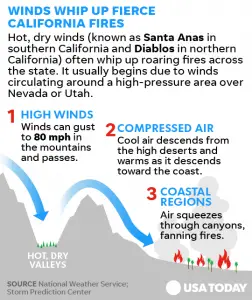
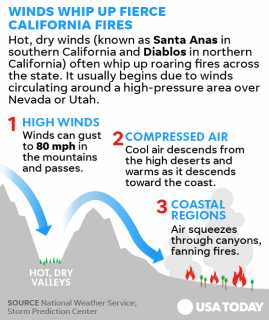
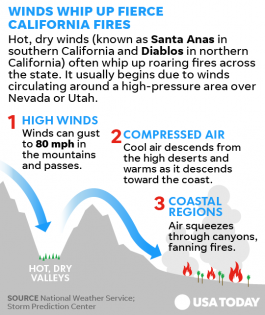
First of all, fires move rapidly. You can be in no danger whatsoever and just see a fire on the distant horizon, and then minutes later, it’s at your back door. Secondly, they change courses. Many times, the fire gets ahold of some new fuel – like a home, tall grass, or trees, and the course veers in that direction. Finally, high winds have propelled these fires rapidly and fanned them to new heights. Every fall, California has something called the “Diablo Winds.” These are seasonal gusts that can reach as high as 80 mph and cause extremely high fire danger. When coupled with existing fires, it’s nothing less than the perfect storm.
October is often the worst month of the year for wildfires in California. Not only is it the time when the Diablo winds (or Santa Ana winds in Southern California) kick up, but it’s also the driest month. California has a long dry season. It isn’t unusual to go without a single drop of rain from May through the end of October. Because of this, all the lush grass that grows during the spring rainy season is dried, crisp, and tragically perfect fuel.
In situations like this, there is often little to no warning before the fire is roaring through your property. The fire may be miles away and heading in the opposite direction one minute, then turn on a dime. Then suddenly, you find yourself directly in the path of an inferno. If you’re lucky, you escape unscathed with your life but lose all your worldly possessions. Many people have not been lucky.
15 large wildfires are blazing through Northern California’s wine country. 40 people are confirmed dead, hundreds are missing, more than a 100,000 have evacuated, and nearly 6000 homes and businesses have been completely burned to the ground. Thus far, the damage estimate is more than 3 billion dollars.
The following videos and stories show you what the Northern California wildfires are really like.
This video is shot from a fire engine from Berkeley, California on the day Santa Rosa burned. It gives you the firefighters’ firsthand view of the destruction and the speed with which it was wrought.
This video shows the utter devastation from the wildfires and includes clips of people escaping with only their lives.
These two roommates left with their dogs as the fire jumped the hill behind their home, narrowly escaping death. (Strong language)
This police officer’s body camera shows the terrifying scene when he was helping people evacuate.
This couple described their escape as being like “driving through hell.”
This video shows multiple clips of people fleeing the blaze as embers rain down and the billowing smoke gets closer. They are trappd on the freeway in slow-moving traffic.
In one tragic story, a family tried to evacuate by car. Their car caught on fire and they had to take off on foot to try and outrun the blaze. They got separated in the smoke. A 14-year-old boy burned to death and the other members of the family are burned over more than half their bodies. The mother and daughter were found by a neighbor and the father was found by paramedics. (source)
In a story with a happier ending, a farmer tried to evacuate his dogs but one refused to go. Odin, a Great Pyrenees, stayed with his herd of goats. The owners were positive they’d never see their beloved dog again, but when they returned to the farm, they discovered a slightly singed Odin with every member of his herd unharmed. This very good boy had even picked up a few baby deer. (source)
Haunting drone footage shows what Santa Rosa looks like after the fire.
While I strongly recommend evacuating in a situation like this, one man stayed behind and managed to save his home and his neighbor’s home from the wildfire.
Along the Napa/Sonoma border, these residents scrambled for safety and barely escaped with their lives. There were fires in all directions, blocking escape routes. People had to choose whether to drive through blinding smoke or flames.
This couple survived a wildfire they couldn’t escape by taking refuge in a neighbor’s swimming pool for SIX hours as the fire blazed all around them.
Another couple who tried to take refuge in a pool was not so fortunate. The woman died in her husband’s arms after 60 years of marriage.
This family’s dog ran away in a panic and they had no option but to leave. They returned home, certain their beloved pup had perished, but then they found this:
These interviews tell the stories of more narrow escapes.
This aerial footage gives you a better idea of what firefighters are dealing with during these widespread blazes.
More than eleven thousand firefighters are pushing themselves to the limits of their endurance to contain these fires, but they aren’t able to directly respond and save people. As the mayor of Calistoga said in a press conference to the few who opted to ignore evacuation orders, “You will NOT be given life safety support at this point. You are on your own.” Exhausted firefighters are grabbing moments of rest when they can.
In some areas, civilians, farmers, and construction crews have taken a stand to protect their homes from the infernos.
The story of the Capell Valley community is one that was repeated in neighborhoods and valleys across Northern California’s wine country this week, as dry conditions and high winds fueled multiple fires in Sonoma, Napa, Yuba and Mendocino counties.
It was not only firefighters who stood in the path of the blazes, but civilians too. Contractors, skilled construction workers and even former wildland firefighters came out of the woodwork to run bulldozers and drive multi-thousand gallon water tenders on twisty and damaged back roads.
They picked up what tools and equipment they could and tried to save their neighborhoods….
This wasn’t the first time Gil Pridmore had fought a fire in those hills. He spent years as the boss of a California Department of Forestry and Fire Protection bulldozer crew and fought the 1981 Atlas Peak Fire.
He used this experience to help lead a team of 30 people to cut multiple layers of firelines on the rim of the valley.
When flames would breach their lines and encroach on houses, the goal was to get the house “in the black,” or completely surrounded by burned areas so there was no fuel left to catch fire. (source)
They managed to save all but one home in the valley.
A few things to learn from the California wildfires
There are lessons to be learned from these videos (and 5 years of living in fire-prone California.) Wildfires happen in other parts of the United States as well, and it’s important to be prepared before the first spark.
You need a fire kit in your vehicle at all times. Things to include:
Swimming goggles: This will protect your eyes and help keep you from being blinded by smoke
Respirator masks: This doesn’t mean you will be able to breathe if the fire sucks all the oxygen from your environment, but it will help to filter out some of the smoke so you aren’t disabled by a coughing fit.
Fire extinguisher: In a worst case scenario if your vehicle catches on fire, you may be able to put it out if you attack while the blaze is small.
Welding gloves: Remember the guy who burned his hands opening a gate? Welding gloves will offer some protection from hot surfaces.
And here are some tips.
Do not wait for the official order: In some parts of Sonoma County, people are questioning why an evacuation alert never came. While officials do their best, YOU are the person who is responsible for your family’s safety. (source)
Have more than one escape route: In situations like this, you will often find your escape route blocked. Have more than one way out. Figure these out ahead of time and now when you are fleeing for your life and blinded by smoke.
Evacuate large animals ahead of time. If possible, evacuate your livestock before the emergency becomes a crisis. In a situation like this, animals can be fearful and uncooperative. Get your livestock to safety first, because if you have to rush out like many of these families did, you’ll have to leave them behind, helpless. I shared good news stories above, but a friend of mine in California went to help out with veterinary rescue. There are far more bad news stories.
Leash or crate pets early on: They will be affected by the same kind of panic. A normally well-behaved pet could rush off into danger, leaving you to make the choice to leave them behind or risk your family’s lives trying to save them.
Grab your dirty clothes hampers: If you have time to grab a few things unless you have just done laundry, grab dirty clothes hampers. They’re likely to have several days of clothing from the skin out, PJs, and socks, saving you time from searching for all those things individually.
Keep precious items and documents in one area: Make sure irreplaceable things are kept together. We have a decorative trunk near the door into which we can sweep precious mementos. Important documents are backed up in the Cloud, which means we don’t have to spend time packing those.
The fires are beginning to be contained, and firefighters say they are gaining an edge. Two out of three of the most destructive fires are more than 50% contained. Some people in Sonoma will be allowed to return to their homes today – or what’s left of them. Winds have lightened, but the weather will still be hot and dry until Thursday when there is a small chance of blessed rain. (source)
With at least 29 dead, and over 3500 houses destroyed, the devastating series of fires that has ravaged Northern California"s Wine Country has to be seen to be believed. As smoke clogs the air up to 100 miles away and with schools and sports programs shut down across the entire NorCal region, this disaster is already being called states deadliest wildfire in history.
“These fires are a long way from being contained, so we’re doing the best we can for people that have been displaced and help them to hopefully rebuild their lives” said Barry Dugan, a Sonoma County spokesman.
Have already burned more than 191,000 acres - an area nearly the size of New York City.
Entire neighborhoods have been lost...
But the park survived...
But Kmart was not so lucky...
As the following shocking aerial footage shows, there is nothing left of some of the states (and country"s) most beautiful places to live...
Aerial footage shows the devastating aftermath of the wildfires in California: whole neighborhoods razed to the ground. At least 29 dead. pic.twitter.com/LpFgHxDgrq
But, as Michael Snyder notes, the true extent of the devastation will not be known until the crisis is over, and it looks like the worst chapters may still be ahead.USA Today is reporting that no rain is in the forecast, and strong winds are going to continue to push wildfires very rapidly across the region…
“No rainfall is forecast for ongoing fires in California,” the weather service said.
“Strong winds behind the front will bring elevated-to-critical fire weather threats to active fires across northern California today.”
Normally, it is one of the most beautiful areas on the entire planet, but now it is literally being transformed into a complete and total nightmare.
The richest vein in the history of predatory mining is just about played out.
A gigantic mine engages in every conceivable destructive practice—strip mining, heap leaching, tailings dams and ponds and so on. It pays such low wages its workers only make ends meet by borrowing from the company at usurious rates. The mine has befouled the air and poisoned the water. Many workers are chronically sick and their children are afflicted with birth defects. The mine’s absentee owners know that the mine is played out and the tailings dam is structurally unsound. They close the mine, count their profits, and move on. A month later the dam gives way. A deluge of noxious sludge inundates the town below the dam, sparing no one and rendering the area uninhabitable.
The government is a strip mining operation, plundering the dwindling residual value of a once wealthy America. Forget ostensible justifications, policy is crafted to allow those who control the government to maximize their take and put the costs on their victims, leaving devastation in their wake.
Wars are no longer about defending the country or even making the world safe for democracy. They are about appropriations, not to be won, but profitably prolonged. The Middle East and Northern Africa have been a mother lode. You would think their sixteen-year war in backward and impoverished Afghanistan would be a shameful disgrace for the military and the intelligence agencies. It’s not. They’ve milked that conflict for all its worth, and now brazenly talk about a “generational war”: many more years of more of the same.
We can also look forward to generational wars in Iraq, Syria, Libya, and Yemen. The strip miners are agitating for an Iranian foray. That’s got Into The 22nd Century written all over it, a rich, multi-generational vein, perhaps America’s first 100-year war.
The only rival for richest mother lode is medicine. Health care is around 28 percent of the federal budget, defense 21 percent. Medical spending no longer cures the sick; it’s the take for insurance, pharmaceutical, and hospital rackets. The US spends more per capita on health care than any other nation (36 percent more than second-place Switzerland) but quality of care ranks well down the list.
In education there is the same gap between per capita spending (the US ranks at or near the top) and value received, in this instance as measured by student performance. What’s paid is out of all proportion to what’s received, especially at a time when computer and communications technology should be driving down the costs of education across the board.
Indoctrination factories formerly known as schools, colleges, and universities dispense approved propaganda. For students, higher education is now on the government-sponsored installment plan. There’s a litany of excuses why Johnny, Joan, Juan, Juanita, Jamal and Jasmine can’t read, compute, or think, but lack of funding and student loans don’t wash. Education dollars fund teachers’ unions, their pensions, administrators, and edifice complexes; learning is an afterthought. This vein will play out as the pensions funds, and the governments that have swapped promises to fund them for educators’ votes, go bankrupt. Probably around the same time as the student loan bubble pops.
Money itself has become a faith-based construct, a strip mining operation jointly owned by the government, the central bank, and the banking cartel it supports. Replacing gold with paper promises, monetizing debt, interest rate suppression, inflation of the money supply and the central bank’s balance sheet, macroeconomic meddling, maintenance of a bankers’ cartel, and insider dealing within the cartel have immeasurably increased the wealth and power of the entire banking complex.
Twenty trillion dollars in debt, two-hundred-plus trillion in unfunded liabilities, and an economy that has barely cruised above stall speed for eight years are core samples indicating the mine is exhausted. The tailings dam has sprung visible leaks. However, the townspeople below the dam remain willfully oblivious to the danger.
Recognizing reality and doing something about it are hallmarks of mental toughness, once considered a virtue. Now, in various tangible and virtual sanctuaries against facts and logic, the demand is made for reality to conform to the delusions of those who refuse to confront it. In the safe space between their ears, the only danger is someone warning of danger.
Lower even than the level of mental fortitude is physical toughness. When the dam breaks, the obese, opiated, otiose endomorphs resting their girths on couches across America will have no chance of escaping the sludge, even with their motorized carts. President Kennedy christened the President’s Council on Physical Fitness to address what he saw as a soft and flabby America. Fifty years later, America is exponentially softer and flabbier—physically, intellectually, and spiritually. Most Americans are in no condition to handle the emotional and physical stresses crises will bring.
It’s viciously ironic that many of them will look to the strip miners for salvation. A captive government that has turned America into a field of rackets, its string-pullers extracting power and wealth while ordinary people have seen their incomes stagnate, their meager savings dwindle, and opportunities shrink, is somehow going to make financial and economic catastrophe all better.
In one sense Hillary Clinton’s use of the term “deplorable” was unfortunate, in that it implies that the strip miners care enough about the townspeople to deprecate them. They don’t. The townspeople have had their uses, but they’re expendable once the mine is played out. Let someone else worry about pulling them from the sludge, or just leave them buried. The strip miners chose America first because it had the richest vein, now exhausted. The strip miners will move on to other, albeit less lucrative, lodes. That is what is meant by globalization.
Since the first day after Christmas last year (12/27/16), the metals space has been a great place to be. Below looks at performance of several metals assets compared to the S&P 500 since this date.
CLICK ON CHART TO ENLARGE
Premium and Metals members went long this sector by purchasing GDXJ on 12/27/16, due to an upside breakout. Even though the S&P is getting a ton of press about doing well and near all-time highs, its performance since 12/27/16 (Up 3.8%), is lagging the metals space by a large percentage!
Below looks at the Gold Bugs/S&P 500 Ratio-
CLICK ON CHART TO ENLARGE
Joe Friday Just The Facts; A upside breakout above pennant pattern resistance at (3), would suggest continued out performance by Gold Miners is in play and should attract buying pressure to mining companies.
Full disclosure; Premium and Metals members own miners at this time.
Not a subscriber to our research products yet? Email us for discount and trial offers to get started


 http://www.theorganicprepper.ca/wp-content/uploads/2017/10/6364332809325...