Showing posts with label Emmanuel Macron. Show all posts

Tuesday, May 8, 2018

Trump To French Prez: The US WILL Withdraw From Obama’s Iran Nuclear Deal


President Donald Trump told French President Emmanuel Macron Tuesday morning that he plans to announce the withdrawal of the United States from the Iran nuclear deal, according to a person briefed on the conversation. Trump has often regarded the deal initiated during the Obama administration as a “bad” one.


President Trump’s decision unravels the signature foreign policy achievement of his predecessor, Barack Obama. Left-leaning media outlets also claim it is isolating the United States among its allies and leaving it at even greater odds with its adversaries in dealing with the Iranians.


Iran has already issued warnings of “severe consequences” should the US decide to pull the plug on the 2015 nuclear agreement.


Iranian President Hassan Rouhani told a cheering crowd of thousands Tuesday that if any country decides to betray the 2015 nuclear deal, there will be “severe consequences.”  Although Rouhani didn’t specifically name the United States, he did say that Tehran is “prepared for all possible situations.”


The New York Timesreported that Germany’s Chancellor Angela Merkel will work to convince Donald Trump to stay in the agreement at a meeting later this week.  And in the meantime, French president Emmanuel Macron is diligently working on swaying Trump’s mind on the issue as well.  Both European leaders want the US to stick to the 2015 nuclear deal put in place by Barack Obama. –SHTFPlan


Trump has not stayed quiet as to how he personally feels about the deal made by his predecessor.


The United States is preparing to reinstate all sanctions it had waived as part of the nuclear accord — and impose additional economic penalties as well, the person said, according to the New York Times. A second person familiar with negotiations to keep the 2015 accord in place said the talks collapsed over Trump’s insistence that sharp limits be kept on Iran’s nuclear fuel production after 2030. The deal currently lifts those limits. Trump is allegedly also planning to formally announce his decision at 2 p.m. on Tuesday at the White House.


The decision will, however, fulfill one of Trump’s oft-repeated campaign promises, and came despite intense personal lobbying by European leaders and frantic attempts to craft fixes to the deal that would satisfy him. Trump’s aides persuaded him twice to stay in the agreement, but the president has made it crystal clear that his patience with the deal had worn thin. Armed with a new, more war hungry set of advisers — led by Secretary of State Mike Pompeo and the national security adviser, John R. Bolton — Trump faced much less internal resistance this time.


It appears that even some in the mainstream media are now siding with Trump with regards to the withdraw from the weapons accord.  Even after inception of the agreement in 2015, the regime has been confronted with credible information that it is operating more advanced centrifuges than permitted, exceeding limits on production of heavy water and, according to Fox News, covertly procuring nuclear and missile technology outside of approved channels: These are all material breaches of the deal.


Tuesday, April 24, 2018

Iran Vows ‘Severe Consequences’ If US Backs Out Of Nuclear Deal


Iranian President Hassan Rouhani told a cheering crowd of thousands Tuesday that if any country decides to betray the 2015 nuclear deal, there will be “severe consequences.”  Although Rouhani didn’t specifically name the United States, he did say that Tehran is “prepared for all possible situations.”


The New York Times reported that Germany’s Chancellor Angela Merkel will work to convince Donald Trump to stay in the agreement at a meeting later this week.  And in the meantime, French president Emmanuel Macron is diligently working on swaying Trump’s mind on the issue as well.  Both European leaders want the US to stick to the 2015 nuclear deal put in place by Barack Obama.


Wendy R. Sherman, the former top official at the State Department who negotiated the deal for then-President Obama, told the paper that Trump and Macron are likely having a “very difficult conversation,” reported Fox News. “I’m sure that Macron will say how important staying in the deal is to a strong trans-Atlantic relationship in all things, particularly security,” she said.


The White House on Monday appeared to show little change in Trump’s opinion on the deal. “He thinks it’s a bad deal…that certainly has not changed,” Sarah Sanders said alluding to the possibility of rejecting the deal entirely. Trump hasn’t hidden his disdain for Obama’s 2015 nuclear deal with Iran.


Trump’s tweet alone shed some light on his feelings about how things are going with Iran.  Tensions seem high, but they may go even higher on the heels of Iran’s vow of severe consequences. According to USA Today, Iran cannot be trusted to uphold their end of the nuclear agreement, however.


The key reason that President Trump must not only not recertify the Iran nuclear deal but outright abrogate it is because Tehran is explicitly and demonstrably out of compliance with the agreement on numerous specific counts. Further, after the Iranian regime was caught in 2002 operating a clandestine weapons program in violation of the Nuclear Non-Proliferation Treaty — conduct underway for at least 14 years — and has never come clean about that program, it cannot be trusted to adhere to any other agreement. –USA Today


It appears that even some in the mainstream media are siding with Trump and asking him to withdraw from the weapons accord.  Even after inception of the agreement in 2015, the regime has been confronted with credible information that it is operating more advanced centrifuges than permitted, exceeding limits on production of heavy water and, according to Fox News, covertly procuring nuclear and missile technology outside of approved channels: These are all material breaches of the deal.


Wednesday, April 11, 2018

Russia Says Israeli Warplanes Struck Syrian Airbase, Trump and Macron Vow Joint Aggression Against Syria

Russia Says Israeli Warplanes Struck Syrian Airbase, Trump and Macron Vow Joint Aggression Against Syria | israeli-warplane-strike | Politics Trump War Propaganda World News

[image: REUTERS/U.S. Air Force/Senior Airman Matthew]

False flags are a US tradition, used to serve its imperial interests.

The fabricated weekend Douma CW incident was staged – a pretext for whatever Washington and its rogue allies have in mind ahead, likely greater aggression than already.


On Monday, Russia’s Defense Ministry issued the following statement, saying:


“On April 9, in the period between 3:25 AM and 3:53 AM Moscow Time, two F-15 aircraft of Israel’s Air Force delivered a strike with eight guided missiles on the T-4 airfield without entering Syria’s airspace from Lebanon’s territory,” adding:


Syrian air defenses destroyed five Israeli missiles, three others striking the airbase’s western area. No Russian personnel were among the casualties.


Iran’s Foreign Ministry spokesman Bahram Qassemi responded to the alleged Douma incident, saying:


Western claims are “conspiratorial and illogical…signal(ing) a new conspiracy against the Syrian government and nation and a pretext for military action against them…aggravating the situation in this country and in the region.”


“When the Syrian army has the upper hand on the battlefield against armed terrorists, it would not be rational for it to use chemical weapons,” he added.


On Sunday, Trump and France’s Macron spoke by phone, vowing a joint response to the alleged Douma incident – fabricated, not real.


It doesn’t matter given likely plans in place for what Washington, Israel, France, and their rogue allies have in mind – the staged incident a convenient pretext.


A White House statement said Trump and Macron “agreed that…Assad…must be held accountable” – for what apparently didn’t happen, the alleged Douma incident fake, not real.


Both leaders vowed to “coordinate a strong, joint response.”


On Sunday, Russia called for a Security Council meeting on “international threats to peace and security.”


Washington, Britain, France and their rogue SC allies called for a session to discuss the alleged weekend Douma incident.


Envoys from these countries agreed on one meeting on both issues, not two separate ones – to be held later on Monday.


Ahead of the session, neocon extremist Nikki Haley issued a press release, saying:


“Yet again, there are reports of what appears to be a chemical weapons attack in Syria.”


“Unfortunately, chemical weapons use to injure and kill innocent Syrian civilians has become all too common.”


“The Security Council has to come together and demand immediate access for first responders, support an independent investigation into what happened, and hold accountable those responsible for this atrocious act.”


The only “atrocious act(s)” so far were likely US responsibility for orchestrating the fake Douma CW incident, furthering its imperial agenda, along with Israeli terror-bombing of Syria’s T-4 airbase, causing unclear numbers of deaths and injuries.


Escalated US-led aggression is likely following the Douma incident – putting conflict resolution further out of reach than already, why it was staged.


Note: Trump reportedly will hold a news conference on Syria, perhaps with his new national security advisor John Bolton, assuming his post on Monday. It’s likely to be bellicose.


The post Russia Says Israeli Warplanes Struck Syrian Airbase, Trump and Macron Vow Joint Aggression Against Syria appeared first on The Sleuth Journal.

Wednesday, February 14, 2018

France Gears Up For War?: ‘France Will STRIKE’ Syria If Chemical Weapons Were Used

macron


French president Emmanuel Macron has promised to “strike” Syria, but only if evidence emerges that chemical weapons were used against civilians.  And he has admitted that French intelligence agencies have not yet discovered any evidence.


“On chemical weapons, I set a red line and I reaffirm that red line,” Macron told reporters in Paris on Tuesday, according to RT.  “If we have proven evidence that chemical weapons proscribed in treaties are used, we will strike the place where they are made.”


“Today, our agencies, our armed forces have not established that chemical weapons, as set out in treaties, have been used against the civilian population.” Macron added that he’s all but threatened Russian president Vladimir Putin with war should his agencies find evidence of chemical weapons uses.  “I’ve reiterated it to President Putin, asking to make it very clear to the Syrian regime, which has reaffirmed that it does not use chemical weapons … but we are watching it,” Macron stated.


Although Macron talks a big game on chemical weapons, he also hasn’t taken any action as he awaits proof. “We have some indications of possible chlorine use [in Syria], but we have no absolute confirmation,” the French Defense Minister Florence Parly said last Friday. “So we, alongside the others, are working on trying to confirm this, as we clearly have to get the facts straight.” But according to the French Foreign Minister, the evidence is mounting the Syrian government, stating using chlorine last week.  “All indications show us today that chlorine is used by the regime right now in Syria,” said Parly.


France, a permanent member of the U.N. Security Council, has struggled to wield influence on Syria. Critics who accuse Macron of inaction say he has not given a clear definition of whether use of chlorine would for him constitute a chemical attack.


On Tuesday, the vice-president of the Syria Civil Defence, or “White Helmets”, volunteer force said France should stop talking and take real action.


France and the United Nations have repeatedly called in past months for a ceasefire and the opening of aid corridors to alleviate Syria’s humanitarian crisis. Russia, Assad’s most powerful ally, said last week a ceasefire was not realistic. -Reuters


The Syrian government has repeatedly denied using chemical weapons and said it targets only armed rebels and militants, according to Reuters.  Last week was one of the bloodiest in the Syrian conflict as Syrian government forces, who are backed by Russia and Iran, bombarded two of the last major rebel areas of Syria. Parts of Eastern Ghouta near Damascus and the northwestern province of Idlib were the hardest hit.

Thursday, January 4, 2018

French President To CENSOR THE MEDIA By Making Certain News Illegal

censorship2


French President Emmanuel Macron says he will push a new law aimed at cracking down on alternative media and news that isn’t liberal. He invoked the term “fake news” saying he hopes to have the law in place by the end of the year.


Oh, the irony of guys like Macron thinking censorship is “freedom.” Speaking at a news conference at the Elysee Palace in Paris on Wednesday, Macron said such a law was essential, especially during elections. Sure.  We can’t be having people pointing out that Macron is communist. That’s not good for reelection chances. He even says it’s to protect “liberal democracies” as if this is some sort of page out of a novel about a dystopian society.


“The freedom of the press is not a special freedom, it is the highest expression of freedom,” Macron said. “If we want to protect liberal democracies, we have to be strong and have clear rules.” He added that “A law will follow in due course.” No law has ever given anyone freedom, rather by their very nature, take it away and list a punishment, so the illogical rant flowing from his mouth is more than enough for most rational humans to roll their eyes at.


macron


The idea of an individual freedom is incompatible with a communist ideology.  The only reason to hold individual speech and information rights would be to better the society, a condition which would likely be met only in certain instances rather than across time, making the default a lack of freedom. –Stanford.edu


Macron said the law should require websites to disclose their source of funding and have a cap on the amount of money they receive from sponsored content. During an election, the government would be authorized to block a website, he said. He insisted that “press freedom” could be preserved under such a law. Of course! Suppressing free speech is always a good start to press freedom.


The Washington Post notes that “On the eve of the vote, Macron’s campaign suffered a massive cyber attack that it compared to the hacking of Hillary Clinton’s presidential campaign last year. U.S. intelligence agencies have blamed that operation on the Russian government.” But magically, Macron was still elected. Meaning those who voted for him didn’t care about the information released or didn’t read it anyway.


If you’re looking for logical consistency from a socialist or communist though, it’s going to take some mental gymnastics. But is anyone really surprised that a communist wants to limit free speech and press freedom? They can’t have people running around saying bad things about the government, now can they? How dare people want to free!

Sunday, December 24, 2017

EU Militarizes Africa To Halt Migration

Authored by Finian Cunningham via The Strategic Culture Foundation,


Fighting terrorism is now morphing into clamping down on human migration, as far as the European Union is concerned.


France’s President Emmanuel Macron is leading the charge, claiming at a conference in Paris last week that terrorism and human trafficking are part of the same problem, requiring the deployment of a military force spread across Africa.


The melding of the two concepts provokes serious legal and moral questions.


But so desperate, it seems, is the EU to halt illegal migration into the bloc that it is moving to militarize the problem in Africa – under the guise of “fighting terrorism”.


This is tantamount to European Neo-imperialism. That is, attempting to sort out deep-seated socio-economic problems down the barrel of a gun. Not only that, but using futile heavy-handed methods to deal with problems that European powers themselves are responsible for creating.


Such an approach will only worsen humanitarian problems for millions of displaced war-torn and impoverished people. In typical arrogant imperialist fashion, the EU is not addressing root causes of the problem – its own role in shattering African societies from illegal wars and predatory economics.


The panicky reaction this week in Brussels to the formation of the new Austrian government led by populist Chancellor Sebastian Kurz shows that the other European powers are still rattled by the rise of nationalistic politics across Europe and the underlying long-term problem of migration into the EU.


Kurz’s People’s Party has formed a coalition government with the Freedom Party. Both share anti-immigration policies and are deeply critical of the EU. The new Austrian administration has been described with trepidation in the news media as the first “far-right” government in the European Union. That epithet appears to be aimed at demonizing the new Austrian authorities with the taint of “fascism”.


However, what seems to be the real concern among the pro-EU governments of Germany and France is that Austria rekindles wider fears in regard to large uncontrolled flows of refugees entering into Europe and the knock-on effect of rising anti-EU populist politics that those fears tend to fan.


Another sign of the EU’s concern over the flow of migrants into the bloc is the attempt by France, Germany and Italy to morph the issue of refugees into one of “fighting terrorism”. This is an audacious, not to say reprehensible, step of treating a humanitarian crisis with military force. But because the emotive “anti-terror” card is invoked, the intention is to mask the controversial, unethical move with a veneer of humanitarianism.


Last week, French President Emmanuel Macron hosted a summit in Paris which was billed as countering terrorism in the Sahel – the vast Northwest desert region of Africa. Macron has taken the lead earlier this year in forming what is known as the Group of Five (G5) countries straddling the Sahel region, comprising Mali, Niger, Burkina Faso, Chad and Mauritania.


The leaders of the G5 were hosted by Macron at a chateau near Paris on December 13. Also in attendance were German Chancellor Angela Merkel and Italy’s premier Paolo Gentiloni. Significant too was the attendance at the summit by the foreign ministers of Saudi Arabia and the United Arab Emirates.


In a brazen appeal for financial funding, Macron asked the Saudis and Emiratis to stump up money for the G5 military force. Both the oil-rich states responded with pledges of $100 million and $30 million, respectively. Other donors to the G5 “anti-terror operations” were the EU and the United States, each pledging $60 million. In other words, the Saudis and Emiratis are bankrolling the G5 “anti-terror” military coalition to the tune of nearly half its total budget.


The G5 comprises some 4,000 troops from the five mentioned African countries – all of them former French colonies. The French forces in the region are believed to number around the same. There are also American special forces operating, as was shown by the dramatic deadly shootout in Niger in October when four US troops were killed in an ambush.


What Macron is claiming to do is to replace the French forces with local troops from the G5. That move will save Paris millions of euro it is currently shelling out on the presence of its military in the Sahel. Knowing that these poor African countries would never be able to finance the operations, the French president is deftly involving the Saudis and Emiratis in the funding.


Macron’s proposal beggars belief. Given the record of the Gulf Arab hardline Sunni regimes in sponsoring terrorism across the Middle East, it is absurd to propose that these same regimes could support “anti-terror” operations in the Sahel.


The contradiction raises the real issue and purpose. France, Germany and Italy, on behalf of the EU, are actually using the moral and political cover of “fighting terrorism” in Africa to further their agenda of stemming the flow of migrants from the continent to Europe. And getting the Gulf Arabs to pay for it. The latter get PR value in return.


It is reckoned that the total African population will double in the next three decades to some 2.5 billion people. That presents European leaders with a formidable headache of worsening migration flows. Already in the last two years, there is estimated to have been 1.5 million refugees entering the EU, many of them from Africa. That phenomenon has, in turn, fueled anti-immigrant political parties across Europe who blame the EU political establishment for the problem. The populist backlash poses a threat to the cohesiveness of the EU. It was one of the issues that drove the British electorate to vote last year for leaving the bloc.


Rather than sniffing at “populist” politics in Austria, Hungary, Poland, the Czech Republic, Slovenia, Denmark, France, Italy, Netherlands and Germany – and denigrating it as “fascist” – European leaders need to question their own responsibility. It is understandable that European communities can feel unnerved by the sudden influx of foreigners into their country. Given the relentless socio-economic austerity imposed on communities by Neo-Liberal capitalist governments, the anxieties over scarce public resources are accentuated, and understandable.


Moreover, the European members of the US-led NATO military alliance bear direct responsibility for opening the migration floodgates when they destroyed the state of Libya in an illegal war for regime change in 2011. France, Italy, Britain and Germany, among others, were complicit in that criminal war.


France too went on an illegal military expedition in Mali in 2013 to “defeat terrorism” – and its forces remain in that country today.


The real reason for that French intervention may likely have been securing uranium ore mines in Mali and Niger.


All those illegal military interventions by the Europeans in Northwest Africa unleashed militants, migration and human trafficking on a massive scale.


A report last week by Amnesty International also openly condemned European governments for colluding with human traffickers in Libya by forcibly sending would-be migrants trying to cross the Mediterranean back into the clutches of the traffickers on land.


Europe is so desperate to stem the flow of migrants because it is destabilizing the internal politics of the EU. So desperate is Europe that it is willing to force refugees back into the human trafficking networks to a fate of slavery in order to impede the flow into Europe.


Macron’s military “solution” for the Sahel is part of the same futile problem-solving. The French president, with the support of Germany, Italy and the rest of the EU, is using military force to combat “terrorism and human trafficking” which he equates as the same.


Furthermore, Macron and the EU are trying to do it on the cheap, by getting the Saudis and Emiratis to pay a large part of the budget.


This militarist policy is nothing short of a Neo-imperialist agenda in Europe, which can only make matters much, much worse.


European powers, as with the Americans, must stop interfering militarily in the affairs of Africa.


What is needed is a radical new economic and political model of massive public investment in Africa and Europe. The money is there, from the trillions of dollars that European corporations have stashed away in global tax havens. In short, what is required is a repudiation of neoliberal capitalism and the militarism that goes with it.


But there can be no solution under the current political leadership in Europe, as epitomized by French President Emmanuel Macron. Under the cynical guise of being a “liberal progressive”, he is offering the same old destructive policies that end up digging ever deeper holes for societies and the wider world.


So much for his recent corny slogan copying Trump, “Make the Planet Great Again”.


The false solution of dealing with European migration as a military problem of “terrorism” and “human traffickers” only lets the real perpetrators of the problems off the hook. France and the other European NATO powers have created their own problems from illegal wars and predatory economic policies. Now they want to “solve” those problems by adding more of the same problems. Make the Planet Groan Again.


Thursday, December 21, 2017

French PM Defends Spending 350,000 Euros On Chartered Flight

Apparently, the chartered flights scandal that enmeshed four Trump cabinet secretaries - eventually leading to the resignation of Health and Human Services Secretary Tom Price - has spread to Paris.


As France 24 reports, French Prime Minister Edouard Philippe has become entangled in a controversy over his use of a chartered flight to travel from Tokyo to Paris earlier this month. Philippe chartered a private aircraft at a cost of 350,000 euros ($415,000) to bring him and a delegation back from Tokyo earlier this month when a French military transport was flying essentially the same route at roughly the same time.


Philippe on Wednesday defended his decision to charter the Airbus A340 with first-class seats, explaining that he needed to be back in Paris urgently because President Emmanuel Macron was leaving the country, and that the air force plane would’ve been “too uncomfortable” for a nighttime trip.


"It"s complicated to move the prime minister around and it"s expensive," Philippe told RTL radio on Wednesday. "I understand both the surprise and the questions that French people are asking themselves."


Asked by a reporter if his trip had been a mistake, Philippe angrily responded: "I take responsibility for this decision completely, I take responsibility to such an extent that I want to explain it."


Edouard Philippe


Philippe was returning from the far-flung French Pacific territory of New Caledonia on December 5 along with a 60-strong delegation of officials and ministers. For the first leg of the journey from Noumea to Tokyo, they used the air force plane. But instead of continuing on to Paris, Philippe’s office hired the private A340 to complete their journey and arrived home two hours before the army plane which landed in Paris almost empty.


"We knew that there wasn"t a commercial flight at that time and that we needed to get back. We knew we needed to get back for something vital which is that the president was leaving on the Wednesday morning of our return," Philippe added.


The prime minister explained that the requirements of his job made travel expensive, but that he has done everything possible to keep a lid on costs - within reason. As Philippe explained, his travel requirements as prime minister are much more intense compared with those of a private citizen.


"If you had invited Edouard Philippe, I would have come in the metro which would have cost me 1.90 or 2 euros. But... I arrived with four vehicles, motorbikes, 15 people, and a doctor and a transmitter, who stay with me because these are the resources given to a prime minister to enable him to work at all times," he added.


Philippe’s office also pointed out that the trip cost 30% less than the similar trip taken by Prime Minister Manuel Valls in 2016.


Unfortunately for Philippe, his explanation did little to quiet the criticisms. Ex-minister of agriculture Stéphane Le Foll - a member of the Socialist Party - tweeted that "nothing can explain spending 350,000 euros... The Republic"s planes are very good. There"s no need to take private planes just so that you can sleep better."


During his campaign, President Emmanuel Macron committed to running a frugal administration should he win the office. The president inadvertently created a spending-related controversy of his own last weekend by celebrating his 40th birthday at an opulent chateau in France"s Loire Valley.


While the Elysee Palace confirmed that the affair was paid for with private funds, Macron’s critics said the over-the-top party was yet another sign of how France’s youngest president is “cut off from the people.”


Tuesday, December 19, 2017

French Mayors Panic As Migrants Overwhelm Cities, Beg Macron For Help

This article was originally published by Tyler Durden at Zero Hedge


france


Percentage of immigrants in total population


Mayors from seven major French cities overwhelmed by the flow of migrants have written a joint letter to Paris published in LeMonde on Saturday, begging the government to step in and help.


According to the letter, the cities of Lille, Bordeaux, Strasbourg, Grenoble, Rennes, Toulousa and Nantes are taking in “several thousand” refugees per month, which the mayors say is causing a social emergency as they are “backed up against a wall” and “completely saturated” by a seemingly endless flood of asylum seekers.


The year 2017 ends with a massive rise in the demand for asylum and the arrival of newcomers puts extreme tension – particularly with the onset of the cold wave – of the classic public and institutional policies. In a proportion never before known, the mechanisms allocated to housing asylum seekers, led by the State, often with the support of our communities, are indeed completely saturated, despite the steady increase the number of places … The evidence is there, before our eyes, in our streets, in homes and shelters: there is urgency.


Every month, several thousand people arrive in our cities. Integrating those recognized as refugees and helping those who have lost their right of asylum who still remain in our territory is a major issue. –Le Monde (translated)


The mayors point to a lack of shelters, and call on Paris to establish a “solidarity network” between the cities of France dedicated to addressing the flow of migrants, as well as an “enlarged meeting with the state at the highest level,” which the mayors say must act quickly by assuming its sovereign powers to “finance these developed actions and propose a clarified framework of work with the communities for a real plan of reception of the migrants.”


In other words – Paris needs to step up and dedicate more money and housing towards the migrant crisis.


In response to the letter, the French Interior Ministry proposed a resettlement scheme which would result in the relocation of some 20,000 housing units, “broken down regionally” to ensure “distribution balanced” refugees and mobilization of donors, reports AFP.


In addition, the authorities asked the prefects to establish “mobile teams” responsible for the identification of migrants in emergency accommodation, much to the chagrin of the associations. (Midecins du  Monde, Emmaus, …) who denounce a logic of “census,  labeling and  triage”. –AFP (translated)


As anyone who listened to the French Presidential debates gathered, France knows it’s got a massive problem with migrants. In October, after a 29 year old undocumented Tunisian man stabbed two women to death in the Southern city of Marseille, French President Emmanuel Macron revealed a new policy whereby illegal immigrants who commit crimes in France will face deportation.


“Even without new legislation we can take tougher measures and expel illegal immigrants if they commit a crime, whatever it may be,” Macron said.


France has been heavily affected by the migrant crisis. After an October 2016 relocation of some 6,000 migrants from the Calais “Jungle” camp across Europe, new asylum seekers continue to pour into the country and set up makeshift camps. Many migrants are sleeping on the streets of Paris, begging for money and angering local residents and sparking sanitary concerns. Last week, a group of Parisian protesters threatened to go on a hunger strike if police didn’t relocate approximately 100 Syrian and Afghan migrants from a northern Paris neighborhood.


Thursday, December 7, 2017

A Two-State Solution For Europe?

Authored by Judith Bergmann via The Gatestone Institute,


  • A poll conducted this summer found that 29% of French Muslims found Sharia to be more important to them than French laws. It also found that 67% of Muslims want their children to study Arabic, and 56% think it should be taught in public schools.

  • A 2016 UK poll showed that 43% of British Muslims "believed that parts of the Islamic legal system should replace British law while only 22 per cent opposed the idea". Another poll from 2016 found that 23% of all Muslims supported the introduction of sharia law in some areas of Britain, 39% agreed that "wives should always obey their husbands," and 52% of all British Muslims believe that homosexuality should be illegal.

  • French President Emmanuel Macron blamed France, not Islam, for the increased radicalization, which he said should lead France to "question itself." According to Macron, then, the parallel Islamic societies of France, have nothing to do with Islam. They are the fault of the French republic. Did the French republic impose sharia and the subjugation of women in the suburbs, described by one female survivor as "hell"? Was the French republic behind the recent distribution of leaflets stipulating "if you meet a Jew, kill him"?


A French intellectual, Christian Moliner, recently suggested that France should establish a Muslim state-within-a-state that adheres to sharia law, inside the borders of France, to avoid a civil war. Warning against refusing to deal with the problems of Islamism in Europe because of political correctness, he stated:


"Out of the fear of appearing Islamophobic, to satisfy this bustling fringe of Muslims, governments are ready to accept the spread of radical practices throughout the country.... [some] territories are outside the control of the Republic. The police can come only in force and for limited durations... We can never convert the 30% of Muslims who demand the introduction of sharia law to the merits of our democracy and secularism. We are now allowing segregation to take place that does not say its name."


Moliner"s solution?


"... Establish a dual system of law in France... one territory, one government, but two peoples: the French with the usual laws and Muslims with Qur"anic status (but only for those who choose it)... The latter will have the right to vote... but they will apply Sharia in everyday life, to regulate matrimonial laws (which will legalize polygamy) and inheritance... They will no longer apply to French judges for disputes between Muslims... conflicts between Christians and believers will remain the responsibility of ordinary courts..."


Moliner"s proposal represents a total surrender to political Islam and is of course outrageous, especially considering that Muslims only comprise a little more than five percent of the French population. What he suggests, however, merely formalizes the status quo that already exists -- and not only in France -- even if it abandons reform-minded Muslims and eventually, with their collapsing demography, the non-Muslims there.


In France, the no-go zones with their Islamization and Islamic law, sharia, and most noticeably the subjugation of women, has already spread from the suburbs (banlieues) to the cities themselves. As Gatestone"s Yves Mamou described:


"... no-go zones are no longer relegated to the suburbs, where migrants and Muslims have usually been concentrated. No-go zones, through mass migration, have been emerging in the heart of Paris, Bordeaux, Toulouse, Marseille, Grenoble, Avignon -- districts "privatized" here and there by a mix of drug traffickers, Salafist zealots and Islamic youth gangs. The main victims are women. They are -- both Muslim and non-Muslim -- sexually harassed; some are sexually assaulted".


Last year, French TV aired a documentary about women disappearing from public view in certain areas, where parallel Islamic societies had taken hold. The program named Sevran in the district of Seine-Saint Denis -- a suburb of Paris described by French political scientist Gilles Kepel as "the capital of French Islam". There are 1.4 million people living in the district of Seine-Saint-Denis. More than 600,000 of them are Muslims. The French postal service recently said that it will no longer supply its Chronopost delivery service to Seine-Saint-Denis -- the danger to their delivery drivers is too high. Last year, 51 of its delivery drivers were reportedly attacked while doing their rounds.


Riot police muster in the northern Paris suburb of Villiers-le-Bel, France. (Photo by Pascal Le Segretain/Getty Images)


In France, a poll conducted by Institut Montaigne this summer found that 29% of French Muslims found sharia to be more important to them than French laws. It also found that 67% of Muslims want their children to study Arabic and 56% think it should be taught in public schools.


A 2016 UK poll, apparently the largest poll ever done on the subject in the UK, showed that 43% of British Muslims "believed that parts of the Islamic legal system should replace British law while only 22 per cent opposed the idea". A different poll, also from 2016, found that nearly a quarter (23%) of all Muslims supported the introduction of sharia law in some areas of Britain, and 39% agreed that "wives should always obey their husbands", compared with 5% of the country as a whole. Nearly a third (31%) thought it was acceptable for a British Muslim man to have more than one wife, compared with 8% of the wider population. According to the same poll, 52% of all British Muslims believe that homosexuality should be illegal.


According to a 2014 study of Moroccan and Turkish Muslims in Germany, France, the Netherlands, Belgium, Austria and Sweden, an average of almost 60% of the Muslims polled agreed that Muslims should return to the roots of Islam; 75% thought there is only one interpretation of the Koran possible and 65 % said that Sharia is more important to them than the laws of the country in which they lived. The specific numbers for Germany were that 47% of Muslims believe Sharia is more important than German law. In Sweden, 52% of Muslims believe that Sharia is more important than Swedish law.


As the polls show, there already are "two peoples" in France and large parts of Europe, who wish to live according to completely different standards, as Moliner suggests. Politicians persist in ignoring these facts or downplaying them. So why be shocked at the suggestion of a "two-state solution" for France? How do these politicians, who do not even acknowledge the problems, propose to tackle the fact that large percentages of their population would rather live under sharia law? They do not propose anything. They pretend that this information does not exist.


French President Emmanuel Macron, is an example of such immunity to facts: "Radicalization has taken hold because the French Republic has resigned," Macron said recently about the Islamization of the French suburbs. Macron blamed France, not Islam, for the increased radicalization, which he said should lead France to "question itself". Macron noted that, "We allowed, in too many cities, too many districts, representatives of a distortion of a religion, which are full of hate and disenfranchisement to provide solutions that the Republic no longer gives."


According to Macron, then, the parallel Islamic societies of France, have nothing to do with Islam. They are the fault of the French republic. Did the French republic impose Sharia and the subjugation of women in the suburbs, described by one female survivor as "hell"? Was the French republic behind the recent distribution of leaflets stipulating "if you meet a Jew, kill him"? Did the French republic force the mother of Mohammed Merah, the man who killed a little Jewish girl at school by shooting her in the head, while screaming "Allahu Akbar", to say that "the prophet permits the killing of Jewish children"?


France, as well as the rest of Europe, is -- wittingly or unwittingly -- heading towards the "two-state solution" outlined by Moliner, whether it wants it or not. That fact, however, does not appear particularly to bother the political establishment.


Monday, August 28, 2017

Macron Approval Rating Crashes Twice As Fast As Trump's

It appears that Trump is no longer the president with the fastest plunge in his approval rating: that honor has now fallen to France"s Emanuel Macron, who since his dramatic victory in the May 7 presidential election, has seen his popularity plummet, and according to a a new poll conducted by Ifop for Le Journal du Dimanche, most French voters are now dissatisfied with Emmanuel Macron’s performance, a dramatic decline for the president who basked in a landslide election victory less than four months ago.


The poll showed Macron’s “dissatisfaction rating” soaring to 57%, from 43% in July. At the same time, those satisfied with Macron tumbled from 54% in July (and 62% at election) to just 40% in August, a stunning 22% drop over three months...  which is twice as fast as Donald Trump"s fall from grace. According to Gallup, on Inauguration Day, 45% of Americans said they approved of Trump and since then, the number has declined by 11% to 34%, which again is only half as bad as Macron popularity plunge. The Ifop poll also showed the cumulative drop in Macron’s popularity ratings since May was far bigger than that of previous Socialist president Francois Hollande over the same period, who is best known for achieving the lowest approval record of any recent French president on record. As such, one wonders how Macron"s approval rating in a few short years can even be positive.


Quoted by Reuters, French government spokesman Christophe Castaner said the ruling party was going through a "tricky time", but added that displeasing some people was a price worth paying if the government wanted to push through reforms. The only problem is the government will most likely not be able to push through reforms, even as Macron"s approval continues its sharp descent. Cartaner also told BFM TV that “yes, we are encountering difficulties, but you cannot just spend your time only looking at polls when you’re in government. We are there to transform the country. Our country needs us to take risks, and we are taking risks." Spoken like a true megalomaniac.


As for Macron -  who is currently midway through a schedule of official visits to various European capitals and who most recently got into a violent feud with Poland when he criticized the Warsaw government for its "non-European ideals" to which Polish PM Beata Syzdlo slammed "arrogant" Macron saying "you won"t rule Europe" - has suffered a number of setbacks since being elected, including tough debates in parliament over labor reform, a standoff with the military and cuts to housing assistance. Then, just last week, Macron became the target of social media scorn and humor, while political opponents criticized the president when it emerged he spent €26,000 ($31,000) on makeup during his first 100 days in office and his office also backed down on plans to give his wife a formal, paid role after a public backlash.


In any case, the latest polling is terrible news for the young new president who was expected to inspire his country with hope and confidence yet appears to be doing just the opposite: Bernard Sananes, head of French polling company Elabe, said the latest survey could encourage Macron’s political opponents, after his party won a commanding majority in parliament.


“It could mean, for the government, that the opposition mobilizes itself again,” Sananes told BFM TV.


It wasn"t just Macron: the poll also showed a steep drop in approval for Prime Minister Edouard Philippe, with 47% expressing satisfaction with him - down 9% from last month.


As Reuters adds, Macron - France"s youngest leader since Napoleon - faces a big test next month when the far-left CGT trade union leads a rally to protest against plans to deregulate the jobs market. "Now is the key time, with the labor executive orders to be presented," said Francois Savary, chief investment officer at Geneva-based investment firm Prime Partners, who has an "underweight" position on French equities.

Friday, August 25, 2017

French President Macron’s Short-Lived Honeymoon

French President Macron’s Short-Lived Honeymoon | emmanuel-macron-french-president | Special Interests World News


The former Rothschild banker, economy minister’s honeymoon began by defeating Marine Le Pen decisively on May 7.


Two weeks later, opinion polls showed 62% of respondents viewed him favorably.


His fall from grace was swift, an early August YouGov poll, showing his approval rating plunged to 36% – the lowest ever for a French president this early in his tenure.


He’s accused of ignoring his core supporters. WikiLeaks published thousands of embarrassing emails relating to his campaign and earlier.


Italian psychiatrist Dr. Adriano Segator called him a “dangerous psychopath,” saying “we have a case of full-blown narcissism.”


“When he talks about the poor or insults the workers of northern France, reducing them to smokers and alcoholics, when he denigrates women, lowering them to the level of the ignorant, we have returned to the ideas perfectly explained by Jacques Lacan.”


“Emmanuel Macron, like all psychopaths, is highly dangerous.” He’s a neoliberal reactionary, representing destructive establishment interests, fundamentally against ordinary French citizens and others abroad, allied with US imperialism.


He favors greater privatizations for maximum profits over popular rights and needs.


He supports corporate tax cuts, lower labor costs aiding business at workers’ expense, reduced social spending and deregulation – claiming neoliberal harshness will stimulate economic growth.


Military cuts he proposed got armed forces chief Pierre de Villiers to resign, saying the army had already “given everything away,” adding he would not let himself be “screwed this way.”


French political analyst Maxim Sokolov said his plunge in popular support is “doubly significant, considering that no force majeure circumstances (economic crisis, major terrorist act, military catastrophe, etc.) took place” on his watch so far.


Falling from public grace is one thing. If France’s military rejects him, he’s got a major problem on his hands.


According to Sokolov, he hasn’t done “anything terrible in practical terms” so far. “The truth is much worse than that.”


“He did nothing at all, continuing to make spectacular speeches against pompous scenery, as if the election campaign did not end on May 7, but will continue eternally.”


His rapid plunge in popularity shows most people in France aren’t buying it.

Macron Spent $30,000 On Makeup In Three Months

One year ago, when he was still president, Francois Hollande scandalized the establishment when it emerged that amid record unemployment, painful labor reforms, a sliding economy and the most serious social unrest in decades, the French president"s personal hairdressed was getting paid a gross salary by the state of ~$11,000 per month (more than a European parliament member). As the media reported at the time, "the hairdresser, who the leaked contract names only as Oliver B, is set to earn half a million pounds over the course of Hollande’s current premiership, in exchange for being available at every waking moment and signing a contract promising not to speak about his position."


The fact that this was probably not the best way to spend French taxpayers" money was confirmed this past summer, when Hollande"s approval rating was so low, the socialist president did not even run for re-election: a first in French history. Sadly, this was lost on Hollande"s former Minister of Economy - and current president - Emmanuel Macron who failed to learn from the mistakes of his former boss.


According to French magazine Le Point, French President Emmanuel Macron spent €26,000 - over $30,000 - on makeup in his first three months as leader of the country.


As Politico adds, "Macron’s personal makeup artist put in two claims for payment, one for €10,000 and another for €16,000, for doing his makeup during his travels and ahead of press conferences."


When asked about this abuse of taxpayer funds, The Elysee Palace said in response: “We called in a contractor as a matter of urgency.” Still, aides said that spending on makeup would be “significantly reduced” in future, Le Point reported.


It gets better: according to the report, the amount spent was less than under Macron’s predecessors. Francois Hollande, for example, was said to spend €30,000 per quarter on makeup, including the salary of a makeup artist.  Which means that in addition to his hairdresser who ran just under €10,000, the former French president spent over quarter million dollars in taxpayer funds every year to look good. One almost wonders why he left the French political scene with an approval rating in the single digits. As for Hollande"s arguably even more vain predecessor, Nicolas Sarkozy spent slightly less on his makeup then Macron: €8,000 a month.


The news comes as Macron’s popularity is plunging according to a new Harris Poll. Only 37% of voters approve of the job Macron is doing, down from a high of 57% after his election in May. Today"s incident will not help his popularity.


Macron"s popularity collapse means that his fall from grace was even faster than that of Trump, although oddly enough, one will not read much, if anything, about that particular collapse in the objective and unbiased western press. It could be a problem for France, however, during the next election when that one third of eligible voters who did not vote for either Macron or le Pen, finally decide to vote against the establishment cadidate.


Monday, August 21, 2017

How The Elites Are Divorcing From Reality: The Economist's "What If"

Via GEFIRA,


The Western globalist elites have not digested Trump’s victory or Brexit yet. They are having a hard time dealing with their ideological failures, and when the reality dares not to comply with their day dreaming, they go online and create a parallel world, where their “expert” predictions always turn right and their failures cannot be questioned.  


The Economist‘s portal named “what if”, a neo-liberal, wishful thinking echo chamber, is the point in case.


Its latest piece attributes magical powers to the new hero of the elites, Emmanuel Macron, who soundly defeated “evil” Marine Le Pen in May. For The Economist, Macron is nothing short of Jesus as he was correspondingly depicted on the monthly’s cover walking on water:


The hypothetical scenario of Macron’s success is based on magical reforms that will somehow create enormous numbers of jobs after an initial friction and fix the out-of-control state budget. The text provides no answer how exactly all this is going to be done. The happy predictions do not stop there. Macron’s miracle, would turn France into another Silicon Valley, a paradise for start-ups. Does it not make us think back to the internet bubble of the 90s? After “making France great again” and defeating Marion Maréchal-Le Pen, Marine’s niece (who for the record has already retired from politics, but don’t tell The Economist, it’d break their narrative, they need an evil antagonist), Macron’s magic would next make Europe great again. Academic papers on the “French Renaissance” are beginning to appear, says the article’s author, an intellectual liberal himself and Macron’s flunky. He speaks of “EU-funded military operations in the Sahel”, because clearly that’s what Europe needs most. Why, destabilizing surrounding countries has worked very well so far, hasn’t it? Islamic terrorism isn’t even touched in the article, so we gather it will magically disappear as will the problems of the banlieu which do not deserve much mention either. Here, too, no solution is offered, just pure magic.


Another article,”If borders were open“, tackles immigration.According to the article, the world would suddenly become richer by 78$ trillion because “Mexicans in the US could make 150% more, Nigerians 1000% more”. Never mind the fact that basic economic logic says the infinite increase in labour supply sends wages crashing down to zero. It also claims that “a Nigerian in the United States cannot be enslaved by the Islamists of Boko Haram” because, clearly, mass migration to the West so far has not resulted in events related to Islamic terrorism nor separated communities. All our concerns about low wages and terrorism are are dismissed as “little besides conjecture and [have] anecdotal evidence to support it”. Reality is anecdotal evidence. The entire article is a massive exercise in intellectual dishonesty, ignoring or downplaying contrary evidence while highlighting potential and rather illusory benefits. Although it covers briefly the possibility that an ethnic group of a radically different culture could numerically overwhelm that of the host country and abolish democracy, no conclusion is drawn. And yet a “what if” scenario is important because a failure in creating a brave new world might result in an ethnic conflict the likes of which we are seeing in Syria now. But that’s not a politically correct answer and thus must be ignored. What matters is the alleged 78$ trillion, which for the record would never happen if ethnic conflicts and societal collapses erupted. The first line of the article says: “the potential gains are so vast that objectors could be bribed to let it happen” and that answers the pertinent question, who would get those 78$ trillion? The elites, and next they will bribe academics and intellectuals to post articles like that one. Indeed The Economist is owned by the world’s most elitist family, the Rothschilds. Very much like their puppet, Macron, who by the way worked for a Rothschild bank. Is this love a coincidence?


We surveyed The Economist‘s past articles. None of them actually predicted today’s world even remotely accurately. For 2015 there was a Russia break-up potential scenario a fantasy that resembles those spun by the late ideologist Zbigniew Brzezinski in his book The Grand Chessboard: American Primacy and its Geostrategic Imperatives. Then there’s “The first 100 days” of President Hillary Clinton.


The prediction of Trump’s victory is the only accurate thing in the article. The conclusions drawn are all false. The subtitle hints that Trump’s inexperience would cause “real-world crises”. Once again, clearly, Hillary Clinton’s “we came, we saw, he died” about Libya did not cause a civil war, a collapsed society and an immigration crisis in the Central Mediterranean, very much like Obama and Hollande’s “Assad must go” approach towards Syria did. To say something like this would be dismissed as “anecdotal evidence”. There’s a claim that his first international visit would be to Russia; it turned out it was to Poland.


Hillary was supposedly toppled by “Russian hackers”, which only confirms that the fantasy was always present in the minds of her supporters. Too bad. The narrative has now shifted to “Russian collusion”. Russia would also be “shooting Estonian helicopters” because Russians are evil. The Russophobic narrative is The Economist‘s recurring leitmotif.


The other claims include Mexico, which would be now a “humanitarian” superpower because it won’t deport “unaccompanied minors”, also known as illegal immigrants to Central American countries, thus teaching Trump a lesson in morality. Oh no, wait, Mexico is actually considering building a wall along the border with Guatemala. What else did they predict?


Trump won’t pass his “Muslim ban”; the travel ban has actually been passed. There will be a trade war with China; there is none as yet. Deportations of illegal immigrants won’t happen; arrests are actually up 40%.


In short, none of The Economist‘s predictions have come true. It must be Russia’s fault or anecdotal evidence.


Liberal intellectuals are too busy living in a parallel world to notice their miscalculations. Are they then worth listening to?

Monday, August 14, 2017

Europe: Burkini War Continues

Authored by Soren Kern via The Gatestone Institute,


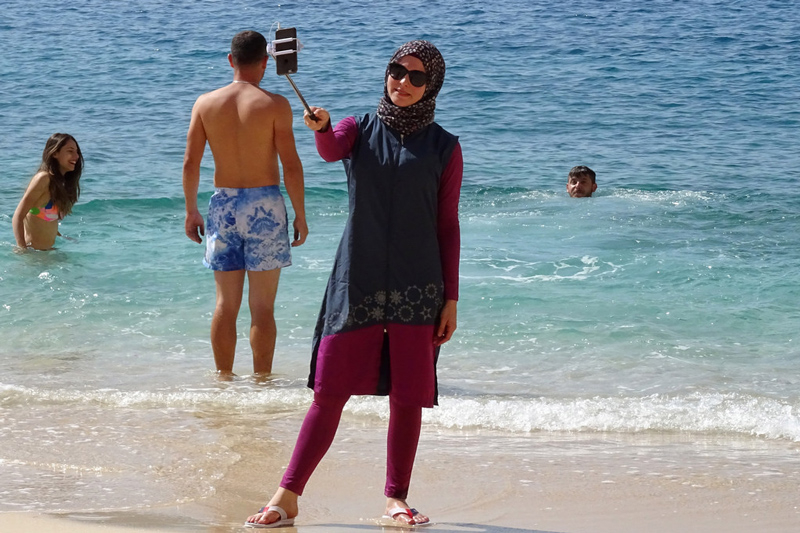
  • Those in favor of the burkini argue that women should be allowed to wear whatever they choose. Critics of the garment say it is an Islamic religious and political symbol which impedes integration and is incompatible with the liberal principles of secularism and gender equality. In recent months, the debate has added another dimension: public health and hygiene.

  • "Secularism and religion are irrelevant here. The burkini is not a Koranic prescription, but another manifestation of political Islam, militant, destructive, seeking to question our way of life, our culture, our civilization." — French commentator Yves Thréard in Le Figaro.

  • Europe"s burkini debate has now spread to the Middle East. In Algeria, thousands of women have joined a "bikini revolt" to reclaim the public space from Islamists who oppose the bikini as a symbol of Western values.

A woman who wore a burkini to swim in a pool in southern France has been charged €490 ($580) to pay for cleaning costs at the facility. The incident, which sparked accusations of Islamophobia, is the latest salvo in an ongoing debate over Islamic dress codes in France and other secular European states.


Those in favor of the burkini argue that women should be allowed to wear whatever they choose. Critics of the garment say it is a religious and political symbol which impedes integration and is incompatible with the liberal principles of secularism and gender equality. In recent months, the debate has added another dimension: public health and hygiene.


The woman was vacationing with her family at a bed and breakfast near Marseille when the owner spotted her in the swimming pool wearing a full-body swimsuit, according to the Collective Against Islamophobia in France (CCIF). He subsequently had the pool emptied and cleaned and charged the family for the costs and compensation for the days the pool was out of service. When they refused to pay, the owner allegedly charged them anyway.


The woman reported the incident to the CCIF, which said the burkini could not have caused a hygiene issue as the swimsuits are specifically adapted for swimming. "I was disappointed, shocked, wounded by the fact that someone could be so hypocritical and wicked because of a burkini," the woman said.


Elsewhere in France, the mayor of Lorette, Gerard Tardy, banned burkinis and other Muslim clothing at a new outdoor swim park, also for reasons of public health:


"Monokinis, burkinis, partial veils or veils which totally conceal the face, or a combination thereof, are prohibited on the beach. Any breach of this provision will lead to the immediate expulsion (which may cover the entire swimming season) of the offenders by security or, if necessary, by the police."


Aldo Oumouden, spokesman of a mosque in Saint Étienne, responded:


"France is multicultural and banning the veil at this facility is an attack on the individual freedom of Muslims and does not even distinguish between burkini and headscarf. How is it that the veil is aggressive or dangerous for the population? It does not represent any health problem, and there is no interference with the freedom of others. Does Mayor Tardy not realize that this decision will further stigmatize Muslims? It is not only unnecessary but also devastating for community harmony."


In July, an appeals court in Marseille validated the ban on burkinis in Sisco, a town in Corsica, in the interests of maintaining public order. Mayor Ange-Pierre Vivoni argued the ban was necessary to avoid a repeat of fighting between local youths and Muslims in August 2016, when five people were hurt. Muslims went on a rampage after a tourist took a photograph of several burkini-clad women swimming in a creek. More than 400 people eventually joined the brawl, in which local Corsicans clashed with migrants from North Africa. The following day, more than 500 Corsicans marched through the town shouting "To arms! This is our home!"


In May, a dozen Muslim women were arrested for holding a pro-burkini protest during the Cannes International Film Festival in Cannes. The women were wearing red, white and blue burkinis along the town"s famous promenade. Police said the women did not have a permit to protest.


In March, the frontrunners in the French presidential election clashed over the burkini in a television debate. Marine Le Pen accused Emmanuel Macron of "defending the burkini." Macron accused Le Pen of "dividing society." According to Le Pen, the burkini is a "fundamentalist uniform."


This year"s controversies harken back to the summer of 2016, when more than 30 cities and towns on the French Riviera banned burkinis from local beaches. In August 2016, the Council of State, France"s highest administrative court, ruled that the bans — which were issued after the July 2016 jihadist attack in Nice — were a "serious and manifestly illegal attack on fundamental freedoms, including the freedom of movement and the freedom of conscience." The judges ruled that local authorities could only restrict individual liberties if there was a "demonstrated risk" to public order. There was, they said, no evidence of such a risk.


Patrice Spinosi, a lawyer for the Human Rights League (LDH), said that in the absence of a demonstrated threat to public order, the high court "has ruled and has shown that mayors do not have the right to set limits on wearing religious signs in public spaces. It is contrary to the freedom of religion, which is a fundamental freedom."


Writing for Le Figaro, French commentator Yves Thréard argued that burkinis are political, not religious, garments:


"Secularism and religion are irrelevant here. The burkini is not a Koranic prescription, but another manifestation of political Islam, militant, destructive, seeking to question our way of life, our culture, our civilization. Veils in schools, street prayers, halal school menus, sexual apartheid in swimming pools, hospitals, driving schools, niqab, burqa... for thirty years this infiltration has been undermining our society, seeking to destabilize. It"s time to slam the door in its face."


(Image source: Eric Baker/Flickr)


Opinion polls show broad public support for bans on burkinis. According to an Ifop poll published by Le Figaro in August 2016, 64% of people in France are opposed to the burkini on beaches; only 6% support it. Ifop director Jérôme Fourquet said:


"The results are similar to those we measured in April about the veil and headscarf on public streets (63% opposed). Beaches are equated with streets, where the wearing of ostentatious religious symbols are also rejected by two-thirds of the French."


The debate over burkinis is not limited to France.


In Portugal, two British tourists said they were "humiliated" after being told to leave a communal swimming pool in Albufeira, a popular holiday destination, because they were wearing burkinis. A member of the hotel staff reportedly told the women to abide by Portuguese norms or leave.


In Italy, a Moroccan family caused a stir at a public swimming pool in Montegrotto. Not only were the women wearing burkinis, but the men jumped into the pool wearing street clothes. Photos of the incident went viral after being posted on social media. At a public pool in Pontedera, a Muslim woman was observed swimming, not in a burkini but in a burka. The pool mangers said: "All people of every religion, culture and school of thought are welcome in this facility provided that they observe hygienic and sanitary norms." Elsewhere, a Muslim woman caused a polemic by wearing a burkini at a municipal pool in Ferrara.


In Austria, the Neuwaldegger Bad, a private outdoor swimming pool in Vienna, announced a burkini ban: "Only swimwear which is customary for us, bathing suits and bikinis, are permitted." The burkini has also been banned at the Wachaubad in Melk, Lower Austria. A water park in rural Kirchberg requires patrons to wear "local bathing clothing." Mayor Anton Gonaus said this rule has been in place for 25 years and that there have been no problems because up to now there have been no burkini wearers. "This puts Muslim women in a corner and tells them that they do not belong," complained Carla Amina Baghajati, the women"s commissioner of the Islamic Community in Austria (IGGiÖ).


In July, a Muslim journalist named Menerva Hammad went to a public swimming pool in Vienna in a burkini to gauge reactions. She was confronted by an Austrian woman who said: "This is unhygienic. This is not Turkey." The pool manager sided with Hammad and asked the Austrian woman to leave the premises. Hammad says she has received hate mail from across Austria by people accusing her of setting off a burkini trend at pools across the country.


Europe"s burkini debate has now spread to the Middle East. In Algeria, thousands of women have joined a "bikini revolt" to reclaim the public space from Islamists who oppose the bikini as a symbol of Western values.


In Morocco, where burkinis are banned at many tourism hotspots, the government in January outlawed the sale and production of burkas, evidently in a bid to crack down on Islamic extremism.


In Lebanon, a woman wearing a burkini was escorted off the beach at a luxury resort in Tripoli; the action was apparently taken to discourage the trend from spreading and harming tourism.


In Egypt, the Ministry of Tourism issued an order requiring hotels and resorts to welcome women wearing the burkini. The government backtracked after hoteliers complained about the potential impact on tourism; hotels and resorts may now decide for themselves whether or not to allow women to wear burkinis.


In Saudi Arabia, Crown Prince Mohammed bin Salman has announced plans for a Red Sea beach resort where the law will be changed to allow women to wear bikinis. The project is part of a plan to transform part of the Saudi coastline into a beach resort for the international market. Some observers say the plan is unlikely to succeed.

Tuesday, August 8, 2017

Will Europe Rebel Against U.S. Sanctions?

Authored by Curt Mills via National Interest,


In comprehensively punishing Moscow, Washington risks further cleaving itself from senior European leadership.


The United States finalized new sanctions against Moscow last week, roping it in with perennial bad actors Iran and North Korea. Despite complaints from Donald Trump and Rex Tillerson—the pair of ex-CEOs that now lead U.S. foreign policy—the administration assented to the “flawed” package on Wednesday. While Trump is sometimes accused of abandoning the trans-Atlantic alliance and scuttling the post-war order, the president now risks further damage to relations with many in Europe by targeting Russia with fresh sanctions.


Hawks in Washington are clearly taking notice of the European position. “Europe’s opposition to the sanctions is troubling. You can’t on one hand ask for a bigger U.S. military commitment to the continent while on the other hand oppose nonmilitary coercive measures,” Boris Zilberman, a Russia analyst at the Foundation for the Defense of Democracies, told me. A central plank in Europe’s concern is energy—the continent is quite reliant on Russian energy (something Ronald Reagan famously warned the Europeans against during the Cold War). “It is déjà vu all over again. Back in the 1980s the Reagan administration targeted Soviet energy exports, specifically pipeline projects. Europeans saw it as a double whammy for them, undercutting their energy security and—given potential secondary sanctions on many firms involved—penalizing their companies,” says Clay Clemens, an expert on German politics at the College of William & Mary.


In particular, a project called Nord Stream 2 between Europe’s central player, Germany, and Russia’s controversial energy company Gazprom could be affected by the sanctions. In addition to Gazprom, the deal has investments from European companies; its signatories aim to carry natural gas under the Baltic Sea. “Some Germans quietly hope that [Nord Stream 2] could transform their country into a European energy hub,” The Economist noted in June. The Ukrainian crisis is also at play here: the project would allow Russia “to bypass existing pipelines in Ukraine, depriving the Ukrainians of lucrative transit fees,” the outlet noted.


But the United States and the EU are not united, and Europe is feuding internally over how to handle this, as well. In contrast to Germany, the Brits haven’t stood in Washington’s way. “We agree that it is important to send a message to Moscow that Russian actions in Ukraine and Syria, interference in the domestic affairs of other countries, and undermining of the rule of law, will be met with a strong response,” a United Kingdom official told me, indicating London didn’t find the legislation abrasive and praising the sanctions for emphasizing “the importance of transatlantic unity.” The Baltic states and Poland, Russia-weary and opposed to Nord Stream 2, have gone along with the sanctions, and would potentially block more radical retaliation by the EU. European Council president Donald Tusk, the former Polish prime minister, has also criticized Nord Stream 2. Vice President Pence was in Estonia earlier this week, and Poland hosted Trump ahead of the G20 summit last month, where he seemingly received a hero’s welcome in a country that has moved dramatically rightward in recent years.


But elsewhere in Europe, including in the EU leadership, there is great concern. In startling language Wednesday, European Commission president Jean-Claude Juncker, of Luxembourg, appeared to treat the U.S.-Europe alliance as a potentially open question. “The U.S. Congress has now also committed to only apply sanctions after the country’s allies are consulted. And I do believe we are still allies,” he said in a statement, with his office noting that “if the US sanctions specifically disadvantage EU companies trading with Russia in the energy sector the EU is prepared to take appropriate steps in response within days.” “We are prepared,” Juncker told a Brussels radio station Wednesday. “We must defend our economic interests vis-à-vis the United States. And we will do that.”


The German establishment is apoplectic, directly accusing the United States of trying to enrich itself economically—the sanctions are paired with provisions encouraging Europe to buy U.S. natural gas. In the era of President “take the oil” Trump and an Exxon Secretary of State, some are suspicious of American motives like never before. “One is left with the sense that the United States is looking to its own economic interests,” Volker Trier, the head of the German Chamber of Industry and Commerce, said last week. In the 1980s, “there was also a sense that the US sanctions were designed to reduce competition for American energy exports,” Clemens noted to me.


Wary of bucking Germany, France has also expressed reservations about the sanctions. “Any conflict in the Paris-Berlin axis is potentially suicidal for Europe at this point,” Vincent Michelot of Sciences Po Lyon tells me. The French foreign ministry said last month the language passed out of the House looked illegal. This Parisian dismissal comes at a time when Trump seems to be cultivating a relationship with the new French president, Emmanuel Macron, who Michelot says is trying to set himself up as an “indispensable mediator” in European and international affairs.


If Ukraine is one nonobvious tripwire in this dispute, Syria is another. Macron has tacitly backed a future for Syrian president Bashar al-Assad, in a major change in French policy. “It is a radical departure from Hollande’s strong stance that there could not be any political resolution of the Syrian conflict with Assad around the negotiation table,” Cecile Alduy of the France-Stanford Center told me. “More importantly, Macron is contradicting himself on this . . . In early April, he was in favor of a military intervention against Assad.” Prolonged, public disputes between Berlin, Paris and Washington could imperil efforts at even unrelated negotiations, however.


In the end, Europe, especially with Germany in the lead, might take a pass on a full-scale feud. Europe “cannot allow the relationship with Russia to sink to the level of the U.S.-Russia confrontation,” Michelot says. “The preference [in most of Europe] is still for some kind of constructive engagement policy, despite EU sanctions after Ukraine,” Clemens says, but cautions: “Of course, overall, it is a tough balance for Merkel in particular to strike, since she has been the leader most skeptical of Putin.”