Showing posts with label Clothing. Show all posts

Tuesday, April 24, 2018

An Urban Survival Course with Selco: Your Gear and How to Pack It

This article was originally published by Selco at The Organic Prepper


Editor’s Note: Did you ever wish you could drop everything and fly over to the Balkans to be trained in urban survival by Selco? Wouldn’t it be great to be able to pick his brain and have him beside you as you learned to deal with an SHTF scenario? Well, here’s the next best thing. Selco recently finished teaching a hardcore 5-day course in Croatia. With 6 students, they went through high-stress exercises and learned about living through an all-out disaster where danger lurks around every corner. Selco has generously agreed to write a series for us so that we can learn from him. It’s not quite like being there, but it’s the next best thing. ~ Daisy


What to Pack for a 5-Day Urban Survival Course


We have just finished our flagship Urban survival course in Croatia.


For 5 days Toby Cowern and I, as instructors, taught students skills and through the different exercises and scenarios, we stress-tested their knowledge and abilities.


For me, the most important thing was to give them a piece of the mindset needed for a real SHTF event and to give them a clear starting point from where they can build more skills, knowledge, and competence.


In some moments it was hard for them, both physically and mentally, but one of the most important points, of course, was to test them in not so perfect conditions.


The whole course cannot be transferred here for reading, but some highlights can be given in a series of articles, reflecting on the most interesting moments of each day. This time, we will start out with the gear necessary for the class.


Equipment (items that  you have with you)


I am a very big fan of carrying items that are multipurpose, and I have adopted over the time the philosophy that “less is more.” In reality,”more skills-less items” is the key to survival. That said, I am aware that we will have many items in our backpack when we talk about urban survival.


Because there is a big chance the items that you carry are gonna be used when you are in a hurry, in danger, in the dark, or simply when you are very tired, those things need to be organized in a practical way.


Add to that fact, there is a chance that sometimes you’ll be in a situation to lose (or throw away) your backpack, then it makes more sense to organize it.


The whole philosophy of having one bag (or backpack) that have “all that you need inside” is kinda wrong if ALL important items are inside.


It is essential to think about “layers” of equipment.


Everything that you carry with you must have a clear role in your survival, otherwise, it should not be in your backpack (or on you) so think about the “comfort vs. necessity” philosophy.


It is very good to have many items, but it is not so cool to go through a tough situation with 50 kg backpack on your back, so choose carefully what you gonna have.


You should organize it in layers.


Let’s take the “fire” category, for example. In the first layer you could have small fire starter around your neck, the second layer is lighters or matches in your waist bag or pocket, the third layer is fuel cubes or whatever other fire help you have in your backpack.


For the food category, you may have power bars in your pocket and then in your backpack, you may have food that is more adequate or “serious”.


It is easy to follow this logic and organize other equipment in the same way. Sometimes you do not need (or you can not have) 3 layers. Sometimes only 2 layers are possible.


It is important to understand that you need to have layers so you maximize your chances for success when you lose equipment, for example, while running away from some danger and throwing away your backpack.


First aid kits


The best example of what often goes wrong with buying, packaging and carrying items are first aid kits.


There are many reasons for that. A few are:


  • People buying “pre-made” first aid kits with useless things inside

  • No knowledge of how to use items in first aid kit

  • No knowledge of what is really needed to have in a medical emergency and what not to have


So as a result, a lot of people have their first aid kit buried deep inside their backpack, or some of them having their first aid kit on a belt but inside they have painkillers, antidiarrheal medicines, a few plasters (band-aids) and nothing more.


I agree that plasters, antidiarrheal medicines, and painkillers may have a place in your first aid kits but use common sense and think about:


  • what is really important and can make difference in seconds or minute

  • what needs to be available all the time, and in an easy and fast to access way


Again, think in layers.


So, of course, you can have antidiarrheal medicines, plasters, painkillers, and hand sanitizers but in your first layer (available immediately) need to be items that can save a life in a matter of minutes, for example, shears, field dressing, bandages, tourniquets, and similar.


If you got a headache you will not die if you do not take a painkiller in a few minutes, but if you get serious wound it may be different if you do not act fast and have the means to treat it immediately.


The best way is to package your own kit, based on your circumstances and your needs. But be sure that you know about every item inside, how it works, and try to test it in the best possible way.


In the photo above, there are two bandages. Each of those bandages was packaged, and for an average man both are just bandages: they look the same and they are supposed to do the same job.


Actually, the bandage in my right hand can do the job like 3 bandages in the left hand, because of the quality, elasticity, texture, and density. Just test everything or you never know what you have until you really need it, and then it might be wrong.


If somebody told you, for example. that you need to have scissors (or shears) in your first aid kit (and he is right) then be sure to test quality of that item because you may find out that in the prepackaged kit you have something that can not do the job needed even for a sewing kit, not to mention working with heavy fabric to treat a wound.


A small difference like having paper medical tape or heavy-duty tape can mean a lot if you are doing something important like treating a wound in a rain-soaked environment.


Clothes


Over time I have started to believe that word “tactical” has become one of the worst enemies in common sense prepping/survival today.


We have tactical caps, tactical boots, pants, stickers, and whatnot.


People start to believe that by buying an item that is “tactical” (or manufacturer states it is) they are solving huge problems in their survival.


In reality, a lot of the items that are “tactical” are actually produced to look nice and cool, but have many flaws that are not so tactical.


For example, if you have tactical camo urban survival jackets that make you stick out so bad in an urban setting, there is nothing tactical about that.


Or there are survival tactical pants that have cool pockets for your stuff and look really cool. But when you walk they produce a hissing sound (because of the fabric) that on a calm night and “tactical” situation can be heard 100 meters away.


Or urban survival tactical bags and pouches with cool fluorescent emblems on it that makes you shine so cool in the dark, but also make you visible when you maybe don’t want to be seen.


Being seen and heard from a distance makes sense in some survival situations, but in others, it is completely undesirable and dangerous. Choose your clothes based on that, not based on how “tactical” they are, or how cool they look.


Stay tuned.


Be sure to watch for the next articles in which Selco “takes us with him” on his Urban Survival Course. Learn more about his online courses and his physical courses.


About the Author


Selco survived the Balkan war of the 90s in a city under siege, without electricity, running water, or food distribution. In his online works, he gives an inside view of the reality of survival under the harshest conditions. He reviews what works and what doesn’t, tells you the hard lessons he learned, and shares how he prepares today. He never stopped learning about survival and preparedness since the war. Regardless what happens, chances are you will never experience extreme situations like Selco did. But you have the chance to learn from him and how he faced death for months. Real survival is not romantic or idealistic. It is brutal, hard and unfair. Let Selco take you into that world. Read more of Selco’s articles here: https://shtfschool.com/blog/ And take advantage of a deep and profound insight into his knowledge and advice by signing up for the outstanding and unrivaled online course. More details here: https://shtfschool.com/survival-boot-camp/

Saturday, November 18, 2017

"It"s A Nightmare" - Chinese Bureaucrats Are Killing The Victoria"s Secret Fashion Show

The marketing brass at L Brands are probably starting to regret their decision to hold this year’s Victoria’s Secret fashion show - expected to have the largest audience in the show"s history - in Shanghai.


As the New York Post reports, the fashion show, which takes place in two weeks and will feature  Adriana Lima, Alessandra Ambrosio and Karlie Kloss, among other internationally recognized supermodels, is transforming into an international diplomatic crisis.


Chinese government officials are refusing to work with the show’s producers and grant the necessary expedited visas so fashion bloggers and other media types who’re supposed to cover the show, according to the New York Post.


Bureaucrats have also stubbornly resisted other seemingly routine requests, like approving shooting locations for the TV crew.


We’re told fashion bloggers booked to cover the glitzy event are canceling their trips because the Chinese government won’t give them visas; TV producers are grappling with bureaucrats over permission to shoot outside the Mercedes-Benz Arena, where it’s being held (“If you’re going to China, you want to show that you are in China!” fumed an insider); and Victoria’s Secret staffers in China can’t send out press releases because they have to be approved by government officials.


“It’s just a nightmare for all the media trying to cover [the show],” said a jet-setting insider. “These TV companies are spending a fortune on it, and they don’t even know what they can shoot when they get there."


We’re told that producers charged with coordinating the coverage for various outlets are “on the verge of nervous breakdowns."


The show, which will be broadcast on CBS, has mostly been held in the US since 2001, but the popular purveyor of ladies’ undergarments has had a run of bad luck in the past few years since trying to host the show overseas, the Post reports. Last year’s show (which was held in Paris) was also plagued with production issues caused by a terror attack and Kim Kardashian’s high-profile robbery.


For that event, every journalist covering the event had to submit to background checks and provide government ID, and security was so tight that cars dropping off VIP guests were only allowed to stop momentarily outside the venue, so celebrities had to circle the block before being dropped off.


This year, they’d be lucky to get a visa.


Thursday, September 28, 2017

UK Public Schools Forcing Girls As Young As Four To Wear Muslim Veil

Research published in The Sunday Times this week revealed that eight state-funded British schools are forcing children to wear the Islamic hijab along with other Muslim female dress code requirements, which includes girls as young as four. The findings are based on open source investigations into published dress code directives of 176 Muslim schools across Britain, most of which are private.


However, the new discovery of public schools among them has sparked outrage across the UK, especially as three of the schools are elementary level schools (including kindergarten). According to The Sunday Times:


Girls as young as four are being “forced to wear the hijab” as part of approved school uniform in state-funded Islamic schools, campaigners have told ministers.


According to research by the National Secular Society, the hijab appears to be compulsory in eight state-funded Islamic schools in England, including three primary schools.


A further 51 private Islamic schools of the 176 surveyed by the society also require the headscarf to be worn by female pupils. Eighteen schools said wearing the head covering was optional.


Shockingly, one particular school called the Independent Olive Secondary requires that, “Hair should be covered by a black scarf; outside the School the face must be covered,” while another UK school is explicit in stipulating that, "It is very important that the uniform is loose fitting and modest and that the hijaab is fitted closely to the head. The College uniform is COMPULSORY" (sic). The Tayyibah Girls School in London warns: "The school is not willing to compromise on any issues regarding uniform."


The Tayyibah Girls School in London.


Meanwhile, some schools go so far as to recommend the niqab. For example girls at Al-Ihsaan school in Leicester are told they must wear either a “jilbaab or niqab”. The jilbaab is a long and loose-fitting gown which covers the entire body expect for hands, face, and feet. But the niqab recommendation is much more significant in that it is practiced by only a small minority within the Muslim world - it covers the entire face except for the eyes, and is typically worn with black garments with cover head to toe. 


In addition to the eight publicly funded schools which require head coverings of veils, thirteen others cite an optional hijab as part of their uniform policy. Islamic academies in Britain came under scrutiny early this month when a previous Times story first reported that "Thousands of state primary schools are allowing girls as young as five to wear the Muslim religious headscarf as part of approved school uniform, a Sunday Times survey has revealed."


The earlier investigation found that even Church of England associated schools were increasingly adopting various forms of Islamic dress as acceptable among students:


Last month a survey by The Sunday Times revealed that nearly a fifth (18%) of 800 state primary schools, including Church of England primaries, in 11 regions of England now list the hijab as part of their uniform policy, mostly as an optional item.


Feversham College is a high school level academy specializing in Science for Muslim girls aged 11-18 years. It"s website spells out that a "close-fitting" hijab is "COMPULSORY" (sic).


Activists associated with the investigation cited by The Sunday Times called the uniform requirements “illiberal and repressive” and stated, “no child should be obliged to wear the hijab or any other article of religious clothing while at school.” Included among those appealing to the UK education secretary to root out such practices, especially when they appear at state funded schools, are Muslim women activists.


Of course, it"s mostly a good thing when the state leaves private religious schools alone to do or require whatever they want in terms of dress code, but that state funded UK schools would enforce Muslim veils is the deepest hypocrisy in a country which has recently been known to target and punish families wanting to opt out of LGBT related curriculum. The British authorities have even threatened Orthodox Jewish schools with closure with the ultimatum: "teach your children about homosexuality and gender reassignment, or we will close you down."


In a trend that began years ago, the British education secretary began warning even Christian private schools that their teaching curriculum must reflect the "UK values" and laws concerning transgender recognition. The government now routinely cites "combating extremist" as a motive for getting private schools to conform.

Saturday, September 9, 2017

The Gentleman's Guide to Self-Defense: Bulletproof SHIRT

See The Gentleman’s Guide to Self-Defense: Knife-Resistant Clothing.


Everyone knows that guns are great for protecting yourself.


But most people forget that all adversarial contests involve both offense and defense. If you"ve got a gun - but the bad guy gets off the first shot with his gun - you might still get killed.


Moreover, while you might be a quicker draw and better shot than a single bad guy breaking into your house, you might get ambushed by terrorists, gang bangers or other bad guys ... and got shot before you even have the time to draw, point and shoot.


That"s why military and law enforcement officers wear body armor.   If you"re playing to win, you need defense as well as offense.


But civilians - especially those of us who work in financial services, legal, accounting or other professional settings - can"t walk around in bulky Kevlar vests.


But that doesn"t mean that we have to be defenseless ...


A new company called Bullet Blocker (a subdivision of MJ Safety Solutions) tailors a new generation of Kevlar into everyday clothing.  For example, t-shirts:


BulletBlocker NIJ IIIA Bulletproof Gabriel BBL Ballistic Base Layer Compression Vest


(The t-shirt,  called the Gabriel, is used by some undercover police officers. And Bullet Blocker"s VP told us that American Secret Service agents have purchased the Gabriel.)


Police magazine notes:


[The Gabriel is] essentially a performance T-shirt with NIJ-certified IIIA ballistic panels added to it.


***


As an added bonus, this design also gives the Gabriel a very low profile, making it ideal for undercover applications.


***


I wore my Gabriel for a few days under my normal work T-shirt and it was almost invisible. Bullet Blocker"s claims of heat dissipation and a more secure fit both rang true and I can certainly appreciate the benefits of the Gabriel design in any law enforcement setting.


2-piece suits:


BulletBlocker NIJ IIIA Bulletproof Classic Two Piece Suit


Top coats:


BulletBlocker NIJ IIIA Bulletproof TopcoatBulletBlocker NIJ IIIA Bulletproof Long Topcoat


Vests:


BulletBlocker NIJ IIIA Bulletproof Dress Vest


Sports coats:


BulletBlocker NIJ IIIA Bulletproof Sportscoat


Leather jackets:


BulletBlocker NIJ IIIA Bulletproof WomenBulletBlocker NIJ IIIA Bulletproof Lamb Leather JacketBulletBlocker NIJ IIIA Bulletproof Distressed Leather Jacket


Every single clothing garment made by Bullet Blocker meets NIJ IIIA standards that will stop a 357 Magnum, 44 Magnum, 9mm, .45, hollow point ammunition and more.


Threat level IIIA is the highest level of protection available in soft body armor, and provides the same anti-ballistic protective coverage area as traditional law enforcement body armor vests.


And all of Bullet Blocker"s clothing can be washed, as the Kevlar panels are removable.


It"s made of anti-bacterial, breathable material.  So it doesn"t get funky right away like heavier materials do.


What"s even better, Bullet Blocker"s experienced tailors can satisfy your special requirements. For example, they were requested to make a bulletproof lab coat:


BulletBlocker NIJ IIIA Bulletproof Medical Lab Coat


So they could certainly make you a bulletproof button down shirt, or anything else you might want.


Bespoke and bulletproof!


We tested the Gabriel for comfort.  While it"s technically called a "compression vest", it"s as comfortable as my normal well-made polo shirts made out of thick cotton.


I hit the gym wearing the Gabriel and worked out like a maniac.  The Gabriel was amazingly cool and breathable for a bulletproof vest.


Bullet Blocker also makes a line of bulletproof briefcases, bags and backpacks.


So now even civilians working can protect ourselves while in professional or casual settings, and help shield ourselves from ambush by terrorists or thugs.


And Bullet Blocker can help protect your kids against school shooters:


I haven’t received a cent for writing this review. Bullet Blocker simply provided me a test sample of the Gabriel.

Monday, August 14, 2017

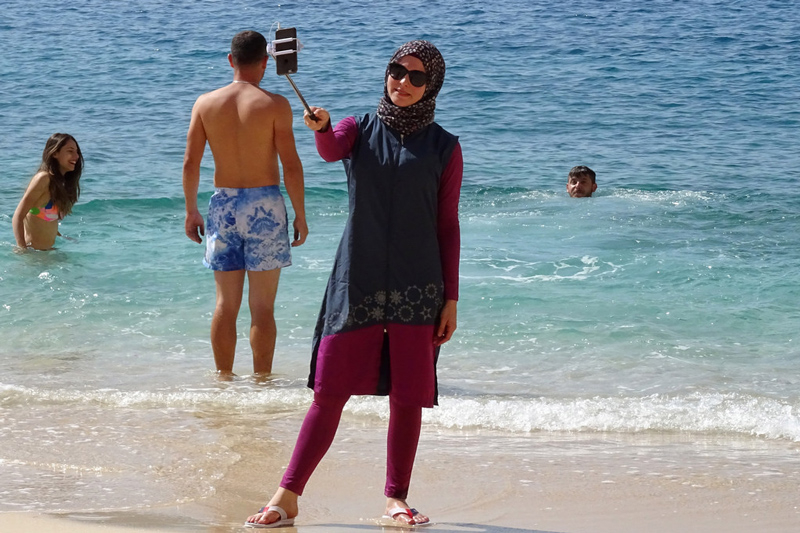
Europe: Burkini War Continues

Authored by Soren Kern via The Gatestone Institute,


  • Those in favor of the burkini argue that women should be allowed to wear whatever they choose. Critics of the garment say it is an Islamic religious and political symbol which impedes integration and is incompatible with the liberal principles of secularism and gender equality. In recent months, the debate has added another dimension: public health and hygiene.

  • "Secularism and religion are irrelevant here. The burkini is not a Koranic prescription, but another manifestation of political Islam, militant, destructive, seeking to question our way of life, our culture, our civilization." — French commentator Yves Thréard in Le Figaro.

  • Europe"s burkini debate has now spread to the Middle East. In Algeria, thousands of women have joined a "bikini revolt" to reclaim the public space from Islamists who oppose the bikini as a symbol of Western values.

A woman who wore a burkini to swim in a pool in southern France has been charged €490 ($580) to pay for cleaning costs at the facility. The incident, which sparked accusations of Islamophobia, is the latest salvo in an ongoing debate over Islamic dress codes in France and other secular European states.


Those in favor of the burkini argue that women should be allowed to wear whatever they choose. Critics of the garment say it is a religious and political symbol which impedes integration and is incompatible with the liberal principles of secularism and gender equality. In recent months, the debate has added another dimension: public health and hygiene.


The woman was vacationing with her family at a bed and breakfast near Marseille when the owner spotted her in the swimming pool wearing a full-body swimsuit, according to the Collective Against Islamophobia in France (CCIF). He subsequently had the pool emptied and cleaned and charged the family for the costs and compensation for the days the pool was out of service. When they refused to pay, the owner allegedly charged them anyway.


The woman reported the incident to the CCIF, which said the burkini could not have caused a hygiene issue as the swimsuits are specifically adapted for swimming. "I was disappointed, shocked, wounded by the fact that someone could be so hypocritical and wicked because of a burkini," the woman said.


Elsewhere in France, the mayor of Lorette, Gerard Tardy, banned burkinis and other Muslim clothing at a new outdoor swim park, also for reasons of public health:


"Monokinis, burkinis, partial veils or veils which totally conceal the face, or a combination thereof, are prohibited on the beach. Any breach of this provision will lead to the immediate expulsion (which may cover the entire swimming season) of the offenders by security or, if necessary, by the police."


Aldo Oumouden, spokesman of a mosque in Saint Étienne, responded:


"France is multicultural and banning the veil at this facility is an attack on the individual freedom of Muslims and does not even distinguish between burkini and headscarf. How is it that the veil is aggressive or dangerous for the population? It does not represent any health problem, and there is no interference with the freedom of others. Does Mayor Tardy not realize that this decision will further stigmatize Muslims? It is not only unnecessary but also devastating for community harmony."


In July, an appeals court in Marseille validated the ban on burkinis in Sisco, a town in Corsica, in the interests of maintaining public order. Mayor Ange-Pierre Vivoni argued the ban was necessary to avoid a repeat of fighting between local youths and Muslims in August 2016, when five people were hurt. Muslims went on a rampage after a tourist took a photograph of several burkini-clad women swimming in a creek. More than 400 people eventually joined the brawl, in which local Corsicans clashed with migrants from North Africa. The following day, more than 500 Corsicans marched through the town shouting "To arms! This is our home!"


In May, a dozen Muslim women were arrested for holding a pro-burkini protest during the Cannes International Film Festival in Cannes. The women were wearing red, white and blue burkinis along the town"s famous promenade. Police said the women did not have a permit to protest.


In March, the frontrunners in the French presidential election clashed over the burkini in a television debate. Marine Le Pen accused Emmanuel Macron of "defending the burkini." Macron accused Le Pen of "dividing society." According to Le Pen, the burkini is a "fundamentalist uniform."


This year"s controversies harken back to the summer of 2016, when more than 30 cities and towns on the French Riviera banned burkinis from local beaches. In August 2016, the Council of State, France"s highest administrative court, ruled that the bans — which were issued after the July 2016 jihadist attack in Nice — were a "serious and manifestly illegal attack on fundamental freedoms, including the freedom of movement and the freedom of conscience." The judges ruled that local authorities could only restrict individual liberties if there was a "demonstrated risk" to public order. There was, they said, no evidence of such a risk.


Patrice Spinosi, a lawyer for the Human Rights League (LDH), said that in the absence of a demonstrated threat to public order, the high court "has ruled and has shown that mayors do not have the right to set limits on wearing religious signs in public spaces. It is contrary to the freedom of religion, which is a fundamental freedom."


Writing for Le Figaro, French commentator Yves Thréard argued that burkinis are political, not religious, garments:


"Secularism and religion are irrelevant here. The burkini is not a Koranic prescription, but another manifestation of political Islam, militant, destructive, seeking to question our way of life, our culture, our civilization. Veils in schools, street prayers, halal school menus, sexual apartheid in swimming pools, hospitals, driving schools, niqab, burqa... for thirty years this infiltration has been undermining our society, seeking to destabilize. It"s time to slam the door in its face."


(Image source: Eric Baker/Flickr)


Opinion polls show broad public support for bans on burkinis. According to an Ifop poll published by Le Figaro in August 2016, 64% of people in France are opposed to the burkini on beaches; only 6% support it. Ifop director Jérôme Fourquet said:


"The results are similar to those we measured in April about the veil and headscarf on public streets (63% opposed). Beaches are equated with streets, where the wearing of ostentatious religious symbols are also rejected by two-thirds of the French."


The debate over burkinis is not limited to France.


In Portugal, two British tourists said they were "humiliated" after being told to leave a communal swimming pool in Albufeira, a popular holiday destination, because they were wearing burkinis. A member of the hotel staff reportedly told the women to abide by Portuguese norms or leave.


In Italy, a Moroccan family caused a stir at a public swimming pool in Montegrotto. Not only were the women wearing burkinis, but the men jumped into the pool wearing street clothes. Photos of the incident went viral after being posted on social media. At a public pool in Pontedera, a Muslim woman was observed swimming, not in a burkini but in a burka. The pool mangers said: "All people of every religion, culture and school of thought are welcome in this facility provided that they observe hygienic and sanitary norms." Elsewhere, a Muslim woman caused a polemic by wearing a burkini at a municipal pool in Ferrara.


In Austria, the Neuwaldegger Bad, a private outdoor swimming pool in Vienna, announced a burkini ban: "Only swimwear which is customary for us, bathing suits and bikinis, are permitted." The burkini has also been banned at the Wachaubad in Melk, Lower Austria. A water park in rural Kirchberg requires patrons to wear "local bathing clothing." Mayor Anton Gonaus said this rule has been in place for 25 years and that there have been no problems because up to now there have been no burkini wearers. "This puts Muslim women in a corner and tells them that they do not belong," complained Carla Amina Baghajati, the women"s commissioner of the Islamic Community in Austria (IGGiÖ).


In July, a Muslim journalist named Menerva Hammad went to a public swimming pool in Vienna in a burkini to gauge reactions. She was confronted by an Austrian woman who said: "This is unhygienic. This is not Turkey." The pool manager sided with Hammad and asked the Austrian woman to leave the premises. Hammad says she has received hate mail from across Austria by people accusing her of setting off a burkini trend at pools across the country.


Europe"s burkini debate has now spread to the Middle East. In Algeria, thousands of women have joined a "bikini revolt" to reclaim the public space from Islamists who oppose the bikini as a symbol of Western values.


In Morocco, where burkinis are banned at many tourism hotspots, the government in January outlawed the sale and production of burkas, evidently in a bid to crack down on Islamic extremism.


In Lebanon, a woman wearing a burkini was escorted off the beach at a luxury resort in Tripoli; the action was apparently taken to discourage the trend from spreading and harming tourism.


In Egypt, the Ministry of Tourism issued an order requiring hotels and resorts to welcome women wearing the burkini. The government backtracked after hoteliers complained about the potential impact on tourism; hotels and resorts may now decide for themselves whether or not to allow women to wear burkinis.


In Saudi Arabia, Crown Prince Mohammed bin Salman has announced plans for a Red Sea beach resort where the law will be changed to allow women to wear bikinis. The project is part of a plan to transform part of the Saudi coastline into a beach resort for the international market. Some observers say the plan is unlikely to succeed.

Thursday, August 3, 2017

Do Your Workout Clothes Contain These Toxins?

Do Your Workout Clothes Contain These Toxins? | jogging | Special Interests Toxins


Everyone knows that exercise improves your mood and supports your health. But were you aware that the toxins in your workout clothes could be undermining the health benefits you are seeking? A recent news report covering research done by Greenpeace is showing startling evidence that our clothes may be contributing to long-term health concerns, regardless of whether you exercise or not. [1]


The Chemicals and Toxins in Your Sportswear


Recent research showing that sportswear contains dangerous toxins–namely chemical dyes, polyfluorinated chemicals (PFCs), and solvents–has spawned an international outcry among environmentalists, health professionals, and consumers. Companies like Nike are working quickly to phase out chemical ingredients, and it’s only through more urging by consumers that other companies will follow suit.


Chemicals in clothing tend to rub off on skin, possibly contributing to endocrine disruption. When you’re active and sweating in these clothes, it may become more problematic. Researchers know that PFCs and solvents are linked with many types of cancer! Many countries, particularly those in Europe, have some type of regulation on these chemicals. In the US, however, chemicals in clothing remain unregulated.


What You Can Do


One of the best things you can do to avoid toxins in your sportswear, and in all your clothes, is to purchase 100% organic and/or 100% cotton clothing. There are also companies that make workout clothes made with hemp, flax, and bamboo. You will have to do your research and ask the company you are purchasing from if their brand uses any chemicals during production.


Are you conscious of the clothes you purchase? What was surprising about this article that stood out for you? Please give us your thoughts in the comments below!


References:


  1. Amy Westervelt. Sweat it out: could your sportswear be toxic? The Guardian.

Sunday, July 16, 2017

The Hidden Toxins In Your Clothing

The Hidden Toxins In Your Clothing | clothing-on-rack | Special Interests Toxins


Popular clothing stores, like H&M, Levi’s, and Gap, are beginning to turn their attention toward producing healthier and more environmentally-friendly clothing. [1] Increased consumer awareness around the dangers of synthetic dyes, polychlorinated biphenyls (PCBs), and phthalates in conventional clothing is fueling a drastic revolution in the fashion industry. Keeping in line with current trends, clothing retailers are finally attempting to appeal to health-conscious buyers as well as appease international health organizations.


How Toxins Invade Your Closet


During the production of clothes, toxic chemicals are used in almost every step. Synthetic fabrics are dyed with man-made chemical dying agents, fabrics are applied with toxins that make them immune to biodegradation, and many clothes contain buttons and accessories that contain known endocrine disruptors. Phthalates, for example, are sometimes found in buttons, and just a few of these worn on a person could, over time, contribute to hormonal imbalance. Common synthetic fabrics like nylon and acrylic are extremely toxic to the body and the environment. The Environmental Protection Agency reports that inhalation of acrylonitrile, the main chemical compound used to produce acrylic fibers, shows carcinogenic potential via inhalation. [2]


Formaldehyde is essentially “baked” into fabric to make it resistant to wrinkling, which is bad news because research shows that this chemical is a human carcinogen. While it’s nice to save time and not have to iron your slacks, at what cost is this convenience factor to our future health? Nonylphenols are another class of endocrine disruptors used in some dying applications, and we’re now detecting levels of this chemical in our water. It is painstakingly clear that, for the future of our health and our planet, we must advocate for a change in the way our clothing is produced. Otherwise, we will be faced with a silent environmental and health crisis, one that may take decades to overcome.


Ways You Can Produce Change


Just as with any health movement, one of the most substantial ways to assist change is to “vote with your pocketbook.” In other words, support companies that produce organic, natural clothing as much as possible. Look for clothes made from bamboo, organic cotton, or flax, and always choose clothes produced using natural dyes. Write to your favorite clothing manufacturers to inquire what they are doing to reduce their reliance on chemicals in their clothing production. Fortunately, choosing clothes made with natural fibers is becoming easier, and the more we support these companies, the faster we will see a change in the clothing industry.


References:


  1. Elizabeth Grossman. Cotton, Cashmere, Chemicals…What Really Goes Into Making Our Clothes? Ensia.

  2. EPA. Acrylonitrile. Environmental Protection Agency.

Tuesday, June 27, 2017

Prada Is Selling A $185 Paper Clip

We finally have some good news for the distressed US retail industry.


In light of recent deteriorating spending trends within the luxury segment, with Bank of America internal card data showing a relentless decline in retail spending among the wealthiest segment...


... one would perhaps think that the conspicuous consumption excesses that marked the peak of the last bubble were long behind us.


One would be wrong: first there was Balenciaga selling a $2,145 handbag that was a spitting image of an IKEA tote sold for $1 at the iconic store, and now, there is the $185 Prada paper clip.


According to Business Insider, the Italian-made clip sold by Barneys New York, is 6.25 centimeters in length and 2.25 centimeters wide, is made from silver and has the Prada logo embossed on its side. It"s supposed to be used as a money clip, although one wonders why nouveau riche Millennials would use a Prada paper clip to hold their money (especially if much of it is in cryptocurrencies) when a, well, money clip should suffice perfectly. Then again, we can only assume Prada did their market research, and this is what it came up with:


Of course, one can buy roughly 300 similar-looking paper clips on Amazon for around $5.50, which comes out to around $0.02 per paper clip, but hey, they are not silver Prada paperclips. 


The social media response, as noted by Mashable, suggests that the new product may not be the smash hit that Prada envisioned:


On the odd chance that $185 is out of your budget, and if you can live without the Prada logo on your silver paper clip, Barneys sells a similar product for only $150.

Wednesday, May 10, 2017

Stockpiling Clothing: Here’s What You’re Forgetting

Stockpiling Clothing: Here’s What You’re Forgetting

Image source: Pixabay.com


Ask any non-prepper on the street what’s needed for survival, and you’ll probably get the answer, “food, clothing and shelter.” I’m not sure where that idea started, but I’ve heard it all my life. The sad thing is that way too many people think that it’s true, and while those three things are actually needed for survival, that little line leaves off some of the most important items — especially water.


Yet it does include clothing, which is something those in the preparedness community normally leave off a list of the highest survival needs. Instead, we use the term “homeostasis,” which refers to maintaining our body heat. Clothing is one of the things that helps us do that, in addition to shelter and fire.


We shouldn’t minimize clothing as a necessity for survival… yet we often do. You rarely find clothing listed on anyone’s list of things we need to stockpile, nor do you find it included in most bug-out bag lists. But it should be in both. Whether you’re bugging out or bugging in, you’ll need something to wear.


Of course, you could just say, “I have clothing, no problem” and I wouldn’t be surprised if you did. Considering that clothing is a durable item and that we all have closets full of the stuff, it really doesn’t seem much like an issue. But again, it is.


There are two ways that clothing could become a major issue in a survival situation. The first is that most of the clothing we own isn’t appropriate for survival. The second is that our children will easily outgrow their clothing if we find ourselves in a long-term survival situation.


Is Your Clothing Appropriate?


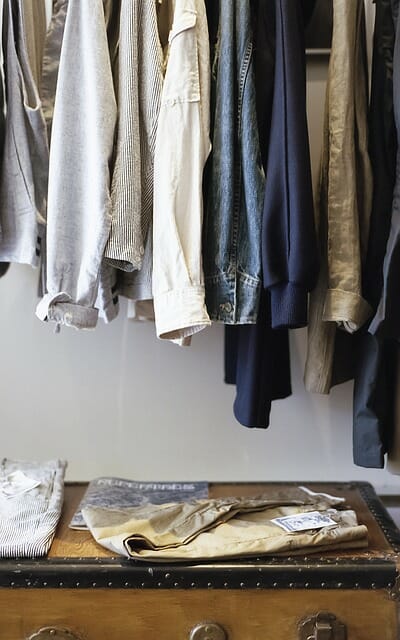
Let’s look at your closet first. Most survival situations are hard on the body, and therefore hard on the wardrobe, too. Yet the vast majority of the clothing in most of our closets is there because it is attractive, not because it is rugged. How much of it can you actually wear while hunting, gardening, digging a hole for an outhouse or trenching cross-country on a bug-out?


Goofy Gadget Can Recharge Your Laptop — And Jump-Start Your Car!


Unless you work in the construction trades, or some other job where you wear rugged clothing all the time, your wardrobe is probably lacking in that sort of clothing. Oh, you’ll have some blue jeans and T-shirts, and you’ll probably have some flannel shirts or sweaters for cold weather, but do you have enough?


Image source: Pixabay.com

Image source: Pixabay.com


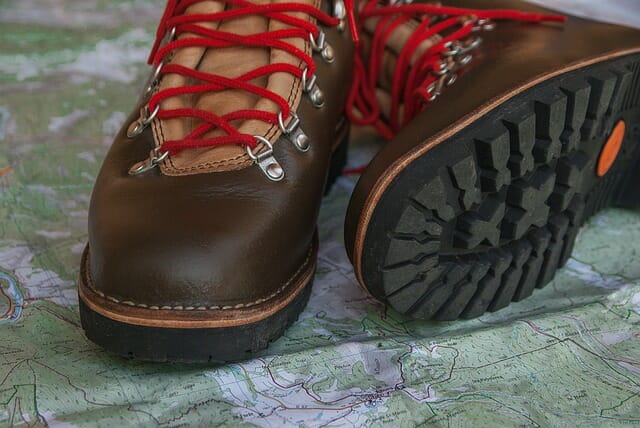
Even worse than your clothing, how are your shoes? About the only shoes that you might have which will be appropriate for survival are tennis shoes, unless you have some hiking boots somewhere.


If you are forced to bug out, you’ll need both rugged clothing and rugged shoes. The stuff you wear to the office every day just won’t do. For that matter, I’d hate to try cutting firewood in work clothes and shoes. I wouldn’t even want to do it wearing tennis shoes. I’d want something that would protect my feet — hiking boots or some good work boots.


The good news is that it won’t take much to rectify the problem. Buy some rugged clothing and some good rugged boots. Either hiking boots or work boots will do. Make sure that you take the time to break them in, though. The last thing you need to do is head out on a bug-out with boots that you’ve never worn.


And Then There’s the Kids


The bigger problem really isn’t your clothing; it’s that of your kids. As we all know, kids go thorough clothing like crazy. They either get holes in it or outgrow it. Either way, they are in regular need of new clothing. That definitely could be a problem, especially in a long-term survival situation.


Of course, your kids will need rugged clothes and boots, just like you do. You really don’t want your kids trekking through the woods on a bug-out without some sort of footwear that will give them ankle support. Kids are just too prone to accidents.


So, how do you deal with the issue of clothing for your kids? Whatever you buy them, they’ll outgrow. It would seem you’ll never get ahead in this game, yet there is a way to get ahead, especially when your kids are smaller and less likely to complain about their clothing styles.


Here’s what my wife and I did: When our children were still children (they’re adults now), we bought their clothes ahead of time. In other words, we didn’t buy the clothes they needed now, we bought the clothing they would need in two to three years. We started this when they were babies and outgrowing their clothes every few months. We just kept it up as they continued to grow.


Part of what made this possible was that my wife is a world-class champion garage-saler. When our children were small, just about all their clothing came from garage sales, especially our girls’ party dresses. There was one time that each of the girls had over 30 fancy dresses they could choose from, in their wardrobe, as well as less elegant clothing. All of it came from garage sales, at a fraction of the original price.


As they grew older, less and less of their clothing came from garage sales. It seems that the older that kids get, the harder they are on their clothing, especially boys. They also wear it longer, so it has more time to wear out. Nevertheless, we kept the system going, switching from buying their clothing at garage sales, to buying their clothing at whatever sales we could find.


Clothing has the highest retail markup of nearly anything, often in the 80 percent range. That means that something you pay $100 for in the store is really worth $20 at wholesale. This huge markup explains how clothing stores can have such incredible sales and still not go out of business.


If you’re buying ahead of time, there’s no problem waiting for the sales. You’ll be able to find what you want, at prices that won’t break the bank. Then you can stash it away, in the attic or basement, in boxes marked by sizes. When it’s time for new clothing, all you have to do is take out the next size box rather than rushing to the store.


Running a system like this, you can have two to three years worth of clothing on hand for your kids at all times, without spending a ridiculous amount of money. Granted, the clothing you’ve bought ahead of time may not be the latest style, but they’ll have clothes to wear. You can always buy them a couple of “in things” to add to that, rounding out their wardrobe.


More importantly from a survival point of view, if a major disaster happens, your kids will have enough clothing to keep them going for several years.


Let’s Go One Step Further


Stockpiling Clothing: Here’s What You’re Forgetting

Image source: Pixabay.com


Merely stockpiling clothing will go a long way toward ensuring that your family has what it needs, just like stockpiling food and toilet paper will. But let’s take that one step further. If we assume an event that requires long-term survival, your stockpiled clothing probably won’t be enough. In that case, it would be a good idea to be able to make your own.


Get Backup Electrical Power In A Convenient, Portable Briefcase!


Now, I realize that few people make their clothing anymore. It’s just not all that practical in our modern world, with so much commercially manufactured clothing available.


But learning to sew isn’t all that hard. I recently had to learn how to do it, because I was making a couple of bullet-proof vests. With a little knowledge and a sewing machine, you can make just about anything. Granted, you’ll also need a few other things, like fabric and thread, so you should probably buy some of them, as well (especially thread). You can always get fabric by cutting apart clothing that’s too big, to make clothing for smaller people.


Remember, we’re talking survival here. In such a situation, your children’s complaints about style won’t matter. They’ll need something to wear, regardless of what it is. I seriously doubt that their friends will keep pressuring them to wear the “in” brands when everyone is trying simply to survive.


One final point. If we assume a long-term event, then we’re probably going to be without electricity. That means that a sewing machine isn’t going to do you much good, unless you have a means of creating your own electricity. The other option is to buy an antique treadle machine and have that for your survival sewing. Turn it into a decoration in your home, and nobody will know that it’s actually a part of your plans.


What advice would you add on stockpiling clothing? Share your thoughts in the section below:

Wednesday, April 26, 2017

Islam In The Heart Of England And France

Authored by Denis MacEoin via The Gatestone Institute,


  • "There are plenty of private Muslim schools and madrasas in this city. They pretend that they all preach tolerance, love and peace, but that isn"t true. Behind their walls, they force-feed us with repetitive verses of the Qur"an, about hate and intolerance." — Ali, an 18-year-old of French origin, whose father was radicalized.

  • "In England, they are free to speak. They speak only of prohibitions, they impose on one their rigid vision of Islam but, on the other hand, they listen to no-one, most of all those who disagree with them." — Yasmina, speaking of extremist Muslims in the UK.

  • "Birmingham is worse than Molenbeek" -- the Brussels borough that The Guardian described as "becoming known as Europe"s jihadi central." — French commentator, republishing an article by Rachida Samouri.

The city of Birmingham in the West Midlands, the heart of England, the place where the Industrial Revolution began, the second city of the UK and the eighth-largest in Europe, today is Britain"s most dangerous city. With a large and growing Muslim population, five of its electoral wards have the highest levels of radicalization and terrorism in the country.


In February, French journalist Rachida Samouri published an article in the Parisian daily Le Figaro, in which she recounted her experiences during a visit there. In "Birmingham à l"heure islamiste" ("Birmingham in the Time of Islam") she describes her unease with the growing dislocation between normative British values and those of the several Islamic enclaves. She mentions the Small Heath quarter, where nearly 95% of the population is Muslim, where little girls wear veils; most of the men wear beards, and women wear jilbabs and niqabs to cover their bodies and faces. Market stalls close for the hours of prayer; the shops display Islamic clothes and the bookshops are all religious. Women she interviewed condemned France as a dictatorship based on secularism (laïcité), which they said they regarded as "a pretext for attacking Muslims". They also said that they approved of the UK because it allowed them to wear a full veil.


Another young woman, Yasmina, explained that, although she may go out to a club at night, during the day she is forced to wear a veil and an abaya [full body covering]. She then goes on to speak of the extremists:


"In England, they are free to speak. They speak only of prohibitions, they impose on one their rigid vision of Islam but, on the other hand, they listen to no-one, most of all those who disagree with them."


Speaking of the state schools, Samouri describes "an Islamization of education unthinkable in our [French] secular republic". Later, she interviews Ali, an 18-year-old of French origin, whose father has become radicalized. Ali talks about his experience of Islamic education:


"There are plenty of private Muslim schools and madrasas in this city. They pretend that they all preach tolerance, love and peace, but that isn"t true. Behind their walls, they force-feed us with repetitive verses of the Qur"an, about hate and intolerance."


Samouri cites Ali on the iron discipline imposed on him, the brutality used, the punishment for refusing to learn the Qur"an by heart without understanding a word of it, or for admitting he has a girlfriend.


Elsewhere, Samouri notes young Muslim preachers for whom "Shari"a law remains the only safety for the soul and the only code of law to which we must refer". She interviews members of a Shari"a "court" before speaking with Gina Khan, an ex-Muslim who belongs to the anti-Shari"a organization One Law for All. According to Samouri, Khan -- a secular feminist -- considers the tribunals "a pretext for keeping women under pressure and a means for the religious fundamentalists to extend their influence within the community".


Another teenager of French origin explains how his father prefers Birmingham to France because "one can wear the veil without any problem and one can find schools where boys and girls do not mix". "Birmingham," says Mobin, "is a little like a Muslim country. We are among ourselves, we do not mix. It"s hard".


Samouri herself finds this contrast between secular France and Muslim England disturbing. She sums it up thus:


"A state within a state, or rather a rampant Islamization of one part of society -- [is] something which France has succeeded in holding off for now, even if its secularist model is starting to be put to the test".


Another French commentator, republishing Samouri"s article, writes, "Birmingham is worse than Molenbeek" -- the Brussels borough that The Guardian described as "becoming known as Europe"s jihadi central."


The comparison with Molenbeek may be somewhat exaggerated. What is perplexing is that French writers should focus on a British city when, in truth, the situation in France -- despite its secularism -- is in some ways far worse than in the UK. Recent authors have commented on France"s growing love for Islam and its increasing weakness in the face of Islamist criminality. This weakness has been framed by a politically-correct desire to stress a multiculturalist policy at the expense of taking Muslim extremists and fundamentalist organizations at face value and with zero tolerance for their anti-Western rhetoric and actions. The result? Jihadist attacks in France have been among the worst in history. It is calculated that the country has some some 751 no-go zones ("zones urbaines sensibles"), places where extreme violence breaks out from time to time and where the police, firefighters, and other public agents dare not enter for fear of provoking further violence.


Many national authorities and much of the media deny that such enclaves exist, but as the Norwegian expert Fjordman has recently explained:


If you say that there are some areas where even the police are afraid to go, where the country"s normal, secular laws barely apply, then it is indisputable that such areas now exist in several Western European countries. France is one of the hardest hit: it has a large population of Arab and African immigrants, including millions of Muslims.


There are no such zones in the UK, certainly not at that level. There are Muslim enclaves in several cities where a non-Muslim may not be welcome; places that resemble Pakistan or Bangladesh more than England. But none of these is a no-go zone in the French, German or Swedish sense -- places where the police, ambulances, and fire brigades are attacked if they enter, and where the only way in (to fight a fire, for example) is under armed escort.


Samouri opens her article with a bold-type paragraph stating:


"In the working-class quarters of the second city of England, the sectarian lifestyle of the Islamists increasingly imposes itself and threatens to blow up a society which has fallen victim to its multicultural utopia".


Has she seen something British commentators have missed?


The Molenbeek comparison may not be entirely exaggerated. In a 1000-page report, "Islamist Terrorism: Analysis of Offences and Attacks in the UK (1998-2015)," written by the respected analyst Hannah Stuart for Britain"s Henry Jackson Society, Birmingham is named more than once as Britain"s leading source of terrorism.


One conclusion that stands out is that terror convictions have apparently doubled in the past five years. Worse, the number of offenders not previously known to the authorities has increased sharply. Women"s involvement in terrorism, although still less than men"s, "has trebled over the same period". Alarmingly, "Proportionally, offences involving beheadings or stabbings (planned or otherwise) increased eleven-fold across the time periods, from 4% to 44%." (p. xi)


Only 10% of the attacks are committed by "lone wolves"; almost 80% were affiliated with, inspired by or linked to extremist networks -- with 25% linked to al-Muhajiroun alone. As the report points out, that organization (which went under various names) was once defended by some Whitehall officials -- a clear indication of governmental naivety.


Omar Bakri Muhammed, who co-founded the British Islamist organization al-Muhajiroun, admitted in a 2013 television interview that he and co-founder Anjem Choudary sent western jihadists to fight in many different countries. (Image source: MEMRI video screenshot)


A more important conclusion, however, is that a clear link is shown between highly-segregated Muslim areas and terrorism. As the Times report on the Henry Jackson Society review points out, this link "was previously denied by many". On the one hand:


Nearly half of all British Muslims live in neighbourhoods where Muslims form less than a fifth of the population. However, a disproportionately low number of Islamist terrorists — 38% — come from such neighbourhoods. The city of Leicester, which has a sizeable but well-integrated Muslim population, has bred only two terrorists in the past 19 years.


But on the other hand:


Only 14% of British Muslims live in neighbourhoods that are more than 60% Muslim. However, the report finds, 24% of all Islamist terrorists come from these neighbourhoods. Birmingham, which has both a large and a highly segregated Muslim population, is perhaps the key example of the phenomenon.


The report continues:


Just five of Britain"s 9,500 council wards — all in Birmingham — account for 26 convicted terrorists, a tenth of the national total. The wards — Springfield, Sparkbrook, Hodge Hill, Washwood Heath and Bordesley Green — contain sizeable areas where the vast majority of the population is Muslim.


Birmingham as a whole, with 234,000 Muslims across its 40 council wards, had 39 convicted terrorists. That is many more than its Muslim population would suggest, and more than West Yorkshire, Greater Manchester and Lancashire put together, even though their combined Muslim population is about 650,000, nearly three times that of Birmingham. There are pockets of high segregation in the north of England but they are much smaller than in Birmingham.


The greatest single number of convicted terrorists, 117, comes from London, but are much more widely spread across that city than in Birmingham and their numbers are roughly proportionate to the capital"s million-strong Muslim community.


Hannah Stuart, the study"s author, has observed that her work has raised "difficult questions about how extremism takes root in deprived communities, many of which have high levels of segregation. Much more needs to be done to challenge extremism and promote pluralism and inclusivity on the ground."


Many observers say Birmingham has failed that test:


"It is a really strange situation," said Matt Bennett, the opposition spokesman for education on the council. "You have this closed community which is cut off from the rest of the city in lots of ways. The leadership of the council doesn"t particularly wish to engage directly with Asian people — what they like to do is have a conversation with one person who they think can "deliver" their support."


Clearly, lack of integration is, not surprisingly, the root of a growing problem. This is the central theme of Dame Louise Casey"s important report of last December to the British government. Carried out under instructions of David Cameron, prime minister at the time, "The Casey Review: A review into opportunity and integration" identifies some Muslim communities (essentially those formed by Pakistani and Bangladeshi immigrants and their offspring) as the most resistant to integration within British society. Such communities do little or nothing to encourage their children to join in non-Muslim education, events, or activities; many of their women speak no English and play no role within wider society, and large numbers say they prefer Islamic shari"a law to British law.


Casey makes particular reference to the infamous Trojan Horse plot, uncovered in 2014, in which Muslim radicals conspired to introduce fundamentalist Salafi doctrines and practices into a range of Birmingham schools -- not just private Muslim faith schools but regular state schools (pp. 114 ff.): "a number of schools in Birmingham had been taken over to ensure they were run on strict Islamic principles..."


It is important to note that these were not "Muslim" or "faith" schools. [Former British counterterrorism chief] Peter Clarke, in his July 2014 report said:


"I took particular note of the fact that the schools where it is alleged that this has happened are state non-faith schools..."


He highlighted a range of inappropriate behaviour across the schools, such as irregularities in employment practices, bullying, intimidation, changes to the curriculum, inappropriate proselytizing in non-faith schools, unequal treatment and segregation. Specific examples included:


  • a teachers" social media discussion called the "Park View Brotherhood", in which homophobic, extremist and sectarian views were aired at Park View Academy and others;

  • teachers using anti-Western messages in assemblies, saying that White people would never have Muslim children"s interests at heart;

  • the introduction of Friday Prayers in non-faith state schools, and pressure on staff and students to attend. In one school, a public address system was installed to call pupils to prayer, with a member of the staff shouting at students who were in the playground, not attending prayer, and embarrassing some girls when attention was drawn to them because girls who are menstruating are not allowed to attend prayer; and

  • senior staff calling students and staff who do not attend prayers "k****r". (Kuffar, the plural of kafir, an insulting term for "unbelievers". This affront reproduces the Salafi technique of condemning moderate or reformist Muslims as non-Muslims who may then be killed for being apostates.)

Casey then quotes Clarke"s conclusion:


"There has been co-ordinated, deliberate and sustained action, carried out by a number of associated individuals, to introduce an intolerant and aggressive Islamic ethos into a few schools in Birmingham. This has been achieved in a number of schools by gaining influence on the governing bodies, installing sympathetic headteachers or senior members of staff, appointing like-minded people to key positions, and seeking to remove head teachers they do not feel sufficiently compliant."


The situation, Casey states, although improved from 2014, remains unstable. She quotes Sir Michael Wilshaw, Her Majesty"s Chief Inspector, in a letter to the Secretary of State for Education, which declared as late as July 8, 2016, that the situation "remains fragile", with:


  • a minority of people in the community who are still intent on destabilising these schools;

  • a lack of co-ordinated support for the schools in developing good practice;

  • a culture of fear in which teachers operate having gone underground but still there;

  • overt intimidation from some elements within the local community;

  • organised resistance to the personal, social and health education (PSHE) curriculum and the promotion of equality.

Elsewhere, Casey notes two further issues in Birmingham alone, which shed light on the city"s Muslim population. Birmingham has the largest number of women who are non-proficient in English (p. 96) and the largest number of mosques (161) in the UK (p. 125).


For many years, the British government has fawned on its Muslim population; evidently the government thought that Muslims would in due course integrate, assimilate, and become fully British, as earlier immigrants had done. More than one survey, however, has shown that the younger generations are even more fundamentalist than their parents and grandparents, who came directly from Muslim countries. The younger generations were born in Britain but at a time when extremist Islam has been growing internationally, notably in countries with which British Muslim families have close connections. Not only that, but a plethora of fundamentalist preachers keep on passing through British Muslim enclaves. These preachers freely lecture in mosques and Islamic centres to youth organizations, and on college and university campuses.


Finally, it might be worth noting that Khalid Masood, a convert to Islam who killed four and injured many more during his attack outside the Houses of Parliament in March, had been living in Birmingham before he set out to wage jihad in Britain"s capital.


It is time for some hard thinking about the ways in which modern British tolerance of the intolerant and its embrace of a wished-for, peace-loving multiculturalism have furthered this regression. Birmingham is probably the place to start.

Sunday, March 5, 2017

"Go Back To Your Own Country" Washington Sikh Told Before Being Shot; Shooter At Large

The Police Department in Kent, Washington is investigating a Friday night shooting that left a man wounded as a possible hate crime. A Sikh man was shot in Washington state by an attacker who approached him in his driveway and yelled, "go back to your own country" according to police reports. The victim was wearing a turban at the time of the shooting.


The Friday night shooting which took place city of Kent about 15 miles (24 km) south of Seattle, has followed a number of other attacks on Sikhs in the United States over a period of more than a decade. Authorities say around 8 p.m., an armed individual walked up to a man working on his car in a driveway at a house off 108th Avenue SE. According to Reuters, hate crime-tracking groups say assailants have occasionally mistaken Sikhs for Muslims, who have also been victimized in religiously motivated crimes. The good news: the victim  was released from hospital with no permanent injury, the Seattle Times reported.


The Sikh man was working on his car in the driveway of his home when he was shot in the arm, according to Seattle television station KIRO 7, which spoke to a woman who knows the victim and saw him after he was struck by the bullet. "Some comments were made to the effect of "get out of our country, go back to where you"re from," and our victim was then shot," Kent Police Chief Ken Thomas said at a news conference. "To think that this could happen in our community was very surprising and extremely disappointing," Thomas said. “This is the first incident of this magnitude that I am aware of in the city of Kent" the police chief added.


Sikh community members, who are pushing authorities including the FBI to investigate the shooting as a hate crime, stood behind Thomas as he described the shooting. One man says a lot of people are scared and couldn’t believe something like this could happen here. “All they see is a person with a turban, so it could have easily been me.”


On Sunday morning, the Police were still seeking the gunman who remained at large.


India"s foreign minister said on Twitter early Sunday that the victim is identified Deep Rai and he told police he was working in his driveway on Friday when the unidentified man approached him. "I am sorry to know about the attack on Deep Rai, a U.S. national of Indian origin," Foreign Minister Sushma Swaraj said. He added that he had spoken to the father of the victim.


Rai told police in the Seattle suburb of Kent that the shooter is 6-foot-tall, white and has a stocky build. He said the man was wearing a mask covering the lower half of his face.


Recently, South Asians have been on edge after a deadly shooting in a suburban Kansas City bar that the FBI is investigating as a hate crime. Authorities said witnesses to the shooting, which left an Indian man dead and another wounded, said the suspect yelled "get out of my country" before he opened fire.


Police told KIRO7 that the agency has contacted the FBI and other law enforcement agencies about the case. "We"re early on in our investigation," Kent Police Chief Ken Thomas said Saturday. "We are treating this as a very serious incident."


The good news: Rai has been released from the hospital. "He is just very shaken up, both him and his family," said Jasmit Singh, a leader of the Sikh community in the nearby suburb of Renton. "We"re all kind of at a loss in terms of what"s going on right now, this is just bringing it home."

Wednesday, February 8, 2017

Rahm Emanuel Tells Democrats To Stop Crying, Bend Over For "Long Haul" - Then Offers Subversive Advice On Dirty Politics


Apparently Stanford University is putting on a week of elite liberal inspirationalists to help the tender psyches of turtleneck wearing "compliant and unawares" recover from the depths of despair. I imagine that miserable couple on the plane to Portland were in attendance - both wearing jeans and faux-buckle loafers with no socks. In a sermon to the fractured cult of Jobs on Monday, Justice Ginsburg put down her antique ivory ear-trumpet to let the world know she wants to eradicate the electoral college, and people need to be more charitable. Credible sources within earshot say many tears of inspiration were shed.


In stark contrast to Ginsburg"s feel-good appearance, Chicago Mayor Rahm Emanuel took a big check to show up on the Palo Alto campus - where he effectively called tantruming democrats whiny children, telling them to put on their big boy/girl/it pants and move on.


Our party likes to be right, even if we lose. If you win, you then have the power to go do what you need to get done. If you lose, you can write a book about what happened. Great. That"s really exciting [Sarcastic Rahm eye roll].


He then went all Harkonen apprentice, talking about plans within plans and biding time:


You also gotta know, you can"t beat something with nothin" - that was Bill Clinton"s always lesson. You have to have an alternative. You have to give people your vision. And I would also be honest, it took us a long time to get this low - it ain"t gonna happen in 2018. Take a chill pill, man. You gotta be in this for the long haul. If you think it"s gonna be a quick turnaround, like that - it"s not.


Of course while waiting to regain power, the most effective thing congressional Democrats can do for the country is stop infighting - and then divide, divide, divide! Here"s Rahm"s advice:


  • "Democrats don"t have the power to swing at everything, so we have to pick what is essential."


  •  B - Wedge: "wherever there is a disagreement among Republicans, I"m for one of those disagreements. President wants Russia, I"m for John McCain and Lindsey Graham, I"m for NATO. Why? Wedge. Schisms have to be wedges, wedges have to be divides."


  • Third: "We gotta lower the President, why? Because they are strong enough to get him in [against?] us. We"re not strong enough."


How about "don"t cheat during the primaries with a candidate whose fake charity took tens of Millions of dollars from our enemies?"


Video here: