Showing posts with label Atlantic Council. Show all posts

Wednesday, December 13, 2017

After Shocking Tillerson Reversal, North Korea Agrees "It Is Important To Avoid War"

Just two weeks after North Korea once again put the world on nuclear war alert by launching its most advanced Intercontinental Ballistic Missile (ICBM) to date - which experts believe could reach New York or D.C. with a nuclear payload - Secretary of State Rex Tillerson in surprising statements Tuesday indicated that the US would be willing to hold talks with North Korea without any preconditions. 


And it appears the North may have already responded to the overture: according to comments from UN political affairs chief Feltman crossing the Reuters wire on Tuesday evening:


  • N.Korea agrees "it is important to avoid war. "

  • We have left the door open for negotiations. 

  • N.Korea did not offer any type of commitment to talks. 


In remarks given to the Atlantic Council think tank in Washington, Tillerson said, “We’re ready to talk anytime North Korea would like to talk and we’re ready to have the first meeting without preconditions." He stated his belief that it was "unrealistic" for North Korea to give up its nuclear weapons program before even coming to the table as they already have "too much invested in it." And it appears the statements are representative of a potential new course for the White House, as Tillerson added that President Trump "is very realistic about that as well."


"We are ready to talk anytime North Korea would like to talk. We are ready to have the first meeting without preconditions," Tillerson said. “Let’s just meet. We can talk about the weather if you want. We can talk about whether it’s going to be a square table or a round table if that’s what you’re excited about.” He added further, “And then we can begin to lay out a road map."


Earlier in the day the secretary of state said the administration was pleased with the "progress" so far in ramping up the "extreme" sanctions and diplomatic pressure on the isolated Communist nation, which has involved heightened UN sanctions and greater pressure from China as well. As evidence of the multi-national nature and effectiveness of the sanctions, Tiller said that over 22 countries have recalled their diplomats from Pyongyang, among them even nations like Mexico and Peru. 


He had also earlier referenced pressure through a regimen of US-South Korea military exercises in the region which the North sees as a threat, saying that, an “important part of our diplomatic success is that we have a strong military presence standing behind us so that if North Korea makes bad choices, we’re prepared.”


The timing of Tillerson"s potential overture is interesting: not only does it come two weeks after a missile launch that experts confirmed could reach much of the North American continent, but at a time when South Korea is feverishly preparing to host the upcoming Winter Olympic games in February 2018. 


Especially worrisome was Pyongyang"s recent November 28th ICBM launch was reported to have flown for 50 minutes on a very high trajectory reaching 4,500 km above the earth (more than ten times higher than the orbit of Nasa’s International Space Station) before coming down nearly 1,000 km from the launch site off the west coast of Japan. The test prompted the US Ambassador to China, Terry Branstad, to reiterate that Kim Jong Un"s provocative actions constitute “the biggest threat to humankind right now.”


Predictably, the US response has been to hold increased military exercises in the region with allies like Japan - as were conducted throughout Tuesday - though other world powers, Russia foremost among them, urged caution and restraint regarding heightened exercises which North Korea sees as saber rattling. However, even South Korea is now requesting that the US dial down its drills, as it worries its northern neighbor could maneuver to stir up trouble preceding or even during the Winter Olympics, set to be hosted in Pyeongchang County from February 9th through Feb 25th, followed by the Paralympic Winter Games. 


The site of the games is a mere 50 miles south of the heavily militarized border, making potential for a major incident as the global spotlight shines on the games an alarming possibility. According to reports, thousands of South Korean military and police personnel are conducting intense security drills preparing for scenarios ranging from bombings, to chemical weapons attacks, to hostage-taking situations. Some 5,000 military personnel are expected to be deployed to the games once they begin as Prime Minuster Lee Nak-yon vowed that the massive security show of force would ensure there are no “security loopholes.”


Meanwhile the South Korean government is reportedly urging the US to hold off on further regional military exercises and shows of force until after the games.


Furthermore, as we reported last night, the security drills come amid new reports that South Korea is asking the U.S. to put off staging two major military exercises until after the end of the Winter Paralympics in March. Those exercises infuriate the Pyongyang regime, which brands them a “rehearsal for war.”  No word yet whether the Pentagon will agree.


This comes amidst talk of what"s being called a "freeze-for-freeze" deal in which the North would agree to halt all missile launches and nuclear tests and in return the US would suspend all military exercises in the area. This is something both Moscow and Beijing are currently pushing hard for, and Tillerson"s remarks before the Atlantic Council today could signal that the White House is seriously considering the plan. 


At the very least, Tillerson"s statements open up a door at an opportune time in which all major powers invested in the region desire to see tensions relaxed, especially the South. His seemingly easygoing remarks, such as “Let’s just meet, we can talk about the weather if you want... so it is really about how do you begin the process of engagement" - appear to have provided just such an opening.


Wednesday, November 15, 2017

Russia"s Alleged Meddling In Catalan Vote: Playing The Blame Game

Authored by Alex Gorka via The Strategic Culture Foundation,


Few people are able to recognize their own mistakes. Many prefer to deny the truth becoming willfully oblivious to obvious facts. Why assume responsibility if there is such a thing as blame shifting - a true-and-tried method to get away with it? Pointing a finger at someone else to divert attention serves the purpose.


There is method to this madness and Western politicians have been resorting to blame-shifting tactic increasingly often. Each and everything going awry in the world is the fault of Russia. The drive of peoples for independence is a good example. Take Catalonia to illustrate the point.


The Spanish government said on Nov.10 that it had noted news manipulation about the Catalan crisis on social media originating from Russia’s territory. Spain"s government spokesman Inigo Mendez de Vigo said disinformation on social networks was a "serious issue." According to Spanish Defence Minister Maria Dolores de Cospedal, the government had established that "many messages and interventions via social networks come from Russian territory." She did not offer any specific examples to confirm the affirmation. Foreign Minister Alfonso Dastis said there was evidence of activity by Russian networks and hackers. The trolls are said to be spreading misinformation across social media to further "destabilize" Spain and the EU.


The issue was even raised at the EU foreign and defense ministers meeting on Nov.13-14, where Spain briefed the EU on the alleged interference. The debate comes after eight member states urged EU foreign service chief Federica Mogherini to build up the counter-propaganda cell in her service.


Spanish media have many times attacked Russia Today (RT) and Sputnik Spanish language services for instigating tensions in Catalonia, supporting the separatist movement. El Pais daily wrote an editorial on Nov. 10 denouncing "the intense campaign by Russian media that are close to the Kremlin," whose "propaganda machine" it accused of siding with the pro-independence movement.


NATO leadership chimed in. On Nov.9, US General Curtis Scaparrotti, the commander of NATO forces in Europe, called on Russia to stop “meddling” into European elections. He was concerned over Russia’s “malign influence’ in other countries. The Atlantic Council, a US-based think-tank close to NATO, has published a report suggesting that Russia was seeking to meddle in support of Catalan independence and to discredit the Spanish central government"s position that the referendum on independence held on Oct. 1 was illegal. El Paisthe Washington Times and Politico all issued publications alleging that an army of Russian bots had perfected their techniques of online influence and thus ensured the October 1 vote went down the path of separation.


If the accusations were true, it would mean that Russia-backed media networks operate to undermine Russia’s official position on the issue made clear in a Foreign Ministry’s statement. Russia has consistently voiced its respect for Spain’s territorial integrity.


Can anyone of sane mind believe that Russia’s “meddling” is the real reason to make over 40 percent of Catalans support independence?


Has Russia been behind the 95-year-old independence movement in Catalonia?


Has Russia made the Catalans’ language and culture distinct?


Did Russia make Francisco Franco oppress the Catalan people?


Has Russia provoked the economic crisis in Spain, which has served to magnify calls for Catalan independence?


Has Russia made Catalans believe that the current tax structure is unfair?


Has Russia made Madrid unwilling to renegotiate Catalonia’s autonomy agreement?


Has Russia written Spain’s constitution, which expressly prohibits a region from breaking away unilaterally?


Did Moscow order Spanish police to use brutal force, while preventing the unconstitutional vote?


If it didn’t count, why take such pains to stop it?


Several world leaders and political figures condemned the violence specifically. Did Russia make them do it?


Did Russia make the EU abstain from mediation effort? And, finally, does Russia stand to gain from an independent Catalonia?


With many publications on the issue, no evidence has been produced to demonstrate a link between the Russian government and Catalonia vote.


Obviously, the use of the "Russian meddling" narrative seems to work as a distraction from the wrongdoing of the Spanish government. The fantasy provides a convenient scapegoat to avoid responsibility of the Spanish government for missing opportunities to launch meaningful political dialogue with Catalonia and mishandling of the vote.


 Spain is by far not the only country to use the narrative to its own advantage. As Karl Sharro, a well-known British architect and satirist, commented on the results of UK elections, “The most disappointing thing about the UK election is there wasn"t even a hint of Russian interference. It"s like we don"t matter at all.”


Monday, October 16, 2017

The Legacy Of Reagan's Civilian 'PsyOps'

Authored by Robert Parry via ConsortiumNews.com,


When the Reagan administration launched peacetime “psyops” in the mid-1980s, it pulled in civilian agencies to help spread these still-ongoing techniques of deception and manipulation...


Declassified records from the Reagan presidential library show how the U.S. government enlisted civilian agencies in psychological operations designed to exploit information as a way to manipulate the behavior of targeted foreign audiences and, at least indirectly, American citizens.


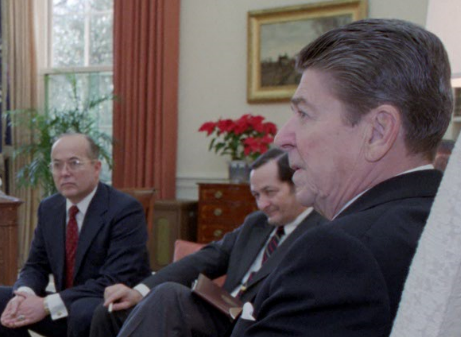
Walter Raymond Jr., a CIA propaganda and disinformation specialist who oversaw President Reagan’s “psyops” and “perception management” projects at the National Security Council. Raymond is partially obscured by President Reagan. Raymond is seated next to National Security Adviser John Poindexter. (Photo credit: Reagan presidential library)


A just-declassified sign-in sheet for a meeting of an inter-agency “psyops” committee on Oct. 24, 1986, shows representatives from the Agency for International Development (USAID), the State Department, and the U.S. Information Agency (USIA) joining officials from the Central Intelligence Agency and the Defense Department.


Some of the names of officials from the CIA and Pentagon remain classified more than three decades later. But the significance of the document is that it reveals how agencies that were traditionally assigned to global development (USAID) or international information (USIA) were incorporated into the U.S. government’s strategies for peacetime psyops, a military technique for breaking the will of a wartime enemy by spreading lies, confusion and terror.


Essentially, psyops play on the cultural weaknesses of a target population so they could be more easily controlled or defeated, but the Reagan administration was taking the concept outside the traditional bounds of warfare and applying psyops to any time when the U.S. government could claim some threat to America.


This disclosure – bolstered by other documents released earlier this year by archivists at the Reagan library in Simi Valley, California – is relevant to today’s frenzy over alleged “fake news” and accusations of “Russian disinformation” by reminding everyone that the U.S. government was active in those same areas.


The U.S. government’s use of disinformation and propaganda is, of course, nothing new. For instance, during the 1950s and 1960s, the USIA regularly published articles in friendly newspapers and magazines that appeared under fake names such as Guy Sims Fitch.


However, in the 1970s, the bloody Vietnam War and the Pentagon Papers’ revelations about U.S. government deceptions to justify that war created a crisis for American propagandists, their loss of credibility with the American people. Some of the traditional sources of U.S. disinformation, such as the CIA, also fell into profound disrepute.


This so-called “Vietnam Syndrome” – a skeptical citizenry dubious toward U.S. government claims about foreign conflicts – undermined President Reagan’s efforts to sell his plans for intervention in the civil wars then underway in Central America, Africa and elsewhere.


Reagan depicted Central America as a “Soviet beachhead,” but many Americans saw haughty Central American oligarchs and their brutal security forces slaughtering priests, nuns, labor activists, students, peasants and indigenous populations.


Reagan and his advisers realized that they had to turn those perceptions around if they hoped to get sustained funding for the militaries of El Salvador, Guatemala and Honduras as well as for the Nicaraguan Contra rebels, the CIA-organized paramilitary force marauding around leftist-ruled Nicaragua.


Perception Management


So, it became a high priority to reshape public perceptions inside those targeted countries but even more importantly among the American people. That challenge led the Reagan administration to revitalize and reorganize methods for distributing propaganda and funding friendly foreign operatives, such as creation of the National Endowment for Democracy under neoconservative president Carl Gershman in 1983.


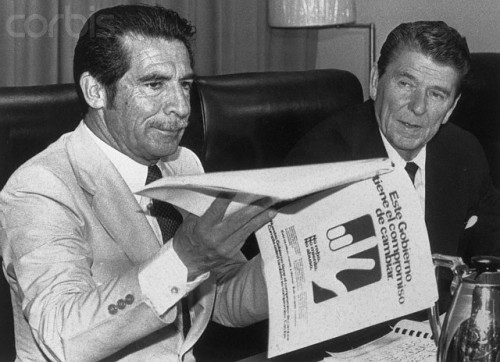
President Ronald Reagan meeting with Guatemalan dictator Efrain Rios Montt, who later faced accusations of genocide against Indian populations in the central highlands.


Another entity in this process was the Psychological Operations Committee formed in 1986 under Reagan’s National Security Council. In the years since, the U.S. administrations, both Republican and Democratic, have applied many of these same psyops principles, cherry-picking or manufacturing evidence to undermine adversaries and to solidify U.S. public support for Washington’s policies.


This reality – about the U.S. government creating its own faux reality to manipulate the American people and international audiences – should compel journalists in the West to treat all claims from Washington with a large grain of salt.


However, instead, we have seen a pattern of leading news outlets simply amplifying whatever U.S. agencies assert about foreign adversaries while denouncing skeptics as purveyors of “fake news” or enemy “propaganda.” In effect, the success of the U.S. psyops strategy can be measured by how Western mainstream media has stepped forward as the enforcement mechanism to ensure conformity to the U.S. government’s various information themes and narratives.


For instance, any questioning of the U.S. government’s narratives on, say, the current Syrian conflict, or the Ukraine coup of 2014, or Russian “hacking” of the 2016 U.S. election, or Iran’s status as “the leading sponsor of terrorism” is treated by the major Western news outlets as evidence that you are a “useful fool” at best, if not a willful enemy “propagandist” with loyalty to a foreign power, i.e., a traitor.


Leading mainstream media outlets and establishment-approved Web sites are now teaming up with Google, Facebook and other technology companies to develop algorithms to bury or remove content from the Internet that doesn’t march in lockstep with what is deemed to be true, which often simply follows what U.S. government agencies say is true.


Yet, the documentary evidence is now clear that the U.S. government undertook a well-defined strategy of waging psyops around the world with regular blowback of this propaganda and disinformation onto the American people via Western news agencies covering events in the affected countries.


During more recent administrations, euphemisms have been used to cloak the more pejorative phrase, “psychological operations” – such as “public diplomacy,” “strategic communications,” “perception management,” and “smart power.” But the serious push to expand this propaganda capability of the U.S. government can be traced back to the Reagan presidency.


The Puppet Master


Over the years, I’ve obtained scores of documents related to the psyops and related programs via “mandatory declassification reviews” of files belonging to Walter Raymond Jr., a senior CIA covert operations specialist who was transferred to Reagan’s National Security Council staff in 1982 to rebuild capacities for psyops, propaganda and disinformation.


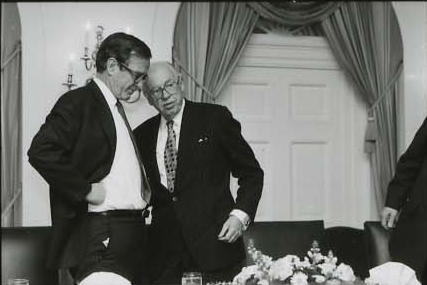
Then-Vice President George H.W. Bush with CIA Director William Casey at the White House on Feb. 11, 1981. (Photo credit: Reagan Library)


Raymond, who has been compared to a character from a John LeCarré novel slipping easily into the woodwork, spent his years inside Reagan’s White House as a shadowy puppet master who tried his best to avoid public attention or – it seems – even having his picture taken.


From the tens of thousands of photographs from meetings at Reagan’s White House, I found only a couple showing Raymond – and he is seated in groups, partially concealed by other officials.


But Raymond appears to have grasped his true importance. In his NSC files, I found a doodle of an organizational chart that had Raymond at the top holding what looks like the crossed handles used by puppeteers to control the puppets below them. The drawing fits the reality of Raymond as the behind-the-curtains operative who was controlling the various inter-agency task forces that were responsible for implementing psyops and other propaganda strategies.


In Raymond’s files, I found an influential November 1983 paper, written by Col. Alfred R. Paddock Jr. and entitled “Military Psychological Operations and US Strategy,” which stated: “the planned use of communications to influence attitudes or behavior should, if properly used, precede, accompany, and follow all applications of force. Put another way, psychological operations is the one weapons system which has an important role to play in peacetime, throughout the spectrum of conflict, and during the aftermath of conflict.”


Paddock continued, “Military psychological operations are an important part of the ‘PSYOP Totality,’ both in peace and war. … We need a program of psychological operations as an integral part of our national security policies and programs. … The continuity of a standing interagency board or committee to provide the necessary coordinating mechanism for development of a coherent, worldwide psychological operations strategy is badly needed.”


One declassified “top secret” document in Raymond’s file – dated Feb. 4, 1985, from Secretary of Defense Caspar Weinberger – urged the fuller implementation of President Reagan’s National Security Decision Directive 130, which was signed on March 6, 1984, and which authorized peacetime psyops by expanding psyops beyond its traditional boundaries of active military operations into peacetime situations in which the U.S. government could claim some threat to national interests.


“This approval can provide the impetus to the rebuilding of a necessary strategic capability, focus attention on psychological operations as a national – not solely military – instrument, and ensure that psychological operations are fully coordinated with public diplomacy and other international information activities,” Weinberger’s document said.


An Inter-Agency Committee


This broader commitment to psyops led to the creation of a Psychological Operations Committee (POC) that was to be chaired by a representative of Reagan’s National Security Council with a vice chairman from the Pentagon and with representatives from CIA, the State Department and USIA.


CIA seal in lobby of the spy agency’s headquarters. (U.S. government photo)


“This group will be responsible for planning, coordinating and implementing psychological operations activities in support of United States policies and interests relative to national security,” according to a “secret” addendum to a memo, dated March 25, 1986, from Col. Paddock, the psyops advocate who had become the U.S. Army’s Director for Psychological Operations.


“The committee will provide the focal point for interagency coordination of detailed contingency planning for the management of national information assets during war, and for the transition from peace to war,” the addendum added.


“The POC shall seek to ensure that in wartime or during crises (which may be defined as periods of acute tension involving a threat to the lives of American citizens or the imminence of war between the U.S. and other nations), U.S. international information elements are ready to initiate special procedures to ensure policy consistency, timely response and rapid feedback from the intended audience.”


In other words, the U.S. government could engage in psyops virtually anytime because there are always “periods of acute tension involving a threat to the lives of American citizens.”


The Psychological Operations Committee took formal shape with a “secret” memo from Reagan’s National Security Advisor John Poindexter on July 31, 1986. Its first meeting was called on Sept. 2, 1986, with an agenda that focused on Central America and “How can other POC agencies support and complement DOD programs in El Salvador, Guatemala, Honduras, Costa Rica and Panama.” The POC was also tasked with “Developing National PSYOPS Guidelines” for “formulating and implementing a national PSYOPS program.” (Underlining in original)


Raymond was named a co-chair of the POC along with CIA officer Vincent Cannistraro, who was then Deputy Director for Intelligence Programs on the NSC staff, according to a “secret” memo from Deputy Under Secretary of Defense Craig Alderman Jr.


The memo also noted that future POC meetings would be briefed on psyops projects for the Philippines and Nicaragua, with the latter project codenamed “Niagara Falls.” The memo also references a “Project Touchstone,” but it is unclear where that psyops program was targeted.


Another “secret” memo dated Oct. 1, 1986, co-authored by Raymond, reported on the POC’s first meeting on Sept. 10, 1986, and noted that “The POC will, at each meeting, focus on an area of operations (e.g., Central America, Afghanistan, Philippines).”


The POC’s second meeting on Oct. 24, 1986 – for which the sign-in sheet was just released – concentrated on the Philippines, according to a Nov. 4, 1986 memo also co-authored by Raymond.


But the Reagan administration’s primary attention continued to go back to Central America, including “Project Niagara Falls,” the psyops program aimed at Nicaragua. A “secret” Pentagon memo from Deputy Under Secretary Alderman on Nov. 20, 1986, outlined the work of the 4th Psychological Operations Group on this psyops plan “to help bring about democratization of Nicaragua,” by which the Reagan administration meant a “regime change.” The precise details of “Project Niagara Falls” were not disclosed in the declassified documents but the choice of codename suggested a cascade of psyops.


Key Operatives


Other documents from Raymond’s NSC file shed light on who other key operatives in the psyops and propaganda programs were. For instance, in undated notes on efforts to influence the Socialist International, including securing support for U.S. foreign policies from Socialist and Social Democratic parties in Europe, Raymond cited the efforts of “Ledeen, Gershman,” a reference to neoconservative operative Michael Ledeen and Carl Gershman, another neocon who has served as president of the U.S.-government-funded National Endowment for Democracy (NED), from 1983 to the present. (Underlining in original.)


Carl Gershman, president of the National Endowment for Democracy.


Although NED is technically independent of the U.S. government, it receives the bulk of its funding (now about $100 million a year) from Congress. Documents from the Reagan archives also make clear that NED was organized as a way to replace some of the CIA’s political and propaganda covert operations, which had fallen into disrepute in the 1970s. Earlier released documents from Raymond’s file show CIA Director William Casey pushing for NED’s creation and Raymond, Casey’s handpicked man on the NSC, giving frequent advice and direction to Gershman. [See Consortiumnews.com’s “CIA’s Hidden Hand in ‘Democracy’ Groups.”]


While the initials USAID conjure up images of well-meaning Americans helping to drill wells, teach school and set up health clinics in impoverished nations, USAID also has kept its hand in financing friendly journalists around the globe.


In 2015, USAID issued a fact sheet summarizing its work financing “journalism education, media business development, capacity building for supportive institutions, and strengthening legal-regulatory environments for free media.” USAID estimated its budget for “media strengthening programs in over 30 countries” at $40 million annually, including aiding “independent media organizations and bloggers in over a dozen countries,”


In Ukraine before the 2014 coup, USAID offered training in “mobile phone and website security,” which sounds a bit like an operation to thwart the local government’s intelligence gathering, an ironic position for the U.S. with its surveillance obsession, including prosecuting whistleblowers based on evidence that they talked to journalists.


USAID, working with billionaire George Soros’s Open Society, also funded the Organized Crime and Corruption Reporting Project (OCCRP), which engages in “investigative journalism” that usually goes after governments that have fallen into disfavor with the United States and then are singled out for accusations of corruption.


The USAID-funded OCCRP also collaborates with Bellingcat, an online investigative website founded by blogger Eliot Higgins, who is now a senior non-resident fellow of the Atlantic Council, a pro-NATO think tank that receives funding from the U.S. and allied governments.


Higgins has spread misinformation on the Internet, including discredited claims implicating the Syrian government in the sarin attack in 2013 and directing an Australian TV news crew to what looked to be the wrong location for a video of a BUK anti-aircraft battery as it supposedly made its getaway to Russia after the shoot-down of Malaysia Airlines Flight 17 in July 2014.


Despite his dubious record of accuracy, Higgins has gained mainstream acclaim, in part, because his “findings” always match up with the propaganda theme that the U.S. government and its Western allies are peddling. Though most genuinely independent bloggers are ignored by the mainstream media, Higgins has found his work touted by both The New York Times and The Washington Post, and Google has included Bellingcat on its First Draft coalition, which will determine which news will be deemed real and which fake.


In other words, the U.S. government has a robust strategy for deploying direct and indirect agents of influence who are now influencing how the titans of the Internet will structure their algorithms to play up favored information and disappear disfavored information.


A Heritage of Lies


During the first Cold War, the CIA and the U.S. Information Agency refined the art of “information warfare,” including pioneering some of its current features like having ostensibly “independent” entities and cut-outs present U.S. propaganda to a cynical public that would reject much of what it hears from government but may trust “citizen journalists” and “bloggers.”


A screen shot of U.S. Assistant Secretary of State for European Affairs Victoria Nuland speaking to U.S. and Ukrainian business leaders on Dec. 13, 2013, at an event sponsored by Chevron, with its logo to Nuland’s left.


USIA, which was founded in 1953 and gained new life in the 1980s under its Reagan-appointed director Charles Wick, was abolished in 1999, but its propaganda functions were largely folded into the new office of Under Secretary of State for Public Diplomacy and Public Affairs, which became a new fount of disinformation.


For instance, in 2014, President Obama’s Under Secretary for Public Diplomacy Richard Stengel engaged in a series of falsehoods and misrepresentations regarding Russia’s RT network. In one instance, he claimed that the RT had made the “ludicrous assertion” that the U.S. had invested $5 billion in the regime change project in Ukraine. But that was an obvious reference to a public speech by U.S. Assistant Secretary of State for European Affairs Victoria Nuland on Dec. 13, 2013, in which she said “we have invested more than $5 billion” to help Ukraine to achieve its “European aspirations.”


Nuland also was a leading proponent of the Ukraine coup, personally cheering on the anti-government rioters. In an intercepted phone call with U.S. Ambassador to Ukraine Geoffrey Pyatt, Nuland discussed how “to glue” or “midwife this thing” and who the new leaders would be. She picked Arseniy Yatsenyuk – “Yats is the guy” – who ended up as Prime Minister after elected President Viktor Yanukovych was overthrown.


Despite all the evidence of a U.S.-backed coup, The New York Times simply ignored the evidence, including the Nuland-Pyatt phone call, to announce that there never was a coup. The Times’ obeisance to the State Department’s false narrative is a good example of how the legacy of Walter Raymond, who died in 2003, extends to the present.


Over several decades, even as the White House changed hands from Republicans to Democrats, the momentum created by Raymond continued to push the peacetime psyops strategy forward.


In more recent years, the wording of the program may have changed to more pleasing euphemisms. But the idea is the same: how you can use psyops, propaganda and disinformation to sell U.S. government policies abroad and at home.

Friday, August 11, 2017

A New Report Raises Big Questions About Last Year’s DNC Hack

Written by Patrick Lawrence of The Nation,


It is now a year since the Democratic National Committee’s mail system was compromised—a year since events in the spring and early summer of 2016 were identified as remote hacks and, in short order, attributed to Russians acting in behalf of Donald Trump. A great edifice has been erected during this time. President Trump, members of his family, and numerous people around him stand accused of various corruptions and extensive collusion with Russians. Half a dozen simultaneous investigations proceed into these matters. Last week news broke that Special Counsel Robert Mueller had convened a grand jury, which issued its first subpoenas on August 3. Allegations of treason are common; prominent political figures and many media cultivate a case for impeachment.


The president’s ability to conduct foreign policy, notably but not only with regard to Russia, is now crippled. Forced into a corner and having no choice, Trump just signed legislation imposing severe new sanctions on Russia and European companies working with it on pipeline projects vital to Russia’s energy sector. Striking this close to the core of another nation’s economy is customarily considered an act of war, we must not forget. In retaliation, Moscow has announced that the United States must cut its embassy staff by roughly two-thirds. All sides agree that relations between the United States and Russia are now as fragile as they were during some of the Cold War’s worst moments. To suggest that military conflict between two nuclear powers inches ever closer can no longer be dismissed as hyperbole.


All this was set in motion when the DNC’s mail server was first violated in the spring of 2016 and by subsequent assertions that Russians were behind that “hack” and another such operation, also described as a Russian hack, on July 5. These are the foundation stones of the edifice just outlined. The evolution of public discourse in the year since is worthy of scholarly study: Possibilities became allegations, and these became probabilities. Then the probabilities turned into certainties, and these evolved into what are now taken to be established truths. By my reckoning, it required a few days to a few weeks to advance from each of these stages to the next. This was accomplished via the indefensibly corrupt manipulations of language repeated incessantly in our leading media.


Debbie


Lost in a year that often appeared to veer into our peculiarly American kind of hysteria is the absence of any credible evidence of what happened last year and who was responsible for it. It is tiresome to note, but none has been made available. Instead, we are urged to accept the word of institutions and senior officials with long records of deception. These officials profess “high confidence” in their “assessment” as to what happened in the spring and summer of last year—this standing as their authoritative judgment. Few have noticed since these evasive terms first appeared that an assessment is an opinion, nothing more, and to express high confidence is an upside-down way of admitting the absence of certain knowledge. This is how officials avoid putting their names on the assertions we are so strongly urged to accept—as the record shows many of them have done.


We come now to a moment of great gravity.


There has been a long effort to counter the official narrative we now call “Russiagate.” This effort has so far focused on the key events noted above, leaving numerous others still to be addressed. Until recently, researchers undertaking this work faced critical shortcomings, and these are to be explained. But they have achieved significant new momentum in the past several weeks, and what they have done now yields very consequential fruit. Forensic investigators, intelligence analysts, system designers, program architects, and computer scientists of long experience and strongly credentialed are now producing evidence disproving the official version of key events last year. Their work is intricate and continues at a kinetic pace as we speak. But its certain results so far are two, simply stated, and freighted with implications:


There was no hack of the Democratic National Committee’s system on July 5 last year—not by the Russians, not by anyone else. Hard science now demonstrates it was a leak—a download executed locally with a memory key or a similarly portable data-storage device. In short, it was an inside job by someone with access to the DNC’s system. This casts serious doubt on the initial “hack,” as alleged, that led to the very consequential publication of a large store of documents on WikiLeaks last summer.


Forensic investigations of documents made public two weeks prior to the July 5 leak by the person or entity known as Guccifer 2.0 show that they were fraudulent: Before Guccifer posted them they were adulterated by cutting and pasting them into a blank template that had Russian as its default language. Guccifer took responsibility on June 15 for an intrusion the DNC reported on June 14 and professed to be a WikiLeaks source—claims essential to the official narrative implicating Russia in what was soon cast as an extensive hacking operation. To put the point simply, forensic science now devastates this narrative.


This article is based on an examination of the documents these forensic experts and intelligence analysts have produced, notably the key papers written over the past several weeks, as well as detailed interviews with many of those conducting investigations and now drawing conclusions from them. Before proceeding into this material, several points bear noting.


One, there are many other allegations implicating Russians in the 2016 political process. The work I will now report upon does not purport to prove or disprove any of them. Who delivered documents to WikiLeaks? Who was responsible for the “phishing” operation penetrating John Podesta’s e-mail in March 2016? We do not know the answers to such questions. It is entirely possible, indeed, that the answers we deserve and must demand could turn out to be multiple: One thing happened in one case, another thing in another. The new work done on the mid-June and July 5 events bears upon all else in only one respect. We are now on notice: Given that we now stand face to face with very considerable cases of duplicity, it is imperative that all official accounts of these many events be subject to rigorously skeptical questioning. Do we even know that John Podesta’s e-mail was in fact “phished”? What evidence of this has been produced? Such rock-bottom questions as these must now be posed in all other cases.


Two, houses built on sand and made of cards are bound to collapse, and there can be no surprise that the one resting atop the “hack theory,” as we can call the prevailing wisdom on the DNC events, appears to be in the process of doing so. Neither is there anything far-fetched in a reversal of the truth of this magnitude. American history is replete with similar cases. The Spanish sank the Maine in Havana harbor in February 1898. Iran’s Mossadegh was a Communist. Guatemala’s Árbenz represented a Communist threat to the United States. Vietnam’s Ho Chi Minh was a Soviet puppet. The Sandinistas were Communists. The truth of the Maine, a war and a revolution in between, took a century to find the light of day, whereupon the official story disintegrated. We can do better now. It is an odd sensation to live through one of these episodes, especially one as big as Russiagate. But its place atop a long line of precedents can no longer be disputed.


Three, regardless of what one may think about the investigations and conclusions I will now outline—and, as noted, these investigations continue—there is a bottom line attaching to them. We can even call it a red line. Under no circumstance can it be acceptable that the relevant authorities—the National Security Agency, the Justice Department (via the Federal Bureau of Investigation), and the Central Intelligence Agency—leave these new findings without reply. Not credibly, in any case. Forensic investigators, prominent among them people with decades’ experience at high levels in these very institutions, have put a body of evidence on a table previously left empty. Silence now, should it ensue, cannot be written down as an admission of duplicity, but it will come very close to one.


It requires no elaboration to apply the above point to the corporate media, which have been flaccidly satisfied with official explanations of the DNC matter from the start.


Qualified experts working independently of one another began to examine the DNC case immediately after the July 2016 events. Prominent among these is a group comprising former intelligence officers, almost all of whom previously occupied senior positions. Veteran Intelligence Professionals for Sanity (VIPS), founded in 2003, now has 30 members, including a few associates with backgrounds in national-security fields other than intelligence. The chief researchers active on the DNC case are four: William Binney, formerly the NSA’s technical director for world geopolitical and military analysis and designer of many agency programs now in use; Kirk Wiebe, formerly a senior analyst at the NSA’s SIGINT Automation Research Center; Edward Loomis, formerly technical director in the NSA’s Office of Signal Processing; and Ray McGovern, an intelligence analyst for nearly three decades and formerly chief of the CIA’s Soviet Foreign Policy Branch. Most of these men have decades of experience in matters concerning Russian intelligence and the related technologies. This article reflects numerous interviews with all of them conducted in person, via Skype, or by telephone.


WB


William Binney


The customary VIPS format is an open letter, typically addressed to the president. The group has written three such letters on the DNC incident, all of which were first published by Robert Parry at www.consortiumnews.com. Here is the latest, dated July 24; it blueprints the forensic work this article explores in detail. They have all argued that the hack theory is wrong and that a locally executed leak is the far more likely explanation. In a letter to Barack Obama dated January 17, three days before he left office, the group explained that the NSA’s known programs are fully capable of capturing all electronic transfers of data. “We strongly suggest that you ask NSA for any evidence it may have indicating that the results of Russian hacking were given to WikiLeaks,” the letter said. “If NSA cannot produce such evidence—and quickly—this would probably mean it does not have any.”


The day after Parry published this letter, Obama gave his last press conference as president, at which he delivered one of the great gems among the official statements on the DNC e-mail question. “The conclusions of the intelligence community with respect to the Russian hacking,” the legacy-minded Obama said, “were not conclusive.” There is little to suggest the VIPS letter prompted this remark, but it is typical of the linguistic tap-dancing many officials connected to the case have indulged so as to avoid putting their names on the hack theory and all that derives from it.


Until recently there was a serious hindrance to the VIPS’s work, and I have just suggested it. The group lacked access to positive data. It had no lump of cyber-material to place on its lab table and analyze, because no official agency had provided any.


Donald Rumsfeld famously argued with regard to the WMD question in Iraq, “The absence of evidence is not evidence of absence.” In essence, Binney and others at VIPS say this logic turns upside down in the DNC case: Based on the knowledge of former officials such as Binney, the group knew that (1) if there was a hack and (2) if Russia was responsible for it, the NSA would have to have evidence of both. Binney and others surmised that the agency and associated institutions were hiding the absence of evidence behind the claim that they had to maintain secrecy to protect NSA programs. “Everything that they say must remain classified is already well-known,” Binney said in an interview. “They’re playing the Wizard of Oz game.”


New findings indicate this is perfectly true, but until recently the VIPS experts could produce only “negative evidence,” as they put it: The absence of evidence supporting the hack theory demonstrates that it cannot be so. That is all VIPS had. They could allege and assert, but they could not conclude: They were stuck demanding evidence they did not have—if only to prove there was none.


Research into the DNC case took a fateful turn in early July, when forensic investigators who had been working independently began to share findings and form loose collaborations wherein each could build on the work of others. In this a small, new website called www.disobedientmedia.com proved an important catalyst. Two independent researchers selected it, Snowden-like, as the medium through which to disclose their findings. One of these is known as Forensicator and the other as Adam Carter. On July 9, Adam Carter sent Elizabeth Vos, a co-founder of Disobedient Media, a paper by the Forensicator that split the DNC case open like a coconut.


By this time Binney and the other technical-side people at VIPS had begun working with a man named Skip Folden. Folden was an IT executive at IBM for 33 years, serving 25 years as the IT program manager in the United States. He has also consulted for Pentagon officials, the FBI, and the Justice Department. Folden is effectively the VIPS group’s liaison to Forensicator, Adam Carter, and other investigators, but neither Folden nor anyone else knows the identity of either Forensicator or Adam Carter. This bears brief explanation.


The Forensicator’s July 9 document indicates he lives in the Pacific Time Zone, which puts him on the West Coast. His notes describing his investigative procedures support this. But little else is known of him. Adam Carter, in turn, is located in England, but the name is a coy pseudonym: It derives from a character in a BBC espionage series called Spooks. It is protocol in this community, Elizabeth Vos told me in a telephone conversation this week, to respect this degree of anonymity. Kirk Wiebe, the former SIGINT analyst at the NSA, thinks Forensicator could be “someone very good with the FBI,” but there is no certainty. Unanimously, however, all the analysts and forensics investigators interviewed for this column say Forensicator’s advanced expertise, evident in the work he has done, is unassailable. They hold a similarly high opinion of Adam Carter’s work.


Forensicator is working with the documents published by Guccifer 2.0, focusing for now on the July 5 intrusion into the DNC server. The contents of Guccifer’s files are known—they were published last September—and are not Forensicator’s concern. His work is with the metadata on those files. These data did not come to him via any clandestine means. Forensicator simply has access to them that others did not have. It is this access that prompts Kirk Wiebe and others to suggest that Forensicator may be someone with exceptional talent and training inside an agency such as the FBI. “Forensicator unlocked and then analyzed what had been the locked files Guccifer supposedly took from the DNC server,” Skip Folden explained in an interview. “To do this he would have to have ‘access privilege,’ meaning a key.”


What has Forensicator proven since he turned his key? How? What has work done atop Forensicator’s findings proven? How?


Forensicator’s first decisive findings, made public in the paper dated July 9, concerned the volume of the supposedly hacked material and what is called the transfer rate—the time a remote hack would require. The metadata established several facts in this regard with granular precision: On the evening of July 5, 2016, 1,976 megabytes of data were downloaded from the DNC’s server. The operation took 87 seconds. This yields a transfer rate of 22.7 megabytes per second.


These statistics are matters of record and essential to disproving the hack theory. No Internet service provider, such as a hacker would have had to use in mid-2016, was capable of downloading data at this speed. Compounding this contradiction, Guccifer claimed to have run his hack from Romania, which, for numerous reasons technically called delivery overheads, would slow down the speed of a hack even further from maximum achievable speeds.


What is the maximum achievable speed? Forensicator recently ran a test download of a comparable data volume (and using a server speed not available in 2016) 40 miles from his computer via a server 20 miles away and came up with a speed of 11.8 megabytes per second—half what the DNC operation would need were it a hack. Other investigators have built on this finding. Folden and Edward Loomis say a survey published August 3, 2016, by www.speedtest.net/reports is highly reliable and use it as their thumbnail index. It indicated that the highest average ISP speeds of first-half 2016 were achieved by Xfinity and Cox Communications. These speeds averaged 15.6 megabytes per second and 14.7 megabytes per second, respectively. Peak speeds at higher rates were recorded intermittently but still did not reach the required 22.7 megabytes per second.


“A speed of 22.7 megabytes is simply unobtainable, especially if we are talking about a transoceanic data transfer,” Folden said. “Based on the data we now have, what we’ve been calling a hack is impossible.” Last week Forensicator reported on a speed test he conducted more recently. It tightens the case considerably. “Transfer rates of 23 MB/s (Mega Bytes per second) are not just highly unlikely, but effectively impossible to accomplish when communicating over the Internet at any significant distance,” he wrote. “Further, local copy speeds are measured, demonstrating that 23 MB/s is a typical transfer rate when using a USB–2 flash device (thumb drive).”


Time stamps in the metadata provide further evidence of what happened on July 5. The stamps recording the download indicate that it occurred in the Eastern Daylight Time Zone at approximately 6:45 pm. This confirms that the person entering the DNC system was working somewhere on the East Coast of the United States. In theory the operation could have been conducted from Bangor or Miami or anywhere in between—but not Russia, Romania, or anywhere else outside the EDT zone. Combined with Forensicator’s findings on the transfer rate, the time stamps constitute more evidence that the download was conducted locally, since delivery overheads—conversion of data into packets, addressing, sequencing times, error checks, and the like—degrade all data transfers conducted via the Internet, more or less according to the distance involved.


In addition, there is the adulteration of the documents Guccifer 2.0 posted on June 15, when he made his first appearance. This came to light when researchers penetrated what Folden calls Guccifer’s top layer of metadata and analyzed what was in the layers beneath. They found that the first five files Guccifer made public had each been run, via ordinary cut-and-paste, through a single template that effectively immersed them in what could plausibly be cast as Russian fingerprints. They were not: The Russian markings were artificially inserted prior to posting. “It’s clear,” another forensics investigator self-identified as HET, wrote in a report on this question, “that metadata was deliberately altered and documents were deliberately pasted into a Russianified [W]ord document with Russian language settings and style headings.”


To be noted in this connection: The list of the CIA’s cyber-tools WikiLeaks began to release in March and labeled Vault 7 includes one called Marble that is capable of obfuscating the origin of documents in false-flag operations and leaving markings that point to whatever the CIA wants to point to. (The tool can also “de-obfuscate” what it has obfuscated.) It is not known whether this tool was deployed in the Guccifer case, but it is there for such a use.


It is not yet clear whether documents now shown to have been leaked locally on July 5 were tainted to suggest Russian hacking in the same way the June 15 Guccifer release was. This is among several outstanding questions awaiting answers, and the forensic scientists active on the DNC case are now investigating it. In a note Adam Carter sent to Folden and McGovern last week and copied to me, he reconfirmed the corruption of the June 15 documents, while indicating that his initial work on the July 5 documents—of which much more is to be done—had not yet turned up evidence of doctoring.


In the meantime, VIPS has assembled a chronology that imposes a persuasive logic on the complex succession of events just reviewed. It is this:


On June 12 last year, Julian Assange announced that WikiLeaks had and would publish documents pertinent to Hillary Clinton’s presidential campaign.


On June 14, CrowdStrike, a cyber-security firm hired by the DNC, announced, without providing evidence, that it had found malware on DNC servers and had evidence that Russians were responsible for planting it.


On June 15, Guccifer 2.0 first appeared, took responsibility for the “hack” reported on June 14 and claimed to be a WikiLeaks source. It then posted the adulterated documents just described.


On July 5, Guccifer again claimed he had remotely hacked DNC servers, and the operation was instantly described as another intrusion attributable to Russia. Virtually no media questioned this account.


Assange


It does not require too much thought to read into this sequence. With his June 12 announcement, Assange effectively put the DNC on notice that it had a little time, probably not much, to act preemptively against the imminent publication of damaging documents. Did the DNC quickly conjure Guccifer from thin air to create a cyber-saboteur whose fingers point to Russia? There is no evidence of this one way or the other, but emphatically it is legitimate to pose the question in the context of the VIPS chronology. WikiLeaks began publishing on July 22. By that time, the case alleging Russian interference in the 2016 elections process was taking firm root. In short order Assange would be written down as a “Russian agent.”


By any balanced reckoning, the official case purporting to assign a systematic hacking effort to Russia, the events of mid-June and July 5 last year being the foundation of this case, is shabby to the point taxpayers should ask for their money back. The Intelligence Community Assessment, the supposedly definitive report featuring the “high confidence” dodge, was greeted as farcically flimsy when issued January 6. Ray McGovern calls it a disgrace to the intelligence profession. It is spotlessly free of evidence, front to back, pertaining to any events in which Russia is implicated. James Clapper, the former director of national intelligence, admitted in May that “hand-picked” analysts from three agencies (not the 17 previously reported) drafted the ICA. There is a way to understand “hand-picked” that is less obvious than meets the eye: The report was sequestered from rigorous agency-wide reviews. This is the way these people have spoken to us for the past year.


Behind the ICA lie other indefensible realities. The FBI has never examined the DNC’s computer servers—an omission that is beyond preposterous. It has instead relied on the reports produced by Crowdstrike, a firm that drips with conflicting interests well beyond the fact that it is in the DNC’s employ. Dmitri Alperovitch, its co-founder and chief technology officer, is on the record as vigorously anti-Russian. He is a senior fellow at the Atlantic Council, which suffers the same prejudice. Problems such as this are many.


“We continue to stand by our report,” CrowdStrike said, upon seeing the VIPS blueprint of the investigation. CrowdStrike argues that by July 5 all malware had been removed from the DNC’s computers. But the presence or absence of malware by that time is entirely immaterial, because the event of July 5 is proven to have been a leak and not a hack. Given that malware has nothing to do with leaks, CrowdStrike’s logic appears to be circular.


In effect, the new forensic evidence considered here lands in a vacuum. We now enter a period when an official reply should be forthcoming. What the forensic people are now producing constitutes evidence, however one may view it, and it is the first scientifically derived evidence we have into any of the events in which Russia has been implicated. The investigators deserve a response, the betrayed professionals who formed VIPS as the WMD scandal unfolded in 2003 deserve it, and so do the rest of us. The cost of duplicity has rarely been so high.


I concluded each of the interviews conducted for this column by asking for a degree of confidence in the new findings. These are careful, exacting people as a matter of professional training and standards, and I got careful, exacting replies.


All those interviewed came in between 90 percent and 100 percent certain that the forensics prove out. I have already quoted Skip Folden’s answer: impossible based on the data. “The laws of physics don’t lie,” Ray McGovern volunteered at one point. “It’s QED, theorem demonstrated,” William Binney said in response to my question. “There’s no evidence out there to get me to change my mind.” When I asked Edward Loomis, a 90 percent man, about the 10 percent he held out, he replied, “I’ve looked at the work and it shows there was no Russian hack. But I didn’t do the work. That’s the 10 percent. I’m a scientist.”


Tuesday, August 1, 2017

Trump Saw A Disturbing Video, Then He Shut Down The CIA's Covert Syria Program

While we"ve carefully documented the dynamics in play behind Trump"s decision to end the CIA"s covert Syria program, as well as the corresponding fury this immediately unleashed among the usual hawkish DC policy wonks, new information on what specifically impacted the president"s thinking has emerged.


Thomas Joscelyn, a Middle East analyst for the Foundation for Defense of Democracies, explains in the August edition of The Weekly Standard:


Earlier this year, President Donald Trump was shown a disturbing video of Syrian rebels beheading a child near the city of Aleppo. It had caused a minor stir in the press as the fighters belonged to the Nour al-Din al-Zenki Movement, a group that had been supported by the CIA as part of its rebel aid program.


The footage is haunting. Five bearded men smirk as they surround a boy in the back of a pickup truck. One of them holds the boy’s head with a tight grip on his hair while another mockingly slaps his face. Then, one of them uses a knife to saw the child’s head off and holds it up in the air like a trophy. It is a scene reminiscent of the Islamic State’s snuff videos, except this wasn’t the work of Abu Bakr al-Baghdadi’s men. The murderers were supposed to be the good guys: our allies.


Trump pressed his most senior intelligence advisers, asking the basic question of how the CIA could have a relationship with a group that beheads a child and then uploads the video to the internet. He wasn"t satisfied with any of the responses:


Trump wanted to know why the United States had backed Zenki if its members are extremists. The issue was discussed at length with senior intelligence officials, and no good answers were forthcoming, according to people familiar with the conversations. After learning more worrisome details about the CIA’s ghost war in Syria—including that U.S.-backed rebels had often fought alongside extremists, among them al Qaeda’s arm in the country—the president decided to end the program altogether.


Screenshot of the horrific video of a CIA-backed Syrian group beheading a boy named Abdullah Issa.


At the time the beheading video surfaced (July 2016), many in the American public naturally wanted answers, but the story never really picked up much momentum in the media. As Joscelyn describes, it caused nothing more than "a minor stir in the press." The State Department seemed merely satisfied that the group responsible, Harakat Nour al-Din al-Zenki, claimed to have arrested the men that committed the gruesome crime, though nothing more was known. Absurdly, a US government spokesperson expressed hope that the child-beheading group would "comply with obligations under the law of armed conflict."


The only press agencies that publicly and consistently challenged the State Department at the time were RT News and the Associated Press, yet even these attempts didn"t get picked up beyond the confines of the State Department"s daily briefing. When the AP"s Matt Lee initially questioned spokesman Mark Toner as to whether Zenki would continue to receive any level of US assistance, Toner casually replied "it would give us pause" - which left Lee taken aback.


Meanwhile, it wasn"t just the US government which had aided Zenki, but as fighting in Aleppo raged it became a favored group among both the mainstream media and prominent think tank pundits. One of the UK"s major broadcasters (Channel 4) even went so far as to attempt to delete and hide its prior online content which sought to normalize the beheaders as "moderate" and heroic once news of the video got out.


Among think tankers, Zenki"s most prominent public supporter, frequently presenting the terror group as actually representative of Syria"s "secular" and supposedly democracy-promoting armed opposition (even after the beheading video emerged), was Charles Lister. Lister was finally confronted not by mainstream media, but by AlterNet"s Max Blumenthal at a DC event held by the (largely Gulf funded) Atlantic Council.


Only by the time of this January 2017 public forum, and after being persistently questioned, did Lister awkwardly back off his previous enthusiastic promotion of Zenki:


We can imagine that Trump saw other things beyond the shocking Zenki beheading video which made him fully realize the utter criminality of the CIA program (Thomas Joscelyn further emphasizes that Trump came to understand the full scope of CIA cooperation with al-Qaeda in Syria).


The only question that remains is who in the CIA or Obama-era State Department should be prosecuted first?

Monday, July 10, 2017

Still Living In Propaganda-ville

Authored by Robert Parry via ConsoortiumNews.com,


As much as the U.S. mainstream media wants people to believe that it is the Guardian of Truth, it is actually lost in a wilderness of propaganda and falsehoods, a dangerous land of delusion that is putting the future of humankind at risk as tension escalate with nuclear-armed Russia.


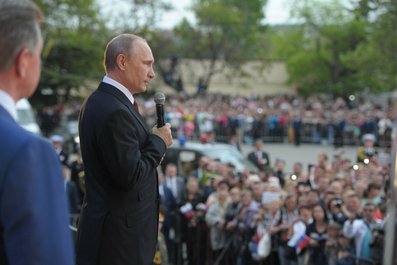
Russian President Vladimir Putin addresses a crowd on May 9, 2014, celebrating the 69th anniversary of victory over Nazi Germany and the 70th anniversary of the liberation of the Crimean port city of Sevastopol from the Nazis. (Russian government photo)


This media problem has grown over recent decades as lucrative careerism has replaced responsible professionalism. Pack journalism has always been a threat to quality reporting but now it has evolved into a self-sustaining media lifestyle in which the old motto, “there’s safety in numbers,” is borne out by the fact that being horrendously wrong, such as on Iraq’s WMD, leads to almost no accountability because so many important colleagues were wrong as well.


Similarly, there has been no accountability after many mainstream journalists and commentators falsely stated as flat-fact that “all 17 U.S. intelligence agencies” concurred that Russia did “meddle” in last November’s U.S. election.


For months, this claim has been the go-to put-down whenever anyone questions the groupthink of Russian venality perverting American democracy. Even the esteemed “Politifact” deemed the assertion “true.” But it was never true.


It was at best a needled distortion of a claim by President Obama’s Director of National Intelligence James Clapper when he issued a statement last Oct. 7 alleging Russian meddling. Because Clapper was the chief of the U.S. Intelligence Community, his opinion morphed into a claim that it represented the consensus of all 17 intelligence agencies, a dishonest twist that Democratic presidential candidate Hillary Clinton began touting.


However, for people who understand how the U.S. Intelligence Community works, the claim of a 17-agencies consensus has a specific meaning, some form of a National Intelligence Estimate (or NIE) that seeks out judgments and dissents from the various agencies.


But there was no NIE regarding alleged Russian meddling and there apparently wasn’t even a formal assessment from a subset of the agencies at the time of Clapper’s statement. President Obama did not order a publishable assessment until December – after the election – and it was not completed until Jan. 6, when a report from Clapper’s office presented the opinions of analysts from the Central Intelligence Agency, Federal Bureau of Investigation and the National Security Agency – three agencies (or four if you count the DNI’s office), not 17.


Lacking Hard Evidence


The report also contained no hard evidence of a Russian “hack” and amounted to a one-sided circumstantial case at best. However, by then, the U.S. mainstream media had embraced the “all-17-intelligence-agencies” refrain and anyone who disagreed, including President Trump, was treated as delusional. The argument went: “How can anyone question what all 17 intelligence agencies have confirmed as true?”


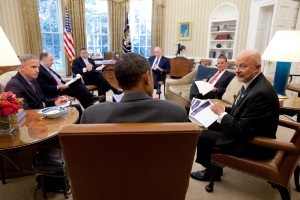
Director of National Intelligence James Clapper (right) talks with President Barack Obama in the Oval Office, with John Brennan and other national security aides present. (Photo credit: Office of Director of National Intelligence)


It wasn’t until May 8 when then-former DNI Clapper belatedly set the record straight in sworn congressional testimony in which he explained that there were only three “contributing agencies” from which analysts were “hand-picked.”


The reference to “hand-picked” analysts pricked the ears of some former U.S. intelligence analysts who had suffered through earlier periods of “politicized” intelligence when malleable analysts were chosen to deliver what their political bosses wanted to hear.


On May 23, also in congressional testimony, former CIA Director John Brennan confirmed Clapper’s description, saying only four of the 17 U.S. intelligence agencies took part in the assessment.


Brennan said the Jan. 6 report “followed the general model of how you want to do something like this with some notable exceptions. It only involved the FBI, NSA and CIA as well as the Office of the Director of National Intelligence. It wasn’t a full inter-agency community assessment that was coordinated among the 17 agencies.”


After this testimony, some of the major news organizations, which had been waving around the “17-intelligence-agencies” meme, subtly changed their phrasing to either depict Russian “meddling” as an established fact no longer requiring attribution or referred to the “unanimous judgment” of the Intelligence Community without citing a specific number.


This “unanimous judgment” formulation was deceptive, too, because it suggested that all 17 agencies were in accord albeit without exactly saying that. For a regular reader of The New York Times or a frequent viewer of CNN, the distinction would almost assuredly not be detected.


For more than a month after the Clapper-Brennan testimonies, there was no formal correction.


A Belated Correction


Finally, on June 25, the Times’ hand was forced when White House correspondent Maggie Haberman reverted to the old formulation, mocking Trump for “still refus[ing] to acknowledge a basic fact agreed upon by 17 American intelligence agencies that he now oversees: Russia orchestrated the attacks, and did it to help get him elected.”


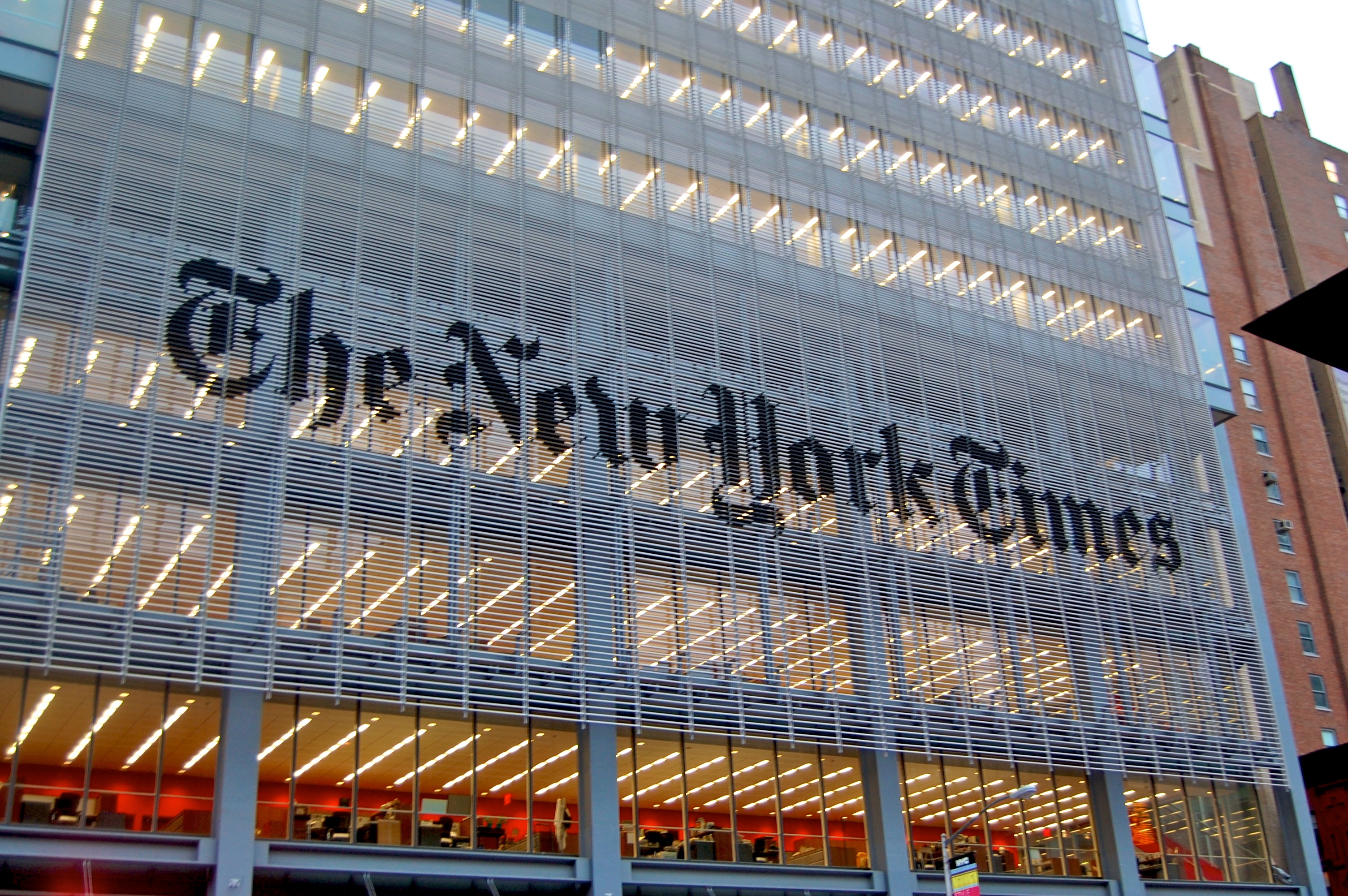
New York Times building in New York City. (Photo from Wikipedia)


When this falsehood was called to the Times’ attention, it had little choice but to append a correction to the article, noting that the intelligence “assessment was made by four intelligence agencies — the Office of the Director of National Intelligence, the Central Intelligence Agency, the Federal Bureau of Investigation and the National Security Agency. The assessment was not approved by all 17 organizations in the American intelligence community.”


The Associated Press ran a similar “clarification” applied to some of its fallacious reporting repeating the “17-intelligence-agencies” meme.


So, you might have thought that the mainstream media was finally adjusting its reporting to conform to reality. But that would mean that one of the pillars of the Russia-gate “scandal” had crumbled, the certainty that Russia and Vladimir Putin did “meddle” in the election.


The story would have to go back to square one and the major news organizations would have to begin reporting on whether or not there ever was solid evidence to support what had become a “certainty” – and there appeared to be no stomach for such soul-searching. Since pretty much all the important media figures had made the same error, it would be much easier to simply move on as if nothing had changed.


That would mean that skepticism would still be unwelcome and curious leads would not be followed. For instance, there was a head-turning reference in an otherwise typical Washington Post take-out on June 25 accusing Russia of committing “the crime of the century.”


A reference, stuck deep inside the five-page opus, said, “Some of the most critical technical intelligence on Russia came from another country, officials said. Because of the source of the material, the NSA was reluctant to view it with high confidence.”


Though the Post did not identify the country, this reference suggests that more than one key element of the case for Russian culpability was based not on direct investigations by the U.S. intelligence agencies, but on the work of external organizations.


Earlier, the Democratic National Committee denied the FBI access to its supposedly hacked computers, forcing the investigators to rely on a DNC contractor called CrowdStrike, which has a checkered record of getting this sort of analytics right and whose chief technology officer, Dmitri Alperovitch, is an anti-Putin Russian émigré with ties to the anti-Russian think tank, Atlantic Council.


Relying on Outsiders


You might be wondering why something as important as this “crime of the century,” which has pushed the world closer to nuclear annihilation, is dependent on dubious entities outside the U.S. government with possible conflicts of interest.


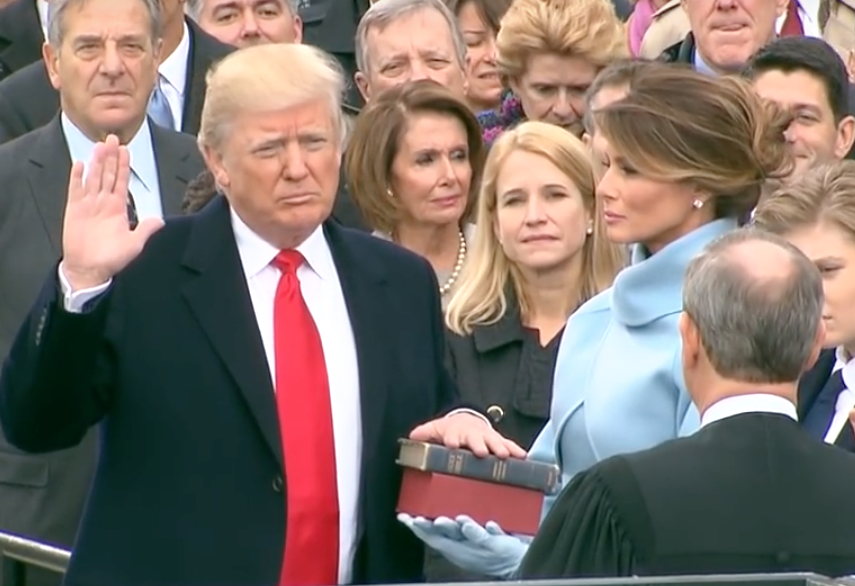
President Donald Trump being sworn in on Jan. 20, 2017. (Screen shot from Whitehouse.gov)


If the U.S. government really took this issue seriously, which it should, why didn’t the FBI seize the DNC’s computers and insist that impartial government experts lead the investigation? And why – given the extraordinary expertise of the NSA in computer hacking – is “some of the most critical technical intelligence on Russia [coming] from another country,” one that doesn’t inspire the NSA’s confidence?


But such pesky questions are not likely to be asked or answered by a mainstream U.S. media that displays deep-seated bias toward both Putin and Trump.


Mostly, major news outlets continue to brush aside the clarifications and return to various formulations that continue to embrace the “17-intelligence-agencies” canard, albeit in slightly different forms, such as references to the collective Intelligence Community without the specific number. Anyone who questions this established conventional wisdom is still crazy and out of step.


For instance, James Holmes of Esquire was stunned on Thursday when Trump at a news conference in Poland reminded the traveling press corps about the inaccurate reporting regarding the 17 intelligence agencies and said he still wasn’t entirely sure about Russia’s guilt.


“In public, he’s still casting doubt on the intelligence community’s finding that Russia interfered in the 2016 election nearly nine months after the fact,” Holmes sputtered before describing Trump’s comment as a “rant.”


So, if you thought that a chastened mainstream media might stop in the wake of the “17-intelligence-agencies” falsehood and rethink the whole Russia-gate business, you would have been sadly mistaken.


But the problem is not just the question of whether Russia hacked into Democratic emails and slipped them to WikiLeaks for publication (something that both Russia and WikiLeaks deny). Perhaps the larger danger is how the major U.S. news outlets have adopted a consistently propagandistic approach toward everything relating to Russia.


Hating Putin


This pattern traces back to the earliest days of Vladimir Putin’s presidency in 2000 when he began to rein in the U.S.-prescribed “shock therapy,” which had sold off Russia’s assets to well-connected insiders, making billions of dollars for the West-favored “oligarchs,” even as the process threw millions of average Russian into poverty.


Assistant Secretary of State for European Affairs Victoria Nuland, who pushed for the Ukraine coup and helped pick the post-coup leaders.


But the U.S. mainstream media’s contempt for Putin reached new heights after he helped President Obama head off neoconservative (and liberal interventionist) demands for a full-scale U.S. military assault on Syria in August 2013 and helped bring Iran into a restrictive nuclear agreement when the neocons wanted to bomb-bomb-bomb Iran.


The neocons delivered their payback to Putin in early 2014 by supporting a violent coup in Ukraine, overthrowing elected President Viktor Yanukovych and installing a fiercely anti-Russian regime. The U.S. operation was spearheaded by neocon National Endowment for Democracy President Carl Gershman and neocon Assistant Secretary of State for European Affairs Victoria Nuland, with enthusiastic support from neocon Sen. John McCain.


Nuland was heard in an intercepted pre-coup phone call with U.S. Ambassador Geoffrey Pyatt discussing who should become the new leaders and pondering how to “glue” or “midwife this thing.”


Despite the clear evidence of U.S. interference in Ukrainian politics, the U.S. government and the mainstream media embraced the coup and accused Putin of “aggression” when ethnic Russians in eastern Ukraine, called the Donbas, resisted the coup regime.


When ethnic Russians and other citizens in Crimea voted overwhelmingly in a referendum to reject the coup regime and rejoin Russia – a move protected by some of the 20,000 Russian troops inside Crimea as part of a basing agreement – that became a Russian “invasion.” But it was the most peculiar “invasion,” since there were no images of tanks crashing across borders or amphibious landing craft on Crimean beaches, because no such “invasion” had occurred.


However, in virtually every instance, the U.S. mainstream media insisted on the most extreme anti-Russian propaganda line and accused people who questioned this Official Narrative of disseminating Russian “propaganda” – or being a “Moscow stooge” or acting as a “useful fool.” There was no tolerance for skepticism about whatever the State Department or the Washington think tanks were saying.


Trump Meets Putin


So, since Trump met with Putin at the G-20 summit in Hamburg, Germany, the U.S. mainstream media has been in a frenzy, linking up its groupthinks about the Ukraine “invasion” with its groupthinks about Russia “hacking” the election.


Washington Post columnist David Ignatius. (Photo credit: Aude)


In a July 3 editorial, The Washington Post declared, “Mr. Trump simply cannot fail to admonish Mr. Putin for Russia’s attempts to meddle in the 2016 presidential election. He must make clear the United States will not tolerate it, period. Naturally, this is a difficult issue for Mr. Trump, who reaped the benefit of Russia’s intervention and now faces a special counsel’s investigation, but nonetheless, in his first session with Mr. Putin, the president must not hesitate to be blunt. …


“On Ukraine, Mr. Trump must also display determination. Russia fomented an armed uprising and seized Crimea in violation of international norms, and it continues to instigate violence in the Donbas. Mr. Trump ought to make it unmistakably clear to Mr.Putin that the United States will not retreat from the sanctions imposed over Ukraine until the conditions of peace agreements are met.”


Along the same lines, even while suggesting the value of some collaboration with Russia toward ending the war in Syria, Post columnist David Ignatius wrote in a July 5 column, “Russian-American cooperation on Syria faces a huge obstacle right now. It would legitimize a Russian regime that invaded Ukraine and meddled in U.S. and European elections, in addition to its intervention in Syria.”


Note the smug certainty of Ignatius and the Post editors. There is no doubt that Russia “invaded” Ukraine; “seized” Crimea; “meddled” in U.S. and European elections. Yet all these groupthinks should be subjected to skepticism, not simply treated as undeniable truths.


But seeing only one side to a story is where the U.S. mainstream media is at this point in history. Yes, it is possible that Russia was responsible for the Democratic hacks and did funnel the material to WikiLeaks, but evidence has so far been lacking. And, instead of presenting both sides fairly, the major media acts as if only one side deserves any respect and dissenting views must be ridiculed and condemned.


In this perverted process, collectively approved versions of complex situations congeal into conventional wisdom, which simply cannot be significantly reconsidered regardless of future revelations.


As offensive as this rejection of true truth-seeking may be, it also represents an extraordinary danger when mixed with the existential risk of nuclear conflagration.


With the stakes this high, the demand for hard evidence – and the avoidance of soft-minded groupthink – should go without question. Journalists and commentators should hold themselves to professional precision, not slide into sloppy careerism, lost in “propaganda-ville.”