 (TIM) — In a recent interview with Breitbart Radio, Rep. Dana Rohrabacher (R-CA), who reportedly visited the Ecuadorian embassy in London in August 2017 and met with WikiLeaks’ Julian Assange, said that Assange has physical evidence to prove that Russia did not provide WikiLeaks with Democratic National Committee (DNC) emails during the 2016 US presidential campaign. “By now, everybody […]
Showing posts with label democratic national committee. Show all posts
Showing posts with label democratic national committee. Show all posts
Tuesday, April 24, 2018
Congressman Says Assange Has “Physical Proof” Russia Did Not Hack DNC
(TIM) — In a recent interview with Breitbart Radio, Rep. Dana Rohrabacher (R-CA), who reportedly visited the Ecuadorian embassy in London in August 2017 and met with WikiLeaks’ Julian Assange, said that Assange has physical evidence to prove that Russia did not provide WikiLeaks with Democratic National Committee (DNC) emails during the 2016 US presidential campaign. “By now, everybody […]

Saturday, April 21, 2018
Blaming WikiLeaks for 2016 Loss, DNC Lawsuit Riddled With Conspiracy Theories
 Press freedom advocates denounced the claims advanced in the suit, arguing they would implicate journalists and newspapers that report on or publish classified information. (CD) — “[Eighteen] months after their crushing defeat at the hands of a game show host, Democrats have still published no public autopsy about why they lost or have collapsed at all levels. […]
Friday, April 20, 2018
DNC Sues Russia, Trump, WikiLeaks for Conspiring to Hurt Hillary in 2016 Election
 (ZHE) — Did the Democrats’ “The Russians did it” narrative just jump the shark? The Washingtoin Post reports that The Democratic National Committee filed a multimillion-dollar lawsuit Friday against the Russian government, the Trump campaign and the WikiLeaks organization alleging a far-reaching conspiracy to disrupt the 2016 campaign and tilt the election to Donald Trump. The lawsuit alleges that […]
Tuesday, February 6, 2018
FBI Scandal Update: Dossier Writer Christopher Steele Failed To Show Up For Court

Former British MI-6 Intelligence Officer Christopher Steele, who was paid $168,000 by Fusion GPS’ Glenn Simpson to write and promote the dossier funded by the Democratic National Committee was a no-show in a civil court case.
The multi-million dollar libel case has brought against Buzzfeed after the media outlet published the unverified disinformation dossier at Steele’s insistence. Steele was paid to promote the fake dossier among select journalists in a smear campaign against President Donald Trump.
According to reports from Fox News, Steele was a no-show Monday for a long-requested deposition in London. The news comes as Senate Judiciary Committee Chairman Chuck Grassley, R-Iowa, and Senator Lindsey Graham, R-S.C., have announced a criminal referral on Steele.
Evan Fray-Witzer, a Boston-based attorney representing Russian tech tycoon Aleksej Gubarev in multi-million dollar civil litigation, described Monday’s U.K. court actions to Fox News. “My understanding is that Mr. Steele’s lawyers spent a good deal of time arguing why they thought he (Steele) should not be required to sit for a deposition and that ultimately the court took the entire matter under advisement.” Gubarev is suing the British-based Steele’s company Orbis Business Intelligence because the dossier also smeared Gubarev’s companies which include XBT Holdings and Webzilla. The dossier claimed the companies used “botnets and port traffic to transmit viruses, plant bugs and steal data.” Fray-Witzer said, “Certainly with respect to Mr. Gubarev, Webzilla and XBT there has never been a single scrap of evidence about them in the dossier.”
As Fox News has reported based upon a review of British court records, Steele promoted and met with five media outlets repeatedly between the spring and fall of 2016. At the same time, Steele was also meeting with the FBI in Rome, according to reports.
Records obtained and reviewed by Fox News from related civil ligitation in Florida reveal that Steele maintains that even showing up for a deposition would “implicate state secrets in London.” Fray-Witzer stressed in that hearing that the British government “has not asserted” Steele’s claims. The attorney has said Steele “is asserting he can’t speak about things. We have pointed out that he’s spoken to anyone who is willing to listen, every journalist, and the FBI.”
Wednesday, January 31, 2018
Here’s The Information The DNC DESPERATELY Tried To Hide During The SOTU Address

During Wednesday’s State of the Union address, elitist Democrats were desperately trying to hide some information. Not only are they still burned by Donald Trump’s win over Hillary Clinton in 2016, the information they filed with attempts to conceal it is probably also a source of some chapped hindquarters.
Filed during the State of the Union in the hopes of getting buried, was the fundraising numbers for the Democratic National Committee. Ken Vogel of The New York Times picked it up where he noted the Democratic National Committee had raised a little over $5 million, finishing the year with a whopping $6 million in debt.
Interesting timing: @DNC files its @FEC report in the middle of the #SOTU, revealing that it raised $5.2M last month, but finished the year with $6.1M in debt. https://t.co/N9mSrDoE7v
— Kenneth P. Vogel (@kenvogel) January 31, 2018
On the other hand, proving democrats know next to nothing about basic economics, the Republican National Committee has no debt and raised over twice as much as their Democratic counterparts. For 2017, the RNC raised $132.5 million to the DNC’s $65.9 million. Regarding cash on hand, the RNC has close to $40 million ($38.8 million to be exact), while the DNC only has $6.3 million.
The DNC tried to bury their latest FEC #s tonight…
Dec. Raise
RNC 11.1M
DNC 5.2M2017
RNC 132.5M
DNC 65.9MCOH
RNC 38.8M
DNC 6.3MDebt
RNC 0
DNC 6.1M (!!)Heading into 2018, the DNC is less than $200K away from insolvency. https://t.co/ifRY2NYlPD
— Michael Ahrens (@michael_ahrens) January 31, 2018
According to Townhall, this could be the reason Democrats looked so sour during the section of Trump’s address that declared the economy is doing well. It should be evident that the left is ill-educated on fundamental money management. Remember, these same politicians are of the party that wants more of your hard-earned money to distribute as they see fit. Considering they can’t even manage their own affairs, it’s got to be getting tough for everyday Americans to trust them with ours.
There will probably be an excuse though, and the mainstream media will sweep this under the rug like they do every time a socialist is caught in a compromising position.
Trump Says He Will ‘100%’ Release The FISA Memo In ‘Hot Mic’ Moment

As president Donald Trump left last night’s State of the Union address, he was caught on a hot mic moment that should send shivers down the spines of leftists and the deep state. The president said he would 100% release the FISA memo.
Representative Jeff Duncan (R-S.C.) approached Trump as he exited the House chamber following the State the Union address, and asked him to “release the memo.” Trump responded. “Don’t worry, 100 percent,” the president said with a wave of his hand.
The exchange was caught by television cameras filming the president after he delivered the address. The president’s comments also come as Congress awaits his decision on whether he will allow members to release the memo to the public, a question that has sharply divided lawmakers along party lines.
Speculation as to when the White House will release the memo following a vote to make it public by GOP lawmakers on Monday night. Many are suggesting that Trump wants the news cycle to focus on his speech until at least Thursday before there is any movement on the release of the memo.
The five-day deadline in which the memo has to be released ends on Saturday night. According to Info Wars, the classified Department of Justice memo is suspected to contain evidence of illegal FBI and DOJ spying on the Trump campaign, possibly at the behest of Hillary Clinton. According to journalist Sara Carter, the memo is so “explosive” that it could lead to “the end of Robert Mueller’s Special Counsel investigation into President Trump and his associates.”
According to the Washington Post, a White House spokesman confirmed early Wednesday that the administration’s official position is now that Trump will release the memo to the public. The simple fact that the Democrats and the FBI want this memo kept secret certainly makes everyone want to see it more.
The memo is said to suggest that British ex-spy Christopher Steele, the author of a now-famous dossier alleging Trump has ties to Russian officials, provided bad information to the FBI. Steele’s dossier work was paid for by the Democratic National Committee and the Hillary Clinton campaign, and Trump has denied the allegations in it.
The very basic fact is that the left desperately wants this memo to remain a secret. That means, it should be released so the people can see for themselves that the mainstream media and Democrats have been lying to them to manipulate public opinion.
Thursday, December 28, 2017
The Anatomy Of Hillary Clinton"s $84 Million Money-Laundering Scheme
Authored by Dan Backer via Investors.com,
In 2014, the Supreme Court ruled in favor of my client, Alabama engineer Shaun McCutcheon, in his challenge to the Federal Election Commission"s (FEC) outdated "aggregate limits," which effectively limited how many candidates any one donor could support.
Anti-speech liberals railed against McCutcheon"s win, arguing it would create supersized "Joint Fundraising Committees" (JFCs). In court, they claimed these JFCs would allow a single donor to cut a multimillion-dollar check, and the JFC would then route funds through dozens of participating state parties, who would then funnel it back to the final recipient.
Democracy 21 President Fred Wertheimer claimed the Supreme Court"s McCutcheon v. FEC ruling would lead to "the system of legalized bribery recreated that existed prior to Watergate." The Supreme Court, in ruling for us, flatly stated such a scheme would still be illegal.
The Democrats" response? Hold my beer.
The Committee to Defend the President has filed an FEC complaint against Hillary Clinton"s campaign, Democratic National Committee (DNC), Democratic state parties and Democratic mega-donors.

As Fox News reported, we documented the Democratic establishment "us[ing] state chapters as straw men to circumvent campaign donation limits and launder(ing) the money back to her campaign." The 101-page complaint focused on the Hillary Victory Fund (HVF) — the $500 million joint fundraising committee between the Clinton campaign, DNC, and dozens of state parties — which did exactly that the Supreme Court declared would still be illegal.
HVF solicited six-figure donations from major donors, including Calvin Klein and "Family Guy" creator Seth MacFarlane, and routed them through state parties en route to the Clinton campaign. Roughly $84 million may have been laundered in what might be the single largest campaign finance scandal in U.S. history.
Here"s what we know. Campaign finance law is incredibly complex and infamous for its lack of clarity. As I"ve explained before, its complexity is a feature, not a bug. Major political players with the resources to hire the very few attorneys who practice campaign finance law benefit from the complexity that keeps others out. Perhaps HVF"s architects thought so too, and assumed that if no one understands what"s happening, no one would complain.
Here"s what you can do, legally. Per election, an individual donor can contribute $2,700 to any candidate, $10,000 to any state party committee, and (during the 2016 cycle) $33,400 to a national party"s main account. These groups can all get together and take a single check from a donor for the sum of those contribution limits — it"s legal because the donor cannot exceed the base limit for any one recipient. And state parties can make unlimited transfers to their national party.
Here"s what you can"t do, which the Clinton machine appeared to do anyway. As the Supreme Court made clear in McCutcheon v. FEC, the JFC may not solicit or accept contributions to circumvent base limits, through "earmarks" and "straw men" that are ultimately excessive — there are five separate prohibitions here.
On top of that, six-figure donations either never actually passed through state party accounts or were never actually under state party control, which adds false FEC reporting by HVF, state parties, and the DNC to the laundry list.
Finally, as Donna Brazile and others admitted, the DNC placed the funds under the Clinton campaign"s direct control, a massive breach of campaign finance law that ties the conspiracy together.
Democratic donors, knowing the funds would end up with Clinton"s campaign, wrote six-figure checks to influence the election — 100 times larger than allowed.
HVF bundled these megagifts and, on a single day, reported transferring money to all participating state parties, some of which would then show up on FEC reports filed by the DNC as transferring the exact same dollar amount on the exact same day to the DNC. Yet not all the state parties reported either receiving or transferring those sums.
Did any of these transfers actually happen? Or were they just paper entries to mask direct transfers to the DNC?
For perspective, conservative filmmaker Dinesh D"Souza was prosecuted and convicted in 2012 for giving a handful of associates money they then contributed to a candidate of his preference — in other words, straw man contributions. He was sentenced to eight months in a community confinement center and five years of probation. How much money was involved? Only $20,000. HVF weighs in at $84 million — more than 4,000 times larger!
So who should be worried? Everyone involved — from the donors themselves to Democratic fundraisers to party officials who filed false reports and, ultimately, to Clinton campaign and HVF officials looking at significant legal jeopardy.
Don"t take my word for it. Our complaint is built entirely on the FEC reports filed by Democrats, memos authored by Clinton campaign manager Robbie Mook, and public statements from Donna Brazile and others.
The only question that matters: Was the law broken? If the answer is yes, then the corrupt Clinton machine should be held accountable.


Monday, December 25, 2017
Was The Steele Dossier The FBI"s "Insurance Policy"?
Authored by Andrew McCarthy via National Review,
Clinton campaign propaganda appears to have triggered Obama administration spying on Trump’s campaign...

The FBI’s deputy director Andrew McCabe testified Tuesday at a marathon seven-hour closed-door hearing of the House Intelligence Committee.
According to the now-infamous text message sent by FBI agent Peter Strzok to his paramour, FBI lawyer Lisa Page, it was in McCabe’s office that top FBI counterintelligence officials discussed what they saw as the frightening possibility of a Trump presidency.
That was during the stretch run of the 2016 campaign, no more than a couple of weeks after they started receiving the Steele dossier — the Clinton campaign’s opposition-research reports, written by former British spy Christopher Steele, about Trump’s purportedly conspiratorial relationship with Vladimir Putin’s regime in Russia.
Was it the Steele dossier that so frightened the FBI? I think so.
There is a great deal of information to follow. But let’s cut to the chase: The Obama-era FBI and Justice Department had great faith in Steele because he had previously collaborated with the bureau on a big case. Plus, Steele was working on the Trump-Russia project with the wife of a top Obama Justice Department official, who was personally briefed by Steele. The upper ranks of the FBI and DOJ strongly preferred Trump’s opponent, Hillary Clinton, to the point of overlooking significant evidence of her felony misconduct, even as they turned up the heat on Trump. In sum, the FBI and DOJ were predisposed to believe the allegations in Steele’s dossier. Because of their confidence in Steele, because they were predisposed to believe his scandalous claims about Donald Trump, they made grossly inadequate efforts to verify his claims. Contrary to what I hoped would be the case, I’ve come to believe Steele’s claims were used to obtain FISA surveillance authority for an investigation of Trump.
There were layers of insulation between the Clinton campaign and Steele — the campaign and the Democratic party retained a law firm, which contracted with Fusion GPS, which in turn hired the former spy. At some point, though, perhaps early on, the FBI and DOJ learned that the dossier was actually a partisan opposition-research product. By then, they were dug in. No one, after all, would be any the wiser: Hillary would coast to victory, so Democrats would continue running the government; FISA materials are highly classified, so they’d be kept under wraps. Just as it had been with the Obama-era’s Fast and Furious and IRS scandals, any malfeasance would remain hidden.
The best laid schemes . . . gang aft agley.
Why It Matters
Strzok’s text about the meeting in McCabe’s office is dated August 16, 2016. As we’ll see, the date is important. According to Agent Strzok, with Election Day less than three months away, Page, the bureau lawyer, weighed in on Trump’s bid: “There’s no way he gets elected.” Strzok, however, believed that even if a Trump victory was the longest of long shots, the FBI “can’t take that risk.” He insisted that the bureau had no choice but to proceed with a plan to undermine Trump’s candidacy: “It’s like an insurance policy in the unlikely event you die before you’re 40.”
The Wall Street Journal reported Monday that, “according to people familiar with his account,” Strzok meant that it was imperative that the FBI “aggressively investigate allegations of collusion between Donald Trump’s campaign and Russia.” In laughable strawman fashion, the “people familiar with his account” assure the Journal that Strzok “didn’t intend to suggest a secret plan to harm the candidate.” Of course, no sensible person suspects that the FBI was plotting Trump’s assassination; the suspicion is that, motivated by partisanship and spurred by shoddy information that it failed to verify, the FBI exploited its counterintelligence powers in hopes of derailing Trump’s presidential run.
But what were these “allegations of collusion between Donald Trump’s campaign and Russia” that the FBI decided to “aggressively investigate”? The Journal doesn’t say. Were they the allegations in the Steele dossier? That is a question I asked in last weekend’s column. It is a question that was pressed by Chairman Devin Nunes (R., Calif.) and Republican members of the House Intelligence Committee at Tuesday’s sealed hearing. As I explained in the column, the question is critical for three reasons:
(1) The Steele dossier was a Clinton campaign product. If it was used by the FBI and the Obama Justice Department to obtain a FISA warrant, that would mean law-enforcement agencies controlled by a Democratic president fed the FISA court political campaign material produced by the Democratic candidate whom the president had endorsed to succeed him. Partisan claims of egregious scheming with an adversarial foreign power would have been presented to the court with the FBI’s imprimatur, as if they were drawn from refined U.S. intelligence reporting. The objective would have been to spy on the opposition Republican campaign.
(2) In June of this year, former FBI director James Comey testified that the dossier was “salacious and unverified.” While still director, Comey had described the dossier the same way when he briefed President-elect Trump on it in January 2017. If the dossier was still unverified as late as mid 2017, its allegations could not possibly have been verified months earlier, in the late summer or early autumn of 2016, when it appears that the FBI and DOJ used them in an application to the FISA court.
(3) The dossier appears to contain misinformation. Knowing he was a spy-for-hire trusted by Americans, Steele’s Russian-regime sources had reason to believe that misinformation could be passed into the stream of U.S. intelligence and that it would be acted on — and leaked — as if it were true, to America’s detriment. This would sow discord in our political system. If the FBI and DOJ relied on the dossier, it likely means they were played by the Putin regime.
How Could Something Like This Happen?
We do not have public confirmation that the dossier was, in fact, used by the bureau and the Justice Department to obtain the FISA warrant. Publicly, FBI and DOJ officials have thwarted the Congress with twaddle about protecting both intelligence sources and an internal inspector-general probe. Of course, Congress, which established and funds the DOJ and FBI, has the necessary security clearances to review classified information, has jurisdiction over the secret FISA court, and has independent constitutional authority to examine the activities of legislatively created executive agencies.
In any event, important reporting by Fox News’ James Rosen regarding Tuesday’s hearing indicates that the FBI did, in fact, credit the contents of the dossier. It appears, however, that the bureau corroborated few of Steele’s claims, and at an absurdly high level of generality — along the lines of: You tell me person A went to place X and committed a crime; I corroborate only that A went to X and blithely assume that because you were right about the travel, you must be right about the crime.
Here, the FBI was able to verify Steele’s claim that Carter Page, a very loosely connected Trump-campaign adviser, had gone to Russia. This was not exactly meticulous gumshoe corroboration: Page told many people he was going to Russia, saw many people while there, and gave a speech at a prominent Moscow venue. Having verified only the travel information, the FBI appears to have credited the claims of Steele’s anonymous Russian sources that Page carried out nigh-treasonous activities while in Russia.
How could something like this happen? Well, the FBI and DOJ liked and trusted Steele, for what seem to be good reasons. As the Washington Post has reported, the former MI-6 agent’s private intelligence firm, Orbis, was retained by England’s main soccer federation to investigate corruption at FIFA, the international soccer organization that had snubbed British bids to host the World Cup. In 2010, Steele delivered key information to the FBI’s organized-crime liaison in Europe. This helped the bureau build the Obama Justice Department’s most celebrated racketeering prosecution: the indictment of numerous FIFA officials and other corporate executives. Announcing the first wave of charges in May 2015, Attorney General Loretta Lynch made a point of thanking the investigators’ “international partners” for their “outstanding assistance.”
At the time, Bruce Ohr was the Obama Justice Department’s point man for “Transnational Organized Crime and International Affairs,” having been DOJ’s long-serving chief of the Organized Crime and Racketeering Section. He also wore a second, top-echelon DOJ hat: associate deputy attorney general. That made him a key adviser to the deputy attorney general, Sally Yates (who later, as acting attorney general, was fired for insubordinately refusing to enforce President Trump’s so-called travel ban). In the chain of command, the FBI reports to the DAG’s office.
To do the Trump-Russia research, Steele had been retained by the research firm Fusion GPS (which, to repeat, had been hired by lawyers for the Clinton campaign and the DNC). Fusion GPS was run by its founder, former Wall Street Journal investigative journalist Glenn Simpson. Bruce Ohr’s wife, Nellie, a Russia scholar, worked for Simpson at Fusion. The Ohrs and Simpson appear to be longtime acquaintances, dating back to when Simpson was a senior fellow at the International Assessment and Strategy Center. In 2010, all three participated in a two-day conference on international organized crime, sponsored by the National Institute of Justice (see conference schedule and participant list, pp. 27–30). In connection with the Clinton campaign’s Trump-Russia project, Fusion’s Nellie Ohr collaborated with Steele and Simpson, and DOJ’s Bruce Ohr met personally with Steele and Simpson.
Manifestly, the DOJ and FBI were favorably disposed toward Steele and Fusion GPS. I suspect that these good, productive prior relationships with the dossier’s source led the investigators to be less exacting about corroborating the dossier’s claims.
But that is just the beginning of the bias story.
At a high level, the DOJ and FBI were in the tank for Hillary Clinton. In July 2016, shortly before Steele’s reports started floating in, the FBI and DOJ announced that no charges would be brought against Mrs. Clinton despite damning evidence that she mishandled classified information, destroyed government files, obstructed congressional investigations, and lied to investigators. The irregularities in the Clinton-emails investigation are legion: President Obama making it clear in public statements that he did not want Clinton charged; the FBI, shortly afterwards, drafting an exoneration of Clinton months before the investigation ended and central witnesses, including Clinton herself, were interviewed; investigators failing to use the grand jury to compel the production of key evidence; the DOJ restricting FBI agents in their lines of inquiry and examination of evidence; the granting of immunity to suspects who in any other case would be pressured to plead guilty and cooperate against more-culpable suspects; the distorting of criminal statutes to avoid applying them to Clinton; the sulfurous tarmac meeting between Attorney General Lynch and former President Clinton shortly before Mrs. Clinton was given a peremptory interview — right before then–FBI director Comey announced that she would not be charged.
The blatant preference for Clinton over Trump smacked of politics and self-interest. Deputy FBI director McCabe’s wife had run for the Virginia state legislature as a Democrat, and her (unsuccessful) campaign was lavishly funded by groups tied to Clinton insider Terry McAuliffe. Agent Strzok told FBI lawyer Page that Trump was an “idiot” and that “Hillary should win 100 million to 0.” Page agreed that Trump was “a loathsome human.” A Clinton win would likely mean Lynch — originally raised to prominence when President Bill Clinton appointed her to a coveted U.S. attorney slot — would remain attorney general. Yates would be waiting in the wings.
The prior relationships of trust with the source; the investment in Clinton; the certitude that Clinton would win and deserved to win, signified by the mulish determination that she not be charged in the emails investigation; the sheer contempt for Trump. This concatenation led the FBI and DOJ to believe Steele — to want to believe his melodramatic account of Trump-Russia corruption. For the faithful, it was a story too good to check.
The DOJ and FBI, having dropped a criminal investigation that undeniably established Hillary Clinton’s national-security recklessness, managed simultaneously to convince themselves that Donald Trump was too much of a national-security risk to be president.
The Timeline
As I noted in last weekend’s column, reports are that the FBI and DOJ obtained a FISA warrant targeting Carter Page (no relation to Lisa Page). For a time, Page was tangentially tied to the Trump campaign as a foreign-policy adviser — he barely knew Trump. The warrant was reportedly obtained after the Trump campaign and Page had largely severed ties in early August 2016. We do not know exactly when the FISA warrant was granted, but the New York Times and the Washington Post have reported, citing U.S. government sources, that this occurred in September 2016 (see here, here, and here). Further, the DOJ and FBI reportedly persuaded the FISA court to extend the surveillance after the first warrant’s 90-day period lapsed — meaning the spying continued into Trump’s presidency.
The FBI and DOJ would have submitted the FISA application to the court shortly before the warrant was issued. In the days-to-weeks prior to petitioning the court, the FISA application would have been subjected to internal review at the FBI — raising the possibility that FBI lawyer Page was in the loop reviewing the investigative work of Agent Strzok, with whom she was having an extramarital affair. There would also have been review at the Justice Department — federal law requires that the attorney general approve every application to the FISA court.
Presumably, these internal reviews would have occurred in mid-to-late August — around the time of the meeting in McCabe’s office referred to in Strzok’s text. Thus, we need to understand the relevant events before and after mid-to-late August. Here is a timeline.
June 2016
In June 2016, Steele began to generate the reports that collectively are known as the “dossier.”
In the initial report, dated June 20, 2016, Steele alleged that Putin’s regime had been “cultivating, supporting and assisting TRUMP for at least 5 years.” (Steele’s reports conform to the FBI and intelligence-agency reporting practice of rendering names of interest in capital letters.) The Kremlin was said to have significant blackmail material that could be used against Trump.
In mid-to-late June 2016, according to Politico, Carter Page asked J. D. Gordon, his supervisor on the Trump campaign’s National Security Advisory Committee, for permission to go on a trip to Russia in early July. Gordon advised against it. Page then sent an email to Corey Lewandowski, who was Trump’s campaign manager until June 20, and Hope Hicks, the Trump campaign spokeswoman, seeking permission to go on the trip. Word came back to Page by email that he could go, but only in his private capacity, not as a representative of the Trump campaign. Lewandowski says he has never met Carter Page.
July 2016
Page, a top-of-the-class graduate of the U.S. Naval Academy with various other academic distinctions, traveled to Moscow for a three-day trip, the centerpiece of which was a July 7 commencement address at the New Economic School (the same institution at which President Obama gave a commencement address on July 7, 2009). The New York Times has reported, based on leaks from “current and former law enforcement and intelligence officials,” that Page’s July trip to Moscow “was a catalyst for the F.B.I. investigation into connections between Russia and President Trump’s campaign.” The Times does not say what information the FBI had received that made the Moscow trip such a “catalyst.”
Was it the Steele dossier?
Well, on July 19, Steele reported that, while in Moscow, Page had held secret meetings with two top Putin confederates, Igor Sechin and Igor Diveykin. Steele claimed to have been informed by “a Russian source close to” Sechin, the president of Russia’s energy conglomerate Rosneft, that Sechin had floated to Page the possibility of “US-Russia energy co-operation” in exchange for the “lifting of western sanctions against Russia over Ukraine.” Page was said to have reacted “positively” but in a manner that was “non-committal.”
Another source, apparently Russian, told Steele that “an official close to” Putin chief of staff Sergei Ivanov had confided to “a compatriot” that Igor Diveykin (of the “Internal Political Department” of Putin’s Presidential Administration) had also met with Page in Moscow. (Note the dizzying multiple-hearsay basis of this information.) Diveykin is said to have told Page that the regime had “a dossier of ‘kompromat’” — compromising information — on Hillary Clinton that it would consider releasing to Trump’s “campaign team.” Diveykin further “hinted (or indicated more strongly) that the Russian leadership also had ‘kompromat’ on TRUMP which the latter should bear in mind in his dealings with them.”
The hacked DNC emails were first released on July 22, shortly before the Democratic National Convention, which ran from July 25 through 28.
In “late July 2016,” Steele claimed to have been told by an “ethnic Russian close associate of . . . TRUMP” that there was a “well-developed conspiracy of co-operation” between “them” (apparently meaning Trump’s inner circle) and “the Russian leadership.” The conspiracy was said to be “managed on the TRUMP side by the Republican candidate’s campaign manager, Paul MANAFORT, who was using foreign policy adviser, Carter PAGE, and others as intermediaries.”
The same source claimed that the Russian regime had been behind the leak of DNC emails “to the WikiLeaks platform,” an operation the source maintained “had been conducted with the full knowledge and support of TRUMP and senior members of his campaign team.” As a quid pro quo, “the TRUMP team” was said to have agreed (a) “to sideline Russian intervention in Ukraine as a campaign issue,” and (b) to raise the failure of NATO nations to meet their defense commitments as a distraction from Russian aggression in Ukraine, “a priority for PUTIN who needed to cauterise the subject.”
Late July to Early August 2016
The Washington Post has reported that Steele’s reports were first transmitted “by an intermediary” to the FBI and other U.S. intelligence officials after the Democratic National Convention (which, to repeat, ended on July 28). The intermediary is not identified. We do not know if it was Fusion, though that seems likely given that Fusion shared its work with government and non-government entities. Steele himself is also said to have contacted “a friend in the FBI” about his research after the Democratic convention. As we’ve seen, Steele made bureau friends during the FIFA investigation.
August 2016
On August 11, as recounted in the aforementioned Wall Street Journal report, FBI agent Strzok texted the following message to FBI lawyer Page: “OMG I CANNOT BELIEVE WE ARE SERIOUSLY LOOKING AT THESE ALLEGATIONS AND THE PERVASIVE CONNECTIONS.” The Journal does not elaborate on what “allegations” Strzok was referring to, or the source of those allegations.
On August 15, Strzok texted Page about the meeting in deputy FBI director McCabe’s office at which it was discussed that the bureau “can’t take that risk” of a Trump presidency and needed something akin to an “insurance policy” even though Trump’s election was thought highly unlikely.
September 2016
Reporting indicates that sometime in September 2016, the DOJ and FBI applied to the FISA court for a warrant to surveil Carter Page, and that the warrant was granted.
Interestingly, on September 23, 2016, Yahoo’s Michael Isikoff reported on leaks he had received that the U.S. government was conducting an intelligence investigation to determine whether Carter Page, as a Trump adviser, had opened up a private communications channel with such “senior Russian officials” as Igor Sechin and Igor Diveykin to discuss lifting economic sanctions if Trump became president.
It is now known that Isikoff’s main source for the story was Fusion’s Glenn Simpson. Isikoff’s report is rife with allegations found in the dossier, although the dossier is not referred to as such; it is described as “intelligence reports” that “U.S. officials” were actively investigating — i.e., Steele’s reports were described in a way that would lead readers to assume they were official U.S. intelligence reports. But there clearly was official American government involvement: Isikoff’s story asserts that U.S. officials were briefing members of Congress about these allegations that Page was meeting with Kremlin officials on Trump’s behalf. The story elaborated that “questions about Page come amid mounting concerns within the U.S. intelligence community about Russian cyberattacks on the Democratic National Committee.” Those would be the cyberattacks alleged — in the dossier on which Congress was being briefed — to be the result of a Trump-Russia conspiracy in which Page was complicit.
Isikoff obviously checked with his government sources to verify what Simpson had told him about the ongoing investigation that was based on these “intelligence reports.” His story recounts that “a senior U.S. law enforcement official” confirmed that Page’s alleged contacts with Russian officials were “on our radar screen. . . . It’s being looked at.”
Final Points to Consider
After his naval career, Page worked in investing, including several years at Merrill Lynch in Moscow. As my column last weekend detailed, he has been an apologist for the Russian regime, championing appeasement for the sake of better U.S.–Russia relations. Page has acknowledged that, during his brief trip to Moscow in July 2016, he ran into some Russian government officials, among many old Russian friends and acquaintances. Yet he vehemently denies meeting with Sechin and Diveykin. (While Sechin’s name is well known to investors in the Russian energy sector, Page says that he has never met him and that he had never even heard Diveykin’s name until the Steele dossier was publicized in early 2017.) Furthermore, Page denies even knowing Paul Manafort, much less being used by Manafort as an intermediary between the Trump campaign and Russia. Page has filed a federal defamation lawsuit against the press outlets that published the dossier, has denied the dossier allegations in FBI interviews, and has reportedly testified before the grand jury in Robert Mueller’s special-counsel investigation.
Even though the FISA warrant targeting Page is classified and the FBI and DOJ have resisted informing Congress about it, some of its contents were illegally and selectively leaked to the Washington Post in April 2017 by sources described as “law enforcement and other U.S. officials.” According to the Post:
The government’s application for the surveillance order targeting Page included a lengthy declaration that laid out investigators’ basis for believing that Page was an agent of the Russian government and knowingly engaged in clandestine intelligence activities on behalf of Moscow, officials said.
Among other things, the application cited contacts that he had with a Russian intelligence operative in New York City in 2013, officials said. Those contacts had earlier surfaced in a federal espionage case brought by the Justice Department against the intelligence operative and two other Russian agents. In addition, the application said Page had other contacts with Russian operatives that have not been publicly disclosed, officials said.
I’ve emphasized that last portion because it strongly implies that the FISA application included information from the Steele dossier. That is, when the Post speaks of Page’s purported “other contacts with Russian operatives that have not been publicly disclosed,” this is very likely a reference to the meetings with Sechin and Diveykin that Page denies having had — the meetings described in the dossier. Do not be confused by the fact that, by the time of this Post report, the Steele-dossier allegations had already been disclosed to the public by BuzzFeed (in January 2017). The Post story is talking about what the DOJ and FBI put in the FISA application back in September 2016. At that time, the meetings alleged in the dossier had not been publicly disclosed.
Two final points.
First: The FISA application’s reliance on 2013 events as a basis for suspicion in 2016 that Page was a foreign agent of Russia is curious. The 2013 investigation involved Russian intelligence operatives who were trying to recruit business people, such as Page, as sources — i.e., Page was being approached by Russia, not acting on Russia’s behalf. In the 2013 investigation, Page met with a Russian agent, whom he apparently did not realize was an agent. They met at an energy symposium in New York and Page did networking-type things: exchanging contact information and providing his jejune assessment of the energy sector’s prospects. The Russian agent described Page as an “idiot” in a recorded conversation. According to Page, he cooperated with the FBI and helped prosecutors in the case against one of the suspects — claims that the government could easily disprove if he is lying.
Second: In reporting on the FISA warrant that targeted Page, the Washington Post asserted that “an application for electronic surveillance under [FISA] need not show evidence of a crime.” That is not accurate.
Under federal surveillance law (sec. 1801 of Title 50, U.S. Code), the probable-cause showing the government must make to prove that a person is an agent of a foreign power is different for Americans than for aliens. If the alleged agent is an alien, section 1801(b)(1) applies, and this means that no crime need be established; the government need only show that the target is acting on behalf of a foreign power in the sense of abetting its clandestine anti-American activities.
By contrast, if the alleged agent is an American citizen, such as Page, section 1801(b)(2) applies: The government must show not only that the person is engaged in clandestine activities on behalf of a foreign power but also that these activities (1) “involve or may involve a violation of the criminal statutes of the United States”; (2) involve the preparation for or commission of sabotage or international terrorism; (3) involve using a false identity to enter or operate in the United States on behalf of a foreign power; or (4) involve conspiring with or aiding and abetting another person in the commission of these criminal activities. All of these involve evidence of a crime.
The only known suspicions about Page that have potential criminal implications are the allegations in the dossier, which potentially include hacking, bribery, fraud, and racketeering — if Russia were formally considered an enemy of the United States, they would include treason. The FBI always has information we do not know about. But given that Page has not been accused of a crime, and that the DOJ and FBI would have to have alleged some potential criminal activity to justify a FISA warrant targeting the former U.S. naval intelligence officer, it certainly seems likely that the Steele dossier was the source of this allegation.
In conclusion, while there is a dearth of evidence to date that the Trump campaign colluded in Russia’s cyberespionage attack on the 2016 election, there is abundant evidence that the Obama administration colluded with the Clinton campaign to use the Steele dossier as a vehicle for court-authorized monitoring of the Trump campaign — and to fuel a pre-election media narrative that U.S. intelligence agencies believed Trump was scheming with Russia to lift sanctions if he were elected president. Congress should continue pressing for answers, and President Trump should order the Justice Department and FBI to cooperate rather than — what’s the word? — resist.


Saturday, December 16, 2017
Deconstructing The Almighty Russian Hackers Myth
Authored by Patrick Armstrong via The Strategic Culture Foundation,
Sometimes things can be made more complicated than they really are.

And such is the case with the story that the Russian government hacked the Democratic National Committee so as to help Trump become president.
In July 2016 Wikileaks released a number of documents showing that the nomination of Hillary Clinton as the Democratic candidate for president had been rigged. A month earlier the DNC had announced it had been "hacked" and the cybersecurity company it hired announced that the Russians had done it – one of the reasons they gave was that the hackers had helpfully left the name of the Polish founder of the Soviet security forces as a clue.
Since then, this story has been broadly accepted and it has spun on and on for eighteen months. But it doesn"t really make any sense.
Let us pretend that Moscow wanted Trump to win. Let us further pretend that Moscow thought that there was a chance that he could win despite the fact that almost all news outlets, pollsters and pundits were completely confident that he could not. And let us pretend that Moscow thought that, with its thumb on the scale, Trump could make it. And, the fourth if, let us pretend that Moscow decided to put its thumb on the scale.
How to do it? Let us pretend (number five) that the strategy was to try and discredit Clinton. Let us further assume (this assumption is the one that"s probably true) that Moscow has very good electronic intelligence capacities. So, we imagine the scene in headquarters as they look for an approach; they quickly find one that is very good, a second that is pretty good and a third area that is worth digging around in.
The Russians would know all about the Uranium One matter where, as even the Clinton-friendly NYT admitted, "a flow of cash made its way to the Clinton Foundation". It would be very easy for them to package this as a case of Secretary of State Clinton selling US policy for personal profit. Russian intelligence organisations would have a great deal of true information and would find it easy to manufacture material to fill in any gaps in the story. Presented as a case of corruption and near treason, the story could have done a great deal of damage to her. And, given that it had happened six years earlier, all the details would have been known and ready to be used. It would have been a very powerful attack that even the complaint media would have had difficulty ignoring.
We know, and it"s very likely that the Russians did too, that she ran a private e-mail server on which there were thousands and thousands of official communications. The server was very insecure and we can assume that Russia"s signals intelligence (and everyone else"s, for that matter) had penetrated it. Think of all the real material from that source that could be revealed or twisted to make a scandal. That would make quite a campaign. Further, it is a reasonable assumption that Russian intelligence would have some of the thousands of e-mails that were "bleached". There would be enough material for a months-long campaign of leaks.
Finally, Hillary Clinton has been in public life for many years and there would have been ample opportunities, and, many would say, ample material in her scandal-plagued career, for the construction of many campaigns to weaken her appeal.
So, a preliminary look would suggest that there were several angles of attack of which Uranium One would be the easiest and most effective.
But, failing that, or as a supplement to that, there was plenty of embarrassing and incriminating material in her illicit private server.
Now we have to pretend (number six), contrary to the universal practice of security organs in all times and places, that the (always assumed in the story to be implacably hostile) Russians would decide to forgo the chance of compromising a future POTUS in favour of a harebrained scheme to get another elected.
But we"re supposed to believe that they did. The Russians, the story goes, with all this potential material, with a solid hit with Uranium One, decide instead to expose the finagling inside the Democratic Party structure. And to expose it too late to make any difference. As I said at the beginning, sometimes things are easier to understand when you, as it were, turn them upside down.
In the middle of June 2016 the DNC admits that its documents have been obtained – a "hack" they insist – and almost immediately, "Guccifer 2.0" pops up to claim responsibility and the DNC"s experts (Crowdstrike) claim Russia was behind it. A month passes before Wikileaks releases the first batch of DNC documents showing the extent of the manipulation of the process by Clinton – who had, according to most counts – already secured the nomination about two weeks before. A couple of days before the release, Trump gets the Republican nomination and a couple of days after that Clinton easily wins the Democratic nomination by a thousand-vote majority.
So, the first thing that should have occurred to the observer (but didn"t) was, if the Russians had had this incriminating evidence that the Democratic Party nomination had been fixed in Clinton"s favour, wouldn"t it have been more useful to put it out at a time when Sanders who was, after all, the swindled one, might have been able to do something about it? Instead those supposedly clever Russian state hackers dropped the news out at a time when it made very little difference. No difference in fact: Clinton got the nomination and there was no comeback from Sanders" people.
So, the "Russian hackers" made their arrow, shot it, hit the target and... no one cared. The people who devoutly believe in the Russian hacking story now have to explain (but don"t) why the Russian state, apparently so determined to bring Clinton down, didn"t immediately hit her with the Uranium One documents and anything else they had that could feed the flames of scandal.
But, as we all know, they didn"t. While long rumoured, and even briefly reported on, we only learned of Uranium One in a big way in October 2017 and the fact that her server contained Special Access material (the very highest classified secrets) was confirmed authoritatively only in November 2017. If the Russian had really had this sort of information and the hostility to Clinton that we"re incessantly told that they had, two years earlier would have been the time.
So, on the one hand we are supposed to believe that the Russian government is so clever that it can hack anything, has innumerable social media trolls that influence elections and referendums around the world ("control the American mind"), drives a "fake news" campaign at a fraction of the cost but with far greater effectiveness than the massed legions of the Western media, is a threat to practically everything we hold sacred... but is too stupid to get it right. Possessing great and powerful secrets and a stunningly powerful machine to spread them, it chooses to fire a damp squib too late to make any difference and passes up the chance to have a compromised US president for it to control.
In other words, it"s nonsense: we don"t really need the forensics of VIPS; we don"t need to argue with people who say it"s fake news about Seth Rich, or that Assange is a Putinbot, or carefully ignore Murray. Those efforts are useful enough but they"re not necessary. In any case, the Russia story is a Gish gallop and a whole academy of wise men and women couldn"t keep up with the latest. (Robert Parry bravely attempts to list the most prominent ones from the Vermont power facility, through all 17 agencies to 14th not 4th.)
Just common sense will do it: if the Russians had wanted to bring Hillary Clinton down, they had far more powerful charges which they could have detonated much earlier. It is not plausible that all they had was the rigging evidence and that they then deployed it too late to have an effect.
Or, maybe they"re not so all-competent in which case all the other stuff we"ve had shoved down our throats for months about "Russian information warfare" is even bigger nonsense.


Wednesday, December 13, 2017
Watch Live: Alabama Voters Head To The Polls To Fill Crucial Senate Seat
Shortly after 8pm EST this evening, the voting results of one of the most controversial special elections in modern history, which pits Republican Roy Moore against Democrat Doug Jones for Jeff Sessions" vacant Senate seat, will start to flow in to news desks all around the country.
While this election would have been a complete blowout just a few months ago, allegations of sexual assault which surfaced against Moore in November and which reportedly occurred in the late "70s, have made it a complete toss up. As we noted earlier this morning, even pollsters have no clue how to predict voter turnout tonight with Fox News predicting a 10-point win for Jones and Emerson predicting a 9-point win for Moore.
For those looking to get an early read on how the night might turn out, we would suggest keeping a close eye on Mobile which is the second largest county in Alabama and is home to a disproportionate share of the state"s affluent republicans who are the most likely to abandon Moore. Otherwise, while voter turnout will undoubtedly be down from the 2016 presidential contest, shifts in support in Jefferson and Montgomery counties, both with high concentrations of African-American voters, could provide an early signal on whether Jones has been successful in turning out his base.

With that intro, tune in below for the live results:
* * *
For those who missed it, below is the preview we shared earlier this morning.
After a last weekend of campaigning with celebrities, Doug Jones (D) with Alabama native Charles Barkley and Roy Moore (R) with Breitbart News chairman Steve Bannon and controversial former Milwaukee County Sheriff David Clarke, election day for one of the most controversial special elections in modern U.S. history has finally arrived.
As The Hill points out, Moore"s chances to become the first Democrat to win an Alabama Senate seat since 1992 rely on his ability to turnout African-American voters in cities like Birmingham and Montgomery. Moore"s fate, on the other hand, depends on voters in the more affluent city of Mobile and rural white voters from around the state.
Jones spent the weekend on stops with prominent black Democratic lawmakers such as Alabama Rep. Terri Sewell and New Jersey Sen. Cory Booker, while Congressional Black Caucus members Rep. Sanford Bishop (D-Ga.) and Rep. Cedric Richmond (D-La.) held get-out-the-vote events down state.
While African-Americans make up roughly a quarter of Alabama’s population, years of dismal Democratic returns have left his party without much of a ground game.
“I wish that the [Democratic National Committee] had focused more on states and making certain they had infrastructure here,” he said.
While Moore’s time on the trail has been limited recently — there were rumors he attended the Army-Navy football game in Philadelphia on Saturday — he did sit down for an interview on “The Voice of Alabama Politics” at the state Republican Party headquarters, which aired Sunday.
Of course, as we pointed out yesterday, the polls headed into election day are almost completely useless as pollsters admit they have no idea how to handicap voter turnout today. While voter turnout in mid-cycle elections is always difficult to predict, this one is especially complicated in light of the sexual assault allegations against Roy Moore.
Which is precisely why the latest Fox News Poll of likely voters showed a commanding 10-point lead for Democrat Doug Jones....

Even though a poll released the day before by Emerson showed the exact opposite with a 9-point lead for Moore. Per Real Clear Politics:

As CNN notes, the key to victory in Alabama could come down to Mobile, a region that is home to scores of more affluent, moderate, business-type Republicans who are most likely to abandon Moore for Jones or simply elect to sit this election out.
There"s a reason Trump"s event was in Pensacola, and Moore closed his campaign with big rallies in Fairhope a week from election day and Midland City on Monday night: They"re all in the Mobile media market.
If Jones is going to win, he can"t rely purely on turning out his base and hoping Republicans stay home. He"ll need some white, conservative supporters, and the Mobile region is his best chance to win some.
Those are the voters Moore"s supporters have targeted with a message that the election is a referendum on Trump"s agenda.
"It"s an up-or-down vote tomorrow between the Trump miracle and the nullification project," Bannon said Monday night in Midland City.
As a quick reminder, here is how Alabama voted in the 2016 Presidential election. Hillary performed well in the heavily African-American cities of Birmingham (+7.6%) and Montgomery (+26.8%) while Trump carried Mobile (+13.7%) and most of the rural areas of the state.

All of which ultimately resulted in a massive 27.7 point blowout victory for Trump.

So, after weeks of intense media focus on an election that should have been a foregone conclusion, we are now just a few hours away from finding out whether Republicans made their first a serious special election blunder by choosing to support a highly controversial candidate who was potentially doomed from the moment sexual assault allegations against him first surfaced last month.


Sunday, December 3, 2017
Anti-Trump FBI Agent Fired From Mueller Probe Relied On Russian Farytales From Fusion GPS Dossier
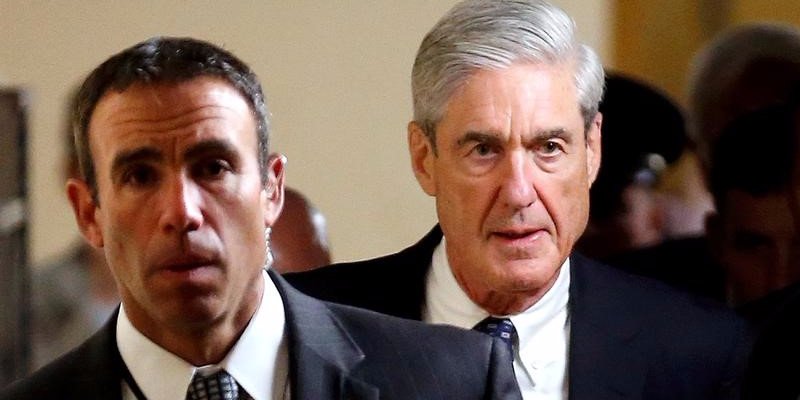
Veteran FBI agent Peter Strzok - who headed up the Hillary Clinton email investigation, was dismissed from Mueller"s Trump-Russia probe in mid-August and relegated to the FBI"s Human Resources department, after the DOJ opened an inquiry into anti-Trump / pro-Clinton text messages Strzok sent to his Trump-hating mistress - FBI lawyer Lisa Page, while the two were working together on the Clinton probe. Page was also fired from the Mueller investigation into Russian meddling earlier this year.
Strzok"s conduct in the Clinton investigation is now under review by the Justice Department, along with his role in a number of other politically sensitive cases, according to Fox News.
"While Strzok’s removal from the Mueller team had been publicly reported in August, the Justice Department never disclosed the anti-Trump texts to the House investigators."
"Responding to the revelations about Strzok’s texts on Saturday, Nunes said he has now directed his staff to draft contempt-of-Congress citations against Rosenstein and the new FBI director, Christopher Wray." -Fox News
Of relevance - Strzok concluded that Hillary Clinton was "careless," in her mishandling of classified information, yet found "no proof of intent," an opinion which former FBI director James Comey based his recommendation not to prosecute. Comey, as it turns out, drafted Clinton"s exoneration letter long before the FBI had finished reviewing evidence in the case.
Strzok"s team and the Trump-Russia dossier...
In August, 2016 - nine months before Trump fired Comey which led to the creation of Robert Mueller"s Special Counsel, the New York Times reported that Strzok was hand picked by FBI brass to supervise an investigation into allegations of Trump-Russia collusion.
The FBI investigation grew legs after they received the infamous anti-Trump "dossier" and decided to act on its salacious and largely unproven claims, According to Fox News:
House investigators told Fox News they have long regarded Strzok as a key figure in the chain of events when the bureau, in 2016, received the infamous anti-Trump "dossier" and launched a counterintelligence investigation into Russian meddling in the election that ultimately came to encompass FISA surveillance of a Trump campaign associate.
The "dossier" was a compendium of salacious and largely unverified allegations about then-candidate Trump and others around him that was compiled by the opposition research firm Fusion GPS. The firm"s bank records, obtained by House investigators, revealed that the project was funded by the Clinton campaign and the Democratic National Committee. -Fox News
Dead ends
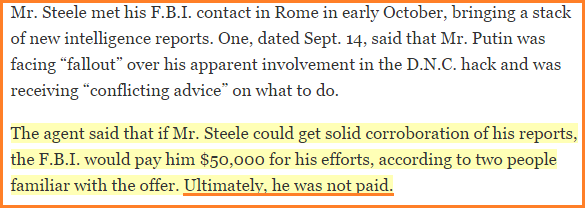
Weeks before the 2016 Presidential election, Strzok"s team agreed to pay former MI6 agent and Fusion GPS operative Christopher Steele $50,000 if he could verify his claims that the agency had already used to take action. Of note, Fusion separately paid Steele $168,000 to assemble the dossier which had the cooperation of two senior Kremlin officials.
The agent said that if Mr. Steele could get solid corroboration of his reports, the F.B.I. would pay him $50,000 for his efforts, according to two people familiar with the offer.
One report, filled with references to secret meetings, spoke ominously of Mr. Trump’s “compromising relationship with the Kremlin” and threats of “blackmail.”
He [Steele] provided the documents to an F.B.I. contact in Europe on the same day as Mr. Comey’s news conference about Mrs. Clinton. It took weeks for this information to land with Mr. Strzok and his team. -NYT
After meeting with the FBI in October to deliver a "stack of new intelligence reports," the agency ultimately decided not to pay Steele because he could not corroborate the information he had provided.
Never let a dodgy dossier get in the way of a good witch hunt!
Despite such a low level of confidence in Steele"s dossier that they didn"t pay him, the FBI used the document to obtain a FISA surveillance warrant on one-time Trump foreign-policy advisor Carter Page - who was described as having a "secret meeting" with Putin associate Igor Sechin and Deputy Chief for International Policy, Igor Diveykin during a July 2016 trip to Moscow to deliver a commencement speech.
Not true according to Page
While Page did travel to Moscow to deliver a commencement speech, he told the House Intelligence Committee that he"s never heard of Diveykin nor met with any of the men mentioned in the dossier.
Page did testify that he spoke with Russia"s deputy prime minister, Arkadiy Dvorkovich, who was in attendance at the commencement ceremony. Upon his return, Page relayed their meeting in a memo to the Trump campaign, writing “In a private conversation, Dvorkovich expressed strong support for Mr. Trump and a desire to work together toward devising better solutions in response to the vast range of current international problems.”
Page claims he hadn"t spoken more than a few words to Dvorkovich, and had instead gained insight into the Russian"s opinion from listening to the Russian"s speeches.
Back on point
We now know that the original, pre-Mueller FBI investigation into Trump-Russia collusion was spearheaded by Peter Strzok - an anti-Trump senior FBI agent who was fired for sending anti-Trump / pro-Clinton text messages to his mistress during their investigation into Hillary Clinton"s mishandling of classified information.
We also know that the FBI probe led by Strzok relied on the salacious 34-page Steele dossier, paid for in part by Hillary Clinton and the DNC, to launch their Trump-Russia investigation and obtain a FISA warrant on Carter Page.
This raises a multitude of questions about Strzok, the Clinton email investigation, and any other politically charged cases he"s worked on - which are now under review by the DOJ"s Office of Personnel Management.
And while Strzok is stapling cover sheets on TPS reports in the FBI"s HR department, it is of particular interest that House Intelligence Committee Chairman Devin Nunes is also honing in on Rod Rosenstein and the new FBI director, Christopher Wray for their roles in the decision to withhold the reasons for Strzok"s dismissal in August.
And none of Strzok"s partisan hackery would have come to light under Madame President...

Anti-Trump FBI Agent Fired From Mueller Probe Relied On Russian Dossier
Submitted by ZeroPointNow of IBankCoin

Veteran FBI agent Peter Strzok - who headed up the Hillary Clinton email investigation, was dismissed from Mueller"s Trump-Russia probe in mid-August and relegated to the FBI"s Human Resources department, after the DOJ opened an inquiry into anti-Trump / pro-Clinton text messages Strzok sent to his Trump-hating mistress - FBI lawyer Lisa Page, while the two were working together on the Clinton probe. Page was also fired from the Mueller investigation into Russian meddling earlier this year.
Strzok"s conduct in the Clinton investigation is now under review by the Justice Department, along with his role in a number of other politically sensitive cases, according to Fox News.
"While Strzok’s removal from the Mueller team had been publicly reported in August, the Justice Department never disclosed the anti-Trump texts to the House investigators."
"Responding to the revelations about Strzok’s texts on Saturday, Nunes said he has now directed his staff to draft contempt-of-Congress citations against Rosenstein and the new FBI director, Christopher Wray." -Fox News
Of relevance - Strzok concluded that Hillary Clinton was "careless," in her mishandling of classified information, yet found "no proof of intent," an opinion which former FBI director James Comey based his recommendation not to prosecute. Comey, as it turns out, drafted Clinton"s exoneration letter long before the FBI had finished reviewing evidence in the case.
Strzok"s team and the Trump-Russia dossier...
In August, 2016 - nine months before Trump fired Comey which led to the creation of Robert Mueller"s Special Counsel, the New York Times reported that Strzok was hand picked by FBI brass to supervise an investigation into allegations of Trump-Russia collusion.
The FBI investigation grew legs after they received the infamous anti-Trump "dossier" and decided to act on its salacious and largely unproven claims, According to Fox News:
House investigators told Fox News they have long regarded Strzok as a key figure in the chain of events when the bureau, in 2016, received the infamous anti-Trump "dossier" and launched a counterintelligence investigation into Russian meddling in the election that ultimately came to encompass FISA surveillance of a Trump campaign associate.
The "dossier" was a compendium of salacious and largely unverified allegations about then-candidate Trump and others around him that was compiled by the opposition research firm Fusion GPS. The firm"s bank records, obtained by House investigators, revealed that the project was funded by the Clinton campaign and the Democratic National Committee. -Fox News
Dead ends
Weeks before the 2016 Presidential election, Strzok"s team agreed to pay former MI6 agent and Fusion GPS operative Christopher Steele $50,000 if he could verify his claims that the agency had already used to take action. Of note, Fusion separately paid Steele $168,000 to assemble the dossier which had the cooperation of two senior Kremlin officials.
The agent said that if Mr. Steele could get solid corroboration of his reports, the F.B.I. would pay him $50,000 for his efforts, according to two people familiar with the offer.
One report, filled with references to secret meetings, spoke ominously of Mr. Trump’s “compromising relationship with the Kremlin” and threats of “blackmail.”
He [Steele] provided the documents to an F.B.I. contact in Europe on the same day as Mr. Comey’s news conference about Mrs. Clinton. It took weeks for this information to land with Mr. Strzok and his team. -NYT
After meeting with the FBI in October to deliver a "stack of new intelligence reports," the agency ultimately decided not to pay Steele because he could not corroborate the information he had provided.
Never let a dodgy dossier get in the way of a good witch hunt!
Despite such a low level of confidence in Steele"s dossier that they didn"t pay him, the FBI used the document to obtain a FISA surveillance warrant on one-time Trump foreign-policy advisor Carter Page - who was described as having a "secret meeting" with Putin associate Igor Sechin and Deputy Chief for International Policy, Igor Diveykin during a July 2016 trip to Moscow to deliver a commencement speech.
Not true according to Page
While Page did travel to Moscow to deliver a commencement speech, he told the House Intelligence Committee that he"s never heard of Diveykin nor met with any of the men mentioned in the dossier.
Page did testify that he spoke with Russia"s deputy prime minister, Arkadiy Dvorkovich, who was in attendance at the commencement ceremony. Upon his return, Page relayed their meeting in a memo to the Trump campaign, writing “In a private conversation, Dvorkovich expressed strong support for Mr. Trump and a desire to work together toward devising better solutions in response to the vast range of current international problems.”
Page claims he hadn"t spoken more than a few words to Dvorkovich, and had instead gained insight into the Russian"s opinion from listening to the Russian"s speeches.
Back on point
We now know that the original, pre-Mueller FBI investigation into Trump-Russia collusion was spearheaded by Peter Strzok - an anti-Trump senior FBI agent who was fired for sending anti-Trump / pro-Clinton text messages to his mistress during their investigation into Hillary Clinton"s mishandling of classified information.
We also know that the FBI probe led by Strzok relied on the salacious 34-page Steele dossier, paid for in part by Hillary Clinton and the DNC, to launch their Trump-Russia investigation and obtain a FISA warrant on Carter Page.
This raises a multitude of questions about Strzok, the Clinton email investigation, and any other politically charged cases he"s worked on - which are now under review by the DOJ"s Office of Personnel Management.
And while Strzok is stapling cover sheets on TPS reports in the FBI"s HR department, it is of particular interest that House Intelligence Committee Chairman Devin Nunes is also honing in on Rod Rosenstein and the new FBI director, Christopher Wray for their roles in the decision to withhold the reasons for Strzok"s dismissal in August.



Thursday, November 30, 2017
AWAN CASE: DNC Lawyer Scrambling To Block Evidence From Hidden Laptop Tied To Wasserman Schultz
Content originally published at iBankCoin.com
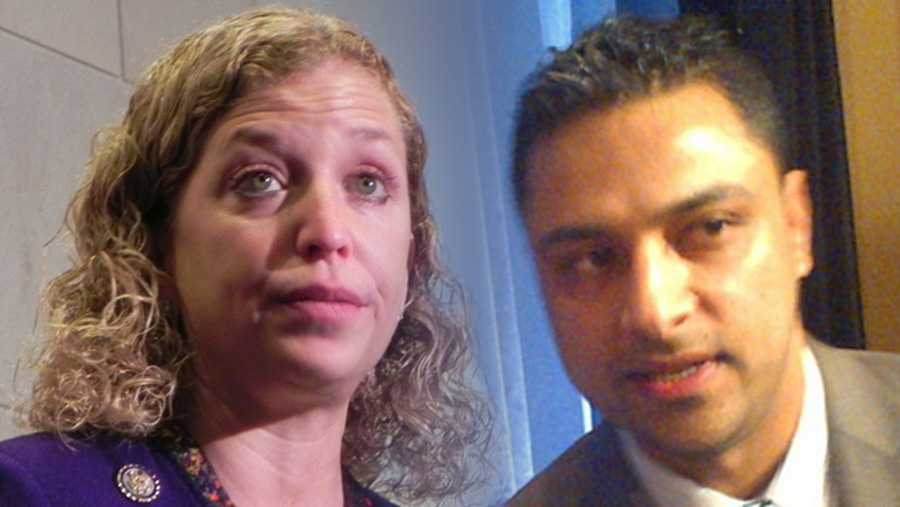
Awan, a Pakistani national, worked for dozens of Democratic members of Congress along with his wife, two brothers and a friend. Following the publication of DNC emails by WikiLeaks in the lead-up to the 2016 election, Congressional investigators discovered that the Awans had a secret server being housed by the House Democratic Caucus backed up to an offsite Dropbox account.
“For members to say their data was not compromised is simply inaccurate. They had access to all the data including all emails. Imran Awan is the walking example of an insider threat, a criminal actor who had access to everything,” -Daily Caller
According to a briefing, "all five of the shared employees system administrators collectively logged onto the [House Democratic] Caucus system 5,735 times, or an average of 27 times per day,” despite only one of them being authorized to do so.
The Awans were banned from the House IT network on February 2, 2017 after being named in a criminal investigation - however they continued to work in the building for Congresswoman Debbie Wasserman Schultz until Imran Awan"s arrest at Dulles Airport trying to flee the country in late July. Awan and his wife, Hina Alvi, were charged with conspiracy and bank fraud in relation to a real estate transaction.
The laptop in question was tucked away in a tiny room formerly used as a phone booth on the second floor of the Rayburn House Office Building late one night in March, only to be found by Capitol Police just after midnight on April 6, 2017 along with notebooks marked "attorney client privilege," letters addressed to the US Attorney of DC regarding Debbie Wasserman Schultz, and several forms of identification. Based on the contents of the backpack, some believe Awan wanted the laptop to be found.
Attorney-Client Privilege
Luke Rosiak of the Daily Caller, who has been tracking the Awan case, reports that Awan"s attorney Chris Gowen - a former aide to Hillary Clinton, is seeking to block the laptop evidence by arguing the "attorney client privilege" note attached to the notebook found with the laptop covers the contents of the hard drive, according to court papers filed Tuesday.
Via the Daily Caller:
"Chris Gowen, Awan’s attorney, said at the last hearing: “We do expect there being an attorney-client privilege issue in this case… What occurred is a backpack from my client was found, he was trying to get a better signal, there was a note that said attorney client privilege and a hard drive. We feel very strongly about this.”
A Capitol Police report reveals the following items were found in the backpack:
#1 a Pakistani ID card with the name Mohommed Ashraf Awan
#2 a copy – not original – of a driver’s license with name Imran Awan
#3 a copy (front and back) of his congressional ID
#4 an Apple laptop with the homescreen initials ‘RepDWS’
#5 composition notebooks with notes handwritten saying ‘attorney client privilege’ and possibly discussing case details below
#6 loose letters addressed to US Attorney of DC discussing the apparent owner of the bag being investigated.
As Rosiak points out, it is unclear how the handwritten note saying "attorney client privilege" could be construed to cover a hard drive, rather than the pages of [the] notebook it was contained on.
Andrew McCarthy, a former chief assistant U.S. attorney who has followed the case, said “The A/C (attorney-client) privilege only applies to communications between the client and lawyer that are for the purpose of seeking legal advice and that are intended by both parties to be kept confidential… Moreover, asserting that something is A/C protected does not make it so. You still have to show that the material in question constitutes communications strictly between the lawyer and client that were for the purpose of seeking legal advice.
“If I give my lawyer my bank records and ask him if they show evidence of a crime, the bank records do not become A/C-privileged — only his advice to me would be A/C-privileged. And if I stuck a sign on my bank records that said ‘A/C-privileged documents,’ that would not make them A/C-privileged documents,” he told The Daily Caller News Foundation Wednesday." -Daily Caller
Debbie Downer
In May of 2016, Debbie Wasserman Schulz - an employer and personal friend of Awan - spent several minutes browbeating the Chief of DC Capitol Police at a budget meeting, claiming the laptop should be given back since it was hers and threatening "consequences" if it wasn"t returned.
#DebbieWassermanSchultz threatens DC Police Chief over not returning Arwan Bros laptop. "there will be consequences" https://t.co/2phDMnvWq5 pic.twitter.com/e2wkBJSaim
— ZeroPointNow (@ZeroPointNow) May 25, 2017
Of Note
Also of note
The brothers were "shared employees," hired by multiple Democrats for IT work whenever it was needed - so they floated all over the place doing all sorts of work on House members computers. Democrats Juaquin Castro, Cedric Richmond, Andre Carson, Jackie Speier, Tammy Duckworth, and Louis Frankel all employed the Awans.
Information Brokers?
Judge Andrew Napolitano appeared on Fox Business Network in late July where he dropped a bombshell: not only did the Awans had access to the emails of every member of Congress, Imran Awan reportedly sold information to still unknown parties, which the FBI is currently investigating.
Napolitano: He was arrested for some financial crime - that"s the tip of the iceberg. The real allegation against him is that he had access to the emails of every member of congress and he sold what he found in there. What did he sell, and to whom did he sell it? That"s what the FBI wants to know. This may be a very, very serious national security situation.
Varney: Wait a second, he was the IT worker along with his two Pakistani brothers, for DWS, and other Democrats in the House - and the theory is that he got access to all of their secrets or whatever, and sold some?
Napolitano: Yes, and this was at the time that Congresswoman Schultz was also the chair of the Democratic National Committee. So at this point I don"t believe they know what he sold, and to whom he sold it - but they do know what he had access to, which is virtually everything in the House of representatives, which would include classified material in the House intelligence committee.
Lt. Colonel Tony Shaffer went even further - claiming that the Awan brothers were linked to the Muslim Brotherhood while working for Democrat Congressman Andre Carson, a report reinforced by Frontpage Magazine:
As Frontpage reported in February:
The office of Andre Carson, the second Muslim in Congress, had employed Imran Awan. As did the offices of Jackie Speier and Debbie Wasserman Schultz; to whom the letter had been addressed.
Carson is the second Muslim in Congress and the first Muslim on the House Permanent Select Committee on Intelligence and, more critically, is the ranking member on its Emerging Threats Subcommittee. He is also a member of the Department of Defense Intelligence and Overhead Architecture Subcommittee.
The Emerging Threats Subcommittee, of which Carson is a ranking member, is responsible for much of counterterrorism oversight. It is the worst possible place for a man with Carson’s credentials.
Carson had inherited his grandmother’s seat and exploited it to promote a radical Islamist agenda. He has interfaced with a laundry list of Islamist groups from CAIR to ISNA to ICNA to MPAC. Islamists have funded Carson’s career to the tune of tens of thousands of dollars. The Center for Security Policy has put together a dossier of Carson’s connections to the Muslim Brotherhood. The Brotherhood is the parent organization of many key Islamic terror groups posing a threat to our national security including Al Qaeda and Hamas.
Andre Carson shared the stage at a CAIR banquet with Sirraj Wahaj: an unindicted co-conspirator in the World Trade Center bombing who had once declared,” You don’t get involved in politics because it’s the American thing to do. You get involved in politics because politics are a weapon to use in the cause of Islam.” CAIR itself had been named an unindicted co-conspirator in terror finance.
Immunity for Hina?
In September, it was reported that Hina Alvi - Imran Awan"s wife, had struck a deal with federal prosecutors to return to the U.S. from Pakistan to face conspiracy and bank fraud charges.
Alvi and her children fled to the safety of Pakistan in early 2017, so her voluntary return - which was structured with an arrest to be made "not in front of her children" is significant. Upon her return to the United States, Hina was arraigned on four felony counts of bank fraud and handed over her U.S. passport to prosecutors.
Congressman Trent Franks (R-AZ) says that Alvi"s return may be part of a broader immunity deal with prosecutors in return for a "significant" and "pretty disturbing" story about Debbie Wasserman Schultz:
“I don’t want to talk out of school here but I think you"re going to see some revelations that are going to be pretty profound. The fact that this wife is coming back from Pakistan and is willing to face charges, as it were, I think there is a good chance she is going to reach some type of immunity to tell a larger story here that is going to be pretty disturbing to the American people.”
"I would just predict that this is going to be a very significant story and people should fasten their seat belts on this one."
Despite the volumes of evidence stacking up against the former DNC IT staffers, Debbie Wasserman Schultz claims the entire investigation of the Awans is nothing more than Islamophobia.
Follow on Twitter @ZeroPointNow § Subscribe to our YouTube channel

Subscribe to:
Posts (Atom)