Showing posts with label black propaganda. Show all posts

Friday, October 20, 2017

Blaming Russia For The Internet "Sewer"

Authored by Robert Parry via ConsortiumNews.com,


As the Russia-gate hysteria spirals down from the implausible to the absurd, almost every bad thing is blamed on the Russians, even how they turned the previously pristine Internet into a "sewer"...


With the U.S. government offering tens of millions of dollars to combat Russian “propaganda and disinformation,” it’s perhaps not surprising that we see “researchers” such as Jonathan Albright of the Tow Center for Digital Journalism at Columbia University making the absurd accusation that the Russians have “basically turned [the Internet] into a sewer.”


Tomb of the Unknown Soldier outside the Kremlin wall in Moscow, Dec. 6, 2016. (Photo by Robert Parry)


I’ve been operating on the Internet since 1995 and I can assure you that the Internet has always been “a sewer” - in that it has been home to crazy conspiracy theories, ugly personal insults, click-bait tabloid “news,” and pretty much every vile prejudice you can think of. Whatever some Russians may or may not have done in buying $100,000 in ads on Facebook (compared to its $27 billion in annual revenue) or opening 201 Twitter accounts (out of Twitter’s 328 million monthly users), the Russians are not responsible for the sewage coursing through the Internet.


Americans, Europeans, Asians, Africans and pretty much every other segment of the world’s population didn’t need Russian help to turn the Internet into an informational “sewer.” But, of course, fairness and proportionality have no place in today’s Russia-gate frenzy.


After all, your “non-governmental organization” or your scholarly “think tank” is not likely to get a piece of the $160 million that the U.S. government authorized last December to counter primarily Russian “propaganda and disinformation” if you explain that the Russians are at most responsible for a tiny trickle of “sewage” compared to the vast rivers of “sewage” coming from many other sources.


If you put the Russia-gate controversy in context, you also are not likely to have your “research” cited by The Washington Post as Albright did on Thursday because he supposedly found some links at the home-décor/fashion site Pinterest to a few articles that derived from a few of the 470 Facebook accounts and pages that Facebook suspects of having a link to Russia and shut them down. (To put that 470 number into perspective, Facebook has about two billion monthly users.)


Albright’s full quote about the Russians allegedly exploiting various social media platforms on the Internet was: “They’ve gone to every possible medium and basically turned it into a sewer.”


But let’s look at the facts. According to Facebook, the suspected “Russian-linked” accounts purchased $100,000 in ads from 2015 to 2017 (compared to Facebook’s annual revenue of about $27 billion), with only 44 percent of those ads appearing before the 2016 election and many having little or nothing to do with politics, which is curious if the Kremlin’s goal was to help elect Donald Trump and defeat Hillary Clinton.


Even former Clinton political strategist Mark Penn has acknowledged the absurdity of thinking that such piddling amounts could have any impact on a $2.4 billion presidential campaign, plus all the billions of dollars worth of free-media attention to the conventions, debates, etc. Based on what’s known about the Facebook ads, Penn calculated that “the actual electioneering [in battleground states] amounts to about $6,500.”


In a Wall Street Journal op-ed on Monday, Penn added, “I have 40 years of experience in politics, and this Russian ad buy mostly after the election anyway, simply does not add up to a carefully targeted campaign to move voters. It takes tens of millions of dollars to deliver meaningful messages to the contested portion of the electorate.”


Puppies and Pokemon


And, then there is the curious content. According to The New York Times, one of these “Russian-linked” Facebook groups was dedicated to photos of “adorable puppies.” Of course, the Times tried hard to detect some sinister motive behind the “puppies” page.


The New York Times building in Manhattan. (Photo credit: Robert Parry)


Similarly, CNN went wild over its own “discovery” that one of the “Russian-linked” pages offered Amazon gift cards to people who found “Pokémon Go” sites near scenes where police shot unarmed black men - if you would name the Pokémon after the victims.


“It’s unclear what the people behind the contest hoped to accomplish, though it may have been to remind people living near places where these incidents had taken place of what had happened and to upset or anger them,” CNN mused, adding:


“CNN has not found any evidence that any Pokémon Go users attempted to enter the contest, or whether any of the Amazon Gift Cards that were promised were ever awarded — or, indeed, whether the people who designed the contest ever had any intention of awarding the prizes.”


So, these dastardly Russians are exploiting “adorable puppies” and want to “remind people” about unarmed victims of police violence, clearly a masterful strategy to undermine American democracy or – according to the original Russia-gate narrative – to elect Donald Trump.


A New York Times article on Wednesday acknowledged another inconvenient truth that unintentionally added more perspective to the Russia-gate hysteria.


It turns out that some of the mainstream media’s favorite “fact-checking” organizations are home to Google ads that look like news items and lead readers to phony sites dressed up to resemble People, Vogue or other legitimate content providers.


“None of the stories were true,” the Times reported. “Yet as recently as late last week, they were being promoted with prominent ads served by Google on PolitiFact and Snopes, fact-checking sites created precisely to dispel such falsehoods.”


There is obvious irony in PolitiFact and Snopes profiting off “fake news” by taking money for these Google ads. But this reality also underscores the larger reality that fabricated news articles – whether peddling lies about Melania Trump or a hot new celebrity or outlandish Russian plots – are driven principally by the profit motive.


The Truth About Fake News


Occasionally, the U.S. mainstream media even acknowledges that fact. For instance, last November, The New York Times, which was then flogging the Russia-linked “fake news” theme, ran a relatively responsible article about a leading “fake news” Web site that the Times tracked down. It turned out to be an entrepreneurial effort by an unemployed Georgian student using a Web site in Tbilisi to make some money by promoting pro-Trump stories, whether true or not.


Hillary Clinton at the Code 2017 conference on May 31, 2017


The owner of the Web site, 22-year-old Beqa Latsabidse, said he had initially tried to push stories favorable to Hillary Clinton but that proved unprofitable so he switched to publishing anti-Clinton and pro-Trump articles, including made-up stories. In other words, the Times found no Russian connection.


The Times article on Wednesday revealed the additional problem of  Google ads placed on mainstream Internet sites leading readers to bogus news sites to get clicks and thus advertising dollars. And, it turns out that PolitiFact and Snopes were at least unwittingly profiting off these entrepreneurial ventures by running their ads. Again, there was no claim here of Russian “links.” It was all about good ole American greed.


But the even larger Internet problem is that many “reputable” news sites, such as AOL, lure readers into clicking on some sensationalistic or misleading headline, which takes readers to a story that is often tabloid trash or an extreme exaggeration of what the headline promised.


This reality about the Internet should be the larger context in which the Russia-gate story plays out, the miniscule nature of this Russian “meddling” even if these “suspected … links to Russia” – as the Times initially described the 470 Facebook pages – turn out to be true.


But there are no lucrative grants going to “researchers” who would put the trickle of alleged Russian “sewage” into the context of the vast flow of Internet “sewage” that is even flowing through the esteemed “fact-checking” sites of PolitiFact and Snopes.


There are also higher newspaper sales and better TV ratings if the mainstream media keeps turning up new angles on Russia-gate, even as some of the old ones fall away as inconsequential or meaningless (such as the Senate Intelligence Committee dismissing earlier controversies over Sen. Jeff Sessions’s brief meeting with the Russian ambassador at the Mayflower Hotel and minor changes in the Republican platform).


Saying ‘False’ Is ‘True’


And, there is the issue of who decides what’s true. PolitiFact continues to defend its false claim that Hillary Clinton was speaking the truth when – in referencing leaked Democratic emails last October – she claimed that the 17 U.S. intelligence agencies “have all concluded that these espionage attacks, these cyberattacks, come from the highest levels of the Kremlin, and they are designed to influence our election.”


Director of National Intelligence James Clapper (right) talks with President Barack Obama in the Oval Office, with John Brennan and other national security aides present. (Photo credit: Office of Director of National Intelligence)


That claim was always untrue because a reference to a consensus of the 17 intelligence agencies suggests a National Intelligence Estimate or similar product that seeks the judgments of the entire intelligence community. No NIE or community-wide study was ever done on this topic.


Only later – in January 2017 – did a small subset of the intelligence community, what Director of National Intelligence James Clapper described as “hand-picked” analystsfrom three agencies – the Central Intelligence Agency, National Security Agency and Federal Bureau of Investigation – issue an “assessment” blaming the Russians while acknowledging a lack of actual evidence.


In other words, the Jan. 6 “assessment” was comparable to the “stovepiped” intelligence that influenced many of the mistaken judgments of President George W. Bush’s administration. In “stovepiped” intelligence, a selected group of analysts is closeted away and develops judgments without the benefit of other experts who might offer contradictory evidence or question the groupthink.


So, in many ways, Clinton’s statement was the opposite of true both when she said it in 2016 and later in 2017 when she repeated it in direct reference to the Jan. 6 assessment. If PolitiFact really cared about facts, it would have corrected its earlier claim that Clinton was telling the truth, but the fact-checking organization wouldn’t budge — even after The New York Times and The Associated Press ran corrections.


In this context, PolitiFact showed its contempt even for conclusive evidence – testimony from former DNI Clapper (corroborated by former CIA Director John Brennan) that the 17-agency claim was false. Instead, PolitiFact was determined to protect Clinton’s false statement from being described for what it was: false.


Of course, maybe PolitiFact is suffering from the arrogance of its elite status as an arbiter of truth with its position on Google’s First Draft coalition, a collection of mainstream news outlets and fact-checkers which gets to decide what information is true and what is not true — for algorithms that then will exclude or downplay what’s deemed “false.”


So, if PolitiFact says something is true – even if it’s false – it becomes “true.” Thus, it’s perhaps not entirely ironic that PolitiFact would collect money from Google ads placed on its site by advertisers of fake news.


Monday, October 16, 2017

The Legacy Of Reagan's Civilian 'PsyOps'

Authored by Robert Parry via ConsortiumNews.com,


When the Reagan administration launched peacetime “psyops” in the mid-1980s, it pulled in civilian agencies to help spread these still-ongoing techniques of deception and manipulation...


Declassified records from the Reagan presidential library show how the U.S. government enlisted civilian agencies in psychological operations designed to exploit information as a way to manipulate the behavior of targeted foreign audiences and, at least indirectly, American citizens.


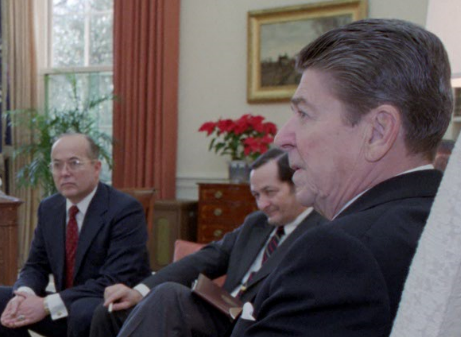
Walter Raymond Jr., a CIA propaganda and disinformation specialist who oversaw President Reagan’s “psyops” and “perception management” projects at the National Security Council. Raymond is partially obscured by President Reagan. Raymond is seated next to National Security Adviser John Poindexter. (Photo credit: Reagan presidential library)


A just-declassified sign-in sheet for a meeting of an inter-agency “psyops” committee on Oct. 24, 1986, shows representatives from the Agency for International Development (USAID), the State Department, and the U.S. Information Agency (USIA) joining officials from the Central Intelligence Agency and the Defense Department.


Some of the names of officials from the CIA and Pentagon remain classified more than three decades later. But the significance of the document is that it reveals how agencies that were traditionally assigned to global development (USAID) or international information (USIA) were incorporated into the U.S. government’s strategies for peacetime psyops, a military technique for breaking the will of a wartime enemy by spreading lies, confusion and terror.


Essentially, psyops play on the cultural weaknesses of a target population so they could be more easily controlled or defeated, but the Reagan administration was taking the concept outside the traditional bounds of warfare and applying psyops to any time when the U.S. government could claim some threat to America.


This disclosure – bolstered by other documents released earlier this year by archivists at the Reagan library in Simi Valley, California – is relevant to today’s frenzy over alleged “fake news” and accusations of “Russian disinformation” by reminding everyone that the U.S. government was active in those same areas.


The U.S. government’s use of disinformation and propaganda is, of course, nothing new. For instance, during the 1950s and 1960s, the USIA regularly published articles in friendly newspapers and magazines that appeared under fake names such as Guy Sims Fitch.


However, in the 1970s, the bloody Vietnam War and the Pentagon Papers’ revelations about U.S. government deceptions to justify that war created a crisis for American propagandists, their loss of credibility with the American people. Some of the traditional sources of U.S. disinformation, such as the CIA, also fell into profound disrepute.


This so-called “Vietnam Syndrome” – a skeptical citizenry dubious toward U.S. government claims about foreign conflicts – undermined President Reagan’s efforts to sell his plans for intervention in the civil wars then underway in Central America, Africa and elsewhere.


Reagan depicted Central America as a “Soviet beachhead,” but many Americans saw haughty Central American oligarchs and their brutal security forces slaughtering priests, nuns, labor activists, students, peasants and indigenous populations.


Reagan and his advisers realized that they had to turn those perceptions around if they hoped to get sustained funding for the militaries of El Salvador, Guatemala and Honduras as well as for the Nicaraguan Contra rebels, the CIA-organized paramilitary force marauding around leftist-ruled Nicaragua.


Perception Management


So, it became a high priority to reshape public perceptions inside those targeted countries but even more importantly among the American people. That challenge led the Reagan administration to revitalize and reorganize methods for distributing propaganda and funding friendly foreign operatives, such as creation of the National Endowment for Democracy under neoconservative president Carl Gershman in 1983.


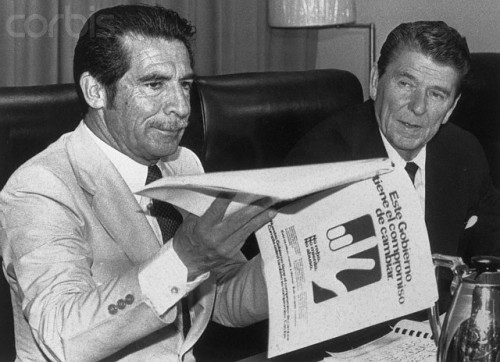
President Ronald Reagan meeting with Guatemalan dictator Efrain Rios Montt, who later faced accusations of genocide against Indian populations in the central highlands.


Another entity in this process was the Psychological Operations Committee formed in 1986 under Reagan’s National Security Council. In the years since, the U.S. administrations, both Republican and Democratic, have applied many of these same psyops principles, cherry-picking or manufacturing evidence to undermine adversaries and to solidify U.S. public support for Washington’s policies.


This reality – about the U.S. government creating its own faux reality to manipulate the American people and international audiences – should compel journalists in the West to treat all claims from Washington with a large grain of salt.


However, instead, we have seen a pattern of leading news outlets simply amplifying whatever U.S. agencies assert about foreign adversaries while denouncing skeptics as purveyors of “fake news” or enemy “propaganda.” In effect, the success of the U.S. psyops strategy can be measured by how Western mainstream media has stepped forward as the enforcement mechanism to ensure conformity to the U.S. government’s various information themes and narratives.


For instance, any questioning of the U.S. government’s narratives on, say, the current Syrian conflict, or the Ukraine coup of 2014, or Russian “hacking” of the 2016 U.S. election, or Iran’s status as “the leading sponsor of terrorism” is treated by the major Western news outlets as evidence that you are a “useful fool” at best, if not a willful enemy “propagandist” with loyalty to a foreign power, i.e., a traitor.


Leading mainstream media outlets and establishment-approved Web sites are now teaming up with Google, Facebook and other technology companies to develop algorithms to bury or remove content from the Internet that doesn’t march in lockstep with what is deemed to be true, which often simply follows what U.S. government agencies say is true.


Yet, the documentary evidence is now clear that the U.S. government undertook a well-defined strategy of waging psyops around the world with regular blowback of this propaganda and disinformation onto the American people via Western news agencies covering events in the affected countries.


During more recent administrations, euphemisms have been used to cloak the more pejorative phrase, “psychological operations” – such as “public diplomacy,” “strategic communications,” “perception management,” and “smart power.” But the serious push to expand this propaganda capability of the U.S. government can be traced back to the Reagan presidency.


The Puppet Master


Over the years, I’ve obtained scores of documents related to the psyops and related programs via “mandatory declassification reviews” of files belonging to Walter Raymond Jr., a senior CIA covert operations specialist who was transferred to Reagan’s National Security Council staff in 1982 to rebuild capacities for psyops, propaganda and disinformation.


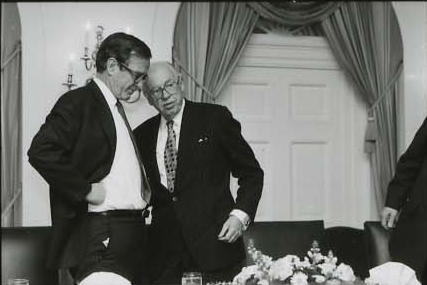
Then-Vice President George H.W. Bush with CIA Director William Casey at the White House on Feb. 11, 1981. (Photo credit: Reagan Library)


Raymond, who has been compared to a character from a John LeCarré novel slipping easily into the woodwork, spent his years inside Reagan’s White House as a shadowy puppet master who tried his best to avoid public attention or – it seems – even having his picture taken.


From the tens of thousands of photographs from meetings at Reagan’s White House, I found only a couple showing Raymond – and he is seated in groups, partially concealed by other officials.


But Raymond appears to have grasped his true importance. In his NSC files, I found a doodle of an organizational chart that had Raymond at the top holding what looks like the crossed handles used by puppeteers to control the puppets below them. The drawing fits the reality of Raymond as the behind-the-curtains operative who was controlling the various inter-agency task forces that were responsible for implementing psyops and other propaganda strategies.


In Raymond’s files, I found an influential November 1983 paper, written by Col. Alfred R. Paddock Jr. and entitled “Military Psychological Operations and US Strategy,” which stated: “the planned use of communications to influence attitudes or behavior should, if properly used, precede, accompany, and follow all applications of force. Put another way, psychological operations is the one weapons system which has an important role to play in peacetime, throughout the spectrum of conflict, and during the aftermath of conflict.”


Paddock continued, “Military psychological operations are an important part of the ‘PSYOP Totality,’ both in peace and war. … We need a program of psychological operations as an integral part of our national security policies and programs. … The continuity of a standing interagency board or committee to provide the necessary coordinating mechanism for development of a coherent, worldwide psychological operations strategy is badly needed.”


One declassified “top secret” document in Raymond’s file – dated Feb. 4, 1985, from Secretary of Defense Caspar Weinberger – urged the fuller implementation of President Reagan’s National Security Decision Directive 130, which was signed on March 6, 1984, and which authorized peacetime psyops by expanding psyops beyond its traditional boundaries of active military operations into peacetime situations in which the U.S. government could claim some threat to national interests.


“This approval can provide the impetus to the rebuilding of a necessary strategic capability, focus attention on psychological operations as a national – not solely military – instrument, and ensure that psychological operations are fully coordinated with public diplomacy and other international information activities,” Weinberger’s document said.


An Inter-Agency Committee


This broader commitment to psyops led to the creation of a Psychological Operations Committee (POC) that was to be chaired by a representative of Reagan’s National Security Council with a vice chairman from the Pentagon and with representatives from CIA, the State Department and USIA.


CIA seal in lobby of the spy agency’s headquarters. (U.S. government photo)


“This group will be responsible for planning, coordinating and implementing psychological operations activities in support of United States policies and interests relative to national security,” according to a “secret” addendum to a memo, dated March 25, 1986, from Col. Paddock, the psyops advocate who had become the U.S. Army’s Director for Psychological Operations.


“The committee will provide the focal point for interagency coordination of detailed contingency planning for the management of national information assets during war, and for the transition from peace to war,” the addendum added.


“The POC shall seek to ensure that in wartime or during crises (which may be defined as periods of acute tension involving a threat to the lives of American citizens or the imminence of war between the U.S. and other nations), U.S. international information elements are ready to initiate special procedures to ensure policy consistency, timely response and rapid feedback from the intended audience.”


In other words, the U.S. government could engage in psyops virtually anytime because there are always “periods of acute tension involving a threat to the lives of American citizens.”


The Psychological Operations Committee took formal shape with a “secret” memo from Reagan’s National Security Advisor John Poindexter on July 31, 1986. Its first meeting was called on Sept. 2, 1986, with an agenda that focused on Central America and “How can other POC agencies support and complement DOD programs in El Salvador, Guatemala, Honduras, Costa Rica and Panama.” The POC was also tasked with “Developing National PSYOPS Guidelines” for “formulating and implementing a national PSYOPS program.” (Underlining in original)


Raymond was named a co-chair of the POC along with CIA officer Vincent Cannistraro, who was then Deputy Director for Intelligence Programs on the NSC staff, according to a “secret” memo from Deputy Under Secretary of Defense Craig Alderman Jr.


The memo also noted that future POC meetings would be briefed on psyops projects for the Philippines and Nicaragua, with the latter project codenamed “Niagara Falls.” The memo also references a “Project Touchstone,” but it is unclear where that psyops program was targeted.


Another “secret” memo dated Oct. 1, 1986, co-authored by Raymond, reported on the POC’s first meeting on Sept. 10, 1986, and noted that “The POC will, at each meeting, focus on an area of operations (e.g., Central America, Afghanistan, Philippines).”


The POC’s second meeting on Oct. 24, 1986 – for which the sign-in sheet was just released – concentrated on the Philippines, according to a Nov. 4, 1986 memo also co-authored by Raymond.


But the Reagan administration’s primary attention continued to go back to Central America, including “Project Niagara Falls,” the psyops program aimed at Nicaragua. A “secret” Pentagon memo from Deputy Under Secretary Alderman on Nov. 20, 1986, outlined the work of the 4th Psychological Operations Group on this psyops plan “to help bring about democratization of Nicaragua,” by which the Reagan administration meant a “regime change.” The precise details of “Project Niagara Falls” were not disclosed in the declassified documents but the choice of codename suggested a cascade of psyops.


Key Operatives


Other documents from Raymond’s NSC file shed light on who other key operatives in the psyops and propaganda programs were. For instance, in undated notes on efforts to influence the Socialist International, including securing support for U.S. foreign policies from Socialist and Social Democratic parties in Europe, Raymond cited the efforts of “Ledeen, Gershman,” a reference to neoconservative operative Michael Ledeen and Carl Gershman, another neocon who has served as president of the U.S.-government-funded National Endowment for Democracy (NED), from 1983 to the present. (Underlining in original.)


Carl Gershman, president of the National Endowment for Democracy.


Although NED is technically independent of the U.S. government, it receives the bulk of its funding (now about $100 million a year) from Congress. Documents from the Reagan archives also make clear that NED was organized as a way to replace some of the CIA’s political and propaganda covert operations, which had fallen into disrepute in the 1970s. Earlier released documents from Raymond’s file show CIA Director William Casey pushing for NED’s creation and Raymond, Casey’s handpicked man on the NSC, giving frequent advice and direction to Gershman. [See Consortiumnews.com’s “CIA’s Hidden Hand in ‘Democracy’ Groups.”]


While the initials USAID conjure up images of well-meaning Americans helping to drill wells, teach school and set up health clinics in impoverished nations, USAID also has kept its hand in financing friendly journalists around the globe.


In 2015, USAID issued a fact sheet summarizing its work financing “journalism education, media business development, capacity building for supportive institutions, and strengthening legal-regulatory environments for free media.” USAID estimated its budget for “media strengthening programs in over 30 countries” at $40 million annually, including aiding “independent media organizations and bloggers in over a dozen countries,”


In Ukraine before the 2014 coup, USAID offered training in “mobile phone and website security,” which sounds a bit like an operation to thwart the local government’s intelligence gathering, an ironic position for the U.S. with its surveillance obsession, including prosecuting whistleblowers based on evidence that they talked to journalists.


USAID, working with billionaire George Soros’s Open Society, also funded the Organized Crime and Corruption Reporting Project (OCCRP), which engages in “investigative journalism” that usually goes after governments that have fallen into disfavor with the United States and then are singled out for accusations of corruption.


The USAID-funded OCCRP also collaborates with Bellingcat, an online investigative website founded by blogger Eliot Higgins, who is now a senior non-resident fellow of the Atlantic Council, a pro-NATO think tank that receives funding from the U.S. and allied governments.


Higgins has spread misinformation on the Internet, including discredited claims implicating the Syrian government in the sarin attack in 2013 and directing an Australian TV news crew to what looked to be the wrong location for a video of a BUK anti-aircraft battery as it supposedly made its getaway to Russia after the shoot-down of Malaysia Airlines Flight 17 in July 2014.


Despite his dubious record of accuracy, Higgins has gained mainstream acclaim, in part, because his “findings” always match up with the propaganda theme that the U.S. government and its Western allies are peddling. Though most genuinely independent bloggers are ignored by the mainstream media, Higgins has found his work touted by both The New York Times and The Washington Post, and Google has included Bellingcat on its First Draft coalition, which will determine which news will be deemed real and which fake.


In other words, the U.S. government has a robust strategy for deploying direct and indirect agents of influence who are now influencing how the titans of the Internet will structure their algorithms to play up favored information and disappear disfavored information.


A Heritage of Lies


During the first Cold War, the CIA and the U.S. Information Agency refined the art of “information warfare,” including pioneering some of its current features like having ostensibly “independent” entities and cut-outs present U.S. propaganda to a cynical public that would reject much of what it hears from government but may trust “citizen journalists” and “bloggers.”


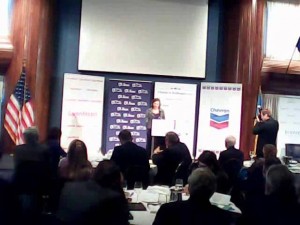
A screen shot of U.S. Assistant Secretary of State for European Affairs Victoria Nuland speaking to U.S. and Ukrainian business leaders on Dec. 13, 2013, at an event sponsored by Chevron, with its logo to Nuland’s left.


USIA, which was founded in 1953 and gained new life in the 1980s under its Reagan-appointed director Charles Wick, was abolished in 1999, but its propaganda functions were largely folded into the new office of Under Secretary of State for Public Diplomacy and Public Affairs, which became a new fount of disinformation.


For instance, in 2014, President Obama’s Under Secretary for Public Diplomacy Richard Stengel engaged in a series of falsehoods and misrepresentations regarding Russia’s RT network. In one instance, he claimed that the RT had made the “ludicrous assertion” that the U.S. had invested $5 billion in the regime change project in Ukraine. But that was an obvious reference to a public speech by U.S. Assistant Secretary of State for European Affairs Victoria Nuland on Dec. 13, 2013, in which she said “we have invested more than $5 billion” to help Ukraine to achieve its “European aspirations.”


Nuland also was a leading proponent of the Ukraine coup, personally cheering on the anti-government rioters. In an intercepted phone call with U.S. Ambassador to Ukraine Geoffrey Pyatt, Nuland discussed how “to glue” or “midwife this thing” and who the new leaders would be. She picked Arseniy Yatsenyuk – “Yats is the guy” – who ended up as Prime Minister after elected President Viktor Yanukovych was overthrown.


Despite all the evidence of a U.S.-backed coup, The New York Times simply ignored the evidence, including the Nuland-Pyatt phone call, to announce that there never was a coup. The Times’ obeisance to the State Department’s false narrative is a good example of how the legacy of Walter Raymond, who died in 2003, extends to the present.


Over several decades, even as the White House changed hands from Republicans to Democrats, the momentum created by Raymond continued to push the peacetime psyops strategy forward.


In more recent years, the wording of the program may have changed to more pleasing euphemisms. But the idea is the same: how you can use psyops, propaganda and disinformation to sell U.S. government policies abroad and at home.

Wednesday, August 9, 2017

The Creepiest EU Initiative Yet: Registering Dissent As "Russian Propaganda" Under Soros' Direction

Via GEFIRA,


Russia is the favourite scapegoat for the Western establishment when it comes to its own failures. Ever since Brexit and Trump’s victory, the Western elite has regularly tried to link citizen discontent to “Russian disinformation“, “hackers” or “trolls“, instead of looking at its own policies. While in the US this took the form of a witch hunt against the Trump administration, in the EU it has taken the form of a “proscription list” of the media that are not enthusiastic enough with the idea of a conflict with the Eastern neighbour. Under the official purpose of countering “disinformation coming from Russia”, the EU External Action has created a “disinformation review“with weekly updates on “fake news” and the websites that post them.


The EUAS officially branded researchers and journalists as fraudulent, unpatriotic and dishonest without any notification. There is a small disclaimer on the list that states that ”disinformation review cannot be considered an official EU position”. Yet it was created by the European Council, is part of the ”diplomatic service” of the EU, hence funded by it, uses its symbols and institutional addresses. So, it is part of the EU and yet does not represent its official position? The statement seems to have been made for the express purpose of dishonestly dismissing concerns raised by citizens.


By organising the naming and shaming list, the EUAS behaves like an authoritarian regime that operates out of the rule of law. Since freedom of the press is the basis for a reliable democracy, the EUAS is working against the values of the European Union:


  • There is no juridical framework within which the texts are judged, and there are no objective standards. The EUAS arbitrarily branded articles they do not like as fraudulent.

  • Groups put on the list by the EUAS as fraudsters are not notified and do not have any fair chance or due process to defend themselves. Researchers and journalists are deemed guilty without proof, they have no right to file a complaint or appeal.

  • Organisations which have a political objective and are financed from outside the European Union are among the list of the so-called 400 experts.
    We were recently notified that our analysis on NGOs activities in the Mediterranean was classified as the “Russian disinformation” news reported in December 2016.

We won’t spend too much time addressing that. Since December the case has become a national and then international case, and recent events have seen the ship Iuventa of the NGO Jugend Rettet seized as evidence for contacts with smugglers and, as the meeting in the open sea did not happen in a situation of peril for migrants, it can’t be classified as rescue, but simply smuggling. Our analysis was correct.


So why were we reported? The piece is hardly about Russia to begin with. The connection is elsewhere. We found out that the report was written by an organization called “Kremlin Watch“, which is a part of the think-thank European Values. We looked at who funds them: George Soros and his Open Society the one who’s heavily involved in the migrant crisis with a vast international network of NGOs and locked in a personal war against Russia. Conspiracy? Not really. Open Society Foundation is listed as one of the top donors of the “European Values” Think-Thank. Among the others is the European Commission itself.


It isn’t even the first time we were personally attacked by George Soros’ agent. Constanza Hermanin, Open Society’s former senior officer and blogger for the Huffington Post, also previously tried to cover up the NGOs smuggling and classify the exposure of it as “filo-Russian fake news”.


Back to the list. There are three regular contributors. East Stratcom Network, part of EUAS, the already mentioned Kremlin Watch and finally a Ukrainian website called “StopFake“, supported again, it’s unclear how, by Open Society Foundations.


The reports normally focus on the Russian media like TASS, Sputnik, RT. The same issue no. 52 also lists ZeroHedge for reblogging Ron Paul’s criticism of the “fake news” crusade, and Paul Craig Roberts’s one. In the Soros version of European values, criticism and democratic debate are fake news! Past issues include the conservative outlet Breitbart, and even The Guardian


It’s also rather interesting to note how Mr. Soros interprets European “liberal values”. Free press is normally listed as a key one, and yet Soros wants proscription lists of anyone who disagrees, something for instance adopted by Turkish President Erdo?an following the last year’s failed coup and widely criticized by the EU itself. Another key liberal value is fair trial. Yet Soros’ own Kremlin Watch is judge, jury and executioner in one. Who does the EU belong to and serve, anyway? Its people or its financial oligarch? Perhaps Israel and Hungary are right: Mr. Soros is a threat to democracy.