Showing posts with label Agency for International Development. Show all posts

Monday, October 23, 2017

West Eyes Recolonization Of Africa With Endless War; Removing Gaddafi Was First Step

Authored by Dan Glazebrook via RT.com,


Exactly six years ago, on October 20th, 2011, Muammar Gaddafi was murdered, joining a long list of African revolutionaries martyred by the West for daring to dream of continental independence.

Earlier that day, Gaddafi’s hometown of Sirte had been occupied by Western-backed militias, following a month-long battle during which NATO and its ‘rebel’ allies pounded the city’s hospitals and homes with artillery, cut off its water and electricity, and publicly proclaimed their desire to ‘starve [the city] into submission’. The last defenders of the city, including Gaddafi, fled Sirte that morning, but their convoy was tracked and strafed by NATO jets, killing 95 people. Gaddafi escaped the wreckage but was captured shortly afterward. I will spare you the gruesome details, which the Western media gloatingly broadcast across the world as a triumphant snuff movie, suffice to say that he was tortured and eventually shot dead.


We now know, if testimony from NATO’s key Libyan ally Mahmoud Jibril is to be believed, it was a foreign agent, likely French, who delivered the fatal bullet. His death was the culmination of not only seven months of NATO aggression, but of a campaign against Gaddafi and his movement, the West had been waging for over three decades.


Yet it was also the opening salvo in a new war - a war for the militarily recolonization of Africa.


The year 2009, two years before Gaddafi’s murder, was a pivotal one for US-African relations. First, because China overtook the US as the continent’s largest trading partner; and second because Gaddafi was elected president of the African Union.


The significance of both for the decline of US influence on the continent could not be clearer. While Gaddafi was spearheading attempts to unite Africa politically, committing serious amounts of Libyan oil wealth to make this dream a reality, China was quietly smashing the West’s monopoly over export markets and investment finance. Africa no longer had to go cap-in-hand to the IMF for loans, agreeing to whatever self-defeating terms were on offer, but could turn to China - or indeed Libya - for investment. And if the US threatened to cut them off from their markets, China would happily buy up whatever was on offer. Western economic domination of Africa was under threat as never before.


The response from the West, of course, was a military one. Economic dependence on the West - rapidly being shattered by Libya and China - would be replaced by a new military dependence. If African countries would no longer come begging for Western loans, export markets, and investment finance, they would have to be put in a position where they would come begging for Western military aid.


To this end, AFRICOM - the US army’s new ‘African command’ - had been launched the previous year, but humiliatingly for George W. Bush, not a single African country would agree to host its HQ; instead, it was forced to open shop in Stuttgart, Germany. Gaddafi had led African opposition to AFRICOM, as exasperated US diplomatic memos later revealed by WikiLeaks made clear. And US pleas to African leaders to embrace AFRICOM in the ‘fight against terrorism’ fell on deaf ears.


After all, as Mutassim Gaddafi, head of Libyan security, had explained to Hillary Clinton in 2009, North Africa already had an effective security system in place, through the African Union’s ‘standby forces," on the one hand, and CEN-SAD on the other. CEN-SAD was a regional security organization of Sahel and Saharan states, with a well-functioning security system, with Libya as the lynchpin. The sophisticated Libyan-led counter-terror structure meant there was simply no need for a US military presence. The job of Western planners, then, was to create such a need.


NATO’s destruction of Libya simultaneously achieved three strategic goals for the West’s plans for military expansion in Africa. Most obviously, it removed the biggest obstacle and opponent of such expansion, Gaddafi himself. With Gaddafi gone, and with a quiescent pro-NATO puppet government in charge of Libya, there was no longer any chance that Libya would act as a powerful force against Western militarism. Quite the contrary - Libya’s new government was utterly dependent on such militarism and knew it.
Secondly, NATO’s aggression served to bring about a total collapse of the delicate but effective North African security system, which had been underpinned by Libya. And finally, NATO’s annihilation of the Libyan state effectively turned the country over to the region’s death squads and terror groups. These groups were then able to loot Libya’s military arsenals and set up training camps at their leisure, using these to expand operations right across the region.


It is no coincidence that almost all of the recent terror attacks in North Africa - not to mention Manchester - have been either prepared in Libya or perpetrated by fighters trained in Libya. Boko Haram, Al-Qaeda in the Islamic Maghreb, ISIS, Mali’s Ansar Dine, and literally dozens of others, have all greatly benefited from the destruction of Libya.


By ensuring the spread of terror groups across the region, the Western powers had magically created a demand for their military assistance which hitherto did not exist. They had literally created a protection racket for Africa.


In an excellent piece of research published last year, Nick Turse wrote how the increase in AFRICOM operations across the continent has correlated precisely with the rise in terror threats. Its growth, he said, has been accompanied by “increasing numbers of lethal terror attacks across the continent including those in Burkina Faso, Burundi, Cameroon, Central African Republic, Chad, Côte d’Ivoire, Democratic Republic of the Congo, Ethiopia, Kenya, Mali, Niger, Nigeria, Somalia, South Sudan, and Tunisia.


In fact, data from the National Consortium for the Study of Terrorism and Responses to Terrorism at the University of Maryland shows that attacks have spiked over the last decade, roughly coinciding with AFRICOM’s establishment. In 2007, just before it became an independent command, there were fewer than 400 such incidents annually in sub-Saharan Africa. Last year, the number reached nearly 2,000. By AFRICOM’s own official standards, of course, this is a demonstration of a massive failure. Viewed from the perspective of the protection racket, however, it is a resounding success, with US military power smoothly reproducing the conditions for its own expansion.


This is the Africa policy Trump has now inherited. But because this policy has rarely been understood as the protection racket it really is, many commentators have, as with so many of Trump’s policies, mistakenly believed he is somehow ‘ignoring’ or ‘reversing’ the approach of his predecessors. In fact, far from abandoning this approach, Trump is escalating it with relish.


What the Trump administration is doing, as it is doing in pretty much every policy area, is stripping the previous policy of its ‘soft power’ niceties to reveal and extend the iron fist which has in fact been in the driving seat all along. Trump, with his open disdain for Africa, has effectively ended US development aid for Africa - slashing overall African aid levels by one third, and transferring responsibility for much of the rest from the Agency for International Development to the Pentagon - while openly tying aid to the advancement of “US national security objectives.”


In other words, the US has made a strategic decision to drop the carrot in favor of the stick. Given the overwhelming superiority of Chinese development assistance, this is unsurprising. The US has decided to stop trying to compete in this area, and instead to ruthlessly and unambiguously pursue the military approach which the Bush and Obama administrations had already mapped out.


To this end, Trump has stepped up drone attacks, removing the (limited) restrictions that had been in place during the Obama era. The result has been a ramping up of civilian casualties, and consequently of the resentment and hatred which fuels militant recruitment. It is unlikely to be a coincidence, for example, that the al Shabaab truck bombing that killed over 300 people in Mogadishu last weekend was carried out by a man from a town in which had suffered a major drone attack on civilians, including women and children, in August.


Indeed, a detailed study by the United Nations recently concluded that in “a majority of cases, state action appears to be the primary factor finally pushing individuals into violent extremism in Africa.” Of more than 500 former members of militant organizations interviewed for the report, 71 percent pointed to “government action,” including “killing of a family member or friend” or “arrest of a family member or friend” as the incident that prompted them to join a group. And so the cycle continues: drone attacks breed recruitment, which produces further terror attacks, which leaves the states involved more dependent on US military support. Thus does the West create the demand for its own ‘products."


It does so in another way as well. Alexander Cockburn, in his book ‘Kill Chain," explains how the policy of ‘targeted killings’ - another Obama policy ramped up under Trump - also increases the militancy of insurgent groups. Cockburn, reporting on a discussion with US soldiers about the efficacy of targeted killings, wrote that:


“When the topic of conversation came round to ways of defeating the [roadside] bombs, everyone was in agreement. They would have charts up on the wall showing the insurgent cells they were facing, often with the names and pictures of the guys running them," Rivolo remembers. "When we asked about going after the high-value individuals and what effect it was having, they’d say, ‘Oh yeah, we killed that guy last month, and we’re getting more IEDs than ever.’ They all said the same thing, point blank: ‘[O]nce you knock them off, a day later you have a new guy who’s smarter, younger, more aggressive and is out for revenge.”’


Alex de Waal has written how this is certainly true in Somalia, where, he says, “each dead leader is followed by a more radical deputy. After a failed attempt in January 2007, the US killed Al Shabaab’s commander, Aden Hashi Farah Ayro, in a May 2008 air strike. Ayro’s successor, Ahmed Abdi Godane (alias Mukhtar Abu Zubair), was worse, affiliating the organization with Al-Qaeda. The US succeeded in assassinating Godane in September 2014. In turn, Godane was succeeded by an even more determined extremist, Ahmad Omar (Abu Ubaidah). It was presumably Omar who ordered the recent attack in Mogadishu, the worst in the country’s recent history. If targeted killing remains a central strategy of the War on Terror”, De Waal wrote, “it is set to be an endless war.”


But endless war is the whole point. For not only does it force African countries, finally freeing themselves from dependence on the IMF, into dependence on AFRICOM; it also undermines China’s blossoming relationship with Africa.


Chinese trade and investment in Africa continues to grow apace. According to the China-Africa Research Initiative at John Hopkins University, Chinese FDI stocks in Africa had risen from just two percent of the value of US stocks in 2003 to 55 percent in 2015, when they totaled $35 billion. This proportion is likely to rapidly increase, given that “Between 2009 and 2012, China’s direct investment in Africa grew at an annual rate of 20.5 percent, while levels of US FDI flows to Africa declined by $8 billion in the wake of the global financial crisis”. Chinese-African trade, meanwhile, topped $200 billion in 2015.


China’s signature ‘One Belt One Road’ policy - to which President Xi Jinping has pledged $124 billion to create global trade routes designed to facilitate $2 trillion worth of annual trade - will also help to improve African links with China. Trump’s policy toward the project was summarised by Steve Bannon, his ideological mentor, and former chief strategist in just eight words: “Let’s go screw up One Belt One Road.”


The West’s deeply destabilizing Africa policy - of simultaneously creating the conditions for armed groups to thrive while offering protection against them - goes some way toward realizing this ambitious goal. Removing Gaddafi was just the first step.


Monday, October 16, 2017

The Legacy Of Reagan's Civilian 'PsyOps'

Authored by Robert Parry via ConsortiumNews.com,


When the Reagan administration launched peacetime “psyops” in the mid-1980s, it pulled in civilian agencies to help spread these still-ongoing techniques of deception and manipulation...


Declassified records from the Reagan presidential library show how the U.S. government enlisted civilian agencies in psychological operations designed to exploit information as a way to manipulate the behavior of targeted foreign audiences and, at least indirectly, American citizens.


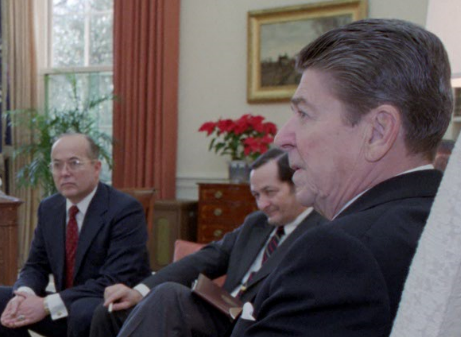
Walter Raymond Jr., a CIA propaganda and disinformation specialist who oversaw President Reagan’s “psyops” and “perception management” projects at the National Security Council. Raymond is partially obscured by President Reagan. Raymond is seated next to National Security Adviser John Poindexter. (Photo credit: Reagan presidential library)


A just-declassified sign-in sheet for a meeting of an inter-agency “psyops” committee on Oct. 24, 1986, shows representatives from the Agency for International Development (USAID), the State Department, and the U.S. Information Agency (USIA) joining officials from the Central Intelligence Agency and the Defense Department.


Some of the names of officials from the CIA and Pentagon remain classified more than three decades later. But the significance of the document is that it reveals how agencies that were traditionally assigned to global development (USAID) or international information (USIA) were incorporated into the U.S. government’s strategies for peacetime psyops, a military technique for breaking the will of a wartime enemy by spreading lies, confusion and terror.


Essentially, psyops play on the cultural weaknesses of a target population so they could be more easily controlled or defeated, but the Reagan administration was taking the concept outside the traditional bounds of warfare and applying psyops to any time when the U.S. government could claim some threat to America.


This disclosure – bolstered by other documents released earlier this year by archivists at the Reagan library in Simi Valley, California – is relevant to today’s frenzy over alleged “fake news” and accusations of “Russian disinformation” by reminding everyone that the U.S. government was active in those same areas.


The U.S. government’s use of disinformation and propaganda is, of course, nothing new. For instance, during the 1950s and 1960s, the USIA regularly published articles in friendly newspapers and magazines that appeared under fake names such as Guy Sims Fitch.


However, in the 1970s, the bloody Vietnam War and the Pentagon Papers’ revelations about U.S. government deceptions to justify that war created a crisis for American propagandists, their loss of credibility with the American people. Some of the traditional sources of U.S. disinformation, such as the CIA, also fell into profound disrepute.


This so-called “Vietnam Syndrome” – a skeptical citizenry dubious toward U.S. government claims about foreign conflicts – undermined President Reagan’s efforts to sell his plans for intervention in the civil wars then underway in Central America, Africa and elsewhere.


Reagan depicted Central America as a “Soviet beachhead,” but many Americans saw haughty Central American oligarchs and their brutal security forces slaughtering priests, nuns, labor activists, students, peasants and indigenous populations.


Reagan and his advisers realized that they had to turn those perceptions around if they hoped to get sustained funding for the militaries of El Salvador, Guatemala and Honduras as well as for the Nicaraguan Contra rebels, the CIA-organized paramilitary force marauding around leftist-ruled Nicaragua.


Perception Management


So, it became a high priority to reshape public perceptions inside those targeted countries but even more importantly among the American people. That challenge led the Reagan administration to revitalize and reorganize methods for distributing propaganda and funding friendly foreign operatives, such as creation of the National Endowment for Democracy under neoconservative president Carl Gershman in 1983.


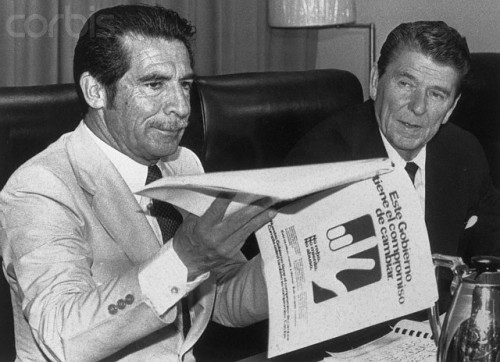
President Ronald Reagan meeting with Guatemalan dictator Efrain Rios Montt, who later faced accusations of genocide against Indian populations in the central highlands.


Another entity in this process was the Psychological Operations Committee formed in 1986 under Reagan’s National Security Council. In the years since, the U.S. administrations, both Republican and Democratic, have applied many of these same psyops principles, cherry-picking or manufacturing evidence to undermine adversaries and to solidify U.S. public support for Washington’s policies.


This reality – about the U.S. government creating its own faux reality to manipulate the American people and international audiences – should compel journalists in the West to treat all claims from Washington with a large grain of salt.


However, instead, we have seen a pattern of leading news outlets simply amplifying whatever U.S. agencies assert about foreign adversaries while denouncing skeptics as purveyors of “fake news” or enemy “propaganda.” In effect, the success of the U.S. psyops strategy can be measured by how Western mainstream media has stepped forward as the enforcement mechanism to ensure conformity to the U.S. government’s various information themes and narratives.


For instance, any questioning of the U.S. government’s narratives on, say, the current Syrian conflict, or the Ukraine coup of 2014, or Russian “hacking” of the 2016 U.S. election, or Iran’s status as “the leading sponsor of terrorism” is treated by the major Western news outlets as evidence that you are a “useful fool” at best, if not a willful enemy “propagandist” with loyalty to a foreign power, i.e., a traitor.


Leading mainstream media outlets and establishment-approved Web sites are now teaming up with Google, Facebook and other technology companies to develop algorithms to bury or remove content from the Internet that doesn’t march in lockstep with what is deemed to be true, which often simply follows what U.S. government agencies say is true.


Yet, the documentary evidence is now clear that the U.S. government undertook a well-defined strategy of waging psyops around the world with regular blowback of this propaganda and disinformation onto the American people via Western news agencies covering events in the affected countries.


During more recent administrations, euphemisms have been used to cloak the more pejorative phrase, “psychological operations” – such as “public diplomacy,” “strategic communications,” “perception management,” and “smart power.” But the serious push to expand this propaganda capability of the U.S. government can be traced back to the Reagan presidency.


The Puppet Master


Over the years, I’ve obtained scores of documents related to the psyops and related programs via “mandatory declassification reviews” of files belonging to Walter Raymond Jr., a senior CIA covert operations specialist who was transferred to Reagan’s National Security Council staff in 1982 to rebuild capacities for psyops, propaganda and disinformation.


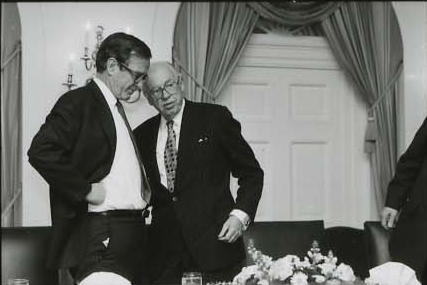
Then-Vice President George H.W. Bush with CIA Director William Casey at the White House on Feb. 11, 1981. (Photo credit: Reagan Library)


Raymond, who has been compared to a character from a John LeCarré novel slipping easily into the woodwork, spent his years inside Reagan’s White House as a shadowy puppet master who tried his best to avoid public attention or – it seems – even having his picture taken.


From the tens of thousands of photographs from meetings at Reagan’s White House, I found only a couple showing Raymond – and he is seated in groups, partially concealed by other officials.


But Raymond appears to have grasped his true importance. In his NSC files, I found a doodle of an organizational chart that had Raymond at the top holding what looks like the crossed handles used by puppeteers to control the puppets below them. The drawing fits the reality of Raymond as the behind-the-curtains operative who was controlling the various inter-agency task forces that were responsible for implementing psyops and other propaganda strategies.


In Raymond’s files, I found an influential November 1983 paper, written by Col. Alfred R. Paddock Jr. and entitled “Military Psychological Operations and US Strategy,” which stated: “the planned use of communications to influence attitudes or behavior should, if properly used, precede, accompany, and follow all applications of force. Put another way, psychological operations is the one weapons system which has an important role to play in peacetime, throughout the spectrum of conflict, and during the aftermath of conflict.”


Paddock continued, “Military psychological operations are an important part of the ‘PSYOP Totality,’ both in peace and war. … We need a program of psychological operations as an integral part of our national security policies and programs. … The continuity of a standing interagency board or committee to provide the necessary coordinating mechanism for development of a coherent, worldwide psychological operations strategy is badly needed.”


One declassified “top secret” document in Raymond’s file – dated Feb. 4, 1985, from Secretary of Defense Caspar Weinberger – urged the fuller implementation of President Reagan’s National Security Decision Directive 130, which was signed on March 6, 1984, and which authorized peacetime psyops by expanding psyops beyond its traditional boundaries of active military operations into peacetime situations in which the U.S. government could claim some threat to national interests.


“This approval can provide the impetus to the rebuilding of a necessary strategic capability, focus attention on psychological operations as a national – not solely military – instrument, and ensure that psychological operations are fully coordinated with public diplomacy and other international information activities,” Weinberger’s document said.


An Inter-Agency Committee


This broader commitment to psyops led to the creation of a Psychological Operations Committee (POC) that was to be chaired by a representative of Reagan’s National Security Council with a vice chairman from the Pentagon and with representatives from CIA, the State Department and USIA.


CIA seal in lobby of the spy agency’s headquarters. (U.S. government photo)


“This group will be responsible for planning, coordinating and implementing psychological operations activities in support of United States policies and interests relative to national security,” according to a “secret” addendum to a memo, dated March 25, 1986, from Col. Paddock, the psyops advocate who had become the U.S. Army’s Director for Psychological Operations.


“The committee will provide the focal point for interagency coordination of detailed contingency planning for the management of national information assets during war, and for the transition from peace to war,” the addendum added.


“The POC shall seek to ensure that in wartime or during crises (which may be defined as periods of acute tension involving a threat to the lives of American citizens or the imminence of war between the U.S. and other nations), U.S. international information elements are ready to initiate special procedures to ensure policy consistency, timely response and rapid feedback from the intended audience.”


In other words, the U.S. government could engage in psyops virtually anytime because there are always “periods of acute tension involving a threat to the lives of American citizens.”


The Psychological Operations Committee took formal shape with a “secret” memo from Reagan’s National Security Advisor John Poindexter on July 31, 1986. Its first meeting was called on Sept. 2, 1986, with an agenda that focused on Central America and “How can other POC agencies support and complement DOD programs in El Salvador, Guatemala, Honduras, Costa Rica and Panama.” The POC was also tasked with “Developing National PSYOPS Guidelines” for “formulating and implementing a national PSYOPS program.” (Underlining in original)


Raymond was named a co-chair of the POC along with CIA officer Vincent Cannistraro, who was then Deputy Director for Intelligence Programs on the NSC staff, according to a “secret” memo from Deputy Under Secretary of Defense Craig Alderman Jr.


The memo also noted that future POC meetings would be briefed on psyops projects for the Philippines and Nicaragua, with the latter project codenamed “Niagara Falls.” The memo also references a “Project Touchstone,” but it is unclear where that psyops program was targeted.


Another “secret” memo dated Oct. 1, 1986, co-authored by Raymond, reported on the POC’s first meeting on Sept. 10, 1986, and noted that “The POC will, at each meeting, focus on an area of operations (e.g., Central America, Afghanistan, Philippines).”


The POC’s second meeting on Oct. 24, 1986 – for which the sign-in sheet was just released – concentrated on the Philippines, according to a Nov. 4, 1986 memo also co-authored by Raymond.


But the Reagan administration’s primary attention continued to go back to Central America, including “Project Niagara Falls,” the psyops program aimed at Nicaragua. A “secret” Pentagon memo from Deputy Under Secretary Alderman on Nov. 20, 1986, outlined the work of the 4th Psychological Operations Group on this psyops plan “to help bring about democratization of Nicaragua,” by which the Reagan administration meant a “regime change.” The precise details of “Project Niagara Falls” were not disclosed in the declassified documents but the choice of codename suggested a cascade of psyops.


Key Operatives


Other documents from Raymond’s NSC file shed light on who other key operatives in the psyops and propaganda programs were. For instance, in undated notes on efforts to influence the Socialist International, including securing support for U.S. foreign policies from Socialist and Social Democratic parties in Europe, Raymond cited the efforts of “Ledeen, Gershman,” a reference to neoconservative operative Michael Ledeen and Carl Gershman, another neocon who has served as president of the U.S.-government-funded National Endowment for Democracy (NED), from 1983 to the present. (Underlining in original.)


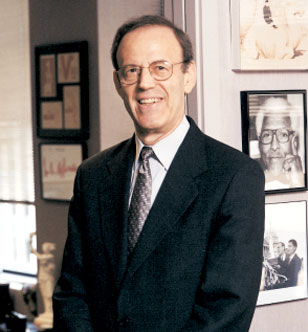
Carl Gershman, president of the National Endowment for Democracy.


Although NED is technically independent of the U.S. government, it receives the bulk of its funding (now about $100 million a year) from Congress. Documents from the Reagan archives also make clear that NED was organized as a way to replace some of the CIA’s political and propaganda covert operations, which had fallen into disrepute in the 1970s. Earlier released documents from Raymond’s file show CIA Director William Casey pushing for NED’s creation and Raymond, Casey’s handpicked man on the NSC, giving frequent advice and direction to Gershman. [See Consortiumnews.com’s “CIA’s Hidden Hand in ‘Democracy’ Groups.”]


While the initials USAID conjure up images of well-meaning Americans helping to drill wells, teach school and set up health clinics in impoverished nations, USAID also has kept its hand in financing friendly journalists around the globe.


In 2015, USAID issued a fact sheet summarizing its work financing “journalism education, media business development, capacity building for supportive institutions, and strengthening legal-regulatory environments for free media.” USAID estimated its budget for “media strengthening programs in over 30 countries” at $40 million annually, including aiding “independent media organizations and bloggers in over a dozen countries,”


In Ukraine before the 2014 coup, USAID offered training in “mobile phone and website security,” which sounds a bit like an operation to thwart the local government’s intelligence gathering, an ironic position for the U.S. with its surveillance obsession, including prosecuting whistleblowers based on evidence that they talked to journalists.


USAID, working with billionaire George Soros’s Open Society, also funded the Organized Crime and Corruption Reporting Project (OCCRP), which engages in “investigative journalism” that usually goes after governments that have fallen into disfavor with the United States and then are singled out for accusations of corruption.


The USAID-funded OCCRP also collaborates with Bellingcat, an online investigative website founded by blogger Eliot Higgins, who is now a senior non-resident fellow of the Atlantic Council, a pro-NATO think tank that receives funding from the U.S. and allied governments.


Higgins has spread misinformation on the Internet, including discredited claims implicating the Syrian government in the sarin attack in 2013 and directing an Australian TV news crew to what looked to be the wrong location for a video of a BUK anti-aircraft battery as it supposedly made its getaway to Russia after the shoot-down of Malaysia Airlines Flight 17 in July 2014.


Despite his dubious record of accuracy, Higgins has gained mainstream acclaim, in part, because his “findings” always match up with the propaganda theme that the U.S. government and its Western allies are peddling. Though most genuinely independent bloggers are ignored by the mainstream media, Higgins has found his work touted by both The New York Times and The Washington Post, and Google has included Bellingcat on its First Draft coalition, which will determine which news will be deemed real and which fake.


In other words, the U.S. government has a robust strategy for deploying direct and indirect agents of influence who are now influencing how the titans of the Internet will structure their algorithms to play up favored information and disappear disfavored information.


A Heritage of Lies


During the first Cold War, the CIA and the U.S. Information Agency refined the art of “information warfare,” including pioneering some of its current features like having ostensibly “independent” entities and cut-outs present U.S. propaganda to a cynical public that would reject much of what it hears from government but may trust “citizen journalists” and “bloggers.”


A screen shot of U.S. Assistant Secretary of State for European Affairs Victoria Nuland speaking to U.S. and Ukrainian business leaders on Dec. 13, 2013, at an event sponsored by Chevron, with its logo to Nuland’s left.


USIA, which was founded in 1953 and gained new life in the 1980s under its Reagan-appointed director Charles Wick, was abolished in 1999, but its propaganda functions were largely folded into the new office of Under Secretary of State for Public Diplomacy and Public Affairs, which became a new fount of disinformation.


For instance, in 2014, President Obama’s Under Secretary for Public Diplomacy Richard Stengel engaged in a series of falsehoods and misrepresentations regarding Russia’s RT network. In one instance, he claimed that the RT had made the “ludicrous assertion” that the U.S. had invested $5 billion in the regime change project in Ukraine. But that was an obvious reference to a public speech by U.S. Assistant Secretary of State for European Affairs Victoria Nuland on Dec. 13, 2013, in which she said “we have invested more than $5 billion” to help Ukraine to achieve its “European aspirations.”


Nuland also was a leading proponent of the Ukraine coup, personally cheering on the anti-government rioters. In an intercepted phone call with U.S. Ambassador to Ukraine Geoffrey Pyatt, Nuland discussed how “to glue” or “midwife this thing” and who the new leaders would be. She picked Arseniy Yatsenyuk – “Yats is the guy” – who ended up as Prime Minister after elected President Viktor Yanukovych was overthrown.


Despite all the evidence of a U.S.-backed coup, The New York Times simply ignored the evidence, including the Nuland-Pyatt phone call, to announce that there never was a coup. The Times’ obeisance to the State Department’s false narrative is a good example of how the legacy of Walter Raymond, who died in 2003, extends to the present.


Over several decades, even as the White House changed hands from Republicans to Democrats, the momentum created by Raymond continued to push the peacetime psyops strategy forward.


In more recent years, the wording of the program may have changed to more pleasing euphemisms. But the idea is the same: how you can use psyops, propaganda and disinformation to sell U.S. government policies abroad and at home.