When WWII ended and the American deep state welded the national security establishment into place with the National Security Act, the world entered into a new era: the era of the military-industrial complex.
But when the Cold War ended and the “Clash of Civilizations” became the new existential threat, the deep state found an opening for another paradigm shift. As the all-pervasive threat of terrorism became the carte blanche for total surveillance, the powers-that-shouldn’t-be found the organizing principal of our age would not be military hardware, but data itself. Welcome to the age of the information-industrial complex.
“In the councils of government, we must guard against the acquisition of unwarranted influence, whether sought or unsought, by the military-industrial complex. The potential for the disastrous rise of misplaced power exists and will persist.”
It is not difficult to see why these words passed so quickly into the political lexicon. Think of their explanatory power.
Why did the US use inflated estimates of Russian missile capabilities to justify stockpiling a nuclear arsenal that was more than sufficient to destroy the planet several times over?
The military-industrial complex.
Why did America send 50,000 of its own to fight and die in the jungles of Vietnam, killing untold millions of Vietnamese (not to mention Cambodians)?
The military-industrial complex.
Why did the US use the public’s fear and anger over 9/11 and a phony panic over non-existent weapons of mass destruction to justify the illegal invasion and trillion-dollar occupation of Iraq?
The military-industrial complex.
Why did Nobel Peace Prize laureate Obama expand the fictitious “war on terror” into Pakistan and Yemen and Somalia, refuse to close Guantanamo despite his earlier promises to the contrary, commit US forces to “kinetic military action” in Libya without so much as seeking Congressional approval, and launch a new era of covert drone warfare?
When you think about it, it’s rather remarkable that such a phrase was ever uttered by a President of the United States, much less a former five-star general. Could you imagine any modern-day President talking about something like the “military-industrial complex” and its attempted “acquisition of unwarranted influence” without immediately dismissing the idea as a conspiracy theory? Over the decades there has been much speculation about Eisenhower’s use of the phrase, and what precisely he was warning against. Some have argued that the phrase was prompted by Eisenhower’s discovery that the Rand Corporation was grossly misrepresenting the Soviet’s military capabilities to John F. Kennedy, who ended up using the Rand invented (and completely fictitious) “missile gap” threat as a cornerstone of his 1960 presidential election campaign.
Whatever the case, it is perhaps time to revisit Eisenhower’s most famous speech. What Eisenhower is ultimately describing is the rise of American fascism; the merger of government and corporate power. What term can better capture the nature of early 21st century American political life? Is there any longer any doubt that the military-industrial complex has reached its ultimate expression in firms like Blackwater (aka “Xe” aka “Academi”) and its military contractor brethren? Is there any other word but “fascism” to describe a state of affairs when a Secretary of Defense can commission a study from a private contractor to examine whether the US military should be using more private contractors, only for that same Secretary of Defense to leave office and become president of the company that conducted the study, only to leave that company to become Vice President of the US and begin waging a war that relies heavily on no-bid contracts awarded to that same company based on the recommendation that it made in its original study? Yet this is precisely the case of Dick Cheney and Halliburton. It would be difficult to think of a more blatant example of the military-industrial complex fascism that Eisenhower was warning of.
But as it turns out, there was another warning about fascism embedded in that farewell address that has received far less attention than the “military-industrial complex” formulation, perhaps because there is no catchphrase hook to describe it:
“Today, the solitary inventor, tinkering in his shop, has been overshadowed by task forces of scientists in laboratories and testing fields. In the same fashion, the free university, historically the fountainhead of free ideas and scientific discovery, has experienced a revolution in the conduct of research. Partly because of the huge costs involved, a government contract becomes virtually a substitute for intellectual curiosity. For every old blackboard there are now hundreds of new electronic computers.”
Given that this warning came in 1961, before the age of communications satellites or personal computers or the internet, it was a remarkably prescient observation. If scientific research half a century ago was dominated by federal grants and expensive computer equipment, how much more true is that for us today, half a century later?
So what is the problem with this? As Ike explained:
“Yet, in holding scientific research and discovery in respect, as we should, we must also be alert to the equal and opposite danger that public policy could itself become the captive of a scientific-technological elite.”
Here, again, the warning is of fascism. But instead of the military-industrial fascism that dominated so much of the 20th century, he was describing here a new fascistic paradigm that was but barely visible at the time that he gave his address: a scientific-technological one. Once again, the threat is that the industry that grows up around this government-sponsored activity will, just like the military-industrial complex, begin to take over and shape the actions of that same government. In this case, the warning is not one of bombs and bullets but bits and bytes, not tanks and fighter jets but hard drives and routers. Today we know this new fascism by its innocuous sounding title “Big Data,” but in keeping with the spirit of Eisenhower’s remarks, perhaps it would be more fitting to call it the “information-industrial complex.”
The concept of an information-industrial complex holds equally explanatory power for our current day and age as the military-industrial complex hypothesis held in Eisenhower’s time.
Why is a company like Google going to such lengths to capture, track and database all information on the planet?
The information-industrial complex.
Why were all major telecom providers and internet service providers mandated by federal law to hardwire in back door access to American intelligence agencies for the purpose of spying on all electronic communications?
The information-industrial complex.
Why would government after government around the world target encryption as a key threat to their national security, and why would banker after banker call for bitcoin and other cryptocurrencies to be banned even as they plan to set up their own, central bank-administered digital currencies?
The information-industrial complex.
The effects of this synthesis are more and more felt in our everyday lives. Every single day hundreds of millions of people around the world are interfacing with Microsoft software or Apple hardware or Amazon cloud services running on chips and processors supplied by Intel or other Silicon Valley stalwarts. Google has become so ubiquitous that its very name has become a verb meaning “to search for something on the internet.” The 21st century version of the American dream is encapsulated in the story of Mark Zuckerberg, a typical Harvard whizkid whose atypical rise to the status of multi-billionaire was enabled by a social networking tool by the name of “Facebook” that he developed.
But how many people know the flip side of this coin, the one that demonstrates the pervasive government influence in shaping and directing these companies’ rise to success, and the companies’ efforts to aid the government in collecting data on its own citizens? How many know, for instance, that Google has a publicly acknowledged relationship with the NSA? Or that a federal judge has ruled that the public does not have the right to know the details of that relationship? Or that Google Earth was originally the brainchild of Keyhole Inc., a company that was set up by the CIA’s own venture capital firm, In-Q-Tel, using satellite data harvested from government Keyhole-class reconnaissance satellites? Or that the former CEO of In-Q-Tel, Gilman Louie, sat on the board of the National Venture Capital Association with Jim Breyer, head of Accel Partners, who provided $12 million of seed money for Facebook? Or that, in 1999, a back door for NSA access was discovered in Microsoft’s Windows operating system source code? Or that Apple founder Steve Jobs was granted security clearance by the Department of Defense for still-undisclosed reasons while heading Pixar in 1988, as was the former head of AT&T and numerous others in the tech industry?
The connections between the IT world and the government’s military and intelligence apparatus run deep. In fact, the development of the IT industry is intimately intertwined with the US Air Force, the Department of Defense and its various branches (including, famously, DARPA), and, of course, the CIA. A cursory glance at the history of the rise of companies like Mitre Corporation, Oracle, and other household electronics and software firms should suffice to expose the extent of these relations and the existence of what we might dub an “information-industrial complex.”
But what does this mean? What are the ramifications of such a relationship?
Although the signs have been there for decades, perhaps the most startling example of what lies at the heart of this relationship has been revealed by the whistleblowers at the heart of the National Security Agency, one of the most secretive arms of the American intelligence apparatus. While Edward Snowden has received the most attention with his “revelation” of the PRISM program, much of the information about the NSA’s ability to surveil all electronic communications has been revealed over the past decade by NSA whistleblowers like Russ Tice, William Binney, Thomas Drake and J. Kirk Wiebe, third-party contractors like Snowden and AT&T whistleblower Mark Klein, and independent journalists like James Bamford. Together, the story they tell is of a truly Orwellian society in which all communications are being captured and analyzed by the NSA, and, with the advent of facilities like the new data center in Utah, presumably stored indefinitely for use at any future time in any future investigation for any pretense by anyone with authorization to access that data. According to Snowden, this includes lowly third-party contractors like himself operating at NSA subcontractors like Booz Allen Hamilton in the vast (and expanding) private intelligence industry that has grown up around the information-industrial complex in the exact same way as private military contractors like Blackwater formed around the military-industrial complex.
In some ways, this information-industrial complex is even more insidious than its military-industrial counterpart. For all of the ills caused by the military-industrial complex (and there are many), at the very least it required some sort of excuse to drain the American people’s resources, and its failures (like the Vietnam quagmire or the debacle in Iraq) happened in the clear light of day. In the information-industrial complex, where vast spying programs happen in the shadows and under the cover of “national security,” it takes whistleblowers and insiders willing to risk it all even to find out what is being done by these shadowy agencies and their private-sector contractors. Even worse, the entire Orwellian spy grid is being run on the flimsiest of pretenses (the “war on terror”) that has no defined end point, and “justifies” turning that spy grid inward, on the American people themselves.
Surely Eisenhower never envisaged the monstrosity that this information-industrial complex has become, but the foresight he had in identifying its early stages over half a century ago is remarkable. The problem is that we are even further away from heeding the warning that he delivered in that 1961 address than we were at that time:
“It is the task of statesmanship to mold, to balance, and to integrate these and other forces, new and old, within the principles of our democratic system—ever aiming toward the supreme goals of our free society.”
If only this were the rhetoric that was shaping today’s debate on the issue, instead of the well-worn canard that we must “strike a balance” between freedom and security. Sadly, until such time as the National Security Act of 1947 is repealed and the cover of national security is lifted from the dark actors that populate this sector, the information-industrial complex is unlikely to be quashed—or even hampered—anytime soon.
It all began with the 1996 bombing of the Khobar Towers apartment complex in the Saudi city of Khobar, which killed 19 U.S. military, who worked at the Dharan air base three miles away.
Both Robert Mueller and his longtime ally James Comey (the latter of whose firing as the FBI chief, by U.S. President Trump, had sparked the appointment of Mueller to become the Special Counsel investigating the U.S. President) performed crucial roles in establishing that the Khobar Towers bombing had been a Hezbollah operation run by the Iranian Government - and, starting upon this basis, in helping to develop the case that Iran “is the foremost state sponsor of terrorism.”
However, as has been made clear by several great independent investigative journalists, on the basis of far more-solid documentation than the official account, the Khobar Towers bombing was instead entirely a fundamentalist-Sunni operation, specifically perpetrated by Al Qaeda, which hates Shia and which also hates America’s military presence in the Middle East. Osama bin Laden’s claim of the bombing"s having been done by Al Qaeda, was, in fact, entirely honest and accurate.
America’s “Deep State,” which extends to Saudi Arabia and to a number of other Governments - it’s an international network - is deeply committed to supporting the fundamentalist-Sunni war to conquer and destroy Shia Islam, and not merely to conquer the leading Shia nation, which is Iran. The U.S. Government has intensely taken a side in the Sunni-Shia religious war. That war is comparable in some respects to the 30 Years’ War (1618-1648) between Catholics and Protestants, which killed an estimated eight million Europeans; and, both the United States and Israel have clearly joined with the fundamentalist-Sunni leaders, against Iran, and against Shia generally.
The reasons behind the prevailing lies about this matter will also be documented here. Discrepancies between the official story and the solidly documented facts, need to be explained, in order for a reader to be able to understand truthfully why Mueller (who cooperated with Comey in order to rig the official account of the bombing, so as to condemn Iran and Hezbollah instead of Al Qaeda) received his appointment. This is also important in order to understand why Trump, though rabidly anti-Iranian himself, is nonetheless insufficiently anti-Iranian to satisfy the Sauds, Israel’s Prime Minister Benjamin Netanyahu, or the rest of the U.S.-and-allied Deep State.
Before proceeding further here, however, the statistical falseness of the allegation that Iran is the foremost state-sponsor of terrorism has to be clearly recognized as being the ultimate fact; because, if this entire question - to which Mueller and Comey contributed so importantly to answering by their identifying Iran (and Shia generally) as being precisely that (‘the foremost state sponsor of terrorism’) — can be assessed at all objectively, then the statistical answer to it would certainly be the objective one.
Wikipedia’s article on “Iran and state-sponsored terrorism” says: “According to the Global Terrorism Database, the majority of deaths, more than 94% attributed to Islamic terrorism since 2001, were perpetrated by Sunni jihadists of the Islamic State, al-Qaeda and others.[3][4].” Only 6% were Shiites, at all — from any country. Similarly, my own independent study of 54 especially prominent global instances of Islamic terrorism was headlined (and reported that) "All Islamic Terrorism Is Perpetrated by Fundamentalist Sunnis, Except Terrorism Against Israel.” (The anti-Israel terrorist instances might constitute the “6%” which was referred to in the Wikipedia article, but that article provided no good link to its source for the “6%” figure.)
So: the basic allegation is false, that Iran is the foremost state-sponsor of terrorism; the general allegation isn’t anywhere near to being true. It’s a lie.
More specifically, now, regarding the Khobar Towers incident, which triggered the start of this fraudulent generalization:
The Saudi royal family asserted, immediately after the bombing, that the attack had been perpetrated by jihadists who had returned from Afghanistan and who were now fighting to overthrow Saudi Arabia’s Government (the royal Saud family).
Then, starting in 1980, “From the Pakistani border, bin Laden raises funds and provides the mujahedeen with logistical and humanitarian aid.”So, the Sauds’ allegation that the Khobar bombers had been “veterans of the Afghan war” would have meant that they had been foot-soldiers for the U.S.-Saudi operation in Afghanistan. Both the U.S. Government and the Saud family (who own the Saudi Government) hate Shia and especially hate Iran. Hezbollah are Shia, and they are extremely pro-Iran. How likely is it that Hezbollah, anywhere, would have been fighting under the command of Al Qaeda, or of any other fundamentalist-Sunni jihadist organization that calls all Shia “infidels”? So, the Sauds’ account of the Khobar Towers bombing is fishy, at best.
Furthermore, a Google-search for the phrase “Hezbollah in Afghanistan” turns up only “6 results,” and all of them say nothing about any “Hezbollah in Afghanistan.” No report comes up about such a thing, for any year, or any period. The only countries where Hezbollah was reported to exist were Iran, Syria, and Lebanon. One of the links in that Google search was globally comprehensive for the year 2007, the Center on International Cooperation’s “Annual Review of Global Peace Operations — 2007”. It included reports on wars during that year, in 26 countries, and the chapter for Afghanistan (pages 52-58) doesn’t mention Hezbollah even once. However, a search for the phrase ”Hezbollah Afghanistan” does bring up “Syria"s Other Foreign Fighters: Iran"s Afghan and Pakistani Mercenaries”, at the neoconservative (and thus favoring not only the American aristocracy but its allied aristocracies — especially in Saudi Arabia and Israel) The National Interest, dated 20 November 2015. That article says, “The liwa’ fatimiyun (Fatimiyun Brigade) is composed exclusively of Afghans and fights under the auspices of Hezbollah Afghanistan,” based in Syria. Other supposed foreign Shiites trying to overthrow Syria’s Government are mentioned, as being supposedly “Pakistanis fighting in Syria under the Hezbollah flag.” However, if these allegations are true, then those men would be opponents of Syria’s secular government, which is headed by the secular Shiite Bashar al-Assad, who is being attacked by fundamentalist Sunnis — including both ISIS and Al Qaeda there — who are trying to kill Hezbollah in Syria, who are, in fact, defending Assad. (Such illogical ‘historical’ accounts as that, are normal in neoconservative publications — counterfactuality is entirely acceptable to them.) Either that, or else the alleged Shiite Pakistanis who are fighting in Syria to overthrow the Shiite Assad and replace him with a fundamentalist Sunni regime, would be — not actually members of Hezbollah, but instead — Shiites from Pakistan who came to Syria in order to help actually not to overthrow the Government but to defend it against its rabidly anti-Shia attackers. That’s the opposite of the assumption that The National Interest made, but it conceivably could be the case. A Pew survey scientifically randomly sampled 1,512 Pakistanis, and found that 1,450 of them declared themselves to be “Muslim,” which is 96%. It also found that 94% of Pakistanis (of any or no faith) say that religion is “very important” in their lives, and found that 81% of the Muslims said they were “Sunni,” 6% said they were “Shiite,” and 12% said they were “Just a Muslim.” So, only 6% of Pakistanis identify themselves specifically as “Shia.” That is such a small percentage of Shiites in Pakistan, as to make unlikely any significant contribution that Pakistanis would be providing to the defense of Syria, which is at least 1,800 miles or 2,900 kilometers, away — not even in the same general region. But, in any case, that neoconservative magazine’s assumptions regarding the entire matter are clearly false.
Clearly, then, the logical feasibility of the U.S. Government’s case against Iran is so tiny as to constitute almost an absolute impossibility of that case being true.
Now, then, let’s consider the specifics of the case:
True-blue Democrats may want to skip the next paragraphs. If President Bush put the kibosh on investigations of Saudi funding of terror and nuclear bomb programs, this was merely taking a policy of Bill Clinton one step further.
Following the 1996 Khobar Towers bombing in Saudi Arabia, Clinton hunted Osama with a passion — but a passion circumscribed by the desire to protect the sheikdom sitting atop our oil lifeline. In 1994, a Saudi diplomat defected to the United States with 14,000 pages of documents from the kingdom’s sealed file cabinets. This mother lode of intelligence included evidence of plans for the assassination of Saudi opponents living in the West and, tantalizingly, details of the $7 billion the Saudis gave to Saddam Hussein for his nuclear program — the first attempt to build an Islamic bomb. The Saudi government, according to the defector, Mohammed Al Khilewi, slipped Saddam the nuclear loot during the Reagan and Bush Sr. years when our government still thought Saddam too marvelous for words [because he was trying to slaughter Shiite Iran]. The thought was that he would only use the bomb to vaporize Iranians [which the rulers of both the U.S. and Saudi Arabia — and of Israel — would love].
Clinton granted the Saudi defector asylum, but barred the FBI from looking at the documents. Al Khilewi’s New York lawyer, Michael Wildes, told me he was stunned. Wildes handles some of America’s most security-sensitive asylum cases. “We said (to the FBI), ‘Here, take the documents! Go get some bad guys with them! We’ll even pay for the photocopying!” But the agents who came to his office had been ordered not to accept evidence of Saudi criminal activity, even on U.S. soil.
In 1997, the Canadians caught and extradited to America one of the [Saudi-Government-alleged] Khobar Towers attackers. In 1999, Vernon Jordan’s law firm stepped in and — poof! — the [Saudi-alleged] killer was shipped back to Saudi Arabia before he could reveal all he knew about Al Qaeda (valuable) and the Saudis (embarrassing). I reviewed but was not permitted to take notes on, the alleged [finally, Palast is getting that right] terrorist’s debriefing by the FBI. To my admittedly inexpert eyes, there was enough on Al Qaeda to make him a source on terrorists worth holding on to. Not that he was set free — he’s in one of the kingdom’s dungeons [likelier dead soon after arriving back in Saudi Arabia] — but his info is sealed up with him. The terrorist’s extradition was “Clinton’s.” “Clinton’s parting kiss to the Saudis,” as one insider put it.
Another great investigative journalist is Seymour Hersh, who in the 22 October 2001 issue of the New Yorker, headlined “King’s Ransom” and he opened:
Since 1994 or earlier, the National Security Agency has been collecting electronic intercepts of conversations between members of the Saudi Arabian royal family, which is headed by King Fahd. The intercepts depict a regime increasingly corrupt, alienated from the country"s religious rank and file, and so weakened and frightened that it has brokered its future by channelling hundreds of millions of dollars in what amounts to protection money to fundamentalist groups that wish to overthrow it.
The intercepts have demonstrated to analysts that by 1996 Saudi money was supporting Osama bin Laden"s Al Qaeda and other extremist groups in Afghanistan, Lebanon, Yemen, and Central Asia, and throughout the Persian Gulf region. "Ninety-six is the key year," one American intelligence official told me. "Bin Laden hooked up to all the bad guys — it"s like the Grand Alliance — and had a capability for conducting large-scale operations." The Saudi regime, he said, had "gone to the dark side.”
Subsequently, he noted:
In 1994, Mohammed al-Khilewi, the first secretary at the Saudi Mission to the United Nations, defected and sought political asylum in the United States. He brought with him, according to his New York lawyer, Michael J. Wildes, some fourteen thousand internal government documents depicting the Saudi royal family"s corruption, human-rights abuses, and financial support for terrorists.
He claimed to have evidence that the Saudis had given financial and technical support to Hamas, the extremist Islamic group whose target is Israel. There was a meeting at the lawyer"s office with two F.B.I. agents and an Assistant United States Attorney. "We gave them a sampling of the documents and put them on the table," Wildes told me last week. "But the agents refused to accept them." He and his client heard nothing further from federal authorities. Al-Khilewi, who was granted asylum, is now living under cover.
The Saudis were also shielded from Washington"s foreign-policy bureaucracy. A government expert on Saudi affairs told me that Prince Bandar dealt exclusively with the men at the top, and never met with desk officers and the like. "Only a tiny handful of people inside the government are familiar with U.S.-Saudi relations," he explained. "And that is purposeful."
Both Mueller and Comey were high enough “at the top” so as to know what the people below them needed to hide in order to succeed in their careers.
The New York Times’s report, on 15 August 1996, quoted a leading Saudi dissident in London as asserting that, “As far as I know, Prince Nayef is keeping the Americans away from all the details at this point.” This report went on: “In a statement responding to the earlier reports of confessions, Prince Nayef said Saudi Arabia would make an announcement as soon as the investigation is completed. His comments were also viewed as refuting earlier suggestions by Secretary of Defense William J. Perry, who had said that Saudi investigations might point to an Iranian connection.” In other words, at that time (as of August 15th), the U.S. official was suggesting “an Iranian connection” but the Saudi official wasn’t — at least, not yet — and the expectation was that “confessions” would be providing the decisive ‘evidence’. However, these ‘confessions’, in Saudi cases are typically ‘information’ extracted under torture, and, where that fails to obtain the ‘information’ that’s desired by the Government, then threats to destroy the person’s immediate family are applied; so, the Sauds famously usually do get exactly the ‘information’ that they want (regardless of whether it’s true).
The Wikipedia article “Khobar Towers bombing” summarizes the ‘findings’ by the U.S. FBI and courts, and ignores the Sauds’ ‘investigation(s)’, because nothing was ever made public from the Sauds’ Government or officials or anyone there, about what they ‘found’ (other than ‘found’ by torture). Wikipedia’s article, which is based entirely upon the U.S. Government (the first party to broach publicly the possibility of “an Iranian connection”) states flatly, right up front, “Perpetrators: Hezbollah Al-Hejaz (English: Party of God in the Hijaz).” In common parlance, that’s Hezbollah, an “Iranian connection” — exactly what the U.S. Government wanted.
Here’s what that article asserts regarding the operations of the alleged mastermind:
In June 2001, an indictment was issued in United States District Court for the Eastern District of Virginia in Alexandria, Virginia charging the following people with murder, conspiracy, and other charges related to the bombing:[18]
The Wikipedia article then continued by listing the other alleged defendants:
Abdelkarim Hussein Mohamed Al-Nasser
Ali Saed Bin Ali El-Hoorie
Ibrahim Salih Mohammed Al-Yacoub
Hani al-Sayegh who had been previously in U.S. custody but deported to Saudi Arabia, when charges against him were dropped due to a lack of evidence.
Eight other Saudis
One Lebanese man listed as "John Doe".
In July 2001, Saudi Arabia said that eleven of the people indicted in the US were in custody in Saudi prisons, and were to be tried in Saudi court, as the country refused to extradite any of them to the United States to stand trial.[19] The government has not since made public the outcome of the trial or the whereabouts of the prisoners.
All six of the named persons there were Shiites in Saudi Arabia. The respective Wikipedia articles on each provide no evidence that any of them was at all involved in the bombing. However, the article on Hani al-Sayegh, who was living in Canada, is extraordinarily honest: it indicates that he said he had had nothing whatsoever to do with any bombings, nor any terrorism at all, and that the U.S. Government tried to get him to confess to something on the basis of which he could be tried and convicted in the U.S., but that he continued to resist all plea-offers, and to maintain that they were seeking to get him to lie, which he would not do. So, since the U.S. would not torture him on U.S. soil, the U.S. deported him “to Saudi Arabia on October 10, 1999 where it was assumed he would be executed upon arrival.[3][12].” But the Saudi regime never announced anything about any of the men they were charging in the Khobar Towers bombing.
The FBI issued charges against al-Sayegh and 12 others (all allegedly Hezbollah) on 21 June 2001, for the bombing; and, since that time, the only publication of their names has been in regards to the mere presumption that they were guilty. Their indictments in the U.S.(without evidence), and (since the Saudi Government wouldn’t say anything about them — not even whether they were in prison or free there) the charge in U.S. courts that Iran had helped them to do it, were 100% based upon that ‘evidence’. Therefore, Iran was declared guilty in U.S. courts, and fined, again, and again, over $500 million in all, without any reliable evidence, at all, that Iran had anything to do with the Khobar Towers bombing. And, not a cent of those fines was paid; but the U.S. Government’s purpose was served nonetheless: getting Iran’s ‘guilt’ onto the official record, such that Wikipedia, for example could say “Perpetrators: Hezbollah Al-Hejaz (English: Party of God in the Hijaz).”
The Wikipedia article on the Khobar Towers bombing closed, however, by saying:
William Perry, who was the United States Secretary of Defense at the time that this bombing happened, said in an interview in June 2007 that "he now believes al-Qaida rather than Iran was behind a 1996 truck bombing at an American military base.”[25]
On December 22, 2006, federal judge Royce C. Lamberth ruled that Iran and Hezbollah were responsible for the attack, stating that the leading experts on Hezbollah presented "overwhelming" evidence of the group"s involvement and that six captured Hezbollah members detailed the role of Iranian officials in providing money, plans, and maps.[4] This decision was reached as a default judgment, however, in which the Iranian government was not represented in court, and had no opportunity to challenge the allegations.
People who trust the U.S. Government’s honesty will interpret the outcome as displaying legal and judicial incompetency, not as displaying political and propagandistic competency.
William Perry announced his opinion only after the 2006 court ‘finding’ of Iran’s ‘guilt’ in the case. The UPI article on this opened and closed as follows:
Perry: U.S. eyed Iran attack after bombing
Published: June 6, 2007 at 4:25 PM
WASHINGTON, June 6 (UPI) -- A former U.S. defense secretary says he now believes al-Qaida rather than Iran was behind a 1996 truck bombing at an American military base.
Former Defense Secretary William Perry said he had a contingency plan to attack Iran if the link had been proven, but evidence was not to either his nor President Bill Clinton"s satisfaction.
The attack would have struck "at a number of their military facilities that would have weakened -- substantially weakened ... the Iranian navy and air force," he said in New York Tuesday during a speech to the Council on Foreign Relations. …
"I believe that the Khobar Tower bombing was probably masterminded by Osama bin Laden," Perry said. "I can"t be sure of that, but in retrospect, that"s what I believe. At the time, he was not a suspect. At the time ... all of the evidence was pointing to Iran."
He said al-Qaida did not emerge as a major threat until Clinton"s second term.
"We probably should have been more concerned about it at the time than we were but in the first term we did not see Osama bin Laden and al-Qaida as a major factor, or one that we were concerned with," he said.
In 2001, the U.S. Justice Department announced a 46-count indictment against 13 Saudis and one Lebanese man in the bombing. All were allegedly connected to Hezbollah, a terrorist group the United States believes is linked to Iran.
Perry said the FBI strongly believed at the time the bombing was ordered by Iran, but Saudi officials tried to discourage that theory.
"They feared what action we would take. They rightly feared it. In fact, I had a contingency plan for a strike on Iran, if it had been if it had been clearly established. But it was never clearly established, and so we never did that," Perry said.
So, although Wikipedia started by alleging “Perpetrators: Hezbollah Al-Hejaz (English: Party of God in the Hijaz)” — and in plain language, that’s Hezbollah — it ended by kaboshing that very theory of the case, which the Wikipedia article had been ‘documenting’ (with bad logic and some false ‘facts’).
Subsequently, the fine investigative journalist Gareth Porter explained how Perry had come to think that Iran and Hezbollah had been the culprit. Perry had trusted the head of the FBI, Louis Freeh. Perry didn’t know that, behind the scenes, Saudi Prince Bandar bin Sultan al-Saud (who was his family’s U.S. Ambassador) had told Freeh that Iran and Hezbollah did it. Furthermore, the Sauds had actually blocked the FBI’s own investigators from having access to the site or to any of the evidence (other than by providing Freeh himself access to the torture-extracted ‘confessions’). Initially, in fact, the Sauds even started bulldozing the site.
The first part of Porter’s five-part report was titled “EXCLUSIVE — PART 1: Al Qaeda Excluded from the Suspects List”. It said: “The Saudi bulldozing stopped only after Scott Erskine, the supervisory FBI special agent for international terrorism investigations, threatened that Secretary of State Warren Christopher, who happened to be in Saudi Arabia when the bomb exploded, would intervene personally on the matter.” It said there was: “a systematic effort by the Saudis to obstruct any U.S. investigation of the bombing and to deceive the United States about who was responsible for the bombing. The Saudi regime steered the FBI investigation toward Iran and its Saudi Shi’a allies with the apparent intention of keeping U.S. officials away from a trail of evidence that would have led to Osama bin Laden and a complex set of ties between the regime and the Saudi terrorist organiser.”
The fourth part was titled “EXCLUSIVE — PART 4: FBI Ignored Compelling Evidence of bin Laden Role”. It noted that, “In October 1996, after having issued yet another fatwa calling on Muslims to drive U.S. soldiers out of the Kingdom, bin Laden was quoted in al Quds al Arabi, the Palestinian daily published in London, as saying, ‘The crusader army was shattered when we bombed Khobar.’"
The key to the success of the Saudi deception was FBI director Louis Freeh, who took personal charge of the FBI investigation, letting it be known within the Bureau that he was the "case officer" for the probe, according to former FBI officials.
Freeh allowed Saudi Ambassador Prince Bandar bin Sultan to convince him that Iran was involved in the bombing, and that President Bill Clinton, for whom he had formed a visceral dislike, "had no interest in confronting the fact that Iran had blown up the towers," as Freeh wrote in his memoirs.
The Khobar Towers investigation soon became Freeh’s vendetta against Clinton. "Freeh was pursuing this for his own personal agenda," says former FBI agent Jack Cloonan.
A former high-ranking FBI official recalls that Freeh "was always meeting with Bandar". And many of the meetings were not in Freeh’s office but at Bandar’s 38-room home in McLean, Virginia.
Meanwhile, the Saudis were refusing the most basic FBI requests for cooperation.
Freeh quickly made Iranian and Saudi Shi’a responsibility for the bombing the official premise of the investigation, excluding from the inquiry the hypothesis that Osama bin Laden’s al Qaeda organisation had carried out the Khobar Towers bombing.
The CIA’s bin Laden unit, which had only been established in early 1996, was also excluded by CIA leadership from that Agency’s work on the bombing.
In order to build a legal case against Iran and Shi"a Saudis, Freeh had to get access to the Shi"a detainees who had confessed. But the Saudis never agreed to allow FBI officials to interview them. In early November 1998, Freeh sent an FBI team to observe Saudi secret police officials asking eight Shi"a detainees the FBI"s questions from behind a one-way mirror at the Riyadh detention center.
By then Saudi secret police had already had two and half years to coach the detainees on what to say, under the threat of more torture. But Freeh didn"t care. "For Louis, if they would let us in the room, that was the important thing," a senior FBI official involved in the Khobar investigation told me. "We would have gone over there and gotten the answers even if they had been propped up."
But the Justice Department refused to go ahead with an indictment based on the information the FBI team brought back. Department lawyers knew the Shi"a detainees had been subject to torture, so they have ruled that the confessions were not valid.
In other words: the head of the FBI believed torture-extracted ‘confessions’ as if such would meet U.S. rules of evidence — which they don’t. And coaching of witnesses is likewise prohibited — under U.S. laws.
Although they’d been aware of each other for years, sharing their similar orbits, Comey and Mueller were first brought together professionally by then-FBI director Louis Freeh in the opening days of the Bush administration. … As the Bush administration took office in 2001, Freeh asked Bob Mueller, who was acting as John Ashcroft’s deputy attorney general, to transfer the [Khobar] case to Comey.
When he finally did so, Mueller called Comey with a warning: “Wilma Lewis is going to be so pissed.” Indeed, Lewis blasted the decision, as well as both Freeh and Mueller personally, in a press release, saying the move was “ill-conceived and ill-considered.” But Freeh’s gambit paid off.
Within weeks, Comey had pulled together the indictment. During a National Security Council briefing at the White House, under the watchful gaze of Secretary of State Colin Powell, Secretary of Defense Donald Rumsfeld, and National Security Advisor Condoleezza Rice, Comey presented overwhelming evidence of Iran’s involvement.
On the eve of the expiration of the statute of limitations, fourteen individuals were indicted for the attack. Freeh, who stepped down the next day, said the indictment was “a major step.”
So, Comey and Mueller were brought in by Freeh because Freeh was about to retire and he wanted successors who would be committed to the theory of the case, that Freeh had gotten from Prince Bandar. If Comey and Mueller wouldn’t go along with that torture-extracted ‘testimony’ as ‘evidence’, then their ability to become appointed head the FBI would have been zero. Freeh, Comey, and Mueller are a team - a team that serves the Bushes and the Sauds. But not the American public.
Our continuing war against Iran is due entirely to their crucial assistance. The Deep State appoints such individuals.
* * *
CLOSING NOTE:This article had been submitted to, and rejected by, the 39 publications listed here at the bottom, sent to each as an exclusive, but since they all rejected it without comment, I now am sending it not just to them but to the entire U.S. newsmedia, on a non-exclusive and free-of-charge basis to publish. Since none of them will pay me for publishing it, I shall be happy if any publish it without charge, even small ‘alternative news’ sites online, because - and especially if a mainstream newsmedium relents and decides to publish it - then perhaps the embargo against the truth of such important matters being published in the United States and its vassal nations, will come to be broken, and the ‘news’media in America and in those other countries, might then terminate being actually the U.S-regime’s propaganda-media, and might finally begin to pay penance for their all having helped the U.S. Government to deceive the American (and allied-nations’) public into supporting the regime’s entirely lie-based invasions of Afghanistan in 2001, of Iraq in 2003, of Libya in 2012, of Syria since 2012, of U.S. coups elsewhere (such as in Ukraine), and, now, potentially repeating it yet again with invasions or coups against Iran or other countries that the U.S. elite want to grab and add to their growing U.S. empire.
If Iran becomes invaded, or another U.S. coup becomes perpetrated there (such as in 1953), then perhaps Russia’s only realistic response — as being the ultimate U.S. target — will be a blitz nuclear attack to destroy the United States, in recognition of the U.S. Government’s fanatical reach to control a total global empire — total global strangulation of freedom and of peace, everywhere. After all, if Russia waits till after a U.S. lie-based invasion of Iran, then it will be simply waiting for a blitz nuclear attack by the U.S. and its NATO alliance against Russia itself, which would be even worse for the world than Russia’s striking first — though the world would end, either way. The U.S. Government now seems to be an out-of-control spreading cancer, a terminal threat to the world in every regard. It’s already recognized throughout the world as being “the greatest threat to peace in the world today”. And its ‘news’media have helped to keep it that way.
Here is the list of 39 publications that this article had been submitted to as an exclusive (and, of course, it’s now being submitted to them, too, yet again, but this time on a non-exclusive, non-fee, basis, along with being submitted to all the rest of the regime’s press, including broadcast media):
McClatchy newspapers, New York Times, Washington Post, The Atlantic, Harper’s, TIME, The New Republic, Foreign Policy, Mother Jones, The Nation, Progressive, National Review, New Yorker, Rolling Stone, Business Week, Forbes, Politico, thedailybeast, huffingtonpost, slate, bloomberg, businessinsider, newsweek, theintercept, breitbart, alternet, newsbud, spiked-online, vice, mintpressnews, truthdig, truth-out, Independent, Guardian, Daily Mail, Spectator, London Review of Books, New Statesman, Spiegel.
Multiple neurologists and experts have told The Guardian that the mysterious "sonic attacks" upon US diplomats in Cuba are likely just a case of mass hysteria. The extensive Guardian report is based on research and interviews with top neurologists and medical experts explaining that the likeliest explanation for the strange and inexplicable symptoms reported by US embassy staff in Cuba which have led to a breakdown in relations between the two countries has nothing to do with some kind of Cuban sonic device or high tech conspiracy.
The neurologists say that the most plausible explanation is that the diplomats" high stress environment is leading to neurological abnormalities and disorders which are causing psychosomatic (or self-induced) symptoms. If true it would be a shocking revelation that such a "natural cause" phenomenon could result in the US removing most of its embassy staff from Havana. The Guardian report was issued on the very day that the Associated Press published what it purports to be an audio recording of high pitched undulating sounds which some embassy workers in Havana claim made them sick. Reports indicate that 22 US victims have suffered mysterious ailments after working at the embassy, including hearing, visual, cognitive, balance, sleep and other problems.
US Embassy in Havana, Cube. Image source: RNZ via AFP
Though it took over a year for the complaints to surface in the media, it all started in the fall of 2016. Several of the affected diplomats were recent arrivals at the embassy, which reopened in 2015 as part of Barack Obama’s reestablishment of diplomatic relations with Cuba. The various accounts were strange yet similar: one diplomat, for example, described being jolted awake in a Havana hotel room by a grinding, blaring cacophony. When he moved a few feet across the room, the noise stopped. When he got back into bed, the agonizing sound hit him again; as if, he told doctors, he had walked through some invisible wall cutting straight down the middle of his room. Multiple personnel also reported persisted nausea, nosebleeds, headaches, and dizziness while stationed in Cuba.
The US State Department has deemed the occurrence to be deliberate attacks, though US officials have stopped short of pointing the finger directly at the Cuban government. But The Guardian is now casting significant doubts on the US allegations even while its report acknowledged the new audio recording obtained by the AP.
It sounds sort of like a mass of crickets. A high-pitched whine, but from what? It seems to undulate, even writhe. Listen closely: There are hear multiple, distinct tones that sound to some like they’re colliding in a nails-on-the-chalkboard effect.
The Guardian begins by citing Alan Carson, a consultant neuropsychiatrist and former president of the British Neuropsychiatry Association, who explained, “Typically what one gets in a functional disorder is some trigger. It is often relatively mild and non-specific, it can be a minor physical injury. But then a combination of a degree of anxiety and also belief and expectation distort that feeling.” Carson suggested that initial reports of US staff hearing strange sounds and experiencing unusual sensations could have triggered similar sensations in others: “If there is a strong enough expectation that something is going to happen, that will distort in an entirely real way the incoming information,” Carson said. “In certain circumstances that can be transmitted from person to person... If one person has that experience strongly enough and sets off that train of thought in somebody’s else’s mind, that can happen too.”
Sound waves from a sonic attack on the US Embassy in Cuba? Image source: New York Post
The report futher cites Mark Hallett, head of the human motor control section of the US National Institute of Neurological Disorders and Stroke, to introduce the likely possibility of a "mass hysteria" phenomenon. Hallet said, “From an objective point of view it’s more like mass hysteria than anything else.” This involves possible "functional disorders" taking root among small groups of people based on the power of suggestion in high stress close working environments. The Guardian explains further:
“Mass hysteria” is the popular term for outbreaks among groups of people which are partly or wholly psychosomatic, but Hallett stressed there should be no blame attached to them.
“Psychosomatic disease is a disease like anything else. It shouldn’t be stigmatized,” said Hallett, who is also president of the International Federation of Clinical Neurophysiology. “It’s important to point out that symptoms like this are not voluntary. They are not a sign of weakness in an individual’s personality.”
Hallet also noted the vagueness of the complains among the nearly two dozen embassy staff: “There are a very large number of individuals that have relatively vague complaints as far as I can see.” He said. “There has been an exploration of possible causes for this and nothing has been found and the notion of some sonic beam is relatively nonsensical."
“If it is mass hysteria that would clarify all the mystery – and presumably normalize US-Cuban relations again,” Hallett suggested. “These people are all clustered together in a somewhat anxious environment and that is exactly the situation that precipitates something like this. Anxiety may be one of the critical factors."
Audio released by the AP on Thursday purports to capture what American embassy staff heard in Cuba.
Jon Stone, a University of Edinburgh neurologist and leading author in the field also told The Guardan that such disorders were so frequent in society that it constitutes the second commonest reason people seek out neurologists. “There is a misconception that only people who are weak-willed, people who are neurotic, get these symptoms. It isn’t true,” Stone explained. “We are talking about genuine symptoms that people have of dizziness, of headaches, of hearing problems, which they are not faking.” Stone seconded Hallett"s analysis of the mass hysteria phenomenon as "the outbreak could have started with one or two people falling ill with headaches or hearing problems, and those spread in a high-stress atmosphere and then amid talk of a "sonic attack"."
One of the interviewed medical professionals went so far as to say it"s likely that experts within American intelligence understand the "mass hysteria" possibility quite well. According to Dr. Robert Bartholomew, author and widely regarded expert on outbreaks of mass hysteria:
None of this makes sense until you consider the psychogenic explanation... American intelligence agencies are the most sophisticated in the world, and they reportedly don’t have a clue as to what’s causing the symptoms. I will bet my house that there are agents in the intelligence community who have also concluded that this is a psychogenic event – but their analysis is either being repressed or ignored by the Trump administration because it doesn’t fit their narrative. Mass psychogenic illness is by far the most plausible explanation.
Meanwhile The Guardian questioned the US State Department about the possibility of functional disorders, to which a spokesperson responded: “We have no definitive answers on the cause or the source of the attacks on US diplomats in Cuba, and an aggressive investigation continues. We do not want to get ahead of that investigation.”
We will be to the first to confess that the idea that this could all be much ado about nothing based on some kind of psychosomatic self-induced mass hysteria and panic event would be an explanation perhaps just as wildly unexpected and "out there" as the high tech sonic device attack scenario. Either one sounds like it could be the plot line for some sci-fi movie or X-Files type series.
Donald Trump, Jr. appears to be the latest figure in President Donald Trump’s inner circle to be caught in the giant web of the Great Kremlin Conspiracy. Trump the younger said he was promised dirt on Hillary Clinton, but that all he got in his June 2016 meeting with a Russian lawyer was an earful about dropping the Magnitzky Act, which sanctions Russian officials involved in the death of a Russian lawyer who was killed in detention.
If the Trump, Jr. meeting is just another chapter in the Beltway telenovela about Trump selling out America to the Russians through an ever-changing cast of supposed intermediaries - come back, Mike Flynn and Carter Page, we hardly knew ye - it sheds valuable light on the ways and means by which the news that fills our iPhone screens and Facebook feeds is now produced.
You see, the Russian lawyer - often carelessly presented as a “Russian government lawyer” with “close ties to Putin” - Natalia Veselnitskaya, who met with Trump, also worked recently with a Washington, D.C. “commercial research and strategic intelligence firm” that is also believed to have lobbied against the Magnitzy Act. That firm, which also doubles as an opposition research shop, is called Fusion GPS - famous for producing the Russia dossier distributed under the byline of Christopher Steele, a former British intelligence agent for hire.
Steele’s report, a collection of anonymously-sourced allegations, many of which were said to come from “high-ranking former Russian government officials” - i.e. not exactly the kinds of people who seem likely to randomly shoot the shit with ex-British spooks - detailed Trump’s ties to Russian officials and strange sexual obsessions. Originally ordered up by one of Trump’s Republican challengers, the dossier circulated widely in D.C. in the months before the 2016 election, pushed by the Clinton campaign, but no credible press organization was able to verify its claims. After Clinton’s surprise loss, the dossier became public, and it’s claims - while still unverified - have shaped the American public sphere ever since.
Yet at the same time that Fusion GPS was fueling a campaign warning against a vast Russia-Trump conspiracy to destroy the integrity of American elections, the company was also working with Russia to influence American policy - by removing the same sanctions that Trump was supposedly going to remove as his quid pro quo for Putin’s help in defeating Hillary. Many observers, including the press, can’t quite figure out how the firm wound up on both sides of the fence. Sen. Chuck Grassley wants to know if Fusion GPS has violated the Foreign Agents Registration Act.
As the founders of Fusion GPS surely understand, flexibility is a key recipe for success - and the more room you can occupy in the news cycle, the bigger the brand. After all, they’re former journalists - and good ones. Fusion GPS is the story of a few journalists who decided to stop being suckers. They’re not buyers of information, they’re sellers.
***
Fusion GPS was founded in 2009—before the social media wave destroyed most of the remaining structures of 20th-century American journalism—by two Wall Street Journal reporters, Glenn Simpson and Peter Fritsch. They picked up former colleagues from the Journal, Tom Catan, and Neil King, Jr., who were also well-respected by their peers. When the social media wave hit two years later, print media’s last hopes for profitability vanished, and Facebook became the actual publisher of most of the news that Americans consumed. Opposition research and comms shops like Fusion GPS became the news-rooms—with investigative teams and foreign bureaus—that newspapers could no longer afford.
As top reporters themselves, the principals of Fusion GPS knew exactly what their former colleagues needed in order to package and sell stories to their editors and bosses. “Simpson was one of the top terror-finance investigative reporters in the field,” says one Washington-based journalist, who knows Simpson professionally and personally, and who asked for anonymity in discussing a former reporter. “He got disillusioned when Rupert Murdoch took over the Journal because there was less room for the kind of long-form investigative journalism he thrived on.”
And now, says the journalist, “they’re guns for hire. They were hired to dig up dirt on donors to Mitt Romney’s campaign, they were hired by Planned Parenthood after a video exposing some of the organization’s controversial practices.”
Besides Russia, Fusion GPS has also worked with other foreign countries, organizing campaigns and creating news that furthers the aims of the people who pay for their services—using the fractured playing field of “news” to extend old-fashioned lobbying efforts in a way that news consumers have been slow to understand.
Fusion GPS, according to the company’s website, offers “a cross-disciplinary approach with expertise in media, politics, regulation, national security, and global markets.” What does that mean, exactly? “They were hired by a sheikh in the UAE after he was toppled in a coup and waged an information war against his brother,” one well-respected reporter who has had dealings with the company told me. “I believe they seeded the New Yorker story about the Trump Hotel in Azerbaijan with alleged connections to the IRGC. They may have been hired to look into Carlos Slim. It’s amazing how much copy they generate. They’re really effective.”
Yet it is rare to read stories about comms shops like Fusion GPS because traditional news organizations are reluctant to bite the hands that feed them. But they are the news behind the news—well known to every D.C. beat reporter as the sources who set the table and provide the sources for their big “scoops.” The ongoing transformation of foundering, profitless news organizations into dueling proxies for partisan comms operatives is bad news for American readers, and for our democracy. But it is having a particularly outsized effect on reporting in the area of foreign policy, where expert opinion is prized—and easily bought—and most reporters and readers are only shallowly informed.
***
For the past seven years, I’ve reported on and written about American foreign policy and what I saw as troubling trends in how we describe and debate our relationship to the rest of the world. What I’ve concluded during that period is that the fractious nature of those arguments—over the Iran Deal, for instance, or the war in Syria, or Russia’s growing role in the Middle East and elsewhere—is a symptom of a problem here at home. The issue is not about this or that foreign policy. Rather, the problem is that the mediating institutions that enabled Americans to debate and decide our politics and policies, here and abroad, are deeply damaged, likely beyond repair.
The shape of the debate over the Joint Comprehensive Plan of Action illustrated this most clearly. The Obama White House turned the press into an instrument used not only to promote its initiatives, but also to drown out and threaten and shame critics and potential opponents, even within the president’s own party. Given the financial exigencies of a media whose business model had been broken by the internet, mismanagement, and the rise of social media as the dominant information platform, the prestige press sacrificed its independence for access to power. If for instance, your beat was national security, it was difficult at best to cross the very few sources of power in Washington that controlled access to information. Your job depended on it. And there are increasingly fewer jobs in the press.
Ironically, the seeds of the moral and physical collapse of the American press were planted at the moment of its greatest popular triumph - All the President’s Men. Not the book by Bob Woodward and Carl Bernstein, but the 1976 film lionizing the work of journalists whose big story about the Watergate break-in and cover-up was based on information provided by a government official, who steered their reporting until he brought down the President of the United States. Oh sure, have it your way, Mark Felt—aka “Deep Throat”—was a whistleblower, a man of conscience serving the people he protected for decades as a federal agent. But he was also a man who wanted to become Director of the FBI, and became furious at Nixon for snubbing him for the top job. In other words, the hero of this epic tale was an embittered law enforcement official who instead of going public with what he knew about a crime, manipulated a vital American institution, the free press, to pay back his boss, while the reporters manfully withheld that information from their readers.
This is to take nothing away from the sedulous and detailed reporting of Bob Woodward and Carl Bernstein. But the lesson of Watergate has been imprinted on two generations of journalists, and it was only a matter of time before it was raised to the level of a virtue in the Obama years—if you want to break real news, you need to ingratiate yourself with the mid to high-level officials who are in position to leak it to you. And then, the bottom fell out of the news business.
Try to imagine what it’s like for recent graduates from the country’s top journalism schools when they first hit the Washington happy hour scene. It’s their first time out with their senior colleagues, their mentors—whoever still has a job. Everyone is three drinks into the evening and bragging about who’s closer to some deputy assistant secretary at the Pentagon, or the scheduler for the vice president’s chief of staff.
Gee, the apprentice reporter thinks to herself, in my “Sociology of the Fourth Estate” seminar at Medill, my favorite professor told me that as journalists, those who help provide the free flow of information necessary for the electorate to make choices about how we live at home and influence others abroad, we serve the American people. And now you’re saying that what we’re really doing is advancing the interests of certain bureaucrats against their rivals in other bureaucracies. So we’re political operatives—except we get paid less. Much much less.
The news media is dead broke. Print advertising is washed up and all the digital advertising that was supposed to replace lost revenue from print ads and subscribers has been swallowed up by Facebook and Google. But the good news is that people will still pay for stories, and it’s an awful lot easier to bill one customer than invoicing the 1,500 readers of your blog. The top customers for these stories are political operations.
There is no accurate accounting of how many of the stories you read in the news are the fruit of opposition research, because no journalist wants to admit how many of their top “sources” are just information packagers—which is why the blinding success of Fusion GPS is the least-covered media story in America right now. There’s plenty of oppo research on the right, but most of it comes from the left. That’s not because Republicans are more virtuous than Democrats and look for dirt less than their rivals do. Nor conversely is it because Republicans make a richer subject for opposition research because they’re so much more corrupt. Nope, it’s simple arithmetic: Most journalists lean to the left, and so do the majority of career officials who staff the federal government. There are more sounding boards on the left, and more sources. It’s not ideological, it’s business.
Thus, most of Fusion GPS’s contracts seem to come from the left—except for its most famous project, the Russia dossier. Before it was passed on to the Democrats, it started on the right, when one Republican candidate—thought to be Jeb Bush but never confirmed—hired the outfit to amass damning material on Trump. From humble beginnings, it has taken on the shape of a modern-day legend.
Plugging in various members of the president’s circle as possible accomplices—including his former national security adviser Mike Flynn, Carter Page, Attorney General Jeff Sessions, Trump’s son-in-law Jared Kushner, and now Donald Trump, Jr.—the narrative has led the news, print and broadcast, nearly every day for seven months. The Great Kremlin Conspiracy has fueled the energies of the anti-Trump resistance and turned obscure twitter feeds into folk heroes. More importantly, it has helped obstruct the legislative and political agenda of an administration that has had no shortage of big problems of its own making without also being the target of what has turned out to be most innovative and successful campaign of political warfare in recent memory.
The Trump-Russia story has frequently been likened to Watergate, a specious comparison since the latter started with evidence of a crime and the former with publication of an anthology of fables, pornography, and Russian-sourced disinformation put together and distributed by partisan political operatives. The salient comparison is rather in the effect—it has the same feel as Watergate. And it’s taking up the same space as Watergate—and that’s because comms shops-for-hire like Fusion GPS have assumed the role that the American press used to occupy.
***
Brickbats and Bouquets
On Wednesday, three major news organization published variations of the same story - about the line of succession to the Saudi throne. It seems that in June the son of King Salman, Mohammed Bin Salman, muscled his cousin Mohammed Bin Nayef out of the way to become the Crown Prince and next in line.
It’s a juicy narrative with lots of insider-y details about Saudi power politics, drug addiction, and the ambitions of a large and very wealthy family, but the most salient fact is that the New York Times, Wall Street Journal, and Reuters published what was essentially the same story, with minor variations, on the same day—not a breaking news story, but an investigative feature.
In other words, these media organizations were used as part of an information campaign targeting Riyadh, for as yet unknown reasons. Who’s behind it? Maybe an opposition research shop like Fusion GPS, or a less formal gathering of interests, like Saudi opponents foreign and domestic, as well as American intelligence officials.
It’s certainly embarrassing to be played for the sucker and see what you likely assumed was a scoop break in two other outlets the very same day, and some of the bylines involved are capable and talented journalists. But it’s perhaps worst for the New York Times, which was compelled to run what amounted to an article-length correction the next day, under the headline, “Saudi Official Who Was Thought to Be Under House Arrest Receives a Promotion.” On Wednesday, the Times reported that Gen. Abdulaziz al-Huwairini had been put under house arrest by a faction loyal to Mohammed Bin Salman. On Thursday, the Times reported that he was in fact named head of a government body overseeing domestic security and counterterrorism issues.
Still, the Times published what was far and away the best piece of foreign news reporting this week, Tim Arango’s July 15 feature, “Iran Dominates in Iraq After US ‘Handed the Country Over.’ ” It’s a terrifically well-reported and well-written piece explaining how the administrations of George W. Bush and Barack Obama are both to blame for bungling one of the costliest and most controversial foreign engagements in American history.
It appears Trump Jr."s email will do a little more damage than some believe. Despite being "vague and inconclusive," WSJ reports that "during routine tracking of Russian espionage" intel agencies "detected conversations in 2015" in which Russian government officials discussed associates of Donald Trump, according to current and former U.S. officials.
As The Hill reports, American intelligence intercepts recorded members of the Russian government talking about Donald Trump and his allies months before he launched his presidential bid, according to a new report.
The allegations come from a new Wall Street Journal report that describes the 2015 conversations as containing "vague and inconclusive information." According to the report, the intercepted conversations included talk of meetings between Russians and Trump allies.
WSJ admits it isn’t clear which Trump associates or advisers the Russians were referring to, or whether they had any connection to his presidential aspirations, and noted:
The reports on the 2015 conversations weren’t particularly illuminating, the people familiar with them said.
In that respect, the reports in and of themselves weren’t alarming. But they did have officials asking each other, “What’s going on?” one former official said.
The reports were gathered by intelligence agencies that routinely monitor Russian espionage against the U.S. Such efforts can include monitoring phone calls and emails as well as information from informants. The efforts weren’t aimed at Mr. Trump or his associates, these people said.
* * *
So "vague and inconclusive" information that happened months before Trump was even considering running, gathered by "intel agencies that routinely monitor" everything, now appear fair game for both leaks to the media and of course congressional investigators.
In summary - Trump Jr"s email has given investigators just the excuse to delve into every and any NSA (clearly the source of the leak) intercept, from as far back as you want to go, in hopes fo finding yet another "smoking gun".
While the intelligence community reportedly didn"t see the conversations as major revelations, the Journal reports that:
...as with other new revelations in the probes of Russian interference in the election, the Trump Jr. emails enable investigators to look at earlier reports with fresh eyes, and to ask new questions, the current and former officials said.
And a whole new can of potential worms opens up...
As much as the U.S. mainstream media wants people to believe that it is the Guardian of Truth, it is actually lost in a wilderness of propaganda and falsehoods, a dangerous land of delusion that is putting the future of humankind at risk as tension escalate with nuclear-armed Russia.
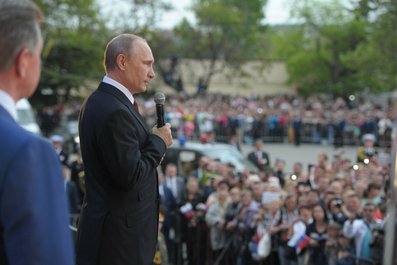
Russian President Vladimir Putin addresses a crowd on May 9, 2014, celebrating the 69th anniversary of victory over Nazi Germany and the 70th anniversary of the liberation of the Crimean port city of Sevastopol from the Nazis. (Russian government photo)
This media problem has grown over recent decades as lucrative careerism has replaced responsible professionalism. Pack journalism has always been a threat to quality reporting but now it has evolved into a self-sustaining media lifestyle in which the old motto, “there’s safety in numbers,” is borne out by the fact that being horrendously wrong, such as on Iraq’s WMD, leads to almost no accountability because so many important colleagues were wrong as well.
Similarly, there has been no accountability after many mainstream journalists and commentators falsely stated as flat-fact that “all 17 U.S. intelligence agencies” concurred that Russia did “meddle” in last November’s U.S. election.
For months, this claim has been the go-to put-down whenever anyone questions the groupthink of Russian venality perverting American democracy. Even the esteemed “Politifact” deemed the assertion “true.” But it was never true.
It was at best a needled distortion of a claim by President Obama’s Director of National Intelligence James Clapper when he issued a statement last Oct. 7 alleging Russian meddling. Because Clapper was the chief of the U.S. Intelligence Community, his opinion morphed into a claim that it represented the consensus of all 17 intelligence agencies, a dishonest twist that Democratic presidential candidate Hillary Clinton began touting.
However, for people who understand how the U.S. Intelligence Community works, the claim of a 17-agencies consensus has a specific meaning, some form of a National Intelligence Estimate (or NIE) that seeks out judgments and dissents from the various agencies.
But there was no NIE regarding alleged Russian meddling and there apparently wasn’t even a formal assessment from a subset of the agencies at the time of Clapper’s statement. President Obama did not order a publishable assessment until December – after the election – and it was not completed until Jan. 6, when a report from Clapper’s office presented the opinions of analysts from the Central Intelligence Agency, Federal Bureau of Investigation and the National Security Agency – three agencies (or four if you count the DNI’s office), not 17.
Lacking Hard Evidence
The report also contained no hard evidence of a Russian “hack” and amounted to a one-sided circumstantial case at best. However, by then, the U.S. mainstream media had embraced the “all-17-intelligence-agencies” refrain and anyone who disagreed, including President Trump, was treated as delusional. The argument went: “How can anyone question what all 17 intelligence agencies have confirmed as true?”
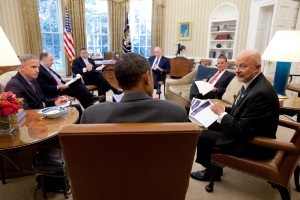
Director of National Intelligence James Clapper (right) talks with President Barack Obama in the Oval Office, with John Brennan and other national security aides present. (Photo credit: Office of Director of National Intelligence)
It wasn’t until May 8 when then-former DNI Clapper belatedly set the record straight in sworn congressional testimony in which he explained that there were only three “contributing agencies” from which analysts were “hand-picked.”
The reference to “hand-picked” analysts pricked the ears of some former U.S. intelligence analysts who had suffered through earlier periods of “politicized” intelligence when malleable analysts were chosen to deliver what their political bosses wanted to hear.
On May 23, also in congressional testimony, former CIA Director John Brennan confirmed Clapper’s description, saying only four of the 17 U.S. intelligence agencies took part in the assessment.
Brennan said the Jan. 6 report “followed the general model of how you want to do something like this with some notable exceptions. It only involved the FBI, NSA and CIA as well as the Office of the Director of National Intelligence. It wasn’t a full inter-agency community assessment that was coordinated among the 17 agencies.”
After this testimony, some of the major news organizations, which had been waving around the “17-intelligence-agencies” meme, subtly changed their phrasing to either depict Russian “meddling” as an established fact no longer requiring attribution or referred to the “unanimous judgment” of the Intelligence Community without citing a specific number.
This “unanimous judgment” formulation was deceptive, too, because it suggested that all 17 agencies were in accord albeit without exactly saying that. For a regular reader of The New York Times or a frequent viewer of CNN, the distinction would almost assuredly not be detected.
For more than a month after the Clapper-Brennan testimonies, there was no formal correction.
A Belated Correction
Finally, on June 25, the Times’ hand was forced when White House correspondent Maggie Haberman reverted to the old formulation, mocking Trump for “still refus[ing] to acknowledge a basic fact agreed upon by 17 American intelligence agencies that he now oversees: Russia orchestrated the attacks, and did it to help get him elected.”
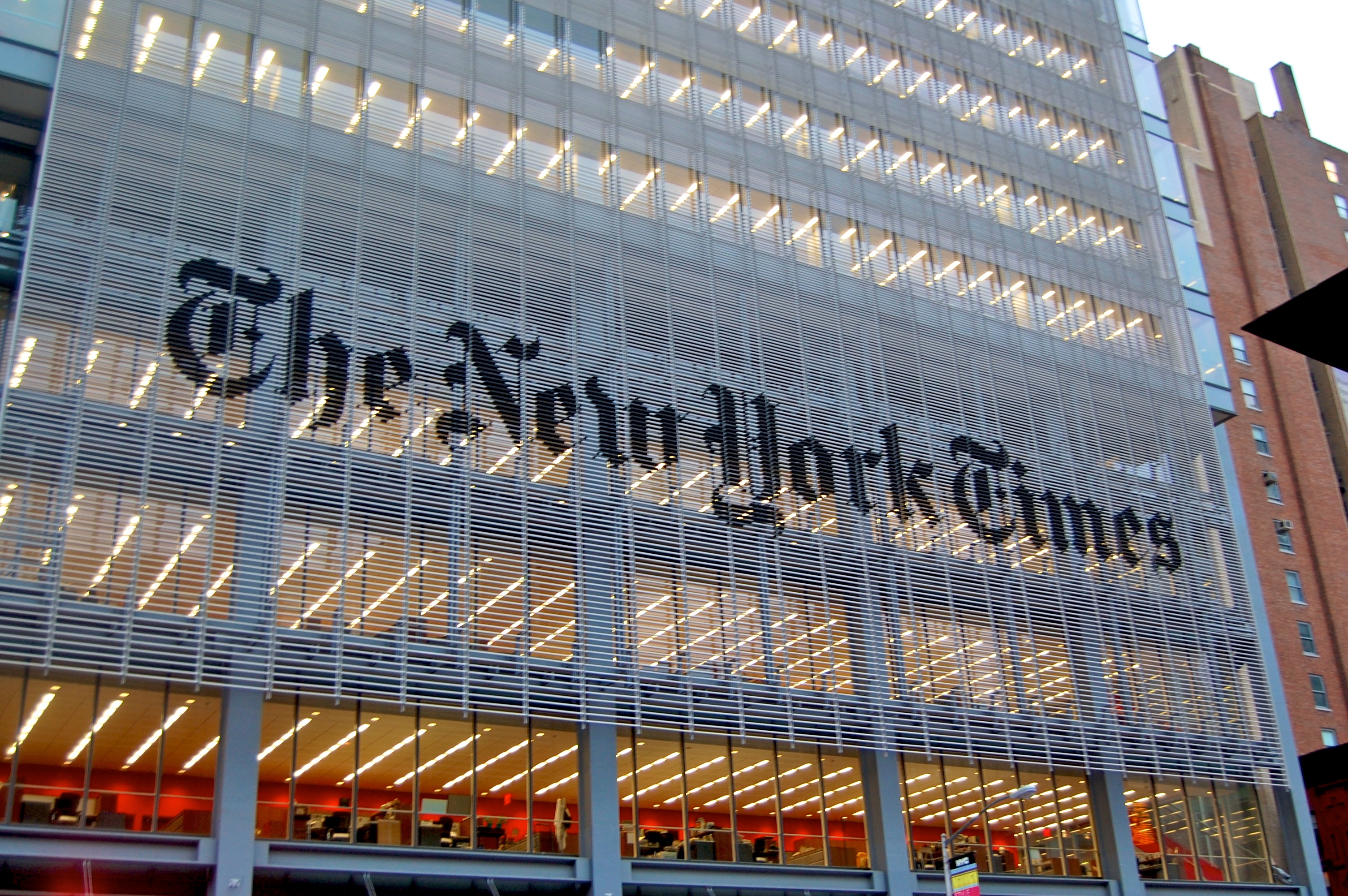
New York Times building in New York City. (Photo from Wikipedia)
When this falsehood was called to the Times’ attention, it had little choice but to append a correction to the article, noting that the intelligence “assessment was made by four intelligence agencies — the Office of the Director of National Intelligence, the Central Intelligence Agency, the Federal Bureau of Investigation and the National Security Agency. The assessment was not approved by all 17 organizations in the American intelligence community.”
The Associated Press ran a similar “clarification” applied to some of its fallacious reporting repeating the “17-intelligence-agencies” meme.
So, you might have thought that the mainstream media was finally adjusting its reporting to conform to reality. But that would mean that one of the pillars of the Russia-gate “scandal” had crumbled, the certainty that Russia and Vladimir Putin did “meddle” in the election.
The story would have to go back to square one and the major news organizations would have to begin reporting on whether or not there ever was solid evidence to support what had become a “certainty” – and there appeared to be no stomach for such soul-searching. Since pretty much all the important media figures had made the same error, it would be much easier to simply move on as if nothing had changed.
That would mean that skepticism would still be unwelcome and curious leads would not be followed. For instance, there was a head-turning reference in an otherwise typical Washington Post take-out on June 25 accusing Russia of committing “the crime of the century.”
A reference, stuck deep inside the five-page opus, said, “Some of the most critical technical intelligence on Russia came from another country, officials said. Because of the source of the material, the NSA was reluctant to view it with high confidence.”
Though the Post did not identify the country, this reference suggests that more than one key element of the case for Russian culpability was based not on direct investigations by the U.S. intelligence agencies, but on the work of external organizations.
Earlier, the Democratic National Committee denied the FBI access to its supposedly hacked computers, forcing the investigators to rely on a DNC contractor called CrowdStrike, which has a checkered record of getting this sort of analytics right and whose chief technology officer, Dmitri Alperovitch, is an anti-Putin Russian émigré with ties to the anti-Russian think tank, Atlantic Council.
Relying on Outsiders
You might be wondering why something as important as this “crime of the century,” which has pushed the world closer to nuclear annihilation, is dependent on dubious entities outside the U.S. government with possible conflicts of interest.
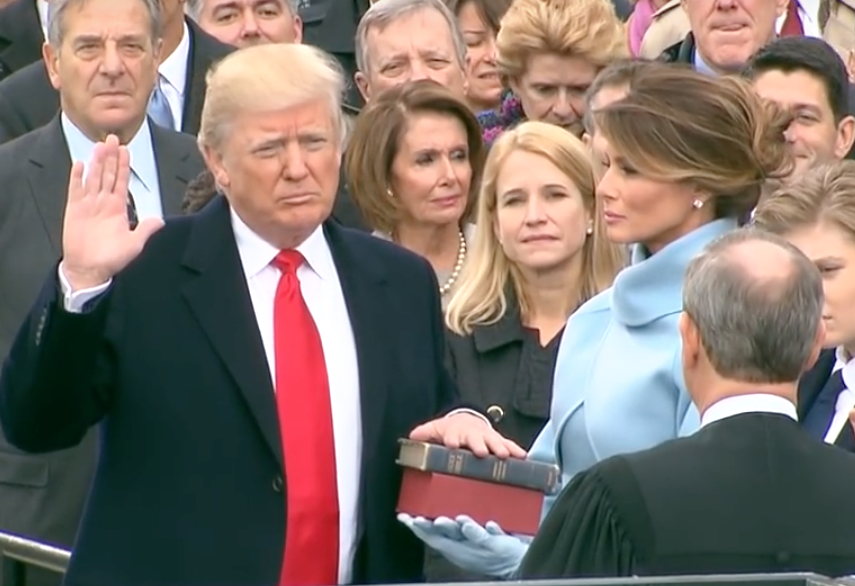
President Donald Trump being sworn in on Jan. 20, 2017. (Screen shot from Whitehouse.gov)
If the U.S. government really took this issue seriously, which it should, why didn’t the FBI seize the DNC’s computers and insist that impartial government experts lead the investigation? And why – given the extraordinary expertise of the NSA in computer hacking – is “some of the most critical technical intelligence on Russia [coming] from another country,” one that doesn’t inspire the NSA’s confidence?
But such pesky questions are not likely to be asked or answered by a mainstream U.S. media that displays deep-seated bias toward both Putin and Trump.
Mostly, major news outlets continue to brush aside the clarifications and return to various formulations that continue to embrace the “17-intelligence-agencies” canard, albeit in slightly different forms, such as references to the collective Intelligence Community without the specific number. Anyone who questions this established conventional wisdom is still crazy and out of step.
For instance, James Holmes of Esquire was stunned on Thursday when Trump at a news conference in Poland reminded the traveling press corps about the inaccurate reporting regarding the 17 intelligence agencies and said he still wasn’t entirely sure about Russia’s guilt.
“In public, he’s still casting doubt on the intelligence community’s finding that Russia interfered in the 2016 election nearly nine months after the fact,” Holmes sputtered before describing Trump’s comment as a “rant.”
So, if you thought that a chastened mainstream media might stop in the wake of the “17-intelligence-agencies” falsehood and rethink the whole Russia-gate business, you would have been sadly mistaken.
But the problem is not just the question of whether Russia hacked into Democratic emails and slipped them to WikiLeaks for publication (something that both Russia and WikiLeaks deny). Perhaps the larger danger is how the major U.S. news outlets have adopted a consistently propagandistic approach toward everything relating to Russia.
Hating Putin
This pattern traces back to the earliest days of Vladimir Putin’s presidency in 2000 when he began to rein in the U.S.-prescribed “shock therapy,” which had sold off Russia’s assets to well-connected insiders, making billions of dollars for the West-favored “oligarchs,” even as the process threw millions of average Russian into poverty.
Assistant Secretary of State for European Affairs Victoria Nuland, who pushed for the Ukraine coup and helped pick the post-coup leaders.
But the U.S. mainstream media’s contempt for Putin reached new heights after he helped President Obama head off neoconservative (and liberal interventionist) demands for a full-scale U.S. military assault on Syria in August 2013 and helped bring Iran into a restrictive nuclear agreement when the neocons wanted to bomb-bomb-bomb Iran.
The neocons delivered their payback to Putin in early 2014 by supporting a violent coup in Ukraine, overthrowing elected President Viktor Yanukovych and installing a fiercely anti-Russian regime. The U.S. operation was spearheaded by neocon National Endowment for Democracy President Carl Gershman and neocon Assistant Secretary of State for European Affairs Victoria Nuland, with enthusiastic support from neocon Sen. John McCain.
Nuland was heard in an intercepted pre-coup phone call with U.S. Ambassador Geoffrey Pyatt discussing who should become the new leaders and pondering how to “glue” or “midwife this thing.”
Despite the clear evidence of U.S. interference in Ukrainian politics, the U.S. government and the mainstream media embraced the coup and accused Putin of “aggression” when ethnic Russians in eastern Ukraine, called the Donbas, resisted the coup regime.
When ethnic Russians and other citizens in Crimea voted overwhelmingly in a referendum to reject the coup regime and rejoin Russia – a move protected by some of the 20,000 Russian troops inside Crimea as part of a basing agreement – that became a Russian “invasion.” But it was the most peculiar “invasion,” since there were no images of tanks crashing across borders or amphibious landing craft on Crimean beaches, because no such “invasion” had occurred.
However, in virtually every instance, the U.S. mainstream media insisted on the most extreme anti-Russian propaganda line and accused people who questioned this Official Narrative of disseminating Russian “propaganda” – or being a “Moscow stooge” or acting as a “useful fool.” There was no tolerance for skepticism about whatever the State Department or the Washington think tanks were saying.
Trump Meets Putin
So, since Trump met with Putin at the G-20 summit in Hamburg, Germany, the U.S. mainstream media has been in a frenzy, linking up its groupthinks about the Ukraine “invasion” with its groupthinks about Russia “hacking” the election.
Washington Post columnist David Ignatius. (Photo credit: Aude)
In a July 3 editorial, The Washington Post declared, “Mr. Trump simply cannot fail to admonish Mr. Putin for Russia’s attempts to meddle in the 2016 presidential election. He must make clear the United States will not tolerate it, period. Naturally, this is a difficult issue for Mr. Trump, who reaped the benefit of Russia’s intervention and now faces a special counsel’s investigation, but nonetheless, in his first session with Mr. Putin, the president must not hesitate to be blunt. …
“On Ukraine, Mr. Trump must also display determination. Russia fomented an armed uprising and seized Crimea in violation of international norms, and it continues to instigate violence in the Donbas. Mr. Trump ought to make it unmistakably clear to Mr.Putin that the United States will not retreat from the sanctions imposed over Ukraine until the conditions of peace agreements are met.”
Along the same lines, even while suggesting the value of some collaboration with Russia toward ending the war in Syria, Post columnist David Ignatius wrote in a July 5 column, “Russian-American cooperation on Syria faces a huge obstacle right now. It would legitimize a Russian regime that invaded Ukraine and meddled in U.S. and European elections, in addition to its intervention in Syria.”
Note the smug certainty of Ignatius and the Post editors. There is no doubt that Russia “invaded” Ukraine; “seized” Crimea; “meddled” in U.S. and European elections. Yet all these groupthinks should be subjected to skepticism, not simply treated as undeniable truths.
But seeing only one side to a story is where the U.S. mainstream media is at this point in history. Yes, it is possible that Russia was responsible for the Democratic hacks and did funnel the material to WikiLeaks, but evidence has so far been lacking. And, instead of presenting both sides fairly, the major media acts as if only one side deserves any respect and dissenting views must be ridiculed and condemned.
In this perverted process, collectively approved versions of complex situations congeal into conventional wisdom, which simply cannot be significantly reconsidered regardless of future revelations.
As offensive as this rejection of true truth-seeking may be, it also represents an extraordinary danger when mixed with the existential risk of nuclear conflagration.
With the stakes this high, the demand for hard evidence – and the avoidance of soft-minded groupthink – should go without question. Journalists and commentators should hold themselves to professional precision, not slide into sloppy careerism, lost in “propaganda-ville.”