Showing posts with label Computer network security. Show all posts

Wednesday, December 13, 2017

Cyberattacks: The Biggest Threat To OPEC

Authored by Irina Slav via OilPrice.com,


Oil and cybersecurity in one sentence certainly makes for a thrilling read, and there will be an increasing amount of information on the topic as the Internet of Things expands and the global oil industry adopts automation and digital technology.


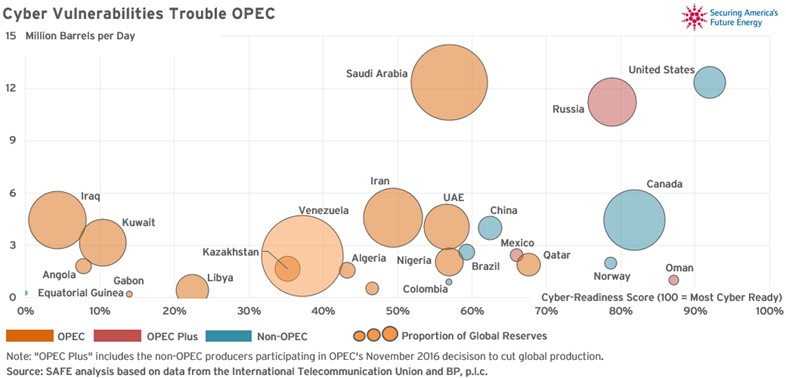
OPEC is no exception in this digitalization drive, but unlike its non-OPEC counterparts, the cartel has emerged as much more vulnerable to cybersecurity threats.


An analysis of data collected from 134 countries by the International Telecommunication Union has revealed that some of the world’s biggest oil producers, including Iraq, Saudi Arabia, Venezuela, Iran, and the UAE, are lacking in the cybersecurity department. This means that, compared to European producers and the United States, OPEC members are pretty much unprepared for a major cyberthreat.


What is the likelihood of such a threat actually materializing? Well, the general opinion in cybersecurity circles is that everything that can be hacked will be hacked at some point. Saudi Arabia’s oil and gas industry, for example, has been a favorite target for numerous attacks over the last few years, including the Shamoon virus, which in 2012 wiped clean the disks of more than 30,000 computers at Aramco, and according to reports from the cybersecurity industry, reared its ugly head again in 2016.


Overall, about half of all cyberattacks in the Middle East target the oil and gas industry, which suggests the answer to the above question is “Pretty high,” but the worse thing is that this likelihood is only going to get higher in the future. Related: Brent Spikes As This Major Pipeline Breaks Down


Middle Eastern producers are following in the footsteps of their non-OPEC counterparts in adopting digital technology and automation to improve efficiencies in the post-2014 world, where efficiency has come to the fore in oil and gas. The problem, of course, is that the more you digitalize, the more vulnerable you become to attacks through digital channels.


A recent study from Siemens and Ponemon Institute found that as digital tech adoption in the Middle East oil industry rises, so does cyber risk. What’s more, this risk is no longer limited to IT operations: the operational technology area is gaining prominence as a preferred target for cybercriminals.


The reason, according to Siemens and Ponemon Institute, is the convergence between IT and OT in the oil and gas industry. “Attackers have identified this convergence of IT and OT as a key opportunity to penetrate an organisation. As a result, an emerging trend of cyberattacks is designed to disrupt physical devices or processes used in operations. In a digital environment, industrial cyber is the new risk frontier,” says Siemens’ Vice President and Global Head of Industrial Cyber, Leo Simonovich.


The cybersecurity industry is sounding an alarm and it seems those in the Middle East that can afford it are hearing it and heeding the warning to improve their cybersecurity capabilities.


The UAE has a Dubai Cyber Security Strategy. Earlier this year, Saudi Arabia launched a National Cyber Security Center, and last month announced the set-up of a National Authority for Cyber Security, seeking to utilize international expertise and best practices to prop up government and critical infrastructure defenses. Iraq is seriously lagging behind and Iran is seen by cybersecurity insiders as more a source of cyberthreats than as a potential victim.


This sounds all well and good, but the trends in cybercrime point to a desperate need to do more. Cybercriminals do not sit on their hands while potential victims work to improve their defenses. While cybersecurity service providers continue to warn businesses and other organizations that they need to become more pro-active with regard to their cybersecurity measures, the hackers are coming up with new ways to undermine existing defenses. This is true for all industries, but it is especially true for oil and gas in the Middle East—national energy infrastructures are called critical for a reason, after all.


Thursday, October 12, 2017

Germany Says It Found "No Evidence" Kaspersky Helped Russia Spy On US

US intelligence agencies are claiming that the Russian government leveraged the popularity of Kaspersky Labs’ cybersecurity software to create what is tantamount to a global spy network with the company’s explicit cooperation. However, Germany’s intelligence agencies say they’ve found “no evidence” to suggest these reports are true.


The Wall Street Journal, which last week reported that the US had identified at least one case of Kaspersky’s software improperly copying classified information, is back with another “exclusive” spoon fed to it by anonymous “senior US officials” alleging that Kaspersky allowed Russian government malware to piggy back on its software. The malware scanned for and copied files labeled “top secret,” not just in the US, but globally. Though WSJ neglects to list other countries that are suspected victims of Russian hacking.


Meanwhile, Germany"s BSI federal cyber agency said on Wednesday it had found no evidence to suggest that Russian hackers had used Kaspersky’s software to spy on US authorities. "There are no plans to warn against the use of Kaspersky products since the BSI has no evidence for misconduct by the company or weaknesses in its software," BSI said in an emailed response to questions about the latest media reports. "The BSI has no indications at this time that the process occurred as described in the media," according to Reuters.


Germany"s BSI, which also uses Kaspersky products for technical analyses, said it was in touch with U.S. officials and other security agencies about the issue so it could take action and issue a warning on short notice if required.


The Russian government used a popular antivirus software to secretly scan computers around the world for classified U.S. government documents and top-secret information, modifying the program to turn it into an espionage tool, according to current and former U.S. officials with knowledge of the matter.


The software, made by the Moscow-based company Kaspersky Lab, routinely scans files of computers on which it is installed looking for viruses and other malicious software. But in an adjustment to its normal operations that the officials say could only have been made with the company’s knowledge, the program searched for terms as broad as “top secret,” which may be written on classified government documents, as well as the classified code names of U.S. government programs, these people said.


After becoming suspicious that the Kaspersky software might be concealing malicious spyware, US intelligence agencies began scrutinizing the software, searching for signs that it was unknowingly copying and transmitting sensitive information.


For many months, U.S. intelligence agencies studied the software and even set up controlled experiments to see if they could trigger Kaspersky’s software into believing it had found classified materials on a computer being monitored by U.S. spies, these people said. Those experiments persuaded officials that Kaspersky was being used to detect classified information.


Later, WSJ notes that, in fact, it was Israeli intelligence that first alerted the US to Kaspersky’s skullduggery, effectively creating a separate, parallel narrative to explain how the deception was exposed.


So, which is it? Did the Israelis tell us? Or did the US discover the breach independently in 2015?


In an ironic twist, Kaspersky exposed Israel for lying about the source of its information on Iran deal talks after WSJ reported two years ago that Israel had spied on negotiations. Israel had said it received its intelligence by other means, but it had in reality infiltrated Kaspersky’s software, a fact the company publicly acknowledged in a research paper published two years ago.


In a twist, Kaspersky appears to have known, or at least suspected, that it had been hacked by Israel. In June 2015, the company published a detailed technical analysis about malicious computer code used to break into its systems, which it dubbed Duqu 2.0. Experts believe that the original Duqu malware, on which the one inside Kaspersky’s system appears to have been based, was used to spy on officials participating in international negotiations over Iran’s nuclear program, a fact that Kaspersky acknowledged in its paper.


The Journal reported in 2015 that Israel had spied on closed-door talks among the U.S. and other world powers about curtailing Iran’s nuclear ambitions. Israeli officials denied spying directly on U.S. negotiators and said they received their information through other means, including close surveillance of Iranian leaders receiving the latest U.S. and European offers.


Which begs the question: Is it possible that Israel was the source of the Kaspersky hack? The country has been exposed for spying on the US before – and not just during the Iran negotiations. And it has also been exposed for infiltrating Kaspersky’s systems.


Keep in mind, suspicions about the infiltration first emerged two years ago at a time of heightened tension between the Obama administration and Israel. In an unprecedented move, the Department of Homeland Security ordered all federal agencies using Kaspersky’s software to uninstall it, effectively ending Kaspersky’s relationship with one of its largest clients.  
 

Friday, September 29, 2017

Airports Systems Just Crashed Globally; Could The Power Grid Be Next?

Authored by Mac Slavo via SHTFplan.com,


Airport computer systems crashed around the globe yesterday. The crash caused passenger delays, angst, and fright among travelers, but a more ominous question has arisen in light of this glitch. Could the next failure be a worldwide power grid outage?


Thousands of travelers were grounded yesterday when a computer glitch took down check-in systems at more than 100 airports worldwide. The crash left passengers waiting in long lines at counters while trying to check-in for their flights. T Amadeus Alta, the company that provides the software, confirmed it is experiencing a “network issue that is causing disruption,” The Telegraph reported.


The glitch affected even massive airports,  such London’s Heathrow International Airport, Charles de Gaulle Airport in Paris, and Ronald Reagan International Airport in Washington, D.C. “Technical teams are working on the problem, services are gradually being restored,” the software company said. After a few hours, officials at Gatwick and Heathrow airports said their systems were “back up and running” after the “momentary IT glitch,” adding there may be a delay due to the outage.


A statement on the glitch read, “A small number of airlines are currently experiencing intermittent issues with their check-in systems at airports around the world — including at Heathrow.”


It continued, “Passengers will still be able to check-in for their flight, although the process may take slightly longer than usual.”


Passengers took to social media to complain about the crash.


According to Fox News, it is still unclear when all the systems will be back up and running, but it begs the question: what if a power grid failure is next?


It isn’t like it’s never happened, but it may only be a matter of time before it occurs on a massive scale.


In December of 2015, 230,000 people in Western Ukraine lost power after 30 substations were mysteriously shut off. Contrary to what most people assumed at the time, this wasn’t an innocuous power outage. The authorities would later admit that the loss of power was caused by a cyber attack, which marked the first time that malware was successfully used to attack a power grid. A similar, albeit more sophisticated cyber attack, occurred one year later just outside of Kiev. Given the current tensions between Russia and Ukraine, it’s widely believed that the Russian government was responsible for these incidents.


However, there’s more to this story than meets the eye. A computer security company has been investigating these attacks, and has discovered the malware that was used to take down the grid. They’ve found that it’s far more dangerous and easier to use than anyone realized before. –Ready Nutrition


It may not necessarily be malicious malware that takes down the grid either.  Even solar flares can cause some incredibly intense issues.


Most policy makers have not taken the threat of an earth-directed solar flare seriously, even though a senior member of the Congressional Homeland Security Committee recently warned that there is a 100% Chance of a Severe Geo-Magnetic Event Capable of Crippling Our Electric Grid.


If such an event were to happen Congressman Roscoe Bartlett, who has advised people to develop individual preparedness plans based on the threat of massive solar flares or electro-magnetic pulse detonations, says that it would take upwards of 18 months to bring the grid back online because of a decaying national infrastructure. –SHTFPlan


With the crash of the airport system affecting people worldwide, imagine how much chaos would ensue should the power grid go down over most of earth.

Wednesday, June 28, 2017

3 Out Of 4 US Energy Firms Were Hacked In 2016

Authored by Zainab Calcuttawala via OilPrice.com,


Hackers have targeted Russian oil giant Rosneft, the company said on Tuesday, just as Deloitte released a report on cyber-attacks targeting U.S. oil companies.


A “powerful hacker” attacked the company’s server in an assault that, according to TASS news agency, could be related to ongoing legal proceedings.


A Russian court recently froze assets of a holding company called Sistema as part of a suit lodged by Rosneft and Bashneft. The two companies are trying to recover $2.9 billion lost during Sistema’s 2014 restructuring.


Russian companies are not the only ones facing the new frontier in corporate espionage. U.S. consulting major Deloitte released a report on Monday that said American energy companies showed “limited strategic appreciation” for cyber-threats.


Analysts said three of every four U.S. oil and gas companies experienced a cyber-attack in 2016, but only a few firms said the computerized attacks posed a major security risk.


"Whether hackers use spyware targeting bidding data of fields, malware infecting production control systems, or denial of service that blocks the flow of information through control systems, they are becoming increasingly sophisticated and, specifically alarming, launching coordinated attacks on the industry," the report said.


Low crude prices have caused energy companies to focus their spending on operations that maximize value for shareholders, instead of investing in protective cyber security measures.


On the most vulnerable aspects of the oil and gas supply chain, Deloitte wrote:


“Among the upstream operations, development drilling and production have the highest cyber risk profiles; while seismic imaging has a relatively lower risk profile, the growing business need to digitize, e-store, and feed seismic data into other disciplines could raise its risk profile in the future.”


Tuesday, June 27, 2017

"Massive Cyberattack" Spreads Across Europe, Hits Ukraine, Russia, UK, Denmark

Update 3: Germany"s Merck also confirms it has been affected by the cyberattack:


* * *


Update 2: RUSSIAN CENBANK SAYS AS A RESULT OF ATTACKS THERE HAVE BEEN ISOLATED CASES WHERE IT SYSTEMS INFECTED


* * *


Update: in addition to the below listed companies, all of which appear to have been targeted in the global cyberattack including Russia"s Rosneft and metals giant Evraz, Danish shipper Maersk, UK ad company WPP, the Ukraine central bank, government and airport, more targets are emerging including Norway"s national security authority which has said that a Ransomeware attack is ongoing in Norway "similar to the attack on Maersk", while Russia"s Home Credit Bank said all domestic branches are closed because of the cyber attack.


As the Spectator adds, companies in Spain are also now affected by the cyberattack which appears to be a modification of the "WannaCry" virus, and has been named "Petya."


A Moscow-based cyber security firm, Group-IB, said it appeared to be a coordinated attack simultaneously targeting victims in Russia and Ukraine, according to Reuters.


* * *


Now that CNN is officially out of the "Russia hacking" fake news business, the Ukraine has decided to fill in the void, and moments ago Ukraine"s Deputy Prime Minister Pavlo Rozenko said that the government"s computer network was down, in what he claimed was a "massive cyberattack", one which has also impacted the central bank, power plant and airport, and promptly blamed Russia for being behind the attack without a shred of evidence. To "prove" the accusation, he posted a picture on Twitter of a computer screen showing an error message.


“We also have a network "down",” he wrote. “This image is being displayed by all computers of the government.” The photo showed his PC displaying a message claiming a disk “contains errors and needs to be prepared”, urging the user not to turn it off.


According to local press, numerous Ukrainian institutions were hit by a wave of cyber attacks earlier in the day, including banks, the state energy distributor and Kiev"s main airport. "We also have a network "down"," Rozenko said on Facebook.


Ukrainian state-run aircraft manufacturer Antonov was among the companies hit, along with state power distributor Ukrenergo, which said the attack did not affect power supplies.


According to Bloomberg, Kievenergo, a Ukrainian utility, switched off all computers after the hack, while another power company, Ukrenergo, was also affected, though “not seriously,” the Interfax news service reported. Ukrainian airports and railways are operating as usual, according to the Russian news service.


Ukrainian delivery network Nova Poshta halted service to clients after its network was infected, the company said on Facebook. Ukraine’s Central Bank warned on its website that several banks had been targeted by hackers.


After the attack, Ukraine quickly went for the empathy points, tweeting a meme from its official Twitter account.


“Some of our gov agencies, private firms were hit by a virus. No need to panic, we’re putting utmost efforts to tackle the issue,” the account tweeted. Attached was an infamous "this is fine" gif.


* * *


So who"s to blame? Why Russia of course.


Speaking to Interfax,the advisor to the Interior Minister of Ukraine, MP Anton Gerashchenko said that "a huge cyber-attack at Ukrainian companies on Tuesday has been organized by Russian intelligence services and it is one of the elements of the hybrid war against Ukraine,


"The intrusion is the biggest in Ukraine’s history,” Gerashchenko wrote on Facebook. The goal was “the destabilization of the economic situation and in the civic consciousness of Ukraine,” though it was “disguised as an extortion attempt,” he said.


"A huge cyber-attack has been started against Ukraine. It was done under the disguise that it is allegedly a virus… According to the preliminary information, this is an organized system, a kind of training by the Russian intelligence services. The attack aims at banks, media and transport communications," he said on 112.Ukraine TV Channel on Tuesday.


One wonders if that preliminary information came from the same FBI that incorrectly claimed the Qatar hack was organized by Russia, when Qatar itself later blamed the "blockade" countries as being behind it.


Gerashchenko said that the virus reached computers during several days and even weeks via getting mails. "Today, at 11:00 [the computers] that were affected by the virus in advance were activated. Thus, this is another example of using cyber-attacks in the hybrid war against our country," he said.


"I think that soon officers of the SBU, the cyber security department of the National Police will unveil the ways how this virus reached the targets and they propose the options to tackle the problem," he said.


* * *


Meanwhile, the fall out in Ukraine, which claimed the cyberattacks are a modified version of the "WannaCry" virus, has been extensive with Ukrainian state-run aircraft manufacturer Antonov among the companies reportedly hit, along with state power distributor Ukrenergo, which said the attack did not affect power supplies. The National Bank of Ukraine said an “unknown virus” was to blame, saying several unnamed Ukrainian banks were affected  along with financial firms.


“As a result of cyber attacks, these banks have difficulties with customer service and banking operations,” a statement said.


“The National Bank bank is confident that the banking infrastructure"s defense against cyber fraud is properly set up and attempted cyber attacks on banks" IT systems will be neutralised.”


Oschadbank, one of Ukraine"s largest state-owned lenders, said some of its services had been affected by a “hacking attack” but guaranteed that customer data was safe.


Computers and departure boards at Boryspil International Airport in Kiev – the largest in Ukraine – were also down. “The official site of the airport and the scoreboard with the schedule of flights aren"t working!” the airport’s acting director, Pavel Ryabikin, wrote on Facebook.


* * *


It wasn"t just Ukraine however. As The Independent writes, Danish shipping giant Maersk said its IT systems were down across “multiple sites and
businesses due to a cyber attack”, although it was unclear whether it
was related to the situation in Ukraine. The congolmerate is the largest container shipping
company in the world and also operates in the oil and gas sectors.


Russia"s Rosneft, a government-owned oil firm, also said it was targeted by a “massive hacker attack” on its servers, as was steel maker
Evraz. "The cyber attack could lead to serious consequences, however, due to
the fact that the Company has switched to a reserve control system,
neither oil production nor preparation processes were stopped,” a
statement from Rosneft said.


British advertising company WPP also said several units were affected by a suspected cyber attack.


Or, as Reuters summarizes:


  • SWISS GOV"T AGENCY SAYS UKRAINE, RUSSIA, ENGLAND AND INDIA ARE MOST AFFECTED BY VIRUS, NO INDICATION THAT SWISS COMPANIES AFFECTED

  • SWISS GOV"T AGENCY SAYS THERE ARE INDICATIONS THAT PETYA RANSOMWARE VIRUS IS CIRCULATING AGAIN

It was not clear how and why Russian hackers would be able to hack the entire world, Russia included, but that probably does not matter: Ukraine has blamed Russia for repeated cyber attacks targeting
crucial infrastructure during the past three years, including one on its
power grid that left part of western Ukraine temporarily without
electricity in December 2015. Today was just a continuation, and after all the world still demand Russia hacking narratives.

Tuesday, May 2, 2017

Cyber Security (Better Than Musk)

By Chris at www.CapitalistExploits.at


I still remember my brother coming home with a cell phone.


It looked like a brick and weighed as much. But hell, was it cool. That was in the late 90"s.


The world today is almost unrecognisable in comparison.


Today, people are hyper connected all the time - streaming Kim Kardashian bending over in her yoga pants or listening to Justin Bieber (why, I cannot fathom). Using some app to help park the car, another to book a hotel, yet another to organise flight schedules, and - when the novelty of all of those has worn off - an app to organise getting laid. Revolutionary stuff!


And if that weren"t enough, while all this is going on you can wear a Fitbit which will record every minuscule thing you do and feed this information back to any device of your choosing in order for you to quantify just exactly how fat and appallingly lazy you actually are.


Not only that but we"ve not even begun to discuss the homes, shopping centres, airports, etc. all regulated with sensors controlling climate, security systems, and so on.


Now, I"ll readily admit to having almost none of these gadgets, partly because I"m mean and partly because I like to keep my life simple. 90% of this stuff doesn"t do that for me.


The other reason is experience has taught me that when the new iAnything comes out it costs $1.8bn new and within 24 months you can get it for a few hundred bucks - Moore"s law being what it is. And by then, I"ve determined I don"t really want it anyway. Problem solved.


Twenty years ago, we all thought we"d be in flying cars by now. Instead we got the smartphone, exquisitely designed to build the next generation of hunchbacks.


There is a beacon of light at the end of this tunnel, though.


Two things:


  1. Turn off the meaningless junk and recapture your life, and

  2. Realise nobody else will, which means that we"re dealing with a growth industry. Excellent!

Tell me, how dependent are you on technology?


Think about it seriously and remember that almost EVERYTHING is connected. Look around you and you"ll realise that EVERYONE is connected.


Take a look at this:


Did you know the IOT was this large? I didn"t.


Think about those 50+ billion connected devices - each of them a vulnerability point for breach of data.


As I"ve written recently, security is an area where nowhere near enough money is being spent. This will change.


I wrote about a private company I"ve invested in in the IOT sector of security, where I mentioned the following:


"The real bang for your buck will lie in artificial intelligence, machine learning, drones, and the integration of existing data sources."


It"s going to change because the risks are exponential.


Consider recent data hacks in the corporate sector:


  • eBay (NASDAQ:EBAY): 150 million passwords

  • JPMorgan Chase (NYSE:JPM): 73 million emails

  • Target (NYSE:TGT): 40 million credit card numbers

  • Yahoo (NASDAQ:YHOO): 1 billion accounts

Ok, so that"s the corporate sector. And remember for many companies simply admitting to hacks taking place renders them less trustworthy in the eyes of the consumer. Most CEOs would sooner admit to genital warts than admit to data breaches. Industry experts suggest the actual number of hacks taking place are far higher than being reported. I don"t doubt them.


Government


Chairman Trump isn"t the only guy to see that cyber security is important. Certainly Hillary figured that one out. It may have even contributed to her losing the election. Here"s what Trump says about cyber security:


"I will make certain that our military is the best in the world in both cyber offense and defense. I will also ask my Secretary of Defense and Joint Chiefs to present recommendations for strengthening and augmenting our Cyber Command."


He goes on to say:


"To enhance the defense of the other agencies of government, including our law enforcement agencies, we will put together a team of the best military, civilian and private sector cybersecurity experts to comprehensively review all of our cybersecurity systems and technology."


What Can We Do?


On a personal level we should be protecting ourselves. Get rid of the crap that brings no value to your life. Simply not using something reduces personal risk.


If you don"t know what I"m talking about, then I strongly suggest watching Snowden and Citizenfour, and jumping online to watch videos given by hackers. You"ll quickly realise how vulnerable we all are.


The simple stuff like using a firewall, anti-virus software, never using public Wi-Fi, and always using a VPN should be mandatory for any device we use. It"s just so easy to use public Wi-Fi, neglect using a VPN, but the risks are asymmetric to the downside. Like wearing a seatbelt, it doesn"t matter until, well, until it does.


Will this protect you from being hacked or your history being recorded and archived? No, but it"ll substantially decrease the risks.


Out of those listed topics above, the only one I"ve had some issues with over the years has been the use of VPNs. I"ve used a number of different ones and, like anything, some work better than others, often depending on your location. I recently found what is I think the best I"ve used so far, but whatever you use, I think using a firewall, anti-virus software, and then neglecting a VPN is silly.


How to Invest


While I"m not sure this qualifies as asymmetric in nature I do think that we"re looking at a growth industry.


Here is a good resource with a host of forecasts and trends in the IOT industry.


Estimates of the current size of the IOT market range from $600 billion to $900 billion. Even if we"re working at the low end of that range, consider that the two largest ETFs in the cyber security space total a combined $870 million. That"s it.


That"s nothing!


Heck, Enron On Wheels" market cap is now north of $50 billion and they make cars (barely) with other peoples" parts. I"d gladly pair trade these over the next decade. Long HACK and CIBR and short TSLA.


In any event, here"s HACK:


And CIBR:


There are pros and cons to them. HACK has more liquidity, is larger in size but charges a higher expense ratio than CIBR.


Why look at ETFs?


Remember Betamax? Killed by VHS which DVDs then sent to the grave.


You want to be involved in the growth of the sector but unless you are going to dedicate your time to really understanding all the movers and shakers in that sector, diligencing balance sheets, earnings statements, competing technologies, and the like, then you"re better off making a sector bet.


If you want a set and forget play, then buying the ETF means you"re just making a sectorial bet not betting on Betamax in 1977 just as VHS was being released.


Either way, cyber security is likely to do really well over the coming years. It"s a war hedge, an innovation play, and, as long as the IOT space continues to grow cyber security, will become an increasingly required service sector.


- Chris


"There are only two types of companies. Those that have been hacked and those that will be." — Robert Mueller, FBI Director 2012


--------------------------------------


Liked this article? Don"t miss our future missives and podcasts, and


get access to free subscriber-only content here.


--------------------------------------

Wednesday, March 8, 2017

Q&A: How Can I Stop My TV Spying On Me?

Following today"s publication, by WikiLeaks, of documents exposing the CIA"s secret hacking program - describing tools that can turn a world of increasingly networked, camera- and microphone-equipped devices into eavesdroppers, AP"s Frank Bajak answers the public"s biggest questions. Bajak warns consumers, there"s "not much you can do if you don"t want to sacrifice the benefits of the device," but offers a silver-lining of sorts for the average joe, the "tools that appear to be targeted at specific people"s (devices).. and many intrusion tools are for delivery via "removable device"."


Smart televisions and automobiles now have on-board computers and microphones, joining the ubiquitous smartphones, laptops and tablets that have had microphones and cameras as standard equipment for a decade. That the CIA has created tools to turn them into listening posts surprises no one in the security community.


Q: HOW WORRIED SHOULD CONSUMERS BE?


A: The intrusion tools highlighted by the leak do not appear to be instruments of mass surveillance. So, it"s not as if everyone"s TV or high-tech vehicle is at risk.


"It"s unsurprising, and also somewhat reassuring, that these are tools that appear to be targeted at specific people"s (devices) by compromising the software on them — as opposed to tools that decrypt the encrypted traffic over the internet," said Matt Blaze, a University of Pennsylvania computer scientist.


The exploits appear to emphasize targeted attacks, such as collecting keystrokes or silently activating a Samsung TV"s microphone while the set is turned off. In fact, many of the intrusion tools described in the documents are for delivery via "removable device."


Q: WHAT CAN BE DONE TO PREVENT A COMPROMISED INTERNET-CONNECTED DEVICE FROM COMMUNICATING WITH SPIES?


A: Not much if you don"t want to sacrifice the benefits of the device.


"Anything that is voice-activated or that has voice- and internet-connected functionality is susceptible to these types of attacks," said Robert M. Lee, a former U.S. cyberwar operations officer and CEO of the cybersecurity company Dragos.


That includes smart TVs and voice-controlled information devices like the Amazon Echo, which can read news, play music, close the garage door and turn up the thermostat. An Amazon Echo was enlisted as a potential witness in an Arkansas murder case.


To ensure a connected device can"t spy on you, unplug it from the grid and the internet and remove the batteries, if that"s possible. Or perhaps don"t buy it, especially if you don"t especially require the networked features and the manufacturer hasn"t proven careful on security.


Security experts have found flaws in devices — like WiFi-enabled dolls — with embedded microphones and cameras.


Q: I USE WHATSAPP AND SIGNAL FOR VOICE AND TEXT COMMUNICATION BECAUSE OF THEIR STRONG ENCRYPTION. CAN THE EXPLOITS DESCRIBED IN THE WIKILEAKS DOCUMENTS BREAK THEM?


A: No. But exploits designed to infiltrate the operating system on your Android smartphone, iPhone, iPad or Windows-based computer can read your messages or listen in on conversations on the compromised device itself, though communications are encrypted in transit.


"The bad news is that platform exploits are very powerful," Blaze tweeted. "The good news is that they have to target you in order to read your messages."


He and other experts say reliably defending against a state-level adversary is all but impossible. And the CIA was planting microphones long before we became networked.


Q: I"M NOT A HIGH-VALUE TARGET. BUT I STILL WANT TO PROTECT MYSELF. HOW?


A: It may sound boring, but it"s vital: Keep all your operating systems patched and up-to-date, and don"t click links or open email attachments unless you are sure they are safe.


There will always be exploits of which antivirus companies are not aware until it"s too late. These are known as zero-day exploits because no patches are available and victims have zero time to prepare. The CIA, National Security Agency and plenty of other intelligence agencies purchase and develop them.


But they don"t come cheap. And most of us are hardly worth it.


Source: AP

Wednesday, January 11, 2017

Mario Draghi's Email Was Hacked By A High-Ranking Mason

Earlier this morning we reported the bizarre story of how two hackers had managed to penetrate the email accounts of not only ECB head Mario Draghi, but also former Italian PMs Matteo Renzi and Mario Monti, as well as countless other highly placed politicians and executives. On the surface this may have been a non-event, especially if the hackers were unaware of the potentially market-moving content of the various emails hacked, and had no means of acting on the uncovered information.


However, as subsequent information revealed, there appears to be much more to the story, including a very surprise twist.


First, as Bloomberg reported, in addition to Draghi and Renzi, the extensive cyber-spying operation targeted more than 18,000 e-mail accounts, according to a court document. The aptly named operation “Eye Pyramid” (more on that shortly) revealed cyber-spying of institutions, state agencies, professionals, political figures and business people lasting for years, Italian police said in an e-mailed statement Tuesday.


Police said two people were arrested: a nuclear engineer and his sister, both living in Rome "and well-known in Roman financial circles."


The two were Giulio Occhionero, 45, and his sister Francesca Maria Occhionero, 48, who were charged with stealing state secrets and illegal hacking. Lawyers representing the two could not be immediately reached. According to the complaint, the alleged hackers acted “with the aim of making a profit for themselves or for others.”


The suspects" arrest warrant issued by Rome pre-trial Judge Maria Paola Tomaselli states that Draghi’s e-mail at the Bank of Italy was hacked in the summer of 2016. Draghi served as governor of the Italian central bank from 2005 to 2011. An e-mail account belonging to Renzi was also hacked, the document says.


Among the others hacked is a list of who"s who in Italian politics: "There were tens of thousands of email accounts hacked, and among them were accounts belonging to bankers, businessmen and even several cardinals in the Vatican," Roberto Di Legami, head of the specialised police cyber unit that conducted the investigation, told Reuters. Other hacker were Italian oil giant Eni SpA, multinational power company Enel SpA and technology company Leonardo Finmeccanica SpA, the court document shows. Political parties, law firms, politicians and ministries were also targeted.


The suspects tried to obtain confidential and sensitive data, especially on banks, at the ECB in Frankfurt and at the Bank of Italy in Rome, according to a person familiar with the investigation, speaking on the condition of not being identified by name. As Bloomberg add, "the two arrested are suspected of obtaining information on national security, serious illegal access to a computer system and illicit interception of computer communications in an investigation led by Rome prosecutors, an Italian police statement said."


Thanks to a wide network of computers infected with malware called “Eyepyramid,” the pair allegedly obtained from a large number of victims “confidential information and sensitive data over many years” which was stored on U.S. servers, according to the police statement. Italian police, working with the Cyber Division of the Federal Bureau of Investigation, have seized the servers, it added. An official at the U.S. embassy in Rome declined to comment on behalf of the FBI.


Draghi"s account at the Bank of Italy, where he was previously governor, and Renzi"s personal Apple account that he used while he was prime minister were among those infected by the malware, according to the arrest warrant cited by Reuters. Renzi"s official email as prime minister was also targeted, Di Legami said.


But back to the perpetrators, because that"s where the story gets even more fascinating. 


Giulio Occhionero, a trained nuclear engineer and co-founder of investment firm Westland Securities, used a malware to infect the email accounts so that he could make "investments based on reserved information," Di Legami said. In other words, profit using information extracted from the head of the European Central Bank, among others.


Giulio Occhionero


And now the punchline: according to the arrest warrant, Occhionero was a high-ranking member of a Masonic lodge, "which in Italy are shrouded in secrecy, and among those he monitored was the grand master of the country"s biggest lodge."


While Putin was not involved in this particular hacking, the actual mechanism was far more bizarre: Occhionero, which means black-eye in Italian, used a customised malware called "Eye Pyramid", a reference to the all-seeing eye of God, like the one depicted on the back of the U.S. dollar bill, as well as a reference to the Masonic eye symbol, which also happens to grace every US Dollar bill.


The court document added that the stolen data was stored in servers in Prior Lake, Minnesota, and Salt Lake City, Utah. The Federal Bureau of Investigation has seized the servers and will ship them to Italy, Di Legami said.


While most of the hacking appears to have been focused on the email accounts, there was evidence that he had managed to install a keylogger on some computers, allowing him to see every keystroke, the warrant showed. It was not clear which computers the Mason was able to track.


The warrant notes that while the investigation began when an infected email was detected in April, 2016, there is evidence the two had been using the malware to spy since 2010. As noted above, the investigation so far shows some 18,000 accounts may have been hacked, and some 2,000 user passwords identified.


And even thought the head of the specialised police cyber unit that conducted the investigation told Reuters there was no evidence the Italian hackers were acting on behalf of foreign states, one wonders which other foreign or non non-foreign actors also had access to information that may have been sourced from the email of Mario Draghi as well as the most important central bank in Europe, and how Occhionero - a high-ranking mason and finance professional - profited on the information, and how any of his accomplices, Masons or otherwise, benefited from having an inside view into what may have been extremely critical, market-moving news, coming at a time when the ECB annonced a variety of initiatives which resulted in the biggest drop in corporate bond yields in history.


Finally, if Occhionero managed to hack virtually every highly-placed Italian, did he do the same with foreign entities, such as Americans, at a time when the public and media are both extremely sensitive to any news of cybercrime, and if so what did they learn?


We hope to learn more as this fascinating case unfolds.