Showing posts with label Asset. Show all posts

Thursday, December 7, 2017

Earnings Don"t Matter After All!

Via The Knowledge Leaders Capital blog,


Our long-time readers are familiar with the work of Professor Baruch Lev of the NYU Stern School of Business, whose research forms the basis for the Knowledge Leaders investment strategy. In his decades-long study of financial records, Lev first discovered a link between a firm’s knowledge capital and its subsequent stock performance, ultimately identifying a market inefficiency that leads highly innovative companies to deliver excess returns. We call this market anomaly the Knowledge Effect.


In a new article in Financial Analysts Journal, Lev and co-author Feng Gu continue to advance the findings on intangibles. The article, “Time to Change Your Investment Model,”  identifies that earnings prediction has lost “much of its relevance in recent years.”


As a form of predicting corporate results, “earnings no longer reliably reflect changes in corporate value and are thus an inadequate driver of investment analysis.”


The basis for this shift, the authors explain, occurred after the emergence of the semiconductor.


Starting in the early 1980s, investment in traditional, tangible assets (structures, factories, machinery, inventory) – considered assets by accountants and reported accordingly on the balance sheet – dropped precipitously from 15% of gross added value in 1977 to 9% in 2014, a 40% drop.


In contrast, the investment rate in intangible capital (R&D, patents, information systems, brands, media content, business processes) – mostly expensed in corporate income statements – increased continuously from 9% to 14% of added value, a 56% increase. This radical business model transformation came to be known as the knowledge – or information revolution, an irreversible trend in developed economies.”
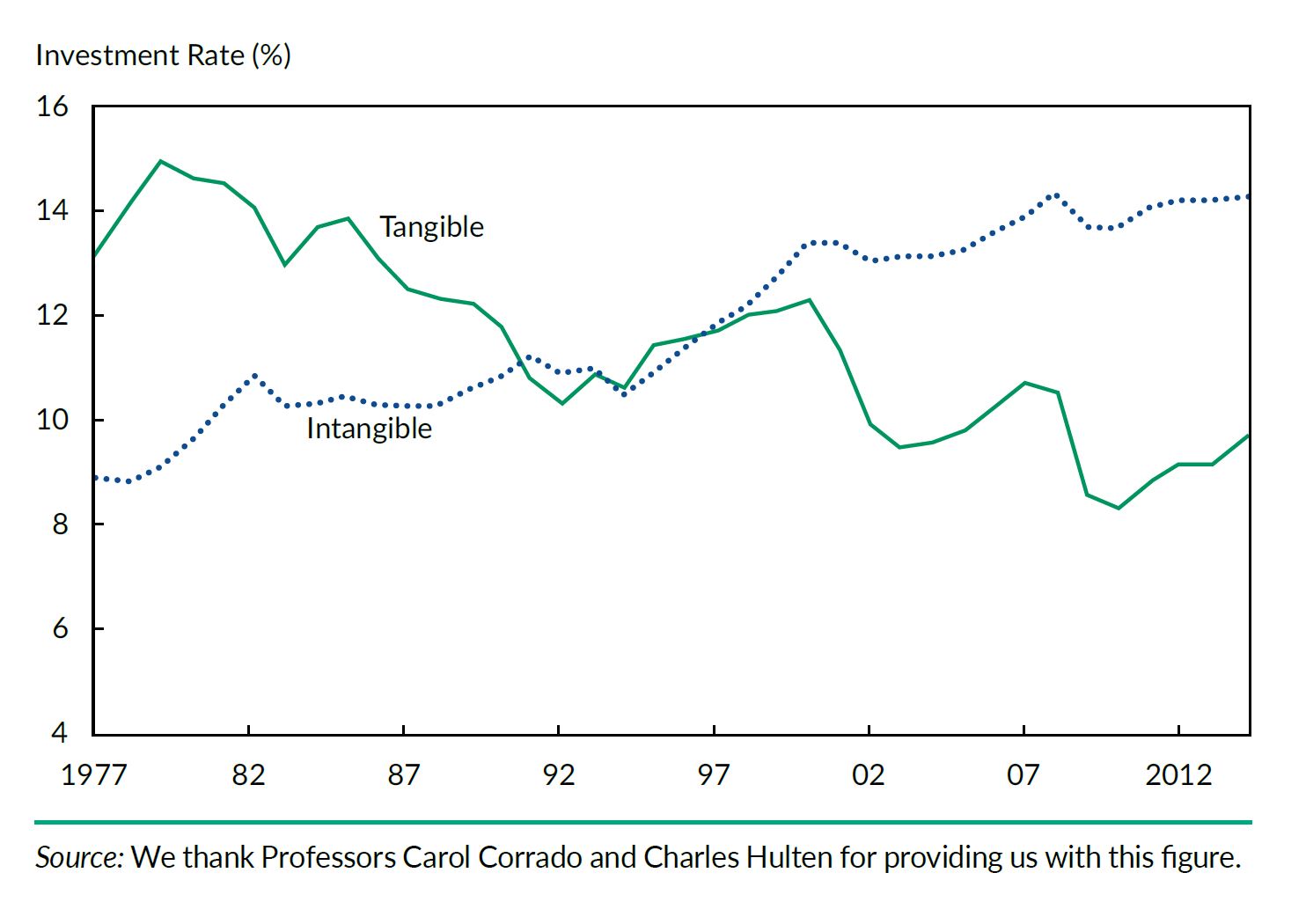


As a result, for companies, “the only way to survive and prosper in such a competitive environment (is) through constant product and process innovation, achieved primarily by investing in intangible assets.” Therefore, “earnings’ usefulness to investors declines sharply for companies that increasingly rely on intangible value-creating assets.”


For these reasons, “GAAP-based reported earnings no longer reflect the periodic value changes (growth) of most business enterprises, and thus conventional earnings-based security analysis has lost much of its usefulness for investors in recent years.”


In summary, the authors observe:


“The disappointing returns on managed funds in recent years should raise doubts about the continued usefulness of conventional security analysis. Our extensive empirical evidence on the loss of relevance of GAAP numbers, in both this article and our recent book, confirms these doubts. Certain major investors have already departed from the status quo. … We propose a different course: Rather than replace analysts with robots, substitute an improved investment methodology for an outdated one.”


If you’re interested in reading Lev and Gu’s article, download it here. Stay tuned for more on Professor Lev’s research in early 2018 and an in-depth Q&A on his latest research on intangible capital.


Tuesday, October 3, 2017

Hard Assets In An Age Of Negative Interest Rates

Time is the soul of money, the long-view - its immortality.


Hard assets are forever, even when destroyed by the cataclysms of history.


It is the outlook that perpetuated the most competent and powerful aristocracies in continental Europe, well up through World War I and, in certain prominent cases, beyond; it is the mindset that has sustained the most fiscally serious democratic republic in the Western world, that of Switzerland (as demonstrated in this article).


In this view, the stewardship of money, formerly known as “banking,” is a serious matter of serious wealth management and not a weird-science lab experiment of investment products ultimately designed for hedge fund managers’ tax arbitrage schemes.


More than ever the focus on hard assets is a dire call to arms given the deformed market culture of central banking monetary magic. Despite the early promise of the Trump presidency to reinvigorate the economy, the United States remains mired in economic stagnation built up over so many years of debt-driven policies, easy-money policies, and the ZIRP fiasco fostering a bizarre-world situation in which the actual economy is doing poorly while the market is soaring. In such an environment, the allure of the centuries’-old tried and true has never had more appeal.


In a word, the hard asset vision is about building wealth outside the stock market. It refers to three main strategies overall: 


1) land ownership and/or farmland, forestry and agriculture


2) gold, other precious metals, and certain base-metal commodities, and


3) The (Old Masters/Classic Modern) art market.


Where this last is concerned, we mean art as investment and not art-as-commerce, such as that which contaminates today’s insipid and overpriced world of ‘Balloon-Dog’ bad art. The auction world of Rembrandt and Picasso; of El Greco and Gerhardt Richter has been on a tear, is smashing records, and cannot be ignored as an excellent safe-haven vehicle, as outstanding works of art traditionally always have been.


To begin with, physical gold and precious metals remain an investment enigma despite being market-leading performers for the past seventeen years. Gold is a must-have portfolio asset amid the aggressive debt levels and monetary debasement that have so unhinged the market. Silver, for its part, in addition to its prestige status, also has innumerable industrial applications and throughout the precious-metal bull market since 2000.


Russia, in this context, is leading the charge in the long-view outlook. For the past three years, the Bank of Russia has been the world’s number one stacker of gold, and, thus far in 2017, has taken the lead position among international central banks in buying the commodity.


At its current pace, Moscow will unseat China for the number five spot of gold-holding nations by the first quarter of 2018.


Currently, the gold-to-GDP ratios of the world’s leading powers are: Russia 5.6%; the Euro Zone 3.6%; the U.S. 1.8% and China 1.5%.


Yet countries buying up gold versus investors who do so are two different worlds. Ninety-five percent of the world’s gold is held as a wealth store.


In other commodities, zinc and copper have been the big movers. Zinc, the key galvanizing agent, claimed the status of the best performing metal last year. Copper began its resurgence in 2017, and in late August of this year, a host of commodities broke out of multi-month consolidation patterns. Nickel and cobalt are also coming into the spotlight as metals essential to the rapidly growing lithium ion (Li-ion) battery sector.


The art world lags not too far behind that of precious metals in terms of history’s preferred storehouses of value as protection against uncertain times. Art as investment has long been a favored strategy of the European elite since, effectively, the High Middle Ages and has never gone out of style. In modern times, the phenomenon of an ever-growing collectors’ base and less supply of museum quality works has been accepted as a meaningful way to protect investors’ cash during economic difficulty. Though continually eclipsed in the media by the brasher contemporary art market, Old Masters (and Classic Modern—the great 20th century works) have shown stable, often spectacular, results over the past ten years with both categories reaching record-breaking highs.


Art, to be a safe haven, must be an investment and not a whim - just as it was for the Liechtenstein family who acquired Leonardo da Vinci’s Ginevra de Benci so many centuries ago. In the wake of the World War II near-bankruptcy of that eponymous principality (whose monarchs were not and are not supported by taxes), that painting was the first of the major, big-ticket art sales of the 20th century, when it was sold to Paul Mellon and The National Gallery of Art in Washington DC. Ginevra continues to hang there today (and to date, is the only Leonardo painting in possession of the United States).  While the average investor may not be in a position to store wealth in a Renaissance master or a Picasso, there are always the underrated gems or the new discoveries that can and will bring in the most unexpected of windfalls decades down the line.


Finally, farmland is seen by many as an excellent addition to a precious-metal portfolio. As Jim Rogers predicted in early September, fortunes will be made in agriculture “and when an industry breaks full faith, even mediocre people make a lot of money” in that sector. Hard asset investors continue to include farmland in their portfolios “for a combination of income generation, diversification and inflation-hedging”. Historically, farmland, like forestland in continental Europe or Latin America, has been a unique asset class demonstrating low-correlation to traditional asset classes, and which performs well as inflation rises.


Cash reserves, land as cash, the endless applications of Nature’s resources to industry; the prestige, privacy, and long-term value of beautiful art: such has been the outlook of the hard-asset philosophy.


Today, that cult of independently-minded investors will laugh all the way to the bank - precisely by avoiding the paths laid out, and so horribly deformed, by those very banks.

Tuesday, April 18, 2017

Asia's Richest Man Is "Aggressively Adding Direct Exposure To Gold"

Authored by Mac Slavo via SHTFplan.com,


The world is awash in crisis with wars looming, economies crashing and revolutions brewing. Doomsday bunkers sales are soaring and individuals from coast to coast are getting ready for whatever tomorrow may bring. Moreover, even governments like China and Russia are preparing, having gone so far as to create their own exchange mechanism to trade directly with gold in the event of a global currency crisis or financial meltdown.


But it’s not just governments who have taken notice of the problems facing the globe. According to Gold Mining Chairman Amir Adnani and Sprott U.S. Holdings CEO Rick Rule, some of the biggest billionaire investors on the planet are actively seeking out precious metals like gold as wealth protection insurance amid the uncertainty of the current geo-political climate.


In a recent interview with SGT Report, Adnani explains that several super wealthy individuals with whom he works very closely, including mainland China’s biggest billionaire investor and the richest man in all of Asia Li Ka-shing, have a renewed and urgent interest in diversifying their assets into both, gold mining firms and the physical asset itself:


This individual’s net worth is about $35 billion… For the first time in a number of years of working with his team when it comes to investments in commodities that they believe were important to the strategic growth of China… for the first time they are looking for gold related investments.


The comment from the person heading this initiative for Li Ka-shing is very interesting… His right had man said to me ‘He’s not just looking for investing in gold mines… he literally wants to find more ways to take physical gold back to Hong Kong and have that exposure.’


This is the largest individual investor in mainland China and I tell you over the last few years of having worked with him on the energy side, this is the first time I have seen him so aggressively looking for gold related opportunities.


In the full interview, insiders Amir Adnani and Rick Rule share their experiences working with others large investors, current strategies and expectations of what’s to come:


(Watch at Youtube)


The reason for why these high net worth individuals are rapidly moving into gold related assets, notes Adnani, is that they are not necessarily all that concerned with the current price and how high it may go in the future, but rather, because precious metals are backed with thousands of years of evidence that they are the asset of last resort during crisis:


That’s one… the second one… we’re very fortunate at Gold Mining… one of the board members of our company who has been a founder of the company since day one is a Brazilian billionaire by the name of Mario Garnero…


When I look at the level of interest that his organization has in terms of wanting that direct exposure to gold… I talked to them about why they are looking at this…


They’re focused on one factor that we seldom think about… We’re so fixated on price of gold… what they’re focused on… what the super wealthy are focused on… what the billionaires are focused on… is the fact that gold plays that hedge in your portfolio… that’s it’s the insurance in the portfolio…


It may not necessarily be as critical to think whether it’s $1200 an ounce or $1300… we fixate so much on the price… and we forget that irrespective of what it’s trading at on any given day it’s meant to be an insurance policy… it’s meant to be protection of wealth and preservation of wealth…


It’s a great reminder when you look at the first trading day after Brexit… I remember looking at my own portoflio.. and looking at the market… and everything is red… the Dow is down over 500 points… the only thing up are gold stocks…


But while insurance and wealth preservation are the key motivating factor for the super wealthy, another billionaire, Sprott U.S. Holdings CEO Rick Rule, says that even a tiny boost in investor demand could drive prices to new highs from here as investors stampede into hard asset stocks and physical holdings as the current bull market gains steam:


Let me give you a startling statistic that tells you what an awakening might do… physical precious metals, certificated precious metals, and precious metals equities occupy about one-third of one percent of the savings and investment assets of the United States.


The corresponding number at the top of the last bull market.. real bull market in 1981… was 8%…


One third of 1% now… 8% at the top.


I’m not suggesting to you that gold and precious metals related investments will ever get back to 8% but I would suggest to you that they will, in this bull market, approach the three decade median, which was 1.5%.


If that occurred, you would see a more than four-fold increase in demand for precious metals and precious metals related equities… I think that could be reasonably dramatic.


I am not one of these doom and gloom guys who says that gold is going win the war against the U.S. dollar.


But if gold lost the war a little less badly… in other words, if gold and gold equities market shares got up to 1.5% of the investment savings matrix of the United States, that would represent a four-fold increase in demand.


The world is primed for a serious, potentially devastating collapse of life as we know it. That may come with war, economic collapse, or both simultaneously. What we know from history is that those who prepared ahead of time and understood the ramifications of such events were positioned to not only survive, but thrive.


The high net worth individuals who are moving into gold related assets see the writing on the wall, and they are positioning themselves now to ensure their wealth will be preserved.


We strongly encourage you to do the same.


Tuesday, March 21, 2017

Accounting Change On Operating Leases To Add $3 Trillion In Debt To Corporate Balance Sheets

From a practical perspective, operating leases are pretty much the same as debt.  They reflect a contractual obligation on the part of one counterparty to make defined stream of cash payments to another over a set period and with an implied interest rate embedded in the payment stream.  In fact, within a bankruptcy context operating leases are treated exactly the same as debt and rank pari passu with the other general unsecured obligations of a business.  That said, accounting rules treat operating leases differently than debt and do not require them to be included as a liability on a company"s balance sheet.  That is, until 2019.


As Bloomberg points out this morning, starting in 2019 new accounting rules, called IFRS 16, will force companies to include operating lease commitments as part of their reported debt obligations.  And while the end result will have far-reaching implications, the biggest will be the addition of roughly $3 trillion in debt to corporate balance sheets.


Of course, retail, telecoms, energy and airline companies will be most affected by the new rules.


Leases


And here are the largest users of operating leases. 


Leases


Of course, some will argue that the accounting rule changes don"t alter a company"s cash flow profile and are therefore irrelevant.  That said, to the extent interest rates remain low, the present value of future cash payment obligations will undoubtedly serve to drive the pro-forma leverage profiles of some companies through the roof...much as low interest rates have wreaked havoc on pension underfundings over the past several years.


Some companies already spell out the impact of leases on total indebtedness. Air France-KLM"s reported net debt is 3.7 billion euros ($3.9 billion) but its lease-adjusted net debt is 11.2 billion euros. The present value of Tesco"s operating lease commitments is one and a
half times the size of reported net debt, according to its 2016 annual report.


Even so, I doubt this transition will be painless. At the very least, the rule change should give armchair investors, not to mention a company"s customers, employees and suppliers, a much better idea of how risky a business is compared to rivals. For some folk, this
will be a nasty surprise. Worries about corporate leverage are already widespread.


Besides, companies aren"t always as forthcoming as you might hope. Some airlines make debt adjustments for aircraft leases but not for other off-balance sheet rental agreements such as airport buildings. Delta Air Lines Inc. reported $6.1 billion in adjusted net debt at the end of December, including $2 billion in aircraft rent liabilities. Yet the discounted value of all its operating leases is closer to $9 billion, Gadfly estimates.


Meanwhile, the biggest impact of the accounting change may be the mere removal of yet another tool that management teams use to "game" their financial statements.


It"s conceivable therefore that IFRS 16 will affect corporate decisions on whether to rent or purchase an asset. Consider sale and lease-back arrangements. These were once a popular way for companies to get their hands on some cash and a quick chance for executives to make themselves look like geniuses. All of a sudden, return on assets improved.


Now, if all that rented floor space has to sit on the balance sheet anyway, selling off the corporate silverware might become less attractive. Buying big ticket assets, rather than leasing, is also cheaper now because of low interest rates.


Another approach may see some companies partly embrace shorter lease terms to minimize the balance sheet liability, according to Ruxandra Haradau-Doser, aviation analyst at Kepler Cheuvreux. Shorter leases are already common in retail, albeit for different reasons. With sales migrating online, retailers want more flexibility to close stores. IFRS 16 could accelerate that.


The accounting changes could also lead to more volatility in financial results, according to James Stamp, a partner at KPMG. Airlines typically take out aircraft leases in U.S. dollars. If the carrier"s domestic currency weakens against the dollar, its liabilities would suddenly increase and it would have to take a currency hit against earnings. Stamp thinks demand for hedging will rise.


And you thought things couldn"t get much worse for retailers...

Thursday, January 19, 2017

Nomi Prins: Financial Crash From Epic Debt, Asset Bubbles “Possible In Last Quarter 2017”


societal-collapse


Could there be a crash coming in 2017? Will increasing interest rates at the Federal Reserve trigger the beginning of the end?


It is possible, but not certain.


It will fall, perhaps, after a new sense of normal sets in, and some become comfortable with the change in leadership, and accustomed to drowning out the opposition yelling noisily from the other side. Expectations have been set for a growing economy, fresh infrastructure and new hopes for the average worker.


But getting too comfortable would be a huge mistake. All that could prove to be a mirage. And things could come crashing down.


On Friday, Donald Trump will be inaugurated as the 45th President, and all eyes will be on his first 100 days as he demonstrates what kind of president he will be, and his cabinet takes action. But even with the best intentions and carefully laid plans, there is no telling at this point how firmly he will be tested, and what kind of crisis America will have to endure during his first term. Wars, terror attacks, civil unrest, debt crisis and financial collapse all loom overhead.


Many have seen dark signals about the immediate future, but no one can claim to know the timing.


However, former Wall Street banker and now best selling critic of the predatory financial system Nomi Prins sees the pattern unfolding, and fears that the end of 2017 may be the time that everyone has been watching for. At the center of it is the whiplash effect of Federal Reserve stimulus-withdrawal (i.e. rate hikes and the contraction of easy money).


Greg Hunter of USAWatchdog interviewed Nomi Prins:


Former top Wall Street banker and best-selling author Nomi Prins correctly predicted no financial crash for 2016. Prins’ upcoming book is titled “Artisans of Money.” It is all about central bank money creation. What does Prins say about this year? Prins predicts, “In 2016, I pegged the non-crash. . . . Central bankers were finding new ways to extend their money creation policies. That is what kept the markets up.


There was a separate bid on the markets after Trump was elected. It was on the expectation that he would be good for growth, that he would be good for infrastructure and that he would create jobs. I do think there is a little juice in the central banks. I keep thinking there shouldn’t be, but they keep surprising all of us with their ability to boost the markets. They have artificially stimulated so many different asset bubbles, whether it’s debt, which is epic, or stock markets, many of which are at historic highs. If we have a crash, it will be in the second half of 2017. The promises, the rate hikes, the dollar being high could collapse into the realities of the stability and this artificialness. I am not sure about a crash this year, but if we see a big decline, it will be in the last quarter.”


Prins foresees gold prices surging during this last quarter period of instability. Those who’ve been eating sinking gold prices may find some relief once again, but the larger economic system is in danger of crashing and burning, and the possibility that the dollar will lose out:


“I think with the expectation of things going well, the dollar will be keeping a bit of a bid. It will be within a range but staying fairly up. I think the dollar will turn around and weaken in the second half of the year. . . .That’s why, in the last half of the year, gold will catch more of a bid.”


Prins discussed the alliance between Russia and China and what is about to unfold geopolitically.


“Because Russia, Putin’s very smart. He’s not just waiting to see what happens with Trump and the U.S. You know, there’s been very favorable rhetoric so far, but, you know, that could be a wild card. Things could be changed. Someone could get annoyed at someone else. So what he’s been doing, he’s been fortifying his relationship with Eastern Europe, his relationships with the UK, with Japan and particularly his relationship with China and the non-Russia BRICS countries. So all of this will be in flux…”


According to Nomi Prins, the crash wouldn’t be so much an immediate headline flashing-event, as it would be a steady decline and gradual sinking to the bottom.


Read more:


 Collapse Strategist: “We’re In The Terminal Phase… Economic Pain Like We’ve Never Seen Before”


What Life Will Be Like After An Economic Collapse: “Things Just Get Gradually Worse…”


MegaBanks Exiting: “Prepare For Economic Nuclear Winter… Sell Everything”


Economic Survival Expert FerFAL: Understanding Societal Collapse


Click here to subscribe: Join over one million monthly readers and receive breaking news, strategies, ideas and commentary.

Advanced Tactical Gas Mask

Please Spread The Word And Share This Post


Author: Mac Slavo
Views: Read by 298 people
Date: January 19th, 2017
Website: www.SHTFplan.com


Copyright Information: Copyright SHTFplan and Mac Slavo. This content may be freely reproduced in full or in part in digital form with full attribution to the author and a link to www.shtfplan.com. Please contact us for permission to reproduce this content in other media formats.


Monday, January 9, 2017

Prince Hoarded Cash, Owned 67 10-Ounce Gold Bars When He Died; Avoided Stocks And Bonds

Prince was a legendary musician; he may also have been a cash hoarding gold bug who had little faith in the merits of conventional investing.


According to an inventory report of the musician"s estate at the time of his death from a drug overdose on April 21, 2016 first reported by the Star Tribune, Prince had acquired tens of millions of dollars in real estate, cars (lots of cars) and other personal property during his illustrious career. His assets have been valued between $100 million and $300 million before taxes, which are expected to claim roughly half.


The asset inventory compiled by Bremer Trust, the special administrator shepherding Prince’s estate, lists a dozen properties in Carver and Hennepin counties with an estimated total value of $25.4 million.


The inventory also lists about $110,000 in four bank accounts including $55,666 and 23 cents in "miscellaneous cash" and $25,273.10 in unclaimed property.


Additionally, Prince’s companies, Paisley Park Enterprises Inc., NPG Records Inc., NPG Music Publishing and LotusFlowr had more than $6 million in cash on hand at the time of his death. The report notes that NPG Records has an estimated $6.8 million in arbitration receivable.


There also are plenty of items that haven’t been assigned a value yet, including musical instruments, his jewelry collection, household furnishings, a 2006 Bentley and the iconic “Purple Rain” and “Graffiti Bridge” motorcycles.


However, perhaps most interesting, is that Prince also owned some 67 10-ounce gold bars classified as "Other Personal Property" and valued at nearly $836,166.70. The report does not disclose the cost basis, or when he bought the precious metal.


As for his holdings of traditional investments, such as "stocks, bonds, and other securities" let"s just say that Prince saw more value in owning cars than equities, and as such the total value of his securities holdings was $0.00 at the time of death.


It remains unclear who will end up owning the assets of Prince who passed away without leaving a will: as the Star Tribune adds, dozens of claims have emerged over the past several months. Filings and judicial orders thus far make it appear likely that the fortune will be divvied up among sister Tyka Nelson and Prince’s half-siblings Sharon Nelson, Norrine Nelson, John Nelson, Omarr Baker and Alfred Jackson. There are also a number of unresolved issues related to Prince’s businesses, including pending lawsuits that could affect the value of the estate.


The full inventory report of Prince"s assets is listed below (link)

Saturday, November 5, 2016

Follow The Carry Trade (Video)

By EconMatters


We look at the funding currencies for the risk on versus risk off mode of evaluating financial market capital flows from an investing standpoint. You are swimming upstream in a Carry Unwinding Mode like a Salmon. Check out the main components of the US Dollar Index and compare their interest rates versus the United States. This serves as the fundamental basis for the Carry Trade Structure, and we have seen major deleveraging of these Carry Trades before the Presidential Election this upcoming Tuesday. Look for these trends to reverse after the election event is over with next week.


© EconMatters All Rights Reserved | Facebook | Twitter | YouTube | Email Digest | Kindle