Showing posts with label Mean Reversion. Show all posts

Friday, October 27, 2017

Keeping A Close Eye On Momentum In The US Equity Market

Authored by Steven Vanelli via Knowledge Leaders Capital blog,


Over the last 20 days, the US equity is showing early signs of exhaustion, and momentum is beginning to weaken.


In the following charts, we’ll highlight the various technical measures we calculate each day to illustrate the early turn in momentum. Our KLSU DM Americas Index represents the top 85% market-cap of the US and Canada.


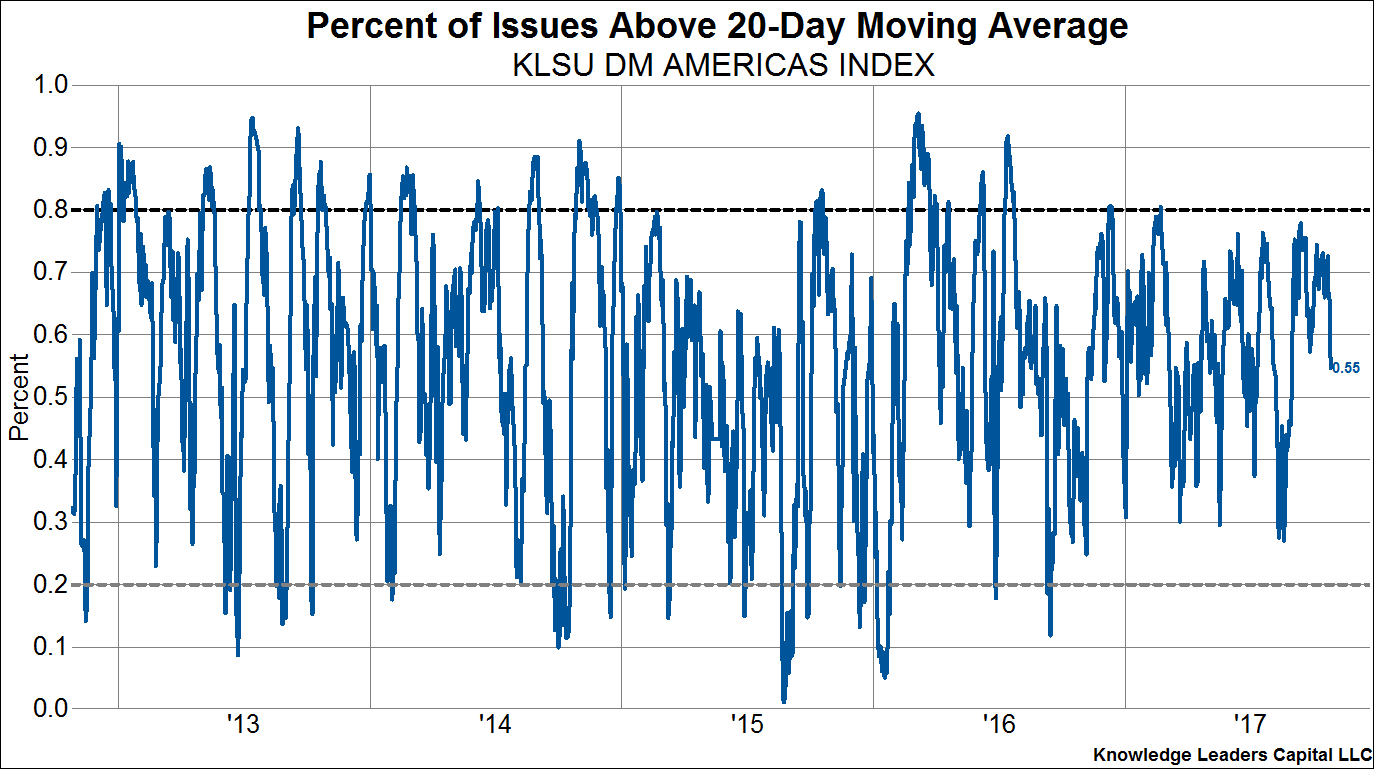
First, after peaking near 80% above the moving average a month ago, now only 55% of stocks are above their own 20-day moving average.


Second, the number of new 20-day lows is picking up. A month ago, only about 2% of North American stocks were making new 20-day lows. Now, the figure is 19%.


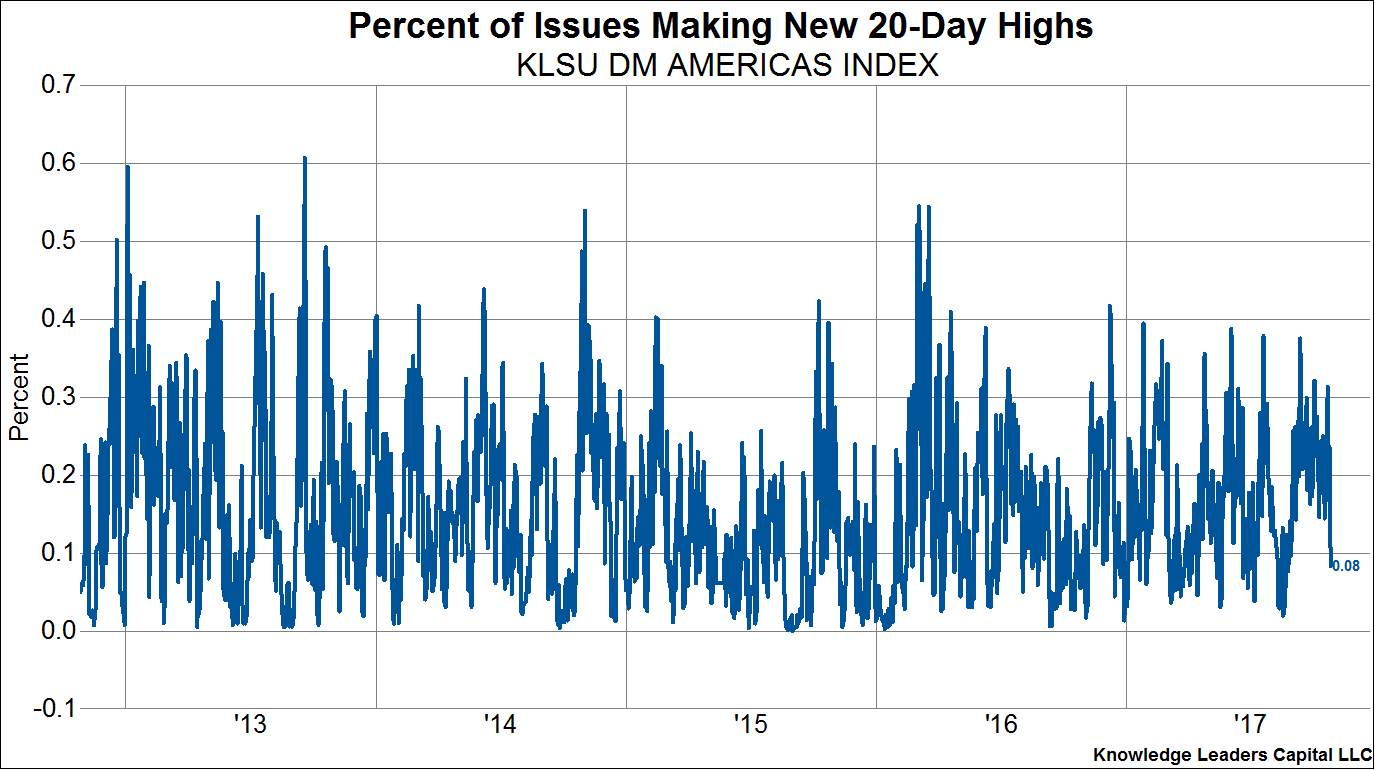
Similarly, a month ago 30% of North American stocks were making new 20-day highs. As of yesterday, only 8% are now making new 20-day highs.


Third, we measure the advance/decline ratio on a daily basis. The A/D ratio for North American equities has deteriorated from about 1.75 a month ago to about 1.31 currently.


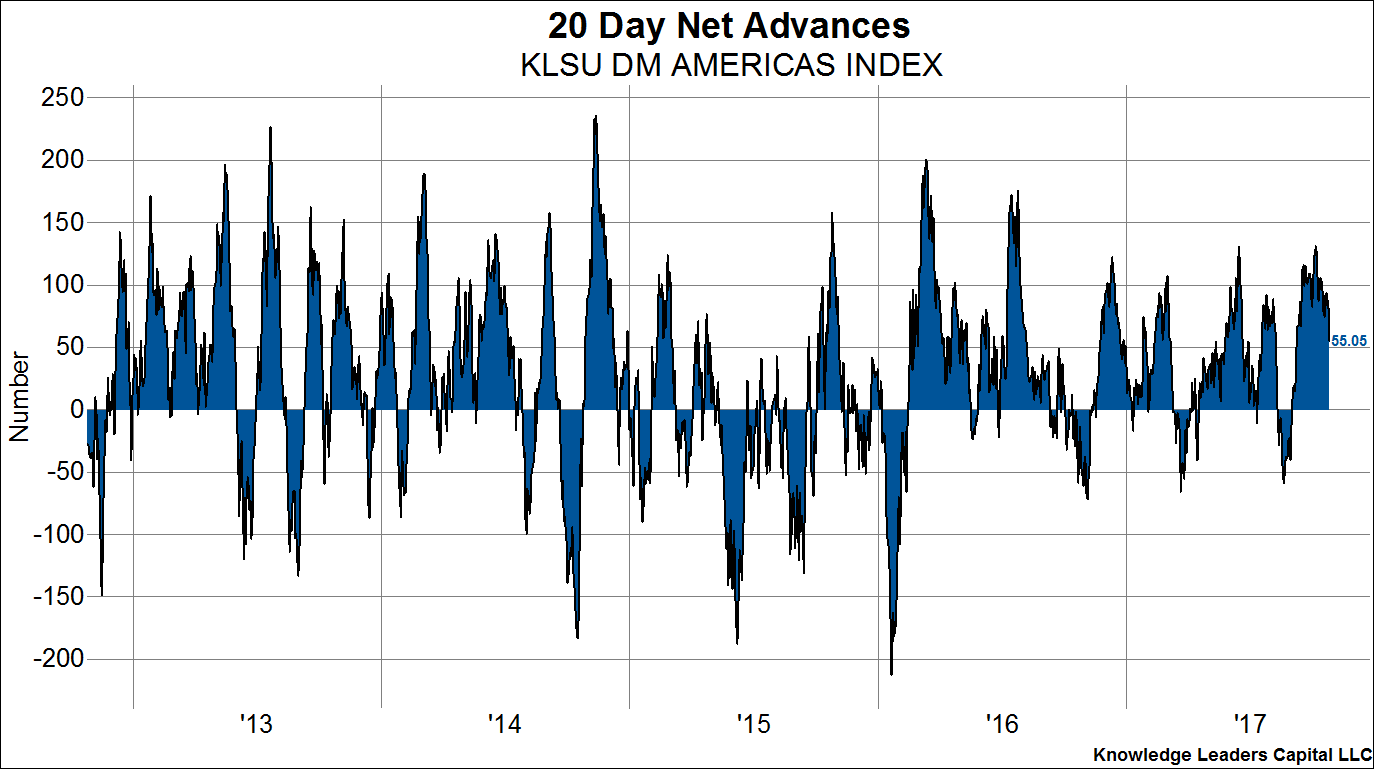
Fourth, we measure the number of net advancing stocks. We take the number of stocks up in a day and subtract the number of stocks down. A month ago, net advances were a bit over 100 for the trailing 20 days. We have slid to 55 net advances as of yesterday.


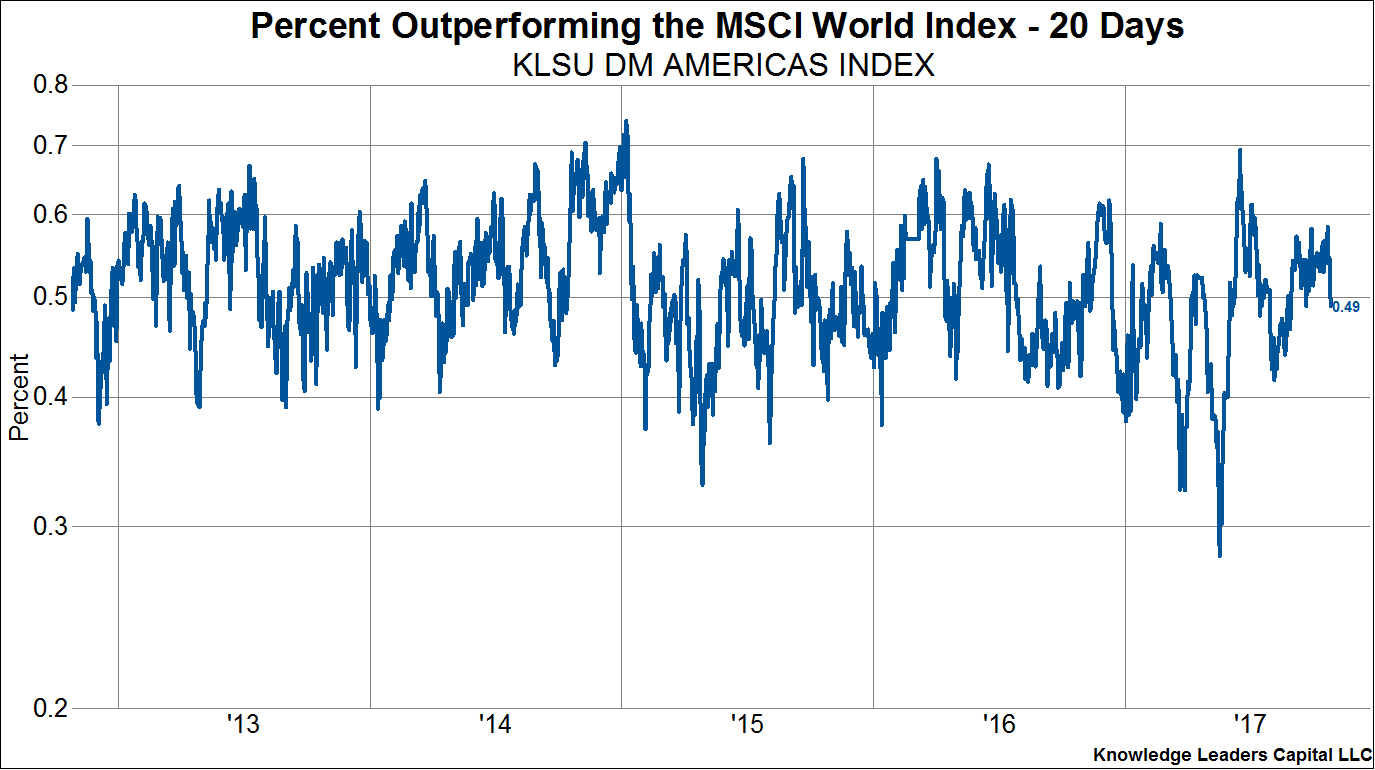
Fifth, we calculate the percent of stocks that are outperforming the MSCI World Index. A month ago just under 60% of all North American stocks had outperformed over the previous 20-day period. As of yesterday, only 49%, less than half the constituents, have outperformed the MSCI World Index over the last 20 days.


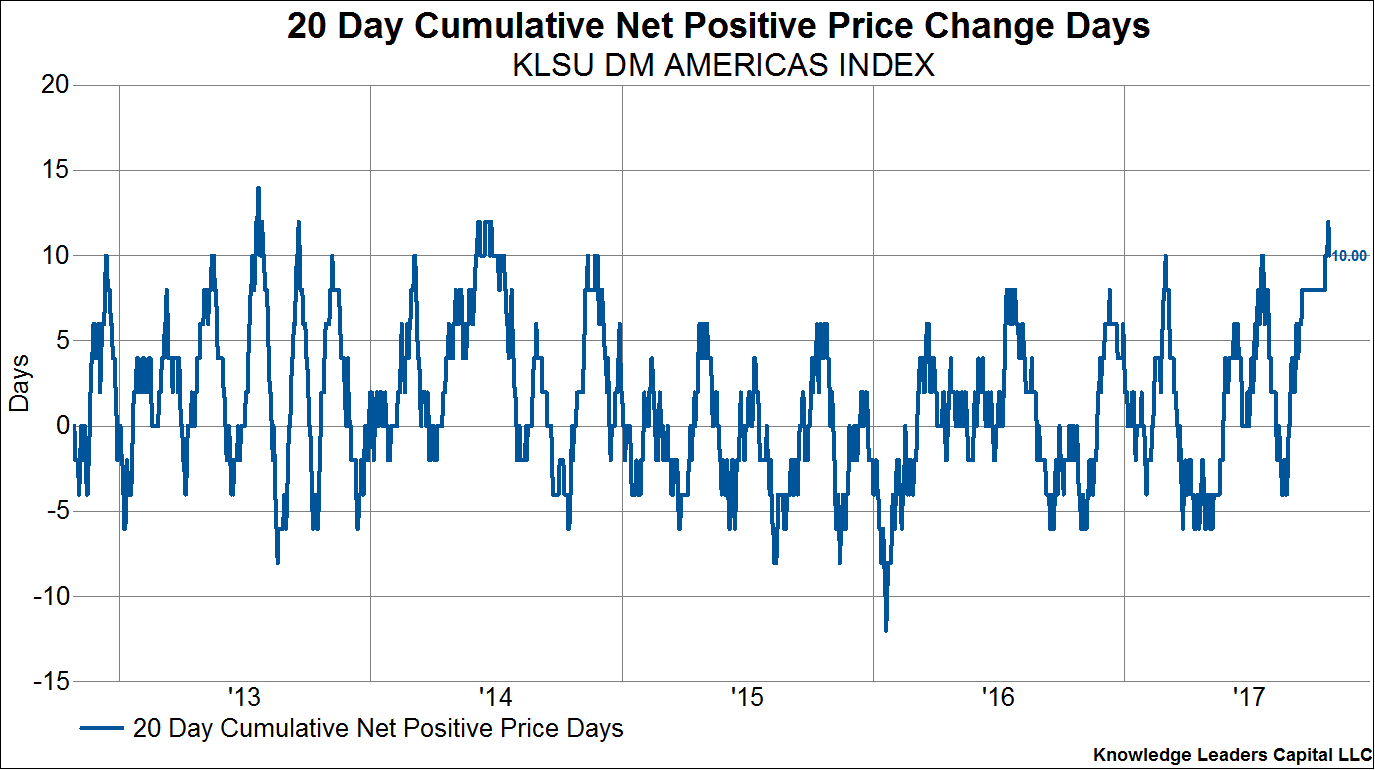
Sixth, we calculate the number of days stocks are up and the number of days stocks are down over a given period. As of Tuesday, the 20-day cumulative net positive price change days was 12, meaning 16 of the preceding 20 days were up days. As of yesterday, it has backtracked to 10.


While still a high reading, given the mean reversion to this data series, it would not be unusual if the recent run turns into a statistical slump, with more down days than up in the near future.


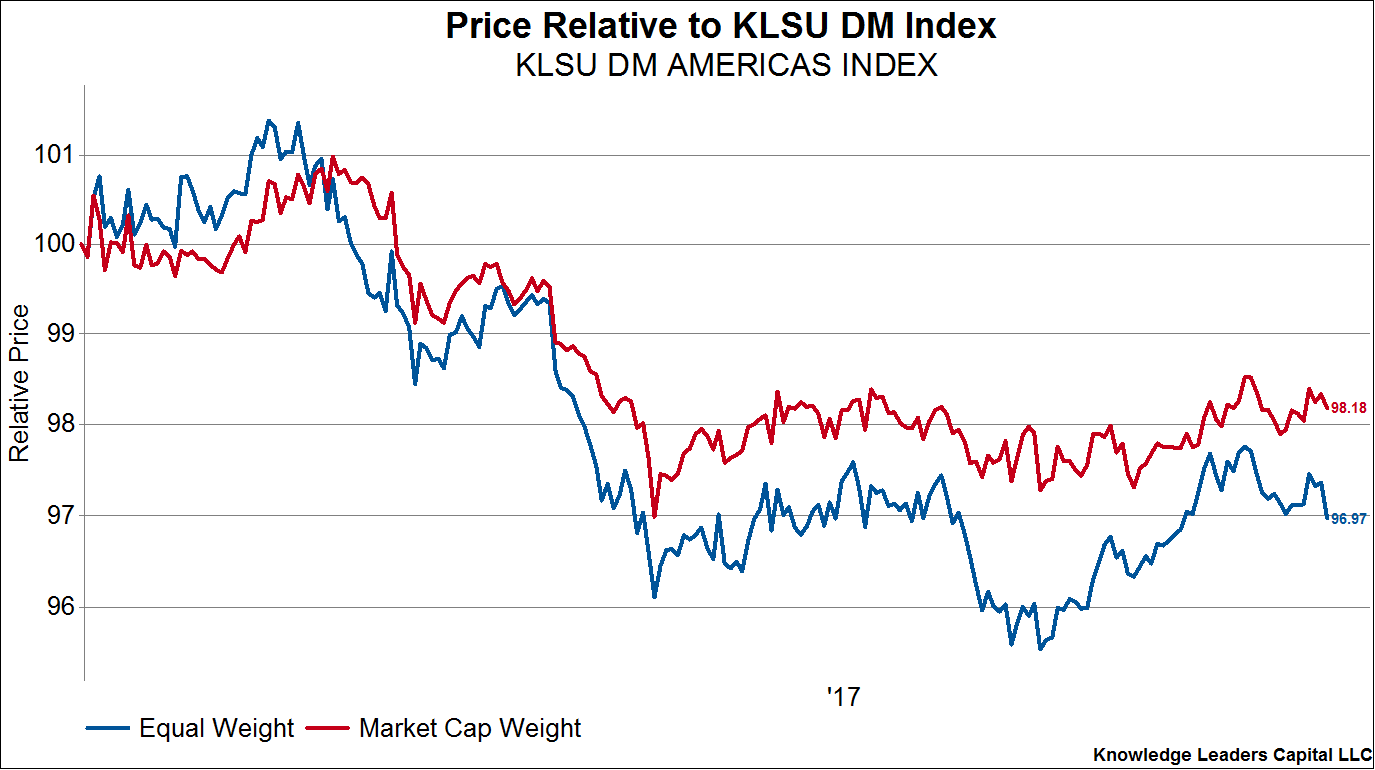
While this isn’t yet super bearish stuff, the deterioration in breadth should be considered alongside the fact that the equal weighted KLSU North America has underperformed the market-cap weighted version all year, suggesting a somewhat narrow market. And most importantly, both versions have underperformed the global equity markets YTD.


Saturday, September 23, 2017

Mark Hanson Warns, Housing Affordability Never Worse... By A Long-Shot

Authored by Mark Hanson via MHanson.com,


Bottom Lines: 


  • The income required to buy a median priced builder house has been more diverged from fundamental, end-user, mortgage-needing, shelter-buyer cohort income (purchasing power), which is why builder demand and end-user resales remain anemic.  

  • Meaningful sales growth with this affordability backdrop is impossible.

  • A mean reversion – via surging wages, new era exotic loans, plunging rates, and/or falling house prices, as speculation ebbs – is inevitable. 

Summary


My chart highlights how for DECADES the income required to buy a median priced house – using popular programs & rates for each era – remained mostly flat (red line) and WELL BELOW the level of household income (black line).


How could house prices rise so much for decades but income required to buy (red) them remain flattish?  Because of the accompanying falling rates/easing credit guideline cycle.  In fact, during Bubble 1.0 house prices soared but exotic loans legitimately made them more affordable than ever, as shown.


But in ’12, as trillions in unorthodox capital, credit & liquidity began to drive massive speculation (just like Bubble 1.0) income required to buy began to surge, with prices, shooting above median HH income (boxed in yellow). Meaningful sales growth with this affordability backdrop is impossible.


This is the point in this inflationary cycle at which affordability detached from end-user fundamentals.


Now, in ’17, end-user purchase power & house prices have never been more diverged from the multi-decade trend line and a mean reversion – via surging wages, new era exotic loans, plunging rates, and/or falling house prices, as speculation ebbs – is inevitable.

Thursday, July 13, 2017

"It's Going To Be A Long Summer" One Trader Warns No One, Not Even The Fed, Believe Their Own Forecasts

It was fun while it lasted. For a few brief months, The Fed appeared to "hawkish, no matter what" as data-dependent morphed into data-ignorant. Markets relished the confidence-inpiring message from the ivory tower academics... but, as former FX trader Rich Breslow notes, none of that occurred in reality and now, "no one really believes even their own forecasts," adding that, as markets wake up to this reality, "it"s going to be a long summer."


Via Bloomberg,


It’s hard to keep a good conspiracy theory in play if you don’t make sure all the main actors are following the story line. Clearly, the two principal Fed speakers this week, Governor Brainard and Chair Yellen decided the game had gone on long enough. Or, more probably, opted for a pause to assess how the latest experiment in message manipulation had gone.


It was interesting, indeed encouraging, to believe that central bankers around the globe saw enough distance between current economic conditions and the financial crisis to orchestrate a move toward higher rates.


But they seem to cling to the notion that they must do so without any knock-on effects to the broader category of assets. They do so love the calming sounds from the trickle-down effect.


So what have we really learned beyond the fact that no one really believes even their own forecasts?


The Canadians are team players willing to take a hit for the greater good. That everyone would indeed like to see rates rise but only at no cost. Expect, therefore, a swift return to good cop, bad cop for steering expectations. The Bank of England is already reprising that role. But the most immediately useful issue to consider is whether this dissembling puts paid to the newfound and seemingly universal love affair for the euro.


The rally in the euro didn’t really kick off when the numbers started to come in stronger. Modern theory maintains that economic results are irrelevant until officially and publicly designated as data dependent worthy. Rather, things got motoring when the ECB hinted at the notion of tapering their quantitative easing. And it did so with a vengeance. At least in analyst forecasts. What a great example of half empty becoming half full in a trice, fully vindicating the notion of animal spirits.


Therefore, either the euro is going to look even better compared to a more hesitant Fed or it’s come too far, too fast and presents a wonderful opportunity to play for the mean reversion. And the Fed does matter more broadly because euro doesn’t zoom against the dollar without making major headway against most other currencies in sympathy.


We have to consider one other point. It’s going to be a long summer. Central banks don’t want to, nor need to, put it on the line again until September and are loath to box themselves in. It’s important to make the distinction between enjoying the luxury of time versus a crisis of confidence. But that doesn’t help right now for settling on the next trade.


Which brings us to the upcoming ECB meeting. Are they going to announce tapering? Probably not, beyond acknowledging the fact that the balance of risks has improved. So that would be euro negative. On the other hand, we just got word that President Draghi will be addressing the Jackson Hole Conference in August. Definitely a euro positive. Keep ’em guessing is more in their comfort zone than speak plainly and look straight into the camera.


It’s not surprising given the cracks in the story line that the euro has retreated back to levels it broke higher from against a slew of other currencies. Fell back but hasn’t broken. Retesting break-outs and holding can be a powerful signal.


For some clues as to where we go from here watch what EUR/GBP does with the .88 level, how EUR/CHF fares here at 1.10 and, of course, 1.1350 against the dollar. It will probably sink or swim against all three in tandem.

Saturday, April 15, 2017

Global Credit Atlas: Who Yields What Around The World

While global interest rates have risen from all time lows, starting around mid-2016 when the China (not Trump) reflation trade hit and has since fizzled, in the process cutting the amount of negative-yielding debt by almost half, the reality is that rates still remain painfully low; so low that many banks have recently issued pieces asking if the world - awash in record debt - can handle a sizable increase in rates.


Perhaps the world won"t have a chance to find out: following the recent inflation prints, it appears that the reflation trade has officially ended, as expected here in February when we showed that the Chinese credit impulse fizzled; instead - and in line with Trump"s latest "weak dollar, low rates" policy - what may come next is not a spike in yields and a "controlled" steepening of the curve, but yet another washout to the downside, as all those predicting the end of the great bond bull market are proven wrong, again.


Or maybe this time central banks will not step in as the latest reflationary handover from China to the "developed world" fails and will finally allow the market to clear, stepping away from promises (or actions) of more QE, NIRP of "yield control", in hopes of inverting cause and effect, and stimulating inflation by letting go of forward rates.


If so, here is a handy chart from Goldman which shows two things:


  • First: the full breakdown of notional amounts of some $36 trillion in global debt, from over $10 trillion in European sovereigns to a tiny sliver of European junk bonds, and covering the entire yield gamut, starting with US junk bonds at the top, and ending with the ECB"s favorite European collateralized securities.

  • Second, and perhaps just as important: the deviation between current yields and the post-crisis median.

If, as many expect, we are about to see a mean reversion in credit metrics, then the chart below provides several distinct arbitrage opportunities as yields either spike or slump to their post-crisis averages, most notably in Europe and the UK, but also potentially in the US where short-end (1-3Yr USTs) yields may have no choice but to slide if and when the Fed admits the tightening experiment was a failure (see the Ghost of 1937), and things go back to abnormal.


Source: Goldman

Tuesday, March 14, 2017

Not The Onion: "Fed Is Jeopardizing The Buy-The-Dip Trade", BofA Warns

Conceived several years ago, "buy the (fucking) dip" was a joke among traders seeking to explain the market"s nearly-instant upward mean reversion, which as we have alleged since 2009, has been pushed higher by central bank policy and various HFT strats. Since then it has, sadly, become perhaps the only "explanation" for the behavior of the most bizarre market traders have ever encountered.


Luckily, the buy the dip quote-unquote "market" may be about to end, perhaps as soon as tomorrow, if Bank of America is right.


In a note titled "Reasons to increasingly fear, not love, the dip", BofA analyst Nitin Saksena writes that a "faster US rate hiking cycle jeopardizes the buy-the-dip trade."


His observations will be familiar to anyone who has tried to top-tick the S&P over the past 8 years, to short stocks, or to otherwise do anything besides "buy" (the dip):


Saksena writes that a "buy-the-dip mentality is dominating US equities as Fed put has become self-fulfilling. It has now been 104 trading days since the S&P 500 last fell by more than 1% (on a close-to-close basis), a stretch of calm in US equities not seen since 1995."


Not paraphrasing the Onion, BofA then goes on to say that "this extreme buy-the-dip mentality is helping crush equity volatility, with S&P 3M realized vol now at a meagre 6.6% and in the 3rd percentile since 1928."


What the BofA strategist says next will not make him any friends among the "smart money crowd" whom he accuses of just being mechancial BTFDers, whose only skills are those of videogamers reacting to a sharp move lower which they then promptly buy:


Perversely, US equity sell-offs have seemingly become embraced as alpha (i.e., buy-the-dip) opportunities instead of being feared as bona fide risk-off events, as the central bank put has become a self-fulfilling prophecy. The abnormality of this development is best appreciated through the lens of market volatility, in our view. Chart 9 shows that the speed with which S&P volatility collapses from a state of high stress back to calm has been escalating since the Aug-15 shock, culminating in unprecedented mean reversion during the 2016 US Presidential election.


So what breaks the buy-the-dip trade? According to BofA, the same entity that created it of course: the Federal Reserve.


Given its influence today on equity market dynamics, we think it is critical to understand what could eventually break the buy-the-dip trade and drive more prolonged market shocks.


In our 2017 Outlook, we outlined one scenario that has come sharply into focus recently with the Fed deliberately and rapidly shifting market expectations towards a March hike and investors now debating whether the onset of an old-school pattern of sequential rate hikes may in fact be imminent (Chart 10).


Specifically, we think that if the Fed is handcuffed by its primary mandates of managing employment and inflation (not to mention potential fiscal stimulus and Fed leadership changes), it would no longer have the luxury of being credibly dovish in the midst of the next exogenous shock to markets. This would push the strike of the “Fed put” lower and in turn weaken one of the key supports for the buy-the-dip trade. In other words, a 10% sell-off in the S&P 500 would not alter the reality of stronger – and slow-moving – employment and inflation data, thus constraining the Fed’s capacity to adhere to its adopted “third mandate” of targeting asset volatility.


Positioning is also a key element of our thesis. If cash continues to get pulled off the sidelines as markets rally and US equity positioning becomes sufficiently bullish, we think markets would be further at risk from investors selling rather than buying a dip.


So with as little as 12 hours to go before the Fed kills the BT(F)D trade, what are BofA clients to do? According to BofA, "Equity puts contingent on higher yields attractive to hedge buy-the-dip failure "


Should the buy-the-dip trade become jeopardized as we outline above, equity puts contingent on higher bond yields should be a well-suited hedge that also aligns with our strategists’ bearish view on rates. The nominal cost of equity put protection is already historically low today (e.g., the current premium of an SPX 6M 95% put is in the 3rd percentile over the past 10 years). Moreover, realized correlation between bond yields and US equities, which had fallen to historically negative levels ahead of the US election as yields rose while equities fell, has since rebounded sharply as yields have risen alongside equities (Charts 11 and 12).


So is it over? Is BTFD about to officially become STFR with Janet Yellen"s blessing? Tune in tomorrow around 3pm after the initial kneejerk reactions to Yellen"s statement and Fed "dots" to find out. And just in case BofA is right, here is the clip that started it all for old time"s sake:


Monday, March 13, 2017

Oil Tumbles Below $48 As JPM Warns Of Possible Commodity Liquidations

Any hopes for an early rebound in oil following last week"s torrid plunge in WTI and Brent appear to be dashed, at least at the open, when WTI promptly tumbled below $48/barrel.


While there have been no materal adverse catalysts over the weekend, three factors are being mentioned by Sunday night trading desks as drivers behind the latest seloff.


First: price momentum has simply persisted from the Friday US selloff, as Asian funds catch up to the US action. 


Second, some have pointed to a report by JPM"s Nikolaos Panigirtzoglou from Friday evening, which warns of "commodity downside" as a result of persistent near-record net long futures positioning, and warns that "a pending normalization/mean-reversion of spec positions in commodity futures has begun." Here are some of the reports highlights:


  • Spec positions stood at pretty elevated levels as of last Tuesday March 7th, the latest available snapshot, suggesting that this normalization is at its beginning rather than its end phase.


  • Even if we assume that the change in the open interest since last Tuesday reflects entirely a build up of short spec positions or a reduction of long spec positions, the commodity position overhang would remain.

  • This pending mean reversion in commodity spec positions is unlikely to be prevented by the growth of commodity index products.

  • In our opinion, the demand for long positions in commodity futures contracts created by passive commodity index products acts merely as a background force.

  • Mean reversion is primarily driven by active investors such as hedge funds and in particular CTAs.

  • Simple return momentum trading models suggest that CTAs are turning incrementally more negative across most commodities.

  • We get a similar overbought picture in commodity equities, by looking at the short interest of the biggest commodity stocks in world equity markets.

  • Therefore any further unwinding of commodity futures positions is likely to be accompanied by an increase in the short interest of commodity stocks.

A third possible catalyst for the drop is the yet another prominent voice in the oil industry has slammed the OPEC gambit, this time Leonardo Maugeri, a "Senior Fellow with the Geopolitics of Energy Project and the Environment and Natural Resources Program at the Harvard Kennedy School’s Belfer Center", though better known as the former head of strategy at Italian energy giant, Eni. His reported is titled simply "OPEC’s Misleading Narrative About World Oil Supply" and as the title suggests, Maugeri is the latest to point out that the OPEC emperor is naked and that OPEC"s actions have, at best, served as psychological support to oil prices:


At a time when energy market headlines focus mainly on OPEC cuts, observers may be forgiven for concluding that a supply crunch and higher prices are imminent. On the contrary, there is still too much oil in global markets. In this context, OPEC production cuts (which notably fall short of the original target envisaged by the organization) appear to serve mainly as a psychological support to oil prices.


... the global oil market remains highly vulnerable to the actual status of oil supplies. There’s a paradox: so far, OPEC’s effort to convey the message of an exceptional level of compliance with cuts has helped sustain oil prices—but in so doing it has also incentivized oil output increases in many countries. The United States is by far the main beneficiary of such price support. In early February, almost all US shale oil producers have presented plans to strongly increase their shale oil output in the course of 2017.


To make matters worse, a heavy global refinery maintenance of around 3 mbd—concentrated in March and April—would lower crude demand and could add to temporary crude builds. When it starts to ease, the OPEC and non-OPEC cuts will be close to expiration—June 30, 2017.


Whatever the reason, for now the selling has continued, and if JPM is correct and momentum and trend chasing CTAs are now in charge, the next level may be far - and sharply - lower from current prices.

Sunday, January 22, 2017

Raoul Pal Warns The Day Of Reckoning Looms For VIX Shorts: "Reminds Me Of Portfolio Insurance In 1987"

ubmitted by Patrick Ceresna via Macrovoices.com,


In a podcast interview on MacroVoices, Macro Guru Raoul Pal makes some comments on some of the biggest imbalances in the markets today. 


He compares the VIX contango trade to the portfolio insurance problem that was blamed for the 1987 crash...


  • they don"t realize the rate of change of the VIX can be so extraordinary that the losses can mount up massively and super quickly

Pal then goes on to discuss the record level of speculative long positions in the oil markets compares to the conditions in the summer of 2014 prior to the bear market decline


  • The other thing was speculative position in crude oil was all time high in fact if I took the trend going back from the early 80"s it was seven standard deviations above that trend and well over three standard deviations maybe four standard deviations from the trend in the last 20 years or 15 years.

  • I"ve seen a similar situation with copper driven by China and a few other things where copper position is wildly extreme and so I start to think well too much reflation is priced into these things maybe there’s an interesting opportunity on the short side

  • What is interesting oil volatility has been coming lower. Look, I don"t think it"s going to get back to where it was in 2014 when it was trading below 20 but it has come down from a peak of 80, a kind of a real trading range of 50 down to 30. If it comes any lower the ability to buy options start to make sense because oil volatility can go to 80 can go to a 100

Full podcast:


Excerpts of the interview:


Erik:                One of the risk factors that we discussed last time was this crazy VIX contango trade where basically people are shorting VIX futures because each time they roll that contract forward they capture the contango by being short and they see it as a way to produce income. Of course, you know that"s not just picking up nickels in front of a steamroller, that"s pennies being pried out from under the steamroller and so far a big downdraft in equity prices has not happened which was the big risk that you saw there. You described how if there was a sudden downward move in equity prices it could really blow up in these guys" faces. Is that risk still in the system, is that trade still on or have people wised up and gotten out of it?


Raoul:             No, that trade still goes on to this day and it reminds me a lot of the portfolio insurance stuff around 1987 or some of the kind of spread trade Low Vol trades that happens around 1998 people go over their ski tips with this stuff. They think it"s all manageable and they think that OK we can sell VIX and if we lose money on that, we"ll use this as an opportunity to buy stock because we"ve been taking in premiums but they don"t realize the rate of change of the VIX can be so extraordinary that the losses can mount up massively and super quickly.


So, I worry about that position. I worry about a whole world that sets up for low volatility when you"ve got a new administration that is almost unquantifiable. We don"t know what kind of volatility should be under an administration like this but a relatively aggressive administration should create more volatility overall so at which case the generalized level of volatility should rise.


If the past 20 years of global historical data is anything to go by, that "awakening" of uncertainty is very bad news...


Erik:                Well I’ll see if you want to grade me on the thoughts I have. The only real directional trade that I see right here is long the dollar index and I think we agree on that we"ve already discussed the reasons why.


Beyond that the things I"m looking at there, if I look at the term structure of crude oil. We"ve got a fairly steep contango for a few months but then we see backwardation in the belly of the curve. So apparently, we"re not going to need storage after June or July or so it"s going to be a non-issue those tanks are going to be empty. I"m not buying that story.


So I do see a curve steepener trade that is-- I actually just bought a bunch of spreads short June, long December. Just thinking that at that point there was backwardation in that segment of the curve I don"t think that"s going to stay in backwardation I think by the time June gets here we"re going to be looking at contango again.


So that"s one trade that I see the other one I"m kind of waiting for and I’m lining up quite a few dominoes here is I think that Trump is going to get tough with ISIS very quickly after entering office and I wouldn"t be surprised if there"s some kind of ultimatum, ISIS knock it off or else, and I think there"s so much hysteria right now politically there"s so many people with such polarized viewpoints that you could easily see a an overreaction, a massive upward spike in oil prices because a lot of paranoid people are convinced that Donald Trump is going to launch nuclear weapons on ISIS or something.


I don"t think that"ll actually happen. If there was a $25 up spike in oil prices from here I would look at that as a very very ripe shorting opportunity because I don"t think prices can go $25 higher and stay there because the shale revolution will be restarted, the bakken will be relaunched and those prices will come back down.


So I don"t want to bet on the up spike I"m not convinced it will happen if it does happen I"ll definitely bet on the mean reversion. Frankly that"s all I can really see at this point for trades.


Raoul:             So to add on about oil. Oil is interesting to me because if you remember I made a very public forecast on oil way back in 2015 I think it was, when I said look I think oil is going to fall to $30 dollars a barrel it was like at 110 at the time and luckily it got there these things don’t always work out that way but it did and the reason I had a lot of faith was twofold one the dollar was going up and I thought it would go much higher which obviously is the normal nature of oil prices so that helps that.


The other thing was speculative position in crude oil was all time high in fact if I took the trend going back from the early 80"s it was seven standard deviations above that trend and well over three standard deviations maybe four standard deviations from the trend in the last 20 years or 15 years. So, the position was huge.


If I look at it now again, I"m looking again at my Bloomberg screen as we speak it"s equal to where it was. So, it came, all the way back down, it"s got all the way back up. So, the market is wildly gigantically bullish on crude oil and that is something that starts looking like an opportunity to me on the short side.


I get what you"re saying about the price risk which is always the danger of shorting crude oil it"s always a bit of a negative gamma trade. So it makes it a bit nervous but I still think that crude oil comes lower so I’m bullish in that.


I"ve seen a similar situation with copper driven by China and a few other things where copper position is wildly extreme and so I start to think well too much reflation is priced into these things maybe there’s an interesting opportunity on the short side.


Erik:                Yeah, I very much agree with that I want to be short equities here and I want to be short crude oil but I don"t dare to touch either trade from the short side right now because there"s been so much bullish hysteria in the equity market. I don"t know what"s going to happen to you know sell the inauguration. OK I"ve said sell quite a few times in the last few years and been wrong so I want to be short but-- emotionally I want to, I can"t bring myself to do it because there"s just been-- every time I say OK the market can"t possibly go higher than this it ends up going higher.


In the case of crude oil, I"m convinced that this rally has played out from a fundamental standpoint. It’s that hysteria risk that if it happens it"s a fantastic opportunity to go short. I would consider puts on crude oil here as a speculation that maybe they"ll go lower. But I don"t want be an outright futures here I"d rather be in puts on futures and have a very limited downside if Trump scares everybody.


If that happens – I don"t think it"s a real risk – I just think it"s hysteria and look at there"s actually been an increase in residency applications in Chile because there are people freaking out about Donald Trump so much that they want to be in the southern hemisphere for when he starts the nuclear war that"s a fact. This is hysteria and until it settles down I don"t want to be on the short side of the oil trade unless it"s using options or something protected.


Raoul:             Yeah, I agree. What is interesting oil volatility has been coming lower. Look, I don"t think it"s going to get back to where it was in 2014 when it was trading below 20 but it has come down from a peak of 80, a kind of a real trading range of 50 down to 30. If it comes any lower the ability to buy options start to make sense because oil volatility can go to 80 can go to a 100 so maybe buying some puts on oil or you buy kind of out of the money calls out of the money puts If you"ve got the view that you have that there is a tail risk events of something that Trump administration will do to drive up the price of oil and that"s possible don"t forget that the economic policies is credibly pro oil in the U.S. right now with the new administration. So, it is in that economic interest to drive up the price of oil.


So yes, I can see that too. I love these kinds of puzzles. These are the kind of ones that get me up at night thinking wow, that’s interesting, you"ve got all of the reasons why the oil price should fall, all of the geopolitical reasons and business reasons why the U.S. wants a higher oil price so how does this play out what does that mean for us.
Thursday, January 5, 2017

Kyle Bass Has Found A "Breathtaking" Opportunity With The "Greatest Risk-Reward Profile Ever Encountered"

Last February, when Kyle Bass announced the upcoming launch of a dedicated fund to short the Yuan, as part of a bigger macro short unveiled in his report on “The $34 Trillion Experiment: China’s Banking System and the World’s Largest Macro Imbalance”, many were skeptical if not outright mocked the Hayman Capital founder.


One year later, it is those who invested alongside Bass that are laughing, because as Bass writes in his latest letter to investors, "I am pleased to share that the Hayman Capital Master Fund, LP"s estimated net performance for the calendar year of 2016 was +24.83%", or double the S&P"s return including dividends. Putting this return in a longer context, those who have invested with Hayman since the fund"s inception in 2006, this represents an inception-to-date return of +436.75% and an annualized return of +16.70%.


Not bad.


So where is Bass now? As he unveiled in his letter, he is sticking with Asia, which he will cover with a brand new Asia-focused fund, his third, "designed to provide investors with nuanced access to perhaps one of the largest imbalances in financial markets history."


Bass explains the reason for his shift back to macro investing, which began 2016, as follows: "we reorganized our portfolio to invest in the macro themes that began to reveal themselves early in the year. Exploiting our reflationary view, we invested in global interest rate markets, currencies, and commodities across the world."


As the above returns confirm, Bass was clearly successful last year and is why he plans to continue doing more of the same in the current year:


As we enter 2017, we believe enormous macro imbalances are just beginning to unwind. As central bank monetary policies have become impotent, these imbalances will likely continue to unfold in what we believe to be a much more predictable manner. Over the past several years, economic gravity has been pulling one way and central banks have been using aggressive monetary policy to pull the other. Investing in macro, while this phenomenon has existed, has been difficult to say the least. From here- on, we expect to encounter significant changes in global fiscal policies along with a continuation of the upward movement of general price levels for consumers and producers alike. This type of environment plays into our strengths at Hayman. 


Bass believes that government policy changes "will likely act as accelerants to the underlying imbalances which have been accumulating for the past eight years (and in some cases, the last three decades), which is a polite way of saying a mean reversion to a state prior to the unprecedented central bank intervention over the past 7 years."


In terms of his outlook, Bass notes that "Unlike establishment prognosticators, we hold a nuanced view of the world that contemplates higher global inflation, tepid real economic growth, and severe imbalances in select Asian financial systems and currency markets."


In other words, it"s all about Asia, again.


And it is likely Asia which he envisions when as he further writes, "global markets are at the beginning of a tectonic shift from deflationary expectations to reflationary expectations."


Bass then gives his investors a rhetorical question: "What happens to economies at maximum leverage when interest rates begin to rise?" 


Just guessing here but, either bad things, or the central banks reengage to prevent even a modest, 10% selloff?


Whatever the right answer, Bass says that "reconciling the potent strengths of the world’s largest economies with their inherent weaknesses has revealed various investable anomalies. The enormity of the apparent disequilibrium is breathtaking, making today a tremendous time to invest. Over the past 18 months, we have focused on a particular set of asymmetries, which we are now seeking to exploit."


However, what we found most notable about Bass" relatively short letter is the following admissions:


One opportunity in particular has the greatest risk-reward profile we have ever encountered in our decade of being a fiduciary. As investors of ours, you are positioned to take advantage of one of the world’s greatest macro imbalances.


He did not disclose what the opportunity was, but left readers on the following optimistic note: "We expect the next few years to be the best years for macro investing since the late 1990s."