Showing posts with label Green Shoots. Show all posts

Friday, November 3, 2017

The End Is Near... Depopulation Is Out Of Control... So Buy Stocks (Seriously)

Authored by Chris Hamilton via Econimica blog,


The world economy is premised on a ludicrous idea - that Asia, then India, and then Africa will continue to drive economic growth. 


So as not to turn this article into a book, lets consider this idea focusing on East Asia consisting of China, Japan, North and South Korea, Taiwan, and minor others.  This region consists of 1.6 billion persons or about 22% of earths inhabitants.  However, since 2008, it is this region that is responsible for nearly 100% of the global increase in demand for oil (best proxy available for true economic growth) and having primarily driven global economic growth.  My point in this article is that the growth in this region is entirely a credit driven supernova against collapsing populations which will never be able to fill the 100+ million newly added apartments or pay back the debt incurred to achieve the "growth".  Contrarily, from an investor standpoint, this weakness is the green light to "invest" as aggressively as possible because as long as central banks exist, they have your back.


Consider, since 2000, China"s debt outstanding has risen something like 14x"s to 17x"s or from about $2 trillion to something between $30 to $35 trillion presently.  As for Japan, who knows Japan"s true debt as Japan"s central bank is buying much or most of the debt and essentially throwing it in a black hole, never to be seen again(...monetization with a capital "M").


Why the massive debt creation and central bank monetization?  Depopulation with a capital "D".  First off, consider the collapse in fertility rates for these nations (chart below).  To maintain a constant, zero growth population, the childbearing population needs to produce 2.1 children in order to replace themselves (dashed line, below).  However, as the chart below shows, E. Asian nations have seen negative fertility rates for decades (Japan turning negative in "74, S. Korea in "83, China in "92, and N. Korea in "96).


Looking at the fertility rates from 2000 (chart below), some minor rises in fertility rates have been noticed in China since "00 and since "05 in Japan and S. Korea.  However, despite the minor upticks, all nations remain solidly negative and well below the 2.1 zero decline threshold.


For those expecting East Asia to continue driving global economic growth, I have a very big problem for you.  East Asia is in the midst of a population collapse.  The East Asian childbearing population, after rising by 366 million or +125% from 1950 until peaking in 2005, is now collapsing nearly as fast.  By 2030, those of childbearing age will have fallen by 180 million or a 27% decline (chart below).  By 2050, a clean halving of the childbearing population is likely.


So, the size of the childbearing population is back where it was in 1980 and by 2050 will be almost back to its 1960 size...but hypercritically, that population in 1960 was having approximately 5 children per family versus the 2020 or 2050 versions having somewhere around 1.6.  It is unlikely anything can be done to stop the depopulation daisy chain in East Asia and the economic collapse is already assured.  The collapse in demand against record quantities of assets is a mismatch for the ages...but of course central banks will continue to step in and monetize as long as possible.


As for the rest of the population, the growth among the heart of the regions economy, the 20 to 65 year olds, peaked in 1990 and has now indefinitely turned negative (falling something like 12 million from 2015 to 2020...and hundreds of millions fewer consumers, home buyers, tax payers by 2050).  Even the growth among the 65+ year old cadre will peak about 2035 before beginning to rapidly decelerate (change per five year periods, chart below).


Lastly, even growth among the old will be shifting to the very oldest as the bulk (and then the entirety) of the growth will be among the 75+ year olds (change per five year periods, chart below).


As for investors, this is your last and greatest chance.  The depopulation issue is not confined within East Asia.  The chart below shows the diving global fertility rate falling by more than 50% since peak fertility in the mid 1960"s.


It is a global phenomenon exhibited nearly everywhere but Sub-Saharan Africa.  The chart below shows global fertility rates are universally collapsing and it is nearly solely Africa that continues the global population increases...at least for now.


Even India and/or the Middle East / North Africa (MENA) are likewise seeing collapsing fertility rates. India"s fertility rate is almost sure to be negative by 2020.  There truly are no green shoots from a population growth perspective.


Central bankers will continue to "fake it" until they "make it".  Obviously, they never will "make it" but a select few will get absolutely rich beyond belief from central banker "efforts" as they continue to "fake it" as long as possible.  So, invest accordingly.


Sunday, October 8, 2017

Kyle Bass Sounds Off On "Worthless" Puerto Rican Debt, The Crypto "Gold Rush", And Guns

With the dollar’s recent post-Fed bout of appreciation providing some much-needed relief for Haymarket Capital’s P&L, its founder Kyle Bass sat for an interview on Friday with Bloomberg’s Erik Schatzker. During the 20 minute discussion, Bass expounded on the importance of holding gold, his cautiously optimistic view on digital currencies, the misguided notion that holders of Puerto Rican debt will someday be made whole – oh, and Bass’s next big call: Long Greece - particularly the stocks and debt of Greek banks.


A few weeks ago, Bloomberg view published a Bass-penned editorial in which the hedge fund founder and CIO called on the IMF to stop bullying Greece -  publicizing the fact that he is now effectively long Greece. Greek government bonds have performed reasonably well so far this year: They’re up about 16%.


And if Bass is right, they could have another 20% to 30% over the next 18 months if the IMF abandons its insistence on austerity and acknowledges that debt relief will need to be part of the long-term alleviation of debt. Bass added that, in the near future, voters will elect a more business-friendly government that will help reestablish the country’s creditworthiness, much like the government of Mauricio Macri did for Argentina. 


I think you also have an interesting political situation in Greece where I think there"s going to be a handoff from the current Syriza government to kind of a more slightly-center-right but very economically independent new leadership in the next, call it, 18 months.


And so, I think you asked why now? And I think you"re starting to see green shoots. You"re starting to see the banks do the right things finally in Greece and you are about to have new leadership.


So, I think that you"re going to see - and if you remember Argentina as Kirschner was going to hand-off – hand the reins over to someone that was much more let"s say focused on business and economics than being a kleptocrat, I think you"re going to see something again slightly similar in Greece where you have leadership today that might not be the right leadership and the government-in-waiting, I believe, and I think you know Mr. (Mitsutakous) - I think you"re going to see something great happen to Greece in the and next, kind of, two years.


Asked if he still considers himself a China bear after the yuan’s surprising run of strength against the dollar, Bass answered in the affirmative. But the language he uses to talk about China has softened notably, with the investor now expecting a correction instead of an all-out collapse.


Chinese President Xi Jinping has been laser-focused on consolidating power during this year’s quinquennial Communist Party National Congress, set for Oct. 18. Once it passes, Bass believes that the PBOC’s grip on the yuan exchange rate will loosen and market forces will reassert themselves. Meanwhile, the country will also relax its focus on appeasing President Trump.


What I"m telling you is my guess is their laser-like focus on exchange rates and dealing with the Trump Administration is going to be relaxed a bit once Xi consolidates his power.


You know, their electoral cycle is a little different than ours if you want to call it that. Their NPCs happen every five years. Xi - this is the end of his first term. He"s going to solidify a second term. He"s going to reconstitute the Standing Committee of the Politburo and we think that he has consolidated power.


He"s quickly becoming the most powerful Chinese ruler since Mao and the question is will he have a third term. And so, once this consolidation of power is over and the NPC is finished I think you"re going to see more natural economic forces acting on their banking system.


He acknowledged that the appreciation of the yuan "has been terrible this year" for his hedge fund, which has predicted that the yuan would fall more than 30%. But he’s standing by the position for now with the expectation that over the next nine months “you’ll see the rubber hit the road.”


It"s been terrible this year. And again, you think about the time continuums of these big global macro events.


Unfortunately, it doesn"t fit into a nice envelope that works every month, every quarter, every year. And so, you have to stick with it as long as you can and in this environment, I think in the next call it nine months from October you"ll see the rubber hit the road.


Bass scoffed at the notion of investing in Puerto Rican debt, saying that investors would be lucky to walk away with between 10 and 20 cents on the dollar. The idea that the island, with a workforce of just 1.4 million people, will ever be able to pay back $70 billion in debt is ridiculous, he said.


These are two different questions - one is, should we help with hurricane? Absolutely. We should do everything possible.


Puerto Rico is just a simple math 101 question.


But on the debt question I just think you have to be a little crazy to think that $100 billion worth of debt or even $70 billion of on-balance sheet debt is worth anything with 1.4 million workers in an economy like Puerto Rico"s.


…


When you look at sovereigns and you look at history of sovereign defaults, recoveries and wipeouts are $0.10-$0.20 on the dollar - that"s what I think people are going to end up with.


Asked for his view on bitcoin, Bass said he’s accepted that he was wrong to dismiss it early on, saying he failed to grasp the technology. He acknowledges now that digital currencies are a “real asset class”. While he hasn’t yet figured out how to value digital assets, bitcoin’s deflationary features would presumably make it a strong performer as inflation rebounds over the coming years, Bass said. Bass said he doesn’t own digital currencies.  


Early on I summarily dismissed bitcoin and I shouldn"t have. And didn"t understand - truthfully, I don"t understand the depth of the algorithms, the technology and the fundamental foundation of bitcoin I didn"t understand. I spent a lot of time trying to understand it in the last call it six months and I believe that the digital-asset class of cryptocurrency is a real asset-class but in terms of kind of how the world views digital currencies we talked - when you look at global cash positions today given global Q/E, they"re now north of 110 percent of global GDP. So, we"re talking about almost $100 trillion of cash in the world.


That has never happened before in world history and so when I think about inflation - you"re starting to see wages move. You"re starting to see the price of all goods and services move. The thing that"s been really deflationary in the globe has been technology. It"s been a very positive deflationary force and I think that"s played out.


The technological deflation has played out so, now I think you"re going to start to see inflation and wages move. And this gets into crypto-currency.


The collective value of crypto currency is a little over $100 billion today. Global M2, global cash is like $80 trillion, $100 trillion; so, what"s $100 billion? The question is, what"s it worth? And as a store of value, a media of exchange and other currency I don"t think there"s any true institutional investor has any money in bitcoin – I know some have a little bit. They have nominal amounts invested but I think it will be an asset class that will work over time. I"m not sure how to value it yet - I really have no idea.


To be sure, Bass expressed skepticism about the red-hot market for ICOs, referring to it as a “digital gold rush” that will end with “a lot of people losing a lot of money.”


I think there"s a digital gold rush that"s gone on.


I think a whole bunch of people are going to lose a lot of money. These ICOs - you"re going to see a bunch of them go completely broke - a bunch of them are frauds. And that"s going to be problematic for all the people that just rushed in and so I feel like it"s a bit of a mania at the moment but


With the end of the interview approaching, the conversation veered toward gun control. Bass said that he and his son own dozens of guns and are close to many members of the armed service. However, he still believes that the state and federal government should maintain comprehensive gun registries, even though such precautions probably wouldn’t have stopped Las Vegas shooter Stephen Paddock from carrying out his horrifyingly deadly crime.


My son and I have this - we have this place here that we enjoy and when I think about this debate - should guns be registered? Absolutely. Should people be able to sell a gun from one to another without recording the buyer and the seller? Should every gun have a serial number and be registered with the federal government and local authorities?


I think this is a no-brainer. That"s just a pragmatist. The NRA fights that tooth-and-nail.


After all, people need to register their cars with the state, Bass said. Why not guns, too?


So, to sum up: Buy Greek bonds, buy Greek debt; hold gold, hold bitcoin; sell Puerto Rican debt, sell ICOs, sell yuan warning that "within nine months, the rubber will hit the road" on China"s currency collapse, and register all your guns...
 

Friday, September 1, 2017

'Supervolcano' Alert - Not Just In Yellowstone

Authored by Robert Gore via Straight Line Logic blog,


Thar she blows!


Once every 600,000 years or so Yellowstone’s supervolcano erupts, making Mt. St. Helens, Pinatubo, and Krakatoa look like firecrackers. It blankets thousands of miles around it in lava and ash, casting a pall over the earth that lowers temperatures and hinders plant life for decades. Compared to Mother Nature we anthropogenic climate changers (if we are that) are pikers. Interestingly enough, that supervolcano is due for another eruption.


Interestingly enough, so too is another supervolcano, one constructed entirely by humans. As to which erupts first, bet on the latter.


Newton’s Third Law: For every action, there is an equal and opposite reaction. Coercion and violence generate a reaction, a countervailing pressure. They are historical constants, so like Yellowstone’s volcano, the pressure has been building for centuries, although not 6,000 of them. Like Yellowstone’s geysers, pressure-reducing steam has occasionally been released; coercion has abated and freedom briefly flowered. We know those periods as the times when progress mostly happened: the Renaissance, the Enlightenment, the Industrial Revolution. However, the twentieth century marked a resurgence of pressure.


Their intellectual degradation complete, the coercive class meets any manifestation of countervailing pressure with still more coercion. The most pathetic case is the US government. Left at a zenith of power at the end of World War II, it has squandered its moral, military, and financial capital trying to squelch the forces that will inevitably topple its empire. After each disaster, it has sought new disasters. President Trump’s tripling down on Bush’s and Obama’s Afghanistan bets is yet another instance of the belief that force which fails can be “fixed” with more force.


The reactive opposites are decentralization and individual autonomy. Individuals now have unprecedented capacities to wage violence, communicate, and compute. Since World War II governments are batting virtually zero trying to suppress insurgencies waged by guerrillas fighting on their home turf.


Try as they might to suppress the Internet, they can’t go too far without severing their economies from the backbone of the information economy. Individuals perform computing feats on their smart phones that were beyond the capabilities of room-size computers fifty years ago. These are the forces pushing back against governmental centralization and coercion.


Lately, not a day has gone by where an article hasn’t appeared arguing that the US government or the media or the globalists or some other nefarious entity is pulling the strings of some nefarious “divide and conquer” strategy. “Divide” needs no help from anyone. Unless humans develop the ability to split themselves, division has proceeded as far as it can go. A solitary soul can work, shop, eat, drink, find amusement and information, and do everything else necessary to sustain life without ever leaving his dwelling or coming into contact with another human being. Undoubtedly some do.


Dividing is a done deal. Conquering is more problematic and in fact won’t happen. A government that’s sixteen years on in Afghanistan and hasn’t won a significant military engagement since World War II is going to have a bit of a problem either maintaining its faltering empire or subjugating its own well-armed population, half of which doesn’t like it very much, the other half expecting a perpetual payday. What if its creditors pull the charge card from the Empire of Debt?


The same problems—imperial inefficiency and debt far in excess of the underlying economy’s ability to support it—will unexpectedly walk in on the globalists’ masturbatory fantasies. Governments at all levels have collectively plighted their troth to a spurious order maintained by force and fraud, resting on a supervolcano. The seismic portents have registered for decades. The Thousand Year Reich lasted twelve years, the Soviet Union sixty-nine. The Chinese government extended its life by rearranging its battery of forces, but the potential—so far successfully suppressed—counter-reaction leaves the rulers in a perpetual state of repressive anxiety.


The western welfare states are beset by bankruptcy, unsustainable expectations, faltering economies, Brexit, Trump, separatist and secessionist movements, and pitched battles over campus speakers, statues, and whatever else triggers the triggered. These are akin to Yellowstone’s recent seismic swarms, and they’ll only get more numerous and intense.


The list of irritations and grievances that can morph into confrontation and chaos is endless. It dawns on the debt-slave young that they are supporting their elders in a style to which they will never become accustomed. The productive tire of funding the unproductive and their government-sponsored rackets. Natives wonder why they should open their arms to migrants, especially those who hate them. Americans rebel against their government’s costly military interventions (okay, that one’s remote). Europe finds the Islamic chokehold increasingly choking and European manhood rediscovers its testicles (even more remote). It would be fitting if the first big morph came at some place like Davos or Jackson Hole.


The think-tank terms for today’s tremors are “devolution” and “decentralization,” always characterized as threats. Supervolcanos take no prisoners. When this one erupts, it will obliterate the rickety superstructures of global governance, finance, and economic. The proper phraseology will be, “blown to smithereens”: the just and unjust, prepared and unprepared, wise and foolish buried under lava flows and choked by ashes, reality beyond a hand in front of one’s face impossible to make out amidst the smoke and haze. The beloved order of the ruling class giving way to entropic atomization.


Atoms are life’s building blocks. Most everything worthwhile—family, community, trade, inquiry, innovation, production, progress—starts with individuals and builds. Most everything deleterious—repression, state-sponsored rapacity, tyranny, war—is imposed from the top by sociopaths masquerading as leaders. Bad as the supervolcano will be, it will blow this “top” to bits, giving the green shoots of decentralized freedom a chance to poke here and there through the ash. It’s about time.

Tuesday, August 29, 2017

How The Deep State Ties Down Trump

Authored by Alastair Crooke via ConsortiumNews.com,


America’s Deep State players have tied down President Trump on Russian sanctions and other foreign and economic policies but that doesn’t mean the struggle is over...


President Trump has had his foreign policy hands and feet tied by the Russia (and Iran) Sanctions Act. 


He now has been rendered “helpless”: in respect to détente with Russia — gulliverized, spitefully, by his own party, working with the Democrats, to empty Trump’s constitutional prerogatives in foreign policy – and to seize them for Congress.


President Donald Trump announces the selection of Gen. H.R. McMaster as his new National Security Adviser on Feb. 20, 2017. (Screen shot from Whitehouse.gov)


And in a further humiliation, Trump has been “rolled” by his military minders (Generals James Mattis, H.R. McMaster and John Kelly) on his Afghan policy: he has relinquished civilian oversight of this military expedition in Afghanistan to McMaster and Mattis — the former being the presumed author of the “new” Afghan policy. The President was “rolled” on his foreign military prerogatives too – as Commander in Chief – by his triumvirate of military minders in the White House. The “civilian” leadership has given place to the “military.”


The question is whether these humiliating concessions will appease his opponents sufficiently to allow the President to “live on,” albeit as an incapacitated President, or is this just the hors d’oeuvre? It seems that the entrée may be being planned as the complete discrediting of Trump’s base – ordinary Republicans being lashed to the Trump “Titanic” – to be sunk along with its captain – as “white-supremacists, white bigots and Nazis.”


Professor Walter Russell Mead – and he should know – tells us that “President Trump’s highest officials remain committed, one way or another, to defending the global order the U.S. has been building since the Truman era. That includes [Secretary of State RexTillerson, Mattis, Kelly and McMaster]: These men share a disdain for the Obama administration’s retrenchment and retreat. … They want to check the ambitions of America’s rivals, while restoring the foundations, both military and economic, of U.S. world power.”


Ok – that is clear: they want to “grasp” America as world order. They have been trying that for some time now, but have not yet succeeded in seizing “her.” With all “her” allure and riches, their quarry remains frustratingly elusive, and her very unattainability seems to madden “ego” even more  – so that which cannot be “had,” must be despoiled.


What else accounts for the new Afghan plan? Almost nobody (outside of the U.S. élites) believes it will do other than prolong an unwinnable war (or worse, push Pakistan and India into confrontation). Yet the further despoliation of Afghanistan must go on, for the sake of the myth of this America – of Trump’s “highest officials” – that America is always victorious, if only it wills it sufficiently, and is persistent – “defeat” as heresy.


It is a familiar story of inflated ego. But the sense of power and wanting to “grasp at something unattainable” is so compelling, that the U.S. élites desire both to crush the “infuriating” Trump, and his “deplorables” – to thrust them down into the irrecoverable depths – while weakening any external rival that might hinder the way to their “having” America, as world order.


A Frenzied Deep State


It seems that the American deep state is so frenzied in this way that its inhabitants can no longer see straight: they are ready to risk despoiling not just the “recalcitrant” abroad, but America herself. And the way they are going about trying to “have her,” may well ruin the deep state too, as collateral damage.


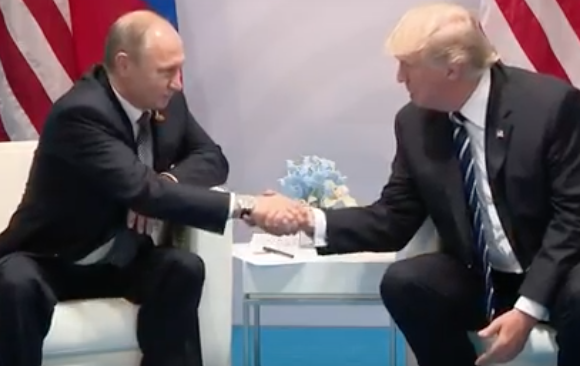
Russian President Vladimir Putin meets with U.S. President Donald Trump at the G-20 summit in Hamburg, Germany, on July 7, 2017. (Screen shot from Whitehouse.gov)


The Russia Sanctions Act may have been conceived both to paralyze President Trump, and to validate the “Putin-stole-the-Election” narrative, but it precisely removes any chance of Messrs Mattis, McMaster, Kelly and Tillerson to succeed with seizing America as world proconsul.


Russia, China and Iran, now linked by again being threatened by sanctions, are now firmly embedded into a strategic coalition – and they are determined to resist.


Incredibly, as one commentator put it: “During the ramp up to new UN sanctions on North Korea, the Trump administration threatened to sanction China if it did not commit to further pressure [on N. Korea] … Trump himself implied that he was willing for a quid pro quo: ‘If China helps us, I feel a lot differently toward trade, a lot differently toward trade’, [Trump] told reporters …


“A deal was made, and the UN Resolution 2371 passed … China did its part of the deal: It helped pass the UN resolution against North Korea – and it immediately implemented it, even though that caused a significant loss for Chinese companies which trade with North Korea. [But …]


“Now Trump is back at sanctioning Chinese (and Russian) companies: The Trump administration on Tuesday imposed sanctions on 16 mainly Chinese and Russian companies and people for assisting North Korea’s nuclear and ballistic missile programs and helping the North make money to support those programs …


“Among those sanctioned are six Chinese companies, including three coal companies; two Singapore-based companies that sell oil to North Korea and three Russians that work with them; a Russian company that deals in North Korean metals and its Russian director; a construction company based in Namibia; a second Namibia-based company, and its North Korean director, that supplies North Korean workers to build statues overseas to generate income for the North.


“These are ‘secondary sanctions’ which block financial transactions and make it nearly impossible for those companies and people to run an international business. Moreover – China had already banned all coal imports from North Korea. It had sent back North Korean coal ships, and instead bought coal from the United States. [And] now, Chinese companies are getting sanctioned over North Korean coal that they no longer buy? Furthermore, selling fuel oil to North Korea is explicitly allowed under the new UN sanctions…”


The alliance of these three states and their “partner forces” no longer believe that America is capable of serious diplomacy, or that it enjoys any real capacity to “seize” the world. On the contrary, they see Europe drifting away from the U.S., the Gulf Cooperation Council in disarray, and even Israel is despairing of its Washington ally. They do remain concerned about North Korea, but the fear of U.S. pre-emptive military action against North Korea is tempered by the knowledge that North Korea effectively holds 30,000 U.S. servicemen hostage in the de-militarized zone.


The primary focus is now shifting to how these states might protect themselves, if the two sides in the U.S. internal conflict succeed in each despoiling one another, and thereby throw the world into financial turmoil (hence the flurry of activity in arranging local currency contracts and currency swaps):


“When Steve Bannon was ejected from the White House, last week,” the New Yorker quotes Bannon as citing “his frustrations with the coming tax bill, as one of the reasons he believed that the Trump nationalist agenda had been hijacked by the so-called globalists, such as Cohn and the other members of the Big Six.”


Yes, Trump has been “rolled” in the economic sphere, too: The “big six” consist of four members of Congress (including Senate Majority Leader Mitch McConnell and House Speaker Paul Ryan), plus economic adviser Gary Cohn and Treasury Secretary Steve Mnuchin – both of Goldman Sachs.


“They’re not populists, they’re not nationalists, they had no interest in his [i.e. Trump’s] program – Zero”, Bannon told the Weekly Standard, “On what element of Trump’s program, besides tax cuts — which is going to be the standard marginal tax cut — where have they rallied to Trump’s cause? They haven’t.”


The Power of Cohn


“In the Bannon-era, factionalized Trump White House, Cohn was not just the head of the National Economic Council but the leader of the group of officials whom Bannon derided as ‘New York.’ (Breitbart stories called Cohn and his companions at the N.E.C. ‘Globalist Swampsters’)”, notes the New Yorker.


White House economic adviser Gary Cohn.


Cohn, who is 56, was brought into the Administration by Jared Kushner, the President’s son-in-law, who once interned for Cohn at Goldman Sachs. Cohn is a long-time donor to Democratic candidates.


So, Trump’s “reflation trade” is being “normalized” by the “big six” – more of the usual D.C. politics.


But, why be concerned if the U.S. stock market is hitting new highs every day? Indeed, the “market” has ridden an “ascending curve for 101 months since March 2009, during which the S&P 500 rose by 270% and rarely dropped by more than 2-4%, without [its members] coming to believe that nothing mattered except hitting the bid [button] during the more than 50 intervals when the stock market momentarily faltered. Virtually without exception, each shallow dip was accompanied by easy money ‘buy’ signals from the central banks, or selective ‘green shoots’ [releases] among the in-coming data.”


As David Stockman writes:


“After 101 months of dip buying … the headline reading algos [robot computer traders] have become programmed in a completely asymmetrical manner. They are triggered to ‘buy’ on economic/policy good news (because it implies more profits); but also to ‘buy’ on bad news (because it means more [liquidity] accommodation, and market-support/price keeping actions by the Fed and other central banks.


“But this beneficent arrangement also encourages even prudent gamblers to minimize the amount of downside hedging insurance they purchase to protect their often heavily leveraged (through options and derivatives) book of longs.”


Stockman is warning that markets already are trading at historic highs, and that no one is paying attention to these extreme valuations or the economic or political fundamentals – simply because the latter has become utterly irrelevant, if every small market dip, is immediately followed by the unbroken elevation of all asset classes (thanks to Central Bank interventions).


“That is, the gamblers and robo-machines have become so hard-wired to the expectation that the central banking and fiscal branches of the state will do ‘whatever it takes’ to keep the stock averages rising, that it has become irrational to waste time and resources on parsing ‘whatever is going on,’” Instead, writes Stockman, “it’s all about the chart points, money flows, next in rotation sectors, ETF buying power, momentum trades and technical arbitrages, such as embodied in the currently massive risk parity trades.”


In short, all sensibility to risk (political or credit or any other) has been expunged by the determination of the Central Banks to keep asset prices inflating higher. The financial system precisely is looking the other way — intent on making money “when the going is easy” – and consequently, any crisis now will create a disproportionate impact on those levered asset values, magnified by the trades today being all one-way.


A Zombiefied Trump


Here is the point: Will the political zombiefication of President Trump satisfy the two party Establishments? Are they mollified enough, to come together to agree on a budget and a new “clean” debt ceiling (the “ceiling” arrives on Sept. 29)? And, even if achieved, will so-called “normalization” of Trump policies really take the U.S. back to the nirvana of “how things used to be”?


The Wall Street bull statue by Arturo Di Modica


Ostensibly, “normalization” of Trump’s economic policy should be manageable: Ryan and McConnell would need only to line up a modest number of Democratic votes (together with Republican foot-soldiers), to enact a debt ceiling increase. But it may be more complicated – much more complicated than that: Should the Democrats cooperate (and they will want to appear that they are co-operating in order to avoid blame for any subsequent Federal shut-down), it will be only on the basis of “an onerous quid pro quo that requires Trump to give up the Mexican Wall; tax cuts for the wealthy; his proposed deep domestic spending cuts, and also to fund the insurance company bailouts that are needed to forestall drastic premium increases and coverage cancellations during the 2018 insurance (and election) year.”


Certainly, the Democrats will present a public face of co-operation, but such is the angry temper of Washington today (with both sides looking for a fight), that almost certainly they will require their revenge pound of flesh cut from Trump’s side. The Freedom Caucus group of Republicans (which is linked to Bannon) might then jump ship, leaving the Big Six with either “no ceiling deal” or a “Democratic”-shaped budget.


Trump tweeted: “I requested that Mitch M & Paul R tie the Debt Ceiling legislation into the popular V.A. Bill (which just passed) for easy approval. They didn’t do it so now we have a big deal with Dems holding them up (as usual) on Debt Ceiling approval. Could have been so easy-now a mess!”


Axios reports that “top White House and GOP leadership officials tell us [Axios], the chances of a market-rattling government shutdown are rising by the day — and were [such] even before Trump threatened at his raucous Phoenix rally on Tuesday night, to use a shutdown as leverage to get funding for the [Mexican] border wall.”


Quoting a “top Republican source” who puts the chance as high as 75 percent, Axios adds that “the peculiar part is that almost everyone I talk to on the Hill, agrees that it is more likely than not.”


The Democrats seem determined to remove any provision for “the wall,” and Trump seems to be spoiling for a fight with the Democrats (and Ryan and McConnell) on this issue. He has had to acquiesce to being “rolled” in foreign and defense policy — might he turn, and dig in his heels? He is already channeling the blame onto the Republican Establishment leadership.


If so, what price the continuation of a market historic “high” and brimming with complacency?


Russia and China are right to be thinking “worst case” and how to minimize their exposure to any American cataclysmic descent into political turmoil – and possible violence.

Saturday, May 27, 2017

The War On Workers, Phase II - Truth Has Become A Liability

Authored by MN Gordon via EconomicPrism.com,


It’s been a long row to hoe for most workers during the first 17 years of the new millennium.  The soil’s been hard and rocky.  The rewards for one’s toils have been bleak.


For many, laboriously dragging a push plow’s dull blade across the land has hardly scratched enough of a rut in the ground to plant a pitiful row of string beans.  What’s more, any bean sprouts that broke through the stony earth were quickly strangled out by seasonal weeds.  Those ‘green shoots’ that persisted bore pods that dried out on the vine before maturity.


This has been the common experience of the typical 21st century American worker, thus far. Countless, stories of labors with no fruits have been shared at bowling alleys across the Bible Belt.  There are also hard numbers that backup these woeful tales.


Just this week, for example, Sentier Research released a new report showing that after scratching and clawing the earth day after day, median household income has finally surpassed a level last seen in January 2000.  In other words, living standards for the typical family are now a smidge higher than they were at the turn of the century.  Rick Newman offers several details:


“Sentier calculates a monthly index representing median household income, based on Census Bureau data, starting at 100 in January of 2000.  Since it’s an index, it’s adjusted for inflation and represents the real earning power of a typical family.  The index drifted slightly above 100 a few times leading up to the 2008 financial meltdown, but mostly went sideways during the George W. Bush administration.  Then it plunged beginning in 2009, with a long recovery beginning in 2011.


“The latest reading in the Sentier index is 100.9, the first time it’s been above 100 since 2008. That number matches the previous high, from 2002, which means family income will hit a new high if it rises in May.”


Rip Van Winkle


Good grief.  What took so darn long?


A lot has changed while the typical worker was running in place for the last decade and a half.  In fact, Rip Van Winkle would hardly recognize the world that remains after these lost years.  Good manners, good ethics, and good people have mostly gone the way of the dodo bird.


For one, politics at home has gone stark raving mad.  Debbie Wasserman Shultz.  Jim Comey.  Barry Obama.  Susan Rice.  John Podesta.  Hillary Clinton.  Anthony Weiner.  Barney Frank.  John Burton.  Harry Reid.  Chuck Schumer.  Ted Kennedy’s ghost.  And on and on.  And so on and so forth.


Years ago, when upright character was an expectation, these malevolent dingle berries would have been painted with tar and rolled in a dirty chicken coop full of feathers, among other things.  Nowadays, they get extended lordship, pensions, and countless hours of paid vacation.


What to make of it?


The federal government – and many state and local governments – appear to be self-destructing in grand fashion.  Federal agencies and politicians are stabbing each other and the President in the back at a clip last witnessed in Moscow during the twilight of the Soviet Union.


At the same time, the truth has become a liability.  Specifically, sharing the dirty truth has become hazardous to one’s life expectancy.  For the ruling class has become desperate to keep the world tilted in its favor.  They’ll go to any length to keep money and power flowing towards them.


The Attack on Workers, Phase II


No doubt, President Trump’s a ghastly fellow.  But he’s not nearly as ghastly as the headlines make him out to be.  There are much worse haircuts out there.  Plus he’s facing an unwinnable battle.


All of Congress wants Trump to fail and are doing everything they can to ensure this happens.  Even his most partial efforts to redirect some of the failing social programs that are bankrupting the country are greeted with a disjointed and frenetic mass hysteria.  Rational contemplation and pragmatic decision making has given way to foaming mouths and erratic neck convulsions.


Should we be surprised?  Maybe this is the way things always were; only now they’ve been ratcheted up several notches.  For instance, two generations ago Nixon era Treasury Secretary William Simon let the cat out of the bag:


“One of the things I learned during my tenure in Washington is that the civic book picture of government in operation is completely inaccurate.  The idea that our elected officials take part in a careful decision-making process—monitoring events, reviewing options, responsibly selecting policies—has almost no connection with reality.


“A more accurate image would be that of a runaway train with the throttle stuck wide open—while the passengers and crew are living it up in the dining car.”


These days, however, the runaway train is one ridge turn from jumping the tracks.  Alas, a stock market crash, depression, and world war will likely accompany it.  After that the attack on worker begins in earnest.

Saturday, May 20, 2017

Rising Occupancy In China's Fake Manhattan Is "Mostly Government Driven"

China"s copy of Manhattan is no longer a ghost town, Bloomberg reports. But that doesn"t mean it has forever forestalled a "day of reckoning" for its debt-fueled growth.


The northern city of Tianjin drew negative press coverage a few years ago because of a newly built replica of Manhattan complete with a mock Rockefeller Center that was created as part of a massive government infrastructure project but for years was little more than a ghost town.  But the city is now occupants are finally clocking to the city: Bloomberg reports that once empty skyscrapers, vacant office towers and unfinished hotels and apartments are gradually filling up amid the central government’s renewed push to refashion the city into a crucial gateway for a revitalized Northern China.


As Bloomberg reports:


There still may still be a financial reckoning for Tianjin looming in the future, but right now there are green shoots of economic life in the urban districts at the center of the city’s unprecedented construction boom.


But there"s a catch, of course: As is true for the broader Chinese economy, the growth in Tianjin "is mostly government driven, though there are signs private industry is coming."


Here"s more from Bloomberg:


In the Binhai district, empty offices are filling up with staff from private companies as well as employees of some of the biggest state-owned enterprises, such as China National Chemical Corp., railcar manufacturer CRRC Corp., and China Poly Group Corp., a conglomerate with businesses ranging from explosives manufacturing to real estate." While many local governments across the country are struggling with heavy dependence on debt-fueled growth, Tianjin benefits more than almost any city from its position at the vanguard of two of the country’s biggest national projects.


*  *  *


Bloomberg saves one notable detail for the last paragraph of the story, citing an official who offers some local perspective: The city is supposed to play in important role in China"s "one belt, one road" initiave, another massive debt-fueled trade and transport infrastructure project meant to replicate the ancient Silk Road trade routes that connected Europe and Asia. The government-funded expansion aims to join Beijing with the surrounding Hebei Province to create a mega city of 100 million people.


It should come as no surprise that Tianjin has...backing from heavy hitters in the party.


"We want the city to become one of the world’s largest ports like Singapore or Hong Kong," said Xiao Sheng, vice director of the free trade zone in Tianjin. "We want to develop a new business and development model that could be promoted to other regions in China."


But even as China signs up foreign partners for its latest scheme, offering financial inducements like a $50 billion infrastructure investment in Pakistan, a key U.S. ally, some at least are showing unease at the massive debt-fueled spending necessary to bring the project into reality. 


In a diplomatic showcase years in the making, Chinese President Xi Jinping invited leaders from 29 countries to hear his pitch about the "one belt, one road." But what"s notable is that India, the worlds fastest growing and second-most populous country, didn"t even bother to send a delegation, warning that the "unsustainable debt burden" required to launch the project would be a disaster for the countries involved.


The story notes that though Tianjin"s growth rate slipped to 8% last year – down from 9% the year before – it still outpaced 6.8% YoY rate for the broader Chinese economy in 2016. But that"s a pretty low bar: China"s economy grew in 2016 at its slowest pace in 26 years.

Wednesday, May 10, 2017

Trader: "Equities Are In A World Of Their Own"


"You know what made yesterday so much fun? For a brief window of opportunity we were able to envision a lot of green shoots globally and talk in the context of a whole set of crystal champagne flutes half-full. Which central bank might be the next one to surprise with a hawkish spin was actually a topic. Speculation, idle or not, on widespread retractions of liquidity was good news, not of that soul-crushing bad news is good news variety."


Frankly, writes former trader and Bloomberg editor Richard Breslow "it was the first time in a long time, I could say markets were compelling."


As Breslow notes, The dollar was up, as were sovereign yields. Gold was through an important first line of support and equities more than kept their composure. Fed speakers stayed on message, Draghi’s speech today was eagerly awaited. Sterling held near recent highs as traders debated how many dissenters there might be at Thursday’s MPC meeting over keeping rates on hold. And then events tried to conspire to rob me of all of my sanguineness.


As I read the comments from the North Korean ambassador and then the reactions to the news from Washington, I kept crooning, “Mama, don’t take my rosy glasses away.”


It strikes me that the bellicose comments amount to little. Been there done THAAD. The market reaction, modest as it was, was more an end of day squaring after nice moves than any sort of sea change of opinion.


The White House announcement is more problematic even if the comparisons to Watergate are grossly overdone. The seriousness of that episode shouldn’t be marginalized by the necessities of the 24/7 news cycle of today. The investing issue here is no one really knows what it might mean. And won’t do for a long while. What it means for future policies and governance is unclear. What if he picks a really good or bad successor to James Comey?


I know we love to indulge in being serially outraged, whether justified or not. But markets have also shown a bizarre, at times mystifying, willingness to ignore events that seem to justify immediate repercussions. We’ve had to learn to separate our politics from trading. Which isn’t an easy thing to do.


So what are some obvious things to watch as indicators of whether Tuesday’s trading was merely range extension or the start of something new and interesting? Was the news seminal or transitory? Gold above or below the 1220 pivot is a good start. We didn’t manage a close through that level.


The 10-year Treasury can use a pivot of the ~2.40% yield, but needs to close above there. Not a big ask, nevertheless a meaningful one. It’s hard to think the Fed will change its tune, but markets have probably put a bigger weight in their forecasts on tax cuts and other fiscal policy proposals than the members of the FOMC are willing to admit are embedded in theirs.


ECB President Mario Draghi’s comments today stuck to an important script that supports the dollar. Things have definitely gotten better but “the time hasn’t come to think about QE exit.”


Upbeat, but clearly not a surrender to the German faction. No headwind for the Fed, but no rate competition either. The dollar index needs to hold above 99. That gives only one-half percent to play with.


Breslow sums up the trading environment perfectyly... As far as equities are concerned, they’re in a world of their own. The S&P 500 up or down a percent will tell you nothing. Meanwhile, I retain all of my biases intact and wait and see.


Wednesday, March 8, 2017

WTI/RBOB Surge After Massive Gasoline Draw (Despite Record Crude Glut)

Following API"s reported massive build in crude (and draw in gasoline), DOE confirmed the extreme moves with a major 8.2mm crude build and a massive 6.56mm draw in gasoline (the biggest since April 2011). US Crude production rose once again - to 13-month-highs.


API


  • Crude +11.6mm (+1.4mm exp)

  • Cushing +788k

  • Gasoline -5.00mm

  • Distillates -2.9mm

DOE


  • Crude +8.21mm (+2mm exp)

  • Cushing +867k (+406k exp)

  • Gasoline -6.56mm (-1.99mm exp)

  • Distillates -925k (-1mm exp)

This is the 9th weekly rise in crude inventories (some chatter on API data including SPR barrels but that was marginal at best compared to the headline print)...The gasoline draw is the biggest since April 2011


Notably West Coast (PADD 5) CRUDE STOCKS INCREASE 4.65M BBL, MOST SINCE OCT. 1999 ..


Bloomberg"s Bert Glibert notes that based on bill of lading data, the biggest sources of waterborne barrels to PADD 5 last week were Ecuadorian Napo and Kuwait Crude oil.


This is a new record high for US crude inventories...“Inventory drawdown slower than I thought after cuts,” Saudi Arabia"s Khalid Al-Falih admits.


Putting the 2017 surge in context, commercial crude stocks are now up 49 million barrels YTD, compared to 38 million in 2016 and a 22MM average over the past decade according to Reuters.


In the last week, oil imports accelerated to 8.15MMbpd from 7.6MMbpd the week before.


However, offsetting the spike in crude imports, gasoline imports fell to the lowest level since 1999.


As a result, gasoline stocks declined by 6.6mmbpd to 249 mm barrels, although still well above the 10 year median for this time of the year.


Distillate stocks likewise dipped modestly in the last week, although remain at the higher end of the last 10 year range as the following Reuters chart shows:


Meanwhile, US crude production continues to trend higher with lagged rig counts, even as Saudi oil minister Khalid Al-Falih had complained that “the green shoots in the U.S. are growing too fast.” In the latest week, US Crude production rose by another +56k b/d, or +0.6% W/W to 9.088MMbpd


This means that US oil production, which is again rapidly rising on leaner, more efficient production technologies, is now just 5.5% below its lifetime high, a level it will surely overtake rapidly should the price of crude not tumble from current levels.


And as a reminder, the EIA published another bullish outlook for U.S. oil production in yesterday"s Short-Term Energy Outlook. It raised the 2017 year-on-year increase in crude and condensate production to 330,000 b/d from its previous assessment of just 100,000 b/d and now sees output above 10 million barrels a day by the end of 2018. Rebalancing the market is getting more difficult.


Notably the RBOB bounce (on API inventory draw) had been largely erased before the DOE data (and WTI had extended losses)...but the better than API crude build and huge gasoline draw triggered panic buying...


Bloomberg"s Vince Piazza warns U.S. inventories across the product value chain remain elevated, with crude oil 39% above the five- year average and distillates, jet fuel and gasoline between 5.5% and 22% higher. This, along with the 51% rebound in rig count since last year, and the robust level of more than 5,300 DUCs (drilled yet uncompleted wells) implies the near-term return of U.S. hydrocarbon volume with an environment of lower range-bound prices.


It appears traders are starting to realize...


Monday, March 6, 2017

Worried You Might Buy Bitcoin or Gold, Report 5 Mar, 2017

The price of gold has been rising, but perhaps not enough to suit the hot money. Meanwhile, the price of bitcoin has shot up even faster. From $412, one year ago, to $1290 on Friday, it has gained over 200% (and, unlike gold, we can say that bitcoin went up—it’s a speculative asset that goes up and down with no particular limit). Compared to the price action in bitcoin, gold seems boring. While this is a virtue for gold to be used as money (and a vice for bitcoin), it does tend to attract those who just want to get into the hottest casino du jure.


Perhaps predictably, we saw an ad from a gold bullion dealer. This well-known dealer is comparing gold to bitcoin, and urging customers to stick with gold because of gold"s potential for price appreciation. We would not recommend this argument. Whatever the merits of gold may be, going up faster than bitcoin is not among them.


We spotted an ad today from a mainstream financial adviser. The ad urged clients not to buy gold. This firm should have little need to worry. Stocks have been in a long, long, endless, forever, never-to-end bull market. Gold is not doing anything exciting now. $1234? “WhatEVAH (roll eyes)!” Stocks, well, the prices just keep on going up. Like we said, nothing whatsoever to worry about. Other than declining dividend yields. There’s more than enough irony to go around.


Speaking of dividend yield, that leads us to an idea. Readers know that we like to compare the yield of one investment to another. This is why we quote the basis as an annualized percentage. You can compare basis to LIBOR easily. And also stocks. Or anything else.


For example, the basis for December—a maturity of well under a year—is 1.2%. The dividend yield of the S&P stocks is just 1.9%. For that extra 70bps, you are taking a number of known risks, and some unknown risks too.


It is worth noting that the yield on the 10-year Treasury is up to 2.5%. Yes, that’s right, you are paid less for the risk of investing in big corporations than you are for holding the risk free asset. Of course, the Treasury bond is not really risk free. But in any case, if the Treasury defaults then it’s safe to assume most corporations will be destroyed, if not our whole civilization.


We have heard the mainstream theory so many times, our heads are hurting. Here are the myths: the Chinese are selling, inflation is coming, and the economy is picking up.


China is selling. The Chinese people are selling the yuan to buy dollars. When they can get through the increasingly-strict capital controls. The People’s Bank of China takes the other side of the trade—selling dollars and buying yuan—to keep the yuan from collapsing. When a foreign central bank holds dollars, it does not hold paper notes. Nor does it deposit them in a commercial bank. It holds Treasury bonds. Its sales of Treasurys may look scary, but that is just the seen. The unseen is that the Chinese people are buying dollars. Those dollars come back to the Treasury market one way or the other.


Inflation is coming. The Fed is printing, the quantity of money is going up, there will be demand-pull, etc. Well, if that were true then the last place you would want to be is in an asset whose price is set by the net present value of its future free cash flows. Or at least the price should be. If you think that stock prices have to rise in inflationary periods, look at what happened in the 1970’s.


The economy is picking up. What can we say? There are two views on this. One has seen (or looked for) green shoots and nascent recoveries since the crisis. The other has seen rising asset prices, and with that a small wealth effect. We will not opine about Trump and the future of the economy here. We just wish to note that junk bonds have not sold off the way Treasurys have. Junk bonds have hardly sold off at all.


Quite the opposite. They have been massively bid up (i.e. yield has been crushed). We submit for your consideration that if inflation was coming and/or the economy was picking up, you would do even worse in junk bonds than in S&P stocks.


The 10-year Treasury hit its low yield (so far) of 1.3% in July. Since then, it has been a wild ride mostly up to 2.6% in December. Since then it’s been choppy but falling (i.e. prices rising a bit).


July also happens to be when the yield on the Swiss 10-year government bond began rising. It made a low of -0.6% (yes, negative). Since then, the yield has gone up (i.e. bond price has gone down) to near zero in December. It is currently -0.1%.


In Japan, the same occurred. Low yield on the 10-year government bond in July was -0.3%. High was hit in December. Still elevated now, but off the December high.


It’s almost as if government bond yields around the world were moved by the same drivers, or even connected by some kind of arbitrage…


Whatever the cause of this worldwide selloff of government bonds may be, it is not selling by China. It is not inflation. It is not expectations that the economy will take off under Trump.


Maybe it’s just traders looking at price charts, buying because stocks are going up?


This week, the prices of the metals dropped. As always, the question is what happened to the fundamentals?


Below, we will show the only true picture of the gold and silver supply and demand. But first, the price and ratio charts.


The Prices of Gold and Silver


Next, this is a graph of the gold price measured in silver, otherwise known as the gold to silver ratio. It moved sideways again this week.


The Ratio of the Gold Price to the Silver Price


For each metal, we will look at a graph of the basis and cobasis overlaid with the price of the dollar in terms of the respective metal. It will make it easier to provide brief commentary. The dollar will be represented in green, the basis in blue and cobasis in red.


Here is the gold graph.


The Gold Basis and Cobasis and the Dollar Price


This week, our old friend returned. He is the correlation between the price of the gold (i.e. inverse of the price of gold in dollar terms) and the cobasis (i.e. our scarcity indicator). They had been moving together.


This week, they met up for old time’s sake. The dollar is up from 24.75mg gold to 25.20mg. And the cobasis is up from -0.41% to -0.16%. At least in the April contract which is rapidly approaching First Notice Day, and already under downward pressure. For farther contracts, the cobasis is up, but not that much.


Our calculated fundamental price dipped twenty bucks. It’s still $150 over the market price.


Now let’s look at silver.


The Silver Basis and Cobasis and the Dollar Price


The cobasis in silver move up big-time as well.


The silver fundamental price also fell, about fifteen cents.


© 2017 Monetary Metals