Scientists say that the Yellowstone supervolcano gets stronger every year, and they now think they know why. An 1,800-mile deep “hotspot” has been discovered under the caldera which scientists believe is the volcano’s heat source.
Yellowstone’s hotspot is situated within our planet’s mantle, and scientists believe it is part of a surge of atypically hot rock known as a mantle plume, according to a recent study. They are thought to begin some 1,850 miles below Earth’s surface at the boundary separating the mantle from the core.
Researchers and scientists have been studying Yellowstone in hopes of preventing or at least having some advanced warning when the supervolcano next erupts. “A supervolcano explosion is capable of “plunging the world into a catastrophe” and pushing humanity “to the brink of existence,” NASA researchers wrote in a 2015 study. The information we have on the rare eruptions today are estimates based on the geologic record and the massive deposits left behind by them.
The ash spewed by such an explosion could create a global “volcanic winter” by blanketing parts of continents with soot. Using prediction models from Yellowstone’s last major eruption 630,000 years ago, the researchers revealed Yellowstone could produce more than a meter of volcanic ash in its immediate vicinity. As you can see, the ash would blanket a vast majority of the United States.
But NASA’s plan to help “fix” an eruption could have the opposite effect. The space agency suggested drilling into the volcano to release heat, making it less volatile. But that comes with potentially humanity eliminating consequences. “It has been suggested that the hydrothermal circulation at Yellowstone may cool the underlying magma and may lead to decreased long-term volcanic hazards,” wrote the scientists.
More research needs to be done to figure out how to best protect the planet from a supervolcano eruption, the researchers also said. As of now, people would have mere minutes at most should the Yellowstone volcano erupt. That would not be enough time to save lives.
The Yellowstone region has seen three big eruptions, the first one 2.1 million years ago, the most recent 630,000 years ago. Contrary to Internet rumor-mongering, as well as conspiracy theories about government coverups, there’s no sign that a fourth cataclysmic event is about to happen. –The Washington Post
Powerful eruptions at a volcano in southern Japan spewed ash thousands of feet into the air on Wednesday as authorities warned locals not to approach the mountain. Shinmoedake volcano has erupted several times in violent explosions recently.
The Shinmoedake volcano, located on Japan’s southernmost main island, Kyushu, has been bubbling and rumbling since last week. The entrance to the volcano was closed and monitoring increased last week before it finally began shooting ash and smoke into the sky on Tuesday.
According to Channel News Asia, “The plume reached the height of 3,000 meters (9,800 feet) for the first time since Apr 3, 2011,” following a total of 29 eruptions at Mount Shinmoedake, Japan’s weather agency said in a statement. People have also been ordered to stay away from the volcano as major ash deposits spread from the crater, the agency said.
The volcano, which featured in the 1967 James Bond film “You Only Live Twice,” has been grumbling since last Thursday. Footage captured by the Meteorological Agency showed lava and thick grey smoke rising from the mountain around midnight on Wednesday.
The volcano also produced so-called “explosive” eruptions, which also featured air blasts. This volcanoes eruption doesn’t appear to be triggering fear in the masses of a more violent “Ring of Fire,” but it’s nonetheless significant geologically. Japan, has scores of active volcanoes and sits on the so-called Pacific “Ring of Fire” where a large proportion of the world’s earthquakes and volcanic eruptions are recorded.
There were no reports of injuries or property damage, but Newsweek reported that eruptions were expected to continue and the risk of flying rocks and pyroclastic flows were possible.
Volcanic ash rained down on the villages which are spotting the countryside in Bali. Mount Agung erupted again sending a massive plume of ash into the sky.
The Bali volcano threat level has been raised to the highest possible level, putting it at a level 4, while the aviation ash warning is now orange. The latest Volcano Observatory Notice for Aviation (VONA) was issued after Mount Agung erupted yesterday morning following several days of calm.
The tourist season has been widely interrupted because of Mount Agung’s volatile and unpredictable behavior. This evening Mount Agung was still sending a plume of ash almost 5000 feet (1,500 meters) into the sky in what was a beautiful yet ominous sign of the ongoing threat. The Volcanology and Geological Disaster Mitigation Agency (PVMBG) has said that greyish-white plumes of ash have soared as high as 6500 feet (2000 meters) above the crater. Hot magma produced an eerie red glow just above the crater as cold lava mudflows have poured down the slopes.
As previously reported by SHTFPlan, more than 70,000 evacuees have fled their homes and are staying in more than 230 shelters across Bali, according to the National Agency for Disaster Management (BNPB). BNPB spokesman Sutopo Purwo Nugroho ash rained down on Temakung village at 7:50 am local time today when the volcano erupted and sent out ash once again.
The Indonesians have told about 100,000 people to evacuate from the radius of the danger zone surrounding the volcano. The Mount Agung volcano, which is capable of very violent eruptions, has shown a marked increase in activity in the last few weeks, stoking fears of a repeat of the 1963 eruption which killed 1,100 people.
Wood-burning stoves are essentially simple machines that provide heat for warmth and cooking when we need it most. But like everything else, regular and annual maintenance are essential, especially if you are totally dependent on the stove for heat.
Summer is obviously the best time for maintenance. You can’t do much with a wood stove that’s blistering hot — and it’s a long day in the winter when you have to shut it down and let it cool for repairs. But there are weekly if not daily tasks that have to occur while the stove is hot.
Regardless of the design of your stove, coals and especially ash are inevitable. Some catalytic stoves burn more efficient and result in less ash, but even they need regular cleaning.
One regular maintenance item, of course, is cleaning ash, with the fundamental tools being an ash shovel and an ash bucket. Both are metal and need to resist the residual heat that the coals and ash will still have. Your dedicated ash-dump areas should be away from the house or other structures and anything else that’s flammable.
Beyond the routine ash cleaning, most maintenance needs to be done when you’re not using the stove. Here are the common areas to check and maintain:
Check the Gaskets and Doors
The firebox door should be inspected very closely for an airtight seal. One of the easiest ways to do this is with the dollar bill test. You close and lock the firebox door with the dollar halfway between the gasket and the stove. Then, gently tug on the bill and if it shows good resistance while you try to pull it out, you have a good seal. Do this all around the perimeter of the door. All it takes is one weak spot to interfere with the efficiency of the stove or cause a smoke leak.
If the seal is weak, you’ll need to replace the gasket. Gaskets once were made out of a braided rope of asbestos but today they’re made from a fireproof fiberglass braid with a gasket glue. You’ll need to remove the door to make this replacement, and you might want to watch some videos so you get it right.
While you’re replacing the gasket, take some time to inspect the glass window that may be in your firebox door. If there’s a buildup of white ash, it can easily be wiped off with a damp rag. If the stains are brown, you may have to buy a woodstove glass cleaner. The reason you may get these brown stains is because the stove is not burning efficiently. Wet or green wood, low-burning fires, inefficient combustion, and resinous woods like pine are often the cause of these stains.
Don’t Forget Flue and Chimney Maintenance
I have a chimney sweep come out once a year to clear the creosote. Creosote is made up of particles that adhere to the sides of the chimney pipe. The danger is that creosote is highly flammable; a chimney fire sends large tongues of flame out of the chimney. Even a spark arrestor can melt under this heat, and the burned bits of creosote can land on the roof and start a fire. If you have a chimney fire, immediately call the fire department.
There are some primary causes of creosote buildup. Low- and slow-burning fires don’t combust well and give off copious smoke and particulate matter. When this hits the cold stove pipes leading up to the chimney, particles are more likely to condense as creosote. A good, hot and consistent fire is the best solution. But be careful. A fire that’s too hot can warp the firebox or cause other parts of the stove to warp over time.
There is also a creosote fire suppressant. If you suspect you have a chimney fire, you put this in the fire box and it produces a chemical smoke that extinguishes the fire. Don’t get cocky, though. The fire can restart if the creosote buildup is significant.
Considering purchasing creosote cleaning logs. You put them into the fire box with a hot fire, and the combination helps to vaporize the creosote and safely flush it out of the chimney.
Prevent Your Stove From Rusting
Cast iron stoves can succumb to rust. Purchase a heat-resistant paint to touch up both the exterior and the interior of your stove. Follow the directions on the can for prep and make sure the paint is dry before starting a fire. I usually start a fire even in the summer after I’ve maintained or painted my stoves just to make sure everything is working properly. A chilly, rainy day is a good excuse for this test.
Other Areas of Maintenance
The features on different wood-burning stoves vary widely. If your stove has a feature like a catalyst, firebrick, soapstone or other unique options, then make sure you check your owner’s manual for recommended maintenance and find a nice warmer day to make sure everything’s alright. Trust me: You’ll sleep better at night.
Stay warm.
What are your wood stove maintenance tips? Share them in the section below:
With the looming threat of a possible eruption at the Yellowstone super volcano, some preppers have wondered exactly how to prepare for such a cataclysmic event. Here is what would happen should the super volcano erupt right now.
Yellowstone’ssupervolcano is essentially a giant, lid-topped cauldron, and it’s so vast that it can only truly be seen from low-Earth orbit. Its crater is 45 miles (72 kilometers) across, and its underlying plumbing contains several tens of thousands of cubic kilometers of magmatic material. But if it were to erupt right now, we would have very little time to even know that it is happening.
IFL Science spoke to one of the country’s most respected volcanologists to get the most up-to-date low-down on the future of the world’s most famous supervolcano. Hopefully, it will give preppers and idea of what to expect in the unprecedented event that it actually explodes.
According to Yellowstone Volcano Observatory’s Scientist-In-Charge, Dr. Michael Poland, the super volcano may not have enough energy at present to produce a supereruption. “Right now, much of Yellowstone’s magma body is partially solidified, and you need a lot of magma to feed a large eruption.” The chances of a supervolcanic paroxysm are currently around one-in-730,000, which makes it less likely than a catastrophic asteroid impact.
A sudden injection of new magma from beneath the caldera, or a sudden weakening of the geological layers encasing it, as unlikely as this is, may be enough to trigger a sudden depressurization event, and the entire system would violently expunge onto the surface and up into the atmosphere. What would happen next is speculative, but it may be important to understand just how dire that could be.
Shortly before the hypothetical eruption, the ground around Yellowstone National Park would rise upwards somewhat. Hydrothermal system, including the geysers and geothermal pools, would rapidly heat to temperatures above boiling, and they’d likely become extremely acidic – more so than usual. A swarm of earthquakes would be detected making their way towards a central point, indicating magma rising rapidly through the crust. Then, the roof rock would fail and the eruption would begin. A vast column of ash and lava would shoot upward to heights of around 25 kilometers (16 miles). Sustained by both raw explosive energy and the release of heat through cooling lava blebs and bombs, it would sustain itself for days, pumping ash into jet streams that would transport it around the stratosphere. When the eruptive column or parts of the column fail, enormous pyroclastic flows would blast their way across the park.
Immediately, anyone within the park itself would perish. That’s roughly 11,000 on average (depending on the time of year). The air would heat up to 570 degrees Fahrenheit which would kill in seconds. When the pyroclastic flows and ash deposits settle and cool, they may seem harmless, but they’re not. If it rains heavily after the eruption, especially on any slopes, then these could mix with mud and turn into rapidly-moving, cement-like slurries called lahars. If you get stuck in one, there’s a good chance you’ll have a hard time making it out alive.
But the most dangerous aspect would be the effect of the fallout on the globe. If you breathe in the ash fallout, it’ll lacerate your lungs and form a glassy cement. It’s also about six times denser than water, which means plenty of architecture would collapse under its weight as it accumulates on rooftops. Poland points out that “even a few tens of centimeters of wet ash could cause weak buildings to buckle.” Roads and sewer systems would clog and break down, water supplies would be contaminated, and electrical grids would short out. Millions of homes would become uninhabitable. Those in Idaho, Wyoming, and Montana would be at the highest risk for this.
The amount of ash fallout could be up to ten feet in the areas near Yellowstone but will spread across the entire continental United States and large parts of Canada.
A fine layer of volcanic ash would make it as far as Miami, New York, and Toronto within a few days, but it would still enough to cause vehicles to break down and water to become unpotable.
The ash’s injection into the stratosphere would cause it to darken the sky and cool regional, if not planetwide temperatures. If the eruption is particularly sulfur-rich – an efficient blocker of sunlight – then temperatures would plummet several degrees, to the point where the next few years will lack a summer. “It’s likely there would be significant cooling for many years,” Poland explains. “But how long it would last, and how much cooling would occur, I can’t say. I’m not sure anyone can.”
The USGS is keen to point out that “scientists at this time do not have the predictive ability to determine specific consequences or durations of possible global impacts from such large eruptions.” Whatever happens, though, it won’t cause civilization to come crashing down. “It would not mean the end of life on Earth,” Poland tells us. “In fact, this experiment has already been run, yet few people realize it.” He points to the Toba eruption, one that occurred 74,000 years ago, and one that “was larger than anything that Yellowstone has ever produced.” Evidently, humanity survived that, and “they didn’t have the benefit of technology back then!”
Humanity will survive, especially those who are well prepared for such a disaster, but it won’t be an easy road to have to walk when the time comes. Hopefully, this quick rundown will give preppers ideas if they want to prepare for a Yellowstone eruption.
A new study done on ancient volcanic ash revealed that we may experience an eruption of the Yellowstone supervolcano even sooner than previously warned. Scientists are also concerned that we will probably have much less advance warning time than we had thought before.
According to National Geographic, we may have mere decades before Yellowstone erupts. If the supervolcano underneath Yellowstone national park erupts again, we could also have far less time to prepare than originally thought. After analyzing minerals in fossilized ash from the most recent mega-eruption, researchers at Arizona State University think the supervolcano last woke up after two influxes of fresh magma flowed into the reservoir below the caldera. The new paper adds to the lengthening list of surprises scientists have uncovered over the last few years as they have continued to study and closely monitor the supervolcano.
A 2013 study, for instance, showed that the magma reservoir that feeds the supervolcano is about two and a half times larger than previous estimates. Scientists also think the reservoir is drained after every monster blast, so they thought it should take a long time to refill. Based on the new study, it seems the magma can rapidly refresh—making the volcano potentially explosive in the geologic blink of an eye. –National Geographic
“It’s shocking how little time is required to take a volcanic system from being quiet and sitting there to the edge of an eruption,” study co-author Hannah Shamloo told the New York Times. But scientists insist that this may seem scary, however, it may still be awhile before the eruption occurs.
About 630,000 years ago, a powerful eruption shook the region, spewing forth 240 cubic miles’ worth of rock and ash. The violent eruption created the Yellowstone caldera, a volcanic depression 40 miles wide that now cradles most of the national park. That eruption also left behind the Lava Creek Tuff, the ash deposit that Shamloo and her ASU colleague Christy Till used for their work. The two scientists presented their findings in August at a volcanology meeting in Oregon. The pair also presented an earlier version of their study at a 2016 meeting of the American Geophysical Union.
Based on fossil deposits like this one, scientists believe that the supervolcano has seen at least two other eruptions on this scale in the past two million years or so. Almost everyone who studies Yellowstone’s slumbering supervolcano says that right now, we have no way of knowing when the next big blast will happen. For its part, the U.S. Geological Survey puts the rough yearly odds of another massive Yellowstone blast at 1 in 730,000. That’s about the same chance as a catastrophic asteroid collision with earth.
Yellowstone is one of the best-monitored volcanoes in the world, notes Michael Poland, the current Scientist-in-Charge of the Yellowstone Volcano Observatory for the U.S. Geological Survey. A variety of sensors and satellites are always looking for changes, and right now, the supervolcano does not seem to pose a threat. “We see interesting things all the time … but we haven’t seen anything that would lead us to believe that the sort of magmatic event described by the researchers is happening,” says Poland via email, adding that the research overall is “somewhat preliminary, but quite tantalizing.”
Click here to subscribe: Join over one million monthly readers and receive breaking news, strategies, ideas and commentary.
Please Spread The Word And Share This Post
Author: Mac Slavo Views: Read by 1 people Date: October 16th, 2017 Website:www.SHTFplan.com
Copyright Information: Copyright SHTFplan and Mac Slavo. This content may be freely reproduced in full or in part in digital form with full attribution to the author and a link to www.shtfplan.com. Please contact us for permission to reproduce this content in other media formats.
There are few things in nature as fascinating as volcanoes. There are also few things that are as deadly. There are regular old volcanoes, and there are super-volcanoes. Super-volcanoes have the capacity to wipe out civilization, and one such super-volcano in Italy appears to be waking from a 500-year slumber. [1]
Monte Nuovo (year 1538). Click for larger version.
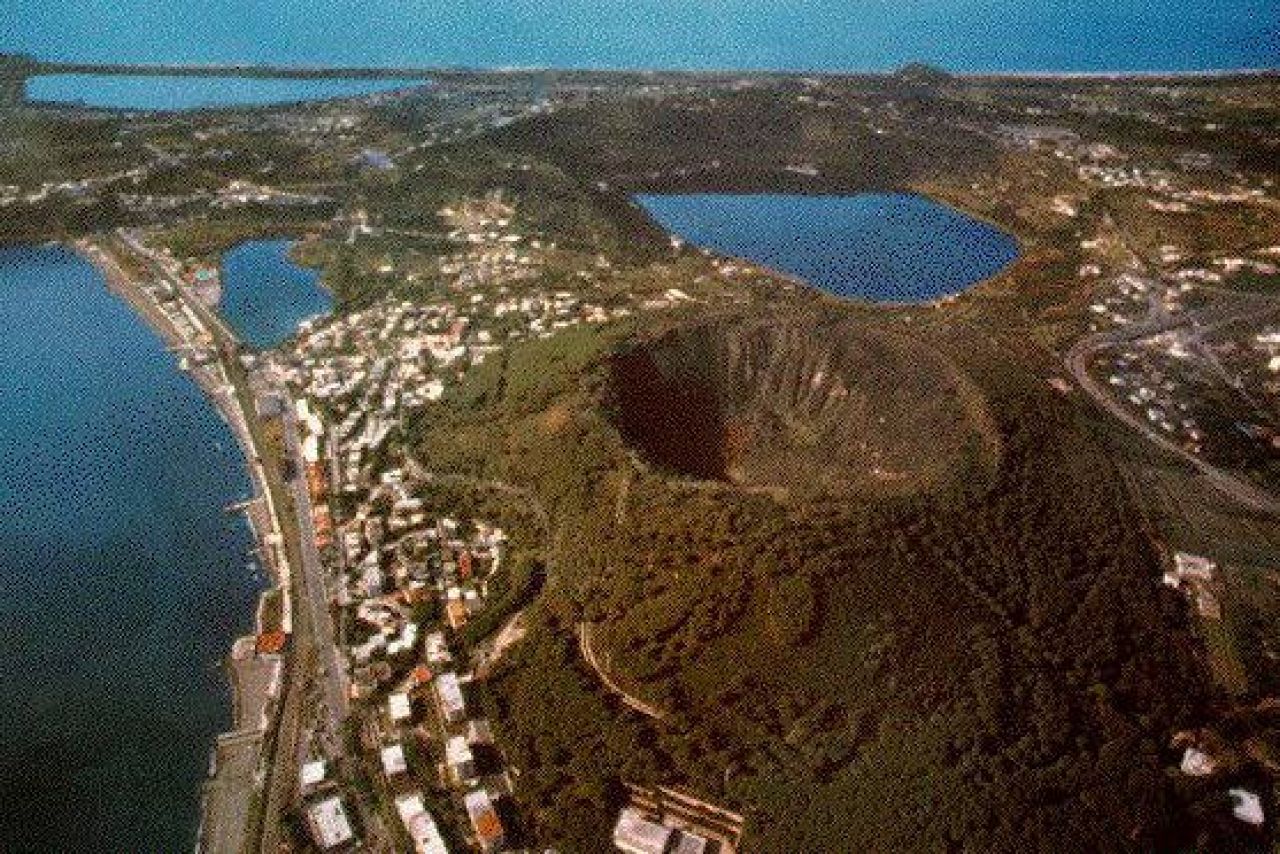
Rumored to have caused the extinction of the Neanderthals, the nearly 5-mile wide Campi Flegrei super-volcano sits on the Italian coast. Researchers are concerned that it is approaching a critical pressure point that could lead to an eruption. There are close to 500,000 people living around it.
When you picture a volcano, you picture smoke and lava erupting from its peak. But super-volcanoes are quite different. Imagine Yellowstone National Park. Super-volcanoes are formed when a volcano ejects so much magma from its center that it actually collapses on itself, leaving behind extensive fields of volcanic activity, a vast crater, as well as numerous geysers, hydrothermal activity, and sulphuric acid.
The Campi Flegrei super-volcano is made up of 24 craters and large volcanic edifices, many of which are submerged beneath the Mediterranean Sea. It formed 39,000 years ago, as part of the largest eruption Europe has experienced in the last 200,000 years.
Since its formation, Campi Flegrei has experienced 2 major eruptions – 35,000 years ago, and 12,000 years ago. A smaller eruption occurred in 1538. That “smaller” eruption, however, lasted for 8 days and spewed so much material into the surrounding area, it formed a new mountain, Monte Nuovo.
You get the point – even a “small” eruption is a huge event, so a major eruption could be catastrophic.
The eruption that occurred 200,000 years ago is believed to have triggered a “volcanic winter” that wiped out the Neanderthals. That’s pure speculation, but scientists say the eruption spewed some 1 trillion gallons of molten rock onto the surface and just as much sulphur into the atmosphere.
Source: CNN
The Critical Pressure Point
A team of researchers from the Italian National Institute for Geophysics and Volcanology are watching Campi Flegrei very closely because the super-volcano appears to be approaching a critical pressure point that could trigger a 3rd major eruption.
“This critical pressure point – referred to as critical degassing pressure (CDP) – could drive volcanic unrest towards a critical state, the team reports, by releasing jets of super-hot gas into the atmosphere, heating the surrounding hydrothermal fluids and rocks, and causing rock failure and possibly an eruption.”
Volcanologist Giovanni Chiodini says:
“Hydrothermal rocks, if heated, can ultimately lose their mechanical resistance, causing an acceleration towards critical conditions.”
Campi Flegrei has been experiencing an “uplift” for the past decade, which suggests that the volatile gases beneath it are rising to the surface at an accelerating rate. This has prompted Italian authorities to raise the super-volcano’s alert level from green (“quiet”) to yellow (“requires scientific monitoring.”)
Uplift has signaled volcanic eruptions in the past, most notably with Rabaul in Papua New Guinea and Sierra Negra in the Galapagos.
No one is telling local residents to run for their lives just yet, because it is impossible to predict what, if anything, Campi Negrei might do. Chiodini says:
“We have many uncertainties and long-term previsions are at the moment not possible! For example, the process that we describe could evolve in both directions: toward pre-eruptive conditions or to the finish of the volcanic unrest.”
Chiodini and his team hope that their latest observations will spur other researchers to monitor Campi Flegrei in the coming years, so people have some idea of just how catastrophic another major eruption could be.
Problems in Peru
Two volcanoes in Peru have roared to life, leading to widespread fear and mass evacuations. [2]
On December 26, at 8:24 a.m., the Sabancaya volcano, which sits just 40 miles from Peru’s second most populous city, Arequipa, began spitting smoke and ash some 11,500 feet into the air just over a week after it became active.
Local authorities have warned the local inhabitants that they are likely to be affected by the ash from the 20,000-foot volcano, whose name translates to “tongue of fire” in the local dialect of Quechua.
Sabancaya had been dormant for 200 years until it began erupting in the 1980’s.
Just 60 miles away, the Ubinas volcano is also in the midst of spewing smoke and ash 2 miles into the atmosphere. It is Peru’s most active volcano, and was last active in April 2014. Ubinas had been dormant for about 40 years before rumbling back to life in 2006.
Authorities began evacuating the surrounding area earlier this week.
Peruvian Geophysical Institute (IGP) investigator Orlando Macedo said:
“All this activity is part of an expected process. Before the eruption, tremors were occurring closer and closer to the volcano and the crater. However, the process is taking longer than that which we saw at the Ubinas Volcano, when everything happened in a matter of days. In the case of Sabancaya, this could go on for several months.”
Other Areas of Concern
There was a lot of moving and shaking in December 2016.
Mount St. Helens in Washington State experienced an earthquake “swarm” of some 120 shallow temblors over the course of several days. It is considered active, but an eruption could be years away. [3]
Source: Oregon Live – Mount St. Helens
On the Kamchatka Peninsula in the Russian Far East, the Shiveluch volcano blew its top, destroying the small lava dome/plug in its crater and generating a 36,000-foot ash plume. Fortunately, the ash drifted to an uninhabited area, but an orange aviation alert was issued to warn airlines of the ash plume.
In Costa Rica, antennas on Irazu will have to be moved because of cracking on the volcano. It is unknown whether the cracking is related to any potential changes in the Irazu volcano, or if the surface blocks are just faulting.
The infamous Hawaiian volcano Kilauea experienced a small explosion, sending huge chunks of debris flying, including old wall rock and lava from the lava lake. This is a fairly common occurrence.
Lastly, scientists have noticed an increase in seismicity at Cayambe in Ecuador. An earthquake swarm that occurred there over several days in December indicate that Cayambe, like Mount St. Helens, is recharging, but no eruption appears to be imminent.
Julie Fidler is a freelance writer, legal blogger, and the author of Adventures in Holy Matrimony: For Better or the Absolute Worst. She lives in Pennsylvania with her husband and two ridiculously spoiled cats. She occasionally pontificates on her blog.