The Philippines most active volcano, Mount Mayon, has been rumbling for days. Because of the volcano’s ongoing activity, the alert level has been raised to 4 and the danger zone around Mayon is now 5 miles in diameter.
A recent explosion has taken place at the volcano in the Philippines as well, sending a huge plume of ash and steam into the sky. Authorities have since raised the alert level to four out of five, meaning a potentially deadly major eruption is possible within days. The Philippine Institute of Volcanology and Seismology (Phivolcs) raised its alert on Mayon to level 4, signifying a hazardous eruption is imminent, from level 3, which warns that such an eruption could be “weeks or even days” away. “We strongly advise all people, both residents, and tourists, to avoid the danger zone, and airlines to avoid flying near the volcano summit,” agency chief Renato Solidum said in a public news conference.
PHIVOLCS reported “increased seismic unrest, lava fountaining, and summit explosions” in the area and Solidum warned of two possible scenarios in the press conference on Monday: continuous lava eruptions, or a more dangerous pyroclastic flow. (A pyroclastic flow is a mix of hot lava blocks, pumice, ash, and volcanic gas that moves at high speed down the slope of a volcano while typically following valleys, according to the United States Geological Survey.)
Solidum said this eruption was a possible “smaller version [of the] 2001 eruption,” which had pyroclastic flow. Solidum said the agency had recorded increased seismic activity and “lava fountaining and a summit explosion” from Sunday night, indicating more explosions could be ahead, including a hazardous eruption. A level 5 would signify that a violent and possible deadly eruption is underway.
Mayon, which at 2,462 meters (8,077 ft) is also one of the tallest mountains in the country. It has been issuing lava and pyroclastic material since it started showing activity and a red-hot glowing core back on January 13. About 40,000 residents living near Mayon have been evacuated. Authorities have also closed schools and encouraged those in the outskirts of Mayon’s danger zone to stay indoors.
Mayon lies in the central province of Albany. “In some areas…it’s already zero visibility, especially along the foot of the volcano,” governor Al Francis Bichara told CNN Philippines, adding that strong winds could carry ash to distant towns. “The public is reminded to observe the danger zone — not to panic, but in essence just be ready. Prepare either gas masks, handkerchiefs or clothes to prevent inhalation of fine ash,” said Solidum.
“This kind of eruption is not over yet. Just like what we experienced a long time ago, it might extend up to a month,” said Bichara. “Maybe tomorrow, there will no eruption, and the following day there will be [one].”
The explosion occurred on Wednesday evening in the Perekrestok store in the shopping center on Kondratyevsky Avenue in the northern part of St. Petersburg. As reported by TASS in the main department of the Ministry for Emergency Situations in St. Petersburg and the Leningrad region, the place is pulled by the operational forces, the evacuation of the building has already been carried out.
"There was a clap in the building, the rescuers are already working on the spot, the evacuation is made, there is no fire," the administration said.
The strength of the explosion is unknown.
Live Feed from the area of the explosion...
According to a source in the emergency services, ten people were injured.
"The explosion of an unidentified device occurred in the entertainment complex" Giant Hall "on the ground floor in the area of the cells of the store" Perekrestok "(without ignition)," the source said.
According to preliminary information, four people have already been hospitalized. Six more are examined by doctors. There is no damage to the load-bearing structures. On-site sappers are working explosives.
When the CEO of Arkema America, Richard Rowe, warned late Wednesday that the company is powerless to prevent an imminent explosion at its Crosby, TX chemical plant, all we could do was wait for the inevitable. We didn"t have long to wait, because just a few hours later, on Thursday morning, Arkema said it has been notified about two explosions at the doomed Crosby plant.
Source: Bloomberg
At approximately 2:00am local time, the company announced that two explosions and black smoke were reported. According to ABC, several people were taken to hospital.
A sheriff’s deputy was among those taken to the hospital after inhaling fumes, according to a tweet from the Harris County Sheriff’s Office. Nine other deputies drove themselves to the hospital as a precaution.
One deputy taken to hospital after inhaling fumes from Archem plant in Crosby. 9 others drove themselves to hospital as precaution.
Arkema had already evacuated workers, and local authorities had cleared the area prior to the blow. From the statement:
At approximately 2 a.m. CDT, we were notified by the Harris County Emergency Operations Center (EOC) of two explosions and black smoke coming from the Arkema Inc. plant in Crosby, Texas. Local officials had previously established an evacuation zone in an area 1.5 miles from our plant, based on their assessment of the situation.
An Arkema spokesperson stated late Wednesday that a fire at the site was inevitable. “The fire will happen. It will resemble a gasoline fire. It will be explosive and intense in nature... as the temperature rises, the natural state of these materials will decompose. A white smoke will result, and that will catch fire. So the fire is imminent. The question is when,” spokesperson Janet Smith said.
The Arkema Inc. chemical plant on Aug. 30
Rachel Moreno, a spokeswoman for the county fire marshal’s office, said it is unclear whether all residents obeyed the evacuation order for the 1.5 mile radius of the plant, adding that the office has received an unconfirmed report of a woman who may still be in the evacuation zone.
The company also said it is working closely with federal, state and local authorities to manage the situation, according to a statement on its website.
As Arkema stores organic peroxides at several locations on the site, the threat of additional explosions remains, it said, adding that the best course of action is to let the fire burn itself out.
We have been working closely with public officials to manage the implications of this situation, and have communicated with the public the potential for product to explode and cause an intense fire. Organic peroxides are extremely flammable and, as agreed with public officials, the best course of action is to let the fire burn itself out.
We want local residents to be aware that product is stored in multiple locations on the site, and a threat of additional explosion remains. Please do not return to the area within the evacuation zone until local emergency response authorities announce it is safe to do so.
Organic peroxides are a family of compounds that are used in a wide range of applications, such as making pharmaceuticals and construction materials.
Meanwhile, Harris County Sheriff Ed Gonzalez stressed during a press conference that "it wasn"t an explosion, I want to be very clear, it was not an explosion..." He instead explained the incident as a series of "pops."
"There were different organic peroxides of different grades that were released and it created a pop in the containers where they were being stored and some gray smoke initially emanated from it and eventually turned into black smoke" after a fire began, he said.
Gonzalez went on to state that it is "not anything toxic, it is not anything that we feel is a danger to the community at all..." The "pops" occurred inside one of nine 18-wheel box trucks at the site, according to Bob Royall, an assistant chief with the Harris County Fire Marshal"s Office.
"There are nine vans. Of the nine, three had lost refrigeration to keep them cool. the other ones are still under refrigeration," he said, adding that the chemicals are "in containers in cardboard boxes inside the vans."
Royall added that the incident has played out in the way that authorities anticipated. "Right now everything is going according to what we thought was going to happen so far. We are in a defensive posture, the fire department is out there on the scene, there is air monitoring being deployed by a contractor by the company to try to find out and watch and see where the smoke might go..." he said.
* * *
As a reminder, on Wednesday the company said it has “no way to prevent” a potentially large explosion and fire at its facility near Houston, after flooding due to Tropical Storm Harvey. The Arkema plant in Crosby, Texas, some 25 miles northeast of Houston, was evacuated late Tuesday. Working with authorities, the company also urged everyone within a mile and a half of the plant to evacuate, and shut down a stretch of Highway 90 that runs alongside the plant, which produces organic peroxides for things like acrylic-based paint.
“We have an unprecedented 6 feet of water throughout the plant,” Arkema’s North American operations Chief Executive Rich Rowe said in a teleconference Wednesday with reporters. Rowe said that the plant lost primary power and two emergency backup power sources, which led to a shutdown of “critical refrigeration needed for our materials.” He said that means those materials “could now explode and cause a subsequent and intense fire,” and added that “the high water that exists on site, and the lack of power, leave us with no way to prevent it.”
Rowe said about 300 people in all have been evacuated, but said it wasn’t a mandatory evacuation, so he’s not certain whether the 1.5-mile radius around the facility is currently devoid of people. He said it is mostly a rural area, so there are “a limited number of homes” within the area. Rowe said local officials told him the water level in the area could actually continue to rise over the course of the next three to six days, and as such Arkema, which is based in France, believes the chemicals will start to degrade well before that happens.
“And once the chemicals begin to degrade we would be in a situation where we could be looking at a fire and/or an explosion,” he said. As soon as the chemicals begin to degrade they start to “self-accelerate” in a type of no-turning-back mode, he added.
Rowe didn’t get specific about the amount of chemicals on site or just how big the blast might be, except to say that the analysis of the quantity of chemical is what led authorities to decide on the 1.5-mile evacuation zone they deemed appropriate.
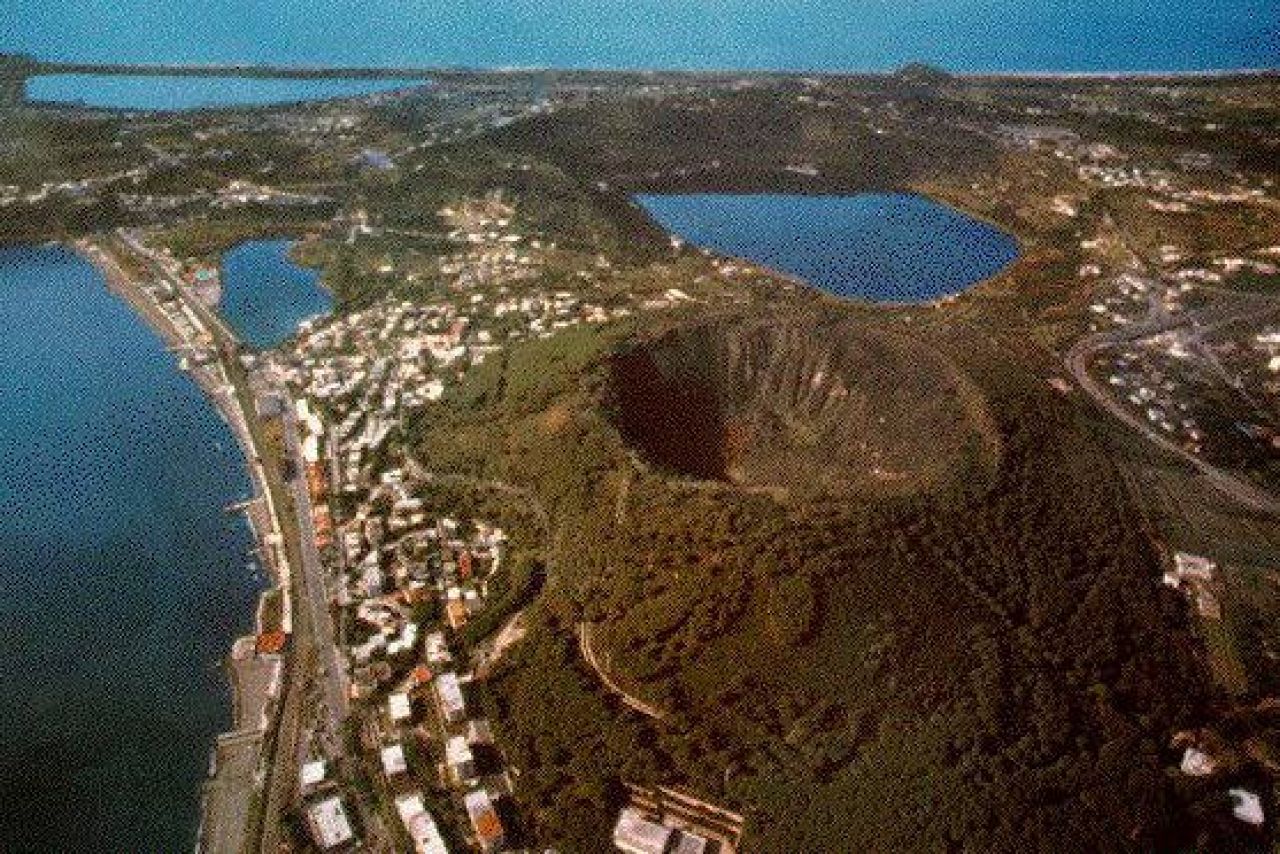
There are few things in nature as fascinating as volcanoes. There are also few things that are as deadly. There are regular old volcanoes, and there are super-volcanoes. Super-volcanoes have the capacity to wipe out civilization, and one such super-volcano in Italy appears to be waking from a 500-year slumber. [1]
Monte Nuovo (year 1538). Click for larger version.
Rumored to have caused the extinction of the Neanderthals, the nearly 5-mile wide Campi Flegrei super-volcano sits on the Italian coast. Researchers are concerned that it is approaching a critical pressure point that could lead to an eruption. There are close to 500,000 people living around it.
When you picture a volcano, you picture smoke and lava erupting from its peak. But super-volcanoes are quite different. Imagine Yellowstone National Park. Super-volcanoes are formed when a volcano ejects so much magma from its center that it actually collapses on itself, leaving behind extensive fields of volcanic activity, a vast crater, as well as numerous geysers, hydrothermal activity, and sulphuric acid.
The Campi Flegrei super-volcano is made up of 24 craters and large volcanic edifices, many of which are submerged beneath the Mediterranean Sea. It formed 39,000 years ago, as part of the largest eruption Europe has experienced in the last 200,000 years.
Since its formation, Campi Flegrei has experienced 2 major eruptions – 35,000 years ago, and 12,000 years ago. A smaller eruption occurred in 1538. That “smaller” eruption, however, lasted for 8 days and spewed so much material into the surrounding area, it formed a new mountain, Monte Nuovo.
You get the point – even a “small” eruption is a huge event, so a major eruption could be catastrophic.
The eruption that occurred 200,000 years ago is believed to have triggered a “volcanic winter” that wiped out the Neanderthals. That’s pure speculation, but scientists say the eruption spewed some 1 trillion gallons of molten rock onto the surface and just as much sulphur into the atmosphere.
Source: CNN
The Critical Pressure Point
A team of researchers from the Italian National Institute for Geophysics and Volcanology are watching Campi Flegrei very closely because the super-volcano appears to be approaching a critical pressure point that could trigger a 3rd major eruption.
“This critical pressure point – referred to as critical degassing pressure (CDP) – could drive volcanic unrest towards a critical state, the team reports, by releasing jets of super-hot gas into the atmosphere, heating the surrounding hydrothermal fluids and rocks, and causing rock failure and possibly an eruption.”
Volcanologist Giovanni Chiodini says:
“Hydrothermal rocks, if heated, can ultimately lose their mechanical resistance, causing an acceleration towards critical conditions.”
Campi Flegrei has been experiencing an “uplift” for the past decade, which suggests that the volatile gases beneath it are rising to the surface at an accelerating rate. This has prompted Italian authorities to raise the super-volcano’s alert level from green (“quiet”) to yellow (“requires scientific monitoring.”)
Uplift has signaled volcanic eruptions in the past, most notably with Rabaul in Papua New Guinea and Sierra Negra in the Galapagos.
No one is telling local residents to run for their lives just yet, because it is impossible to predict what, if anything, Campi Negrei might do. Chiodini says:
“We have many uncertainties and long-term previsions are at the moment not possible! For example, the process that we describe could evolve in both directions: toward pre-eruptive conditions or to the finish of the volcanic unrest.”
Chiodini and his team hope that their latest observations will spur other researchers to monitor Campi Flegrei in the coming years, so people have some idea of just how catastrophic another major eruption could be.
Problems in Peru
Two volcanoes in Peru have roared to life, leading to widespread fear and mass evacuations. [2]
On December 26, at 8:24 a.m., the Sabancaya volcano, which sits just 40 miles from Peru’s second most populous city, Arequipa, began spitting smoke and ash some 11,500 feet into the air just over a week after it became active.
Local authorities have warned the local inhabitants that they are likely to be affected by the ash from the 20,000-foot volcano, whose name translates to “tongue of fire” in the local dialect of Quechua.
Sabancaya had been dormant for 200 years until it began erupting in the 1980’s.
Just 60 miles away, the Ubinas volcano is also in the midst of spewing smoke and ash 2 miles into the atmosphere. It is Peru’s most active volcano, and was last active in April 2014. Ubinas had been dormant for about 40 years before rumbling back to life in 2006.
Authorities began evacuating the surrounding area earlier this week.
Peruvian Geophysical Institute (IGP) investigator Orlando Macedo said:
“All this activity is part of an expected process. Before the eruption, tremors were occurring closer and closer to the volcano and the crater. However, the process is taking longer than that which we saw at the Ubinas Volcano, when everything happened in a matter of days. In the case of Sabancaya, this could go on for several months.”
Other Areas of Concern
There was a lot of moving and shaking in December 2016.
Mount St. Helens in Washington State experienced an earthquake “swarm” of some 120 shallow temblors over the course of several days. It is considered active, but an eruption could be years away. [3]
Source: Oregon Live – Mount St. Helens
On the Kamchatka Peninsula in the Russian Far East, the Shiveluch volcano blew its top, destroying the small lava dome/plug in its crater and generating a 36,000-foot ash plume. Fortunately, the ash drifted to an uninhabited area, but an orange aviation alert was issued to warn airlines of the ash plume.
In Costa Rica, antennas on Irazu will have to be moved because of cracking on the volcano. It is unknown whether the cracking is related to any potential changes in the Irazu volcano, or if the surface blocks are just faulting.
The infamous Hawaiian volcano Kilauea experienced a small explosion, sending huge chunks of debris flying, including old wall rock and lava from the lava lake. This is a fairly common occurrence.
Lastly, scientists have noticed an increase in seismicity at Cayambe in Ecuador. An earthquake swarm that occurred there over several days in December indicate that Cayambe, like Mount St. Helens, is recharging, but no eruption appears to be imminent.
Julie Fidler is a freelance writer, legal blogger, and the author of Adventures in Holy Matrimony: For Better or the Absolute Worst. She lives in Pennsylvania with her husband and two ridiculously spoiled cats. She occasionally pontificates on her blog.
According to latest update from Russian security forces, ten people (up to 14 according to unconfirmed reports) have been killed and at least 37 were injured when an explosion tore through a train carriage in a St. Petersburg metro tunnel on Monday. According to an update from Interfax news agency, the blast may have been caused by an explosive device hidden in a briefcase which had been left on the train before it was departing the Sennaya Ploshchad station towards the Tekhnologichesky Institut station.
"According to preliminary data, the explosion in the St. Petersburg metro system was committed not by a suicide bomber; the explosive device had most likely been left behind in the railcar before the train"s departure," the source said.
Alleged photos of the IED surfaced on social media. They show a medium-sized leather bag, which apparently held a container filled with explosives, with ball bearings wrapped around it.
Interfax also said that surveillance cameras had captured images of what it called the organizers of the explosion, which hit St Petersburg as President Vladimir Putin was visiting the city. As a result, Russian security forces have issued a search warrant for two people suspected to be behind the blast.
Russia"s National Anti-Terrorist Committee also said an undetonated improvised explosive device (IED) was discovered and defused by investigators at the Ploshchad Vosstaniya Station and defused by specialists, the NAC reported. It rejected media reports which claimed that more than one explosion occurred, saying no evidence supporting this was found.
Putin, in another part of the city for a meeting with Belarus"s leader, was initially cautious. He said he was considering all possible causes, including terrorism.
Investigators are currently giving priority to the extremist or nationalistic trace theory behind the blast. A terrorism probe has been launched over the blast by Russia’s Investigative Committee. The committee also praised the driver of the train for not trying to stop in the tunnel after the explosion.
“He acted right in the circumstances. The explosion happened in the tunnel between stations, but the driver took the right decision and brought it to the next station, which allowed evacuation and help to the injured to start at once. This may have prevented casualties,” the committee said.
Russian President Vladimir Putin commented that “The causes of this event have not been determined yet, so it’s too early to talk about [possible causes]. The investigation will show. Certainly, we will consider all possibilities: common, criminal, but first of all of a terrorist nature.”
All Metro stations are closed to passengers. Commuters were evacuated from the subway within about an hour of the first reports of the blast coming in. Ambulances and fire engines descended on the concrete-and-glass Sennaya Ploshchad metro station. A helicopter hovered overhead as crowds gathered to observe rescue operations.
"I appeal to you citizens of St. Petersburg and guests of our city to be alert, attentive and cautious and to behave in a responsible matter in light of events," St Petersburg Governor Georgy Poltavchenko said in an address.
As Reuters adds, an attack on Russia"s old imperial capital would have symbolic force for any militant group, notably Chechen secessionists and Islamic State, which is now fighting Russian forces in Syria. Chechen militant attacks in the past have largely focused on Moscow, including an attack on an airport, a theater and in 2010 a metro train
Video from the scene of Monday"s blast showed injured people lying bleeding on a platform, some being treated by emergency services and fellow passengers. Others ran away from the platform amid clouds of smoke, some screaming or holding their hands to their faces.
“I saw a lot of smoke, a crowd making its way to the escalators, people with blood and other people"s insides on their clothes, bloody faces,,” St Petersburg resident Leonid Chaika, who said he was at the station where the blast happened, told Reuters by phone. "Many were crying."
A huge hole was blown open in the side of a carriage with metal wreckage strewn across the platform. Passengers were seen hammering at the windows of one closed carriage. Russian TV said many had suffered lacerations from glass shards and metal, the force of the explosion maximized by the confines of the carriage and the tunnel.
Authorities closed all St. Petersburg metro stations. The Moscow metro said it was taking unspecified additional security measures in case of an attack there. Russia has been on particular alert against Chechen rebels returning from Syria, where they have fought alongside Islamic State, and wary of any attempts to resume attacks that dogged the country several years ago.
At least 38 people were killed in 2010 when two female suicide bombers detonated bombs on packed Moscow metro trains. Over 330 people, half of them children, were killed in 2004 when police stormed a school in southern Russia after a hostage taking by Islamist militants. In 2002, 120 hostages were killed when police stormed a Moscow theater to end another hostage-taking.