As the world stands at the precipice of a third world war, eerie satellite images show that North Korea is likely getting ready for another nuclear test. The new images are reigniting fears that this could be the final straw that would officially lead to world war 3.
Dramatic satellite images taken earlier this month show disturbing activity on a barge that supports the development of a deadly nuclear submarine. The photos show activity on a second submersible ballistic missile test stand barge at the Nampo Navy Shipyard, a seaport in South Pyongan Province. This particular barge supported the development of the deadly Pukguksong-1 SLBM and the SINPO-Class experimental ballistic missile submarine.
The photo below was taken by satellite on January 6, 2018.
The fitting-out dock is used when vessels need systems such as pumps or electrics to be installed and minor work to be completed before being placed into devastating service. Since the last set of images were taken in December, the barge now has a small floating crane moored alongside it. Though the purpose of the work is unclear, it is probably related to final stages of repair before declaring the barge operational, reported Express.co.uk.
It comes as Kim Jong-un’s repeated tests of his atomic arsenal have caused tensions to heat up in Asia, bringing condemnation from numerous powers and fanned World War 3 fears. This news also surfaces as a nuclear scientist, who has frequently visited North Korea, warned that the nation could have an atomic bomb capable of fitting onto a missile. The director of Los Alamos National Laboratory Sig Hecker said that the rogue regime could also have anywhere between 30 and 60 small mobile nuclear warheads. Speaking to CBS News’ 60 Minutes, Hecker said: “What’s even more important than the 30 or 60, is how small can they make them.”
When prompted as to what the nuclear warheads look like, Hecker said that they looked like a “fission bomb.” “This to me is one that I would call a spherical fission bomb, in other words, the atomic bomb,” Hecker said. “It looks like a simple bomb. However what I found most important about this is the size of it, it looks to be about 60 centimeters.
Photos from almost two years ago show North Korea’s tyrannical dictator posing with what he claimed was a nuclear warhead small enough to be mounted on a missile. When asked whether it could be mounted to a missile, Hecker said: “They definitely want us to think so.”
Volcanic ash rained down on the villages which are spotting the countryside in Bali. Mount Agung erupted again sending a massive plume of ash into the sky.
The Bali volcano threat level has been raised to the highest possible level, putting it at a level 4, while the aviation ash warning is now orange. The latest Volcano Observatory Notice for Aviation (VONA) was issued after Mount Agung erupted yesterday morning following several days of calm.
The tourist season has been widely interrupted because of Mount Agung’s volatile and unpredictable behavior. This evening Mount Agung was still sending a plume of ash almost 5000 feet (1,500 meters) into the sky in what was a beautiful yet ominous sign of the ongoing threat. The Volcanology and Geological Disaster Mitigation Agency (PVMBG) has said that greyish-white plumes of ash have soared as high as 6500 feet (2000 meters) above the crater. Hot magma produced an eerie red glow just above the crater as cold lava mudflows have poured down the slopes.
As previously reported by SHTFPlan, more than 70,000 evacuees have fled their homes and are staying in more than 230 shelters across Bali, according to the National Agency for Disaster Management (BNPB). BNPB spokesman Sutopo Purwo Nugroho ash rained down on Temakung village at 7:50 am local time today when the volcano erupted and sent out ash once again.
The Indonesians have told about 100,000 people to evacuate from the radius of the danger zone surrounding the volcano. The Mount Agung volcano, which is capable of very violent eruptions, has shown a marked increase in activity in the last few weeks, stoking fears of a repeat of the 1963 eruption which killed 1,100 people.
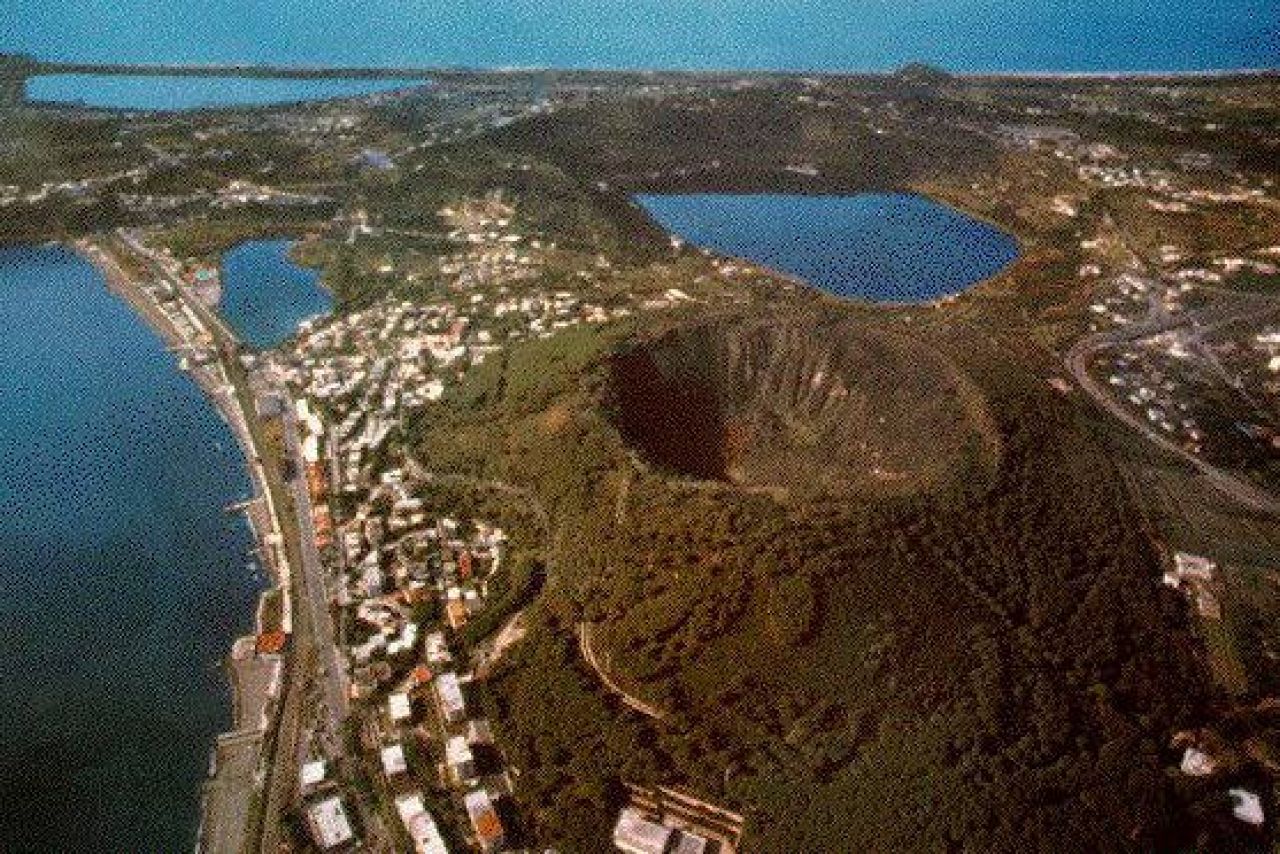
There are few things in nature as fascinating as volcanoes. There are also few things that are as deadly. There are regular old volcanoes, and there are super-volcanoes. Super-volcanoes have the capacity to wipe out civilization, and one such super-volcano in Italy appears to be waking from a 500-year slumber. [1]
Monte Nuovo (year 1538). Click for larger version.
Rumored to have caused the extinction of the Neanderthals, the nearly 5-mile wide Campi Flegrei super-volcano sits on the Italian coast. Researchers are concerned that it is approaching a critical pressure point that could lead to an eruption. There are close to 500,000 people living around it.
When you picture a volcano, you picture smoke and lava erupting from its peak. But super-volcanoes are quite different. Imagine Yellowstone National Park. Super-volcanoes are formed when a volcano ejects so much magma from its center that it actually collapses on itself, leaving behind extensive fields of volcanic activity, a vast crater, as well as numerous geysers, hydrothermal activity, and sulphuric acid.
The Campi Flegrei super-volcano is made up of 24 craters and large volcanic edifices, many of which are submerged beneath the Mediterranean Sea. It formed 39,000 years ago, as part of the largest eruption Europe has experienced in the last 200,000 years.
Since its formation, Campi Flegrei has experienced 2 major eruptions – 35,000 years ago, and 12,000 years ago. A smaller eruption occurred in 1538. That “smaller” eruption, however, lasted for 8 days and spewed so much material into the surrounding area, it formed a new mountain, Monte Nuovo.
You get the point – even a “small” eruption is a huge event, so a major eruption could be catastrophic.
The eruption that occurred 200,000 years ago is believed to have triggered a “volcanic winter” that wiped out the Neanderthals. That’s pure speculation, but scientists say the eruption spewed some 1 trillion gallons of molten rock onto the surface and just as much sulphur into the atmosphere.
Source: CNN
The Critical Pressure Point
A team of researchers from the Italian National Institute for Geophysics and Volcanology are watching Campi Flegrei very closely because the super-volcano appears to be approaching a critical pressure point that could trigger a 3rd major eruption.
“This critical pressure point – referred to as critical degassing pressure (CDP) – could drive volcanic unrest towards a critical state, the team reports, by releasing jets of super-hot gas into the atmosphere, heating the surrounding hydrothermal fluids and rocks, and causing rock failure and possibly an eruption.”
Volcanologist Giovanni Chiodini says:
“Hydrothermal rocks, if heated, can ultimately lose their mechanical resistance, causing an acceleration towards critical conditions.”
Campi Flegrei has been experiencing an “uplift” for the past decade, which suggests that the volatile gases beneath it are rising to the surface at an accelerating rate. This has prompted Italian authorities to raise the super-volcano’s alert level from green (“quiet”) to yellow (“requires scientific monitoring.”)
Uplift has signaled volcanic eruptions in the past, most notably with Rabaul in Papua New Guinea and Sierra Negra in the Galapagos.
No one is telling local residents to run for their lives just yet, because it is impossible to predict what, if anything, Campi Negrei might do. Chiodini says:
“We have many uncertainties and long-term previsions are at the moment not possible! For example, the process that we describe could evolve in both directions: toward pre-eruptive conditions or to the finish of the volcanic unrest.”
Chiodini and his team hope that their latest observations will spur other researchers to monitor Campi Flegrei in the coming years, so people have some idea of just how catastrophic another major eruption could be.
Problems in Peru
Two volcanoes in Peru have roared to life, leading to widespread fear and mass evacuations. [2]
On December 26, at 8:24 a.m., the Sabancaya volcano, which sits just 40 miles from Peru’s second most populous city, Arequipa, began spitting smoke and ash some 11,500 feet into the air just over a week after it became active.
Local authorities have warned the local inhabitants that they are likely to be affected by the ash from the 20,000-foot volcano, whose name translates to “tongue of fire” in the local dialect of Quechua.
Sabancaya had been dormant for 200 years until it began erupting in the 1980’s.
Just 60 miles away, the Ubinas volcano is also in the midst of spewing smoke and ash 2 miles into the atmosphere. It is Peru’s most active volcano, and was last active in April 2014. Ubinas had been dormant for about 40 years before rumbling back to life in 2006.
Authorities began evacuating the surrounding area earlier this week.
Peruvian Geophysical Institute (IGP) investigator Orlando Macedo said:
“All this activity is part of an expected process. Before the eruption, tremors were occurring closer and closer to the volcano and the crater. However, the process is taking longer than that which we saw at the Ubinas Volcano, when everything happened in a matter of days. In the case of Sabancaya, this could go on for several months.”
Other Areas of Concern
There was a lot of moving and shaking in December 2016.
Mount St. Helens in Washington State experienced an earthquake “swarm” of some 120 shallow temblors over the course of several days. It is considered active, but an eruption could be years away. [3]
Source: Oregon Live – Mount St. Helens
On the Kamchatka Peninsula in the Russian Far East, the Shiveluch volcano blew its top, destroying the small lava dome/plug in its crater and generating a 36,000-foot ash plume. Fortunately, the ash drifted to an uninhabited area, but an orange aviation alert was issued to warn airlines of the ash plume.
In Costa Rica, antennas on Irazu will have to be moved because of cracking on the volcano. It is unknown whether the cracking is related to any potential changes in the Irazu volcano, or if the surface blocks are just faulting.
The infamous Hawaiian volcano Kilauea experienced a small explosion, sending huge chunks of debris flying, including old wall rock and lava from the lava lake. This is a fairly common occurrence.
Lastly, scientists have noticed an increase in seismicity at Cayambe in Ecuador. An earthquake swarm that occurred there over several days in December indicate that Cayambe, like Mount St. Helens, is recharging, but no eruption appears to be imminent.
Julie Fidler is a freelance writer, legal blogger, and the author of Adventures in Holy Matrimony: For Better or the Absolute Worst. She lives in Pennsylvania with her husband and two ridiculously spoiled cats. She occasionally pontificates on her blog.