The 134 earthquakes that have had the San Andreas fault line rocking and rolling this past week are igniting fears that the “big one” could be just around the corner.
According to The Daily Mail, in the last week, 134 earthquakes have hammered a three-mile stretch around Monterey County on the San Andreas fault. Fresh fears have been raised that a huge earthquake is about to hit California after a swarm of recent tremors in the area.
Of those earthquakes, 17 were stronger than 2.5 magnitude and six of them were stronger than 3.0, with more tremors expected in the coming weeks, experts warn. It follows fears raised last week that the ‘Big One’ is about to hit after a series of ten “mini-quakes” struck the same area. The swarm included one 4.6-magnitude quake that was felt in San Francisco more than 90 miles (145 km) away. The 4.6 shock was followed by 9 smaller aftershocks. The largest of these aftershocks measured a magnitude 2.8, Annemarie Baltay, a seismologist with the US Geological Survey in Menlo Park, told SFGATE.
“This one has been a quite productive aftershock sequence,” said Ole Kaven, a US Geological Survey (USGS) seismologist. “We suspect there will be aftershocks in the 2 to 3 [magnitude] range for at least a few more weeks,” he said. There have not been any reports of injuries, writes San Francisco news outlet SFGate.
Experts have continuously warned that any activity along the San Andreas fault line is a cause for concern because of the soaring population that would be affected. “Any time there is significant seismic activity in the vicinity of the San Andreas fault, we seismologists get nervous,” Thomas Jordan, director of the Southern California Earthquake Centre, told theLA Timeslast year.
Seismologist Dr. Lucy Jones, from the US Geological Survey, warned in a dramatic speech that people need to act to protect themselves rather than ignoring the threat. Jones said people’s decision not to accept it will only mean more suffer as scientists warn the ‘Big One’ is now overdue to hit California. In a keynote speech to a meeting of the Japan Geoscience Union and the American Geophysical Union, Dr. Jones warned that the public is yet to accept the randomness of future earthquakes.
People tend to focus on earthquakes happening in the next 30 years but they should be preparing now, she warned. Jones said there are three key reasons why the peril is so frightening – it cannot be seen, it is uncertain, and it seems unknowable. This means people bury their heads in the sand and pretend it won’t happen when they should be prepared and soon for the “big one.”
Twenty-two earthquake in four days have rocked a famous tourist location. This recent swarm has sparked more fears that yet another volcano could be on the verge of erupting.
All of the quakes near Mount Teide were relatively minor, however, with the most powerful tremor recording a magnitude of 1.4. That quake was recorded as striking at 11.05 am local time (11:05 GMT, 06:05 GMT) on Tuesday morning. But, they all took place directly beneath the surface of the volcano. According to Oregon State University, most earthquakes directly beneath a volcano are caused by the movement of magma and that places pressure on the rocks until it cracks the rock. Magma then moves into the crack and begins building pressure again. Every time the rock cracks it makes a small earthquake.
But scientists are saying that there’s still time and that everyone should remain calm. “This swarm is similar to the other Seismic Swarms Recorded in Tenerife since last June 2017 and as always important to emphasize, it does not represent any kind of concern to the population,” a representative wrote on their Facebook page. “These types of swarms are common in active volcanoes,” they wrote, explaining that it was caused by changes in the pressure in the hydrothermal system.
Lucan Duria, a physicist and volcano monitoring expert at Involcan told MailOnline there are normally two or three earthquakes every day near Mount Teide, so there was “nothing special” about recent activity.
But with all of the earthquakes swarms occurring across the globe right now, many are rightly concerned that a volcanic natural disaster coupled with an earthquake could be next.
In recent weeks, the locals living in the Maurienne part of Savoie in the French Alps have been getting used to being shaken awake at night. The region has been rocked by 140 earthquakes in a mere 40 days sparking fears that Europe may soon experience “the big one.”
Sismalp, a French earthquake organization, has registered 140 minor tremors in the area in the last month or so. And with the strongest tremor being recorded 3.8 on the Richter scale, many are panicked that Europe’s “big one” could occur soon. While none of the earthquakes have been strong enough to cause any structural damage, they are starting to worry locals. Residents have been briefed about how to act in the case of a powerful tremor.
Martine, a resident of the village of Montgellafray, told a local radio station: “The noise is like a storm coming from far away. Everything shakes. I said ‘that’s it, all the tiles are going to break’. The last earthquake was really frightening. Since the end of August, it has never stopped. Every two days there is one and they are getting more common.”
Other village residents say many are asking questions about the earthquake swarm and the potential large-scale quake in the near future. “Everyone is asking questions. Everyone in the village is talking about it,” Yves, a fellow resident said.
But those living in the region have not had their fears alleviated. Seismologists say they are unable to explain the increase in the number of quakes in the region but have placed five new sensors in the valley to “monitor and better understand the phenomenon”. Back in 2014 after a series of earthquakes along the French Riviera, a seismologist specializing in the swarms told The Local that south-east France would be hit with a huge quake at some point. The seismologist reportedly said: “We don’t know when a big one will come, but it will and there will be fatalities.”
A new video has surfaced on YouTube which shows what appears to be a UFO zig-zagging it’s way over the Yellowstone supervolcano in northern Wyoming. The video was taken on June 9, but only recently uploaded to the video-sharing site.
The bright metallic object can be seen zipping across the sky on the left.
Yellowstone has long been a hotspot for alien sightings and UFO enthusiasts. According to the National UFO Reporting Center, there have been hundreds of reported sightings in the state of Wyoming, going all the way back to 1871. Jeanetta Foresta uploaded a video of the sighting under the heading “Things R flying all over – overnight”. She posted: “There were more than four at the beginning and this is overnight so there is no sun to reflect off of a plane.”
The famed Yellowstone volcano has garnered national interest in recent months, especially over the summer when more than 400 earthquakes hit in one week near the volcano. “This is the highest number of earthquakes at Yellowstone within a single week in the past five years, but is fewer than weekly counts during similar earthquakes swarms in 2002, 2004, 2008 and 2010,” scientists explained in a June statement to the Star Valley Independent. The scientists added, however, that the swarms are nothing new and are not a cause for worry. Experts at the U.S. Geological Survey (USGS) say the risk of the Yellowstone supervolcano erupting is quite low, with a probability of one in 730,000.
There is still no official explanation for what was captured on this video.
Click here to subscribe: Join over one million monthly readers and receive breaking news, strategies, ideas and commentary.
Please Spread The Word And Share This Post
Author: Mac Slavo Views: Read by 50 people Date: October 11th, 2017 Website:www.SHTFplan.com
Copyright Information: Copyright SHTFplan and Mac Slavo. This content may be freely reproduced in full or in part in digital form with full attribution to the author and a link to www.shtfplan.com. Please contact us for permission to reproduce this content in other media formats.
The rumblings beneath the formerly dormant supervolcano known as the Yellowstone caldera just won’t quit. And the ongoing earthquake swarm at the Yellowstone National Park supervolcano is now one of the longest ever recorded, having started on June 12.
Over the past three and a half months, almost 2,500 earthquakes have been recorded in the western part of the national park. This is on par with the biggest swarm ever recorded, where more than 3,000 earthquakes took place over three months,Newsweek reports.
In its latest monthly update about activity at Yellowstone, the US Geological Survey said 115 earthquakes had been reported in the park during September. Of these, 78 were part of the ongoing swarm 6 miles north of West Yellowstone. The biggest event in the swarm last month was magnitude 2.3.
“This is the sort of work that will happen in the months to come, as we gather up all of the available data and start crunching numbers,” Poland says. “What we can say now is that through the of September, the University of Utah has located 2,475 earthquakes in the swarm. This puts the 2017 swarm on par with that of 1985, which lasted three months and had over 3,000 located events.
“[This is] certainly a fascinating event and one that we hope to learn more about through some post-swarm analysis,” he adds. “There’s a lot to work on this winter, for sure.”
While scientists at the USGS have brushed off the threat of a supervolcano eruption, scientists at NASA have said it represents a potentially devastating threat to the US population. These same scientists have suggested several risky strategies to prevent an eruption if one appears imminent.
Brian Wilcox, a former member of the NASA Advisory Council on Planetary Defense, and several other NASA researchers over the summer shared a report previously unseen outside the space agency about the threat Yellowstone poses, and what can be done to prevent an eruption.
According to NASA, an eruption at Yellowstone could plunge the earth into a volcanic winter and destroy crops and livestock, precipitating widespread famines. Food reserves would only last about 74 days, according to the UN, after an eruption of a super volcano, like that under Yellowstone.
With an eruption long overdue, NASA has devised a plan to drill into the caldera and try to artificially cool it – a strategy that researchers say comes with its own risks.
Scientists at the USGS say the monthslong earthquake storm at the caldera has ended; however, they played down the risks posed by the swarm shortly after it started over the summer, only for the rumbling to continue. Others maintain that an eruption is long overdue.
Click here to subscribe: Join over one million monthly readers and receive breaking news, strategies, ideas and commentary.
Please Spread The Word And Share This Post
Author: Tyler Durden Views: Read by 474 people Date: October 6th, 2017 Website:http://www.zerohedge.com/
Copyright Information: This content has been contributed to SHTFplan by a third-party or has been republished with permission from the author. Please contact the author directly for republishing information.
The rumblings beneath the formerly dormant supervolcano known as the Yellowstone caldera just won"t quit. And The ongoing earthquake swarm at the Yellowstone National Park supervolcano is now one of the longest ever recorded, having started on June 12. The ongoing earthquake swarm at the Yellowstone National Park supervolcano is now one of the longest ever recorded, having started on June 12.
Over the past three and a half months, almost 2,500 earthquakes have been recorded in the western part of the national park. This is on par with the biggest swarm ever recorded, where more than 3,000 earthquakes took place over three months,Newsweek reports.
In its latest monthly update about activity at Yellowstone, the US Geological Survey said 115 earthquakes had been reported in the park during September. Of these, 78 were part of the ongoing swarm 6 miles north of West Yellowstone. The biggest event in the swarm last month was magnitude 2.3.
“This is the sort of work that will happen in the months to come, as we gather up all of the available data and start crunching numbers,” Poland says. “What we can say now is that through the of September, the University of Utah has located 2,475 earthquakes in the swarm. This puts the 2017 swarm on par with that of 1985, which lasted three months and had over 3,000 located events. end
“[This is] certainly a fascinating event and one that we hope to learn more about through some post-swarm analysis,” he adds. “There"s a lot to work on this winter, for sure.”
While scientists at the USGS have brushed off the threat of a supervolcano eruption, scientists at NASA have said it represents a potentially devastating threat to the US population. These same scientists have suggested several risky strategies to prevent an eruption if one appears imminent.
Brian Wilcox, a former member of the NASA Advisory Council on Planetary Defense, and several other NASA researchers over the summer shared a report previously unseen outside the space agency about the threat Yellowstone poses, and what can be done to prevent an eruption.
According to NASA, an eruption at Yellowstone could plunge the earth into a volcanic winter and destroy crops and livestock, precipitating widespread famines. Food reserves would only last about 74 days, according to the UN, after an eruption of a super volcano, like that under Yellowstone.
With an eruption long overdue, NASA has devised a plan to drill into the caldera and try to artificially cool it – a strategy that researchers say comes with its own risks.
Scientists at the USGS say the monthslong earthquake storm at the caldera has ended; however, they played down the risks posed by the swarm shortly after it started over the summer, only for the rumbling to continue. Others maintain that an eruption is long overdue.
Yellowstone volcano has been struck by 1,400 earthquakes in recent weeks, leading to fears that the supervolcano is ready to blow and wipe out life on Earth.
Seismic activity around the Yellowstone National Park in Wyoming, US, is not uncommon, but the heaviest swarm in half a decade has people very concerned.
Since June 12, The Express reportsthere has been over 1,400 tremors in the region, and experts state that the swarm could go on for another month.
However, seismologists state that there is nothing to be concerned about yet. Jamie Farrell at the University of Utah in Salt Lake City told New Scientist:
“This is a large swarm but it is not the largest swarm we’ve recorded in Yellowstone.
“Earthquake swarms are fairly common in Yellowstone.
“There is no indication that this swarm is related to magma moving through the shallow crust.”
Neverthelesss, following Montana’s biggest earthquake in 34 years, a 5.4 tremor in early June, which is on the same fault line as Yellowstone, and coupled with the swarm of quakes in the National Park, many are convinced that the supervolcano is now ready to blow.
One local wrote on Twitter: “Earthquake in Bozeman = truly terrified Yellowstone volcano gonna go off.”
There are few things in nature as fascinating as volcanoes. There are also few things that are as deadly. There are regular old volcanoes, and there are super-volcanoes. Super-volcanoes have the capacity to wipe out civilization, and one such super-volcano in Italy appears to be waking from a 500-year slumber. [1]
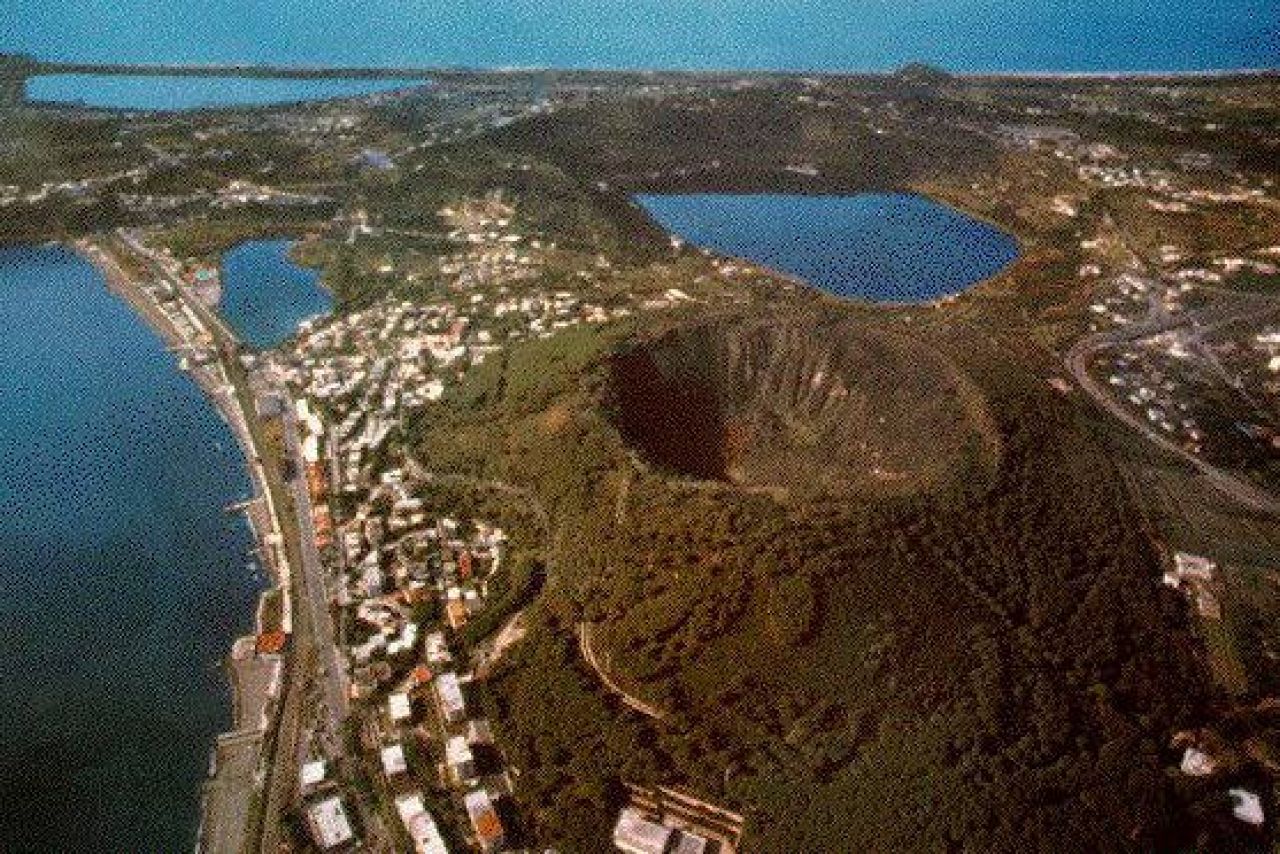
Monte Nuovo (year 1538). Click for larger version.
Rumored to have caused the extinction of the Neanderthals, the nearly 5-mile wide Campi Flegrei super-volcano sits on the Italian coast. Researchers are concerned that it is approaching a critical pressure point that could lead to an eruption. There are close to 500,000 people living around it.
When you picture a volcano, you picture smoke and lava erupting from its peak. But super-volcanoes are quite different. Imagine Yellowstone National Park. Super-volcanoes are formed when a volcano ejects so much magma from its center that it actually collapses on itself, leaving behind extensive fields of volcanic activity, a vast crater, as well as numerous geysers, hydrothermal activity, and sulphuric acid.
The Campi Flegrei super-volcano is made up of 24 craters and large volcanic edifices, many of which are submerged beneath the Mediterranean Sea. It formed 39,000 years ago, as part of the largest eruption Europe has experienced in the last 200,000 years.
Since its formation, Campi Flegrei has experienced 2 major eruptions – 35,000 years ago, and 12,000 years ago. A smaller eruption occurred in 1538. That “smaller” eruption, however, lasted for 8 days and spewed so much material into the surrounding area, it formed a new mountain, Monte Nuovo.
You get the point – even a “small” eruption is a huge event, so a major eruption could be catastrophic.
The eruption that occurred 200,000 years ago is believed to have triggered a “volcanic winter” that wiped out the Neanderthals. That’s pure speculation, but scientists say the eruption spewed some 1 trillion gallons of molten rock onto the surface and just as much sulphur into the atmosphere.
Source: CNN
The Critical Pressure Point
A team of researchers from the Italian National Institute for Geophysics and Volcanology are watching Campi Flegrei very closely because the super-volcano appears to be approaching a critical pressure point that could trigger a 3rd major eruption.
“This critical pressure point – referred to as critical degassing pressure (CDP) – could drive volcanic unrest towards a critical state, the team reports, by releasing jets of super-hot gas into the atmosphere, heating the surrounding hydrothermal fluids and rocks, and causing rock failure and possibly an eruption.”
Volcanologist Giovanni Chiodini says:
“Hydrothermal rocks, if heated, can ultimately lose their mechanical resistance, causing an acceleration towards critical conditions.”
Campi Flegrei has been experiencing an “uplift” for the past decade, which suggests that the volatile gases beneath it are rising to the surface at an accelerating rate. This has prompted Italian authorities to raise the super-volcano’s alert level from green (“quiet”) to yellow (“requires scientific monitoring.”)
Uplift has signaled volcanic eruptions in the past, most notably with Rabaul in Papua New Guinea and Sierra Negra in the Galapagos.
No one is telling local residents to run for their lives just yet, because it is impossible to predict what, if anything, Campi Negrei might do. Chiodini says:
“We have many uncertainties and long-term previsions are at the moment not possible! For example, the process that we describe could evolve in both directions: toward pre-eruptive conditions or to the finish of the volcanic unrest.”
Chiodini and his team hope that their latest observations will spur other researchers to monitor Campi Flegrei in the coming years, so people have some idea of just how catastrophic another major eruption could be.
Problems in Peru
Two volcanoes in Peru have roared to life, leading to widespread fear and mass evacuations. [2]
On December 26, at 8:24 a.m., the Sabancaya volcano, which sits just 40 miles from Peru’s second most populous city, Arequipa, began spitting smoke and ash some 11,500 feet into the air just over a week after it became active.
Local authorities have warned the local inhabitants that they are likely to be affected by the ash from the 20,000-foot volcano, whose name translates to “tongue of fire” in the local dialect of Quechua.
Sabancaya had been dormant for 200 years until it began erupting in the 1980’s.
Just 60 miles away, the Ubinas volcano is also in the midst of spewing smoke and ash 2 miles into the atmosphere. It is Peru’s most active volcano, and was last active in April 2014. Ubinas had been dormant for about 40 years before rumbling back to life in 2006.
Authorities began evacuating the surrounding area earlier this week.
Peruvian Geophysical Institute (IGP) investigator Orlando Macedo said:
“All this activity is part of an expected process. Before the eruption, tremors were occurring closer and closer to the volcano and the crater. However, the process is taking longer than that which we saw at the Ubinas Volcano, when everything happened in a matter of days. In the case of Sabancaya, this could go on for several months.”
Other Areas of Concern
There was a lot of moving and shaking in December 2016.
Mount St. Helens in Washington State experienced an earthquake “swarm” of some 120 shallow temblors over the course of several days. It is considered active, but an eruption could be years away. [3]
Source: Oregon Live – Mount St. Helens
On the Kamchatka Peninsula in the Russian Far East, the Shiveluch volcano blew its top, destroying the small lava dome/plug in its crater and generating a 36,000-foot ash plume. Fortunately, the ash drifted to an uninhabited area, but an orange aviation alert was issued to warn airlines of the ash plume.
In Costa Rica, antennas on Irazu will have to be moved because of cracking on the volcano. It is unknown whether the cracking is related to any potential changes in the Irazu volcano, or if the surface blocks are just faulting.
The infamous Hawaiian volcano Kilauea experienced a small explosion, sending huge chunks of debris flying, including old wall rock and lava from the lava lake. This is a fairly common occurrence.
Lastly, scientists have noticed an increase in seismicity at Cayambe in Ecuador. An earthquake swarm that occurred there over several days in December indicate that Cayambe, like Mount St. Helens, is recharging, but no eruption appears to be imminent.
Julie Fidler is a freelance writer, legal blogger, and the author of Adventures in Holy Matrimony: For Better or the Absolute Worst. She lives in Pennsylvania with her husband and two ridiculously spoiled cats. She occasionally pontificates on her blog.