Via Duane of FreeMarketShooter.com,
It is pretty accepted knowledge that a number of lower-skilled jobs will disappear in the coming 5-10 years, due to the human element being replaced by autonomous machines.

One of the most at-risk professions is that of Truck Driver, which as 13D Research points out, is one of the no.1 reasons you rarely (if ever) hear President Trump discuss automation in the workplace:
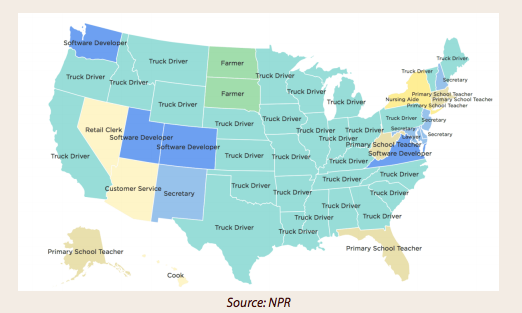
A widely circulated NPR graphic shows “truck driver” was the most common job in more than half of the U.S. states in 2014?—?in part because how the Bureau of Labor Statistics sorts common jobs, such as educators, into small groups. Indeed, truck driving is one of the last jobs standing that affords good pay (median salary for tractor-trailer drivers, $40,206) and does not require a college degree. According to the American Trucking Association, there are 3.5 million professional truck drivers in the U.S. Entire businesses (think restaurants and motels) and hundreds of small communities, supporting an additional 5.2 million people, have been built around serving truckers crisscrossing the nation. That’s 8.7 million trucking-related jobs. It also represents one of Trump’s most important voting blocs?—?working-class men.
And while it may be further out on the timeline, if you think your job requires a higher, special element of skill and mental acuity that just cannot be automated, you are probably very mistaken. In fact, there are few (if any) jobs in which a machine would be inferior to a person. And this is not as far out in the future as you may think.
Just imagine, how Truck Drivers would have reacted if ten years ago, you told them that they would be at risk of being replaced by a machine? And this isn’t some far-off vision of the future… it is happening now:
But like many of the blue-collar jobs the President promised to save during his campaign, the future of these 3.5 million trucking jobs is less than certain. Fully automated trucks could put half of America’s truckers out of a job within a decade, The Los Angeles Times reported last year. This isn’t an imagined future. It’s already happening. Otto, an automated trucking company acquired by Uber, made a delivery of beer last year and has been approved to travel two routes in Ohio.
Last year, Noel Perry, an analyst at industry research firm FTR Transportation Intelligence, told The International Business Times: “Despite a shortage in high-quality drivers, pay hasn’t gone up in five years. Trucks are easier to drive.” So-called “soft-automation” features, like automatic braking and lane assist, mean the trucks can already be driven by less experienced operators commanding smaller salaries. Even ahead of automation, the profession is losing traction. Perry’s final remark to IBT strikes to the heart of the matter?—?“The free market produces jobs, the government doesn’t.”

Now imagine, telling lower level lawyers, doctors, programmers, accountants, etc, that their jobs are at risk now. While many people would scoff at the notion, they are likely the same people who scoffed at the notion of trucks being automated ten years ago. Denis Sproten explained a lot of the history and future of automation of labor recently:
A short introduction, first there were the luddites, destroying machinery, which automated mundane tasks. People tell us, we should be happy that we don’t need to do these anymore. This is all history, from which we moved on:
- Working the fields / weaving: Let’s assume that required a machine with IQ 80 or MIQ of 80, production increased and more products were sold on markets, consumption increased, transportation was needed and distribution of goods into shops. More roads were needed etc, we found a replacement occupation in the next layer.
- Working as a driver / service industry : assume it requires a machine of IQ 100-110, more complex tasks, product knowledge, navigation, forms to be filled, start of knowledge industry. These jobs are being replaced now as we get automated trucks, drones delivering, online shops replacing shops on the street.
- Working in an office Knowledge Industry : assume it requires an IQ of 100-120, even more complex tasks, which involve creation of new products, design, programming, lawyers, accountants, doctors etc. We are not there yet, but we soon will have AI which can do basic tasks of doctors, writing news articles, design thinking, algorithms which categorise knowledge and lets you search it.
People are being pushed to become Data Scientists, AI programmers, math geniuses writing algorithms, all jobs which likely require an IQ of 130+. Programs can now write music and are starting to be creative.
The trend I see is that, yes we will be able to find new jobs, but they will require really highly intelligent people, which covers only a small percentage of the population, no matter how much education they have received. Maybe becoming cyborgs will be the answer, if we believe Elon Musk.

More “intelligent” machines below the scale of a true “A.I.” means a growing number of jobs will be “outsourced” to machines, and they will never be coming back. Even now, you likely find yourself with less reason to visit the doctor, because you can just go on WebMD and see if there is a simple solution to what ails you. Imagine that function being extrapolated across a series of machines at the basic level of medicine, to serve your needs for more common medical questions/issues. Wouldn’t that eliminate the need for a significant number of medical professionals?
Medicine is just one example, because truly nothing is off limits. “Humans Need Not Apply” explained this masterfully over two years ago – if you think your job is “safe” because “a machine could never do it,” you better think again.
(Note: This video is 15 minutes long, and while I’m hesitant to post lengthy videos, since the attention span of viewers for short clips drops significantly after one minute, you may reconsider your job security after seeing this one.)
All of this is a precursor to a topic I plan on discussing in the future – not if, but when, a machine is created that is as capable (or more likely, far superior to and more capable than) as a human being. What will that machine look like and be capable of? How will it view and process the existence of humans, and/or threat human beings pose to its own existence? It is something you have seen in many sci-fi movies, and discussed by many billionaire business moguls and scientists. Still, there are many aspects of A.I. that have not been touched on by the ongoing discussion, mostly related to how a machine would react, knowing that it is superior to its human creators.
In the meantime, while the machines created today and in the near future might not be more capable than their human creators, they are going to become exceedingly efficient at the jobs they are built to do. And one of those jobs a machine might replace, is yours. Whether this is something that a politician is willing to discuss or not, you should think long and hard about what it will take for a machine to replace you in the workplace, and what you will do with your life if that happens to you while you’re still in your working years.