Showing posts with label Babson College. Show all posts

Saturday, May 13, 2017

A "Mysterious Antenna" Emerges In An Empty Chicago Field; Billions Depend On It

Readers are familiar with the various microwave and laser arrays located at the real New York Stock Exchange in Mahwah, New Jersey, both of which we have written about in the past.


Microwave tower located next to the NYSE in Mahwah, NJ.


This article, however, is not about the familiar antennas off Route 17 in New Jersey. Instead, demonstrating to what lengths the high frequency traders will go for just a few millisecond advantage - which makes in the HFT world makes all the different between billions in profits and losses - Bloomberg reports that a mysterious antenna has emerged in an empty field in Aurora, near Chicago, and a trading fortune depends on it.


Strange? Of course: as BBG"s Brian Louis admits "it was an odd transaction from the outset: $14 million, double the going rate, for a 31-acre plot of flat, undeveloped land just west of Chicago. In the nine months since, the curious use of the space has only added to the intrigue. A single, nondescript pole with two antennas was erected by a row of shrubs. Some supporting equipment was rolled in. That’s it."


As it turns out, those antennas - as readers may imagine - were anything but ordinary. Same goes for the buyer of the property: anything but your typical land investor, although the name will be all too familiar to those who have followed our reporting on HFT over the years: it was Jump Trading LLC, "a legendary and secretive trading firm that’s a major player in some of the most important financial markets."


Equipment on land purchased by an affiliate of Jump Trading


Jump Trading affiliate World Class Wireless purchased the 31-acre lot for $14 million, according to county records. “They paid probably twice as much as it’s worth,” said David Friedlandof Cushman & Wakefield. “I don’t see anyone else paying close to that price.”


There was a reason why Jump overpaid so much: it was an investment into guaranteed future returns.


Because ultimately the purchase was all about the location: just across the street lies the data center for CME Group, the world’s biggest futures exchange. By placing its antennas so close to CME’s servers, Jump hopes to shave maybe a microsecond off its reaction time, enough to separate a winning from a losing bid in trading that takes place at almost the speed of light. Enough to make billions in profits if done successfully millions of times every minute for year.


As Bloomberg describes the land grab, "it was the latest, and perhaps boldest, salvo in an escalating war that’s being waged to stay competitive in the high-speed trading business."


The war is one of proximity -- to see who can get data in and out of CME the quickest. A company called McKay Brothers LLC recently won approval to build the tallest microwave tower in the area while another, Webline Holdings LLC, has installed microwave dishes on a utility pole just outside the data center.


“It tells you how valuable being just a little bit faster is,” said Michael Goldstein, a finance professor at Babson College in Babson Park, Massachusetts. “People say seconds matter. This is microseconds matter.”


It also tells you something else: at its core, modern trading is simply about being faster than your competition: no thinking goes into the trade, only reaction times matter. That, and frontrunning your competition. Some more details about this literal land grab:


In October 2015, McKay Brothers, a company that sells access to its microwave network to high-speed traders, leased land diagonal to the CME data center, under the name Pierce Broadband LLC, according to DuPage County property records.


Last month, the county gave McKay approval to erect a 350-foot high microwave tower that could be 600 feet closer to the data center than its current location, records show. Two trading firms, IMC BV and Tower Research Capital LLC, own minority stakes in McKay. Co-founder Stephane Tyc said his firm may never build the tower but it would be part of the firm’s continual efforts to speed transmission time.


Then there’s Webline Holdings. In November 2015, it was granted a license to operate microwave equipment on a utility pole just outside the data center, according to Federal Communications Commission records. Webline has licenses for a microwave network stretching from Aurora to Carteret, New Jersey, where Nasdaq Inc.’s data center is located. Messages left for Webline were not returned.


Back to the mysterious antenna: according to Bloomberg, the license for the transmission dishes is held by a joint venture between World Class and a unit of KCG Holdings, another HFT trading firm that was recently acquired by Virtu Financial. In other words, the "who is who" of HFT has been unleashed on an empty field near Chicago, and to the builder will go the spoils.


It could be billions in revenues.


* * *


After all this frentic building of microwave tower, who is closest to the CME servers? It is unclear. Trading data first leaves CME computers via fiber cable, and then to nearby antennas that send it by microwave to other towers until it reaches New Jersey, where all the major U.S. stock exchanges house their computers. The moves in Aurora are intended to reduce the time that the data is conveyed through cable; the practical impact is shaving off a millisecond or maybe even a few nanoseconds.


At its core, the race is about latency arbitrage, and not being the slowest firm on the block - a recipe for financial ruin. Sending data back and forth between the U.S. Midwest and East Coast allows high-frequency traders to profit from price differences for related assets, including S&P 500 Index futures in Illinois and stock prices in New Jersey. Those arbitrage opportunities often last only tiny fractions of a second.


Ironically, all the land grab and overpriced land purchases could be made obsolete with one simple decision: a microwave tower could be installed on the roof of the CME data center to eliminate the need for jockeying around the site, the same way the NYSE has a microwave tower next to its NJ headquarters. The exchange is indeed looking at allowing roof access, along with CyrusOne, the company that bought the data center last year, CME said in a statement. Traders being traders, however, they may continue to battle, this time for the most advantageous position on the microwave tower itself.


“We are confident the CME can provide an alternate and better solution which offers a level playing field to all participants," said McKay’s Tyc.


Which is ironic because at its core, modern High Frequency Trade is about everything but a level playing field: after all there are millions of traders to be frontrun, take that away, and the HFT parasites of the world have no advantage whatsoever.

Saturday, February 18, 2017

Why President Trump Does Not Tweet About Automation

Via 13D Research (13D.com),


"Fully automated trucks could put half of America’s truckers out of a job within a decade..."


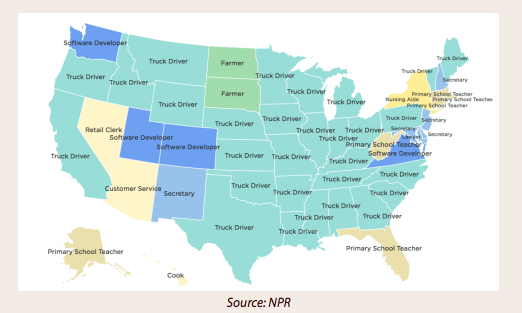
A widely circulated NPR graphic shows “truck driver” was the most common job in more than half of the U.S. states in 2014?—?in part because how the Bureau of Labor Statistics sorts common jobs, such as educators, into small groups. Indeed, truck driving is one of the last jobs standing that affords good pay (median salary for tractor-trailer drivers, $40,206) and does not require a college degree. According to the American Trucking Association, there are 3.5 million professional truck drivers in the U.S. Entire businesses (think restaurants and motels) and hundreds of small communities, supporting an additional 5.2 million people, have been built around serving truckers crisscrossing the nation. That’s 8.7 million trucking-related jobs. It also represents one of Trump’s most important voting blocs?—?working-class men.


But like many of the blue-collar jobs the President promised to save during his campaign, the future of these 3.5 million trucking jobs is less than certain. Fully automated trucks could put half of America’s truckers out of a job within a decade, The Los Angeles Times reported last year. This isn’t an imagined future. It’s already happening. Otto, an automated trucking company acquired by Uber, made a delivery of beer last year and has been approved to travel two routes in Ohio.


Last year, Noel Perry, an analyst at industry research firm FTR Transportation Intelligence, told The International Business Times: “Despite a shortage in high-quality drivers, pay hasn’t gone up in five years. Trucks are easier to drive.” So-called “soft-automation” features, like automatic braking and lane assist, mean the trucks can already be driven by less experienced operators commanding smaller salaries. Even ahead of automation, the profession is losing traction. Perry’s final remark to IBT strikes to the heart of the matter?—?“The free market produces jobs, the government doesn’t.”


Drivers reportedly account for about one third of the cost in the trucking industry. Ostensibly, there isn’t much a president?—?even one as untraditional as Trump?—?can do to stop a company from making more money. Or is there? Which begs the question: How will automation, employment, productivity and Trump co-exist?


A few days after Trump “saved” 750 jobs at Carrier, Greg Hayes, CEO of Carrier’s parent firm, United Technologies, admitted that automation would eventually win out. During a CNBC interview with Jim Cramer, Hayes revealed: “We’re going to make a $16 million investment in the factory in Indianapolis to automate to drive down costs so that we can continue to be competitive. . .But what that ultimately means is there will be fewer jobs.


Thomas H. Davenport, professor in management and information technology at Babson College, opined recently for The Harvard Business Review:


“Trump knows virtually nothing about technology?—?other than a smartphone, he doesn’t use it much. And the industries he’s worked in?—?construction, real estate, hotels, and resorts?—?are among the least sophisticated in their use of information technology. So he’s not well equipped to understand the dynamics of automation-driven job loss.


“. . .The Art of the Deal’s author clearly has a penchant for sparring with opponents in highly visible negotiations. But automation-related job loss is difficult to negotiate about. It’s the silent killer of human labor, eliminating job after job over a period of time. Jobs often disappear through attrition. There are no visible plant closings to respond to, no press releases by foreign rivals to counter. It’s a complex subject that doesn’t lend itself to TV sound bites or tweets.


To be fair, it’s not just Trump who finds this a difficult enemy to battle; other politicians don’t engage with that much either. And there are several good reasons. . . One is that automation usually comes with corporate investment rather than cutbacks. Note that United Technologies announced a $16 million investment in the Indiana Carrier plant. Who wants to criticize that?”


As we have written, Trump’s number one priority is to get re-elected. To do so, he will have to keep the 8.7 million men and women in the trucking sector employed. At the same time, he has pledged to encourage foreign investment in the U.S. and to attract U.S. companies back to American soil, all with an eye to creating more jobs for Americans. To remain competitive, these companies will have to improve productivity, and the shortest path to increased productivity, is automation. But, even with vigorous training, the vast majority of America’s working middle-class, like the 3.5 million truckers who voted largely for Trump, cannot transition easily into the types of job created by automation?—?engineering, integration, IT.


Therein lies the dilemma facing America, and much of the developed and the developing world. The economy needs more productivity growth, not less. But it also needs to create jobs. Any politician who wants to appeal to the business community will be reluctant to provoke a war against automation. But, he cannot afford to see his key voter bloc displaced.


All of which begs the question: How can Trump insulate the status quo from the disruptive forces of automation and technology? Will he tweet to the perception or the underlying reality?

Monday, February 13, 2017

Goldman Had 600 Cash Equity Traders In 2000; It Now Has 2

For the dramatic impact of technology, and specifically trade automation from algo, quant and robotic trading  on today"s capital markets, look no further than Goldman"s cash equities trading floor at the firm"s headquarters which, according to the MIT Tech Review, employed 600 traders its height back in 2000, buying and selling stocks for Goldman"s institutional client clients. Today there are just two equity traders left.


Complex trading algorithms, some with machine-learning capabilities, first replaced trades where the price of what’s being sold was easy to determine on the market, including the stocks traded by Goldman’s old 600.


Call it the rise of the machines which we warned about over 8 years ago back in 2009, just after the peak of the financial crisis, which have led to the extinction of the cash equity trader job.


"Automated trading programs have taken over the rest of the work, supported by 200 computer engineers. Marty Chavez, the company’s deputy chief financial officer and former chief information officer, explained all this to attendees at a symposium on computing’s impact on economic activity held by Harvard’s Institute for Applied Computational Science last month."


It"s not just cash trading: according to Goldman"s next CFO, Marty Chavez, areas of trading like currencies and even parts of business lines like investment banking are moving in the same automated direction that equities have already traveled. As Tech Review adds, today, nearly 45 percent of trading is done electronically, according to Coalition, a U.K. firm that tracks the industry. In addition to back-office clerical workers, on Wall Street machines are replacing a lot of highly paid people, too.


Ironically, the age of trading automation, means that the big banks, like the rest of the economy, are increasingly seeing the same income spreads that mirror the broader economy.


Average compensation for staff in sales, trading, and research at the 12 largest global investment banks, of which Goldman is one, is $500,000 in salary and bonus, according to Coalition. Seventy-five percent of Wall Street compensation goes to these highly paid “front end” employees, says Amrit Shahani, head of research at Coalition.


According to Goldman"s most recent quarterly report, after sliding for the past few years, average banker comp rebounded to the highest in one year, reaching $338,576, still well below the levels attained in recent years.


As the MIT publication adds, for the highly paid who remain, there is a growing income spread that mirrors the broader economy, says Babson College professor Tom Davenport. “The pay of the average managing director at Goldman will probably get even bigger, as there are fewer lower-level people to share the profits with,” he says.


With time, even more highly paid jobs will be lost to automation:


Complex trading algorithms, some with machine-learning capabilities, first replaced trades where the price of what’s being sold was easy to determine on the market, including the stocks traded by Goldman’s old 600.


Now areas of trading like currencies and futures, which are not traded on a stock exchange like the New York Stock Exchange but rather have prices that fluctuate, are coming in for more automation as well. To execute these trades, algorithms are being designed to emulate as closely as possible what a human trader would do, explains Coalition’s Shahani.


After equities, the next distressed group appear to be FX traders, which is hardly surprising after the recent scandals rocking the cash and spot trading FX community, resulting in billions of settlements payments over rigged fixes and markets. Here, Goldman has already begun to automate currency trading, and has found consistently that four traders can be replaced by one computer engineer, Chavez said at the Harvard conference.


Stunningly, some 9,000 people, about one-third of Goldman’s staff, are computer engineers, Chavez said at the symposium.


And, after equity and FX traders, it will be the backbone of Wall Street: investment bankers themselves: "Next, Chavez said, will be the automation of investment banking tasks, work that traditionally has been focused on human skills like salesmanship and building relationships. Though those “rainmakers” won’t be replaced entirely, Goldman has already mapped 146 distinct steps taken in any initial public offering of stock, and many are “begging to be automated,” he said."


Needless to say, this is great news for Goldman, which says that reducing the number of investment bankers would be a great cost savings for the firm. Investment bankers working on corporate mergers and acquisitions at large banks like Goldman make on average $700,000 a year, according to Coalition, with most MDs and partners earning orders of magnitude more.


Chavez himself is an example of the rising role of technology at Goldman Sachs. It’s his expertise in risk that makes him suited to the task of CFO, a role more typically held by accountants, Chavez told analysts on a recent Goldman Sachs earnings call. “Everything we do is underpinned by math and a lot of software,” he told the Harvard audience in January.


Finally, for the most glaring example of how technology impact new Goldman product lines, consider that Goldman’s new consumer lending platform, Marcus, aimed at consolidation of credit card balances, is entirely run by software, with no human intervention, according to the CFO. It was nurtured like a small startup within the firm and launched in just 12 months, he said. It’s a model Goldman is continuing, housing groups in “bubbles,” some on the now-empty trading spaces in Goldman’s New York headquarters:


“Those 600 traders, there is a lot of space where they used to sit,” he said.


Of course, regular readers are well aware of the extinction of the carbon-based trader, seen nowhere better than on the trading floor of the legendary UBS trading floor, once upon a time the world"s biggest.


Before:


 And 8 year after, when all that"s left of the UBS trading floor, and the legacy of that version of Wall Street, is this.