Showing posts with label Michael Maharrey. Show all posts

Thursday, March 22, 2018

Arizona Law Takes Another Step to Support Sound Money

By Michael Maharrey


Last week, Arizona Gov. Doug Ducey signed a bill into law that takes another step toward establishing gold and silver as money. The new law supplements Federal Reserve notes with honest money that has stable, constitutionally protected value.


Rep. Mark Finchem (R-Tucson) introduced House Bill 2013 (HB2013) on Jan. 9. The new law recognizes silver and gold as liquid capital for trust companies.


Practically speaking, the bill does two things.


  1. Modifies the definition of “liquid capital” to include legal tender for trust company certification. (Sec. 1)

  2. Defines legal tender as a medium of exchange, including specie, that is authorized by the U.S. Constitution or Congress for the payments of debts, public charges, taxes and dues. (Sec. 1) Specie is defined as coins having precious metal content.


Trust businesses act as “fiduciaries.” A fiduciary is a person who holds a legal or ethical relationship of trust. Typically, a fiduciary handles money or other assets for another party. A trust company in Arizona must maintain $500,000 of liquid capital reserves in order to operate. The bill would allow trust companies to count gold and silver specie as part of their liquid capital.


Under the current law, liquid capital is defined as capital in the form of certificates of deposit issued by banks, savings banks or savings and loan associations that do business in Arizona. These certificates of deposit are insured by the FDIC. HB2013 expands the definition to include gold and silver. Finchem explained the impact of the bill.


This would fortify the capital asset reserve of trust companies in Arizona. Since the FDIC only insures up to $250,000 of personal deposits in an FDIC insured bank, and they can take up to 99 years to pay a claim under federal law, this move permits investors in trust companies to place hard assets on deposit as ready, liquid capital reserve without converting the real money to fiat currency and then digital currency as in a deposit in the ACH system.


From a broader perspective, the passage of HB2013 recognizes hard money as a legitimate risk reducer. It also expands the role of gold and silver as money in Arizona, and further undermine the Federal Reserve’s monopoly on money.


Last month, the House passed HB2013 by a 33-24 vote. On March 14, the Senate approved the measure 17-13. Gov. Ducey signed the bill into law Friday. It will go into effect 90 days after the legislature adjourns sine die.


Tuesday, March 13, 2018

Alabama Law will Help Encourage the Use of Gold and Silver as Money

By Michael Maharrey


Last week, Alabama Gov. Kay Ivey signed a bill into law exempting the sale of gold and silver bullion from state sales and use tax, encouraging its use and taking the first step toward breaking the Federal Reserve’s monopoly on money.


Sen. Tim Melson (R-Florence) introduced Senate Bill 156 (SB156) on Jan. 11. The new law exempts the gross proceeds from the sale of gold, silver, platinum, and palladium bullion in the form of bars, ingots or coins from sales and use tax in the state for five years after the date of enactment.


The House passed SB156 by a 100-0 vote. The Senate approved the measure by a 26-0 vote.


Imagine if you asked a grocery clerk to break a $5 bill and he charged you a 35 cent tax. Silly, right? After all, you were only exchanging one form of money for another. But that’s essentially what Alabama’s sales tax on gold and silver bullion did. By removing the sales tax on the exchange of gold and silver, Alabama will treat specie as money instead of a commodity. This represents a small step toward reestablishing gold and silver as legal tender and breaking down the Fed’s monopoly on money.


We ought not to tax money – and that’s a good idea. It makes no sense to tax money,” former U.S. Rep. Ron Paul said during testimony in support an Arizona bill that repealed capital gains taxes on gold and silver in that state. “Paper is not money, it’s fraud,” he continued.


The law’s impact will go beyond mere tax policy. During an event after his Senate committee testimony, Paul pointed out that it’s really about the size and scope of government.


If you’re for less government, you want sound money. The people who want big government, they don’t want sound money. They want to deceive you and commit fraud. They want to print the money. They want a monopoly. They want to get you conditioned, as our schools have conditioned us, to the point where deficits don’t matter.


Practically speaking, eliminating taxes on the sale of gold and silver will crack open the door for people to begin using specie in regular business transactions.This will mark an important small step toward currency competition. If sound money gains a foothold in the marketplace against Federal Reserve notes, the people will be able to choose the time-tested stability of gold and silver over the central bank’s rapidly-depreciating paper currency.


There are already signs of the tax repeals impact. According to Coin Week, the state can now host major coin shows.


“We have discussed the possibility of hosting a show in Alabama, however, we have been reluctant because of the sales-tax obstacle,” President of Whitman Publishing president Mary Burton said. “The new law allows us to once again give serious consideration to hosting a successful show in Alabama.”


BACKGROUND INFORMATION


The United States Constitution states in Article I, Section 10, “No State shall…make any Thing but gold and silver Coin a Tender in Payment of Debts.” States have simply ignored this constitutional provision for years. It’s impossible for a state to return to a constitutional sound money system when it taxes gold and silver as a commodity.


This Alabama tax repeal takes a small step toward that constitutional requirement, ignored for decades in every state. Such a tactic would set the stage to undermine the monopoly of the Federal Reserve by introducing competition into the monetary system.


Constitutional tender expert Professor William Greene said when people in multiple states actually start using gold and silver instead of Federal Reserve Notes, it would effectively nullify the Federal Reserve and end the federal government’s monopoly on money.


“Over time, as residents of the state use both Federal Reserve notes and silver and gold coins, the fact that the coins hold their value more than Federal Reserve notes do will lead to a “reverse Gresham’s Law” effect, where good money (gold and silver coins) will drive out bad money (Federal Reserve notes). As this happens, a cascade of events can begin to occur, including the flow of real wealth toward the state’s treasury, an influx of banking business from outside of the state – as people in other states carry out their desire to bank with sound money – and an eventual outcry against the use of Federal Reserve notes for any transactions.”


Once things get to that point, Federal Reserve notes would become largely unwanted and irrelevant for ordinary people. Nullifying the Fed on a state by state level is what will get us there.


WHAT’S NEXT


The law will go into effect June 1, 2018.


Michael Maharrey [send him email] is the Communications Director for the Tenth Amendment Center, where this article first appeared. He proudly resides in the original home of the Principles of ’98 – Kentucky. See his blog archive here and his article archive here. He is the author of the book, Our Last Hope: Rediscovering the Lost Path to Liberty. You can visit his personal website at MichaelMaharrey.com and like him on Facebook HERE

Friday, February 9, 2018

Alabama Senate Unanimously Passes Bill to Help Encourage Use of Gold and Silver as Money

By Michael Maharrey


Earlier today, the Alabama Senate unanimously passed a bill that would exempt the sale of gold and silver bullion from state sales and use tax, encouraging its use and taking the first step toward breaking the Federal Reserve’s monopoly on money.


Sen. Tim Melson (R-Florence) introduced Senate Bill 156 (SB156) on Jan. 11. The legislation would exempt the gross proceeds from the sale of gold, silver, platinum, and palladium bullion in the form of bars, ingots or coins from sales and use tax in the state for five years after the date of enactment.


The Senate passed SB156 by a 26-0 vote.


similar bill is moving through the Alabama House.


Imagine if you asked a grocery clerk to break a $5 bill and he charged you a 35 cent tax. Silly, right? After all, you were only exchanging one form of money for another. But that’s essentially what Alabama’s sales tax on gold and silver bullion does. By removing the sales tax on the exchange of gold and silver, Alabama would treat specie as money instead of a commodity. This represents a small step toward reestablishing gold and silver as legal tender and breaking down the Fed’s monopoly on money.


We ought not to tax money – and that’s a good idea. It makes no sense to tax money,” former U.S. Rep. Ron Paul said during testimony in support an Arizona bill that repealed capital gains taxes on gold and silver in that state. “Paper is not money, it’s fraud,” he continued.


The proposed law’s impact would go beyond mere tax policy. During an event after his Senate committee testimony, Paul pointed out that it’s really about the size and scope of government.


If you’re for less government, you want sound money. The people who want big government, they don’t want sound money. They want to deceive you and commit fraud. They want to print the money. They want a monopoly. They want to get you conditioned, as our schools have conditioned us, to the point where deficits don’t matter.


Practically speaking, eliminating taxes on the sale of gold and silver would crack open the door for people to begin using specie in regular business transactions.This would mark an important small step toward currency competition. If sound money gains a foothold in the marketplace against Federal Reserve notes, the people would be able to choose the time-tested stability of gold and silver over the central bank’s rapidly-depreciating paper currency.


BACKGROUND INFORMATION


The United States Constitution states in Article I, Section 10, “No State shall…make any Thing but gold and silver Coin a Tender in Payment of Debts.” States have simply ignored this constitutional provision for years. It’s impossible for a state to return to a constitutional sound money system when it taxes gold and silver as a commodity.


This Alabama bill takes a step towards that constitutional requirement, ignored for decades in every state. Such a tactic would set the stage to undermine the monopoly of the Federal Reserve by introducing competition into the monetary system.


Constitutional tender expert Professor William Greene said when people in multiple states actually start using gold and silver instead of Federal Reserve Notes, it would effectively nullify the Federal Reserve and end the federal government’s monopoly on money.


Over time, as residents of the state use both Federal Reserve notes and silver and gold coins, the fact that the coins hold their value more than Federal Reserve notes do will lead to a “reverse Gresham’s Law” effect, where good money (gold and silver coins) will drive out bad money (Federal Reserve notes). As this happens, a cascade of events can begin to occur, including the flow of real wealth toward the state’s treasury, an influx of banking business from outside of the state – as people in other states carry out their desire to bank with sound money – and an eventual outcry against the use of Federal Reserve notes for any transactions.


Once things get to that point, Federal Reserve notes would become largely unwanted and irrelevant for ordinary people. Nullifying the Fed on a state by state level is what will get us there.


WHAT’S NEXT


SB156 will move to the House for further consideration.


Michael Maharrey [send him email] is the Communications Director for the Tenth Amendment Center, where this article first appeared. He proudly resides in the original home of the Principles of ’98 – Kentucky. See his blog archive here and his article archive here. He is the author of the book, Our Last Hope: Rediscovering the Lost Path to Liberty. You can visit his personal website at MichaelMaharrey.com and like him on Facebook HERE

Saturday, January 27, 2018

Indiana Committee Passes Bill to Clear Way for Commercial Hemp Market Despite Federal Prohibition

By Michael Maharrey


A Indiana House committee unanimously passed a bill that would expand the state’s hemp law to prohibit state prosecution of people who sell or possess industrial hemp and industrial hemp products. Passage of this legislation would open the door for a commercial hemp market in the state, setting the foundation to nullify federal prohibition in practice.


Rep. Jim Lucas (R-Seymour) and Rep. Sean Eberhart (R-Shelbyville) introduced House Bill 1137 (HB1137) on Jan. 9. The legislation would clarify the existing hemp law in Indiana to prevent state prosecution of people selling hemp or hemp products.


Except as provided in subsection (a), a person may process, manufacture, possess, transport, sell, distribute, buy, or otherwise use industrial hemp or industrial hemp products if the industrial hemp was planted, grown, cultivated, harvested, and processed by persons licensed under this chapter or by persons in another jurisdiction according to the laws of that jurisdiction. A person who engages in an activity under this subsection is not subject to a civil or criminal action or penalty under state law.


Committee on Agriculture and Rural Development passed HB1137 12-0 with some technical amendments.


Practically speaking, final passage of HB1137 would end state prosecution of individuals or businesses selling CBD oil and other hemp products. Last year, an Indiana TV station reported on raids conducted by state excise police and the Indiana Alcohol and Tobacco Commission. According to WTHR, excise officers confiscated CBD oil products from dozens of stores across Indiana, citing the businesses with violating state law for possessing marijuana.


CBD oil has proven effective in treating a number of medical conditions, including seizures, pain and anxiety.


Provisions in HB1137, along with changes in the definition of hemp in the bill would open the door for legal CBD sales in the state, and would also protect sellers and buyers of other hemp products.


HB1137 would also remove the current requirement that the state seed commissioner must apply for necessary permissions, waivers, or other forms of legal status by the United States Drug Enforcement Agency or other federal agencies to implement the state industrial hemp law.


HB1137 would open the door for an expanded commercial hemp market in Indiana, despite federal prohibition.


FEDERAL FARM BILL


In 2014, Congress cracked the door open for hemp in the U.S. with an amendment to the 2014 Farm Bill. The law allows hemp cultivation for research purposes, but prohibits “commercial” production.


The “hemp amendment” in the 2014 farm bill  —


…allows State Agriculture Departments, colleges and universities to grow hemp, defined as the non-drug oil-seed and fiber varieties of Cannabis, for academic or agricultural research purposes, but it applies only to states where industrial hemp farming is already legal under state law.


In 2016, the U.S. Department of Agriculture and Drug Enforcement Agency released a “statement of principles” to guide interpretation of the hemp section in the Farm Bill. It states, “The growth and cultivation of industrial hemp may only take place in accordance with an agricultural pilot program to study the growth, cultivation, or marketing of industrial hemp established by a State department of agriculture or State agency responsible for agriculture in a State where the production of industrial hemp is otherwise legal under State law.”


In short, the current federal law authorizes farming of hemp – by research institutions, or within state pilot programs – for research only. Farming for commercial purposes by individuals and businesses remains prohibited.


The definition of “commercial” remains murky and has created significant confusion.


The statement of principles also asserted that industrial hemp programs are limited to fiber and seed. It didn’t mention the CBD oil or other edible hemp products.The DEA has interpreted that to mean they remain illegal. According to the DEA, CBD cannot be sold under any circumstances. WTHR interviewed DEA spokesman Rusty Payne.


“It’s not legal. It’s just not.”


Payne says cannabis plants are considered a Schedule I controlled substance, and medicinal oils derived from cannabis plants are illegal according to two federal laws: the Controlled Substance Act and the Food, Drug and Cosmetic Act. He said confusion surrounding the Agricultural Act of 2014 (better known as the “Farm Bill”) is frequently cited as legal justification by those who want to manufacture, sell or use CBD oil. The DEA believes the Farm Bill permits only CBD research — not CBD marketing and sales.


“Anybody who’s in violation [of the federal laws] always runs that risk of arrest and prosecution,” he said.


Passage of HB1137 would expand the market for CBD oil and other commercial hemp products. While prospective producers would still have to take federal law into consideration, by eliminating the possibility of state prosecution, the law would clear away a major obstacle to a widespread CBD sales, and more generally the development of a commercial hemp industry in Indiana.


Several other states with federally-compliant hemp programs, such as Kentucky, North Dakota, Minnesota and New York, have grown significant acreage under federally-approved research programs. This takes a first step, but with federal shackles in place, these states are not legally allowed to develop any kind of commercial market. Ironically, many of these “federally compliant” programs are not actually federally compliant.


Recognizing its limited research program was hindering the development of the industry, West Virginia dumped its federally compliant hemp program during the 2017 legislative session and will now issue federally non-compliant commercial licenses to growers. West Virginia Public Broadcasting confirmed limits imposed by the old program due to its conformity with federal law were holding back the development of a viable hemp industry and everyday farmers cannot benefit.


“But because of the strict requirements under the 2014 bill, growers are not able to sell their plants and cannot transport them across state lines to be turned into those usable products. That’s limited the ability to create a real hemp industry in the state.”


OTHER STATES


Other states, including Colorado, Oregon, Maine, California and Vermont have simply ignored federal prohibition and legalized industrial hemp production within their state borders.


Colorado was the first state with widespread commercial hemp production. Farmers began growing hemp in southeast Colorado back in 2013 and the industry is beginning to mature. The amount of acreage used to grow industrial hemp in the state doubled in 2016 to nearly 5,000 acres, and nearly doubled again in 2017.


The Oregon legislature initially legalized industrial hemp production in 2009. While it was technically legal to grow hemp in the state, farmers didn’t take advantage of the opportunity for nearly five years. When the Oregon Department of Agriculture finally put a licensing and regulatory program in place early in 2014, farmers began growing hemp. The initial regulatory structure placed significant limits on hemp farming and effectively locked small growers out of the market. In 2016, Gov. Kate Brown signed House Bill 4060 into law. It relaxed state laws regulating hemp already on the books and made the crop more like other agricultural products. Within months, the Oregon Department of Agriculture had already promulgated new rules under the reformed law. According to Oregon’s Cannabis Connection, the rules set the stage to creates a “massive” medical hemp market. The state produced 3,469 acres of hemp in 2017.


Both Colorado and Oregon demonstrate how loosening rules at the state level encourage the market and allow hemp a legitimate commercial hemp industry to develop.


HUGE MARKET FOR HEMP


According to a 2005 Congressional Research Service report, the U.S. is the only developed nation that hasn’t developed an industrial hemp crop for economic purposes.


Experts suggest that the U.S. market for hemp is around $600 million per year. They count as many as 25,000 uses for industrial hemp, including food, cosmetics, plastics and bio-fuel. The U.S. is currently the world’s #1 importer of hemp fiber for various products, with China and Canada acting as the top two exporters in the world.


During World War II, the United States military relied heavily on hemp products, which resulted in the famous campaign and government-produced film, Hemp for Victory!


WHAT’S NEXT


HB1137 will now move to the full House for a vote.

Michael Maharrey [send him email] is the Communications Director for the Tenth Amendment Center, where this article first appeared. He proudly resides in the original home of the Principles of ’98 – Kentucky.See his blog archive here and his article archive here.He is the author of the book, Our Last Hope: Rediscovering the Lost Path to Liberty. You can visit his personal website at MichaelMaharrey.com and like him on Facebook HERE

Thursday, January 25, 2018

Alabama Committee Passes Bill to Help Encourage Use of Gold and Silver as Money

By Michael Maharrey


An Alabama House committee has passed a bill that would exempt the sale of gold and silver bullion from state sales and use tax, encouraging its use and taking the first step toward breaking the Federal Reserve’s monopoly on money.


Rep. Ronald Johnson (R-Sylacauga) introduced House Bill 19 (HB19) earlier this month. The legislation would exempt the gross proceeds from the sale of gold, silver, platinum, and palladium bullion and coins from sales and use tax in the state. The tax repeal would sunset in five years unless renewed by the legislature.


Today, the House Ways and Means Education Committee passed HB19 with “favorable” recommendation.


Imagine if you asked a grocery clerk to break a $5 bill and he charged you a 35 cent tax. Silly, right? After all, you were only exchanging one form of money for another. But that’s essentially what Alabama’s sales tax on gold and silver bullion does. By removing the sales tax on the exchange of gold and silver, Alabama would treat specie as money instead of a commodity. This represents a small step toward reestablishing gold and silver as legal tender and breaking down the Fed’s monopoly on money.


Practically speaking, eliminating taxes on the sale of gold and silver would crack open the door for people to begin using specie in regular business transactions. This would mark an important small step toward currency competition. If sound money gains a foothold in the marketplace against Federal Reserve notes, the people would be able to choose the time-tested stability of gold and silver over the central bank’s rapidly-depreciating paper currency.


BACKGROUND INFORMATION


The United States Constitution states in Article I, Section 10, “No State shall…make any Thing but gold and silver Coin a Tender in Payment of Debts.” States have simply ignored this constitutional provision for years. It’s impossible for a state to return to a constitutional sound money system when it taxes gold and silver as a commodity.


This Alabama bill takes a step towards that constitutional requirement, ignored for decades in every state. Such a tactic would set the stage to undermine the monopoly of the Federal Reserve by introducing competition into the monetary system.


Constitutional tender expert Professor William Greene said when people in multiple states actually start using gold and silver instead of Federal Reserve Notes, it would effectively nullify the Federal Reserve and end the federal government’s monopoly on money.


Over time, as residents of the state use both Federal Reserve notes and silver and gold coins, the fact that the coins hold their value more than Federal Reserve notes do will lead to a “reverse Gresham’s Law” effect, where good money (gold and silver coins) will drive out bad money (Federal Reserve notes). As this happens, a cascade of events can begin to occur, including the flow of real wealth toward the state’s treasury, an influx of banking business from outside of the state – as people in other states carry out their desire to bank with sound money – and an eventual outcry against the use of Federal Reserve notes for any transactions.


Once things get to that point, Federal Reserve notes would become largely unwanted and irrelevant for ordinary people. Nullifying the Fed on a state by state level is what will get us there.


WHAT’S NEXT


HB19 will now move to the full House for further consideration. If you live in Alabama, call your state representative and ask her/him to vote “yes” on HB19. You can find House contact information HERE.


Michael Maharrey [send him email] is the Communications Director for the Tenth Amendment Center, where this article first appeared. He proudly resides in the original home of the Principles of ’98 – Kentucky. See his blog archive here and his article archive here. He is the author of the book, Our Last Hope: Rediscovering the Lost Path to Liberty. You can visit his personal website at MichaelMaharrey.com and like him on Facebook HERE

Thursday, November 16, 2017

Big Step Forward for Sound Money: Location for Texas Bullion Depository Now Official

By Michael Maharrey


The Texas Bullion Depository took a step closer becoming operational earlier this month when officials announced the location of the new facility. The creation of a state bullion depository in Texas represents a power shift away from the federal government to the state, and it provides a blueprint that could ultimately end the Federal Reserve’s monopoly on money.


Gov. Greg Abbot signed legislation creating the state gold bullion and precious metal depository in June of 2015. The facility will not only provide a secure place for individuals, business, cities, counties, government agencies and even other countries to store gold and other precious metals, the law also creates a mechanism to facilitate the everyday use of gold and silver in business transactions. In short, a person will be able to deposit gold or silver in the depository and pay other people through electronic means or checks – in sound money.


Earlier this summer, Texas Comptroller Glenn Hegar announced Austin-based Lone Star Tangible Assets will build and operate the Texas Bullion Depository. On Nov. 3, the company announced it will construct the facility in the city of Leander, located about 30 miles northwest of Austin. According to the Community Impact Newspaper, the Leander City Council has approved an economic development agreement with Lone Star. Construction of the depository is expected to begin in early 2018. Lone Star officials say it will take about a year to complete construction of the 60,000-square-foot secure facility located on a 10-acre campus.


The depository will operate out of Lone Star’s existing facilities during construction. It will provide services nationwide beginning in early 2018, with international services to be offered in the future phases, according to Community Impact.


“This state-of-the-art facility will provide tremendous benefits to the citizens of Leander and will give Texans a secure facility right here in the Lone Star State where their gold and precious metals will be kept safe and close at hand,” Hegar said in the press release.


The Texas Bullion Depository has already established an online presence. You can visit the depository website HERE.


According to an article in the Star-Telegram, state officials want a facility ‘with an e-commerce component that also provides for secure physical storage for Bullion.’ Officials say plans for a depository should include online services that would let customers accept, transfer and withdraw bullion deposits and related fees.


By making gold and silver available for regular, daily transactions by the general public, the new law has the potential for wide-reaching effect. Professor William Greene is an expert on constitutional tender and said in a paper for the Mises Institute that when people in multiple states actually start using gold and silver instead of Federal Reserve notes, it would effectively nullify the Federal Reserve and end the federal government’s monopoly on money.


“Over time, as residents of the state use both Federal Reserve notes and silver and gold coins, the fact that the coins hold their value more than Federal Reserve notes do will lead to a ‘reverse Gresham’s Law’ effect, where good money (gold and silver coins) will drive out bad money (Federal Reserve notes).


“As this happens, a cascade of events can begin to occur, including the flow of real wealth toward the state’s treasury, an influx of banking business from outside of the state – as people in other states carry out their desire to bank with sound money – and an eventual outcry against the use of Federal Reserve notes for any transactions.”


University of Houston political science professor Brandon Rottinghaus called the development of a state gold depository a step toward independence.


“This is another in a long line of ways to make Texas more self-reliant and less tethered to the federal government. The financial impact is small but the political impact is telling, Many conservatives are interested in returning to the gold standard and circumvent the Federal reserve in whatever small way they can.”


The Texas gold depository will create a mechanism to challenge the federal government’s monopoly on money and provides a blueprint for other states to follow. If the majority of states controlled their own supply of gold, it could conceivably make the Federal Reserve completely irrelevant.


State bullion depositories are one of four steps states can take to help bring down the Fed.


Michael Maharrey [send him email] is the Communications Director for the Tenth Amendment Center, where this article first appeared. He proudly resides in the original home of the Principles of ’98 – Kentucky. See his blog archive here and his article archive here. He is the author of the book, Our Last Hope: Rediscovering the Lost Path to Liberty. You can visit his personal website at MichaelMaharrey.com and like him on Facebook HERE

Wednesday, July 26, 2017

North Carolina Law Removes Roadblock to the Use of Gold and Silver as Money

By Michael Maharrey


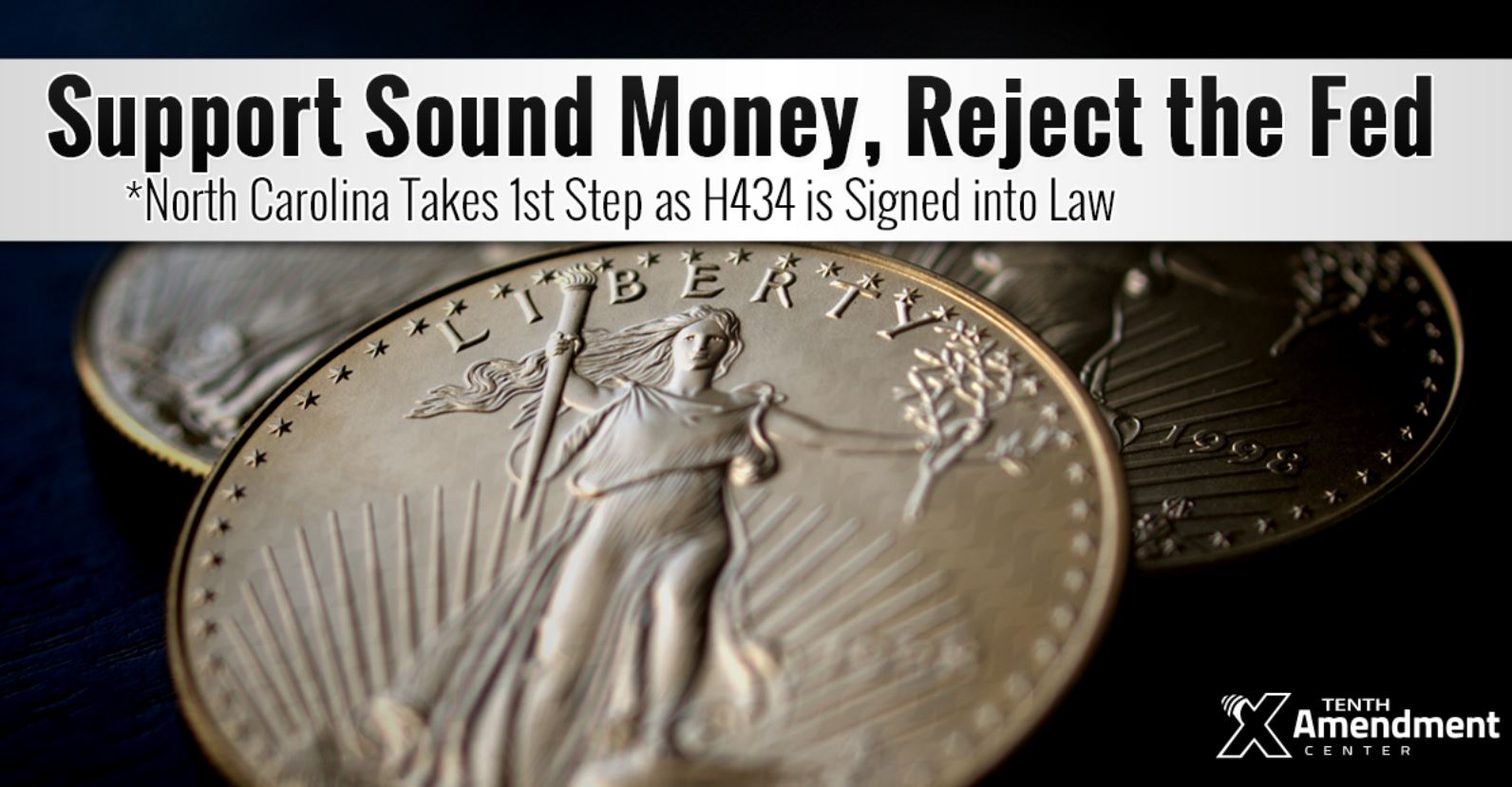
North Carolina Gov. Roy Cooper has signed a bill into law exempting the sale and purchase of gold and silver from state sales taxes. The new law will remove an important roadblock in the way of their everyday use as money, taking the first step toward breaking the Federal Reserve’s monopoly.


Rep. Dana Bumgardner (R-Gastonia) and Rep. Jeff Collins (R-Rocky Mount) introduced House Bill 434 (H434) in March. The legislation exempts precious metals in various forms from state sales tax, including investment metal bullion, U.S. Mint-produced gold and silver, investment coins and non-coin currency.


The House passed H434 on second reading by a 104-8 vote in May. It then gave final approval on the third reading by a voice vote. The Senate concurred with a vote of 35-13 on June 27. With the governor’s signature, the law went into effect retroactively to July 1, 2017.


IN PRACTICE


Imagine if you asked a grocery clerk to break a $5 bill and he charged you a 35 cent tax. Silly, right? After all, you were only exchanging one form of money for another. But that’s essentially what North Carolina’s sales tax on gold and silver did. By removing the sales tax on the exchange of gold and silver, North Carolina will treat specie as money instead of a commodity. This represents a small step toward reestablishing gold and silver as legal tender and breaking down the Fed’s monopoly on money.


Practically speaking, eliminating taxes on the sale of gold and silver cracks open the door for people to begin using gold and silver in regular business transactions.This would mark an important small step toward currency competition. If sound money gains a foothold in the marketplace against Federal Reserve notes, the people would be able to choose the time-tested stability of gold and silver over the central bank’s rapidly-depreciating paper currency.


BACKGROUND INFORMATION


The United States Constitution states in Article I, Section 10, “No State shall…make any Thing but gold and silver Coin a Tender in Payment of Debts.” States have simply ignored this constitutional provision for years. It’s impossible for states to return to a constitutional sound money system when it taxes gold and silver as a commodity.


This North Carolina law takes a step towards that constitutional requirement, ignored for decades in every state. Such a tactic sets the stage to undermine the monopoly of the Federal Reserve by introducing competition into the monetary system.


Constitutional tender expert Professor William Greene said when people in multiple states actually start using gold and silver instead of Federal Reserve Notes, it would effectively nullify the Federal Reserve and end the federal government’s monopoly on money.


Over time, as residents of the state use both Federal Reserve notes and silver and gold coins, the fact that the coins hold their value more than Federal Reserve notes do will lead to a “reverse Gresham’s Law” effect, where good money (gold and silver coins) will drive out bad money (Federal Reserve notes). As this happens, a cascade of events can begin to occur, including the flow of real wealth toward the state’s treasury, an influx of banking business from outside of the state – as people in other states carry out their desire to bank with sound money – and an eventual outcry against the use of Federal Reserve notes for any transactions.


Once things get to that point, Federal Reserve notes would become largely unwanted and irrelevant for ordinary people. Nullifying the Fed on a state by state level is what will get us there.


Michael Maharrey [send him email] is the Communications Director for the Tenth Amendment Center, where this article first appeared. He proudly resides in the original home of the Principles of ’98 – Kentucky. See his blog archive here and his article archive here. He is the author of the book, Our Last Hope: Rediscovering the Lost Path to Liberty. You can visit his personal website at MichaelMaharrey.com and like him on Facebook HERE

Thursday, July 6, 2017

New West Virginia Law Legalizes Commercial Hemp Farming Despite Federal Prohibition

By Michael Maharrey


Yesterday, a West Virginia law went into effect that significantly expands the state’s hemp licensing program, opening the door for anybody in the state to produce or process industrial hemp for commercial purposes. The new law sets the foundation to end federal prohibition of hemp in effect in the Mountain State.


Del. Jeff Eldridge (D-Alum Creek) and Del. Jim Butler (R-Henderson) sponsored House Bill 2453 (HB2453). The legislation removes language in the previous hemp licensing program that restricted it to the Department of Agriculture and state institutions of higher learning. Under the new law, any person with a license will be able plant, grow, harvest, possess, process, sell, and buy industrial hemp.


The licensing program is “shall issue,” meaning the Department of Agriculture will be required to issue a license to any person meeting statutory requirements. Without this section, the department could deny applications for a myriad of reasons.


HB2453 passed the Senate 34-0. It passed the House by a 99-0 vote. With Gov. Justice’s signature, the law went into effect July 4.


“I think West Virginia is kind of in the center; we could have the industry move here to process hemp the plant itself and extract all of the derivatives from the plant you can,” Eldridge said in an interview.


West Virginia Public Broadcasting reported the limits of the current program due to its conformity with federal law has hindered the development of a hemp industry.


“But because of the strict requirements under the 2014 bill, growers are not able to sell their plants and cannot transport them across state lines to be turned into those usable products. That’s limited the ability to create a real hemp industry in the state.”


FEDERAL FARM BILL


Early in 2014, President Barack Obama signed a new farm bill into law, which included a provision allowing a handful of states to begin limited research programs growing hemp. The “hemp amendment”


…allows State Agriculture Departments, colleges and universities to grow hemp, defined as the non-drug oil-seed and fiber varieties of Cannabis, for academic or agricultural research purposes, but it applies only to states where industrial hemp farming is already legal under state law.


In short, current federal law authorizes the farming of hemp – by research institutions, or within state pilot programs, for research only. Farming for commercial purposes by individuals and businesses remains prohibited. HB2453 ignores federal prohibition and authorizes commercial farming and production anyway.


OTHER STATES


By rejecting any need for federal approval, HB2453 sets the stage to nullify the federal hemp ban in practice. West Virginia could join with other states – including Colorado, Oregon, Maine, Massachusetts, California and Vermont – that have simply ignored federal prohibition and legalized industrial hemp production within their state borders.


While prospective hemp growers would still have to take federal law into consideration, by eliminating the chance of state prosecution, the West Virginia law will clear away a major obstacle to widespread commercial hemp farming within the borders of the state.


Farmers in SE Colorado started harvesting the plant in 2013, and farmers in Vermont began harvesting in 2014, effectively nullifying federal restrictions on such agricultural activities. On Feb. 2, 2105, the Oregon hemp industry officially opened for business and one week later, the first license went to a small non-profit group. As more people engage in hemp production and the market grows within these states, more people will become emboldened creating an exponential wave, ultimately nullifying the federal ban in effect.


HUGE MARKET FOR HEMP


According to a 2005 Congressional Research Service report, the U.S. is the only developed nation that hasn’t developed an industrial hemp crop for economic purposes.


Experts suggest that the U.S. market for hemp is around $600 million per year. They count as many as 25,000 uses for industrial hemp, including food, cosmetics, plastics and bio-fuel. The U.S. is currently the world’s #1 importer of hemp fiber for various products, with China and Canada acting as the top two exporters in the world.


During World War II, the United States military relied heavily on hemp products, which resulted in the famous campaign and government-produced film, Hemp for Victory!


Michael Maharrey [send him email] is the Communications Director for the Tenth Amendment Center, where this article first appeared. He proudly resides in the original home of the Principles of ’98 – Kentucky. See his blog archive here and his article archive here. He is the author of the book, Our Last Hope: Rediscovering the Lost Path to Liberty. You can visit his personal website at MichaelMaharrey.com and like him on Facebook HERE

Saturday, July 1, 2017

New Oregon Law will Help Facilitate the Sale of Industrial Hemp Products

By Michael Maharrey


Yesterday, Oregon Gov. Kate Brown signed a bill into law that will pave the way for faster development of Oregon’s hemp market, and further nullify federal prohibition in effect.


Sen. Ted Ferrioli (R-John Day) introduced Senate Bill 1015 (SB1015) in March. The new law will give the Oregon Liquor Control Commission authority over the processing of industrial hemp. Under this regulatory scheme, the state’s hemp business will be treated equally to the recreational cannabis industry.


According to Corvallis Advocate, this could open up new possibilities for the hemp industry subject to certain limitations.


Currently only registered hemp handlers can grow, process, and sell industrial hemp products in Oregon. According to Seattle’s CannaLaw group, a legal firm providing support to several pot businesses in the Northwest, SB 1015 would create industrial hemp licensing for individuals already working in the legal weed business so that regular cannabis processors, handlers, and retailers could start to process and sell goods made out of hemp. The biggest advantage of the new law would be that CBD-exclusive products like extracts could be sold in recreational dispensaries, thus lending even more of an edge to Oregon’s booming cannabis economy.


A recreational marijuana producer would have to register with the OLCC before selling hemp products. The law will also expand some plant testing and record-keeping requirements.


Despite the additional requirements, the new law should serve to expand the hemp industry in Oregon.


SB1015 passed the House by a 45-0 vote. It initially passed the Senate 26-3 on June 12. Brown signed it yesterday.


The Oregon legislature initially legalized industrial hemp production in 2009. When the Oregon Department of Agriculture finally put its licensing and regulatory program in place early in 2014, some farmers began growing hemp, despite high barriers to entry. Legislation passed in 2016 relaxed licensing requirements to encourage further development of a hemp market within the state. The new law  already shows signs of delivering on promises to further open up hemp production and processing in the state.


The federal government still prohibits the cultivation of industrial hemp in most cases, and it prohibits the commercial cultivation of hemp in all cases. Despite federal prohibition, Oregon’s current law sets the foundation for people to nullify the ban by encouraging hemp production in the state. By relaxing regulations and facilitating further development of the hemp industry with this new law, Oregon will ultimately expand this “illegal” market.


The evolution of the hemp program in Oregon also demonstrates a practical reality. Tenth Amendment Center executive director Michael Boldin pointed out when states pass bills that remove a layer of law, markets will inevitably begin to develop.


“As those markets take root, legislators start feeling the pressure to relax laws further,” he said. “Some critics complain that state licensing programs ‘restrict freedom.’ Still, state-restricted hemp farming is better than no hemp farming at all. That’s at least a little more freedom. And as we’re seeing in Oregon, it ultimately opens the door to even freer markets down the road. A little freedom begets more freedom.”


FEDERAL FARM BILL


Early in 2014, President Barack Obama signed a new farm bill into law, which included a provision allowing a handful of states to begin limited research programs growing hemp. The “hemp amendment”


…allows State Agriculture Departments, colleges and universities to grow hemp, defined as the non-drug oil-seed and fiber varieties of Cannabis, for academic or agricultural research purposes, but it applies only to states where industrial hemp farming is already legal under state law.


In short, current federal law authorizes the farming of hemp – by research institutions, or within state pilot programs – for research only. Farming for commercial purposes by individuals and businesses remains prohibited. Oregon law ignores federal prohibition and authorizes commercial farming and production anyway.


OTHER STATES


By rejecting any need for federal approval, states like Oregon, and others including Colorado, Maine, Massachusetts, California and Vermont, set the stage to nullify the federal hemp ban in practice by simply ignoring federal prohibition and legalizing industrial hemp production within their state borders.


While prospective hemp growers still have to take federal law into consideration, by eliminating the state requirement for federal permission, these states clear away a major obstacle to widespread commercial hemp farming within the borders of the state. As more people engage in hemp production and the market grows within these states, more people will become emboldened creating an exponential wave, ultimately nullifying the federal ban in effect.


HUGE MARKET FOR HEMP


According to a 2005 Congressional Research Service report, the U.S. is the only developed nation that hasn’t developed an industrial hemp crop for economic purposes.


Experts suggest that the U.S. market for hemp is around $600 million per year. They count as many as 25,000 uses for industrial hemp, including food, cosmetics, plastics and bio-fuel. The U.S. is currently the world’s #1 importer of hemp fiber for various products, with China and Canada acting as the top two exporters in the world.


During World War II, the United States military relied heavily on hemp products, which resulted in the famous campaign and government-produced film, Hemp for Victory!


WHAT’S NEXT


SB1050 goes into effect on October 9, 2017.

Friday, June 30, 2017

New Nevada Law Legalizes Commercial Hemp Production Despite Federal Prohibition

By Michael Maharrey


Tomorrow, a new Nevada law goes into effect legalizing commercial industrial hemp production in the state, despite a federal ban on the same. The new policy sets the foundation to nullify federal prohibition in practice and effect within the state.


A bipartisan coalition of 12 legislators sponsored Senate Bill 396 (SB396). The new law authorizes the cultivation of industrial hemp for commercial purposes and the production of agricultural hemp seed in Nevada. The statute expands current law that only allows an institution of higher education or the Nevada Department of Agriculture to cultivate industrial hemp for research purposes conducted under an agricultural pilot program or for other agricultural or academic research. Under the new law, the state will create separate licensing programs for growers, handlers and producers of hemp seed.


The federal government currently restricts the acquisition of seed. Encouraging seed development within the state will also incentivize the hemp market. However, the law gives the Department of Agriculture wide latitude in its rule-making authority. How the program operates in practice will ultimately depend on how the department formulates the rules.


The Senate passed SB396 by a 20-0 vote. The Assembly approved the measure by a vote of 34-5. With Gov. Sandoval’s signature, the law goes into effect July 1.


FEDERAL FARM BILL


Early in 2014, then-President Barack Obama signed a new farm bill into law, which included a provision allowing a handful of states to begin limited research programs growing hemp. The “hemp amendment”


…allows State Agriculture Departments, colleges and universities to grow hemp, defined as the non-drug oil-seed and fiber varieties of Cannabis, for academic or agricultural research purposes, but it applies only to states where industrial hemp farming is already legal under state law.


In short, current federal law authorizes the farming of hemp – by research institutions, or within state pilot programs – for research only. Farming for commercial purposes by individuals and businesses remains prohibited. SB396 ignores federal prohibition and authorizes commercial farming and production anyway.


OTHER STATES


By rejecting any need for federal approval, SB396 sets the stage to nullify the federal hemp ban in practice. Nevada could join with other states – including Colorado, Oregon, Maine, Massachusetts, California and Vermont – that have simply ignored federal prohibition and legalized industrial hemp production within their state borders.


While prospective hemp growers would still have to take federal law into consideration, by eliminating the state requirement for federal permission, the proposed Nevada law would clear away a major obstacle to widespread commercial hemp farming within the borders of the state.


Farmers in SE Colorado started harvesting the plant in 2013, and farmers in Vermont began harvesting in 2014, effectively nullifying federal restrictions on such agricultural activities. On Feb. 2, 2105, the Oregon hemp industry officially opened for business and one week later, the first license went to a small non-profit group. As more people engage in hemp production and the market grows within these states, more people will become emboldened creating an exponential wave, ultimately nullifying the federal ban in effect.


HUGE MARKET FOR HEMP


According to a 2005 Congressional Research Service report, the U.S. is the only developed nation that hasn’t developed an industrial hemp crop for economic purposes.


Experts suggest that the U.S. market for hemp is around $600 million per year. They count as many as 25,000 uses for industrial hemp, including food, cosmetics, plastics and bio-fuel. The U.S. is currently the world’s #1 importer of hemp fiber for various products, with China and Canada acting as the top two exporters in the world.


During World War II, the United States military relied heavily on hemp products, which resulted in the famous campaign and government-produced film, Hemp for Victory!


Michael Maharrey [send him email] is the Communications Director for the Tenth Amendment Center, where this article first appeared. He proudly resides in the original home of the Principles of ’98 – Kentucky. See his blog archive here and his article archive here. He is the author of the book, Our Last Hope: Rediscovering the Lost Path to Liberty. You can visit his personal website at MichaelMaharrey.com and like him on Facebook HERE

Saturday, June 24, 2017

New Louisiana Law Helps Encourage Use of Gold and Silver as Money

By Michael Maharrey


Yesterday, Louisiana Gov. John Bel Edwards signed a bill into law that exempts the sale and purchase of gold and silver from state sales and use taxes, encouraging their use and taking the first step toward breaking the Federal Reserve’s monopoly on money.


Rep. Stephen Dwight (R) and Rep. Mark Abraham (R) introduced House Bill 396 (HB396) on March 31. The legislation exempts the sale of platinum, gold, or silver bullion, ingots, or coins that are valued only on their precious metal content from the state sales tax. It also exempts certain numismatic (collectable) coins.


The House initially passed HB396 95-0 on May 24. The Senate followed up on June 2 and approved the measure by a vote of 30-2 with some technical amendments. The House then concurred with the Senate amendments by a vote of 103-0. With Gov. John Bel Edwards’ signature, the new law went into immediate effect on June 22.


IN PRACTICE


Imagine if you asked a grocery clerk to break a $5 bill and he charged you a 35 cent tax. Silly, right? After all, you were only exchanging one form of money for another. But that’s essentially what Louisiana’s sales tax on gold and silver did. By removing the sales tax on the exchange of gold and silver, Louisiana will now treat specie as money instead of a commodity. This represents a small step toward reestablishing gold and silver as legal tender and breaking down the Fed’s monopoly on money.


Practically speaking, eliminating taxes on the sale of gold and silver will crack open the door for people to begin using it in regular business transactions.This marks an important small step toward currency competition. If sound money gains a foothold in the marketplace against Federal Reserve notes, the people would be able to choose the time-tested stability of gold and silver over the central bank’s rapidly-depreciating paper currency.


BACKGROUND INFORMATION


The United States Constitution states in Article I, Section 10, “No State shall…make any Thing but gold and silver Coin a Tender in Payment of Debts.” States have simply ignored this constitutional provision for years. It’s impossible for states to return to a constitutional sound money system when it taxes gold and silver as a commodity.


This Louisiana bill takes a step toward that constitutional requirement, ignored for decades in every state. Such a tactic sets the stage to undermine the monopoly of the Federal Reserve by introducing competition into the monetary system.


Constitutional tender expert Professor William Greene said when people in multiple states actually start using gold and silver instead of Federal Reserve Notes, it would effectively nullify the Federal Reserve and end the federal government’s monopoly on money.


Over time, as residents of the state use both Federal Reserve notes and silver and gold coins, the fact that the coins hold their value more than Federal Reserve notes do will lead to a “reverse Gresham’s Law” effect, where good money (gold and silver coins) will drive out bad money (Federal Reserve notes). As this happens, a cascade of events can begin to occur, including the flow of real wealth toward the state’s treasury, an influx of banking business from outside of the state – as people in other states carry out their desire to bank with sound money – and an eventual outcry against the use of Federal Reserve notes for any transactions.


Once things get to that point, Federal Reserve notes would become largely unwanted and irrelevant for ordinary people. Nullifying the Fed on a state by state level is what will get us there.

Wednesday, March 29, 2017

West Virginia House Unanimously Approves Commercial Hemp Farming


By Michael Maharrey


Today, the West Virginia House unanimously passed a bill that would significantly expand the state’s hemp licensing program, opening the door for anybody in the state to produce or process industrial hemp for commercial purposes. Final approval would set the foundation to end federal prohibition in practice.


Del. Jeff Eldridge (D-Alum Creek) and Del. Jim Butler (R-Henderson) introduced House Bill 2453 (HB2453) on Feb. 15. The legislation would remove language in the current hemp licensing program restricting it to the Department of Agriculture and state institutions of higher learning. Under the proposed law, any person with a license could plant, grow, harvest, possess, process, sell, and buy industrial hemp.


The licensing program is “shall issue,” meaning the Department of Agriculture would be required to issue a license to any person meeting statutory requirements. Without this section, the department could deny applications for a myriad of reasons.


HB2453 passed the House by a 99-0 vote.


“I think West Virginia is kind of in the center; we could have the industry move here to process hemp the plant itself and extract all of the derivatives from the plant you can,” Eldridge said in an interview.


West Virginia Public Broadcasting reported the limits of the current program due to its conformity with federal law has hindered the development of a hemp industry.


But because of the strict requirements under the 2014 bill, growers are not able to sell their plants and cannot transport them across state lines to be turned into those usable products. That’s limited the ability to create a real hemp industry in the state.


FEDERAL FARM BILL


Early in 2014, President Barack Obama signed a new farm bill into law, which included a provision allowing a handful of states to begin limited research programs growing hemp. The “hemp amendment”


…allows State Agriculture Departments, colleges and universities to grow hemp, defined as the non-drug oil-seed and fiber varieties of Cannabis, for academic or agricultural research purposes, but it applies only to states where industrial hemp farming is already legal under state law.


In short, current federal law authorizes the farming of hemp – by research institutions only, for research only. Farming for commercial purposes by individuals and businesses remains prohibited. HB2453 ignores federal prohibition and authorizes commercial farming and production anyway.


OTHER STATES


By rejecting any need for federal approval, HB2453 sets the stage to nullify the federal hemp ban in practice. West Virginia could join with other states – including Colorado, Oregon, Maine, Massachusetts, California and Vermont – that have simply ignored federal prohibition and legalized industrial hemp production within their state borders.


While prospective hemp growers would still have to take federal law into consideration, by eliminating the state requirement for federal permission, the West Virginia law would clear away a major obstacle to widespread commercial hemp farming within the borders of the state.


Farmers in SE Colorado started harvesting the plant in 2013, and farmers in Vermont began harvesting in 2014, effectively nullifying federal restrictions on such agricultural activities. On Feb. 2, 2105, the Oregon hemp industry officially opened for business and one week later, the first license went to a small non-profit group. As more people engage in hemp production and the market grows within these states, more people will become emboldened creating an exponential wave, ultimately nullifying the federal ban in effect.


HUGE MARKET FOR HEMP


According to a 2005 Congressional Research Service report, the U.S. is the only developed nation that hasn’t developed an industrial hemp crop for economic purposes.


Experts suggest that the U.S. market for hemp is around $600 million per year. They count as many as 25,000 uses for industrial hemp, including food, cosmetics, plastics and bio-fuel. The U.S. is currently the world’s #1 importer of hemp fiber for various products, with China and Canada acting as the top two exporters in the world.


During World War II, the United States military relied heavily on hemp products, which resulted in the famous campaign and government-produced film, Hemp for Victory!


UP NEXT


HB2453 now heads to the Senate for further consideration.


Free Book – The Compact Garden Blueprint (Ad)


Michael Maharrey [send him email] is the Communications Director for the Tenth Amendment Center, where this article first appeared. He proudly resides in the original home of the Principles of ’98 – Kentucky. See his blog archive here and his article archive here. He is the author of the book, Our Last Hope: Rediscovering the Lost Path to Liberty. You can visit his personal website at MichaelMaharrey.com and like him on Facebook HERE

Wednesday, March 1, 2017

Washington House Votes 98-0 To Decriminalize Industrial Hemp


By Michael Maharrey


Yesterday, the Washington state House unanimously passed bill that would remove industrial hemp from the state’s “controlled substances” list. Passage into law would set the stage for people there to nullify federal prohibition on the plant in practice.


Rep. Matt Shea (R-Spokane Valley) and a bipartisan coalition of three republicans and three democrats introduced House Bill 2064 (HB2064) on Feb. 9. The legislation would simply remove industrial hemp from the scope of the state’s controlled substances act. While marijuana is legal in Washington, it is still considered a controlled substance and heavily regulated. Passage of HB2064 would ensure hemp is not regulated as a controlled substance.This would open the door for a full-scale commercial hemp market in the state by treating it as any other crop for farming.


HB2064 would not require any license to grow hemp, and it would create no state regulatory structure. In short, the state would treat industrial hemp like other plants, such as tomatoes. By ending state prohibition, residents in Washington would have an open door to start industrial hemp farming, should they be willing to risk violating ongoing federal prohibition.


HB2064 received a majority “do-pass” recommendation from the House Committee on Commerce and Gaming. Yesterday, the full House voted 98-0 to send it to the Senate.


FEDERAL FARM BILL


Early in 2014, President Barack Obama signed a new farm bill into law, which included a provision allowing a handful of states to begin limited research programs growing hemp. The “hemp amendment”


…allows State Agriculture Departments, colleges and universities to grow hemp, defined as the non-drug oil-seed and fiber varieties of Cannabis, for academic or agricultural research purposes, but it applies only to states where industrial hemp farming is already legal under state law.


In short, current federal law authorizes the farming of hemp – by research institutions only, for research only. Farming for commercial purposes by individuals and businesses remains prohibited.


OTHER STATES


By rejecting any need for federal approval, state decriminalization of hemp sets the stage to nullify the federal hemp ban in practice. Washington could join other states – including Colorado, Oregon, Maine, Vermont, Massachusetts, California and others – that have simply ignored federal prohibition and legalized industrial hemp production within their state borders.


While prospective hemp growers still have to take federal law into consideration, by eliminating the state requirement for federal permission, this law would clear away a major obstacle to widespread commercial hemp farming within the borders of the state. As more states simply ignore federal prohibition, the likelihood of federal enforcement diminishes.


Farmers in SE Colorado started harvesting the plant in 2013, and farmers in Vermont began harvesting in 2014, effectively nullifying federal restrictions on such agricultural activities. On Feb. 2 of 2015, the Oregon hemp industry officially opened for business and one week later, the first license went to a small non-profit group. As more people engage in hemp production and the market grows within these states, more people will become emboldened creating an exponential wave, ultimately nullifying the federal ban in effect.


HUGE MARKET FOR HEMP


According to a 2005 Congressional Research Service report, the U.S. is the only developed nation that hasn’t developed an industrial hemp crop for economic purposes.


Experts suggest that the U.S. market for hemp is around $600 million per year. They count as many as 25,000 uses for industrial hemp, including food, cosmetics, plastics and bio-fuel. The U.S. is currently the world’s #1 importer of hemp fiber for various products, with China and Canada acting as the top two exporters in the world.


During World War II, the United States military relied heavily on hemp products, which resulted in the famous campaign and government-produced film, Hemp for Victory!


HB2064 would represent an essential first step toward hemp freedom in New Hampshire.


UP NEXT


HB2064 will not move to the state Senate for further consideration.


Michael Maharrey [send him email] is the Communications Director for the Tenth Amendment Center, where this article first appeared. He proudly resides in the original home of the Principles of ’98 – Kentucky.See his blog archive here and his article archive here.He is the author of the book, Our Last Hope: Rediscovering the Lost Path to Liberty. You can visit his personal website at MichaelMaharrey.com and like him on Facebook HERE

Tuesday, February 21, 2017

New Virginia Law Is A First Step To Help Support Sound Money


By Michael Maharrey


A Virginia bill that would remove sales taxes from some purchases of gold and silver was signed into law by the Governor yesterday. It represents an important first step toward encouraging its regular use as currency and breaking the Federal Reserve’s monopoly on money.


A bipartisan coalition of delegates sponsored House Bill 1668 (HB1668). The legislation exempts gold, silver, or platinum bullion or legal tender coins whose sales price exceeds $1,000 from from state sales tax. Each piece of gold, silver, or platinum or legal tender coin need not exceed $1,000, provided that the sales price of one entire transaction of such pieces exceeds $1,000. ”


Under the new law, the exemption will remain in place until June 30, 2022.


The House passed HB1668 by a 99-0 vote. It passed in the Senate by a vote of 38-1.


The new law goes into effect on Jan. 1, 2018.


IN PRACTICE


Imagine if you asked a grocery clerk to exchange $1000 in cash for smaller bills and he charged you a $53 tax. Silly, right? After all, you were only exchanging one form of money for another. But that’s essentially what Virginia’s sales tax on gold and silver does.


By removing the sales tax on some exchanges of gold and silver, Virginia would move toward treating specie as money instead of a commodity. This represents a small step toward reestablishing gold and silver as legal tender and breaking down the Fed’s monopoly on money.


In a state that has not been friendly to sound money, this represents a first step. Not that it has been signed into law, people in Virginia should pressure the legislature to eliminate both the sunset clause and the $1000 minimum next year.


Practically speaking, fully and permanently eliminating taxes on the exchange of gold and silver would open the door for people to begin using specie in regular business transactions. This would mark an important step toward currency competition. If sound money gains a foothold in the marketplace against Federal Reserve notes, the people would be able to choose the time-tested stability of gold and silver over the central bank’s rapidly-depreciating paper currency.


BACKGROUND INFORMATION


The United States Constitution states in Article I, Section 10, “No State shall…make any Thing but gold and silver Coin a Tender in Payment of Debts.” States have simply ignored this constitutional provision for years. It’s impossible for states to return to a constitutional sound money system when it taxes gold and silver as a commodity.


This Virginia bill takes a step towards that constitutional requirement, ignored for decades in every state. Such a tactic would set the stage to undermine the monopoly of the Federal Reserve by introducing competition into the monetary system.


Constitutional tender expert Professor William Greene said when people in multiple states actually start using gold and silver instead of Federal Reserve Notes, it would effectively nullify the Federal Reserve and end the federal government’s monopoly on money.


Enter to Win 50 American Silver Eagles (Ad)


Over time, as residents of the state use both Federal Reserve notes and silver and gold coins, the fact that the coins hold their value more than Federal Reserve notes do will lead to a “reverse Gresham’s Law” effect, where good money (gold and silver coins) will drive out bad money (Federal Reserve notes). As this happens, a cascade of events can begin to occur, including the flow of real wealth toward the state’s treasury, an influx of banking business from outside of the state – as people in other states carry out their desire to bank with sound money – and an eventual outcry against the use of Federal Reserve notes for any transactions.


Once things get to that point, Federal Reserve notes would become largely unwanted and irrelevant for ordinary people. Nullifying the Fed on a state by state level is what will get us there.


Michael Maharrey [send him email] is the Communications Director for the Tenth Amendment Center, where this article first appeared. He proudly resides in the original home of the Principles of ’98 – Kentucky. See his blog archive here and his article archive here. He is the author of the book, Our Last Hope: Rediscovering the Lost Path to Liberty. You can visit his personal website at MichaelMaharrey.com and like him on Facebook HERE