Showing posts with label ingredients. Show all posts

Tuesday, May 8, 2018

How To Turn Old Meat Into Survival Jerky That Lasts MONTHS AND MONTHS

How To Turn Old Meat Into Survival Jerky That Lasts MONTHS AND MONTHS

jerky — wikipedia


Have you ever found yourself looking for something in the freezer, and then stumbled upon a couple of packages of venison that somehow lost their way? This happened to me several months ago and I couldn’t have been happier. Why did the notion of being reunited with some venison make me happy? One word: jerky.


Making jerky is one of those time-honored traditions that my family just loves. It is an extremely lean and healthy snack for everyone. I love it because instead of eating processed garbage, my kids are eating a snack high in protein and not simply refined sugar. I love jerky because it is the perfect reason for me to sharpen my favorite knife and fire up the smoker.


Restore Your Old Blades To A Razor’s Edge In Just Seconds!


I have a very simple recipe for making jerky, and it works for both venison and beef. I have never tried it with other meats, although I cannot imagine the process would be dramatically different. What follows is a very basic process for making jerky using an electric smoker. I prefer to use mesquite when smoking meats like venison and beef, but the choice is totally yours.


Ingredients


  • 2 pounds venison

  • ½ cup soy sauce

  • 1/4 cup Worchester sauce

  • ½ teaspoon Morton Tender Quick Cure

  • 1 teaspoon chili powder

  • 1 tablespoon garlic powder

  • 1 tablespoon onion powder

  • 2 tablespoons rough cracked pepper


The Process


How To Turn Old Meat Into Survival Jerky That Lasts MONTHS AND MONTHS

Image source: Pixabay.com


You want to begin working with this stuff the night before you intend to fire up the smoker. Make sure your venison is trimmed of any fat or sinew and is sliced thin. The thinner the better here, since it will help it to dry out easier and will provide more surface area for the marinade to adhere. Make your goal for strips around ¼-inch thick or so. It might be helpful when cutting the meat to have it be not quite frozen, but a bit stiff. This will give you a little more control as you are slicing it. Also, take a couple of minutes and sharpen your knife before you get going. A sharp knife will make this job a lot easier.


Once you have the meat sliced, just put it aside and focus on the marinade. Put all of the ingredients except the cracked pepper in a plastic storage bag and make sure it is mixed thoroughly. Once this is done, add the venison and place it in the refrigerator overnight.


The next day, you want to get your smoker going low. Try to hit somewhere between 150-175 degrees Fahrenheit. Next, take the marinated venison out of the fridge and drain the marinade. Spray the racks of your smoker with cooking spray and begin laying out the venison strips. The last thing you want at this step is to have the strips touching each other in any way, so space accordingly. Before you place the jerky in the smoker, liberally sprinkle them with the cracked black pepper.


Once the racks are in the smoker, monitor the temperature for the next several hours. Avoid adding any wood at this time and just let the smoker do its thing. After about three hours, check on the jerky. It should feel almost sticky to the touch. If this is where you are at, then add a handful of woodchips to the smoker to add a smoky flavor to the venison. After this, you are going to want to wait on the smoker for another few hours. It is also helpful to rotate the racks from time to time to ensure that the racks are presented with an even amount of heat and smoke.


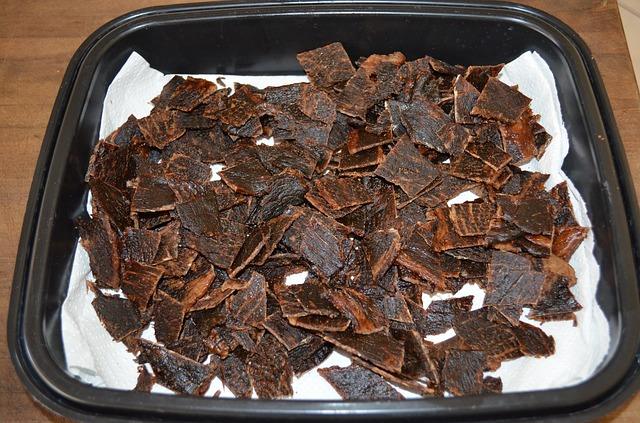
The time it will take your smoker to successfully turn that wonderful venison into tremendous jerky can vary. Expect it to take anywhere from 5-6 hours depending on the size of the slices and the temperature of the smoker. If you are nervous about the jerky after it comes out of the smoker, you can always finish it in the oven at 200 degrees for an additional 10-15 minutes or so. You will know the jerky is done when you can bend a piece and it begins to splinter. If the jerky snaps when you bend it, it is too far gone, although will still be delicious. Once it is done, put the jerky in a glass jar or vacuum seal it for storage.


If you use the cure, it will last you months and months, making it useful out in the wild or just for storage as a survival food. Without the cure, I would recommend refrigeration and prompt eating to avoid any mold growth. However, if your family is like mine, then you will never be able to find out just how long it can truly last, because it will be gone the second you turn your back.


What jerky-making advice would you add? Share your tips in the section below:


Learn How To ‘Live Off The Land’ With Just Your Gun. Read More Here.


The post How To Turn Old Meat Into Survival Jerky That Lasts MONTHS AND MONTHS appeared first on Off The Grid News.

Thursday, March 1, 2018

How To Avoid GMOs When You’re On A Budget

How To Avoid GMOs When You’re On A Budget | shopping-grocery-store | General Health GMOs Organic Market Classifieds Organics


What’s the most controversial topic at the grocery store these days?


It’s GMOs.


Should you consume them? Are they okay in moderation? Should you strictly avoid them at all times? And if so, how on earth can you manage to navigate the store without stepping into a genetically modified landmine? And if you really want to challenge yourself, how can you do that on a budget?


The anti-GMO movementHow To Avoid GMOs When You’re On A Budget | EpUbGBhbeXlLkAc2IXnWWCdjrdmn51ccsXdym9DWo0bS7F0unVzlehYBRQRvAPSD_R3ZNzbPn9Kh47Khxe7D4IPw0oLZuq08DOhkaBWy4l_CwrudD2RNUxegSQ7idNESjkLjAqPDitM | General Health GMOs Organic Market Classifieds Organics  is picking up steam, for a multitude of excellent reasons. My family is making continuous efforts to remove genetically modified products from our lives. If you want to learn how you can banish them too, read on!


Forget about GMO labeling.


First of all, let’s face some facts here.  Crony capitalism in America isn’t going to allow changes that would require the labeling of genetically modified ingredients in your food.  While in a perfect world, a place that requires people selling healthfully grown organic foods to jump backwards through hoops and turn a cartwheel to be allowed to place a “certified organic label” on their items, Big Agri can blithely don hazmat suits to spray ever-increasing amounts of glyphosate on crops that have been genetically modified to withstand the poisons, with nary a word to consumers.


The reality is, Monsanto and their ilk have incredibly deep pockets. The Big Food companies that purchase vast amounts of GMO crops are also rolling in money. If you want to avoid GMOs, you can’t look to those who have a vested interest in selling them to protect you. You have to constantly educate yourself to beat them at their own game.


And their game, of course, is Monopoly.


If they refuse to label their products, we can refuse to buy them.  Money talks, and to large corporations it SHOUTS.  If their bottom line begins to dwindle because people refuse to consume their products, eventually they will have to make a change.


That’s exactly what happened with Dean Foods, actually. In 2009, Dean Foods switched their formula for their popular Silk Soymilk.  Instead of using organic soybeans, they began purchasing conventional soybeans. As we all know, nearly all of the soy grown in the United States is genetically modified – at last report it was over 94%.  So, more than likely, the soymilk that Dean Foods was putting out was GMO.  When outraged customers refused to purchase the product, Dean realized that they were losing money hand over fist, and they switched back to organic soy.


Victory: Team Anti-GMO.


So, you see, that’s how it works. In a free market where consumers have adequate information, their desires direct what is produced. The issue right now is that consumers do NOT have adequate information – at least not without a diligent search for it.


We can wish for labeling until the rBGH-free cows come home, but the battle will have to be fought without the aid of labels.


Avoiding GMOs is easier than you might think. And it can be done on a budget. Here’s how.


Learn to use the labels that DO exist.


How To Avoid GMOs When You’re On A Budget | non-gmo-verified-project | General Health GMOs Organic Market Classifieds Organics


Although companies are no required to put warning labels on GMOs, companies can opt to boast when their products are GMO-free.


The Non-GMO Project is focused in the opposite direction of the activists that insist GMOs be labeled. They are working to label products that have been scrupulously tested and are verified NOT to contain genetically modified material.


(Here’s a list of  1,000 non-gmo foods)


The pretty little butterfly label is your best indication that the product in your hand doesn’t contain GMOs.   Through a third-party verification process, the products are tested and audited to maintain their standing.


The retailers who started the Non-GMO Project were motivated by a simple idea. They believed that consumers in North America should have access to clearly-labeled non-GMO food and products, now and in the future. That conviction continues to guide the Non-GMO Project, as North America’s only independent verification for products made according to best practices for GMO avoidance.


The verification seal indicates that the product bearing the seal has gone through our verification process. Our verification is an assurance that a product has been produced according to consensus-based best practices for GMO avoidance:


  • We require ongoing testing of all at-risk ingredients—any ingredient being grown commercially in GMO form must be tested prior to use in a verified product.

  • We use an Action Threshold of 0.9%. This is in alignment with laws in the European Union (where any product containing more than 0.9% GMO must be labeled). Absence of all GMOs is the target for all Non-GMO Project Standard compliant products. Continuous improvement practices toward achieving this goal must be part of the Participant’s quality management systems.

  • After the test, we require rigorous traceability and segregation practices to be followed in order to ensure ingredient integrity through to the finished product.

  • For low-risk ingredients, we conduct a thorough review of ingredient specification sheets to determine absence of GMO risk.

  • Verification is maintained through an annual audit, along with onsite inspections for high-risk products.


Other products sometimes say that they do not contain GMOs.  While this may be true, the Non-GMO Project Verified seal is earned through rigorous testing, and you can feel fairly confident that foods bearing this seal are free of genetically modified ingredients.


Another label to look for is USDA Certified Organic.


According to the USDA’s official blog, the inclusion of any type of GMOs is prohibited in an organic product.


The use of genetic engineering or genetically modified organisms (GMOs) is prohibited in organic products. This means an organic farmer can’t plant GMO seeds, an organic cow can’t eat GMO alfalfa or corn, and an organic soup producer can’t us any GMO ingredients. To meet USDA organic regulations, farmers and processors must show they aren’t using GMOs and that they are protecting their products from contact with prohibited substances, such as GMOs, from farm to table.


Sadly, it’s important to note that the USDA has relaxed their standards and “organic” now means 95% or more organic.


Learn about the likely suspects.


In the United States and Canada, two things shout “GMO” like no other: corn and soy. As of 2012, more than 94% of the soy and 88% of the corn in America was genetically modified.


The sad fact is, if you are buying anything processed at all, corn or soy is most likely to be an ingredient. And given the statistics above, it’s almost guaranteed that the corn or soy is GMO unless it’s otherwise noted. Both ingredients masquerade under many names. The lists below may seem overwhelming, but it’s important to see the number of aliases that allow these products to sneak into your food.


Here’s a sobering chart from the website Corn Allergens that shows many of the names under which corn lurks in your food.


  • Acetic acid

  • Alcohol

  • Alpha tocopherol

  • Artificial flavorings

  • Artificial sweeteners

  • Ascorbates

  • Ascorbic acid

  • Aspartame (Artificial sweetener)

  • Astaxanthin

  • Baking powder

  • Barley malt* (generally OK, but can be contaminated)

  • Bleached flour*

  • Blended sugar (sugaridextrose)

  • Brown sugar* (generally OK if no caramel color)

  • Calcium citrate

  • Calcium fumarate

  • Calcium gluconate

  • Calcium lactate

  • Calcium magnesium acetate (CMA)

  • Calcium stearate

  • Calcium stearoyl lactylate

  • Caramel and caramel color

  • Carbonmethylcellulose sodium

  • Cellulose microcrystalline

  • Cellulose, methyl

  • Cellulose, powdered

  • Cetearyl glucoside

  • Choline chloride

  • Citric acid*

  • Citrus cloud emulsion (CCS)

  • Coco glycerides (cocoglycerides)

  • Confectioner’s sugar

  • Corn alcohol, corn gluten

  • Corn extract

  • Corn flour

  • Corn oil, corn oil margarine

  • Corn starch

  • Corn sweetener, corn sugar

  • Corn syrup, corn syrup solids

  • Corn, popcorn, cornmeal

  • Cornstarch, cornflour

  • Crosscarmellose sodium

  • Crystalline dextrose

  • Crystalline fructose

  • Cyclodextrin

  • DATUM (a dough conditioner)

  • Decyl glucoside

  • Decyl polyglucose

  • Dextrin

  • Dextrose (also found in IV solutions)

  • Dextrose anything (such as monohydrate or anhydrous)

  • d-Gluconic acid

  • Distilled white vinegar

  • Drying agent

  • Erythorbic acid

  • Erythritol

  • Ethanol

  • Ethocel 20

  • Ethyl acetate

  • Ethyl alcohol

  • Ethyl lactate

  • Ethyl maltol

  • Ethylcellulose

  • Ethylene

  • Fibersol-2

  • Flavorings*

  • Food starch

  • Fructose*

  • Fruit juice concentrate*

  • Fumaric acid

  • Germ/germ meal

  • Gluconate

  • Gluconic acid

  • Glucono delta-lactone

  • Gluconolactone

  • Glucosamine

  • Glucose syrup* (also found in IV solutions)

  • Glucose*

  • Glutamate

  • Gluten

  • Gluten feed/meal

  • Glycerides

  • Glycerin*

  • Glycerol

  • Golden syrup

  • Grits

  • High fructose corn syrup

  • Hominy

  • Honey*

  • Hydrolyzed corn

  • Hydrolyzed corn protein

  • Hydrolyzed vegetable protein

  • Hydroxypropyl methylcellulose

  • Hydroxypropyl methylcellulose pthalate (HPMCP)

  • Inositol

  • Invert syrup or sugar

  • Iodized salt

  • Lactate

  • Lactic acid*

  • Lauryl glucoside

  • Lecithin

  • Linoleic acid

  • Lysine

  • Magnesium citrate

  • Magnesium fumarate

  • Magnesium stearate

  • Maize

  • Malic acid

  • Malonic acid

  • Malt syrup from corn

  • Malt, malt extract

  • Maltitol

  • Maltodextrin

  • Maltol

  • Maltose

  • Mannitol

  • Methyl glucose

  • Methyl glucoside

  • Methyl gluceth

  • Methylcellulose

  • Microcrystaline cellulose

  • Modified cellulose gum

  • Modified corn starch

  • Modified food starch

  • Molasses* (corn syrup may be present; know your product)

  • Mono- and di- glycerides

  • Monosodium glutamate

  • MSG

  • Natural flavorings*

  • Olestra/Olean

  • Polenta

  • Polydextrose

  • Polylactic acid (PLA)

  • Polysorbates* (e.g. Polysorbate 80)

  • Polyvinyl acetate

  • Potassium citrate

  • Potassium fumarate

  • Potassium gluconate

  • Powdered sugar

  • Pregelatinized starch

  • Propionic acid

  • Propylene glycol monostearate*

  • Propylene glycol*

  • Saccharin

  • Salt (iodized salt)

  • Semolina (unless from wheat)

  • Simethicone

  • Sodium carboxymethylcellulose

  • Sodium citrate

  • Sodium erythorbate

  • Sodium fumarate

  • Sodium lactate

  • Sodium starch glycolate

  • Sodium stearoyl fumarate

  • Sorbate

  • Sorbic acid

  • Sorbitan* (anything)

  • Sorbitol

  • Sorghum* (not all is bad; the syrup and/or grain CAN be mixed with corn)

  • Splenda (Artificial sweetener)

  • Starch (any kind that’s not specified)

  • Stearic acid

  • Stearoyls

  • Sucralose (Artificial sweetener)

  • Sucrose

  • Sugar* (not identified as cane or beet)

  • Threonine

  • Tocopherol (vitamin E)

  • Treacle (aka golden syrup)

  • Triethyl citrate

  • Unmodified starch

  • Vanilla, natural flavoring

  • Vanilla, pure or extract

  • Vanillin

  • Vegetable anything that’s not specific*

  • Vinegar, distilled white

  • Vinyl acetate

  • Vitamin C* and Vitamin E*

  • Vitamins*

  • Xanthan gum

  • Xylitol

  • Yeast*

  • Zea mays

  • Zein


Likewise, soy is another item that wears many hats and can be difficult to avoid. Here are some of the names under which soy could be hiding in your food. (List is from About.com)


  • Bean curd

  • Bean sprouts

  • Bulking agent

  • Edamame (fresh soybeans)

  • Guar gum

  • Gum arabic

  • Hydrolyzed plant protein (HPP) or hydrolyzed vegetable protein (HVP)

  • Hydrolyzed soy protein (HSP)

  • Kinako

  • Lecithin

  • Miso (fermented soybean paste)

  • Mixed tocopherols

  • Mono- and di-glycerides

  • MSG (monosodium glutamate)

  • Natto

  • Natural flavoring

  • Nimame

  • Okara

  • Shoyu

  • Soy (albumin, cheese, fiber, grits, milk, nuts, sprouts, yogurt, ice cream, pasta)

  • Soy lecithin

  • Soy protein (concentrate, hydrolyzed, isolate)

  • Soy sauce

  • Soya

  • Soybean (curds, granules)

  • Soybean oil

  • Stabilizer

  • Tamari

  • Tempeh

  • Teriyaki sauce

  • Textured vegetable protein (TVP)

  • Thickener

  • Tofu (dofu, kori-dofu)

  • Vegetable gum, starch, shortening, or oil

  • Vitamin E

  • Yuba


As you can see, it’s difficult to avoid potential GMOs if you eat anything that comes from a package.  Despite the fact that many people suffer from food allergies, these items are allowed to be included under names that make it difficult to discern what you’re actually getting.  Names like “thickener”, “natural flavoring”, and “drying agent” do not give the label reader much of a clue.


More than 60 GMO crops that have been approved in the US are:


  • Corn (20 varieties)

  • Oilseed Rape/Canola (11 varieties)

  • Cotton (11 varieties)

  • Tomato (6 varieties)

  • Potato (4 varieties)

  • Soybean (3 varieties)

  • Sugar Beet (3 varieties)

  • Squash (2 varieties)

  • Cantaloupe

  • Rice

  • Flax

  • Raddicchio

  • Papaya

  • Alfalfa

  • Wheat


Fortunately, not all of these are currently on the market.  Currently corn, soybeans, cotton, canola, squash, and papaya are all sold commercially. (Source: Organic Consumers)


The best possible choices have no label at all.


Bluntly put, food manufacturers are out to deceive the consumer. They know that many people are trying to avoid GMOs, but they still want you to buy their products. This is why they are adamantly against labeling the products, although they like to say it’s because we, the mere mortal customers, just aren’t smart enough or educated enough to comprehend in our fuzzy little brains that GMOs are “safe”.  So, they opt not to disclose the inclusion of genetically modified ingredients.


If you shop at the grocery store, then I have to be honest – it’s nearly impossible to avoid GMOs. If every item you purchase is organic, then you can probably get through the checkout line unscathed. But these days, who can afford to push a cart full of organic grocery store food up to the register? I know that I certainly can’t.  Prices are sometimes triple that of a conventionally grown item. If you truly want to avoid GMOs – and by avoid I mean banish them from your dinner table and cupboards for good – you need to stop buying food with ingredients. You need to rethink where your food comes from.


Food shouldn’t contain ingredients. Food should BE ingredients.  What you purchase when doing your weekly food shopping should be the basis for delicious meals.  When you no longer eat things from packages that have long lists of ingredients in them, you will begin to free yourself from the ridiculous Monopoly game that you have been playing with Big Food.


Here are some examples:


Instead of buying a package of pasta and a jar of Alfredo sauce, make zucchini noodles and a homemade Alfredo primavera.


Instead of buying a box of flavored, sugar-y cereal for breakfast, have oatmeal (cooked from scratch – not the little packets) and top it with fruit and nuts.


Instead of a sandwich made from a loaf of processed bread and a deli meat, have a salad made from fresh greens and vegetables, and topped with a slice of chicken that you cooked yourself.


Instead of opening a can of tomato soup, puree some tomatoes and make your own soup. Top it with freshly chopped basil.


Instead of a breakfast sandwich with rubbery eggs on a processed English muffin, make a decadent omelet with farm fresh cheese and vegetables.


None of these meals takes a diploma from Le Cordon Bleu to make. None of these meals started their journey to your table at a factory farm and then on to a facility to be processed into a box on the grocery store shelf, either. They came straight from the garden or farm. Grab some farm-to-table cookbooksHow To Avoid GMOs When You’re On A Budget | EpUbGBhbeXlLkAc2IXnWWCdjrdmn51ccsXdym9DWo0bS7F0unVzlehYBRQRvAPSD_R3ZNzbPn9Kh47Khxe7D4IPw0oLZuq08DOhkaBWy4l_CwrudD2RNUxegSQ7idNESjkLjAqPDitM | General Health GMOs Organic Market Classifieds Organics  or vintage cookbooksHow To Avoid GMOs When You’re On A Budget | EpUbGBhbeXlLkAc2IXnWWCdjrdmn51ccsXdym9DWo0bS7F0unVzlehYBRQRvAPSD_R3ZNzbPn9Kh47Khxe7D4IPw0oLZuq08DOhkaBWy4l_CwrudD2RNUxegSQ7idNESjkLjAqPDitM | General Health GMOs Organic Market Classifieds Organics , and you’ll find loads of recipes that are simple, fast, and filling.  (My favorites are The Nourished KitchenHow To Avoid GMOs When You’re On A Budget | EpUbGBhbeXlLkAc2IXnWWCdjrdmn51ccsXdym9DWo0bS7F0unVzlehYBRQRvAPSD_R3ZNzbPn9Kh47Khxe7D4IPw0oLZuq08DOhkaBWy4l_CwrudD2RNUxegSQ7idNESjkLjAqPDitM | General Health GMOs Organic Market Classifieds Organics  and The Fanny Farmer Cookbook How To Avoid GMOs When You’re On A Budget | EpUbGBhbeXlLkAc2IXnWWCdjrdmn51ccsXdym9DWo0bS7F0unVzlehYBRQRvAPSD_R3ZNzbPn9Kh47Khxe7D4IPw0oLZuq08DOhkaBWy4l_CwrudD2RNUxegSQ7idNESjkLjAqPDitM | General Health GMOs Organic Market Classifieds Organics  from 1896.)  For more inspiration, think about what you like to eat, and then about how your grandmother would have made it.


It’s time to change your definition of food shopping.


It’s entirely possible for many of us to completely break up with the grocery store. I grow veggies in my backyard and I purchase what I can’t grow from farmers, farmer’s marketsCSAs, and the local co-op.  Specific staples like organic sugar and baking items come from online vendors. (I realize that these are the same items I could be purchasing at the grocery store, but I have made the personal choice to no longer do business with that industry. I try to buy direct from farms and small producers as much as possible.)


Don’t limit yourself to produce, either. Be sure to look for meat and dairy products from local vendors as well!  The organic free-range chicken that you get from your local farmer is well worth the additional price you’ll pay.  If you have a freezer, you can buy many types of meat in bulk (quarter of a cow, anyone?) I’m able to serve free range chicken, rabbit, and grass-fed beef to my family, even on a tight budget, by shopping direct from the farmers. There are few occupations where people work so hard for such a small amount of profit. Farming is a noble profession that doesn’t get the respect it deserves, and I like nothing better than giving my hard-earned dollars to people who give me true nourishment.


I can hear some of you saying, “That’s fine in the summer, but what am I supposed to eat in the winter, when there’s nothing local that is being harvested? I’ll have to go back to the grocery store.”


Not necessarily. It’s possible to skip the grocery stores (and the GMOs) even in the winter if you are prepared to do some food preservation when produce is at its peak. If you aren’t familiar with the lost arts, check out some websites, go to a class at your county extension office, or read a book. CanningdehydratingHow To Avoid GMOs When You’re On A Budget | EpUbGBhbeXlLkAc2IXnWWCdjrdmn51ccsXdym9DWo0bS7F0unVzlehYBRQRvAPSD_R3ZNzbPn9Kh47Khxe7D4IPw0oLZuq08DOhkaBWy4l_CwrudD2RNUxegSQ7idNESjkLjAqPDitM | General Health GMOs Organic Market Classifieds Organics root cellaringHow To Avoid GMOs When You’re On A Budget | EpUbGBhbeXlLkAc2IXnWWCdjrdmn51ccsXdym9DWo0bS7F0unVzlehYBRQRvAPSD_R3ZNzbPn9Kh47Khxe7D4IPw0oLZuq08DOhkaBWy4l_CwrudD2RNUxegSQ7idNESjkLjAqPDitM | General Health GMOs Organic Market Classifieds Organics , and freezingcan make your summer bounty last all through the year. I like to take extra effort when canning fruits and vegetables to make them special, so that we are excited to pop open a jar in the winter.  I add vanilla and spices to pears. I toss a little bit of garlic into the jar with green beans. Carrots have a dash of cinnamon and a dollop of honey. Jams are bursting with intense fruity flavor. Relishes, chutneys, and sauces await their invitations to the table, dressing up a wintery dish with a dash of summer. Jars of chewy dehydrated fruits are ready to go into lunchboxes, and dehydrated veggies add a burst of out-of-season nutrition to soups and sauces.


It’s amazing how far you can make a bushel of peaches extend if you use the “whole buffalo” – a family theory of food economics named by my youngest daughter that means we use every edible part of the item to help stretch our budget. We recently took 100 pounds of peaches (purchased for $1 a pound from an orchard down the road) and made 3 kinds of jam, 3 kinds of canned peaches, peach peel candy, peach liqueur, and peach iced tea. Only then, after getting every last drop of flavor and goodness out of those peaches, pit and all, did we cast the remnants onto the compost pile.


If you think you don’t have time to eschew the grocery store, with its convenient boxes and freezer aisle, reconsider. Fruits and vegetables are the original “fast food”.  Many of them can be consumed right after you pick them from the plant.


Challenge yourself to one week without groceries – you may find that the food is so much more delicious and satisfying that you don’t want to go back to the store!


Here are the top 10 things to remember when shopping for non-GMO foods.


Don’t buy into the malarkey that it’s impossible to avoid GMOs these days. It’s entirely possible when you stop playing by the rules laid out by Big Food!


Keep these things in mind when purchasing food:


  1. Stop looking for labels. Assume that if it isn’t labeled GMO-free, that it contains GMOs.


  2. Look for products that are USDA Certified Organic or Non-GMO Project Verified.


  3. Avoid all corn, soy, and canola that is not specifically labeled as non-GMO.


  4. Familiarize yourself with the abundant aliases for corn and soy.


  5. Buy ingredients, instead of food with ingredients.


  6. Cook from scratch.


  7. Stop shopping at the grocery store.


  8. Get to know your farmers personally.


  9. Preserve food while it’s in season.


  10. Don’t be wasteful. Use every single edible part to make your food dollars go further.


Do you have other ways of avoiding GMOs?  Please share them in the comments section.


Resources


GMO OMGHow To Avoid GMOs When You’re On A Budget | ir?t=theorgpre-20&l=as2&o=1&a=B00J2PQY5E | General Health GMOs Organic Market Classifieds Organics


GMO Free Diet: How to stay healthy by identifying and avoiding dangerous foodsHow To Avoid GMOs When You’re On A Budget | ir?t=elg02-20&l=as2&o=1&a=1494384264 | General Health GMOs Organic Market Classifieds Organics


Genetic Roulette: The Gamble of Our LivesHow To Avoid GMOs When You’re On A Budget | ir?t=theorgpre-20&l=as2&o=1&a=B0096DP4CG | General Health GMOs Organic Market Classifieds Organics


GMO Food Poison Handbook: ‘Genetically-Modified’ Agriculture and Animals


The post How To Avoid GMOs When You’re On A Budget appeared first on The Sleuth Journal.

Monday, December 4, 2017

Severe Flu Alert: Young Mother Dies Of Flu, Vaccine Is Only 10% Effective

flu


As health officials warn that this year’s flu season could be one of the worst we’ve seen in recent history, they also have stated the vaccine is less than 10% effective.


In just a matter of days after contracting the flu, a young mother died from the disease. Alani Murrieta became sick and was diagnosed with the flu only one week ago. The 20-year-old mother of two was given some medicine and sent home to recover. One day later, she was diagnosed with pneumonia and tragically, just hours later she died. Her family says the young mother was perfectly healthy and hardly ever got sick while the CDC is reporting three states  (Louisiana, Mississippi, and South Carolina) with high levels of flu activity, and numbers of new flu cases continue rising every week.


The vaccine that the health officials are pushing on people is only 10% effective against this year’s probable troublsome flu strain too. According to the World Health Organization, the United States typically sees 140,000 to 710,000 influenza-related hospitalizations and 12,000 to 56,000 deaths each year. The very young, very old, and people with existing medical conditions are most at risk.


According to Quartz, the annual flu vaccine development process begins several months before each flu season. When developing a new vaccine, researchers meet at the World Health Organization to identify the strains of the influenza virus they think will infect people in the northern hemisphere. Their findings are based on what made people sick in the southern hemisphere’s most recent flu season. This approach usually still provides mediocre protection (40% to 60%) from the flu.


But it’s a compounding problem because so many are getting vaccinated without understanding what’s in the vaccine, or that their risks of contracting the flu in later years are higher than those who have never been vaccinated. It is, however, very easy to follow the money trail:


With all the evidence pointing toward not getting the shot this year, government agencies and most doctors still suggest that everyone get the flu shot – even though it’s effectiveness isn’t even worth mentioning and the toxic ingredients do more harm to the body than good.


Make sure to be well-informed when making decesions for yourself or your family when it comes to the flu and this year’s vaccine.

Thursday, August 3, 2017

Do Your Workout Clothes Contain These Toxins?

Do Your Workout Clothes Contain These Toxins? | jogging | Special Interests Toxins


Everyone knows that exercise improves your mood and supports your health. But were you aware that the toxins in your workout clothes could be undermining the health benefits you are seeking? A recent news report covering research done by Greenpeace is showing startling evidence that our clothes may be contributing to long-term health concerns, regardless of whether you exercise or not. [1]


The Chemicals and Toxins in Your Sportswear


Recent research showing that sportswear contains dangerous toxins–namely chemical dyes, polyfluorinated chemicals (PFCs), and solvents–has spawned an international outcry among environmentalists, health professionals, and consumers. Companies like Nike are working quickly to phase out chemical ingredients, and it’s only through more urging by consumers that other companies will follow suit.


Chemicals in clothing tend to rub off on skin, possibly contributing to endocrine disruption. When you’re active and sweating in these clothes, it may become more problematic. Researchers know that PFCs and solvents are linked with many types of cancer! Many countries, particularly those in Europe, have some type of regulation on these chemicals. In the US, however, chemicals in clothing remain unregulated.


What You Can Do


One of the best things you can do to avoid toxins in your sportswear, and in all your clothes, is to purchase 100% organic and/or 100% cotton clothing. There are also companies that make workout clothes made with hemp, flax, and bamboo. You will have to do your research and ask the company you are purchasing from if their brand uses any chemicals during production.


Are you conscious of the clothes you purchase? What was surprising about this article that stood out for you? Please give us your thoughts in the comments below!


References:


  1. Amy Westervelt. Sweat it out: could your sportswear be toxic? The Guardian.

Sunday, July 2, 2017

What Is In Our Food That Should Not Be There?

What Is In Our Food That Should Not Be There? | frozen-food-grocery-store | General Health Special Interests Toxins


(The Real Agenda News) The following is the first part in a series of articles that focus attention on the food industry’s success in making people believe that processed and packaged products can pass as food.


In this article, I will attempt to bring attention to the definitions of food we know and start unmasking the pesky ingredients that are present in our ‘food’ even though they don’t qualify as such.


First, let’s review the definition of food as it should be understood. Then, we will review what most people understand as food.


According to the Merriam-Webster dictionary, one of the definitions of food is “something that nourishes, sustains, or supplies“.


The question then is what is it that nourishes, sustains, or supplies our bodies with the nutrients we need to stay alive and healthy? Remember that our definition of food – rice, beans, meat, vegetables – may not be the type of sources of nutrients that our body needs to achieve a healthy state.


In fact, the items that we understand as food are in many cases sources of malnourishment. So just to be clear, food should be something we intake to nourish, sustain and supply our body with the nutrients it needs to function.


This takes us to the second definition of food, which is the one most people use as their guide. The same Merriam-Webster dictionary says that food is also “material consisting essentially of protein, carbohydrate, and fat used in the body of an organism to sustain growth, repair, and vital processes and to furnish energy.”


The question in this case is, is it important where do protein, carbohydrates, and fats come from when deciding what to use as a source of nourishment? The answer of course is YES. Not all protein, cabs and fats are created equal.


The key in the case of nutrition and our Chemical Reality is that none other but nature has the ability to create food that has the proper protein, carbohydrates, fats and other ingredients to nourish, sustain and supply our body.


Despite great advances in science and technology, there isn’t a single industrialised product that meets nature’s ability to provide what we need to ingest in order to remain alive and healthy.


In fact, most industrialised products are unsuitable for human consumption. Products created in a lab through food engineering should be seen as substitutes of food only to be used as emergency supplies, not as day to day providers of nutrition. Why? Because they do not have the power to provide nourishment to our bodies.


Most food products are made in mass amounts and with the cheapest possible ingredients with the only aim to supply a food market.


Put simply, humans are not getting what they think they are paying for when grocery shopping. The definition of food that our body recognises is far from being the same than the definition we have been led to believe.


Unfortunately for our body, the second definition is what dictates what we use to supposedly nurture our body. There are probably very few people who haven’t fallen for the ‘miraculous weight losing shake’ and ‘belly flab burning pill’ propaganda only to realise that they were just flat out lies.


What is in our food that should not be there?


It is extremely important to know what ingredients are present in the food products that we are led to believe can be called food. Learning how and why the food we eat impacts our health and well-being is the second step towards living and enjoying a healthy life.


Recently, the Environmental Working Group (EWG) issued its “Dirty Dozen List of Endocrine Disruptors”. According to the National Institute of Environmental Sciences (NIEHS) of the United States, an endocrine disruptor is a substance, a chemical “that may interfere with the body’s endocrine system and produce adverse developmental, reproductive, neurological, and immune effects in both humans and wildlife.” Endocrine disruptors not only directly affect our health, but also that of the plants and animals we turn into food.


It is also important to understand what is the Endocrine System and how this system relates to an overall state of well-being.


The Endocrine System is the one that regulates the functions of organs in the body, helping to maintain the body in perfect balance and free of disease.


Among the functions that are included in this balance are: cellular metabolism, reproduction, sexual development, sugar and mineral homeostasis, heart rate, and digestion. The Endo part of it means INSIDE while the Crene part means SECRETE.


The answer to the question posed on the subheading is that endocrine disruptors should not be in our food essentially because they do not provide nourishment to our bodies, but also because they negatively impact our health.


Chemicals in the food products that most people eat deliver a double punch: they malnourish and disrupt the human body.


As you may already know, there is a long list of chemicals, many of them well-known endocrine disruptors present in food products.


Despite knowing that these chemicals cause our bodies to become ill, the food industry put them in the food products most people eat and government agencies in charge of checking that those substances stay out of the food products allow food companies to use them.


The common excuses for the use of chemicals in food products is that they are necessary to preserve the products and that the amounts used are minimal.


According to the NIEHS, some of the most common substances that cause endocrine disruption which are found in food products are: pharmaceuticals, dioxin, dioxin-like compounds, polychlorinated biphenyls, DDT, pesticides, bisphenol A.


These and other endocrine disruptors are found in everyday products like plastic bottles, metal food cans, detergents, flame retardants, food, toys, cosmetics, and pesticides.


The NIEHS says that “research shows that endocrine disruptors may pose the greatest risk during prenatal and early postnatal development when organ and neural systems are forming.”


Despite this warning, people continue to consume food products laden with chemicals throughout their lives. More often than not, chemicals substances such as the ones cited before and many others are fed to fetuses in the womb, new borns, toddlers and small kids through their daily diets.


To close this section of the article let’s conclude that most people, unless they grow their own food organically and on clean soil, feed themselves and their families food products — not food — which contain a deadly mixture of chemical substances, many of which have been proven to cause drastic disruptions in endocrine function, which in turn causes disease.


Perhaps, this chemical reality should be the origin of any research that looks into why people are sicker than at any other time in history.


It should be the starting point for researchers and scientists who seek to answer why more and more people are malnourished, obese, sick with cancer, diabetes, heart disease, Alzheimer’s disease and a long list of ailments that lots of people talk about but that few truly understand.


The truth is that we are growing sick mostly because of what we put in our bodies.


In case you have not gotten the idea yet, our body does not see it as normal to ingest food products that are manufactured in massive amounts and with the cheapest ingredients to satisfy a growing food product market.


If you are interested in the scientific side of things regarding how the endocrine system and hormones work in our bodies, please watch a documentary by the BBC titled “World of Hormones“.


If you are interested more in how the food industry makes people believe that food products are food, watch the documentary titled “The Truth about Food“.


In our next article I will begin unmasking the nastiest of the nasty chemicals that are present in food products — not food — even though they should not be.


Future articles will attempt to explain the dangers that these chemicals pose to our health, why people should rethink and reform their eating habits and why is not a crazy idea to grow your own food.


It is very important to remember this: “Every time you eat or drink anything, your are either feeding disease or fighting it.”