Showing posts with label American studies. Show all posts

Saturday, December 9, 2017

Wisconsin Governor Pushes Forward With Plan To Drug Test Food Stamp Recipients

Anyone looking to take advantage of the federal food stamp program in the state of Wisconsin may soon have to pee in a cup before rushing to the grocery store each month for their taxpayer subsidized sugary beverages and assortment of Hostess baked goods.  As the StarTribune points out today, Wisconsin Governor Scott Walker took steps earlier today that could eventually make his state the first to require drug tests for able-bodied adults applying for food stamps.


Gov. Scott Walker moved ahead Monday with his plans to make Wisconsin the first state to drug test able-bodied adults applying for food stamps, a move blocked by the federal government or found to be unconstitutional when other states have tried.


Wisconsin"s plan was approved by the Republican-controlled Legislature more than two years ago, but it languished because it conflicts with federal rules prohibiting states from imposing additional eligibility criteria on food stamp recipients.


Walker approved a rule change to implement the screening and sent it to the Legislature for review Monday. Walker spokesman Tom Evenson said the governor believes he has the authority to implement the rule.


The Legislature has four months to review the rule and it could take a year after its approval before the testing would begin. Lawsuits by those who oppose the drug testing are expected once it"s implemented, assuming the federal government doesn"t step in and block it in the meantime.


Under the plan, childless FoodShare participants who fail a drug test would be eligible for state-funded rehabilitation treatment if they don"t have any other way to pay for it. FoodShare is Wisconsin"s name for the federal Supplemental Nutrition Assistance Program.


Walker


Not surprisingly, opponents of Walker"s efforts promised a constitutional challenge if his plan were to ever be implemented...


"The state could do far more to expand the workforce by investing in broader access to effective drug treatment programs, rather than spending scarce state resources on the administration of drug screening and testing requirements," said Jon Peacock, research director for Kids Forward, which advocates for children and families in Wisconsin.


Peacock said he was certain there would be a legal challenge over the constitutionality of drug screening food stamp recipients as well as whether such a move would be a violation of federal law governing the food stamp program.


...and if history is any guide, they would probably win that challenge.  Florida was the last state that had a drug test requirement for food stamp recipients but it was blocked by a federal appeals court in 2014 after it was found to violate constitutional protections against unreasonable searches.


Of course, earlier this year we noted that 13 Alabama counties experienced some "shocking" results, or maybe not depending on your natural level of cynicism, when they decided to once again require able-bodied food stamp recipients, without dependents, to be employed and/or engaged in a job-training program in order to participate in the program for more than 3 months over a 3-year period...namely a small 85% reduction in food stamp participation. Per AL.com:


Thirteen previously exempted Alabama counties saw an 85 percent drop in food stamp participation after work requirements were put in place on Jan. 1, according to the Alabama Department of Human Resources.


During the economic downturn of 2011-2013, several states - including Alabama - waived the SNAP work requirements in response to high unemployment. It was reinstituted for 54 counties on Jan. 1, 2016 and for the remaining 13 on Jan. 1, 2017. As of April 2017, the highest jobless rate among the 13 previously excluded counties was in Wilcox County, which reported a state-high unemployment rate of 11.7 percent, down more than 11 percentage points from the county"s jobless rate for the same month of 2011.


As of Jan. 1, 2017, there were 13,663 able-bodied adults without dependents receiving food stamps statewide. That number dropped to 7,483 by May 1, 2017. Among the 13 counties, there were 5,538 adults ages 18-50 without dependents receiving food stamps as of Jan. 1, 2017. That number dropped to 831 - a decline of about 85 percent - by May 1, 2017.


But sure, there is no fraud in the entitlement programs...Scott Walker is just a mean guy.


* * *


For those who missed it, below is a look back at a prior post which detailed exactly how Americans are spending the nearly $7 billion they receive through the SNAP program each year.


A new study just released by the USDA, offers a very detailed look at exactly how participants in the "Supplemental Nutrition Assistance Program" (SNAP, aka Food Stamps) spend their taxpayer-funded subsidies.  Unfortunately for taxpayers, the amount of money spent on soft drinks and other unnecessary junk foods/drinks is fairly staggering.  But, we suppose it"s a nice taxpayer funded subsidy for the soda industry...so score one for Warren Buffett and the Coca Cola lobbyists.


Per the study, nearly $360mm, or 5.4% of the $6.6BN of food expenditures made by SNAP recipients, is spent on soft drinks alone.  In fact, soft drinks represent the single largest "commodity" purchased by SNAP participants with $100mm more spent on sodas than milk and $150mm more than beef.


Soft drinks were the top commodity bought by food stamp recipients shopping at outlets run by a single U.S. grocery retailer.


That is according to a new study released by the Food and Nutrition Service, the federal agency responsible for running the Supplemental Nutrition Assistance Program (SNAP), commonly known as the food stamp program.


By contrast, milk was the top commodity bought from the same retailer by customers not on food stamps.


In calendar year 2011, according to the study, food stamp recipients spent approximately $357,700,000 buying soft drinks from an enterprise the study reveals only as “a leading U.S. grocery retailer.”


That was more than they spent on any other “food” commodity—including milk ($253,700,000), ground beef ($201,000,000), “bag snacks” ($199,300,000) or “candy-packaged” ($96,200,000), which also ranked among the top purchases.


SNAP


Even worse, when we added up all of the commodities that would typically be considered "junk food" (i.e. soft drinks, candy, cakes, energy drinks, etc.), we found that roughly $950mm, or just over 14% of the aggregate $6.6BN of food expenditures made by SNAP recipients, is spent on unnecessary, unhealthy products.


SNAP


It"s a good thing democrats re-branded Food Stamps as the "Supplemental Nutrition Assistance Program"....otherwise we would have confused it for a blatant waste of taxpayer money on sodas and energy drinks.




Tuesday, October 10, 2017

US Boosts Defense Spending - To What End?

Authored by J.Hawk, Daniel Deiss, & Edwin Watson via SouthFront.org,


One of Donald Trump’s campaign promises was the pledge to “rebuild the US military”, and it is one of the few of his initiatives that appears to enjoy broad bipartisan support.


The US Senate’s version of the defense appropriations bill provides for what amounts to a dramatic 10% increase in defense spending, or more than even the Trump Administration requested. The bill passed with a strong bipartisan majority and with hardly any debate. There is no reason to expect the House of Representatives will not follow suit.


This naturally raises the question: what is behind the sudden interest in boosting US defense spending, after a decade and a half of continuous war?


The official reason for the boost, and one that has some merit, is the sorry state of the US military. The wars in Afghanistan and Iraq, plus the various and sundry other operations against Libya, Syria, Yemen, Somalia, not to mention the confrontations with Russia, China, and North Korea, have left the US military stretched thin and demoralized.


Much of the Army and Marine equipment pool has incurred significant wear and tear from operating in the hot and dusty Middle East conditions. The air force has been reduced to a collection of on-call bomb trucks supporting land operations. Even the navy, easily the least-engaged of the three services, has had to station carrier battle groups to contribute their airwings to the ground support mission, and thus justify the existence of the costly carrier fleet. The result is a force with significant morale and training problems which manifest themselves in crashing planes and colliding warships.


It is doubtful, however, that Congress is so eagerly “supporting the troops” for the reasons outlined above. As the recent US elections have demonstrated, the US economy’s softness is leading to unpredictable and uncontrollable election outcomes. Moreover, ideological opposition makes public spending extremely difficult to provide, with defense spending being the one solitary exception. The members of Congress are therefore supporting the defense appropriations bill with the expectation it will create jobs in their districts and states. Defense contractors themselves go out of their way to “educate” the legislators of the benefits associated with supporting this bill.


Donald Trump’s own motives likely aren’t all that different. While he campaigned on, for example, a “trillion-dollar investment in infrastructure,” the chances of such a program being passed by Congress are between slim and none. So offering a de-facto trillion-dollar increase in defense spending is the next best thing, as it may well translate into enough jobs in key states to ensure a margin of victory in the 2020 election.


But there is also a deeper sense to this effort, as the US establishment seems to try to re-enact the 1980s. And for a good reason. It was quite literally the last decade of America’s greatness, the last decade in which the country elected a president by a landslide–Ronald Reagan in 1984–and the last decade in which it scored a genuine, unalloyed geopolitical triumph in the form of the collapse of USSR and the emergence of the US as the sole hegemonic power. Therefore it is no surprise that US decisionmakers want to use it as a blueprint for repeating the earlier success.


Indeed, if one looks at the origins of America’s 1980s triumph, it is easy to see similarities between the current policies and US policies of 1970s and 1980s. The prescription for success looks something like this: first, end unpopular costly quagmire wars, retrench, carry out domestic reforms liberalizing the economy, run up national debt through massive deficit spending, pump hundreds of billions of dollars of new spending into a revitalized all-volunteer force benefiting from a technological leap forward, and watch the geopolitical benefits practically reap themselves!


But it’s unlikely this feat can be repeated.


There is no next generation of US weapons comparable to the Abrams and Bradley armored vehicles, F-15 and F-16 fighters, or AEGIS destroyers that would provide the US with the sort of qualitative advantage it enjoyed in the 1980s and 1990s. It seems highly unlikely the US will be able to extricate itself from the debilitating wars in the Middle East. Trump is no Nixon, he lacks the foreign policy credibility sufficient to persuade the US establishment to accept at least a temporary loss of influence in the Middle East. Most importantly, while Reagan benefited from a stagflationary economy that benefited from liberalization and deregulation, and a low level of national debt, Trump has neither. US economy is suffering from neoliberalism and globalization taken to their logical extremes, not over-regulation or over-taxation. The US national debt is reaching its historic maximums. And, last but not least, China today is an economic powerhouse while Russia’s economy is on a far more sound footing than the Soviet economy was in the 1970s and 1980s.


The danger here is that, aware that the time is not on their side, the US elites may engage in more international adventurism to a far greater extent than Reagan did in Grenada and Lebanon.


Unfortunately, there are few indications the US elites have accommodated themselves to the new, post-hegemonic, international balance of power, and the boost in military spending is a reflection of their efforts to recapture past glories. But it is unlikely they can reverse the process of US hegemonic decline. Indeed, this effort actually represents a still-heavier burden on the already weak US economy.

Wednesday, August 23, 2017

Neocons Love Trump's New Afghanistan Plan, Blackwater Calls It "Obama-Lite"

In an extended tweetstorm conccurrent with Trump"s Monday night Afghanistan address, Ron Paul lashed out at the president, saying that at long last, Trump"s neo-con nature had emerged. "Steve Bannon brakes removed. Neocons feeling their oats" and urging the public to "Beware! @LindseyGrahamSC loves Trump"s speech! Why are arch-neocons celebrating so much? Very telling!." It appears that Paul"s assessment of Trump"s new strategy was not far off, because as the Hill reports today, the neoconservative wing of the Republican Party applauded President Trump’s troop surge in Afghanistan, even as members of the president’s base accused him of capitulating to the national security establishment.


Some of the loudest accolades came from foreign policy hawks in the Senate, including two of Trump’s fiercest GOP critics, Lindsey Graham and John McCain, who praised Trump for going against his “instinct” and delegating the decision to his generals, who convinced him that victory could be had in the 16-year war that has spanned three administrations.


“I’m proud. I’m relieved,” Graham said on Fox News after Trump’s Monday night address. “I’m proud of the fact that President Trump made a national security decision, not a political decision. I’m proud of the fact that he listened to the generals, and I’m most proud of the fact that he showed the will to stand up to radical Islam. I’m relieved he did not take the advice to withdraw, which would have been disastrous, or create a mercenary army, so I’m very pleased. Very thoughtful, very inspiring speech, and I can assure you a lot of people in Congress will be behind the president.”


McCain echoed Graham, saying Trump was moving beyond former President Obama’s “failed strategy of merely postponing defeat,” although it was not exactly clear how since Trump was doing precisely what Obama (and Hillary Clinton did and would have one), adding that it was “especially important” that Trump did not commit to a timeline for withdrawal.


Marco Rubio, another proponent of foreign US intervention and a "muscular" foreign policy, called Trump’s strategy “the right approach.”


Support also came from prominent neoconservative writers and thinkers who had long been worried that Trump, who ran on an “America First” platform, would take a more isolationist approach to foreign policy. John Podhoretz, a former speechwriter for President George W. Bush and the editor of the conservative magazine Commentary, reacted to the speech by saying it’s almost as if Bush’s former deputy secretary of Defense, Paul Wolfowitz, has been put in charge.


"President Trump’s decision to recommit to Afghanistan was right and important,” wrote American Enterprise Institute scholar Fred Kagan, another proponent of neoconservatism.


The Weekly Standard’s Bill Kristol, a key voice behind every single recent US war and intervention, a “Never Trump” Republican and another "uber" neocon, reveled in the fact that Trump’s generals appeared to have won the power struggle over his nationalist advisers, like former chief strategist Stephen Bannon.


Meanwhile Breitbart, where former Trump advisor Steve Bannon return to after last week"s latest White House staff fireworks, ran a story on Tuesday saying that “Trump’s "America First" base” is unhappy with the president’s “flip-flop Afghanistan speech,” along with a host of stories highlighting GOP establishment support for Trump’s new strategy.


“President Trump’s ‘America First’ base was the biggest loser of Trump’s speech on Afghanistan Monday night, and many quickly expressed their disappointment at the business-as-usual address from the president who had once promised to limit American intervention abroad and focus on nation-building at home,” Breitbart reporter Adam Shaw wrote.


Predictably Ron Paul"s son, senator Rand Paul (R-Ky.), a prominent non-interventionist whose views on foreign policy are derided by the conservative foreign policy establishment, bemoaned the costs to the military and taxpayers for the continuing war: “I strongly disagree with the president’s actions here. If the president and my colleagues want to continue the war in Afghanistan, then at the very least Congress should vote on it. I’ll insist they do it this fall, and I’ll be leading the charge for "no." "


Finally, Laura Ingraham, a pro-Trump, anti-establishment conservative radio personality, tweeted:


Not surprisingly, the harshest criticism for Trump"s new foreign policy came from the founder of private military company Blackwater, who ripped Trump’s new Afghanistan war plan as an “Obama-lite policy.”


Erik Prince who for obvious reason has encouraged administration officials to use contractors instead of U.S. military forces in Afghanistan, called Trump’s plan “a continuation of the same limited or failed strategy of the last 16 years.... This is a kind of Obama-lite policy,” Prince told The Hill, referring to President Obama’s 30,000 troop surge in 2009 in Afghanistan. The increase brought the total number of troops in the country to more than 100,000 in 2011 before a rapid drawdown.


“This is a lighter but almost as expensive version. Remember, the Pentagon now is spending as much as when they had five times as many troops in the country. It’s horrendous how they’ve lost control of the spending. That’s what makes this so unsustainable,” Prince added.


“He said it’s not a blank check, but the Pentagon continues to stand and plan and operationalize as if it is a blank check,” Prince said. “That’s the fundamental problem the plan now doesn’t address: How does this end. The Pentagon wants to position this like a forever occupation like South Korea. And I think that’s a horrendous and untenable position.


Surprisingly, Prince was doubtful that the president and Defense Secretary James Mattis are fully behind the strategy: “I don’t think the president loves this plan, I don’t think Secretary Mattis does either. He’s not even on the same continent,” Prince said, referring to Mattis’s current trip to the Middle East and Europe.


So if neither Trump, nor his chief military advisor "loved" the plan - and yet every prominent neo-con did - one wonders, just where did this plan come from?

Monday, August 7, 2017

"That's The Wrong Way To Go" - Robert Shiller Slams America's "Excessive Lust For Wealth"

Authored by Robert Shiller, originally posted op-ed at The New York Times,


The Transformation of the ‘American Dream’


“The American Dream is back.” President Trump made that claim in a speech in January.


They are ringing words, but what do they mean? Language is important, but it can be slippery. Consider that the phrase, the American Dream, has changed radically through the years.


Mr. Trump and Ben Carson, the secretary of housing and urban development, have suggested it involves owning a beautiful home and a roaring business, but it wasn’t always so.


Instead, in the 1930s, it meant freedom, mutual respect and equality of opportunity.


It had more to do with morality than material success.


This drift in meaning is significant, because the American Dream - and international variants like the Australian Dream, Le Rêve Français and others - represents core values. In the United States, these values affect major government decisions on housing, regulation and mortgage guarantees, and millions of private choices regarding whether to start a business, buy an ostentatious home or rent an apartment.


Conflating the American dream with expensive housing has had dangerous consequences: It may have even contributed to the last housing bubble, the one that led to the financial crisis of 2008-9.


These days, Mr. Trump is using the hallowed phrase in pointed ways. In his January speech, he framed the slogan as though it were an entrepreneurial aspiration.


“We are going to create an environment for small business like we haven’t seen in many many decades,” he said, adding, “So, essentially, we are getting rid of regulations to a massive extent, could be as much as 75 percent.”


Mr. Carson has explicitly said that homeownership is a central part of the Dream. In a speech at the National Housing Conference on June 9, he said, “I worry that millennials may become a lost generation for homeownership, excluded from the American Dream.”


But that wasn’t what the American Dream entailed when the writer James Truslow Adams popularized it in 1931, in his book “The Epic of America.”


Mr. Adams emphasized ideals rather than material goods, a “dream of a land in which life should be better and richer and fuller for every man, with opportunity for each according to his ability or achievement.” And he clarified,


“It is not a dream of motor cars and high wages merely, but a dream of a social order in which each man and each woman shall be able to attain to the fullest stature of which they are innately capable, and recognized by others for what they are.”


His achievement was an innovation in language that largely replaced the older terms “American character” and “American principles” with a forward-looking phrase that implied modesty about current success in giving respect and equal opportunity to all people. The American dream was a trajectory to a promising future, a model for the United States and for the whole world.


In the 1930s and ’40s, the term appeared occasionally in advertisements for intellectual products: plays, books and church sermons, book reviews and high-minded articles. During these years, it rarely, if ever, referred to business success or homeownership.


By 1950, shortly after World War II and the triumph against fascism, it was still about freedom and equality. In a book published in 1954, Peter Marshall, former chaplain of the United States Senate, defined the American Dream with spiritually resounding words: “Religious liberty to worship God according to the dictates of one’s own conscience and equal opportunity for all men,” he said, “are the twin pillars of the American Dream.”


The term began to be used extensively in the 1960s. It may have owed its growing power to Martin Luther King’s “I Have a Dream” speech in 1963, in which he spoke of a vision that was “deeply rooted in the American Dream.” He said he dreamed of the disappearance of prejudice and a rise in community spirit, and certainly made no mention of deregulation or mortgage subsidies.


But as the term became more commonplace, its connection with notions of equality and community weakened.


In the 1970s and ’80s, home builders used it extensively in advertisements, perhaps to make conspicuous consumption seem patriotic.


Thanks in part to the deluge of advertisements, many people came to associate the American Dream with homeownership, with some unfortunate results. Increasing home sales became public policy.


In 2003, President George W. Bush signed the American Dream Downpayment Act, subsidizing home purchases during a period in which a housing bubble — the one that would lead to the 2008-9 financial crisis — was already growing at a 10 percent annual rate, according to the S.&P. Corelogic Case-Shiller U.S. National Home Price index (which I helped to create).


This year, Forbes Magazine started what it calls the “American Dream Index.” It is based on seven statistical measures of material prosperity: bankruptcies, building permits, entrepreneurship, goods-producing employment, labor participation rate, layoffs and unemployment claims. This kind of characterization is commonplace today, and very different from the original spirit of the American dream.


One thing is clear: Bringing back the fevered housing dream of a decade ago would not be in the public interest. In “House Lust: America’s Obsession With Our Homes,” published in 2008, Daniel McGinn marveled at the craving for housing in that era: “In many neighborhoods, if you’d judged the nation’s interests by its backyard-barbecue conversation — settings where subjects like war, death, and politics are risky conversational gambits — a lot of people find homes to be more compelling than any geopolitical struggle.”


This is not to say that homes have no appropriate place in our dreams or our consciousness. To the contrary, in a 2015 book “Home: How Habitat Made Us Human,” the neuroanthropologist John S. Allen wrote, “We humans are a species of homebodies.” Ever since humans began making stone tools and pottery, they have needed a place to store them, he says, and the potential for intense feelings about our homes has evolved.


But the last decade has shown that with a little encouragement, many can easily become excessively lustful about homeownership and wealth, to the detriment of our economy and society.


That’s the wrong way to go. Instead, we need to bring back the American Dream of a just society, where everyone has an opportunity to reach “the fullest stature of which they are innately capable.”

Sunday, August 6, 2017

Pence Blasts NYTimes For "Absurd Fake News" Suggesting He'll Run In 2020

Last night, the New York Times ran an article (see: Republican Shadow Campaign for 2020 Takes Shape as Trump Doubts Grow) suggesting, among other things, that Mike Pence was quietly preparing for a Presidential run in 2020 on the chance that Mueller, the mainstream media and the intelligence community is ultimately successful in taking down Trump.  They even suggested that members of Pence"s team have openly admitted as much to potential donors at fundraising events.  Here are a couple of the key excerpts:


Senators Tom Cotton and Ben Sasse have already been to Iowa this year, Gov. John Kasich is eyeing a return visit to New Hampshire, and Mike Pence’s schedule is so full of political events that Republicans joke that he is acting more like a second-term vice president hoping to clear the field than a No. 2 sworn in a little over six months ago.


Mr. Pence has been the pacesetter. Though it is customary for vice presidents to keep a full political calendar, he has gone a step further, creating an independent power base, cementing his status as Mr. Trump’s heir apparent and promoting himself as the main conduit between the Republican donor class and the administration.


The vice president created his own political fund-raising committee, Great America Committee, shrugging off warnings from some high-profile Republicans that it would create speculation about his intentions. The group, set up with help from Jack Oliver, a former fund-raiser for George W. Bush, has overshadowed Mr. Trump’s own primary outside political group, America First Action, even raising more in disclosed donations.


Mr. Pence’s aides, however, have been less restrained in private, according to two people briefed on the conversations. In a June meeting with Al Hubbard, an Indiana Republican who was a top economic official in Mr. Bush’s White House, an aide to the vice president, Marty Obst, said that they wanted to be prepared to run in case there was an opening in 2020 and that Mr. Pence would need Mr. Hubbard’s help, according to a Republican briefed on the meeting. Reached on the phone, Mr. Hubbard declined to comment.


Mr. Ayers has signaled to multiple major Republican donors that Mr. Pence wants to be ready.


This morning, Mike Pence has issued the following official statement blasting the New York Times article as just more "fake news" while saying that any suggestion he may be looking to undermine Trump"s presidency was simply "laughable and absurd."


"Today"s article in the New York Times is disgraceful and offensive to me, my family and our entire team.  The allegations in this article are catergorically false and represent just the latest attempt by the media to divide this Administration."


"Thanks to the President"s leadership, we are rebuilding the military, ISIS is on the run, and we"ve seen more than 1 million jobs created while the stock market hits all time highs."


"The American people know that I could not be more honored to be working side by side with a president who is making America great again."


"Whatever fake news may come our way, my entire team will continue to focus all our efforts to advance the President"s agenda and see him re-elected in 2020.  Any suggestion otherwise is both laughable and absurd."


Not surprisingly, reporters have already taken Pence"s statement as a sign of further discord in the White House and evidence of a growing divide between Trump and Pence...


...of course, if we were the cynical types, we might suggest that was the goal of the article all along.

Thursday, July 27, 2017

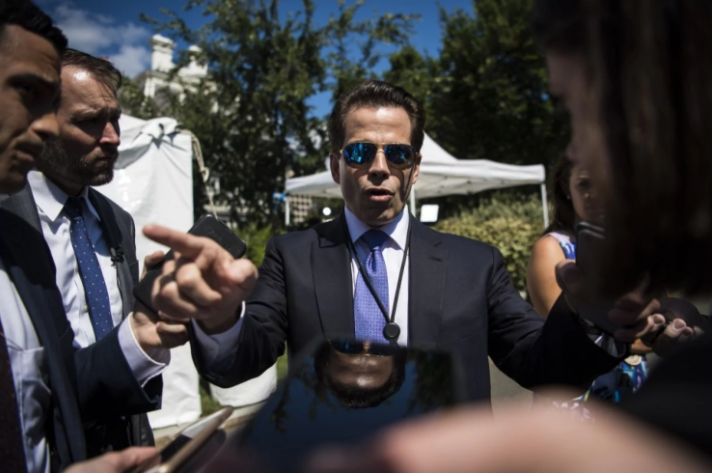
Scaramucci Implicates Priebus In Now-Deleted Tweet Following 'Felony' Leak Of $85 Mil Net Worth


White House Communications Director Anthony Scaramucci set of a firestorm of speculation last night with a now deleted tweet following a Politico article containing information he claimed was leaked - revealing his net worth at $85 million. Scaramucci stated that he "will be contacting @FBI and the @TheJusticeDept #swamp @Reince45," oddly tagging White House Chief of Staff Reince Priebus.


In response, Twitter exploded with rumors that Priebus was a White House leaker - an implication which Ryan Lizza of The New Yorker (and contributor to CNN) somehow confirmed.


30 minutes later, another "blue check" Twitter user - Josh Kraushaar from National Journal, tweeted "@RyanLizza reports on CNN that Mooch already contacted the FBI about Reince // not just a threat (as he said in tweet)."


As speculation reached a fevered pitch, Scaramucci - who keeps his phone at 100% charge - poured cold water over the hopes and dreams of everyone who hates Reince, tweeting "Wrong! Tweet was public notice to leakers that all Sr Adm officials are helping to end illegal leaks. @Reince45"


While Scaramucci said the "leak" of his financial disclosure form was a "felony," The New York Times reported that the document, filed on June 23, could have been released July 23 upon a journalist"s request. When reached for comment as to why he thought there was an illegal leak, Scaramucci told the NYT "They aren"t in process yet."


Hannity interview - and then dinner? 


Earlier in the evening, Scaramucci appeared on Fox News with Sean Hannity to discuss the leaks, where he said that the leaks were actually orders from senior officials handed down to underlings.


One of the big problems here that I"m discovering in the comms team is that senior people are really the guys doing the leaking, and they ask junior people to leak for them. So, I"m very proud to be reporting directly to the president so that I can hermetically seal off the comms team from this sort of nonsense.


You and I both know that there are political holdovers from the Obama administration that want to put a hurt on the Trump administration, so we have to sort of move quickly there as well. -Anthony Scaramucci


In response to Scaramucci"s appearance on Hannity, the DOJ issued this statement:


And in yet another "leaked" tidbit from earlier yesterday, Ryan Lizza also reported that president Trump, Sean Hannity, Bill Shine, and Anthony Scaramucci had plans to eat dinner together last night.


Don"t read too much into it, but apparently Reince wasn"t there...

Friday, July 14, 2017

Will Trump Use Obama's "Secret Debt Ceiling Plan" To Avoid A U.S. Treasury Default?

After voting to repeal and replace Obamacare 60 times under the Obama administration, Senate Republicans, now that it counts, are locked in a heated civil war over how or if they should even modify the controversial legislation.  As proven time and again, despite sharing a common party, conservative and moderate republicans have very little else in common.


So, while many may think that a repeat of the 16-day government shutdown in 2013 is unlikely while a single a party controls all three branches of government in Washington D.C., we suspect it may not be quite as simple as that.  Without a budget in place that truly balances, conservative republicans will most likely be unwilling to approve debt ceiling increases no matter who is sitting in the White House.


While republicans have attempted to get ahead of the game by passing a debt ceiling increase well in advance of a breach, efforts so far have failed.  And while it may seem far away, the U.S. government will reach its statutory limit on borrowing some time in October.  So how will Mnuchin handle the Treasury Department if Republicans fail to act and Democrats refuse to play ball?  Turns out Obama had a plan for that.  Per Bloomberg:


When the nation almost breached its debt ceiling six years ago, the Federal Reserve and Treasury drew up contingency plans that were kept secret until January, when transcripts of an Aug. 1, 2011 conference call at the central bank were released after a customary five-year lag.


Under the contingency plan, holders of U.S. debt and recipients of social security, veterans benefits and other entitlements would be paid first. Everyone else, such as government contractors and federal employees, would be at risk of payment delays or partial payments.


Though the scenario nominally protects holders of U.S. debt by prioritizing the payments they are due, it raises fears that the value of their underlying assets could suddenly decline if the U.S. government’s reputation for creditworthiness is damaged.


“I’m assuming that prioritization is the fallback,” said Lou Crandall, chief economist at Wrightson ICAP LLC. The acknowledgment in the Fed transcripts of the existence of a backup plan to pay interest first makes it more plausible, he said, calling it a “truly terrible idea.”


Under the prioritization plan described in the 2011 transcripts, Treasury would make all semi-annual coupon payments on debts in part by using monies built up by deferring other obligations. The government would auction new debt at regularly scheduled times only to fund old debts that matured.


Meanwhile, even though the plan would still make all interest payments on U.S. debt when due, it"s unclear whether Obama"s prioritization plan would merit further downgrades from the ratings agencies.


Prioritizing U.S. debt is a contentious issue, with no consensus over whether it constitutes a default. Former Treasury Secretary Jacob Lew called it “default by another name” while in office. Fitch Ratings disagrees, but says it would trigger a review of whether the U.S. still warrants a AAA rating.


Moody’s Investor Service, which considers it likely that the government would use the plan if the Treasury exhausts extraordinary measures to stay under the ceiling and Congress doesn’t act, seems comfortable with it. The agency says that the economic disruption that could erupt would expedite a political compromise to end the impasse.


Of course, in the long run these shutdowns are just a waste of time as politicians ultimately cave to pressure from a base of constituents who have been whipped into a state of mass hysteria by a barrage of news flow on the damning impacts of a government shutdown.


There is little support for prioritizing debt payments in Congress, with Oklahoma Republican Tom Cole, a member of the House Budget Committee, calling it a “harebrained scheme that is apt to backfire.”


“Proposing to pay interest to the Chinese first, while stiffing American businesses and households that are owed payments by Treasury, hardly seems like a winning political strategy,” Wrightson’s Crandall said. “We’re not sure how the market would respond to that kind of payments twilight zone.”


And, in the end, the result is always the same:


Debt

Saturday, July 1, 2017

Trump Unloads In Angry Tweetstorm: Slams "Dumb As A Rock" Mika, "Garbage" CNN

One day after the NY Post issued its shortest ever editorial on the topic of "Trump"s tweets", writing just three words: “Stop. Just Stop"...


... and which came on the heels of Trump’s latest Twitter controversy, where the president targeted MSNBC’s Morning Joe hosts Mika Brzezinski and Joe Scarborough for their coverage of the president and his administration, saying Scarborough was a “psycho” and Brzezinski “crazy” before going on to claim that Mika was “bleeding badly from a face lift” when she was at his Florida resort around New Year’s 2016, it appears that Trump has again ignored the advice, and in a burst of angry tweets, the president has doubled down by not only targeting Morning Joe"s Mika, whom he called "dumb as a rock", but also commenting on the unexpected departure of Greta van Susteren from MSNBC, and perhaps less surprisingly, the ongoing CNN "fake news" fall out, which in his latest twitter rant he called "garbage."


It all started off politely enough, withTrump wishing "Happy Canada Day to all of the great people of Canada and to your Prime Minister and my new found friend @JustinTrudeau. #Canada150"


However, things quickly went downhill from there, with Trump first speculating on the reason for Van Susteren"s depature, saying "Word is that @Greta Van Susteren was let go by her out of control bosses at @NBC & @Comcast because she refused to go along w/ "Trump hate!""


He next lashed out at CNN, again, saying "I am extremely pleased to see that @CNN has finally been exposed as #FakeNews and garbage journalism. It"s about time!"


Before finally taking aim, for the second time in three days, at the Morning Joe hosts: "Crazy Joe Scarborough and dumb as a rock Mika are not bad people, but their low rated show is dominated by their NBC bosses. Too bad!"


Trump"s Saturday tweetstorm may or may not be over, but it is sure to provoke more protests about unpresidential and/or improper language - by both democrats and republicans - from Trump, which in turn demonstrates that the president intends to continue defying the "proper" protocols of appropriate behavior. What his strategy is by doing so, if of course there is one, remains unclear.

Thursday, June 29, 2017

White House Press Secretary Defends Trump's Attack on Morning Joe: 'The President Will Not Be Bullied'

Content originally published at iBankCoin.com


I know, the Nasdaq is down 100 and tech stocks are engulfed in flames. But how do you expect me to sit here and ignore this story? As a person who lives to "stir the pot", this is the best timeline for me. All I have to do it sit back and watch the President of the United States talk smack all day, providing me with endless ways to trigger those opposed to him.


Just to recap today"s impeachable offense.


Trump tweeted to Joe Scarborough ( a never Trumper), and his soon to be wife Mika Brzezinski, these insane comments.


The response by Never Trumpers and the Hillbot brigade has been sheer unhinged outrage.


Here"s the statement by MSNBC.


Sen. Sasse


Sen. Graham


Sen. Collins


Here was Paul Ryan"s response.

And finally, White House Press Secretary, Sara Huckabee Sanders, defended Trump"s tweets, saying "the President will not be bullied."

Sunday, June 4, 2017

CNN Host Reza Aslan Calls President Trump a 'Piece of Shit' Following London Attacks

Content originally published at iBankCoin.com


CNN employs all of the finest people in media. One of their scholars, Reza Aslan, melted down last night, after Trump called for a travel ban -- following the results of the latest Islamic inspired attacks in London.


This is what the President said.


And this is what the CNN said?


Will CNN fire Mr. Aslan for disrespecting the office of the Presidency in such a degenerate and unprofessional manner?


NOTE: Reza"s family immigrated to the United States from Iran during the Iranian revolution in 1979.


BONUS: MSNBC asks if the police response to the London attacks were too much?

Thursday, May 18, 2017

Watch Live: Paul Ryan Hosts Weekly Press Conference As Russia Rumors Swirl

Updates:


Captain Obvious answered the first question of the day:


  • *RYAN SAYS IT"S ALWAYS NICE TO HAVE LESS DRAMA


Ryan refused to answer questions about Chaffetz"s alleged departure:


  • *RYAN HASN"T SPOKEN TO CHAFFETZ ABOUT WHAT HE"S DOING

  • *RYAN: OVERSIGHT CMTE HAS MADE DOCUMENT REQUESTS


On tax reform, Ryan said that the goal is still to get a bill passed in calendar year 2017.  Of course, equities are starting to doubt whether that"s actually possible.


  • *RYAN: OUR GOAL IS CALENDAR 2017 FOR TAX REFORM

  • *RYAN: I THINK BORDER ADJUSTMENT IS SMART WAY TO GO

  • *RYAN: U.S. TAX SYSTEM ONE OF WORST IN INDUSTRIALIZED WORLD


* * *


For the first time since former FBI Director Mueller was appointed Special Counsel looking into Trump"s alleged collusion with Russia, House Speaker Paul Ryan will take questions from an eager press.  Tune in below for the fireworks.


Monday, May 15, 2017

Watergate's Bernstein Warns Trump White House "Potentially More Dangerous" Than Nixon's

Infamous Watergate journalist Carl Bernstein, having criticized both Comey and Clinton in recent months, is now taking aim at President Trump. In a Sunday interview on CNN, Bernstein said current White House conditions could be more dangerous than the Watergate scandal.


As The Hill reports, Bernstein referred to President Trump"s decision to fire former FBI Director James Comey last week. Comey was leading the FBI"s investigation into the Russian meddling in the 2016 presidential election, including allegations that Trump"s campaign colluded with Moscow.


"I think this is a potentially more dangerous situation than Watergate and we"re at a very dangerous moment,"


"Because we are looking at the possibility that the president of the United States and those around him, during an election campaign, colluded with a hostile foreign power to undermine the basis of our democracy: free elections," Bernstein continued.


Bernstein said the country does not yet know the facts.


"But what we do know is, is that the president of the United States seems to be doing everything in his power to keep us from knowing the facts," he said.


"Including firing the director of the FBI because, says the president of the United States, of "this Russia thing." So the question of a cover-up seems to me to have been answered a while ago."


Bernstein said there is a cover-up going on to keep the public from knowing what happened.


"Whether that means the president of the United States obstructed justice or not, or those around him did, we don"t know," he said.


"But what we see is that at every turn, this president is impeding the ability of those who were chosen to investigate to do so...It"s a truly dangerous moment. It"s very different than Watergate."


Trump sparked controversy last week when he fired the FBI director. Bernstein is the latest to question the timing of the firing and raise comparisons between the current situation and the Watergate scandal. During an interview last week, Trump said: “When I decided to just do it, I said to myself — I said, you know, this Russia thing with Trump and Russia is a made-up story."


Ironically, Bernstein"s partner, reporter Bob Woodward, had some uncomfortable words for the mainstream media"s safe-space-seekers earlier in the year. Following a tempestuous few days as the media and the White House toss propaganda grenades at one another, on Friday"s broadcast of MSNBC"s "Hardball" show, the Washington Post Associate Editor stated that:


the press “shouldn’t whine, and if we sound like we are an interest group only concerned with ourselves, it doesn’t work with the public. At the same time, we need to continue the in-depth inquiries, the investigations.”


Still when did the opinion of the average American joe matter when there"s a narrative to peddle?

Monday, May 8, 2017

Robert Mercer, Co-CEO Of Renaissance, Sued By Former Employee Alleging Retaliation Over Trump

Back in February we reported of a striking development taking place at Renaissance, arguably the world"s most successful (and according to many, politically connected and powerful) hedge fund, where one of its key employees, David Magerman, "mutinied" against co-CEO Robert Mercer, the man who together with his daughter Rebekah have been instrumental in getting Trump elected, accusing him of engaging in actions that would harm the future of America.


Following Trump"s election Magerman - a research scientist who worked at the hedge fund for two decades and a registered Democrat who calls himself a centrist, and who had complained to colleagues about Mercer’s role as a prominent booster of Donald Trump’s presidential campaign - started to become more vocal at the office about his disdain for Mercer’s activities, which resulted in this awkward phone call with his boss, as reported by The Wall Street Journal


Magerman says he was in his home office in suburban Philadelphia earlier this month when the phone rang. His boss, hedge-fund billionaire Robert Mercer, was on the line.“I hear you’re going around saying I’m a white supremacist,” Mr. Mercer said. “That’s ridiculous.”


“Those weren’t my exact words,” Mr. Magerman said he told Mr. Mercer, stammering and then explaining his concerns about Mr. Trump’s policy positions, rhetoric and cabinet choices.


“If what you’re doing is harming the country then you have to stop.”


Following this rather "uncomfortable" phone call with his billionaire boss, as well as the real possibility of getting fired, one would think the democrat would have prudently decided to keep his mouth shut. But Magerman did no such thing. In fact, he ramped up his efforts to show Mercer that he’s not going to stand by and let the politics of Breitbart News ruin the country. There were more phone calls:


Magerman says he first spoke with Mr. Mercer in January, when Mr. Magerman, who donates to local schools, called Mr. Mercer to ask for the opportunity to reach out to Rebekah Mercer to offer the administration help on education policy. During the call, they talked politics, disagreeing about some of the administration’s early steps. After airing his concerns with others at the company, Mr. Magerman received the second call from Mr. Mercer two weeks ago.


The conversation grew strained. After telling Mr. Mercer to stop harming the country, he said Mr. Mercer responded that his goal had been to defeat Mrs. Clinton and that he wouldn’t remain very involved in politics.


“How can you say you’re not involved?” Mr. Magerman said, citing an outside group Rebekah Mercer was involved in that was aimed at boosting Mr. Trump’s agenda.


From that point on, relations between the two Renaissance workers devolved further, and eventually Magerman was suspended without pay in mid-February and could "no longer have contact with the company." That"s when the first WSJ story about the conflict inside Renaissance emerged once Magerman decided to go public. As a reminder, Mercer had emerged as one of the most influential Republican donors in the 2016 election, giving at least $2 million to Make America Number 1, a political action committee that began backing Trump in July. His daughter, Rebekah Mercer, was named to Trump’s transition team in November.


Fast forward to today, when as Bloomberg reports Robert Mercer was sued by Magerman, claiming he was fired for calling Mercer a racist and criticizing his support of Trump. The suit by David Magerman, a research scientist who worked at the hedge fund for two decades, alleges he was wrongfully fired April 29 after his relationship with Mercer and his family became toxic. For example, Magerman alleges that Mercer’s daughter called him “pond scum” at a celebrity poker tournament.


Mercer, a major investor in Breitbart News, advised Trump to hire two of his family’s associates, Stephen Bannon and Kellyanne Conway, according to the complaint filed May 5 in federal court in Pennsylvania. Mercer’s support "tainted" the hedge fund, while internal policies that prohibit "politely" speaking out in public are "unfair and untenable," Magerman said.


Bloomberg then recounts the public details about the deteriorating relationship between Magerman and Mercer, most of which had been previously noted on this site:


The dispute started on Jan. 16 when Magerman called Mercer and asked to have a conversation about his support of Trump, according to the complaint. During the chat, Mercer said the U.S. had started going in the wrong direction “after the passage of the Civil Rights Act in the 1960s,” according to the complaint. Mercer also said that black Americans “were doing fine” in the late 1950s and are the “only racist people remaining in the U.S.,” according to the complaint.


“Magerman was stunned by these comments and pushed back,” according to the complaint. Reminded of the racial segregation that existed at the time, Mercer allegedly responded by saying those issues weren’t important.


After the phone call, Magerman complained about Mercer’s comments to Co-Chief Executive Officer Peter Brown, who "expressed disbelief" and urged the two men to speak again, according to the complaint. Magerman agreed and called Mercer back on Feb. 5. "I hear you’re going around saying I’m a white supremacist," Mercer said, according to the complaint. During the call, Mercer "scoffed" at the idea that segregation was degrading and destructive, Magerman said.


Then there was the famous celebrity poker tournament, previously reported by the WSJ where things only got worse:


On April 20, Magerman attended a celebrity poker tournament in New York City, where many Renaissance staffers were present, according to the suit. Magerman told the Wall Street Journal that he attended the event to repair his frayed relationship with the firm, according to an April 28 article. Rebekah Mercer allegedly confronted Magerman, calling him "pond scum" and saying karma "is a bitch," according to the complaint. Magerman was fired April 29, according to the suit. Magerman seeks "substantial damages," his lawyer said.


Bloomberg notes that while the employee handbook bars workers from disparaging the hedge fund or any of its workers, such policies are "illegal and unenforceable," according to the complaint. It is unclear why one would make that assumption. In any case, one day after the Wall Street Journal article was published, Magerman was suspended without pay, according to the suit.


In light of the implied allegations in the suit, namely that a core employee was terminated due to his opposition for Mercer"s support of Donald Trump, and perhaps more importantly, because it will shed a bright light on what has traditionally been one of the most secretive hedge funds in the world, expect this case to be very closely watched by both market participatants and political commentators. It is also why Renaissance may seek to settle quickly, even if in the process it open itself up to lawsuits by other potentially disgruntled democratic employees.


Full lawsuit below.

Saturday, April 29, 2017

Will Trump Release The Missing JFK Files?

Authored by Philip Shenon via Politico.com,


The nation’s conspiracy-theorist-in-chief is facing a momentous decision. Will President Donald Trump allow the public to see a trove of thousands of long-secret government files about the event that, more than any other in modern American history, has fueled conspiracy theories – the 1963 assassination of President John F. Kennedy?


The answer must come within months. And, according to a new timeline offered by the National Archives, it could come within weeks.


Under the deadline set by a 1992 law, Trump has six months left to decide whether he will block the release of an estimated 3,600 files related to the assassination that are still under seal at the Archives. From what is known of the JFK documents, most come from the CIA and FBI, and a number may help resolve lingering questions about whether those agencies missed evidence of a conspiracy in Kennedy’s death. As with every earlier release of JFK assassination documents in the 53 years since shots rang out in Dealey Plaza in Dallas, it is virtually certain that some of the files will be seized on to support popular conspiracy theories about Kennedy’s murder; other documents are likely to undermine them.


There is no little irony in the fact that decision will be left to Trump, long a promoter of so many baseless conspiracy theories about everything from his predecessor’s birthplace to the notion that the father of one of his campaign-trail rivals was in league with JFK assassin Lee Harvey Oswald.


For the first time, the Trump White House is acknowledging that it is focused on the issue, even if it offers no hint about what the President will do. A White House official, speaking on condition of anonymity, told Politico last week that the Trump administration “is familiar with the requirements” of the 1992 law and that White House is working with the National Archives “to enable a smooth process in anticipation of the October deadline.”


Under the 1992 JFK Assassination Records Collection Act, the library of documents about Kennedy’s death must be made public in full by the deadline of this October 26, the law’s 25th anniversary, unless Trump decides otherwise. It is his decision alone.


The prospect of the release of the last of the government’s long-secret JFK assassination files has long tantalized historians and other scholars, to say nothing of the nation’s armies of conspiracy theorists, since no one can claim to know exactly what is in there.


Martha W. Murphy, the Archives official who oversees the records, said in an interview last month that a team of researchers with high-level security clearances is at work to prepare the JFK files for release and hopes to begin unsealing them in batches much earlier than October – possibly as early as summer.


Beyond releasing the 3,600 never-before-seen JFK files, the Archives is reviewing another 35,000 assassination-related documents, previously released in part, so they can be unsealed in full. Short of an order from the president, Murphy said, the Archives is committed to making everything public this year: “There’s very little decision-making for us.”


Many of the documents are known to come from the files of CIA officials who monitored a mysterious trip that Oswald paid to Mexico City several weeks before the assassination – a trip that brought Kennedy’s future killer under intense surveillance by the spy agency as he paid visits to both the Soviet and Cuban embassies there. The CIA said it monitored all visitors to the embassies and opened surveillance of Oswald as soon as he was detected inside the Soviet compound for the first time.


Other documents are known to identify, by name, American and foreign spies and law-enforcement sources who had previously been granted anonymity for information about Oswald and the assassination. At least 400 pages of the files involve E. Howard Hunt, the former CIA operative turned Watergate conspirator who claimed on his deathbed that he had advance knowledge of Kennedy’s murder.


The documents were gathered together by a temporary federal agency, the Assassination Records Review Board, that was established under the 1992 law. In an interview last month, its former chairman, Judge John R. Tunheim of the Federal District Court in Minnesota, said he “wouldn’t be surprised if there’s something important” in the documents, especially given how much of the history of the Kennedy assassination has had to be rewritten in recent decades.


He said he knew of “no bombshells” in the files when the board agreed to keep them secret two decades ago, but names, places and events described in the documents could have significance now, given what has been learned about the assassination since the board went out of business. “Today, with a broader understanding of history, certain things may be far more relevant,” he said.


Murphy, the Archives official, said she, too, knew of no shocking information in the documents – but she said her researchers were not in a position to judge their significance. “As you can imagine, we’re not reading them for that, so we’re probably not the best people to tell you,” she said. “I will say this: This collection is really interesting as a snapshot of the Cold War.”


The Review Board, created by Congress to show transparency in response to the public furor created by Oliver Stone’s conspiracy-minded 1991 film “JFK,” did force the release of a massive library of other long-secret documents from the CIA, FBI, Secret Service and other federal agencies, as well as from congressional investigations of the assassination.


Many showed how much evidence was withheld from the Warren Commission, the independent panel led by Chief Justice Earl Warren that investigated the assassination and concluded in 1964 that there was no evidence of a conspiracy in Kennedy’s death.


The documents showed that both the CIA and FBI had much more extensive information about Oswald—and the danger he posed to JFK—before the assassination than the agencies admitted to Warren’s investigation. The evidence appeared to have been withheld from the commission out of fear that it would expose how the CIA and FBI had bungled the opportunity to stop Oswald.


Under the 1992 law, agencies may make a final appeal to try to stop the unsealing of specific documents on national security grounds. But the law grants only one person the power to actually block the release: the president. The law allows Trump to keep a document secret beyond the 25-year deadline if he certifies to the National Archives that secrecy was “made necessary by an identifiable harm to military defense, intelligence operations, law enforcement or conduct of foreign relations” and that “the identifiable harm is of such gravity that it outweighs the public interest in disclosure.”


Both the CIA and FBI acknowledged in written statements last month that they are reviewing the documents scheduled for release; neither agency would say if it planned to appeal to the White House to block the unsealing of any of the records. “CIA continues to review the remaining CIA documents in the collection to determine the appropriate next steps with respect to any previously-unreleased CIA information,” said agency spokesperson Heather Fritz Horniak. The FBI said it had a team of 21 researchers assigned to the document review.


According to a skeletal index of the documents prepared by the Archives, some of the files appear to involve, at least indirectly, a set of conspiracy theories that Trump himself promoted during the 2016 campaign – about possible ties between Cuban exile groups in the United States and Oswald. On the campaign trail, Trump repeatedly promoted an article published last April in the National Enquirer that suggested a connection between Oswald and the Cuban-born father of Senator Ted Cruz of Texas, one of Trump’s rivals for the Republican nomination. The article was based entirely on a 1963 photograph that showed Oswald, a self-proclaimed Marxist and champion of Fidel Castro’s Communist revolution in Cuba, handing out pro-Castro leaflets in New Orleans with a man who, the tabloid suggested, was Cruz’s father, Rafael.


The Cruz family denied that the senator’s family was the man depicted in the photo and that Rafael Cruz had any connection to Oswald; there is no other evidence of any connection.


The National Archives index shows that the documents to be released this year include a 86-page file on a prominent CIA-backed anti-Castro exile group that Oswald appears to have tried to infiltrate in New Orleans, his hometown, in order to gather information that might be of use to the Castro government.


Judge Tunheim said that Oswald’s trip to Mexico City in September and October 1963 figures directly or indirectly in many of the documents that remain under seal, including the internal files of CIA operatives who worked at the American embassy there.


Historians agree that the trip, which Oswald apparently undertook in hopes of obtaining a visa to defect to Castro’s Cuba, much as he had once tried to defect to the Soviet Union, has never been fully investigated.


“I still think there are loose threads in Mexico City that no one has ever explored,” Tunheim said. “It was a bizarre chapter – there’s no question about it.” Previously declassified CIA and FBI documents suggest that Oswald openly boasted to Cuban officials there about his intention to kill Kennedy and that he had a brief affair with a Mexican woman who worked in Cuba’s consulate. The American ambassador to Mexico at the time of the assassination said later that he believed the woman had probably been working for the CIA.


Tunheim said the Review Board agreed to keep the Mexico-related documents secret in the 1990s at the request of the State Department, the CIA and other agencies that warned that their release could do damage to relations with the Mexico government, which worked closely with the CIA and FBI during the Cold War. “Mexico City was where everybody spied on everybody else,” the judge said.


But given the chill in relations between the United States and Mexico following Trump’s election and early moves by his administration to build its long-promised wall along the Mexican border, a similar plea to keep the documents secret may not go very far with the new president. Said Tunheim: “I guess we don’t have much of a relationship with the Mexican government to protect anymore.”

Friday, April 14, 2017

Stocks Are Completely Mispricing the Risk of a Another Debt Ceiling Screw Up

While everyone continues to focus on Trump and his policies, a much larger issue looms.


That issue is the US debt ceiling.


The US Government hit its debt ceiling on March 16, 2017. The Government employed “extraordinary measures” to keep the Government open. At that time, Congress had a little over three weeks to deal with this issue.


Given how divided Congress has become, it’s no surprise this has gone nowhere. Congress left for its spring recess without fixing this.


Congress returns on April 21st and will have just a handful of sessions to resolve this issue before its deadline. (April 28 2017).


In order to resolve this issue, Congress will have to resolve the budget… which includes issues that are EXTREMELY contentious (the US/Mexico border wall for one).


Put simply… in order to avoid a Government shutdown and potential repeat of the 2013 Debt Ceiling Crisis, the same Congress that cannot even get an Obamacare Repeal off the ground (one of the most sought after pieces of legislation in over a decade)… is supposed to somehow work out a budget including VERY contentious issues… in a HANDFUL of sessions.


Good. Luck. With. That…… particularly at a time when it is clear certain groups in Congress are all too happy to blow up deals in order to sabotage the Trump administration’s agenda.


This is an absolute mess. And the market is only just beginning to wake up to the risk here with the S&P 500 breaking below critical support on Thursday.


If you are concerned about a potential debt crisis in the US, you can take easy steps to prepare for it.


Indeed, you could even make money from it with the right investments.


On that note we are already preparing our clients for how to make money from this with tree simple investment strategies designed to pay out when the markets enter periods of heightened risk.


To learn them you can pick up a free Investment Report here:


http://phoenixcapitalmarketing.com/bondbubble2.html


Best Regards


Graham Summers


Chief Market Strategist


Phoenix Capital Research

Thursday, April 13, 2017

Recession Alert: Government Revenues Suffer Biggest Drop Since The Financial Crisis

On the surface, today"s monthly budget statement was disappointing: in March the US Treasury brought in total receipts of $216 billion, below the $228 billion last March, versus outlays of a record $392 billion, resulting in a deficit of $176 billion, more than the $167 billion expected, and $68 billion more than the previous year. For the fiscal year through March 31, the total US budget deficit was $527 billion, compared to $459 billion on year ago.


Declining government revenue and long-term costs associated with an aging population are expected to continue pushing up the deficit. Over the past 12 months, the deficit stood at $651.5 billion, compared with $460.6 billion a year ago, an increase of over 40% Y/Y.


On a 12 month run-rate, the US deficit stood at 3.1% of GDP. A year earlier, that figure was a third less, or 2.2%.


More troubling is that in March the US government had its biggest one month outlay ever, spending a record $392.8 billion, $57 billion or 17%  higher than a year ago.


The break down of March spending was as follows:


  • Defense: $58 billion

  • Social Security: 79 billion

  • Medicare: $75 billion

  • Interest on debt: $30 billion

  • Other: $151 billion

However, the most concerning picture emerges when looking at the annual change in the rolling 12 month total. It is here that we find that, like last month, in the LTM period ended March 31, total federal revenues, tracked as government receipts on the Treasury"s statement, were $3.264 trillion. This amount was 1.3% lower than the $3.31 trillion reported one year ago, and was the fourth consecutive month of declines. This was also the biggest drop since the summer of 2008.


Why is this important? Because as the chart below shows, every time since at least 1970 when government receipts have turned negative on an annual basis, the US was on the cusp of, or already in, a recession. Indicatively, the last time government receipts turned negative was in July of 2008.


One potential mitigating factor this time is that much of the collapse in receipts is due to a double digit % plunge in corporate income tax, which begs the question what are real corporate earnings? While we keep hearing that EPS are rising, at least for IRS purposes, corporate America is in a recession. As for that far more important indicator of overall US economic health, and biggest contributor to government revenue, individual income taxes? As of February, the YTD number was $695Bn, just fractionally higher than the same period a year ago.


Weak corporate profits have weighed on government finances in recent years amid sluggish global economic growth, depressed energy prices and a strong dollar, among other factors. At the same time, government spending continues to rise as the population grows older and more people qualify for Social Security and Medicare.


The latest, and most troubling budget report in this economic cyle, comes as the Trump administration and Republicans in Congress are weighing proposals to further cut corporate taxes, which would lead to even steeper declines in government receipts, while boosting spending on infrastructure, which are likely to spark a broader debate about tax and spending policies.


As to whether the 4th consecutive decline in tax receipts is indicative of a recession as it has been in the past, we"ll just have to wait. If Trump indeed wants a lower dollar and even lower interest rates, this may be just the catalyst that assures he gets precisely what he wants, killing any hopes of Fed rate hikes for the foreseeable future.

Sunday, April 9, 2017

Hacker Group Releases Password To NSA's "Top Secret Arsenal" In Protest Of Trump Betrayal

Last August, the intel world was abuzz following the news that a previously unknown hacker collective, "The Shadow Brokers" had hacked and released legitimate hacking tools from the NSA"s own special-ops entity, the "Equation Group", with initial speculation emerging that the Russians may have penetrated the US spy agency as suggested by none other than Edward Snowden. The Shadow Brokers released a bunch of the organization"s hacking tools, and were asking for 1 million bitcoin (around $568 million at the time) to release more files, however failed to find a buyer.


Attention then shifted from Russians after some speculated that the agency itself may be housing another "mole" insider. At the time, a former NSA source told Motherboard, that “it’s plausible” that the leakers are actually a disgruntled insider, claiming that it’s easier to walk out of the NSA with a USB drive or a CD than hack its servers." As famed NSA whistleblower William Binney - who exposed the NSA"s pervasive surveillance of Americans long before Snowden confirmed it - said, “My colleagues and I are fairly certain that this was no hack, or group for that matter, This ‘Shadow Brokers’ character is one guy, an insider employee."


In a subsequent Reuters op-ed by cybersecurity expert James Bamford, author of The Shadow Factory: The Ultra-Secret NSA From 9/11 to the Eavesdropping on America, and columnist for Foreign Policy magazine, he said that seemed as the most probable explanation, and that Russia had nothing to do with this latest - and most provocative yet - hack.


Since then, the Shadow Broker group, whose origin and identity still remains a mystery, disappeared from the radar only to emerge today, when in an article posted on Medium, the group wrote an op-ed, much of it in broken English, in which it slammed Donald Trump"s betrayal of his core "base", and the recent attack on Syria, urging Trump to revert to his original promises and not be swept away by globalist and MIC interests, but far more imporantly, released the password which grants access to what Edward Snowden moments ago called the NSA"s "Top Secret arsenal of digital weapons."


The article begins with the group explaining why it is displeased with Trump.


Don’t Forget Your Base


Respectfully, what the fuck are you doing? TheShadowBrokers voted for you. TheShadowBrokers supports you. TheShadowBrokers is losing faith in you. Mr. Trump helping theshadowbrokers, helping you. Is appearing you are abandoning “your base”, “the movement”, and the peoples who getting you elected.


Good Evidence:


#1—Goldman Sach (TheGlobalists) and Military Industrial Intelligence Complex (MIIC) cabinet
#2—Backtracked on Obamacare
#3—Attacked the Freedom Causcus (TheMovement)
#4—Removed Bannon from the NSC
#5—Increased U.S. involvement in a foreign war (Syria Strike)


The peoples whose voted for you, voted against the Republican Party, the party that tried to destroying your character in the primaries. The peoples who voted for you, voted against the Democrat Party, the party that hates, mocks, and laughs at you. Without the support of the peoples who voted for you, what do you think will be happening to your Presidency? Without the support of the people who voted for you, do you think you’ll be still making America great again? Do you be remembering when you were sitting there at the Obama Press Party and they were all laughing at you? Do you be remembering when you touring the country and all those peoples believed in you and supported you? You were those peoples hope. How do you be thinking it will be feeling when those people turn on you? Will they be laughing at you, hating you, and mocking you too?


TheShadowBrokers doesn’t want this to be happening to you, Mr. Trump. TheShadowBrokers is wanting to see you succeed.


The hackers then ask Trump whose war is he fighting:


 If you made deal(s) be telling the peoples about them, peoples is appreciating transparency. But what kind of deal can be resulting in chemical weapons used in Syria, Mr. Bannon’s removal from the NSC, US military strike on Syria, and successful vote for SCOTUS without change rules? Mr. Trump whose war are you fighting? Israeli Nationalists’ (Zionist) and Goldman Sachs’ war? Chinese Globalists’ and Goldman Sachs war? Is not looking like you fighting the domestic wars, the movement elected you to be fighting. You not being in office three months and already you looking like the MIIC’s bitch with John McCain and Chuck Schumer double dutch ruddering each other in the corner over dead corpses.


The post continues by exposing what the ShadowBrokers believe is the general mindset of Trump"s support base:


Your Supporters:


  • Don’t care what is written in the NYT, Washington Post, or any newspaper, so just ignore it.

  • Don’t care if you swapped wives with Mr Putin, double down on it, “Putin is not just my firend he is my BFF”.

  • Don’t care if the election was hacked or rigged, celebrate it “so what if I did, what are you going to do about it”.

  • Don’t care if your popular or nice, get er done, Obama’s fail, thinking he could create compromise. No compromise.

  • Don’t want foreign wars, Do want domestic wars, “drain the swamp”, “destroy the nanny state”

  • Don’t care about your faith, you sound like a smuck when you try to say god things

  • DO support the ideologies and policies of Steve Bannon, Anti-Globalism, Anti-Socialism, Nationalism, Isolationism


In the article, the ShadowBrokers also touch upon what until recently was the primary topic of the daily news cycle, namely the whether Russia is behind this (and any other black hat intel hacking operation):


For peoples still being confused about TheShadowBrokers and Russia. If theshadowbrokers being Russian don’t you think we’d be in all those U.S. government reports on Russian hacking? TheShadowBrokers isn’t not fans of Russia or Putin but “The enemy of my enemy is my friend.” We recognize Americans’ having more in common with Russians than Chinese or Globalist or Socialist. Russia and Putin are nationalist and enemies of the Globalist, examples: NATO encroachment and Ukraine conflict. Therefore Russia and Putin are being best allies until the common enemies are defeated and America is great again.


The report than goes on to suggest that the hacking group is in fact comprised mostly of former US spies: "President Trump, theshadowbrokers is offering our services to you and your administration. Did you know most of theshadowbrokers’ members have taken the oath “…to protect and defend the constitution of the United States against all enemies foreign and domestic…”. Yes sir! Most of us used to be TheDeepState everyone is talking about."


Then something changed, and the collective notes that "TheDeepState is being the enemy of the constitution, individualism, life, liberty, and the pursuit of happiness. With the right funding we can recruit some of the best hacker intel peoples in United States and world. “Unmasking” is being new buzz word, so we use. TheShadowBrokers is being happy to unmask anyone we considering to be an enemy of the Constitution of the United States."


Enemies like John McCain. Something doesn’t rub theshadowbrokers rite about Vietnam War POW who at every opportunity seeks to do violence to others via the proxy of young service men and women. If anyone should be being pacifist, slow to pick fight it should be being former POW. TheShadowBrokers is sure if we “unmasking”, Senator McCain, Magog itself might come out, many defense contractors, Saudi Princes, and possibly little Vietnamese boy he shares with Senator Lindsey Graham, not cool! Mr. Trump we know you are having DOJ and FBI, so why you be needing theShadowBrokers? You don’t, but theshadowbrokers is confused. Why haven’t you served search warrant to NYT, Washington Post, Goldman Sacks, Jeff Bezos, and all other Globalist for investigation and prosecution of treason, sedition, and un-American activities during a time of war? The


It was the conclusion to the post, however, that was most interesting - in it the Shadow Brokers urges Trump to be the "real deal" and has released the password to the NSA hacking tool binaries that made so much news last summer:


Mr. President Trump theshadowbrokers sincerely is hoping you are being the real deal and that you received this as constructive criticism toward #MAGA. Some American’s consider or maybe considering TheShadowBrokers traitors. We disagreeing. We view this as keeping our oath to protect and defend against enemies foreign and domestic. TheShadowBrokers wishes we could be doing more, but revolutions/civil wars taking money, time, and people. TheShadowBrokers has is having little of each as our auction was an apparent failure. Be considering this our form of protest. The password for the EQGRP-Auction-Files is CrDj”(;Va.*NdlnzB9M?@K2)#>deB7mN


Shortly after the blog post hit, Wikileaks noticed:


Even Edward Snowden got involved


As per Wikileaks, the released information include "browsable decrypted Shadow Brokers "NSA" hacking tools+docs files corresponding to password released today", and that "Hundreds of NSA cyber weapons variants publicly released including code showing hacking of Pakistan mobile system"


The github depository of the released code can be found here.


Other hackers organizations confirm, the key released by the ShadowBrokers has been verified:


Inside the NSA dump among many other findings, we find hundreds of NSA attacks on China, as well as penetration attempts in which the NSA "pretends" to be China so one wonders how difficult it would be for the NSA to pretend they are, oh, say Russia?


Additionally, today"s revelation exposes hacking attacks on EU states, as well as Latin America, Russia, China, Japan and South East Asia.  Among the contents one also finds the hacking configuration for China Mobile, the world"s largest mobile telecom company by number of subscribers (just under 900 million) and market cap.


Another example shows the NSA"s EquationGroup tool (ELECTRICSLIDE) impersonating a Chinese browser with fake Accept-Language.


We are in the process of further exploring the disclosed data, and will present any notable revelations in due course, however we find it quite interesting that now that the "rogue" element in the intel community appears to have given up on Trump, they are bypassing the president and taking their war with the "deep state" directly to the people.


Finally, a rhetorical question from Julian Assange on today"s revelations: