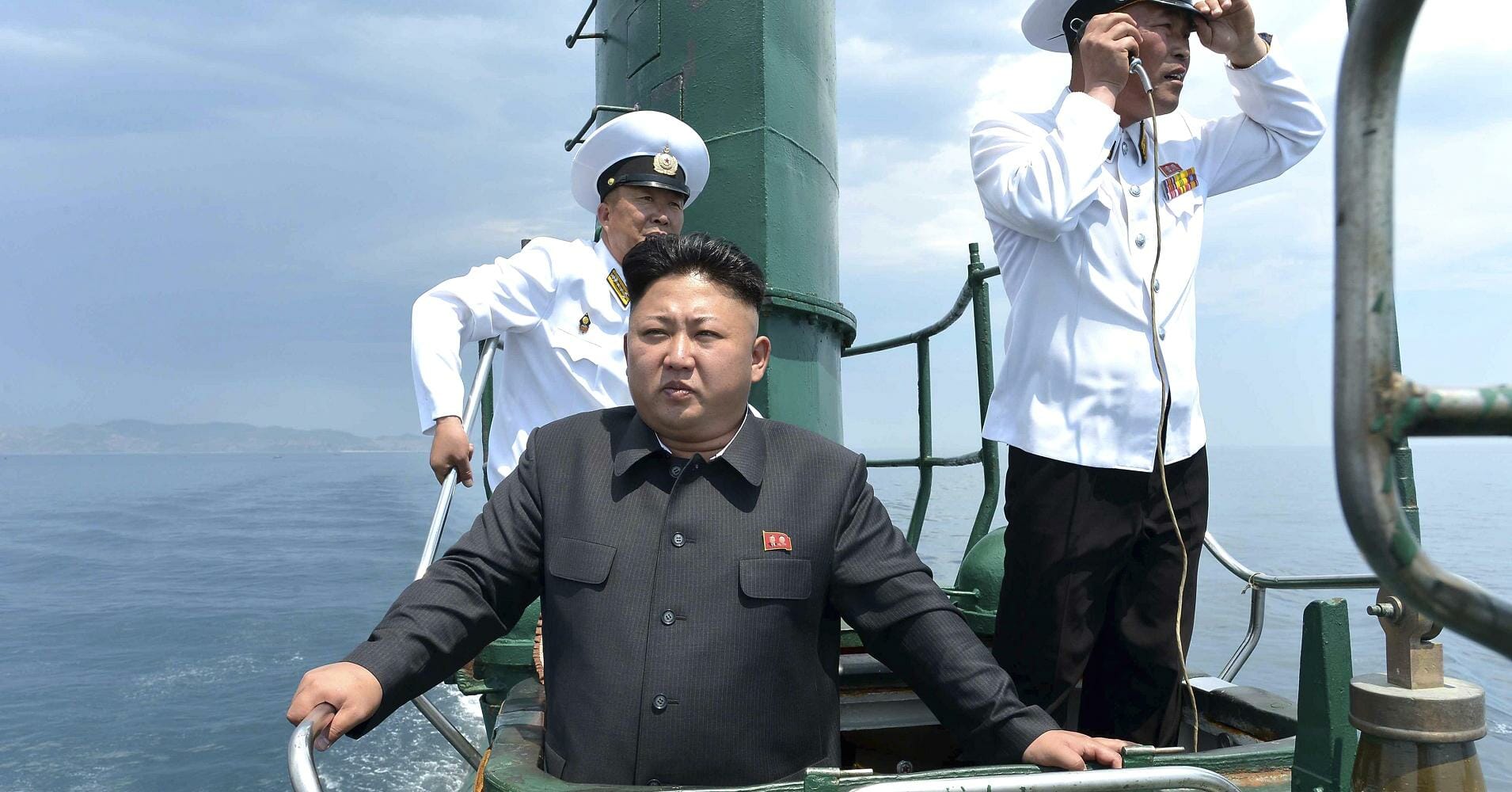
Showing posts with label submarine. Show all posts

Sunday, November 19, 2017

Crew Of Missing Argentine Submarine Makes Contact Attempt

Argentinians breathed a collective sigh of relief Saturday night after authorities revealed that the crew of a missing submarine had attempted to make contact for the first time since communication with the sub suddenly ceased on Wednesday. Defense Minister Oscar Aguad said over Twitter on Saturday night that the submarine, which was carrying a crew of 44 sailors, had sent seven “communication attempts” earlier in the day. He did not provide further details.


“We received seven signals from satellite calls that would come from the submarine San Juan. We are working hard to locate him and we convey hope to the families of the 44 crew members: that they may soon have them in their homes.”


The vessel disappeared from radar last week, forcing the Argentine navy to hastily organize a search and recovery effort. The last registered position of the vessel was on November 15 at 07:30 in latitude 46 ° 44 ‘south and longitude 59 ° 54 West, at the height of Puerto Madryn and off the coast of Patagonia. Since then, the vessel has not reappeared on radar, or been spotted by the search party, according to the Associated Press.


The whereabouts of the vessel, the subject of an intensive search involving eight nations including the US, remains a mystery. Officials don’t even know whether it’s at the surface or underwater.


The submarine ARA San Juan left Argentina Monday to participate in naval exercises off southern Argentina before departing Monday from the city of Ushuaia for a naval base in Mar de Plata. The last contact was made after the northbound vessel passed the Valdes Peninsula about 270 miles off Argentina’s coast.


NASA joined the search effort on Saturday with a P-3 Orion propeller-driven patrol airplane, equipped with magnetometers, infrared cameras and other sensors that can detect a submerged submarine. The aircraft, which can also measure ice thickness, is temporarily based in Ushuaia to take part in a NASA survey of Antarctica.


Argentine naval officials said they received no distress signals from the vessel, a German-built TR-1700 model, before losing contact. Vessels from Chile, Brazil, Peru, Uruguay, South Africa and the United Kingdom are also assisting in the search.


Pope Francis, a native of Argentina, said in a statement issued by the Vatican earlier Saturday that he was praying for the safe return of the submarine and its crew, and for “spiritual serenity and Christian hope” for Argentina. He said he felt especially close to family members “in these difficult moments."


Anguished family members of the crew have gathered at the Mar de Plata base awaiting news.


“It’s agonizing the passing of the hours, a mixture of horrible feelings and silence,” said Marcela Moyano, wife of submarine machinist Hernan Rodriguez, in an interview at the base with TodoNoticias TV channel before Aguad’s announcement. “It’s a situation of desperation and fear. But we’re still hopeful they are returning,” according to the Associated Press.


Of the missing sub’s 44 crew members, one is a woman: Lt. Eliana Maria Krawczyk, 34, the sub’s operations chief. Her father, Eduardo, said in a TV interview Thursday that he last talked to his daughter two weeks ago.


“She told me that after arriving at Tierra del Fuego, that the (female) governor of the state came aboard the submarine and congratulated her because a woman was on the crew,” Eduardo Krawczyk said. He added that he is praying for his daughter’s safe return and that seeing her again will be like “being born again."


Psychologists and a Roman Catholic bishop have arrived at the naval base to counsel family members. Navy spokesman Enrique Balbi said the fleet was “not discarding any hypothesis” on what might have happened to the sub.  “We are going to suppose the submarine had problems of communications, that there might have been a blackout, or power failure, and that it is now adrift,” Balbi said. “From (projected) movement after going adrift, we can estimate the search area."


The diesel-powered sub is one of three submarines in Argentina’s fleet. Measuring 220 feet long, the sub has a range of 13,000 miles. It underwent a major overhaul and reconditioning in 2008 that officials here say qualified it for 30 years more of use.


But weather in the search area has turned rough, with strong winds and waves as high as 20 feet, complicating the rescue operation, Balbi said.


“Remember that the part of the submarine that is above surface is very small, just a third of its length. The color of the vessel doesn’t help either because it mimics that of the ocean,” Balbi told reporters.


Argentine President Mauricio Macri tweeted Friday that the government is doing everything it can to find the sub: “We are in contact with the families of the crew of the submarine ARA San Juan who is missing to inform and support them. We share your concern and that of all Argentines."


Four Argentine ships, various helicopters and 500 marines are participating in the search.


Sunday, August 13, 2017

Satellite Images Suggest North Korea Preparing Submarine Ballistic Missile Launch

On Friday afternoon as the market was about to close, we discussed an unconfirmed report that North Korea had issued "emergency standby orders" to its civil defense units, and we said that at the same time, "traders are furiously hitting refresh on the website of 38North.org for the daily satellite image update of North Korea"s missile launch preparedness, which has yet to hit and which could mean the difference between another sleepy, boring open on Monday and a VIX surging above 20, 30 or more depending on what "path" Kim Jong-Un picks over the next 48 hours."


Shortly after the note, 38North, best known for its real-time satellite imagery of North Korean military operations and slightly less known for a pro-war spin according to some (hence, take their conclusions with caution), reported that recent satellite photos suggests that North Korea is preparing for fresh submarine-based missile tests even as Trump has repeatedly stated that any new provocation from North Korea could be grounds for a military operation.


Referring to photographs taken on August 7, Joseph Bermudez, a North Korea specialist, claimed that they could indicate preparations for a new test of a submarine-launched ballistic missile (SLBM). "Recent commercial satellite imagery reveals several developments suggesting that North Korea may be accelerating the development of the sea-based leg of its nuclear forces," he said.


Of particular interest in the imagery is that netting or tarps have been suspended above both the fore and aft decks of the SINPO-class submarine obscuring any activity taking place beneath them. This was last done prior to the July 9, 2016 test of the Pukguksong-1, suggesting that the North may be preparing for a new series of “at sea” test launches, has undertaken modifications or upgrades to the submarine’s launch systems, or is developing a more advanced version of the Pukguksong-1. Recent ejection tests of an SLBM also support the assessment that an at-sea SLBM test may be forthcoming.


Figure 1. Netting or tarps suspended over SINPO-class SSBA in the secure boat basin


Some further details:


As noted in our July report, sometime during the last week in May, the SINPO-class submarine was repositioned forward along its dock and the submersible test stand barge was moved to a position aft of the submarine (both had previously been in their former positions since December 9, 2016). Since the July report, netting or tarps have been suspended above both the fore and aft decks of the submarine obscuring any activity taking place beneath them. The only other time this was seen was during May-July 2016 and prior to the failed July 9, 2016 Pukguksong-1 test. It is unclear if this activity is signaling a forthcoming at sea SLBM test, although the recent ejection tests would support such an assessment. No activity is noted on or near the submersible test stand barge in the latest image.


Figure 2. Netting or tarps suspended over SINPO-class SSBA observed in May 2016.


Separately, Bermudez said that imagery of the Mayang-do Navy Shipyard and Submarine Base shows the same number of ROMEO-class submarines that are usually berthed there, indicating that a recent spike in ROMEO activity in the East Sea (Sea of Japan) was a singular rather than force-wide event.


Imagery of the Mayang-do Navy Shipyard and Submarine Base shows the same number of ROMEO-class submarines that are usually berthed there, indicating that a recent spike in ROMEO activity in the East Sea (Sea of Japan) was a singular rather than force-wide event. The week-long patrol by a ROMEO-class attack submarine in the East Sea (Sea of Japan) was “highly unusual and unprecedented,” as Korea People’s Navy submarines have not been known to venture far from their home ports over the past ten years. The few times they have, it has been only to participate in short annual military exercises. The purpose of this recent activity is unclear, but there are several potential explanations including: Kim Jong Un’s desire to expand his provocative policy of the past two years into the naval arena; a practical exercise demonstrating renewed North Korean offensive naval capabilities (potentially a component of the strategic review of military capabilities ordered by Kim Jong Un when he came to power); a training cruise intended to prepare a submarine and its crew for a longer cruise to monitor future ballistic missile tests or conduct offensive conventional attack missions; validation of upgrades to the ROMEO-class submarine (a number of ROMEO-class submarines have been undergoing extended maintenance and refurbishment during the past five years)—or some combination of the above.


A preliminary comparison of the submarine activity at both the Mayang-do Navy Shipyard and Submarine Base during the past twelve months with the August 7 image shows the number of ROMEO-class submarines has remained relatively constant, averaging 12-15; and the number of SANGO-class coastal submarines averaging 11-15. In the August 7 image, 12 ROMEO- and 15 SANGO-class submarines are berthed. This suggests that the July “unusual activities” were a singular event rather than a force-wide event. Regardless, extended North Korean operations in the East Sea should be viewed with concern.


Figure 3. Multiple SANGO and ROMEO-class submarines berthed in the Mayang-do Navy Shipyard.


Figure 4. One SANGO-class and three ROMEO-class submarines berthed at the south pier of the Mayang-do Submarine Base.


Tuesday, August 1, 2017

North Korea Quietly Testing Submarine Nuclear Missile System In ‘Highly Unusual’ Activity

North Korea Quietly Testing Submarine Nuclear Missile System In ‘Highly Unusual’ Activity


North Korea is testing a submarine missile system in what one defense official called “highly unusual and unprecedented levels” of activity.


Four tests of a cold-ejection launch system for submarine-based ballistic missiles have been carried out at the Sinpo Naval Shipyard this year, with the latest one taking place in recent days, officials told CNN.


A cold-launch system prevents the missile’s engine from burning the submarine. With such a system, the missile is propelled away from the submarine before the engine starts.


Are Your Prepared For A Downed Grid? Get Backup Electricity Today!


“Achieving a successful cold-launch ejection test, even from land-based tubes, is a critical step forward in making an operational missile,” defense analyst Michael Gatling told The Telegraph. “The whole point of putting missiles into a stealthy platform like a submarine is to achieve tactical surprise, and this moves closer to that.”


Just last week, North Korea tested an intercontinental ballistic missile (ICBM) that experts say likely could have reached Denver or Chicago if it had been fired in that direction.


Strangely enough, North Korea has the world’s largest submarine fleet with 76 ships, according to Global Firepower. Most of those vessels are small diesel-powered submarines not capable of hauling missiles, but all it would take is one nuclear submarine to cross the Pacific to kill several million Americans.


Meanwhile, a North Korean submarine equipped with 14 torpedoes and up to 20 mines conducted tests for a week in July off the coast of the Korean peninsula. Officials with the US-Korea Institute at Johns Hopkins University told The Telegraph that the latest cold-launch test “most likely is preparations for a test in the near future of an updated Pukguksong-1 submarine-launched ballistic missile or a potentially newer system.”


North Korean launched its first submarine-launched ballistic missile (SLBM) in August 2016.


What do you think the Trump administration should do? Share your thoughts in the section below:

Saturday, April 29, 2017

Meet The Machine-Gun Wielding Robots And 'HyperSubs' Of Modern Warfare

When the U.S. Marines and Allied forces stormed the beaches of Normandy in June 1944 over 200,000 Allied forces lost their lives in a matter of weeks. Now, courtesy of some futuristic military technology, "storming a beach" can be done from a completely remote location with some machine-gun wielding robots and not a single human casualty. 


Per a recent Fox News note, in addition to miniature robot tanks, the Navy and Marine Corps have been quietly testing about 50 new fascinating technologies at Camp Pendleton, at the Ship-to-Shore Maneuver Exploration and Experimentation Advanced Naval Technology Exercise 2017, in California.  Among other things, new gadgets include speedboats that instantly transform into small stealthy submarines that can dive beneath the surface to avoid detection.


First up, meet the Multi-Utility Tactical Transport (MUTT) unit designed by General Dynamics.


The ATV-sized robots are mounted with machine guns that can charge up a beach and drive themselves, while helping dismount small units.


Surf, sand and steep inclines are not going to stop the water-friendly MUTTs. The vehicles drive on tracks, or wheels, and there are two wheeled variants: 8x8 and 6x6.


The robot can be mounted with a range of different weapons, including machine guns.


The Browning M2 .50 caliber machine gun that weighs about 84 pounds is one option. Others include the belt-fed fully automatic FN Hershel 240B medium machine gun and the classic SAW (Squad Automatic Weapon M249).


Beyond machine guns, they’ve also been successfully kitted out with options like 60mm mortars.


Watch the latest video at video.foxnews.com


And here"s another look:


Next up, and something that looks as if were lifted straight out of a Batman flic, is the "HyperSub", designed by Reynolds Marion, which can serve as a speedboat operating on the surface of the water or quickly dive beneath the water to avoid detection.


Aside from the hybrid speedboat-submarine being worthy of a Hollywood summer blockbuster, it could potentially be used for tasks like scouting and surveillance. It could travel rapidly ahead of the fleet speeding along the surface.


Marion calls the hybrid Fathom, a “HyperSub.” A specific model was created and brought to this exercise with details rather hush hush. But in general, the HyperSub can deploy from a beach or a dock and with its two 480-hp Yanmar 6LY3-ETP diesel engines reach cruising speeds of 38 mph.


To evade enemy detection, it could dive beneath the surface. Able to recharge dive air and batteries, the vehicle can dive repeatedly. It is designed to provide protection from pressure changes.


The HyperSub has more than 30,000 pounds of lift on demand. When the “coast is clear,” the Fathom can surface again and zip along the shore conducting surveillance.


Of course, these are just the toys the U.S. military is willing to show us...

Friday, April 21, 2017

China Is Building The World's Largest Nuclear Submarine Facility

Perhaps it is time to shift attention away from the "rally around the flag" diversion that is North Korea and pay some attention to China, which delighted by the ongoing geopolitical distractions is currently building the world"s largest submarine facility, which will be able to produce as many as four ultramodern nuclear submarines at a time.


Starting later this year, China"s new submarine factory on the Yellow Sea will churn out nuclear-powered attack submarines (or SSNs) ensuring that the sub program of the People"s Liberation Army Navy (PLAN) will soon be a deadly global force. Once fully operational, the assembly line will enable China to at least match USN SSN production.


Bohai Shipbuilding Heavy Industrial Corporation (BSHIC) is putting the finishing touches on its new facility, which as profiled by Popsci, will start production this year. BSHIC, based in Huludao, Liaoning Province, is China"s only builder of nuclear submarines. It previously built the Type 091, 093 nuclear attack submarines (SSN) and Type 092 and 094 nuclear ballistic missile submarine (SSBN).


When this enclosed submarine factory begins operation later this year, the BSHIC will be able
to quickly build nuclear submarines.


Why is this building such a big deal? Simple: inside a superstructure, submarines are hidden from snoops, spies, and satellites. It also provides a controlled environment for development and construction.


According to Popsci, the massive new assembly hall, which measures more than 430,000 square feet, has enough room for two parallel production lines; each production line has one half dedicated to assembling and attaching together submarine modules, and the other half dedicated to finishing the hull with quieting measures like anechoic tiles. That"s enough space for four SSN"s to be built simultaneously (two sets of modules being assembled at one end, and another pair of assembled hulls being fitted out before launch). Once completed, the SSN is rolled off the line and into the ocean. The assembly hall can also handle construction of the next generation SSBN, the Type 096.


The module assembly hall is well equipped, with gantry cranes for lifting SSN modules in
position
and parallel rails for moving completed hull sections further down the assembly line.


The facility is reported to begin construction on the first Type 095 SSN later this year. The Type 095 is expected to have a single/hybrid pressure hull, pumpjet propulsion and vertical launch system cells, making it (at least) superior to older SSNs like the U.S."s Los Angeles III and Russia"s Akula II.


The Type 095 SSN, swhon in this rendering, will likely have VLS cells for launching a wide range of cruise missiles, plus pumpjet propulsion and improved quieting technology. The first Type 095  will likely begin production in late 2017 at the new BSHIC factory, with many more to follow in the 2020s.


Monday, February 20, 2017

Russian UN Ambassador Dies Unexpectedly in New York, As Russian Warship Trawls U.S. Shores

churchin


In a world where nothing is coincidence…


Yet another Russian diplomat has died unexpectedly at a time when tensions between East and West are great, and when there is a great deal of subterfuge going on behind the scenes.


Few could forget the shocking video of Andrei Karlov, Russia’s ambassador to Turkey, being shot at an art gallery podium in Turkey by a man who was supposed to be on his security detail. Russian and Turkish leaders both suggested that it was an attempt to undermine cooperation and potential peace agreements over Syria.


Only hours after that event took place in December, a second Russian diplomat, Petr Polshikov, was reportedly found dead from a gun shot wound in his Moscow apartment. No further details have emerged, but a great deal of speculation was fueled as to what was really going on.


Now, Russia’s ambassador to the United Nations, Vitaly Churkin, has “unexpectedly” dropped dead – one day before his 65th birthday from an apparent heart attack, though an autopsy and further determination of the cause of death could be forthcoming.


According to Reuters:


Russia’s combative ambassador to the United Nations, Vitaly Churkin, died suddenly in New York on Monday after being taken ill at work, the Russian Foreign Ministry said.


The ministry gave no details on the circumstances of his death but offered condolences to his relatives and said the diplomat had died one day before his 65th birthday.


It declined to comment on reports that Churkin had been taken to a hospital shortly before his death.


A U.S. government official, who was not authorized to speak publicly on the case, said that Churkin had died of an apparent heart attack.


A federal law enforcement official, also speaking on condition of anonymity, said that there appeared to be nothing unusual about the ambassador’s death.


[…]“Ambassador Churkin remained at his work post until the last minute. He devoted his whole life to defending the interests of Russia and was to be found on the very front lines and in the most stressful posts.”


Meanwhile, the U.S. Coast Guard has been tracking a Russian spy ship that is trawling off the East Coast – and quite near to an American submarine base in Connecticut and to the borders of United States territorial waters in general.


Surely, there is no reason for concern there… because it’s ‘not a direct threat.’


According to the Courant.com:


The military tracked a Russian spy ship moving up the East Coast to within 30 miles of the Naval Submarine Base in Groton Wednesday and some political figures called the maneuver another aggressive action by Russian President Vladimir Putin.


“At this point there’s not a violation of international waters. Unless that happens you aren’t going to see any aggressive pushback, but it’s something that has us on high alert,” U.S. Rep. Joe Courtney, D-2nd District, told The Courant.


Two retired Navy submarine commanders downplayed the Russian presence, saying the ship presents little threat to U.S. security. Such Russian intelligence ships routinely patrol areas outside U.S. naval bases and track U.S. and allied forces’ naval exercises.


[..]


“The U.S. Coast Guard is aware of a Russian Federation-flagged vessel transiting international waters off the East Coast of the United States, as we are of all vessels approaching the U.S. The ship has not entered U.S. territorial waters, which extend 12 miles out to sea,” the Coast Guard said in a statement. “We respect freedom of navigation exercised by all nations beyond the territorial sea of a coastal state consistent with international law. The Coast Guard continues to coordinate with federal agency partners to monitor maritime contacts operating in the vicinity of U.S. shores.”


Curiously, there have been other assassinations taking place as well.


While the mainstream media and deep state figureheads have been busy assassinating President Trump’s character, covert operations have been taking place around the world.


The half brother of North Korean dictator Kim Jong Un – said to be at odds with the premiere – was just assassinated in a Malayasian airport in a bizarre series of events that involved two women apparently putting a cloth around his face and/or spraying some sort of aerosol on the exiled potential heir.


As SHTF reported, the two women told police they thought they were taking part in a viral prank video – and may well have been unwitting of their role in his death. Either way, the unconventional hit was capture on CCTV video for all the world to see.


This isn’t just about North Korea, though. Clearly, “they” can get to anybody, anytime, by whatever means they please:


While it has been presumed that Kim Jong Nam, the half brother of the dictator, was killed by North Korea, given their long history of cutthroat politics and petty reasons for assassinating dissenters among their ranks, there may well be more to the story.


Big things are in the works. China is reportedly cutting off billions of dollars of coal that it sells to North Korea, which will put tremendous pressure on the regime. Meanwhile, the new regime in the U.S. could eye the Hermit Kingdom as a new, easy enemy to rally around – particularly given that North Korea was listed as a member of the so-called “Axis of Evil” back during the last Bush Administration.


Who, exactly, is chasing whose tail?


That much remains a mystery.


Are Russian diplomats dropping like flies because the CIA or other covert agency are targeting them – as one ex-CIA official blatantly called for on television – or could someone within Putin’s Administration be culling internal opponents to some agenda? Perhaps there are other motives, as well. Or perhaps, it is just another individual taken by the toll of stress and overwork.


Is Churkin’s death just another part of life, or is it more writing on the wall that things are anything but normal in the current state of affairs?


Read more:


Uncensored RAW VIDEO: Russian Ambassador Shot Dead In Turkey


Thwarted Peace? Assassination of Russian Ambassador “A False Flag Operation By the West”


Update: “Putin’s Favorite Chauffer” Killed In Accident… Exactly As Former CIA Director Described On TV


Creepy and Bizarre: Pranksters Set-Up to Assassinate Kim Jong Un’s Half Brother with “Aerosol Spray”