Showing posts with label Films. Show all posts

Sunday, December 24, 2017

So Which Is It?

(As a reminder, you can get free, real-time crypto charts in SlopeCharts).


Forty thousand dollars per bitcoin. One hundred thousand. Three hundred thousand. The predictions are as numerous as the people making them.


I don"t pretend to know which one is going to be reality, and neither should anyone else. I do find the simplified presentation of price movements during manias to be an interesting road map, however. We all know that last week cryptos went crazy, with some losing more than half their value. On Friday, and into this weekend, they are beginning to strengthen, and I suspect many crypto-bulls have heaved a sigh of relief and are comforted by the fact this was just another one of those scary downturns. They don"t say HODL for nothing, you know.


phases


The zealots, I imagine, would point to the green tinted area I"ve highlighted above as the current state of affairs. That is, we"re still in the "awareness phase", and, yeah, there was a sharp, scary selloff, but all it"s going to mean is that the pantywaists aren"t going to stick around for the man-sized gains.


Maybe. Maybe not.


To my mind, it"s also plausible that what we saw was more along the lines of the cyan-tinted zone. What happens to cryptos this week might be an important "tell" in that respect.


If prices continue to stabilize and eventually bolt past the lifetime highs we saw not long ago, it will simply egg on the crypto crowd, because it will be the umpteenth example that selloffs are temporary and, for the bold, buying opportunities. They can all get back to the game of seeing Who Can Utter The Most Outlandish Prediction.


On the other hand, if the cryptos can"t muster their way past those highs - - if, instead, they stall out, start to weaken and.......gasp.......slip before the selloff levels we witnessed late last week, it"s going to stoke the flames of fear flickering from Friday.


btc


I"m somewhat in the "Post-New Paradigm" camp, myself, and would humbly suggest comparing the price chart above (and its tint) to the earlier diagram.

Thursday, October 12, 2017

Twitter Labels Ben Affleck "Buttman" After Women Accuse Him Of Groping Them

Nearly two dozen women have accused Harvey Weinstein of crimes ranging from sexual harassment to groping and even rape in a scandal that’s upended the entertainment industry’s power structure and threatening to tarnish the reputations of several other public figures, including politicians like Manhattan Attorney General Cyrus Vance Jr., who killed an investigation into Weinstein back in 2015.


But of all the Hollywood figures who’ve been criticized for tacitly condoning Weinstein’s behavior, none have sustained quite as much reputational damage as Ben Affleck, who’s been branded as a hypocrite by Weinstein accuser Rose McGowan for his half-hearted condemnation of Weinstein’s actions.


Soon after Weinstein accused Affleck of lying in a statement disavowing Weinstein, twitter users brought up a 2003 incident where Affleck appeared to grope actress Hilarie Burton live on camera, which in turn prompted several women to come forward to allege that Affleck groped them during a party years ago.


Twitter users gleefully responded by branding Affleck with a hilarious new epithet: The Buttman.


Affleck famously played Batman in a widely panned “Batman vs. Superman.”


Affleck has apologized to Burton...


Then the other women came forward.


Then Buttman was born...


Affeck has yet to respond to the groping accusations.


…But just in case you weren’t an avid watcher of TRL back in 2003


Tuesday, October 10, 2017

Hollywood’s War on Humanity

Via The Daily Bell


Oh, Hollywood… It’s only in this demented part of the planet that a man could give birth to his own mother!


If you haven’t seen it yet check it out.


mother!


Its another stillborn of a film slipped out from between Hollywood’s fetid thighs. A movie midwifed by none other than the talented, anti-human auteur Darren Aronofsky.


Thanks, Darren, for sharing with us your great message! Which is that people are shit. We hear it every day, thanks for chiming in.


We are too greedy, noisy, selfish and we use too many resources. Got it.


This self-serving lie has turned into Chinese water torture by now. Its steady, hypnotic beat against our foreheads is designed to get us to agree, if only to make it stop.


We hear it on the news, in the schools, and of course in art. How much of a virus we are.


Listening to those who’ve hijacked our culture you’d think us humans are base cannibals, roasting and eating our dear mother (earth) alive… pass the salt!


How many times have you heard it yourself? From friends, relatives, colleagues, randoms… “Ya know, there are too many people.”


Oh? Quick, kill yourself then. No? I didn’t think so. These types always want to volunteer others though.


Oh, and God is a bastard, of course. Another of Hollywood’s old hats found in the bowels of this film.


So lets recap mother! 


1. Humans are a craven, unworthy lot.
2. It’s because God is a sadist.


That’s the movie, delivered via ham-fisted allegory. Aronofsky says he came up with the idea in 5 days while reflecting on the Bible. It’s also about as long as it takes a ham-fisted sandwich to rot.


This, my friends, is the state of art in the West. It’s our last gasp and the culture vultures are circling.


3 worldwide monopolies are still run out of the United States. Money, War, and Culture. And they go hand in hand in hand.


Hollywood is a keystone here, controlling the zeitgeist. Telling us whats cool, whats funny. Who we should be killing.


Over the last hundred years Hollywood has targeted: The Germans, the Germans again, the Russians, the Arabs, the Russians again. In that order. And the Germans still don’t get a day off.


These cultural takedowns always prop up actual wars, hot, cold and proxy.


And now humanity itself is the target. We are being taught through garbage like mother! to hate ourselves. And it’s working. You hear everywhere that overpopulation is the problem.


You hear that because you are the enemy. 


The overpopulation parrots have no imagination. They can’t see the cities built on the mountain ranges, under the sea, in space. Last time I checked a single apple seed can produce an infinite number of apples and seeds. You can grow plants in the middle of the Sahara desert, without soil in glass basins made from sun-welded sand and with water sucked out of the air. How about that.


The issue of resources is a technical one. And if humanity needs a particular resource but can’t get it we’ll invent our way around it. That’s what we do.


Overpopulation isn’t the problem. The boring, unimaginative little monsters that rule over us are. And their disdain for the average person is crystal clear.


Here’s the deal.


If they can convince us that we are animals, they can then treat us like animals.


Its all the justification needed to corral us, tag us, shear us, and butcher us. Those that orchestrate such mental machinations are the same types of people that rolled heads down pyramids.


And Hollywood isn’t just a perverted pedo-playground producing garbage. Hollywood is bonafide cancer engaged in psycho-cultural warfare.


If only we could stop dancing to their tune and recognize it for the death dirge that it is.


mother? Not mine.


This boring story of the human animal has run its course. Let’s get back to the inspiration that accompanied the divine human. Let’s reach for the real stars.

Friday, September 29, 2017

The 'Koyaanisqatsi' Economy

Authored by Raul Ilargi Meijer via The Automatic Earth blog,


The film Koyaanisqatsi was released in 1982. The title means ‘life out of balance’ in the language of the Hopi, a Native American tribe who live(d) mainly in what is now north-east Arizona. It is directed by Godfrey Reggio with music by Philip Glass and cinematography by Ron Fricke. There are no actors, and no dialogue. Philip Glass’s music underlies a series of film fragments that contrast the beauty of American nature with the noise and pollution mankind has added to it. Wikipedia:


The film consists primarily of slow motion and time-lapse footage of cities and many natural landscapes across the United States. The visual tone poem contains neither dialogue nor a vocalized narration: its tone is set by the juxtaposition of images and music. Reggio explained the lack of dialogue by stating “it’s not for lack of love of the language that these films have no words. It’s because, from my point of view, our language is in a state of vast humiliation. It no longer describes the world in which we live.”


Due to its initial success, Reggio and Glass made two sequels to the film, Powaqqatsi (1988), meaning “parasitic way of life” or “life in transition”, and Naqoyqatsi (2002) which means “life as war”, “civilized violence” and “a life of killing each other”. If you haven’t seen them, they come highly recommended.


Koyaanisqatsi is an fitting term to describe not only our world in general, but also our economies. They are severely out of balance, and getting more so every day. But economies, like nature, need at least a minimum in balance. If that disappears, this lack of balance will tip them over. It is somewhat strange that this is not being recognized, and not even discussed.


It’s as if people think that when almost all wealth goes to a select very few, an economy can still continue to function. It can’t. The rich getting continually richer means the poor getting poorer (as overall growth is slow or non-existent), until the latter reach a point where they can no longer afford even basic necessities. That’s when parts of an economy will start dying, in the same vein that parts of a living body, an organism, die off when the supply of blood, nutrients and oxygen is cut off.


For an economy to function, it needs money to flow through it the same way a body needs blood to flow. If all the money gets increasingly concentrated in just a small area, the economy stagnates. We measure the flow of money as velocity:


If that graph would describe a human body, it would be in an ambulance on the way to ER. The only times velocity of money have been as low as today was during a Great Depression and a World War.


The ever richer rich cannot spend enough to keep things moving. They can buy stocks and bonds and houses, but they can’t buy all the groceries and clothing that the poor and middle class no longer can. But it’s those things that keep the economy humming along.


An economy as unbalanced as the one we presently have is bound to perish. The rich are killing their own economies by trying to get richer all the time. And they have no idea that’s what happens. It’s sort of baked into their understanding of what capitalism is. Or neo-liberalism if you want.


We should look upon, and handle, our economies and societies as living, and vibrant, systems, but we’re miles away from any such understanding. Our education systems are gross failures when it comes to this, and our media, owned by the rich, support anything that will make them richer. Even though that is suicidal for everyone involved. We are a tragic species in many more ways than one.


This has nothing to do with political views, with socialism or communism or any ism, it’s a simple empirical observation. It’s not about ‘everyone deserves their fair share’, but about if they don’t get their share, no economy will be left to hand out any shares even to the rich. If the rich want to get richer, they will need a functioning economy to get there.


In other words, someone will have to call a halt, or at least a pause, to the pace at which they’re getting richer, or their quest for riches will become self-defeating. Literally every single human being can grasp this, but hardly anyone even considers it. At their peril.


Here’s just a small example from CNBC, there are thousands just like it:


The Top 1% Of Americans Now Control 38% Of The Wealth


America’s top 1% now control 38.6% of the nation’s wealth, a historic high, according to a new Federal Reserve Report. The Federal Reserve’s Surveys of Consumer Finance shows that Americans throughout the income and wealth ladder posted gains between 2013 and 2016. But the wealthy gained the most, driven largely by gains in the stock market and asset values. The top 1% saw their share of wealth rise to 38.6% in 2016 from 36.3% in 2013.


The next highest 9% of families fell slightly, and the share of wealth held by the bottom 90% of Americans has been falling steadily for 25 years, hitting 22.8% in 2016 from 33.2% in 1989. The top income earners also saw the biggest gains. The top 1% saw their share of income rise to a new high of 23.8% from 20.3% in 2013. The income shares of the bottom 90% fell to 49.7% in 2016.


Now, you may think: 38%, how bad is that?, and you may be forgiven for thinking that way. After all, you’re in a majority there. To understand the severity of what’s happening, you need to look at the trends:


This one from the New York Times, annotated by Charles Hugh Smith, is very revealing too. What happens is that just as we find ourselves in a stagnating/shrinking economy, the rich get richer fast. They can do that because central banks are releasing trillions of dollars in QE, but also because the system is geared towards eviscerating the poor, and increasingly the middle class as well:


And this is amplified by the ultra-low rates policies central banks have been pushing over the past decade. They allow for the ever poorer to keep up appearances of wealth by plunging into debt ever deeper, but they don’t allow for their living conditions, their jobs, their savings, their pensions, to recover. They do the exact opposite. As this graph from Mike Lebowitz, one of many to show the same trendline, goes to show:


This is not an American phenomenon, though it’s more pronounced stateside. And Trump’s tax reform plans promise to only make it worse. It looks like Bernie Sanders might be the only politician in the US to stop it, but what are the odds of that? We live in a system that is warranting economic suicide for everyone including its own proponents, and we’re blindly following it like so many lemmings.


The Koyaanisqatsi film doesn’t have a happy Hollywood ending, and it makes no pretense of it. Our Koyaanisqatsi economy will not end with ‘they lived happily ever after’ either. The protagonists wouldn’t know how to achieve that. They don’t understand what makes an economy run, and keeps it running.


And they don’t want to understand, because they think it’ll make them less rich. Nobody gives balance a second’s thought. Presumably because they think the system, like nature, will eventually balance itself. And they’re right in that. They just haven’t considered what that balancing act might mean for them personally.


if you’re rich, good on you. But don’t forget what made it possible for you to gather your riches, or you’ll lose them, and probably a lot more too.


Friday, August 18, 2017

"Let's Blow Up Mount Rushmore" Says Vice

We may have hit peak media crazy here. A prominent online news publication says, “Let"s blow up Mt. Rushmore.” No, this is not al-Qaeda"s "Inspire" magazine or the Islamic State"s "Dabiq" propaganda publication - it"s Brooklyn based Vice News.


On the same day a barbaric terror attack takes place in Barcelona, resulting in 13 deaths and 100 people injured, the popular liberal news org known for its edgy investigative approach and stylistic "cooler than thou" appeal to millennials tweeted out an article which advocates for blowing up Mount Rushmore. 


Vice initially titled the article, authored by Vice Senior Editor Wilbert L. Cooper, as follows:


After fierce online push back on a day there was a literal terror attack unfolding across the Atlantic, Vice hastily deleted the tweet and changed the article title to the toned down, Let"s Get Rid of Mt. Rushmore - this time with an editor"s note at the bottom of the page attempting to explain the change: 


Editor"s note: The headline and URL of this story have been updated. We do not condone violence in any shape or form, and the use of "blow up" in the original headline as a rhetorical device was misguided and insensitive. We apologize for the error.


Rhetorical device? The content of the article still supports destroying America"s most celebrated and iconic historic monument dedicated to American presidents. The author literally states he is "onboard" should there ever be "a serious push to blow up Rushmore":


With the president of the United States basically justifying neo-Nazism, it seems unthinkable that we will ever see a day when there is a serious push to blow up Rushmore and other monuments like it. But if that moment ever arrives, I suspect I"d be onboard.


Cooper further (not so) eloquently calls for leveling the whole place, and presumably all monuments devoted to past US "cults of personality" (as he calls them):


Demystifying the historical figures of the past, pulling them off the great mountain top back down to Earth where they shat, farted, spit, pissed, fucked, raped, murdered, died, and rotted seems like important business for this country. As long as we allow those men to be cults of personality who exist beyond reproach, we"re never going to be able to see them for all of their good and all of their evil. 


Disturbingly, the call for leveling such monuments is contained in the conclusion of an article with repeat references equating President Trump with neo-Nazis:


Trump and his white supremacist cohorts believe the reverence some Americans have for these statues is simply respect for history, and that tearing them down is tantamount to ripping pages out of a textbook.


Ironically, the article does acknowledge the truthfulness of Trump"s recent words that we are headed towards a dangerously iconoclastic slippery slope set to end in the demolishing of American history. But the Vice article at the outset essentially says... yes! Let"s do just that:


Donald Trump says removing confederate statues is a slippery slope that could get out of control. Maybe he"s right—would that be such a bad thing?


And if a private citizen said "let"s blow up Mount Rushmore" and published an article which seriously explored destroying the site - an article which was clearly "pro" dynamiting the monument? It doesn"t take much imagination to know who would come knocking if this were anything but a $5.7 billion news organization.

Sunday, August 6, 2017

"How Do We Get To The Next Crisis": An Interview With Raoul Pal And Julian Brigden

With the dollar index now 10 points below its recent cycle highs from early January, nervous dollar bulls are starting to reevaluate their initial assumption that this would be a short-term pullback, and many are worried that this could be the start of a new secular bear market. In this week’s MacroVoices podcast, host Erik Townsend invited two of the show’s most popular guests, Raoul Pal and Julian Brigden, two well-respected analysts whose research commands high fees from institutional investors, to discuss complacent equity markets, the timing of the next correction and whether US interest rates will “back up” another 50 basis points.


Townsend started by asking his guests to emphasize areas where they disagree to try and help listeners develop a better understanding of how the two analysts formulate their ideas about markets. But their discussion soon turned to the US dollar, which has been exasperating for the three longtime dollar bulls.


Pal admitted that the dollar’s persistent weakness was beginning to make him nervous as he"s been losing money on his dollar trades for a dangerous stretch. However, he believes the “underlying basis for why the dollar bull market should still be in play” is still there.


Raoul: My view, like yours, is bullish dollars. Now, the problem is we’ve only had two dollar bull markets in history, one in the early 80s and one in the late 90s. So we have a very small data sample to look at the behavior of dollar bull markets. But what I did notice is no dollar bull market has had a weekly close down more than 10%. Once it goes more than 10% it’s generally a reversal. So that’s a kind of—not so much a line in the sand but a guideline for me.


Now, we’re very much there now. We’re at 9.5% negative on a weekly basis. So it’s starting to make me concerned. There’s plenty of support levels around here as well. I use DeMark Indicators and they are counting towards a reversal. We know that the market positioning is very high. So for me it’s really crucial that the dollar does hold.


I think the underlying case for why the dollar bull market should still be in play is still there. But what we need is some sort of change of sentiment within the market, whether it’s either a renewed belief in much faster rate rises in the US or it’s weaker economic growth. The dollar has a kind of smile where it rallies in either/or but falls when we’re in the Goldilocks phase, which we’ve been having recently. So I’m looking at that.


I’m obviously nervous on my view because it has been going against me. And I’ve been in the trade for a long, long time now so, in Euro terms it’s about 148 and a half. So I’m now really finessing the idea does it move further than here?


If we look at the previous dollar bull markets they tend to go much further, so it would tend to suggest there’s maybe another 15 or 20% upside in the dollar over time. I also look at—and something we’ll probably talk about later—the comparison between this dollar bull market and the dollar bull market leading into the 90s is remarkably similar. The pattern almost fits exactly. And that was the period going into 1999 where we had a correction in the dollar. At that time it went about 8.5% and then it turned around and started rallying as economic growth started falling and rates started easing off a bit. The Europeans at the time were raising rates still. And that whole scenario, we saw actually the dollar go much, much higher. And so that’s what I’m looking for. If I’m wrong, the world’s a different place, and there’s a number of trade opportunities from that. But I still remain a dollar bull but a nervous one.”


Brigden says he remains a committed dollar bull, and sees the greenback rising in either one of two scenarios: the greenback will climb as equities and bond price fall in a "risk off rally" where the dollar becomes the haven asset. His other "risk on" case involves the dollar and stocks climbing alongside yieds. Hoping to avoid confusion with his fund"s long-Europe trades, Brigden also said it"s important to specify what exactly one means when they"re talking about going long, or shorting the dollar.


Julian: So I think one of the things—and I would concur pretty much with everything that Raoul said—I think one of the observations that I would make is that we’ve got to be a little bit careful of what we call a dollar. Because I think there’s a great temptation to look at some of the dollar indexes, in particular the Euro, and say, well, that’s indicative of what the dollar is doing. And I don’t really believe that is the case.


I think we have been as a shop very bullish, and I think it was on your show, Erik, talking about how we saw the growth pickup coming in Europe. We were singularly bullish, the dollar backing end of April beginning of May, for our clients—sorry, singularly bullish, Euro end of April beginning of May, for our clients. And that was on the break of—we started to see break above 108 in the Euro. In actual fact, we just advocated 24 hours ago to start taking profits in those long Euro positions.


But the point is that things like the DXY are essentially Euros. I mean, they’ve got some Swiss Francs in there, some Swedish Krona, and those are both pegged effectively to the Euro. So you really, I think you have to be a bit careful.


I think what we’ve seen a lot this year is a repricing of the growth-inflation story in Europe. And I think that’s one of the reasons why the dollar has been underperforming. So I’m not quite as concerned about this 10% line in the sand. I think Raoul makes some good observations on that, but I would say that I think to get the next kicker we need to see some developments in story here in the US.


We’re either going to have to see a—and this is my fear—we’re going to see a risk-off dollar rally. So you could have a situation where you can get a correction in bond markets and a correction in equities, and you can actually get the dollar rising because it’s a safe haven vehicle. Or we move into the latter half of the year, we get the Fed to start to shrink the balance sheet—I talked to your listeners about this before—I think that’s potentially a very bullish event. And particularly as well in early 2018 if we get the Trump tax cut.


And my sources in D.C. tell me that still the odds—even though Trump doesn’t seem to be able to put his trousers on straight any day of the week—that the odds are somewhere around 65-70% that we get a tax deal. And it will definitively include repatriation. So I think, to me, I’m still in that structural bull environment for the dollar. But it—we may have quite a few months to wait still. And in that interim, I think what we’re doing is just repricing the Euro.”


Turning the conversation to equities, Brigden said the US market is showing signs of a "classic bubble," meanwhile, rising interest rates and a hoped-for reversal in the dollar would remove two of the fundamental cases for being long equities.


“Just because we’d had this incredibly good run, we think that a lot of the outperformance of the European stock market had been predicated on Euro weakness and also low bond yields. And both of those we think are in the process of changing. So we scaled back our belief in this European outperformance trade at this stage.


I think the US equity market, we seem to be going through this game of rotation. And once again, to differentiate between markets, you know, in the same way that you can’t look at the dollar as just a single thing. What we’ve got is we’ve had up until the last week or so really very aggressive outperformance by a relatively narrow group of stocks. And those stocks—and you know we’ve talked about it in a number of publications—are increasingly looking like what I would call a classic bubble, and I think I’ve talked on your show about a classic bubble. It’s just chart pattern we look for, Erik.”


Meanwhile, Pal said “there are opportunities” in equities among the ongoing changes in underlying market conditions:


Raoul: Well, for me, I would like go back to the business cycle. You know, we looked at it last year and the business cycle weakened significantly, gained traction again, and bounced again. I mean, it’s done this a couple of times now. It’s tiresome, but it is what it is. Because I much prefer it when we get to the bottom of a cycle—we know when to invest etc. But waiting for this is slightly painful.


But until economic growth weakens in any meaningful way, the equity market will continue to grind higher, volatility will remain low, until something changes. Now there is—and that’s structural volatility. There are opportunities—and I think Julien will talk a bit about this—for spikey volatility where there is an opportunity for a risk-off, which may not be pervasive and may not last very long. We won’t get anything that lasts long and we won’t get a structural shift in volatility until the business cycle weakens.”


Pal also believes that interest rates could head back toward 3% in the medium term if President Donald Trump manages to pass tax reform.


Raoul: Yeah, again, we need to talk about path and we need to talk about time horizons. So, for me, the path is—I’m less interested in—I think it’s a pretty benign environment for US rates. Yes, if Trump does manage to pass something in terms of economic stimulus in terms of some sort of fiscal policy or taxation, whatever it may be, then can rates back up a bit? Yeah.


But, for me, I’m indifferent from a backup in rates from, you know, 225 where they are today at ten years, to, 275. Fifty basis points I don’t really care, because I think the risk reward is that, at the bottom of the business cycle—which we’ve identified has to come and will come within the next call it 18 months—the bottom of the business cycle should see bond yields at 50 basis points or even less. So that makes, even with a backup in yields to let’s say 275, it still makes it kind of a five for one risk reward.


So, for me, I look through the speed bumps and look at the horizon. The horizon for me is 50 basis points at the bottom of the next business cycle, which has to come. Well, it doesn’t have to come, but the probability is extremely high that it comes in the next 18 months or two years.”


Brigden said that while Pal may be correct, he wasn"t comfortable with the time frame, saying it could take longer for bond yields to start moving higher again. But the more important question is when will we see the next market crisis commence, and how will we get there. That"s the key topic of discussion in the next section:


Julian: Yeah, it is Erik. I mean, it’s certainly in the next, shall we say, six months. And I think it’s—Raoul and I talk about this a lot and it’s one of the things that I think we believe is one of the strengths of the product: we tend to sort of chew through our stories. And our views are structurally very, very similar, but often our timelines are slightly different in how we get there.


And my concern is I can ultimately see Raoul’s right, I mean, I think we could get another very nasty downturn. I think we could get a—you know, it’s hard to argue against the sort of structural deflationary trends or disinflationary trends that you see globally. The question is how do you get to that next crisis? Do you sort of go quietly into the night, and we walk in one day and ISM stands at 45, and everybody says, wow, QE doesn’t work. Or do you get there a different way?


And my inclination is I believe we’ll actually get there a slightly different way. And at the moment the biggest risk that I see in markets is this chasm between, as I said, equity market pricing and bond pricing. And with that you can throw in Vol. And my biggest fear is that we’re going to get to the next crisis, not via immediate economic weakness, but actually via strength.


And it isn’t so much in the US. As I said, I think there’s a chance that we get a burst of very aggressive activity. That’s sometime in 2018 if we get this Trump stimulus through.


But when I look at the world, actually, my biggest fear—and I think this is interesting for US listeners of yours, because generally Americans don’t look too broadly at the rest of the world, they tend to be very focused certainly in financial networks, they tend to be very focused on what’s going on in the US—I actually think the biggest risk is Europe. I look at European growth models—and we’ve talked about this—but these things continue to strengthen. And the inflation picture, actually, I think is just really going to rip.


And I was reading today how one of my peers was talking about how, for the fourth time, ECB’s going to have to upgrade their growth forecasts. Well, I just think they’re going to have to keep upgrading and upgrading their growth forecasts. And what I fear is that we’re on the cusp of a repeat of events that we saw in the spring of 2015. So, if you remember, at that point ECB had launched QE in the end of 2014, the DAX had ripped higher, and bund yields were locked at zero. And then, one day we walked in and the bund market finally said, screw this, I am repricing because what’s the point of holding bunds at zero, if the DAX is going through the stratosphere.”


Both men are also worried about how shifting demographics, notably how the aging baby boomer generation will impact markets. With the largest-ever wave of retirees set to leave the workforce in the next few years, equity markets are facing a terrifying transition: When millions of buyers are, for the first time, forced to sell.


You can listen to the podcast in full below:

Tuesday, July 4, 2017

One Brit Explains Why He Loves July 4

From Bill Blain of Mint Partners


     “And the rocket’s red glare, the bombs bursting in the air, gave proof through the night…”


I love July 4th.


It’s the day we celebrate getting shot of these pesky, whiny, tax-dodging colonists we despatched to the New World all these years ago. Always complaining about something, and what they’ve done to the English language is just despicable… I do think telling them to reproduce and travel far was possibly the best thing King George ever did.


Subsequent history shows the wisdom of our decision. The British Empire now spans the entirety of this island perched at the unfashionable end of a dismal continent that doesn’t like us or our cuisine, while the Americans are cursed with being a global superpower.


Hah! that’ll teach them…


And today it gets better and better. The Shermans will take a whole day off work (no doubt mourning their loss of royalty) – demonstrating just how feckless and lazy they really are. The upside is we won’t have to listen to them for a whole 24 hours, although their day-glow orange president will inevitably tweet something profoundly stupid at some point during the day..


* * *


Now, what is there to say about markets:


I’m reliably informed stocks have bottomed and we’re on the upswing. Excellent.. for the next few days till the charts say otherwise… 


If you want proof that markets are all about Politics and confidence compare and contrast the UK and France.


As we’re only too aware here in Mint Towers at the cheap end of Canary Wharf, the UK has become something of a political joke and embarrassment. Imagine if Theresa May came round to tea.. what would you do? Pretend you weren’t in? What would you talk about? It wouldn’t be prudent to ask which of her colleagues might step-in, because the whole pack have made themselves broadly unelectable.. (Except that nice chap Hammond, but he’s had an even more effective personality bypass than May.) Heroes to Zeros in a single night. Consumer and Business confidence are suffering accordingly – withness UK PMI tumbling a full five points lower than Germany y’day.


What’s the alternative... even my kids admit they only voted for Corbyn as a protest… No one ever expects him to actually govern.. heaven forbid! No one expects the Spanish Inquisition…


A few months ago the UK was confidently approaching BREXIT: strong, stable, certain and secure in the belief our new found economic and political freedom meant more jobs, more pay and lots of jam tomorrow for everyone. What went wrong? Now we’re mired with a desperate government nakedly trying to buy public sector votes. Hey, buddy.. its not just nurses, firemen and soldiers that ain’t had pay rises – neither has anyone else according to the latest UK data!


Yet France seems in throes of a new self-discovery. The Macron effect is really having an effect. He’s making all the right noises, talking about actually making the country work by dealing with inefficiencies in government and labour reform.


By Jove! It might just be working.


I’ve been reading a slew of reports predicting further upside. France is the current favourite among economists arguing that rising incomes, tumbling unemployment is causing Frenchmen to feel increasingly confident about opening their wallets and spending again.


Of course, it’s not without risk – what could possibly derail the French recovery? 

Monday, July 3, 2017

The Real Threat Of Artificial Intelligence - Keynesian Dystopia

Authored by Kai-Fu Lee, originally posted at The New York Times,


What worries you about the coming world of artificial intelligence?


Too often the answer to this question resembles the plot of a sci-fi thriller. People worry that developments in A.I. will bring about the “singularity” — that point in history when A.I. surpasses human intelligence, leading to an unimaginable revolution in human affairs. Or they wonder whether instead of our controlling artificial intelligence, it will control us, turning us, in effect, into cyborgs.


These are interesting issues to contemplate, but they are not pressing. They concern situations that may not arise for hundreds of years, if ever. At the moment, there is no known path from our best A.I. tools (like the Google computer program that recently beat the world’s best player of the game of Go) to “general” A.I. — self-aware computer programs that can engage in common-sense reasoning, attain knowledge in multiple domains, feel, express and understand emotions and so on.


This doesn’t mean we have nothing to worry about. On the contrary, the A.I. products that now exist are improving faster than most people realize and promise to radically transform our world, not always for the better. They are only tools, not a competing form of intelligence. But they will reshape what work means and how wealth is created, leading to unprecedented economic inequalities and even altering the global balance of power.


It is imperative that we turn our attention to these imminent challenges.


What is artificial intelligence today? Roughly speaking, it’s technology that takes in huge amounts of information from a specific domain (say, loan repayment histories) and uses it to make a decision in a specific case (whether to give an individual a loan) in the service of a specified goal (maximizing profits for the lender). Think of a spreadsheet on steroids, trained on big data. These tools can outperform human beings at a given task.


This kind of A.I. is spreading to thousands of domains (not just loans), and as it does, it will eliminate many jobs. Bank tellers, customer service representatives, telemarketers, stock and bond traders, even paralegals and radiologists will gradually be replaced by such software. Over time this technology will come to control semiautonomous and autonomous hardware like self-driving cars and robots, displacing factory workers, construction workers, drivers, delivery workers and many others.


Unlike the Industrial Revolution and the computer revolution, the A.I. revolution is not taking certain jobs (artisans, personal assistants who use paper and typewriters) and replacing them with other jobs (assembly-line workers, personal assistants conversant with computers). Instead, it is poised to bring about a wide-scale decimation of jobs — mostly lower-paying jobs, but some higher-paying ones, too.


This transformation will result in enormous profits for the companies that develop A.I., as well as for the companies that adopt it. Imagine how much money a company like Uber would make if it used only robot drivers. Imagine the profits if Apple could manufacture its products without human labor. Imagine the gains to a loan company that could issue 30 million loans a year with virtually no human involvement. (As it happens, my venture capital firm has invested in just such a loan company.)


We are thus facing two developments that do not sit easily together: enormous wealth concentrated in relatively few hands and enormous numbers of people out of work. What is to be done?


Part of the answer will involve educating or retraining people in tasks A.I. tools aren’t good at. Artificial intelligence is poorly suited for jobs involving creativity, planning and “cross-domain” thinking — for example, the work of a trial lawyer. But these skills are typically required by high-paying jobs that may be hard to retrain displaced workers to do. More promising are lower-paying jobs involving the “people skills” that A.I. lacks: social workers, bartenders, concierges — professions requiring nuanced human interaction. But here, too, there is a problem: How many bartenders does a society really need?


The solution to the problem of mass unemployment, I suspect, will involve “service jobs of love.” These are jobs that A.I. cannot do, that society needs and that give people a sense of purpose. Examples include accompanying an older person to visit a doctor, mentoring at an orphanage and serving as a sponsor at Alcoholics Anonymous — or, potentially soon, Virtual Reality Anonymous (for those addicted to their parallel lives in computer-generated simulations). The volunteer service jobs of today, in other words, may turn into the real jobs of the future.


Other volunteer jobs may be higher-paying and professional, such as compassionate medical service providers who serve as the “human interface” for A.I. programs that diagnose cancer. In all cases, people will be able to choose to work fewer hours than they do now.


Who will pay for these jobs? Here is where the enormous wealth concentrated in relatively few hands comes in. It strikes me as unavoidable that large chunks of the money created by A.I. will have to be transferred to those whose jobs have been displaced. This seems feasible only through Keynesian policies of increased government spending, presumably raised through taxation on wealthy companies.


As for what form that social welfare would take, I would argue for a conditional universal basic income: welfare offered to those who have a financial need, on the condition they either show an effort to receive training that would make them employable or commit to a certain number of hours of “service of love” voluntarism.


To fund this, tax rates will have to be high. The government will not only have to subsidize most people’s lives and work; it will also have to compensate for the loss of individual tax revenue previously collected from employed individuals.


This leads to the final and perhaps most consequential challenge of A.I. The Keynesian approach I have sketched out may be feasible in the United States and China, which will have enough successful A.I. businesses to fund welfare initiatives via taxes. But what about other countries?


They face two insurmountable problems. First, most of the money being made from artificial intelligence will go to the United States and China. A.I. is an industry in which strength begets strength: The more data you have, the better your product; the better your product, the more data you can collect; the more data you can collect, the more talent you can attract; the more talent you can attract, the better your product. It’s a virtuous circle, and the United States and China have already amassed the talent, market share and data to set it in motion.


For example, the Chinese speech-recognition company iFlytek and several Chinese face-recognition companies such as Megvii and SenseTime have become industry leaders, as measured by market capitalization. The United States is spearheading the development of autonomous vehicles, led by companies like Google, Tesla and Uber. As for the consumer internet market, seven American or Chinese companies — Google, Facebook, Microsoft, Amazon, Baidu, Alibaba and Tencent — are making extensive use of A.I. and expanding operations to other countries, essentially owning those A.I. markets. It seems American businesses will dominate in developed markets and some developing markets, while Chinese companies will win in most developing markets.


The other challenge for many countries that are not China or the United States is that their populations are increasing, especially in the developing world. While a large, growing population can be an economic asset (as in China and India in recent decades), in the age of A.I. it will be an economic liability because it will comprise mostly displaced workers, not productive ones.


So if most countries will not be able to tax ultra-profitable A.I. companies to subsidize their workers, what options will they have? I foresee only one: Unless they wish to plunge their people into poverty, they will be forced to negotiate with whichever country supplies most of their A.I. software — China or the United States — to essentially become that country’s economic dependent, taking in welfare subsidies in exchange for letting the “parent” nation’s A.I. companies continue to profit from the dependent country’s users. Such economic arrangements would reshape today’s geopolitical alliances.


One way or another, we are going to have to start thinking about how to minimize the looming A.I.-fueled gap between the haves and the have-nots, both within and between nations. Or to put the matter more optimistically: A.I. is presenting us with an opportunity to rethink economic inequality on a global scale. These challenges are too far-ranging in their effects for any nation to isolate itself from the rest of the world.

Friday, June 16, 2017

Silver Screen Gun Wisdom: 7 Movie Quotes That Apply To Everyday Carry

Silver Screen Gun Wisdom: 7 Movie Quotes That Apply To Everyday Carry

John Wayne, “Big Jake.”


Everyone loves a good movie. For those who take firearms and the use of them seriously, there are a few quotes from the silver screen that have real-world application.


Below are just a few of the many gun quotes from movies that stick out in my mind … along with my accompanying interpretation for everyday carry and defensive living.


1.“I bet you could almost get that fancy gun outta that fancy holster before some fast gentleman with on old-fashioned six gun blew a hole in ya.” Jacob McCandles, played by John Wayne, from the movie “Big Jake,” 1971.


Don’t let your equipment defeat you! I wrote an article on just that topic earlier this year. Whatever gun you carry for defensive purposes, know it well and be able to efficiently get that firearm into action if needed; your carry system is just as important as the gun. Be confident in your abilities through purposeful training.


2. “When you have to shoot … shoot, don’t talk.” Tuco, played by Eli Wallach, from the movie “The Good, the Bad and the Ugly,” 1966.


There indeed may be a time when it’s valid to give some warning prior to use of deadly force, and then again, maybe not. There is no requirement that you give a warning or that you try and talk yourself out of a life-or-death encounter; this hesitation may get you killed.


The Self-Defense Weapon That Doesn’t Require A Firearms License!


Don’t misinterpret what I am saying; if you can leave or avoid a violent encounter, then by all means do so. But if not, shut up and take care of business. Remember your actions must be reasonable and necessary to protect your life or the life of another.


3. “I’ve shot many a sassy bandit with just my pistol.” Gus, played by Robert Duvall, from the TV miniseries “Lonesome Dove,” 1989.


Most of us are not packing a carbine around on our person each day (although I have one in my vehicle 24/7). Again, refer back to No. 1: Know your pistol, be confident in your abilities, and train well and train often. A quote from the late Colonel Jeff Cooper comes to mind here: “The pistol, learn it well, wear it always.”


Silver Screen Gun Wisdom: 7 Movie Quotes That Apply To Everyday Carry

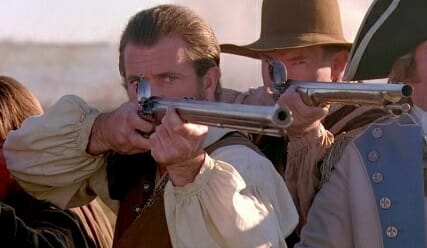
Mel Gibson, “Patriot.”


4. “Aim small, miss small.” Benjamin Martin, played by Mel Gibson, from the movie “The Patriot,” 2000.


The better you understand and are able to carry out marksmanship fundamentals, the better you will perform under the stress of a defensive encounter. I believe in accuracy first. I often utilize the “five shot drill” for students. In this drill, I challenge students, standing at three or five yards from the target, to fire five shots and put them all in one hole. Very few can do this right out of the box. The purpose? If I can shoot those five shots into one clustered hole, then I have the foundation of good shooting fundamentals. Under the stress of a violent encounter, your shooting accuracy will drop off. But if you have these solid fundamentals, you are on your way to winning. Another great drill that leads you down this path is called “dot torture.” You can find this drill and others at pistol-training.com. Your goal is a combination of speed and accuracy, but in the end I’d rather be accurate first than fast and miss!


5. “A gun that’s unloaded and cocked ain’t good for nothing.” Rooster Cogburn, played by John Wayne, from the movie “True Grit,” 1969.


Keep your everyday carry gun hot and ready to go! I hear much discussion from students as to whether they will carry a round in the chamber. Again, this is a training and equipment issue. The last thing you need under the stress of a violent encounter is to have to remember to chamber a round in your handgun to defend yourself. Take such nonsense and inhibitions out of the equation, being sure to use a carry system that keeps the gun both accessible and under your direct control.


6. “It ain’t so easy to shoot a man anyhow, especially if the son of a b—ch is shootin’ back at ya.” Little Bill Daggett, played by Gene Hackman, from the movie “Unforgiven,” 1992.


Mental preparation and related training that assists you in developing stress inoculation is invaluable if you intend to take defensive living and mindset seriously. Force decisions and Simunition training comes to mind. In this type of training, you are forced into a confrontation with another live human being in a controlled and safe environment.


7. “I just don’t wanna be killed for lack of shootin’ back.” Clyde (one armed deputy), played by Ron White, from the movie “Unforgiven,” 1992.


Don’t be without your pistol. When it’s needed, take decisive action.


As you can see, I’ve avoided the more popular quotes such as “make my day” or “I’m gonna blow your head off.” I am not glorifying the use of force. Just the opposite. My goal here is to apply some sound advice in your training process for EDC spoken in the movies that is, in my estimation, more than just Hollywood talk.


What quotes would you add? Let us know in the section below:

Sunday, April 16, 2017

Ron Paul: "Peace Is Popular... People Don't Start The Wars"

Authored by Chris Campbell via lfb.org,


Last week, Ron Paul and many other notables in the liberty sphere took to the stage in Lake Jackson, Texas, for a very important symposium.


The topic of discussion? War and Peace in the Age of Trump.


As promised, today we present to you highlights from Ron Paul’s speech, Peace is Popular.


Lots of great stuff to cover.


So let’s get to it…


Ron Paul on liberty…


“Liberty is a young idea,” Dr. Paul began. “It’s really not something that’s been around for thousands and thousands of years. And the benefits of liberty have just been rather recent. I think of the Industrial Revolution as a consequence of an understanding of economic liberty. And with the tremendous advancements that have existed with the Industrial Revolution I’ve always wondered, why don’t we advance in the social revolution?


“If we learn how to build so many wonderful things and the standard of living goes up for so many people and we have all of these luxuries, why is it that we haven’t figured out how to stay out of killing each other?


“So at the same time we’ve had all of this advancement that helped us with technological things and the Industrial Revolution, we’ve had more killing than ever before.


“Just think of the 20th century, with all of that advancement. I can’t help but think about my dad talking to me about when the family dairy started. He delivered milk in a horse and wagon. And that was at the beginning of the last century. It was so recent and yet we haven’t advanced very much in this social sphere of how we get along with people. I am an optimist because I believe we should be able to do that. And when you look at the history of mankind, it’s really so very young.”


“Peace is popular.”


“I think peace is popular. Very popular. Not just among us, I think with all people. The big question is, if peace is popular and people want it, why are there so many wars?


“And that’s really a serious question… what’s going on? Especially when I go to the campuses and talk to young people, they’re not saying, ‘Yeah, let’s go have another war. We’d like to go off and get exposed to the killing and we want all the death to deal with. And we want to deal with inflation. No. That group of individuals are generally less pro-war than the rest.


“I can remember one time that I made a charge that this particular piece of legislation was pro-war. And it was on the side of the Republicans that were promoting this piece of legislation. And boy, I had one ex-military official come up to me. He was so annoyed, he said: ‘I am not pro-war!’


“They don’t see themselves that way. And yet, they are pro-war. If I had to look back and guess on the number of people I’ve met throughout my lifetime… you know, from grade school on up and the many people I’ve met in the past 15 or 20 years in politics… tens of thousand, and exposed to hundreds of thousands of people, I would say that 90% of the people I come into contact with are really pro peace.


“Peace is what they want. Why is it that although 90% of the people really want to live in peace, we don’t live in peace?


The problem of war…


“Our problem is not so much the people become supportive of war or promote the war. Too many of them are very apathetic and complacent and just go along. But the big problem is, that the people, the citizens, the people who suffer from the war, don’t start the wars. The real problem that we have to understand is it’s the government and the government policies that cause the war and that’s what we have to restrain.


“So I think what happens… is people who have psychopathic and aggressive personalities and enjoy telling other people how to live — whether it’s in a social, economic or military sense — they like power. There is an opening and those people themselves don’t have much resistance. And governments tend to have, over the centuries, assumed a lot more power. And this just opens up the door for people who just want the power. And even those who go with good intentions to Washington, they are consumed with this attitude and they are part of the system.


“One term I don’t like is ‘moderation in politics,’ because I believe it’s a sacrifice of principles. What I like to think about in politics as far as making corrections because there’s so many imperfections, is to work with coalitions. And that is, there are a lot of people that might not be true libertarians, but they have a set of principles where they’d like to see a lot less killing and a lot less war and there’s no reason in the world we can’t be talking to the Dennis Kucinich’s of the world. Who will stand up for peace and this, to me, is I think the real answer. Moderates, when they come together, they have to sacrifice their true conviction.


Although the non-aggression principle, if widely adopted, would solve many incessant problems we face today, “One thing you can’t solve,” says Dr. Paul, “is the problem of good and evil. Adams said, ‘We the founders have given you a republic if you can keep it.’ And he said the moral standings of the people will make the difference. When the people become immoral, the system doesn’t work. At the same time, the problem is the immoral people get into government.


Why secession and nullification are important…


In order to keep government in check, says Paul, we need to have a clear definition of the role of government.


“The role and purpose of government should be to protect liberty. That’s it. That’s what our goal should be.”


In order to do so, we need to repeal the vast majority of what today’s government does.


“You have to have a system where the government is strictly limited. What would it mean? It would mean, first off, that we should be able to have a position in a county like ours, that our states should always have a right to secede. It’s the right to secede that’s important. That would hold the federal government in check. The government would have to be careful. But even if they had nullification, which is a strong issue of Jefferson. Just so we as a people, the local people, the local and state governments, didn’t like what the feds were doing, and if they’re violating the Constitution, you oughta be able to opt out and nullify it. That would hold a big check on the federal government as well.


“And the neat part about this is it’s coming. We are going to have chaos. We’re going to have economic chaos. We’re going to have the political fallout from our foreign interventionism. The world will turn against us and we are going to have an opportunity for a lot of nullification. It’s already happening.”


“I think it’s fantastic that the issue of the ridiculous War on Drugs is coming to an end because the states and the people are nullifying these laws and saying ‘stay away.’  I hope that doesn’t get reversed with this administration, but at least we’re making progress there. And I think that is great.


“I was out in Arizona, because they’re passing a bill out there and it’s very popular. Trying to follow the Constitution on the money issue. Because the directive is to the states. The states are not allowed to use anything other than gold and silver as legal tender. So who broke the law? The government broke the law. They were explicit in the Constitution that you can’t counterfeit. That you can’t debase the currency. And they were very explicit. We’re not allowed to debase the currency. But the government is. And that is why this principle, that basic Bastiat principle, that if you and I cannot do something, if you and I can’t steal from people, we can’t debase the currency, and we can’t rob and kill and do all of these things, why in the world have we allowed our governments to do that?


“We have to curtail that power. So we just can’t just go out and kill people because it’s against the law and it’s immoral… why do we allow our governments to do this constantly? With bombs and missiles and threats and boycotts… all of the things we do. We have to be able to apply these basic principles that have been understood. But it’s turned out that our governments did this to hold us in check. To say, ‘You can’t do this. You can’t do that. You bend the rules, we’re going to get you.’


“But they’re exempt. And this sucks in the people who love that power. And most people are too lackadaisical and too apathetic.


“We need to get rid of the apathy. We need to stand up and be engaged. Everybody has a responsibility. And I’ve often talked about the responsibility of us as individuals.”


We are the eight percent.


Dr. Paul makes an important point we’ve made here in our virtual pages plenty of times before. Democracy obscures the truth of how changes in society are really made.


All throughout history, it has been a creative minority, not 51% of the population, that has helped bring incredible leaps of human progress to fruition. A relatively small group of changemakers blazed the trail and the rest of the population, seeing this new path was a better option than the status quo’s, simply traipsed through.


Today is no different.


“I think that we need eight percent of the population to really change the world,” says Dr. Paul. “Eight percent to lead the charge.”


If you’re reading this, it’s very likely you belong to that eight percent.

Friday, March 17, 2017

SNAP Slumps To $18 Handle

the Juggernaut has spoken, Bitchezz!


seriously though, didn"t Fakebook start out like this,  and we were cheering their post ipo losses ...  


only to see them go on to give stockholders many times return


this could be a BTFD deal - the first Trump dipper on offer ?    


no, this is different ?

Friday, February 24, 2017

Le Pen Is Mightier Than The Sword

There is no problem what so ever. Everything is moving along precisely as it has been engineered by the "technocrats". The chosen racer global mutt sect set out to destroy Society, destroy the family, pervert the institution of marriage and the concept of fidelity and love, normalise twisted and depraved gender confused imbeciles, pedophilia, bestiality, satanic ritualised cannibalism, promote murder, rape and brutality live on social media and every perversion that Hollyweird can vomit out on the masses of product that Sugarmountain khasarian ass#ole Zuckerscum can come up with...and voila you have the Western "democratic" sewer ready to erupt. What could go wrong?


"In his book «Praktischer Idealismus», (1920) Austrian Count Richard Von Coudenhove Kalergi indicates that the residents of the future "United States of Europe" will not be the People of the Old Continent, but a kind of sub-humans, products of miscegenation. He clearly states that the peoples of Europe should interbreed with Asians and colored races, thus creating a multinational flock with no quality and easily controlled by the ruling elite.


Kalergi proclaims the abolition of the right of self-determination and
then the elimination of nations with the use of ethnic separatist movements and
mass migration. In order for Europe to be controlled by an elite, he wants to
turn people into one homogeneous mixed breed of Blacks, Whites and Asians. Who
is is this elite however? Kalergi is particularly illuminating on this:


The man of the future will be of mixed race. The races
and classes of today will gradually disappear due to the elimination of space,
time, and prejudice. The Eurasian-negroid race of the future, similar
in appearance to the Ancient Egyptians, will replace the diversity of peoples
and the diversity of individuals. Instead of destroying European
Judaism, Europe, against her will, refined and educated this people, driving
them to their future status as a leading nation through this artificial
evolutionary process. It"s not surprising that the people that escaped from the
Ghetto-Prison, became the spiritual nobility of Europe. Thus, the
compassionate care given by Europe created a new breed of aristocrats. This
happened when the European feudal aristocracy crashed because of the
emancipation of the Jews [due to the actions taken by the French Revolution]


"Count" Richard Coudenhove Kalergi’s Plan outlined by Gerd Honsik


“Kalergi proclaims the abolition of the right of self-determination, ... the elimination of nations by means of ethnic separatist movements or mass allogeneic (genetically dissimilar) immigration tocreate a multiethnic flock without quality, easily controllable by the ruling class. Kalergi characterized the multiethnic flock as cruel and unfaithful but maintained the elite must deliberately create them in order to achieve their own superiority: ‘Then the elite will first eliminate democracy – the rule of the people. Next, the elite will eliminate the people via miscegenation, thereby replacing the ruling white race with an easily controllable mestizo race. By abolishing the principle of equality of all before the law, avoiding and punishing any criticism of minorities, and protecting minorities with special laws, the masses will be suppressed.’"


5 wise members of the sect help us understand "the plan" of our
elite masters.


And concerning the rape of Sweden...in her own words supremacist USSAN Israeli Barbara Lerner Spectre explains clearly what their plan is.


Spectre


https://www.youtube.com/watch?v=MFE0qAiofMQ


Gysi


https://www.youtube.com/watch?v=cDU9V579g74


Kahane


https://www.youtube.com/watch?v=QpQgJBmgymM


Sarkozy


https://www.youtube.com/watch?v=I8yaiN6ew_g


Russo


https://www.youtube.com/watch?v=QyzW8tV-bz4

Sunday, January 29, 2017

"Refugees In, Racists Out" Protestors Storm JFK, O'Hare Airports After Trump's 'Muslim Ban' - Live Feed

With banners and chants proclaiming "build a wall... we"ll tear it down", "let them in", "hey, hey, JFK, no more fascists USA", and "refugees in, racists out", hundreds of protestors are assembled at JFK airport (and Chicago O"Hare) following President Trump"s "Muslim" ban.


As NBC4New York reports,


With chants of "No hate, no fear, refugees are welcome here," protesters gathered at John F. Kennedy Airport where 12 refugees were detained Saturday under President Donald Trump"s executive order to ban refugees from entering the United States for four months.


More than 300 demonstrators held homemade signs that read "No ban, no wall" and "Refugees welcome" in front of Terminal 4"s international arrivals area. One sign called for President Trump"s impeachment and the deportation of the first lady.


"We"re here to tell Trump that we are not going anywhere," said lawyer and refugee advocate Jacki Esposito, who helped organize the protest. "Today is the beginning of a long opposition from us, and our neighbors all over the country."


The crowds are growing.


Additionally, the NYC Taxi Workers just called for a work stoppage, starting at 6 pm. No pick ups or drop offs to JFK.


From 6 to 7 p.m., drivers are not picking up passengers at Terminal 4.


"As an organization whose membership is largely Muslim, a workforce that"s almost universally immigrant, and a working-class movement that is rooted in the defense of the oppressed, we say no to this inhumane and unconstitutional ban," the NYTWA said in a statement. There are approximately 19,000 drivers in the union including yellow cab drivers, green car and black car drivers. The union also represents Uber and Lyft drivers.


The protests will be coming to other airports...


Live Feed:


Alternate Live Feed:

Saturday, January 21, 2017

The Fake News of Fakebook: Welcome to the Machine

Sometimes we need to take a step back and gain some perspective.  As we explain in our book Splitting Pennies - the world isn"t always as it seems at first glance.  What"s happening now, is much a result of what was planned and started 50, 60, and 70 years ago by a previous generation.  Modern history and especially regarding USA really should be looked at since @ 1950, at the wind up of World War 2.  And, the most significant element in global society, is quite possibly the first form of Artificial Intelligence: The Machine.  The Machine, as referenced by Eisenhower on his farewell address as the "Military Industrial Complex" and later referenced by Pink Floyd as simply "The Machine" - is a form of AI that is very dangerous for the survival of mankind itself, let alone the waste of economic resources and others.  Economically, looking at the military, it would seem that there really is an Alien conspiracy controlling powerful countries because the Military only destroys, it doesn"t create.


This battle between The Machine and "The People" you can say took hold in America in the 50"s and peaked in the 60"s during the civil rights movement.  Sides were formed, society was polarized.  Common interests aligned themselves.  Big business sided with The Machine as they saw new opportunities for profit and consumer control.  It"s important to have this perspective; often we write about the CIA, about the big banks, they are all cogs in a larger entity "The Machine" which has an intelligence of its own.  It is not a complex intelligence, such as developed recently in computing - but nonetheless, as any intelligence is defined, it is a form of artificial intelligence.  It has a simple goal - expand, survive, grow, evolve.  Human collatoral damage, is irrelevant.  Destruction of society, destroying the planet, doesn"t matter to the survival of The Machine.  War profiteers are like hosts to a virus, that perpetuate its operations.


Of course, the best example of one of the many parts of The Machine is the CIA, but it is not the only one, nor the most significant part of the machine.  Hosts to this virus like the forces behind Black Lives Matter, and other social destructive forces, are possibly even more significant, due to the fact that they are "on the front lines" stopping any change or taming The Machine.  The best explanation academically and intellectually is provided by Noam Chomsky, you can checkout his latest book here and see trailer from recent documentary below:


The Machine is now in it"s 3rd or 4th generation depending on how you calculate but in any regard, the current agents working for The Machine clearly don"t even understand their own jobs, they are just mindless government workers raised on a violent culture programmed by Quentin Tarantino, like the Rick Perry that didn"t know what his job would be, that he accepted.  The government has become so bloated and inefficient, 90% of it could be deleted and we"d still function fine.  But remember, the Government is no longer "for the people" it"s "for The Machine".  It"s unfair to say that specific people, or specific groups, are the sole cause of America"s decline - it"s not Globalists, it"s not "offshoring" - it"s a lot more complex than that and frankly, USA is irrelevant too for The Machine.  It just so happens that the USA has had and does have the most funded, technologically advanced military in the world.  It"s just strategic positioning.  America isn"t the most powerful country in the world because of "freedoms" or "ideals" it was simply a geo-strategic advantage during World War 2, on a number of levels, that enabled Superpower status, and the creation of The Machine which now operates on a global level.


Fakebook is the new "tool" of social control.  During the 60"s, 70"s, and 80"s the CIA popularized street drugs in order to control and quell the population, as well as various diseases (AIDS) and more modern methods (Chemtrails) and other tools.  Fakebook is the current "drug" of the era - what will be next?  We can get a glimpse at Darpa.


This is what TRUMP is up against.  And while politically, he"s a nobody, a rogue from the "forest" who as Gingrich said "Didn"t go to the same schools, isn"t part of a secret society;" in the final analysis, TRUMP is still part of The Machine, although a failed one - relying on his persona as a reality star to build his "brand."  Maybe this is why the common man can relate to TRUMP so well, he"s also been spit out by The Machine in different ways, in business - except he did it while part of the "haves" and not the "have nots" - probably TRUMP doesn"t know what he"s up against in the coming days and weeks ahead.  We must remember especially regarding the mindless zombies that burn down bank of america branches and McDonalds drive throughs, what is at stake for bettering the lives of all Americans is not political, it is not about liberals and their idiocy - The Machine is something far greater, it is employed by both parties, Democrat and Republican - Rich and Poor.  These are the dividing lines the Elite do not want you to understand!  As long as blacks are fighting whites, women are fighting men, homosexuals are fighting heterosexuals - the divide and conquer plan of the Elite is easy to implement.


This generation"s war for the machine is being fought in the battlefield called "social media" - and the platform hosting the Fake News - Fakebook.


Welcome my son, welcome to the machine
Where have you been?
It"s alright we know where you"ve been
You"ve been in the pipeline, filling in time
Provided with toys and "scouting for boys"
You brought a guitar to punish your ma
And you didn"t like school, and you
Know you"re nobody"s fool
So welcome to the machine


Welcome my son, welcome to the machine
What did you dream?
It"s alright we told you what to dream
You dreamed of a big star
He played a mean guitar
He always ate in the Steak Bar
He loved to drive in his Jaguar
So welcome to the machine


To learn about how this works regarding the financial markets, checkout Splitting Pennies - Understanding Forex, and see how deep the rabbit hole goes.