Showing posts with label poultry. Show all posts

Monday, February 19, 2018

Bird Flu From Chinese Poultry Infects Humans For The First Time: Dangerous Human/Bird Flu Virus Hybrids Possible


The flu virus is evolving in unpredictable ways in Chinese poultry. For the first time, the avian flu has mutated and infected a human being.


According to New Scientist, the World Health Organization says no similar bird flu strains have ever crossed over to people before and this unexpected jump from chickens to humans was a surprise. The Chinese government has confirmed the first human case of H7N4 bird flu in the country. The patient, a 68-year-old woman in the Jiangsu province, is in stable condition and health authorities believe she will make a full recovery.


According to The Guardian, the patient contracted the virus in December and began to develop symptoms on Christmas Day. Bird flu symptoms in humans include mild to a severe pink eye, fever, cough, sore throat, and muscle aches. The patient was admitted to a hospital on January 1 and stayed until January 22. Although her identity has not been disclosed, media outlets confirmed she likely contracted the virus from close contact with live birds. Although the virus does not appear to be particularly harmful to humans, it sets an interesting precedent since this is the first instance of such transmission to a person from a chicken.


“She had contact with live poultry before the onset of symptoms,” Hong Kong’s Center for Health Protection (CHP) said in a statement of the woman infected. “According to a report from the Chinese center for disease control and prevention, upon analysis, the genes of the virus were determined to be of avian origin.”


Dr. Bettina Fries, chief of Stony Brook Medicine Division of Infectious Diseases, told Newsweek it’s cause for great concern any time a bird flu virus causes disease in humans. “There would not be any preexisting immunity since the virus is new for humans,” Fries said. She also explained that the bird flu could form a dangerous combination with a human flu virus. “The viruses recombine/mix their genomes and you have a new flu virus half human, half bird flu virus,” said Fries. “The swine flu outbreak was a strain with some swine and some human flu. What keeps us safe at the moment from bird flu is that they rarely infect humans,” she said. “A recombination of virus (human and bird flu) could change that and we could find ourselves in a pandemic with a rapidly spreading virus and no preexisting herd immunity, no vaccine.”


The virus was identified through genetic testing, and results were only just released, the South China Morning Post reported. The patient’s close contacts are also under surveillance for signs of the illness, but so far no one has developed any symptoms, CNN reported.


According to the Center for Disease Control and Prevention, the avian flu H7N4 is a subtype of influenza A viruses that infect birds. All influenza A viruses are divided based on their proteins (the HA subtype) and the surface of the virus (NA subtype). Therefore, H7N4 has an H7 protein and an N4 protein.


The Hong Kong CHP statement urged the public to practice strict hygiene both in Hong Kong, an autonomous region south of mainland China and while traveling in China. This includes avoiding living or freshly slaughtered poultry, which is described as any domesticated fowl such as a chicken, turkey, duck, or goose.

Thursday, November 16, 2017

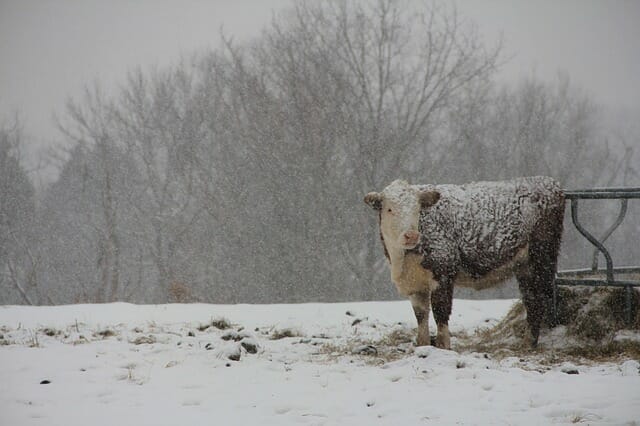
Tips & Tricks To Protect Livestock During Winter

Taking care of livestock and poultry during warm weather is hard enough, but when frigid weather hits, it can be downright difficult.


Yet if you know what you’re doing, your livestock can survive and even thrive during winter weather.


This week’s guests on Off The Grid Radio — Shawn and Beth Dougherty — take care of cattle, pigs, sheep, chickens and ducks throughout the year on a large farm in Ohio. They tell us the tricks they use to care for their animals when cold weather hits.


Shawn and Beth – the authors of the book, “The Independent Farmstead” (Storey) – also tell us:


  • What they feed their animals during winter.

  • How they keep the livestock’s water from freezing.

  • What they do to protect their animals when temperatures approach 0 degrees Fahrenheit.

Shawn and Beth also tell about the vegetables they grow in the garden during winter – and how they do it.


If you own livestock or poultry, then this week’s show is for you!

Friday, October 13, 2017

Completely, 100 Percent Off-Grid: 9 Essential Foods You Should Grow

Completely, 100 Percent Off-Grid: 9 Essential Foods You Should Grow

Image source: Pixabay.com


Are you ready to feed your family by what you grow and raise? If you want to reduce your dependency on the commercial food supply, you better start now. It is important to develop a functional homestead capable of producing enough food to live on before you need it.


Establishing crops, building infrastructure, raising animals and working out the kinks all takes time, and you may have a few less successful years before you can really eat off the grid.


Assuming you have a house on cleared land, with at least one usable outbuilding already constructed, then you will be able to focus on growing food. With long working days, attention to seasonal change and weather, efficient work practices, and regular routines, two adults can work the land for food within a few years. Figuring in planting time, growing time, daily chores, pest and weed control, soil maintenance and construction, it would be reasonable to expect a partially self-sufficient homestead within three years, and a fully sustaining one in around five years. In addition to a milk source (cows or goats), you should plan on having:


Protein


1. Beans – Reliable and easy to grow, beans are a nutritional staple for the homesteading family. Prepare the soil early, and plan on 2-3 months of growing before harvest to get a yield in your first year, and you can expect more in year two.


Just 30 Grams Of This Survival Superfood Provides More Nutrition Than An Entire Meal!


2. Poultry – If starting with chicks, expect 2-3 years of successful rearing, selection, brooding and culling before you will have your flock established. In the meantime, you will collect eggs and eat birds you choose not to keep in the flock. Start with 10-12 chicks, and plan for them to be around 3-4 months old before butchering.


3. Rabbits – Rabbits are quick producers of meat for your family. It is not unreasonable to expect 20 or more rabbits per year from a single breeding pair. Allow for 1-2 years for your rabbits to become established. Select for breeding performance, health and size, and introduce new genetics regularly.


Grains


4. Corn – Corn is a prolific grain crop needing much nutrition from the soil and up to four months of heat for production. In your first year of growing corn, it is not unusual to have a lot of losses due to weather, pests or soil issues. However, once you have worked out the issues corn can be an important staple grain. Plan on about two years of learning before cultivating a substantial harvest.


5. Wheat – One of the most common grains in the American diet, wheat is reasonably easy to grow and hard to harvest. Wheat is ready after around two months of hot weather. When planning to start wheat, figure in threshing and grinding time.


Fruits & Vegetables


6. Winter Squash – Grow winter squash to supply your family with important vitamins and provide you with an easy keeper crop. Winter squash takes up to 4 months to mature, but you should be able to get a good yield in your first year with appropriate pest management and watering.


Completely, 100 Percent Off-Grid: 9 Essential Foods You Should Grow

Image source: Pixabay.com


7. Apples – Although apples can be extremely useful, you need to plan on 6 – 10 years with your trees before they will bear fruit. Your patience will pay off, however, and planting apple trees is well worth the wait.


Looking For Non-GMO Seeds? Get Them From A Company You Can Trust!


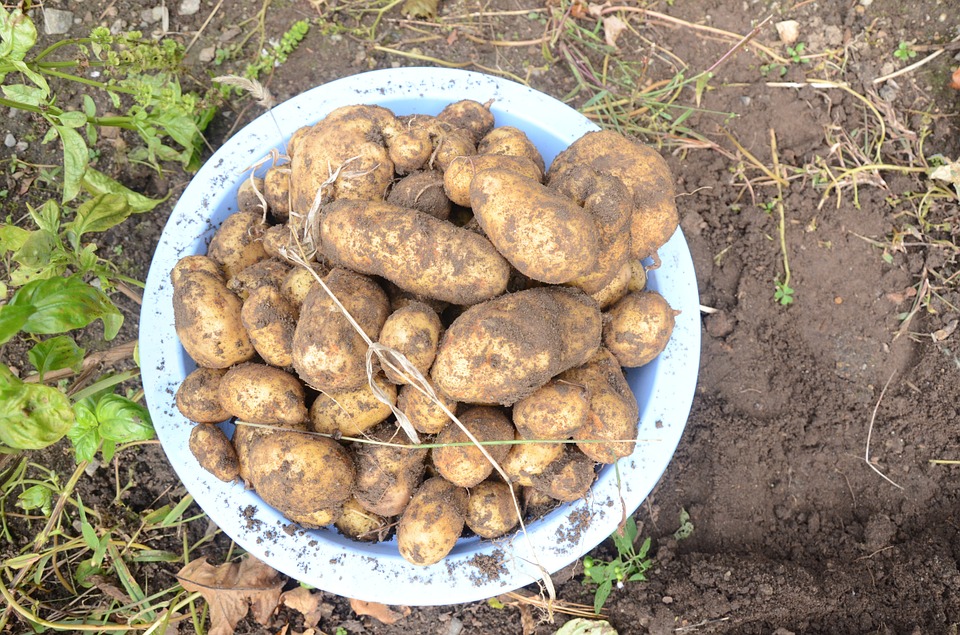
8. Potatoes – Potatoes are easy to start. You can expect a good yield in your first year of potatoes. Short season varieties will grow in as little as 2 months, but longer season varieties can take 3 months or more.


Extras


9. Honey – Honey is a fantastic sweetener on the homestead and comes with lots of nutritional benefit. Plus, bees pollinate your crops. However, bees take a while to get production ramped up. Your first year harvest will be very small, but in the second year you can harvest up to 30 pounds of surplus honey from one hive (leaving the bees something to eat over the winter).


If self-sufficiency is your goal, then don’t wait to start on projects like these. Even if you’re still buying most of your food, developing your homestead so you can begin slowly weaning yourself away from doing so, means you won’t have to spend your early years of self-sufficiency struggling to find food.


What advice would you add? What would you add to this list? Share it in the section below:


Discover The Secret To Saving Thousands At The Grocery Store. Read More Here.

Monday, August 28, 2017

You Wouldn’t Recognize The Poultry Your Great-Great Grandparents Raised

You Wouldn’t Recognize The Poultry Your Great-Great Grandparents Raised


For most homesteaders, having poultry is an important part of the lifestyle. We’ve all read the magazine articles about preserving our heritage poultry, and so we bring home flocks of gorgeous Rhode Island Reds and Welsh Harlequin ducks, trios of Royal Palm turkeys, and a pair or two of handsome Pilgrim Geese.


We enjoy our poultry flocks. After all, we are living like our forefathers, right? Well, maybe not.


What if I told you that most of the beautiful species of poultry we raise today weren’t even developed back when great-great granddaddy had his farm and worked the land?


For most of us, our great-great grandparents would have been living life in the 1800s. Whether your ancestors lived on farms or in town, pretty much everyone owned chickens. Dual-purpose chickens provided both eggs and meat, and for this reason most families of six had at least a dozen or more birds. Feeding your flock was mostly about free-ranging them in your yard and feeding them scraps. Occasionally, birds were supplemented with cracked corn, oats, barley or wheat.


Goose and duck flocks were managed in much the same way as chickens, and some breeds were developed to weed crops and orchards. Geese were raised for not only meat but also their feathers and down, which were used in pillows and mattresses. Duck owners enjoyed their meat as well as their eggs. Neither was widely raised until later in the century. In most areas of the country, ducks and geese were hunted rather than grown, most likely as a way to provide meat for the family without the time and expense of managing a flock. Duck meat has never really gained the popularity here that it has in Europe, due largely to the fact that chickens tend to be leaner and far more prolific.


Are Your Prepared For A Downed Grid? Get Backup Electricity Today!


For the farmer with larger fowl such as turkeys, the birds were primarily allowed to forage. Flocks were raised not only for meat, but also because of their remarkably large appetite for bugs. For this reason, they were often raised in orchards and in woodlots, where the birds also had space to roost in trees. During the winter, birds were supplemented with corn, oats, barley or wheat, much like chickens. Some old-timey turkey-raising manuals even suggest that farmers slaughter a hog as feed for their turkey flocks during the winter months as a way to provide extra fats and protein.


With turkeys being native to over half of the United States, there were plenty of small farms that preferred to hunt them rather than raise them. However, events such as the Mexican-American War and the Civil War impacted the wild populations of the Gould’s, Rio Grande and the Eastern Wild along the Southern United States.


The Breeds of Great-Great Grandaddy’s Day


Chickens


In the early 1800s, chickens were strictly viewed as a utilitarian bird. This meant that flocks largely consisted of crosses of the birds available at the time. One of the more common purebred birds was the Dominique, a dual-purpose bird with barred markings and a very good foraging ability. These handsome birds were often depicted in paintings from that era and are credited as being the oldest breed in America.


Immigrants to the New World brought along breeds such as the Hamburg and Polish, as well as crossed birds from their native countries. The Java also made its appearance in the early 1800s in the colors of black, white and mottled. From these birds of possible Asiatic descent, the Plymouth Rock was developed and made its first official appearance in 1835. English varieties such as the Dorking were imported into the United States around this same time, and by the 1850s “Hen Fever” had caught on to the point that even small farmers were venturing into new breeds. Some of these early imports included the Brahma, Cochin, Orpington, and later on, the Leghorn. By the end of the century many breeders, farmers and enthusiasts were tinkering with creating their own breeds, and we see the emergence of the Winnebago (modern-day Silver Laced Wyandotte), Jersey Giant, Buckeyes and Rhode Island Red.


For our ancestors, the importation and creation of new breeds created larger, often more robust animals that produced better meat and more eggs. Imports were expensive, and a common practice of those early days was to buy a rooster of imported blood and breed it into an established flock. Since hens were allowed to go broody and hatch their own chickens, it took a relatively short amount of time to completely change the landscape of chicken raising in the U.S.


Ducks


The first domesticated ducks in American are believed to have been the Aylesbury from England and the Huttegem from Belgium. While I could find very little about the Huttegem, the Aylesbury is still a very popular breed in England and is prized for its delicious meat and good egg laying ability. Both breeds were not uncommon in New England during the 1800s, and small farms throughout the Midwest usually had a combination of these breeds crossed with domesticated wild mallards.


In the early 1800s, several new duck breeds emerged, claiming to be bred from native species that were caught and domesticated. Most never gained popularity and they disappeared. One in particular endured — the Cayuga duck. The Cayuga’s wild beginnings are often disputed, however, with many believing it actually to be a descendant of the Lancashire Black, which was common on farms in Lancashire, England, into the 1860s. Regardless of its start, the Cayuga was named after the Cayuga region of New York, and the breed was popular in the North East due to its hardiness and its personable, easy nature.


As “Hen Fever” ramped up and chickens began to be imported, a few duck breeds also arrived. In 1850, the Rouen entered the U.S. by way of England, and small poultry keepers rushed to add these heavy weight ducks to their small flocks in an effort to increase meat yields.


The late 1800s saw the importation of the Blue Swedish Duck, and near the turn of the century the first Pekin (or Peking) White ducklings arrived. From here, the U.S. saw the development of many other duck breeds well into the 20th Century.


Geese


Domesticated geese came into America in the early days of the first European settlers. These birds were most likely descendants of the wild Greylag goose, and/or descendants of the domesticated Roman goose.


Beyond birds bred for the small farm or homestead, geese were being bred in large numbers to be used to weed the cotton fields of the South. Descended from unknown birds that arrived during colonial times, these birds became their own breed, the Cotton Patch. Regardless, in my research I could find no truly distinguished goose breeds listed until the arrival of the Bremens (the modern Embden) in the early 1800s. We do know that the Cotton Patch goose was already being utilized in the south by this time; they just hadn’t yet been developed into a true “breed.”


Following the Bremens, Toulouse arrived during the mid-century and became widely popular in the Midwest due to their heat tolerance. In the later part of the century we see the arrival of both the African and Chinese goose, which descend from the wild swan goose of Asia. While the Toulouse flourished in America, the Africans and Chinese didn’t really catch on until much, much later.


Turkeys 


Domesticated turkeys in the Americas have an interesting history. The original turkey breed in America (domesticated) and most widely raised is the Bronze. These birds are descended from varieties brought by the first Europeans, crossed with the wild Eastern Turkeys. The resulting animals displayed Hybrid Vigor — being hardier, taller and much heavier than either. Stock from these crosses was retained and resulted in the breed we know today as the Heritage Bronze.


Sometime during the 1700s, the ancestors of the Norfolk Black (also called the Black Spanish) arrived. These birds descended from turkeys taken from Mexico to Europe in the 1500s and brought back to American with the early European Settlers. The birds were then crossed into wild Eastern Turkeys to make it what it is today. While they enjoyed popularity for a time, the breed had more or less fallen out of favor by the mid-1800s.


The Black was used in developing what some consider to be the first truly American turkey, the Narragansett. Developed in Rhode Island from wild Easterns and Blacks, they were considered THE turkey of choice from the Midwest to the Mid-Atlantic from the 1700s until their decline around 1900. They were the first breed to be bred and standardized for commercial production, and were popular on small farms and homesteads for their mild dispositions, large size and prolific breeding. Farmers raising these birds during the early 1800s claimed that a flock of a dozen hens could produce a flock of 100-200 birds in a single year!


Sometime right before the 1800s, the Chocolate turkey arrived from France. These birds were not quite as large or as cold-tolerant as the Northeastern breeds, but they became very popular in the Southern United States prior to the Civil War. They were a popular sight on small holdings and plantations alike, but with the desperate times of the war flocks were devastated to such a degree that they never really made a comeback.


About the same time that the Chocolate was arriving, a new breed was finding favor in the Northeast — the Holland White. It’s interesting to note that the Holland is not a Dutch bird as the name suggests, and is actually a mutant strain of the Heritage Bronze. They quickly found favor for being a bit smaller than the other breeds available at the time, and with their white pin feathers they quickly developed into a commercial breed. They were not as popular with small farmers and homesteaders as the other breeds.


In the late 1800s, the Bourbon Red (or “Bourbon Butternut,” as it was originally known) was developed, and if your ancestors lived in Kentucky or Ohio as mine did, this was the breed they raised. The striking red birds with white tail and wing feathers became very popular for their good growth and large size. They have remained popular into the 21st Century.


It’s worth mentioning that the Jersey Buff was also available during the 1800s, though its exact emergence is difficult to pin down. We do know that it was used in the development of the Bourbon Red, but truly never gained popularity and was considered to be extinct by 1915.


What is plain when researching these breeds is that our forefathers relied on poultry that could withstand the climate they were being raised in and reproduce effectively there. Birds that could serve multiple purposes were far more preferred than anything that was just merely pretty, and efficient foragers with good growth rates were a must. Our great-great grandparents simply didn’t have the time, money or energy to expend on stock that didn’t offer a good return.


What would you add? Do you know what types of breeds your ancestors raised? Share your thoughts in the section below:

Monday, August 21, 2017

5 DIY Chicken Tractors That Will Revolutionize Your Homestead

5 DIY Chicken Tractors That Will Revolutionize Your Homestead


When it comes to housing poultry, your options are truly limited only by your imagination. Most poultry, chickens especially, are hardy and readily adapt to a variety of housing setups.


All coops will fall into two major categories: the permanent structure or the tractor. By definition, a chicken tractor is any bottomless pen or cage that can be moved from one area to another. This allows the poultry to eat things on the ground, such as vegetation and bugs, while still keeping them contained. Chicken tractors may have wheels or skids to be pulled along the ground, and are an excellent alternative to free-ranging if you live in an urban/suburban setting or an area with a large number of predators.


There are several good reasons to think about adding a chicken tractor to your homestead. Here are a few of the best reasons:


  • Allowing the birds ground access cuts feed costs. Every blade of grass and every grasshopper is just that much less feed you must provide.

  • Droppings fertilize the ground. Just remember to move your pen often enough to prevent manure build-up.

  • Saves on gas for the mower. We spent an entire summer moving bird pens around one one-acre section of lawn at our last house. We used three tractors and mowed the whole thing twice in six months.

  • Tractors can be moved to new property or sold if you don’t need it anymore. This is not always the case with a permanent structure.

  • No ugly, bare chicken run.

Tractors can be made of just about anything. On our homestead, we have used five different styles, and all of them were made from recycled/upcycled materials. To inspire your own chicken tractor ideas, let’s look at the ones we have used.


The Cattle Panel Hoop


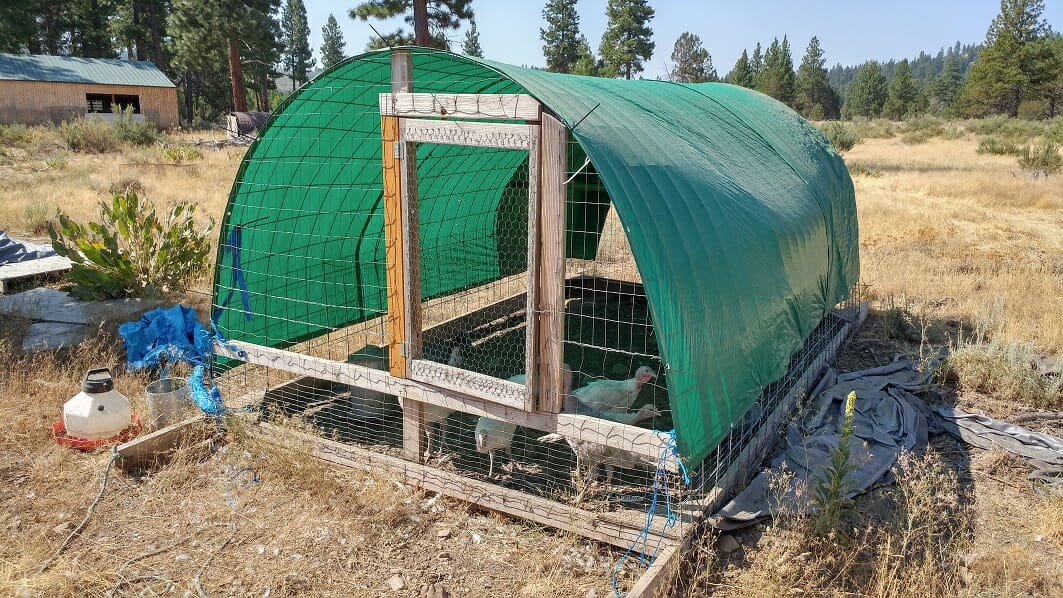
This was our first design for tractors, and is the one we still prefer. We’ve made them in 8-foot and 12-foot lengths, with an 8-foot width. We have housed everything in them, from chickens to ducks, geese, turkeys and yes, even a goat or two. The premise is fairly simple. It’s just a framework with cattle panels bent from one side to the other to create a tunnel, ends finished with plywood or netting, and a tarp over the top for a roof.


Discover More Than 1,000 Off-Grid-Living Tricks!


Hoops are fairly quick and easy to create, and I have built quite a few in just a couple of hours. They are lightweight enough that one person, attaching a rope from one skid to the other, can move it. They also can be moved quite easily with a quad or even a riding lawnmower.


There are a few things to consider before using this style of pen. Strong winds can move or even flip them over. Additionally, because of the raised cross pieces, small predators such as skunks, weasels and even smaller raccoons are more likely to try and get into the pen.


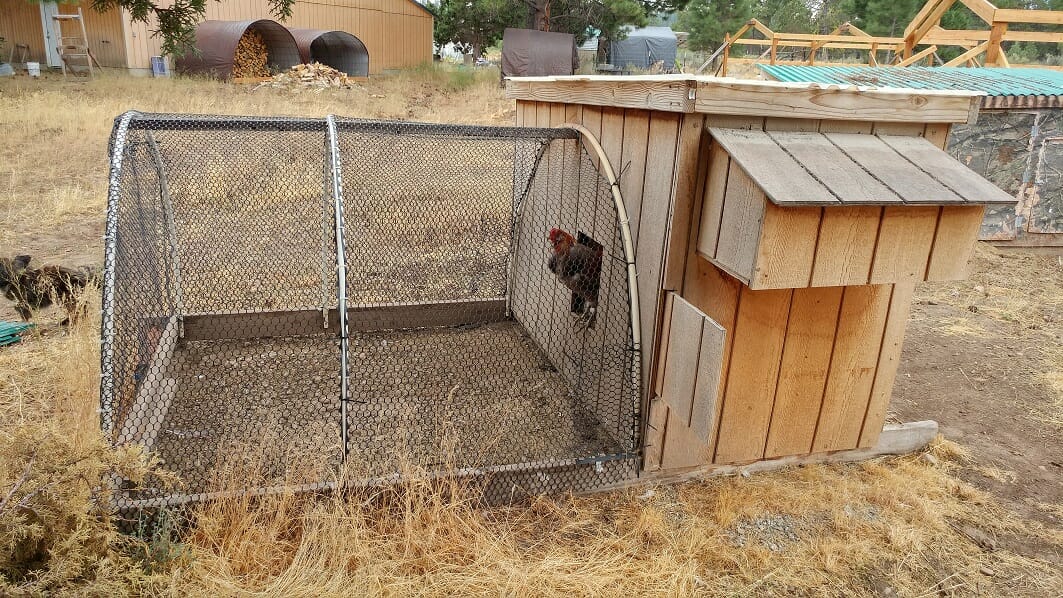
The Upcycled Dog House


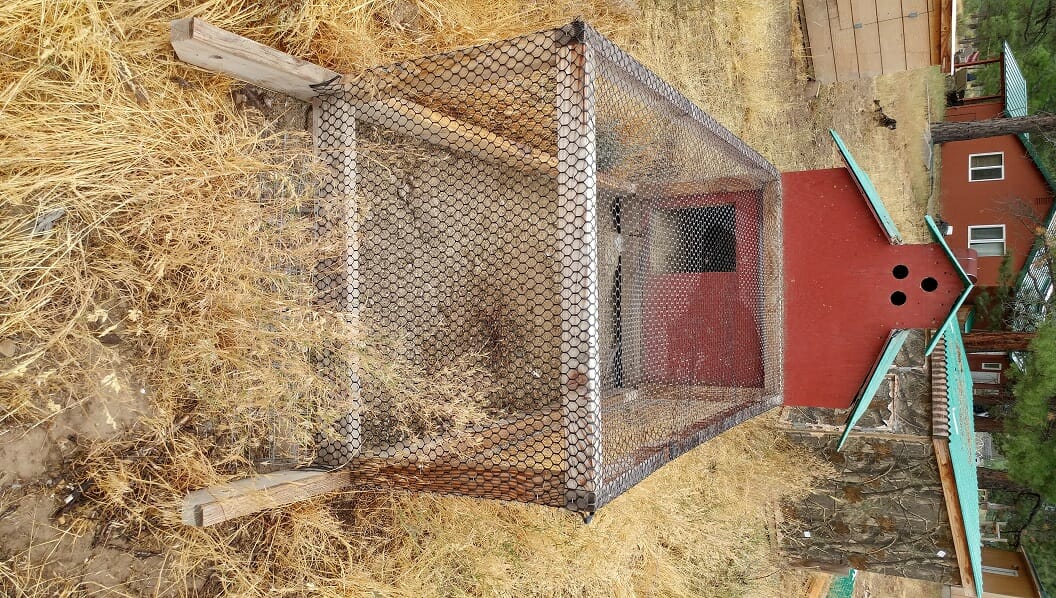
We had an acquaintance contact us about a doghouse they needed to get rid of as they were planning a move. It was a cute little thing, and had actually been used as a house for ducks. We built a skid framework, added a floor and mounted the house on skids, then added a simple run along the front. I did a little work to the roof, added a nest box and perch, plus built a new closing door and cut a smaller door to the run. I had the whole project done in just a few hours, and we’ve used it successfully for two years.


My biggest regret with this one is simply that I didn’t put a door into the run for us! This has been inconvenient on the two occasions that the birds have managed to get their feed bowls outside. Fortunately, it is lightweight enough to be lifted fairly easily.


The Little Red Coop and The White Hen House


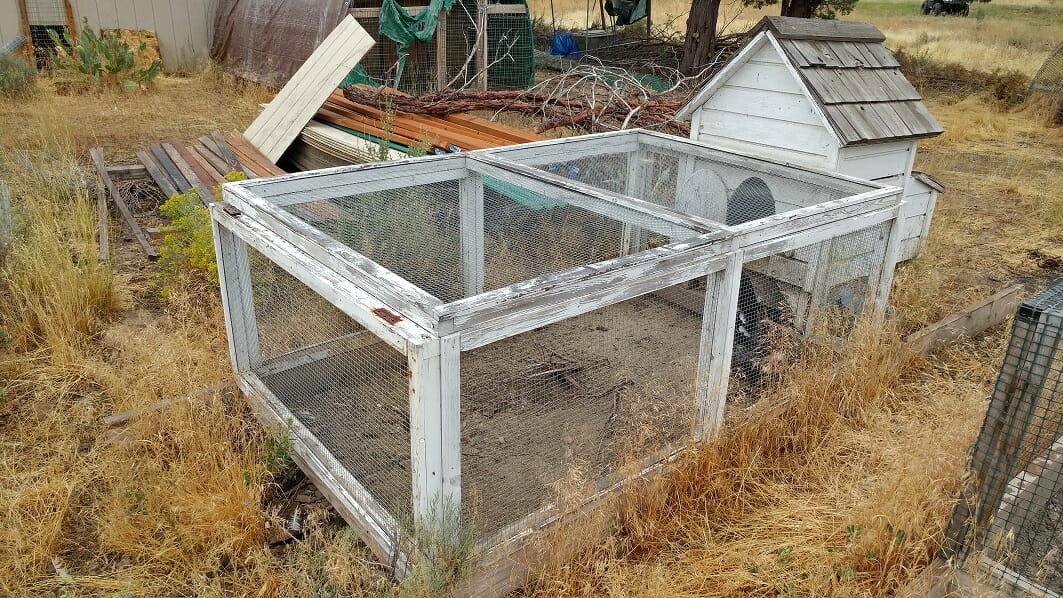
The next two tractors we built were made from a couple of small hen houses we picked up off of Craigslist for next to nothing. The Red Coop had a detachable yard made left over interior house trim and covered with rusty pieces of assorted wire. The White Hen House had a lovely set of yard panels that were only two-feet tall so the chickens kept hopping over the panels and destroying the owner’s garden! Both of these little coops were made to be permanent structures.


Essentially, we did the same thing as with the Dog House. We built a skid system and just mounted the houses on the skids, then built a yard. I was fortunate with the White Hen House that when arranged carefully, the yard pieces actually made a contained box! With some hinges added to the top panels and a hook to close it, the yard is accessible if we need to open it up for any reason. With the Red Coop, I made the same mistake as with the Dog House and didn’t add a door to the run for us to be able to access it. Again, the pen is very light and can be lifted up if we need in it.


The Shipping Crate House


This is by far the heaviest of the houses we’ve built, and it’s the only chicken tractor that cannot be moved by hand.


The house frame itself is made of a shipping crate that was used to send in a special order tub surround. Basically, we just added some OSB scrap to make a floor, sided it with leftover plywood siding, built a roof and a nest box and cut in a couple doors. The whole thing is mounted on skids, and the yard is made of PVC pipe with some used plastic chicken netting attached to it via zip ties.


The roof doesn’t have much pitch, but was built to be strong. We’ve had a foot of snow on it and never a problem!


The faults with this pen are pretty minimal, the biggest being the weight. As with some of the other pens, I do wish I had added a door to the run. I’m also not sure I would use the plastic netting again, as it does rip after three summers in the sun, and will most likely need to be redone in the next year.


Final Thoughts


The options for building tractors really are endless. I have seen some very ingenious ideas on Google and other sites using old swing-set frames, units made entirely of PVC and wire, and even out of an old lawn cart. With the versatility of these great pens and the benefits they provide to the small homestead, we are sure you’ll want to add one or two of these to your own setup.


Do you have any unique chicken tractor ideas? Share your tips in the section below:

Wednesday, August 2, 2017

Perdue Farms Releases First Chicken Welfare Report, Says Improvements Being Made

One of the largest chicken producers in the United States, Perdue Farms recently released its first-ever chicken welfare report in July 2017. The company says it has taken important steps to follow through on plans it announced a little over a year ago to change the way it raises and slaughters chickens. [1]


Perdue says in the report that it implemented new breeding methods which allow chickens to grow at a faster rate without causing them harm. The company additionally claimed that it would install stunning systems that minimize stress to the birds as they’re headed to slaughter.


Over time, the changes will be rolled out to about 1,500 contract farmers and 5,000 chicken houses, according to company chairman Jim Perdue and senior vice president Bruce Stewart-Brown.


Factory Farms Have a Serious Negative-Image


In recent years, Perdue Farms has had its share of problems. One I can recall off-hand was in 2014, when farmer Craig Watts – a contractor for Perdue at the time – revealed shocking video footage of the filthy, unhealthy, and downright inhumane living conditions suffered by chickens produced for the company.


Watts, who eventually left the chicken farming industry in disgust, went on to release equally disturbing video footage of the horrid living conditions and treatment of chickens produced for Pilgrim’s Pride.


In both videos, over-large chickens are seen crammed together in a filthy warehouse. They have no natural light in to bask in, and the birds must literally trample each other just to get to their feed.


‘Positive Changes are Coming’


Perdue Farms, the 4th-largest poultry producer in the country, is the largest poultry producer to ensure chickens in its supply chain are treated better, according to Humane Society of the U.S. vice president Josh Balk.


The new chicken houses have lots of windows, space for the chickens to move about, even ramps and straw bales for the birds to perch on. [2]


Leah Garces, executive director of Compassion in World Farming, who recently took a tour of Perdue’s vision of the future, said “It’s a big difference.” She added that chickens in the house with natural light are “running around, climbing on things, pecking, perching,” compared with the chickens in the the windowless house, which are “quiet, they’re sitting, they’re not moving.”


Company executives say they’ve seen a substantial difference in the health and quality of the chickens raised in better conditions. Jim Perdue said the company found that when chickens are more active and not left squatting in cramped conditions, the meat is of higher quality, something they learned when they started raising their birds according to organic rules.


Jim said:


“We’re finding that meat from organic chickens is better. More tender. Different color. Activity is the key. [Organic chickens] are more active, they’re running around.”


Any person who has ever eaten organic, humanely-raised meat can attest that there is an elephantine difference in the quality and flavor of organic meat. The superior birds – the organic ones – are better for human health, too.


Source: The Guardian

Even without Perdue Farms’ revelations about the virtues of organic chicken farming, pressure from big corporate customers certainly would have forced the poultry producer to alter its behavior. These customers include food service companies and other institutions, such as Aramark and Compass, both of which have announced that by 2024, they will only purchase chickens from companies that improve the lives of its birds.


The food service companies say they’ll only purchase chickens from companies that raise them according to new animal welfare rules set in place by Global Animal Partnership, an organization originally launched by the grocery chain Whole Foods.


Those rules include:


  • Chicken houses will have natural light.

  • Chicken producers will use a new slaughtering process that knocks the birds unconscious with gas before they are killed. This will replace electrical stunning, which involves hanging the birds by their feet on a sort of conveyor belt and their heads come into contact with electrically charged water.

More Progress Needs to be Made


Perdue is on the path to meeting the requirements, but there is one hurdle that could be hard for the company to hop over: growing a chicken that can freely move about because it doesn’t fatten up as quickly.


In the secret videos recorded by Craig Watts, hugely fat chickens endeavor to navigate the facilities, balanced on its 2 scrawny legs, only for their legs to give out under the birds’ weight – an image described by Watts as “2 toothpicks sticking out a grape.”


Chickens are raised for breast meat, and for the last, oh, 60 years or so, chicken producers have been on a mission to increase the size of their birds in order to compete. The competition reaches as far down as the farmers themselves, whose pay depends on the amount of meat their birds produce. Chickens have quadrupled in size since the 1950’s, according to a 2014 study in the journal Poultry Science.


Source: Seattle Organic Restaurants

The Global Animal Partnership demands that companies use slower-growing breeds. The animal welfare group hasn’t decided which breeds will meet its standard, but Perdue Farms is studying 6 alternative breeds at a research farm.


Unfortunately, the switch to slower-growing chickens is likely to have a palpable impact on business. And because certain breeds of slower-growing chickens produce less breast meat and bigger legs, buyers can expect to feel the impact, too. They may have to pay more for poultry, or eat more dark meat.


Jim Purdue said:


“This is a big change for our company as well as the industry. Getting everyone aligned is the big challenge. From that aspect, I think things are going well as far as people understanding what we want to look like.” [3]


Sources:


[1] Associated Press


[2] NPR


[3] Organic Authority


The Guardian


Seattle Organic Restaurants


Links to some of Perdue’s Latest Documents:


Commitments to Animal Care 2017 Press Release


Perdue Farms Statement on Meeting Demand for Chicken Welfare Standards


What Others Say About Perdue’s Animal Care Commitments 2017


Storable Food


About Mike Barrett:


Author Image
Mike is the co-founder, editor, and researcher behind Natural Society. Studying the work of top natural health activists, and writing special reports for top 10 alternative health websites, Mike has written hundreds of articles and pages on how to obtain optimum wellness through natural health.