Showing posts with label north dakota. Show all posts

Sunday, October 15, 2017

Melissa Etheridge Arrested For Having Cannabis Oil She Used to Help With Cancer

etheridge

It was reported this week that rock musician and cancer survivor Melissa Etheridge was recently arrested in North Dakota after police found cannabis oil on her tour bus.


The arrest took place on August 17 but was not publicized until TMZ broke the story yesterday. Like millions of people with cancer across the world, including myself, Etheridge has discovered that cannabis oil not only treats the after-effects of chemotherapy but also promote apoptosis, which prevents cancer from developing again.


In October 2004, Etheridge was diagnosed with stage two breast cancer and endured a lumpectomy with five rounds of chemotherapy and radiation. It is not clear what her preventative regimen has been this past decade, but it is safe to speculate that cannabis oil has played a role in her continued remission as well as treatment for pain and nausea.


Advertisment


Etheridge looked confident after her arrest and can be seen with a huge grin in her mugshot photo. She pleaded not guilty to the charges against her.


Just weeks after her arrest, fellow rock musician Todd Rundgren was also arrested at the very same spot in North Dakota when police found two small vape pens filled with cannabis oil on his tour bus.


Cannabis oil is legal for medical patients who live in California, as Etheridge does, but the laws are still comparatively harsh in North Dakota, despite the fact that measures were recently passed in the legislature to start a medical marijuana program. As of now, North Dakota exists in a legal gray area because politicians are dragging their feet and bickering about how the program will be implemented.


READ MORE:  Landmark Study Confirms Marijuana Extract Obliterates Seizures in Epileptic Children


This situation is sadly common throughout the US. Even in my state of Maryland where I am fighting my cancer, medical cards are available so patients can avoid arrest, but the political process has stalled the establishment of dispensaries for over a year, forcing sick patients into the black market.


In the past several years, the science and strong anecdotal evidence proving the medical value of cannabis has continued to grow, especially in regards to cancer treatment. Just in this past year, we have reported on multiple incidences where studies have confirmed the healing power of cannabis, to the point where organizations tied to big pharma and the US government are now forced to reverse their position on the medicine.


Etheridge said in a recent article that she does not live a party-oriented lifestyle, but found that cannabis is one of the best medicines for a cancer survivor.


“Because I am a musician, people often assume that I must indulge in the fast-paced life that often comes with playing on the road. But they would be wrong. Coming up in the business in the 1980’s, I saw plenty of drugs, but it never really appealed to me. I’m not even much of a drinker,” she wrote in her article at newapproachmissouri.com.


She continued: “But when I was diagnosed with cancer in 2004, I found that there was one substance that helped me through: Cannabis. My doctors gave me what they called ‘dose dense’ chemotherapy, which is stronger than usual. They could prescribe that level of chemo for me because I was able to take time off work to fight my cancer full time. Unfortunately, the dose dense chemo made the side effects even worse. My friends told me that medical cannabis could help me handle chemotherapy, so I gave it a try. It worked even better than they said it would. Not only did it treat my nausea better than anything else I tried, it alleviated both my physical and emotional pain. I continue to use cannabis to treat the lasting gastrointestinal effects of the chemo and to help me get a good night’s sleep.”


Etheridge is scheduled to perform the national anthem at the Chiefs vs. Steelers game this Sunday to raise awareness and funds for the “Crucial Catch” campaign, with the goal of helping unknowing patients catch their cancer early.

Saturday, March 18, 2017

These US States Entered A Recession In 2016

At the beginning of 2016, a minor war broke out between two intellectual camps: one said that as a result of the collapse in energy prices, the US economy would slide in a recession as the bulk of the states responsible for job gains under Obama were the same ones that would get crushed with oil plunging. The opposing camp - which boasted Janet Yellen at one point - vociferously claimed that sliding oil prices are great for consumers and with thanks to the extra purchasing power, the US would not only avoid a recession but prosper. One year later we look back to see which, if any, of the two camps was correct.


As it turns out, the truth was in the middle, because while the US in total may have avoided an economic contraction (at least according to the NBER), numerous states did in fact enter a recession.


Based on new research by Kansas Fed Economist Jason Brown, several states suffered severe downturns as of the third quarter of 2016 that hampered growth nationwide. According to the report, Kansas, New Mexico, Oklahoma and Wyoming experienced recessions last year, while others saw milder contractions, including Maine, Montana, North Dakota, Louisiana and West Virginia.


As noted first by Bloomberg, Brown said a ripple effect from the decline in commodity prices hit the oil- and coal-dependent states particularly hard, leading to economic contractions as local governments such as Oklahoma cut back on spending. 


The findings also underscore the growing sense of economic inequality in the nation, as data compiled by Bloomberg show states like Washington and Massachusetts grew well above the national average last year. They saw employment climb as joblessness expanded in Louisiana, Oklahoma, Wyoming, North Dakota and Alaska.


These "mini recessions" may have had far greater political implications than previous expected: of all the states mentioned that experienced some degree of economic downturn, only New Mexico and Maine supported his rival, Hillary Clinton.  Perhaps it was sheer luck, or an active analysis of which US states are in the more dire of economic straits, but Donald
Trump targeted his campaign to voters "left behind by the economic
recovery", pledging after his win to help Americans he called “the
forgotten men and women of our country," and which were found mostly in the contracting states. He won.


To be sure, as Bloomberg notes, identifying recessions at the state level isn"t an exact science, as there’s no single authority that does so. Further complicating matters is the fact that data on GDP is published with a longer lag than at the national level.  So, to come up with his findings, Brown took monthly, state-level data on economic activity from the Philly Fed and ran two different statistical models, for two periods ending in September 2016. There"s not enough information to say definitively whether states are out of recession just yet, he said.


Other researchers have found similar results. In January, S&P Global Ratings said that six of eight major oil-producing states fell into recession in 2015 and 2016, including New Mexico, Oklahoma and Wyoming. The report also shows Alaska, Louisiana and North Dakota entered recession and that North Dakota went from the fastest growing state in 2014 to the worst performer in 2015.


Finally, since the states that S&P and Brown said were in recession represent 4.4% of U.S. GDP, their downturns “certainly” affected national growth.

Thursday, February 2, 2017

BREAKING: Police Raids for Removal of Water Protectors at Standing Rock Begins

Police and National Guard forces began raiding camps at Standing Rock Wednesday afternoon, not long after reports stated the U.S. Army Corps of Engineers would be granting an easement necessary for completion of the Dakota Access Pipeline.


Reports from the scene suggested law enforcement blocked the road into the camp at both the northern and southern ends — effectively kettling the entire area, which would leave anyone remaining subject to arrest.


“Law enforcement have evicted about 40 Dakota Access pipeline opponents from a camp the demonstrators set up on higher ground near their flood-prone main camp in southern North Dakota,” CBC reports. Social media reported the number of arrested had surpassed 50.


Among the detained water protectors, livestreamer Shiyé Bidzííl stated on video, was vocal pipeline opponent and #NoDAPL leader, Chase Ironeyes.


Heavily militarized police advanced across Highway 1806’s Backwater Bridge from the north — a boundary not crossed by either law enforcement or water protectors since the barricade was reinforced by authorities in November.


Social media posts indicated Bureau of Indian Affairs police had set up a roadblock to prevent anyone seeking to enter the camps while the raid was performed.


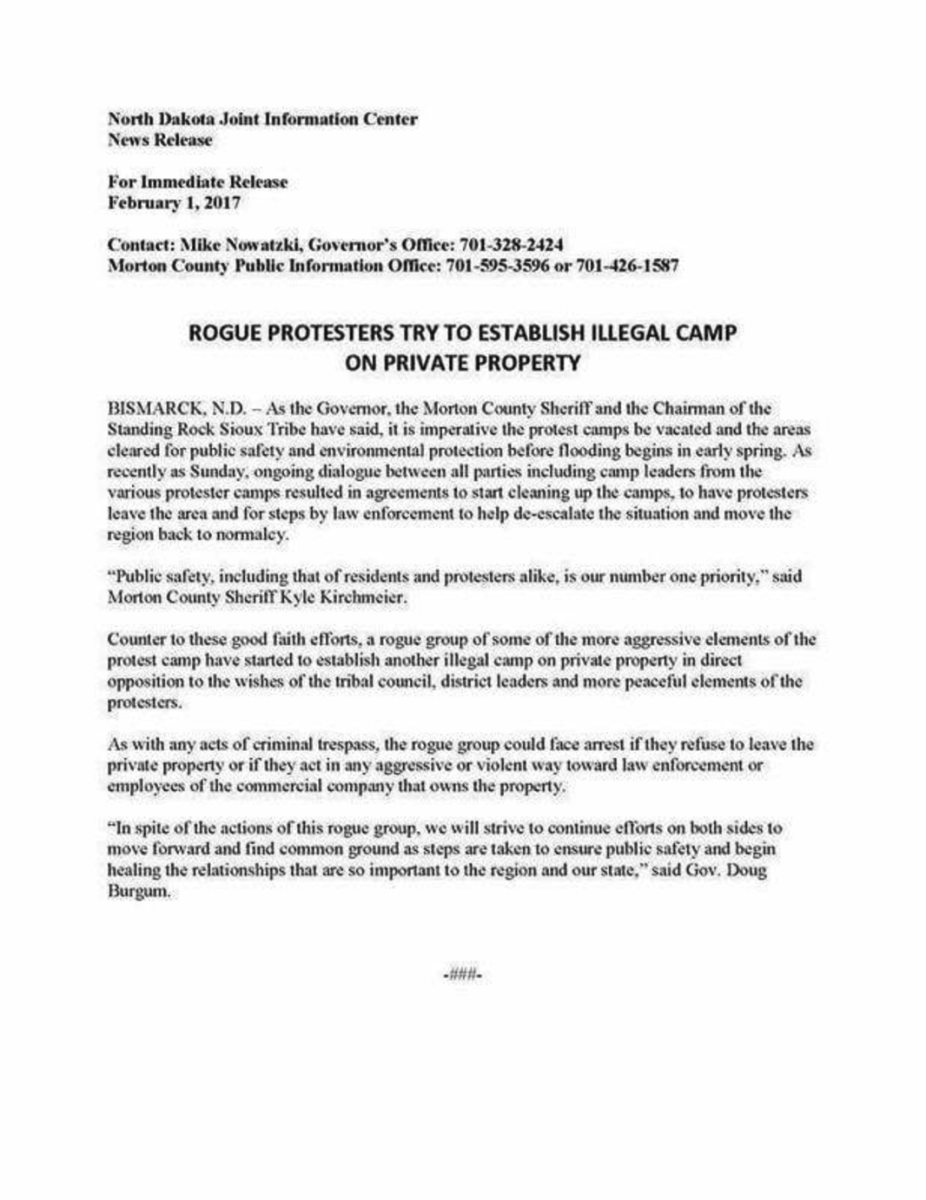
Government forces intend to clear a newly erected camp put in place on ground above the floodplain where Oceti Sakowin, the main camp, and others have been in place since as early as April last year.


But that camp was considered illegal, and as such became the first camp subject to a police raid since last fall.


camps


Energy Transfer Partners, the company responsible for Dakota Access and recently acquired by Sunoco Logistics, halted construction after the U.S. Army Corps of Engineers denied an easement in order to perform a full environmental impact statement.


That order, however, came on the heels of another order from the Corps and one from North Dakota Governor Jack Dalrymple which essentially cut access by emergency services to the camps and deemed anyone present to be subject to arrest for trespassing.


Indeed, over concerns about winter conditions and the spring snow melt flooding the camps, leaders in the Standing Rock Sioux Tribe have repeatedly requested the water protectors who aren’t residents to evacuate.


Just yesterday, Senator John Hoeven issued a statement announcing,


“Today, the Acting Secretary of the Army Robert Speer informed us that he has directed the Army Corps of Engineers to proceed with the easement needed to complete the Dakota Access Pipeline. This will enable the company to complete the project, which can and will be built with the necessary safety features to protect the Standing Rock Sioux Tribe and others downstream […]


“We are also working with the Corps, the Department of Justice, the Department of Interior and the Department of Homeland Security to secure additional federal law enforcement resources to support state and local law enforcement. On Sunday, 20 additional Bureau of Indian Affairs law enforcement officers arrived at Standing Rock to assist local authorities. Also, the Standing Rock Sioux Tribal Council has asked the protesters to leave the campsite on Corps land.”


Fraught with contention, Dakota Access has been the subject of a massive opposition campaign since last spring, which began with a couple hundred people camped near the Missouri River’s Lake Oahe reservoir, and quickly mushrooming to several thousand in the summer.


Though camp population has declined following the multiple orders from authorities, at least 300 people recently started a new camp above the floodplain in an effort to be partially compliant.


As this article went to publication, militarized riot police and National Guard troops backed by armored vehicles and other equipment stood on the road looking over camps, as if awaiting night for another advancement.


This is a developing story and will be updated as needed.

Tuesday, January 17, 2017

New Bill Will Legalize Causing ‘Injury or Death’ By Running Over Protesters

In a daring swipe at First Amendment rights, North Dakota lawmakers have proposed bills directly targeting protesters of the Dakota Access Pipeline (DAPL). If passed, the bills would add insult to injury for Native Americans and their supporters attempting to protect the water source of the Standing Rock Sioux.


Introduced by so-called ‘small government conservatives,’ one bill would make it a crime for people to have face coverings at protests. Another bill, introduced by Rep. Keith Kempenich (R), would make it legal to run over protesters if the driver says he or she didn’t mean to do it.


House Bill Number 1203 states:


“Notwithstanding any other provision of law, a driver of a motor vehicle who unintentionally causes injury or death to an individual obstructing vehicular traffic on a public road, street, or highway, is not guilty of an offense.”


Kempenich, an ally of the oil industry sure to benefit from a completed DAPL, cited complaints by his mother-in-law in justifying his proposed bill, going so far as to say a tragedy could occur “if [drivers] have punched the accelerator rather than the brakes.” He did not provide any actual examples of protesters getting hit or data on complaints from other citizens.


The bill is set for a hearing in the House Transportation Committee on Friday, but the Senate Majority Leader has expressed concerns about lawsuits. Interestingly, he also said it could add to the state’s prison population “that’s soared due to crime accompanying the rise in oil production.” But lawmakers are pumping out the disinformation.


“When people are having their lives disrupted, you’re going to see things move up here,” said Sen. Kelly Armstrong, an oil company executive and GOP chairman. “It’s very difficult to write ‘protest laws.’ We need to make sure there is reasonable application of the law in all circumstances, whether protest-related or not.”


READ MORE:  13 Cops Dispatched to Arrest One 15-year-old Girl, Because a Cop "Smelled Weed"


Not satisfied with having law enforcement violently cracking down on protesters, Kelly believes assaulting the fundamental rights of citizens is the next step. Perhaps Kelly and his political colleagues are feeling emboldened by incoming president Donald Trump, a strong fossil fuel advocate who is ready to embrace authoritarianism.


Lawmakers, eager to begin raking in tax revenue from DAPL, make no mention of the fact that Native American rights were ignored in the process of granting the pipeline right-of-way. They claim the pipeline is necessary to transport oil from shale fields, even though oil production is steadily falling and existing transport infrastructure is already underused – making DAPL nothing more than a high-risk investment by oil barons.


In yet another indication of their readiness to use big government, the same lawmakers are proposing “legislation that would require the state attorney general to sue the federal government to help cover costs for policing a protest.”


They’ve already spent $22 million of state taxpayers’ money acting as militarized protection services for oil companies, and now they feel everyone else should pay them back. There is no confirmation yet if Energy Transfer Partners will or already has reimbursed law enforcement for their help.


This comes after a bill, already withdrawn, that would have had North Dakota claim land and mineral rights in the pipeline’s path under the Missouri River to reimburse law enforcement costs.


Cleary, these ‘small-government conservatives’ are desperate for payback and vengeance. The unabashed desire to wield state power against the most fundamental right of American citizens is truly a frightening prelude.

Monday, January 16, 2017

North Dakota Lawmakers Want to Legalize Running Over Protesters

House Bill Number 1203 (pdf) states that, “Notwithstanding any other provision of law, a driver of a motor vehicle who unintentionally causes injury or death to an individual obstructing vehicular traffic on a public road, street, or highway, is not guilty of an offense.”


The bill is slated to be heard by the North Dakota’s House Transportation Committee on Friday.


Rep. Keith Kempenich (R-Bowman), one of the bill’s co-sponsors, told the Bismarck Tribune on Wednesday, “[The roads are] not there for the protesters. They’re intentionally putting themselves in danger.”


“It’s shifting the burden of proof from the motor vehicle driver to the pedestrian,” Kempenich said.


Tara Houska, an Indigenous water protector and attorney who has resided at the Dakota Access Pipeline (DAPL) resistance camps since August, told NBC News that the bill was “a direct violation of our First Amendment rights.”


“It’s shocking to see legislation that allows for people to literally be killed for exercising their right to protest in a public space,” said Houska, who also serves as the national campaigns director for Honor the Earth, an Indigenous-focused environmental nonprofit.


Water protectors at times blocked roads leading to DAPL construction sites as part of the resistance to the pipeline. Blocking traffic is also an occasional tactic of various environmental and human rights movements.


Houska also criticized another bill in the legislative lineup that would require North Dakota’s attorney general to sue the federal government to recoup some of the cost of policing the months-long DAPL protests.


“These [bills] are meant to criminalize the protests with no real concern for constitutional law,” she said.


Standing Rock Sioux Chairman Dave Archambault II added, “The state claims they want to work closely with the tribe on repairing our relationship with them. Clearly that is not happening when legislation that impacts us is being drafted without consultation, consent, or even basic communication.”


Allison Renville, an activist from the Lakota nation, saw the bills as an insult to sovereign Native American communities, and expressed concern about the recent naming of Republican Sen. John Hoeven, a supporter of the DAPL pipeline and fossil fuel industry, as chairman of the U.S. Senate Committee on Indian Affairs.


“This is a really scary time for Indian Country,” Renville told NBC News. “To have such an avid supporter of the oil industry who has consistently stated his support for extractive industry projects on Native lands named to the position as chairman is akin to stepping on our sovereignty.”

Wednesday, December 14, 2016

Oil Pipeline Spills 170,000 Gallons Just Miles from Standing Rock

December 14, 2016   |   admintam


Monitoring equipment failed to detect the breakage, and it is unknown how long the pipeline was leaking before a landowner discovered it.


(COMMONDREAMS) A pipeline just two and half hours’ drive from the Indigenous water protectors’ ongoing stand against the Dakota Access Pipeline has leaked over 170,000 gallons of crude oil into a tributary of the Little Missouri River and into a hillside, it was reported late Monday.


Monitoring equipment failed to detect the leak, and it is unknown how long the spill near Belfield, North Dakota had gone on before a local landowner discovered it on December 5.


At least two cows have been confirmed dead near the site of the spill, reports the Pioneer Press.


The Belle Fourche pipeline is operated by the Wyoming-based True Companies, which is the same company behind the 2015 pipeline rupture in Montana that sent over 40,000 gallons of crude into the Yellowstone River. Indeed, at that time it was reported that the operator had a “checkered environmental history,” with 30 recorded pipeline leaks and multiple federal fines on its record.


Bill Seuss, an environmental scientist with the North Dakota Health Department, told the Associated Press that the investigation into the cause of the most recent spill is ongoing, and cleanup efforts may last into the spring.


Energy Transfer Partners, the company behind the controversial Dakota Access Pipeline, has repeatedly insisted that the pipeline is “safe,” but water protectors have argued that it is not a question of if it will leak, but when.


“But it will be safe THIS time, right?” wrote Honor the Earth national campaigns director Tara Houska on Facebook, sharing a report of the latest spill.


The U.S. Pipeline and Hazardous Materials Safety Administration notes that there have been over 11,000 reported “significant incidents” — meaning spills, injuries, deaths, and costly accidents—involving pipelines since 1996.


This article (Oil Pipeline Spills 170,000 Gallons Just Miles from Standing Rock) by Nika Knight originally appeared on CommonDreams.org and is licensed Creative Commons 3.0. Image Credit: . The Anti-Media radio show airs Monday through Friday @ 11pm Eastern/8pm Pacific. Help us fix our typos: edits@theantimedia.org

Wednesday, November 9, 2016

Using Election Day as a Distraction, Dakota Access Pipeline Defies White House Pushes on With Drilling

Cannon Ball, ND — “It’s almost as though they have no soul.”


Intentionally exploiting the chaos of Election Day, the company constructing the much-maligned Dakota Access Pipeline announced Tuesday it would defy President Obama’s request to stand down and will begin drilling for the most contentious section of construction under the Missouri River — in just two weeks.


Unequivocally a significant escalation to seething contention, Energy Transfer Partners plans to flagrantly spurn requests from multiple federal agencies, the president, and even international human rights groups, by pushing ahead with construction of the exact portion of pipeline at the center of massive opposition.


Thus far, as a lawsuit by the Standing Rock Sioux Tribe languishes in court, ETP has not been required to stop constructing the $3.7 billion Dakota Access Pipeline — and unsurprisingly has made significant progress on the project, despite verbal appeals and adamant opposition from the tribe and thousands of supporters occupying camps to protect the waters of the Missouri River from future contamination.


ETP, in fact, plans to continue with construction as planned, despite Obama’s talk of possibly rerouting the pipeline to at least partially accommodate fears it could rupture into the Missouri and poison drinking water for nearby Standing Rock Sioux Reservation and some 18 million people downstream.


Last week, Obama finally gave a statement on mass arrests and police violence taking place because of this construction, saying tepidly he would “let it play out for several more weeks, and determine whether or not this can be resolved in a way that I think is properly attentive to the traditions of the first Americans.”


In a statement cited by the Guardian, Energy Transfer Partners explained it was “mobilizing horizontal drilling equipment” to tunnel under the Lake Oahe reservoir on the Missouri River near the encampments of water protectors and activists opposing Dakota Access. For months, the project has continued virtually unhindered, and undercutting the reservoir is one of the only remaining obstacles to completion.


Considering this section of pipeline comprises the heart of the issue for the Standing Rock Sioux, the timing of the announcement during Election Day must have been purposely planned. National coverage of Dakota Access construction and the massive movement opposing has already been severely limited, and often mischaracterizes the situation — so the distraction of the election meant this startling news went largely undetected — except by those directly affected.


“With the election being so big, and North Dakota being so small, they think they can just sweep this under the rug,” Danny Grassrope of the Lower Brule Sioux Tribe explained of the suspect timing of the announcement. “I’m not really surprised. Snakes are sneaky, and this is a black snake. It blindsides everyone.”


Mainstream presstitutes who covered the stand against Dakota Access at all, have portrayed explicit and unfettered violence by heavily-militarized police against the largely peaceful and prayerful Native Americans as essentially law versus disorder.


However, strict rules in place at the campsites prohibit the bringing of weapons and use of violence to oppose the pipeline — and instead encourage civil disobedience and prayer to combat what has been termed “the black snake.”


News of drilling for construction under Lake Oahe filtered into the encampments, and infuriated water protectors already wary of exploitation by ETP and complicity by the government, whose police essentially protect Big Oil from angry civilians.


“I’m in shock. I’m speechless,” Sicangu Lakota Tribe member Cheryl Angel, who arrived at the camps in spring, told the Guardian. “It’s unconscionable and devastating. It’s almost as though they have no soul.”


Angel’s sentiments would be difficult to dispute, given ETP’s apparent plans to dismiss any debate over rerouting Dakota Access, as the company’s statement continues:


“Dakota Access previously received a permit from the army corps with respect the tunneling activities under Lake Oahe, and Dakota Access has all other regulatory approvals and land rights to complete the crossing of the Missouri river at Lake Oahe.”


Indeed, Energy Transfer Partners spokeswoman Vicki Granado, asked to respond to Obama’s comments by the Guardian, replied,


“We are not aware that any consideration is being given to a reroute, and we remain confident we will receive our easement in a timely fashion.”


Water protectors and pipeline opponents expressed shock over ETP’s seemingly shameless attitude and unwillingness to even discuss other potential options.


“I’m in tears, because I can’t believe [the company] would do this to a whole group of people who don’t have any say,” Angel continued.


Jan Hasselman, an attorney representing the Standing Rock Sioux in the lawsuit over permitting on the project, noted for the Guardian that ETP does not yet have all the necessary permits to begin constructing the Lake Oahe section, saying,


“Starting construction without permits would be beyond the pale, even for Dakota Access. It is deeply irresponsible to keep putting investors’ money into this route when both the President and Senator Tim Kaine are openly discussing rerouting away from Lake Oahe.”


Law enforcement treatment of water protectors and activists so concerned the international community, a group from the United Nations is actively investigating possible human rights abuse, and Amnesty International deployed observers to the camps.


“Are indigenous people so invaluable that now that Dakota Access is to the water, does it not matter to anyone that people are going to start laying down their lives?” Jicarilla Apache and Laguna Pueblo Tribes member Eryn Wise told the Guardian.


“I think that people need to seriously question the integrity of the work produced by DAPL right now, because they’re rushing. Is it safe when they’ve been rushing like this?”


Grassrope, knowing the ETP announcement would further inflame the incendiary situation, implored,


“A lot of people are going to get angry, and this is where we need to stay positive. We need prayers more than ever now.”