Showing posts with label Energy Transfer Partners. Show all posts

Saturday, May 27, 2017

Leaked Docs Prove Counter-Terror Ops Used To Silence ‘Jihadist’ Water Protectors at Standing Rock


Indigenous water protectors and their non-Native American allies — who camped in North Dakota in close proximity to the Missouri River to oppose construction of the disputatious Dakota Access Pipeline — were likened to violent jihadist fighters by dubious mercenary international security firm, TigerSwan.


Obtained by The Intercept, internal TigerSwan communications “describe the movement as ‘an ideologically driven insurgency with a strong religious component’ and compare the anti-pipeline water protectors to jihadist fighters,” that outlet reports.


Worse, TigerSwan repeatedly described water protectors as “terrorists” — yes, literally.


Reports the Intercept:


“One report, dated February 27, 2017, states that since the movement ‘generally followed the jihadist insurgency model while active, we can expect the individuals who fought for and supported it to follow a post-insurgency model after its collapse.’ Drawing comparisons with post-Soviet Afghanistan, the report warns, ‘While we can expect to see the continued spread of the anti-DAPL diaspora … aggressive intelligence preparation of the battlefield and active coordination between intelligence and security elements are now a proven method of defeating pipeline insurgencies.’”


Members of the Standing Rock Sioux and Cheyenne River Sioux Tribes engendered the support of thousands of Indigenous Peoples and their supporters in encampments near Cannon Ball in an heroic effort to thwart Energy Transfer Partners’ Bakken pipeline project — but, for their prayerful, peaceful, and largely nonviolent actions to be equated with violent militants is, well, inexplicable.


According to the Intercept, a TigerSwan employee leaked more than 100 internal documents proving the firm led a multi-fronted campaign of pernicious surveillance of activists and water protectors. Over 1,000 documents given the outlet upon public records requests affirm in detail the colossal surveillance program.


TigerSwan — in obeisance to fossil fuel colossus ETP — employed a “militaristic approach to protecting its client’s interests but also the company’s profit-driven imperative to portray the nonviolent water protector movement as unpredictable and menacing enough to justify the continued need for extraordinary security measures. Energy Transfer Partners has continued to retain TigerSwan long after most of the anti-pipeline campers left North Dakota, and the most recent TigerSwan reports emphasize the threat of growing activism around other pipeline projects across the country.”


Between September 2016 and May 2017, TigerSwan regularly fed ETP ‘situation reports’ containing comprehensive updates by operatives in North Dakota, South Dakota, Iowa, Illinois, and Texas, including surveillance of activists and their planned protests — as well as detailed notes culled from social media.


Documents “also provide extensive evidence of aerial surveillance and radio eavesdropping, as well as infiltration of camps and activist circles,” the Intercept notes.


Water protectors and independent journalists indeed recounted extensive surveillance and communications breaches while in Standing Rock camps and at the Tribe’s Prairie Knights Casino — especially pertaining to social media and two-way radios — so much so, newcomers to the area were immediately warned they would be watched.


Beyond the internal TigerSwan communiqués, documents evincing coordination and shared intelligence between the FBI, Department of Homeland Security, the U.S. Justice Department, the Marshals Service, the Bureau of Indian Affairs, and a veritable cadre of state and local police — collectively deeming itself the “Intel Group” — reveal the real-time monitoring of the #NoDAPL movement on social media.


READ MORE:  Cop Turned Lawmaker Just Proposed Making the Teasing of Cops ILLEGAL. No, Seriously


“Daily intelligence updates,” generated by TigerSwan and obtained by public records requests attest to this chimerical government-private alliance amongst the various law enforcement agencies and the adumbral security firm — whose “operatives comment frequently about their routine coordination and intelligence sharing with law enforcement.”


In an ominous portent for future protest actions, as the Intercept asserts, “The intel group went so far as to use a live video feed from a private Dakota Access security helicopter to monitor protesters’ movements. In one report, TigerSwan discusses meeting with investigators from North Dakota’s Attorney General’s Office.”


Names of ‘dozens’ of “well-known activists” — and even those thinly associated with opposition to Dakota Access — appear in the documents.


Reports shared by TigerSwan with the lengthy list of agencies read more like a comprehensive, collective, psychological evaluation — parsing out information such as the dynamics in the various camps, morale, infighting, and speculation on whether or not planned actions would be illegal or violent, including the potentiality weapons would come into play.


Photographs, license plates, and additional information identifying water protectors can also be found in the cache — along with a list of “persons of interest.”


Unsurprisingly, the Intercept notes, records exhibit attempted counterintelligence operations by TigerSwan, in the dissemination of posts to social media condemning actions by water protectors. Reports the outlet,


“TigerSwan’s internal files describe its utilization of aerial surveillance, including use of helicopters and drones to photograph and monitor the pipeline opponents. The September 12 situation report notes that an operation by construction workers was ‘over-watched by a predator on loan to the JEJOC from Oklahoma.’ The TigerSwan contractor who provided the Intercept with the situation reports said he did not believe the company ever operated a predator drone, but metadata in images he shared pointed to a camera used by a commercially available Phantom 4 drone. One of the daily intelligence updates notes plans to obtain night-vision goggles, LRADs, body armor, and FLIR (forward looking infrared) cameras.


“The reports also reveal a widespread and sustained campaign of infiltration of protest camps and activist circles. Throughout the leaked documents, TigerSwan makes reference to its intelligence-gathering teams, which infiltrated protest camps and activist groups in various states. TigerSwan agents using false names and identities regularly sought to obtain the trust of protesters, which they used to gather information they reported back to their employer, according to the TigerSwan contractor.”


An October 3 report states,


“Exploitation of ongoing native versus non-native rifts, and tribal rifts between peaceful and violent elements is critical in our effort to delegitimize the anti-DAPL movement.”


READ MORE:  Zuckerberg Just Revealed Facebook"s 7-Point Plan to Censor "Fake News" and It"s Chilling


Then, on February 19, plans for infiltration appear:


“TigerSwan collections team will make contact with event organizers to embed within the structure of the demonstration to develop a trusted agent status to be cultivated for future collection efforts.”


A terrifying report, dated May 4, evidences “a TigerSwan operative describes an effort to amass digital and ground intelligence that would allow the company to ‘find, fix, and eliminate’ threats to the pipeline — an eerie echo of ‘find, fix, finish,’ a military term used by special forces in the U.S. government’s assassination campaign against terrorist targets.”


Unapologetically, if farcically, militaristic language in the communications from TigerSwan paint the peaceful water protector movement as a finely-oiled machine on par with counterterrorism operations undertaken by nation-states — a tactic telling of brazen hostility by the firm toward activists whose sole concern continues to comprise protection of the water supply from contamination with noxious fossil fuels.


“At times, the military language verges on parody,” note the Intercept journalists, “as when agents write of protesters ‘stockpiling signs’ or when they discuss the ‘caliber’ of paintball pellets. More often, however, the way TigerSwan discusses protesters as ‘terrorists,’ their direct actions as ‘attacks,’ and the camps as a ‘battlefield,’ reveals how the protesters’ dissent was not only criminalized but treated as a national security threat. A March 1 report states that protesters’ ‘operational weakness allows TS elements to further develop and dictate the battlespace.’”


While the Intercept report goes into far greater detail on these phenomenally revealing communications, the fact TigerSwan — and, thus, the law enforcement and intelligence agencies making use of its reports — literally characterized water protectors as “terrorists” should not be blithely ignored.


Protest is and inarguably must remain a constitutionally-protected activity — period.


When myriad insidious government agencies partner with a firm known for shady, violent, and potentially illegal actions confronts a movement dedicated solely to nonviolent, prayerful actions, the ability to redress grievances through demonstration stands directly threatened.


Whatever your particular position on the Dakota Access Pipeline — and the fossil fuel industry, in general — to qualify activists as terrorists prognosticates the coming end to protest and resistance in the U.S.


This war on dissent, in all its fetid ugliness, leads only to resounding totalitarian rule; thus — if you value the shreds of freedom and liberty still clinging to existence in the United States — resentment toward the #NoDAPL movement and other protesters must, instead, be turned toward the arrogant rulers convinced The People are Enemy Number One.

Monday, May 1, 2017

Big Oil Now Has Authority to Arrest You for Protesting a Pipeline on Your OWN Property

pipeline


If you’re a resident of Huntingdon County unfortunate enough to have your property in the path of Sunoco’s Mariner East 2 pipeline, you can forget protesting — unless arrest and jail time aren’t an issue for you.


Common Pleas Court Judge George Zanic signed a rare and factious “writ of possession” order last week in favor of Sunoco, which had sought an “emergency measure” to thwart landowners protesting pipeline construction by occupying trees — on their own property.


In short, protesting encroachment of this pipeline on one’s own property will earn an arrest.


“We’re seriously looking at going to jail,” Elyse Gerhart told NPR. “I’m not the type of person who lets injustice go unchallenged, and neither is my mother. What we’re doing makes [Sunoco] show their true face.”


NPR’s StateImpact Pennsylvania reports,


“Ellen and Stephen Gerhart in Huntingdon, Pa., along with their daughter Elyse, have become outspoken critics of the pipeline and the use of eminent domain by the company to take possession of land along the 350 mile route.


“Charges against Ellen Gerhart were dropped after she was arrested last year for trespass on her own property. But with this new writ, Sunoco can enlist law enforcement to arrest anyone within the easement, including the actual property owners.”


Sunoco, in no uncertain terms, has garnered the full weight of support via force of the U.S. government against the interests of citizens who have done literally nothing else wrong but have their properties awkwardly situated where Big Oil wants its pipeline to run.


Elyse Gerhart took to the trees in early February with an unknown number of others facing similarly offensive corporate actions, after the unironically monikered Department of Environmental Protection granted permits for Sunoco to begin construction of Mariner East 2.


As the Gerharts’ attempt to stave off the corporo-government’s eminent domain seizure of private property winds its way through courts, Judge Zanic’s order effectively quashes any remnants of effective protest the landowners had at their disposal — rendering moot their objections in favor of Sunoco’s plans to complete its pipeline until court proceedings play out.


Sunoco Logistics, it is imperative to note, completed a long-anticipated merger with Energy Transfer Partners — of Dakota Access Pipeline notoriety — just two days ago.


Given the extreme measures ETP employed against the Standing Rock Sioux Tribe and supporting Indigenous and non-Native water protectors from around the globe — who were camped in opposition to DAPL for months near the banks of the Missouri River’s Lake Oahe reservoir — the move to usurp law-abiding civilians’ private property hardly comes as a shock.


Indeed, the pompousness of corporate theft of property under the already-contentious governmental program known as eminent domain seems par for the course for Big Oil — particularly now that industry darling, Donald Trump, occupies the White House.


Occupying treetops on their own properties has already led to the sort of disputatious confrontations, albeit on a smaller scale, which brought international scorn to the Dakota Access Pipeline Project. Although charges were ultimately dropped, authorities arrested Ellen Gerhart last year — for trespassing on her own property.


Attorney Rich Raiders is representing the Gerhart family in its challenge of eminent domain, and noted the court’s use of ‘writ of possession’ is “very rare and very unusual.”


A writ of possession technically allows authorities to seize control of everything you own — giving you and everyone in your household limited time to vacate the premises.


Twenty-seven acres of forests and wetlands comprise the Gerharts property in Huntingdon County, and the family has thus far stood resolute in refusing to voluntarily grant an easement and its 50-foot wide right-of-way with additional 25-foot staging area for the Mariner East line.


In their appeal to the Commonwealth Court, the family argues, in part, Sunoco’s planned liquid natural gas pipeline — “which would carry ethane, propane and butane from the Marcellus Shale to an export terminal in Delaware County” — is not in the public interest.


A common defense against eminent domain, any company arguing for seizure and use of private property normally bears the brunt of proving necessity and public interest — Sunoco, in this instance, claims Mariner East 2 would deliver needed heating oil to parts of Pennsylvania. Mariner East 1, the Gerharts and their attorney rebuff, already supplies what is needed — the second line is redundant and unnecessary.


In an email response to that claim, Sunoco spokesman Jeff Shields asserted the writ of possession holds to the confines of the law, telling StateImpact,


“We are proceeding with construction in Huntingdon County and elsewhere and will conduct ourselves according to the law at all times.”


As with Energy Transfer Partners’ horrendous steamrolling of Native American rights concerning the justifiably maligned Dakota Access Pipeline, that black-and-white simplistic view of Big Oil’s manifest rights hardly comes as a shock — though its might makes right attitude has won no favor with landowners who otherwise couldn’t care less about the exploits of the industry.


This writ of possession and its granting authority to arrest property owners on their own land should they not permit notoriously faulty oil and gas infrastructure to impede in their lives proves yet again the government’s subservience to corporate industry over the rights of people supposedly governed.


No matter Sunoco’s and ETP’s brazen claims to superiority over individual property rights, the argument legality supersedes inalienable rights will never tacitly equate a moral high ground.


And as Big Oil finds new impunity to run roughshod where it sees fit, that legality does not equal morality has never been more clear.

Friday, April 28, 2017

BREAKING: Secret DAPL Spill Assessment Feds Said Would Endanger Lives — Found Online

dapl


Investigative and watchdog media outlet, MuckRock, again had a Freedom of Information Act request turned down concerning the Dakota Access Pipeline, with the Army Corps of Engineers petulantly claiming the release of the full environmental impact assessment would somehow threaten public safety.


According to MuckRock, documentation was “withheld in its entirety under b(7)(f), ‘law enforcement-related information necessary to protect the physical safety of a wide range of individuals.’


“Army Corps of Engineers (ACoE) have rejected a FOIA request for the ‘assessment report on the potential impact of an oil spill of the Dakota Access pipeline,’ arguing that the release of such information would people’s lives at risk.”


For its part, Army Corps attorney Damon Roberts told MuckRock and co-founder Michael Morisy in a denial letter, “The referenced document contains information related to sensitive infrastructure that if misused could endanger people’s lives and property.”


Roberts refused to edit those allegedly ‘dangerous’ details to release the document in full — instead choosing to keep the body of information undisclosed.


“I understand exempting some details,” Morisy told Huffington Post, “but knowing the impact of a natural disaster should be public. I was very disappointed.”


Withholding such information might not give the Corps pause, but considering strident opposition to Dakota Access — water protectors camped on site for months, supporting the Standing Rock Sioux Tribe over concerns drinking water from the Missouri River’s Lake Oahe reservoir could be tainted with crude — it would seem any assessed potential for leaks is of the utmost priority.


A priority the Army Corps and Energy Transfer Partners, the company responsible for pipeline construction, seemed to dismiss outright in foregoing multiple requests from the Tribe to be granted consultation, not only for the integrity of the water supply, but also over potential cultural, tribal, and historical impacts.


But, in the interest of transparency in government, The Free Thought Project discovered portions of the information sought by MuckRock surreptitiously placed online in February — a full 1,261 pages, in fact, bearing the unassuming title,


“Mitigated Finding of No Significant Impact. Environmental Assessment. Dakota Access Pipeline Project. Williams, Morton, and Emmons Counties, North Dakota.”


READ MORE:  WATCH: Armed Troops Deployed Ahead of Court Ruling on Pipeline, Holding Militarized Checkpoints


This document, dated July 2016, indeed appears to be the official environmental assessment around which controversy continues to fly — even after recent completion of the Lake Oahe juncture, the last remaining segment of Dakota Access.


Buried in its pages are details pertaining to expected trouble points along the pipeline’s 1,172-mile route, as well as imagined impacts to sensitive ecosystems where DAPL crosses over or under bodies of water — points exclusively under Army Corps management.


Controversy surrounded Dakota Access Pipeline’s planned route under Lake Oahe, as the Standing Rock Sioux’ drinking water supply is drawn from the same body of water — ETP claimed the pipeline being situated feet beneath the bed of the lake, concerns persisted a breach would allow crude to seep uncontrollably and travel down the Missouri.


And it isn’t as if the public will be privy to future leaks and spills, as U.S. District Judge James E. Boasberg ruled in March that points along the pipeline at risk for spills should not be available to the public — though how a spill or leak would be handled by crews, should be.


According to the judge, referring to the less detailed environmental assessment undertaken prior to DAPL winning approval, ETP “modified the pipeline workspace and route more than a hundred times in response to cultural surveys and Tribes’ concerns regarding historic and cultural resources.”


Spill data ostensively contained in the environmental assessment could have provided the grounds for the Standing Rock Sioux and Cheyenne River Sioux Tribes to demand a time-consuming and far more comprehensive environmental impact study — one which had been promised by the Corps, but which fell by the wayside to pro-Big Oil interests upon the inauguration of industry darling, President Trump.


Thousands of water protectors, hundreds of whom camped near the contentious pipeline crossing for months in peaceful opposition, have since vacated the area — but have transferred the peaceful group effort in what came to be termed the #NoDAPL movement to multiple additional planned pipelines around the U.S. and beyond.


Incidentally, authorities in March discovered vandals had seared a hole into a portion of the Dakota Access Pipeline running through South Dakota, and although authorities have not made any arrests over the incident, analysts believe that — had crude been coursing through at the time — the responsible parties would have been incinerated on the spot.


Tribal members and residents — whose property in the path of the pipeline was seized through the use of eminent domain — feel the U.S. government, Obama and Trump administrations, the Army Corps of Engineers, and, of course, Energy Transfer Partners, brought about completion of the Dakota Access Pipeline Project only through duplicitous means will be pleased to find the over 1,000 pages of information available for perusal.


READ MORE:  5 Vital Stories the Media is Covering Up With Irrational Fear of "Evil Clowns"


Notably, and consistent with any project of this nature, an option not to construct Dakota Access appears in the introduction summary for the assessment. It appears concern another method of transport would be employed should the pipeline not be approved had provided a significant measure in Corps’ consideration.


dapl


It states,


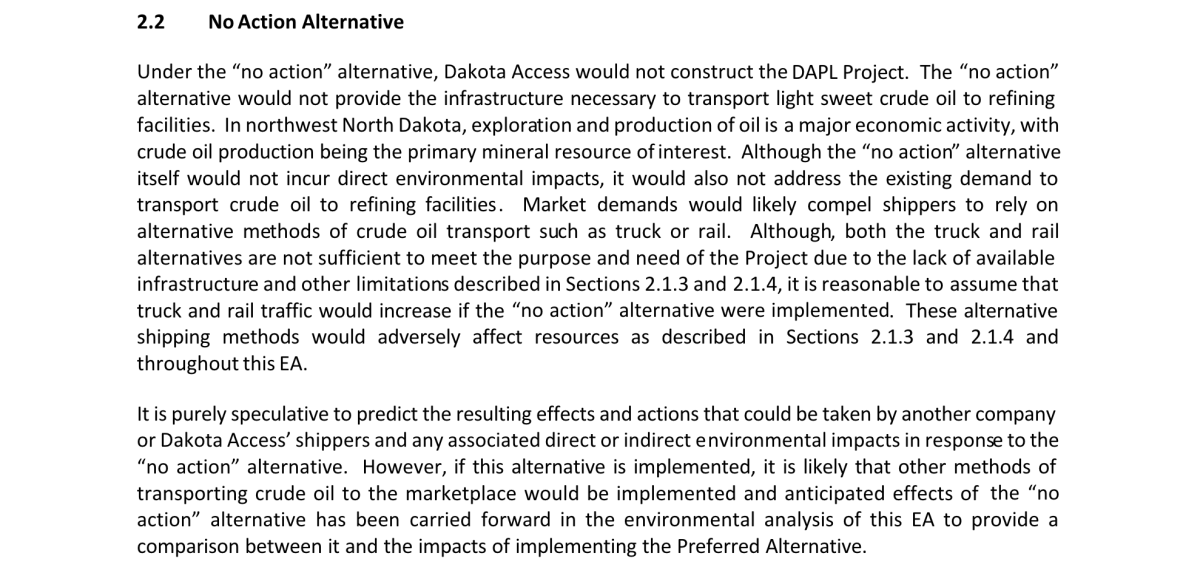
“Under the ‘no action’ alternative, Dakota Access would not construct the DAPL Project. The ‘no action’ alternative would not provide the infrastructure necessary to transport light sweet crude oil to refining facilities. In northwest North Dakota, exploration and production of oil is a major economic activity, with crude oil production being the primary mineral resource of interest. Although the ‘no action’ alternative itself would not incur direct environmental impacts, it would also not address the existing demand to transport crude oil to refining facilities. […]


“It is purely speculative to predict the resulting effects and actions that could be taken by another company or Dakota Access’ shippers and any associated direct or indirect environmental impacts in response to the ‘no action’ alternative. However, if this alternative is implemented, it is likely that other methods of transporting crude oil to the marketplace would be implemented and anticipated effects of the ‘no action’ alternative has been carried forward in the environmental analysis of this EA to provide a comparison between it and the impacts of implementing the Preferred Alternative.”

Friday, February 17, 2017

North Dakota Governor Signs Executive Order Evicting Dakota Access Pipeline Protesters

After nearly a year since the first protest camp sprung up in opposition to the Dakota Access Pipeline, it looks as if the Governor of North Dakota, Doug Burgum, has finally had enough and has signed an executive order demanding that protesters evacuate by February 22nd.


Ironically, environmental damage caused by the protesters, including "months of accumulated debris, and human waste generated by the populations that have occupied the aforementioned areas," and the resulting risk posed to the waters of the Missouri River was cited by the Governor as the primary reason for the eviction notice.  Per the Executive Order:


WHEREAS, large populations have ignored the November 28, 2016 evacuation order detailed in Governor"s Executive Order 2016-08 and the separate eviction order issued by the United States Army Corps of Engineers on November 25, 2016.  These populations continue to unlawfully occupy and reside in flood-prone areas...


WHEREAS, months of accumulated debris, including human waste generated by the populations that have occupied the aforementioned areas of Morton and Sioux Counties pose a significant and increasing environment threat to the waters of the Missouri River if cleanup and removal efforts are not quickly accelerated and completed before flooding begins...


WHEREAS, the presence of accumulated waste, abandoned vehicles and unlawful temporary and permanent dwelling structures in this flood-prone area has created significant health and public safety risks as well as environment hazards, even absent imminent flooding...


All persons occupying or residing in the evacuation area are ordered to leave the area no later than 2 p.m. on Wednesday, February 22,2017.


The full Executive Order can be read here:


Of course, this executive order comes after the US Army Corps said in a court filing earlier this month that it had granted the final easement needed to finish the controversial pipeline. The easement was needed for Energy Transfer Partners to complete work on the last pipeline portion located under Lake Oahe.


And for those of you not familiar with this ongoing saga, the 1,172-mile Dakota Access Pipeline will bring crude oil from North Dakota"s Bakken shale region to Patoka, Illinois, and from there connect to the Gulf of Mexico, where many U.S. refineries are located.


Finally, here is a compilation video of protesters efforts to disrupt the pipeline over the past several months...it was a valiant effort.

Wednesday, February 15, 2017

Company Behind DAPL Reported 69 Accidents, Polluted Rivers in 4 States in Only 2 Years

Although it obstinately insists pipelines are safe, the company responsible for the Dakota Access Pipeline racked up 69 reported accidents in just two years — leaking hundreds of thousands of gallons of oil products and tainting rivers in four states.


That averages nearly three spills each month.


A new report from the Louisiana Bucket Brigade and DisasterMap.net on Energy Transfer Partners and subsidiary Sunoco Logistics documents accidents filed with the National Response Center — the federal contact point for oil spills and industrial accidents — noting 69 accidents between 2015 and 2016.


However, as the study crucially notes, “These are just the accidents that are reported.”


“Heavy rain was the explanation for some of the worst accidents,” the report states, noting, “Bad weather, however, just exposes faulty equipment. While Energy Transfer Partners and other companies portray weather related accidents as unavoidable, they are in reality a result of poor planning and neglected maintenance. For example, the largest tank fire in history happened in south Louisiana in 2001. Because it occurred during a storm, Orion Refining blamed the weather. In truth, a faulty drain on the tank sank the roof, exposed the gasoline and attracted lightning.”


According to the report, ETP’s horrendous track record over the two-year period in the analysis — including the contamination of the Delaware River in Pennsylvania and New Jersey, the Schuylkill River in Pennsylvania, and the Red River in Louisiana — “thereby confirm[s] the concerns of the Standing Rock Sioux tribe who fear the Dakota Access Pipeline would pollute the Missouri River.”


“Sunoco and ETP accidents stretch from Texas to Massachusetts,” asserted Dr. Ezra Boyd, a geographer with DisasterMap.net who analyzed data for the report. “While these accidents cover a large area of the map, the Bayou Bridge pipeline would put an entirely new area at risk: south central Louisiana, including the Atchafalaya Basin.”


EcoWatch reports:


“Dallas-based Energy Transfer Partners owns about 71,000 miles of natural gas, natural gas liquids, refined products and crude oil pipelines across the country.


“The report lists 42 known oil spills, 11 natural gas spills, nine gasoline spills, three propane spills, two ‘other’ spills and two ‘unknown’ spills. Those 69 incidents led to eight injuries, five evacuations and a total damage dollar amount of $300,000. In all, the total known amount of various substances spilled was 544,784 gallons.”


pipeline


pipeline


pipeline


Pipeline companies and the oil and gas industry contend pipelines are the safest means of transporting fossil fuels — and, in comparison to rail and tanker truck methods, they are technically correct.


However, while pipeline accidents occur less frequently, the quantity of oil released tends to be far larger, given the substance is under pressure to flow through the lines and equipment tasked with sensing and stopping leaks doesn’t always function properly — meaning many accidents in desolated areas aren’t discovered immediately.


Take the case of a North Dakota wheat farmer less than two miles from where water protectors remain encamped in opposition to the Dakota Access Pipeline, which will run under the Missouri River’s Lake Oahe reservoir and could threaten the Standing Rock Sioux Reservation’s water supply, and that of around 18 million people downstream.


In 2013, Steve Jensen discovered thick, black, crop-killing crude contaminating a distant corner of one of his wheat fields — not realizing at the time a pipeline under the property had bled nearly one million gallons of the hydrocarbon. Tesoro Corporation got the alert for the spill from Jensen, not from remote pipeline sensors as it should have, and has since dug 50 feet in some areas to alleviate the environmental nightmare sprawling across the land the size of 13 football fields.


Now estimated to soar to $60 million, the cleanup isn’t projected to ever reach full completion.


Incidentally, that spill — and a second belching 176,000 gallons into Ash Coulee Creek — were the handiwork of six-inch steel pipelines. Dakota Access, in comparison, is a 30-inch steel pipeline slated to transport nearly 20 million gallons — daily.


Nasty track record aside, ETP has nearly completed construction on DAPL — to the condemnation of the Standing Rock Sioux and a global movement of water protectors seeking to halt all new fossil fuel infrastructure and shift to renewable energy. And DAPL, like the Tesoro pipeline under the Jensens’ field, will be located underground in bedrock — something ETP claims is the safest possible method of crossing the Missouri, no matter the evidence to the contrary.


This week, the final battle to halt Dakota Access began winding down in federal courts after the U.S. Army Corps of Engineers granted the easement necessary for ETP to complete the pipeline.


A judge denied the tribe’s request for an emergency restraining order to stop ETP from drilling under the river — but a new motion was filed by the tribe on Tuesday, attempting the same, under the premise an imperative environmental impact study should have been carried out as promised.


Dakota Access isn’t the only controversial pipeline project on Energy Transfer Partners’ roster — the Trans-Pecos Pipeline in Texas and Bayou Bridge Pipeline in Louisiana have sparked new encampments like those in Standing Rock as water protectors branch out from North Dakota.


Bayou Bridge — a relatively short, 162-mile pipeline planned to run through precarious ecosystems in the Louisiana bayou — is of particular concern to the Bucket Brigade, whose mission per the website is to “end petrochemical pollution” in the state. EcoWatch explains:


“The planned route crosses major bodies of water and important ecological sites, including the Atchafalaya Basin, Calcasieu, Vermillion and the Mermentau Rivers, as well as Bayou Lafourche and Bayou Teche. The Vermillion River and Bayou Lafourche are sources of drinking water and the Atchafalaya Basin is the country’s largest wetland and swamp, and home to several endangered species.”


With such an atrocious safety and spill record under its belt, Energy Transfer Partners seems so hell bent on profiteering, potential destruction of the environment matters little — if at all.


“Energy Transfer Partners’ records contradict their claim that pipelines are a safer way of transporting oil,” Renate Heurich of 350 Louisiana told EcoWatch. “Pipelines make transporting tar sands cheaper, thus stimulating dirty tar sands extraction despite low oil prices. The real question is: Why do we still invest in more pipeline infrastructure when we urgently need to invest in sustainable alternative energy sources?”


The real answer is simple, at least when it comes to ETP: profit from foreign markets. In preparing to construct the Dakota Access Pipeline, ETP worked furiously behind the scenes to ensure a ban on the export of unrefined crude in place since the 1970s would be lifted specifically so the company could cash in on exporting the Bakken sweet, light crude it would carry.


That single act of surreptitious legislative legerdemain opened the crude and cash floodgates for Big Oil — nearly guaranteeing the fossil fuel industry will opportune the chance to run roughshod over anyone or anything in the way of profit, while duplicitously claiming in the face of evidence otherwise that pipelines are perfectly safe.

Wednesday, February 8, 2017

‘This Is the #NoDAPL Last Stand’: Tribe to Sue as Actions Planned Nationwide

February 8, 2017   |   admintam


(COMMONDREAMS) The Trump administration “will be held accountable in court” for its decision to grant the final easement on the Dakota Access pipeline (DAPL), Indigenous people and environmental allies vowed Tuesday.


And with actions planned nationwide on Wednesday, the administration won’t get off in the court of public opinion, either.


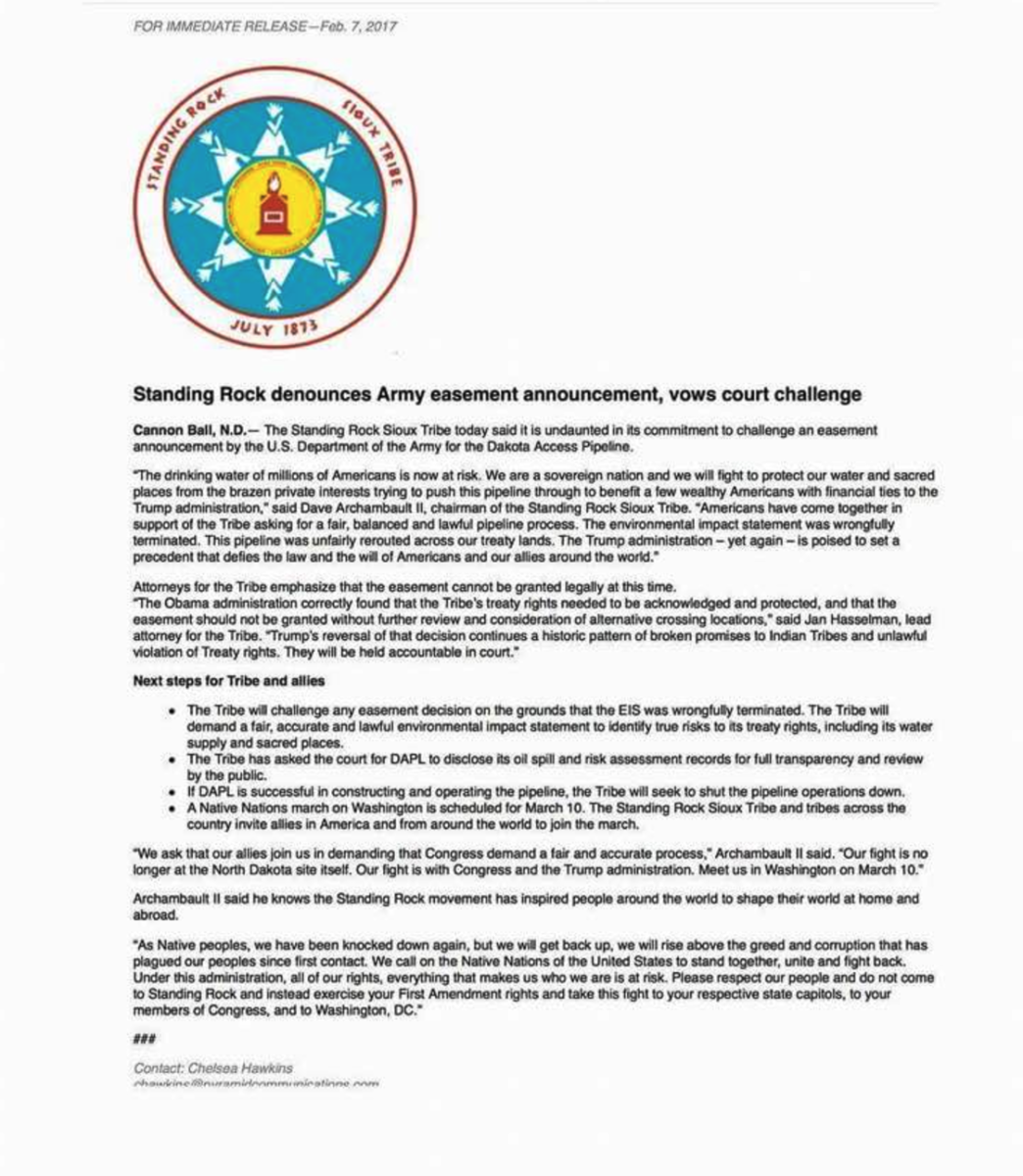
“The drinking water of millions of Americans is now at risk,” said Dave Archambault II, chairman of the Standing Rock Sioux tribe, following the U.S. Army Corps of Engineers’ announcement (pdf) that it would give the official go-ahead within 24 hours. “We are a sovereign nation and we will fight to protect our water and sacred places from the brazen private interests trying to push this pipeline through to benefit a few wealthy Americans with financial ties to the Trump administration.”


In granting the easement, the Army Corps halted (pdf) the preparation of an environmental review ordered by the Obama administration. The Standing Rock tribe, which says DAPL threatens its clean water supply and violates Indigenous treaty rights, pledged to “challenge any easement decision on the grounds that the [environmental impact statement, or EIS] was wrongfully terminated.”


“Trump’s reversal of that decision continues a historic pattern of broken promises to Indian tribes and unlawful violation of treaty rights,” added Jan Hasselman of Earthjustice, lead attorney for the tribe. “They will be held accountable in court.”


Other next steps, according to the Standing Rock statement, include asking the court for DAPL-operator Energy Transfer Partners “to disclose its oil spill and risk assessment records for full transparency and review by the public,” and, “if DAPL is successful in constructing and operating the pipeline, the tribe will seek to shut the pipeline operations down.”


The tribe is not alone in its outrage. Multiple environmental groups voiced their opposition to the decision, while Democratic members of the House and Senate natural resources committees wrote a letter to President Donald Trump expressing their own dismay.


“This blatant disregard for federal law and our country’s treaty and trust responsibilities to Native American tribes is unacceptable,” the lawmakers wrote. “We strongly oppose this decision and any efforts to undermine tribal rights. We urge you to immediately reverse this decision and follow the appropriate procedures required for tribal consultation, environmental law, and due process.” Signatories included Sens. Maria Cantwell (D-Wash.), Bernie Sanders (I-Vt.), and Catherine Cortez Masto (D-Nev.), as well as Reps. Raúl Grijalva (D-Ariz.) and Donald Beyer (D-Va.).


Grijalva, ranking member of the House Natural Resources Committee, also issued a separate statement: “Before the Women’s March and before thousands of people protested at airports, the Standing Rock Sioux and their allies were camping in the freezing cold to defend their rights,” he said. “The Obama Administration heard those concerns and agreed to take a step back; this Administration is ignoring them. In his first few weeks in office our new president has built a resume of discrimination, falsehoods, and sloppy work, and now the decision to trample the sovereignty of our First Americans is the latest entry on a growing list of shameful actions.”


A protest in front of the White House is planned for 5:00pm Wednesday, along with more than 30 actions taking place around the country on what the Indigenous Coalition at Standing Rock has dubbed “an international day of emergency actions to disrupt business as usual and unleash a global intersectional resistance to fossil fuels and fascism.”


“This is the #NoDAPL last stand,” the group declared online.


Find an action near you here.


“Donald Trump will not build his Dakota Access Pipeline without a fight,” said Tom Goldtooth of the Indigenous Environmental Network. “The granting of an easement, without any environmental review or tribal consultation, is not the end of this fight—it is the new beginning. Expect mass resistance far beyond what Trump has seen so far.”


Goldtooth continued:


The granting of this easement goes against protocol, it goes against legal process, it disregards more than 100,000 comments already submitted as part of the not-yet-completed environmental review process—all for the sake of Donald Trump’s billionaire big oil cronies. And, it goes against the treaty rights of the entire Seven Councils Fires of the Sioux Nations.


Donald Trump has not met with a single Native nation since taking office. Our tribal nations and Indigenous grassroots peoples on the frontlines have had no input on this process. We support the Standing Rock Sioux tribe, and stand with them at this troubling time.


In addition, a Native Nations March on Washington is in the works for March 10. “Our fight is no longer at the North Dakota site itself,” said Archambault. “Our fight is with Congress and the Trump administration. Meet us in Washington on March 10.”


An energetic divestment campaign, urging banks to pull their funding for the controversial project, is also gaining steam.


On that front, the Seattle City Council voted 9-0 on Tuesday to cut banking ties with Wells Fargo because of its role as a DAPL lender. “People might argue that Seattle’s $3 billion account is just a blip on the radar for Wells Fargo, but this movement is poised to scale up,” Hugh MacMillan, a senior researcher at Food & Water Watch, told YES! Magazine. “I think you’ll see more cities following Seattle’s lead.”


This article (‘This Is the #NoDAPL Last Stand’: Tribe to Sue as Actions Planned Nationwide) by Deirdre Fulton originally appeared on CommonDreams.org and is licensed Creative Commons 3.0. The Anti-Media radio show airs Monday through Friday @ 11pm Eastern/8pm Pacific. Image credit: L May. Help us fix our typos: edits@theantimedia.org

#NoDAPL Last Stand: Final Construction Could Begin Today As Army Corp Grants Easement

Cannon Ball, ND — Final construction on the Dakota Access Pipeline could begin as soon as today, now that the U.S. Army Corps of Engineers filed a notice of intent on Tuesday to grant Energy Transfer Partners the easement necessary to drill under the Missouri River’s Lake Oahe reservoir.


In short, the Army Corps failed to uphold a December announcement it would complete a full environmental impact assessment as the Standing Rock Sioux Tribe had requested, and has instead abruptly sided with the Trump administration for Big Oil over environmental concerns and treaty rights.


Although the USACE announcement merely codifies an executive memorandum issued by President Trump — which called for completion of both the $3.8 billion, 1,172-mile Dakota Access and the Keystone XL Pipelines — just days after he came to office, the significance in the ability for ETP to complete construction of the notorious pipeline cannot be overstated.


Acting Secretary of the Army David Speer told Congress he plans to grant the easement to the pipeline’s owner for the next 30 years.


In the notice to federal court, USACE states it will “waive its policy to wait 14 days after Congressional notification before granting” the easement to ETP, which could feasibly begin drilling under Lake Oahe sometime today.


construction


construction


construction


“The Obama administration correctly found that the tribe’s treaty rights needed to be respected, and that the easement should not be granted without further review and consideration of alternative crossing locations,” Jan Hasselman, lead attorney for the Standing Rock Sioux Tribe, explained, quoted by Native News Online.


“Trump’s reversal of that decision continues a historic pattern of broken promises to Indian tribes and violation of treaty rights. They will be held accountable in court.”


Court may be the last remaining option for those who oppose the pipeline. Several pieces of litigation over Dakota Access remain stalled in federal courts, but will not have teeth should ETP resume construction the moment USACE gives the official green light.


Both the Standing Rock Sioux and Cheyenne River Sioux Tribes responded to the disappointing but expected development, with Standing Rock Tribe Chairman Dave Archambault II — himself the subject of controversy — stating,


“The drinking water of millions of Americans is now at risk. We are a sovereign nation and we will fight to protect our water and sacred places from the brazen private interests trying to push this pipeline through to benefit a few wealthy Americans with financial ties to the Trump administration.


“Americans have come together in support of the Tribe asking for a fair, balanced and lawful pipeline process. The environmental impact statement was wrongfully terminated. This pipeline was unfairly rerouted across our treaty lands. The Trump administration – yet again – is poised to set a precedent that defies the law and the will of Americans and our allies around the world.”


construction


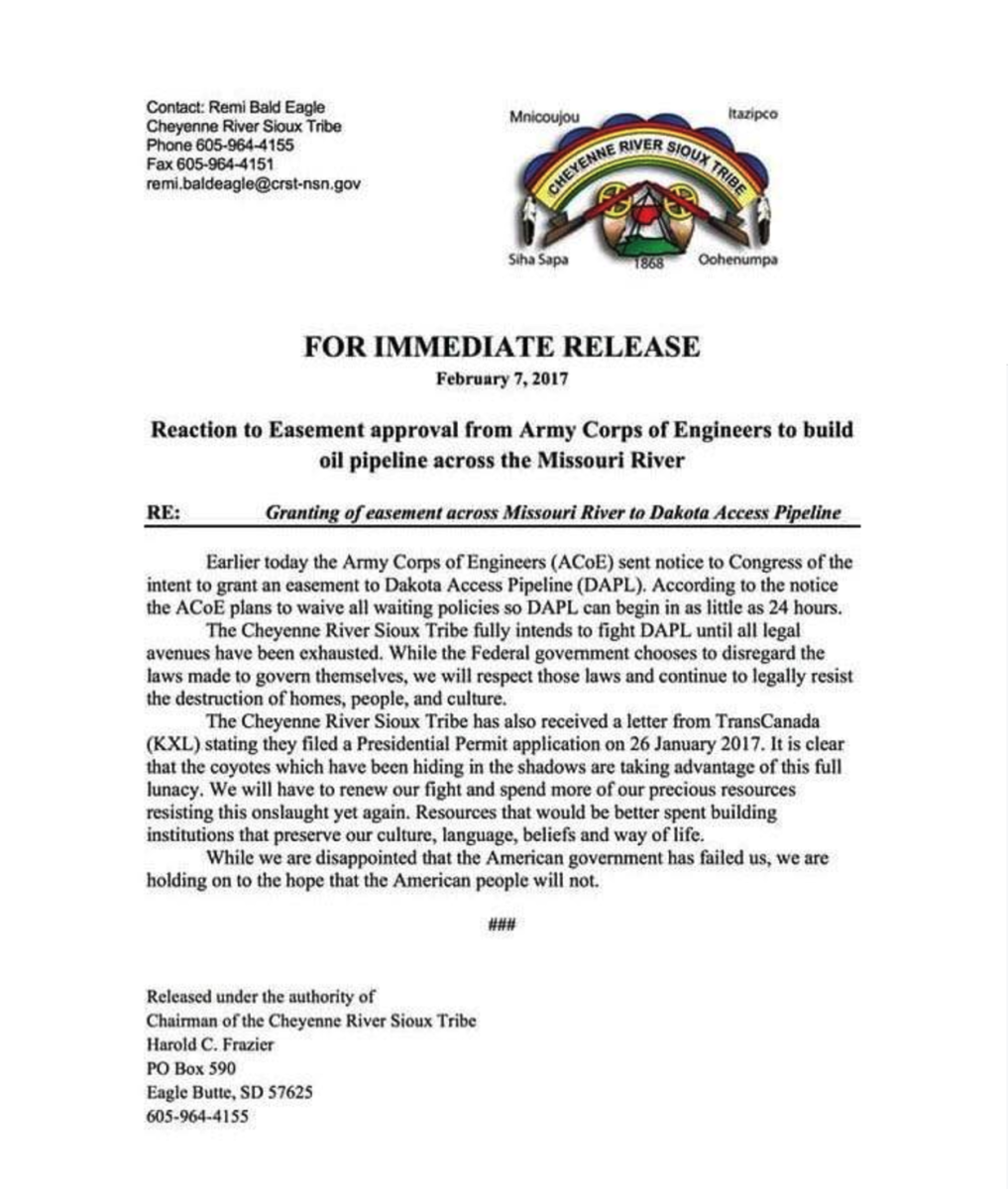
In a press release, Cheyenne River Tribe Chairman Harold C. Frazier, asserted,


“The Cheyenne River Sioux Tribe fully intends to fight DAPL until all legal avenues have been exhausted. While the federal government chooses to disregard the laws made to govern themselves, we will respect those laws and continue to legally resist the destruction of homes, people, and culture.


“The Cheyenne River Sioux Tribe has also received a letter from TransCanada (KXL) stating they filed a Presidential Permit application on 27 January 2017. It is clear that the coyotes which have been hiding in the shadows are taking advantage of this full lunacy. We will have to renew our fight and spend more of our precious resources resisting this onslaught yet again. Resources that would be better spent building institutions that preserve our culture, language, beliefs and way of life.


“While we are disappointed that the American government has failed us, we are holding on to the hope that the American people will not.”


READ MORE:  Breaking: Emergency Call to Action at Standing Rock as Police Violently Attack Prayer Ceremony


construction


Subject of months of protests worldwide, and appalling violence by the Morton County Sheriff’s Department-led, multi-state coalition of police against water protectors occupying space to halt construction, Dakota Access will now cross under the water source of the Standing Rock Reservation and 18 million people downstream.


While Energy Transfer Partners duplicitously claims the pipeline won’t leak and the path under the reservoir through bedrock is perfectly safe, its own pipeline safety and accident record — and that of the oil and gas industry — belies unnecessary risk in situating fossil fuel infrastructure near bodies of clean water.


Over 9,000 ‘significant’ spills occurred over the last 30 years, alone, and that figure doesn’t account for moderate and minor accidents with damage adding up over time. According to Richard Stover, an environmental advocate and former research astronomer at the University of California, Santa Cruz, who assisted CityLab in compiling and analyzing data to map the information, “these accidents have resulted in 548 deaths, 2,576 injuries, and over $8.5 billion in financial damages.”


With justifiable concerns regarding the safety of DAPL, thousands of Native American, Indigenous, and non-Native water protectors have visited camps near Standing Rock over the months since Camp of the Sacred Stones was erected for youth in April 2016.


Police have repeatedly attacked groups of water protectors with nearly every supposed less-than-lethal weapon and munition available — including water cannons in sub-freezing temperatures — leaving scores injured, including a few permanently.


Camp populations dwindled for some time, particularly amid North Dakota’s unforgiving winter conditions, but hundreds still remain encamped near Standing Rock — both in staid opposition to DAPL and for the tremendous cleaning of camps ahead of spring flooding.


News construction on the contentious pipeline could resume as early as Wednesday led a coalition of water protectors to issue a worldwide Call to Action today, February 8, as a collective last stand:


“The Indigenous Coalition at Standing Rock is calling for February 8th to be an international day of emergency actions to disrupt business as usual and unleash a global intersectional resistance to fossil fuels and fascism.  Connect with other struggles.  Think long-term movement building.  We are in this for the long haul.


“The Standing Rock Sioux Tribe has consistently asked for people to go home, and we understand this.  Regardless, water protectors remain on the ground at the Sacred Stone Camp, determined to stop the black snake, and we support them.  If you go, expect police violence, mass arrests, felony charges for just about anything, abuse while in custody, targeted persecution and racial profiling while driving around the area, etc.


“We are calling for emergency actions all over the world. PLEASE, THIS IS OUR LAST STAND. Please visit everydayofaction.org to find or register an action wherever you are. Check out our world action map to join the mass distributed actions” planned for today.


Indeed, it’s now entirely feasible police and National Guard forces could effect the ultimate crackdown on camps and perform mass arrests — though how this will play out is anyone’s guess.


Emphatically, however, what has been made plain is U.S. government makes no qualms over its imperialistic policies against Native and Indigenous peoples — and that environmental concerns and human rights become moot when Big Oil stands to profit.


“All of our hearts are broken,” lamented Linda Black Elk, part of the water protector healer council, in a video on the Army Corps’ decision. “I’m just going to ask you guys to keep us all in your prayers. Pray for the water. Pray for the people. Pray for the water protectors. Pray for the tribe.”

Friday, February 3, 2017

‘Not on Our Watch’ — Veterans Promise ‘Boots on the Ground’ to Stop DAPL

A group of U.S. military veterans, standing in defense of Indigenous rights, has vowed construction of the Dakota Access Pipeline will never be completed — and will put boots on the ground to ensure it.


“We are committed to the people of Standing Rock, we are committed to nonviolence, and we will do everything within our power to ensure that the environment and human life are respected,” Anthony Diggs, spokesman for Veterans Stand, told CNBC. “That pipeline will not get completed. Not on our watch.”


Veterans, said Diggs, seek to raise enough funds “to have a larger, solid boots-on-the-ground presence.”


As staunch a stance as that might sound, the veterans remain committed to nonviolent action in defense of the Standing Rock Sioux against Energy Transfer Partners, the company responsible for pipeline construction.


On Wednesday evening, heavily militarized and armed police and National Guard forces advanced en masse across Highway 1806’s Backwater Bridge for the first time in months to clear out a newer camp. At least 76 people were arrested, ostensibly for trespassing on private property — though the Morton County Sheriff’s Department told the Guardian on Wednesday specifics of the charges had yet to be determined.


“A lot of water protectors really felt that we needed to make some sort of stand as far as treaty rights,” Linda Black Elk of the Catawba Nation told the Guardian. “We basically started to see police mobilizing from all directions. Someone came along and told us we had about 15 minutes before the camp would get raided.”


Law enforcement moved to clear the camp just one day after Secretary of the Army Robert Speer told the U.S. Army Corps of Engineers to grant ETP the easement required to complete drilling under the Missouri River’s Lake Oahe reservoir — the source of Standing Rock’s drinking water and the subject of furious contention over Dakota Access.


Speer’s command also follows the recent signing of executive orders by President Donald Trump for completion of both the Dakota Access and Keystone XL Pipelines — despite the latter being shot down by former President Obama.


Further indicative of a coming law enforcement crackdown on camps of water protectors, on Thursday, officials from the Bureau of Indian Affairs, tribal police, the ATF, the Standing Rock division of Fish and Wildlife, and USACE showed up unannounced and without a warrant on the property of LaDonna Tamakawastewin Allard to “assess” the Camp of the Sacred Stones.


Livestreamer Johnny Dangers captured officials on video refusing to offer explanation beyond the vague ‘assessment’ for their presence on Allard’s private property. Sacred Stone, as the camp is commonly known, is the original site erected for youth water protectors opposing pipeline construction; and — being located on private land — was believed immune from law enforcement efforts of eviction.


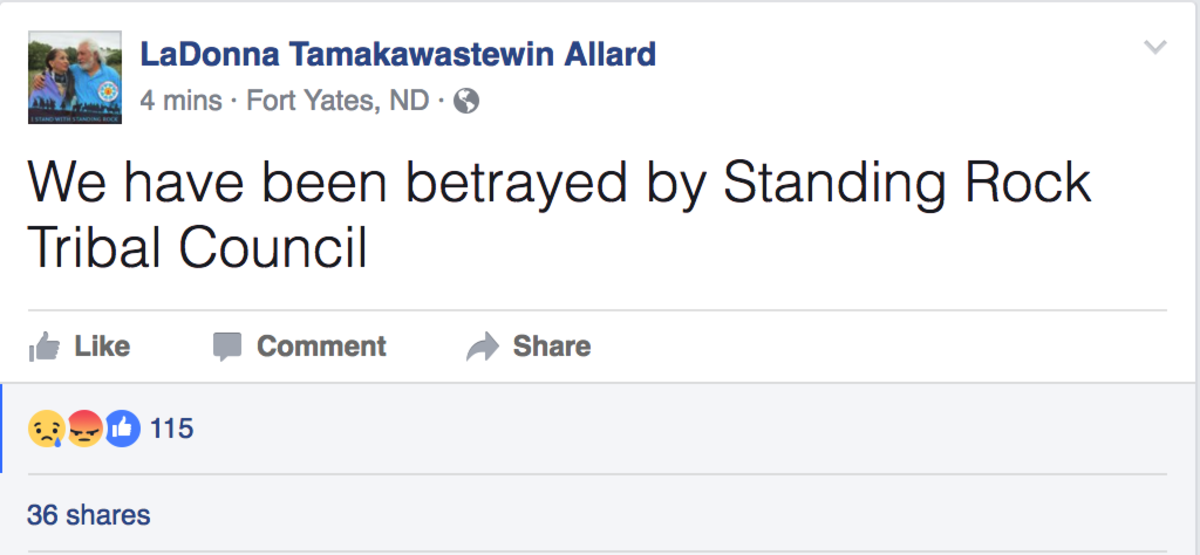
Worse, as Dangers and Allard said on social media, Standing Rock Sioux Tribe council appears to have asked officials to descend on the property — making the ‘raid’ a duplicitous act.


“We have been betrayed by Standing Rock Tribal Council,” Allard posted to Facebook when officials arrived and refused to produce a warrant.


In December, tentative celebration erupted when USACE halted pipeline construction in order to perform an exhaustive environmental impact study before granting the aforementioned easement. But Energy Transfer Partners — cognizant of the Trump administration’s favoritism of Big Oil — vowed Dakota Access would be completed without deviation from a planned path under Lake Oahe.


Now, the two raids — and an increasingly intolerant attitude toward camped water protectors by both law enforcement and certain members of the tribal council — seem to evince coming action to evict and arrest water protectors still occupying floodplain land at several camps, including the largest, main camp, Oceti Sakowin.


But the veterans group doesn’t want to let that happen.


“Veterans Stand for Standing Rock started as a mission to shield water protectors and highlight human rights violations,” states the Veterans Stand website. “It grew into something that we never could have imagined. Veterans are people who take an oath and write a blank check to the United States of America, up to and including their life, to protect the Constitution from all enemies, both foreign and domestic […]


“Our veterans have stepped up and chosen to serve, because there are still human and constitutional rights being violated. We are honored to serve beside them.”


READ MORE:  U.S. Congresswoman & Military Vet to Join the Resistance With Fellow Veterans at Standing Rock


U.S. Navy veteran, Petty Officer 1st Class Kash Jackson came to Standing Rock to stand in defiance of the government-backed industry exploitation of Native Americans, telling a reporter from The Young Turks in November, about marching with an inverted American flag,


“Our greatest enemies are not overseas — our greatest enemies are right here.”


Per the U.S. Flag Code, he continued, “whenever you invert the American flag, it is permissible, underneath extreme risk to life and property — and based on what I’ve witnessed, over here in Standing Rock, I don’t think there’s any question whether or not there’s a risk to life and property.”


Several violent attacks led by police against unarmed and prayerful water protectors have left hundreds injured — several permanently — and have fueled worldwide consternation over the U.S. government’s corporate fealty.


But, given concerted efforts by ETP — whose CEO Kelcy Warren donated $100,000 to the president’s campaign — to ensure the oil flowing through the Dakota Access Pipeline would be legally permitted for export and profit, anti-pipeline actions around the country should expect similarly oppressive measures from the Trump administration.


With water protectors vehement about staying put in Standing Rock to halt construction of Dakota Access Pipeline for good, assistance from Veterans Stand will undoubtedly be welcome.

Thursday, February 2, 2017

BREAKING: Police Raids for Removal of Water Protectors at Standing Rock Begins

Police and National Guard forces began raiding camps at Standing Rock Wednesday afternoon, not long after reports stated the U.S. Army Corps of Engineers would be granting an easement necessary for completion of the Dakota Access Pipeline.


Reports from the scene suggested law enforcement blocked the road into the camp at both the northern and southern ends — effectively kettling the entire area, which would leave anyone remaining subject to arrest.


“Law enforcement have evicted about 40 Dakota Access pipeline opponents from a camp the demonstrators set up on higher ground near their flood-prone main camp in southern North Dakota,” CBC reports. Social media reported the number of arrested had surpassed 50.


Among the detained water protectors, livestreamer Shiyé Bidzííl stated on video, was vocal pipeline opponent and #NoDAPL leader, Chase Ironeyes.


Heavily militarized police advanced across Highway 1806’s Backwater Bridge from the north — a boundary not crossed by either law enforcement or water protectors since the barricade was reinforced by authorities in November.


Social media posts indicated Bureau of Indian Affairs police had set up a roadblock to prevent anyone seeking to enter the camps while the raid was performed.


Government forces intend to clear a newly erected camp put in place on ground above the floodplain where Oceti Sakowin, the main camp, and others have been in place since as early as April last year.


But that camp was considered illegal, and as such became the first camp subject to a police raid since last fall.


camps


Energy Transfer Partners, the company responsible for Dakota Access and recently acquired by Sunoco Logistics, halted construction after the U.S. Army Corps of Engineers denied an easement in order to perform a full environmental impact statement.


That order, however, came on the heels of another order from the Corps and one from North Dakota Governor Jack Dalrymple which essentially cut access by emergency services to the camps and deemed anyone present to be subject to arrest for trespassing.


Indeed, over concerns about winter conditions and the spring snow melt flooding the camps, leaders in the Standing Rock Sioux Tribe have repeatedly requested the water protectors who aren’t residents to evacuate.


Just yesterday, Senator John Hoeven issued a statement announcing,


“Today, the Acting Secretary of the Army Robert Speer informed us that he has directed the Army Corps of Engineers to proceed with the easement needed to complete the Dakota Access Pipeline. This will enable the company to complete the project, which can and will be built with the necessary safety features to protect the Standing Rock Sioux Tribe and others downstream […]


“We are also working with the Corps, the Department of Justice, the Department of Interior and the Department of Homeland Security to secure additional federal law enforcement resources to support state and local law enforcement. On Sunday, 20 additional Bureau of Indian Affairs law enforcement officers arrived at Standing Rock to assist local authorities. Also, the Standing Rock Sioux Tribal Council has asked the protesters to leave the campsite on Corps land.”


Fraught with contention, Dakota Access has been the subject of a massive opposition campaign since last spring, which began with a couple hundred people camped near the Missouri River’s Lake Oahe reservoir, and quickly mushrooming to several thousand in the summer.


Though camp population has declined following the multiple orders from authorities, at least 300 people recently started a new camp above the floodplain in an effort to be partially compliant.


As this article went to publication, militarized riot police and National Guard troops backed by armored vehicles and other equipment stood on the road looking over camps, as if awaiting night for another advancement.


This is a developing story and will be updated as needed.

Wednesday, January 25, 2017

After Trump’s Executive Order, Sheriff Issues Ominous Warning to DAPL Water Protectors

Cannon Ball, ND — After President Donald Trump issued Executive Orders greenlighting both the Keystone XL and Dakota Access Pipelines, protests erupted from coast to coast — including in the nation’s capital — as the Standing Rock Sioux Tribe, Morton County Sheriff’s Department, and clean energy advocates were left scrambling to make sense of the abrupt power play.


Rumors have circulated for months law enforcement would opportune the first chance to forcefully evict water protectors from the camps — whether under the guise of safety, since several sit amid a spring flood plain, or under the premise of illegality despite the location being part of lands granted to the tribe by treaties over a century ago by the U.S. government. Now, thanks to Trump, the future of pipeline opposition camps looks grim.


According to a statement,


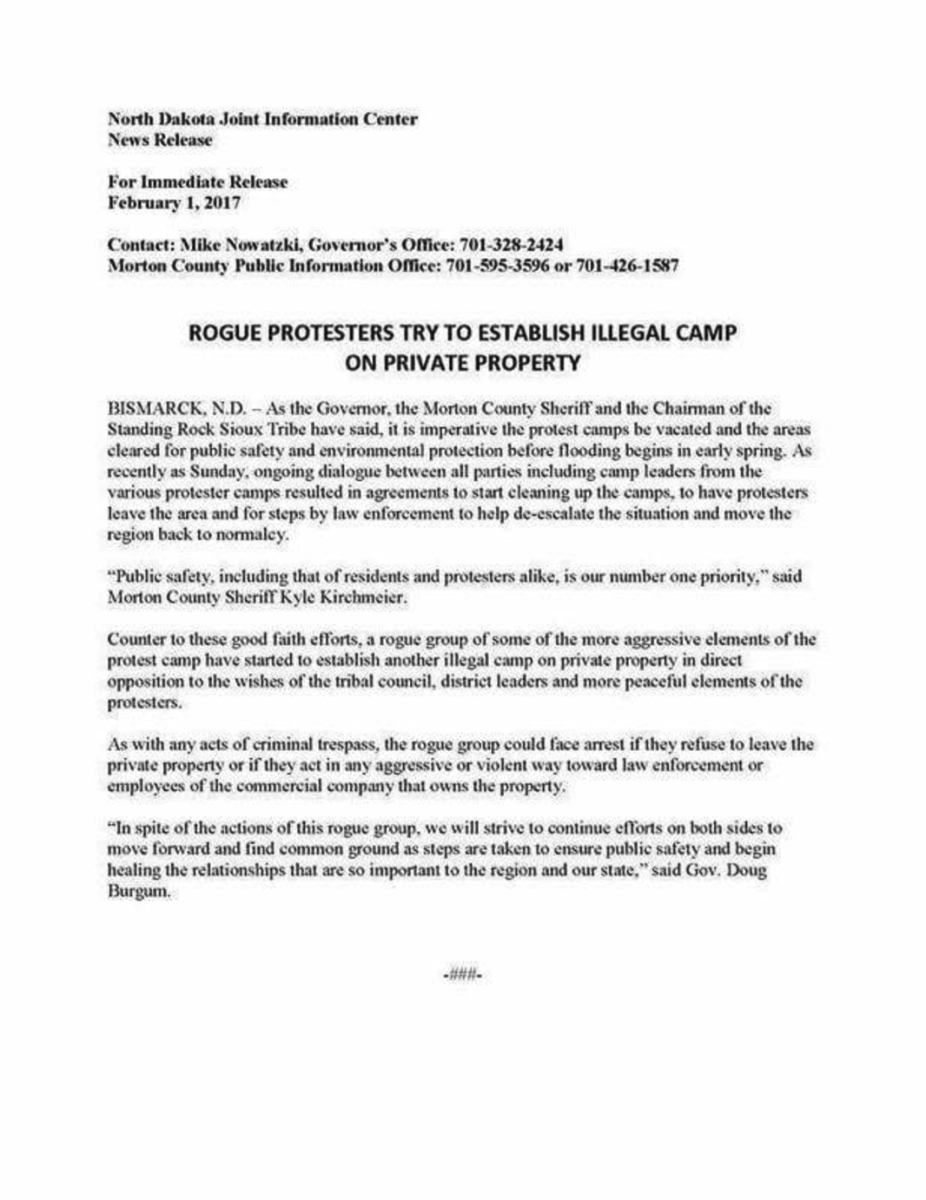
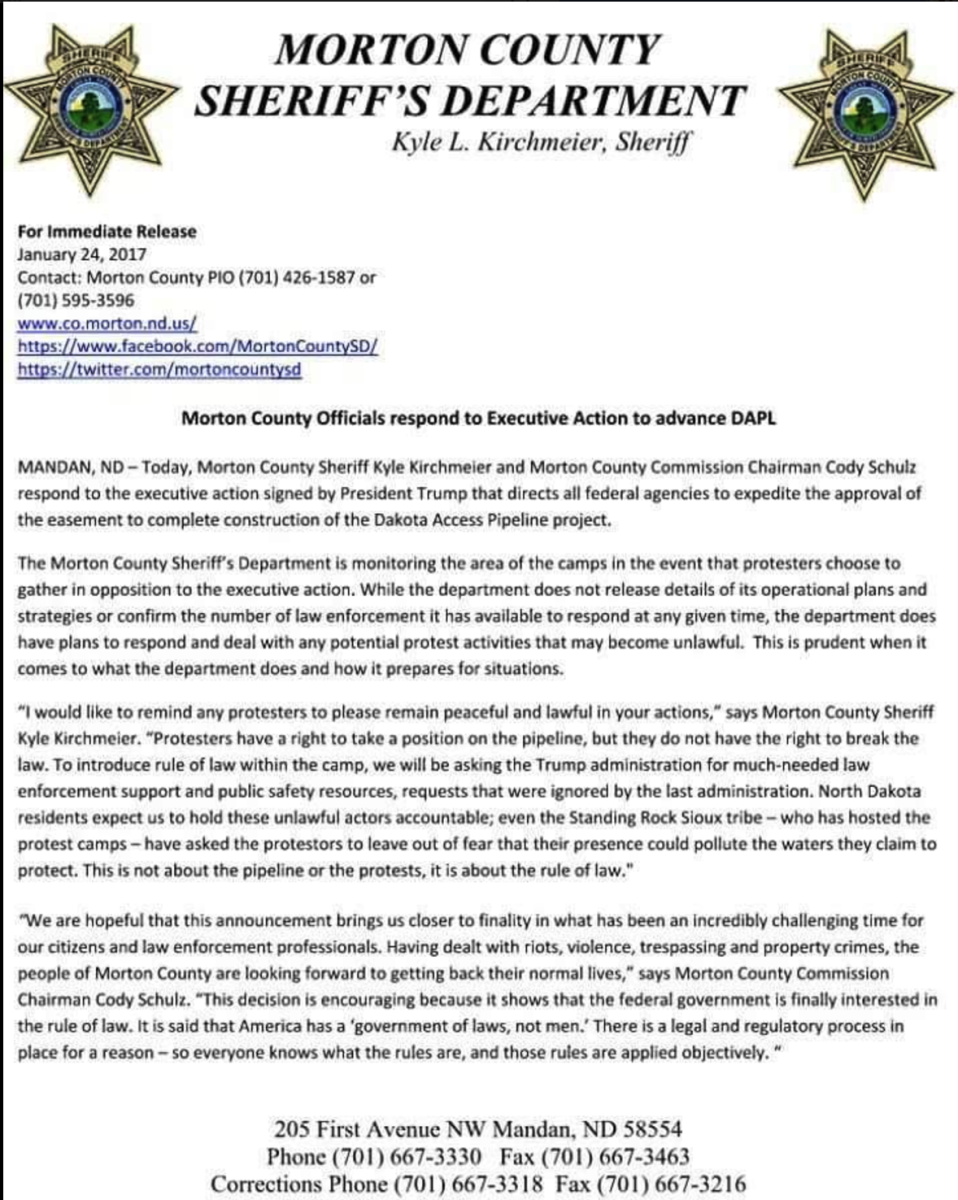
“The Morton County Sheriff’s Department is monitoring the area of the camps in the event that protestors choose to gather in opposition to the executive action. While the department does not release details of its operational plans and strategies or confirm the number of law enforcement it has available to respond at any given time, the department does have plans to respond and deal with any potential protest actions that may become unlawful. This is prudent when it comes to what the department does and how it prepares for situations.”


In the same statement, Morton County Sheriff Kyle Kirchmeier issued a stern admonishment to Standing Rock water protectors (a term preferred over ‘protesters’ by pipeline opposition for their stance of protecting the Missouri River from contamination):


“I would like to remind any protesters to please remain peaceful and lawful in your actions. Protesters have a right to take a position on the pipeline, but they do not have the right to break the law. To introduce rule of law within the camp, we will be asking the Trump administration for much-needed law enforcement support and public safety resources, requests that were ignored by the last administration. North Dakota residents expect us to hold these unlawful actors accountable; even the Standing Rock Sioux tribe – who has hosted the protest camps – have asked the protestors to leave out of fear that their presence could pollute the waters they claim to protect. This is not about the pipeline or the protests, it is about the rule of law.”


READ MORE:  Oil Company Takes Dozers on 20-Mile Detour to "Deliberately Destroy" Ancient Native American Sites


And Kirchmeier wasn’t the only Morton County official to mischaracterize the largely peaceful and unarmed Dakota Access Pipeline opposition in that statement.


“We are hopeful that this announcement brings us closer to finality in what has been an incredibly challenging time for our citizens and law enforcement professionals. Having dealt with riots, violence, trespassing and property crimes, the people of Morton County are looking forward to getting back their normal lives,” said Morton County Commission Chairman Cody Schulz. “This decision is encouraging because it shows that the federal government is finally interested in the rule of law. It is said that America has a ‘government of laws, not men.’ There is a legal and regulatory process in place for a reason – so everyone knows what the rules are, and those rules are applied objectively.”


Morton County


“A lot of jobs, 28,000 jobs,” Trump said on Tuesday, according to ABC News, regarding the economic impact of the pipeline projects — citing a number not backed by several reports on the matter. “Great construction jobs.”


What, exactly, happens next appears — at least temporarily — to be anyone’s guess. But for water protectors encamped near the banks of the Missouri River’s Lake Oahe reservoir — who have vowed to do whatever it takes to halt construction of DAPL — Trump’s memorandum allowing Energy Transfer Partners to continue the final stages of the project represents the final threat to Indigenous sovereignty and integrity of the water supply.


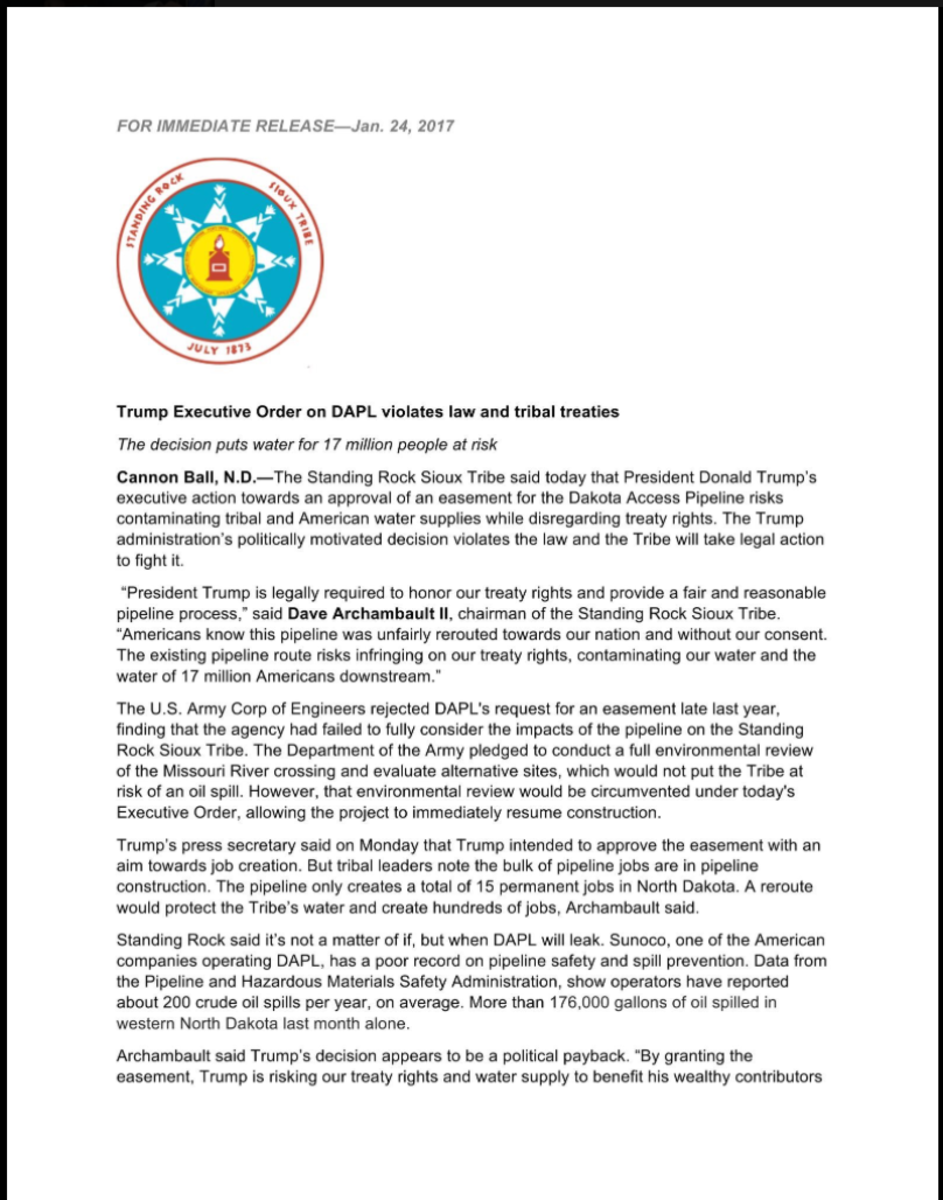
“The Standing Rock Sioux Tribe said today that President Donald Trump’s executive action towards an approval of an easement for the Dakota Access Pipeline risks contaminating tribal and American water supplies while disregarding treaty rights,” an official statement explains. “The Trump administration’s politically motivated decision violates the law and the Tribe will take legal action to fight it.”


Morton County


Morton County


From Los Angeles and Seattle, to New York City and Washington, D.C., spontaneous demonstrations erupted after the new president’s unexpectedly decisive approvals for both pipelines.


Adhering to longstanding dictates from the Standing Rock Sioux Tribe’s calls for pipeline opposition to remain unarmed, prayerful, and peaceful, Native and non-Native water protectors from coast to coast broke out in song and chanted support in the streets of major cities — with large crowds amassing outside the White House in D.C. and Trump Tower in New York City.


“It’s amazing the power of social media,” one water protector observed from the Los Angeles rally, concerning the organic planning of events after Trump’s staggering announcement.


Indeed, absent sufficient and balanced coverage from the mainstream media for months, Standing Rock water protectors have relied on platforms like Facebook and Twitter to present an accurate portrait of the quagmire that is the Dakota Access Pipeline project and its opposition.


Thousands of supporting water protectors from hundreds of Indigenous bands around the world, as well as non-Native activists, have spent time in a smattering of camps attempting to halt pipeline construction through physical occupation at the site. Several hundred are still enduring a rough and bitter North Dakota winter at the site — and have pledged to stay in place no matter the consequences of Trump’s fraught executive actions.


Despite the haunting mirror to historical clashes between Native Americans and the nascent United States government — including the gruesome Battle of Wounded Knee, which occurred on the same lands — coverage by the corporate press has remained tepid, at best, often slanting neutrally or in favor of law enforcement where glaringly inappropriate.


Now that President Trump has avowed Big Oil’s right-of-way on both hotly contentious projects, it would appear critically necessary attention will finally be devoted to Indigenous and people’s rights over industry profits. In fact, claims the pipelines would create much needed jobs hold little basis in reality.


Keystone XL would permanently employ just 35 workers, and Dakota Access, a mere 40 in operational and maintenance positions — not to mention the latter is already more than 85 percent complete.


“The Keystone XL project,” Slate reported, “which will take 800,000 barrels of oil a day from Canada to the Gulf Coast, was the subject of a largely symbolic battle waged by climate activists opposed to the continued development of fossil fuel infrastructure. It was torpedoed by President Obama in 2015, a month before the Paris Climate Summit. ‘America is now a global leader when it comes to taking serious action to fight climate change,’ he said upon rejecting a permit for the pipeline’s construction. ‘And frankly, approving this project would have undercut that global leadership.’”


However welcome the former president’s disapproval of KXL, Obama remained noticeably silent on the Standing Rock Sioux Tribe’s fight to prevent Dakota Access from traversing under the Missouri River just north of the reservation — a route believed to directly endanger the tribe’s only water source.


Energy Transfer Partners, responsible for construction, insists DAPL poses no threat to the Missouri River — but the company’s safety record says otherwise, evincing egregious breaches, spills, and leaks, and calling to question whether the pipeline’s proximity to the water supply of millions is a prudent choice.


Notably, Trump’s announcement immediately succeeds a motion by the tribe in support of the evacuation of camps — a direct contrast to life-or-death devotion many water protectors have declared against construction of Dakota Access.


Indeed, simmering contentions between some Standing Rock tribal leadership and other members of the tribe have fomented a near constant anxiety and a flurry of accusations something untoward may be afoot. Anyone spending time in the area will notice a pall having replaced overwhelming unity present in the pipeline opposition’s early stages last spring.


Tribal council rulings seemed to tacitly confirm those longstanding suspicions over the weekend.


“Cody Two Bears, the Cannon Ball district representative to the tribal council, said the district is requesting federal law enforcement aid in removing protesters from the district and setting up posts blocking those who do not live or work in the district from entering. The district requests these actions be taken in the next 30 days,” reported the Bismarck Tribune on Sunday.


Led by the Morton County Sheriff’s Department, law enforcement from at least nine states have on multiple occasions acted aggressively and forcefully against unarmed, prayerful water protectors.


These barbarous crackdowns have left scores injured — several permanently disfigured — and have further highlighted that police forces are guarding pipeline interests over those of the people they were once tasked with keeping safe from harm.


Trump’s action to preempt a full environmental impact study that was supposed to be performed by the U.S. Army Corps of Engineers in coming days appeared per the statement only to further embolden law enforcement to act aggressively against the unarmed collective of water protectors.


With the president’s summary actions favoring Big Oil interests over the water supply of millions of Americans — and the Morton County Sheriff’s Department poised to move forcefully on Standing Rock camps — the eyes of the world are once again trained on the United States in a waiting game to see whether violence against the unarmed begging for human rights will take a turn for the deadly.