Showing posts with label Dakota Access Pipeline. Show all posts

Saturday, May 27, 2017

Leaked Docs Prove Counter-Terror Ops Used To Silence ‘Jihadist’ Water Protectors at Standing Rock


Indigenous water protectors and their non-Native American allies — who camped in North Dakota in close proximity to the Missouri River to oppose construction of the disputatious Dakota Access Pipeline — were likened to violent jihadist fighters by dubious mercenary international security firm, TigerSwan.


Obtained by The Intercept, internal TigerSwan communications “describe the movement as ‘an ideologically driven insurgency with a strong religious component’ and compare the anti-pipeline water protectors to jihadist fighters,” that outlet reports.


Worse, TigerSwan repeatedly described water protectors as “terrorists” — yes, literally.


Reports the Intercept:


“One report, dated February 27, 2017, states that since the movement ‘generally followed the jihadist insurgency model while active, we can expect the individuals who fought for and supported it to follow a post-insurgency model after its collapse.’ Drawing comparisons with post-Soviet Afghanistan, the report warns, ‘While we can expect to see the continued spread of the anti-DAPL diaspora … aggressive intelligence preparation of the battlefield and active coordination between intelligence and security elements are now a proven method of defeating pipeline insurgencies.’”


Members of the Standing Rock Sioux and Cheyenne River Sioux Tribes engendered the support of thousands of Indigenous Peoples and their supporters in encampments near Cannon Ball in an heroic effort to thwart Energy Transfer Partners’ Bakken pipeline project — but, for their prayerful, peaceful, and largely nonviolent actions to be equated with violent militants is, well, inexplicable.


According to the Intercept, a TigerSwan employee leaked more than 100 internal documents proving the firm led a multi-fronted campaign of pernicious surveillance of activists and water protectors. Over 1,000 documents given the outlet upon public records requests affirm in detail the colossal surveillance program.


TigerSwan — in obeisance to fossil fuel colossus ETP — employed a “militaristic approach to protecting its client’s interests but also the company’s profit-driven imperative to portray the nonviolent water protector movement as unpredictable and menacing enough to justify the continued need for extraordinary security measures. Energy Transfer Partners has continued to retain TigerSwan long after most of the anti-pipeline campers left North Dakota, and the most recent TigerSwan reports emphasize the threat of growing activism around other pipeline projects across the country.”


Between September 2016 and May 2017, TigerSwan regularly fed ETP ‘situation reports’ containing comprehensive updates by operatives in North Dakota, South Dakota, Iowa, Illinois, and Texas, including surveillance of activists and their planned protests — as well as detailed notes culled from social media.


Documents “also provide extensive evidence of aerial surveillance and radio eavesdropping, as well as infiltration of camps and activist circles,” the Intercept notes.


Water protectors and independent journalists indeed recounted extensive surveillance and communications breaches while in Standing Rock camps and at the Tribe’s Prairie Knights Casino — especially pertaining to social media and two-way radios — so much so, newcomers to the area were immediately warned they would be watched.


Beyond the internal TigerSwan communiqués, documents evincing coordination and shared intelligence between the FBI, Department of Homeland Security, the U.S. Justice Department, the Marshals Service, the Bureau of Indian Affairs, and a veritable cadre of state and local police — collectively deeming itself the “Intel Group” — reveal the real-time monitoring of the #NoDAPL movement on social media.


READ MORE:  Cop Turned Lawmaker Just Proposed Making the Teasing of Cops ILLEGAL. No, Seriously


“Daily intelligence updates,” generated by TigerSwan and obtained by public records requests attest to this chimerical government-private alliance amongst the various law enforcement agencies and the adumbral security firm — whose “operatives comment frequently about their routine coordination and intelligence sharing with law enforcement.”


In an ominous portent for future protest actions, as the Intercept asserts, “The intel group went so far as to use a live video feed from a private Dakota Access security helicopter to monitor protesters’ movements. In one report, TigerSwan discusses meeting with investigators from North Dakota’s Attorney General’s Office.”


Names of ‘dozens’ of “well-known activists” — and even those thinly associated with opposition to Dakota Access — appear in the documents.


Reports shared by TigerSwan with the lengthy list of agencies read more like a comprehensive, collective, psychological evaluation — parsing out information such as the dynamics in the various camps, morale, infighting, and speculation on whether or not planned actions would be illegal or violent, including the potentiality weapons would come into play.


Photographs, license plates, and additional information identifying water protectors can also be found in the cache — along with a list of “persons of interest.”


Unsurprisingly, the Intercept notes, records exhibit attempted counterintelligence operations by TigerSwan, in the dissemination of posts to social media condemning actions by water protectors. Reports the outlet,


“TigerSwan’s internal files describe its utilization of aerial surveillance, including use of helicopters and drones to photograph and monitor the pipeline opponents. The September 12 situation report notes that an operation by construction workers was ‘over-watched by a predator on loan to the JEJOC from Oklahoma.’ The TigerSwan contractor who provided the Intercept with the situation reports said he did not believe the company ever operated a predator drone, but metadata in images he shared pointed to a camera used by a commercially available Phantom 4 drone. One of the daily intelligence updates notes plans to obtain night-vision goggles, LRADs, body armor, and FLIR (forward looking infrared) cameras.


“The reports also reveal a widespread and sustained campaign of infiltration of protest camps and activist circles. Throughout the leaked documents, TigerSwan makes reference to its intelligence-gathering teams, which infiltrated protest camps and activist groups in various states. TigerSwan agents using false names and identities regularly sought to obtain the trust of protesters, which they used to gather information they reported back to their employer, according to the TigerSwan contractor.”


An October 3 report states,


“Exploitation of ongoing native versus non-native rifts, and tribal rifts between peaceful and violent elements is critical in our effort to delegitimize the anti-DAPL movement.”


READ MORE:  Zuckerberg Just Revealed Facebook"s 7-Point Plan to Censor "Fake News" and It"s Chilling


Then, on February 19, plans for infiltration appear:


“TigerSwan collections team will make contact with event organizers to embed within the structure of the demonstration to develop a trusted agent status to be cultivated for future collection efforts.”


A terrifying report, dated May 4, evidences “a TigerSwan operative describes an effort to amass digital and ground intelligence that would allow the company to ‘find, fix, and eliminate’ threats to the pipeline — an eerie echo of ‘find, fix, finish,’ a military term used by special forces in the U.S. government’s assassination campaign against terrorist targets.”


Unapologetically, if farcically, militaristic language in the communications from TigerSwan paint the peaceful water protector movement as a finely-oiled machine on par with counterterrorism operations undertaken by nation-states — a tactic telling of brazen hostility by the firm toward activists whose sole concern continues to comprise protection of the water supply from contamination with noxious fossil fuels.


“At times, the military language verges on parody,” note the Intercept journalists, “as when agents write of protesters ‘stockpiling signs’ or when they discuss the ‘caliber’ of paintball pellets. More often, however, the way TigerSwan discusses protesters as ‘terrorists,’ their direct actions as ‘attacks,’ and the camps as a ‘battlefield,’ reveals how the protesters’ dissent was not only criminalized but treated as a national security threat. A March 1 report states that protesters’ ‘operational weakness allows TS elements to further develop and dictate the battlespace.’”


While the Intercept report goes into far greater detail on these phenomenally revealing communications, the fact TigerSwan — and, thus, the law enforcement and intelligence agencies making use of its reports — literally characterized water protectors as “terrorists” should not be blithely ignored.


Protest is and inarguably must remain a constitutionally-protected activity — period.


When myriad insidious government agencies partner with a firm known for shady, violent, and potentially illegal actions confronts a movement dedicated solely to nonviolent, prayerful actions, the ability to redress grievances through demonstration stands directly threatened.


Whatever your particular position on the Dakota Access Pipeline — and the fossil fuel industry, in general — to qualify activists as terrorists prognosticates the coming end to protest and resistance in the U.S.


This war on dissent, in all its fetid ugliness, leads only to resounding totalitarian rule; thus — if you value the shreds of freedom and liberty still clinging to existence in the United States — resentment toward the #NoDAPL movement and other protesters must, instead, be turned toward the arrogant rulers convinced The People are Enemy Number One.

Thursday, May 11, 2017

Water Protectors Were Right: DAPL Already Leaking as ND Pipelines Spill Oil Every 12 Hours

pipeline


In just four days, North Dakota’s sweet, light crude from the Bakken Shale region will begin flowing through the sharply contentious Dakota Access Pipeline — the Black Snake, to Indigenous Americans of the Standing Rock Sioux and Cheyenne River Sioux Tribes — despite over a year of efforts to quash the project by an immense opposition movement, who rightly term themselves ‘water protectors.’


They have a valid point.


Only days before the well is set to be fully operational, the DAPL is already leaking. In a report released this week by the South Dakota Department of Environmental and Natural Resources, a spill was documented on April 4 in Tulare Township in Spink County. The spill occurred just 100 miles from Lake Oahe, the Sioux tribes precious water source which became the impetus for the massive protests against the pipeline.


Camps of water protectors near the banks of the Missouri River’s Lake Oahe reservoir ultimately proved ineffective in quashing the Dakota Access project — but North Dakota’s horrendous record on pipeline safety more than proves their concerns Big Oil infrastructure will inevitably sully the state’s drinking water supply legitimate.


In just the past year, the North Dakota Department of Health recorded 745 oil spills — as analyzed by KCET Environment Editor Chris Clarke — a figure tragically substantiating fears of water protectors for the future of the state’s water supply.


For perspective, for the number of pipeline incidents for the year ending on May 1, 2017, North Dakota’s oil infrastructure experienced an average of one spill every 11 hours and 45 minutes — that’s one leak, contaminating the planet, two times per day, every day, over the last twelve months.


“And we’re not talking small leaks here. One event on the 18 May 2016 saw 400 barrels of oil (16,800 gallons) leak out in Bowman County, spreading more than 100 metres outside the refinery gates and into the surrounding environment,” Science Alert keenly notes.


“That same event saw an additional 2,500 barrels (1 million gallons) of brine leak outside the facility.”


Although leaks ranged tremendously in size, some comprising just 20-gallon dribbles, major spills managed considerable damage, when electronic alert systems — meant to notify a pipeline’s operator of unexpected changes in pressure and other factors which denote emergencies — failed or malfunctioned.


One notorious major accident occurred in Billings County, when oil spewed from the Belle Fourche Pipeline into Ash Coulee Creek in December, due to an alert system failing so miserably, five full days elapsed before the company was made aware of the leak — and only then, because a civilian happened upon the noxious spill and notified authorities.


At that point, escaping crude had snaked its way almost five-and-a-half miles from the source breach — contaminating the creek, delicate ecosystems, and pristine countryside as it belched forth without obstruction.


Now estimated to comprise some 530,000 gallons — more than threefold the original appraisal of 176,000 gallons — the Belle Fourche spill is believed one of the largest in North Dakota history.


But the state’s largest spill engulfs the aforementioned — and it, too, had been wildly underestimated on first assessment.


In December 2013, a farmer discovered crude bubbling six inches high in a remote corner of a wheat field from an underground six-inch pipeline, which had ruptured unbeknownst to operator Tesoro. Company estimates at first claimed a mere 750 barrels, or 31,499 gallons, of crude spilled from the rupture — but that had to be increased by orders of magnitude, and on readjustment, that spill comprised 20,600 barrels, or 865,199 gallons.


That embarrassing spill still isn’t entirely cleaned up, and both of those incidents — incidentally, each occurring within 200 miles of the now-vanished Dakota Access Pipeline opposition camps — poured from cracks in six-inch pipelines.


Dakota Access — again, slated to be operational Sunday — is a 30-inch pipeline. And it runs underneath Lake Oahe, the Standing Rock Sioux Tribe’s sole source for drinking water, and the Missouri River — the drinking water supplier of some 18 million total people downstream from the pipeline’s crossing points.


Clarke explains the ramifications of such hefty spills from pipelines, which industry leaders claim to be far safer than rail or road transport of oil and gas, and why such deceptive marketing of safety concerns could be detrimental to North Dakota and the rest of the United States,


“Less than four months after the 2013 Tesoro spill on the Jensens’ farm, a train collision near Casselton dumped the contents of 16 tank cars full of crude oil onto the ground, where the oil flowed into a culvert and caught fire. Around 11,500 barrels [482,999 gallons] of oil were spilled in that incident.


“Shipping oil by rail is undeniably risky, and communities across the country are organizing in opposition to rail oil shipments through their neighborhoods. But it’s worth noting that the December 2013 derailment near Casselton, the worst railroad oil spill in North Dakota history, did considerably less damage than two pipeline spills that have happened since.”


Not only that, but train derailments aren’t exactly a frequent occurrence — not even approaching the frequency of pipeline leaks, breaches, and spills.


In a period of almost nine years, from the beginning of 2006 through October 2014, there were 1,327 reported pipeline spills — 638 of which included the release of at least one barrel of oil, the rest, other petroleum substances or byproducts of industry, like brine or wastewater.


READ MORE:  Video: Cops Fire Tear Gas on Water Protecters as They Attempt to Reclaim Sacred Land


“That’s a pipeline oil spill every five days, on average, over nearly nine years, and 41,672 barrels [1,750,223 gallons] of oil spilled onto the North Dakota landscape,” Clarke notes. “In other words, more than two gallons of oil for every resident of North Dakota. Does it really matter whether it hits the earth all at once, or just one or two barrels at a time?”


Affirming those telling figures — and a bleak future for North Dakotans concerned for the integrity of the state’s ecosystems — a New York Times article from 2014 added,


“Over all, more than 18.4 million gallons of oils and chemicals spilled, leaked or misted into the air, soil and waters of North Dakota from 2006 through early October 2014. (In addition, the oil industry reported spilling 5.2 million gallons of nontoxic substances, mostly fresh water, which can alter the environment and carry contaminants.)”


Water protectors who have carried on the fight to end this nation’s and planet’s reliance on fossil fuels in favor of renewable energy sources need look no further than the state where the fight exploded onto the world stage.


As shocking as these figures might be, they comprise the data from a single state — and a severely limited time period — while oil and gas spills happen every day around the planet.


One example is the 1989, 11 million-gallon Exxon Valdez disaster in Alaska’s Prince William Sound. Black crude from that spill — over 18 years ago, now — can still be found by digging an inch or two deep into the sandy shores of the sound.


But the raspberry for the worst oil accident in U.S. history must be reserved for the BP Deepwater Horizon catastrophe, which began on April 20, 2010, when a failed well spewed crude into the Gulf of Mexico and continued, unhindered, despite attempts to halt it, until the breach was officially capped on September 19.


In total, it is believed the deadly and deleterious disaster comprised 4.9 million barrels of oil — some 210 million gallons — enough, some scientists have found upon studying resultant environmental impacts, to kill off or severely impinge most life in the albeit enormous Gulf.


Fossil fuels are a finite resource, and long overdue for replacement with tenable options — if for no other reason than that the companies hawking petroleum can’t manage to adhere to the most basic of safety standards.

Monday, May 8, 2017

Free Speech is Dead: State Passes ‘Emergency’ Law to Fine Protesters Up to $1 Million

protesters


Rushed to the governor’s desk under the pretense of being “an emergency,” a new statute signed into law in Oklahoma days ago increases penalties against protesters — specifically, it targets opposition to construction of the Diamond Pipeline — with those found guilty facing far stiffer penalties, including fines topping a mind-numbing $1 million.


Anyone caught trespassing on property considered containing a “critical infrastructure facility” will “face a felony and a minimum $10,000 fine if a court determines they entered property intending to damage, vandalize, deface, ‘impede or inhibit operations of the facility.’ Should the trespasser actually succeed in ‘tampering’ with the infrastructure, they face a $100,000 fine or 10 years of imprisonment,” The Intercept reports.


Summoning the ugly specter of Energy Transfer Partners’ horrendous PR imbroglio over massive camps of Native American water protectors endeavored to halt construction of the Dakota Access Pipeline in North Dakota, Oklahoma Governor Mary Fallin hastily signed the dissent-wrecking statute in a preemptive attempt to quash protest against the factious $900 million Diamond Pipeline — before grassroots opposition has the opportunity to mushroom.


As NewsOK describes the new rights-stomping legislation,


“Someone charged under the new law could face a $10,000 fine and up to a year in jail if they intend to halt progress of a pipeline or otherwise interfere with operations. The penalty increases to 10 years and $100,000 if the person is successful at damaging, vandalizing, defacing or tampering with equipment.


“The fine for just trespassing at a critical infrastructure site would be at least $1,000, but the Legislature did not include an upper limit.”


Inadvertently reiterating the pernicious law’s definitive use against the constitutional right to protest, Republican Representative Scott Biggs — primary author of House Bill 1123 — noted its intent to put the rights of Big Oil infrastructure first, stating,


“This law isn’t about lost hunters or misplaced campers. This law is about protecting our state’s most important and critical infrastructure by holding those who seek to do our state harm accountable.”


While destruction of property should arguably carry harsh penalties, this draconian law — and a mirror bill currently winding its way through state legislature — make definitive the privilege the oil and gas industry enjoys by degrees of magnitude above public concern for the environment.


To wit, in addition to heightened punishments for trespassing individuals, both pieces of legislation exponentially ratchet up fines and prison time when actions are believed coordinated by an organization — increasing by tenfold the penalties when the perpetrator is a ‘group’ — as pro-fossil fuel advocates pegged outside entities as responsible for the immense show of opposition to Dakota Access.


“On the same day Fallin signed that bill,” NewsOK continues, “lawmakers approved another one that would make trespassers liable for damages to real or personal property. House Bill 2128 also extends civil liability to a ‘person or entity that compensates, provides consideration or remunerates a person for trespassing.’


“The bill’s author, state Rep. Mark McBride, said the so-called vicarious liability provision would apply to people who give lodging to those who are later arrested for trespassing. He said the idea for the bill came from actions along the Dakota Access Pipeline.”


Worse still, these laws would allow the pursuit of damages against protesters — even when no conviction results — and even if a subject is only arrested on the mere suspicion of trespassing.


“Significantly,” The Intercept elaborates, “the statute also implicates any organization ‘found to be a conspirator’ with the trespasser, threatening collaborator groups with a fine ‘ten times’ that imposed on the intruder — as much as $1 million in cases involving damage.”


House Bill 2128 would hold liable anyone — or any group — who “compensates, remunerates or provides consideration to someone who causes damage while trespassing.”


Opposition from Oklahoma Democrats centered primarily around that frightfully heavy-handed, subjective possibility. Representative Cory Williams demanded clarification from McBride on his intended definition of ‘compensation,’ Public Radio Tulsa reports, to which the author retorted sans irony,


“It means just what we want it to on this bill. How about that?”


“I’m sorry, what?” a stunned Williams replied. “Is it a check? Is it money? Is it staying at somebody’s house? Is it some other benefit conferred?”


Representative Collin Walke also queried of McBride,


“So at the end of the day, you can be arrested, acquitted, and somebody can be held liable for your completely lawful activity?”


“That would be for the courts to decide,” said McBride.


“All due respect, we’re supposed to be writing laws,” Williams chided. “They interpret them. Our laws should have definitions in them.”


While water protectors’ peaceful but powerful opposition to the Dakota Access Pipeline occupied headlines for months — thanks, in part, to the abhorrent violence inflicted by a multi-state police coalition headed by the Morton County Sheriff’s Department — resistance to new oil infrastructure construction spilled over into dozens of additional projects, including Diamond.


“The Diamond Pipeline is a $900 million, 20-inch crude oil pipeline that will run approximately 440 miles from Cushing to Memphis,” Tulsa World explains. “The pipeline will provide Valero’s Memphis Refinery with crude oil from Cushing and will be capable of transporting up to 200,000 barrels per day. Diamond Pipeline will cross seven counties in eastern Oklahoma — Lincoln, Creek, Okmulgee, Muskogee, McIntosh, Haskell and LeFlore. It will also pass through Arkansas to Memphis.”


Plains All American Pipeline and Valero Energy Corporation received approval to construct Diamond in 2014 — and crews began working on the project last year.


Similarly to Dakota Access, Diamond’s route is slated to span Native American lands — considered sovereign nations in the U.S. Constitution — and has thus riled tensions once again between the corporate-protectionist government and Indigenous populations.


Bold Oklahoma joined #NoPlainsPipeline and the American Indian Movement in January to stand against Diamond Pipeline’s potentially ruinous route through Indigenous cultural, sacred, and historical locales, as well as hallowed burial grounds.


Despite understandable rancor among politicians opposed to the new laws, historically small-government Republicans remained adamant, ditching tradition to stand in solidarity with Big Oil against the perceived threat of paid protesters — and the potentiality of a hefty law enforcement payout should burgeoning protests attract the level of outrage and physical attention as Dakota Access.


Bold Oklahoma Director Mekasi Camp Horinek, asked whether direct action would be condoned by the group, carefully stated,


“We stand behind the people, and if people choose to do that, we’re going to stand behind them in that choice, but that’s always an individual choice. There’s nobody that’s going to tell somebody else to do something illegal or put their bodies or their families in harm’s way.”


Now that Big Oil has yet again been emboldened to run roughshod over anyone opposing construction of new infrastructure via untenably severe fines and prison sentences, the choice to partake in nonviolent civil disobedience must be carefully weighed by individuals.


But, with disruptive civil disobedience being the last bastion of the oppressed, it’s likely law enforcement and oil-loyal Oklahoma courts could see the theoretical $1 million liability levied in the near future.


Behind the flimsy façade feigning protesters with paychecks responsible for Americans’ embittered response to new pipeline construction —  and, thus, worthy of protection — pro-Diamond Oklahomans will soon conclude a law targeting one faction can as readily target another.


Having been arrested under suspicion of being a paid protester at Standing Rock during DAPL opposition, Horniek opined the necessity of preservation and conservation of water, land, and natural resources, recounting of the movement and his experiences,


“I don’t think that when we’re talking about life, not only the life of our children and the life of our brothers and sisters, but when we’re talking about life itself, all living things on the planet, that state borders are going to deter or stop anybody from going to try to protect a body of water.


“I’m an enrolled member of the Ponca Nation, and we were forcefully removed to the state of Oklahoma in 1876. I was there first as a father, as a son, as a brother. Secondly I was there as a Ponca tribal member, protecting the Missouri River. Last but not least, I was representing the Bold organization that I work for.”


He added, “I think it’s a fear tactic to try to oppress the First Amendment.”


Centuries of governmental atrocities committed against Native Americans and the Indigenous Peoples of this continent have catapulted into the present in a simultaneous normalcy in maltreatment and categorical dismissal of Indigenous rights which so characterizes the immense anti-pipeline movement now spreading around the planet.


Many Native Americans — familiar to the shame of ignored treaties and the morass of legislation unmistakably benefiting industry over the health of the environment — view opposition to the Diamond and Dakota Access Pipelines, among others, as inherently inextricable from the very act of existence.


Without the ability to protest legally and peacefully, the oil and gas industry — embraced by the U.S. government’s mothering arms — isn’t likely to tamp down efforts to construct even the most redundant and undesired pipelines across the nation.


“As a father and son of the state of Oklahoma, I’m going to stand up and do what I feel is right for my family, for my people, and the people of this state,” Horniek asserted, duly noting parallels in the anti-Big Oil movement with the Civil Rights Movement of the 1960s — specifically, in acts of civil disobedience common to both.


“Without those people who were willing to sacrifice themselves and put themselves in a position to nonviolently break the law,” Horinek lamented, “some of the rights that we all benefit from today might not have happened if these types of laws were in place at the time.”

Monday, May 1, 2017

Big Oil Now Has Authority to Arrest You for Protesting a Pipeline on Your OWN Property

pipeline


If you’re a resident of Huntingdon County unfortunate enough to have your property in the path of Sunoco’s Mariner East 2 pipeline, you can forget protesting — unless arrest and jail time aren’t an issue for you.


Common Pleas Court Judge George Zanic signed a rare and factious “writ of possession” order last week in favor of Sunoco, which had sought an “emergency measure” to thwart landowners protesting pipeline construction by occupying trees — on their own property.


In short, protesting encroachment of this pipeline on one’s own property will earn an arrest.


“We’re seriously looking at going to jail,” Elyse Gerhart told NPR. “I’m not the type of person who lets injustice go unchallenged, and neither is my mother. What we’re doing makes [Sunoco] show their true face.”


NPR’s StateImpact Pennsylvania reports,


“Ellen and Stephen Gerhart in Huntingdon, Pa., along with their daughter Elyse, have become outspoken critics of the pipeline and the use of eminent domain by the company to take possession of land along the 350 mile route.


“Charges against Ellen Gerhart were dropped after she was arrested last year for trespass on her own property. But with this new writ, Sunoco can enlist law enforcement to arrest anyone within the easement, including the actual property owners.”


Sunoco, in no uncertain terms, has garnered the full weight of support via force of the U.S. government against the interests of citizens who have done literally nothing else wrong but have their properties awkwardly situated where Big Oil wants its pipeline to run.


Elyse Gerhart took to the trees in early February with an unknown number of others facing similarly offensive corporate actions, after the unironically monikered Department of Environmental Protection granted permits for Sunoco to begin construction of Mariner East 2.


As the Gerharts’ attempt to stave off the corporo-government’s eminent domain seizure of private property winds its way through courts, Judge Zanic’s order effectively quashes any remnants of effective protest the landowners had at their disposal — rendering moot their objections in favor of Sunoco’s plans to complete its pipeline until court proceedings play out.


Sunoco Logistics, it is imperative to note, completed a long-anticipated merger with Energy Transfer Partners — of Dakota Access Pipeline notoriety — just two days ago.


Given the extreme measures ETP employed against the Standing Rock Sioux Tribe and supporting Indigenous and non-Native water protectors from around the globe — who were camped in opposition to DAPL for months near the banks of the Missouri River’s Lake Oahe reservoir — the move to usurp law-abiding civilians’ private property hardly comes as a shock.


Indeed, the pompousness of corporate theft of property under the already-contentious governmental program known as eminent domain seems par for the course for Big Oil — particularly now that industry darling, Donald Trump, occupies the White House.


Occupying treetops on their own properties has already led to the sort of disputatious confrontations, albeit on a smaller scale, which brought international scorn to the Dakota Access Pipeline Project. Although charges were ultimately dropped, authorities arrested Ellen Gerhart last year — for trespassing on her own property.


Attorney Rich Raiders is representing the Gerhart family in its challenge of eminent domain, and noted the court’s use of ‘writ of possession’ is “very rare and very unusual.”


A writ of possession technically allows authorities to seize control of everything you own — giving you and everyone in your household limited time to vacate the premises.


Twenty-seven acres of forests and wetlands comprise the Gerharts property in Huntingdon County, and the family has thus far stood resolute in refusing to voluntarily grant an easement and its 50-foot wide right-of-way with additional 25-foot staging area for the Mariner East line.


In their appeal to the Commonwealth Court, the family argues, in part, Sunoco’s planned liquid natural gas pipeline — “which would carry ethane, propane and butane from the Marcellus Shale to an export terminal in Delaware County” — is not in the public interest.


A common defense against eminent domain, any company arguing for seizure and use of private property normally bears the brunt of proving necessity and public interest — Sunoco, in this instance, claims Mariner East 2 would deliver needed heating oil to parts of Pennsylvania. Mariner East 1, the Gerharts and their attorney rebuff, already supplies what is needed — the second line is redundant and unnecessary.


In an email response to that claim, Sunoco spokesman Jeff Shields asserted the writ of possession holds to the confines of the law, telling StateImpact,


“We are proceeding with construction in Huntingdon County and elsewhere and will conduct ourselves according to the law at all times.”


As with Energy Transfer Partners’ horrendous steamrolling of Native American rights concerning the justifiably maligned Dakota Access Pipeline, that black-and-white simplistic view of Big Oil’s manifest rights hardly comes as a shock — though its might makes right attitude has won no favor with landowners who otherwise couldn’t care less about the exploits of the industry.


This writ of possession and its granting authority to arrest property owners on their own land should they not permit notoriously faulty oil and gas infrastructure to impede in their lives proves yet again the government’s subservience to corporate industry over the rights of people supposedly governed.


No matter Sunoco’s and ETP’s brazen claims to superiority over individual property rights, the argument legality supersedes inalienable rights will never tacitly equate a moral high ground.


And as Big Oil finds new impunity to run roughshod where it sees fit, that legality does not equal morality has never been more clear.

Friday, April 28, 2017

BREAKING: Secret DAPL Spill Assessment Feds Said Would Endanger Lives — Found Online

dapl


Investigative and watchdog media outlet, MuckRock, again had a Freedom of Information Act request turned down concerning the Dakota Access Pipeline, with the Army Corps of Engineers petulantly claiming the release of the full environmental impact assessment would somehow threaten public safety.


According to MuckRock, documentation was “withheld in its entirety under b(7)(f), ‘law enforcement-related information necessary to protect the physical safety of a wide range of individuals.’


“Army Corps of Engineers (ACoE) have rejected a FOIA request for the ‘assessment report on the potential impact of an oil spill of the Dakota Access pipeline,’ arguing that the release of such information would people’s lives at risk.”


For its part, Army Corps attorney Damon Roberts told MuckRock and co-founder Michael Morisy in a denial letter, “The referenced document contains information related to sensitive infrastructure that if misused could endanger people’s lives and property.”


Roberts refused to edit those allegedly ‘dangerous’ details to release the document in full — instead choosing to keep the body of information undisclosed.


“I understand exempting some details,” Morisy told Huffington Post, “but knowing the impact of a natural disaster should be public. I was very disappointed.”


Withholding such information might not give the Corps pause, but considering strident opposition to Dakota Access — water protectors camped on site for months, supporting the Standing Rock Sioux Tribe over concerns drinking water from the Missouri River’s Lake Oahe reservoir could be tainted with crude — it would seem any assessed potential for leaks is of the utmost priority.


A priority the Army Corps and Energy Transfer Partners, the company responsible for pipeline construction, seemed to dismiss outright in foregoing multiple requests from the Tribe to be granted consultation, not only for the integrity of the water supply, but also over potential cultural, tribal, and historical impacts.


But, in the interest of transparency in government, The Free Thought Project discovered portions of the information sought by MuckRock surreptitiously placed online in February — a full 1,261 pages, in fact, bearing the unassuming title,


“Mitigated Finding of No Significant Impact. Environmental Assessment. Dakota Access Pipeline Project. Williams, Morton, and Emmons Counties, North Dakota.”


READ MORE:  WATCH: Armed Troops Deployed Ahead of Court Ruling on Pipeline, Holding Militarized Checkpoints


This document, dated July 2016, indeed appears to be the official environmental assessment around which controversy continues to fly — even after recent completion of the Lake Oahe juncture, the last remaining segment of Dakota Access.


Buried in its pages are details pertaining to expected trouble points along the pipeline’s 1,172-mile route, as well as imagined impacts to sensitive ecosystems where DAPL crosses over or under bodies of water — points exclusively under Army Corps management.


Controversy surrounded Dakota Access Pipeline’s planned route under Lake Oahe, as the Standing Rock Sioux’ drinking water supply is drawn from the same body of water — ETP claimed the pipeline being situated feet beneath the bed of the lake, concerns persisted a breach would allow crude to seep uncontrollably and travel down the Missouri.


And it isn’t as if the public will be privy to future leaks and spills, as U.S. District Judge James E. Boasberg ruled in March that points along the pipeline at risk for spills should not be available to the public — though how a spill or leak would be handled by crews, should be.


According to the judge, referring to the less detailed environmental assessment undertaken prior to DAPL winning approval, ETP “modified the pipeline workspace and route more than a hundred times in response to cultural surveys and Tribes’ concerns regarding historic and cultural resources.”


Spill data ostensively contained in the environmental assessment could have provided the grounds for the Standing Rock Sioux and Cheyenne River Sioux Tribes to demand a time-consuming and far more comprehensive environmental impact study — one which had been promised by the Corps, but which fell by the wayside to pro-Big Oil interests upon the inauguration of industry darling, President Trump.


Thousands of water protectors, hundreds of whom camped near the contentious pipeline crossing for months in peaceful opposition, have since vacated the area — but have transferred the peaceful group effort in what came to be termed the #NoDAPL movement to multiple additional planned pipelines around the U.S. and beyond.


Incidentally, authorities in March discovered vandals had seared a hole into a portion of the Dakota Access Pipeline running through South Dakota, and although authorities have not made any arrests over the incident, analysts believe that — had crude been coursing through at the time — the responsible parties would have been incinerated on the spot.


Tribal members and residents — whose property in the path of the pipeline was seized through the use of eminent domain — feel the U.S. government, Obama and Trump administrations, the Army Corps of Engineers, and, of course, Energy Transfer Partners, brought about completion of the Dakota Access Pipeline Project only through duplicitous means will be pleased to find the over 1,000 pages of information available for perusal.


READ MORE:  5 Vital Stories the Media is Covering Up With Irrational Fear of "Evil Clowns"


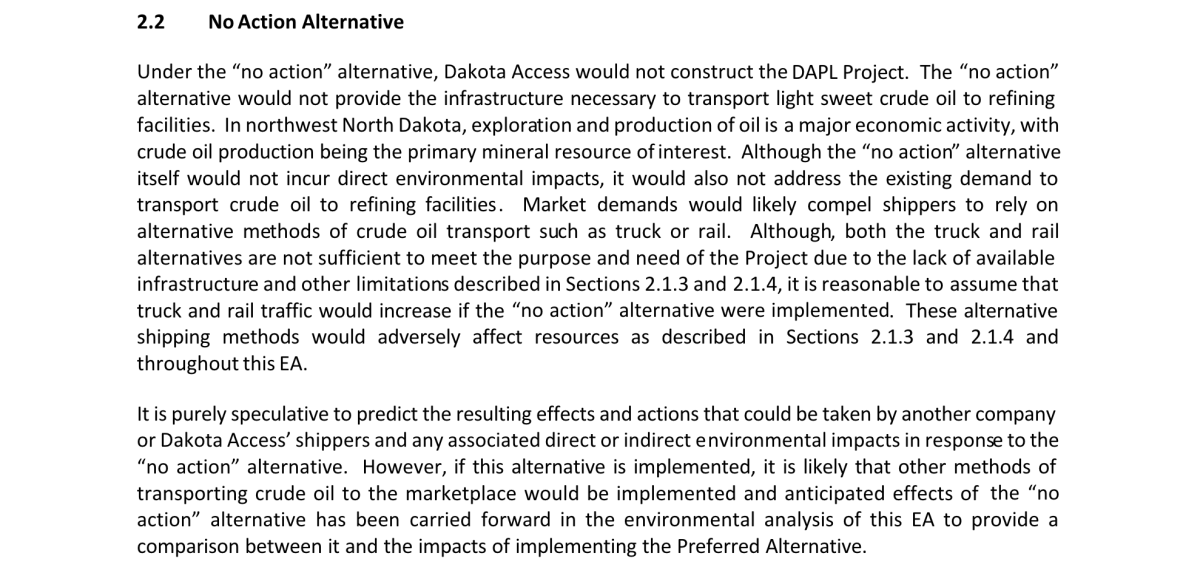
Notably, and consistent with any project of this nature, an option not to construct Dakota Access appears in the introduction summary for the assessment. It appears concern another method of transport would be employed should the pipeline not be approved had provided a significant measure in Corps’ consideration.


dapl


It states,


“Under the ‘no action’ alternative, Dakota Access would not construct the DAPL Project. The ‘no action’ alternative would not provide the infrastructure necessary to transport light sweet crude oil to refining facilities. In northwest North Dakota, exploration and production of oil is a major economic activity, with crude oil production being the primary mineral resource of interest. Although the ‘no action’ alternative itself would not incur direct environmental impacts, it would also not address the existing demand to transport crude oil to refining facilities. […]


“It is purely speculative to predict the resulting effects and actions that could be taken by another company or Dakota Access’ shippers and any associated direct or indirect environmental impacts in response to the ‘no action’ alternative. However, if this alternative is implemented, it is likely that other methods of transporting crude oil to the marketplace would be implemented and anticipated effects of the ‘no action’ alternative has been carried forward in the environmental analysis of this EA to provide a comparison between it and the impacts of implementing the Preferred Alternative.”

Saturday, April 1, 2017

Judge Orders Removal of Gas Pipeline from Native American Property

pipeline


Seventeen years after the expiration of an easement, a federal judge has ordered an energy company to completely remove its pipeline from the properties of 38 Native American landowners — none of whom have been compensated for the company’s use of their land since the year 2000.


Now, the pipeline company will have just six months to dismantle and completely remove the structure.


“Having carefully reviewed the parties’ submissions, and in light of the facts and circumstances in this case,” Judge Vicki Miles-LaGrange wrote in the 10-page decision for the U.S. District Court for the Western District of Oklahoma, “the court finds that a permanent injunction should be entered in this case. Specifically, it is plaintiffs’ interests in the exclusive possession of their land which has been invaded by the presence of the pipeline and defendants’ continued use of the pipeline.


“Further, Defendants have continued to use the pipeline and although they were advised by the [Bureau of Indian Affairs] on March 23, 2010, more than five and a half years before the instant action was filed, that ‘[i]f valid approval of a right of way for this tract is not timely secured, Enogex should be directed to move the pipeline off the subject property’ …”


Since the granting of the original 20-year easement to Producer’s Gas Company back in 1980, many of the landowners, who are primarily citizens of the Kiowa, Comanche, and Apache Tribes, chose not to renew permission for Enable Midstream Partners, Enogex’ successor, to encroach on their private property — but the company opportuned the fact the ambivalence hasn’t been unanimous.


Court documents disclose the original parties to the easement were each paid $1,925 in compensation for the natural gas pipeline to traverse the 137-acres of land, individually, a 0.73-acre segment of their property.


But the tense relationship only unraveled from there, as Indianz.com reports,


“After the easement expired in 2000, they were offered $3,080 for another 20-year lease, according to the documents. But a majority of the allotment’s owners never agreed to the proposed amount, which they contend was far below market value.


“Despite the lack of consent, a firm named Enogex continued to operate the pipeline, which is part of a larger network of gas transmission lines in Oklahoma. The trespass continued even after the Bureau of Indian Affairs in 2010 told the company to reach an agreement or stop using the land.”


Despite that assertive demand, the BIA proceeded to accept $1,098.35 in payment for the easement from 2000 until 2002. Worse, Indianz.com notes, the BIA continued to accept payments from Enogex through 2006 — but didn’t bother consulting landowners about the arrangement.


Worse, at one point — and in diametric opposition to its original posturing — the BIA essentially wrested the decision from the very people whose land would be impacted by the continued presence of the pipeline.


“Despite the rejection by a majority of landowners,” the ruling states, “on June 23, 2008, the Interim Superintendent of the BIA’s Anadarko Agency approved Enogex’s application for the renewal of the right-of-way easement for twenty years.”


A complaint filed by the Indigenous landowners ultimately reversed that approval, with the BIA determining “it did not have authority to approve the right-of-way” without the interested parties’ consent — thus, on March 23, 2010, BIA gave the company notice that, if an agreement satisfactory to all involved parties could not be reached in a timely fashion, the pipeline would need to be moved.


Because a compromise never came to fruition, the court held the pipeline operator has been trespassing on private land since that date — specifically striking down arguments from the defense the Oklahoma statute of limitations for trespass had long passed, and that the consent of just five property owners somehow nullified any claims of trespass.


For a federal judge to rule the energy company must remove an operational pipeline from the property of Native American landowners is an acute contrast to the eventual approval by officials for completion of the Dakota Access Pipeline — despite a monumental, months-long upswell of hundreds of thousands standing in opposition.


With a mere six-month window to disassemble and evacuate the pipeline, the federal court is forcing Enable Midstream Partners to tuck tail and rein in its arrogant exploitation of Indigenous Peoples — at least, for now, in this specific case.

Monday, February 27, 2017

An Oscar Was Once Refused to Protest Native Rights, and Could Happen Again Tonight

Icon and legend, actor Marlon Brando once turned down one of the most prestigious awards in Hollywood for reasons opposition to the Dakota Access Pipeline by the Standing Rock Sioux Tribe and supporters prove decidedly have yet to be resolved: the trampling of Native American rights and sovereignty.


Brando refused to accept the Academy Award for best actor on March 5, 1973 — amid the ongoing offensive by the U.S. government against the occupation by a group of 200 Oglala Lakota and American Indian Movement activists of the tiny South Dakota town, Wounded Knee, on the Pine Ridge Indian Reservation — in part, because the movie industry was propagating the appalling government dehumanization of Native peoples.


“The motion picture community has been as responsible as any for degrading the Indian and making a mockery of his character, describing his as savage, hostile, and evil,” Brando wrote. “It’s hard enough for children to grow up in this world. When Indian children … see their race depicted as they are in films, their minds become injured in ways we can never know.”


Not only did Brando’s rejection of the Oscar swell a tidal wave of controversy in its own right, but how the actor — who played the now-iconic mafioso, Vito Corleone, in “The Godfather” — chose to announce the decision only amplified the storm.


As Business Insider notes, Brando’s reputation behind the scenes prior to the stellar success of instant classic hadn’t won many allies in the industry, and his career seemed headed for the dustbin:


“‘The Godfather’ grossed nearly $135 million nationwide and is heralded as one of the greatest films of all time. Pinned against pinnacles of the silver screen — Michael Caine, Laurence Olivier, and Peter O’Toole — Brando was favored to win best actor.”


However, the night before the Academy Awards were to take place, Brando threw quite the wrench into plans for the glitzy event — by announcing he would boycott.


When the time came for the godfather, himself, to ascend the stage to accept the well-deserved best actor award, the president of the National Native American Affirmative Image Committee and relatively unknown actress, Sacheen Littlefeather, took his place. With long hair pulled to the sides in intricately-beaded ties, the courageous Native American woman came to the podium sporting Brando’s statement, holding an open palm to refuse the prized statuette.


“I’m representing Marlon Brando this evening and he has asked me to tell you … that he very regretfully cannot accept this very generous award. And the reasons for this being are the treatment of American Indians today by the film industry —”


Jeers from the crowd briefly cut the even-keeled actress short, and she says, “Excuse me,” but other attendees immediately topped detractors in supportive applause, as she continues,


“— and on television, in movie reruns, and also in recent happenings at Wounded Knee. I beg at this time that I have not intruded upon this evening, and that we will, in the future — our hearts and our understandings will meet with love and generosity.”


Due to time constraints, Littlefeather could not read Brando’s lengthy speech to the disquieted crowd, but the media soon received the text — and the actor’s stinging manifesto took industry ignorance, national apathy, and oppressive government to task.


“When they laid down their arms, we murdered them. We lied to them. We cheated them out of their lands. We starved them into signing fraudulent agreements that we called treaties which we never kept. We turned them into beggars on a continent that gave life for as long as life can remember. And by any interpretation of history, however twisted, we did not do right. We were not lawful nor were we just in what we did. For them, we do not have to restore these people, we do not have to live up to some agreements, because it is given to us by virtue of our power to attack the rights of others, to take their property, to take their lives when they are trying to defend their land and liberty, and to make their virtues a crime and our own vices virtues.


READ MORE:  Federal Court Rules Native Americans Can’t Use Pot, But Can Use Peyote For Religious Cememonies


“But there is one thing which is beyond the reach of this perversity and that is the tremendous verdict of history. And history will surely judge us. But do we care? What kind of moral schizophrenia is it that allows us to shout at the top of our national voice for all the world to hear that we live up to our commitment when every page of history and when all the thirsty, starving, humiliating days and nights of the last 100 years in the lives of the American Indian contradict that voice?”


Brando continued, his words tragically as pertinent now as they were over four decades ago,


“It would seem that the respect for principle and the love of one’s neighbor have become dysfunctional in this country of ours, and that all we have done, all that we have succeeded in accomplishing with our power is simply annihilating the hopes of the newborn countries in this world, as well as friends and enemies alike, that we’re not humane, and that we do not live up to our agreements.”


Outrage buried Brando and his emissary after the Academy Awards boycott, but nothing could strip the bite of truth from the resounding statement of solidarity in the action and its motivation.


Given the ongoing eviction of camps at Standing Rock, tonight presents a ripe opportunity for an Oscar winner to follow in Marlon Brando’s albeit difficult to fill shoes.

Thursday, February 23, 2017

BREAKING: Dozens Arrested as Heavily Armed Cops Move In With MRAPs to Remove Water Protectors

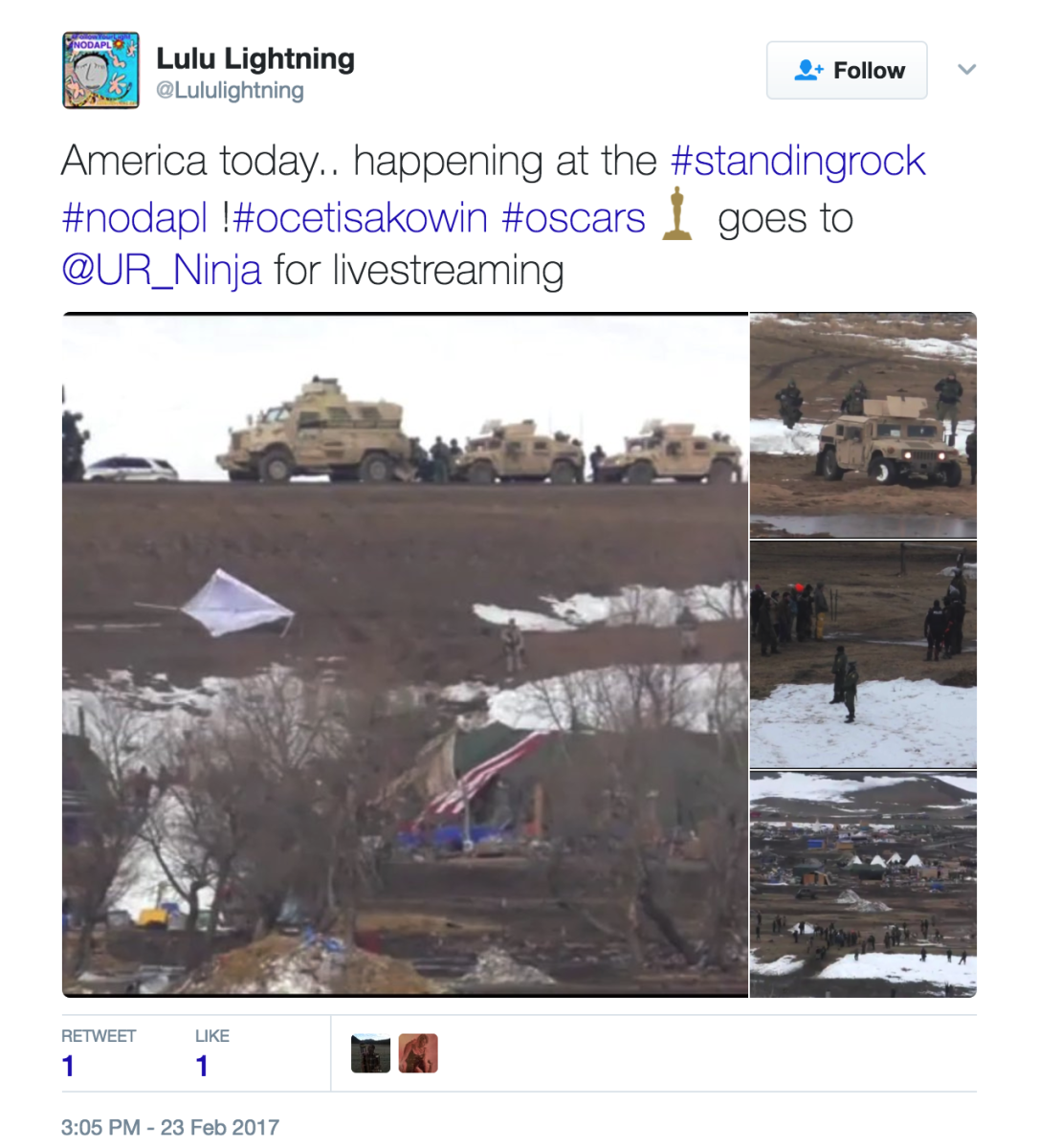
Cannon Ball, ND — Heavily militarized police and National Guard forces moved in to raid camps at Standing Rock on Thursday morning, with hundreds of riot gear-clad officers marching in formation to clear camps of water protectors, journalists, and anyone firmly entrenched to oppose the Dakota Access Pipeline.


Ominously poised on Highway 1806, officers waited in formation with dozens of heavily armored vehicles for over an hour before eventually descending into the remnants of the largest Standing Rock camp, Oceti Sakowin, in recent days renamed Oceti Oyate.


Prayerful song eerily served as a backdrop for what constituted a military raid of land unceded to the U.S. government in treaties from 1851 and 1868.


In a livestream taken a slight distance from camp, Unicorn Riot explained a Bearcat armored vehicle on scene was likely the same from which an officer in a gun turret fired an alleged explosive device at Sophia Walinsky, ripping her arm to shreds on November 20, during a police offensive.


Just before noon local time — and under the watchful eye of snipers — officers in helmets carrying temporary zip-tie restraints could be seen roaming the camp, searching for stragglers to arrest under the premise water protectors are trespassing on land federally managed by the U.S. Army Corps of Engineers.


With assault rifles and guns in hand — and helicopters occasionally just ten feet in the air above — militarized cops perched outside tipi and tent entrances, searching for violators of the eviction order. As the search continued, live video showed several water protectors joining hands in prayer before near certain arrest.


At 12:30 local time, dozens of officers approached a tiny group of water protectors — one of whom raised a sacred pipe in prayer as they closed in to make arrests. Reports more than 20 military veterans had been arrested were unconfirmed at the time this article was published, but images posted to social media did show police arresting an elderly Native grandmother and searching the pockets of her coat.


Despite nearly a year of proving themselves unarmed, water protectors became the subject of utterly unfounded law enforcement rumors that an armed group of rebels could be hiding out in an unknown location within the camps.


Thus, MRAPs (Mine-Resistant Ambush Protected vehicles), Bearcats, and Hum-vees zig-zagged through the a complex of still-intact structures that had served as home for the protectors for months, making sure to evacuate everyone before razing the property.


camp


National Guard and police were still searching through the property as of 1 p.m. local, and appeared to be secondarily kettling water protectors inside the camp, where arrests would be easier to effect en masse.


Sweeps of the territory will take hours, as officers move from structure to structure with assault rifles drawn — permission to use live fire was reportedly given months ago — in a methodical but deliberate process.


Just as law enforcement appeared to have gained a foothold of control on the camp, two of a handful of livestreams were suddenly cut. A third livestreamer, Hunter Nolan, recorded as authorities tried to determine how to extricate a lone water protector perched on the roof of a house in defiance of the eviction — whom Nolan described as ‘the last man in camp.’


Thursday’s operations follow initial eviction actions on Wednesday, in which 10 people were arrested, including livestreamer and Native activist, Eric Poemz — whose hip was fractured by cops when they rushed a small group of water protectors who had attempted to start a dialogue.


Journalists and activists familiar with heightened tensions between law enforcement and water protectors surmised the official eviction date, February 22, would see violent clashes and assaults by police; but the day seemed more a test for the final clearance of camp, and authorities offered to allow protectors a few more hours to leave.


Today, however, authorities seemed determined to carry out the final eviction of any water protectors left at the location near the Missouri and Cannonball Rivers — no matter the irony that land rightfully belongs by treaty to the Standing Rock Sioux Tribe — members of which sparked the Herculean effort to prevent construction of the Dakota Access Pipeline, in the first place.

Friday, February 17, 2017

North Dakota Governor Signs Executive Order Evicting Dakota Access Pipeline Protesters

After nearly a year since the first protest camp sprung up in opposition to the Dakota Access Pipeline, it looks as if the Governor of North Dakota, Doug Burgum, has finally had enough and has signed an executive order demanding that protesters evacuate by February 22nd.


Ironically, environmental damage caused by the protesters, including "months of accumulated debris, and human waste generated by the populations that have occupied the aforementioned areas," and the resulting risk posed to the waters of the Missouri River was cited by the Governor as the primary reason for the eviction notice.  Per the Executive Order:


WHEREAS, large populations have ignored the November 28, 2016 evacuation order detailed in Governor"s Executive Order 2016-08 and the separate eviction order issued by the United States Army Corps of Engineers on November 25, 2016.  These populations continue to unlawfully occupy and reside in flood-prone areas...


WHEREAS, months of accumulated debris, including human waste generated by the populations that have occupied the aforementioned areas of Morton and Sioux Counties pose a significant and increasing environment threat to the waters of the Missouri River if cleanup and removal efforts are not quickly accelerated and completed before flooding begins...


WHEREAS, the presence of accumulated waste, abandoned vehicles and unlawful temporary and permanent dwelling structures in this flood-prone area has created significant health and public safety risks as well as environment hazards, even absent imminent flooding...


All persons occupying or residing in the evacuation area are ordered to leave the area no later than 2 p.m. on Wednesday, February 22,2017.


The full Executive Order can be read here:


Of course, this executive order comes after the US Army Corps said in a court filing earlier this month that it had granted the final easement needed to finish the controversial pipeline. The easement was needed for Energy Transfer Partners to complete work on the last pipeline portion located under Lake Oahe.


And for those of you not familiar with this ongoing saga, the 1,172-mile Dakota Access Pipeline will bring crude oil from North Dakota"s Bakken shale region to Patoka, Illinois, and from there connect to the Gulf of Mexico, where many U.S. refineries are located.


Finally, here is a compilation video of protesters efforts to disrupt the pipeline over the past several months...it was a valiant effort.

Wednesday, February 15, 2017

Company Behind DAPL Reported 69 Accidents, Polluted Rivers in 4 States in Only 2 Years

Although it obstinately insists pipelines are safe, the company responsible for the Dakota Access Pipeline racked up 69 reported accidents in just two years — leaking hundreds of thousands of gallons of oil products and tainting rivers in four states.


That averages nearly three spills each month.


A new report from the Louisiana Bucket Brigade and DisasterMap.net on Energy Transfer Partners and subsidiary Sunoco Logistics documents accidents filed with the National Response Center — the federal contact point for oil spills and industrial accidents — noting 69 accidents between 2015 and 2016.


However, as the study crucially notes, “These are just the accidents that are reported.”


“Heavy rain was the explanation for some of the worst accidents,” the report states, noting, “Bad weather, however, just exposes faulty equipment. While Energy Transfer Partners and other companies portray weather related accidents as unavoidable, they are in reality a result of poor planning and neglected maintenance. For example, the largest tank fire in history happened in south Louisiana in 2001. Because it occurred during a storm, Orion Refining blamed the weather. In truth, a faulty drain on the tank sank the roof, exposed the gasoline and attracted lightning.”


According to the report, ETP’s horrendous track record over the two-year period in the analysis — including the contamination of the Delaware River in Pennsylvania and New Jersey, the Schuylkill River in Pennsylvania, and the Red River in Louisiana — “thereby confirm[s] the concerns of the Standing Rock Sioux tribe who fear the Dakota Access Pipeline would pollute the Missouri River.”


“Sunoco and ETP accidents stretch from Texas to Massachusetts,” asserted Dr. Ezra Boyd, a geographer with DisasterMap.net who analyzed data for the report. “While these accidents cover a large area of the map, the Bayou Bridge pipeline would put an entirely new area at risk: south central Louisiana, including the Atchafalaya Basin.”


EcoWatch reports:


“Dallas-based Energy Transfer Partners owns about 71,000 miles of natural gas, natural gas liquids, refined products and crude oil pipelines across the country.


“The report lists 42 known oil spills, 11 natural gas spills, nine gasoline spills, three propane spills, two ‘other’ spills and two ‘unknown’ spills. Those 69 incidents led to eight injuries, five evacuations and a total damage dollar amount of $300,000. In all, the total known amount of various substances spilled was 544,784 gallons.”


pipeline


pipeline


pipeline


Pipeline companies and the oil and gas industry contend pipelines are the safest means of transporting fossil fuels — and, in comparison to rail and tanker truck methods, they are technically correct.


However, while pipeline accidents occur less frequently, the quantity of oil released tends to be far larger, given the substance is under pressure to flow through the lines and equipment tasked with sensing and stopping leaks doesn’t always function properly — meaning many accidents in desolated areas aren’t discovered immediately.


Take the case of a North Dakota wheat farmer less than two miles from where water protectors remain encamped in opposition to the Dakota Access Pipeline, which will run under the Missouri River’s Lake Oahe reservoir and could threaten the Standing Rock Sioux Reservation’s water supply, and that of around 18 million people downstream.


In 2013, Steve Jensen discovered thick, black, crop-killing crude contaminating a distant corner of one of his wheat fields — not realizing at the time a pipeline under the property had bled nearly one million gallons of the hydrocarbon. Tesoro Corporation got the alert for the spill from Jensen, not from remote pipeline sensors as it should have, and has since dug 50 feet in some areas to alleviate the environmental nightmare sprawling across the land the size of 13 football fields.


Now estimated to soar to $60 million, the cleanup isn’t projected to ever reach full completion.


Incidentally, that spill — and a second belching 176,000 gallons into Ash Coulee Creek — were the handiwork of six-inch steel pipelines. Dakota Access, in comparison, is a 30-inch steel pipeline slated to transport nearly 20 million gallons — daily.


Nasty track record aside, ETP has nearly completed construction on DAPL — to the condemnation of the Standing Rock Sioux and a global movement of water protectors seeking to halt all new fossil fuel infrastructure and shift to renewable energy. And DAPL, like the Tesoro pipeline under the Jensens’ field, will be located underground in bedrock — something ETP claims is the safest possible method of crossing the Missouri, no matter the evidence to the contrary.


This week, the final battle to halt Dakota Access began winding down in federal courts after the U.S. Army Corps of Engineers granted the easement necessary for ETP to complete the pipeline.


A judge denied the tribe’s request for an emergency restraining order to stop ETP from drilling under the river — but a new motion was filed by the tribe on Tuesday, attempting the same, under the premise an imperative environmental impact study should have been carried out as promised.


Dakota Access isn’t the only controversial pipeline project on Energy Transfer Partners’ roster — the Trans-Pecos Pipeline in Texas and Bayou Bridge Pipeline in Louisiana have sparked new encampments like those in Standing Rock as water protectors branch out from North Dakota.


Bayou Bridge — a relatively short, 162-mile pipeline planned to run through precarious ecosystems in the Louisiana bayou — is of particular concern to the Bucket Brigade, whose mission per the website is to “end petrochemical pollution” in the state. EcoWatch explains:


“The planned route crosses major bodies of water and important ecological sites, including the Atchafalaya Basin, Calcasieu, Vermillion and the Mermentau Rivers, as well as Bayou Lafourche and Bayou Teche. The Vermillion River and Bayou Lafourche are sources of drinking water and the Atchafalaya Basin is the country’s largest wetland and swamp, and home to several endangered species.”


With such an atrocious safety and spill record under its belt, Energy Transfer Partners seems so hell bent on profiteering, potential destruction of the environment matters little — if at all.


“Energy Transfer Partners’ records contradict their claim that pipelines are a safer way of transporting oil,” Renate Heurich of 350 Louisiana told EcoWatch. “Pipelines make transporting tar sands cheaper, thus stimulating dirty tar sands extraction despite low oil prices. The real question is: Why do we still invest in more pipeline infrastructure when we urgently need to invest in sustainable alternative energy sources?”


The real answer is simple, at least when it comes to ETP: profit from foreign markets. In preparing to construct the Dakota Access Pipeline, ETP worked furiously behind the scenes to ensure a ban on the export of unrefined crude in place since the 1970s would be lifted specifically so the company could cash in on exporting the Bakken sweet, light crude it would carry.


That single act of surreptitious legislative legerdemain opened the crude and cash floodgates for Big Oil — nearly guaranteeing the fossil fuel industry will opportune the chance to run roughshod over anyone or anything in the way of profit, while duplicitously claiming in the face of evidence otherwise that pipelines are perfectly safe.