Showing posts with label DAPL. Show all posts

Saturday, May 27, 2017

Leaked Docs Prove Counter-Terror Ops Used To Silence ‘Jihadist’ Water Protectors at Standing Rock


Indigenous water protectors and their non-Native American allies — who camped in North Dakota in close proximity to the Missouri River to oppose construction of the disputatious Dakota Access Pipeline — were likened to violent jihadist fighters by dubious mercenary international security firm, TigerSwan.


Obtained by The Intercept, internal TigerSwan communications “describe the movement as ‘an ideologically driven insurgency with a strong religious component’ and compare the anti-pipeline water protectors to jihadist fighters,” that outlet reports.


Worse, TigerSwan repeatedly described water protectors as “terrorists” — yes, literally.


Reports the Intercept:


“One report, dated February 27, 2017, states that since the movement ‘generally followed the jihadist insurgency model while active, we can expect the individuals who fought for and supported it to follow a post-insurgency model after its collapse.’ Drawing comparisons with post-Soviet Afghanistan, the report warns, ‘While we can expect to see the continued spread of the anti-DAPL diaspora … aggressive intelligence preparation of the battlefield and active coordination between intelligence and security elements are now a proven method of defeating pipeline insurgencies.’”


Members of the Standing Rock Sioux and Cheyenne River Sioux Tribes engendered the support of thousands of Indigenous Peoples and their supporters in encampments near Cannon Ball in an heroic effort to thwart Energy Transfer Partners’ Bakken pipeline project — but, for their prayerful, peaceful, and largely nonviolent actions to be equated with violent militants is, well, inexplicable.


According to the Intercept, a TigerSwan employee leaked more than 100 internal documents proving the firm led a multi-fronted campaign of pernicious surveillance of activists and water protectors. Over 1,000 documents given the outlet upon public records requests affirm in detail the colossal surveillance program.


TigerSwan — in obeisance to fossil fuel colossus ETP — employed a “militaristic approach to protecting its client’s interests but also the company’s profit-driven imperative to portray the nonviolent water protector movement as unpredictable and menacing enough to justify the continued need for extraordinary security measures. Energy Transfer Partners has continued to retain TigerSwan long after most of the anti-pipeline campers left North Dakota, and the most recent TigerSwan reports emphasize the threat of growing activism around other pipeline projects across the country.”


Between September 2016 and May 2017, TigerSwan regularly fed ETP ‘situation reports’ containing comprehensive updates by operatives in North Dakota, South Dakota, Iowa, Illinois, and Texas, including surveillance of activists and their planned protests — as well as detailed notes culled from social media.


Documents “also provide extensive evidence of aerial surveillance and radio eavesdropping, as well as infiltration of camps and activist circles,” the Intercept notes.


Water protectors and independent journalists indeed recounted extensive surveillance and communications breaches while in Standing Rock camps and at the Tribe’s Prairie Knights Casino — especially pertaining to social media and two-way radios — so much so, newcomers to the area were immediately warned they would be watched.


Beyond the internal TigerSwan communiqués, documents evincing coordination and shared intelligence between the FBI, Department of Homeland Security, the U.S. Justice Department, the Marshals Service, the Bureau of Indian Affairs, and a veritable cadre of state and local police — collectively deeming itself the “Intel Group” — reveal the real-time monitoring of the #NoDAPL movement on social media.


READ MORE:  Cop Turned Lawmaker Just Proposed Making the Teasing of Cops ILLEGAL. No, Seriously


“Daily intelligence updates,” generated by TigerSwan and obtained by public records requests attest to this chimerical government-private alliance amongst the various law enforcement agencies and the adumbral security firm — whose “operatives comment frequently about their routine coordination and intelligence sharing with law enforcement.”


In an ominous portent for future protest actions, as the Intercept asserts, “The intel group went so far as to use a live video feed from a private Dakota Access security helicopter to monitor protesters’ movements. In one report, TigerSwan discusses meeting with investigators from North Dakota’s Attorney General’s Office.”


Names of ‘dozens’ of “well-known activists” — and even those thinly associated with opposition to Dakota Access — appear in the documents.


Reports shared by TigerSwan with the lengthy list of agencies read more like a comprehensive, collective, psychological evaluation — parsing out information such as the dynamics in the various camps, morale, infighting, and speculation on whether or not planned actions would be illegal or violent, including the potentiality weapons would come into play.


Photographs, license plates, and additional information identifying water protectors can also be found in the cache — along with a list of “persons of interest.”


Unsurprisingly, the Intercept notes, records exhibit attempted counterintelligence operations by TigerSwan, in the dissemination of posts to social media condemning actions by water protectors. Reports the outlet,


“TigerSwan’s internal files describe its utilization of aerial surveillance, including use of helicopters and drones to photograph and monitor the pipeline opponents. The September 12 situation report notes that an operation by construction workers was ‘over-watched by a predator on loan to the JEJOC from Oklahoma.’ The TigerSwan contractor who provided the Intercept with the situation reports said he did not believe the company ever operated a predator drone, but metadata in images he shared pointed to a camera used by a commercially available Phantom 4 drone. One of the daily intelligence updates notes plans to obtain night-vision goggles, LRADs, body armor, and FLIR (forward looking infrared) cameras.


“The reports also reveal a widespread and sustained campaign of infiltration of protest camps and activist circles. Throughout the leaked documents, TigerSwan makes reference to its intelligence-gathering teams, which infiltrated protest camps and activist groups in various states. TigerSwan agents using false names and identities regularly sought to obtain the trust of protesters, which they used to gather information they reported back to their employer, according to the TigerSwan contractor.”


An October 3 report states,


“Exploitation of ongoing native versus non-native rifts, and tribal rifts between peaceful and violent elements is critical in our effort to delegitimize the anti-DAPL movement.”


READ MORE:  Zuckerberg Just Revealed Facebook"s 7-Point Plan to Censor "Fake News" and It"s Chilling


Then, on February 19, plans for infiltration appear:


“TigerSwan collections team will make contact with event organizers to embed within the structure of the demonstration to develop a trusted agent status to be cultivated for future collection efforts.”


A terrifying report, dated May 4, evidences “a TigerSwan operative describes an effort to amass digital and ground intelligence that would allow the company to ‘find, fix, and eliminate’ threats to the pipeline — an eerie echo of ‘find, fix, finish,’ a military term used by special forces in the U.S. government’s assassination campaign against terrorist targets.”


Unapologetically, if farcically, militaristic language in the communications from TigerSwan paint the peaceful water protector movement as a finely-oiled machine on par with counterterrorism operations undertaken by nation-states — a tactic telling of brazen hostility by the firm toward activists whose sole concern continues to comprise protection of the water supply from contamination with noxious fossil fuels.


“At times, the military language verges on parody,” note the Intercept journalists, “as when agents write of protesters ‘stockpiling signs’ or when they discuss the ‘caliber’ of paintball pellets. More often, however, the way TigerSwan discusses protesters as ‘terrorists,’ their direct actions as ‘attacks,’ and the camps as a ‘battlefield,’ reveals how the protesters’ dissent was not only criminalized but treated as a national security threat. A March 1 report states that protesters’ ‘operational weakness allows TS elements to further develop and dictate the battlespace.’”


While the Intercept report goes into far greater detail on these phenomenally revealing communications, the fact TigerSwan — and, thus, the law enforcement and intelligence agencies making use of its reports — literally characterized water protectors as “terrorists” should not be blithely ignored.


Protest is and inarguably must remain a constitutionally-protected activity — period.


When myriad insidious government agencies partner with a firm known for shady, violent, and potentially illegal actions confronts a movement dedicated solely to nonviolent, prayerful actions, the ability to redress grievances through demonstration stands directly threatened.


Whatever your particular position on the Dakota Access Pipeline — and the fossil fuel industry, in general — to qualify activists as terrorists prognosticates the coming end to protest and resistance in the U.S.


This war on dissent, in all its fetid ugliness, leads only to resounding totalitarian rule; thus — if you value the shreds of freedom and liberty still clinging to existence in the United States — resentment toward the #NoDAPL movement and other protesters must, instead, be turned toward the arrogant rulers convinced The People are Enemy Number One.

Thursday, February 23, 2017

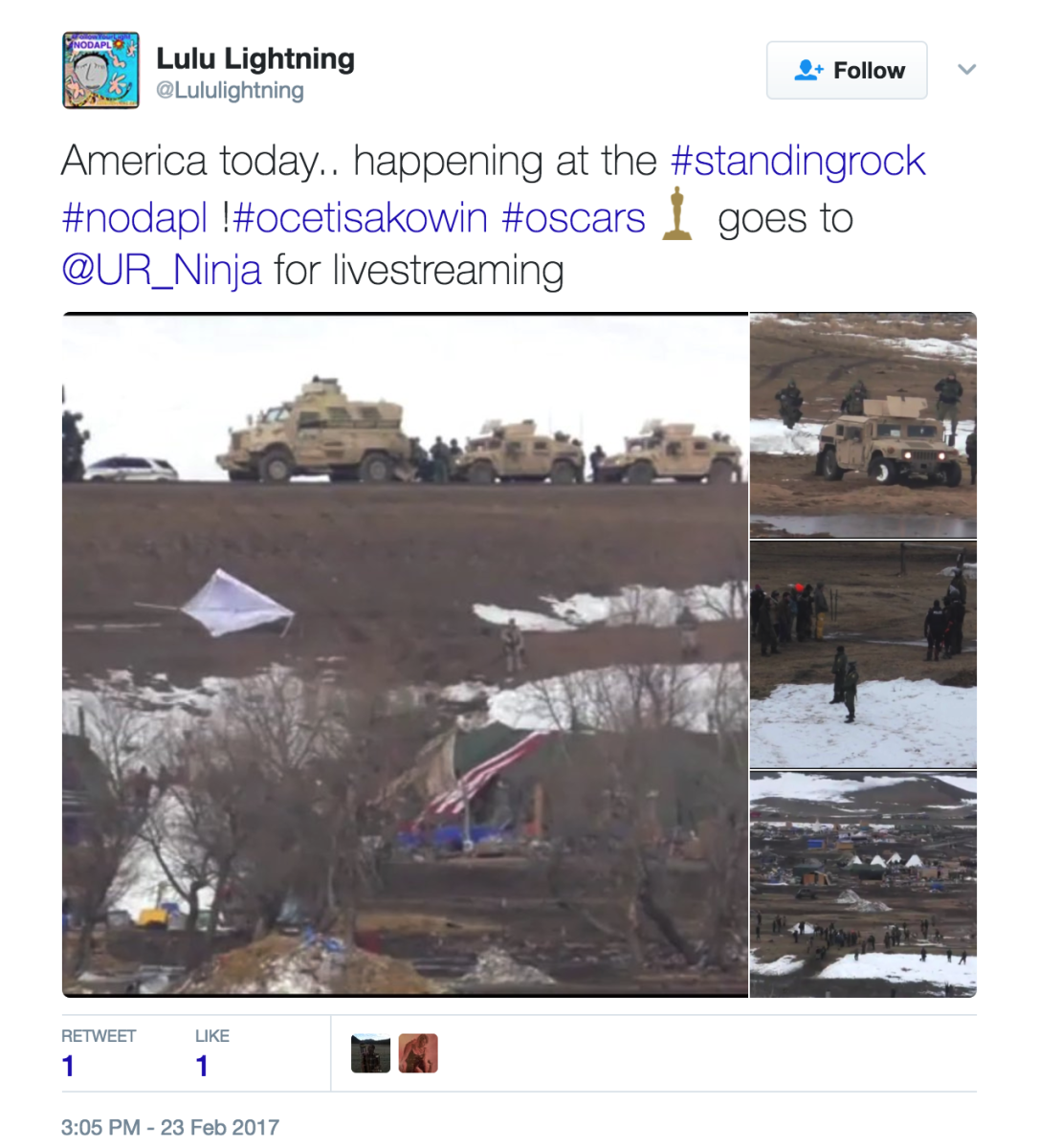
BREAKING: Dozens Arrested as Heavily Armed Cops Move In With MRAPs to Remove Water Protectors

Cannon Ball, ND — Heavily militarized police and National Guard forces moved in to raid camps at Standing Rock on Thursday morning, with hundreds of riot gear-clad officers marching in formation to clear camps of water protectors, journalists, and anyone firmly entrenched to oppose the Dakota Access Pipeline.


Ominously poised on Highway 1806, officers waited in formation with dozens of heavily armored vehicles for over an hour before eventually descending into the remnants of the largest Standing Rock camp, Oceti Sakowin, in recent days renamed Oceti Oyate.


Prayerful song eerily served as a backdrop for what constituted a military raid of land unceded to the U.S. government in treaties from 1851 and 1868.


In a livestream taken a slight distance from camp, Unicorn Riot explained a Bearcat armored vehicle on scene was likely the same from which an officer in a gun turret fired an alleged explosive device at Sophia Walinsky, ripping her arm to shreds on November 20, during a police offensive.


Just before noon local time — and under the watchful eye of snipers — officers in helmets carrying temporary zip-tie restraints could be seen roaming the camp, searching for stragglers to arrest under the premise water protectors are trespassing on land federally managed by the U.S. Army Corps of Engineers.


With assault rifles and guns in hand — and helicopters occasionally just ten feet in the air above — militarized cops perched outside tipi and tent entrances, searching for violators of the eviction order. As the search continued, live video showed several water protectors joining hands in prayer before near certain arrest.


At 12:30 local time, dozens of officers approached a tiny group of water protectors — one of whom raised a sacred pipe in prayer as they closed in to make arrests. Reports more than 20 military veterans had been arrested were unconfirmed at the time this article was published, but images posted to social media did show police arresting an elderly Native grandmother and searching the pockets of her coat.


Despite nearly a year of proving themselves unarmed, water protectors became the subject of utterly unfounded law enforcement rumors that an armed group of rebels could be hiding out in an unknown location within the camps.


Thus, MRAPs (Mine-Resistant Ambush Protected vehicles), Bearcats, and Hum-vees zig-zagged through the a complex of still-intact structures that had served as home for the protectors for months, making sure to evacuate everyone before razing the property.


camp


National Guard and police were still searching through the property as of 1 p.m. local, and appeared to be secondarily kettling water protectors inside the camp, where arrests would be easier to effect en masse.


Sweeps of the territory will take hours, as officers move from structure to structure with assault rifles drawn — permission to use live fire was reportedly given months ago — in a methodical but deliberate process.


Just as law enforcement appeared to have gained a foothold of control on the camp, two of a handful of livestreams were suddenly cut. A third livestreamer, Hunter Nolan, recorded as authorities tried to determine how to extricate a lone water protector perched on the roof of a house in defiance of the eviction — whom Nolan described as ‘the last man in camp.’


Thursday’s operations follow initial eviction actions on Wednesday, in which 10 people were arrested, including livestreamer and Native activist, Eric Poemz — whose hip was fractured by cops when they rushed a small group of water protectors who had attempted to start a dialogue.


Journalists and activists familiar with heightened tensions between law enforcement and water protectors surmised the official eviction date, February 22, would see violent clashes and assaults by police; but the day seemed more a test for the final clearance of camp, and authorities offered to allow protectors a few more hours to leave.


Today, however, authorities seemed determined to carry out the final eviction of any water protectors left at the location near the Missouri and Cannonball Rivers — no matter the irony that land rightfully belongs by treaty to the Standing Rock Sioux Tribe — members of which sparked the Herculean effort to prevent construction of the Dakota Access Pipeline, in the first place.

Wednesday, February 15, 2017

Company Behind DAPL Reported 69 Accidents, Polluted Rivers in 4 States in Only 2 Years

Although it obstinately insists pipelines are safe, the company responsible for the Dakota Access Pipeline racked up 69 reported accidents in just two years — leaking hundreds of thousands of gallons of oil products and tainting rivers in four states.


That averages nearly three spills each month.


A new report from the Louisiana Bucket Brigade and DisasterMap.net on Energy Transfer Partners and subsidiary Sunoco Logistics documents accidents filed with the National Response Center — the federal contact point for oil spills and industrial accidents — noting 69 accidents between 2015 and 2016.


However, as the study crucially notes, “These are just the accidents that are reported.”


“Heavy rain was the explanation for some of the worst accidents,” the report states, noting, “Bad weather, however, just exposes faulty equipment. While Energy Transfer Partners and other companies portray weather related accidents as unavoidable, they are in reality a result of poor planning and neglected maintenance. For example, the largest tank fire in history happened in south Louisiana in 2001. Because it occurred during a storm, Orion Refining blamed the weather. In truth, a faulty drain on the tank sank the roof, exposed the gasoline and attracted lightning.”


According to the report, ETP’s horrendous track record over the two-year period in the analysis — including the contamination of the Delaware River in Pennsylvania and New Jersey, the Schuylkill River in Pennsylvania, and the Red River in Louisiana — “thereby confirm[s] the concerns of the Standing Rock Sioux tribe who fear the Dakota Access Pipeline would pollute the Missouri River.”


“Sunoco and ETP accidents stretch from Texas to Massachusetts,” asserted Dr. Ezra Boyd, a geographer with DisasterMap.net who analyzed data for the report. “While these accidents cover a large area of the map, the Bayou Bridge pipeline would put an entirely new area at risk: south central Louisiana, including the Atchafalaya Basin.”


EcoWatch reports:


“Dallas-based Energy Transfer Partners owns about 71,000 miles of natural gas, natural gas liquids, refined products and crude oil pipelines across the country.


“The report lists 42 known oil spills, 11 natural gas spills, nine gasoline spills, three propane spills, two ‘other’ spills and two ‘unknown’ spills. Those 69 incidents led to eight injuries, five evacuations and a total damage dollar amount of $300,000. In all, the total known amount of various substances spilled was 544,784 gallons.”


pipeline


pipeline


pipeline


Pipeline companies and the oil and gas industry contend pipelines are the safest means of transporting fossil fuels — and, in comparison to rail and tanker truck methods, they are technically correct.


However, while pipeline accidents occur less frequently, the quantity of oil released tends to be far larger, given the substance is under pressure to flow through the lines and equipment tasked with sensing and stopping leaks doesn’t always function properly — meaning many accidents in desolated areas aren’t discovered immediately.


Take the case of a North Dakota wheat farmer less than two miles from where water protectors remain encamped in opposition to the Dakota Access Pipeline, which will run under the Missouri River’s Lake Oahe reservoir and could threaten the Standing Rock Sioux Reservation’s water supply, and that of around 18 million people downstream.


In 2013, Steve Jensen discovered thick, black, crop-killing crude contaminating a distant corner of one of his wheat fields — not realizing at the time a pipeline under the property had bled nearly one million gallons of the hydrocarbon. Tesoro Corporation got the alert for the spill from Jensen, not from remote pipeline sensors as it should have, and has since dug 50 feet in some areas to alleviate the environmental nightmare sprawling across the land the size of 13 football fields.


Now estimated to soar to $60 million, the cleanup isn’t projected to ever reach full completion.


Incidentally, that spill — and a second belching 176,000 gallons into Ash Coulee Creek — were the handiwork of six-inch steel pipelines. Dakota Access, in comparison, is a 30-inch steel pipeline slated to transport nearly 20 million gallons — daily.


Nasty track record aside, ETP has nearly completed construction on DAPL — to the condemnation of the Standing Rock Sioux and a global movement of water protectors seeking to halt all new fossil fuel infrastructure and shift to renewable energy. And DAPL, like the Tesoro pipeline under the Jensens’ field, will be located underground in bedrock — something ETP claims is the safest possible method of crossing the Missouri, no matter the evidence to the contrary.


This week, the final battle to halt Dakota Access began winding down in federal courts after the U.S. Army Corps of Engineers granted the easement necessary for ETP to complete the pipeline.


A judge denied the tribe’s request for an emergency restraining order to stop ETP from drilling under the river — but a new motion was filed by the tribe on Tuesday, attempting the same, under the premise an imperative environmental impact study should have been carried out as promised.


Dakota Access isn’t the only controversial pipeline project on Energy Transfer Partners’ roster — the Trans-Pecos Pipeline in Texas and Bayou Bridge Pipeline in Louisiana have sparked new encampments like those in Standing Rock as water protectors branch out from North Dakota.


Bayou Bridge — a relatively short, 162-mile pipeline planned to run through precarious ecosystems in the Louisiana bayou — is of particular concern to the Bucket Brigade, whose mission per the website is to “end petrochemical pollution” in the state. EcoWatch explains:


“The planned route crosses major bodies of water and important ecological sites, including the Atchafalaya Basin, Calcasieu, Vermillion and the Mermentau Rivers, as well as Bayou Lafourche and Bayou Teche. The Vermillion River and Bayou Lafourche are sources of drinking water and the Atchafalaya Basin is the country’s largest wetland and swamp, and home to several endangered species.”


With such an atrocious safety and spill record under its belt, Energy Transfer Partners seems so hell bent on profiteering, potential destruction of the environment matters little — if at all.


“Energy Transfer Partners’ records contradict their claim that pipelines are a safer way of transporting oil,” Renate Heurich of 350 Louisiana told EcoWatch. “Pipelines make transporting tar sands cheaper, thus stimulating dirty tar sands extraction despite low oil prices. The real question is: Why do we still invest in more pipeline infrastructure when we urgently need to invest in sustainable alternative energy sources?”


The real answer is simple, at least when it comes to ETP: profit from foreign markets. In preparing to construct the Dakota Access Pipeline, ETP worked furiously behind the scenes to ensure a ban on the export of unrefined crude in place since the 1970s would be lifted specifically so the company could cash in on exporting the Bakken sweet, light crude it would carry.


That single act of surreptitious legislative legerdemain opened the crude and cash floodgates for Big Oil — nearly guaranteeing the fossil fuel industry will opportune the chance to run roughshod over anyone or anything in the way of profit, while duplicitously claiming in the face of evidence otherwise that pipelines are perfectly safe.

Sunday, February 12, 2017

Dakota Access Pipeline (DAPL): Has the Standing Rock Resistance been Co-opted by the Non-Profit Industrial Complex?

courtesy_standing_rock_dakota_access_pipeline_opposition2

“Perhaps the best answer is that Standing Rock is the killing of three birds with one stone. [1) Protection of BNSF profits, 2) Continued colonization of Indigenous Peoples, 3) An integral observation lab to study NVDA training impacts/results on non-Anglo cultures in recognition that NGOs are now rolling out NVDA training “programs” across the globe."


-from STANDING ROCK: PROFUSION, COLLUSION & BIG MONEY PROFITS [PART 1] by Cory Morningstar and Forrest Palmer


LISTEN TO THE SHOW


Length (59:24)


Click to Download audio (MP3 Format)


Standing Rock Sioux Nation, in what is called North Dakota has become the centre of what’s been dubbed an unprecedented convergence of tribal communities from across the continent and around the world.


Hundreds of tribes and thousands of people rallied behind this community in its fight to frustrate the development of the Dakota Access Pipeline, a fracked oil pipeline they claim will desecrate their sacred sites and threaten the quality of water in the Missouri River basin.


Joining the frey have been prominent Non Profit organizations, including the Rainforest Action Network, 350.org, and the Sierra Club. These groups and others helped publicize the action, utilizing websites, social media and e-petitions. Soon, the world would connect Standing Rock with fundraising concerts and celebrity visits.


Optimistic prospects as to the success of a strategy centred around prayer, ceremony and Non Violent Direct Action (NVDA) appear to have hit a wall. The US Army Corps of Engineers under the new Trump administration just granted the easement to allow the pipeline to pass under Lake Oahe.


This week’s Global Research News Hour attempts to take a fearless look at the Dakota Access Pipeline resistance, and what is at stake, not just for the people in the area, but for the future of authentic environmental and Indigenous struggles.


In the first half hour, we hear from two water protectors, who identify as Cedar Woman (Lorraine Clements) and Wopilawin (Paula Antoine, an organizer and veteran of a similar anti-Keystone XL action). They spoke from their vantage point on how the camp came together, the violent actions against campers by law enforcement and security personnel, mis-portrayal of the camp by media as ‘riotous’, and the importance of remaining united in the face of this common struggle.


Later on, retired Canadian biophysicist Dennis LeNeveu utilizes his own research and provides an assessment of the hazards stemming from the pipeline if it proceeds along the projected path.


Finally, London, Ontario based writer and researcher Cory Morningstar, returns to the program with a critical evaluation of the many non-profits, celebrities, and even corporations like Unilever, which have jumped on the Standing Rock bandwagon, to the detriment of the Tribal peoples and ecological causes those ‘allies’ purport to support. Following up on her research into the “non-profit industrial complex” (NPIC) Morningstar reveals the hidden and unwholesome motives of Warren Buffett, and other ‘philanthropists’, who finance anti-pipeline activism to the tune of millions of dollars through their foundations.


Even though there are, according to John Schertow of Intercontinental Cry, as many as 15 other pipeline developments in the U.S. alone threatening Indigenous lands, #NoDAPL has become the focus of attention in mainstream and alternative media. Morningstar notes that blocking the completion of one pipeline will not stop the ongoing genocide of tribal peoples in and around the Bakken. She also postulates that the NPIC- boosted profile of the Standing Rock protest may signal that efforts are underway to socially engineer grassroots Indigenous resistance, arguably the one grassroots movement left posing a serious challenge to imperialist plunder of the planet.


Cory Morningstar, a past guest of this program, is a native of London, Ontario. An independent journalist and researcher, she is published at Counterpunch, and Wrong Kind of Green, as well as her own site, theartofanniliation.com. Her six part series: STANDING ROCK: PROFUSION, COLLUSION & BIG MONEY PROFITS first appeared at Wrong Kind of Green in early December, 2016.


LISTEN TO THE SHOW


Length (59:24)


Click to Download audio (MP3 Format)


The Global Research News Hour airs every Friday at 1pm CT on CKUW 95.9FM in Winnipeg. The programme is also podcast at globalresearch.ca . The show can be heard on the Progressive Radio Network at prn.fm. Listen in everyThursday at 6pm ET.


Community Radio Stations carrying the Global Research News Hour:


CHLY 101.7fm in Nanaimo, B.C – Thursdays at 1pm PT


Boston College Radio WZBC 90.3FM NEWTONS  during the Truth and Justice Radio Programming slot -Sundays at 7am ET.


Port Perry Radio in Port Perry, Ontario –1  Thursdays at 1pm ET


Burnaby Radio Station CJSF out of Simon Fraser University. 90.1FM to most of Greater Vancouver, from Langley to Point Grey and from the North Shore to the US Border.


It is also available on 93.9 FM cable in the communities of SFU, Burnaby, New Westminister, Coquitlam, Port Coquitlam, Port Moody, Surrey and Delta, in British Columbia, Canada. – Tune in  at its new time – Wednesdays at 4pm PT.


Radio station CFUV 101.9FM based at the University of Victoria airs the Global Research News Hour every Sunday from 7 to 8am PT.


CORTES COMMUNITY RADIO CKTZ  89.5 out of Manson’s Landing, B.C airs the show Tuesday mornings at 10am Pacific time.


Cowichan Valley Community Radio CICV 98.7 FM serving the Cowichan Lake area of Vancouver Island, BC airs the program Thursdays at 6am pacific time.


Campus and community radio CFMH 107.3fm in  Saint John, N.B. airs the Global Research News Hour Fridays at 10am.


Caper Radio CJBU 107.3FM in Sydney, Cape Breton, Nova Scotia airs the Global Research News Hour starting Wednesday Morning from 8:00 to 9:00am. Find more details at www.caperradio.ca 


Saturday, February 11, 2017

BREAKING: As Construction Begins, Vets Return to Standing Rock — Form Human Shield

“We are prepared to put our bodies between Native elders and a privatized military force,” Elizabeth Williams, a U.S. Air Force veteran, told the Guardian on her decision to come to Standing Rock as a human shield.


Williams and perhaps hundreds of other military veterans are descending on several remaining camps at Cannon Ball, North Dakota, near the banks of the Missouri River’s Lake Oahe reservoir in a last stand against construction of the Dakota Access Pipeline.


“This is a humanitarian issue,” asserted U.S. Navy veteran Matthew Crane. “We’re not going to stand by and let anybody get hurt.”


But things could get ugly. They have multiple times in the past.


Indeed, hostilities have increased on every front — the Standing Rock Sioux Tribe Council voted to ask water protectors not from the area to go home. A multi-state police force led by the Morton County Sheriff’s Department randomly employs violence against water protectors it also wishes would leave.


Meanwhile, the few hundred water protectors remaining in Standing Rock have vowed to halt the pipeline, no matter the cost — up to and including paying with their lives. That’s where the veterans come in — they see shielding the unarmed water protectors as not only the right thing to do, but as duty.


And they are well prepared.


“We’ve stood in the face of fire before,” Williams continued. “We feel a responsibility to use the skills we have.”


Jake Pogue, a veteran of the Marines, expressed concerns about possible police tactics in coming days and told the Guardian, “We’re not coming as fighters, but as protectors. Our role in that situation would be to simply form a barrier between water protectors and the police force and try to take some of that abuse for them.”


READ MORE:  DOJ Investigation Confirms: Albuquerque Police "Executing" Citizens


This is no ordinary protest — camps at Standing Rock began breaking ground in April last year, and have since become fully-functioning mini-cities. Now, however, water protectors are racing two clocks — the first involves fully cleaning up camps in the floodplain before the spring thaw; and the second, completion of Dakota Access.


In vowing to stay and fight the pipeline, water protectors have loosely complied with requests from the tribe and authorities to evacuate the floodplain — and even attempted to establish a camp on higher ground. But the nascent Last Child Camp nearly immediately fell to police — and 76 were arrested — under the pretense the location was private property.


With authorities, locals, certain leaders of the Standing Rock Sioux, and President Trump’s administration progressively inimical to the #NoDAPL movement, the assistance of veterans will be as welcome now as it was last year.


Much hype surrounded the first group of veterans who came to Standing Rock, but major shortcomings in official leadership led to chaos and confusion — and even stranded a large faction inside a barely-heated gymnasium away from the camp for several days without communication.


Despite lingering bitterness over that deployment, some of the same veterans now plan to return with the same mission — to form a human shield for protectors and absorb the rubber bullets, tear gas, pepper spray, concussion grenades, water cannons, or any of the other ostensively less-than-lethal weapons at Morton County’s disposal.


Water protectors have come to expect the worst from law enforcement — offensives by police robbed a Native American woman of her eyesight in one eye, and a non-Native supporter nearly lost her arm when an explosive projectile ripped open flesh to the bone. This barbarism had been darkly par for the course for police.


But now, after Energy Transfer Partners received the green light to continue drilling under Lake Oahe by the U.S. Army Corps of Engineers this week, water protectors find themselves in the precarious position of knowing law enforcement and National Guard troops will likely move to forcefully clear camps and arrest anyone remaining — but not knowing when the move will come nor how brutally they will be treated.


Vets dedicated to guarding the unarmed as they take a last stand also know this — but their very presence creates a political nightmare.


After all, if live ammunition is fired by police and National Guard against unarmed water protectors and U.S. military veterans on land rightfully belonging to Native Americans via several treaties, the fallout would be rightly insurmountable for those in charge.


“This historical trauma of indigenous communities in this country is very real. It’s tragic,” Crane explained. “The military has a lot of the same problems.”


In telling ways, Indigenous water protectors facing government-initiated violence echoes through an unbroken history — one in which Native American lives have been devalued in the eyes of politicians and corporate elite, who quantify — rather than treasure — the geography of this land.


Veterans — many of whom have also been devalued by the government upon return from duty — relate particularly well to the traumas suffered at Standing Rock. Water protectors who haven’t directly been impacted by brutal policing have likely either seen it happen, or know someone who has been injured — and many suffer post-traumatic stress disorder because of this.


“We are able to talk about PTSD,” said Mescalero Apache Tribe member, Aubree Peckham, of the intense bonding between Indigenous protectors and veterans. “And they finally feel like they are understood.”


Some of the vets see protecting the camps as atonement for fighting in wars they later learned had far more to do with natural resources or the whims of politicians and corporations than anything remotely pertaining to freedom.


“This is the right war, right side,” Vietnam veteran Dan Luker explained to the Guardian. “Finally, it’s the US military coming on to Sioux land to help, for the first time in history, instead of coming on to Sioux land to kill natives.”

Wednesday, February 8, 2017

‘This Is the #NoDAPL Last Stand’: Tribe to Sue as Actions Planned Nationwide

February 8, 2017   |   admintam


(COMMONDREAMS) The Trump administration “will be held accountable in court” for its decision to grant the final easement on the Dakota Access pipeline (DAPL), Indigenous people and environmental allies vowed Tuesday.


And with actions planned nationwide on Wednesday, the administration won’t get off in the court of public opinion, either.


“The drinking water of millions of Americans is now at risk,” said Dave Archambault II, chairman of the Standing Rock Sioux tribe, following the U.S. Army Corps of Engineers’ announcement (pdf) that it would give the official go-ahead within 24 hours. “We are a sovereign nation and we will fight to protect our water and sacred places from the brazen private interests trying to push this pipeline through to benefit a few wealthy Americans with financial ties to the Trump administration.”


In granting the easement, the Army Corps halted (pdf) the preparation of an environmental review ordered by the Obama administration. The Standing Rock tribe, which says DAPL threatens its clean water supply and violates Indigenous treaty rights, pledged to “challenge any easement decision on the grounds that the [environmental impact statement, or EIS] was wrongfully terminated.”


“Trump’s reversal of that decision continues a historic pattern of broken promises to Indian tribes and unlawful violation of treaty rights,” added Jan Hasselman of Earthjustice, lead attorney for the tribe. “They will be held accountable in court.”


Other next steps, according to the Standing Rock statement, include asking the court for DAPL-operator Energy Transfer Partners “to disclose its oil spill and risk assessment records for full transparency and review by the public,” and, “if DAPL is successful in constructing and operating the pipeline, the tribe will seek to shut the pipeline operations down.”


The tribe is not alone in its outrage. Multiple environmental groups voiced their opposition to the decision, while Democratic members of the House and Senate natural resources committees wrote a letter to President Donald Trump expressing their own dismay.


“This blatant disregard for federal law and our country’s treaty and trust responsibilities to Native American tribes is unacceptable,” the lawmakers wrote. “We strongly oppose this decision and any efforts to undermine tribal rights. We urge you to immediately reverse this decision and follow the appropriate procedures required for tribal consultation, environmental law, and due process.” Signatories included Sens. Maria Cantwell (D-Wash.), Bernie Sanders (I-Vt.), and Catherine Cortez Masto (D-Nev.), as well as Reps. Raúl Grijalva (D-Ariz.) and Donald Beyer (D-Va.).


Grijalva, ranking member of the House Natural Resources Committee, also issued a separate statement: “Before the Women’s March and before thousands of people protested at airports, the Standing Rock Sioux and their allies were camping in the freezing cold to defend their rights,” he said. “The Obama Administration heard those concerns and agreed to take a step back; this Administration is ignoring them. In his first few weeks in office our new president has built a resume of discrimination, falsehoods, and sloppy work, and now the decision to trample the sovereignty of our First Americans is the latest entry on a growing list of shameful actions.”


A protest in front of the White House is planned for 5:00pm Wednesday, along with more than 30 actions taking place around the country on what the Indigenous Coalition at Standing Rock has dubbed “an international day of emergency actions to disrupt business as usual and unleash a global intersectional resistance to fossil fuels and fascism.”


“This is the #NoDAPL last stand,” the group declared online.


Find an action near you here.


“Donald Trump will not build his Dakota Access Pipeline without a fight,” said Tom Goldtooth of the Indigenous Environmental Network. “The granting of an easement, without any environmental review or tribal consultation, is not the end of this fight—it is the new beginning. Expect mass resistance far beyond what Trump has seen so far.”


Goldtooth continued:


The granting of this easement goes against protocol, it goes against legal process, it disregards more than 100,000 comments already submitted as part of the not-yet-completed environmental review process—all for the sake of Donald Trump’s billionaire big oil cronies. And, it goes against the treaty rights of the entire Seven Councils Fires of the Sioux Nations.


Donald Trump has not met with a single Native nation since taking office. Our tribal nations and Indigenous grassroots peoples on the frontlines have had no input on this process. We support the Standing Rock Sioux tribe, and stand with them at this troubling time.


In addition, a Native Nations March on Washington is in the works for March 10. “Our fight is no longer at the North Dakota site itself,” said Archambault. “Our fight is with Congress and the Trump administration. Meet us in Washington on March 10.”


An energetic divestment campaign, urging banks to pull their funding for the controversial project, is also gaining steam.


On that front, the Seattle City Council voted 9-0 on Tuesday to cut banking ties with Wells Fargo because of its role as a DAPL lender. “People might argue that Seattle’s $3 billion account is just a blip on the radar for Wells Fargo, but this movement is poised to scale up,” Hugh MacMillan, a senior researcher at Food & Water Watch, told YES! Magazine. “I think you’ll see more cities following Seattle’s lead.”


This article (‘This Is the #NoDAPL Last Stand’: Tribe to Sue as Actions Planned Nationwide) by Deirdre Fulton originally appeared on CommonDreams.org and is licensed Creative Commons 3.0. The Anti-Media radio show airs Monday through Friday @ 11pm Eastern/8pm Pacific. Image credit: L May. Help us fix our typos: edits@theantimedia.org

Friday, February 3, 2017

‘Not on Our Watch’ — Veterans Promise ‘Boots on the Ground’ to Stop DAPL

A group of U.S. military veterans, standing in defense of Indigenous rights, has vowed construction of the Dakota Access Pipeline will never be completed — and will put boots on the ground to ensure it.


“We are committed to the people of Standing Rock, we are committed to nonviolence, and we will do everything within our power to ensure that the environment and human life are respected,” Anthony Diggs, spokesman for Veterans Stand, told CNBC. “That pipeline will not get completed. Not on our watch.”


Veterans, said Diggs, seek to raise enough funds “to have a larger, solid boots-on-the-ground presence.”


As staunch a stance as that might sound, the veterans remain committed to nonviolent action in defense of the Standing Rock Sioux against Energy Transfer Partners, the company responsible for pipeline construction.


On Wednesday evening, heavily militarized and armed police and National Guard forces advanced en masse across Highway 1806’s Backwater Bridge for the first time in months to clear out a newer camp. At least 76 people were arrested, ostensibly for trespassing on private property — though the Morton County Sheriff’s Department told the Guardian on Wednesday specifics of the charges had yet to be determined.


“A lot of water protectors really felt that we needed to make some sort of stand as far as treaty rights,” Linda Black Elk of the Catawba Nation told the Guardian. “We basically started to see police mobilizing from all directions. Someone came along and told us we had about 15 minutes before the camp would get raided.”


Law enforcement moved to clear the camp just one day after Secretary of the Army Robert Speer told the U.S. Army Corps of Engineers to grant ETP the easement required to complete drilling under the Missouri River’s Lake Oahe reservoir — the source of Standing Rock’s drinking water and the subject of furious contention over Dakota Access.


Speer’s command also follows the recent signing of executive orders by President Donald Trump for completion of both the Dakota Access and Keystone XL Pipelines — despite the latter being shot down by former President Obama.


Further indicative of a coming law enforcement crackdown on camps of water protectors, on Thursday, officials from the Bureau of Indian Affairs, tribal police, the ATF, the Standing Rock division of Fish and Wildlife, and USACE showed up unannounced and without a warrant on the property of LaDonna Tamakawastewin Allard to “assess” the Camp of the Sacred Stones.


Livestreamer Johnny Dangers captured officials on video refusing to offer explanation beyond the vague ‘assessment’ for their presence on Allard’s private property. Sacred Stone, as the camp is commonly known, is the original site erected for youth water protectors opposing pipeline construction; and — being located on private land — was believed immune from law enforcement efforts of eviction.


Worse, as Dangers and Allard said on social media, Standing Rock Sioux Tribe council appears to have asked officials to descend on the property — making the ‘raid’ a duplicitous act.


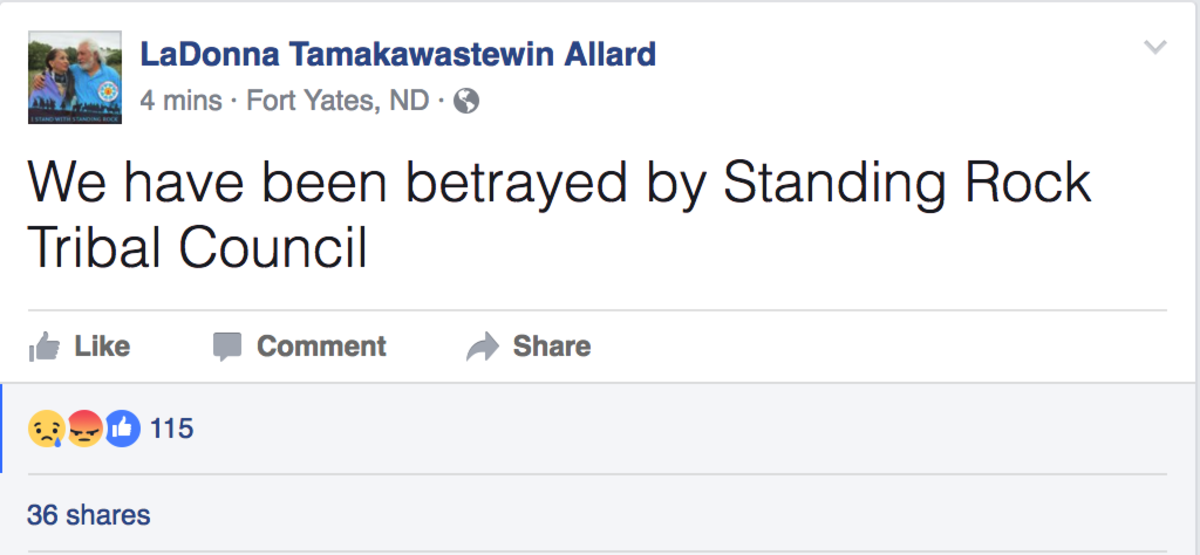
“We have been betrayed by Standing Rock Tribal Council,” Allard posted to Facebook when officials arrived and refused to produce a warrant.


In December, tentative celebration erupted when USACE halted pipeline construction in order to perform an exhaustive environmental impact study before granting the aforementioned easement. But Energy Transfer Partners — cognizant of the Trump administration’s favoritism of Big Oil — vowed Dakota Access would be completed without deviation from a planned path under Lake Oahe.


Now, the two raids — and an increasingly intolerant attitude toward camped water protectors by both law enforcement and certain members of the tribal council — seem to evince coming action to evict and arrest water protectors still occupying floodplain land at several camps, including the largest, main camp, Oceti Sakowin.


But the veterans group doesn’t want to let that happen.


“Veterans Stand for Standing Rock started as a mission to shield water protectors and highlight human rights violations,” states the Veterans Stand website. “It grew into something that we never could have imagined. Veterans are people who take an oath and write a blank check to the United States of America, up to and including their life, to protect the Constitution from all enemies, both foreign and domestic […]


“Our veterans have stepped up and chosen to serve, because there are still human and constitutional rights being violated. We are honored to serve beside them.”


READ MORE:  U.S. Congresswoman & Military Vet to Join the Resistance With Fellow Veterans at Standing Rock


U.S. Navy veteran, Petty Officer 1st Class Kash Jackson came to Standing Rock to stand in defiance of the government-backed industry exploitation of Native Americans, telling a reporter from The Young Turks in November, about marching with an inverted American flag,


“Our greatest enemies are not overseas — our greatest enemies are right here.”


Per the U.S. Flag Code, he continued, “whenever you invert the American flag, it is permissible, underneath extreme risk to life and property — and based on what I’ve witnessed, over here in Standing Rock, I don’t think there’s any question whether or not there’s a risk to life and property.”


Several violent attacks led by police against unarmed and prayerful water protectors have left hundreds injured — several permanently — and have fueled worldwide consternation over the U.S. government’s corporate fealty.


But, given concerted efforts by ETP — whose CEO Kelcy Warren donated $100,000 to the president’s campaign — to ensure the oil flowing through the Dakota Access Pipeline would be legally permitted for export and profit, anti-pipeline actions around the country should expect similarly oppressive measures from the Trump administration.


With water protectors vehement about staying put in Standing Rock to halt construction of Dakota Access Pipeline for good, assistance from Veterans Stand will undoubtedly be welcome.

Saturday, January 28, 2017

NODAPL 2.0 — Water Protectors Take Stand in Louisiana to Resist ‘Tail End’ of DAPL

With the executive order signed by President Trump to override the Corps of Engineers, it appears the Dakota Access Pipeline (DAPL) is more likely to be bored underneath Lake Oahe, the water source of the Standing Rock Sioux. It’s a final insult in the violation of property rights and Native American treaties, all for a high-risk investment by oil tycoons.


Regardless of the outcome, the massive protests and brave actions of water protectors showed the world that informed citizens will no longer stand idly by as fossil fuel exploitation needlessly threatens natural resources and civil rights. It exposed the police state for violent mercenaries protecting corporate interests, as militarized cops poured in from multiple states and the National Guard even manned checkpoints.


North Dakota isn’t the only state where the business venture of Energy Transfer Partners (ETP) is threatening vast swaths of water resources and property rights. In Louisiana, the tail-end of DAPL is set to be installed across 162 miles of the state – crossing 700 bodies of water, 600 acres of fragile wetlands, and “wells that reportedly provide drinking water for some 300,000 families.”


Water protectors from North Dakota and elsewhere are already preparing to join Louisiana natives in resisting the Bayou Bridge Pipeline. The 24-inch diameter pipeline would carry up to 480,000 barrels of oil per day – originating in the Bakken oilfields of North Dakota and going through the controversial DAPL — to refineries and ports in Louisiana.


Farmers and crawfishermen showed up at a packed public hearing to speak about the threat to their livelihood and health posed by the Bayou Bridge Pipeline. Conservationists and local residents of all stripes protested the destruction the pipeline would bring to the treasured natural habitats of south Louisiana.


READ MORE:  “Because I got High” Remixed: Afroman Realizes the Atrocity of the War on Drugs


Jody Meche, president of the state Crawfish Producers’ Association, described how careless actions of prior oil companies have ruined natural water flow in the Atchafalaya Basin, creating spoil banks (piled up sediment from trench excavation) and zones where crawfish and other aquatic life cannot thrive.


“The best way to determine the future is to look at the past,” said Anne Rolfes of the Louisiana Bucket Brigade. “And you can see how honest they were about filling the old canals: there’s not a single example of them fixing the existing spoil banks.”


The Atchafalaya Basin – a national heritage area and American’s largest wetland – is threatened by both pipeline construction and the potential for large oil spills. 77 acres of wetlands would be permanently lost and 171 acres would be temporarily affected.


An oil spill from the large diameter pipeline could do catastrophic damage to the Basin ecosystem, which hosts a rich, diverse array of life and several endangered species. It is a significant ecotourism destination and is loved by countless Louisiana sportsmen for fishing and hunting.


Last year alone there were 144 pipeline accidents in Louisiana, including 85 oil spills. Residents and water protectors are not confident the Bayou Bridge Pipeline would somehow escape the propensity for pipelines to leak.


According to the permit application, the Bayou Bridge Pipeline would create just 12 permanent jobs, but the health and livelihoods of many more who depend on these waters would be at risk. The oil will likely be exported, meaning even less benefit to state residents.


READ MORE:  Death Metal Musician Voted Into Town Council After Asking "Please Don"t Vote For Me"


More than 400 people attended the permit hearing, with most of them protesting the pipeline.


“This new pipeline adds an additional threat to my rice and crawfish crops because it threatens a major source for irrigation. It threatens the drinking water for my family, my neighbors and my livestock,” Rachel Roche testified.


Former U.S. Sen. Mary Landrieu, a long-time ally of the oil and gas industry and recipient of ETP campaign donations, testified in favor of the pipeline. She claimed pipelines are the safest transportation method for oil, but as we reported in September, that is not actually the case.


Retired U.S. Lt. Gen. Russel Honoré described how Louisiana legislators are notoriously indifferent to the impact of oil and gas on natural resources and property rights. State and federal regulators don’t have the resources to enforce permit requirements; the Corps of Engineers doesn’t even have a boat to inspect construction activity in the vast Atchafalaya Basin.


This writer, residing in Acadiana and having worked in the industry, is intimately familiar with the laissez-faire attitude of Louisiana government toward oil and gas. Industry representatives routinely grease the skids with paid dinners and all sorts of other gifts to legislators and regulators.


The Atchafalaya Basin and most other wetlands in south Louisiana are riddled with the scars of previous oil and gas activities. Spoil banks disrupt the natural flow of water through the freshwater swamps, while rig channels in coastal marshes have caused monumental destruction by allowing saltwater intrusion.


Water protectors are ready to bring the energy of the North Dakota DAPL resistance down to the bayou. Local activists professed their intent to stand in the way of machinery, and others described how networks are already forming to join Louisianans in the fight against the tail-end of DAPL.


READ MORE:  25 Lies About Cannabis on the DEA Website — Refuted by the DEA Itself in 2016


“We are connected with people the country — heck across the world — who won’t blink from your tear gas, duck from your rubber bullets, or cringe from your sound cannons,” said Emma Yip, a California resident who went to Standing Rock.


Protests are also growing against major pipeline projects in Texas, Alabama and Florida, where natural resources and property rights are also being violated. Yesterday we reported on a couple in Alabama served with a restraining order prohibiting them from parts of their own property — so an oil company could drill there.


On the opposite side of the country from North Dakota, the same company is threatening major water resources to drop off DAPL oil for export. Louisiana, long in the pocket of big oil, is going to have a new experience when water protectors amass in the bayou state.

Friday, January 27, 2017

State Department: Keystone XL Pipeline Would Create 35 Permanent Jobs

January 27, 2017   |   Darius Shahtahmasebi


(ANTIMEDIA) — President Donald Trump’s decision to move forward with the Keystone XL pipeline may ultimately backfire, as the State Department has estimated the pipeline will only create 35 permanent jobs after the one or two years’ worth of construction work has been completed.


According to Census.gov, the current population of the United States is over 316 million. Congratulations – Donald Trump has successfully created jobs for 0.000011 percent of the American population.


Republican supporters have long argued that the pipeline project will be a tremendous job creator. In 2012, the U.S. Chamber of Commerce took out a full-page ad in the New York Times warning Barack Obama not to say no to 20,000 jobs (the pipeline company’s estimate.)


The State Department’s recent estimate means the pipeline could bring in 42,100 jobs in total, but they would all be one-year only contracts. What happens to the 42,000 workers after that one year of construction? Do they build a new pipeline? This does not sound sustainable.


As noted by the Guardian, the proposed Keystone XL and Dakota Access pipelines will also create an enormity of blowback in other ways:


“Beyond risking our energy economy on what we now call ‘alternative facts,’ these pipelines pose specific risks to Indian Country – and President Trump ignores those risks at his own political peril. Keystone XL would run on top of the Ogallala Aquifer, a vast multi-state underground reservoir that provides water to millions of Americans, including many Native American tribes, across the midwest. Part of the Dakota Access pipeline would run under Lake Oahe, a major water source for the Standing Rock Sioux tribe in North Dakota. Consultation with Native American tribes in the construction of both pipelines has been feeble.”


This is quite humorous given that publications such as the Guardian and other corporate media outlets refused to report on the protests happening at Standing Rock in its early stages. It wasn’t until many alternative media organizations began to break the story, forcing the issue on social media, that these news outlets were willing to take notice of the situation.


Now that it is Trump ramping up these proposals, however, the media is suddenly on the side of the people again.


This article (State Department: Keystone XL Pipeline Would Create 35 Permanent Jobs) is free and open source. You have permission to republish this article under a Creative Commons license with attribution to Darius Shahtahmasebi and theAntiMedia.org. Anti-Media Radio airs weeknights at 11 pm Eastern/8 pm Pacific. If you spot a typo, please email the error and name of the article to edits@theantimedia.org.

Wednesday, January 25, 2017

After Trump’s Executive Order, Sheriff Issues Ominous Warning to DAPL Water Protectors

Cannon Ball, ND — After President Donald Trump issued Executive Orders greenlighting both the Keystone XL and Dakota Access Pipelines, protests erupted from coast to coast — including in the nation’s capital — as the Standing Rock Sioux Tribe, Morton County Sheriff’s Department, and clean energy advocates were left scrambling to make sense of the abrupt power play.


Rumors have circulated for months law enforcement would opportune the first chance to forcefully evict water protectors from the camps — whether under the guise of safety, since several sit amid a spring flood plain, or under the premise of illegality despite the location being part of lands granted to the tribe by treaties over a century ago by the U.S. government. Now, thanks to Trump, the future of pipeline opposition camps looks grim.


According to a statement,


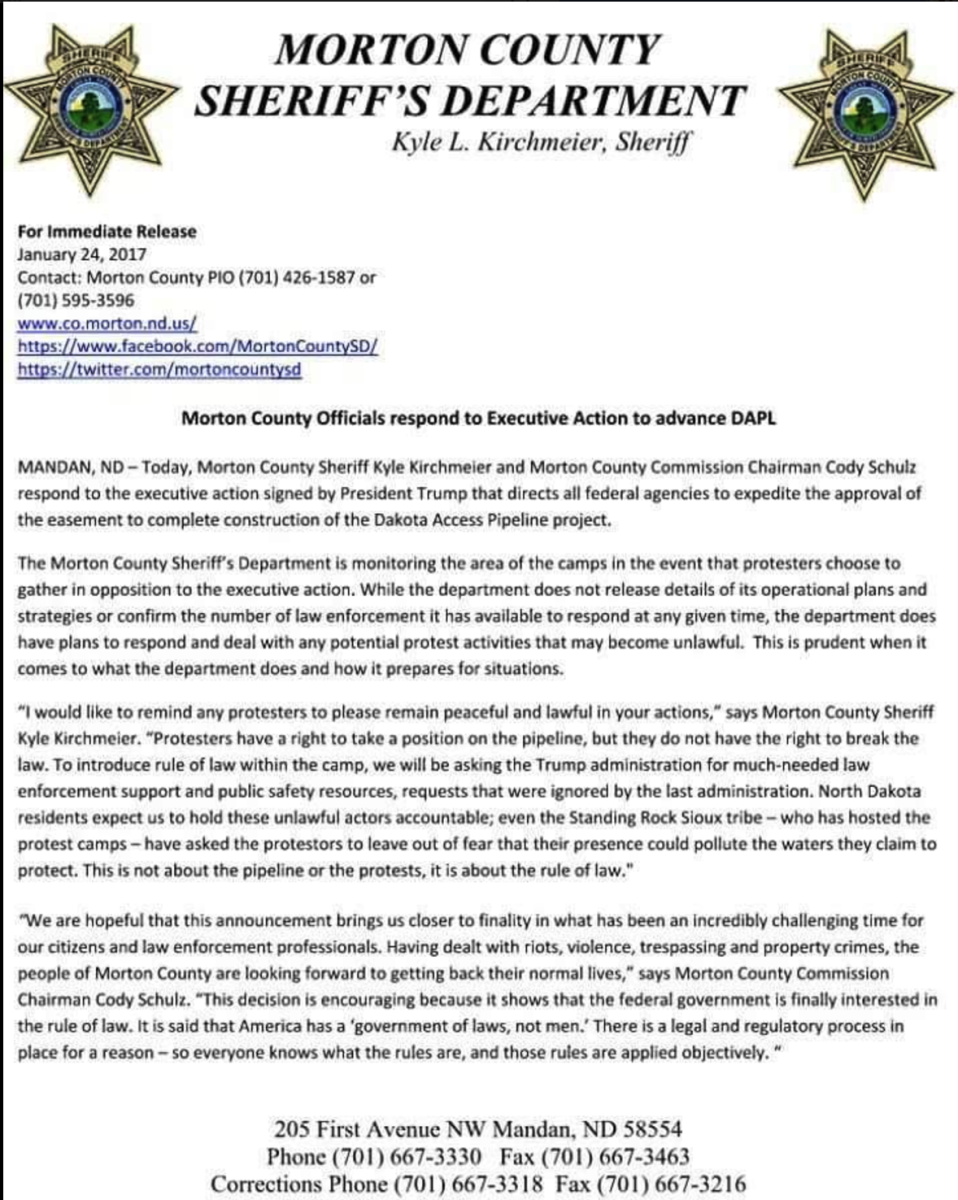
“The Morton County Sheriff’s Department is monitoring the area of the camps in the event that protestors choose to gather in opposition to the executive action. While the department does not release details of its operational plans and strategies or confirm the number of law enforcement it has available to respond at any given time, the department does have plans to respond and deal with any potential protest actions that may become unlawful. This is prudent when it comes to what the department does and how it prepares for situations.”


In the same statement, Morton County Sheriff Kyle Kirchmeier issued a stern admonishment to Standing Rock water protectors (a term preferred over ‘protesters’ by pipeline opposition for their stance of protecting the Missouri River from contamination):


“I would like to remind any protesters to please remain peaceful and lawful in your actions. Protesters have a right to take a position on the pipeline, but they do not have the right to break the law. To introduce rule of law within the camp, we will be asking the Trump administration for much-needed law enforcement support and public safety resources, requests that were ignored by the last administration. North Dakota residents expect us to hold these unlawful actors accountable; even the Standing Rock Sioux tribe – who has hosted the protest camps – have asked the protestors to leave out of fear that their presence could pollute the waters they claim to protect. This is not about the pipeline or the protests, it is about the rule of law.”


READ MORE:  Oil Company Takes Dozers on 20-Mile Detour to "Deliberately Destroy" Ancient Native American Sites


And Kirchmeier wasn’t the only Morton County official to mischaracterize the largely peaceful and unarmed Dakota Access Pipeline opposition in that statement.


“We are hopeful that this announcement brings us closer to finality in what has been an incredibly challenging time for our citizens and law enforcement professionals. Having dealt with riots, violence, trespassing and property crimes, the people of Morton County are looking forward to getting back their normal lives,” said Morton County Commission Chairman Cody Schulz. “This decision is encouraging because it shows that the federal government is finally interested in the rule of law. It is said that America has a ‘government of laws, not men.’ There is a legal and regulatory process in place for a reason – so everyone knows what the rules are, and those rules are applied objectively.”


Morton County


“A lot of jobs, 28,000 jobs,” Trump said on Tuesday, according to ABC News, regarding the economic impact of the pipeline projects — citing a number not backed by several reports on the matter. “Great construction jobs.”


What, exactly, happens next appears — at least temporarily — to be anyone’s guess. But for water protectors encamped near the banks of the Missouri River’s Lake Oahe reservoir — who have vowed to do whatever it takes to halt construction of DAPL — Trump’s memorandum allowing Energy Transfer Partners to continue the final stages of the project represents the final threat to Indigenous sovereignty and integrity of the water supply.


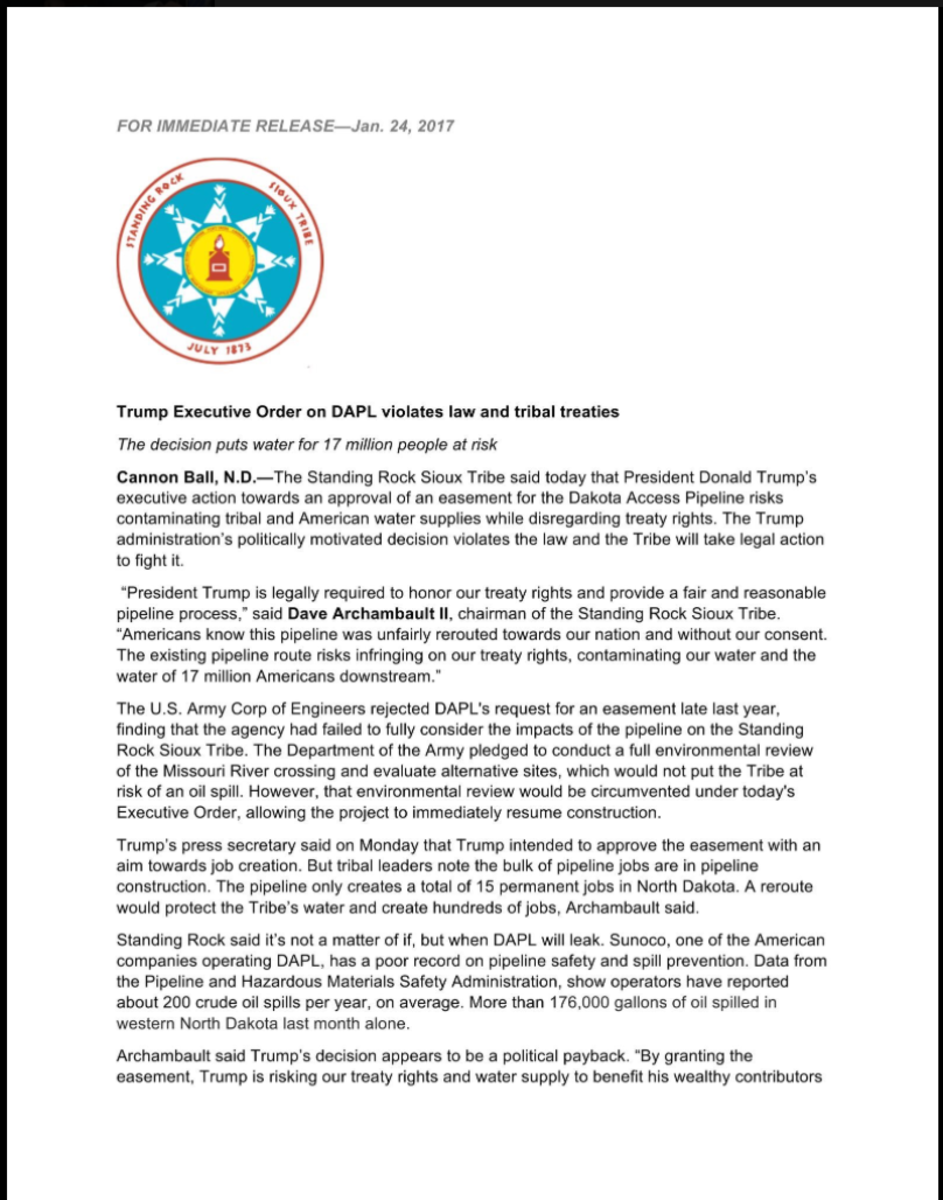
“The Standing Rock Sioux Tribe said today that President Donald Trump’s executive action towards an approval of an easement for the Dakota Access Pipeline risks contaminating tribal and American water supplies while disregarding treaty rights,” an official statement explains. “The Trump administration’s politically motivated decision violates the law and the Tribe will take legal action to fight it.”


Morton County


Morton County


From Los Angeles and Seattle, to New York City and Washington, D.C., spontaneous demonstrations erupted after the new president’s unexpectedly decisive approvals for both pipelines.


Adhering to longstanding dictates from the Standing Rock Sioux Tribe’s calls for pipeline opposition to remain unarmed, prayerful, and peaceful, Native and non-Native water protectors from coast to coast broke out in song and chanted support in the streets of major cities — with large crowds amassing outside the White House in D.C. and Trump Tower in New York City.


“It’s amazing the power of social media,” one water protector observed from the Los Angeles rally, concerning the organic planning of events after Trump’s staggering announcement.


Indeed, absent sufficient and balanced coverage from the mainstream media for months, Standing Rock water protectors have relied on platforms like Facebook and Twitter to present an accurate portrait of the quagmire that is the Dakota Access Pipeline project and its opposition.


Thousands of supporting water protectors from hundreds of Indigenous bands around the world, as well as non-Native activists, have spent time in a smattering of camps attempting to halt pipeline construction through physical occupation at the site. Several hundred are still enduring a rough and bitter North Dakota winter at the site — and have pledged to stay in place no matter the consequences of Trump’s fraught executive actions.


Despite the haunting mirror to historical clashes between Native Americans and the nascent United States government — including the gruesome Battle of Wounded Knee, which occurred on the same lands — coverage by the corporate press has remained tepid, at best, often slanting neutrally or in favor of law enforcement where glaringly inappropriate.


Now that President Trump has avowed Big Oil’s right-of-way on both hotly contentious projects, it would appear critically necessary attention will finally be devoted to Indigenous and people’s rights over industry profits. In fact, claims the pipelines would create much needed jobs hold little basis in reality.


Keystone XL would permanently employ just 35 workers, and Dakota Access, a mere 40 in operational and maintenance positions — not to mention the latter is already more than 85 percent complete.


“The Keystone XL project,” Slate reported, “which will take 800,000 barrels of oil a day from Canada to the Gulf Coast, was the subject of a largely symbolic battle waged by climate activists opposed to the continued development of fossil fuel infrastructure. It was torpedoed by President Obama in 2015, a month before the Paris Climate Summit. ‘America is now a global leader when it comes to taking serious action to fight climate change,’ he said upon rejecting a permit for the pipeline’s construction. ‘And frankly, approving this project would have undercut that global leadership.’”


However welcome the former president’s disapproval of KXL, Obama remained noticeably silent on the Standing Rock Sioux Tribe’s fight to prevent Dakota Access from traversing under the Missouri River just north of the reservation — a route believed to directly endanger the tribe’s only water source.


Energy Transfer Partners, responsible for construction, insists DAPL poses no threat to the Missouri River — but the company’s safety record says otherwise, evincing egregious breaches, spills, and leaks, and calling to question whether the pipeline’s proximity to the water supply of millions is a prudent choice.


Notably, Trump’s announcement immediately succeeds a motion by the tribe in support of the evacuation of camps — a direct contrast to life-or-death devotion many water protectors have declared against construction of Dakota Access.


Indeed, simmering contentions between some Standing Rock tribal leadership and other members of the tribe have fomented a near constant anxiety and a flurry of accusations something untoward may be afoot. Anyone spending time in the area will notice a pall having replaced overwhelming unity present in the pipeline opposition’s early stages last spring.


Tribal council rulings seemed to tacitly confirm those longstanding suspicions over the weekend.


“Cody Two Bears, the Cannon Ball district representative to the tribal council, said the district is requesting federal law enforcement aid in removing protesters from the district and setting up posts blocking those who do not live or work in the district from entering. The district requests these actions be taken in the next 30 days,” reported the Bismarck Tribune on Sunday.


Led by the Morton County Sheriff’s Department, law enforcement from at least nine states have on multiple occasions acted aggressively and forcefully against unarmed, prayerful water protectors.


These barbarous crackdowns have left scores injured — several permanently disfigured — and have further highlighted that police forces are guarding pipeline interests over those of the people they were once tasked with keeping safe from harm.


Trump’s action to preempt a full environmental impact study that was supposed to be performed by the U.S. Army Corps of Engineers in coming days appeared per the statement only to further embolden law enforcement to act aggressively against the unarmed collective of water protectors.


With the president’s summary actions favoring Big Oil interests over the water supply of millions of Americans — and the Morton County Sheriff’s Department poised to move forcefully on Standing Rock camps — the eyes of the world are once again trained on the United States in a waiting game to see whether violence against the unarmed begging for human rights will take a turn for the deadly.