 (TT) — In 2012, Colorado sparked a movement when it voted to legalize medical marijuana. Now, the state is in the spotlight again — but this time, for its potential decision to decriminalize psilocybin, or “magic mushrooms.” The initiative is being led by the group Denver for Psilocybin. Soon, they may receive the all-clear to gather signatures […]
Showing posts with label mushrooms. Show all posts
Showing posts with label mushrooms. Show all posts
Thursday, March 15, 2018
After Legalizing Marijuana, Colorado Moves To Decriminalize Mushrooms
(TT) — In 2012, Colorado sparked a movement when it voted to legalize medical marijuana. Now, the state is in the spotlight again — but this time, for its potential decision to decriminalize psilocybin, or “magic mushrooms.” The initiative is being led by the group Denver for Psilocybin. Soon, they may receive the all-clear to gather signatures […]

Sunday, January 28, 2018
Why Shrooms Are Illegal: Study Shows Psychedelic Experiences Make You Resist Authoritarians

A recent study found that psychedelic mushrooms tend to make people more resistant to authority and more connected with nature.
The post Why Shrooms Are Illegal: Study Shows Psychedelic Experiences Make You Resist Authoritarians appeared first on The Free Thought Project.
Friday, April 28, 2017
3 Medicinal Mushrooms Anyone Can Find

Poplar Mushrooms. Image source: Flickr / Wendell Smith / Creative Commons
An old Croatian proverb went like this: “All mushrooms are edible, some only once.” The meaning: Yes, many mushrooms are delicious and nutritious, but many also are quite poisonous.
If you are not an experienced and competent collector and cannot positively identify look-alike species, I strongly suggest purchasing a field guide that will help you with this, and consider asking a veteran mushroom hunter to help.
Still, the world has 38,000 different species of mushrooms that hold medicinal qualities.
Yep, 38,000.
Researchers have found their compounds potentially effective against all sorts of maladies — from chronic fatigue syndrome to cancer. In the environmental arena, researchers are studying them for their ability to absorb toxic substances.
Many mushrooms also happen to be really delicious.
Here are just three that you are likely to find on your property and some of the information you can use to determine their use in your personal life.
1. Hiratake (Oyster Mushroom)
(Pleurotus Ostreatus)
Where it is grown: Grows wildly in temperate and sub-tropical forests and is responsible for the decomposition of deciduous trees like the beech.
Fast, All-Natural Pain Relief With No Nasty Side Effects!
Medicinal properties: The Hiratake mushroom contains statins that are known to lower the bad type of cholesterol, LDL. The statin compounds are present in the fruited body as well as the mycelium network of the mushroom.
Cultivating: Can be done simply and inexpensively by inoculating a medium of brown rice and then harvesting the fruit bodies or mycelium. Asian countries cultivate it primarily by putting layers of hay into plastic bags, the mushroom spores being placed in between the layers.
Table fare: The oyster mushroom is a common companion in Asian and Indian dishes and makes a good addition to various soups and stews.
Weird but true: Aside from being able to decompose trees, this particular species of mushroom can purportedly decompose disposable diapers and absorb petrochemicals and PCBs.
Its usefulness in waste and toxin remediation is currently being researched by several organizations. Dried, it also makes a high R-value insulator for the homestead.
2. Chestnut Mushroom (Poplar Mushroom)
(Agrocybe Aegerita)
Where it is grown: This mushroom grows naturally all over the world wherever deciduous trees are found. It is particularly fond of Poplars, where it causes holes in the tree, hence the name “Poplar mushroom.”
Medicinal properties: The mushroom contains compounds that are scavengers of free radicals. There also have been studies linking the mushroom’s active compounds to a slowing down of osteoporosis advancement.
Cultivating: Inoculating hardwood chips, sawdust or hardwood logs with the spores. It is known to be one of the easiest mushrooms to cultivate commercially.
Table fare: This mushroom is both meaty and delicious — raw or cooked. But as part of a genus that contains more than 100 different species, some quite poisonous, it is best left to an experienced collector who can differentiate it from its more unpleasant relatives. Having said that, it has a strong, earthy flavor and makes a tremendous contribution to the flavor of sauces, stews and casseroles.
Learn How To Make Powerful Herbal Medicines, Right in Your Kitchen!
Weird but true: The ancient Greeks collected these mushrooms and believed that they “popped” out as a result of lightning strikes. Many morel hunters hold this very same superstition.
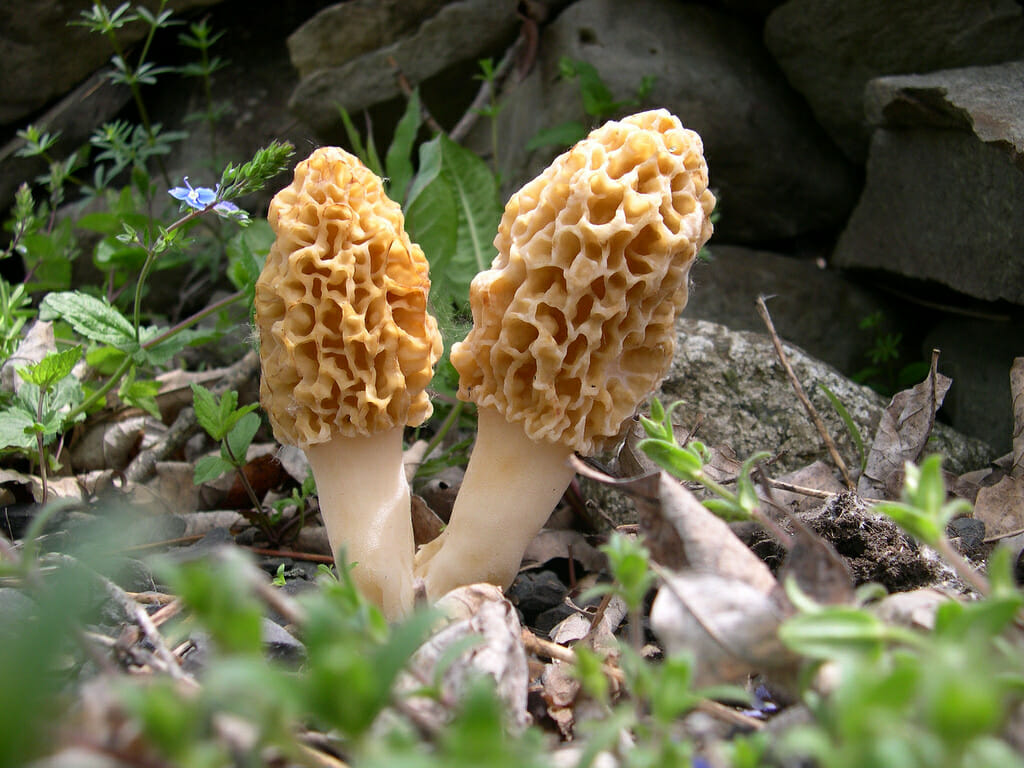
Morel. Image source: Flickr / Creative Commons
3. Morel Mushroom
(Morchella Esculenta)
Where it is grown: It is commonly found in the temperate Northern Hemisphere, including North America, Pakistan and China.
Medicinal properties: Particularly high in iron and B-complex vitamins, it is a wonderful addition to the medicine cabinet. This mushroom is also known for its immune-boosting properties.
Cultivating: Although several attempts have been made to commercially grown these ghosts of the woods, none has been successful. Best case is to scatter the trimmings from wild harvested mushrooms in your nearby wooded area and hope for some volunteers. This is usually quite sporadic and takes years to establish.
Table fare: The morel is the most highly prized of all mushrooms for its deeply earthy, meaty flavor. The French cherish its flavors and feature it in many highly refined dishes. For the rest of the world, they are delicious cut in half, dredged in flour, and sautéed in butter until crispy. Delicious!
Weird but true: The morel took center stage for many mushroom conspiracy theorists. An entrepreneur and mycologist was once purported to have found a way to commercially cultivate the mushroom in large scale. Just as he was about to sell his method to a popular pizza chain (of all things), he mysteriously died, prompting many to believe that he was murdered in an attempt to keep his secret from becoming public.
What is your favorite mushroom to forage for and eat? Share your tips in the section below:
Saturday, February 4, 2017
3 Edible Mushrooms That Defy Nature & Grow During Winter

Oyster mushrooms. Image source: YouTube
Any outdoor survival situation eventually requires some degree of hunting and gathering. Unfortunately, there are far fewer plants and animals in winter than you might find in more temperate seasons. Curiously, though, mushrooms in winter are an option — but you have to know where and when to look.
How can mushrooms grow in winter? The simple answer is that most can’t, but there are occasions when a mid-winter thaw will not only allow but encourage some mushrooms to emerge.
Two examples of edible mushrooms in winter include oyster mushrooms and wood ears. There’s also an edible winter mushroom called velvet shank that can withstand freezing and thawing throughout the winter.
Perhaps the most visible and ubiquitous mushrooms in winter are growing low to the ground on the trunks of trees. They often grow in clusters and stick out from the sides of the tree like little shelves.
This class of mushroom is commonly called “tree brackets” or as their appearance implies, “shelf mushrooms.” Mycologists refer to them as polypores. There is one polypore exception we’ll cover that can be eaten, and that’s wood ears, but it is a rare exception.
Discover More Than 1,100 Homesteading Tips And Tricks!
While tree brackets are easy to spot and seem to be everywhere, almost all of them are defined as inedible and most are toxic and as tough as frozen leather.
Where to Look
Mushrooms favor forested areas where the rotting cellulose of trees provides them with the nutrients to survive and grow. A few can emerge in an open field or you may have seen them in your lawn, but lurking beneath the ground is a humus of rotting vegetation that feeds many species of mushroom. These are referred to as saprophytic fungi.
Then again, some species of mushrooms are parasitic and actually grow on green trees and plants as opposed to dead and rotting ones. The tree-brackets or shelf mushrooms we just covered are an example of a class of mushrooms referred to as parasitic fungi.
There’s a third classification referred to as a symbiotic or mycorrhizal fungi. These mushrooms emerge from the roots of living plants and trees and actually help the plant or tree to draw more water or nutrients from the ground. These also can be found in an open field, lawn or wooded forest.
When to Look
Mushrooms cannot emerge from hard, frozen ground or frozen, rotting wood in winter. It takes a mid-winter thaw, usually preceded by rain or thawing snow, to motivate the mycelium or the early growth stage of a mushroom to spring to life, and with any luck (and a duration of a few days) a mushroom will emerge. The rare exception is the velvet shank which emerges and survives all year round.
What to Look For
Now comes the hard part. What have you found? There are three edible mushrooms often identified as prime species for mid-winter emergence. It’s worth noting that all three of these mushroom species are saprophytic, meaning they thrive on the rotting wood of trees, or the rotting cellulose of plants.
1. The velvet shank
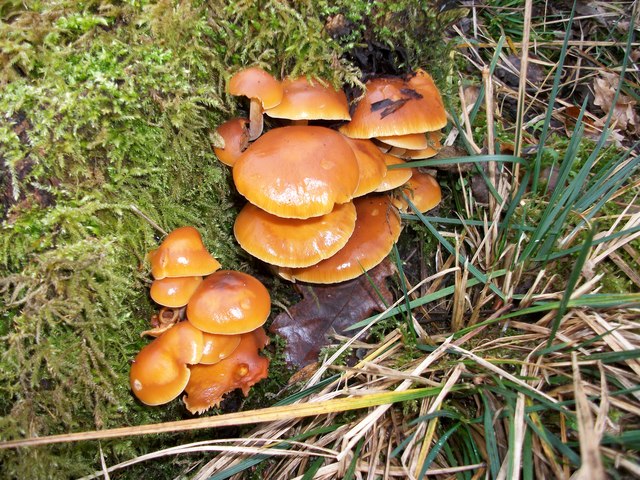
Velvet shank. Image source: Geograph.co.uk / Creative commons
The prime season for the velvet shank in many parts of North America is defined as November, December and January, although it is a year-round mushroom. The velvet shank is a very common mushroom and can actually withstand freezing and thawing. Its appearance is defined by yellow caps that are flat and about 2 to 10 centimeters in diameter. The stem is very tough and is also yellow, although it darkens towards the base, and the stem darkens to black as it matures. The velvet shank stands about 3 to 10 centimeters from the trunk or stump of the tree and has thin, yellow flesh. Horse chestnut and elms are a favored host for the velvet shank.
2. Oyster mushrooms
Prime months for oyster mushrooms include November, December, January and February, although they also can grow year-round. They first appear as grey turning to a creamy brown as they mature. The caps are shell-shaped anywhere from 4 to 20 centimeters in diameter. The oyster mushroom favors the trunks or branches of rotting, broad-leafed trees. It is also a very common mushroom. But beware. There is a similar looking mushroom called the olive oysterling that is toxic.
3. Wood ears
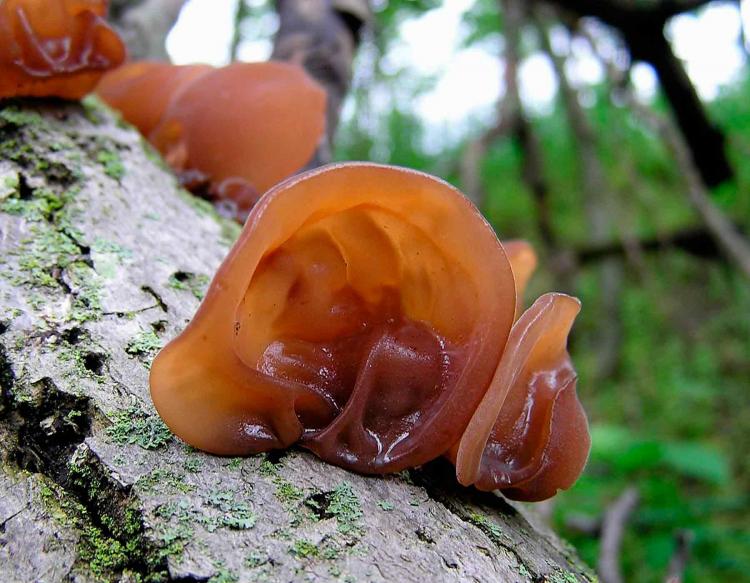
Wood ears. Image source: Mo.gov
This mushroom has its prime season in January, but like the others is also a year-round species. After first appearing its texture is jelly-like but it hardens as it approaches maturity. It has a reddish-brown appearance and the interior of the cap is greyish-brown. It also grows on dead branches and trunks and some of the common trees it favors include sycamore and elder. It, too, is a very common mushroom found across most of North America and is one of the few tree brackets that is edible.
While there are many sources for information about mushrooms, I usually look to the U.S. Forest Service as a starting point. They have an excellent publication that you can download for free as a PDF that does a great job of identifying mushrooms in the Eastern United States. You also can visit their website at www.fs.gov.us to search for information about mushrooms across the continent.
Another good resource is The National Audubon Society Field Guide to North American Mushrooms. This is handy to take into the field with you while you’re studying mushrooms.
What advice would you add? Share your thoughts in the section below:

Monday, November 21, 2016
Mushrooms: The Perfect, Indoor, Fast-Growing Winter Crop

The idea of gardening indoors during the winter can be daunting. It’s easy to feel defeated by the low levels of sunlight and the limited amount of space. But some crops are excellent choices to grow inside during the winter, and mushrooms are one. They will happily grow in a plastic bucket, a chunk of log or a seedling flat — and they require minimal space. Plus, the naturally dark and cool winter environment suits them perfectly.
Mushrooms are little health warriors. Carb-free, gluten-free, low in calories and sodium, and nutrient-rich, they are incredibly healthy. Different varieties of mushrooms are packed with nutrients like potassium, selenium, iron, and vitamins B2 (riboflavin) and B3 (niacin). Mushrooms enhance our immune systems and lower hypertension and cholesterol. Their meat-like texture makes them ideal meat substitutes.
There’s no doubt that mushrooms are healthy, but how feasible is it to grow them in our homes? Many of us have heard stories about mushrooms being grown in places like abandoned mines. Plus, mushrooms grow from microscopic spores, instead of seeds. Still, believe it or not, mushrooms are fairly easy — and fun — to grow.
Mushroom Kits
Mushroom spores need to be mixed with a nutrient-rich base like sawdust, grain or straw. This mixture will develop mycelium: thin, soft, white threads (think of mold). Once mycelium develops, it’s called “spawn.” For the best mushroom crop, spawn should be spread on a substrate (base material). Common substrates include cardboard, straw, logs, manure and grain; but other materials like coffee grounds and tea leaves can be used.
Looking For Non-GMO Vegetable Seeds? Get Them From A Company You Can Trust!
Because each variety prefers different substrates and growing conditions, getting a mushroom harvest is a bit of an art. First-time growers should consider using a kit. Kits come complete with spawn, substrate, instructions, and often additional supplies like water misters and plastic sheeting. Growing mushrooms from kits is a breeze, and it offers a terrific chance of success.
Experimenting with Spawn and Substrate

Using your own substrates is part of the fun, and it’s a money-saver. Most substrates do need to be pasteurized before use to kill off harmful bacteria and fungi, but the process is fairly simple. Common methods include baths in hot water, hydrogen peroxide or lime, and cold incubation.
Cardboard is an exception. Since most other fungi and bacteria won’t grow on cardboard, it doesn’t need to be pasteurized before use. Simply tear waste cardboard into small pieces and soak in water for at least an hour. Once it’s drained, it’s ready to use.
Cultivating mushroom spores so that you can bypass spawn suppliers is, unfortunately, labor-intensive and costly. It requires a sterile workplace, as well as a pressure cooker or autoclave. However, if you become an avid mushroom producer, you might want to look into cultivating your own spores, too.
A Step-by-Step Guide
- Buy a mushroom kit or spawn.
- If you’re not using a kit, prepare the substrate, and then inoculate it with spawn.
- Place the inoculated substrate in the best possible environment for the variety. Most mushrooms grow best if the temperature is around 55-60 degrees Fahrenheit, but some varieties will perform better in temperatures that are slightly cooler or warmer. Some light is OK, but keep the substrate away from direct sunlight. Basements often work well for growing mushrooms, as does the space under your kitchen sink.
- Keep the inoculated substrate moist by covering it with a damp cloth or a sheet of plastic that has some holes punched in it for air circulation. Remove the covering and spritz with non-chlorinated water two to three times a day.
- Depending on the variety chosen, the quality of the spawn, and the suitability of the growing environment, tiny mushrooms may begin growing within a few days to a few weeks. This process is called “pinning.”
- Once your mushrooms begin pinning, they will mature quickly, usually within a few days.
- The method of harvesting your mushroom depends on the variety you are growing. Some should be cut at the stem; others should be broken off in clumps.
And that’s it! Who knew it could be so easy to grow mushrooms? It really isn’t all that different from growing vegetables, except you are using spawn instead of seeds, and darkness instead of light. Because they prefer cool, dark environments, and require only a little bit of space, mushrooms are the perfect indoor winter crop.
Have you ever grown mushrooms? What advice would you add? Share your tips in the section below:
Bust Inflation With A Low-Cost, High-Production Garden. Read More Here.
Subscribe to:
Posts (Atom)