Showing posts with label Beef. Show all posts

Tuesday, May 8, 2018

How To Turn Old Meat Into Survival Jerky That Lasts MONTHS AND MONTHS

How To Turn Old Meat Into Survival Jerky That Lasts MONTHS AND MONTHS

jerky — wikipedia


Have you ever found yourself looking for something in the freezer, and then stumbled upon a couple of packages of venison that somehow lost their way? This happened to me several months ago and I couldn’t have been happier. Why did the notion of being reunited with some venison make me happy? One word: jerky.


Making jerky is one of those time-honored traditions that my family just loves. It is an extremely lean and healthy snack for everyone. I love it because instead of eating processed garbage, my kids are eating a snack high in protein and not simply refined sugar. I love jerky because it is the perfect reason for me to sharpen my favorite knife and fire up the smoker.


Restore Your Old Blades To A Razor’s Edge In Just Seconds!


I have a very simple recipe for making jerky, and it works for both venison and beef. I have never tried it with other meats, although I cannot imagine the process would be dramatically different. What follows is a very basic process for making jerky using an electric smoker. I prefer to use mesquite when smoking meats like venison and beef, but the choice is totally yours.


Ingredients


  • 2 pounds venison

  • ½ cup soy sauce

  • 1/4 cup Worchester sauce

  • ½ teaspoon Morton Tender Quick Cure

  • 1 teaspoon chili powder

  • 1 tablespoon garlic powder

  • 1 tablespoon onion powder

  • 2 tablespoons rough cracked pepper


The Process


How To Turn Old Meat Into Survival Jerky That Lasts MONTHS AND MONTHS

Image source: Pixabay.com


You want to begin working with this stuff the night before you intend to fire up the smoker. Make sure your venison is trimmed of any fat or sinew and is sliced thin. The thinner the better here, since it will help it to dry out easier and will provide more surface area for the marinade to adhere. Make your goal for strips around ¼-inch thick or so. It might be helpful when cutting the meat to have it be not quite frozen, but a bit stiff. This will give you a little more control as you are slicing it. Also, take a couple of minutes and sharpen your knife before you get going. A sharp knife will make this job a lot easier.


Once you have the meat sliced, just put it aside and focus on the marinade. Put all of the ingredients except the cracked pepper in a plastic storage bag and make sure it is mixed thoroughly. Once this is done, add the venison and place it in the refrigerator overnight.


The next day, you want to get your smoker going low. Try to hit somewhere between 150-175 degrees Fahrenheit. Next, take the marinated venison out of the fridge and drain the marinade. Spray the racks of your smoker with cooking spray and begin laying out the venison strips. The last thing you want at this step is to have the strips touching each other in any way, so space accordingly. Before you place the jerky in the smoker, liberally sprinkle them with the cracked black pepper.


Once the racks are in the smoker, monitor the temperature for the next several hours. Avoid adding any wood at this time and just let the smoker do its thing. After about three hours, check on the jerky. It should feel almost sticky to the touch. If this is where you are at, then add a handful of woodchips to the smoker to add a smoky flavor to the venison. After this, you are going to want to wait on the smoker for another few hours. It is also helpful to rotate the racks from time to time to ensure that the racks are presented with an even amount of heat and smoke.


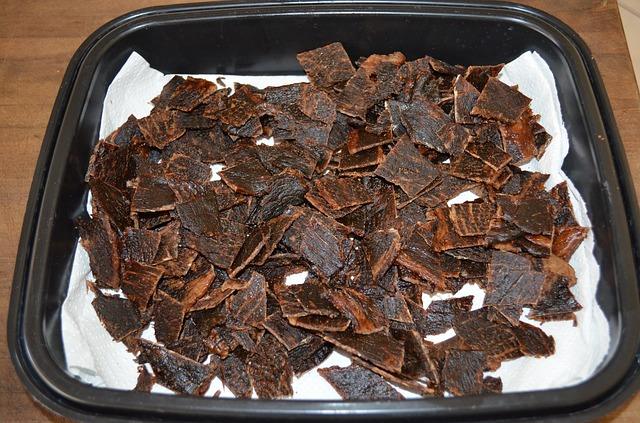
The time it will take your smoker to successfully turn that wonderful venison into tremendous jerky can vary. Expect it to take anywhere from 5-6 hours depending on the size of the slices and the temperature of the smoker. If you are nervous about the jerky after it comes out of the smoker, you can always finish it in the oven at 200 degrees for an additional 10-15 minutes or so. You will know the jerky is done when you can bend a piece and it begins to splinter. If the jerky snaps when you bend it, it is too far gone, although will still be delicious. Once it is done, put the jerky in a glass jar or vacuum seal it for storage.


If you use the cure, it will last you months and months, making it useful out in the wild or just for storage as a survival food. Without the cure, I would recommend refrigeration and prompt eating to avoid any mold growth. However, if your family is like mine, then you will never be able to find out just how long it can truly last, because it will be gone the second you turn your back.


What jerky-making advice would you add? Share your tips in the section below:


Learn How To ‘Live Off The Land’ With Just Your Gun. Read More Here.


The post How To Turn Old Meat Into Survival Jerky That Lasts MONTHS AND MONTHS appeared first on Off The Grid News.

Saturday, April 14, 2018

Processed Meats And Red Meat Cause Cancer

Processed Meats And Red Meat Cause Cancer | barbecue-red-meat-steak-sausage-processed-meat | General Health Special Interests Toxins


(The Real Agenda) Cancer is not a disease and it is not a series of diseases, either. Contrary to what most people think, cancer is nothing else than the body’s expression of massive toxicity. This is why chemotherapy and radiation are not effective tools to treat or cure cancer. Neither chemotherapy nor radiation end toxicity. In fact, they increase it.


The origin of body toxicity usually stems from the liver’s incapacity to get rid of substances that enter the human body. Preventing cancer can be as easy as cleansing your body, more specifically, cleansing your liver.


When people do not carry out frequent cleansings of the liver as well as other organs and, in addition, consume food products that are loaded with chemicals, GMOs, estrogen mimickers, pesticides and herbicides, among others, that the body cannot excrete, these chemicals bioaccumulate to a point where they cause a chain reaction of cellular over multiplication and overgrowth. The result is the apparition of bulks of tissue that are better known as tumors.


Many of the ingredients that may cause cancer are found in processed foods and red meat. Red meat, although for a different reason, also promotes body toxicity which may or may not develop into disease such as cancer, but that may also manifest as fatigue, flu-like symptoms, stomach pain or cramps, and a host of other warnings.


So-called genetic predisposition, a supposed conditioned understood by many as a death sentence, may or may not be a trigger to develop cancer during a person’s lifetime. Just because relatives have suffered from cancer does not mean a person is destined to have the same outcome. As of today, genetic testing to detect alleged predisposition to cancer or other diseases is non-conclusive at best.


What has been scientifically proven up until today is that the ingredients contained in processed meats and frequent consumption of red meat do serve as preconditions to develop diseases such as cancer.


According to the International Agency for Research on Cancer (IARC), the cancer agency of the World Health Organization, thorough review of scientific literature does show enough proof that red meat is a probable trigger of colorectal cancer in humans.


In addition to colorectal cancer, literature also shows associations between consumption of red meat and pancreatic cancer and prostate cancer.


“The experts concluded that each 50 gram portion of processed meat eaten daily increases the risk of colorectal cancer by 18%,” says the press release published by the WHO.


“For an individual, the risk of developing colorectal cancer because of their consumption of processed meat remains small, but this risk increases with the amount of meat consumed. In view of the large number of people who consume processed meat, the global impact on cancer incidence is of public health importance,” explained Dr. Kurt Straif, Head of the IARC Monographs Programme.


Meanwhile, says Dr Christopher Wild, Director of IARC, ”these findings further support current public health recommendations to limit intake of meat.” He emphasized that the results of the latest review of literature are important because they enable people to conduct risk assessments, which in turn may result in a clear path towards balancing the risks and benefits of eating red meat.


The most recent evaluation from the WHO also makes a clear distinction about what is considered red meat, so that people have a clear understanding about which meats they should avoid. “Red meat refers to all types of mammalian muscle meat, such as beef, veal, pork, lamb, mutton, horse, and goat.”


An important differentiation was also made about processed meats, which the report identifies as that which has been “transformed through salting, curing, fermentation, smoking, or other processes to enhance flavour or improve preservation.”


According to the WHO, over 8 million people die every year from cancer. Cancer deaths account for about 13% of all deaths worldwide. IARC expects that cancer rates increase by 70% in the next 2 decades.


The post Processed Meats And Red Meat Cause Cancer appeared first on The Sleuth Journal.

Friday, February 9, 2018

Stop Buying ‘Fake’ Beef

Stop Buying


Story at-a-glance


  • In a lawsuit filed against the U.S. Department of Agriculture (USDA), ranch groups and cattle producers allege that millions of pounds of imported beef are being labeled as “Products of the USA”

  • The USDA has argued that imported beef can be labeled as U.S. beef if it comes from a country with food safety standards that are equivalent to those in the U.S.

  • In 2013, the country-of-origin-label (COOL) rule was improved and meat packages were supposed to be required to label where the animal that provided your meat was born, raised and slaughtered

  • In 2015, the World Trade Organization (WTO) ruled U.S. law requiring COOL labels on meat was illegal, as it discriminated against Canadian and Mexican meat companies and gave an advantage to U.S. meat producers

  • Look for the American Grassfed Association (AGA) logo on your meat and dairy, which ensures the highest quality, U.S.-born and raised, grass fed products


The average American is slated to eat about 800 burgers’ worth of beef in 2018, or about 222 pounds.1 Where you get this beef, how it’s raised and, ultimately, the way it is prepared make all the difference in how it affects your health and the environment. Source matters — greatly — and part of that includes knowing where your beef was raised. You’d probably assume that beef labeled “Product of the USA” was a product of the U.S., but this isn’t necessarily the case.


In a lawsuit filed against the U.S. Department of Agriculture (USDA) and USDA Secretary Sonny Perdue, ranch groups R-CALF USA and the Cattle Producers of Washington (CPoW) allege that millions of pounds of imported beef are being labeled as “Products of the USA.” They cite the Tariff Act of 1930, which requires imported beef to be labeled with its country-of-origin, including when it reaches the consumer, “unless the beef undergoes substantial transformation” in the U.S.2


However, the USDA has argued that imported beef can be treated as U.S. beef if it comes from a country with food safety standards that are equivalent to those in the U.S. As reported by the American Grassfed Association (AGA), “Consequently, the Secretary allows multinational meatpackers to label imported beef as ‘Products of the USA’ even if the imported beef receives only minor processing, such as unwrapping and rewrapping the package.”3


Why Is Imported Meat Allowed To Be Labeled as US Meat?


While it seems like labeling meat to let consumers know where it came from would be a straightforward requirement, it’s anything but. The original Country of Origin Labeling (COOL) rule, which was approved in 2002 and took effect in 2008, required the country of origin to be listed on meat labels. In 2013, the COOL rule was improved and meat packages were supposed to be required to label where the animal that provided your meat was born, raised and slaughtered.


At the time, industrial meat producers like Tyson, Cargill and the National Cattlemen’s Beef Association were among those who spoke out against the rule, calling it unnecessarily costly and “shortsighted,” while fearing it would shrink demand for imported meat. Unfortunately for U.S. consumers seeking greater transparency in their food sources, the meat giants needn’t have worried because global dictators stepped in and essentially told consumers they don’t have the right to know.


In 2015, the World Trade Organization (WTO) ruled U.S. law requiring COOL labels on meat was illegal, as it discriminated against Canadian and Mexican meat companies and gave an advantage to U.S. meat producers.4 WTO even ordered more than $1 billion in trade sanctions annually against the U.S. if the COOL labels were not weakened or removed altogether. As reported by the Huffington Post:5


“[The] World Trade Organization (WTO) ruling against the country-of-origin meat labels (COOL) that Americans rely on to make informed choices about their food provides a glaring example of how trade agreements can undermine U.S. public interest policies … Mexican and Canadian livestock producers and the U.S. meat processing industry fought fiercely against the policy’s initial enactment and then turn to deregulation-by-trade-agreement as Plan B.”


Americans Want to Know Where Their Meat Comes From


As it stands there is no USDA requirement that beef or pork be labeled to let consumers know what country it came from, despite the fact that Americans overwhelmingly want to know. A Consumers Union poll found that 93 percent of those who responded said they favored country-of-origin labeling.6 And why wouldn’t they? It’s one more way for you to know where your food comes from, providing once commonplace information that has disappeared in the industrial food arena.


By removing COOL, multinational companies are allowed to pass off imported meat as U.S.-raised, while U.S. farmers suffer. AGA noted, “Evidence submitted by the groups indicate that U.S. cattle producers received higher prices for their cattle when the origins of foreign beef was distinguished in the marketplace.” AGA president Will Harris continued:7


“The American Grassfed Family Farmer suffers financially, from this intentional anonymity, more than any other segment of the meat industry. Thank you R-Calf for bringing this injustice to light. Some American Consumers make the decision to pay a premium for beef that is produced in a humane and regenerative manner.


They do this, in part, to positively impact lands, animals and farm communities in the United States. Hiding the National Origin of products from these consumers is a travesty. It should not be tolerated.”


Meanwhile, the lawsuit against the USDA alleges that it’s actually illegal for the USDA to allow meat without country-of-origin labels because it violates the Meat Inspection Act. That act requires COOL on imported steaks and chops, according to Public Justice, which is representing the ranchers’ groups behind the lawsuit.


“And if you don’t believe our suit, believe the USDA itself,” Public Justice reported. “The department had COOL requirements in place for eight years, and it did so in order to be in compliance with the Meat Inspection Act. In other words, the USDA knows its current policies don’t follow the law; it is just captured by corporate interests. It’s time for that to change.”8


JBS Scandal Highlights the Importance of Transparency in the Food Supply


Located in Brazil, JBS is the world’s largest meat company, having acquired U.S. Swift and Company in 2007 and Smithfield’s beef business in 2008. In 2009, JBS became a majority stockholder in poultry giant Pilgrim’s Pride. In 2017, however, JBS became mostly known for being surrounded in scandals, particularly in their home country of Brazil, which is one of the world’s largest meat exporters.


The meat business, much like other large industries, has connections at various levels of government. In the case of meat exports from Brazil, those connections have reached all the way to the country’s president. In 2017, authorities in Brazil suspended 33 government employees and closed three slaughterhouses after finding factory managers had bribed politicians and inspectors to obtain meat export certificates for meat that had never been inspected.9


This was the largest organized federal police effort in Brazil, which police used to dismantle a “criminal organization” that had used kickbacks to aid the production and exportation of adulterated meat by meat producer JBS. As a result of corruption charges, Brazilian prosecutors fined JBS $3.1 billion, an assessment that came on the heels of another plea agreement between the Brazilian government and JBS that included reduced sentences for seven executives from the company.10


Although JBS did not disclose the corruption charges, investigations into President Michel Temer were launched following a leaked recording of Temer condoning a JBS executive to bribe politician Eduardo Cunha,11 serving 15 years after being found guilty of tax evasion, money laundering and corruption.


The U.S. and other countries temporarily halted imports of Brazilian beef following the scandal, and JBS began selling off some of its assets in Brazil and Europe, along with all of its U.S. cattle feedlots, which hold nearly 1 million cattle. R-CALF, which is part of the COOL lawsuit against the USDA, has also called for an investigation into JBS USA. Former Montana rancher Bill Bullard, R-CALF’s CEO, said in a news release:12


“Here we have a company whose business model includes bribery and other corrupt practices … We believe that it’s highly possible that this company is deploying this same corrupt business model here in the United States of America.”


Grass Fed Is Best for Beef


When in search of the best beef for your health and the environment, it’s not only the country of origin that matters but also the conditions in which it’s raised. Grass fed is the clear winner. For starters, it’s better for you, with beneficial conjugated linoleic acid (CLA) levels increasing by two- to threefold when cattle are grass finished as opposed to grain finished.13 This is a significant benefit, as CLA is associated with a lower risk of cancer and heart disease and optimized cholesterol levels.


The ratio of dietary fats is also healthier in grass fed beef, and it is also higher in antioxidants like vitamins E and A, along with the enzymes superoxide dismutase and catalase, which mop up free radicals that could otherwise hasten oxidation and spoilage.14


Grain feeding cows also encourages the growth of E. coli in the animals’ gut, as it leads to a more acidic environment. Grain-fed cows live in a state of chronic inflammation, which increases their risk of infection and disease, and necessitates low doses of antibiotics in feed for disease-prevention purposes.15


This isn’t the case with grass fed cattle, which stay naturally healthy as they’re allowed access to pasture, sunshine and the outdoors. In a Consumer Reports study of 300 raw ground beef samples, grass fed beef raised without antibiotics was three times less likely to be contaminated with multidrug-resistant bacteria compared to conventional CAFO (concentrated animal feeding operation) samples.16


The grass fed beef was also less likely to be contaminated with E. coli and Staphylococcus aureus than the CAFO meat. So while giving you more nutrition, you’re also less likely to be exposed to drug-resistant pathogens when eating grass fed food.


Further, while CAFOs are top sources of air and water pollution, grass fed farming regenerates the soil and maintains ecological balance without relying on chemical fertilizers and pesticides. Last, but certainly not least, the basic elements of animal welfare are missing from CAFOs, while animals raised on pasture are afforded the freedom to express their natural behaviors, making it the humane choice as well.


Imports of grass fed beef, which make up 75 percent to 80 percent of U.S. grass fed beef sales by value, pose a hurdle, however. Australia and Brazil can produce grass fed beef at a lower cost, as their climate allows for year-round grazing. But as with conventional beef, U.S. consumers may not know the grass fed beef they purchase isn’t from the U.S., because as long as a piece of imported beef passes through a USDA-inspected plant, it can be labeled as a “Product of the USA.”


Looking for U.S.-Raised, Grass Fed Beef? Look for the AGA Logo


According to Back to Grass: The Market Potential for U.S. Grassfed Beef, a report produced by a collaboration between sustainable agriculture and ecological farming firms, accurate labeling is imperative to “ensure that consumers are getting what they think they’re buying.”17 Not only may you be buying imported beef without knowing it, the grass fed beef you’re buying may not be as wholesome as you expect it to be, thanks to weak standards.


Unfortunately, the USDA is not doing nearly enough to provide transparency for U.S. consumers, which is why I encourage you to either buy direct from a trust farm or look for The American Grassfed Association (AGA) logo, a much-needed grass fed standards and certification for American-grown grass fed meat and dairy.18


The standard allows for greater transparency and conformity19 and is intended to ensure the humane treatment of animals and meet consumer expectations about grass fed meat and dairy, while being feasible for small farmers to achieve.


An AGA logo on a product lets you know the animals were fed a lifetime diet of 100 percent forage, were raised on pasture (not in confinement) and were not treated with hormones or antibiotics.20 In addition, the AGA logo on your meat and dairy ensures the animals were born and raised on American family farms,21 which is far more than can be said for the USDA-allowed, and incredibly misleading, “Product of U.S.A.” stamps that favor multinational corporations over small U.S. farmers.


Consumers must now face the fight against the globalist agenda of corporations like JBS, and an excellent start is by supporting the real U.S. grass fed farmers.


– Sources and References


The post Stop Buying ‘Fake’ Beef appeared first on The Sleuth Journal.

Sunday, December 3, 2017

Zilmax: Performance Enhancing Drug of the Beef Industry

Zilmax: Performance Enhancing Drug of the Beef Industry | black-angus-cow | Agriculture & Farming General Health Sleuth Journal Special Interests


Some may say there’s something romantic about beef. “Black angus cattle” conjures up thoughts of tough cattle grazing on the open pastures in the rugged farmland of America’s heartland. I personally follow an organic vegan diet, but I realize many people enjoy a thick, hearty steak and consider it a taste of the literal fat of the land. The commercials depict jeans, boots, trucks, hard work, good intentions- it seems so pure.


Unfortunately, that imagery is mostly limited to the advertisements. Some argue that the industry’s decisions are made mostly by bean counters and pharmaceutical drug developers who are removed from the farm and don’t have to worry about getting their shoes dirty.


Don’t get me wrong, there are many good and very decent people who work in the beef industry. But, the beef industry is like any other and making money is mandatory. Costs must go down, performance must go up. Enter Zilmax, the industry’s performance enhancing drug.


What is Zilmax?


Zilmax is a feed supplement that contains Zilpaterol hydrochloride (ZH), a drug that makes cattle produce more muscle and less fat. Formally, the Federal Drug Administration recognizes that Zilpaterol hydrochloride “increases rate of body weight gain, improves feed efficiency, and increases carcass leanness.” [1] Zilmax is added to cattle feed, usually during the last few weeks before slaughter, as a final fattening up process. Except the cattle don’t get fatter, they get more muscular.


Why is Zilmax Used?


Growth drugs are being promoted as measures to save on costs while increasing production. They allow cattle to produce more meat without any extra food or water. On paper, that’s very attractive. Additionally, external factors like the weather can put farming operations on high alert. A drought will cause feed and water prices to go up. Cattle farmers have hundreds or thousands of mouths to feed, literally. If there’s a way to do it cheaper, it’s going to be considered.


What’s the Downside?


Zilmax, and other products with ZH, may produce more steak, but do they produce a better steak? A casual analysis produces doubts. Zilmax makes cattle produce more muscle and less fat, this isn’t all positive. Ask anyone who eats steak, the marbling (fat) is a desired quality that provides the juicy flavor and tender texture. Without it, you may as well be eating shoe leather. Many people say that is what ZH steaks taste like, too.


Trained taste testers at the Department of Animal Science at Oklahoma State University reported that ZH steaks were less juicy and more tough than steaks without. [2] Researchers at the Department of Animal Sciences at the University of Illinois at Urbana-Champaign also described ZH steaks as less tender but suggested that aging the steaks may help that out. [3] Oh, okay then.


Predictably, manufacturers of ZH products claim the drug doesn’t affect meat quality. [4]


Who is Affected?


The industry has implemented widespread use of Zilmax and four companies (National Beef Packing, Tyson Foods, Cargill, and JBS SA) control about 85% of the meat packing industry. If you eat beef, this affects you. Does this make you more interested in organic, free-range, hormone-free meat? Or, even avoiding meat altogether and adopting a vegan diet?


References (4)


  1. Delmore RJ, Hodgen JM, Johnson BJ. Perspectives on the application of zilpaterol hydrochloride in the United States beef industry. J Anim Sci. 2010 Aug;88(8):2825-8. doi: 10.2527/jas.2009-2473. Epub 2010 Apr 9. Review.

  2. Garmyn AJ, Shook JN, VanOverbeke DL, Beckett JL, Delmore RJ, Yates DA, Allen DM, Hilton GG. The effects of zilpaterol hydrochloride on carcass cutability and tenderness of calf-fed Holstein steers. J Anim Sci. 2010 Jul;88(7):2476-85. doi: 10.2527/jas.2009-2635. Epub 2010 Apr 9.

  3. Holmer SF, Fernández-Dueñas DM, Scramlin SM, Souza CM, Boler DD, McKeith FK, Killefer J, Delmore RJ, Beckett JL, Lawrence TE, VanOverbeke DL, Hilton GG, Dikeman ME, Brooks JC, Zinn RA, Streeter MN, Hutcheson JP, Nichols WT, Allen DM, Yates DA. The effect of zilpaterol hydrochloride on meat quality of calf-fed Holstein steers. J Anim Sci. 2009 Nov;87(11):3730-8. doi: 10.2527/jas.2009-1838. Epub 2009 Jul 31.

  4. Merck Animal Health. Zilmax.


The post Zilmax: Performance Enhancing Drug of the Beef Industry appeared first on The Sleuth Journal.

Saturday, July 29, 2017

The Empire Strikes Back: Japan Jacks Up US Beef Import Tariffs To 50%

President Donald Trump’s decision to withdraw the US from the 12-nation Trans Pacific Partnership angered the Japanese, provoking fears of a bruising trade showdown between the world’s largest and third-largest economies. On Friday, the Japanese instituted a new policy that will do little to assuage those concerns.


After Japan signed a sweeping trade agreement with the European Union, a move that pundits warned would weaken the US’s position as a dominant player in the global economy, the country has taken another dramatic step clearly aimed at retaliating against the US: Japan said it would impose a temporary 50% tariff on frozen beef from the US and several other countries.


According to the Wall Street Journal, Japan’s decision to crack down on frozen beef imports was mandated by a 1994 global trade deal that would’ve been scrapped under the TPP. US trade groups are already warning about how the decision will negatively impact beef prices stateside.


“The U.S. Meat Export Federation said Japan’s move would have negative implications for both U.S. beef producers and Japanese restaurant chains that rely on frozen American beef. The group “will work with its partners in Japan to mitigate the impact” of the move as much as possible, said Chief Executive Philip Seng.


Under Japanese law, an additional tariff known as a safeguard is triggered when frozen-beef imports from all countries and frozen-beef imports from countries lacking free-trade deals with Japan - or “non-EPA countries” because they lack an economic partnership agreement with Japan - both increase by more than 17% from the same period a year earlier. The import volumes are reviewed each quarter.


US government officials couldn’t be reached immediately for comment.”


According to Japan’s Ministry of Finance, Japan imported 89,253 tons of frozen beef during the second quarter, with 37,823 tons coming from non-EPA countries. Both surpassed the “safeguard volume” initiated by the 1994 trade agreement. In Japan, frozen beef is widely used at restaurants to make hamburger patties and bowls of beef over rice, a popular fast-food item, according to WSJ. The safeguard duty affects around 12% of total beef supply in Japan, said Finance Ministry tariff official Koyu Izumi.


In recent months, frozen beef imports have been rising as merchants have sought to lock in prices before China resumes US beef imports as a part of a trade deal. China cracked down on US beef imports 14 years ago during a mad-cow diseases scare. But as beef grows in popularity among Chinese consumers, while memories of the scare have mostly faded, in the world’s second-largest economy are excited about the return of US beef to store shelves.


"American steak is delicious," said one user on China"s Twitter-like Weibo service. "It doesn"t have the mutton smell of domestic beef,” according to Fortune Magazine.
Japan also temporarily blocked US beef imports in 2003 after the mad-cow scare, but it resumed imports in late 2005, halted them again shortly afterward, then fully restarted them in mid-2006. The US exported $1.5 billion of beef to Japan last year, according to data from the US Meat Export Federation cited by Reuters.


Furthermore, while Trump"s protectionist rhetoric has helped escalate tensions between the US and its partners, the US trade situation is improving. According to the latest reading on the US trade balance, released earlier this month, the US trader deficit shrunk in May. The trade deficit decreased in May 2017 from an unrevised $47.6 billion in April (revised). The most notable declines were seen in China and the European, where deficits declined by $2.6BN and $2.0BN respectively.


Several rival countries do have economic agreements with Japan that has exempted their beef imports from the restrictions, potentially granting them an opening to supplant US suppliers and increase their market share. These countries include as Australia, Mexico and Chile, according to Reuters. The wire service reported that Japan’s Finance Minister Taro Aso is calling foreign leaders of the affected countries to explain the increase in tariffs. But seeing as much of the US beef industry is centered on midwestern states like Nebraska that sided with Trump during the election.


We suspect Trump won’t let this go that easily.
 

Friday, March 17, 2017

The Older I Get The More Irish I Become

Growing up in a dominant Italian household, with pasta served every god damned night, I never bonded with my Irish side. My Father had died when I was 4, so I never got to know him or his side of the family. It was only when I got older did I begin to embrace my Irish side -- especially on St. Paddy"s Day -- a day designated for everyone to embrace the Irish culture. It might bemuse you to learn that I regale myself in all of the traditional accouterments -- a full blown leprechaun trotting around in green garb, with dastardly designs at becoming as drunk as humanly possible.


Over the years, I"ve had many memorable St. Paddy"s days, none of which included the fag parade. Typically, upon waking up, I toss the corned beef in a pot brimming with water, beer, and mustard seeds. After several hours of boiling the bastard, I always open up another beer (maybe 2) and pour it into the pot. Spending my time wisely, I drink a half dozen beers in record time -- write a bunch of shit on the internet, trade a few stocks, then I peel a bunch of potatoes and dice up some cabbage.


Making sure the beef is progressing according to schedule, I open the pot and poke at it -- as if I know what the hell I"m doing. Then I simply drop all of the potatoes and cabbage into the pot, cover it, and then forget it ever existed for the next two hours or so.


Dinner is well on its way.


My house is usually filled with guests, all wanting to eat boiled food and drink lots of strong beer, so we make more than one pot of corned beef. Sometimes I crock pot one -- or as my good friend likes to say, when pretending to be a world class chef, "slow cook" it.


Soon enough, the company begins to pile in -- most clad in green garments or off-white cable knit sweaters -- looking like old seamen just back from a month at sea. "How was the catch?", I ask them. "Pretty good lad -- now get me a fargin" beer, would ya?"


"Aye."


We"re playing the songs from the old country, naturally. Here are a few crowd pleasers.


After we"ve been properly inebriated, the fatty meat, potatoes, and cabbage are served, liberally. People usually bring their own corned beef -- so there"s plenty to go around. The music is blasting and the beers are being consumed at an industrial rate. Not before long, whiskey and single barrelled scotch are being passed around like bubble gum in a little league baseball dugout. The men venture outside to smoke a pipe or cigar, any sort of tobacco, and the rest of the night becomes a slow motion blur -- intermingled between laughter, comical moments, and juvenile foolishness.


Alas, by the end of the night, we"re all Irish -- outraged, mind you, by the treatment of "our people" by those fucking Brits.


We wait one year hence and then do it all over again.


Happy St. Paddy"s Day.
Content originally generated at iBankCoin.com