Showing posts with label British government. Show all posts

Tuesday, February 6, 2018

FBI Scandal Update: Dossier Writer Christopher Steele Failed To Show Up For Court

christophersteele


Former British MI-6 Intelligence Officer Christopher Steele, who was paid $168,000 by Fusion GPS’ Glenn Simpson to write and promote the dossier funded by the Democratic National Committee was a no-show in a civil court case.


The multi-million dollar libel case has brought against Buzzfeed after the media outlet published the unverified disinformation dossier at Steele’s insistence. Steele was paid to promote the fake dossier among select journalists in a smear campaign against President Donald Trump.


According to reports from Fox News, Steele was a no-show Monday for a long-requested deposition in London. The news comes as Senate Judiciary Committee Chairman Chuck Grassley, R-Iowa, and Senator Lindsey Graham, R-S.C., have announced a criminal referral on Steele.


Evan Fray-Witzer, a Boston-based attorney representing Russian tech tycoon Aleksej Gubarev in multi-million dollar civil litigation, described Monday’s U.K. court actions to Fox News. “My understanding is that Mr. Steele’s lawyers spent a good deal of time arguing why they thought he (Steele) should not be required to sit for a deposition and that ultimately the court took the entire matter under advisement.” Gubarev is suing the British-based Steele’s company Orbis Business Intelligence because the dossier also smeared Gubarev’s companies which include XBT Holdings and Webzilla.  The dossier claimed the companies used “botnets and port traffic to transmit viruses, plant bugs and steal data.”   Fray-Witzer said, “Certainly with respect to Mr. Gubarev, Webzilla and XBT there has never been a single scrap of evidence about them in the dossier.”


As Fox News has reported based upon a review of British court records, Steele promoted and met with five media outlets repeatedly between the spring and fall of 2016.  At the same time, Steele was also meeting with the FBI in Rome, according to reports.


Records obtained and reviewed by Fox News from related civil ligitation in Florida reveal that Steele maintains that even showing up for a deposition would “implicate state secrets in London.” Fray-Witzer stressed in that hearing that the British government “has not asserted” Steele’s claims. The attorney has said Steele “is asserting he can’t speak about things.  We have pointed out that he’s spoken to anyone who is willing to listen, every journalist, and the FBI.” 


Wednesday, December 27, 2017

From Snowden To Russia-Gate - The CIA And The Media

Via Moon Of Alabama blog,


The promotion of the alleged Russian election hacking in certain media may have grown from the successful attempts of U.S. intelligence services to limit the publication of the NSA files obtained by Edward Snowden.


In May 2013 Edward Snowden fled to Hong Kong and handed internal documents from the National Security Agency (NSA) to four journalists, Glenn Greenwald, Laura Poitras, and Ewen MacAskill of the Guardian and separately to Barton Gellman who worked for the Washington Post. Some of those documents were published by Glenn Greenwald in the Guardian, others by Barton Gellman in the Washington Post. Several other international news site published additional material though the mass of NSA papers that Snowden allegedly acquired never saw public daylight.


In July 2013 the Guardian was forced by the British government to destroy its copy of the Snowden archive.


In August 2013 Jeff Bezos bought the Washington Post for some $250 million. In 2012 Bezos, the founder, largest share holder and CEO of Amazon, had already a cooperation with the CIA. Together they invested in a Canadian quantum computing company. In March 2013 Amazon signed a $600 million deal to provide computing services for the CIA.


In October 2013 Pierre Omidyar, the owner of Ebay, founded First Look Media and hired Glenn Greenwald and Laura Poitras. The total planned investment was said to be $250 million. It took up to February 2014 until the new organization launched its first site, the Intercept. Only a few NSA stories appeared on it. The Intercept is a rather mediocre site. Its management is said to be chaotic. It publishes few stories of interests and one might ask if it ever was meant to be a serious outlet. Omidyar has worked, together with the U.S. government, to force regime change onto Ukraine. He had strong ties with the Obama administration.


Snowden had copies of some 20,000 to 58,000 NSA files. Only 1,182 have been published. Bezos and Omidyar obviously helped the NSA to keep more than 95% of the Snowden archive away from the public. The Snowden papers were practically privatized into trusted hands of Silicon Valley billionaires with ties to the various secret services and the Obama administration.


The motivation for the Bezos and Omidyar to do this is not clear. Bezos is estimated to own a shameful $90 billion. The Washington Post buy is chump-change for him. Omidyar has a net worth of some $9.3 billion. But the use of billionaires to mask what are in fact intelligence operations is not new. The Ford Foundation has for decades been a CIA front, George Soros" Open Society foundation is one of the premier "regime change" operations, well versed in instigating "color revolutions".


It would have been reasonable if the cooperation between those billionaires and the intelligence agencies had stopped after the NSA leaks were secured. But it seems that strong cooperation of the Bezos and Omidyar outlets with the CIA and others continue.


The Intercept burned a intelligence leaker, Reality Winner, who had trusted its journalists to keep her protected. It smeared the President of Syria as neo-nazi based on an (intentional?) mistranslation of one of his speeches. It additionally hired a Syrian supporter of the CIA"s "regime change by Jihadis" in Syria. Despite its pretense of "fearless, adversarial journalism" it hardly deviates from U.S. policies.


The Washington Post, which has a much bigger reach, is the prime outlet for "Russia-gate", the false claims by parts of the U.S. intelligence community and the Clinton campaign, that Russia attempted to influence U.S. elections or even "colluded" with Trump.


Just today it provides two stories and one op-ed that lack any factual evidence for the anti-Russian claims made in them.


In Kremlin trolls burned across the Internet as Washington debated options the writers insinuate that some anonymous writer who published a few pieces on Counterpunch and elsewhere was part of a Russian operation. They provide zero evidence to back that claim up. Whatever that writer wrote (see list at end) was run of the mill stuff that had little to do with the U.S. election. The piece then dives into various cyber-operations against Russia that the Obama and Trump administration have discussed.


A second story in the paper today is based on "a classified GRU report obtained by The Washington Post." It claims that the Russian military intelligence service GRU started a social media operation one day after the Ukrainian President Viktor Yanukovych was illegally removed from his office in a U.S. regime change operation. What the story lists as alleged GRU puppet postings reads like normal internet talk of people opposed to the fascist regime change in Kiev. The Washington Post leaves completely unexplained who handed it an alleged GRU report from 2014, who classified it and how, if at all, it verified its veracity. To me the piece and the assertions therein have a strong odor of bovine excrement.


An op-ed in the very same Washington Post has a similar smell. It is written by the intelligence flunkies Michael Morell and Mike Rogers. Morell had hoped to become CIA boss under a President Hillary Clinton. The op-ed (which includes a serious misunderstanding of "deterrence") asserts that Russia never stopped its cyberattacks on the United States:


Russia’s information operations tactics since the election are more numerous than can be listed here. But to get a sense of the breadth of Russian activity, consider the messaging spread by Kremlin-oriented accounts on Twitter, which cybersecurity and disinformation experts have tracked as part of the German Marshall Fund’s Alliance for Securing Democracy.


The author link to this page which claims to list Twitter hashtags that are currently used by Russian influence agents. Apparently the top issue Russia"s influence agents currently promote is "#merrychristmas".


When the authors claim Russian operations are "more numerous than can be listed here" they practically admit that they have not even one  plausible operation they could cite. Its simply obfuscation to justify their call for more political and military measures against Russia. This again to distract from the real reasons Clinton lost the election and to introduce a new Cold War for the benefit of weapon producers and U.S. influence in Europe.


None of the Russia-gate stories so far has held up to scrutiny. There is no proof at all, nor reasonable evidence, that Russia interfered in elections in the U.S. or elsewhere. There is no evidence of "collusion" with the Trump campaign.


One of the most complete debunking of the false claims can be found in the recent London Review of Books: What We Don’t Talk about When We Talk about Russian Hacking. Consortium News has published many pieces on the issue as well as analyses and warnings of what may follow from it. Many other writers have caught up and debunk the various false claims. The Nation lists various cases of journalistic malpractice with regard to Russia-gate.


The people who promote the "Russian influence" nonsense are political operatives or hacks. Take for example Luke Harding of the Guardian who just published a book titled Collusion: Secret Meetings, Dirty Money, and How Russia Helped Donald Trump Win. He was taken apart in a Real News interview (vid) about the book. The interviewer pointed out that there is absolutely no evidence in the book to support its claims. When asked for any proof for his assertion Harding defensively says that he is just "storytelling" - in other words: its fiction. Harding earlier wrote a book about Edward Snowden which was a similar sham. Julian Assange called it "a hack job in the purest sense of the term". Harding is also known as plagiarizer. When he worked in Moscow he copied stories and passages from the now defunct Exile, run by Matt Taibbi and Mark Ames. The Guardian had to publish an apology.


The Mexican government controls the media by buying an immense amount of advertisement. It thus guarantees income as long as its political line is followed. The U.S. government has its own ways of controlling the media. In the 1950s to 1970s the CIA ran Operation Mockingbird which gave it control over much of the news and opinion output in U.S. media. During that time up to 400 main stream journalists were working for the CIA.


The method of control has likely changed. The handling of the Snowden affair lets one assume that the CIA induces billionaires to buy up media and to implement the CIA"s favored policies through them. We do not know what the billionaires get for their service. The CIA surely has many ways to let them gain information on their competition or to influence business regulations in foreign countries. One hand will wash the other.


James Clapper as Director of National Intelligence, John Brennan as CIA head and James Comey from the FBI "assessed" that Russia influenced the U.S. presidential election. Annex B of their report, which hardly any report bothered to mention, read:


Judgments are not intended to imply that we have proof that shows something to be a fact. Assessments are based on collected information, which is often incomplete or fragmentary, as well as logic, argumentation and precedents.


That sentence is the core of Russia-gate. There are lots of claims, assertions and judgments but no proof at all that any of the alleged Russian influence really happened.


It is probably due to the undue influence of the intelligence services that media have adopted that Annex B standard for themselves. With regards to Russia (and other issues), assertions are now enough - there is no need to investigate, to find the truth or to verify claims.


*  *  *


How will that system work if an accident happens, some jet gets shot down and the issue escalates. Will there be any reporter left in the main stream media who is allowed to ask real questions?


Thursday, December 14, 2017

Desperate Britain Forced To Import Russian Gas From Sanction-Targeted Project

We said two days ago that it’s been a tough week for anybody who needs to heat their home or put gasoline in their cars in Britain. The litany of negative events and mishaps includes extremely low temperatures, the shutdown of the Forties pipeline due to a hairline crack and an explosion at one of the Europe’s biggest gas hubs in Austria, which further tightened UK supplies.


As we noted, the price of gas futures surged by the most in 8 years. The timing of the gas hub explosion, as we head into Winter, couldn’t have been worse either.


However, adding insult to injury, the UK lacks gas storage capacity and the web of interconnections that link markets across Continental Europe. And…Centrica is closing the nation’s biggest storage site after more than 30 years. The question was, where could the UK secure alternative supplies, as we noted.


It takes about two weeks to bring LNG from Qatar, the U.K.’s biggest supplier of the super-chilled fuel. Only one tanker, the Bu Samra, is confirmed as arriving in the U.K. this month. The first tanker from Russia’s Arctic plant Yamal LNG may also head to Britain and would arrive in about five days, according to shipping website sea-distances.


The photo below shows Russian President, Vladimir Putin, personally giving the order to begin loading the first export shipment of Yamal LNG onto the world’s first icebreaking LNG carrier, the Christophe de Margerie.


The destination of the LNG carrier was expected to be Asia, but will actually be Britain, even though the British government backed US sanctions against the project. Indeed, Novatek, which operates Yamal had to perform “financial gymnastics” after the US Treasury cut it off from western financing in 2014. To overcome this challenge, the company converted the funding of the $27bn project into euros and secured a $12bn loan from Chinese banks. As the Financial Times reports.


British homes are set to be heated over the new year with gas from a Russian project targeted by US sanctions, as the shutdown of a key North Sea pipeline slashes domestic output and sends utilities and traders scrambling for supplies. The first tanker of liquefied natural gas from the Yamal LNG project in Russia’s Arctic, which was opened by President Vladimir Putin last week, is making its way to the Isle of Grain import terminal in Kent as UK gas prices soar.


The shipment of the super-chilled cargo to the UK, which was originally expected to go to Asia, will be cheered in the Kremlin, where the Yamal LNG project has been held up as evidence that it can withstand western sanctions. Moscow has insisted that Europe will remain reliant on Russia for gas. The UK government has taken a tough line on Russian sanctions since Moscow first intervened in Ukraine nearly four years ago, and Theresa May, prime minister, has stepped up criticisms more recently, accusing Moscow of meddling in elections and attempting to “weaponise information” to undermine the west.


As the FT notes, it’s not unusual for the UK to import small volumes of Russian gas by pipelines through other European countries, however, the arrival of the Christophe de Margerie LNG tanker will be the first Russian delivery to arrive by ship. Neither the UK or EU sanctions specifically target Yamal LNG, although they have targeted finance and technology for other Russian energy projects in the wake of Russia’s annexing of Crimea in 2014. The FT quoted an unnamed official close to the Russian energy ministry saying that the UK’s decision to back US sanctions, including ones targeting Yamal LNG, looks like “someone biting the hand that feeds him”. So, given the embarrassing position the UK has found itself in, what is its response? According to the FT.


Britain’s Department of Business, Energy and Industrial Strategy (BEIS), which has argued that gas supplies will still be ample this winter because of the UK’s import capacity, emphasised that 80 per cent of the gas consumed in the UK is domestic or bought from Norway or Qatar. BEIS said that it was up to the market to decide what gas to import. The LNG cargo has been bought by the London-based trading arm of Malaysia’s Petronas, which did not respond to requests for comment. “Whether this liquefied natural gas shipment is eventually consumed in the UK is down to the market,” BEIS said. “But we can only benefit from having a diverse range of supplies.”


So, using a third party gives the UK leeway to say, essentially “It’s not me, Guv’nor”, to use the cockney vernacular.


The FT asked an analyst at the respected Wood Mackenzie consultancy for his opinion.


Frank Harris at Wood Mackenzie, an Edinburgh-based energy consultancy, said that the shipment demonstrated that the UK was now reliant on a market-based import model for its gas supplies. “There’s great flexibility in that model, but ultimately you’re competing with other countries on price for supplies,” Mr Harris said.


Having been loaded last Friday, the Christophe de Margerie is currently sailing past the northern coast of Norway. As commentators are pointing out, it could still be redirected if someone is willing to pay a higher price for its gas. The way the UK’s luck has gone recently, that’s probably a pretty good bet.


Wednesday, November 22, 2017

Doomsday Scenarios: UK"s Hair-Raising Admissions About Prospects Of Nuclear War (Or Accident)

Authored by T J Coles via Counterpunch.org,


The British Ministry of Defence (MoD) has published several reports over the last few years. They discuss geopolitics and related themes, one of which is the likelihood of nuclear war or accident, including what it means for long-term survival.


Experts say that even a so-called limited exchange or accident would be catastrophic. For example, a recent paper in Earth’s Future calculates that the most optimistic scenario of a “small,” regional nuclear war between India and Pakistan would wipe out millions of people through famine and result in a nuclear winter. An exchange between the USA and Russia, for instance, could be even bigger and more devastating.


America’s ongoing “Asia Pivot” encourages China to build up its arsenals. Proxy wars in Syria and Ukraine with Russia and continuing tensions with North Korea also increase the risk of brinkmanship and miscalculation between those nuclear powers.


Britain’s Role 


By training rebels in Syria and armed forces in Ukraine, the UK is particularly responsible for contributing to escalating tensions. Britain remains one of the USA’s closest allies and enjoys a “special relationship” with the US. It serves as a proxy for US Trident nuclear weapons systems. The UK’s Vanguard submarines host US-supplied Trident II D5 Intercontinental Ballistic Missiles. In 2016, a dummy ICBM was launched by the UK at a test target off the coast of Africa. It self-destructed and headed for Florida, according to news reports. The event took place a time when the British government voted to upgrade Trident in violation of Britain’s Non-Proliferation Treaty obligations and at a time when the newly-appointed Prime Minister, Theresa May (not yet elected), answered “Yes,” when asked by a member of Parliament if she would launch a nuclear missile and kill hundreds of thousands of civilians.


Let’s look at some examples of the UK MoD’s admissions that: 1) the world is getting more dangerous, 2) it is likely that some states will use nuclear weapons at some point, 3) brinksmanship increases the risk of miscalculation, and 4) that such events threaten human existence. These admissions are startling for a number of reasons: the MoD possesses nuclear weapons, yet acknowledges their danger; the media fail to report on these matters, despite their coming from establishment sources; and governments are not inherently compelled by this information to de-escalate.


“Doomsday Scenarios.”


Every few years, the MoD updates its studies concerning the nature of global developments. The third edition of the Strategic Trends Programme predicts trends between the years 2007-2036. It states (MoD’s emphases):


Accelerating nuclear proliferation will create a more complex and dangerous strategic environment, with the likely clustering of nuclear-armed states in regions that have significant potential for instability or have fears about foreign intervention.


For example, North Korean, Pakistani and potentially, Iranian nuclear weapon capability will increase significantly the risks of conflict in Asia if a system of mutual deterrence does not emerge. In addition, nuclear possession may lead to greater adventurism and irresponsible conventional and irregular behaviour, to the point of brinkmanship and misunderstanding.


Finally, there is a possibility that neutron technologies may reemerge as potential deterrent and warfighting options.


Neutron weapons supposedly kill living things but do not harm property. The report also notes a potential “revival of interest” among “developed states” in “neutron and smarter nuclear technologies.” Neutron bombs could become “a weapon of choice for extreme ethnic cleansing in an increasingly populated world.” The document concludes rather casually, stating: “Many of the concerns over the development of new technologies lie in their safety, including the potential for disastrous outcomes, planned and unplanned.” Note the word planned. It goes on to say: “Various doomsday scenarios arising in relation to these and other areas of development present the possibility of catastrophic impacts, ultimately including the end of the world, or at least of humanity.”


Will the US or Israel get impatience and attack Iran or North Korea? The now-archived Future of Character of Conflict (2010) predicts trends out to 2035 and states:


The risk of Chemical, Biological, Radiological and Nuclear (CBRN) use will endure; indeed increase, over the long term. The strategic anxiety and potential instability caused by CBRN proliferation is typified by international frustration over Iran and North Korea, with the risks of pre-emptive action and regional arms races, and where soft power alone has not been notably successful.


Soft power refers to economic and diplomatic coercion. As the US expands its global reach, other countries might seek possession of nuclear weapons to deter the USA: “[t]he possession of nuclear weapons, perceived as essential for survival and status, will remain a goal of many aspiring powers.”


Unless enforcement mechanisms are imposed, will arms controls and treaties be effective? Out to the year 2040, says the MoD’s fourth edition of its now-withdrawn Strategic Trends Programme, “[t]he likelihood of nuclear weapons usage will increase.” It goes on (MoD’s emphases):


Broader participation in arms control may be achieved, although this is unlikely to reduce the probability of conflict. Effective ballistic missile defence systems will have the long-term potential to undermine the viability of some states’ nuclear deterrence.


Could that last statement refer to ICBMs being integrated into a so-called defense shield and used by the few countries that possess them against ones that do not? What is the likelihood of nuclear weapons being used for warfighting? Finally, Future Operating Environment 2035 states:


Some commentators believe it is increasingly likely that a range of state actors may use tactical nuclear weapons as part of their strategy against non-nuclear and conventional threats coming from any environment, severe cyber attacks. Limited tactical nuclear exchanges in conventional conflicts by 2035 also cannot be ruled out, and some non-Western states may even use such strikes as a way of limiting or de-escalating conflict.


Conclusion


These analyses and admissions on behalf of the UK MoD and its reliance on US-produced weapons systems should serve as enough of a warning to scholars and anti-nuclear weapons campaigners to suggest that, as long as weapons of mass destruction exist and as long as international treaties have no enforcement mechanisms with regards the powerful countries, the clock to midnight will continue ticking.


Monday, October 23, 2017

Censorship In The Digital Age

Authord by Jason Hirthler via CounterPunch.org,


The grand experiment with western democracy, badly listing thanks to broadsides from profiteering oligarchs, may finally run ashore on the rocks of thought crime. In the uneven Steven Spielberg project Minority Report, starring excitable scientologist Tom Cruise, Cruise plays a futuristic policeman who investigates pre-crimes and stops them before they happen. The police owe their ability to see the criminal plots developing to characters called pre-cognitives, or pre-cogs, kind of autistic prophets who see the future and lie sleeping in sterile pools of water inside the police department. Of course, it turns out that precogs can pre-visualize different futures, a hastily hidden flaw that threatens to jeopardize the profits of the pre-crime project. Here is the crux of the story: thought control is driven by a profit motive at bottom. As it turns out, just like real life.


Now, the British government has decided to prosecute pre-crime but has done away with the clunky plot device of the pre-cogs, opting rather to rely on a hazy sense of higher probability to justify surveilling, nabbing, convicting, and imprisoning British citizens. The crime? Looking at radical content on the Internet. What is considered radical will naturally be defined by the state police who will doubtless be personally incentivized by pre-crime quotas, and institutionally shaped to criminalize trains of thought that threaten to destabilize a criminal status quo. You know, the unregulated monopoly capitalist regime that cuts wages, costs, and all other forms of overhead with psychopathic glee. Even a Grenfell Towers disaster is regarded more as a question of how to remove the story from public consciousness than rectify its wrongs.


The Triple Evils


Martin Luther King, Jr. famously, or infamously, depending on whether you are a penthouse mandarin or garden-variety prole, linked the triple evils of poverty, racism, and militarism. These evils are as yet unaddressed in our society, as we are daily shown on the media mouthpieces of imperial capitalism. Wars must be waged. Victims of social injustice must be incarcerated. Society itself must be made poor to ensure higher profits.


Yet there is another set of evils that are primarily used to mask the original trifecta outlined by King. In fact, the connection between propaganda, surveillance, and censorship is clear and inseparable. Take as your initial premise that imperial capitalists want to control the world. Not an unjustified claim. As an imperial capitalist, you are part of a privileged minority whose objective is to further exploit the disenfranchised whose only recourse is the resources you are pillaging. War, be it with bombs or sanctions or special forces or proxies, is immensely profitable to the capitalists. Arms makers make money. Chemical companies make money. Energy companies make money. Media companies make money. Presidents not only make money, they also make history. But the workers, the poor, and the downtrodden pay the price. That’s why they won’t be happy to hear of your plans. Therefore, they must be lied to, lied to so convincingly and comprehensively that they accept, without a second thought, the plans you have laid out before them.


This convincing requires three decisive actions: propaganda, surveillance, and censorship. The first is the official lie you craft to convince them to believe you. The second is the dragnet of digital observation by which you assess whether or not they do believe you. The third is the coercive methods by which you punish those that don’t believe you (justified by the imperial tale you first wove).


The official interpretation of reality is already in place: western civilization is beset on all sides by maniacs that want to take away our freedoms. The surveillance is already in place through programs like the Five Eyes alliance and ECHELON, PRISM, Boundless Informant, FISA, Stellar Wind, and many others. What remains is to tighten the noose of censorship around the neck of our open western societies.


Idiots Abroad


To that end, British Home Secretary Amber Rudd recently announced that citizens that view too much extremist material online could face up to 15 years in jail. Rudd related,


“I want to make sure those who view despicable terrorist content online, including jihadi websites, far-right propaganda and bomb-making instructions, face the full force of the law.”


This flaxen cipher of totalitarian control opened by tabulating some 67,000 tweets by ISIS, along with 44,000 links to ISIS propaganda, had been generated in the last year. Already, Section 58 of the Terrorist Act 2000 criminalized the possession of information that might be useful to a terrorist. But this is not enough for 10 Downing Street. Rudd is taking that law of possession and expanding it into a law of perception. It is now enough to simply watch extremist content. You needn’t download it, distribute it, or otherwise act on it. You need only see it more than once. At that point, by Rudd’s surely flawlessly calculated probabilities, you have become an existential threat to the state, or rather, to national security. You are more likely to commit acts of terror than those who have not seen the extremist content. Pre-crime without the pre-cogs.


But Rudd’s was another step in a long line of encroachments peddled by fascist-minded western governments. Theresa May, the reviled Thatcherite epigone, wants to play a paternal role in preventing citizens from even having the chance to view extremist content. The Tory manifesto tells us, “Some people say that it is not for government to regulate when it comes to technology and the internet. We disagree.” Britain plans, quite proudly it seems, to become the “global leader” in the regulation of the Internet. Just before these announcements were made, Britain had passed the Investigatory Powers Act, which lets the government sweep up user browsing histories. So the surveillance data authorities would use to implement Rudd’s plan is already there. Want to read that eloquent jeremiad against the Tories? Sorry, that was just labeled hate speech. Want to visit your favorite leftist forum? Apologies, mate, but that was deemed a “safe space” for extremist speech and shut down. Want to watch some attractive young people copulate? No problem. Just submit a request to your local minister outlining your precise reasons for wanting access to such nominally proscribed content. Otherwise, forget it.


The Germans aren’t far behind. The so-called Network Enforcement Act is said to create a framework for managing Internet activity, particularly in social media. The act is part of the country’s fake fight against fake news and hate speech, or rather its quite real fight against progressive, leftist, or communist thought and expression. This law demands, on pain of a fifty million euro penalty, that companies with two million or more web visitors must, on receipt of complaint, remove “unlawful content” from their sites. Facebook has opened a new data center in Germany to deal with removal requests, sure to be flooding in from the Bundestag. As the World Socialist Web Site makes clear, if your fake news promotes war (Iraq 2003), mischaracterizes coup d’états (Ukraine 2014), or spreads anti-immigrant hysteria (Cologne 2015), then you’ve got nothing to fear. Of course, it falls to the government itself to decide what is and what isn’t extremist content, no doubt a comforting thought for myriad Der Spiegel loyalists. And, of course, the erstwhile European Commission, destroyer of Greece and perpetrator of other ills, has published guidelines to help member states remove “illegal” content. Even the Russians have joined in, promoting legislation designed to curtail digital freedoms.


Stateside Schlemiels


None of this would be news to Barack Obama, whose own legacy of crumpled writs of habeas corpus, worthless privacy platitudes, and high-altitude wetwork, sits like a canker on the body politic. On his way out the door, through the turnstile of public weal into private gain, he provided the deep state with millions of dollars when he added the Countering Disinformation and Propaganda Act to the annual National Defense Authorization Act (NDAA), which consecrates black budgets, cost overruns, price gouging, and all other manner of insecurity practiced by the Pentagon and its parasitic defense contractor community. The CDPA, if that’s how it will eventually be known, will effectively pay people to generate officially sanctioned narratives. The U.S. government is fighting fact by calling it propaganda and then producing its own propaganda and calling it fact.


Thanks in part to pressure from Congressional Senate Intelligence Committee that, and the indefatigable efforts of Democrats Adam Schiff and Mark Warner, major brands have been hopping on the clanging tumbrel of Russiagate, as it wheels unsteadily through the digital space, collecting the corpses of freethinkers. Facebook is now blocking “fake news” from its ads. YouTube has begun to fetter content producers with a more restrictive ad network and murky review policies. Google has tweaked its algorithm to keep “fake news” from surfacing high in Search Engine Results Pages, or SERPS.


What precisely constitutes fake news is evidently up to the Zuckerbergs and Schmidts of the world. For Google, it has decidedly meant suppressing progressive and left-wing content, as plummeting traffic numbers have indicated. Of course, it won’t mean suppressing the fake news produced by the CIA or Mi5 or the standard state-fluffing smorgasbord of lies, deceits and hit jobs offered up by the so-called mainstream media.


The always sharp Glen Ford at Black Agenda Report writes that the FBI has created a fresh construct to deal with African-American unrest, called, “Black Identity Extremism,” already truncated into another mind-murdering acronym, BIE. (As though an acronym adds just the note of tenability required to pass off a fatuity on a mal-educated populace.) Foreign Policy, in an otherwise surprisingly liberal-minded story, suggests the construct risks reviving the racism the agency has worked so hard to overcome. Ford drily notes the overlooked matter of J. Edgar Hoover targeting blacks since the 1920s, not to mention COINTELPRO and attacks on the Black Panthers. Regardless, in the eyes of the FBI, blacks angry about police abuses, persistent economic inequalities, and the New Jim Crow, are little more than “identity extremists,” a danger to national security, notably the security of the white plutocracy which it serves.


(Fore) Closing Thoughts


Remember that much of this apparatus of thought control has been applied beneath the banner of the fake Russia hacking story. That story, created by the Clinton camp to distract from the DNC email revelations provided by WikiLeaks, at first blamed Russia for hacking into “our democracy”, then suggested Donald Trump had colluded with Russia to swing the election, and then emphasized that Russia had launched an “influence campaign” designed to swing the election, with the focus subtly shifting from hacking to collusion to influence. At each turn, the evidence proves paltry, the claims absurd, and the virtue signaling nauseating. The bar is being progressively lowered until it meets a threshold of credibility by which the Senate Intel Committee can prosecute Donald Trump or justify some sort of punitive measures against Russia.


The story is so transparently false, from the technical detail to the geopolitical motive, that it is only sustained by the permanent - or deep state - elements of the foreign policy community that need a means by which to control and direct the Trump administration. Russia collusion served as an ideal pretext to force Trump away from campaign-trail odes to conciliation and toward a continuation of the hostile foreign policies glibly enabled and advanced by Barack Obama. The comedy of it all is that Facebook found ‘incriminating’ ads that amounted to less than one percent of the Facebook total ad buys. Congress would like to ban RT, which has ratings that are 0.3 percent of Judge Judy’s. And the infamous hack has been shown to be a leak. What are we left with? A grandiose deceit based on a need to sustain a brutal ideology of oppression, austerity, and war.


But this is how the imperialists do it. They organize globally to oppress locally. That’s why they’ve been rightly rebranded as ‘the globalists’. The workers always trail behind, left to cope with recently discovered alliances of institutional powers collaborating to fence in the prospects for economic equality, social justice, and the fair distribution of a nation’s wealth. We find ourselves beneath the a pregnant cloud of metastasizing repression, conceived and constructed beneath our own gaze. In his recent novel Purity, one of author Jonathan Franzen’s characters, a famous East German exile and whistleblower extraordinaire (a more charismatic Assange), finds himself a global celebrity, the subject of countless interviews wherein,


“…he’d taken to dropping the word totalitarian. Younger interviewers, to whom the word meant total surveillance, total mind control, gray armies in parade with medium-range missiles, had understood him to be saying something unfair about the Internet. In fact, he simply meant a system that was impossible to opt out of.”


Whether it is too late for a world of working class people and the ubiquitous poor to opt out of the globalized imperium dreamed up by our post-war planners, is hard to say. But if you think there’s still time, be extremely careful, since the pre-crime police are nearly omnipresent, and they might overhear you quoting Marx or see you scrawling ideas about redistribution on the walls of some abandoned underpass. Just imagine some future advertisement for the pre-crime program, a glistening LCD ad floating between skyscrapers, a smiling family at play, a nation secure, and an omniscient narrator softly reminding you, “Don’t forget—it’s the thought that counts.”


Tuesday, October 17, 2017

UK PMs Push Back As Regulators "Bend The Rules" To Accommodate Saudi Aramco IPO

All IPO’d up and no place to go? UK portfolio managers with $6.9 trillion resist rule bending by regulator to achieve Aramco London listing


Another potential problem for the world’s biggest ever (potential) IPO…


A lobby group representing UK portfolio managers with $6.9 trillion AUM has warned the UK financial regulator that bending the rules to accommodate Aramco’s IPO will damage London’s status as a global financial centre.


In a letter to the head of the Financial Conduct Authority (FCA), the embattled Andrew Bailey, the Investment Association (IA) argued that it threatened the “high standards” of London’s listing regime.


In “Funds fire broadside over Saudi oil float”, the Sunday Times noted that “Britain’s largest investors have turned up the heat on the City watchdog over its controversial plans to allow Saudi Arabia’s oil giant to float in London.”


Besides the tricky issue of its oil and gas reserves (especially the Ghawar field), the IA argued in the letter that “For the premium segment of the UK main market, investors must have confidence that a company is run for all shareholders, not just the major or controlling shareholder.”  


Selling only 5% of the share capital, rather than the prescribed 25%, is one of the major stumbling blocks in terms of the listing regulations.


According to the London Stock Exchange, a premium listing meets “the UK’s highest standards of regulatory and corporate governance.”


However, regulations are made to be broken…not just by banks and funds…but (when it suits) by the regulator itself, it seems. The FCA’s Bailey has proposed a new category of premium listing which would be tailor-made for government-controlled companies, like Aramco.


According to Bailey, investor safeguards would not be “weakened.”


It turns out that Bailey proposed the new category of premium listing after meeting and having conversations with Aramco and its advisers. As the Sunday Times reports, Bailey “emphasised during those conversations that we (FCA) were reviewing the listing regime.”


Perfect timing.


Clicking on the “About Us” tab on the FCA’s website, the regulator champions its wish that “consumers can place their trust in transparent and open markets” under the heading “Enhancing Market Integrity”.


Having said that, there is an option to click “No” after the question “Was this page helpful?”


In Bailey’s defence, it is possible that he’s being lent on by the British government to find a way to accommodate the high-profile Aramco IPO.


After all, Theresa May travelled to Saudi Arabia in April with the CEO of the London Stock Exchange, Xavier Rolet.


Here is Mrs May making the introductions in Riyadh on 5 May 2017.


Given the stringent anti-trust laws in the US and Aramco’s pivotal role in the Opec cartel, a US listing is also looking problematic. So, it’s no wonder that chatter about delays to the IPO or a private sale to China, or a consortium of sovereign wealth funds, has gathered pace.


Aramco denied such reports on Twitter over the weekend “All listing venues under review for optimal decision, IPO process is on track for 2018.”


If three denials are forthcoming, maybe we’ll know what’s really happening.


In the meantime, it’s embarrassing to the Saudi regime and not good news for improving its short/medium term cash flow problem.

Saturday, October 7, 2017

Survey shows UK and US Pensions Crisis is Imminent

Survey shows UK and US Pensions Crisis is Imminent


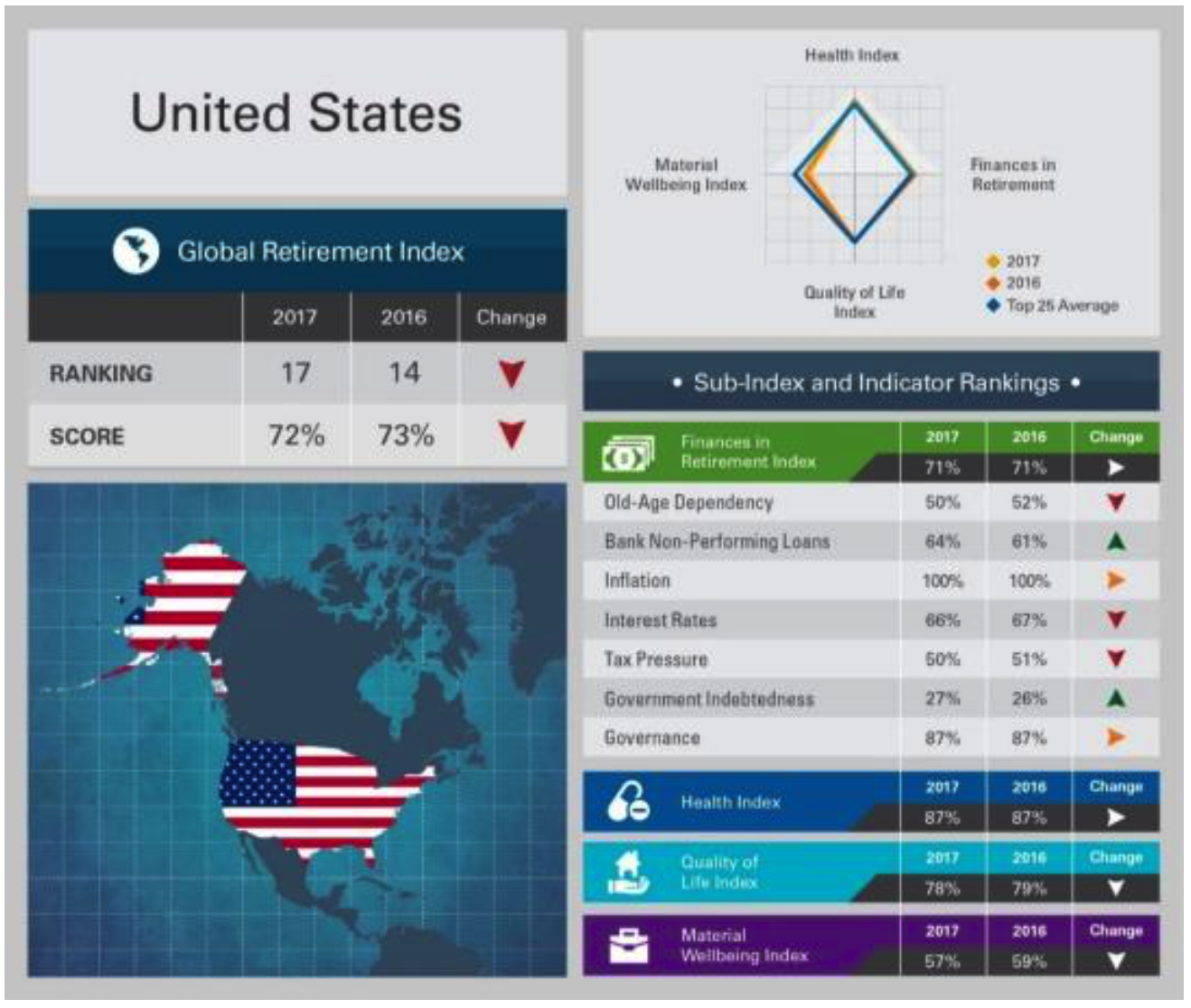
  • Both UK and US drop in Global Retirement Security Rankings

  • US falls due to sharp income inequality and reduced workforce to support retirees

  • UK is two spots away from being in the bottom 10 for government indebtedness

  • FCA"s Andrew Bailey says "clear risk" that savings rate for retirement is too low

  • UK"s retirement savings gap set to widen to £2.3trn due to automation of jobs

  • UK expected to fall into major pensions crisis by 2028

pension crisis


The economics of retirement funding is at breaking point. Thanks to low interest rates, looming inflation rates and slow growth the future of our retired populations are at serious risk.


Currently there are 600 million individuals placing pressure on already-established retirement systems. This is set to get worse as the results of the last decade of financial experimentation show themselves and ageing populations widen the cracks in our economies.


Most pension schemes were formed in a time when manufacturing and traditional bricks and mortar business were the pinnacle of Western economies. This is no longer the case. Globalisation has seen countries switch to service economies. Our financial planning has failed to keep up.


Both the United States and United Kingdom are performing so badly in retirement planning that they have dropped rankings in the Global Retirement Security Rankings.


The global retirement crisis is playing out against a backdrop of a much greater economic crisis. There is slow economic growth across major nations, rising inflation levels and a major debt crisis. No-one really knows how this is going to end.


No stranger to the United Kingdom


Natxis" Global Retirement Security Rankings sees the United Kingdom drop one place from last year. This is mainly due to a fall in it"s health score.


It is its finances sector though which is bringing it down the most and a point of real concern for pensioners of the future.


Natxis explains:


The UK still ranks in the bottom 10 for the Finances sub-index, despite improving in both rank and score from last year. For the second year in a row, it scores 1% in the interest rates indicator and is only two spots away from being in the bottom 10 for government indebtedness.


The U.K. is no stranger to pension crises. In the last five years we have sadly seen what bad planning, mismanagement and lack of government oversight can mean for pension funds. Tata Steel, Woolworths and BHS are just some that come to mind.


A Pensions and Lifetime Savings Association report finds that three million workers with final salary pensions have 50% chance of losing up to fifth of their income because their employers have made unaffordable promises.


The PLSA data finds the most vulnerable employers have a 50:50 chance of not having an insolvency event in the next 30 years:


“More than 11 million people rely on defined benefit pension schemes for some or all of their retirement income but there is a real possibility that without change we will see more high profile company failures such as BHS or Tata Steel."


Former pensions minister Steve Webb told City A.M. that he agrees:


"It"s not enough money. It"s just brutally not enough money going in,"


Just this week FCA Chief Executive Andrew Bailey made a point of the dangers looming for retirees, in his annual Mansion House speech:


“There is a clear risk that the savings rate for retirement is for many people too low to meet their expectations of retirement.”


For future workforces the situation is unlikely to improve. Last month pension consultants Hymans Robertson warned that a third of UK jobs were at high risk of automation by 2030.


The FT reported:


“If one in three jobs are at risk of automation by 2030, as estimated, then this would mean retirement shortfalls increase to £2.3tn, or one year’s current UK economic output.”


Poor State of the United States


The United States" new ranking puts it below the Czech Republic and Belgium. It dropped three places, down to 17th place in a global index of 25 countries.


Index producers, Natixis, explain that "While the country has the fifth- highest income per capita, inequality remains an area of concern given it has the sixth-lowest score for income equality."


US retirement security index


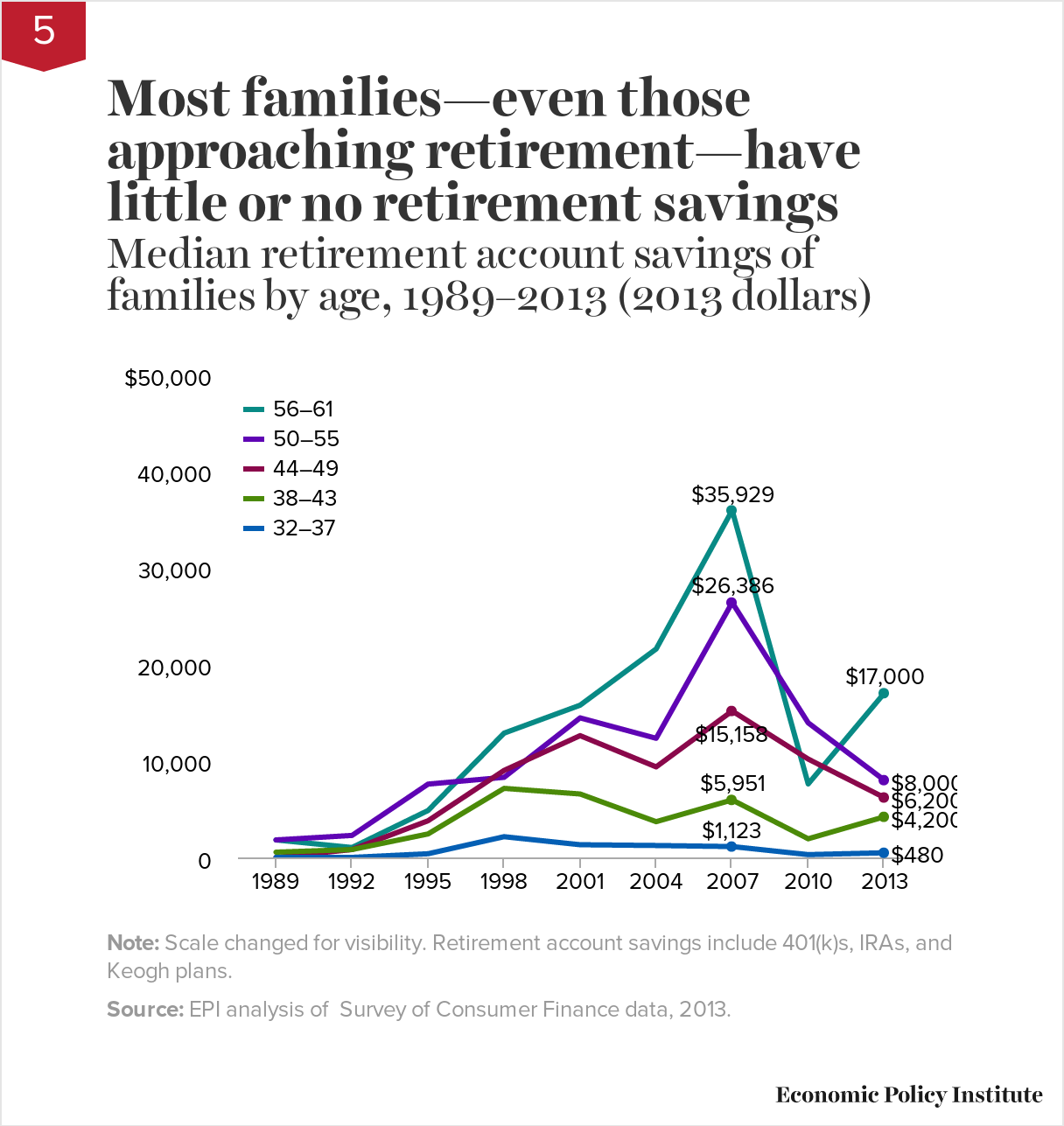
This does not help pension contributions. Research shows that Nearly 40% of U.S. workers are not offered any payroll savings options. Around 30% of American workers have no retirement savings at all.


Families do not have retirement funds


As in the U.K. there are a number of studies that work to estimate the size of impending retirement crisis, each with varying (but all worrying) results.


The most pessimistic is from the National Institute for Retirement Security. The Institute finds that 84% of American households are falling short of acceptable retirement savings targets. They estimate that total household undersaving may reach $14 trillion.


When it comes to government run plans, the shortfall is just as depressing. Andrew Biggs of the American Enterprise explains:


Estimates of total funding shortfalls for government-run plans range from a low of $14.3 trillion to a high of $26.1 trillion. The higher estimates are generated by economists who seek to more accurately measure the benefit liabilities of public sector pensions.


In regard to the U.S. the WEF concluded that the situation was as dire as it was for the U.K. 85% of the retirement savings shortfall is in government plans, with corporate plans making up 2% and households the remaining 13%.


How to solve a problem like retirement


We need leaders to take note of the retirement problem and recognise it for what it is: a looming crisis. Public policy is the only real way over 600 million Westerners are going to be supported in what is currently looking like a dire situation.


Currently governments are adopting a "wait-and-see" approach. See the recent UK pension dramas of Woolworth, Tata Steel and BHS. None of those were a surprise, people must have known they were coming for years. But it took a last minute call to the government to try and solve the problems.


"Luckily" the UK government could just magic up some money to either stump up the pension pots or force those responsible to do the same. The problem is, there is a £1.5 trillion pension shortfall at the moment. This is set to grow, the British government is broke. They cannot keep balling out retirement funds.


Right now companies who cannot afford to pay the pensions they have promised staff will have their pension schemes rescued by the Pension Protection Fund, government service. Those affected may receive up to a fifth lower than what they were originally promised.


In the U.S. politicians have promised deal with this upcoming crisis through a combination of expanded Social Security benefits and new state-sponsored retirement.However, this doesn"t work for political gains.


Andrew Biggs explains:


In government, by contrast, the incentives are in the wrong direction. When government retirement plans are underfunded, politicians can keep current taxes low while handing the bill to future generations. And of course future generations don"t vote in today"s elections. This explains why Congress has done nothing to fix Social Security, despite knowing since the late 1980s that the program needs reforms.


Sadly the "solution" offered by large think tanks and government bodies is that we just need to figure out how to get people working for longer:


“Policymakers do need to be thinking now about how to integrate 75- and even 80-year-olds in the workplace,” Michael Drexler, head of financial and infrastructure systems for the WEF told The Financial Times.


Getting people to work longer is ok in theory but in reality it"s not practical. One just needs to look at the medical bills for the elderly and realise this.


Ultimately, the key is to generate sufficient economic growth to plug the gap. But we come full circle, governments appear to have no plan as to how to make that happen. We need to take responsibility.


Do not rely on employers and the government in retirement


As we recently discussed, the OECD believes the UK"s pension deficit to be far greater than aforementioned UK bodies have assessed.


In May they estimated that the pension shortfall is higher than £6.2 trillion. The OECD expects it to increase by around 4 per cent per year, reaching more than £25 trillion by 2050.


Following a month of political party conferences in the U.K. and a year of Trump"s election pledges, there has been little mention as to how the looming deficit will be managed.


It is vital that savers and investors begin to take responsibility for their own pensions and ask questions. Most importantly one must ask if you can hold gold as part of your pension.


The economy shows that whilst stock and bond markets have done well in the short term and they are artificially overvalued. Once again this is with thanks to the easy monetary policies of central banks and governments.


This is where gold plays a key role.


Dr. Constantin Gurdgiev, formerly an adviser to GoldCore, says the following about the importance of having gold in your pension:


“Gold is a long-term risk management asset, not a speculative one.


As such it should be analysed and treated predominantly in the context of its role as a part of a properly structured, risk-balanced and diversified portfolio spanning the full life-cycle of the investment and pension horizon for individual investors and those with pensions.


Whether they be SIPPs in the UK or IRAs in the USA.”


Investors in the UK and Ireland, the US, the EU can invest in gold bullion in their pension, through self-administered pension funds.


UK investors can invest in gold bullion through their Self-Invested Personal Pensions (SIPPs), Irish investors can invest in gold in  Small Self Administered Schemes (SSAS) and US investors can invest in gold in their Individual Retirement Accounts (IRAs).


The pension crisis is a multi-trillion dollar/pound crisis. It is not going to go away. Adding gold to your pension is a key way to protect your retirement from the pensions time bomb.


Pension funds, throughout the West, have a distinct lack of diversification when it comes to assets. This has cost pension holders a huge amount of money and places their future livelihoods and risk.


Gold has an important role to play over the long term in preserving and growing pension wealth. You can read our guide about how to invest in gold in a pension in the UK here.


News and Commentary


Gold prices steady ahead of U.S. payrolls data (Reuters.com)


Gold settles lower, builds on a weekly loss (MarketWatch.com)


U.S. jobless claims fall; rise in exports helps narrow trade deficit (Reuters.com)


Crypto Coin Sales Get Fresh Regulatory Scrutiny as ECB Weighs In (Bloomberg.com)


US Mint Gold-Coin Sales Drop to Decade Low: Chart (Bloomberg.com)


Source: Gold.org


Gold Investment In Germany Surges To €6.8B In 2016 (Gold.org)


Why Precious Metals Are The Better LONG-TERM Store Of Value Over Bitcoin (GoldSeek.com)


U.S. Treasury increased the public debt by $318 billion (GoldSeek.com)


Europe Could See Another Brexit-Like Rupture—Beyond Spain (Bloomberg.com)


Puerto Rico Is Running Out of Money (Bloomberg.com)


Gold Prices (LBMA AM)


06 Oct: USD 1,268.20, GBP 970.43 & EUR 1,083.93 per ounce
05 Oct: USD 1,278.40, GBP 969.28 & EUR 1,086.51 per ounce
04 Oct: USD 1,275.55, GBP 960.87 & EUR 1,085.11 per ounce
03 Oct: USD 1,270.70, GBP 959.00 & EUR 1,081.87 per ounce
02 Oct: USD 1,273.10, GBP 956.48 & EUR 1,084.55 per ounce
29 Sep: USD 1,286.95, GBP 963.15 & EUR 1,090.82 per ounce


Silver Prices (LBMA)


06 Oct: USD 16.63, GBP 12.73 & EUR 14.20 per ounce
05 Oct: USD 16.66, GBP 12.64 & EUR 14.19 per ounce
04 Oct: USD 16.83, GBP 12.67 & EUR 14.29 per ounce
03 Oct: USD 16.61, GBP 12.53 & EUR 14.13 per ounce
02 Oct: USD 16.58, GBP 12.46 & EUR 14.12 per ounce
29 Sep: USD 16.86, GBP 12.60 & EUR 14.27 per ounce


Recent Market Updates


- Yahoo Hacking Highlights Cyber Risk and Increasing Importance of Physical Gold
- Safe Haven Silver To Outperform Gold In Q4 And In 2018
- Plan For Run On The Pound
- Russia Gold Rush Sees Record Reserves For Putin Era
- China Catalyst To Send Gold Over $10,000 Per Ounce?
- Gold Matches S&P 500 Performance In First 3 Quarters; Up 12% 2017 YTD
- Gold Standard Resulted In “Fewer Catastrophes” – FT
- Financial Advice From Man Who Made $1+ Billion in 1929 – Importance Of Being Patient and “Sitting”
- “Gold prices to reach $1,400 before the end of the year” – GoldCore
- Commodities King Gartman Says Gold Soon Reach $1,400 As Drums of War Grow Louder
- Bitcoin “Is A Bubble” but Gold Is Money Says World’s Biggest Hedge Fund Manager
- Pensions and Debt Time Bomb In UK: £1 Trillion Crisis Looms
- Gold Investment “Compelling” As Fed May “Kill The Business Cycle”
- “This Is Where The Next Financial Crisis Will Come From” – Deutsche Bank


Important Guides


For your perusal, below are our most popular guides in 2017:


Essential Guide To Storing Gold In Switzerland


Essential Guide To Storing Gold In Singapore


Essential Guide to Tax Free Gold Sovereigns (UK)


Please share our research with family, friends and colleagues who you think would benefit from being informed by it.

Friday, September 22, 2017

Complete Preview Of Theresa May's "Florence" Brexit Speech

On Friday - a day many have called  "the most important day for Brexit since the referendum" - Theresa May will delivers her much anticipated Brexit speech in Florence. The roughly 5000-word speech is scheduled at begin around 09:15 EDT and is expected to provoke an immediate response from Brussels.


Among the flurry of last minute preparations, earlier this week, the Telegraph reported that Foreign Secretary Boris Johnson will resign if May veers toward a "Swiss-style" EU arrangement in her speech (more here). Earlier today, BBC Political Editor Laura Kuenssberg reported that May’s Friday speech will say the UK willing to pay €20BN during transition period “BUT only if we have access to single market + some form of customs union.” As RanSquawk added, the €20BN does not cover long term liabilities, so the eventual total departure bill to taxpayers will potentially be far higher.


Taking a step back, here is a bigger picture preview of what is known - and unknown - about tomorrow"s speech courtesy of RanSquawk


What will May Say?


Few specific details are available on what UK Prime Minister Theresa May will cover in her speech, to be delivered from Florence, Italy, on 22 September. However, it is expected that the material will be significant given that the UK delayed the fourth round of Brexit talks (which were set to take place in the week of 25 September). A spokesperson for May has been quoted as saying that the speech would outline the UK"s hopes for a "deep and special partnership" with the EU following Brexit. May was said to have discussed the particulars with her Cabinet on Thursday 21 September. At the time of publication, no firm details have been leaked, although a BBC reporter was told that May will seek a transitional agreement, with a time frame of two years being touted.


"In the wake of slow progress on Brexit negotiations, the United Kingdom may be preparing to adjust its approach," analysts at Stratfor write. "Brexit negotiations have achieved limited progress so far, and the EU side has warned that talks are still far from the "sufficient progress" necessary to move to their second phase, which is meant to address the future bilateral relationship" which the UK was eager to begin in October.


One theory that is gaining traction, therefore, is that the UK will offer some concessions to the EU which will help move the discussions on.


Tensions Within May"s Cabinet


The secrecy surrounding her speech was causing tension in May"s Cabinet. Reports in the Telegraph newspaper suggested that Foreign Secretary Boris Johnson would tender his resignation if May pivoted towards a "Swiss-style" arrangement. The news drove sterling higher, with traders seemingly taking comfort from the idea that some of the more extreme, "hard" voices around May would leave the Cabinet, allowing her to pursue a "softer", more amenable deal.


However, the story was denied and it has been subsequently reported that May made moves to appease Johnson; the Telegraph reported "the Cabinet truce over Britain"s future payments to the EU involves paying substantial sums to the bloc, but no further payments after Britain"s transition period."


The FT later wrote that PM May believes the UK can achieve a "bespoke" final deal with the EU, and May reportedly said neither a Canadian-style nor a Norway-style deal for single market was appropriate for the UK.


Divorce Bill


The Financial Times this week reported that the UK was set to make an "offer to fill a post-Brexit EU budget hole of at least €20bn" in an attempt to settle its so-called "diovrce bill." The FT adds "UK officials have indicated Britain would ensure no member state would have to pay more into the EU budget or receive less money from it until 2020, the end of EU"s current long-term budget planning period. The expected hole in those two years after Brexit would be at least €20bn when payments the UK receives back from Brussels are excluded.


"A figure of €20bn is pretty close to estimates for what the UK"s net contribution to the EU budget would have been under the status quo "Remain" scenario," say analysts at RBC Capital, "however, it is unlikely that monies relating to the current EU budget period will be the end of the financial settlement negotiation between the UK and the EU." Later reports, which followed Ma"s Cabinet meeting, suggested any financial settlement - which May would not directly address in her speech - would be contingent on single market access.


It is unclear how the EU might respond, given earlier demands from some suggesting a figure of as much as €60bln may be needed.


"On the EU side, any response next week which hints progress is sufficient to move towards discussing the future UK-EU trade deal before year end should be supportive of a view that the two-year Article 50 process isn"t too far off-track," RBC says.


Transitional Period


May is also expected to acknowledge the need for a transitional period to avoid a "Brexit cliff", where the UK would continue to abide by EU rules in some areas, while phasing out a withdrawal in other areas. "While the British government seemed to be aiming for a two-year transition, we have been told May prefers a longer hiatus of three years, which would give her enough time to prepare for elections, to be held on their scheduled date, in 2022," analysts at SGH Macro argue.


* * *


Want more? Here is another preview, this time from Barclays?


Media speculation is mounting over the content of UK PM May’s Brexit Speech in Florence tomorrow. This is the first big Brexit-specific speech by the PM following the General Election. It is designed to outline the basis for negotiations at the fourth round of EU-UK negotiations in Brussels next week. Following that, the UK Conservative Party Conference will take place on 1-4 October, where PM May will need to satisfy her own party members with regards to the tone set over Brexit. Hence, the challenge for the PM in her speech will be to appear constructive to her EU partners, so as to advance the negotiation process, while at the same time not angering those within her own party, who may prefer a less accommodative course vis-a-vis the EU in the negotiations.


May is expected to outline three key issues – The transition, the EU withdrawal bill, and the future relationship.


  • Transition – Highlights were provided by Chancellor Hammond last week. He insisted that the UK will leave the Single Market and the Customs Union in March 2019. The UK will seek to maintain the status quo of trade and access. A two-year transition period is seen as most likely to stop cabinet in-fighting.

  • EU Withdrawal bill – PM May is likely to commit to the UK paying what is deemed reasonable during a transition period. Her traditional style has been vague and there is a chance she may continue with this approach, and stop short of stating an actual figure that could leave herself open to attack during the upcoming Tory Party conference. However, press speculation is mounting of a £20bn figure as a starting point for negotiations, conditional upon access to the single market and some form of Customs Union (source: BBC). We expect an eventual figure in the region of £40-50bn may be negotiable. The reaction to this from Brussels and the UK media will be important for PM May going into the Tory Party conference.

  • Future relationship – Hammond gave some colour last week, focusing on financial services, and recognised concerns about the UK potentially deviating from high EU regulatory standards. We expect PM May to reiterate the importance of regulatory homogeneity in the short run. May is likely to try to insist on the need for the UK to negotiate trade deals, even if legally, this cannot begin until the second phase of negotiations.

  • Reaction following the speech: The key to watch here would be the reaction from EU’s chief Brexit negotiator, Michel Barnier, as well as the UK press. The speech lays the foundations for the EU-UK negotiations next week, and EU officials have voiced increasing frustration over delays, bearing in mind that the principles for the first phase of negotiations, covering  guarantees, commitments on citizens rights, are due to be agreed between October to December before it is possible to move on to trade issues in Phase 2.

Monday, September 18, 2017

The Root Of Current Tensions: "They Hold No Loyalty Except To Themselves And To Personal Gain"

Authored by Jeremiah Johnson (nom de plume of a retired Green Beret of the United States Army Special Forces) via SHTFplan.com,


One of the items that is regularly reported on, but quietly…not alarming anyone…is the situation developing in Eastern Europe and the Baltic States. 


At the forefront is Ukraine, as the U.S.-orchestrated coup of 2014 and the subsequent annexation of Crimea by Russia created a line to develop into a Second Cold War.  This is the root of the current tensions where both Russia and the U.S. are continuously posturing against one another.


The root of the matter lies in the undue influence that was secured by Georgy Schwarz (also known as George Soros) with the purchase of John McCain.  An article just surfaced on September 13, 2017 entitled Power Games: What McCain, Soros, and the Clintons Have in Common, by Ekaterina Blinova of Sputnik News.  The article gives a brief history of “The McCain Institute for International Leadership,” a non-profit organization profiting on the campus of Arizona State University.  This non-profit organization has received “minor” donations, such as $1 million from the Saudi Arabian government in 2014.


Financial ties between McCain and Soros have been exposed in the past, and that the two have had a nebulous relationship since 2001.  Interestingly enough, it was McCain who was the leading proponent behind the regime change in Ukraine.  Assisted by Victoria Nuland with Obama and Hillary Clinton acting the part of “Zardoz” floating invisibly in the background, supplying the authority, and with Sen. Lindsey Graham as a lapdog-collaborator, it was McCain who orchestrated the coup above-board.


Beneath the boards was Soros.  The reason Soros funded Maidan (the right-wing ultra-nationalists of Ukraine) and approved of Arseniy Yatsenuk (a globalist scientologist who currently resides in California) was to grab Eastern Ukraine for himself.  Soros planned on dumping $50 million, backed by political control via McCain and the other Munsters, and financially by the IMF…all wrapped up in the NATO Hegemony….and buying himself one third of Ukraine…with all types of natural resources from coal to minerals…for 1/1000th of its actual worth.


Soros’ plan fell apart, because he did not count on the Russians seizing Crimea to secure Sevastopol (their Black Sea Fleet HQ) and access to the Mediterranean.  He also did not count on Ukrainians of Russian national derivation revolting in Eastern Ukraine against the installed puppetry of Yatsenuk (Yoda) that eventually “morphed” into Petro “Willy Wonka” Poroshenko’s Kiev government.  Because of the insurrection in the east, the IMF would not bail Ukraine out of the $9 billion plus owed to Russia to pay Gazprom for natural gas consumption.


Notice the complexion of the game has changed.  Soros now is fostering ties with Russia, in the hopes that he can take those mineral and oil rights from the other direction and take himself off the hook with the Russian government. Par for the course in the manner of Rothschild, bankrolling both Napoleon and the British government and selling short on both sides to pocket from the overall misfortune of the situation.  A situation caused by Rothschild and instigated into a war that gave him profits.  Only the players are different in the comedy being played out today.


Jared Kushner has deep ties to Soros, as does Hillary Clinton.  As mentioned in other articles, read Shadow Party by Poe that outlines the key role Soros played in the rise to power of Hillary Clinton.  The President truly needs to clean Washington out, and remove these politicos that kowtow and bend to the whim of oligarchs.  Only then can foreign policy be set that is in the interests of the United States and not a pack of privateers, oligarchs, and politicians…such as a Pelosi who begins a career making $150 grand and ends up with a net worth of more than $40 million.


There is a part of it all that is even worse than the theft.  Because of these games and the corruption attached to them, these individuals depose governments and throw whole nations into civil war and anarchy for the promulgation of personal power and personal gain.  World wars begin on the whims of madmen and see fruition because those madmen are in positions of authority derived from the citizens, yet with no accountability to the citizens.  They hold no loyalty except to themselves and to personal gain.