Showing posts with label Caucasus. Show all posts

Thursday, January 18, 2018

Richard E. Lugar: Body of Evidence Suggests New US Biological Warfront Opening

55799372c46188cb178b45cd


We know that the Richard E. Lugar Centre in Tbilisi is actually a biological weapons lab. It has always been assumed that the US Department of Defense took over this facility, alongside a string of others in the former Soviet Union, for offensive purpose, and that the “scientific research” into animal and human diseases it claims to be carrying out is merely a front for developing new biological strains, viruses and bacteria, and then testing them on the Georgian population and the agricultural industry, without asking for consent, and even developing new generation vaccines and cures which are often experimental, naturally donated or supported by the US Department of Defence and German medical research facilities.


There is much evidence that these strains are being tested on the population, ironically even pundits got-it-right. More measurable evidence includes the sudden unexplained spikes in various diseases, human and plants, mortality rates. One also needs to mention the great reluctance of medical people in Georgia to talk about such things, other than off the record and in total confidence, not even to be recorded.


Fewer are even willing to discuss the fact that, after millions of dollars have been spent on this “research lab”, because of flawed engineering and substandard safety standards. Ironically it is very difficult, if not impossible, to find a single research paper published in Georgian, and even the clinical studies are done in secret—and without informed consent. Josef Mengele, Nazi doctor, would be impressed with the Georgian project.


This is not all.


The present Georgian government made a great show of taking over this lab as soon as it took office, due to public concern about it, but the US Department of Defense still claims to run it regardless. A number of foreign contract staff at the centre had returned home to die, too many for these to be natural cause, unrelated deaths. If anyone starts asking questions, problems will result, as Ragnar Skre, a Norwegian Journalist found out after attacked at his home by mast men within hours of visiting the lab several years ago.


He thought at the time that robbery was not the purpose and suspected that the attack was connected to him having information on the planned production of biological weapons in Georgia. He had been carrying out journalistic investigation regarding the allegation.


Even if the production of biological weapon does not start in Georgia, the government does not appreciate to expose the information that there is reserve of biological bacteria in the country,” said Skre in an interview with the Georgian Human Rights Centre.


All these things are matters of public record; even VOA tries to provide a smokescreen for its actual purpose, claiming that it is “politics-and-not-science” is why should Russia is concerned.


But recent developments suggest that the lab has other functions, including the links between DNA groups and bio weapons. It is not simply observing the effects of new biological strains by studying them by manipulating them. There is a strong possibility that one of its purposes is to inflict upon Georgia already proven viruses and bacteria, which no one needs to test.


Many in Russia and Arab countries suspect that they are likely the target of such research. Russian Senator Klintsevich claims that “It is no secret that different ethnic groups react to biological weapons in different ways and that is why the West is meticulously collecting material all across Russia.”  


In short, this and other labs, in Kenya, Thailand and Ukraine are not preparing weapons for future use by its favoured terrorists but by stockpiling them for a rainy day: using them itself: conducting its own biological terrorism against its friends rather than its enemies. It is no accident that it partners with the Army Medicine’s US Army Medical Research and Materiel Command in carrying out infectious disease surveillance and research, purportly develop better diagnostics, treatments and vaccines. Naturally all this is in violation of the Bio Weapons Convention, but that is a moot issue when the research is outsourced to Grey Zones as Georgia, under the flimsy guise of human and animal health.


Each State Party to this Convention undertakes never in any circumstances to develop, produce, stockpile or otherwise acquire or retain: Microbial or other biological agents, or toxins whatever their origin or method of production, of types and in quantities that have no justification for prophylactic, protective or other peaceful purposes Weapons, equipment or means of delivery designed to use such agents or toxins for hostile purposes or in armed conflict.


One of the people who ended up in a hospital for investigating what is going on in the Richard E. Lugar Centre is Jeffrey Silverman, who has lived in Georgia for over 25 years, and thought he had seen it all until the nature of this lab became clear. He has contributed some of his thoughts and experience to the book “Putin’s Praetorians”, written by NEO and Veterans Today contributor Phil Butler.


Silverman has brought to our attention a message he received from someone who apparently wrote to him out-of-the-blue. He recognised this message as the action of someone with a story to tell, who may have difficulty making the right people hear it.


Given the contents, this might be surprising in some countries, but not in Georgia.


Killing Hope – “Survival is Insufficient”


The message is from one Per Have. It reads:


“Dear Mr. Silverman,


I am writing to you after having read Putin’s Praetorians, and in particular your chapter.


Being a retired veterinarian specialising in animal virus diseases I am particularly interested in the spread of the devastating virus disease of pigs known as African Swine Fever (ASF). This infection had its origin in warthogs and other indigenous pigs in Sub-Saharan Africa.


ASF was introduced into Portugal and Spain around 1960, but has since been eliminated from the Iberian Peninsula. Quite surprisingly, it then surfaced in Cuba and other Caribbean islands at the beginning of the ’70s, where it proved to be detrimental to pig farming and the livelihood of poor people. It was suspected that it was introduced to cause economic damage by anti-Castro rebels supported by CIA (as mentioned in W, Blum, and “Killing Hope”).


In 2007 ASF appeared in Georgia, and has since spread to Russia, Ukraine, Belarus and most recently several Eastern EU countries. It is currently the greatest threat to pig production in the EU, because it is maintained in the wild boar population, which is expanding in Europe and in which it is practically impossible to control.


It does not stop there, and as in the US, where there is compelling evidence that the CIA released whooping-cough bacteria into the open air in Florida, followed by an extremely sharp increase in the incidence of the disease in the state that year. The following year, another toxic substance was disseminated in the streets and tunnels of New York City (Blum).


Officially, it is assumed (but not proven) that the virus was brought to Georgia via swill unloaded from ships in Black Sea harbours. The [apparent] fingerprints of the virus trace it back to South-East Africa. Having read your accounts on the biological warfare activities in Georgia, the question which comes to mind is whether the introduction of ASF was entirely accidental?


I don’t know the answer to this question, but I have also not seen anyone try to answer it. I wonder if you might have any info which could shed more light on these events.


Silverman responds:


I have read your message, and I think the question is very well worth the effort of asking. I will present it to the so-called experts in the Georgian Ministry of Health and Science, and to the Lugar Lab via the mainstream media in Georgia.


What went on in Cuba, based on your materials is going on in Georgia, such as Task 33, a “Plan for Incapacitation of Sugar Workers,” as part of a pan to develop a plan for incapacitating large sections of the sugar workers by the covert use of BW [biological weapons] or CW agents, and I suspect the loses in the hazelnut industry in Western Georgia is a pilot for what is planned for Turkey next.


There is no coincidence that the US military is involved, and how such attacks are backstopped by the bio warfare experts from Fort Detrick, Maryland. BTW, I too have a background in agriculture, spending much of my youth on a farm, having a BSc and MSc in vocational agriculture, and I even worked on the university swine farm in my student days.


Based on the information I have had access to, material from insiders working in the lab and my own background in bio and chemical weapons, US Army, there is little doubt in my mind that ASF was intentionally released as an experiment to play havoc on the Russian economy. I will be looking into this, and will see what kind of literature review I can come up with, as Georgia is mostly surrounded by Muslim countries, and Turkey may be the next target, and the virus did not affect the wild pigs in Georgia as it did the domestic herds.


DNA Specific Weapons


But how the hell can one prove one version or the other? DNA strain – South East Africa, which could be Mozambique, not well known for its pork production “husbandry” – or for having the facilities to identify or weaponise any virus, and even if it was South Africa, who may well have the facilities and know how, I very much doubt there is the political appetite to get involved in this kind of adventure. Then too there is the theory that various strains of diseases are being designed to deal with Russians and Middle Eastern populations.


I am nearly always drawn to the cock up theory. I know a friend who spent some time looking at a story about strain of mildew that affected heroin harvests in Afghanistan – reducing it by as much as 80 percent. The Soviets had [allegedly] developed it in Abkhazia and at other plant warfare facilities in Georgia after the Soviet invasion.


More recently, it turned out that neither the Brits nor Americans would touch it as it would be biological warfare and set a precedent. If they wouldn’t do it in Afghanistan where there was a kinetic war, partly funded by heroin and the arms trade, then I doubt anyone would do it to get a very minor economic advantage—at least in a world when better minds make the decisions.


Ways out at the front


It will be interesting to see what response, if any, Silverman and Have get to their questions once this information is shared with the Georgian media. What we do know already is that Donald Trump took office stating that he wanted to cut US military commitments, after its people have long supported ever-increasing spending on being the self-appointed policeman of the world.


All Trump has actually done so far is threaten all kinds of wars and make US military action ever more likely, all bark and not bite. But he knows, as do his military brass, that the US war machine is being stretched too thin. Simply in order to maintain its existing influence the US has to find another way to project force. With some of its former allies now looking at other protectors, in tandem or as replacements, the US needs more conflict simply to stand still.


During the Cold War one of the issues frequently talked about was that although both sides had nuclear weapons, the West would have had to use them first, due to the size of the Soviet Bloc’s conventional forces. The West didn’t want to do that, which is why the various disarmament treaties such as SALT were largely a Western initiative. Nuclear arms limitation would bring parity, and thus peace, because it would stop the West from having to resort to such weapons, and this—being in itself a warlike gesture.


We do not live in the Cold War world now, but we are witnessing the rise of China and a gradual loss of US influence which its own behaviour has brought upon itself. US allies are increasingly less willing to sign up to US regime change schemes, such as the Syrian conflict, and then be told by The White House that they need to pay for a greater portion of them themselves. Nor do they appreciate being told who else they can talk to if they are friends of the US, or that they are harbouring terrorists just because the US isn’t arming and paying that particular bunch of terrorists today, though it might next week.


The US is losing the conventional power game. But it still doesn’t want to nuke everyone, merely to threaten to, by putting ever more missiles in ever more bases. So the US needs biological warfare to do what it can’t do in any other way. It can destabilise its enemies, and keep its allies under control, in the biological sphere when it can’t project other types of force.


In effect, this is what Trump said on the campaign trail, as it provides the way he can square the circle of threatening all kinds of countries and still cutting conventional military expenditure, the things people see, like men and tanks. Other countries will also have to pay for a share of a US/NATO biological warfare programme, but how much of it will be on the books?


There are different degrees of classified information, and the secrecy surrounding the work of the Lugar lab and other research facilities in Georgia, which are supposed to be a “scientific institutes”, suggests that whatever goes on there is not being fully accounted for, or properly audited, because it can’t be. Trump’s business career demonstrates that he knows effective ways to save money on paper, whatever the reality.


Pigs do fly


At least the US is consistent. Whenever its actions are called into question anywhere, you can find parallels with previous US actions which give an idea of what is really going on, and even which intelligence training schools the perpetrators went to. For example, regime change has a long history of prior analogies.


Back in 1977 the San Francisco Chronicle reported on its front page that anti-Castro terrorists introduced African Swine Fever into Cuba in 1971, just as Per Have suggests, despite the fact he probably never read this article. As in the more recent case in Georgia, the virus entered Cuba by boat through friendly ports and halted pork production, thereby damaging the Cuban economy.


Those involved in transmitting the virus may not have been aware of what it was, but they were well paid for doing the job, much better than they would have been for ordinary cargo. As in the Georgian case, the US did not admit involvement, and could not have done, as the Nixon White House had banned chemical warfare at this time. But no one else could have developed the virus, introduced it in the matter they did and paid the operatives so well to do it.


Following the international embarrassment of the ironically-named Bay of Pigs fiasco, the US had few offensive options in Cuba in 1971. Military action was off the table, and propaganda wasn’t working with the very people it should have, those who were suffering privation from the Castro regime but were enchanted by the promise of the riches some exiles were making. When all else had failed, the US used pigs to try and ruin the country.


The present Georgian government, though pro-US, is not as compliant as the criminal gang which preceded it. It wants to run more of the show itself, and move away from the dirty deeds of the previous regime. So it needs to be shown who’s boss, without scaring other partners. Sending a deadly virus which ruins the pork industry was as good a way of doing this as the previous Georgian government’s favourite method, which was cutting the domestic electricity at strategic times when the country was actually exporting electrical energy.


A plus B


The US ostensibly moved its biological facilities into Georgia to study new strains of disease which were naturally occurring in livestock, and under control. The real reason however, to take control of the left over stocks of especially dangerous pathogens storied there, under the veil of threat reduction.


This may explain why the Lugar Centre has not produced public research papers – it can’t find naturally occurring bio agents, only ones it put there and researches. But as always, Georgia has been used as the template for the region – what happens there will be rolled out in other friendly regional states sooner or later, if the US sees an advantage in it—and the timing is right.


Testing biological agents on the population through takes time and a willing government that will turn a blind eye. Furthermore, you have to keep at least some of the effects quiet. Poisoning of pigs can be blamed on the virus itself, the transmission can be claimed as a natural accident or the work of hostile powers, and the effects can be broadcast to the skies so everyone goes running to their protectors.


If you were a military man who couldn’t achieve the same objectives by sending troops in, which second option would you choose? It is all about finishing the job and making the World Safe for Democracy, US-styled Democracy.


One only needs to take a look Emily St. John Mandel, and her work of fiction, Station Eleven, where 99 percent of the World’s population has been wiped out within hours and days of spread of the mysterious Georgia Flu, unknowingly brought to the United States via virus-carrying airline, naturally filled passengers from Russia.


Enough similarities abound with the fictitious Georgia Flu/Lugar Bio Weapons Lab and/or “the real-life Ebola virus to challenge the interest of conspiracy theorists. Any level-headed reader will raise an eyebrow and wonder what if … could this?”


Henry Kamens, columnist, expert on Central Asia and Caucasus, exclusively for the online magazine “New Eastern Outlook”.

Friday, November 24, 2017

How Turkey, Iran, Russia, And India Are Playing The New Silk Roads

Authored by Pepe Escobar via The Asia Times,


A pacified Syria is key to the economic integration of Eurasia through energy and transportation connections...


Vladimir Putin, Recep Tayyip Erdogan and Hassan Rouhani will hold a summit this Wednesday in Sochi to discuss Syria. Russia, Turkey and Iran are the three power players at the Astana negotiations – where multiple cease-fires, as hard to implement as they are, at least evolve, slowly but surely, towards the ultimate target – a political settlement.


A stable Syria is crucial to all parties involved in Eurasia integration. As Asia Times reported, China has made it clear that a pacified Syria will eventually become a hub of the New Silk Roads, known as the Belt and Road Initiative (BRI) – building on the previous business bonanza of legions of small traders commuting between Yiwu and the Levant.


Away from intractable war and peace issues, it’s even more enlightening to observe how Turkey, Iran and Russia are playing their overlapping versions of Eurasia economic integration and/or BRI-related business.


Much has to do with the energy/transportation connectivity between railway networks – and, further on the down the road, high-speed rail – and what I have described, since the early 2000s, as Pipelineistan.


map2


The Baku-Tblisi-Ceyhan (BTC) pipeline, a deal brokered in person in Baku by the late Dr Zbigniew “Grand Chessboard” Brzezinski, was a major energy/geopolitical coup by the Clinton administration, laying out an umbilical steel cord between Azerbaijan, Georgia and Turkey.


Now comes the Baku-Tblisi-Kars (BTK) railway – inaugurated with great fanfare by Erdogan alongside Azerbaijani President Ilham Aliyev and Georgian Prime Minister Giorgi Kvirikashvili, but also crucially Kazakh Prime Minister Bakhytzhan Sagintayev and Uzbek Prime Minister Abdulla Aripov. After all, this is about the integration of the Caucasus with Central Asia.


Erdogan actually went further: BTK is “an important chain in the New Silk Road, which aims to connect Asia, Africa, and Europe.” The new transportation corridor is configured as an important Eurasian hub linking not only the Caucasus with Central Asia but also, in the Big Picture, the EU with Western China.


BTK is just the beginning, considering the long-term strategy of Chinese-built high-speed rail from Xinjiang across Central Asia all the way to Iran, Turkey, and of course, the dream destination: the EU. Erdogan can clearly see how Turkey is strategically positioned to profit from it.


map1


Of course, BTK is not a panacea. Other connectivity points between Iran and Turkey will spring up, and other key BRI interconnectors will pick up speed in the next few years, such as the Eurasian Land Bridge across the revamped Trans-Siberian and an icy version of the Maritime Silk Road: the Northern Sea Route across the Arctic.


What’s particularly interesting in the BTK case is the Pipelineistan interconnection with the Trans-Anatolian Gas Pipeline (TANAP), bringing natural gas from the massive Azeri gas field Shah Deniz-2 to Turkey and eventually the EU.


Turkish analyst Cemil Ertem stresses, “just like TANAP, the BTK Railway not only connects three countries, but also is one of the main trade and transport routes in Asia and Europe, and particularly Kazakhstan and Turkmenistan ports. It connects Central Asia to Turkey with the Marmaray project in Istanbul and via the Caspian region. Along with the Southern Gas Corridor, which constitutes TANAP’s backbone, it will also connect ports on the South China Sea to Europe via Turkey.”


It’s no wonder BTK has been met with ecstatic reception across Turkey – or, should we say, what used to be known as Asia Minor. It does spell out, graphically, Ankara’s pivoting to the East (as in increasing trade with China) as well as a new step in the extremely complex strategic interdependence between Ankara and Moscow; the Central Asian “stans”, after all, fall into Russia’s historical sphere of influence.


Add to it the (pending) Russian sale of the S-400 missile defense system to Ankara, and the Russian and Chinese interest in having Turkey as a full member of the Shanghai Cooperation Organization (SCO).


From IPI to IP and then II


Now compare the BTK coup with one of Pipelineistan’s trademark cliff-hanging soap operas; the IPI (Iran-Pakistan-India), previously dubbed “the peace pipeline”.


IPI originally was supposed to link southeastern Iran with northern India across Balochistan, via the Pakistani port of Gwadar (now a key hub of the China-Pakistan Economic Corridor, CPEC). The Bush and Obama administrations did everything to prevent IPI from ever being built, betting instead on the rival TAPI (Turkmenistan-Afghanistan-Pakistan-India) – which would actually traverse a war zone east of Herat, Afghanistan.


TAPI might eventually be built – even with the Taliban being denied their cut (that was exactly the contention 20 years ago with the first Clinton administration: transit rights). Lately, Russia stepped up its game, with Gazprom seducing India into becoming a partner in TAPI’s construction.


But then came the recent announcement by Russian Energy Minister Aleksandr Novak: Moscow and Tehran will sign a memorandum of understanding to build a 1,200km gas pipeline from Iran to India; call it II. And Gazprom, in parallel, will invest in unexplored Iranian gas fields along the route.


Apart from the fact of a major win for Gazprom – expanding its reach towards South Asia – the clincher is the project won’t be the original IPI (actually IP), where Iran already built the stretch up to the border and offered help for Islamabad to build its own stretch; a move that would be plagued by US sanctions. The Gazprom project will be an underwater pipeline from the Persian Gulf to the Indian Ocean.


From New Delhi’s point of view, this is the ultimate win-win. TAPI remains a nightmarish proposition, and India needs all the gas it can get, fast. Assuming the new Trump administration “Indo-Pacific” rhetoric holds, New Delhi is confident it won’t be slapped with sanctions because it’s doing business with both Iran and Russia.


And then there was another key development coming out of Putin’s recent visit to Tehran: the idea – straight out of BRI – of building a rail link between St. Petersburg (on the Baltic) and Chabahar port close to the Persian Gulf. Chabahar happens to be the key hub of India’s answer to BRI: a maritime trade link to Afghanistan and Central Asia bypassing Pakistan, and connected to the North-South Transport Corridor (INSTC), of which Iran, India and Russia are key members alongside Caucasus and Central Asian nations.


You don’t need a weatherman to see which way the wind blows across Eurasia; integration, all the way.


Thursday, November 2, 2017

Armenia’s Energy: Benefits of Cooperation with the EU

45234234234


In November 2017, the Republic of Armenia (RA) plans to sign an important treaty with the European Union. The document is known as the “Comprehensive and Enhanced Partnership Agreement” (CEPA). In the view of its supporters, the expansion of cooperation with the EU as a result of the CEPA implementation should benefit the Armenian economy. However, the conditions put forward by the European party make people doubt the benefits of the agreement for the Republic of Armenia.


One of the important requirements of the EU, which Armenia must fulfill in accordance with the CEPA, is the closure of the Armenian nuclear power plant.


The Armenian (Metsamor) NPP is located near Metsamor in the Ararat Valley, 28 km from Yerevan. More than 100 Soviet enterprises and organizations, most of which belonged to the RSFSR, took part in the construction of the station and the manufacture of necessary equipment, and after the collapse of the USSR, it was taken over by the Russian state corporation “Rosatom.”


The first power unit of the Armenian nuclear power plant was launched in 1976, and the second unit was put into operation in 1980. The project of the station was developed taking into account the seismic activity of the Armenian highland. The increased strength of the buildings, the monolithic slab in the basement and the hydro-depreciation system made it possible to prevent an accident during the devastating Spitak earthquake of December 1988. The earthquake claimed tens of thousands of lives and caused tremendous damage to the Armenian infrastructure and industry, but there was no radiological catastrophe. Moreover, the Armenian NPP remained fully operational.


However, in fear of new ground tremors, the Soviet leadership decided not to take the risk, and in early 1989, the operations of both units of the nuclear power plant were ceased. The Armenian SSR then shifted to using hydrocarbon fuel as its main energy source. Armenia does not have its own larger or smaller oil and gas fields. Therefore, hydrocarbons were supplied by rail and gas pipelines from the Azerbaijan SSR, the Turkmen SSR and the RSFSR. After the dissolution of the USSR and the beginning of the Armenian-Azerbaijani conflict in Nagorny Karabakh, the shipments by Azerbaijan were stopped. The transit of Russian energy carriers through the territory of Georgia also became impossible due to the military activities in Abkhazia and Ossetia. Turkey, which supported Azerbaijan in the Karabakh conflict, blocked all communication through the Turkish-Armenian border. Armenia thus found itself blockaded.


After that, the energy crisis of 1992-1995 broke out in Armenia, which became a difficult page in Armenian history. The relaunch of the Armenian Nuclear Power Plant helped overcome it. In 1993, the Government of Armenia decided to begin rehabilitation work on the second power unit of the station. The first unit was then already partially dismantled and was not fit for restoration. In November 1995, Power Unit No. 2 of the Armenian Nuclear Power Plant was put back into operation again.


At present, the station generates up to 40% of all the electricity consumed in the RA. Despite the successful operation of two Armenian thermal power plants and several dozen hydropower stations, as well as energy exchange with Iran, it remains a strategically important target for Armenian energy security. Therefore, for many, the demand of the European Union to close the Armenian nuclear power plant is puzzling: do the expansion of cooperation with the EU and the possibility of the introduction of a visa-free regime cost 40% of electricity?


It should be noted that the EU has long been pushing for the closure of the Armenian Nuclear Power Plant. This issue has been raised periodically in the negotiations between Brussels and Yerevan since the early 2000s. Also, Azerbaijan and Turkey have for many years been demanding that the station operations be discontinued. However, these two countries have been engaged in a long-standing conflict with Armenia, and there is nothing surprising about their desire to try and weaken it. Nevertheless, the motives of the EU leadership are not yet very clear.


Usually, the supporters of the station closure are explaining their position in terms of security considerations. Thus, on 26 April 2017, the day of the 31st anniversary of the Chernobyl nuclear disaster, the Ministry of Foreign Affairs of Azerbaijan once again called upon the international community to turn its attention to the Armenian Nuclear Power Plant. It was stated that the station was built based on the same technologies as the Chernobyl Nuclear Power Plant, that it is located in a seismically hazardous zone, and that no major repairs have ever been carried out on it in all its years of existence, as the RA does not have the means to fully maintain its nuclear power plant. According to the representatives of the Azerbaijani Ministry of Foreign Affairs, the Armenian NPP poses a threat to the lives of millions of people in the region of the Caspian, Black and Mediterranean seas.


Most of these statements are untrue. First, the Armenian NPP does not have much in common with the Chernobyl NPP. As mentioned above, the plant was designed taking into account the increased seismicity of the construction area. At the Armenian NPP, VVER-440 reactors were installed that are much more stable than the RBMK reactors operating at Chernobyl. Secondly, the operation of the station is constantly supervised by the International Atomic Energy Agency (IAEA), which has repeatedly confirmed its security. Other international organizations are also in agreement with the IAEA.


For example, in August-September 2017, The World Association of NPP Operators audited the operation of the Armenian NPP. A panel of experts from eight countries assessed the plant performance in terms of international safety standards. Following this assessment, some of them stated that the level of safety of the Armenian NPP is higher than that of most European nuclear power plants.


The European Union also recently had the opportunity to verify the plant’s security: in the summer of 2016, a group of experts from the European Nuclear Safety Regulators Group and representatives of the European Commission conducted an expert assessment of the report on the “stress test” at the Armenian NPP. It should be recalled that, after the accident at the Japanese station “Fukushima-1” in 2011, it was decided that all European nuclear power plants were to undergo a “stress test,” during which reactors were supposed to operate under conditions close to the conditions of the Fukushima accident. A number of non-EU countries, including Armenia, also voluntarily decided to conduct such tests.


With regard to the maintenance of the Armenian NPP, to which, according to the Azerbaijani MFA, the RA does not have any funds allocated, it should be recalled that, since the relaunching of the station in 1995, Russian specialists from Rosatom have been carrying out the planned repairs. Rosatom is currently in the process of extending the operating life of Power Unit No. 2 of the Armenian NPP in accordance with the agreement that the Russian Federation and Armenia concluded in 2014. In May 2017, the RA Ministry of Energy stated that two thirds of these works had been completed. The Russian party took over the financing of the modernization of the nuclear power plant by allocating Armenia a credit of USD 270 million and a grant of USD 30 million.


Thus, the statements coming from Azerbaijan about the threat posed by the Armenian NPP to the whole region appear groundless. Many experts believe that the large-scale company deployed by Azerbaijan and Turkey against the atomic energy of the Republic of Armenia only has the goal of weakening its old enemy, inflicting it with maximum damage by any means. There is even a perception that the closure of the nuclear power plant is necessary for Azerbaijan in connection with its military plans.


It should be recalled that in April 2016, after more than 20 years of armistice, some fighting broke out between the armed forces of the RA and the unrecognized Nagorno-Karabakh Republic on the one hand and the Azerbaijan troops on the other. The fighting was soon halted, but after that, some high-ranking Azerbaijani officials began threatening Armenia with a missile attack. One of the reasons why these threats are not yet feasible is the state of the Armenian NPP. Local weather conditions are such that in the event of Azerbaijani missiles hitting a station loaded with nuclear fuel, the wind would carry the resulting radioactive cloud back to Azerbaijani territory. Thus, the NPP is not only an important source of energy for Armenia, but also a defense barrier against military blackmail.


If the behavior of Azerbaijan and its ally Turkey seems understandable, the reason for their support by the European Union is unclear. The EU is not offering Armenia any specific substitution for its nuclear energy. There are only unclear promises of investment in renewable energy sources. Given the precarious financial situation of the EU, its promises should not be relied upon. The RA itself does not have the means to change its energy in a revolutionary manner. It is argued that once it accepts the EU conditions and signs the СЕРА, the country will immediately undergo a new energy crisis or become energy dependent on the countries that would agree to supply Armenia with hydrocarbons. If it were Azerbaijan, the Nagorno-Karabakh Republic could forget its independence. Perhaps Brussels, which is now concerned about the integrity of the EU after Brexit and the events in Catalonia, would welcome such a result.


However, the Armenian Nuclear Power Plant is clearly not scheduled to close in the near future. As mentioned above, Rosatom is now working to extend its term of service to 2026. The possibility of building a new unit equipped with a more modern and safe Russian VVER-1000 reactor is still being discussed. In October 2017, the Russian company TVEL (a subsidiary of Rosatom specializing in the production of nuclear fuel) and the management of the Armenian NPP signed a new major contract for the fuel supply.


At the end of October 2017, there was held a regular meeting of the Security Council for Nuclear Energy under the President of Armenia, at which Armenian leader Serzh Sargsyan stated that the preservation and development of nuclear energy remains a strategic direction for the country.


All this clearly contradicts the conditions of the СЕРА. The EU may have to reconsider its requirements if it wants the treaty to be signed.


Dmitry Bokarev, political observer, exclusively for the online magazine “New Eastern Outlook.


Monday, October 23, 2017

Rigging Elections in Georgia, Russia and the United States?

5453


Whenever national-level elections take place in any country, other countries have an interest in the outcome. Major powers want to make sure smaller ones continue to toe-the-line, or are ripe for conversion to their side of the argument. Smaller countries want to remain, or become, first in the queue when new aid or partnership arrangements are discussed. So every country tries to influence elections, in the same way they try and influence governments when they are in power.


Sometimes this attempt to influence takes absurd forms. At the 2008 US Presidential election Mikheil Saakashvili and his cronies in Georgia were openly canvassing for John McCain, and putting McCain bumper stickers on their cars. Very few Georgian citizens are able to vote in US elections, and those who can are not likely to be swayed by the antics of some other country’s president. Then when McCain lost, Saakashvili said how much Barack Obama had supported Georgia and spent three months running round the US trying to force him to meet him, while Obama’s agents tracked his movements and shepherded their boss out of any place Saakashvili turned up.


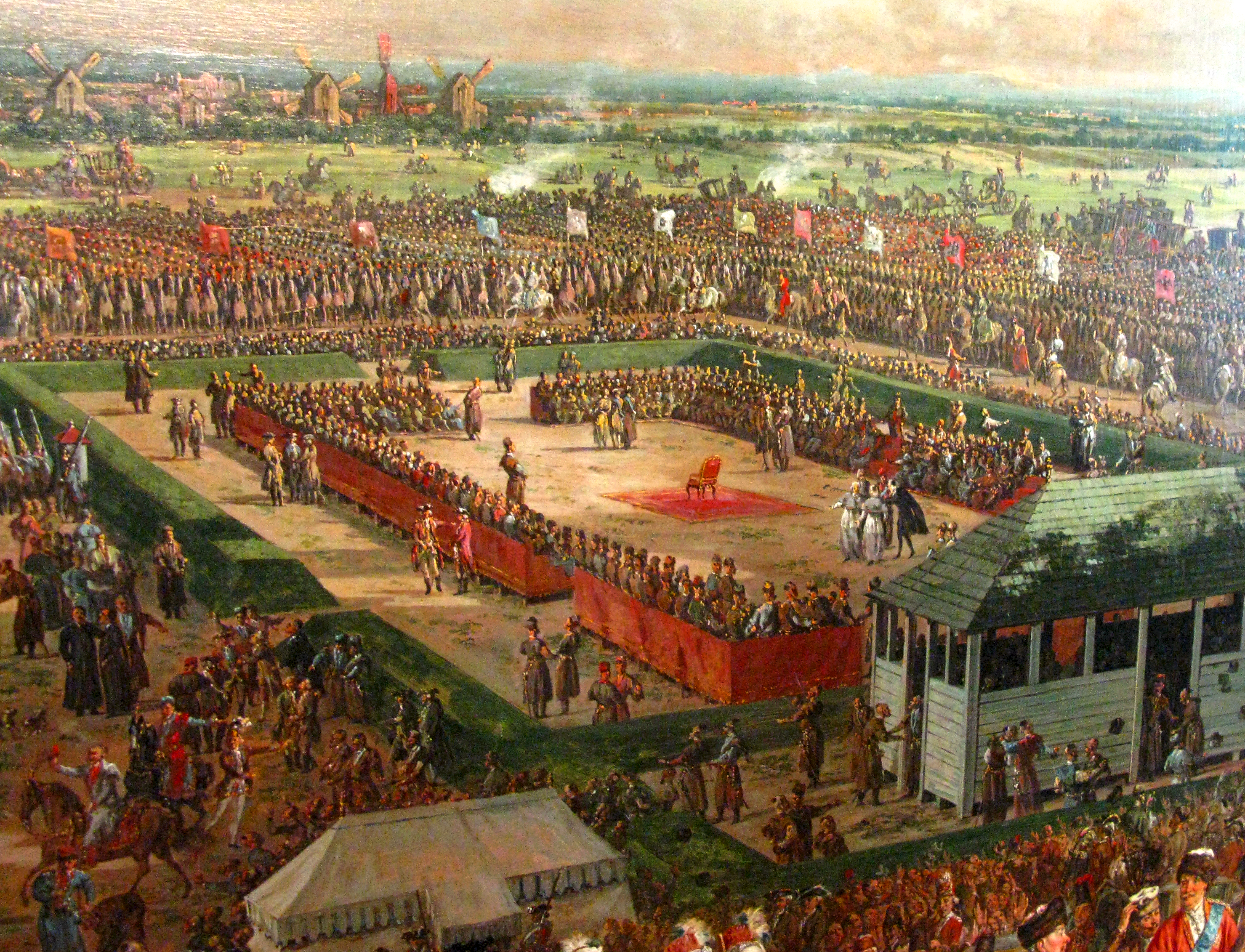
But for over two centuries it was Russia, not Georgia, which was thought to be the world leader in vote rigging. The classic example of a country influencing another’s election was held to be the Russian army surrounding the Polish nobles who were electing their new king in 1764. Though the Russians didn’t actually surround the field as depicted, this behaviour resulted in an association being made in the public mind between “Russia” and “rigged elections”. The long years of Russian domination of Eastern Europe under the Soviet system only magnified this perception.


So perhaps it is surprising that the Russia-hating West is only now accusing The Kremlin of rigging a Western election, despite the hundreds we have seen in Western Europe since then. As a result of the allegations against Donald Trump, and the widespread desire to pin anything on him which might remove him from office, the hand of Russia is now being seen everywhere: for example, links have been alleged between The Kremlin and Robert Mercer’s Cambridge Analytica, which has targeted articles in this journal, even though Mercer’s politics are far removed from Putin’s.


But is rigging elections a uniquely Russian phenomenon? Is it even a largely Russian trait? If you want to know about rigged elections, you need to ask those who know. You won’t have any difficulty understanding the answer because these experts speak English, after a fashion. What Russia did in 1764 has been developed into such a sophisticated weapon by its enemies that it is like comparing a bicycle with a motor car.


Blank cheques for marked ballots


When Watergate was being investigated one of the key figures in the scandal was the lawyer Don Segretti, who had run the dirty tricks campaign undertaken by Nixon’s Committee to Re-Elect the President. Amongst other things, Segretti had produced faked letters on stolen notepaper which smeared every serious Democratic candidate and caused each one to drop out, one by one. Segretti himself regarded this behaviour as inconsequential, compared with what he had been doing in college whilst studying for a career serving justice.


In consequence Nixon ran against George McGovern, the opponent he had wanted all along, who could be presented as a wild, anti-American radical out of touch with “decent” people. Nixon won by a landslide, and only when the actions of people like Segretti become known was he forced to resign.


Segretti was sent to prison. But apparently he is still seen as a good man to have around, even today. He lives in Orange County, California, and as recently as 2000 was the co-chair of the presidential campaign of – you guessed it – John McCain.


Five years before he had stood for election as a judge in the county, and had to withdraw when he realised people had still not forgiven him for Watergate. That didn’t stop McCain believing him to be a suitable person to help his own ambitions, aided by a strange silence from the Senate’s Ethics Committee.


The US and its compliant allies don’t rig elections by sending the army to surround the polling stations. They send the army in if the results are not to the White House’s liking, as in Ukraine, Iran and many other places.


But there are many ways to skin a cat. The Western world is able to identify alleged election rigging because most of the examples it has seen are not Soviet, the sort of thing you would expect in a dictatorship you don’t agree with, but American, and therefore attract greater suspicion and comment.


Bend it, break it


A common rigging tactic is limiting choice. In any “reconstruction”, it is the “liberators” who decide which parties are allowed to stand for election. Those they deem unacceptable are treated as anti-state forces which should not exist. Yet nevertheless the world is told that the options available represent the entire political spectrum, and thus the government is a product of democratic choice.


Uganda is one place where this has happened again and again. The old president is removed, and then his supporters are declared enemies and either excluded from participating in elections or massacred. When that still doesn’t work, other methods are used.


The 1980 elections were held after the overthrow of the notorious Idi Amin, who had alienated all Western nations. The West wanted his predecessor Milton Obote to return, rather than the once-dominant Baganda people, represented by the Democratic Party, being allowed to run the country. Though the Democratic Party got fractionally more votes than Obote’s UPC it won 25 fewer seats because many UPC candidates were elected unopposed. Strangely enough, they had stood in Baganda areas known to be Democratic Party strongholds.


But often restricting choice has the opposite effect. You end up with a bunch of people all as bad as each other, because no one has ever had to respond to public opinion. In such cases, the opposite is done: a new saviour is parachuted in from nowhere as the favoured son of the Western sponsors who provide the only way out of the mess the politicians are alleged to have made, though it was those who restricted public choice who actually created this problem.


Spinning Yeltsin


Russians remember who gave them Yeltin, and how they did it. There was even a movie made about it. Even today the media is speaking of how highly paid and catered US advisors used polling company methods, focus groups, negative campaigning and rigging polls to ensure that Yeltsin won that election. This was followed by the wholesale looting of Russia under the guise of market economics, conducted by hired gun economic advisors, often funded by USAID and the World Bank. So this practice isn’t going to end anytime soon, if ever.


Writing the book again


In this field as in any other, if you want to see what the US wants to do anywhere given the chance you look at what is happening in Georgia. Georgians are used to both these methods being used. After the overthrow of the first democratically elected Georgian president Zviad Gamsakhurdia, with Western help, all the parties which supported him boycotted subsequent elections.


When the West got tired of its poster boy Shevardnadze it promoted Saakashvili to replace him, and after him Bidzina Ivanishvili, who was only necessary because no opposition politician in situ had any credibility. In all three cases, the public was left in no doubt what the West wanted and would get. Elections were meaningless, because the people would have to kick their Western sponsors out to change anything, and no one knows how to do it.


Jeffrey Silverman, Veterans Today Bureau Chief in Georgia, has seen it all. This is what he had to say about the forthcoming Georgian elections in a recent interview with the Georgian media:


“Whoever has the most money and government support will win, and that is already decided. Like it was before, with the UNM, the Georgian Dream has all the material resources it needs because it is the majority party. The margin of victory will not be large, but just enough for the winning party to claim “free and fair” elections.


“Georgian politics are really much more complicated than that, but much of the problem as to why “multi-party democracy” does not work in Georgia derives from who controls the media and the people’s level of education. Real issues are not being discussed, and elections are more a beauty contest about who has the best looking family and most impressive dog. Debate is non-existent or superficial at best.


“The US government gave too much money and trust to so-called “democratic organisations”, and then put “all its eggs in one basket” after the 2003 Rose Revolution, which was more a staged performance than anything close to a revolution. That is where most of the problem started with elections. For all practical purposes, Georgia still has a single party system. They can pretend to be different but they are all the same trash, “იგივე ნაგავი“– and that is the civilised translation.


Khurcha Incident


“I have seen with my own eyes how election fraud is carried out, as I was once an election monitor in Zugdidi with the Human Rights Centre in May 2008 and also was involved in investigating the Khurcha Incident together with the Georgian Human Rights Centre Norwegian Helsinki Committee. This investigation was the basis for the UN conclusion which confirmed that the attack was planned.


“The US and UNM worked hand in hand to provide a distraction from their stealing of the election back in 2008, and could have started a war over Abkhazia in the process. Let’s not forget what happened, and how the Potomac Institute, a Washington-based think tank, was involved in rigging elections in Georgia. I have written several reports and articles on this topic, and personally know many details which would seriously impact Georgia’s attitude towards the United States if totally made public.


“Democratic elections have never been a priority of the United States. It puts its own National Security Interests first, which is why it was so willing to support and turn a blind eye to election fraud and human rights violations. Just look at its track record in South America for starters, and they is no question as why they so hate the US government.


“Once the UNM got into power it cut back on funding independent NGOs and put money into government pockets. Much of the money stolen from various US-sponsored programmes was used as payoff for election fraud. That practice goes back to the period of Shevardnadze and the Citizens Union: even food aid, delivered under the American “Food for Peace Program” and other mechanisms of assistance to IDPs, was distributed during election rallies as part of the US government efforts to influence elections.


Care International and UMCOR were two of the NGOs much involved in such schemes. I worked with another part of the US government, providing information, about such schemes, Office of Inspector General, OIG. They were able to investigate such manipulations, and found that many of these were organised by the US State Department and the CIA. However, nothing could be done but to move but were not able to do anything about it.


Free from political bias


Keep in mind; he adds that, “Assistance to Georgia is supposed to be free from political bias, at least in theory. But in practice a Georgian NGO could lose its funding if it started asking questions about the government in office. Having purchased the government it wanted, the UNM, the US was not going to have the Georgian people complaining about its choice. USAID, the United States Agency for International Development, is especially guilty of providing the means to meddle in the democratic process, but it is only one organisation at the top of a long list: for example, the NDI, National Democratic Institute, and the National Endowment for Democracy, NED, are simply fronts for manipulating and changing governments.


“One only has to compare the reports published by NDI with those of the OSCE and local NGOs, like the Human Rights Centre, to get a full picture of how far the US government is willing to lie about election processes and try and whitewash massive corruption. If you also look at the media coverage, especially in the English language press, you get a full picture of how the US supported the UNM over other parties, and either ignored or under-reported intimidation of opposition parties and voters, faked election lists, people voting at different polling stations on the same day, and how the electoral commissions were packed with people close to the ruling party”.


Pattern perception


Hillary Clinton has emerged from hiding to make a series of statements about how and why she lost the presidential election to Trump. She has even begun to admit she might have made mistakes in that campaign.


But no matter what Clinton apologises for, she will never admit that one of the reasons for her defeat was that her own supporters had seen how she won the nomination. Long before it was mathematically certain, the press insisted she would be the candidate, and she had only got to that position by excluding registered voters in various states who supported Bernie Sanders. This may be OK in Third World countries the US sponsors, but not the US itself. However obnoxious Trump was to many, Hillary’s vote rigging made her the devil they knew only too well.


Why did she think she could get away with it? Because the US has made rigging votes in other countries a standard official practice. Getting the result which suits the US is more important than how it is done. As a political insider and former Secretary of State, Clinton would know the fine details of such schemes as well as anyone.


Duck Test


Next time you hear people talking about mysterious Russians rigging elections, ask how they know. The rest of the world can only identify vote rigging because they have seen it so often in the Western-backed countries they are more familiar with – and as Americans say, if it walks like a duck, and it talks like a duck, then it probably is a duck.


Americans wrote the play book as how to rig elections.


Seth Ferris, investigative journalist and political scientist, expert on Middle Eastern affairs, exclusively for the online magazine “New Eastern Outlook”.

Sunday, October 8, 2017

Tricks and Trades of the Matrix – Western Private Education in Georgia “not-as-billed”

4523213123There is no such thing as a neutral education system. It either teaches people to buy into the existing status quo and support it, or gives them problem-solving skills in order for them to change it. This is why foreign governments are often glad that their actions in countries they are trying to influence are controversial. The more people complain about the political positions the invaders adopt, and who they encourage at the expense of whom, the less attention is paid to their third column, education.


Where embassies and aid agencies lead, schools and educational reform inevitably follow. But no one wants to notice this, because the potential rewards of exploiting the system – finding the one little door in the Matrix – are so great that people will put up with almost anything in the name of advancement, even the progressive destruction of future generations.


What are the benefits of such reforms? Do they do more to help or harm a country in transition?


People tend to view the same things differently in various parts the world. Citizens of monarchies understand the principles of monarchy, citizens of republics would generally never dream of going back to such a system. This is largely due to differences in education: what seemed natural in previous generations, for example the conquest of “primitive” peoples overseas for their own good, now seems unusual because changes in education have led people to that view, without them having to examine the issue too closely.


Political policy,and the way aid is distributed, tell us a lot about the real attitude, rather than the professed one, more important countries have towards a less important one. But bigger countries also use another lever of influence, which is less remarked on because nobody wants to believe it is being used as a lever.


The usual culprit


Take, for example, the Republic of Georgia, which is generally ignored when education policy is being discussed. Georgia is a US ally, so everyone argues about what the US does there, whom it supports and what relation there is between its principles and what it actually does. But those who object to things like aid money being diverted to fund political corruption still want a US-based education for their children, because it will help them go to places controlled by the same US.


Georgia has little to offer its financially advantaged citizens in terms of education. To quote a former student, Anna Simonishvili, “Georgian Schools are not providing the knowledge and skills necessary for students to be successful in their academic and professional lives. The level of education is really not even enough to be able to pass school and national exams and enter top universities in Georgia.”


But despite this, there is still more help available for institutions which provide a Western education than a Georgian one. International exchange programmes are massively oversubscribed, and few of the resources poured into the country are used for developing native Georgian education to a decent level. Even those who queue up to bash the US are left with no choice but to support the US-model of education in Georgia, designed to knock this view out of them, because only this can make them rich and important enough to provide them with a platform from which to do anything about the erstwhile invaders.


Hence there is a lucrative marketfor private schools offering an education that will get children out of Georgia into other US client states, and will actually teach them something worthwhile now that Georgian public education has been diminished to bring this market into being. Few can afford this education, but that only makes it more prestigious. No one dares question what is taught, or why, or what avenues are open to those with such an education, as that might make this option go away too, and leave average Georgians with nothing.


New school, old tricks


Consider the New School and American High School in Tbilisi, once touted as the obvious places to educate ambitious young Georgians. These are among many schools to have disappointed a succession of parents and students. As in other cases, this did not have to be so. They have willfully disappointed their clients because if they had done their jobs properly Georgians would be equal citizens of the world, exactly what the foreign sponsors of this education dare not contemplate.


The New School is a small school, with perhaps 30 foreign teachers and about twice as many Georgian staff. It openly caters to those who want to obtain a school leaving certificate which gets out of Georgia, regardless of what it takes to achieve that.Therefore it treats them as a captive audience.


At the New School and other, the American Way, often under the guise of an European/International education, is the only way. If you don’t agree, you have no future. If you do, you will do anything the school asks you to. You don’t need to twist the arms of politicians or aid recipients when you have persuaded them to think that they never had arms to begin with.


The New School is advertised as an “International Baccalaureate (IB) programme, with unique academic rigor and emphasis on students’ personal development”, but does not feel the need to conform to most IB regulations. It simply puts up the facade of being a true IB school to make more money. But all this is a test. If you put up with it, you will start to accept what you are told, for the benefits you might obtain. Inevitably, this means you learn to see things as Americans do, since America is the source of the curriculum. But what advantage does this actually provide?


Nowadays, almost as many Georgians live outside the country than within it. How many prominent Georgians living in other countries can you name? The few you can name have generally had their careers in sport and the arts, where educational qualifications are not a priority.


Few can actually get a good job in the West just by thinking like an American, because they are still Georgians. The American matrix, as adopted by the IB schools, makes Georgians ever dependent, forever needing Uncle Sam to show them how to do the things they once did on their own when allowed – which is why they were first targeted for indoctrination.


The worse the reality, the better the dream


Parents claim to have been tricked into going to private high schools by glossy pamphlets and slick speeches by public relations marketers – manipulative people with questionable integrity, much like Georgian government spin doctors such as Patrick Worms, an avid reader of Seth Ferris articles. They have complained that their children can’t even write, and that the maths programme has become a disaster over time.


Georgian teachers are paid lower wages for the same job in order to encourage students to emulate foreigners, not them. Plagiarism and cheating are rampant, but treated as part of the collective cultural mindset, so that these practices can be used against Georgians in future. In fact students are encouraged to get away with anything in order to criminalise the whole country through its best and brightest representatives, as if “lower level” Georgians must be inherently even worse.


The New School seeks to award the DP diploma by any means necessary, regardless of the merit of the student. This is one of the main reasons it retains its status, despite competition from other schools. As with Pakistani engineering qualifications, the diploma is worthless in itself. It merely shows that you come from a certain class, know the right people and are happy with corruption provided you yourself can gain an advantage from it..


If you look at the successive pro-Western political leaders installed in Georgia, each one has been distinguished by exactly these characteristics in the eyes of the Georgian public. Most Georgian politicians are not wealthy when they enter parliament, but acquire mysterious wealth with “MP” after their name. So the system works, and is seen by its clients to work. No matter how much people rail about US policy, they won’t ultimately bite the hand that feeds them, particularly when no other hand can feed them as a result of the same educational policy.


The US attitude to Georgia makes the New School’s business model foolproof. The school charges parents high fees to ensure that their children get the DP diploma, but then creates conditions under which it is impossible to teach well. Therefore, children cannot pass the exams legitimately elsewhere.


You play the crooked game or get nothing. When everyone knows you’re a crook, and so is everyone else from the place you matriculated, you end up with neither credibility nor decent salary at the end of the day. But the more this happens, the more parents take the only route this policy has left them with, in the hope that somehow it won’t happen to their children.


Many foreign teachers ultimately realise they are being used to disguise this method of giving students the IB/DP, employed merely to placate parents who want foreign teachers. They cannot succeed because they are in an untenable position, but are expected to sign altered exam papers and internal assessments and ignore cheating and unsupervised testing. If anyone is caught (which apparently hasn’t happened up to now), the IB/DP coordinator and the school will presumably claim that the teacher is to blame.


If a teacher authenticates submissions/exams which they know have been tampered with their name is ruined. If they don’t “go along with the programme”, they will not only lose their job but find themselves blacklisted from others for having worked there to begin with, though it is equally likely they will lose it for any number of reasons.


The US is one of the countries which revolves ambassadors because they might start thinking like the locals if they stay too long. Very few teachers at the New School stay beyond two years. This lack of consistency, along with the untenable teaching conditions and inadequate instruction, have consistently left the students below where they should be in all academic subjects, largely through no fault of their own. If Georgia is to remain in the place it has been allotted by its ally, and while Georgians make ever-greater compromises to try and buck this system, this is how things must be.


One piece of silver


The New School is only one of many which offers a Western-style education. But it is the one with the biggest waiting list. You can decide for yourself what the others are like by reading about QSI and European School.


Georgia has made some attempt to reform its public school system. But in practice these reforms have been “one size fits all”. Much of what has been implemented has not considered the diverse range of student and community needs, nor cultural traditions or the nature of local economies. This is deliberate, as the more generalised and discredited public education is the more students and parents seek private education, creating greater inequality and encouraging them to think that the more crooked you are, the more you will preserve what little you have.


Ultimately, the message of the Western education imposed on Georgia is that everything is permissible as long as you can gain an advantage over someone else. Georgia’s politicians and public have been obliged to buy into this system for so long they no longer see anything strange about it. Nor could they, as all the private schools operate in the same way and all the public schools are forced to offer junk to support these private schools. You don’t need an invading army when the population will never see you coming.


It is all falling into the Matrix – as in the Matrix Revolution movie, where everyone who resists eventually falls prey to Agent Smith, who is a rogue agent. He takes them over like the Borg does. The fact that Georgia is an independent state, which produced renowned academics and professionals before the US came along, has been conveniently forgotten by those who created this situation, and continues to be by those Georgians who still wish to benefit from it.


Seth Ferris, investigative journalist and political scientist, expert on Middle Eastern affairs, exclusively for the online magazine “New Eastern Outlook”.

Wednesday, February 22, 2017

How American Weapons Are being Smuggled to Syria

34242312321Former Georgian presiden Mikhail Saakashvili still enjoys close ties with various American organizations, involving USAID, which traffics weapons under the cover of agricultural projects in West Georgia, close to Zugdidi – as one of the key sources of this article explains, “I have told you in previous articles, and interview with the Georgian press, ones which were not interesting enough at the time to be published, or the time was not ripe, or it wasn’t politically expedient. Georgia is an integral part of the so-called “ratline” of weapons and fighters to Syria.


The official DoD definition of ratline is: “An organised effort to move personnel and/or material by clandestine means across a denied area or border”.


Megis Kardava, as various source explained interviews with the Georgian Press, is in Turkey under the protection of the Turkish and American intelligence services, as he is the person most directly responsible for the flow of weapons and fighters into Turkey and Syria.


Panalpina and Evergreen, are companies involved in weapons trafficking, are [always] ready to accept goods and deliver-to-the-given-destination. One of the main companies involved in the weapons shipments to Georgia and Syria is Dillon Aero, which works out of the State of Arizona. This is one of the reasons John McCain and John Kerry made recent visits to Georgia, they are afraid of what might be revealed under a Trump presidency.


Dillon Aero sells equipment under various schemes and acts as a security guard. It is expert at providing end-user certificates from third countries, like Georgia or Turkmenistan.


A legal shipment from the United States can become an illegal entry into the territory of other countries. Already a Federal Judge, also from Arizona, has tried to shut me up about links with the arms traffickers from the home State of John McCain, and the many terrorist networks linked to John McCain and those people you are asking questions about, including Davit Kerezashvili and Temur Alasania. There is also a big Israeli connection, with the Shin Bet Intelligence Service. Known by its Hebrew acronym “Shabak”, Shin Bet is one of the most powerful security organisations in the world.


Where are the weapons which pass through Georgia delivered to?


As Veterans Today and other news outlets discussed last year, as to how evidence of … and actual weapons were delivered by ship to Batumi and Poti, both Georgian Black Sea ports. The names of the shipments, ships, ships- captains, export and delivery ports and the names of the military officers responsible on the sending side, who are mostly Ukrainian, were also shared with the foreign embassies community.


This is also an interesting company called Jeppesen, which is tied in with all kinds of custom air transport services, and does not only transport people accused of terrorism but proven terrorists. It is also involved in the transport of alleged terrorists round the world for the US, the CIA, who are part of the secret torture site network. They also run an operation out of Georgia, and have small drones protecting it, which fly security flights in proximity to Tbilisi International Airport.


The detailed manifests of deliveries to offshore companies, such as Bel Trading & Consulting Ltd in the Seychelles, which are well known to the intelligence services as a site for offshore companies connected to modern day Air Americas – the CIA front which delivered weapons during the Vietnam war.


Former US Ambassador John F. Tefft had at the time. If the Georgian Ministry of Defence (MOD) wants it can go back and confirm the order of the rifles and grenade launchers listed on various end user licence applications and find out where the weapons actually went.


It does appear that all such weapons were delivered, but not all to the MOD of Georgia, as based on the end users these weapons were diverted to third countries, with the cooperation of Turkish intelligence. It is highly likely that such deliveries were diverted to those conducting terrorist activities and have contributed to human rights violations in Syria and elsewhere.


Some of this material has been discussed in the Georgian media and confirmed in person with Vakhtang Maisaia, a former NATO representative and political prisoner under Saakashvili’s regime, who was severely tortured and subjected to beatings and mock executions.


Why is the government keeping silent about this?


It is clueless and scared shitless; it knows what is happening but doesn’t want to know too much, as it is outside the inner workings of these deals. If anyone asks too many questions they will be told to keep their mouth shut and could end up dead.


This is why we have so many members of the former Georgian government in Ukraine, as if they are somehow being protected. It is highly likely that many of them will be terminated, killed by Blackwater death squads – under the new America effort to eliminate those involved with terrorism and former friends of the previous administration.


What is Kezerashvili’s connection with weapons?


For the record, his links are via Shin Bet, as already mentioned, and he was, and continues to be, the banker for one part of the former National Party, not only dealing with the proceeds of weapons sales but those from the sale of stolen oil from Syria and Iraq. His connections were first exposed in an investigative report which was made between the Georgian Human Rights Center journalist Natia Mikiashvili, broadcast in 2011, which looked into some of the dealings of Temur Alasania, the uncle of – who else? – Georgian president of the time Mikheil Saakashvili.


An earlier report had detailed the seizing of an Illyushin Il-76 in Bangkok on December 12, 2009 which contained 40 tonnes of military equipment, including mortars and anti-tank and portable zenith-rocket propelled systems, which intelligence experts in Georgia thought were intended for South Sudan and Pakistan, both allies of the United States—but that was only the official cover story.


It so happens that the plane had been registered in Batumi, Georgia, and flown via South Korea. It had been leased to a Ukrainian company affiliated with SP Trading. This is one of the airlines allegedly run by Victor Bout, but its named operational managers were connected to both Temur Alasania and Saakashvili’s Defence Minister David Kezerashvili, and thus also linked with John McCain.


Let’s not forget that around the same time a plane containing weapons crashed in Congo, hence the accusation that various alleged arms dealers were was trying to “hinder democracy” there. It killed several Georgian citizens who were mysteriously on board. Keep in mind that back in August 2009 a ship flying under the Panamanian flag had been seized carrying contraband cargo, and 13 Georgian sailors arrested. The captain, an American, took responsibility for the arms on board and the case disappeared, but why Georgians were involved at all was never explained.


All these things happened because these individuals and means of transport were all part of the same transit mechanism, one that was used by various members of the former government, in cooperation with US and Turkish intelligence, with the cooperation of BP, using logistics companies who were already members and compliant governments, like that of Georgia.


Let us not forget that the Boeing related company Jeppesen even has a training agreement here which acts as a cover for its illegal activities. Another company, much involved in illegal weapons trafficking, is operated by the Batumi-based company Air West, and uses dodgy documents from New Zealand and Hong Kong to supply arms to various countries. These originally derived from a private company registered in Swaziland, Africa, via American front companies in California and Armenia, but the Swazi company is now owned by Air West.


Saakashvili has said: TRUMP is My FRIEND … will he help Saakashvili retake power in Georgia?


Saakashvili is running scared and is a threat to the new US government. His days in Ukraine are coming to an end and he has already escaped to the US. The deposed president and former Georgian citizen is more a liability than an asset, either to the US, Ukraine or even his various business partners, including rogue elements in Russian intelligence, the GRU, claims various sources.


He was recently in NY at the Cheese Boat meeting some of those close to John McCain, and yes, there were discussions about using the Georgians currently in Ukraine to stage a Bay of Pigs-type return to Georgia. However President Donald Trump will never allow this to happen, and even the Georgian government will not be toppled by a “has been” president who is at the end of his rope.


Let’s not forget that there are still secret weapons stashes at various sites in Georgia, and these can be used, at least in theory, by those still loyal to Saakashvili and his mafia clan.


Let me remind you of what Robert Muller, the former Deputy Director of the Federal Bureau of Investigation (FBI), said some years ago, when he was in Georgia to cover some of the “dirty deals” concerning our fine friends. Back in 2010 Muller had a meeting with the then Minister of Internal Affairs, Vano Merabishvili, and Minister of Justice Zurab Adeishvili. Both meetings were held behind closed doors. The visit of the General Director of the FBI to Georgia lasted several hours, and he had just arrived [by coincidence] from Israel.


The US Embassy refused to make any comment, and asked us to concentrate on the official statement made by the FBI Director when he arrived in Georgia, by repeating that “Cooperation between the Georgian and American law enforcement organs plays an essential role in our joint struggle against international criminal and terrorism.


“As a rule, such countries, state powers, persons, finish badly with such activities, while the “bad” finish takes various forms …” Muller said.


Let’s warn those involved in this business, “your days are numbered … you are a threat to important people in the United States, and you are supporters of terrorists. It is time to find a safe haven, and there isn’t going to be one in the US or Ukraine. It is highly likely that many such rogue individuals, as you, are already featured on kill lists which will be provided to Blackwater and other defence contractors in the nearest future.


Soon the real war on terrorism will commence.


Henry Kamens, columnist, expert on Central Asia and Caucasus, exclusively for the online magazine “New Eastern Outlook”.

Thursday, February 16, 2017

Trump’s Foreign Policy on Georgia – You Helped Us, Now “U are Bad 4-Doing-So!”

34523423424Let’s face a few facts. We know that Donald Trump can’t continue with current US foreign policy and has no interest in doing so. We know that part of that policy has long been turning certain countries into regional CIA dirty tricks bases. We know that one of those countries is Georgia, whose previous governments were very happy to live under such an arrangement, for the usual percentage, but now has a government which is equally pro-US but doesn’t have the criminal tendencies of its predecessor.


So what the US does in Georgia under Trump will be a template for what we can expect in other countries, such as Yemen, which the US has entered to do the things it would never be allowed to do at home. For once the US will be seeking to impose a change of its own regime, not that of the countries it intervenes in. It has been a long time since this happened, and therefore it is difficult to see what template will be used: assuming Trump takes any notice of previous precedent, or listens to any advice, neither of which seem to be his style.


So what can we expect the Trump Administration to do in Georgia, which will then roll out in other countries? We asked Jeffrey Silverman, Georgia Bureau Chief for Veterans Today, and found him answering some of the same questions for the Georgian media. Here is his take on what the world will see more of over the next four years, and where it leaves everyone who gets in the way.


Friend of the public enemies


“It has been suggested that Trump will recall US Ambassador Ian Kelly. Kelly has been no friend of Georgia or the American people, who want change, and probably has no future now, as he was personally chosen by Obama. It is too early to know for sure if Trump has recalled Kelly, as no information can confirm this as yet. But recently Kelly has been very active, holding several meetings in January and even visiting the border crossings at Nabakevi-Khurcha and Otobaia-Orsantia to personally observe the situation in the Gali region, as the residents there oppose the closure of the Administrative Boundary Lines connecting the Georgian breakaway region of Abkhazia with Georgia proper. He has also congratulated Georgia on its visa liberalisation result and said he was very happy with that .


“One of the problems with Kelly is that he continues to support what is left of former ruling United Nation Party, UNM. Such behaviour is embarrassing to me, as a native born American who has lived in Georgia since 1991. He and so many before him, former US Ambassadors like Richard Miles, John Bass, John Tefft and Richard Norland, still cling to the shirt-tails of former Georgian president Mikheil Saakashvili and his corrupted minions.


“We should keep in mind that Trump has many enemies, including members of the former US government who will try and spoil relations for their own self interest. But America will continue to support Georgia’s sovereignty and territorial integrity regardless. The US is well aware of what Georgia has contributed to its illegal wars in Iraq and Afghanistan, providing more troops than any other country in terms of population, and more dead soldiers in body bags.


“The rump UNM’s plan, no matter what it may claim, is to bully and coerce its way back into power by bringing down the elected government. The Georgian Dream has taken the middle ground quite effectively, and is now seen as a pro-Western party, although the UNM still tries to convince the world it isn’t. But there has never been a multi-party democracy in Georgia, and most political parties, at least the major ones, are based on the cult of one individual, not a defined political platform.


“Too many in Georgia are not thinking of what is best for Georgia but what is best for their own hidden agendas and bank balances. Much of Trump’s policy toward Georgia will be based on how far it assists the efforts now being made by Kiev to ramp up the war in east Ukraine. Georgia’s covert involvement in the Maidan Square killings, for which it provided Georgian hired killers, is not going to go down well when it is fully revealed, but Georgia will still be expected to toe whatever the new line is.


Everyone’s country but its own


“Trump does not really have a policy on Georgia so far, but his enemies (he has lots of them, including many former US Ambassadors to Georgia) will try to portray him as idolising Putin, and use whatever he does in Georgia for this purpose. It is important to keep in mind that 1.5 million Georgians have emigrated to different countries, many are now living there illegally and nearly 100,000 are in the United States. If Trump and immigration are not willing to shut their eyes this could have a very negative effect on Georgia and its economy, as at least 80,000 families are living on the salaries their relatives are receiving from working in the US, and if they are deported to Georgia the results might be devastating.


“Overall it is not likely that American policy towards Georgia will change much. But if the Russia Federation really did help Trump win the election via cyber attacks than now Trump has to show his appreciation. It is also claimed that the Russians have some recordings about Trump which can discredit him, and the American intelligence service has apparently confirmed that such recordings exist. If this is so, Georgia’s future depends more on what Russia wants than what the United States wants.


Georgia is a no man’s land between the competing interests of the United States and the Russian Federation. The situation kind of reminds me of the famous World War II movie Casablanca, where an exiled American and former freedom fighter, Rick, runs the most popular nightclub in town. His bar is the meeting place for spies and all kinds of shady characters. The same can be said of Georgia, as here is where competing interests meet and act as if they are the best of friends.


Trump is the equivalent of the loyal but still corrupt Frenchman who kills the Nazi Major Strasser—who symbolises what is left of the UNM, Saakashvili’s corrupt and murderous regime. However there are many Nazi Majors here, including those involved with Admiral David Shimp. Shimp is some kind of Professor of Government and Public Policy at Caucasus University. It is worth noting that the next Dean of Caucasus University will be another ex-UNM criminal, Dimtri Shashkin.


There is an retired Admiral Shimp, and who is also linked with Anderson Consulting, a security firm which many in the intelligence community. Many claim that Anderson is a CIA front company. It is clear in retrospect that Shimp and various people in the US State Department, including those some linked to Anderson Consulting, provided the Command & Control for the failed coup attempt in Georgia last year which tried to reseat Saakashvili. There is also a direct connection between Anderson and various Georgian ports and arms shipments linked directly to the conflicts in Ukraine and Syria.


Out of mind but still in sight


“Despite the change of government, there are still too many former UNM members working in key ministries, the courts and even regional and local government. Georgia is still infected with a disease which will afflict it for many years to come. Some of the UNM crooks who ran away like rats when the Georgian Dream first came to power have come back. Several had diplomatic and foreign passports, which have kept them out of Georgian and foreign jails and enabled them to rehabilitate themselves within the political system, though not with the Georgian public.


“Former Tbilisi Mayor Gigi Ugulava has been released from jail at the request U.S. Senators John McCain (R-AZ) and Lindsey Graham (R-SC), as he is needed to help cover up the connection between them and various illegal deals in Georgia, including the plot a few years ago to overthrow the government. These senators are involved in international arms trafficking, and I have provided documentation on various deals they have been involved in to the Georgian prosecutor’s office, at its request. But when Ugulava was released it was widely assumed there must have been some sort of hidden agreement between him and Ivanishvili, and when Ugulava said that Saakasvili didn’t deserve to be the leader of the UNM any more as he had destroyed the party this idea gained credence http://www.tabula.ge/en/story/116353-ugulava-mikheil-saakashvili-is-responsible-for-the-destruction-of-the-party.


“The Georgian Dream government has brought hope, and an end to terror, as people no longer live under constant fear of having their property stolen or of being arrested on fake charges. The UNM was a mafia organisation with a top down design. People now have greater political and economic freedom, but unfortunately there are few opportunities to use it as the model of government is still too centralised and top down. Only through participatory democracy can this be changed.


“No-one yet seems able or willing to say it, but the Georgian Dream would have done considerably better, and fulfilled more of their promises during the past four years, if they had not also being battling against the anti-state, undermining tactics of the UNM and their foreign partners, for whom regime change and revolution are a way of life, regardless of what that means for the citizens of Georgia.


Nowhere to go but down


“Georgians will now be granted visa free travel with the EU. Technically Georgians have visa free access to Israel too, but visitors from Georgia often show up at the airports and get turned back, as the visas issued are not what they purport to be. This will cause lots of disappointments, as Georgians will realise that they can never be accepted as so-called Europeans. Even Georgian Jews who have legally emigrated to Israel under the Law of the Return have the reputation of being no more than petty thieves, and this is the case in many European countries too.


“The visa regime between Georgia with Russia was recently relaxed, but it is unlikely that this was a product of negotiations between Putin and Trump. There is evidence however that the point of it is to try and weaken Europe with so-called refugees. Georgia will accept them, while countries like the USA, Britain and Switzerland will prevent them from entering and fast track their deportations. It is ironic that many members of the EU are looking for ways to leave it, as it is proving a failed experiment, but Georgia is clamouring to enter it.


“All of this will have an impact on the innocent Georgians who just want to travel, study and be able to visit their families. A country derided as the home of petty crooks and the people Europe doesn’t want will find it increasingly difficult to find friends. After all Georgia has done for the US this is hardly the way it should be treated – but having been made into a beggar by the previous government, it can’t become a chooser now, and will be abandoned as an embarrassment by an Administration which wants change, but is appointing all the enforcers of the old policies to positions of power in Washington”.


Ignorance is not bliss


There are further clues which suggest that the new Administration’s policy will be to declare it an embarrassment, but keep it as a dirty tricks base notwithstanding. One of these is the return of Dmitri Shashkin. He was previously the minister of defense and education minister, and in the last capacity he introduced many new books of a significantly lower standard than the previous ones. This was part of a longstanding UNM campaign to cut Georgians off from their language, culture and faiths, make their education worthless and thus prevent them having any sort of life unless they pretended to be things they are not, a move which convinces no employer in the West.


When the elections are routinely rigged in Georgia we are told the country is a “young democracy”. In other words, its people don’t know how to behave. Governments can rig elections and people have little or no power to do so, but this allegation fits nicely with the Western portrayal of Georgians as petty criminals. It adds further fuel to the argument that Georgians are not reliable partners, so the West can pull out of this embarrassment whilst at the same time staying to protect its own interests there from Georgians – leaving all the dodgy projects in place without giving Georgia even nominal oversight of what s going on.


Georgia is not the only US “partner” which a much poorer record on human rights, rule of law and democracy than the West wishes to admit. There are plenty of other countries which could be jettisoned as embarrassments to the ideals of the US, and probably should be.


But they are not longstanding dirty tricks bases or located on the strategic energy and smuggling routes between East and West. Some countries you can just scale back a commitment to, or ignore. Georgia has to be either lauded or demonised to explain the Western presence there, and now the policies which lauded it are perceived to have failed, Georgia is going to be dragged down with those who pursued them.


The George W. Bush Administration became notorious for declaring many different countries enemies. The projected change of policy of this Administration looks like being seeing how many former friends it can ruin for doing what the US wanted them to do. That may be the change Americans want, but they don’t have to live in the countries affected. If you can’t say that all Italian-Americans are in the Mafia you also can’t say that every Georgian is an embarrassment because they come from that country, but that is where we are heading.


Henry Kamens, columnist, expert on Central Asia and Caucasus, exclusively for the online magazine “New Eastern Outlook”.