The Northern Territory (abbreviated as NT) is a federal Australian territory covering 520,902 square miles with a total population size of 245,000 (8th largest in Australia).
A brand new report from the NT Police Commissioner indicates an elite unit of the Australian Federal Police called Territory Response Group (TRG) will be using military grade weapons to patrol Alice Springs and Darwin at night.
Commissioner Reece Kershaw confirms TRG’s deployment to the area and said, it’s in response to concerned communities as the youth crime wave spirals out of control.
Timing of the deployment is for the holiday season, as many local officials believe crime will surge.
Police estimate more than 50 percent of property break-ins in NT are from youths as young as 10 to 12-years old. TRG will be using military grade equipment and weapons to monitor people kids “acting suspiciously”.
“We’ve had information around Alice Springs of kids jumping onto roofs of hotels and stealing people’s wallets and all sorts of things. TRG will be there to act as surveillance, and what we call the night-time assessment team”, Mr Kershaw said.
The announcement came a week to the day since a royal commission delivered its report on youth detention and child protection systems in the Northern Territory. The report published damning findings about police over-arresting and over-charging children and youth.
A recommendation to raise the age of criminal responsibility from 10 to 12 years of age has so far been accepted by the NT Government “in principle”. Legal groups have called for an immediate moratorium on child arrests, but so far the Government has not provided a timeframe on when the recommendation would come into effect.
Earlier this year, A Current Affair, an Australian TV media outlet, launched an investigative report called ‘Aboriginal Youth Crime Storm In NT’.
The mind blowing report highlights the out of control crime by youths breaking into commercial and residential properties.
TRG will be providing protection and surveillance to community members in Darwin, the capital of NT, and Alice Springs, a community in the most southern point of the territory through the holiday season.
The Australian Bureau of Statistics says the “youth offender rate, as measured per 100,000 persons aged 10–17 years, was highest in the Northern Territory”.. As noted on the chart below, theft is the most popular by youth offenders.
Mr Kershaw did not provide concrete evidence of what started the youth crime wave, but offered to give his opinion on broken families and domestic violence.
We’d rather prevent crime before it occurs, and some of these kids are out on the streets because of things like domestic violence.
We know that because of studies of repeat young offenders and some of their history. We’re going to be working with Territory Families and other agencies and NGOs to answer how do we provide that safe place for these kids to go to, and keep them on the right path.
At the moment, we’re bringing these children and youth before the courts, and nothing has come to me to say we’re breaking the law — we’re here to uphold and maintain social order.
And lastly according to ABC Australia, TRG officers would be approaching children as young as 10 while camouflaged and carrying assault weapons, Mr Kershaw said it was up the response group to determine how they conducted their operation.
Early this month, we discussed whether the world’s longest running bull market – 55 years – in Australian house prices had come to an end. This was UBS’s view following the October 2017 monthly report on Australian house prices from CoreLogic suggested that measures to tighten credit standards and dissuade overseas buyers (especially Chinese in Sydney and Melbourne) have finally begun to bite. As CoreLogic’s summary table shows, Sydney prices fell in October, for the second month running, and poised to lead national prices lower.
We followed up that discussion with “Why Australia’s Economy Is A House Of Cards” in which Matt Barrie and Craig Tindale described how Australia’s three decades long economic expansion had mostly been the result of “dumb luck”.
As a whole, the Australian economy has grown through a property bubble inflating on top of a mining bubble, built on top of a commodities bubble, driven by a China bubble.
Now Bloomberg has followed UBS in calling the end of the bull market, while showing some of the frankly scary metrics for Australian housing versus the country’s GDP.
The party is finally winding down for Australia’s housing market. How severe the hangover is will determine the economy’s fate for years to come. After five years of surging prices, the market value of the nation’s homes has ballooned to A$7.3 trillion ($5.6 trillion) -- or more than four times gross domestic product. Not even the U.S. and U.K. markets achieved such heights at their peaks a decade ago before prices spiraled lower and dragged their economies with them.
Australia’s obsession with property is firmly entrenched in the nation’s economy and psyche, fueled by record-low interest rates, generous tax breaks, banks hooked on mortgage lending, and prime-time TV shows where home renovators are lauded like sporting heroes. For many, homes morphed into cash machines to finance loans for boats, cars and investment properties. The upshot: households are now twice as indebted as China’s.
One thing which should slow Australian property prices on the way down is that the Governor of the Reserve Bank of Australia (RBA), Philip Lowe, is still in no rush to raise rates. However, his hands are tied…and he knows it…as Australia’s New Daily reported.
“In striking the appropriate balance in our policy setting we have paid close attention to trends in household borrowing given the already high levels of debt.”
Over the past four years, household borrowing has increased at an average rate of 6.5 per cent while household income has increased at an average rate of just 3.5 per cent, he said. An area of particular concern for Dr Lowe is the slow growth in household incomes. Over the past four years, nominal average hourly earnings have grown at the slowest rate in “many decades”.
“This means that borrowers haven’t been able to rely on rising incomes to reduce the real value of the debt repayments in the way they used to,” he said.
Here’s Bloomberg on the same theme.
Aussie households have racked up record private debts and aren’t getting the pay rises to help service them. That’s a core concern for the RBA and frequently cited as a deterrent for hiking interest rates. Macquarie Bank has said such debt levels mean any hikes will have triple the impact on consumers than tightening cycles in the mid-1990s. With retail sales looking grim and wage growth near record lows, debt will likely vex policy makers for years.
Of course, as Bloomberg notes, the RBA is pointing out the resilience of the Australian financial system should it be hit by any shocks...somewhat reminiscent of Ben Bernanke prior to the sub-prime crisis.
So far, the Reserve Bank of Australia has relied on banking regulators to apply the brakes with lending curbs. It reckons the financial system is well-placed to withstand any shocks, but isn’t so confident on consumers.
The banks didn’t fare so well in the 2008 crisis, nor will they in an Australian housing crisis. Bloomberg continues.
On one hand, the dizzy valuations reflect a desirable location and strong population growth. But they also reflect the massive liabilities that are now tied to these assets. “The risk is that it leaves the Australian economy extremely exposed, and a minor shock could become far more significant,” said Daniel Blake, an economist at Morgan Stanley in Sydney.
The increasing treatment of housing as a financial commodity has seen borrowers rush into a byzantine maze of mortgage-related products. That’s made banks very profitable, but very exposed. While the RBA is satisfied that lenders have adequate buffers to cope with any downturn, banks may find it harder to value their collateral in a falling market as investors look to consolidate their portfolios of multiple homes, said Blake.
Meantime, aside from tighter lending standards and fewer overseas buyers, the major Australian cities are poised to see a wave of new supply, especially apartments – as this chart shows.
As you’d expect, even that is not something that will change the rhetoric from the central bank, as Bloomberg notes.
While cranes dot the Sydney skyline for miles, the central bank remains confident that population growth will eventually fill all those new apartments. Its worries about a Melbourne glut have eased off recently, with the main concern in the Brisbane market, where peak completion is expected this year, capping a three-year period in which the number of apartments has increased by more than a third. Overseas buyers comprise up to 15 percent of new dwelling purchases nationwide, according to the RBA.
Having called the end of Australia’s housing boom, UBS notes.
“The cooling may be happening a bit more quickly than even we expected.”
Young Australians are increasingly likely to live most of their lives in high-density rented accommodation – and that’s not necessarily such a bad thing.
That was one of the more controversial findings of a major study into the housing market released in recent days.
The Committee for Economic Development of Australia (CEDA) concluded that capital city home ownership would continue to be unaffordable for at least the next four decades.
It was grim news for many young Australians, particularly those who have bought into the Aussie dream of owning their own house and backyard in a spacious suburb.
But the study argued that a lower level of home ownership, and/or a greater level of high-density living, need not be a bad thing.
In fact, examples from overseas – and even some in Australia – suggest it could be a positive. But this would require a massive shift in policy and, more importantly, attitude.
What clearly emerged from the report is that there is no one culprit behind the property price explosion; rather, the picture is of a tangled mess of convergent causes, most of which will not go away.
CEDA blamed all the usual suspects, including foreign investment, negative gearing, capital gains tax rules, interest rates, increasing urban population, limited land supply, restrictive planning rules, and the tendency of stamp duty to discourage retirees from downsizing.
Professor Rodney Maddock, CEDA’s research and policy committee chairman, said the research showed that “barring any major economic jolts, demand pressures are likely to continue over the next 40 years and supply constraints will continue”.
In other words, if you’re holding out for the “bubble” to burst before you make your move, you may be waiting a long time.
Many of the partial solutions were equally as predictable: replace stamp duty with a land tax; raise capital gains tax on investment properties; loosen planning restrictions; and improve infrastructure to more remote suburbs.
While all of these would help the situation, none would comprehensively reverse the astonishing increase in property prices over recent decades.
The result of all this is that more and more people will be forced to rent – which, indeed, has already been happening.
In 1982, the report showed, just over 40 per cent of 25- to 34-year-olds were renters. Now it’s closer to 65 per cent. The proportion of renters has increased in every age group over that time period, excluding the over-65s.
Predicting this trend will continue, CEDA recommended improving tenancy laws to “provide adequate protection and certainty to long-term renters”.
It pointed to countries such as Germany, the Netherlands and Sweden, where “long-term contracts exist within the private rental market, and termination is only possible in limited circumstances”.
The case of Germany is an interesting one. Only 52 per cent of Germans own their own home, compared with 67 per cent of Australians. Given Germany is a developed country with a high standard of living, this shows home ownership is not a prerequisite for wellbeing.
At the end of the report, CEDA presents a utopian, and occasionally dystopian, vision of high-density living. It takes the example of an existing high-density development in Sydney’s northern beaches, called ‘The Village’.
A particularly irksome passage talks about a “hierarchy of spaces to create an intuitive sense of public and private space, without excluding non-residents from the residential parts of the site”.
While this vision may be off-putting, the fact is this sort of development is the most logical answer to the problems raised by the report. It makes economical and sustainable use of space, and in so doing solves many of the problems we are currently facing.
However, embracing such an ‘un-Australian’ style of accommodation would clearly require a fundamental shift in attitude.
But if we don’t make this shift, many younger Australians may find their quality of life greatly diminished, as more and more of their pay goes towards servicing massive mortgages, paying inflated rents, and simply getting to and from work.
- Gold hedge against currency devaluation - cost of fuel, food, housing - True inflation figures reflect impact on household spending - Household items climbed by average 964% - Pint of beer sees biggest increase in basket of goods - rise of 2464% - Bread rises 836%, butter by 1023% and fuel (diesel) up by 1375% - Gold rises 2672% and hold"s its value over 40 years - Savings eaten away by money creation and negative interest rates - Further evidence of gold’s role as inflation hedge and safe haven
Editor: Mark O"Byrne
Gold hedges against rising cost of living
Remember when you were taught about the inflation of the Weimar Republic in Germany at school? More recently I was taught about the inflation of Zimbabwe. In both instances we were given examples of how much the staple food of people cost - the humble loaf of bread.
We were all supposed to be horrified and thank our lucky stars we didn’t live in such times. We thanked God that those days were gone and long in the past, never to be seen again.
Obviously we are not unfortunate enough to live in a country where the price of bread changes from us walking into the bakery to paying for the loaf. Nor do we have to carry huge wads of bank notes around in bricks as we saw in Zimbabwe.
Worthless 1 Trillion Zimbabwe Dollar Note (Wikimedia Commons)
But, there has still been a whopping devaluation in the pound, the dollar and all major fiat currencies - as much as of over 90% devaluation in some in the last forty or so years. Food items have increased on average by 964% in the UK.
A form of hyperinflation is has happened globally but just over a much longer time period.
Back in 2014 we wrote about the impact of inflation on household spending and the cost of living due to the devaluation of the pound since 1973. Needless to say three years on that the impact of inflation is even greater and the pound worth even less - especially after sterling"s sharp fall after Brexit.
Today a British Pound from 1973 is worth just eight pence. When we first reported on this issue in 2014 the value of a 1973 pound was worth nine pence. In contrast, since 1973, one ounce of gold has climbed by a whopping 2,673%. Today, the £100 of 1973 is worth just £9.01, compared to £9.48 in 2014.
These numbers show just how much damage has been done to the British pound and therefore the value of our medium of exchange and savings.
They also show how well you would have been protected by investing in gold. Had you done so you would have enjoyed the benefits of this time tested hedge against the long term ravages of inflation.
Cost of household goods rises by average of 964%
The £9.01 today wouldn’t get you too far given the prices found in the July 2017 RPI and CPI price list.
The price list also shows how many producers have been forced to lower prices thanks to supermarkets’ buying and pricing power. Bread and milk are just two key items which have been forced down in price since 2014. Despite this, their prices remain highly inflated since 1973.
A pint of a beer has felt the biggest surge of the food and drink items we selected, it has shot up by 2,464.3% from 14p to £3.59 per pint.
A sliced loaf of white bread has come down from £1.30 to £1.03 since 2014, but it is still up a huge 836% since 1973. The processed, mass produced bread of today is unlikely to be of the quality of the bread of then.
The butter your parents might have once slathered onto your morning toast might just have to be lightly dabbed on, given it costs nearly 11 times more than it did in 44 years ago. A 250 gramme slab of butter went from 13p to £1.46 or over 1000%.
Perhaps your fancy crepes for breakfast instead of toast. A dozen eggs are now 5 times what they once were, setting you back £2.02 when they once would have been a bargain at 33p. The flour to help you make those crepes has climbed almost as much in price, by 446% to 82p for 1.5kg.
That morning coffee you love so much? 100g of its instant form costs nearly 10 times more from 28p to £2.95. And the milk to make it a latte costs over 6 times more, climbing from 6p to 43p. Don’t forget the sugar, a kilo bag of sugar will now set you back now costs 68p, up from 11p – up over 500%.
Apples cost have climbed in price by 621%, from 28p per kilo to £2.02 per kilo. Other vegetables have also increased. Carrots - those magic vegetables to help you see in the dark will now cost you nearly 8 times what they would have in 1973. A kilo bag of carrots now costs 91p, up from 11p or a rise of 723%.
Sadly after beer and butter, the items which have climbed the most in this list of household essentials are not food and drink items. Instead, they’re the items which keep us safe and warm, and help us keep earning an increasingly valueless wage - home prices and fuel.
Diesel costs nearly 14 times more, from 8p in 1973 to to £1.18 in July this year. If you have even glanced at house prices recently then you won’t be surprised to hear they are practically unaffordable or that the price of the average detached house went from £16,980 to £345,833. The family home now costs nearly 2,000% more than in 1973.
Of course, what has beaten all of these in a climb in price? An ounce of gold, which has gone from £34 to £1051, an increase of over 2,600%.
What about from 50 years ago?
We have been going through a spate of changes here in the UK, of new paper notes some of which haven’t been changed (in design) since the 1950s. But, their spending power certainly has.
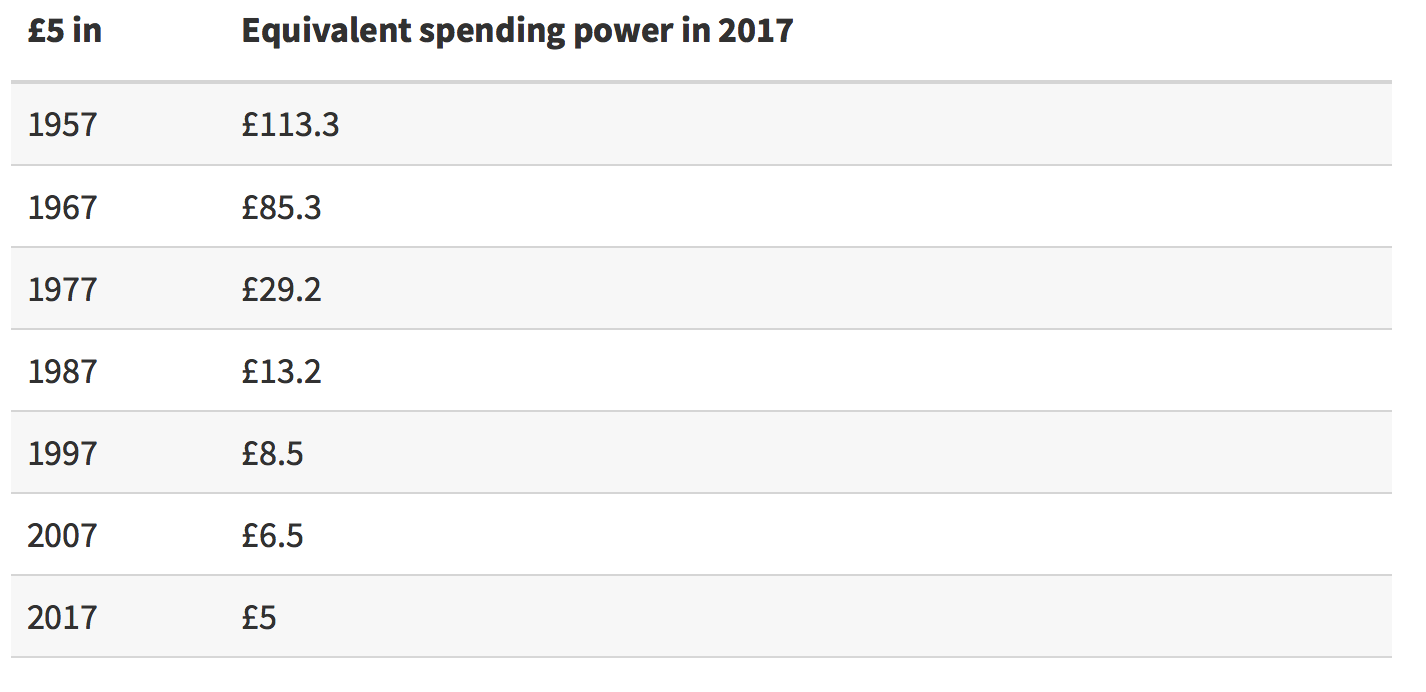
One of these is the fiver. Interestingly it was once standard to be able to get a £5 note from a cash machine. I don’t recall this (I was born in the 1980s) and when I was at university there was one cash machine which was almost a novelty because it did dispense of the notes. When the financial crisis hit banks and ATM companies decided to start reissuing £5 notes in order to ‘help people with their budgeting.’
Why had the fiver stopped being issued in ATMs? Because the £5 had become small change. When you look at the figures in terms of what the £5 of today would have bought you back in 1957 then you really do get a good look at the damage that has been done to the British pound’s spending power.
Our American subscribers and clients will relate to this as the $5 note (USD) today does not buy what it bought 20, 30 or 40 years ago. Households and savers hit from all angles
Every month we hear about where inflation is. Headlines are always screaming about whether or not inflation has hit the Bank of England MPC’s target. Rarely do we here about the ongoing damage being done to the value of the pound over a long term period.
On an annual basis we are not suffering as much today as perhaps we would have been in the 1970s to early 80s. My grandfather retired in the 1970s, he died just last year. The first few years of his retirement were fraught with inflation as the average rate was around 13%.
Annual Inflation Rate & Multiplier (1970 -1980) Source Stephen Morley.org
Of course, a retirement as long as my grandfather’s will be near unimaginable for generations since. This is partly do with lifestyle choices but also thanks to the fact that we can no longer afford to save enough in order to enjoy such a break. Many retire in the hope that their pension pots and savings will grow thanks to interest rates. As we know from the last ten years, this just isn’t possible anymore.
As we wrote back in 2014, ‘If retail prices were to rise by 2.8% annually – in line with government targets – the value of money would decline by a further 67% over the next 40 years."
‘If inflation follows this pattern, consumers would need £311 in 2053 to have the same spending power as an individual with £100 today – or more than £3 million to enjoy the equivalent lifestyle of a millionaire today.’
This isn’t just a problem for those who have retired. It is a daily problem for British households. Recently we wrote about shrinkflation and the impact it is having on British households. But even where size of common household items remains constant, consumers are seeing a huge fall in the amount they get for their money and what they are earning.
There are very few households in the UK at present who are not feeling badly hit from all angles. From the increased rise in the cost of living to their wages which are not keeping up with inflation. Even those who can afford to save are suffering thanks to the devaluation of the pound, low interest rates and the threat of negative rates.
Conclusion - what’s the real story?
Laughingly the Bank of England’s website reads ‘Price stability is defined by the Government’s inflation target of 2%’. In other words, climbing prices and a falling purchasing power of the sovereign currency is considered to be price stability.
Tell that to parents who are struggling to clothe, feed, transport, educate and look after the health care needs of their children. They might welcome a little bit of mild deflation. Especially those struggling to rent basic housing or buy a home.
The study which originally inspired us to look at this situation in more details was carried out by Lloyds, who at the time stated that ‘in 40 years, an individual would need £3 million to enjoy the same lifestyle as a millionaire today.’
To that we say, it’s a lot more simple than worrying about accumulating £3 million in the right time period in order to be able to retire comfortably or very comfortably.
Instead, look at the table again and realise what has held its value and protected people"s purchasing power - gold.
As it has throughout recorded history, gold has acted as hedge against inflation and a financial insurance against irresponsible and reckless governments and central banks. No matter what level of currency devaluation your country has seen, one ounce of gold is one ounce of gold, is recognised and liquid everywhere and has remained a store of value globally.
Gold is flat this year after falling 40% in recent years. However, it rose 8% last year but it is has performed very well over the long term - a 10, 20, 30 and 40 year time period.
Long term the value of your cash savings and deposits is being eaten away - especially in an era of zero percent and negative interest rates. Gold might continue to be unappreciated by the majority but a quick glance at these charts and all can see the protection it offers savers a
"It is important to note that all portfolios under all conditions actually perform better with exposure to gold and silver" - David Morgan
In the short video above, David Morgan, the Silver Guru, speaks briefly about the importance of owning silver bullion coins and bars as financial insurance in an uncertain world. He speaks about GoldCore Secure Storage and how he recommends GoldCore"s ultra secure allocated and segregated gold, silver, platinum and palladium bullion storage (Zurich, London, Singapore and Hong Kong) to his retail and high net worth clients.
Citigroup Chief Economist Willem Buiter says Australia is experiencing “a spectacular housing bubble” that needs to be addressed with tougher regulatory measures – something we’ve noted time and time again.
A shortage of housing, coupled with record-low interest rates, has made Sydney the world’s most second-most expensive property market. The city’s home prices jumped 16% in the 12 months through April, stoking record household debt and putting home ownership out of the reach of many.
"It had better be focused on immediately, to try and tether a soft housing landing,” Buiter told reporters in Sydney Wednesday, according to Bloomberg.“Clearly if these things are not managed well they can be a trigger for a cyclical downturn.”
Australia’s biggest banks have been tightening their lending standards under pressure from regulators, making home loans for investors and interest-only mortgages more expensive, Bloomberg reported.
The Reserve Bank of Australia, which has cited the east-coast property markets and their impact on financial stability as a key concern, is in a tough spot. While it’s reluctant to cut the benchmark interest rate from 1.5 percent and stoke prices even higher, lifting borrowing costs would place a greater burden on households saddled with debt already at 189 percent of gross domestic product, Bloomberg reported.
Investors, for their part, are starting to come around to the dangerously overvalued nature of Australian stock and housing markets. Earlier this week, Australian asset manager Altair Asset Management made the extraordinary decision to liquidate its Australian shares funds and return "hundreds of millions" of dollars to its clients according to the Sydney Morning Herald, citing an impending property market "calamity" and the "overvalued and dangerous time in this cycle".
Parker said he wanted "to make clear this is not a winding up of Altair, but a decision to hand back client monies out of equities which I deem to be far too risky at this point."
"We think that there is too much risk in this market at the moment, we think it"s crazy," Parker said with a candidness few of his colleagues are capable of, at least when still managing money.
"Valuations are stretched, property is massively overstretched and most of the companies that we follow are at our one-year rolling returns targets – and that"s after we"ve ticked them up over the past year. Now we are asking "is there any more juice in these companies valuations?" and the answer is stridently, and with very few exceptions, "no there isn"t"."
Parker outlined a list of "the more obvious reasons to exit the riskier asset markets of shares and property". These include:
the Australian east-coast property market "bubble" and its "impending correction";
worries that issues around China"s hot property sector and escalating debt levels will blow up "later this year";
"oversized" geopolitical risks and an "unpredictable" US political environment;
and the "overvalued" Aussie equity market.
But, to Parker, it was the overheated local property market that was the clearest and most present danger. "When you speak to people candidly in the banks, they"ll tell you very specifically that they are extraordinarily worried about the over-leverage of the Australian population in general," he said. He flagged how exposed the country"s lenders were to a correction.
"If they get a property downturn anything similar to 1989 to 1991 then they are going to have all sorts of issues," Parker said.


 Worthless 1 Trillion Zimbabwe Dollar Note (Wikimedia Commons)