Showing posts with label shotgun. Show all posts

Tuesday, May 8, 2018

Starting Your Armory

handgun and ammoIf you’ve decided to take your personal or home defense seriously, you’re probably researching buying a few firearms, or perhaps you already own one or more. The world of firearms can be confusing, so I wanted to cover a few points every prospective gun owner should consider.


First, you need to ask yourself what the objective is. Are you planning for home defense, or is the gun going to be used for self-defense away from home? Or do you plan on hunting, and if so, what are you going to be shooting at? This distinction will start you down the right path.


Second, what is your experience with weapons? If you grew up with guns and have practiced a lot, you’re in a much different place than the person who’s never touched one.


If you read gun enthusiast publications you’re likely to hear everything from ‘buy as many guns as you can afford’ to ‘buy as few guns as possible’ and everything in between. My advice is to buy the weapons you expect to need and become an expert with them.So let’s get on to building your armory.


One of the best starting points for your armory is a revolver or semi-auto handgun that you can use for home, self-defense and even emergency hunting, and you can carry it with you discreetly. My favorite weapon for this purpose is the .357 Magnum, an all-around gun that is effective, easy to use and flexible.


By flexible I mean it shoots several different types of ammo and the ammo is widely available. There’s an old saying that the best gun is one you have with you when you need it, and with the .357 you can carry it with you without too much trouble. If you want additional capacity, I like the Glock 23, a .40 caliber semi auto that gives you the ability to carry eight more rounds than the five-shot .357.However, a semi-auto is a much more complex weapon both from an operational and maintenance standpoint. More can go wrong… so be honest about your own skill level before buying one.


Once you have a trusted handgun, I recommend you acquire a firearm for home defense, and in my opinion the hands-down winner would be a 12 gauge pump shotgun.It is a powerful and extremely versatile gun, because you can vary your ammunition based on your needs. You can shoot birdshot, buckshot, slugs, darts (flechette rounds), explosive fragments, bean bags, pepper gas, tear gas, rock salt, rubber slugs/buckshot, pyrotechnic whistles, bolo’s and even flares.With that range of ammunition you can kill almost anything you can imagine, except hunt game at long distances.


Much of personal and home defense is deterrence, and this is where the pump shotgun really shines. If some thug is scouting your place and is carrying a knife or a handgun and you show up on the front doorwith a shotgun in hand, he’s going to move on. You see, even if you’re skilled with a handgun, a person can survive and even continue firing after being hit, but with a shotgun, you’re almost guaranteed a powerful, knock-down hit and serious bleeding.


Nobody wants to face an angry homeowner with a shotgun, even if she’s a 5′ grandma. If you suffer the misfortune of facing an intruder in your home, the sound of that shotgun pumping has been known to send intruders running away… quickly.


Once you have a handgun and a shotgun, you have covered 95% of your defense needs. Anyone in your home who might handle the gun in an emergency should spend a lot of time at the range, training and shooting with both weapons.


Your third, and final component to your armory should be a rifle.The rifle gives you the ability to hunt or take down threats at a distance, and in conjunction with your other two weapons will cover virtually every need you might have.


rifle at canyonChoosing the right rifle involves an evaluation of the stopping power, the likely uses, the range of the weapon, availability of parts and ammunition, and the weight.I also like to own different weapons that can shoot the same ammo, since it makes buying and stockpiling ammunition easy.


If you’ve purchased the .357 I recommended, one great option would be a lever-action rifle that uses the .357 magnum rounds.A lever gun is the rifle equivalent of a revolver; easy to use, easy to clean and simple and reliable when you need it. I think of my lever gun like a hammer in my toolkit… it’s really that versatile.


Now, if you want something with greater range, I recommend the .308 rifle.It has more power and precision at distance than the .357 lever rifle.It’s great for hunting many different types of game and is more effective than higher-powered, similar rifles.


One of the great things about the .308 rifle is it can fire the 7.62x51mm NATO rifle cartridge, the same round fired by the best battle rifles in the world. This means that your available ammunition now includes the most-produced rifle cartridge in the world.


These three or four firearms will make for a very robust armory that will cover almost any need. If you can envision a scenario where these weapons will not meet your need, you should probably be worried about escape and evasion rather than fighting.


The post Starting Your Armory appeared first on Off The Grid News.

Tuesday, May 1, 2018

The Ultimate Shotgun


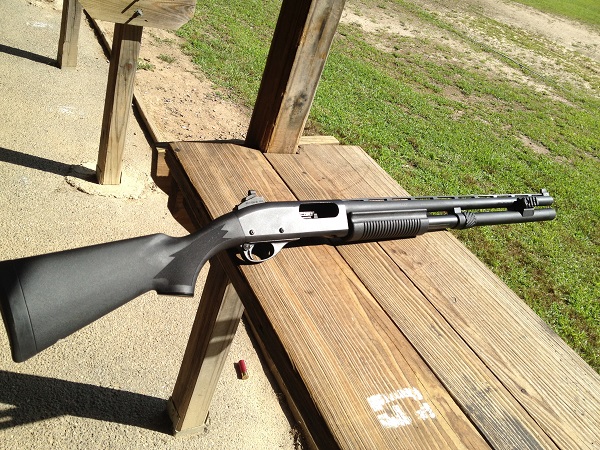
Well folks, here it is. The absolute peak of shotgun technology. However, this technology has barely changed since its inception in 1950. For those who have never had the opportunity to use one, the ultimate shotgun has been sitting right in front of our eyes for six decades, and over ten million have been sold. I firmly believe that the Remington Model 870 is the perfect shotgun. It’s the kind of weapon that you can be confident you will be passing on to your children one day, assuming you treat your gun correctly.


The Remington Model 870 is the best shotgun due to the quality, strength, and ideal shooting ability. There’s a reason that this firearm has been so incredibly popular thanks to these features, among many others.


As a whole, the Remington Model 870 is one of the highest quality shotguns on the market. This quality comes mostly from the receiver and the slide. The receiver starts as a solid billet of steel and is eventually machined into a receiver. This process of machining the receiver is tried and true and is proven to be a powerful receiver. The slide has two action bars that assure that the spent shell is engaged and the next shell is chambered every time. The pump action is exceptionally smooth, over and over again. Regarding quality and reliability, it will not get better than the Remington Model 870.


The strength of the shotgun comes mainly from the billet receiver, as was previously talked about. It’s also worth noting that the stocks of the guns are equally tough and are resistant to the elements. There are thousands of Model 870s that are still around from past decades.


The Model 870 is available in quite a few different variants. We will touch on each of them briefly, and talk about what each one might be good for.


  • Wingmaster. The classic. The Model 870 Wingmaster is the nicest looking of the 870s. It has a satin-finished pump and stock, and a polished receiver and barrel. It is truly a sight to behold. Available in .410 bore, 12 gauge, 20 gauge, and 28 gauge. It is the most expensive of the group, and it would look as good above your fireplace as it would bird hunting. However, if you are only looking for a hunting weapon, there are better options available.

  • Express. The same strength and quality of the classic Wingmaster, at a much more affordable cost. The hardwood stock and pump don’t have a shiny finish, and the metals are also matte black. It is offered in 12 gauge or 20 gauge. The Model 870 Express is broken down into even more variants. There are multiple tactical versions with a black synthetic stock and pump replacing the wood. One tactical version has a seven shell capacity, and one synthetic tactical version has a rifled barrel to shoot slugs. There are a few different ones that are treated with a camo finish. The Model 870 Express Super Magnum can handle all sizes of 12 gauge shells.

  • Marine Magnum. The Marine Magnum variant has nickel plating covering all metal surfaces, which makes it resistant to corrosion. It is only available in 12 gauge.


All in all, the Remington Model 870 is an extremely high-strength, durable, and reliable shotgun. This same technology has been around since its creating in 1950 and has allowed the shotgun to retain its popularity since then, as over ten million Model 870s have been sold. While there are fancier shotguns available, you would be hard-pressed to find a better mix of affordability and durability than the Model 870.


The post The Ultimate Shotgun appeared first on Off The Grid News.

Monday, April 2, 2018

Picking The Perfect Shotgun: Everything You’ve Ever Wanted To Know (But Didn’t Want To Ask)

Picking The Perfect Shotgun: Everything You’ve Ever Wanted To Know (But Didn’t Want To Ask)

Image source: DoD photo by Marvin D. Lynchard


The shotgun is one of the most capable firearms in the world. For hunting small game, to game birds, and even big game, a shotgun will do the job. For home defense, the shotgun is more than capable and intimidating. Want a survival gun? The shotgun can cover it all in the most trying conditions.


The choices of action types, gauges, barrel lengths and stock configurations are an added incentive for owning a shotgun. Choose pump action, semi-auto, single or double barrel, or even lever action. The 12 gauge is the most common today, with the 20 gauge being a close second. There are others; the ole 16 gauge seems to have lost its popularity. Another, the 28 gauge, is primarily used by upland game bird hunters. The 10 gauge is a rarity in today’s times. Then there is the 410 which is correctly designated as .410 bore (slug diameter of the .410) rather than gauge.


Of the above gauges mentioned, 10ga is the largest, then 12, 16, 20, 28 and 410 in descending order based on the amount of shot or the weight of an individual slug (projectile) the hull/shell contains. On average, shell lengths are 2 ½ to 3 inches in length.


Your choice of action type will be driven by the intended use of the shotgun, whether it’s hunting, trap or skeet competition, as a home defense tool, or your young child’s first gun. Let’s first take a look at shotgun action types found on the market today.


Single Shot


Generally this action is a hinged, break-open type that employs a lever to open the action. It is designed to load one round and then unload the spent hull before reloading another live round. Companies such as Harrington and Richardson, Iver Johnson, and Chiappa are but a few that produce a single shot break open shotgun.


Lever Action


Lever-action shotguns are mostly out of the picture today, but do have their following. They operate similar to a lever-action rifle such as the classic Winchester 30-30. Every pull of the lever down and up unloads and reloads the chamber. Henry and Chiappa are the mainstays of producing these guns.


Bolt Action


For the most part, bolt-action shotguns have become obsolete and are no longer produced. You may find one around from days gone by that was marketed by Sears, Westernfield, Stevens or Mossberg. While they may hold some nostalgic interest, there are too many other shotgun action types that are more practical.


Double Barrel (side by side or over and under)


Double barreled shotguns are loaded in a similar fashion as the single shot break opens via a hinged connection between the barrels/forend and the action itself. The double comes in both a side by side, where the barrels are left and right of each other, and the over and under, wherein the name denotes one barrel being directly above the other.


Many classic names are associated with this category, such as Parker, Winchester, Browning, Ruger and others. While these guns are most often considered for competitive or sporting purposes, there are applications and models that lend themselves to home defense as well. Some of the short-barreled side by sides are a good example, like the Cimarron model 1878 coach gun.


Pump Action


Probably the most widely used and popular action type today, the pump action has been around for decades. The pump action is just that: by pumping the forend back toward the receiver, you cycle the action. This motion extracts a fired round and reloads another in the blink of an eye. This style of shotgun is very popular with hunters and has been used extensively in police and military applications. Remington model 870 and the Mossberg model 500 are two of the most widely recognized and used pump actions today.


Semi Auto


Gaining much interest and use in the last several years is the semi-auto. Not unlike a pistol or carbine, the semi-auto shotgun fires, extracts and reloads a new round with every press of the trigger. Semi-auto shotguns are heavily used in many venues including hunting, sport competition, and law enforcement. Remington, Benelli, Saiga and Browning are just a few companies that offer semi-auto shotguns.


What Gauge Fits Your Needs?


Let’s stick with easily available shotgun gauges and ammunition for them. Yes, you can still get 10 and 16 gauge via online ammunition warehouses … but you generally cannot walk into a Walmart or other local retailer and easily find these gauges. And I won’t even get into European shotguns like the 24 and 32 gauge.


12 Gauge


It’s the most common and everyday available gauge, although the 20 is a close second. Having been around since at least the 1870s, it is still the everyday staple around the farm, ranch and for law enforcement and military use. I have personally taken plains game in Africa with 12-gauge slug and buckshot. The most common configuration includes 2 ¾ to 3 inch shells holding anywhere from 1 to 1¾ oz of shot. Buckshot and slugs are also readily available in the 12 gauge.


20 Gauge


A mainstay in the shotgun world for decades, the 20 gauge is still going strong today and may have even outpaced the larger 12 gauge for certain applications. It is a popular hunting choice and offers a wide variety of shot options to include buckshot and slug offerings. The most common loads for 20 gauge are 7/8 oz to 1 ½ oz of shot.


28 Gauge


Most often associated with upland game bird hunting, the 28 gauge has also been around for decades but in my experience is probably one of the least used gauges today as compared to the 12 and 20. Shot shells in this gauge are most common in ¾ oz of shot. When I hear 28 gauge, I visualize walking behind a fine bird dog and taking shots at bobwhite quail or grouse.


.410 Bore


The .410 is in fact a shot shell, but as described earlier is designated by bore diameter rather than gauge. The diminutive .410 has been a farm, ranch and household favorite for years when it comes to dealing with pests. It’s often the first gun (aside from the 22 rimfire) many kids are introduced to. In .410 ½ oz to  11/16 oz of shot are common. Today, there are revolver offerings such as the Taurus Judge and Smith & Wesson Governor that utilize the 410 as a defensive round. There are several derringer offerings in .410, as well; Bond Arms Derringers is a popular example.


All of the above shotgun ammunition can also be found in various types of buckshot, slug and defensive round offerings.


No gauge discussion is complete without the 10 and 16. Both are a decades-old staple in many parts of the country and are in fact still used today. My intent is not to minimize these two, but rather point out that these gauges aren’t commonly found at your local sporting goods dealer on a daily basis, much less the ammo … but they are available.


Defensive Use


Everyone has their own idea as to what works best for them in a self-defense shotgun. Because I carried and used one extensively during my career in law enforcement and for more years than I care to remember in the field hunting, the pump action in 12 gauge has to be my top pick. A primary reason for me is the pump action is fairly simple and rugged, making it generally reliable and easy to use. As I mentioned earlier, 12 gauge ammunition is the most readily available of all the gauges listed.


As to the shotgun make and model, I like and have used extensively over the years, the Remington Model 870, Mossberg 500, Winchester Defender and Ithaca Model 37. There have been others and several variations of these, but this list comprises most. Overall, I have utilized the Remington 870 more than any other to include extensive application in the law enforcement world.


If you are considering a shotgun for exclusive home defense, the simplicity of a side-by-side double-barrel may also be worth a look. Cimarron, CZ, and Stoeger all make a version of the short barreled “coach gun,” that can be ideal for quick home defense. And, there’s the added charm of owning a model whose very type is named after its historical use as a security tool for overland horse-and-wagon travel.


Also readily on the market today are pistol grip style shotguns. Here I’m speaking of a hand grip only, with no shoulder stock. The new Mossberg Shockwave and the Remington Tac-14 both come in a 14-inch barrel and are considered shotgun pistols therefore sidestepping NFA (National Firearms Act) requirements. The Mossberg 500 series also has a true pistol grip shotgun, offered in both 12 and 20 gauges.


As you might imagine, there are a myriad of other add-ons for a shotgun, like ammo carriers, a variety of sights, lasers, slings, and probably even a can opener if you look hard enough! My philosophy is to keep it simple and usable based on your needs. I like a ghost ring sight or just a plain old front sight bead, even for a defensive shotgun. However, there is a following for the use of red dot style sights for defensive shotguns. Red dots have gained much popularity in both the carbine and handgun world, why not shotgun — if it fits your needs. I also like a simple sling and ammo carrier on the buttstock or the receiver. Essentially, that is as far as I would go for add-ons.


In today’s world of short-barreled rifles and high capacity magazines, the shotgun is often overlooked. Its diversity of uses make it a top contender for a must-have and it would certainly be in my personal “if I could only have three guns” list. Even many police agencies have eliminated it from their armory — a mistake, in my estimation.  Don’t have a shotgun? You should!


What is your favorite shotgun? Share your thoughts in the section below:


Monday, November 20, 2017

The 5 Best Tactical Shotguns For Home Defense

The Very Best Tactical Shotguns For Home Defense


I love my guns, but at the end of the day, there are very few that really matter to me. The AR-15s, AK-47s, and other “fun guns” are great, but don’t serve much of a purpose to me. However, if you want to talk about a weapon that does serve an essential purpose to me, it would be my home defense shotgun.


I have owned and tried more tactical-style shotguns than I can remember. This is one firearm that I don’t mind spending extra money on, or doing a ton of testing until I find the perfect one.


In my opinion, a shotgun is absolutely necessary for home defense. However, in order to be a viable option for home defense, I think a few criteria must be met.


First and foremost, the shotgun must be reliable. In a home defense situation, being able to count on the weapon is absolutely paramount. There is no way around that.


Second, a fast cycle rate is important to me. It gives me some peace of mind that I am able to re-engage the target if necessary. A commonly held opinion is that semiautomatic shotguns are not as reliable as pump action shotguns. In my opinion, this is both true and not true. There are more internal parts that can go wrong, but there are plenty of quality, reliable semiautomatic shotguns available.


Third, the sights must be good, or must have an easy way to mount my own sights if I choose to do so. Generally speaking, I prefer to put my own sight on it, as it’s probably going to be a sight I can easily see at night.


You Don’t Need A Firearms License For This Weapon!


Last, I generally prefer a shotgun with a pistol grip. My opinion is that these are more mobile and controlled, although it’s not a necessity. I know that not everyone will agree with me on that, but in my personal experience, I have found them to be more mobile.


So, here is a list of some of my favorite home defense shotguns. All of these are 12-gauge shotguns that I would load with Winchester PDX Defender shells.


1. Benelli M4 Tactical


It feels wrong putting a semiautomatic shotgun first on my list, but once you’ve used this one, you will understand why. Although it does have a pretty steep price tag, this is an absolutely awesome weapon that meets all of my criteria. It has a 5+1 magazine capacity, and weighs in at 7.8 pounds.


The weapon is extremely reliable, as I haven’t had any issues with cycling any different shells. It also cycles extremely fast. The sights that come on it are decent, and they are fully adjustable. You can also get tritium inserts for the standard sights, which will make them easier to see at night. However, it also has a Picatinny rail system, so you can mount your own sights to it if easily.


If you like the sound of this one, but are a little afraid of the pricetag, the Benelli M2 is another good option that is less expensive.


2. Mossberg Model 500 Tactical – SPX


This pump action shotgun from Mossberg is a beast. Similar to the Benelli M4, it has a pistol grip and a 5+1 capacity. However, this one is a pump-action, which many will find enjoyable. Some folks will tell you that simply pumping the action on a shotgun is enough to scare off a would-be intruder.


This shotgun also has some good standard sights. It has a fiber optic front sight, which allows for excellent visibility. Just like the M4 though, it also has a Picatinny rail if you want to mount your own sight.


The pistol grip and pump are ergonomic, and allow for plenty of grip and control. The stock of this one is fully adjustable, which is an advantage over the M4. It is also a little bit lighter than the M4.


As far as pump-action shotguns go, this one is my favorite. It is comfortable to hold and shoot, it is reliable, and the price is reasonable.


3. Remington 870 Express Synthetic Tactical 7 Round


I have written before about how much I love the Remington 870. In my opinion, it is the best shotgun on the market. They are extremely reliable and will last forever. The only reason that this one isn’t higher on my list is because it doesn’t have a pistol grip.


This pump action from Remington has a 6+1 capacity and weighs 7.5 pounds. It is extremely sturdy, and the action will work every single time for years and years.


Unfortunately, I wasn’t crazy about the single bead sight on this one, and it doesn’t have the Picatinny rail. The sights aren’t awful; it just took some time getting used to them.


4. Mossberg 930 Tactical – 8 Shot SPX


I’m generally not a huge Mossberg fan, but their home defense offerings are awesome. The 930 Tactical is a semiautomatic shotgun, and the 8-Shot SPX version has a pistol grip as well as an 8-shell capacity. This extra shell could make a huge difference. It weighs in at 7.75 pounds.


When I shot this shotgun, I thought it was pretty smooth and enjoyable to shoot. However, I definitely don’t think that this action is as smooth as the Benelli. While it never gave me a reason to be concerned, I still think it’s worth mentioning.


Just like the other Mossberg shotgun, this one has excellent sights, and also has a Picatinny rail. While the stock isn’t adjustable like we saw on the 500 Tactical, this weapon is still pretty comfortable to carry and maneuver with. I would feel more than comfortable with this weapon for defending my home, especially when considering that it’s available at a reasonable price.


5. Benelli SuperNova Tactical Pump


Last on our list is a pump-action shotgun from Benelli. This one has a 6-shell capacity and weighs 7.6 pounds. It has a stock and pistol grip that is very similar to the M4.


The action of this shotgun is silky smooth and it has very little recoil compared to its competition. If you have ever fired a Benelli pump action, you know what I’m talking about, I’m sure.


The sights on this one are good, but unfortunately there isn’t a Picatinny rail. You can have either open rifle sights or a ring style sight. Just like the M4, there are optional tritium inserts for the sights.


Overall, this is an excellent quality pump action that is extremely affordably priced. It would do great for a home defense shotgun, especially considering the pistol grip.


What would you add to our list? Share your tips in the section below: 

Thursday, October 12, 2017

Remington 870 Vs. Mossberg 590: Which Pump Shotgun Is Truly Better?

Remington 870 Vs. Mossberg 590: Which Pump Shotgun Is Truly Better?

Image source: YouTube screen capture


There are two flavors of pump shotgun that seem to dominate the market: the Remington 870 and the Mossberg 590. Each gun has its associated advantages and disadvantages when compared to the other, and fans and detractors seem almost evenly split into two camps, with a lot of us in the middle who shoot and own both types.


Let’s take a look at each design.


Remington 870


In 1951, Remington unveiled the Model 870 as the ultimate modern pump shotgun. Some 65 years and more than 10 million models delivered, it has proven itself to be the best-selling shotgun in history.


Remington 870 Vs. Mossberg 590: Which Pump Shotgun Is Truly Better?

Remington 870. Image source: RifleShooter.com


Available in a variety of barrel lengths, finishes and furniture options, the Model 870 has a vigorous aftermarket dedicated to improving its performance.


One of our gripes about the 870 pertains to Remington going with a dimpled magazine tube that inhibits the installation of a magazine extension.


Be Prepared. Learn The Best Ways To Hide Your Guns.


Probably not a major concern to the millions of duck and deer hunters who cannot legally use them on their 870, it has plagued those of us in the competitive shooting and self-defense realms. There are a number of ways to circumvent this issue, but it is our only real gripe with the 870.


You can either pound the dimples out by inserting a socket head into the magazine tube, or simply drill them out.


I was first issued a 5-shot 18-inch barreled Remington 870 Wingmaster while serving guard duty at the armory during a stint in infantry training school at Camp Pendleton. I did not feel under gunned with it then, and still keep one in a safe with a magazine extension, Remington factory top-folding stock, Rem choke system and Magpul forend with a surefire light.


Mossberg 590


In 1961, Mossberg rolled out their Model 500. The 590 was an improvement upon this design that came about a few years later. The most significant change was the magazine tube that was closer in design to the Remington 870 by using a similar magazine cap that made maintenance easier.


Remington 870 Vs. Mossberg 590: Which Pump Shotgun Is Truly Better?

Mossberg 590. Image source: MossbergOwners.com


The design was further improved in the 590A1 by upgrading the plastic safety and trigger guard to metal versions and using a heavier barrel at the request of the US Navy and US Marine Corps.


Perhaps the most significant difference between the two is the placement of the safety. Remington uses a cross bolt type at the base of the trigger guard, whereas Mossberg places theirs at the rear of the receiver in line with the shooter’s sight.


Our gripe with Mossberg is that they offer very little in the way of a choke system on most factory models. A choke system gives the shotgun more versatility as a system. While it may be mostly negligible on shorter barrel home-defense guns, it is still the only way to attach a shotgun silencer like Silencerco’s Salvo.


In spite of my experience with the Remington, my first shotgun was a stainless Mossberg Marinecote 590. I chose this one because I felt its construction would inhibit rust while deploying for six-month Western Pacific tours with the Marines. That and despite being a Marine Infantryman for two years, I was still too young to legally purchase a handgun. I currently have two Mossbergs in my safe. One is a short-barreled 20 gauge that holds two rounds. The other a 9-shot 590A1 with a Speed Feed stock holding four extra rounds, a sidesaddle shell carrier holding six, a forend light and of course the ubiquitous bayonet lug that mounts either an M7 or M9 bayonet.


The Verdict


If World War III were to break out tomorrow and for some reason I needed a fighting shotgun, I might be more inclined to grab the 590A1 with its ghost ring sights, dedicated weapon light and advantages with capacity and on-board ammo storage.


My 870 is lighter and a bit nicer to shoot due to a better trigger and tends to be what I grab in the house most often when I hear a suspicious noise. It is simply easier to maneuver indoors than the bigger Mossberg. Fit and finish is slightly better than the Mossberg, but this is a shotgun that is over 30 years old and not representative of Remington’s current offerings.


As a gun writer, I have the luxury of shooting a variety of firearms, and placement of the safety is not a huge concern. I do urge new shooters or those who shoot less frequently to select a version where the placement of the safety is more comfortable for them, as that seems to be the only difference.


Both shotguns will serve you well as a self-defense weapon. In the end, it all comes down to personal preference.


Which shotgun do you prefer – the Remington 870 or Mossberg 590? Why? Share your thoughts on the weapons in the section below:


Pump Shotguns Have One BIG Advantage Over Other Shotguns. Read More Here.

Thursday, September 14, 2017

The 5 Most Reliable Shotguns For Home Defense

Image source: screen grab (YouTube: hickok45 channel).

Image source: screen grab (YouTube: hickok45 channel).


When looking for a home defense shotgun, the senses can be annihilated by the numerous varieties that are out there.


But what are the best, most reliable ones? Rather than choosing the top five brands or models, we decided to break this down by action-types or how the shotgun works.


For gauges, I generally recommend the 12, 20 and 16 gauges above all else. .410 bore shotguns can be useful, as the recoil is mild and a host of self-defense rounds are offered. In general, I avoid the massive 10 gauge and diminutive 28 gauge — unless you are attacked by a flock of birds — as there are severe limitations on the ammunition types for these two.


1. The pump shotgun


Easy to use and the hallmark of home defense for more than 100 years, the pump shotgun is probably the number one long gun choice for home defense in today’s world. Holding anywhere from 3 to 12 rounds based on configuration, the pump shotgun offers rapid follow up shots and the option of a quick reload.


Chances are that you already have one of these shotguns made by Mossberg, Remington, Winchester, Benelli or one of the myriad of other companies that produces shotguns today.


Vicious New Hand-Held Self-Defense Tool Turns Lethal In Seconds!


The most common examples include the Mossberg 500/590 series, Remington Model 870, Winchester 1300 or Defender, Winchester Model 12, Benelli Nova, Kel-Tec KSG and Maverick 88.


2. The semiautomatic shotgun


Older semiautomatic shotguns may have had their limitations with regard to reloading quickly or reliability, depending on the type of shells used, but modern semiautomatic shotguns have proven themselves to be adequate fight stoppers with the right ammunition.


Follow-up shots are quicker than the pump shotgun, and perceived recoil is only slightly greater as opposed to some of the original models used to protect home and family.


I prefer the Remington 1100 or 1187, or the newer Benelli M1 and M3 versions.


3. The side-by-side shotgun


The 5 Most Reliable Shotguns For Home Defense

Image source: Pixabay.com


Long before the semi-auto and pump shotguns came into common usage, the side-by-side double barrel put food on the table, quelled more than one riot and protected more homesteads than any of the various revolvers or lever-action carbines that claim to have won the West.


More modern renditions use internal hammers and can be had by European American Armory, Baikal, Remington and a few others that cater to the Cowboy Action Shooting realm.


4. The single shot shotgun


For the shooter on a budget, a single shot shotgun may be a sane alternative. Costing less than $100 in some places, these shotguns are better than a small caliber handgun as your only option for self-defense at times.


A shell carrier mounted to the butt stock provides quick reloads at your fingertips.


The most common single shots on the market today are produced by Iver Johnson, Harrington & Richardson as well as a few store brands made under license by these companies.


5. The lever action shotgun


Not as common in history as we may have been led to believe through the magic of movies, the lever action shotgun debuted as Winchester’s answer to keeping their tradition of fine lever guns going forward. With the originals now holding value as collector’s items, one need only look to the Italian replicas as examples of how costly it was to make these shotguns.


A number of Chinese-made versions are imported, and if you have to have one based on the nostalgia of watching Terminator 2 more than once, they make a great home defense shotgun with a little work.


What’s Missing?


We left out the over/under shotgun, for a number of reasons. Most have barrels that are way too long for maneuverability inside the home, and even a shorter barrel makes it slow to reload, as the action must almost always have to break a sharper angle to remove spent shells than a typical single shot or side-by-side shotgun.


Apart from those limitations, if it is the only firearm you have with which to defend yourself, it beats trying to hold down the fort with a sock full of nickels.


Accessories


I strongly recommend the shortest barrel you can legally use and the addition of a flash light (for target identification) and a sling (for portability). Some butt stocks will allow the use of shot shell carriers, and others can be mounted to the receiver.


The most important accessory, of course, is ammunition, so you can practice often with your self-defense loads of choice to see how the shotgun patterns and feel its recoil.


What is your shotgun choice for home defense? Share your ideas in the section below:


Pump Shotguns Have One BIG Advantage Over Other Shotguns. Read More Here.

Thursday, June 29, 2017

4 Reasons The 16-Gauge Shotgun Is NOT Obsolete

4 Reasons The 16-Gauge Shotgun Is NOT Obsolete

Image source: HoneyKnivesOfChina


The phrase “16-gauge shotgun” often sparks memories of yesteryear: the dusty old single shot from the 50s you inherited from your grandfather, or the quirky old pump you once eyed in the gun store.


The 16-gauge shotgun is a strange gun, especially in the Western U.S. I understand it has a bit more popularity in the Northeast, and of course our European cousins seem overly fond of it. But just what good is a semi-obsolete shotgun that seems to stay alive out of sheer force of habit?


Here are four good answers you should consider one:


1. They can be cheap. Odds are that a comparable 16-gauge will be cheaper on the used gun rack than a similar 12- or 20-gauge. The market just isn’t there, and these things can languish on the shelves. They still go “boom,” though, and still are perfectly good for whatever use you might have for a shotgun. If you are into saving money, you can assemble a nice battery of quality shotguns at an incredible saving by going with a 16-gauge.


2. They fill a sweet spot between 12- and-20 gauge. The shot patterns fall nicely in the middle of the two, and often 16s are lighter to carry than a 12. The right-in-the-middle performance of a 16-gauge means better success in the field and better performance in the kind of circumstances where you might want to haul a light 20-gauge around. The 16-gauge really shines in thick brush, where hunters might normally choose a 12-gauge to bust through the cover. However, you wind up with small game riddled with more pellets than might be desirable, but often a 20-gauge just won’t cut it. The 16 is “just right” for those circumstances.


3. The 16-gauge is a handloader’s dream come true. Admittedly, this is because at some point you have to load for it, due to inconsistent availability of ammo, but once you are freed from the traditional market and cultural expectations of what the “ideal” load is, you are wide open to do your own thing. I have always maintained that if I must load my ammo, I’d rather do it for a niche gun than one where I can get whatever I want off the shelf in the gunstore. This is why I carry a .41 magnum revolver, shoot a Krag, and have a 16-gauge single shot for birds. Beyond that, you can make a 16-gauge do the work of a 20 or 12 with little effort, depending on how you load for it. What’s not to love?


4. The ammo really isn’t that hard to find. If you live near a population center or a large sporting goods store, odds are there are basic 16-gauge loads available to you: birdshot, buckshot, slugs and the like. It’s easy to overlook, but once you start shopping for it, 16-gauge ammo seems to pop up everywhere. Really, a good 16-gauge is a darn fine gun. What I like most about them, though, is that you can walk into almost any country gun shop, or old pawnshop, and find at least one or two neat old 16-gauges. There is something classy about picking up an old break-action shotgun, cleaning it up and bringing it back to life.


So many 16-gauge shotguns fed families, or were prized possessions and are now relegated to the dustbin of history because they aren’t the “latest” and “greatest” scattergun. When shopping for a used 16-gauge, you often will find they are well-preserved, often because at some point the owner decided it was too oddball a cartridge to keep using regularly.


I have seen fine semi-auto 16s at crazy low prices. I can’t begin to count the number of nearly mint 1950s department store branded pumps I’ve run across, either. And, of course, there are a great many old single-shot 16s out there. Well-used, well-loved, but still with plenty of life left in them. The 16-gauge is a direct link back to a different time in American history, when things moved a little slower and were at times a bit simpler.


Hardly an obsolete cartridge, with just a little bit of care, you’ll find a good 16-gauge shotgun is one heck of an off-the-grid companion or even just spare shotgun. Pick one up. You’ll be glad you did.


Do you own a 16-gauge? Have you ever shot one? What do you think? Share your thoughts in the section below:

Monday, March 27, 2017

How To Build A Survival Gun Cache On A $500 Budget

How To Build A Survival Gun Cache On A $500 Budget

Image source: MossbergOwners.com


Survivalists who find themselves on serious budgets always will be faced with the problem of accumulating the gear they want within a price point that they can afford. Putting together a survival armory of guns is no exception.


Let’s say that you only have $500 to spend on guns. Many would say that with this budget, it’s A) impossible to build a complete armory that covers your bases, and, B) the guns that you do buy for your armory will be cheaply made or of low quality.


Both of these are absolute nonsense. While $500 is certainly not going to buy you as many guns as a $2,000 or $3,000 budget will, it’s still not impossible to gather the guns you need for this amount.


In fact, you will be able to acquire the three most important guns that you need for just $500.  The specific models that you can buy may not be the fanciest examples on the market, but they are still reliable and will work well enough.


Let’s outline what the three most important categories of guns to have are, and then list an example of a make and model of gun that you can have in that category.


12 GA SHOTGUN – MAVERICK 88 ($180)


It’s hard to say no to a 12-gauge shotgun being the first gun that you own. The 12-gauge round is highly versatile. You can use buckshot for home defense, birdshot for target shooting and bird/small game hunting, and slugs for hunting bigger game such as deer or wild boar.


You also should ideally make your shotgun be a pump-action model over a single shot or semi-automatic, the reason being that you have more capacity than a single and greater reliability with feeding different types of rounds over the semi.


We’re going to cap off the price of a budget shotgun at $180, and the best model that you can buy for this price is going to be the Maverick 88 shotgun, which is the budget model of the world-renowned and highly popular Mossberg 500. While the Maverick doesn’t come with a lot of the same features as the 500, it is still highly reliable and more than adequate for defensive or hunting use.


The Self-Defense And Hunting Weapon That Doesn’t Require A Firearms License!


Although the Maverick 88 usually costs around $200 for a new model, you can very easily find used ones for $180 or even a little less on online auction sites such as Gunbroker.com.


.22 RIFLE – MOSSBERG 702 PLINKSTER ($100)


No gun collection of personal battery of arms is complete without a .22 rifle, even if you only have $500 in total to spend. .22 ammunition is very small, meaning you can store and carry lots of it on you. It’s also a perfect round for small game hunting, plinking, general homestead use, and for introducing new people to the sport of shooting. If necessary, it could be used for self-defense, as well.


Normally, the three .22 rifles that I would recommend first would be the Ruger 10/22, Marlin Model 60, or Smith & Wesson M&P 15-22. Unfortunately, none of these options is going to work, since I’m capping off the price for a .22 rifle at $100.


At this price point, your best option will be the Mossberg 702 Plinkster, which can be found used for even $80 or $90 if you look hard enough online. The Mossberg 702 is available in a wide variety of configurations and comes standard with a 10-round magazine, although higher capacity 25-round magazines also are available.


9MM PISTOL – TAURUS PT111 G2 ($220)


We’re now left with $220 to spend on our final firearm, which absolutely must be a pistol. The pistol is the gun you will have strapped to your side at all times during a disaster scenario. You want it to be easily concealed. I also recommend in this case that your pistol be a 9mm, simply because it’s the cheapest and most plentiful pistol caliber there is.


The specific pistol that I am going to recommend at this price point is going to be a pistol I wrote about recently, the Taurus PT111 G2. While it normally sells for around $250 new at most sporting goods stores, a quick perusal on Gunbroker shows that it can be purchased new or used in good condition for the $200-$220 range.


The PT111 G2 is a compact firearm, which makes concealment easy, but is also large enough so that you can get a full grip on the weapon. It holds 12 rounds in the magazine plus an additional round in the chamber, which is plenty of firepower for defending yourself against multiple attackers. Reviews of the PT111 G2 have been mostly very positive, and owners applaud its reliability, ergonomics and overall value. And besides, it looks much better than a Hi-Point.


Conclusion


So, there you have it. For $500, give or take a few dollars, you should easily be able to acquire a solid survival armory. And they cover your bases: target shooting, home defense/personal protection, and small-game or big-game hunting.


What do you think? What would be in your $500 survival gun armory? Share your thoughts in the section below:


If You Run Out Of Ammo, What Would You Do? Learn How To Make Your Own! Read More Here.

Thursday, March 9, 2017

The One Shotgun That Passed The U.S. Military’s Torture Test

The One Shotgun That Passed The U.S. Military’s Torture Test

Image source: MossbergOwners.com


If the average gun owner is asked what the most important weapon to own for home defense is, the answer often is the 12-gauge shotgun. Yes, some will say go with a pistol and others will prefer a semi-automatic rifle, but the 12 gauge is probably the most commonly recommended firearm for home defense.


There’s good reason for that. Twelve gauge 00 buckshot or any other kind of defensive load is devastating at close range and will incapacitate the attacker, likely with only a single shot. The pump-action shotgun itself is a very rugged, reliable and simple weapon that practically anybody can pick up and quickly learn how to use.


Many will claim that the pump-action design is now outdated in the age of automatic rifles such as the AR-15 or AK-47, and indeed, there are some very high-quality semi-automatic shotguns out there. That said, semi-auto shotguns (at least the quality ones) almost always tend to be more expensive than pump actions, and they also can be just a little more finicky with certain types of ammo. For those reasons, the pump action is still an excellent defensive weapon even in the 21st century and likely will continue to be for many years to come.


Be Prepared. Learn The Best Ways To Hide Your Guns.


The next question then is: What is the absolute best 12-gauge pump-action shotgun for home defense? Well, if you knew that there was only one pump shotgun that has passed the U.S. military’s brutal and unforgiving torture test, you would probably agree that that shotgun would be a top contender, right?


The specific shotgun is the Mossberg 590A1, a further development of the hugely successful Mossberg 500 and 590 series of shotguns. The 590A1 incorporates all of the same features of the 590 and then makes several improvements of its own. The overall weapon itself is insanely rugged and durable.


Why It’s So Rugged


First of all, let’s become familiar with how the Mossberg 500 series of shotguns work. The 500/590 is a very basic pump shotgun that features a polymer safety, trigger guard, and blued barrels (that are easily interchangeable). The safeties of Mossberg 500s are ambidextrous and located behind the receiver, while the slide release lever is located behind the trigger guard for convenience.


Right off the bat, the 590A1 uses more durable materials than the 500 and 590. All of the parts of the gun are constructed out of aluminum (trigger guard, safety, slide release lever, etc.). Furthermore, the 590A1 also uses a heavier durable barrel that is intended to better take abuse, as well.


The overall finish of the 590A1 is parkerized, which is rust- and corrosion-resistant in contrast to the standard bluing of the 500 or 590 that will require constant care and attention. In other words, the 590A1 is a shotgun you can take out in wet environments and not have to worry as much about.


Granted, 500 and 590 models called the Mariner are made in a corrosion-resistant stainless steel finish (called Marinecote), but these specific models tend to be significantly more expensive.


Additional notable features of the 590A1 includes a bayonet lug on the front for mounting an M7 bayonet. The 590A1 also incorporates a swivel mount on the stock for easily adding a sling. In contrast to this, you generally have to add the swivels yourself to the 500 or 590, which, of course, increases the amount of money you have to spend. The 590A1 will have a 6+1, 7+1, or 8+1 capacity, depending on the model that you get.


All in all, the 590A1 is essentially the ultimate pump-action combat shotgun and a superb choice for home defense or personal protection. The Remington 870 is also a great shotgun, no doubt, but keep in mind it was the 590A1 that passed the military’s torture test, which says a lot about its capabilities and quality.


Do you own a 590A1? What is your favorite pump-action shotgun? Share your tips in the section below:


Pump Shotguns Have One BIG Advantage Over Other Shotguns For Home Defense. Read More Here.

Monday, January 16, 2017

4 Shotgun Accessories For A Better Home Defense

4 Shotgun Accessories For A More Effective Home Defense

Image source: Pixabay.com


A shotgun is the ideal choice for a home defense firearm for many gun owners. There are great reasons for this: avoidance of over-penetration, slightly less demanding accuracy standards in less-than-perfect shooting conditions, and mighty stopping power. Practically every conversation about home defense shotguns also includes mention of that ominous racking sound—but I hope no one is depending on sound effects to scare off intruders, when real force may be necessary.


Like anything else associated with the word “tactical” these days, a plethora of add-ons are available for defense shotguns, not all of which are really useful. Here, I’ll point out a few that are worth the investment for mounting an effective—and ethical—counterattack with a shotgun.


1. A sling


The larger your property, the more complicated your responsibilities at home, the more a sling makes sense. Being able to navigate space hands-free is a major asset; however, it’s also a good idea to keep your gun with you. A sling lets you do both.


Options for slings and sling mounts are many. From a simple latigo strap threaded through the swivel loops on a hunting rifle (making a two-point configuration that’s easy to shoulder), to a one- or three-point tactical setup that allows more options for the method of carry, this is a highly customizable choice.


Be Prepared. Learn The Best Ways To Hide Your Guns.


Expect to spend $20 to $35 for an entry-level tactical sling. Mounts are generally higher in price, starting at $25 and priced up to $75. Before purchasing a sling/mount set, make sure your shotgun has studs, rails or whatever is needed to attach the mounts. It would seem to go without saying, but make sure the sling’s hardware is a match for what’s on the gun. Paracord is a frequently used accessory for making stiff connections easier to work with, and for making a too-wide sling work with narrow loops or rings.


2. On-board ammunition


Let’s assume your gun’s capacity is more typical, between two and six rounds. Even six rounds may not be enough in dire situations where multiple attackers or poor marksmanship have created the need for more ammo.


Where will more ammo go? As with slings, there are choices. I’ll eliminate things like belt-mounted ammo storage for this discussion, since this is about ammo that’s needed in fast order—so it needs to be in or on the gun.


Extended magazine tubes are one choice, and the shortest distance between need and a hot chamber. Alternative mag tube choices exist for common platforms like the Remington 870, Mossberg 500, and their variants. A couple brands also have manufactured their parts to be compatible with Remington or Mossberg mag tubes, but be sure to check the specs before purchase. Expect to spend $50 to $80 on an extension for a magazine tube.


Not crazy about the idea of modifying your scattergun? One alternative is a cloth cartridge holder, which can stretch over or Velcro onto the buttstock, keeping ammo at the ready. I did find it necessary to secure this sock-like accessory with tape when I used one to prevent it from sliding around. That might be undesirable if you aim to preserve a finished wood stock.


Similar to a cloth cartridge holder, but possibly requiring some modification, is a sidesaddle-type shell carrier. These can be mounted anywhere from the buttstock to the receiver, depending on design, and price can vary from $25 to more than $100, depending on material and capacity.


Left-handed shooters should note that many cartridge storage products are made with a right-hand bias, and may not be usable without modifications.


One advantage of an external ammo storage system is being able to organize, and see, ammunition types in relation to their position on the gun. Methods vary, but some defenders like to have one type of ammo, like buckshot, in the magazine, and birdshot ready in the most available loading position. Perhaps slugs will be in the rearmost position. Storing the shells with primer up or down, or a combination thereof, also can help indicate ammo type in a high-pressure situation.


3. Auxiliary light


4 Shotgun Accessories For A More Effective Home Defense

Image source: LA Police Gear


It’s your legal and ethical obligation to correctly identify a threat before firing. The handful of tragedies and more near-tragedies that happen annually due to failure to identify the target are inexcusable.


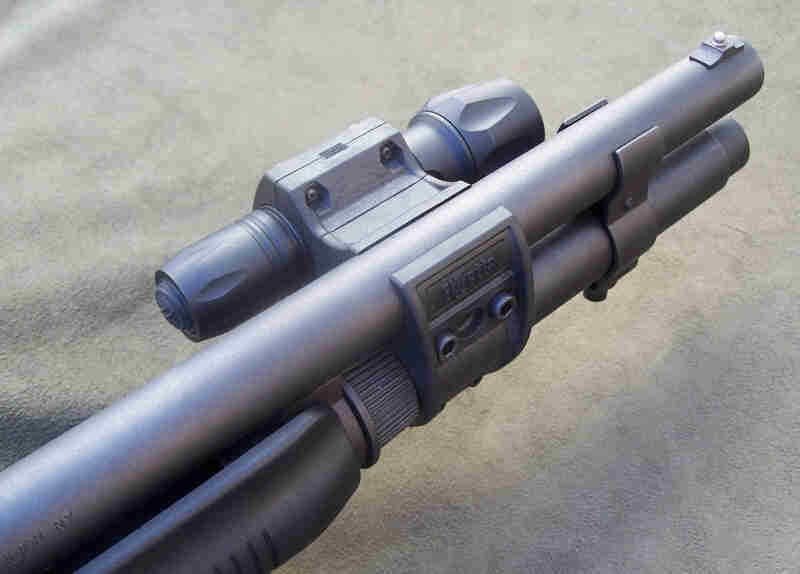
We’re talking about a gun that you’re likely to use in the dark hours. Light is a must for identifying your target. It also might serve as a navigational or signaling aid, but this kind of use should be minimized since, with a weapon-mounted light, the muzzle will cover everything you light up—a shaky proposition from both safety and legal viewpoints; the latter especially applies when outside of your residence.


Wouldn’t a nice flashlight do just as well? Perhaps, but most people aren’t prepared to wield both a flashlight and a long gun while making accurate shots. So a gun-mounted light makes sense, though it cannot avoid the muzzling issue, so that safety rule about keeping your finger off the trigger until the sights are on target and you’ve decided to shoot applies — in spades.


Entry level long gun-mounted lights begin at around $65. Prices climb rather dramatically after that, with some excellent choices available for less than $200. You’ll want to select a light with a pressure switch — that is, one that you can operate with the hand that’s on the forend, and one that turns off as soon as you release pressure. When someone’s trying to kill you, it’s a good idea not to reveal your position with light more than necessary.


4. Tritium front sight


Least beneficial but still useful of the four items here is a front sight with a tritium insert, which glows in the dark and is visible only behind the gun. Without it, only a silhouette of the front sight will be visible with a weapon-mounted light. This accessory will cost $60-$100, but consider hardware and gunsmith costs. as well. Be sure to practice with any sight system so you know where your shots will impact at typical close-range distances, and adjust your sights accordingly, or adjust your hold if the sights are non-adjustable.


Hopefully. this has given you some ideas of choices to accessorize your home shotgun to make it safer and more effective for defensive use. While these gadgets are useful, having them is only half the equation. Practice, and with that, knowing how to use them in dim light, is equally valuable.


If readers have experience with other shotgun accessories they’re fond of, I’m interested in hearing about them.


Do you have other favorite shotgun accessories? Share your tips in the section below:


Pump Shotguns Have One BIG Advantage Over Other Shotguns For Home Defense. Read More Here.