Showing posts with label home defense. Show all posts

Monday, May 7, 2018

Selco: How to Defend Your Home and Yourself When the SHTF

This article was originally published by Selco at The Organic Prepper


Editor’s Note: Have you ever wondered how to defend your home and yourself if the SHTF? In this interview, Selco provides us with information from his personal experience during the occupation of Bosnia. There are many lessons we can learn from his experience. ~ Daisy


What was the most likely crime you would encounter when the SHTF?


Where there is no regular system of law and order you have different kinds of groups who impose that “law and order.” In reality, it is lawlessness or law of whichever group is stronger.


To add to that, when there is not any kind of “law” it is then a matter of a no-rules situation.


That means all kind of violence was there.


In reality, it worked on many different levels. For example, you form an armed neighborhood watch. We did, of some 15 people, in our street. Sometimes, in the middle of the of night, we were faced with a group of 50 men demanding something from us. For example, one was a group of people in uniform who stated that they were government forces and they wanted to check our neighborhood for whatever reason.


We could obey or fight or negotiate. All combination were tested over the time, and sad truth is that when SHTF for serious there is gonna be many different groups who will “represent” government (or law, or order or you name it). But in reality, it all comes down to who will outsmart who.


The most likely crimes were connected with resources because simply in that time and city there was not enough resources.


So it was about who owned how much (resources), and ways to take those resources from other folks.


It worked on a low level. For example, a few guys could kill you in the street and take your possessions, or on a bigger level – a local gang (if strong enough) could own your part of town and terrorize you and other folks by taking your stuff with brute force.


How did you make your home less desirable to criminals?


First, it was important where your home is, even in urban settings your house can be kinda “isolated” or stand in a way that it clearly “sticks out.” That was bad, and you could not change it.


Then it was important what period of SHTF we are talking about. At the starting period of SHTF, it was bad if your house was close to some objects that were interesting for looting, like malls, gas stations, police stations, or similar.


Generally speaking, it was better if your home (we are talking about in the city) was in the area where it was more packed with houses, simply because it was easier to blend in. Also, as the situation worsened we could use close houses too as they became destroyed or abandoned, which gave us more options, especially in terms of security.


The first level of making a  home “less desirable” to criminals was simple blending in. I point it out very often as the most important thing in a home defense plan.


It may seem hard to understand why I point it out so much, but think about it this way:


In order to “pacify” and “own” a city, you need to have a huge military force, organized in a perfect way. Even then it is impossible to be safe in that city. There are many examples of that in modern history.


In my case, and in that SHTF, nobody really “owned” the city. There were many groups trying to acomplish that through different methods. But in reality and on the ground it was a situation where nothing was for sure.


As a result, most of the home invasions were a matter of opportunity. If attackers saw the opportunity they took it.


It was not a rule, but it was very often like that.


As a result, a good plan was not to be that opportunity.


In my case that meant we tried to keep our activities on a low level when it came to giving up information about resources in our home.


For example, if we needed to drag some bags of food home we did it so no one saw it. If we cooked something, sometimes even a nice smell could pose a possible danger.


In short, it was time to be quiet and look for danger.


For example, to transfer it to your world-  if something serious happens there in your city do you want to be the only guy in the neighbourhood running a generator? Or do you want to be only one who has a barbecue every night when SHTF?


In my case, sometimes people did even more drastic things, like placing dead animals somewhere so stench could fend off intruders. It was not about scaring the attacker with the stench. It was about a situation where you have 20-30 houses very close to each other, and you have 50 people going through your street, mostly armed. And they look for useful things, they are scavenging. They might take a chance and fight if they find people defending some house, or they might not, you never know.


So you make your house or your entrance and yard look abandoned, deserted destroyed, dirty…by putting some garbage, obstacles from ruins, some dead animals and you hope they will choose some other house because other houses look easier to get in and more desirable.


People do not go gladly into places where they suspect dead things are or go gladly through some obstacles that can hurt them (remember-no doctor). They will chose another target.


That is the first line of defense. The second line is you and the people inside waiting with guns.


Now, this may look stupid to you. You might say,”Oh, this is the US. It does not work like that here.” But think about principles, maybe in your case some CDC label (“infectious diseases” or “bodies inside”) works.


For example, in my case, a sign warning of “mines” would do a pretty good job but it might be good only for my region.


It is all about deterring those who are thinking about coming to your home.


How did you secure your doors and windows?


First, it was very important not to “trap yourself” in. There was no sense, if you were under attack, being so well fortified that you could not get out.


Alternate exit and entrances were very useful at that time, not only because of defense. Very often, it was good to leave and enter your home invisibly. You were never sure who monitored you and the stuff you were taking into your home.


Most of our houses are brick or stone houses, so from that point pretty good for smaller calibers. Very soon people started to reinforce doors and windows with whatever was available that offered protection.


One of the coolest was steel sewage covers. Those covers offered good protection. The favorite was dirt bags in combination with boards (planking).


Of course, we used also whatever was available, so a laundry machine, for example, was a good addition for “plugging” a hole.


Can you tell us about your home defense plan? How did you defend your home?


The house was always guarded, all the time.


Depending on the situation (or let us use the term “threat level”) it was guarded and defended in layers. The outer layer, for example, started on the street, through the neighboring abandoned house, then to the last layer – our house.


If you had to fight, it was bad if you failed to use outer levels and the fight started in your house.


If you choose to avoid fighting, then the outer levels may not be implemented at all. You could wait and hope to avoid the fight unless they attacked your home.


Another good term that comes to mind is that situation was dynamic. Based on that, we adapted.


Sometimes the situation dictated that the threat would be eliminated quickly out in the street.


No rules.


We were not soldiers, and the people who attacked us were not soldiers in most of the situations. We were closer to some kind of militia probably when it came to the rules of fighting.


Our weapons and condition was a matter of many other factors:


  • how much ammo we had

  • how many sick group members

  • did some of us had a grenade in given moment


Then it was a question of how the attackers looked to us:


  • organized or not

  • what kind of weapon they had

  • any visible fighting skills

  • RPGs

  • organized gang or bunch of desperate folks


Every situation was different.


How great was the risk of being assaulted when you were away from home?


It was a great risk because you were exposed much more to the danger then being inside your home.


It is important to understand that sooner or later you’ll be forced to go out, and in urban settings that means you meet other people.


The point of prepping is to postpone that moment (by having a lot of resources in your home) until you figure out what is going on outside.


You can try to minimize the risk of violence when you are out by carefully planning all your trips and tasks and using as much information available in that planning. But in reality, in urban settings, there are simply too many factors. You never knew what you find out outside your home while you are looking for firewood for example.


Were women victimized? How did they protect themselves?


In any societal breakdowns, women are victimized.


Also in any modern society, there are certain people who are, let’s say sick, but they are under the care of the system (or simply scared of system and punishment that the system will bring to them if they assault women.)


When society’s laws are out, that punishment is also out, so those kind of people are on the hunt.


Women’s victimization is also brought on another level. Powerful groups (gangs) had their own prisons with women inside. That was used as a kind of reward for gang members.


It was also used in a way of bringing terror to the people. For example, rape was used as a punishment in a lot of cases if people would not obey.


It was part of a special war policy if you can call it like that, to know as a fact that women from your family, for example, could end up in a private rape prison.


Fear and terror was a big part of everything.


Women protected themselves in two ways (actually just like males did):


  • by belonging to some group, like family, group of friends or similar-sharing their knowledge and role in that survival group

  • by joining some other group, more let us say sinister group and looking for safety there in exchange for other activities.


What were the ways people protected themselves?


The most effective way was by organizing into groups that had something in common. The more things, they had in common, the better the group was. People with things in common are more trustful.


Of course, common sense says that no matter how much a group was trustful, if they did not had enough skills and the will to use violence, chances for them were poor.


Quite opposite to some myths, violence was not a solution for everything. Very often it led to death.


The knowledge of how to use violence was very cool, but much more important was the skill to judge WHEN to use violence and when to chose some other way (run, negotiate, trade…)


What are your suggestions for ways we can prepare now to keep our homes and selves safe when the SHTF?


There are no magic solutions.


I am talking from the point of urban survival, and there are two reasons for that:


  1. I experienced urban collapse so I have experience there


and


  1. Most of the people live in some kind of urban settings, so chances are big you are gonna experience it too.


There is a popular myth that all of us who live in urban settings will “bug out” to our rural retreat on time (I have that plan too), but in reality lot of us who even have the good bug out places out of the urban centers will simply fail to reach it on time. This is reality.


So a few urban survival suggestions to defend your home:


  1. Do not be alone when SHTF. No matter how romantic it looks to be the lone wolf, it is hard and almost impossible to survive it alone without help. You are gonna be sick, you are gonna be forced to be on guard 24 hrs a day, you are gonna have hard time looking for resources…

  2. Find like minded people (preferably before SHTF). You need time to find people, and you need time to get to know that people.

  3. Be ready for violence. Both physically and mentally, practice with your weapon and be very familiar with your skills and especially with your limitations. Use common sense in choosing your weapons. Check what is useful to have in your situation.(For example, in my situation it made sense to have AK, CZ and similar.)

  4. Look at your home from the point of defending/attacking it. Look today how your home stands, how you can improve it, for example in “deterring” possible attackers, neighboring houses, ways of approach, possible booby traps, ways to quickly reinforce your home…


At the end, you need to get up and work pretty hard in order to be prepared for a real collapse, No internet article can teach you that. It can only give you highlights or possible direction.


******


About the Author


Selco survived the Balkan war of the 90s in a city under siege, without electricity, running water, or food distribution. In his online works, he gives an inside view of the reality of survival under the harshest conditions. He reviews what works and what doesn’t, tells you the hard lessons he learned, and shares how he prepares today. He never stopped learning about survival and preparedness since the war. Regardless what happens, chances are you will never experience extreme situations like Selco did. But you have the chance to learn from him and how he faced death for months. Real survival is not romantic or idealistic. It is brutal, hard and unfair. Let Selco take you into that world.


You can learn more about Selco at his website, SHTFschool.com. Check out his online courses and physical courses for a reality check about SHTF scenarios.

Monday, January 8, 2018

Will Home Security Systems Work When The Grid’s Down?

Will Home Security Systems Work When The Grid’s Down?


Defending your home can be a complex task, and one that we need to simplify as much as possible.


What makes it complex, more than anything else, is that we are trying to defend ourselves from a variety of different potential threats.


The majority of the population is only concerned about protecting themselves and their homes from robbers and home invaders. While these are two distinct groups, who act and react differently while committing their crimes, the differences aren’t as great as their commonalities. But the real thing that our friends and neighbors have going for them, in defending from these threats, is that there is an active police force working in their city.


Even if the police can’t get there on time to stop a crime from happening, the threat of the police bringing the law down on the criminal is a deterrent to crime. Criminals’ actions are largely built around avoiding that happening. Thus, your average criminal will try to avoid doing anything to attract attention.


As members of the preparedness community, we deal with these threats, as well, but we also look beyond the “normal” to times when there might be a breakdown of society. In such a societal collapse, the normal constraints against crime are reduced or eliminated altogether. So, there will be more criminals and they will act differently.


For this reason, the conventional wisdom that is used to prevent crime may not work in such a situation. We cannot assume that those operating outside the law will care about attracting attention to themselves when there is the possibility that there won’t be a police force to hunt them down and arrest them.


One of the many things that this means is that intruder alarms in a post-disaster situation, where there is a breakdown of society, will need to perform different functions than they do today, when things are normal.


Alarms in Normal Times


To start with, let’s look at intruder alarms and home security systems in our normal, day-to-day life. There is little chance that any of us is going to be faced with a gang attacking our homes, looking for food. The threats we are concerned with are robbers (trying to steal our valuables) and home invasions (which can be more violent). While it may be necessary to take up arms in the defense of home and family in these situations, you have the advantage of the police backing you up and coming to the rescue.


You Don’t Need A Firearms License For This Weapon!


Most home security systems are intended to deal with this sort of situation. A monitoring station receives notification that the alarm has been triggered and then informs the police so they can act.


In such a case, your defense is primarily dependent upon the police and how quickly they can react, not your own actions. But considering that the average criminal is in the home 90 seconds and according to 9-1-1 the average police response time is 3 to 12 minutes, they don’t manage to stop many crimes. In reality, the threat of that alarm is the greater deterrent, and you often can get the same results by putting a sign from the major alarm companies in your front yard.


Alarms in Post-Disaster Times


When we look at a post-disaster scenario, the burglar alarms that people depend on today won’t do the least bit of good. There are two main reasons for that. First, the entire system, especially the monitoring station, depends on the electric grid being intact, providing them with power. Yet, as we’ve seen in just about every major storm, the electrical grid is highly susceptible to damage.


The second reason why that burglar alarm is not going to be useful is that the police probably won’t be available to respond. Even if the police don’t abandon their posts to take care of their own families, they will be overwhelmed by work, making it more or less impossible for them to respond to every alarm. So, you’ll largely be on your own.


This means that any alarm system you use must be designed to function on a local level. In other words, it must be there to inform you that someone is coming onto your property, and not simply inform the police. Ideally, it will do this without you having to monitor it constantly.


Burglar Alarms


Although a burglar alarm that goes to a monitoring station probably won’t do you any good, that doesn’t mean that burglar alarms are useless. Rather than having an alarm company install a system, you could install your own, setting off an audible alarm to warn you when someone breaks into your home. Of course, this requires having an electrical power source to operate, but most alarms use very little electricity.


The drawback to this sort of system is that you can only put it on the perimeter of your home, not the perimeter of your property. Nevertheless, it has value.


Monitors


Video monitors allow you to up your game, in that when they are properly situated, they can show you everything that’s going on around your home or survival retreat. Many modern monitors operate off Wi-Fi, so they are easy to install and have a low electrical consumption. Even if the Internet is out, your local Wi-Fi network would still be operable, as long as you are producing your own electrical power and have a modem that was not damaged by an EMP.


The drawback of using monitors is that someone must monitor the monitors. However, if you already have someone pulling guard or lookout duty, they could watch the monitors, as well, making it possible for them to keep watch in more than one direction at the same time.


Trip Wires


Perhaps the simplest way of providing yourself with an intruder alert is with some sort of tripwire. While the basic tripwire is nothing more than that — a wire — tripwires can become much more sophisticated, depending on what you have to work with and what you need to do. More than anything, you’ll want to use tripwires as part of your perimeter defenses, letting you know when someone comes on your property.


Typically, trip wires are attached to some sort of alarm. On the most basic level, this is a metal can with some gravel in it. When the wire is hit, the can moves and the gravel inside makes noise. You can easily improve upon this system by buying the simple sort of battery-operated burglar alarm, which is sold for travelers to use on their hotel rooms.


You may have seen an article at some time about using chemlights to make a perimeter alarm. This is nothing more than a visual form of tripwire, rather than an auditory one. But the basic idea is the same. If you live out in the woods, such an alarm would be extremely obvious, making it an excellent choice.


Another type of tripwire is the laser entry alarms that are commonly used in stores. Placed across a driveway or other entry to your property, they can cover great distances, especially at night. Although they need electricity to operate, they have the advantage of not informing the intruder that they’ve set off an alarm, unless you want them to.


While tripwires are an excellent option, they all have the same drawback — that of needing to be monitored. Granted, it is possible to set them up in such a way that they set off an alarm that doesn’t require constant vigilance, but it will always require constant awareness. When that alarm goes off, you want to be sure that you will hear it or see it, regardless of where you are or what you are doing.


Animals


Animals are the oldest intruder alarm in history. Anyone who owns dogs knows how effective they can be in letting you know when an intruder comes around. Your dogs will warn you of every delivery, Girl Scout selling cookies and meter reader that dare approach your home.


While animals are not a perfect alarm system, they have many advantages over any other, especially if you have a number of animals. One dog alone might be able to tell you if someone approaches the front of your house, but they can’t tell you that if they’re in the backyard when that intruder arrives. As with any other alarm system, to be effective, animals need to be scattered around the property.


Dogs aren’t the only animals that make good alarms. Donkeys are excellent intruder alarms, as are guinea hens. Nothing will be able to come near your home undetected if you have a dozen or so guinea hens living there. On top of that, they serve as a backup food source.


Conclusion


As you can see from what I’ve listed above, there really is no perfect intruder alarm that will work in all situations. To create a more perfect system, you really need to use a combination of different alarms, providing you with a layered defensive approach. What one alarm might miss, another will see, providing you with the necessary notification of any intruder arriving.


What advice would you add? Share it in the section below:

Monday, December 11, 2017

Clever Home Defense Tactics That Will Keep You Safe

Clever Home Defense Tactics That Will Keep You Safe

Public Domain Pictures


Many people own weapons for the purpose of protecting their home. However, how many people actually have a plan for what to do if they ever have to use them?


While it is a scary thought, thinking about some home defense basics is worthwhile. Having your weapons is great. Having a plan increases your ability to protect yourself with them.


In this article, we will go over some basic home defense tactics. I have written previously about how I like to have weapons spread out throughout my house. While I realize that not everyone agrees with this thought process, the tactics will be similar.


As long as you have a weapon that is easily accessible, your home can be defended. How you do that is up to you, whether you have guns throughout your house, or if you are always armed on your person. However, for home defense, I cannot understate the importance of having a shotgun. In my opinion, this really is the most important home defense weapon.


You Don’t Need A Firearms License For This Weapon!


Before getting into the tactics, we are going to assume that you have all of the non-weapon home defense measures in place. Examples could include motion sensor floodlights, deadbolt locks, and a security system. As we all know, these aren’t always enough, but they are a necessary start.


Let’s get into the tactics.


Avoid/Escape


I know what you’re thinking. This is not what you want to do in the event your house is being broken into.


While many people don’t want to hear this, it is the safest answer. If you can safely get out of your house or barricade yourself in a room (armed, of course), that will be your safest bet. Arm yourself first, but if you can safely get out, I would recommend doing that. Get away or get out, call the police, and be prepared.


Fight


However, in many situations, this isn’t possible. Maybe you’ve got kids upstairs, the intruder knows you are home, or you aren’t going to be able to get out of the house. Whatever the case may be, there is a good chance you may have to engage the intruder.


When it comes to engaging the target, speed is the most important factor. Speed of acquiring the target, speed of engaging the target, and speed of re-engaging the target are all very important things to consider.


Target Acquisition


To increase your speed acquiring a target, there really is only one thing to do. Practice, practice, practice.


Go to the range and practice aiming down your sights and acquiring targets. Move your body around and move the target around. You don’t even have to go to the range. Do dry runs in your house or backyard, as long as you are certain the weapon is cleared.


Engaging the Target


It may seem simple. Aim and shoot. But, consider the fact that your life will be threatened and your adrenaline will be pumping. Do you think it might be possible to accidentally leave the safety on, or make a similar mistake?


This can be improved with practice, as well. Run through it as much as possible; it will eventually become muscle memory.


Part of this could be taking the target by surprise. Anything that can give you a speed advantage should be considered. In a situation like this, being controlled but fast will keep you alive.


Now, keep in mind that you may have to re-engage a target that will likely be moving. Improving the speed at which you can do this also comes from practice. Practice acquiring targets, engaging the target, and cycling the weapon, if necessary. It is hard to replicate shooting a moving target, but the more time you have spent looking down your sights, the easier it will be.


Protecting Yourself


Obviously, it would be ideal to engage an intruder in a plate carrier and Kevlar helmet. However, this isn’t always possible, so what other ways are there to protect yourself and those around you?


As most people who are familiar with weapons and ballistics are aware, there really isn’t much true cover inside a house. There are very few things that will actually stop a bullet in your house. However, concealing part of your body will give the intruder less to return fire at. If part of your body is concealed by a wall or something similar, this will make you much safer.


Another way to make yourself safer is to change the position from where you’re shooting. Taking a knee makes less of your body exposed, and makes it more difficult for an intruder to potentially return fire.


So, if you are able to quickly acquire and engage a target while part of your body is concealed, you will do a good bit in improving your safety.


However, where is that bullet going? Like we talked about before, there isn’t much in your house that will stop a bullet. So, while you are going over some potential courses of action, be sure to take into account exactly what and where you are shooting. Think about whether or not people may actually be behind the target you’re shooting at. This is the exact kind of thing that you would not think about in the moment. However, having somewhat of a plan will help.


Weapon Accessories


Some people swear up and down by their weapon accessories. I think that they can sometimes be helpful, but many people rely too heavily on them.


Weapon accessories can help you, but they cannot replace practice. Practice using your weapons. Use the accessories as accessories rather than necessities.


However, with that said, there are two accessories that I think are very helpful in a situation like this. A quality sight can make it much easier to acquire a target. A red dot style sight that you can shoot with both of your eyes open can give your weapon point and shoot ease of use, which could be extremely useful in the middle of the night or when your adrenaline is pumping.


The other accessory that I think would be helpful is a bright flashlight. While being directly in front of your target is certainly less than ideal, a very bright flashlight can buy you some extra time. It could disorient your target, and give you enough time to acquire and engage the target.


One Final Tactic to Consider


If for any reason you have to clear a room in your house, there is one basic tactic to check out. Look up the “slicing the pie” tactic on YouTube. It is easier to see it in a video than read it in words. However, it is a simple tactic that can help you to clear a room if you need and will keep you safe.


What other home defense tactics have you been taught? Be sure and leave a comment below!

Monday, December 4, 2017

The Very Best Ammo For Home Defense

The Very Best Ammo For Home Defense

Image source: Pixabay.com


Previously, I wrote about my basic layout for home defense, and why I like to have my weapons laid out in such a specific way. In this article, I’ll go over my thought process for choosing ammunition, and what types of ammo I have throughout my house.


Generally speaking, I select the type of ammunition that will inflict the most damage if I ever have to use it.


Shotgun


As I’ve said before, in my opinion, home defense starts and ends with a shotgun. It is absolutely the best weapon that I own for self-defense. My 12-gauge shotgun is a permanent fixture above my nightstand, and it’s always loaded with Winchester PDX1 shells.


There are plenty of different home-defense shotguns, both slugs and buckshot. Choosing the best load for your shotgun should be based on your use. If your shotgun is primarily meant for close-range engagements, buckshot would be your best bet. If you might use it at further distances, a slug would perform admirably.


You Don’t Need A Firearms License For This Weapon!


My personal favorite round is Winchester PDX1. This specific round has three buck pellets surrounding a slug. The result is an extremely deadly round. However, there are plenty of different shotgun rounds that could meet your needs.


Handgun


Regardless of caliber, hollow-point ammunition is going to be your best bet for defense purposes. Jacketed hollow-point ammunition expands on impact, as opposed to traditional target ammo, which does not. For defense use, this means that once the bullet hits your target, it will expand and impact more tissue. As a result, the round is much deadlier. While it is more expensive, hollow point ammunition is worth it for defense purposes.


Rifle


There are a few different types of rounds used in 5.56 ammo that are used in AR-15s. There is the standard full-metal-jacket ball ammo, hollow-point ammo, and also barrier blind ammunition. Barrier blind is a relatively new type of ammunition, and represents the most modern ammunition technology. Based on initial testing, barrier-blind ammunition performs very well.


However, high-grain ball ammo and hollow-point ammo also perform well in AR platform firearms. In other rifles, most quality hunting ammunition will perform well for home defense use.


Overall, the number of different types of ammunition available can be overwhelming. As a general rule of thumb, more propellant means a faster bullet, which means a deadlier round. However, there are a few other things to keep in mind. Modern improvements in ammunition, such as jacketed hollow point and barrier-blind ammunition, perform extremely well. They do an excellent job expanding when they hit their target. This expansion creates a much deadlier round then the traditional full-metal-jacket range ammo. When it comes to shotguns, buckshot is probably your best bet, but once again, there is modern ammunition that has both a rifled slug and buckshot built into it.


What do you prefer for home defense ammo? Share your thoughts in the section below:

Thursday, September 14, 2017

The 5 Most Reliable Shotguns For Home Defense

Image source: screen grab (YouTube: hickok45 channel).

Image source: screen grab (YouTube: hickok45 channel).


When looking for a home defense shotgun, the senses can be annihilated by the numerous varieties that are out there.


But what are the best, most reliable ones? Rather than choosing the top five brands or models, we decided to break this down by action-types or how the shotgun works.


For gauges, I generally recommend the 12, 20 and 16 gauges above all else. .410 bore shotguns can be useful, as the recoil is mild and a host of self-defense rounds are offered. In general, I avoid the massive 10 gauge and diminutive 28 gauge — unless you are attacked by a flock of birds — as there are severe limitations on the ammunition types for these two.


1. The pump shotgun


Easy to use and the hallmark of home defense for more than 100 years, the pump shotgun is probably the number one long gun choice for home defense in today’s world. Holding anywhere from 3 to 12 rounds based on configuration, the pump shotgun offers rapid follow up shots and the option of a quick reload.


Chances are that you already have one of these shotguns made by Mossberg, Remington, Winchester, Benelli or one of the myriad of other companies that produces shotguns today.


Vicious New Hand-Held Self-Defense Tool Turns Lethal In Seconds!


The most common examples include the Mossberg 500/590 series, Remington Model 870, Winchester 1300 or Defender, Winchester Model 12, Benelli Nova, Kel-Tec KSG and Maverick 88.


2. The semiautomatic shotgun


Older semiautomatic shotguns may have had their limitations with regard to reloading quickly or reliability, depending on the type of shells used, but modern semiautomatic shotguns have proven themselves to be adequate fight stoppers with the right ammunition.


Follow-up shots are quicker than the pump shotgun, and perceived recoil is only slightly greater as opposed to some of the original models used to protect home and family.


I prefer the Remington 1100 or 1187, or the newer Benelli M1 and M3 versions.


3. The side-by-side shotgun


The 5 Most Reliable Shotguns For Home Defense

Image source: Pixabay.com


Long before the semi-auto and pump shotguns came into common usage, the side-by-side double barrel put food on the table, quelled more than one riot and protected more homesteads than any of the various revolvers or lever-action carbines that claim to have won the West.


More modern renditions use internal hammers and can be had by European American Armory, Baikal, Remington and a few others that cater to the Cowboy Action Shooting realm.


4. The single shot shotgun


For the shooter on a budget, a single shot shotgun may be a sane alternative. Costing less than $100 in some places, these shotguns are better than a small caliber handgun as your only option for self-defense at times.


A shell carrier mounted to the butt stock provides quick reloads at your fingertips.


The most common single shots on the market today are produced by Iver Johnson, Harrington & Richardson as well as a few store brands made under license by these companies.


5. The lever action shotgun


Not as common in history as we may have been led to believe through the magic of movies, the lever action shotgun debuted as Winchester’s answer to keeping their tradition of fine lever guns going forward. With the originals now holding value as collector’s items, one need only look to the Italian replicas as examples of how costly it was to make these shotguns.


A number of Chinese-made versions are imported, and if you have to have one based on the nostalgia of watching Terminator 2 more than once, they make a great home defense shotgun with a little work.


What’s Missing?


We left out the over/under shotgun, for a number of reasons. Most have barrels that are way too long for maneuverability inside the home, and even a shorter barrel makes it slow to reload, as the action must almost always have to break a sharper angle to remove spent shells than a typical single shot or side-by-side shotgun.


Apart from those limitations, if it is the only firearm you have with which to defend yourself, it beats trying to hold down the fort with a sock full of nickels.


Accessories


I strongly recommend the shortest barrel you can legally use and the addition of a flash light (for target identification) and a sling (for portability). Some butt stocks will allow the use of shot shell carriers, and others can be mounted to the receiver.


The most important accessory, of course, is ammunition, so you can practice often with your self-defense loads of choice to see how the shotgun patterns and feel its recoil.


What is your shotgun choice for home defense? Share your ideas in the section below:


Pump Shotguns Have One BIG Advantage Over Other Shotguns. Read More Here.

Monday, August 28, 2017

How To Turn Hedges Into A Rock-Solid Home Defense Fortress

How To Turn Hedges Into A Rock-Solid Home Defense Fortress

Image source: Pixabay.com


There are a lot of homes with wrought iron fences around them in the area where I live. This comes from the strong Hispanic population in the area. In Mexico, it’s common to build cinder block walls or wrought iron fences around a home as a means of protection (remember, they don’t have our Second Amendment rights). So, what we have here is merely a carryover that they’ve brought with them when they moved to the United States.


This is rare in the rest of the country, where we are accustomed to wood fences in the backyard and open front yards. Our fences aren’t built so much for security, but for privacy. We even call them “privacy fences.” In reality, those privacy fences don’t do much to help protect us, considering that the horizontal bars provide a ladder. They aren’t even secure from the other side, as all it takes is a hammer and pry bar to pull the fence apart.


Coming Up With an Alternative


So, what do we do? How can we provide ourselves with some level of perimeter defense, without making it look like we’re trying to turn our home into Fort Knox?


Before we go any farther, let me clarify something. No passive defense system you can build will keep your home safe, unless you build an actual castle, moat and all. However, it can do several things for you: 1) It can slow down your attackers, giving you time to react. 2) It can channel the avenue down which your attackers come. 3) It can limit the access points to your house.


You Don’t Need A Firearms License For This Weapon!


I recommend planting hedges. First, it can be just as effective at blocking access to your property as a wall can. Perhaps even more so, especially if you use a plant that has thorns. There’s just something about those thorns that people don’t like. Secondly, it won’t look like a wall, so it won’t convey the message of being a part of your defenses, even though it is.


There’s another real advantage of planting a hedge rather than building a fence: The hedge is a whole lot cheaper. Our hedge, which surrounds our front yard, consists of 84 bugambilia bushes. Since I bought them from a wholesale nursery, it cost me less than $200 to plant my hedge.


Creating Your Defensive Hedge


If you decide to plant a defensive hedge, the first thing you must decide is whether you want a slow-growing plant or a fast-growing plant. The slow-growing one will take less maintenance, as you won’t have to trim it as often, but it will be considerably longer before your hedge is at the point of being an effective part of your defenses. A fast-growing one, on the other hand, will augment your defenses within a few months, but you’ll end up having to trim it every week or two.


We planted our hedge in one day, with the help of some friends. While we were doing the project, I took advantage of the opportunity to install underground soaker hoses for watering, cutting down on my maintenance work. I also put a swath of landscaping fabric under the bushes, covering it with mulch. This eliminates the problem of having to mow under the bushes.


You will have to decide how far apart to plant your bushes, based upon the type of bush you select and how fast it grows. Mine are two feet apart, which worked out extremely well. But if I had used a slow-growing plant, I would have planted them closer together.


As part of your planning, decide what openings you are going to leave. The only ones we have are at the front walkway, coming up to our front door and the walkway that connects to the driveway. At the end of the hedge, where it connects to the neighbor’s fence, we have grown the hedge several feet past the corner, eliminating any opening there that can be used to squeeze through. So, we have positive control over the access routes that attackers can use. Those are covered by surveillance cameras.


The most important part of the process begins once the bushes start growing. That is to interweave the branches, crossing them over those of the adjacent bushes. In some cases, the branches on our bushes are actually crossing three other bushes before reaching the top. This makes it impossible for anyone to push their way through the hedge. They would have to cut through it first.


I’ve made that difficult by threading some quarter-inch diameter steel rod through the hedge, with one course halfway up its four-foot height and another about a foot above the ground. It is tied off to the trunks of the bushes where possible. This also serves to keep people from being able to low crawl under the bushes, even though our small dog can still escape that way.


The Psychology Behind the Plan


It’s important to understand what I’m trying to accomplish here. It’s not so much to keep people from being able to approach my front door, as it is controlling how they approach my front door. Without the hedge, people could cross over from my neighbor’s front yard and approach my front door without me having a chance of seeing them. That could mean that my first notice that my home was about to be invaded would be someone’s boot kicking my front door.


Other than trained military operators, people will pick the easiest way to go around or through any obstacle. So, by blocking off my front yard, while leaving open the front walkway, I can pretty much guarantee how people will approach my home. And, thus, my home is safer.


Have you ever used hedges for home defense? Share your advice in the section below:

Monday, August 21, 2017

I Store My Home-Defense Guns In 5 Different Rooms. Here’s Why.

I Store My Home-Defense Guns In 5 Different Rooms. Here’s Why.

Image source: Pixabay.com


While I may be a bit over the top with my home defense preparation, I would rather be way overprepared than underprepared.


I’ve put a lot of thought into where weapons should be placed throughout my house. Each one is in a very specific location, and serves its own distinct purpose. The way that I have placed my weapons was based on a few different threat levels that I assessed. All total, I store weapons in five rooms.


The first threat level that I considered was an immediate threat. To me, an immediate threat constitutes someone actively breaking into my house. In this situation, I would like a firearm easily accessible and ready to rock. The most important weapon that I consider to be used against an immediate threat is a shotgun in the bedroom. My reasoning: I view the most dangerous situation to be someone breaking into my house in the middle of the night. I generally still have my daily carry weapon in my nightstand, so it’s easy to grab on the way out the door, but a shotgun permanently lives on the wall above my nightstand in a custom concealed weapon case. The reason that I decided to go with a shotgun in the bedroom is that I’m a pretty heavy sleeper, and in the event that someone is actively breaking into my house, I like the point-and-shoot ease-of-use of a shotgun.


Vicious Hand-Held Self-Defense Tool Doesn’t Require A License!


The next weapons that I considered for use against an immediate threat are handguns in the rooms that I am most frequently in. For this reason, I’ve got a revolver tucked away in my living room and in my kitchen. Similar to my shotgun, these are all concealed in some type of box or case that is easy to open.


To me, a secondary threat constitutes someone lingering suspiciously around my house or poking around my vehicles too much. It’s a situation where I’m not planning on immediately engaging a threat, but I’m getting the feeling that something is wrong and I want to be ready in the event the unpredictable happens. For a secondary threat, I want a handgun with a higher ammunition capacity near the back door and the garage door of my house, so that I can easily grab it and throw it in a sweatshirt pocket or the waist of my pants to see what’s going on. These are concealed in boxes on shelves.


The last threat level that I considered is the extremely unlikely chance that I’m engaged in some type of firefight or a gunfight that moves out of the house. To me, these are the kind of weapons that can be tucked away in a closet or in a safe, because it’s unnecessary for me to have them immediately accessible. In my situation, I have my AR-15 with three loaded magazines in my closet.


Lastly, I will touch on safety. A headline we see all too frequently involves young children getting a parent’s weapon and accidentally harming or killing someone – perhaps themselves. Since I don’t have any children, I have absolutely no qualms leaving my weapons completely ready to go. Every single weapon in my house has a round in the chamber, with the exception of the AR, as I don’t classify that threat level as requiring immediate action. However, as soon as I do have kids, things will be different. I’ll still keep the magazines loaded, but I will refrain from keeping a round in the chamber. A habit that I will have to break is simply leaving my daily carry weapon on my nightstand. I also will have to make sure all of my weapons are up high and even locked away where a young child can’t reach.


Like I said, I am probably over the top on home defense, but I feel that being overprepared is far superior to being underprepared. My biggest concern when it comes to home defense is being adequately prepared to engage any threat that may face me or my family.


Where do you keep your guns in your home? And if you have children, how do you keep your weapons out of reach? Share your home-defense tips in the section below:  

Monday, January 16, 2017

4 Shotgun Accessories For A Better Home Defense

4 Shotgun Accessories For A More Effective Home Defense

Image source: Pixabay.com


A shotgun is the ideal choice for a home defense firearm for many gun owners. There are great reasons for this: avoidance of over-penetration, slightly less demanding accuracy standards in less-than-perfect shooting conditions, and mighty stopping power. Practically every conversation about home defense shotguns also includes mention of that ominous racking sound—but I hope no one is depending on sound effects to scare off intruders, when real force may be necessary.


Like anything else associated with the word “tactical” these days, a plethora of add-ons are available for defense shotguns, not all of which are really useful. Here, I’ll point out a few that are worth the investment for mounting an effective—and ethical—counterattack with a shotgun.


1. A sling


The larger your property, the more complicated your responsibilities at home, the more a sling makes sense. Being able to navigate space hands-free is a major asset; however, it’s also a good idea to keep your gun with you. A sling lets you do both.


Options for slings and sling mounts are many. From a simple latigo strap threaded through the swivel loops on a hunting rifle (making a two-point configuration that’s easy to shoulder), to a one- or three-point tactical setup that allows more options for the method of carry, this is a highly customizable choice.


Be Prepared. Learn The Best Ways To Hide Your Guns.


Expect to spend $20 to $35 for an entry-level tactical sling. Mounts are generally higher in price, starting at $25 and priced up to $75. Before purchasing a sling/mount set, make sure your shotgun has studs, rails or whatever is needed to attach the mounts. It would seem to go without saying, but make sure the sling’s hardware is a match for what’s on the gun. Paracord is a frequently used accessory for making stiff connections easier to work with, and for making a too-wide sling work with narrow loops or rings.


2. On-board ammunition


Let’s assume your gun’s capacity is more typical, between two and six rounds. Even six rounds may not be enough in dire situations where multiple attackers or poor marksmanship have created the need for more ammo.


Where will more ammo go? As with slings, there are choices. I’ll eliminate things like belt-mounted ammo storage for this discussion, since this is about ammo that’s needed in fast order—so it needs to be in or on the gun.


Extended magazine tubes are one choice, and the shortest distance between need and a hot chamber. Alternative mag tube choices exist for common platforms like the Remington 870, Mossberg 500, and their variants. A couple brands also have manufactured their parts to be compatible with Remington or Mossberg mag tubes, but be sure to check the specs before purchase. Expect to spend $50 to $80 on an extension for a magazine tube.


Not crazy about the idea of modifying your scattergun? One alternative is a cloth cartridge holder, which can stretch over or Velcro onto the buttstock, keeping ammo at the ready. I did find it necessary to secure this sock-like accessory with tape when I used one to prevent it from sliding around. That might be undesirable if you aim to preserve a finished wood stock.


Similar to a cloth cartridge holder, but possibly requiring some modification, is a sidesaddle-type shell carrier. These can be mounted anywhere from the buttstock to the receiver, depending on design, and price can vary from $25 to more than $100, depending on material and capacity.


Left-handed shooters should note that many cartridge storage products are made with a right-hand bias, and may not be usable without modifications.


One advantage of an external ammo storage system is being able to organize, and see, ammunition types in relation to their position on the gun. Methods vary, but some defenders like to have one type of ammo, like buckshot, in the magazine, and birdshot ready in the most available loading position. Perhaps slugs will be in the rearmost position. Storing the shells with primer up or down, or a combination thereof, also can help indicate ammo type in a high-pressure situation.


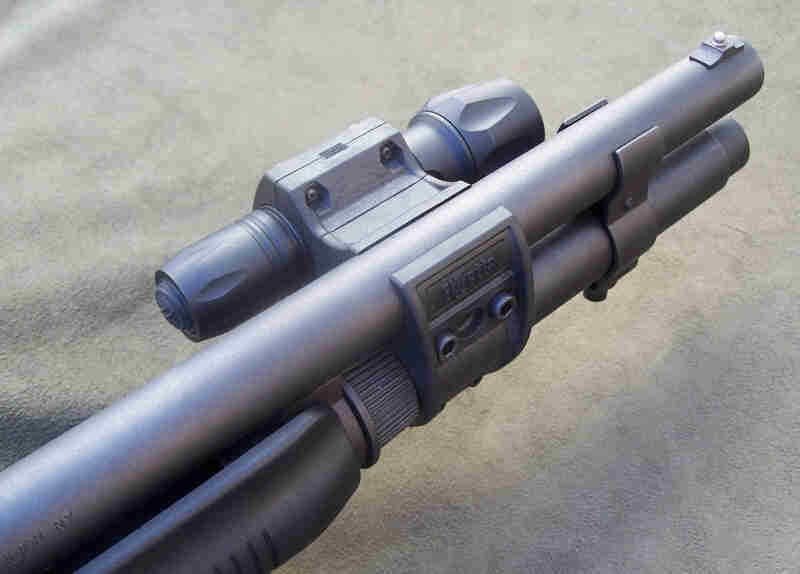
3. Auxiliary light


4 Shotgun Accessories For A More Effective Home Defense

Image source: LA Police Gear


It’s your legal and ethical obligation to correctly identify a threat before firing. The handful of tragedies and more near-tragedies that happen annually due to failure to identify the target are inexcusable.


We’re talking about a gun that you’re likely to use in the dark hours. Light is a must for identifying your target. It also might serve as a navigational or signaling aid, but this kind of use should be minimized since, with a weapon-mounted light, the muzzle will cover everything you light up—a shaky proposition from both safety and legal viewpoints; the latter especially applies when outside of your residence.


Wouldn’t a nice flashlight do just as well? Perhaps, but most people aren’t prepared to wield both a flashlight and a long gun while making accurate shots. So a gun-mounted light makes sense, though it cannot avoid the muzzling issue, so that safety rule about keeping your finger off the trigger until the sights are on target and you’ve decided to shoot applies — in spades.


Entry level long gun-mounted lights begin at around $65. Prices climb rather dramatically after that, with some excellent choices available for less than $200. You’ll want to select a light with a pressure switch — that is, one that you can operate with the hand that’s on the forend, and one that turns off as soon as you release pressure. When someone’s trying to kill you, it’s a good idea not to reveal your position with light more than necessary.


4. Tritium front sight


Least beneficial but still useful of the four items here is a front sight with a tritium insert, which glows in the dark and is visible only behind the gun. Without it, only a silhouette of the front sight will be visible with a weapon-mounted light. This accessory will cost $60-$100, but consider hardware and gunsmith costs. as well. Be sure to practice with any sight system so you know where your shots will impact at typical close-range distances, and adjust your sights accordingly, or adjust your hold if the sights are non-adjustable.


Hopefully. this has given you some ideas of choices to accessorize your home shotgun to make it safer and more effective for defensive use. While these gadgets are useful, having them is only half the equation. Practice, and with that, knowing how to use them in dim light, is equally valuable.


If readers have experience with other shotgun accessories they’re fond of, I’m interested in hearing about them.


Do you have other favorite shotgun accessories? Share your tips in the section below:


Pump Shotguns Have One BIG Advantage Over Other Shotguns For Home Defense. Read More Here.