
Image source: YouTube screen capture
There are two flavors of pump shotgun that seem to dominate the market: the Remington 870 and the Mossberg 590. Each gun has its associated advantages and disadvantages when compared to the other, and fans and detractors seem almost evenly split into two camps, with a lot of us in the middle who shoot and own both types.
Let’s take a look at each design.
Remington 870
In 1951, Remington unveiled the Model 870 as the ultimate modern pump shotgun. Some 65 years and more than 10 million models delivered, it has proven itself to be the best-selling shotgun in history.
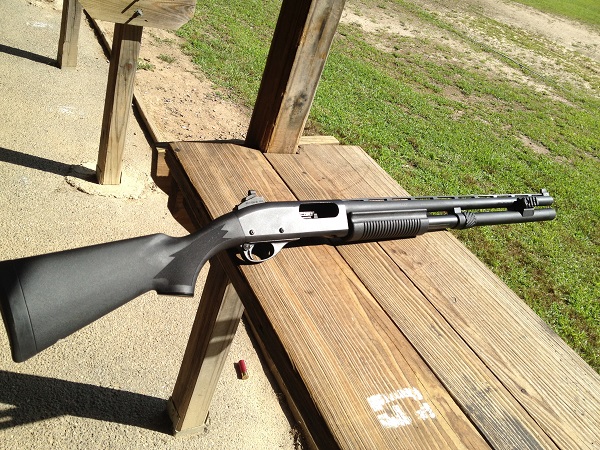
Remington 870. Image source: RifleShooter.com
Available in a variety of barrel lengths, finishes and furniture options, the Model 870 has a vigorous aftermarket dedicated to improving its performance.
One of our gripes about the 870 pertains to Remington going with a dimpled magazine tube that inhibits the installation of a magazine extension.
Be Prepared. Learn The Best Ways To Hide Your Guns.
Probably not a major concern to the millions of duck and deer hunters who cannot legally use them on their 870, it has plagued those of us in the competitive shooting and self-defense realms. There are a number of ways to circumvent this issue, but it is our only real gripe with the 870.
You can either pound the dimples out by inserting a socket head into the magazine tube, or simply drill them out.
I was first issued a 5-shot 18-inch barreled Remington 870 Wingmaster while serving guard duty at the armory during a stint in infantry training school at Camp Pendleton. I did not feel under gunned with it then, and still keep one in a safe with a magazine extension, Remington factory top-folding stock, Rem choke system and Magpul forend with a surefire light.
Mossberg 590
In 1961, Mossberg rolled out their Model 500. The 590 was an improvement upon this design that came about a few years later. The most significant change was the magazine tube that was closer in design to the Remington 870 by using a similar magazine cap that made maintenance easier.

Mossberg 590. Image source: MossbergOwners.com
The design was further improved in the 590A1 by upgrading the plastic safety and trigger guard to metal versions and using a heavier barrel at the request of the US Navy and US Marine Corps.
Perhaps the most significant difference between the two is the placement of the safety. Remington uses a cross bolt type at the base of the trigger guard, whereas Mossberg places theirs at the rear of the receiver in line with the shooter’s sight.
Our gripe with Mossberg is that they offer very little in the way of a choke system on most factory models. A choke system gives the shotgun more versatility as a system. While it may be mostly negligible on shorter barrel home-defense guns, it is still the only way to attach a shotgun silencer like Silencerco’s Salvo.
In spite of my experience with the Remington, my first shotgun was a stainless Mossberg Marinecote 590. I chose this one because I felt its construction would inhibit rust while deploying for six-month Western Pacific tours with the Marines. That and despite being a Marine Infantryman for two years, I was still too young to legally purchase a handgun. I currently have two Mossbergs in my safe. One is a short-barreled 20 gauge that holds two rounds. The other a 9-shot 590A1 with a Speed Feed stock holding four extra rounds, a sidesaddle shell carrier holding six, a forend light and of course the ubiquitous bayonet lug that mounts either an M7 or M9 bayonet.
The Verdict
If World War III were to break out tomorrow and for some reason I needed a fighting shotgun, I might be more inclined to grab the 590A1 with its ghost ring sights, dedicated weapon light and advantages with capacity and on-board ammo storage.
My 870 is lighter and a bit nicer to shoot due to a better trigger and tends to be what I grab in the house most often when I hear a suspicious noise. It is simply easier to maneuver indoors than the bigger Mossberg. Fit and finish is slightly better than the Mossberg, but this is a shotgun that is over 30 years old and not representative of Remington’s current offerings.
As a gun writer, I have the luxury of shooting a variety of firearms, and placement of the safety is not a huge concern. I do urge new shooters or those who shoot less frequently to select a version where the placement of the safety is more comfortable for them, as that seems to be the only difference.
Both shotguns will serve you well as a self-defense weapon. In the end, it all comes down to personal preference.
Which shotgun do you prefer – the Remington 870 or Mossberg 590? Why? Share your thoughts on the weapons in the section below:
Pump Shotguns Have One BIG Advantage Over Other Shotguns. Read More Here.

