Showing posts with label Social information processing. Show all posts

Saturday, December 23, 2017

Facebook Handing Over More Info To US Government: "This Is What Facebook Was Designed To Do"

Authored by Mac Slavo via SHTFplan.com,


Every year, Facebook gets tens of thousands of requests for data from governments worldwide, including search warrants, subpoenas, or calls to restrict certain kinds of content. And, according to a new report, those requests are increasing at an alarming rate.


According to QZ.com, in the United States, the requests rose by 26% from the last six months of 2016 to the first six months of 2017, while globally, requests increased by about 21%. Since 2013, when the company first started providing data on government requests, the US number has been steadily rising - it has roughly tripled in a period of four years.


This is alarming many and causing a concern about privacy.  Joe Joseph, from the Daily Sheeple, isn’t sugarcoating the reality of Facebook either.  “Duh. This is exactly what Facebook was designed to do,” says Joseph.


“You have to remember that Zuckerberg had “seed money” and that seed money came from CIA front companies that put a lot of resources into this and…basically think about it as like, sowing seeds; if you will. They knew that Facebook was gonna bear fruit.


I don’t think they realized just how big it would become. But I can tell you that they get so much information and intel from social media:  I don’t think that it would go away even if we wanted it to.”


The government keeps requesting the information, and Facebook continues to comply with the government’s demands. 


In the first six months of 2013, it granted the government - which includes the police - 79% of requests (“some data was produced” in these cases, the company says); in the first six months of 2017, that share rose to 85%. “We continue to carefully scrutinize each request we receive for account data — whether from an authority in the U.S., Europe, or elsewhere — to make sure it is legally sufficient,” Chris Sonderby, the company’s general counsel, wrote in a post. “If a request appears to be deficient or overly broad, we push back, and will fight in court, if necessary.”


But Joseph thinks Facebook is just trying to pacify the easily manipulated sheeple of society.


“This is pretty troubling when you think about what you put out there, what they collect, and Facebook only being one of the many avenues that they have,” Joseph says.


“The United States is collecting your data. Whether you like it or not. They are scooping up everything. And they’re taking it and they’re storing it in their facility at Bluffdale, Utah which has the capacity at this time to store every communication on the face of this earth for the next one hundred years.”


“It’s unbelievable,” Joseph continues.  “This is stuff that is unacceptable to me, but I’m sure, to a lot of you. And these companies have really gone too far…they can reconstruct your life and make anyone they want a patsy.”


Saturday, December 16, 2017

Facebook Really Is Bad For You, Researchers Say

Apparently, Chamath Palihapitiya was on to something when he revealed earlier this week that he felt “tremendous guilt” for the role that he played in Facebook’s success as a social-media company.


To wit, Facebook"s director of research David Ginsberg and research scientist Moira Burke published a blog post this week explaining that, in some instances, the social network can have a deleterious impact on an individual’s overall mood and health.


"University of Michigan students randomly assigned to read Facebook for 10 minutes were in a worse mood at the end of the day than students assigned to post or talk to friends on Facebook," the blog post said. "A study from UC San Diego and Yale found that people who clicked on about four times as many links as the average person, or who liked twice as many posts, reported worse mental health than average in a survey."


In other words, using Facebook to mindlessly browse through your feed or click posts can leave you in a foul mood after.


However, the research wasn’t exclusively negative. Facebook also worked with Carnegie Mellon University and found that "people who sent or received more messages, comments and timeline posts reported improvements in social support, depression and loneliness." Likewise, Facebook said students at Cornell who used Facebook for 5 minutes while viewing their own profiles saw "boosts in self-affirmation," while folks who looked at other profiles did not.


Chamath Palihapitiya


In other words, using Facebook to interact with people - as opposed to just "browsing" as the University of Michigan study analyzed - seemed to have a positive effect on people


Facebook says it"s going to take this data and work to encourage more social interaction among users  to try and cut down on those who spend it to waste time and, ultimately, feel worse after.


Meanwhile, Facebook’s research showed that social support can help prevent suicide.


Facebook is in a unique position to connect people in distress with resources that can help. We work with people and organizations around the world to develop support options for people posting about suicide on Facebook, including reaching out to a friend, contacting help lines and reading tips about things they can do in that moment.


Toward the end of its post, Facebook acknowledged that it hadn’t yet had time to discover “all the answers” – though the company recently pledged $1 million toward research to better understand the relationship between media technologies, youth development and well-being to determine how Facebook has affected the attention spans of its users.


While Palihapitiya later walked back his assertion that Facebook is “ripping apart the fabric of how society works” after being brutally flamed on Twitter for his purported hypocrisy, the notion that Facebook is making its users sick and miserable is certainly nothing new.


As we pointed out in August, even though post-Millennials are safer, physically, than adolescents have ever been. Social media has pushed them to the brink of a mental health crisis.


Wednesday, October 18, 2017

"No Devilishly Effective Plot" - Clinton Chief Strategist Admits "You Can't Buy The Presidency For $100,000"

Authored by Mark Penn, former chief strategist on Bill Clinton’s 1996 presidential campaign, Hillary Clinton’s 2000 Senate campaign, and Mrs. Clinton’s 2008 presidential campaign; via The Wall Street Journal,


Russia didn’t win Trump the White House any more than China re-elected Bill Clinton in 1996.


The fake news about fake news is practically endless. Americans worried about Russia’s influence in the 2016 election have seized on a handful of Facebook ads—as though there weren’t also three 90-minute debates, two televised party conventions, and $2.4 billion spent on last year’s campaign. The danger is that bending facts to fit the Russia story line may nudge Washington into needlessly and recklessly regulating the internet and curtailing basic freedoms.


After an extensive review, Facebook has identified $100,000 of ads that came from accounts associated with Russia. Assume for the sake of argument that Vladimir Putin personally authorized this expenditure. Given its divisive nature, the campaign could be dubbed “From Russia, With Hate”—except it would make for a disappointing James Bond movie.


Analyzing the pattern of expenditures, and doing some back-of-the-envelope math, it’s clear this was no devilishly effective plot. Facebook says 56% of the ads ran after the election, reducing the tally that could have influenced the result to about $44,000. It also turns out the ads were not confined to swing states but also shown in places like New York, California and Texas. Supposing half the ads went to swing states brings the total down to $22,000.


Facebook also counted ads as early as June 2015. Assuming they were evenly spread and we want only those that ran the year of the election, that knocks it down to $13,000. Most of the ads did not solicit support for a candidate and carried messages on issues like racism, immigration and guns. The actual electioneering then amounts to about $6,500.


Now look at the bigger picture.


Every day, Americans see hundreds of ads on TV and radio, in newspapers and magazines, on billboards and smartphones. North Americans post to Facebook something like a billion times a day, and during the election many of those messages were about politics. Facebook typically runs about $40 million worth of advertising a day in North America.


Then consider the scale of American presidential elections.


Hillary Clinton’s total campaign budget, including associated committees, was $1.4 billion. Mr. Trump and his allies had about $1 billion. Even a full $100,000 of Russian ads would have erased just 0.025% of Hillary’s financial advantage. In the last week of the campaign alone, Mrs. Clinton’s super PAC dumped $6 million in ads into Florida, Pennsylvania and Wisconsin.


I have 40 years of experience in politics, and this Russian ad buy, mostly after the election anyway, simply does not add up to a carefully targeted campaign to move voters. It takes tens of millions of dollars to deliver meaningful messages to the contested portion of the electorate. Converting someone who voted for the other party last time is an enormously difficult task. Swing voters in states like Ohio or Florida are typically barraged with 50% or more of a campaign’s budget. Try watching TV in those states the week before an election and you will see how jammed the airwaves are.


No one wants foreign governments meddling in American elections.


In 1996, the Chinese government had the “China plan” and pumped hundreds of thousands of dollars into Bill Clinton’s re-election campaign. There were congressional investigations, and several fundraisers were prosecuted, but Attorney General Janet Reno rejected calls for an independent counsel. Campaigns tightened up their donor-validation procedures, and life moved on. The same is called for here. Internet companies should improve their screening of electioneering ads, impose clearer standards on all ads, and do a better job weeding out phony accounts.


Millions of taxpayer dollars have probably been spent already poring over that $100,000 of Facebook ads.


Better to keep it all in perspective, as everyone did in 1996.


The only way Russia will get its money’s worth is if Washington overreacts and narrows the very freedoms that make America different in the first place.

Wednesday, September 13, 2017

Facebook Believes That $50,000 Changed The Election; Senator Warner Agrees

Last week we jokingly wrote about a Facebook press release that was apparently an honest effort by the social media giant intended to summarize Russian efforts to undermine the 2016 election using their social media platform.


That said, at least to us, it seemed as though Facebook unwittingly proved what a farce the entire "Russian collusion" narrative has become as, after digging through advertising data for the better part of full year, Facebook reported that they found a "staggering" $50,000 worth of ad buys that "MAY" have been purchased by Russian-linked accounts to run "potentially politically related" ads.


Now, just in case it isn"t crystal clear why the above statement is so ridiculous, please allow us to demonstrate with one simple chart.  This is how the $50,000 worth of "Russian" ad buys on Facebook compares to the $1.2 billion that Hillary spent on her campaign...please note, this is not a mistake...the $50k literally isn"t even big enough to show up on the chart. 


All of which means that one of the following three things is true: i) Facebook delivers the greatest ROIC to advertisers in the history of mankind, ii) Hillary is the worst allocator of capital ever or iii) this whole narrative is just beyond dumb.


Of course, despite this relatively simplistic explanation of why Facebook went "full retard" in their attempt to prove that Russians used their website to throw a presidential election, Democrats in Congress apparently don"t get the joke.  As The Hill pointed out earlier today, Senate Democrats on the Intelligence Committee are inexplicably using the new Facebook advertising "revelations" from last week to demand a public hearing with a handful of social media giants including Facebook and Twitter.


The top lawmakers on the Senate Intelligence Committee have both signaled interest in having officials from Facebook and Twitter testify about Russian interference on their platforms during the 2016 presidential election.


Warner has been pushing for the companies" officials to testify before the Senate panel, and on Tuesday he weighed in on a report that Russian agents used Facebook to promote protests in the U.S., including an anti-immigrant protest in August 2016 during the campaign.


Facebook shared some details with Warner last week regarding Russia"s election interference. Warner said the company did not reveal to him that Russian actors had created Facebook event pages for anti-immigration and anti-Muslim rallies, which the Daily Beast reported Tuesday.


“I’m disappointed that Facebook didn’t come forward with this information about the Russians pushing people to anti-immigration rallies,” Warner told reporters.


“That somehow that was something they didn’t think was relevant, which is again why I think this is the tip of the iceberg. There’s going to be, I think, much more," he said. “I question whether Facebook has put near the resources they need into getting us all the facts."


Warner said that he has been frustrated by Facebook’s limited disclosures on Kremlin-connected groups using the platform to influence U.S. politics, noting that the company has only revealed a single “troll farm” involved, the Internet Research Group.


Meanwhile, Reuters may have just stumbled upon the key piece of evidence proving that the Russians managed to change the course of American history with just $50,000 in ad buys.  Apparently, one series of ads was so effective that it managed to attract the "interest" of 48 people on Facebook to an "anti-immigrant" rally in Idaho...and 4 of them even said they went (again, this is not a typo...that"s 4 people, not 4,000 or 400,000...no, just 4).


The Daily Beast, the news website that first reported on the promoted events posted on Facebook, said one advertisement promoted an anti-immigrant rally in Idaho in August 2016.


The rally was hosted by a Facebook group called “Secured Borders,” which was a Russian front and is now suspended, according to the Daily Beast.


Some 48 people on Facebook expressed an interest in the Idaho event and four said they went, according to a copy of the event page archived by Google’s search engine.


For the record, Idaho hasn"t been a contended state since Lyndon Johnson won it for Democrats in 1964.


So there you have, $50,000 in Russian ad buys on Facebook convinced 4 people to attend and anti-immigrant rally in Idaho and that changed the course of American history forever. 


On other news, yes, this is real life.

Tuesday, July 4, 2017

This Is What A Hunger-Games-Society Looks Like

Authored by Michael Hart and StockBoardAsset,


The burned out shells of vacant buildings and crumbling infrastructure, the mobs of dispossessed youth wandering the streets, the constant violence and threats of violence set against a soundtrack of car alarms, bumping car stereos, and the distant hum of an electric transformer buzzing like a swarm of electric flies feasting on the carcass of a once thriving city-at a cursory glance these places seem ungovernable, or at the very least ungoverned.


But here lies the ultimate irony: the citizens residing in these districts are possibly the most intensely governed people in the country. From birth until death, they are shuffled through an almost constant stream of government institutions: government housing, public schools, welfare, the penal system-the list is almost endless.


Indeed, last weeks announcement by President Trump announcing that he will be sending federal agents to “clean up” Chicago indicate that the most intensely governed among us will be subjected to an even more proximate relationship with the government that they already depend on for nearly every facet of existence. Dad is either dead, or locked up, or running the streets, while Mom rules the household with the State as her sugar daddy. Destruction of the family is essential, because the State is a jealous god who allows no reliance upon any other institution. While the 20th century saw the collapse of the extended family and the rise of the nuclear family, the 21st century has seen the destruction of the nuclear family and the rise of the fully atomized individual who is disconnected from any support system other than the state. This was always the intention.


The live feed of violence and inner city debauchery broadcast to the Capitol and the surrounding districts functions as both entertainment as well as a threat-yeah it’s shocking and violent and sometimes funny, but if you f*ck up too badly, you might end up there too.


Chicago Man Murdered While Recording Himself on Facebook LIVE


Guy Has a Shoot Out On Facebook Live With LAPD


In the 1990s it was COPS. Now it’s Worldstar Hiphop, Facebook Live, and Liveleak broadcasting a constant stream of no-budget sadism-as-entertainment to satiate the curious and the bloodthirsty in real time, direct from the deepest corners of the most depraved, impoverished districts. And while we, the spectators, marvel in awe and disgust at the fights and robberies and suicides and murders that we watch live onscreen, we forget that we, too, are denizens of a similarly curated and managed ghetto environment: the digital one.


Whereas the actual, physical ghettos are the product of 1960s utopian ideas about government spending being the answer to social ills gone awry, the digital ghettos are also an inverted utopia, albeit one crafted by the rogue programmers of the 1970s and 1980s. These programmers imagined a world where personal computers and the emerging internet would literally connect the world; where ideology would wither away as the postmodern World Wide Web would force all of us to confront a myriad of foreign ideas and foreign people, all from the comfort of your home office.


These technologies have not connected us, or at least not in the ways that these computing pioneers imagined. We, too, have been hyperfragmented and atomized into our own digital ideological echo chambers. The 21st century collapse of the nuclear family that we discussed earlier was perhaps intended to redefine one’s sense of self in relation to society as a whole rather than in relation to one’s immediate or extended family (you know, the whole “It takes a village” nonsense that people liked to talk about a couple of decades ago). But what we’re seeing now is a sort of fragmentation of the self, facilitated by these digital technologies, where there is a disconnect between one’s online self and one’s physical self-a sort of “social schizophrenia” that threatens to destroy the very societies that these technologies were supposed to solidify.


Now back to the districts: what the Capitol fears most is an uprising of the district that bleeds into the Capitol. We call this The Fourth Turning: S?ummer of Rage and the Tot?al Eclipse of the Deep St?ate. Provincial wars are fine, as long as they are kept far away from the ruling elite. Periodically, though, rival factions governing the Capitol enlist mercenaries from the districts to cause trouble at the doorstep. We see this regularly with the astroturf Black Lives Matter, Occupy Wall Street, and other seemingly ‘grassroots’ franchise protest movements erupt in American cities every few years-these dispossessed citizens of the district, unemployed or underemployed with little to no job prospects, saddled with debt, and very little to lose or gain are shipped around from city to city, given some protest signs, and proceed to yell, fight, burn buildings, and disrupt traffic.


A genuine uprising would be terrifying to the ruling elite, because it would be a refusal to participate at all in a society that exploits you solely by your participation in it. Non-participation is much quieter than the manufactured type, and doesn’t lend itself as well to dramatic photo ops. It’s impact, however, would be much more significant. Certainly, in the digital realm, this refusal would look very much like Bitcoin and other cryptocurriencies, whose very existence threaten the hegemony that the international banking cartels have over global finance. This is the same idea: our non-participation in corrupt institutions is their death knell. These are the quiet weapons for quiet wars, and I believe that we will win.


Conclusion: Your districts are the body. The capital is the beating heart. A refusal to participate is a disruption in the flow of the lifeblood to the capitol. Prepare for heart-failures...

Friday, June 9, 2017

Facebook Spies on You to Manipulate Your Emotions

Via The Daily Bell


Learning through observation is an important trait for humans, and can account for many aspects of why we are a highly advanced species. Just as peers’ behavior influences our own, it should come as no surprise that we are also influenced by the emotions of those around us.


Those who inject themselves into our lives also influence our emotions. It is no longer just face to face contact that humans deal with on a daily basis, but also a barrage of information from the news media and social media.


Facebook study performed in 2014 has implications far beyond the social network. The study found that when a user was shown fewer positive posts, they were more likely to write negative posts themselves, and vice versa. So simply by having some negativity injected into them, a person is more likely to go and express negativity. And what will those further infected with negativity do? The same thing, spreading the sadness that Facebook primed.


And though Facebook always takes things further, they are still relatively new to the emotional manipulation scene. News media have been doing this for years. During the 90’s, violent crimes rates were dropping, and the news was showing more stories about murder. By the end of the 90’s people were clamoring for the government to do something about the out of control murder rate that seemed to be skyrocketing. But the world was actually safer than a decade earlier; the only difference was that people were hearing about more negative things in the media.


Just consider how easy that is for social and mainstream media to manipulate people on a broad scale. It is less about inserting a particular belief, and more about influencing the overall feelings.


They could even induce certain emotions for certain reasons. For instance, if a re-election is coming up, Facebook could inundate people with negative posts, even having nothing to do with the election. But feeling negative overall, if that person goes to the polls they would be more likely to vote for change since something is causing them to be so sad all the time.


Or maybe when Facebook needs to sell you something, they will spread positive posts all over your feed, putting you in a good receptive mood where you are more likely to say yes, because you just nodded yes in agreement to posts about how cute puppies are, that women are being empowered, and that chocolate isn’t so bad for you after all.


As Usual, Facebook Pushes the Privacy Boundaries


But Facebook wants to take it even further. Facebook wants real-time updates on how happy or sad they are making people.


They have submitted a patent to spy on users through their phones’ camera in order to analyze their facial emotions in real time. They want to see every wrinkle and grimace, smile and chortle. With this information, their big data empire will grow to untold heights. Never has a company before had such immense power to analyze that type of data on such a large scale.


Facebook says it could use the technology to deliver more content that people like, without them having to “like” it. But another possibility is that they could deliver content to change the emotions of the viewer. In a perfect world, they would see the content making someone sad, and instead, deliver happy content until that frown turns upside down. But in the real world… it is possible Facebook would do the opposite.


Of course, this is super creepy. As a private company, Facebook should be able to do what it wishes. But every step it takes seems to make the social networking site less palatable. Will they go too far? Or is there “baby steps” approach to data domination effectively curtailing any exodus?


The other question is, just how much of this information will be made available to employers, schools, governments, and other organizations who want to scoop up specific users’ data in order to vet them for a job or admittance into their group?


Recently a group of students who were accepted to Harvard had their offers revoked after it was discovered that they were participating in a meme sharing Facebook group. The students posted and joked about offensive memes. When Harvard found out, it revoked the acceptance offers for some of the students.


Harvard is not to blame for this; you could debate whether or not they went too far, but it is entirely within their rights as a private organization to refuse admittance to those they deem immature or a liability to their reputation. But a just a few years ago, this was clearly not an issue. Whatever offensive opinions a person held in their minds were not given a public avenue that could damage their reputation.


Now, it is currently pretty easy to avoid this type of public shame: just don’t post and react to offensive material. But with the new facial emotion analysis technology that Facebook is exploring, will you even be able to hide your true opinion?


Could you imagine a dystopian future where everyone walks around with a dead-pan blank expression to keep their “thought crimes” from companies and governments?


Unfortunately, Facebook could be pioneering this type of situation. Beliefs that you never expressed publicly could come to light by seeing how your face reacts to information, memes, and articles.


Think of all the eye rolls they will be recording every time an article about the social justice warriors’ newest shenanigans is released. Is scoffing a micro-aggression?

Monday, May 22, 2017

Here's How Facebook Decides What You Can And Can't See

One of Facebook’s overwhelmed content moderators – who reportedly sometimes have just 10 seconds to decide whether or not a piece of content is appropriate for the site"s immense user base or not – appears to have leaked a slideshow outlining the company’s complex rules for governing what Facebook’s 2 billion users can and cannot see to the Guardian.


The Guardian published the presentation in a series of slideshows divided into different topics: Sadism, violence, child abuse...


One of the slides outlining how the company handles depictions of graphic violence appeared with the following editor’s note:


“Some use language we would not usually publish, but to understand Facebook’s content policies, we decided to include it. See for yourself how Facebook’s polices what users post.”


It’s important to remember that Facebook’s moderators remove content “on report only,” meaning that millions of Facebook users could see a graphic image or video – such as a beheading – before it’s removed.


As one report notes, the guidelines “may also alarm free speech advocates concerned about Facebook’s de facto role as the world’s largest censor. Both sides are likely to demand greater transparency.”


Facebook employs about 4,500 “content moderators” but recently announced plans to hire another 3,000, the Guardian reported.


Here are some notable excerpts highlighted by the Guardian:


  • Remarks such as “Someone shoot Trump” should be deleted, because as a head of state he is in a protected category. But it can be permissible to say: “To snap a bitch’s neck, make sure to apply all your pressure to the middle of her throat”, or “fuck off and die” because they are not regarded as credible threats.

  • Videos of violent deaths, while marked as disturbing, do not always have to be deleted because they can help create awareness of issues such as mental illness.

  • Some photos of non-sexual physical abuse and bullying of children do not have to be deleted or “actioned” unless there is a sadistic or celebratory element.

  • Photos of animal abuse can be shared, with only extremely upsetting imagery to be marked as “disturbing”.

  • All “handmade” art showing nudity and sexual activity is allowed but digitally made art showing sexual activity is not.


Here"s a sampling of the more-than 100 slide presentation.


Here"s an example of the slides relating to guidelines surrounding depictions of graphic violence. It begins, predictably, with a trigger warning:


Here are a few slides that explain the site"s policies for determining whether threatening language crosses over into being a credible threat.


Here"s a slide that describe how the site handles threats made about public figures - which it determines as anyone who has over 100,000 followers on any social media website.


Thursday, April 20, 2017

Chicago Tribune Says Facebook's 'Fake News' Filter Is Killing Its Traffic

Back in December we wrote about the efforts of Facebook to combat the spread of "fake news" over social media with the introduction of a filter intended to flag "fake" content so that users wouldn"t haven"t to go through the hassle of critically analyzing information on their own.  As we noted at the time, it was a genius plan, except for one small issue:  who determines what is considered "fake news" and how exactly do they draw those conclusions?  From our prior post (see "Facebook Launches Campaign To Combat "Fake News""):


The first problem, however, immediately emerges because as NBC notes, "legitimate news outlets won"t be able to be flagged", which then begs the question who or what is considered "legitimate news outlets", does it include the likes of NYTs and the WaPos, which during the runup to the election declared on a daily basis, that Trump has no chance of winning, which have since posted defamatory stories about so-called "Russian propaganda news sites", admitting subsequently that their source data was incorrect, and which many consider to be the source of "fake news".


Also, just who makes the determination what is considered "legitimate news outlets."


Now, it seems as though the first confirmed victim of Facebook"s "fake news" crusade may be none other than the Chicago Tribune, a newspaper that undoubtedly considers itself a "legitimate news outlet."


The discovery was highlighted in an article written by the Chicago Tribune"s own Deputy Editor for Digital News, Kurt Gessler, who noted that a curious thing happened back in December when Facebook first changed up its algorithms to target fake news, namely their traffic crashed.  Per the chart below, the typical Tribune post went from attracting the interest of 30-35k people down to 15-20k people in a matter of months.


Meanwhile, the number of Tribune articles shared over Facebook that reached less than 10,000 viewers (i.e. the "duds") skyrocketed while the number of highly successful articles, those reaching 50,000+ people, simultaneously plunged.


So, either the Chicago Tribune suddenly started producing a lot of garbage that no one wanted to read, which just happened to coincide with the implementation of Facebook"s new "fake news" algo, or the media outlet was pumping out content that Facebook suddenly figured to fit the definition of "fake".


Certainly, the issue couldn"t be attributed to a loss of followers....


...or less content creation.


Perhaps Facebook"s algos are better at identifying "fake news" than we thought.

Friday, April 14, 2017

Facebook Refuses To Remove Child Porn One Month After Separate Incident Involving BBC And Police

Social media giant Facebook - whose "Fake News" thought police include the degenerates over at Snopes, and which has banned conservative accounts such as iBankCoin from accessing the platform - is apparently really cool with child pornography and beheading videos.


According to UK publication The Times, Facebook could face criminal prosecution for refusing to remove dozens of images and videos depicting child porn, pedophilic cartoons, child rape, an ISIS beheading video, and propaganda posters glorifying terrorist attacks in London and Egypt.


Instead of removing the content, moderators said that the posts did not breach the site’s “community standards”.


Facebook’s algorithms even promoted some of the offensive material by suggesting that users join groups and profiles that had published it.


A leading QC who reviewed the content said that, in his view, much of it was illegal under British law. Facebook was at risk of committing a criminal offence because it had been made aware of the illegal images and had failed to take them down, he said.


This isn"t the first time Facebook has defended pedos...


In March, the BBC - which busted a Facebook pedo ring in 2016 (resulting in a 4 year prison sentence) - reported dozens of examples of child pornography. Facebook"s response? They removed around 20% of the images, then reported the BBC journalists to the police - and canceled plans for an interview!


Using Facebook’s own moderation tools, the BBC’s recent investigation attempted to report 100 images that appeared to violate Facebook’s terms of service for sexualized images of children. The BBC found that just 18 of the 100 were eventually taken down on Facebook. -Gizmodo


What in the hell is going on?


In November, we reported how Twitter banned a user for exposing thousands of child porn accounts, while allowing the offensive content to remain on the platform.


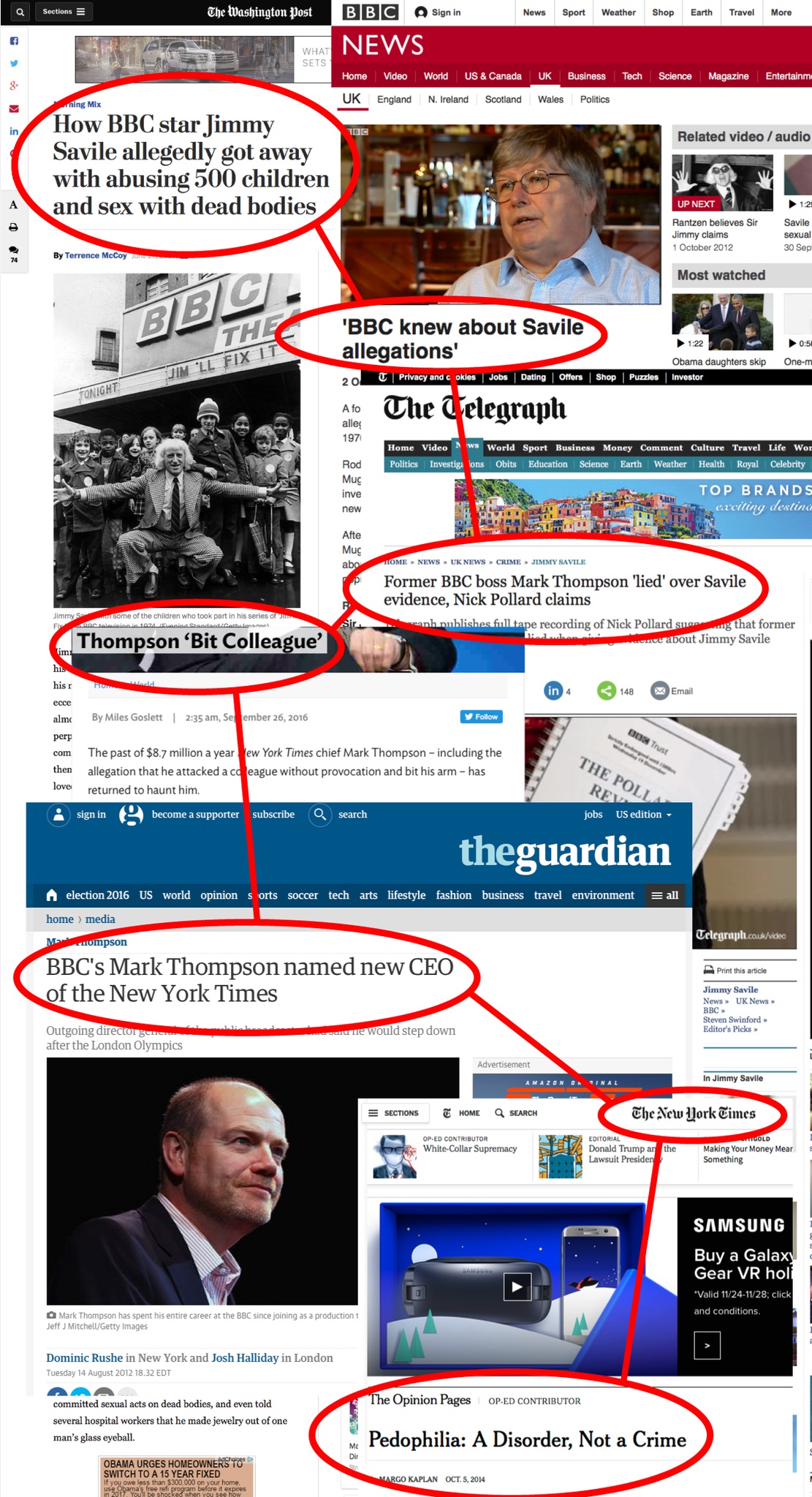
Meanwhile the New York Times and Salon have tried to "normalize" pedophilia by running an article in defense of pedos. Salon went on to scrub the article from their website the day before a hit-piece on Milo Yiannopoulos, however the NYT continues to run it. I wonder why?


So we have social media giants Twitter and Facebook allowing pedophilic and pro-terrorism content on their platforms, while MSM outlets such as the New York Times and Salon defend it. And it"s not just those outlets... Think about it - how much attention has the record number of human trafficking busts since the inauguration received from the MSM? Meanwhile, conservative voices with divergent opinions are being throttled, banned, "un-followed," or otherwise limited from reaching audiences.


Something is very wrong with this picture...

Wednesday, March 8, 2017

No - The Oil Market Is Not Fixed! (Video)

Tips: tips [ at ] zerohedge.com


General: info [ at ] zerohedge.com


Legal: legal [ at ] zerohedge.com


Advertising: ads [ at ] zerohedge.com


Abuse/Complaints: abuse [ at ] zerohedge.com


Advertise With Us

Thursday, February 16, 2017

At This Point - It`s Just Pure Gambling (Video)

Tips: tips [ at ] zerohedge.com


General: info [ at ] zerohedge.com


Legal: legal [ at ] zerohedge.com


Advertising: ads [ at ] zerohedge.com


Abuse/Complaints: abuse [ at ] zerohedge.com


Advertise With Us

Sunday, February 12, 2017

The Underlying Force of Economics at Work in Society (Video)

Tips: tips [ at ] zerohedge.com


General: info [ at ] zerohedge.com


Legal: legal [ at ] zerohedge.com


Advertising: ads [ at ] zerohedge.com


Abuse/Complaints: abuse [ at ] zerohedge.com


Advertise With Us

Friday, January 13, 2017

"Fake News" Facebook Lands On List Of "America's Most Hated Companies"

Facebook just can"t seem to catch a break lately.  From questionable privacy policies and mass data collection of its users to its handling of the so-called "Fake News" epidemic (see "George Soros Is Funding Facebook"s "Third-Party Fact Checking" Organization Targeting "Fake News""), Mark Zuckerberg is pissing off a lot of people these days.  Unfortunately, when your entire business model is based on "friending" others, the alienation of various groups has caused enough people to "dislike" Facebook that the company has landed itself on 24/7 Wall Street"s list of "America"s Most Hated Companies."


Coming in at #6, Facebook narrowly beat out Spirit Airlines, which, for anyone who has been left stranded by Spirit in Chicago"s O"Hare Airport in the middle of winter, that speaks volumes. 


  1. Comcast (NASDAQ: CMCSA)

  2. Bank of America (NYSE: BAC)

  3. Mylan (NASDAQ: MYL)

  4. McDonald’s (NYSE: MCD)

  5. Wells Fargo Bank (NYSE: WFC)

  6. Facebook (NASDAQ: FB)

  7. Spirit (NASDAQ: SAVE)

  8. DISH Network (NASDAQ: DISH)

  9. Sears (NASDAQ: SHLD)

  10. Sprint (NYSE: S)

  11. Wal-Mart (NYSE: WMT)

  12. Charter Communications (NASDAQ: CHTR)


Zuckerberg


Meanwhile, the two largest cable providers in the country also made the
list which is astonishing given their impeccable reputation for such
helpful customer service and 100% internet reliability.  But, only about 40% of
the households in the U.S. rely on those two companies for service so
it"s probably not a big deal.


But, of the top 12, Facebook was the only Silicon Valley giant to make the list despite, as 24/7 Wall Street points out, being a "boon for shareholders since it"s IPO."


Facebook has been a boon for shareholders since its IPO.
The company’s stock is now trading over 200% higher than its 2012 Wall
Street debut. However, not everyone is pleased with the social media
platform. In recent years, the company has drawn significant
criticism over its privacy policies and the mass data collection of its
users.


Recently, the company faced
sharp criticism for not doing enough to curb the spread of fake news
leading up to the U.S. presidential election.
Since then, in an
apparent attempt to mend public relations, the company announced a
series of new policies aimed at identifying and flagging fake news
stories on its site.


 Oh well, at least they beat Sears.

Friday, December 16, 2016

Facebook Stock Sinks As Social Network Admits Another Advertising Metric Error

Fool me once...


For the umpteenth time this year, Facebook has come clean with an error in its advertising metrics. In November, Facebook said that after discovering several mistakes in its reporting methods, it would be more transparent about errors in the future. And so they have...


We"ve uncovered an issue for a small group of Instant Articles publishers that impacts reporting in comScore. comScore alerted us to the issue, and we’ve since identified this is a result of a recent Facebook update that impacted publishers using our legacy comScore integration who support HTTPS on their websites. This caused an underreporting of iPhone traffic from Facebook in comScore products between Sep 20 to Nov 30, 2016. iPad and Android traffic were not affected. We have fixed the issue and are working with comScore to produce updated estimates for the relevant time periods for the small group of partners affected. We have reached out to affected publishers.


We know how important it is to be open about meaningful updates we make to our metrics, so we’ve created this channel for regular information on metrics enhancements.


As Bloomberg reports,


Facebook said it found another problem with metrics used by publishers and advertisers to gauge the reach of content posted on the world’s largest social network.


Facebook said in a blog post that it had been under-reporting traffic from publishers that participate in the company’s Instant Articles system. The mishap, which Facebook said was discovered by comScore, was traced to a recent software update. It resulted in some traffic not being counted properly from iPhone users from Sept. 20 to Nov. 30.


“We have fixed the issue and are working with comScore to produce updated estimates for the relevant time periods for the small group of partners affected,” Facebook said in the post.


Facebook has been trying to lure publishers into the Instant Articles program. It lets media companies publish content on the social network directly instead linking back to their own websites. Articles load faster for users, but some publishers have raised questions about ceding control to Facebook and diminishing their relationship with readers.


The disclosure is the latest in a string of problems Facebook has disclosed about metrics critical to business decisions made by advertisers and publishers working with the Menlo Park, California-based company.


The result, for now, is selling pressure...


Sunday, November 13, 2016

The United States Desperately Needs An Objective News Channel (Video)

Tips: tips [ at ] zerohedge.com


General: info [ at ] zerohedge.com


Legal: legal [ at ] zerohedge.com


Advertising: ads [ at ] zerohedge.com


Abuse/Complaints: abuse [ at ] zerohedge.com


Advertise With Us

Saturday, November 12, 2016

Wheat Market and the US Dollar (Video)


Tips: tips [ at ] zerohedge.com


General: info [ at ] zerohedge.com


Legal: legal [ at ] zerohedge.com


Advertising: ads [ at ] zerohedge.com


Abuse/Complaints: abuse [ at ] zerohedge.com


Advertise With Us


Tuesday, November 8, 2016

The Copper Market Has Exploded (Video)

Tips: tips [ at ] zerohedge.com


General: info [ at ] zerohedge.com


Legal: legal [ at ] zerohedge.com


Advertising: ads [ at ] zerohedge.com


Abuse/Complaints: abuse [ at ] zerohedge.com


Advertise With Us