Showing posts with label Kalashnikov. Show all posts

Saturday, October 7, 2017

Is Saudi Arabia's Grand Strategy Shifting?

Authored by Andrew Korybko via Oriental Review,


Even in this era of global paradigmatic changes, Saudi Arabia’s shifting grand strategy is perhaps one of the most surprising developments to occur thus far, but the fast-moving Russian-Saudi rapprochement is likely to provoke an Iranian “zero-sum” reaction which could complicate Moscow’s multipolar efforts in managing the “New Middle East”.


Vladimir Putin with King Salman bin Abdulaziz Al Saud at the official greeting ceremony, Moscow, October 5, 2017 (Photo: kremlin.ru)


Most observers were taken aback by what to many seemed to be the inexplicable visit of Saudi King Salman to Moscow this week, wondering how and why the two long-standing Great Power rivals were able to get so close to one another in such a short period of time – and apparently without much public fanfare, too – in making this historic event possible. The usual Alt-Media demagogues decried this as a sellout of Russia’s fundamental national interests, with the most extreme pundit-provocateurs even ranting that it amounts to President Putin siding with “terrorists” such as Daesh and Al Qaeda, especially in light of Moscow’s decision to sell the much-vaunted S-400 anti-air missile systems to Riyadh and even set up a Kalashnikov production plant in the Kingdom.


Had the Saudi Arabia of 2017 been the same country as it was half a decade ago, or even last year for that matter as some could argue, then there might be some rhetorical substance to this outlandish claim no matter how false it would still be, but what most people don’t realize is that Saudi Arabia is in the process of comprehensive changes to its foreign and domestic policies, and that there’s a very high likelihood that it will moderate its traditional behavior in becoming a more responsible actor in international (and especially regional) affairs. A lot of this has happened away from the public eye, at least in the sense that the developments weren’t “sexy” enough to draw widespread attention from most media outlets and commentators, but these piecemeal changes have altogether contributed to the formation of what looks to be a totally new grand strategy.


Russia’s Rationale


Before getting into the details of the drastic policy changes that Saudi Arabia has been up to lately, it’s important to comment a bit on why Russia is embracing its erstwhile nemesis. For starters, Russia’s foreign policy is driven nowadays by the “progressive” faction of the Ministry of Foreign Affairs, which believes that their country’s 21st-century grand strategic ambition should be to become the supreme balancing force in the Eurasian supercontinent. To this end, they’re diligently employing “military diplomacy” and “nuclear diplomacy”; the first in selling arms to rival states in order to preserve the status quo between them and prevent a hot war from transpiring (which is the opposite of the US selling weapons in order to tip the balance in favor of its preferred partner and spark the said conflict that Russia wants to avoid), and the second in utilizing its global leadership in nuclear energy technology to make important strategic inroads with non-traditional partners.


Multipolarity In Action


Concerning Saudi Arabia, this has seen Russia sign deals with it for the S-400 anti-air missile system and Kalashnikov production plant (“military diplomacy”), and Rosatom’s proposal to build Riyadh’s first-ever nuclear power plant (“nuclear diplomacy”). Of course, there’s also traditional and energy diplomacy at play here as well, the former as it relates to cooperation in uniting the Syrian “opposition” as a prerequisite to resolving the War on Syria, and the latter when it comes to both sides’ participation in the historic OPEC+ output deal from last year and subsequent renewal earlier in 2017. Moreover, none of this is occurring in a multipolar vacuum either, as Russia’s premier Chinese partner has been making great strides with Saudi Arabia in the same timeframe, including by inking two sets of deals totaling than $130 billion in the past six months alone.


King Salman bin Abdulaziz in Moscow (photo: kremlin.ru)


Riyadh’s Reforms


Most of the Chinese-Saudi agreements were signed in the framework of Crown Prince Mohammed Bin Salman’s ambitious Vision 2030 project for diversifying away from his Kingdom’s present oil-exporting dependency and towards a more “real-sector” economy. This can’t happen unless crucial socio-cultural reforms are made in Saudi Arabia, and the young prince – who’s far from a fundamentalist Wahhabi in real life and therefore something like a “rock star” among his country’s majority “moderate-prone” youth population (over half of which is under 25 years old)  – recently undertook the pivotal decision to allow women to drive in the future, understanding that this a necessary step to increasing their future participation in the economy. It can be expected that more such reforms might follow in the future, such as the possible reopening of movie theaters and maybe even one day lessening the patriarchal legal restrictions placed on women’s freedom of movement.


Unipolar Pushback


Mohammed Bin Salman’s reforms aren’t without controversy, however, as they’ve produced a lot of resistance among the country’s ultra-fundamental clerical class, as was explained in the author’s recent analysis about “Why Allowing Saudi Women To Drive Is Very Dangerous”. The fact of the matter is that Saudi Arabia isn’t a pure “monarchical dictatorship” in the structural-political sense, but a “dual dictatorship” between the monarchy and the clergy, but the Crown Prince’s socio-culturally modernizing reforms are being perceived of as an unprecedented “power grab” which de-facto constitutes a “soft coup” by the monarchy against the clergy. In turn, the most extreme clerics could become a pressing national security risk if they rally their followers against the monarchy in fomenting unrest, whether manifested through street protests, a royal coup, or terrorism. It’s the fear of this happening which explains the Kingdom’s recent crackdown and the author’s subsequent investigation into “Who’s Really Trying To Overthrow Mohammed Bin Salman?


 As the aforementioned article concludes, the only serious player with the clandestine competencies to pull this off is the US, which is considering the “Balkanization” of the Kingdom into a collection of emirates aided by the duplicitous connivance of its regional UAE ally. This was elaborated on more in depth by the author in his work a couple of months ago explaining “The Machiavellian Plot to Provoke Saudi Arabia and Qatar into a ‘Blood Border’ War”, but the overriding idea is that the US has had an interest in betraying its decades-long ally ever since the 2015 Iranian nuclear deal was agreed to, which the author predicted in his summer 2015 piece about a “Polar Reorientation In The Mideast” that also described the strategic contours that would eventually lead to the present-day Russian-Saudi rapprochement. It’s this Great Power convergence between Moscow and Riyadh, as well as the latter and Beijing, which is driving the US to wage an incipient but increasingly multifaceted Hybrid War on Saudi Arabia.


Rosatom SEO Alexey Likhachev with his Saudi counterpart after signing program documents in nuclear sphere (photo: kremlin.ru)


Stopping The Saudi “Deep State” Conspiracy


Mohammed Bin Salman must masterfully manage to tame both the radical clerics and domestic terrorists if he’s to have a chance at avoiding a US-backed royalist coup against him. He already has the support of the majority-youthful masses who could come out to the streets to support him in the event of a sudden coup, just like they did for Turkish President Erdogan during last year’s failed pro-US coup attempt, so this infers that he needs to win the backing of the military-security services in order to preemptively suppress clerical-terrorist destabilizations before countering the royalist conspiracy that’s  taking form. However, Saudi forces are embroiled in the bloody War on Yemen, which was one of the first decisions that he made as Defense Minister and is therefore attributed entirely to him, but would have probably happened regardless of whoever was in power at the time due to the geopolitical dynamics involved.


In fact, the author forecast that a forceful Saudi response could be expected to developments in Yemen as early as September 2014 in his article about “Syria’s Yemeni Opportunity and the Rise of the Shia Circle”, which deliberately analyzed events from Riyadh’s sectarian perspective in an attempt to better understand the Kingdom’s future response. Likewise, the follow-up piece in January 2015 about “Yemen: The Saudi Coup That Totally Backfired” presciently concluded that “the Saudis are expected to hit back as hard as they can against the phantom ‘Iranian menace’ that they’re attributing their Yemeni failings to”, and that “no matter which form it takes, it’s not going to be pretty.” In any case, the only way for Mohammed Bin Salman to be confident in the support of his military-security services is to downscale the disastrous War on Yemen and eventually follow the Syrian peace format in resolving the conflict there in as much of a “face-saving” way as possible.


That, however, won’t necessarily endear him to any of the conspiratorial royals who are plotting his ouster, many of whom are reportedly irreconcilably opposed to him for his high-profile foreign policy failings in the aforementioned War on Yemen and Qatar Crisis, which is why the young prince so urgently needed to make up for them with a dramatic success elsewhere, ergo the reason why he decided to commence his country’s now-successful rapprochement with Russia. Conversely, it’s precisely because of his pivotal role in carrying out this game-changing foreign policy rebalancing that the US wants him out, and Washington sent a very clear message to Riyadh of its displeasure just the other day when it announced that it will be halting some of its military exercises with “Gulf countries” until the Qatar Crisis is resolved. Reading between the lines, this is the Pentagon voicing its strong opposition to King Salman’s visit to Moscow and Saudi Arabia’s S-400 deal with Russia, thereby signaling to its in-country proxies that it’s time to commence their planned regime change operation.


Russia-Saudi Arabian talks in extended format in Moscow, Oct 2017 (photo: kremlin.ru)


Moderating The Monarchy


All in all, Mohammed Bin Salman is trying to compensate for his earlier errors of judgement in “moderating” his country’s foreign policy to the most realistic extent possible under the present circumstances, which in an historical comparison amounts to an unprecedented pivot of sorts towards the Multipolar World Order.  This doesn’t just have geopolitical implications, however, as there’s the very real possibility that Saudi Arabia might de-dollarize new Vision 2030 and energy contracts with its new non-Western partners, which would in effect equate to the death of the “petrodollar”. The author predicted this in a late-September forecast after it became abundantly clear that the country was no longer as solidly in the American camp as most observers had considered it, especially following its fast-moving rapprochement with Russia and the $130 billion’s worth of deals that the Kingdom signed with China.


The combined effect of these two multipolar realignments, as well as the likely downscaling of the War on Yemen and the “Damocles’ Sword” potential that Saudi Arabia has for dealing a deathblow to the dollar, are increasingly turning Mohammed Bin Salman into the “Saudi Saddam”, in that he’s now being targeted for elimination by the US because this one-time American subordinate was brave enough to chart his country’s own sovereign path in the world. If he can successfully withstand the US-encouraged “deep state” coup against him being waged through the Hybrid War mechanisms of a rebelling clergy, a possible domestic terrorist insurgency (as partial blowback from Saudi Arabia’s support for such groups abroad), and a royalist plot, among whatever other means might soon make themselves available, then it’s expected that the end result will be a considerable moderation of the Kingdom’s destabilizing activities in the region.


Irate Iranians


Background Concepts:


While the welcoming of Saudi Arabia into the multipolar fold as a responsible member of the international community would be celebrated by many because of the far-reaching consequences that it could have in altering the entire course of the New Cold War, there’s one multipolar party which would actually be incredibly irate at this happening, and that’s Iran. The Islamic Republic is caught in an intense security dilemma with the Kingdom, inspired partly by the centuries-old but previously long-dormant Sunni-Shiite split, and also the US’ efforts since the 1979 Revolution and especially after 9/11 to exacerbate this into taking on geopolitical dimensions all across the international Muslim community (“Ummah”). Iran and Saudi Arabia both conceive of international affairs as being a “zero-sum” game between them, and it’s very likely that Riyadh and its media surrogates will intentionally misportray King Salman’s visit to Russia as being against Tehran instead of epitomizing Moscow’s skillful geopolitical balancing act.


It’s understandable if Iran feels uncomfortable with these optics, though it should recognize that Russia’s overall intent is truly apolitical and driven by neutral Great Power considerations, not anything directed against it personally no matter what the forthcoming Saudi psy-ops might infer.


That being said, it’s very tempting to perceive of events through the aforementioned “zero-sum” prism in seeing any betterment of Russian-Saudi relations as being to the overall detriment of Russian-Iranian ones, which in turn might prompt an asymmetrical response or set thereof from Tehran in countering what some of its leadership might truly believe is Russia’s “unfriendly” and “humiliating” gesture by hosting the Saudi King, selling him S-400 anti-air missiles and state-of-the-art Kalashnikovs, and bidding to produce the Kingdom’s first-ever nuclear power plant. This isn’t speculation either, as Iran already isn’t happy with the de-facto alliance that Russia has struck with “Israel” in Syria, which is explained in detail in the author’s earlier work rhetorically questioning whether “Anyone Still Seriously Thinks That Russia And Israel Aren’t Allies?


Phase 1: Syria


Moreover, Iran doesn’t like how Saudi Arabia is the main reason why it hasn’t been invited to join BRICS, and while the other four members are in a technical sense equally responsible for this too, it’s only Russia which is courting Saudi Arabia in a way which could make Iran uneasy given how impactful the latest rapprochement will be for Syria. Therefore, even though Iran’s official media has been largely silent on the implications of the Russian-Saudi rapprochement, it can’t be ruled out that the millennia-experienced Iranian diplomats are preparing one of their stereotypically asymmetrical responses to what’s happening, and that it could most immediately have consequences for Syria. For example, Iran could make the Astana talks more difficult by siding more closely with Damascus in attempting to rebuff the joint Russian-Turkish efforts to get the Syrian government to enter into certain political-administrative concessions (e.g. a “phased leadership transition” and “federalization”) as part of a comprehensive peace plan that would meet the interests of most external parties to the conflict and therefore maximize Moscow’s geopolitical “balancing” capabilities.


Phase 2: Caucasus


Apart from that and stepping its response up a notch, there’s also the possibility that Iran could work with India to redirect the North-South Transport Corridor (NSTC) from Azerbaijan and Russia to Armenia and Georgia instead, the latter route of which was predicted in the Mideast chapter of the author’s book-length analytical series about “The Chinese-Indian New Cold War” and would allow both on-the-fence Great Powers to pioneer a trade route to the EU. This would be a geopolitically troubling development for Russia and contribute to its perception that Armenia has become an “obstructionist” actor vis-à-vis Moscow-led Eurasian integration processes and has probably been totally taken over by the powerful American-based diaspora lobby, though China’s latest inroads in building its second-largest embassy in the post-Soviet space in Yerevan might help to “balance” everything out in preventing this potential move from being completely disastrous for multipolarity. Nevertheless, if Iran takes this step in rerouting some or all of the NSTC to Armenia, Georgia, and the EU, then it would probably mean that it’s also seriously considering expanding its asymmetrical response to the third phase of operations in the Balkans.


Phase 3: Balkans


The third and final escalatory phase of Iran’s most realistic responses to any perceived “security dilemma” with Russia after Moscow’s rapprochement with Riyadh would be if Tehran seeks to broaden its asymmetrical measures to include energy and geopolitical dimensions in the Balkans. The author wrote about the future role that post-sanctions Iranian energy exports to Europe could have in challenging Russia’s present market dominance in certain regions, and while this might not happen if the EU reimposes sanctions against the Islamic Republic in compliance with American pressure, it still can’t be entirely discounted that Iranian LNG exports to Croatia, Ukraine, Lithuania, and even Poland could be in the cards, as well as its exit from the OPEC+ output agreement. However, the most destabilizing consequence of Iran’s irritability with Russia could be if it decides to return to its post-Yugoslav role in breaking up Bosnia, using the Serbs as stand-ins for the Russians in a new proxy war. That’s the most extreme step that Iran could take and there’s nothing right now which indicates that it will happen, but it should nevertheless be included as the worst-case “dark scenario” forecast.


Concluding Thoughts


Royal Pivot:


Saudi Arabia’s grand strategy is shifting away from its former Western-/unipolar-centric focus to a more diversified one of “multi-alignment’ with multipolar leaders such as Russia and China, motivated in part by the US’ hostile energy and geopolitical actions against it. On the domestic front, Crown Prince Mohammed Bin Salman is modernizing his country’s socio-cultural situation by enacting belated reforms that will complement his ambitious Vision 2030 project of multisectoral economic diversification away from its present dependency on oil exports. Taken together, the international and domestic dimensions of Saudi Arabia’s grand strategic shifts are expected to have game-changing implications in altering the global dynamics of the New Cold War, to say nothing of what would happen if the Kingdom de-dollarizes its future Vision 2030 and energy deals with its new non-Western partners, hence why the initiator of all of this, Mohammed Bin Salman, is now the “Saudi Saddam” in the sense of being targeted for elimination.


Iranian Reaction:


That’s not all that there is to it, however, since even in the event that the young prince is successful in thwarting his myriad Hybrid War adversaries and the wide variety of weaponized threats that they’re poised to utilize against him, it’s unlikely that this will result in multipolar stability in the Mideast, owing mostly to the fact that Iran is expected to be incredibly irate at its hated rival being feted as a privileged partner by Russia and China. The difference between the two Eurasian Great Powers, however, is that Moscow’s outreaches to Riyadh are having direct consequences for Syria, particularly as it relates to possibly “counterbalancing” or even “rolling back” Iran’s intended post-Daesh influence in the Arab Republic, or so it may seem, which is why Tehran looks much more suspiciously at Moscow than it does at Beijing. The problem, though, is that Russia isn’t doing any of this “against Iran”, but in the “larger multipolar interests” of becoming the supreme “balancing” force in the Eurasian supercontinent, which in and of itself necessitate having excellent relations with Saudi Arabia.


Scenario Forecasts:


If the Iranian leadership is misled into viewing Russia’s ties with Saudi Arabia as part of a “zero-sum” game and not the “win-win” strategy that it’s actually intended (key word) to be, then it’s very likely that the Islamic Republic will resort to one of its stereotypically asymmetrical responses honed by millennia of diplomatic experience in making its silent disagreements well known. This would be an unfortunate development because it would mean that Russia’s sincere efforts to balance and then mediate the Saudi-Iranian/Sunni-Shiite rivalry would be for naught, and that the US’ unstated goal of redirecting Iranian attention away from Saudi Arabia and towards Russia would have been partially successful. Nevertheless, should this happen, then it’s expected that the three-phase tier of escalatory responses could see Iran create “complications” in the Astana peace process; redirect the North-South Transport Corridor away from Azerbaijan and Russia and towards Armenia, Georgia, and the EU; and begin actively competing with Russia for part of the European energy market. At the worst, it might even try to restore its destabilizing influence in Bosnia and spark a proxy war against Russia’s Serbian partners there.


American Backup Plan:


None of Iran’s forecasted responses are certain, or even that it will negatively appraise the fast-moving Russian-Saudi rapprochement in the first place, but in the possible event that it does, then it would inadvertently be playing into the US’ intended strategy of indirectly using Iran as a backup plan for replacing Saudi Arabia in countering Russian interests in the Mideast, Caucasus, and the Balkans. In addition, Riyadh’s reversal from the unipolar camp to the multipolar one would leave the US without a regular source of jihadi recruits, thereby necessitating that it scout elsewhere in such countries as Sudan, India, Bangladesh, and Indonesia. The most likely scenario to happen in the near future is that Iran’s suspicions of the Russian-Saudi rapprochement manifest themselves subtly in Syria, at least at first, while the US begins looking to non-Mideast “Global South” countries for mercenaries while concurrently commencing its regime change operation in Saudi Arabia.


The best outcome would be if Russia’s multidimensional diplomatic efforts could bring Saudi Arabia and Iran together in a “New Détente” like how Iraq’s Muqtada al-Sadr unsuccessfully tried to do, all the while assisting both of them in warding off the US’ Hybrid War threats, but the most likely result is that this wishful thinking eventuality is still a far way’s off, if it ever happens at all, since the US is well known for flexibly adapting its unipolar grand strategy to accommodate for any multipolar contingency such as this one.


Wednesday, September 6, 2017

Kalashnikov Unveils New Anti-Drone Weapon


rex-1


While most western countries are reverting back to medieval technology to combat the use of drones, legendary Russian arms manufacturer Kalashnikov, makers of the AK series, has developed an advanced anti-drone gun. Drones are now becoming more widely available, therefore, anti-drone technology is becoming a major field in the defense industry.


Of course, Kalashnikov is leading the pack in anti-drone warfare. Built on the MP-514K rifle system, the fully modular device comes equipped with interchangeable jamming units, which disrupt GPS, GLONASS, WiFi, and other electronic and radio signals, rendering drones inoperable. Due to its ability to block phone signals, the device also can be used to prevent remote detonation of improvised explosives.


Meet the REX-1.


For the first time in Russia, Kalashnikov Concern, the largest arms manufacturer in the country, showed off its electromagnetic anti-drone rifles at the Army-2017 expo in the Moscow Region. Prototypes of the REX-1 are also undergoing tests in some subunits of the Russian National Guard.


The gun has some fascinating features which makes it extremely effective. It is able to “fire” continuously for four hours. It can then be recharged for four hours using an ordinary 220-volt socket, or it can be connected to an additional battery for uninterrupted use. And, according to Nikita Khamitov, head of the special projects department at Zala Aero Group – the company that developed the new weapon and is part of Kalashnikov Concern, it’s possible to change each component in a matter of seconds, just like changing the magazine on an assault rifle.


“This radiomagnetic ‘gun’ suppresses the command and control channels of the world’s most commonly encountered drones. It’s also installed with a number of interchangeable electromagnetic and infrared units that suppress GSM, GPS, GLONASS, Galileo [the last three are various types of satellite navigation systems – RBTH], and other channels,” said Khamitov. -RBTH


Drones generally have two default modes in case communication is lost with the operator.  They will either return to the start point or automatically land. “In the latter case the drone will disappear from enemy radars, and you effectively have a new toy in your hands,” Khamitov added. “A particular feature of the device is the possibility of not just neutralizing unmanned aerial vehicles but also explosive devices triggered by remote control – via a phone call or text message, as one sees in films. The gun shuts out all external signals and gives the combat engineer group time to arrive on the spot and completely eliminate the threat,” Khamitov said.


And it’s possible you could end up getting your hands on a REX-1 too.  Well, the civilian version, anyway.  According to Khamitov, a version of the gun could definitely be designed for the civilian market. Or course, not all its functions would be made available. For instance, in the civilian version, the GPS neutralizing device would not be included.


The price of the weapon will be determined when the subunits of the Federal National Guard Troops Service decide the number they want to procure. “Looking at the market, I think the civilian version of our system could cost around $5,000,” Khamitov said.


Click here to subscribe: Join over one million monthly readers and receive breaking news, strategies, ideas and commentary.

Gas Masks, Filters, Body Suits, Anti Radiation Pills

Please Spread The Word And Share This Post


Author: Mac Slavo
Views: Read by 293 people
Date: September 6th, 2017
Website: www.SHTFplan.com


Copyright Information: Copyright SHTFplan and Mac Slavo. This content may be freely reproduced in full or in part in digital form with full attribution to the author and a link to www.shtfplan.com. Please contact us for permission to reproduce this content in other media formats.


Friday, August 11, 2017

The Common Sense Way To Get Rid Of Kim Jong-Un

By Chris at www.CapitalistExploits.at


That will never happen!


Much to the consternation of the little men in that incestuous, insular, politically inbred, inward looking place called Washington DC, young Kim is firing rockets into the air to much fanfare in his desperately poor paradise.


This week, the UN security council unanimously approved sanctions against the naughty boy north of Seoul. Stupid, stupid (which I"ll come to in a moment)!


In the meantime, more brilliance from Washington:


I’ll hit North Korea with fire and fury, vows Donald Trump


Oy vey! Here we go.


An entire bottle of Kalashnikov vodka laced with Prozac guaranteed to blow your head clean off is required to understand the logic. Hang on while I pour myself a glass.


North Korea poses less danger to the US than a bunch of angry Saudi teenagers with boxcutters and a belief that 72 virgins await them should they kill the infidel.


You know why?


The damage they could do was truly asymmetric relative to the damage their enemy could do.


It"s a topic I discussed recently when suggesting the economics of warfare have changed:


What we’re seeing is power shifting into the hands of individuals or at least small groups as apposed to large groups.


This same dynamic is at work with respect to war.


All wars are won or lost due to either side’s ability to secure supply lines, logistics, transportation, provisions, military hardware, and communications. And the ability to pay for all of them. Just as any business which can’t finance its plans goes belly up so, too, does any army.


Now, imagine an army with the ability to decentralise all of these elements.


This army is actually technologically and economically backward. This doesn’t sound threatening until you realise that:


  • This army can and does utilise the technology and economics of its enemy. No need to develop its own.

  • Transportation is not only provided to them but provided by their enemy.

  • This army benefits from acquiring its transport, provisions, and even military hardware from its enemy.

  • This army uses the communication tools necessary to conduct attacks at fractional cost… tools produced more often than not by its enemy… now out in the public realm


Would this not be a pretty powerful army?


Surely it hasn"t escaped the geniuses at the UN and in that five sided building that houses more wet-lipped psychopaths than a maximum security prison that nuclear weapons can quite easily be delivered by angry Algerian teenagers in oh, I dunno... a car, a truck, a boat, or a private plane.


And being intelligent readers, you"ll well know that there seems no shortage of angry Algerian teenagers quite willing to carry out such a task. Why, oh why build an incredibly expensive missile system to do what can be done easily, at lower cost, and delivered with greater precision to unguarded targets?


The answer is that young Kim needs a show of force to legitimise his very existence to the North Korean people.


The fact he"s recently stepped up his rhetoric should be treated as evidence of domestic pressures on his regime. And this means that there exists an excellent opportunity to bring down his regime... but it"ll absolutely never be used (more on that in a minute).


This brings me back to sanctions...


Those sanctions just provided Kim more fuel to fire up his domestic popularity than he could ever have garnered on his own. His response was precisely what you"d expect of every self-respecting dictator. He barked at them and used it as further evidence of the evil that "his people" must overcome.


The clowns at the UN sipping US$10 water must have said to themselves, "Well, we"ll hit him hard with these sanctions. We"ll deprive his people of goods and services and Kim will cave in and change his tune."


Why? Because he cares so much for them and can"t stand to see them starve? Really? Are these people that dumb?


Or maybe they think to themselves,
"His people will become so fed up with starving they"ll overthrow him".


This tactic has worked splendidly before. Oh wait! No, wrong! It"s
never worked before.


How it is that the inescapable logic and hard evidence defies entry into their cognitive functions requires another glass of Kalashnikov.


Dictators are bullies by nature, and bullies everywhere operate on a platform of fear, intimidation, and a show of resolute strength. Weakness of any sort is as dangerous as any nuclear weapon to them. Why would Kim risk being seen as weak and ineffective when doing so would threaten his very regime?


This would be like the Pope coming out saying,
"Sorry folks it"s all a hoax. There is no God."


No. 
Sanctions act only to bolster a dictator"s resolve.


People starved of resources are by nature less resourceful and actually less trusting of foreign influence - the very thing that those who are bringing the sanctions actually say they want. And so overthrowing him becomes even less of a probability. Well done guys!


Typically, the politics behind such things has less to do with logic than it does money. As I mentioned 
when discussing Trump and Russia, you can"t take away the rice bowls:


Why Washington and the Establishment Need a Russian Enemy


Without a Russian threat the need for NATO is… well, jeez Louise, there isn’t one. Hmmm.


After all, NATO doesn’t need Eurofighters to deal with angry Algerian teenagers. They were built to do combat with Ivan. What if Ivan isn’t the threat they need him to be?


 Europe (and NATO) actually need weapons designed for a knife fight in a cubicle. Nuclear submarines seem like overkill for jihadists donning exploding underwear and yelling “Allahu Akbar” in a Paris subway. You sure as hell can’t fight him with a Mig-29. The problem is, none of this works for the lobbying military contractors sucking at the teat of Washington.


Scrap the 20 F-22 Raptor jets boys. We’ve got an order for… Oh, jeez… An order for… 45,000 stab vests??… No, that can’t be right.”Without NATO Lockheed Martin may not build as many ugly and ludicrously expensive planes.


Without a Russian enemy Halliburton don’t provide “services”. Rice bowls are at risk. It’s about the money. It’s always about the money.


The Actual Solution


You have to make the distinction between a government and a people. They"re absolutely not the same thing.


Now, if you want to get rid of the North Korean people, then it makes perfect sense to turn North Korea into glass. That"s easy: Conjure up a reason like weapons of mass destruction and then go at it. We all remember Iraq. On the other hand, if your objective is to "liberate" them, the solution is really quite simple.


You immediately eliminate all sanctions and you absolutely let goods, services, and information flow. Immediately open the borders to allow North Koreans visa access to the rest of the world.


The Berlin Wall fell not because those nasty Commies got bombed to smithereens... or because they saw the light and came around to a smarter way of doing things.


No, it fell because information spread. I"d go so far as to say that it was the fax machine which brought down the Berlin Wall.


It sure as hell wasn"t some busybody know it alls in DC or any of the think tanks that litter the halls of power-like plastic bags on the side of an African highway.


If the West completely opened up to North Korea, there would be a greater infiltration of goods and services into North Korea, and this, much like the fax machine, would bring resources and information to the people of the country (remember, without resources it"s tough to displace Kim). More importantly, it would eliminate the ability of Kim to adequately have a terrible foe.


Show me one country with a desperately poor populace that has posed any real threat to the dictator running the show. Now go and read your history books and you"ll find that when a populace develops a middle class status the risks to the regime are much much higher.


This is where China is now, and it"s a balancing act - one, I might add, that China have been managing remarkably well by providing increased economic freedom while limiting political freedom (not unlike Singapore).


The reason the West will not eliminate sanctions is because our Western leaders refuse to allow overwhelming evidence to influence their repeatedly failed policies.


And so here we are...


The risks ratcheting higher everyday, and we know it only takes one stupid move and we"ll have cities in smoking ruins.


It"ll never be "tactical" or short. Forget about what the generals say.


Wars are more unpredictable than an epileptic on a bronco. Take a look at Iraq. It was going to be a cakewalk as was Afghanistan... and Somalia... and Vietnam.


Question


Wow Poll 10 Aug 2017

Cast your vote here and also see what others think will happen


- Chris


"There are very few examples looking back over the last 25 to 30 years where sanctions have actually succeeded". — Nicholas Burns, former US diplomat


--------------------------------------


Liked this article? Then you"ll probably like my other missives on


this topic as well. Go here to access them (free, of course).


--------------------------------------

Monday, July 17, 2017

Elon Musk's Worst Nightmare - Russian AK-47 Maker Builds Fully-Automated "Killer Robot"

Authored by Joseph Jankowski via PlanetFreeWill.com,


The debate over the role robots will play in the future of warfare is one that is taking place right now as the development of automated lethal technology is truly beginning to take shape. Predator drone style combat machines are just the tip of the iceberg for what is to come down the line of lethal weaponry and some are worried that when robots are calling the shots, things could get a little out of hand.


Recently there has been some debate at the U.N. about “killer robots,” with prominent scientists, researchers, and Human rights organizations all warning that this type of technology – lethal tech. that divorces the need for human control – could cause a slew of unintended consequence to the detriment of humanity.


A study conducted the University of British Columbia shows that this type of terminator-like weaponry isn’t sitting well with the general public, as an overwhelming majority of people, regardless of country or culture, want a complete ban placed upon any further development of these autonomous systems of war.


Despite the warnings of risk and concern, this is not stopping arms manufacturers from taking warfare into the twilight zone and bringing the futuristic battlefield scenario where A.I. robots and human are fighting with each other, side by side, closer to everyday reality.


Kalashnikov, the maker of the iconic AK-47, is one of those manufacturers bringing lethal automation and robotics into the present-day as it is currently building a range of products based on neural networks,’ including a fully automated combat module’ that can identify and shoot at its targets.


Defense One is reporting:


The maker of the famous AK-47 rifle is building “a range of products based on neural networks,” including a “fully automated combat module” that can identify and shoot at its targets. That’s what Kalashnikov spokeswoman Sofiya Ivanova told TASS, a Russian government information agency last week. It’s the latest illustration of how the U.S. and Russia differ as they develop artificial intelligence and robotics for warfare.


The Kalashnikov “combat module” will consist of a gun connected to a console that constantly crunches image data “to identify targets and make decisions,” Ivanova told TASS. A Kalashnikov photo that ran with the TASS piece showed a turret-mounted weapon that appeared to fire rounds of 25mm or so.


Defense One points out that in 2012 then-Deputy Defense Secretary Ash Carter signed a directive forbidding the U.S. to allow any robot or machine to take lethal action without the supervision of a human operator.


Then in 2015, then-Deputy Defense Secretary Bob Work said fully automated killing machines were un-American.


“I will make a hypothesis: that authoritarian regimes who believe people are weaknesses,” Work said, “that they cannot be trusted, they will naturally gravitate toward totally automated solutions. Why do I know that? Because that is exactly the way the Soviets conceived of their reconnaissance strike complex. It was going to be completely automated. We believe that the advantage we have as we start this competition is our people.”


According to Sergey Denisentsev, a visiting fellow at the Center For Strategic International Studies, Russian weapons makers see robotics and the artificial intelligence driving them as key to future sales to war makers.


“There is a need to look for new market niches such as electronic warfare systems, small submarines, and robots, but that will require strong promotional effort because a new technology sometimes finds it hard to find a buyer and to convince the buyer that he really needs it, ” Denisentsev said earlier this year.


With my previous reporting dealing with robotics and war, I always point out the incredible advances made by Softbank owned Boston Dynamics in the field of A.I., using it as an example of what future warfare could (or most likely will) look like it. And to be honest, it really is nightmarish.


The bottom line is war is a racket. Killing for political reasons is always disastrous. So the fact that governments are on the verge of possessing this terminator technology should send chills down everyone’s spine.


H/T Nicholas West of ActivistPost.com

Monday, April 3, 2017

Is This The Greatest 'Arb' In The World?

Since it first entered service with the Soviet army in 1948, the AK-47 and its derivatives have become the world"s most widely used assault rifles.


As Statista"s Niall McCarty writes, in his book "AK47: The Story of The People"s Gun", author Michael Hodges estimates that there are as many as 200 million Kalashnikov rifles in circulation, one for every 35 people on earth. Its popularity among soldiers, criminals and militants is primarily due to its cheap price, durability, reliability and sheer simplicity.


However, while demand may be high, prices vary dramatically... which gave us an idea.


Infographic: The Cost Of An AK-47 On The Black Market | Statista


You will find more statistics at Statista


200 different types of Kalashnikov are produced in at least 30 countries with vast quantities of rifles turning up in trouble spots all over world, especially in Africa. The AK rifles used in the Paris attacks at Charlie Hebdo and the Bataclan theater were purchased in Belgium and traced back to the Balkans (and to Serbia in particular). Given that the AK-47 is at the center of the illegal ams trade (worth an estimated $1.7 to $3.5 billion every year), how much would one cost on the black market?


A recent report from Global Financial Integrity has shed light on the cost of an illegally-procured AK-47 in several selected countries. Somebody seeking one in Pakistan could pay $148 for a locally produced version or $1,200 for the real deal. In Belgium, where the Paris attackers obtained their guns, an AK-47 has an average pricetag of $1,135. It"s also possible to find AK-type rifles through the darknet and they can cost anywhere from $2,800 to $3,600.


So, is buying AK-47s in Afghanistan and selling them online via the Dark Web, the greatest globalization "arb" ever? Or simply the correct risk-premium for life-threatening procurement costs and jail-threatening sales anxiety?

Sunday, March 12, 2017

Trump Wall – How Exactly?

By Chris at www.CapitalistExploits.at


Market dislocations occur when financial markets, operating under stressful conditions, experience large widespread asset mispricing.


Welcome to this week’s edition of “World Out Of Whack” where every Wednesday we take time out of our day to laugh, poke fun at and present to you absurdity in global financial markets in all its glorious insanity.


While we enjoy a good laugh, the truth is that the first step to protecting ourselves from losses is to protect ourselves from ignorance. Think of the “World Out Of Whack” as your double thick armour plated side impact protection system in a financial world littered with drunk drivers.


Selfishly we also know that the biggest (and often the fastest) returns come from asymmetric market moves. But, in order to identify these moves we must first identify where they live.


Occasionally we find opportunities where we can buy (or sell) assets for mere cents on the dollar – because, after all, we are capitalists.


Join the INSIDER membership and find out what we"re doing with our own money... targeting asymmetric investment opportunities


Capitalist Exploits Insider


In this week"s edition of the WOW: Trump Wall - How Exactly?


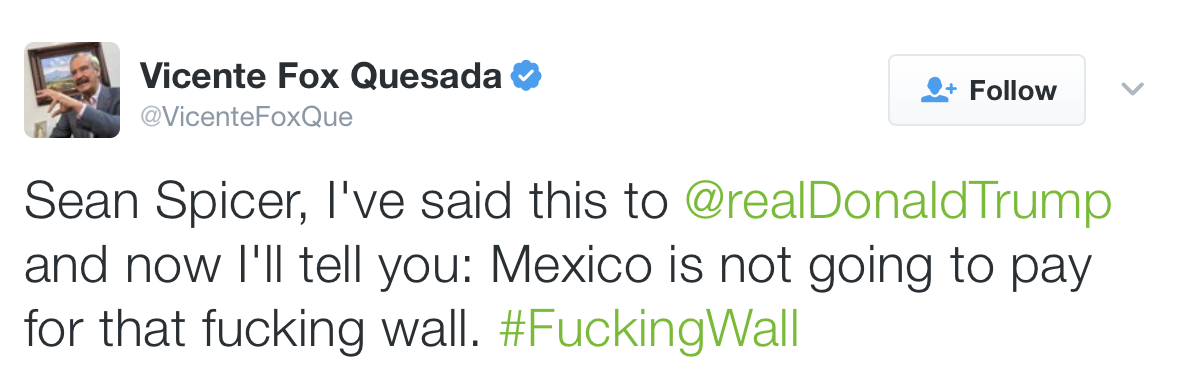
How many people voted for "Herr Von Trump" because he promised to build a "great and beautiful wall"?


Likely the same folks that fervently believe stable jobs at shuttered coal mines and steel factories are actually coming back (they"re not).


He made it a pillar of his campaign - the beautiful wall, that is. Which makes me wonder about his use of speech. I mean, I know I"m going to be accused of nitpicking but I"ve seen a lot of walls, none I"d describe as beautiful. Charlize Theron is beautiful. Walls are not.


Understandably the folks south of the border got testy. Surprisingly, they don"t appreciate being called rapists and drug pushers:


Even the former Mexican Grand Mufti honcho got stuck in.


And Nieto"s turn:


“Mexico will not pay for that wall, we will pay for ladders though,” Nieto said. “Trump can do whatever he wants, he can spend as much money as he wants, but the fact is, so many of our people have friends and family in the United States. And unfortunately for these people they cannot afford a visa or citizenship or cannot wait the long delays in getting one, so ladders are the answer.”


Trump wasn"t backing down.


Football hooligans couldn"t do it better. This is the best these countries have to offer, folks. God help us all!


It"s enough to drive a man to drink. I"m sorely tempted to pop down to the local liquor store for a litre of Kalashnikov Vodka - guaranteed to blow my head clean off.


Still , I"ve become accustomed to dealing with the fact the world is littered with the dullest and most useless people steering the ships. But what"s more concerning is why nobody has asked the obvious questions.


Meatheads never ask the obvious questions. Mental arithmetic requiring independent thought being something strongly discouraged.


What sort of wall? Concrete? Wire fencing? If so, how much?


How will the materials get there? Take a look, there are no roads in much of the territory.


Who builds it? Mexicans?


What about housing for what will have to be a sizeable workforce? What about water, food, medical supplies?


How high? Not high enough and a USD10 ladder trumps (pun intended) a multi billion dollar wall.


What about tunnels under it? Smugglers, after all, have been tunneling for years where the wall already exists. Reminds me of Einstein"s definition of insanity. Why would they stop what already works?


Then there"s the little issue of this being 2,000km of wall. That"s an awful lot of wall. Wall that has to go through private land which begs the question. What about imminent domain?


What about the environment protection agency and the mating habits of the endangered red-eared slider?


Has any of this been thought about? Did voters, in their desperate desire to rid themselves of the sclerotic, nepotistic, basilisk and the establishment she represents, bother to ask themselves these questions?


The US Department of Homeland Theatre Security estimate the wall will cost USD21.6 billion and take more than 3.5 years to build. Trump doesn"t think so.


"It"ll get done so quickly your head will spin."


Guess we"ll see. Anyway, considering government estimates I think it"s safe to double both of these figures - USD44 Billion and 7 years sounds about right then. That"s bigger than the GDP of Slovenia, it"s twice that of Iceland, and 3 times that of Jamaica. Personally, I"d rather just buy Jamaica, lie in the sun and collect all the rum revenues while stashing a little in the cellar, of course. But then, I"m not running the mess show.


I wonder: Did Trump think through the fact that the US has a pact with Mexico on shared water rights? Did he know one existed before making this part of his campaign? Annoyingly, he"s failed to brief me but I have my suspicions he didn"t.


The same report estimates that this agreement alone could bring the cost from USD11 million per mile to USD15 million per mile in one area.


This is the Rio Grande. Perhaps many Americans haven"t been down here or thought about this much. You gonna build a wall here?


This doozy sits in the report, too:


"It also does not account for major physical barriers, like mountains, in areas where it would not be feasible to build."


Take another look at the Rio Grande. This, folks, isn"t merely a 2x on opex estimation. Just sayin"...


So what"s up with Trump? Can he not do arithmetic? Does he simply speak like most politicians (lie)? Or does he simply shoot from the lip.


Has he looked at the fact that more Mexicans are leaving than entering the United States?


That a Mexican border wall is impractical, impossible, ludicrously expensive, and will create (rather than solve) the problems it"s purported to solve but that won"t stop Washington from doing what Washington does: stupid things.


The Question is...


Trump Wall Poll


Cast your vote here and also see what others think


- Chris


"Walls in people"s heads are sometimes more durable than walls made of concrete blocks." ? Willy Brandt, Erinnerungen


--------------------------------------


Liked this article? Don"t miss our future missives and podcasts, and


get access to free subscriber-only content here.


--------------------------------------

Thursday, February 2, 2017

AK-47 Maker Staffs Up Amid Surge In Export Orders

As the world roils amid Middle East maelstroms, Donald Trump dysphoria, and terrorist tantrums, there is a silver-lining for some. As MSN reports, the maker of the AK-47 semi-automatic machine gun says it is to increase staff by 30% because of a surge in export orders.


As a reminder this surge in demand follows US sanctions banning the import of Kalashnikov firearms from Russia in 2014.


The Kalashnikov Group put out a press release from its Moscow office Monday stating that it will create a further 1,700 jobs this year.


"Following the growth of production volume, which was driven by the rise in the number of export orders, it was decided to increase the number of the Group"s employees," said Alexey Krivoruchko, chief executive of the Kalashnikov Group.


"The challenge we face is managing the growing number of orders. To fulfil them, as of April 2017, production will run in three shifts," he added.


The Kalashnikov Group said it employed around 5,500 people at the end of 2016. The new staff will be recruited to work as service technicians, grinders, toolmakers and machine operators.


Kalashnikovs remain the most popular rifle in history...


Monday, January 16, 2017

Is Tolerance A One-Way Street?

Submitted by Douglass Murray via The Gatestone Institute,


  • When just about every other magazine in the free world fails to uphold the values of free speech and the right to caricature and offend, who could expect a group of cartoonists and writers who have already paid such a high price to keep holding the line of such freedoms single-handed?

  • Most of the people who said they cared about the right to say what they wanted when they wanted, were willing to walk the walk -- to walk through Paris with a pencil in the air. Or they were willing to talk the talk, proclaiming "Je Suis Charlie." But almost no one really meant it.

  • If President Hollande and Chancellor Merkel had really believed in standing up for freedom of expression, then instead of walking arm-in-arm through Paris together with such an inappropriate figure as Palestinian leader Mahmoud Abbas, they would have held up covers of Charlie Hebdo and said: "This is what a free society looks like and this is what we back: everyone, political leaders, gods, prophets, the lot can be satirised, and if you do not like it then you should hop off to whatever unenlightened hell-hole you dream of."

  • The entire world press has internalised what happened at Charlie Hebdo and instead of standing united, has decided never to risk something like that ever happening to them again.

  • For the last two years, we have learned for certain that any such tolerance is a one-way street. This new submission to Islamist terrorism is possibly why, in 2016, when an athlete with no involvement in politics, religion or satire was caught doing something that might have been seen as less than fully respectful of Islam, there was no one around to defend him.

The 7th of this month marked two years to the day since two gunmen walked into the offices of the satirical magazine Charlie Hebdo in Paris and murdered twelve people. This period also therefore marks the second anniversary of the period of about an hour during which much of the free world proclaimed itself to be "Charlie" and attempted, by walking through the street, standing for moments of silence or re-tweeting the hashtag "Je Suis Charlie" to show the whole world that freedom cannot be suppressed and that the pen is mightier than the Kalashnikov.


So two years on is a good time to take stock of the situation. How did that go? Did all those "Je Suis" statements amount to anything more than a blip on the Twitter-sphere? Anyone trying to answer such a question might start by looking at the condition of the journal everyone was so concerned about. How has it fared in the two years since most of its senior editorial staff were gunned down by the blasphemy police?


A Paris rally on January 11, 2015, after the Charlie Hebdo attack, featuring "Je Suis Charlie" signs. (Image source: Olivier Ortelpa/Wikimedia Commons)


Not well, if a test of the magazine"s wellbeing is whether it would be willing to repeat the "crime" for which it was attacked. Six months after the slaughter, in July 2015, the new editor of the publication, Laurent Sourisseau, announced that Charlie Hebdo would no longer publish depictions of the Prophet of Islam. Charlie Hebdo had, he said, "done its job" and "defended the right to caricature." It had published more Muhammad cartoons in the issue immediately after the mass murder at their offices and since. But, he said, they did not need to keep on doing so. Few people could have berated him and his colleagues for such a decision. When just about every other magazine in the free world fails to uphold the values of free speech and the right to caricature and offend, who could expect a group of cartoonists and writers who have already paid such a high price to keep holding the line of such freedoms single-handed?


Now, at the second anniversary of the atrocity, one of the magazine"s most prominent figures, Zineb El Rhazoui, has announced that she is leaving the magazine. El Rhazoui, who has been described as "the most protected woman in France" because of the security detail she receives from the French state, has announced that Charlie Hebdo has gone "soft" on Islamic radicalism. She told Agence France-Presse that "Charlie Hebdo died on [7 January 2015]." The magazine had previously had a "capacity to carry the torch of irreverence and absolute liberty" she said. "Freedom at any cost is what I loved about Charlie Hebdo, where I worked through great adversity."


Of course, El Rhazoui is an unusual person. And a scarce one in twenty-first century Europe. Which is why she needs the security detail. Most of the people who said they cared about the right to say what they wanted when they wanted, about everything and anything -- including one particularly stern and unamused religion -- were willing to walk the walk: that is, they were willing to walk through Paris with a pencil in the air. Or they were willing to talk the talk, proclaiming "Je Suis Charlie." But almost no one really meant it. If they had, then -- as Mark Steyn pointed out -- those crowds in Paris would not have been parading through the streets holding pencils, but holding cartoons of Mohammed. "You"re going to have to get us all" would have been the message.


And ditto the leaders. If President François Hollande and Chancellor Angela Merkel had really believed in standing up for freedom of expression, then instead of walking arm-in-arm through Paris together with such an inappropriate figure as Palestinian Authority leader Mahmoud Abbas, they would have held up covers of Charlie Hebdo and said: "This is what a free society looks like and this is what we back: everyone, political leaders, gods, prophets, the lot can be satirised, and if you do not like it then you should hop off to whatever unenlightened hell-hole you dream of. But Europe is not the continent for you."


Instead, in the two years since those gestures, European society went quiet. Of course, there have been regular opportunities to display the modern idea of virtue, often using Charlie Hebdo as the punching bag. Since being alerted to the existence of the magazine by the gunmen, the censorious types who now fill our societies (and who probably do not even buy or read magazines) nevertheless regularly send out social media messages objecting to things to which they have been alerted within the magazine.


So it is that a rude and satirical magazine has found itself repeatedly judged by the humourless morality police of our day and often deemed to be insufficiently reverential about various world events. A Charlie Hebdo cartoon about the Cologne New Year"s Eve sexual assaults was deemed in poor taste. Elsewhere, the publication"s response to an earthquake in Italy failed to hit the single acceptable note in the eyes of some non-readers. Likewise the crash of a Russian jet and other stories that were considered to lack appropriate piety.


Meantime, we are in a situation, as the British author Kenan Malik said of the period after the Satanic Verses affair, of having "internalised" the atrocity. The entire world press -- perhaps especially, in free countries -- has internalised what happened at Charlie Hebdo, and instead of standing united has decided, quietly and in the privacy of their own offices, never to risk something like that ever happening to them again. This new submission to Islamist terrorist demands is possibly why, in 2016, when an athlete with no involvement in politics, religion or satire was caught doing something that might have been seen as less than fully respectful of Islam, there was no one around to defend him. Even the British Prime Minister, Theresa May, asked in the House of Commons to stand up for the right of an athlete not to have his career destroyed because of one fleeting, drunken joke, equivocated:


"This is a balance that we need to find. We value freedom of expression and freedom of speech in this country -- that is absolutely essential in underpinning our democracy.


"But we also value tolerance to others. We also value tolerance in relation to religions. This is one of the issues that we have looked at in the counter-extremism strategy that the Government has produced.


"I think we need to ensure that yes it is right that people can have that freedom of expression, but in doing so that right has a responsibility too -- and that is a responsibility to recognise the importance of tolerance to others."


For the last two years, we have learned for certain that any such tolerance is a one-way street. Our societies had been walking up it. But from the other direction came the Kalashnikov brigade who only had to fire once; in the face of it, the whole civilised world chose to U-turn and run back the other way. Allah"s blasphemy police would be foolish not to push the advantage that such capitulation gives their cause over the months and years ahead.

Monday, January 2, 2017

Islamic State Claims Responsibility For Istanbul Nightclub Attack As Manhunt For Gunman Continues

One week after a video emerged of the Berlin Christmas market truck killer, Anis Amri, pledging allegiance to ISIS, on Monday the Islamic State claimed responsibility for the deadly New Year’s Day terrorist attack in Istanbul that killed at least 39 people and wounded dozens more, claiming the operation had targeted Turkey in revenge for Turkish military operations against the organization in Syria, a similar justification used by the Turkish offduty policemen to assassinate the Russian ambassador in Turkey in December.


The statement was distributed by Nashir News, a channel that publishes Islamic State propaganda, and which had called for followers of the extremist group to target holiday celebrations days before the attack the WSJ reported. In the statement, the Islamic State described the Reina nightclub, where many foreigners as well as Turks were killed, as a gathering point for Christians celebrating their "apostate holiday".


"The apostate Turkish government should know that the blood of Muslims shed with airplanes and artillery fire will, with God"s permission, ignite a fire in their own land," the Islamic State declaration said. There was no immediate comment from Turkish officials according to Reuters.


The jihadist group has been blamed for at least half a dozen attacks on civilian targets in Turkey over the past 18 months but, other than targeted assassinations, this is the first time it has directly claimed any of them. It made the statement on one of its Telegram channels, a method used after attacks elsewhere. Islamic State most recently killing more than 50 people in August at a wedding in Gaziantep by the Syrian border. Within days of that bombing, Turkey launched its operation inside Syria. Previously, the extremist organization struck Istanbul’s biggest airport, killing more than 40 people in June during an attack waged with bombs and firearms.


Attacks in Turkey have accelerated in recent weeks: on Dec. 10, two bombs claimed by Kurdish militants exploded outside a soccer stadium in Istanbul, killing 44 people. A security guard who survived that attack was killed at Reina. A car bomb killed at least 13 soldiers and wounded 56 when it ripped through a bus carrying off-duty military personnel in the central city of Kayseri a week later, an attack Erdogan also blamed on Kurdish militants. Islamic State"s Amaq website said the group was behind a car bomb attack that killed 11 people and wounded 100 in the city of Diyarbakir in November, but Turkish authorities denied this and said Kurdish militants carried out the attack. The Russian ambassador to Turkey was shot dead as he gave a speech in Ankara on Dec. 19 by an off-duty police officer who shouted "Don"t forget Aleppo" and "Allahu Akbar."


* * *


Meanwhile, on Monday the Turkish police continued the manhunt for the suspected gunman behind the Istanbul nightclub shooting. The lone attacker sprayed bullets into a crowd of revelers who had come from across the Middle East and elsewhere to celebrate at the Reina, a cosmopolitan party spot overlooking the Bosporus.


The attacker was believed to have taken a taxi from the southern Zeytinburnu district of Istanbul and, because of the busy traffic, got out and walked the last four minutes to the entrance of the nightclub, newspaper Haberturk said. He pulled his Kalashnikov rifle from a suitcase at the side of the road, opened fire on those at the door, then threw two hand grenades after entering, Turkey"s Haberturk said. It said six empty magazines were found at the scene and that he was estimated to have fired at least 180 bullets.


On Sunday afternoon, surveillance footage appeared to show the suspect behind Sunday"s attack on an Istanbul nightclub opening fire at the entrance.


Security services had been on alert across Europe for new year celebrations following an attack on a Christmas market in Berlin that killed 12 people. Only days ago, an online message from a pro-Islamic State group called for attacks by "lone wolves" on "celebrations, gatherings and clubs".


In a statement hours after the shooting, President Tayyip Erdogan said such attacks aimed to create chaos and destabilize the country. Additionally, the government, in what has become an increasingly routine step, has imposed a media ban on coverage of the attack, prohibiting reporting of information other than what is released by authorities.


In Syria, rebels backed by Turkey’s armed forces have been taking over territory previously held by Islamic State, helping Ankara with its goal of establishing a safe zone for opposition forces while also clearing the porous Turkish border of extremist militants.


In its statement, disseminated in Arabic and Turkish, Islamic State said “let the apostate government of Turkey know that the blood of Muslims being shed through the shelling of its warplanes and artillery will inflame a fire in the middle of [Turkey] God willing.”


Moments ago, the Turkish polish said that its has detained eight people in connection with the istanbul attack however the gunman is said not to be among those in custody.


Police distributed a hazy black-and-white photo of the alleged gunman taken from security footage.He is described as having "wide eyes and wide cheekbones" which dominate his face.


The authorities believe the attacker may be from a Central Asian nation and suspect he had links to Islamic State, the Hurriyet newspaper said. It said he may be from the same cell responsible for a gun-and-bomb attack on Istanbul"s main airport in June, in which 45 people were killed and hundreds wounded.