Showing posts with label Behavioral economics. Show all posts

Tuesday, March 13, 2018

Most Limits Exist Only In Our Minds

This article was originally published by Adam Taggart at PeakProsperity.com


Roger Bannister died last week.


Even if you don’t recognize his name, you’re aware of his legacy: he was the first human to run a mile in under 4 minutes.


It was a mind-blowing feat. Ever since the Ancient Greeks set their sights on attaining this “perfect” goal 3,000 years ago, no runner on the planet had been able to run that fast for that long.


For millennia of sport, breaking the 4-minute barrier was widely regarded as physically impossible.


But Bannister, a busy medical student at the time with often only 30 minutes available to train per day, had an unorthodox view — one rooted in skepticism of the conventional training techniques and mindset.


He began with the assumption that the 4-minute mile was possible, and then challenged himself to develop a science-based regimen for attaining it.


During a brief lull on the otherwise blustery day of May 6, 1954, Roger Bannister made history by completing the mile-run in 3 minutes 59.4 seconds. The impossible had been achieved.


Photo of Roger Bannister breaking the 4-minute mile


Bannister crossing the finish line at the Iffley Road track, Oxford


But what ensued next was equally momentous.


Just a month after Bannister first broke the 4-minute barrier, both he and another runner (John Landy) broke it again. The next year, 3 more runners (all in the same race) followed suit.


By the end of 1957, a total of 16 runners had achieved sub-4-minute mile times.


How could so many people suddenly overcome a challenge that had thwarted the best runners in the world for three millennia? The transition was so immediate and abrupt that it can’t be attributed to advancements in technology, training or diet. Yet something changed that enabled this new era for speed.


What changed was Belief.


Prior to Bannister’s shocking feat, elite runners just didn’t believe it was possible to run that fast.


But once freed from that limiting mindset, those very same athletes found that not only could they match Bannister’s record, they could beat it.


Today, 60 years later, over 1,300 people have run the mile in under 4 minutes. The fastest of them completed it in 3 minutes 43.13 seconds (Hicham El Guerrouj, July 7, 1999)


More than simply breaking a record, Roger Bannister’s greater legacy was proving to the world that limits are largely set by the mind. When we fail (or more accurately put, fail to try hard enough), it’s often because we believe we can’t succeed.


Bannister’s example showed us that by changing our mindset — by being open-minded to success — we can change our universe of potential outcomes. The ‘impossible’ becomes possible.


Others, before and after Bannister, have validated this to us time and again. Here are but a few of them:


  • Sir Edmund Hillary and Tenzing Norgay summiting Mount Everest, the world’s tallest mountain, in 1953

  • Billie Jean King defeating Bobby Riggs in The Battle of the Sexes in 1973, proving women can perform at the same level as men

  • Alan Turing cracking the “unbreakable” Nazi Enigma code during WW2 (and developing the first modern computer in the process)

  • Inexperienced novelist and near-penniless single parent J. K. Rowling in the early 1990s, writing a manuscript in various Scottish coffee shops that would become Harry Potter and ultimately make her a billionaire


Each refused to accept conventionally-defined limits as true. Each started with the belief that success was possible, and that they just needed to find the right path to unlock it.


A Mindset Needed More Today Than Ever


Today’s world bombards us with dire headlines and intractable issues that can easily make us feel defeated and powerless. Rather than being retired by the march of progress, in many ways it feels like the limits on our future are multiplying.


Declining opportunity for the 99%, cartel-style rackets controlling much of industry, and an accelerating wealth gap between the elites and the rest of society define our economic situation.


Our political system prioritizes fear, divisiveness and war mongering — getting precious little accomplished save a continued chipping away at our civil liberties. Social discord is growing in response.


Meanwhile, we’re despoiling the natural systems we depend on. The past few decades have seen more mass species die-offs, pollution, climatic shifts, and chronic health epidemics than ever before. Our insatiable exploitation of resources and prioritization of quick profits have become existential threats.


Given the above, it’s understandable to feel hopeless; that we’re all simply screwed.


But as Bannister, Hilary, Turing et al have showed us, we have much more control over our destiny than we realize. Even in the face of nation-wide, even planetary, issues like those listed above, we have agency to change our situation for the better.


On the individual level, we work hard here at PeakProsperity.com to surface and showcase models we deem worthy of your consideration. Here are several that have helped many of our readers improve their quality of life today, while simultaneously improving their resilience against any challenges tomorrow may bring:


  • Looking to improve your health and longevity? Learn how nutrition, functional exercise, sleep hygiene and stress management are key success ingredients.

  • How can humans grow (more) food by regenerating rather than depleting our soils? No-till farming practices are enabling just that.

  • How can you become better valued and more supported by those around you? Here are a number of community-building steps that work.

  • Want to protect and grow your money? Read this.

  • How can you remain positive, and even thrive, in the face of adversity? By using these psychological strategies.


These are but a few examples of the very real pathways available to each of us to build better futures for ourselves. But to benefit from them, we need to first start with the belief that a better future is indeed possible for us.


If we do, then it becomes simply a math formula. With enough courage, discipline, and hard work, almost any goal is attainable within time.


And make no mistake, the world is in dire need of self-directed saviors. Too much of the population is mindlessly marching along to the status quo, blind to its dangers and unsustainability.


Chris Martenson’s “giant canoe” parable captures our predicament well:


Our Giant Canoe


Think of our situation as if humanity were all together in a giant canoe and nearly everybody is paddling as hard as they can. After all, we’re trying to get somewhere: to improve ourselves, to grow our economy and increase our prosperity. There are goals to be met!


Along the way we’ve convinced ourselves that this canoe is the best one ever built and it cannot fail us. It is the very pinnacle of achievement. It looks great, and there are creature comforts and pleasant distractions galore. Food has never been more abundant or easier to obtain, new gadgets keep showing up, and (in theory, at least) you can determine for yourself where you want to sit in the canoe.


The people in the front love being there, as they feel powerful and in control. Ironically, though, it’s the few people in the stern who are actually secretly and rather effortlessly steering, but nobody in the rest of the canoe seems to notice or care.


There’s only one thing wrong with this canoe. It’s headed for a gigantic waterfall, and if it tips over the lip, very few will survive. It will be like going over Niagara Falls without a barrel.


A few in the canoe have woken up and noticed this. But their protests are limited to either pulling their paddles out of the water and refusing to propel the canoe any faster, or even trying to futilely paddle backwards against the rest of humanity’s combined efforts.


Neither approach is a solution, mind you. But at least for these ‘awake’ souls, it feels better than paddling mindlessly towards the roaring falls.


As it stand today, humanity’s canoe is destined to speed right over the edge. Unless we consciously do something about it. Which we could, if we really wanted to.


As there’s nothing preventing us from steering the canoe safely to land, I find this one of the most interesting and fascinating times to be alive. We are currently playing the role of our own destroyer, but the savior role is still there for the choosing.


But what stops us? What keeps us paddling furiously ahead even as the sound of the roaring falls gets louder and louder? The answer is at once both very simple and devilishly hard.


It’s our egos.


To save ourselves from ourselves, we have to begin doing things very, very differently. Truthfully, the only way we can save ourselves is to shift our consciousness.  


Chris’ follow-on report, How To Be, reveals the elements of psychology, neuroscience, behavioral economics and human culture that lie at the root of our self-limiting behavior, yet also hold the keys to our salvation. It explains why to start living differently, we first need to start thinking differently.


There’s an emerging huge body of work here that goes deeply into the ‘Being’ and Emotional Capital areas of our ongoing efforts to help people live with greater resilience. We’re talking about real inner change here. If you want things to be different on the outside in your life, the only certain way to go about doing that is to change things on the inside first.


If this line of exploration resonates at all with you, click here to read the ‘How To Be’ report (free executive summary, enrollment required for full access)

Friday, March 2, 2018

Daniel Nevins: Economics for Independent Thinkers

This report was originally published by Adam Taggart at PeakProsperity.com


Economists are supposed to monitor and analyze the economy, warn us if risks are getting out of hand, and advise us on how to make things runs more effectively — right?


Well, even though that’s what most people expect from economists, it’s not at all how they see their role, warns CFA and and behavioral economist Daniel Nevins.


Economists, he cautions, are modelers. They pursue academic lines of thought in order to make their models more perfect. They live in a universe of equations and presumptions about equilibrium states and other chimerical mathematical perfections that don’t exist in real life.


In short, they are the wrong people to advise us, Nevins claims, as they have no clue how the imperfect world we live in actually works.


In his book Economics For Independent Thinkers, he argues that we need a new, more accurate and useful way of studying the economy:


However far you go back, you can find economists who had a more realistic approach to how humans actually behave, than the way that mainstreamers assume they behave in the models that the Fed uses to pick winners and losers.


You mentioned credit cycles, business environment, and behavioral economics. What I’ve done is to say, “Okay. We know that the modeling approach, the systems of equations approach doesn’t work. But instead of starting completely from scratch, what can we find in the economics literature that is maybe more realistic?”


And the interesting thing is that if you look at the work that was done, the state of the profession before the 1930s, before Keynesianism took hold, you can find a lot of work that was quite sensible.


I think where that points is towards this notion that when we think about economic volatility, there are really three things that we need to bring together:


One is the behavioral side. And we have to be realistic about the way that people really process information, the way that they truly make decisions.


The second has to do with the way businesses operate and all the challenges that businesses face to gain and retain profitability. That’s something that economists were intently focused on before Keynesianism and then it became kind of sidelined afterwards because all of these models assumed that businesses didn’t have any challenges.


If you pick apart the standard models that the Fed uses that are taught in PhD programs, they assume that business are always profitable, they always sell all of their output instantaneously, and they know exactly what their customers want, and businesses don’t struggle. So, that’s another thing we need to correct that you can find a lot of useful research if you know where to look (before Keynesianism and at the nontraditional schools that have continued in the older approaches).


And then the third thing is the credit side where mainstream economics is just so off-target, especially in their models that exclude any role for banks. Effectively, mainstream economists have made assumptions about the way money works and the way banks work that just flat do not match how they actually work in real life. That’s something that’s hugely critical to understanding economic volatility and understanding financial crises. But even regular business cycles have a lot to do with the ebbs and flows of bank lending. And banks just aren’t included in standard macroeconomic models(…)


Until you understand that the economic profession is really not doing anything like what I would say they should be doing—studying these things that go wrong, the recessions and depressions and crises—you might not realize that we shouldn’t really be relying on mainstream economists to tell us how policies should be crafted, to tell us what risks might be out there. We need a different approach.


Click the play button below to listen to Chris’ interview with Daniel Nevins (46m:19s).


For the transcript of this recording, please click here.

Monday, November 20, 2017

Gresham"s Law

Authored by Ted Rivelle via TCW.com,


This year’s Nobel prize in economics was awarded to Richard Thaler, a pioneer of behavioral economics. But there is a tale told by a lesser known Nobel laureate, Kenneth Arrow. As a World War II weather officer, he was tasked with analyzing the reliability of the army’s long-range weather forecasts. His conclusion: statistically speaking, the forecasts weren’t worth the paper they were printed on. Captain Arrow sent along his report only to be told, “Yes, the General is well-aware the forecasts are completely unreliable. But, he needs them for planning his military operations.”


Okay, maybe you don’t actually need a Nobel prize to know that rationality in the decision-making department is often lacking. Case in point: the capital markets. While subtle and ingenious in construction, the capital markets are, nonetheless, driven by the mass action of millions. They are a reflection of ourselves and necessarily express both the summit of our knowledge as well as the pit of our fears, and everything else in-between. And, this brings us to the subject at hand: Gresham’s Law. Sir Thomas Gresham was a financier in the time of King Henry VIII and his name is, of course, attached to the principle that “bad money drives out good money.” Coin collectors of a certain age are familiar with the near immediate disappearance from circulation of all silver American coins once Congress had mandated the use of base metals beginning with the 1965 vintage. While all coins – silver and copper alike – carried identical legal tender value, it was the silver coins that vanished. Perhaps you are wondering what this has to do with bond investing? Everything!


Consider the state of financial markets as witnessed by metrics of implied volatility:


VIX Index


Source: Bloomberg


MOVE Index


Source: Bloomberg


Both indices hover at generational low levels. If markets were “run” today by humanity’s better angels of wisdom and rationality, you would have to conclude that Mr. Market has drawn on his collective insight and pronounced the capital markets to be safer now than at any other time in the past quarter-century. That is a stunning conclusion! But if rationality can’t explain a 25-year trough in expected risk, then we must necessarily conclude that there must be some other, less rational explanation. How about this: investors are, by and large, famished for yield and willing to underwrite most any risk to get some income. In short, the marginal price setter is “irrationally exuberant”, or dare we say it out loud? “Greedy.”


So, the age old tension that presents itself is this: there are those investors, the “value tribe”, that resists the general lowering in underwriting standards that comes with the aging cycle. The value guys believe that their principal is always precious and is best “wagered” when the return/risk profile is asymmetrically biased in favor of the investor.


The “momentum tribe”, in contrast, tends towards a belief that your capital must be kept working, otherwise “yield” is “needlessly” sacrificed.


Does it not stand to reason that, late in the asset price cycle, that the “momentum” money drives out the “value” money? Yes! Capital that lowers its hurdle rate of return and adapts itself to loose underwriting criteria will necessarily bid up asset prices to levels that become inconsistent with the criteria applied by the more discriminating pools of capital. The “clad” underwriting drives out the “silver.”


Now, admittedly, a win is a win, and momentum has been the winning trade. Whether intrepid or fool-hardy, “risk on” has won the year 2017. But do trees ever grow to the skies? Did Minsky not elucidate how extended periods of low volatility have the effect of masking financial pathologies, allowing them to metastasize throughout the system? Indeed! While the central bankers dream of a never-never land where wise scholars can direct the flow of irrational humans, the real world that the rest of us inhabit is decidedly messier.


How so? Long periods of low volatility often mean that some traders and fund managers become less concerned with closely scrutinizing what they own. Credit analysis is hard, and in an environment where prices become inelastic to the “fundamentals,” some conclude that the work involved in analyzing bonds is a case of the juice not being worth the squeeze. Low volatility environments remove incentives to trade, thereby degrading the quality of price information. Meanwhile, the low rate / high asset price environment removes the impetus for corporate frame breaking changes, and so low productivity businesses are “allowed” to just muddle along, restraining the Shumpeterian forces necessary for growth. In short, fundamental problems are systemically ignored by the collective. So, if you happen to see an emperor strolling about, happy and stark naked, you just shrug and move on.


But the worm will turn. It always turns. The collective gets jolted out of its slumber and suddenly realizes that capital is surrounded on all sides by clear and present dangers. The torrent of capital that flooded in under the FOMO banner may well become the most formidable ebb tide!


Before concluding one of our typical (i.e., informative and cheery) discussions, it’s worth a brief reminder that markets “vote” in the short-run and “weigh” over the long-run. Equities, real-estate, and bonds with “hair” have all voted, and we know how that has turned out. Meanwhile, we may not have heard enough from one of the most reliably smart guys in the financial markets. He seems to do a pretty good job of “weighing” and has one of the better (though far from perfect!) track records of forecasting recessions. Never heard of him? Oh, yes you have: he’s the yield curve, of course:


U.S. Treasury Yield Curve


Source: Bloomberg


Stocks roar to new highs. Tax cuts advance in Congress, I think. Consumer confidence revs while unemployment plumbs its lowest levels in decades. Yet, the yield curve just doesn’t seem to be buying it. Perhaps he has lost his mojo. On the other hand, even if he has misplaced his crystal ball, a flattening yield curve does more than just signal that growth and inflation prospects are viewed skeptically.


A flatter curve squeezes the term premium out of the equation for virtually all financial intermediaries. Less term premium means less net interest margin (NIM). Less NIM dis-incentivizes credit formation. Indeed, should term premia continue its vanishing act, we might find that it was the yield curve that helped put the “de” back into “de-leveraging.” Proceed with caution!


Saturday, October 14, 2017

The Curious Case Of Missing The Market Boom

Authored by Raul Ilargi Meijer via The Automatic Earth blog,


“The Cost of Missing the Market Boom is Skyrocketing”, says a Bloomberg headline today. That must be the scariest headline I’ve seen in quite a while. For starters, it’s misleading, because people who ‘missed’ the boom haven’t lost anything other than virtual wealth, which is also the only thing those who haven’t ‘missed’ it, have acquired.


Well, sure, unless they sell their stocks. But a large majority of them won’t, because then they would ‘miss’ out on the market boom… Some aspects of psychology don’t require years of study. Is that what behavioral economics is all about?


And it’s not just the headline, the entire article is scary as all hell. It reads way more like a piece of pure and undiluted stockbroker propaganda that it does resemble actual objective journalism, which Bloomberg would like to tell you it delivers. And it makes its point using some pretty dubious claims to boot:


The Cost of Missing the Market Boom Is Skyrocketing


Skepticism in global equity markets is getting expensive. From Japan to Brazil and the U.S. as well as places like Greece and Ukraine, an epic year in equities is defying naysayers and rewarding anyone who staked a claim on corporate ownership. Records are falling, with about a quarter of national equity benchmarks at or within 2% of an all-time high.


If equity markets in places like Greece and Ukraine, ravaged by  - in that order - financial and/or actual warfare, are booming, you don’t need to fire too many neurons to understand something’s amiss. Some of their companies may be doing okay, but not their entire economies. Their boom must be a warning sign, not some bullish signal. That makes no sense. Stocks in Aleppo may be thriving too, but…


“You’ve heard people being bearish for eight years. They were wrong,” said Jeffrey Saut, chief investment strategist at St. Petersburg, Florida-based Raymond James, which oversees $500 billion. “The proof is in the returns.” To put this year’s gains in perspective, the value of global equities is now 3 1/2 times that at the financial crisis bottom in March 2009.


If markets crash by, pick a number, 20-30-50% next week, will Mr. Saut still claim “The proof is in the returns”? I doubt it. Though this time he might be right. As for the ‘value’ of global equities being 250% (give or take) higher than in March 2009, does that mean those who were -or still are- bearish were wrong? Or is there some remote chance that the equities are part of a giant planetwide bubble?


Aided by an 8% drop in the U.S. currency, the dollar-denominated capitalization of worldwide shares appreciated in 2017 by an amount – $20 trillion – that is comparable to the total value of all equities nine years ago. And yet skeptics still abound, pointing to stretched valuations or policy uncertainty from Washington to Brussels. Those concerns are nothing new, but heeding to them is proving an especially costly mistake.


$20 trillion. That’s a lot of dough. It’s what all equities in the world combined were ‘worth’ 9 years ago. It’s also, oh irony, awfully close to the total increase in central bank balance sheets, through QE etc. Might the two be related in any way?


Clinging to such concerns means discounting a harmonized recovery in the global economy that’s virtually without precedent – and set to pick up steam, according to the IMF. At the same time, inflation remains tepid, enabling major central banks to maintain accommodative stances.


‘Harmonized recovery’ is a priceless find. But you have to feel for anyone who believes it. And it’s obviously over the top ironic that central banks are said to be ‘enabled’ to keep rates low precisely because they fail to both understand and raise inflation. Let’s call it the perks of failure.


“When policy is easy and growth is strong, this is an environment more conducive for people paying up for valuations,” said Andrew Sheets, chief cross-asset strategist at Morgan Stanley. “The markets are up in line with what the earnings have done, and stronger earnings helped drive a higher level of enthusiasm and a higher level of risk taking.”


Oh boy. He actually said that? What have earnings done? He hasn’t read any of the warnings on P/E (price/earnings) for the (US) market in general –“the Shiller P/E Cyclically Adjusted P/E, or CAPE, ratio, which is based on the S&P 500’s average inflation-adjusted earnings from the previous 10 years, is above 30 when its average is 16.8”– or for individual companies (tech) in particular?


The CAPE ratio has been higher than it is now only twice in history: right before the Great Depression and during the dotcom bubble, when tech companies didn’t even have to be able to fog a mirror to attract billions in ‘capital’. And the chief cross-asset strategist at Morgan Stanley says markets are in line with earnings? Again, oh boy.


No, it’s not earnings that “..helped drive a higher level of enthusiasm and a higher level of risk taking.” Cheap money did that. Central banks did that. As they were destroying fixed capital, savings, pensions.


The numbers are impressive: more than 85% of the 95 benchmark indexes tracked by Bloomberg worldwide are up this year, on course for the broadest gain since the bull market started. Emerging markets have surged 31%, developed nations are up 16%. Big companies are becoming huge, from Apple to Alibaba.


Look, emerging markets and developed economies have borrowed up the wazoo. Because they could. Often in US dollars. That may cause a -temporary- gain in stock markets, but it casts a dark spell over the reality of these markets. If it’s that obvious that a substantial part of your happy news comes from debt, there’s very little reason to celebrate.


Technology megacaps occupy all top six spots in the ranks of the world’s largest companies by market capitalization for the first time ever. Up 39% this year, the $1 trillion those firms added in value equals the combined worth of the world’s six-biggest companies at the bear market bottom in 2009. Apple, priced at $810 billion, is good for the total value of the 400 smallest companies in the S&P 500.


To cast those exact same words in a whole different light, no, Apple is not ‘good for the total value of the 400 smallest companies in the S&P 500’. Yes, you can argue that Apple’s ‘value’ has lifted other stocks too, but this has happened in a time of zero price discovery AND near zero interest rates. That means people have no way to figure out if a company is actually doing well, so it’s safer to park their cash in Apple.


Ergo: Apple, and the FANGs in general, take valuable money out of the stock market. At the same time that they, companies with P/E earnings ratios to the moon and back, buy back their stocks at blinding speeds. So yeah, Apple may be ‘good’ for the total value of the 400 smallest companies in the S&P 500, but at the same time it’s not good for that value at all. It’s killing companies by sucking up potential productive investment.


And Apple’s just an example. Silicon Valley as a whole is a scourge upon America’s economy, hoovering away even the cheapest and easiest money and redirecting it to questionable start-up projects with very questionable P/E ratios. But then, that’s what you get without price discovery.


Overall, U.S. corporate earnings are expected to rise 11% this year, on track to be the best profit growth since 2010. And after years of disappointments, European profits are set to climb 14% in 2017, Bloomberg data show. The expectations for both regions are roughly in line with forecasts made at the beginning of the year, defying the usual pattern of analysts downgrading their estimates as the months go by.


Come on, the European Central Bank has been buying bonds and securities at a rate of €60 billion a month for years now. How can it be any wonder that officially stock markets are up 14%? Maybe we should be surprised it’s not 114%. Maybe the one main point in all of this is that the ECB is still buying at that rate, and thereby signaling things are still as bad as when they started doing it.


Meanwhile, Asia is home to some of the world’s steepest rallies, led by Hong Kong stocks that are up 29% this year. Shares in Tokyo also hit fresh decade highs this week, bolstered by investor confidence before the local corporate earnings season and a snap election this month. “Asia will benefit from continued improving regional growth, stable macroeconomic conditions and undemanding valuations,” said BNP Paribas Asset Management’s head of Asia Pacific equities Arthur Kwong. Any pullback in Asian equities after the year-to-date rally presents a buying opportunity for long-term investors, he wrote in a note.


In Japan, so-called investor confidence is based solely on the Bank of Japan continuing to purchase anything that’s not bolted down. In China, the central bank buys the kitchen sink as well. How, knowing that, can you harp on about increased investor confidence? As if central banks taking over entire economies either isn’t happening, or makes no difference to economies? Buying opportunity?


Global economic growth has been robust in most places, with Europe finally joining the party and the euro-area economy on track for its best year since at least 2010. The region’s steady recovery has eclipsed worries about populism, which a few years ago would have been enough to derail any stock market rally.


No, global economic growth has not been ‘robust’. Stock market growth perhaps has been, but that’s only due to QE and buybacks. Still, stock markets are not the economy.


“I’ve never been so optimistic about the global economy,” said Vincent Juvyns, global market strategist at J.P. Morgan Asset Management. “Ten years after the financial crisis, Europe is recovering and we have synchronized economic growth around the world. Even if we get it wrong on a country or two, it doesn’t change the big picture, which is positive for the equity markets.”


Oh man. And at that exact moment the ECB announces it wants to cut its QE purchase in half by next year.


Nowhere is the shifting sentiment more pronounced than in Europe, where global investors began the year with a election calendar looming like a sword of Damocles. Ten months later, the Euro Stoxx 50 Index is up 10%, Italy’s FTSE MIB Index is up 17% and Germany’s DAX Index is up 13%. The rally is even stronger when priced in U.S. dollars, with the Euro Stoxx 50 up 23% since the start of the year.


Sure, whatever. I don’t want to kill your dream, and I don’t have to. The dream will kill itself. You’ll hear a monumental ‘POP’ go off, and then you’re back in reality.

Saturday, September 30, 2017

Every Single Cognitive Bias In One Infographic

The human brain is capable of incredible things, but it’s also extremely flawed at times.


Science has shown that we tend to make all sorts of mental mistakes, called “cognitive biases”, that can affect both our thinking and actions. These biases, as Visual Capitalist"s Jeff Desjardins points out, can lead to us extrapolating information from the wrong sources, seeking to confirm existing beliefs, or failing to remember events the way they actually happened!


To be sure, this is all part of being human – but such cognitive biases can also have a profound effect on our endeavors, investments, and life in general. For this reason, today’s infographic from DesignHacks.co is particularly handy. It shows and groups each of the 188 known confirmation biases in existence.


WHAT IS A COGNITIVE BIAS?


Humans tend to think in certain ways that can lead to systematic deviations from making rational judgments.


These tendencies usually arise from:


  • Information processing shortcuts

  • The limited processing ability of the brain

  • Emotional and moral motivations

  • Distortions in storing and retrieving memories

  • Social influence

Cognitive biases have been studied for decades by academics in the fields of cognitive science, social psychology, and behavioral economics, but they are especially relevant in today’s information-packed world. They influence the way we think and act, and such irrational mental shortcuts can lead to all kinds of problems in entrepreneurship, investing, or management.


COGNITIVE BIAS EXAMPLES


Here are four examples of how these types of biases can affect people in the business world:


Familiarity Bias: An investor puts her money in “what she knows”, rather than seeking the obvious benefits from portfolio diversification. Just because a certain type of industry or security is familiar doesn’t make it the logical selection.


Self-Attribution Bias: An entrepreneur overly attributes his company’s success to himself, rather than other factors (team, luck, industry trends). When things go bad, he blames these external factors for derailing his progress.


Anchoring Bias: An employee in a salary negotiation is too dependent on the first number mentioned in the negotiations, rather than rationally examining a range of options.


Survivorship Bias: Entrepreneurship looks easy, because there are so many successful entrepreneurs out there. However, this is a cognitive bias: the successful entrepreneurs are the ones still around, while the millions who failed went and did other things.

Monday, January 2, 2017

A Biased 2017 Forecast, Part 1

Submitted by Jim Quinn via The Burning Platform blog,


“The idea that the future is unpredictable is undermined every day by the ease with which the past is explained.”Daniel Kahneman, Thinking, Fast and Slow


A couple weeks ago I was lucky enough to see a live one hour interview with Michael Lewis at the Annenberg Center about his new book The Undoing Project. Everyone attending the lecture received a complimentary copy of the book. Being a huge fan of Lewis after reading Liar’s Poker, Boomerang, The Big Short, Flash Boys, and Moneyball, I was interested to hear about his new project. This was a completely new direction from his financial crisis books. I wasn’t sure whether it would keep my interest, but the story of Daniel Kahneman and Amos Tversky and their research into the psychology of judgement and decision making, creating a cognitive basis for common human errors that arise from heuristics and biases, was an eye opener.


In psychology, heuristics are simple, efficient rules which people often use to form judgments and make decisions. They are mental shortcuts that usually involve focusing on one aspect of a complex problem and ignoring others. These rules work well under most circumstances, but they can lead to systematic deviations from logic, probability or rational choice theory. The resulting errors are called “cognitive biases” and many different types have been documented.


Heuristics usually govern automatic, intuitive judgments but can also be used as deliberate mental strategies when working from limited information. Kahneman and Tversky created the heuristics and biases research program, which studies how people make real-world judgments and the conditions under which those judgments are unreliable. Their research challenged the idea that human beings are rational actors, but provided a theory of information processing to explain how people make estimates or choices. Kahneman won a Nobel Prize in economics for his work in behavioral economics.


To put their research into terms the common person can understand, human decision making is extremely flawed due to our biases, feelings, irrational thought processes and beliefs in falsehoods. It’s over-confidence in our decision making ability that causes us the most problems. For the average person this can result in financial hardship, frustration or a premature death.


When high level government officials, bankers or corporate executives make flawed decisions due to their biases, it can mean war, financial disasters, depressions, or disastrous legislation like Obamacare. Hubris, egotism and faulty reasoning, as noted by Mark Twain one hundred and fifty years ago, can kill you and in some cases lead to war and unthinkable levels of death and destruction.


“It’s not what you don’t know that kills you, it’s what you know for sure that ain’t true.”  – Mark Twain


In the seven weeks since the election of Donald Trump as our next president, I’ve witnessed the largest case of hindsight bias in world history. Hindsight bias, also known as the knew-it-all-along effect or creeping determinism, is the inclination, after an event has occurred, to see the event as having been predictable, despite there having been little or no objective basis for predicting it.


On November 7 the “expert” pollsters like Nate Silver; every corporate mainstream media network, newspaper, and website; along with elitist economists, professors, Hollywood movie stars, Wall Street bankers, and billionaire oligarchs; were 100% sure Hillary Clinton was going to be elected president. Only the deplorables thought otherwise – and they spoke loudly. Putin had nothing to do with the result.


These very same “experts” and “deep thinkers” now act as if Trump’s election was foreseeable, predictable and the likely outcome. They bloviate about how and why he won as if they knew it was going to happen. When 99% of all establishment “experts” were sure Trump was going to be crushed in a Clinton landslide, why should anyone listen to a word they say?


The same people who didn’t see even the faintest possibility of a Trump victory now expect the ignorant masses to believe their analysis of what will happen next. I would like to attribute their obtuseness to cognitive biases, but I believe it is more insidious. The Deep State propaganda machine is hard at work spreading falsehoods.


“A reliable way to make people believe in falsehoods is frequent repetition, because familiarity is not easily distinguished from truth. Authoritarian institutions and marketers have always known this fact.”Daniel Kahneman, Thinking, Fast and Slow


The onslaught of 2017 predictions from a myriad of Wall Street “experts” talking their book, highly educated economists demonstrating their lack of prescience, mainstream media pundits peddling propaganda and cheerleaders cheering for their home teams, has already begun. I haven’t written an annual forecast article in a few years because I was tired of being wrong. Since I have no newsletters or books to sell, no investments to peddle, and no agenda to push, an annual forecast will just be my best guess at what will happen in 2017.


The two biases most likely to color my analysis are confirmation bias (The tendency to focus on information in a way that confirms my preconceptions) and pessimism bias (The tendency to overestimate the likelihood of negative things happening). My family and friends think I’m a pessimist. I think I’m a realist. I try to use data to back-up my conclusions, but as George Dvorsky points out, our brains often lead us astray.


“The human brain is capable of 1016 processes per second, which makes it far more powerful than any computer currently in existence. But that doesn’t mean our brains don’t have major limitations. The lowly calculator can do math thousands of times better than we can, and our memories are often less than useless — plus, we’re subject to cognitive biases, those annoying glitches in our thinking that cause us to make questionable decisions and reach erroneous conclusions.” – George Dvorsky


My predictions will be framed by my belief we are midway through a Fourth Turning era of crisis. The three catalysts framing this Fourth Turning are debt, civic decay, and global disorder. No amount of normalcy bias, optimism bias, over-confidence, or desire for the status quo, will take precedence over the uncontrollable mechanisms propelling this Fourth Turning.


We are in the midst of a once in a lifetime crisis and there is only one thing more frightening than not knowing what is coming next, and that is living in a world run by “experts” who think they know exactly what is going to happen next. These are the same “experts” who didn’t see the 2005 housing bubble, the 2008 financial collapse, the EU implosion, Brexit, or the Trump presidency.


“It’s frightening to think that you might not know something, but more frightening to think that, by and large, the world is run by people who have faith that they know exactly what is going on.” –  Amos Tversky


I try to understand the world around me every day, but the hyper-complexity, noise, Deep State propaganda, and volume of data points is overwhelming to our easily distracted brains. I have constructed a story in my mind of how things will develop over the next five to ten years based upon the generational theory put forth by Strauss & Howe in their book The Fourth Turning. It is not a story with a happy ending.


I don’t have high confidence that I understand how it will play out and what specific events will propel history in the making. I can admit my deficiencies, while people in power with the ability to blow up the world overestimate their understanding of the world and ignore the role of chance in events.


“We are prone to overestimate how much we understand about the world and to underestimate the role of chance in events.”Daniel Kahneman, Thinking, Fast and Slow


Knowing what I don’t know about the unknowns, I’ll try and use what I do know to make some prognostications about 2017:


Debt Forecast


It is fascinating to me no one seems all that worried about the systematically dangerous levels of global debt supporting essentially bankrupt governments, banks and consumers. Global debt stood at $142 trillion at the end of 2007, just prior to a worldwide financial meltdown, caused by too much bad debt in the financial system.


To “fix” this problem, central bankers around the globe ramped up their electronic printing presses to hyper-drive and created another $57 trillion of debt by mid-2014. They haven’t taken their foot off the gas since. Today, global debt most certainly exceeds $225 trillion and has surpassed 300% of global GDP. Rogoff and Reinhart made a pretty strong case that when debt to GDP exceeds 90%, disaster will follow.


Global debt issuance reached a record $6.6 trillion in 2016, with corporations accounting for $3.6 trillion – most of which was used to buy back their stock at all-time highs. What could possibly go wrong? The level of normalcy bias amongst financial “experts”, the intelligentsia, and the common man is breathtaking to behold. We are in the midst of the mother of all bubbles, never witnessed in the history of mankind, and we pretend everything is normal, with no consequences for our reckless disregard for honesty, rational thinking, or simple math.


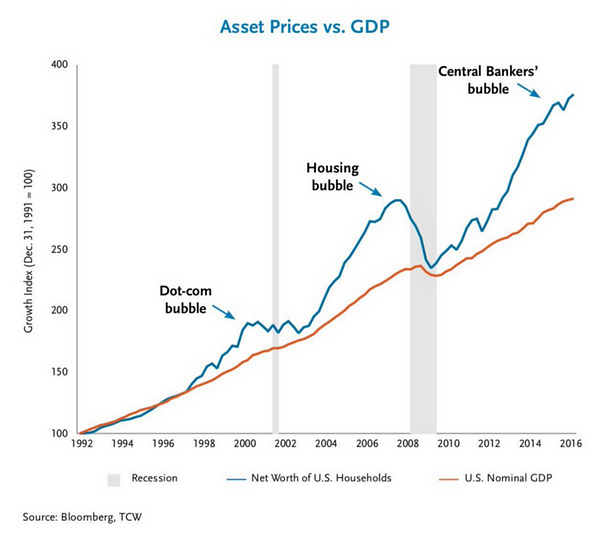
The 2000 dot.com bubble and the 2008 housing bubble were one dimensional. This mother of all bubbles required the global coordination and unprecedented irresponsible intervention of the US Federal Reserve, the European Central Bank (ECB), the Bank of Japan (BOJ), the Bank of England (BOE) and the Swiss National Bank (SNB) to lead the world to the brink of monetary disaster. The highly educated theorists running these central banks have created tens of trillions in unpayable debt while suppressing interest rates to zero or below at the behest of their Deep State masters.


The result is simultaneous bubbles in stocks, bonds and real estate. The pin destined to pop all the bubbles is slightly higher interest rates. The 1% increase in the 10 Year Treasury is already causing havoc in the housing market, the bond market and is hammering pension funds. With the hundreds of trillions in globally interconnected derivatives primed to detonate, 2017 could be an explosive year.


Here are a few things I think could happen in 2017 on the economic front:


  • The national debt stands at $19.9 trillion and will reach $20 trillion before Obama departs. With spending on automatic pilot and tax revenue in decline, the national debt will reach $21 trillion in 2017. With most of the debt financed short-term, the increase in rates will ratchet the interest on the debt from $433 billion to over $550 billion.

  • With the CPI increasing by over 3% in the first few months of the year, the Fed will continue to raise rates, and the 10 Year Treasury will breach the 3% level.

  • Home prices have surpassed the 2006 peak, even though existing home sales are still 20% below 2006 levels and housing starts are 50% below 2006 levels. The entire “recovery” has been engineered by the Fed and Wall Street at the high end of the market. With mortgage rates up 1% already, the further increase will result in existing home sales and housing starts falling by 20% in 2017 and home prices falling by 5% to 10%.


  • The short-term OPEC agreement will allow oil prices to move back to $60 per barrel, further eating into consumer discretionary spending. Desperate fracking companies needing cash flow to service their debt will ramp up. Bankrupt or near bankrupt countries like Venezuela, Mexico, and Iran will also increase production. With a slowing global economy and surging supply, prices will collapse again into the $40s in the second half of the year.

  • Holiday sales for the bricks and mortar retailers will be reported in January as lukewarm at best. By February, the store closing announcements will reach into the hundreds. Sears will finally declare bankruptcy and shutter at least 50% of their stores. Mall developers will begin to declare bankruptcy as vacancies and rising interest rates create a perfect storm.

  • Consumer debt will reach the previous high of $1 trillion, as subprime student loan and auto debt continues to accumulate at an astounding pace. The spigot for student loans is likely to be tightened under Trump, with over 25% of the loans effectively in default. Auto sales (if you can call six year financing and 40% leases, sales) peaked in 2016. Millions of auto buyers are underwater on their loans, subprime auto loans are going into default quicker than you can say Cadillac Escalade, and higher interest rates will price out more potential suckers.

  • The faux jobs recovery is running out of steam. With non-existent wage growth, surging costs for rent, health care, energy, and credit cards tapped out, American families will hunker down and reduce spending further. With consumer spending accounting for 68% of GDP, this will lead to an official recession by the middle of 2017.

  • All the recent surveys showing consumer confidence soaring and optimism for 2017 are based on nothing but hope. The promises of a Trump administration will not come to fruition until 2018 at the earliest. He will meet resistance from Democrats across the board and resistance amongst his own party. His grand plans for massive tax cuts and spending increases will run into the reality of $1 trillion annual deficits. As reality sets in, and recession arrives, the unwarranted optimism will fade rapidly. Tax cuts will be tempered by reduced spending plans.

  • The USD hitting fourteen year highs against the basket of worldwide currencies does not bode well for bringing manufacturing jobs back to make America great again. The reason for the strong dollar is because we are the best looking horse in the glue factory. With Europe and Japan promoting negative interest rates and the Fed slowly raising rates, the dollar will continue to rise. This will hurt our manufacturing businesses, increase our $500 billion annual trade deficit further, and depress the profits of our global corporations.

  • With rising inflation, rising interest rates, stagnant wages, falling corporate profits, stock valuations at all-time highs, and corporations no longer able to finance stock buy backs at no cost, the stock market will finally hit the wall after a seven year bull market. This last surge of euphoria, based on nothing but Trumpmania sweeping Wall Street, will constitute the final blow-off. The market is currently valued to provide nominal returns of less than 1% over the next twelve years and is likely to experience an abrupt sell-off of 50% in the near future. I believe the near future will be 2017. I think the powers that be will be testing Trump’s mettle in his first year to see if he’ll play ball and do their bidding.


“The illusion that we understand the past fosters overconfidence in our ability to predict the future.”  – Daniel Kahneman, Thinking, Fast and Slow


In Part Two of this article I will ponder how much further our civic decay and global disorder will advance in 2017. Over-confidence, hubris and arrogance of our leaders will be the driving factors.